1. Introduction
Accurate state-of-charge (SOC) prediction supports energy-aware operation and user decisions in personal mobile computing. Communication, navigation, media, sensing, authentication, and background services produce SOC trajectories that vary with device state and user behavior. Mobile operating systems expose battery percentage as a practical SOC proxy, enabling its future evolution to be estimated from routine device records. Time to empty (TTE) is then obtained as the interval until the predicted SOC trajectory reaches a prescribed terminal threshold. Recent mobile-energy studies connect this trajectory-based problem with large-scale battery telemetry, user-specific application and network behavior, and continuous smartphone SOC and TTE modeling [
1,
2,
3,
4].
Personal-device SOC evolution has a structured temporal composition. Standby operation establishes a slowly varying baseline, screen and application activity produce synchronous changes, and network transfers, positioning requests, scans, and background wake events retain effects after their recorded triggers. Contemporary smartphone datasets align battery observations with applications, screen state, wireless activity, mobility, temperature, and signal conditions, while recent prediction studies show that application, network, workload, and physical operating factors shape discharge trajectories [
1,
2,
4,
5,
6]. A continuous-time logging model further separates instantaneous and delayed drain effects in routine device records [
3]. This evidence motivates a three-module model comprising baseline drain, synchronous state response, and asynchronous event memory.
Recent mobile-energy research addresses complementary levels of the prediction problem. GreenHub supports population-scale analysis of Android battery consumption, smartphone app-usage research organizes the behavioral signals available for modeling, and user-specific deep learning links application and network activity to battery consumption [
1,
2,
6]. Continuous-time and electrochemical-informed frameworks further connect operating conditions with SOC trajectories and TTE [
3,
4]. These studies strengthen device-level and corpus-level discharge characterization. Their reported evaluation designs do not jointly combine cross-user synthesis under isolated raw records, chronological personalization from a few completed segments, and trajectory-consistent threshold evaluation. This combination defines the unresolved requirement addressed here.
Recent mobile-context resources clarify the observations available for temporal SOC modeling. GreenHub records large-scale battery and device measurements, MDF organizes longitudinal battery, application, screen, wireless, mobility, temperature, and signal records by user, and current app-usage research systematizes the datasets and behavioral features used in smartphone analysis [
1,
5,
6]. This literature improves context coverage and device-performance analysis. Its reported targets center on dataset construction, app-usage analysis, or device-level energy characterization. A cross-user SOC predictor additionally needs to map the same event stream into an interpretable baseline, synchronous state response, delayed event memory, and forward trajectory under user-held-out learning.
Federated learning provides a computational structure for shared modeling across user-specific data domains. FedAvg forms a shared model through data-weighted parameter aggregation, FedProx constrains local drift under statistical and system heterogeneity, and the broader federated learning literature formalizes optimization and communication across decentralized participants [
7,
8,
9]. Recent privacy research shows that exchanged updates can retain reconstructive information and develops differential-privacy and secure-aggregation mechanisms for the same distributed setting [
10,
11,
12]. These studies establish general optimization and protection primitives. They do not prescribe SOC-specific temporal semantics, chronological support construction, or trajectory-threshold evaluation. Cross-user discharge modeling therefore requires compact knowledge exchange, semantic alignment, and an explicit data boundary. In this study, privacy isolation denotes a user-level data-access boundary. Raw log rows, direct identifiers, exact event times, and directly readable personal records remain within their partition. Each participant supplies a locally preprocessed, model-specific feature representation together with the compact fields required by the fitting and aggregation workflow. The reported experiments evaluate this data-partitioning and representation boundary. Transport encryption is a deployment-layer protection and is not implemented or measured in the current experiments; resistance of transformed representations to reconstruction attacks also remains outside the present evaluation.
Personalized and few-shot learning addresses adaptation from limited target evidence. Per FedAvg learns an initialization for rapid local specialization, Ditto regularizes personal models toward a shared model, and FedRep separates an aggregated representation from user-specific heads [
13,
14,
15]. Model-fusion, knowledge-distillation, and shared-representation approaches transfer model knowledge across heterogeneous or personalized tasks [
16,
17,
18,
19,
20,
21,
22,
23,
24], while personalized federated few-shot learning uses compact support sets and collaborator selection [
25]. Contemporary reviews organize these approaches around global–local model relations, data heterogeneity, and personalization mechanisms [
26]. Charging interruptions, telemetry gaps, and terminal threshold requirements reduce routine phone logs to relatively few complete discharge segments, and user isolation further limits the target user’s support history. Estimates from these short sequences are sensitive to transient activity and user heterogeneity, while random support construction can violate chronological validity. Existing evaluations primarily use sampled support instances, classification tasks, or a single source-to-target transfer. Personal SOC prediction therefore requires chronological support, continuous discharge dynamics, complete user separation, and trajectory-based threshold evaluation.
AttFL continuously personalizes time-series models for mobile and embedded sensing, privacy-preserving edge federated learning supports resource-constrained mobile-health systems, and heterogeneity-aware personalized federated learning combines spatial–temporal health prediction with component-level aggregation [
27,
28,
29]. Energy-aware device-to-device assistance and parallel edge–server execution address energy budgets, stragglers, asynchronous participation, and complex aggregation in edge federations [
30,
31]. These systems advance privacy-aware mobile sensing and resource-aware personalized learning. Their reported evidence targets generic sensing, health, and edge-learning objectives. It does not establish an SOC-specific chain from semantically separated discharge components to chronological personal adaptation and threshold-based TTE.
These methods organize knowledge around sensor-task predictors, privacy-aware edge learning, resource scheduling, and generic–personalized model alignment. The proposed method begins from a different modeling requirement: personal-device discharge is decomposed into a persistent baseline, a synchronous response to the current operating state, and asynchronous multi-scale memory of earlier events. This module-decomposition-driven SOC model supplies the common scientific object for local estimation, cross-user synthesis, chronological few-shot personalization, SOC-trajectory construction, and threshold-based TTE inference.
This study integrates these research directions into a few-shot federated SOC prediction framework built around that module decomposition. Each source partition converts its chronological record into synchronous states and causal multi-scale event memories and estimates the three-module discharge model. The aligned baseline, synchronous, and event-memory coefficient blocks are updated through 75 rounds of selected-client learning and sample-count-weighted aggregation. A source-side grid search fixes the common mixing coefficient before target-user evaluation. The target user’s early chronological support then supplies one robust personal-rate estimate, and local forward integration produces the SOC trajectory and threshold-based TTE.
The empirical study evaluates the common coordinate branch of this framework using public small sample longitudinal smartphone logs. User directories define logical data partitions, sample weighted parameter consensus forms the aggregate model, and complete target user holdout preserves separation between model formation and personal evaluation. Chronological partitioning assigns earlier target records to personalized fine-tuning and later records to testing.
The contribution of this study is the task-specific integration of module-structured SOC modeling, federated knowledge synthesis, chronological few-shot personalization, and trajectory-based TTE evaluation into one semantically aligned workflow. This integrated contribution is summarized through the following connected elements:
- (1)
A continuous-time SOC and TTE formulation decomposes personal-device discharge into persistent baseline drain, synchronous state response, and asynchronous multi-scale event memory, then propagates their combined rate to a threshold-crossing trajectory.
- (2)
A semantics-preserving federated representation carries the three discharge components through local estimation and cross-user aggregation as aligned coefficient blocks, enabling shared learning while raw user telemetry remains within its original partition.
- (3)
A constrained few-shot adaptation mechanism combines the aggregate temporal response with one robust personal drain-scale estimate derived from the earliest target segments, preserving the learned response structure while adapting its user-specific scale.
- (4)
A source-only coefficient-selection procedure and chronological user-held-out evaluation separate model development, target support, and final testing; paired user-level analysis then quantifies consistency across eight target partitions and 447 final origins.
The remainder of the article follows the same knowledge flow.
Section 2 presents the three-module model, knowledge package, federated synthesis, personalized fine-tuning, SOC trajectory computation, and threshold inference.
Section 3 defines the data and user-isolated evaluation protocol.
Section 4 reports the experimental results and ends with a dedicated Discussion subsection, and
Section 5 summarizes the findings, scope, and limitations.
2. Three-Module Discharge Dynamics and Federated Knowledge Synthesis
2.1. System Roles and the User-Level Data Boundary
Consider a federation of user roles
coordinated by an aggregation service. User
controls a chronological local dataset
containing the operating-system-reported battery percentage, charging state, synchronous device states, transient events, and operating context. Local preprocessing maps the aligned record to a model-specific feature set
that excludes raw log rows, direct identifiers, exact event times, and directly readable personal records. For a target role
v, the source federation is
. Each source role initializes a three-module model from a common specification and estimates temporary parameters through the local learning operator
The resulting model state is specific to the current execution and user partition. In the evaluated common-coordinate workflow, local model knowledge is encoded as
, containing the model-specific feature representation, aligned module parameters, and support weight
. The aggregation service maps the package set to the aggregate three-module model,
and delivers
to the target role. Personalized fine-tuning applies the early chronological support set
through
, followed by local SOC-proxy trajectory integration and TTE inference.
The data-access policy follows the standard federated separation between local optimization and aggregation service coordination. The preprocessing operator
accesses
within user role
u, the aggregation operator
accesses the uploaded package set, and the personalization operator accesses
within role
v. Raw log rows, exact event times, application histories, mobility traces, reconstructed discharge segments, direct identifiers, and target outputs reside in their respective user domains. The evaluated workflow receives the locally transformed representation together with aligned module parameters and support weights. This access structure defines the evaluated privacy-isolated scope of the framework.
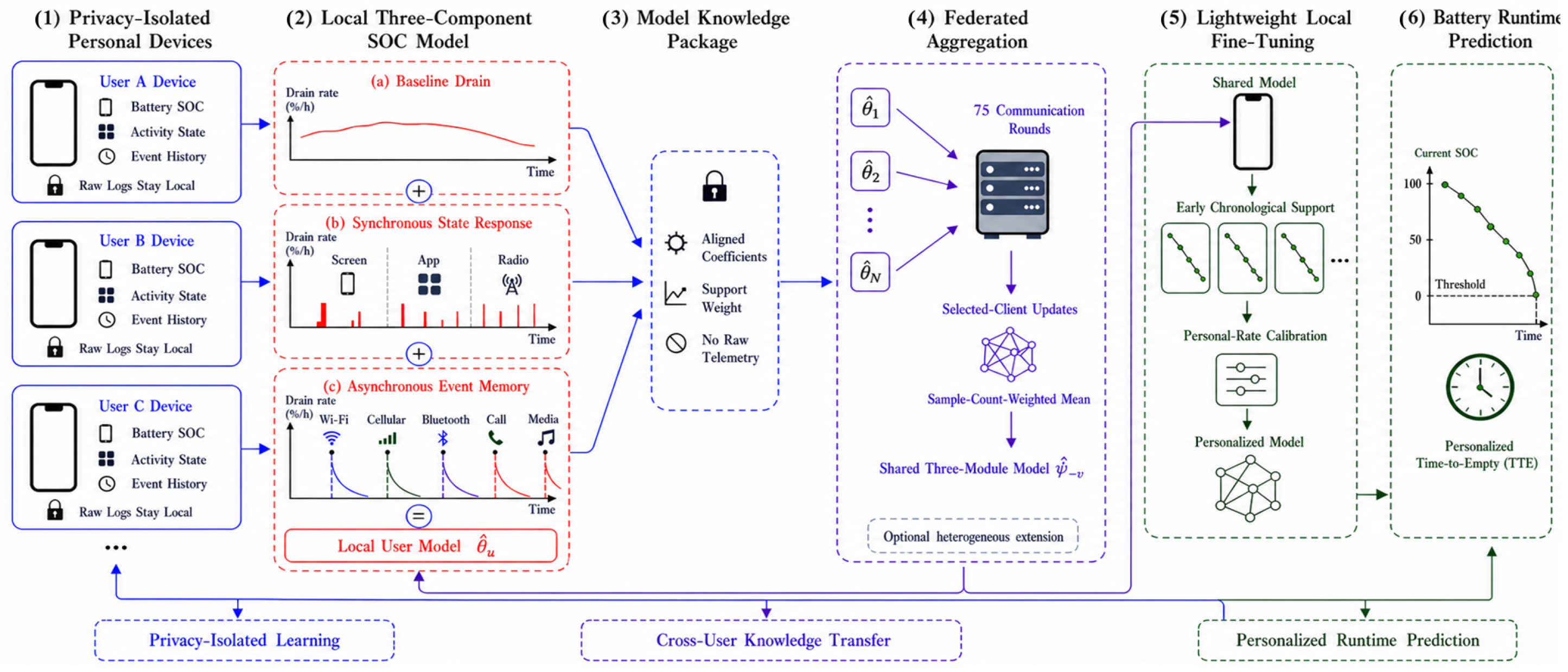
Figure 1 presents the common-coordinate workflow examined in this study and also outlines a heterogeneous-distillation interface reserved for subsequent investigation.
The evaluated privacy boundary comprises local retention of raw telemetry and local feature transformation before cross-partition exchange. The transmitted package carries model-specific feature representations and compact workflow fields for the authorized model operations. Transport encryption remains a deployment requirement outside the present experimental evaluation.
Table 1 consolidates the notation used throughout local estimation, federated synthesis, and personalized fine-tuning. With the system roles and data boundaries established, the subsequent formulation specifies the state representation, module dynamics, knowledge interface, aggregation objective, and TTE computation.
Within this formulation, each source role converts its hierarchical state-and-event record into a locally preprocessed feature representation and a temporary model with baseline, synchronous, and asynchronous event-memory modules. Common-coordinate knowledge extraction encodes the transformed representation, aligned parameters, and support weight for round-wise aggregation. Personalized fine-tuning then specializes the resulting aggregate three-module model from a fixed chronological support set, and local forward integration yields the SOC-proxy trajectory and time-to-empty (TTE).
Locally preprocessed model-specific feature representations, aligned module parameters, and support weights constitute the evaluated communication surface. The empirical protocol evaluates this common-coordinate workflow under user-level partitioning; it does not implement or benchmark transport encryption.
2.2. State-And-Event Representation of Personal Discharge Records
The model receives user-partitioned smartphone context records that combine battery observations with application, screen, wireless, media, mobility, location, temperature, and signal-related streams. The few-shot setting represents deployment conditions in which longitudinal discharge records are difficult to acquire, including new devices or new users that have yet to accumulate sufficient historical records, short observation periods, and slowly accumulated personal logs under privacy constraints. Quality filtering and chronological segmentation construct the support records used for personalized fine-tuning.
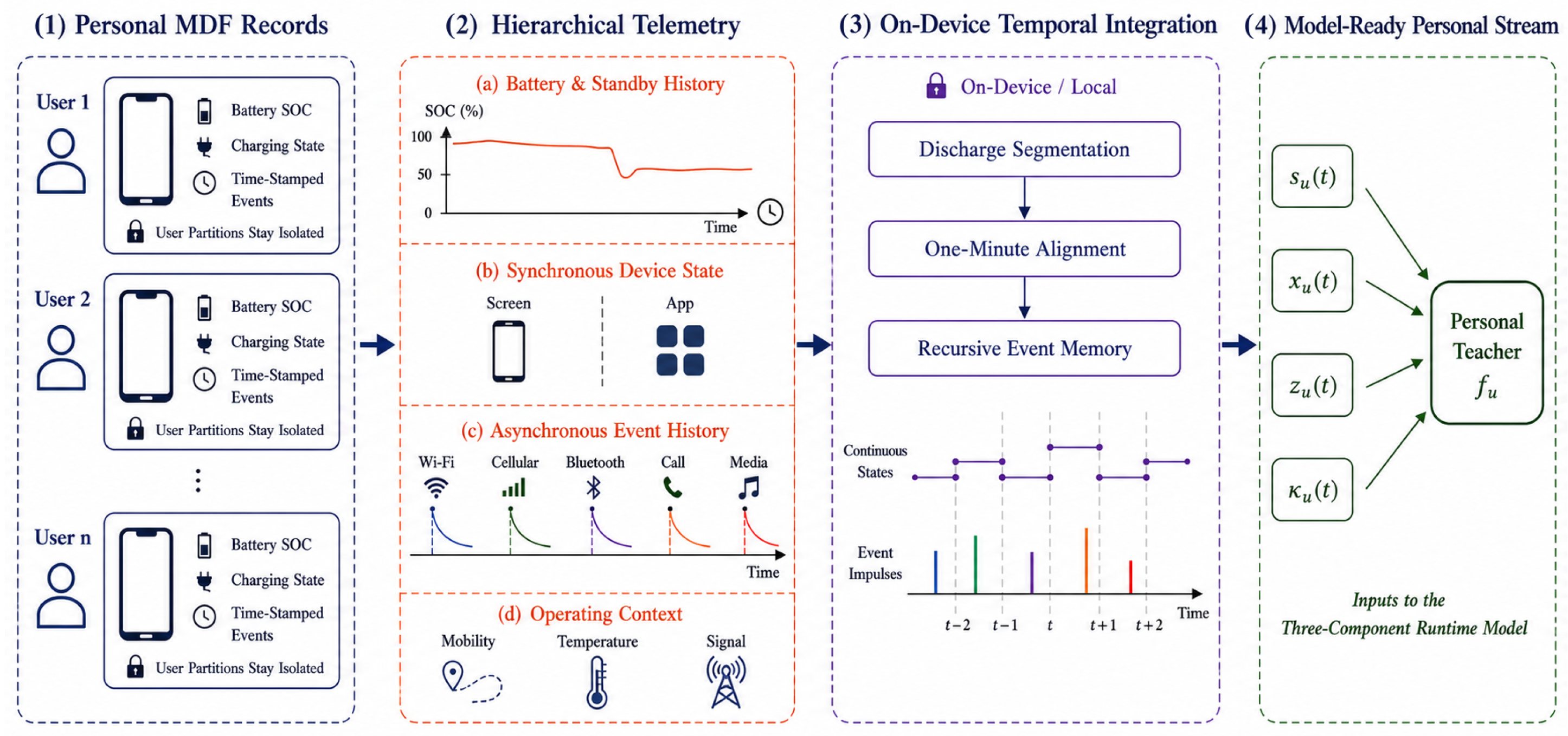
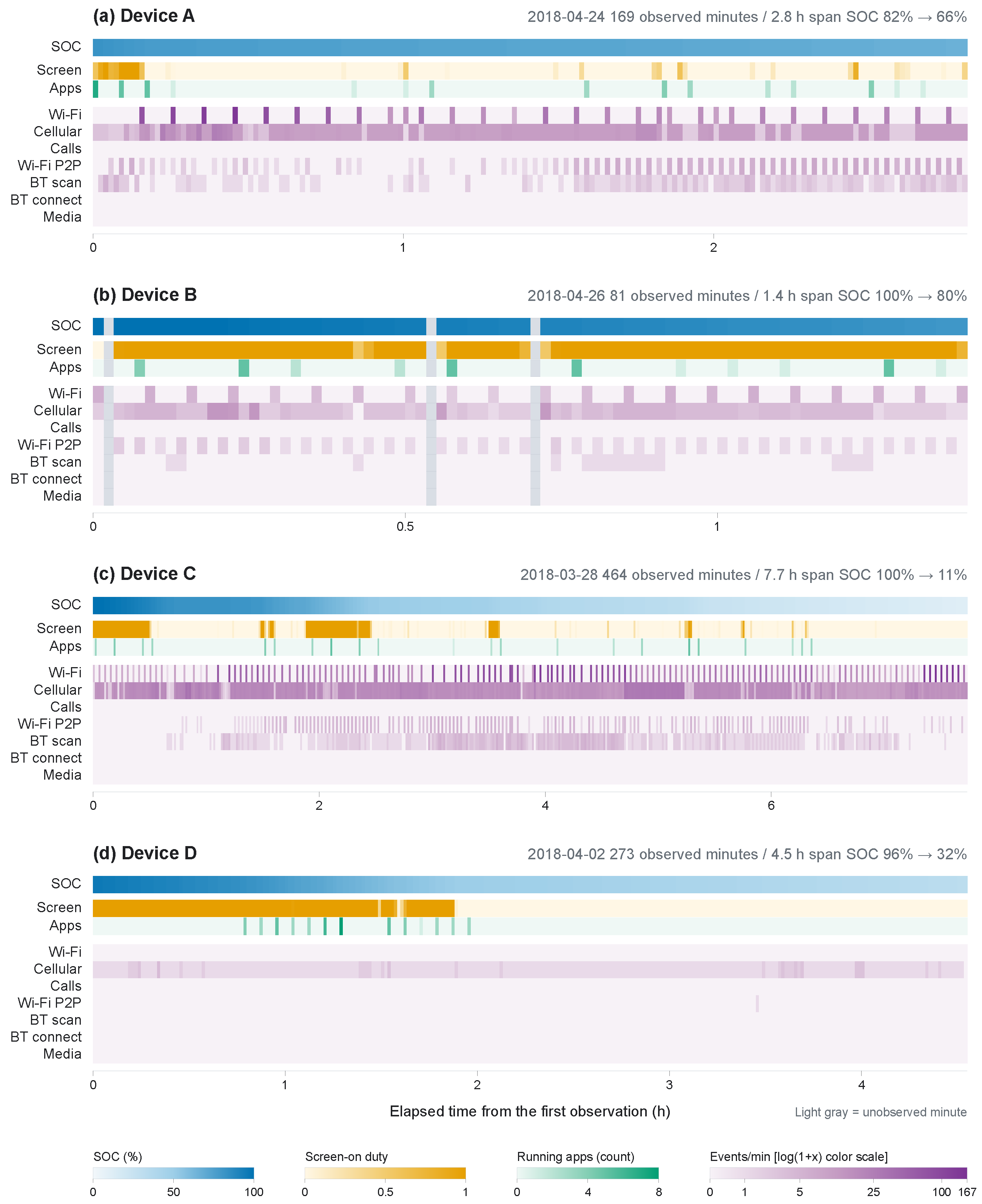
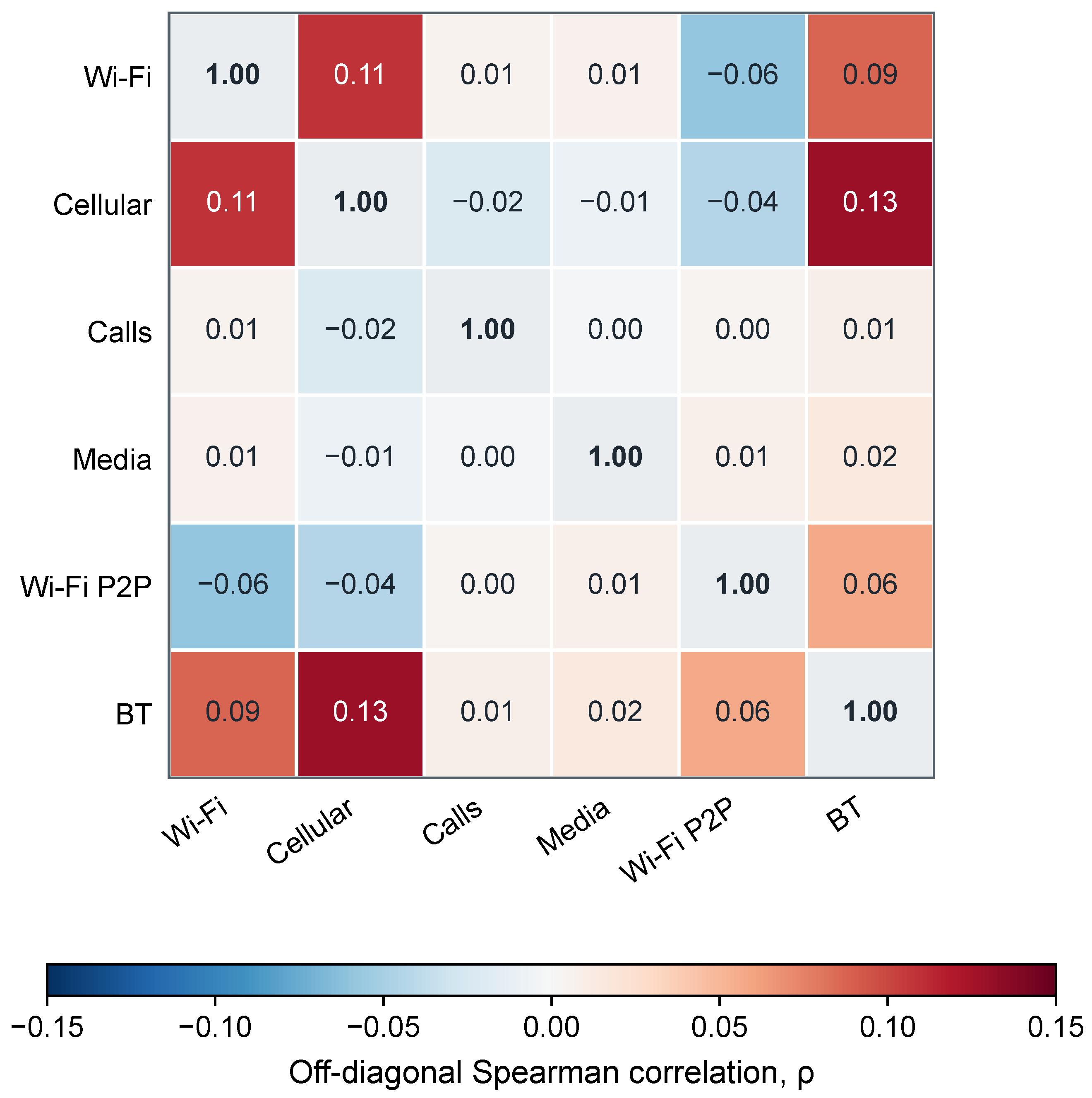
Within each logical user role, battery records are ordered by timestamp and separated into charging and discharging periods. Continuous downward trajectories define discharge segments, and the remaining streams are aligned to the battery timeline at one-minute resolution. Battery history provides the SOC proxy, charging status, timestamps, recent decline, and personal baseline information. Synchronous states summarize screen duty, application intensity, and continuously active loads over the current interval. Sparse Wi-Fi, cellular, call, media, Wi-Fi P2P, and aggregated Bluetooth (BT) events enter as impulses that propagate through asynchronous memory states. The BT channel combines scan and connection activity within each minute. Mobility, location-update intensity, temperature, and signal proxies modulate continuous and delayed drain, while session identity and a slowly varying offset absorb personal and session-level scale variation. Prediction features use observations available at or before each origin, and the subsequent threshold crossing supplies the TTE label.
Figure 2 presents the hierarchical preparation pipeline. In the conceptual architecture, alignment and feature construction occur within each personal-device role. The dataset user directories provide the corresponding logical separation in the empirical protocol.
The aligned local representation supplies the inputs for the temporary three-module source model defined next.
2.3. Local Estimation of Three-Module Source Models
The user-specific source model maps the observable SOC proxy and aligned state-and-event record to an effective decline rate. Each execution initializes and estimates its source-model state from the current participating partition. All user roles use the same feature order, units, normalization rules, event-channel dictionary, and decay-scale convention. This common coordinate system gives corresponding parameter blocks the same meaning across execution-specific source models.
Let
denote the normalized battery percentage reported by the operating system. During a valid discharge segment, its continuous-time evolution is
where
is the predicted decline rate of the observable SOC proxy in s
−1. For aligned observations separated by
, the corresponding observed decline-rate target is
Both quantities use normalized SOC fraction per second. The quality rules select valid discharge intervals before
enters model fitting.
Sparse event streams enter a recursive memory representation. For event channel
m and decay component
h,
where
is the aligned event count and
is the memory time constant. Multiple decay components allow one event channel to express short, intermediate, and sustained residual responses. The stacked vector
provides a compact causal summary of event history and can be updated as each local record interval arrives.
The three unscaled drain components are
where
is the personal maintenance baseline,
contains synchronous device states, and the non-negative vectors
and
quantify synchronous and delayed contributions. The positive gains
and
describe observable context modulation. The separation follows recent mobile-energy evidence linking application, network, workload, and physical operating conditions to discharge while distinguishing instantaneous state effects from delayed event responses [
2,
3,
4].
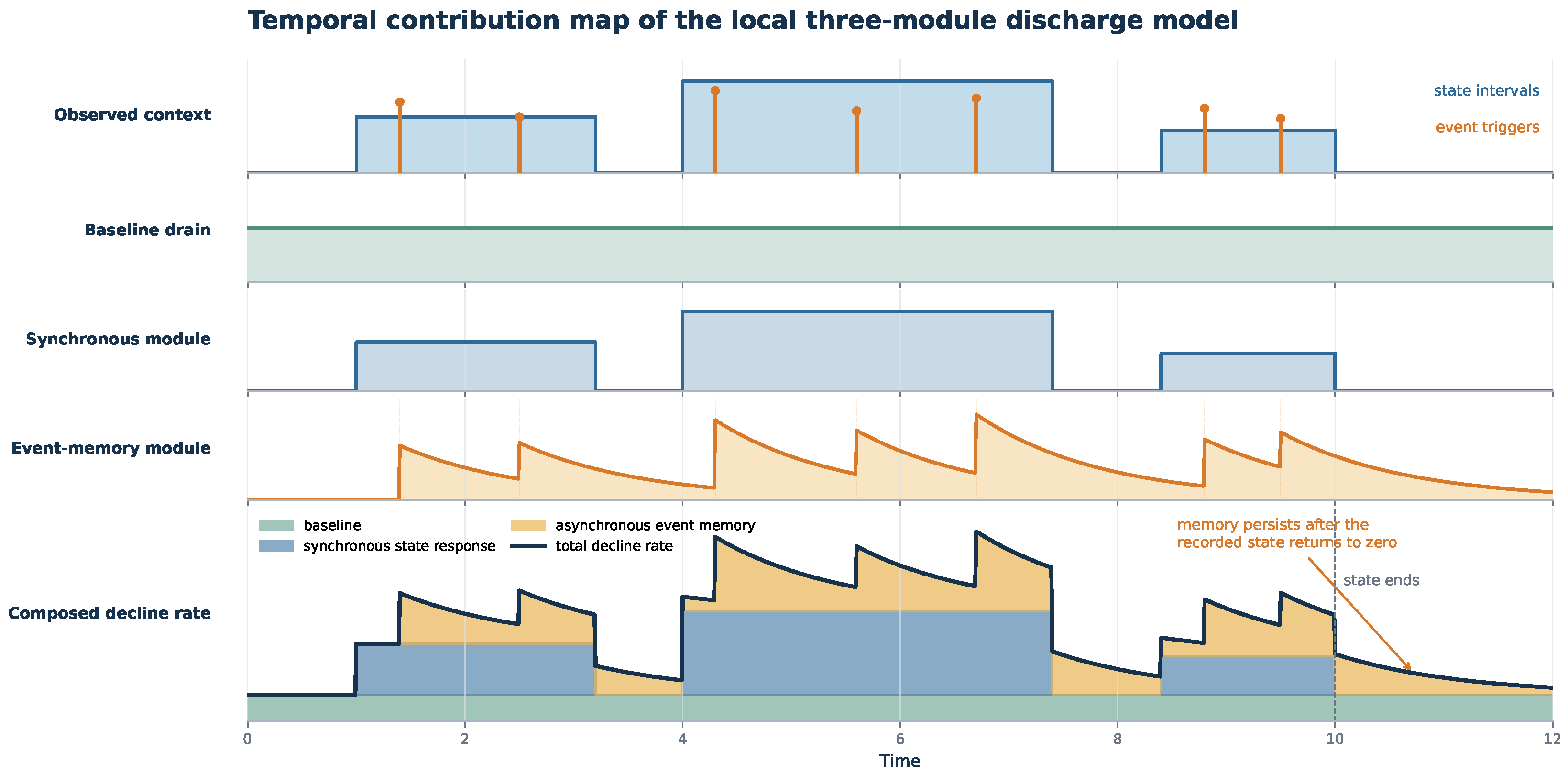
Figure 3 visualizes how observed state intervals and discrete event triggers map into the three module outputs and their composed decline rate.
Session and temperature variation enter through a positive dimensionless scale factor,
where
is the common log-scale reference,
indexes the discharge session,
is its slowly varying offset, and
is the temperature correction driven by the logged operating temperature
. The final predicted decline rate is
Equation (
8) gives every participating user role the same model grammar while preserving the partition-specific parameter values and session states learned during the current execution.
Let
collect the baseline, synchronous weights, event-memory weights, context-gain parameters, and scale terms of user partition
u. Its constrained fitting objective is
where
contains valid intervals from the current user partition,
imposes the non-negative structural constraints,
is the regularizer, and
controls its strength. The optimizer output becomes the temporary source model used by the model-knowledge interface in the same execution.
2.4. Knowledge-Package Construction
After local alignment and transformation,
contains only the model-specific coordinates required by the three-module fitting workflow. Directly readable raw fields and identifiers are excluded before cross-partition exchange. Transport encryption can protect this transformed feature set in a physical deployment, but cryptographic execution is outside the reported experiment. For coordinate-compatible source models, a fixed projection
maps the baseline, synchronous, asynchronous, and context blocks into identically ordered coordinates. Let
denote the effective number of valid local fitting intervals. The common-coordinate package is
The feature field supplies the transformed coordinates, the parameter field retains the meanings of the three drain components, and
supplies the support weight used during aggregation. Session identifiers, latent event histories, source timestamps, applications, locations, complete trajectories, and per-origin targets remain within the user partition.
2.5. Round-Wise Federated Aggregation of Module-Aligned Parameters
At communication round
r, the service selects the participating source set
. Each selected source initializes its local coefficient vector from the current aggregate vector, performs the prescribed local updates, and returns the updated baseline, synchronous-response, and event-memory coefficient blocks in their common order. The round-specific support weights are
The service then forms
where
E is the number of local steps and
preserves the shared block order. Repeating this operation propagates the module decomposition through federated learning as three explicit, consistently ordered coefficient blocks. After the final round,
supplies the held-out target initialization. The exact local objective, gradient update, client participation, and round count used in the experiment are given in
Section 3.2.
The methodological scope of this study is defined by the common-coordinate workflow, in which the maintenance-baseline, synchronous-response, and asynchronous event-memory blocks retain their semantic alignment from local estimation through federated aggregation and chronological target personalization. This implemented path provides a common basis for the algorithmic specification and empirical evaluation, maintaining direct correspondence among the proposed method, its execution, and the reported evidence.
2.6. Few-Shot Fine-Tuning and TTE Inference
The aggregate three-module model is delivered to a held-out target-device role
v. A fixed, small chronological support set
contains the prediction origins belonging to the first five eligible completed target-user discharge segments. For support origin
i, let
denote the observed decline-rate target. The robust personal rate is
The eight final target-user partitions are isolated before coefficient selection. A source-only development set
supports an inner chronological grid search over the bounded candidate set
, where
guarantees a positive aggregate-model contribution. Within this source-side search, eligible development users act in turn as pseudo-target roles: their earlier records provide a personal-rate estimate, their later development records provide the scoring origins, and the remaining development users form the corresponding aggregate model. Let
denote the resulting TTE at source-side scoring origin
i. The pooled source-side RMSE selects
where
contains the eligible source-side pseudo-target roles,
is the corresponding chronological source-side scoring set,
is the observed TTE, and
. Equation (
14) fixes one coefficient for all outer target-user folds before any target-user record is accessed. Target-user records therefore contribute only after aggregate-model formation and coefficient selection: Equation (
13) uses the early support block to estimate
, and all later origins remain exclusive final-evaluation records.
For a live local context
, let
be the aggregate three-module model decline-rate prediction. Lightweight personalized fine-tuning applies the source-selected geometric shrinkage
The bounded weight retains population information while calibrating the overall decline scale to the target device. The aggregate three-module predictor continues to determine the time-varying response, and the robust personal rate supplies a low-dimensional correction from the sparse support record. Starting from prediction time
and current SOC proxy
, the forward trajectory is
The device reports the first crossing of terminal threshold
:
The origin-level implementation uses the piecewise-constant-rate case of Equations (
16) and (
17). With decline rates expressed per second, the predicted TTE in minutes is
where
is the SOC proxy observed at origin
i,
is the terminal threshold assigned to that origin, and
is the fine-tuned decline rate held constant over the prediction horizon. The context path, fine-tuned head, forward trajectory, TTE, and component attributions constitute the local outputs, and the empirical protocol records the corresponding origin-level predictions.
Algorithm 1 presents the implemented user-held-out workflow. The source-only search fixes the common personalization coefficient before any target-user record is accessed. The outer loop then holds out one target user v at a time, forms , and runs the complete federated optimization on that source set.
| Algorithm 1 User-Held-Out Federated Training and Few-Shot Personalization |
| Line | Pseudocode |
| Input | User records ; held-out targets ; target support sets ; source-only coefficient grid ; fixed optimization settings from Table 2. |
| Output | Fold-specific shared models , fixed coefficient , and local TTE outputs. |
| 1 | ▹ no target data |
| 2 | for each held-out target user
do |
| 3 | ; |
| 4 | for each do end for |
| 5 | for do |
| 6 | |
| 7 | for each in parallel do |
| 8 | |
| 9 | for do |
| 10 | ; |
| 11 | |
| 12 | end for; Send |
| 13 | end for |
| 14 | |
| 15 | end for; |
| 16 | ▹ first five complete segments only |
| 17 | |
| 18 | ▹ support excluded |
| 19 | end for; return |
Table 2.
Fixed configuration of the user-held-out aggregate-model evaluation.
Table 2.
Fixed configuration of the user-held-out aggregate-model evaluation.
| Parameter | Symbol | Fixed Setting |
|---|
| Temporal resolution | | 60 s |
| Event-memory constants: Wi-Fi, media, Wi-Fi P2P, and Bluetooth | | s |
| Event-memory constants: cellular activity | | s |
| Event-memory constants: call activity | | s |
| Shared-model decline-rate clipping bounds | | 1st–99th percentiles of the positive response values (log decline rate) pooled over the source users of the training fold; the held-out target user is excluded |
| Ridge penalty | | 1.0; intercept excluded from regularization |
| Initial aggregate parameter vector | | Zero initialization |
| Communication rounds | R | 75 |
| Selected clients per round | K | 11 of 22, sampled without replacement |
| Local full-batch gradient steps per round | E | 2 |
| Learning rate | | 0.01 |
| Gradient-norm cap | | 5.0 |
| Source-partition aggregation weight | | , where is the participating-client set in round r |
| Candidate mixing coefficients | | |
| Minimum shared-model contribution | | 0.10 |
| Selected mixing coefficient | | 0.90 |
| Number of repeated runs | | 10 |
| Terminal SOC-proxy thresholds | | 5% and 20% |
| Evaluation metrics | — | MAE, RMSE, and |
4. Results and Analysis
4.1. Within-Partition Characterization of the Source Models
The first analysis characterizes the SOC dynamics captured by the execution-specific source models through their threshold-crossing outputs. Each source model is estimated and evaluated within the same user partition; these results characterize the representation of observed discharge dynamics and support analysis of the three-module design. Their inferential role is limited to within-partition behavior. Cross-user transfer is assessed separately in
Section 4.2 under target-user holdout, chronological support, and later-origin testing.
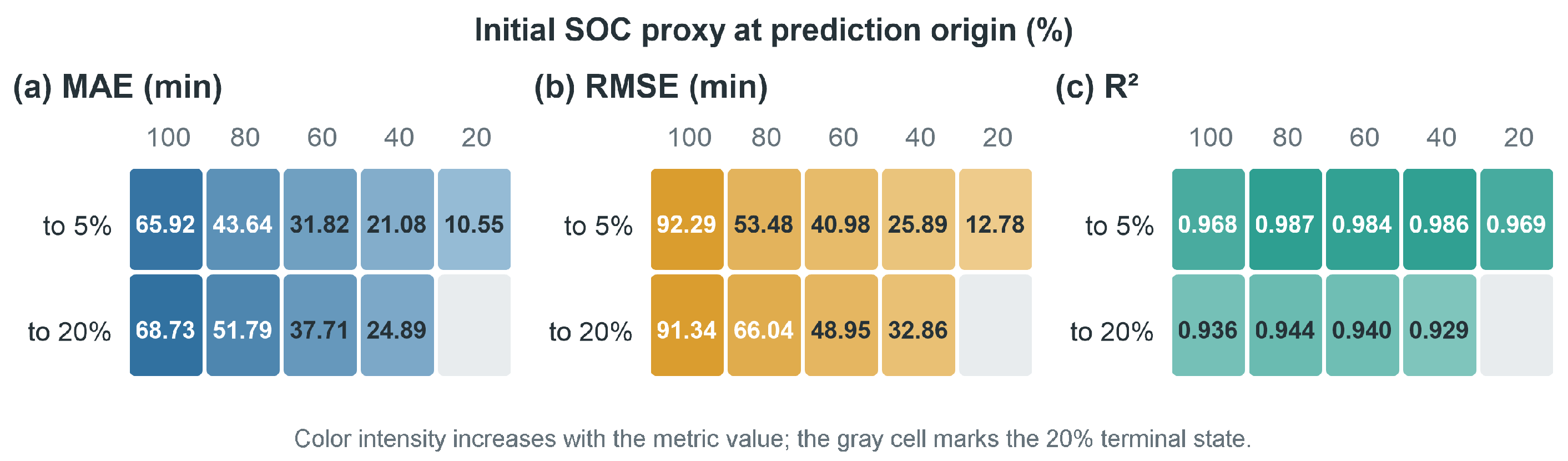
Figure 6 organizes the derived TTE performance by the observed SOC proxy at the prediction origin and the terminal threshold. The matrix representation presents error magnitude and explained variance for each discrete evaluation condition.
Table 3 provides the corresponding numerical values and sample sizes.
Absolute threshold-crossing error decreased as the prediction origin approached the terminal state. MAE ranged from 65.92 to 68.73 min at the 100% origin, declined to 21.08 to 24.89 min at the 40% origin, and reached 10.55 min for the 20% to 5% condition. This horizon-dependent pattern reflects the accumulation of discharge-rate uncertainty over longer SOC prediction intervals.
Explained variance remained high across every positive-duration cell. The observed values ranged from 0.929 to 0.987. The combination from 80% to 5% reached , and the combination from 40% to 5% reached . The longest 100% origin conditions retained values of 0.968 and 0.936. The fitted three-module predictor preserved the ordering and variation of threshold-crossing times across heterogeneous SOC trajectories, while absolute error grew with the interval over which discharge-rate discrepancies accumulated.
These origin-specific outputs establish the response behavior contributed by each temporary source model. Each source model maps an origin state and a standardized state-and-event context to a discharge response, a forward SOC trajectory, and a derived threshold-crossing time. In the evaluated common-coordinate workflow, the locally preprocessed model-specific feature representation, aligned three-module parameters, and support weight form the source package used for round-wise aggregation. The following subsection evaluates the fold-specific aggregate model before and after personalized fine-tuning.
4.2. Personalized Fine-Tuning Under Target-User Holdout
The non-target partitions form the aggregate model before the early support records enter personalization. The paired evaluation then applies the shared and personalized models to the same later target-user origins.
Table 4 gives the pooled summaries and repeat-run dispersion under the paired evaluation protocol. The source-only grid search fixes the shared mixing coefficient before the target-user folds, and the later target-user origins provide the final comparison. Personalized fine-tuning reduced MAE from 185.75 to 61.16 min, a 67.07% reduction. RMSE decreased from 295.52 to 83.10 min, a 71.88% reduction, and
increased from 0.1894 to 0.9359. Under the fixed fold protocol, the constrained personal update corrected a substantial proportion of the between-user drain-scale mismatch in the aggregate initialization. Read together with the within-partition characterization in
Section 4.1, this comparison locates the personalization burden in the personal drain scale: the three-module response structure transfers across users, and the compact early support block restores the remaining scale information.
Table 5 reports the paired result for every held-out target user and the number of origins contributed by that user. The eight target users are presented as user1–user8 in the fixed row order used throughout this analysis.
Table 4 reports the pooled origin-level metrics across repeated client-participation runs,
Table 5 separates the target users, and
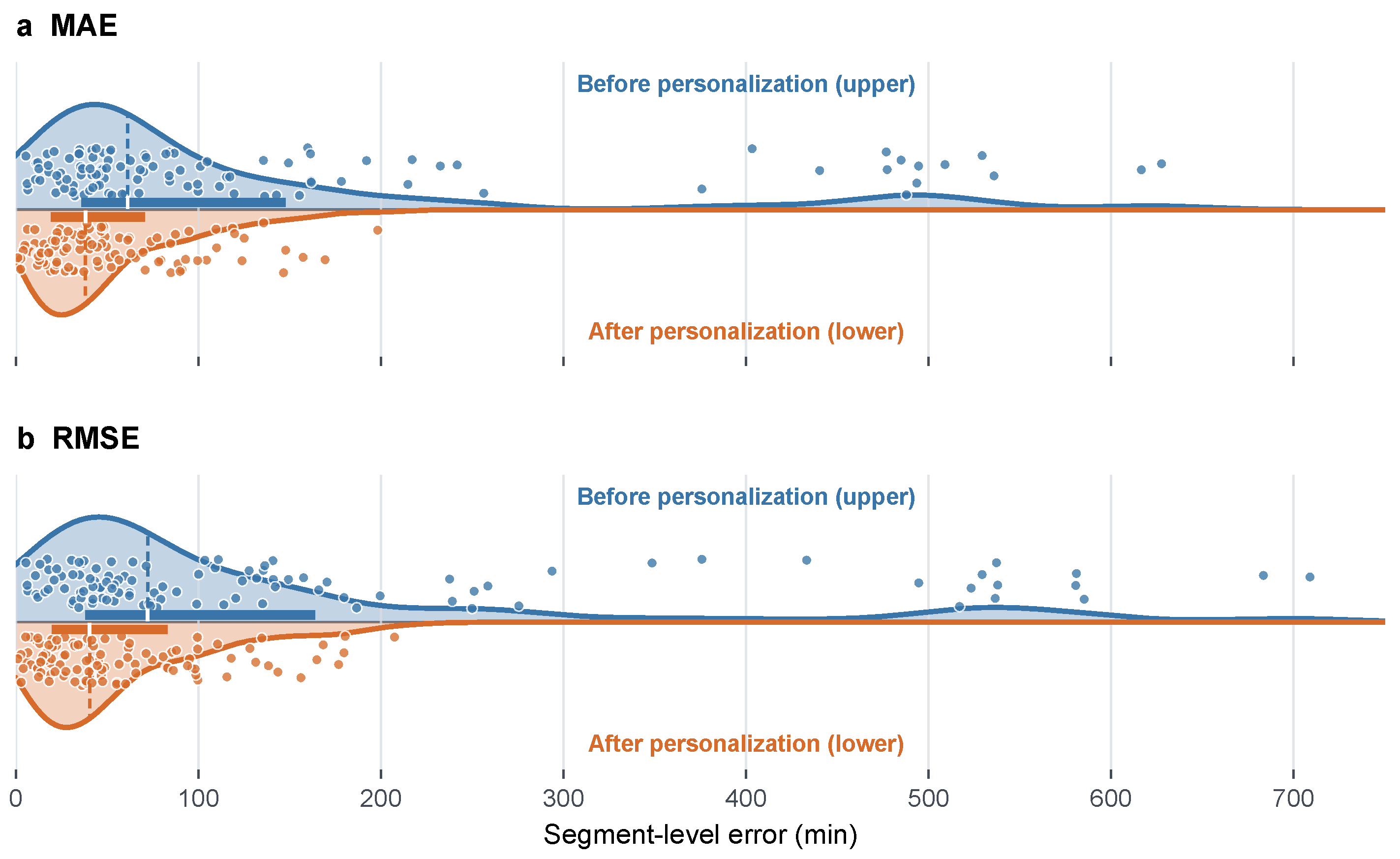
Figure 7 shows the raw segment-level MAE and RMSE distributions with embedded box summaries before and after personalization. Treating the user as the paired analysis unit, personalized fine-tuning reduced MAE by 82.24 min on average (user-level paired-bootstrap 95% CI: 18.30–182.80 min; exact Wilcoxon
) and RMSE by 106.90 min (95% CI: 30.89–216.75 min;
); both intervals exclude zero, and all eight held-out users are retained in these statistics. The improvement was also present at both terminal thresholds: MAE decreased from 198.23 to 62.55 min at the 5% threshold and from 173.27 to 59.64 min at the 20% threshold. The magnitude of the gain was not uniform across users, and one held-out user did not improve on either metric;
Table 5 reports the individual values. For that user the aggregate model was already among the most accurate before personalization, so Equation (
15), which places the larger weight on the personal drain scale at
, has little residual error to recover and can instead carry a support-block drain level that the later origins no longer match. A plausible reading is therefore that the constrained update is most valuable when a user’s drain scale departs from the population and least valuable, occasionally adverse, when the aggregate model already describes that user well; this remains an interpretation of a single case rather than a tested claim. The small standard deviations in
Table 4 quantify sensitivity to repeated client-participation draws under the fixed users, whereas the per-user results and the paired analysis characterize the between-user variation that the pooled metrics do not display.
The completed comparison validates formation, delivery, and personalized fine-tuning of the aggregate three-module model. Temporary source models in the participating source partitions produce aligned parameter updates, the coordinating routine performs weighted aggregation, the resulting aggregate model is delivered to the target partition, and the early support segments provide the local personal-rate estimate used with the source-selected coefficient. The geometric log-rate blend adjusts personal scale while preserving a positive contribution from the aggregate baseline, synchronous-response, and event-memory representation. Raw log rows and directly readable personal records reside within their assigned user partitions throughout the computational protocol; only the locally preprocessed model-specific feature representation and compact model fields cross the partition boundary. This partition-preserving data flow defines the empirical privacy scope of the study.
4.3. Contribution of the Three-Module Decomposition
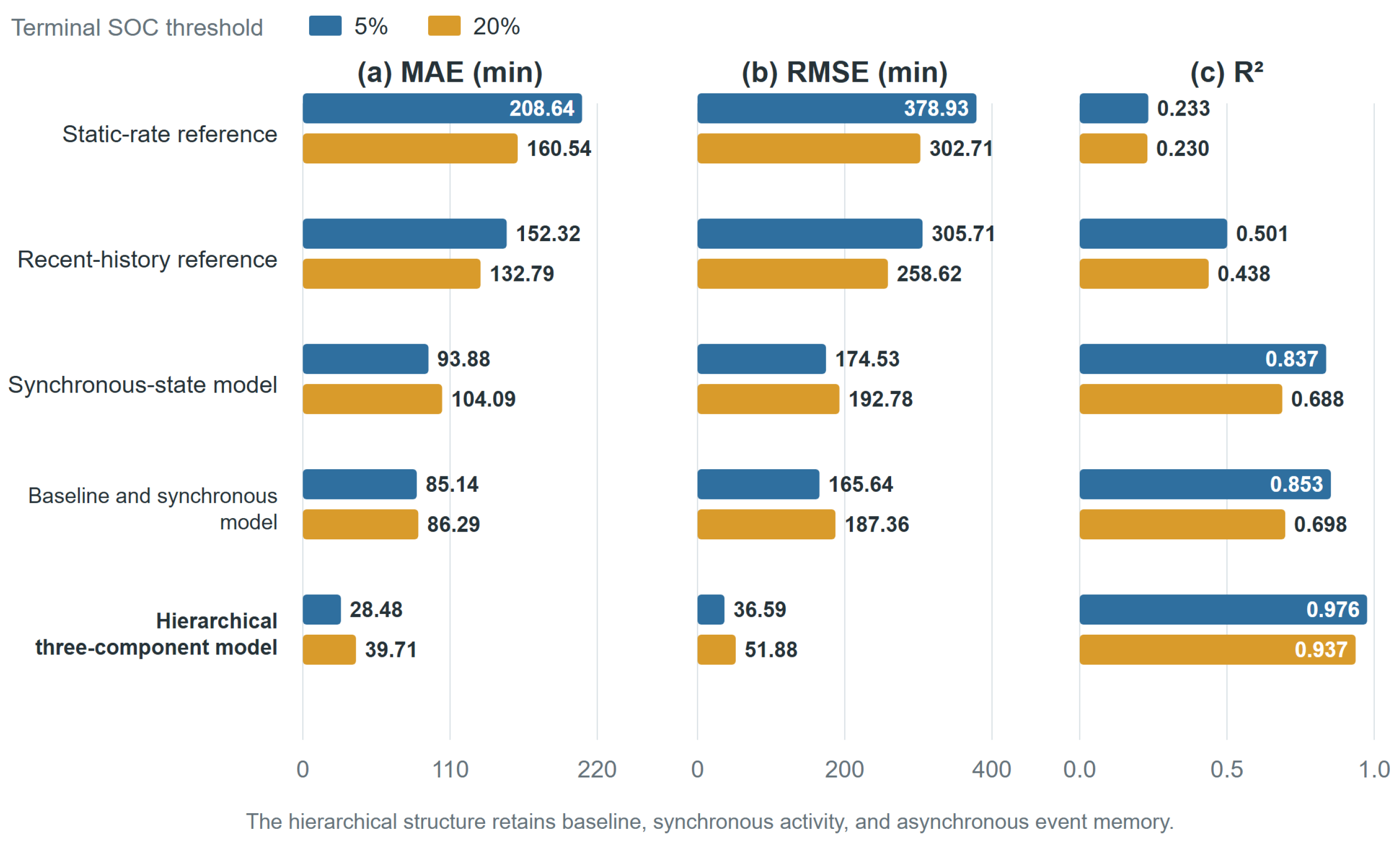
Figure 8 compares five explicitly nested predictor structures. The static-rate referencepropagates TTE from one constant drain-rate estimate. The recent-history reference uses the decline rate observed immediately before the prediction origin. The synchronous-state model maps current device states to drain through the synchronous module. The baseline and synchronous model combines the persistent personal baseline with the synchronous module. The hierarchical three-module model integrates the personal baseline, synchronous activity response, and asynchronous multi-timescale event memory.
Table 6 supplies the exact values for these definitions.
At the 5% terminal threshold, performance improved consistently across the nested structures. From the static rate reference to the baseline and synchronous model, MAE decreased from 208.64 to 85.14 min and increased from 0.233 to 0.853. Incorporating asynchronous event memory produced the strongest result, with an MAE of 28.48 min, an RMSE of 36.59 min, and .
The same ordering remained visible at the 20% threshold. The hierarchical three-module model achieved an MAE of 39.71 min and an RMSE of 51.88 min with . Relative to the baseline and synchronous model, event memory reduced MAE by 53.98% and RMSE by 72.31%. At the 5% threshold, the corresponding reductions were 66.55% and 77.91%. The improvement supports the asynchronous term as a substantive part of the temporary personal source model, especially when wireless, media, or system events retain an energy effect after their recorded trigger.
The module-resolved results establish the value of the complete representation. The next comparison tests whether this advantage persists against established federated and recurrent baselines.
4.4. External Baseline Comparison
Table 7 reports the methods from the largest to the smallest error. FedAvg is included as the canonical federated-learning baseline from the literature. Under the controlled implementation used here, its unpersonalized output is numerically identical to the before-personalization column of
Table 4; comparison with the complete framework therefore measures the additional effect of the constrained personal-rate calibration. The GRU and Ditto rows compare the complete proposed workflow with recurrent sequence learning and full-vector personalization, respectively. The proposed framework achieved an MAE of 61.16 min, an RMSE of 83.10 min, and
. Relative to the strongest independent comparator, Ditto, it reduced MAE by 14.55% and RMSE by 18.94%, while increasing
by 0.0335.
Read together,
Table 6 and
Table 7 separate two sources of performance. The component comparison identifies the predictive contribution of the baseline, synchronous-response, and asynchronous event-memory decomposition. The FedAvg stage reference then shows the shared model before target calibration. Ditto and the GRU test alternative personalization and sequence-modeling choices. The proposed workflow retains one coherent module-decomposed representation from source learning through aggregation and confines target adaptation to the personal drain scale. This structural continuity yields the leading MAE, RMSE, and
values with a compact local update.
4.5. Computational and Communication Cost
Table 8 summarizes the computational structure and model-state requirements of the proposed framework and the representative baselines. The proposed framework retains 41 trainable coefficients and one locally derived scalar in a 0.168 kB model state. This corresponds to 50.00% fewer trainable parameters and 48.78% less model-state memory than Ditto, and 98.54% fewer trainable parameters and 98.50% less model-state memory than the GRU.
Across the eight target-user folds, each fold comprised 825 two-step source-client updates over 75 rounds, one target-user personal-rate calculation, one scalar mixing operation per prediction, and evaluation at that fold’s final origins. These operation counts provide the reproducible numerical-workload boundary for coefficient updates, sample-count-weighted aggregation, target personal-rate estimation, scalar mixing, and prediction at the final origins. End-to-end mobile latency additionally depends on feature extraction, file access, client scheduling, serialization, encryption or decryption, network transport, coordination-service overhead, and operating-system scheduling, and therefore requires direct measurement on physical devices. For a reference request–response deployment, one personalized TTE query uploads 40 locally transformed feature values, the current SOC proxy, the requested terminal threshold, and one local calibration scalar, and downloads one predicted TTE value. With float32 serialization, the raw application payload is 176 bytes, or 0.176 kB, per query. This estimate excludes model-training traffic, serialization metadata, encryption framing, transport headers, retransmission, and network-control traffic. These quantities define four separate accounting categories: model-state memory, training-update workload, per-query application-layer data, and end-to-end deployment cost.
4.6. Discussion
The module decomposition is the physical and computational center of the framework. The baseline term represents persistent drain, the synchronous term maps the current operating state, and the asynchronous event-memory term carries residual responses after recorded events at multiple decay scales. The within-partition analysis shows that this event-memory component improves representation of the observed discharge dynamics; the separate target-user-held-out analysis establishes transfer beyond the partition used for source-model estimation.
In the target-user-held-out comparison, FedAvg serves both as the canonical external aggregation baseline and, under the shared three-module backbone, as the unpersonalized reference for isolating the constrained target update. Ditto and the GRU test full-vector personalization and recurrent sequence modeling, respectively. The proposed workflow outperformed both independent comparators, and the user-level paired analysis showed a significant reduction in both error measures over the held-out users, with paired-bootstrap confidence intervals excluding zero. The magnitude of the gain was not uniform across users, and one held-out user did not improve on either metric. Repeated-run standard deviations quantify sensitivity to client participation, whereas the target-user-held-out results and user-level paired analysis evaluate generalization to held-out users within the MDF dataset and characterize the between-user heterogeneity that the pooled metrics conceal.
The evaluated scope retains raw telemetry and identifiers locally and exchanges only transformed model-specific representations and compact fields. The findings are bounded to the MDF partitions and their represented operating conditions; transport encryption, formal privacy mechanisms, hardware variation, battery aging, end-to-end latency, and energy use require physical deployment studies. Within this scope, the 41-coefficient model, one local calibration scalar, explicit update count, and the 0.176 kB raw payload of one reference TTE request define the implementation profile.
5. Conclusions
This study develops and evaluates an integrated SOC prediction workflow that connects a module-decomposed predictor with federated aggregation, chronological few-shot personalization, and trajectory-based TTE inference. Federated aggregation preserves the baseline, synchronous-response, and asynchronous event-memory blocks, while chronological few-shot personalization adjusts only the personal drain scale.
On the MDF partitions, personalization achieved an MAE of 61.16 min, an RMSE of 83.10 min, and , reducing MAE and RMSE by 67.07% and 71.88% relative to the shared model. The reduction in both error measures was statistically significant in a paired user-level analysis over the held-out target users, although the magnitude of the gain was not uniform and one of the eight users did not improve on either metric; the framework also outperformed Ditto. The target-user-held-out design and user-level paired analysis provide evidence of generalization to previously unseen users within the represented MDF setting. The model uses 41 trainable coefficients and one local scalar in a 0.168 kB model state. Separately, the serialized application data for one reference TTE query amount to 0.176 kB. This application-layer quantity precedes protocol, encryption, and transport framing, while training communication and end-to-end deployment cost form separate accounting categories.
These findings establish the accuracy and compact numerical profile of the common-coordinate workflow within the represented MDF setting. Future work will evaluate physical multi-device deployment across hardware, battery-health, and environmental variation, measure end-to-end cost and additional privacy mechanisms, adapt the strength of the personal-scale update to the agreement between a user’s support block and the aggregate prediction, and extend the knowledge-synthesis stage to response-based distillation across heterogeneous model structures.