Article

PSATM: Planar Structure Awareness-Based Texture Mapping for 3D Reconstruction of Photovoltaic Scenes


1
Anhui Provincial Key Laboratory of Multimodal Cognitive Computation, Anhui University, Hefei 230601, China
2
School of Computer Science and Technology, Anhui University, Hefei 230601, China
*
Author to whom correspondence should be addressed.
Computers 2026, 15(8), 537; https://doi.org/10.3390/computers15080537
Submission received: 7 June 2026 / Revised: 2 August 2026 / Accepted: 13 August 2026 / Published: 19 August 2026

Abstract

In the field of 3D reconstruction for photovoltaic scenes, current texture mapping techniques frequently encounter significant texture segmentation and apparent joins in uniform plane regions, such as solar panels, because they lack geometric structural assumptions. To tackle these challenges, we introduce a new texture-mapping strategy for 3D solar panel scene reconstruction that focuses on planar structure awareness. We term the proposed method PSATM. Initially, we suggest a global constraint and a local refinement process to incorporate clear geometric structure details. This process automatically detects and labels planar regions through a region-growing approach. Next, we integrate a planar structure-aware module into the smoothness term of the Markov Random Field (MRF) energy function. This module uses dihedral angles and plane membership to adjust label transition costs, enhancing texture coherence within planar regions and maintaining smooth transitions at genuine geometric breaks. Furthermore, we establish a boundary treatment technique relying on local geometric support. This method combines area-based weighting and normal consistency to modify erroneous labels, successfully removing small remnants and smoothing texture edges. We tested the proposed PSATM with texture patch counts and visual quality measures on actual solar panel scenes. The results indicate that the proposed PSATM considerably reduces texture segmentation errors and improves texture flow and overall visual quality compared to the existing method.

1. Introduction

With the ongoing global shift towards renewable energy, the photovoltaic power generation industry has been witnessing continuous growth [1,2,3]. To meet the demands of large-scale photovoltaic power stations for planning, design, spatial analysis, and intelligent operation and maintenance, large-scale outdoor 3D reconstruction using unmanned aerial vehicle (UAV) imagery has gained prominence. In the realm of 3D reconstruction, texture reconstruction primarily concerns restoring the visual quality and realism of model surfaces. It is a crucial stage that influences the visual quality and analyzability of 3D scenes [4,5,6].
Three-dimensional reconstruction is a key technology in computer vision and computer graphics. It is the process of reconstructing the 3D geometric structure and appearance (such as texture and color) of a scene from a set of 2D images captured at different viewpoints [7,8,9,10]. Essentially, it acts as the inverse of image projection, using geometric constraints and correspondences across multiple 2D views to recover 3D spatial information. The fundamental pipeline of multi-view 3D reconstruction typically consists of the following key steps: (1) Image acquisition and preprocessing. The process begins with capturing multiple overlapping images of the target scene from various angles using cameras. Before processing, the images often undergo preprocessing steps such as denoising, distortion correction, and normalization to improve the accuracy of subsequent algorithms. (2) Feature extraction and matching. Distinctive features (such as corners or edges) are detected in each image [11]. Algorithms such as SIFT [12], SURF [13], and ORB [14] are commonly used to extract these feature points and generate descriptors. The system then matches these features across different images to establish corresponding pixel relationships, which serve as the foundation for understanding the geometric relationships between views. (3) Structure from Motion (SfM) [15,16], using the matched feature points, SfM estimates the position and orientation (pose) of each camera when the photos were taken. Simultaneously, it uses triangulation to compute the 3D coordinates of the matched feature points, thereby generating an initial sparse point cloud. (4) Multi-View Stereo (MVS) [17], building upon the known camera poses and sparse point clouds generated by SfM, aims to recover the dense geometry of the scene. It computes the depth value for almost every pixel by evaluating photometric consistency across multiple views. The MVS transforms the sparse point cloud into a dense point cloud. (5) With Surface Reconstruction [18], the discrete dense point cloud is then converted into a continuous surface representation. The most common form is a triangle mesh, consisting of vertices, edges, and faces. This stage may also include post-processing operations like noise removal, hole filling, and surface smoothing. (6) With Texture Mapping [19], the original color information from the 2D images is projected and pasted onto the surface of the reconstructed 3D mesh. This step gives the digital model a realistic visual appearance, completing the 3D reconstruction process.
State-of-the-art methods exist for texture reconstruction in 3D modeling [20]. One approach, presented in [21], is a new OpenMVS-based technique that leverages automatic plane segmentation in 3D mesh models. It maximizes the mesh’s planar structure and 3D face information, resulting in an enhanced, more rapid, and superior texture chart creation. Bi et al. in [22] introduce patch-based synthesis for generating a set of photometrically aligned images. This technique improves the quality of texture maps that degrade due to inaccuracies by borrowing information from source images. They suggest a two-step optimization involving patch search, voting, and reconstruction. Laura et al. [23] contribute a high-quality texture-mapping technique that supports the creation of semantically textured 3D models. The work emphasizes mesh partitioning and assigns weights to meshes based on their flatness and chart distance. Xu et al. [24] propose a general texture mapping framework for 3D modeling from real-world photographs. This framework seeks to create a seamless texture map for a 3D model under uncontrolled conditions, tackling issues such as texture discontinuity from self-calibration errors and color/lighting inconsistencies between images. Yin et al. [25] suggest using coded markers as control points for texture mapping. They capture multiple images with markers and use photogrammetry to reconstruct the 3D coordinates. Simultaneously, the bundle adjustment strategy optimizes the texture camera parameters, reducing reliance on texture features and geometric models. Schuster et al. [26] demonstrate a method for example-based texturing on triangular 3D meshes. This method applies a small 2D texture sample to objects of any size, ensuring no repetition, minimal distortion, and an integrated patch-based approach to reduce visual artifacts.
Existing texture reconstruction techniques encounter substantial difficulties in intricate scenes with a multitude of regular planar structures, such as those found in photovoltaic arrays. During viewpoint selection and label optimization, traditional methods often rely on a Markov Random Field (MRF) framework [27], where texture consistency is generally enforced based on local topological adjacency among triangular facets. Nonetheless, these methods do not adequately characterize or leverage higher-level geometric structural features in 3D space. The absence of global prior information about planar structures causes the algorithm to frequently switch texture sources within the same physical plane to accommodate minor local photometric variations. Consequently, many unnatural texture fragments and visually mismatched seams are produced, significantly impairing the overall visual continuity and structural coherence of photovoltaic arrays.
To mitigate texture fragmentation and seam-related artifacts, we introduce a Planar Structure-Aware Texture Mapping technique, termed PSATM. This method purposefully integrates geometric structural data into the texture mapping optimization phase. It identifies and utilizes planar characteristics in 3D models, thereby generating desired texture mappings.
The main contributions of this paper are summarized as follows:
  • We propose a planar structure-aware texture mapping method for 3D reconstruction of photovoltaic scenes, named PSATM. This method addresses severe texture fragmentation and obvious seams on photovoltaic panels, thereby achieving highly smooth texture models.
  • We propose a face-level planar segmentation approach for mesh analysis, which relies on normal consistency and topological connectivity. This method automatically identifies planar regions and assigns face-level labels using region growing.
  • We develop a texture consistency module designed for planar structures. This module rigorously maintains texture consistency within uniform planar areas while permitting seamless texture changes at genuine geometric folds and structural edges.
  • We propose a simplified texture boundary optimization technique, which implements adaptive label filtering. This strategy accounts for both face-area weights and normal consistency, successfully eliminating leftover minor local fragments.
  • We evaluate the proposed PSATM on actual scenarios and compare it with the most advanced methods. The experimental findings confirmed the efficacy of the proposed PSATM. These findings can also serve as a reference for further research.
The remainder of the paper is structured as follows: Section 2 discusses relevant studies; Section 3 introduces the proposed PSATM in detail; Section 4 presents the experimental results; and Section 5 summarizes the paper.

2. Related Work

Texture reconstruction typically involves using dense point clouds and mesh models along with camera parameters to produce coherent, color-matched texture maps, as highlighted in recent studies [21,28]. This process is particularly relevant in 3D reconstruction projects for ancient buildings or intricate scenes, where multi-view image sequences are frequently applied. Since texture mapping became a technique, various texture reconstruction strategies have been proposed. They can be grouped into four main categories: (1) Single-view selection techniques [29], which apply the highest-quality view image directly to the mesh and are known for their simplicity and speed, but can suffer from occlusions and texture degradation. (2) Multi-view weighted fusion methods [30], which blend visible images based on their importance for each triangle, reducing color mismatches at the cost of increased computational effort. (3) Image stitching approaches [27,31], which utilize global optimization to minimize texture seams and ghosting effects, making them more resilient to occlusions, albeit more computationally demanding for extensive scenes. (4) Semantic or prior knowledge-based optimization techniques [21], which enhance texture coherence and detail recovery under specific conditions but rely heavily on the accuracy of available prior information. Currently, image stitching techniques are prevalent in large-scale outdoor scene reconstruction. Hence, the subsequent discussion will focus mainly on this approach.
Compared to the 3D reconstruction of small scenes, large-scale scene reconstruction typically involves a trade-off between visual quality and efficiency. These approaches initially establish an energy function that considers aspects such as viewpoint and image resolution. They then choose the best image for each triangular face to define its color. When adjacent faces are linked to different images, discontinuities often occur [32]. Thus, these algorithms prioritize minimizing these seams. Lempitsky et al. [27] were pioneers in formulating texture seam minimization as an optimization problem within a mesh-based Markov Random Field (MRF) energy function. Building on this, Allene et al. [30] and Gal et al. [33] added various constraints to the energy function to mitigate seam issues between adjacent faces. Waechter et al. [31] enhanced a standard data term to select the best projection view for each face, eliminating seams while maintaining texture clarity. Li et al. [34] optimized texture mapping by combining color and gradient information, reducing alignment errors between images. To further decrease the mapping error between geometry and texture images, Li et al. [21] incorporated planar priors as smoothness constraints in the MRF energy function to create texture maps and refine jagged edges based on priority and longest-edge principles. Kang et al. [35] introduced an intelligent interpolation method for texture mapping that significantly lessened texture discontinuities. Qiao et al. [36] extensively investigated 3D model texture mapping and refinement techniques for UAV oblique photogrammetry, highlighting strategies for dealing with complex surfaces in batch mapping, closely related to boundary post-processing optimization.
Waechter et al. [31], formulated the view selection problem as a labeling problem. By constructing a Markov Random Field (MRF) energy function, a globally optimal solution can be obtained using Graph Cut. Such methods generally define the following energy function: the data term mainly evaluates the angle between the camera viewing direction and the facet normal, projection sharpness, and occlusion conditions, ensuring that each facet selects the image with the best observation quality; the smoothness term is mainly used to constrain adjacent facets to select the same view so as to reduce texture seams. However, traditional smoothness terms usually rely only on a simple Potts model, imposing a uniform penalty on all adjacent facets. In large planar regions such as photovoltaic panels, this lack of structure-aware constraints often fails to suppress subtle illumination variations, leading to frequent label switching even within the same plane, i.e., texture fragmentation.
Traditional methods [37] typically use the standard Potts model to define the smoothness term, imposing uniform penalties on inconsistent labels without considering 3D geometric structure. In scenes featuring clear regular structures, like photovoltaic arrays, this approach often leads to issues: a single plane is segmented into multiple texture patches (texture fragmentation); seams are common, leading to poor visual continuity; and the optimization is excessively sensitive to local photometric changes. As a result, incorporating geometric prior information into the texture optimization process has become a significant research focus.
Several researchers have attempted to integrate geometric prior knowledge, including linear and planar structures, along with semantic tags, into the texture mapping process to enhance the structural integrity and visual quality of 3D reconstruction outcomes [10]. Among these strategies, plane-prior-based methods [38] have been extensively used in common scenes, like urban architecture. These techniques generally aid in texture alignment by estimating prevalent directions or explicitly aligning planes, thus minimizing texture discontinuities. Nonetheless, these methods often rely on rigid scene assumptions, which limits their effectiveness in complex natural settings and results in higher computational costs for parameter estimation and model fitting. Conversely, semantically aware methods [39] employ deep learning to extract scene-level semantic details, such as roads, buildings, and flora, and implement distinct smoothness constraints for various semantic classes to improve texture continuity. However, these methods are highly dependent on the training data and the accuracy of semantic segmentation [40], and they also add complexity to the model.
Photovoltaic scenes often display pronounced structural regularity, with photovoltaic arrays typically arranged in large-scale, repetitive, and locally flat patterns. Based on these characteristics, several studies have started to integrate geometric structural data into texture enhancement processes. For instance, flatness priors [21] are integrated into the Markov Random Field (MRF) model to improve texture uniformity within the same flat area, and texture coordinate optimization [34], along with boundary smoothing techniques, is used to minimize stitching errors. Despite these advancements, certain limitations persist. Firstly, many approaches treat planar information merely as a minor constraint, failing to explicitly model higher-level structural relationships. Secondly, the interaction between geometric data and the energy function is inadequate, hindering direct control over the cost of texture label transitions. Moreover, effective post-processing is frequently absent following graph-cut optimization, leading to the retention of small texture fragments and the degradation of overall visual quality.

3. The Proposed Method

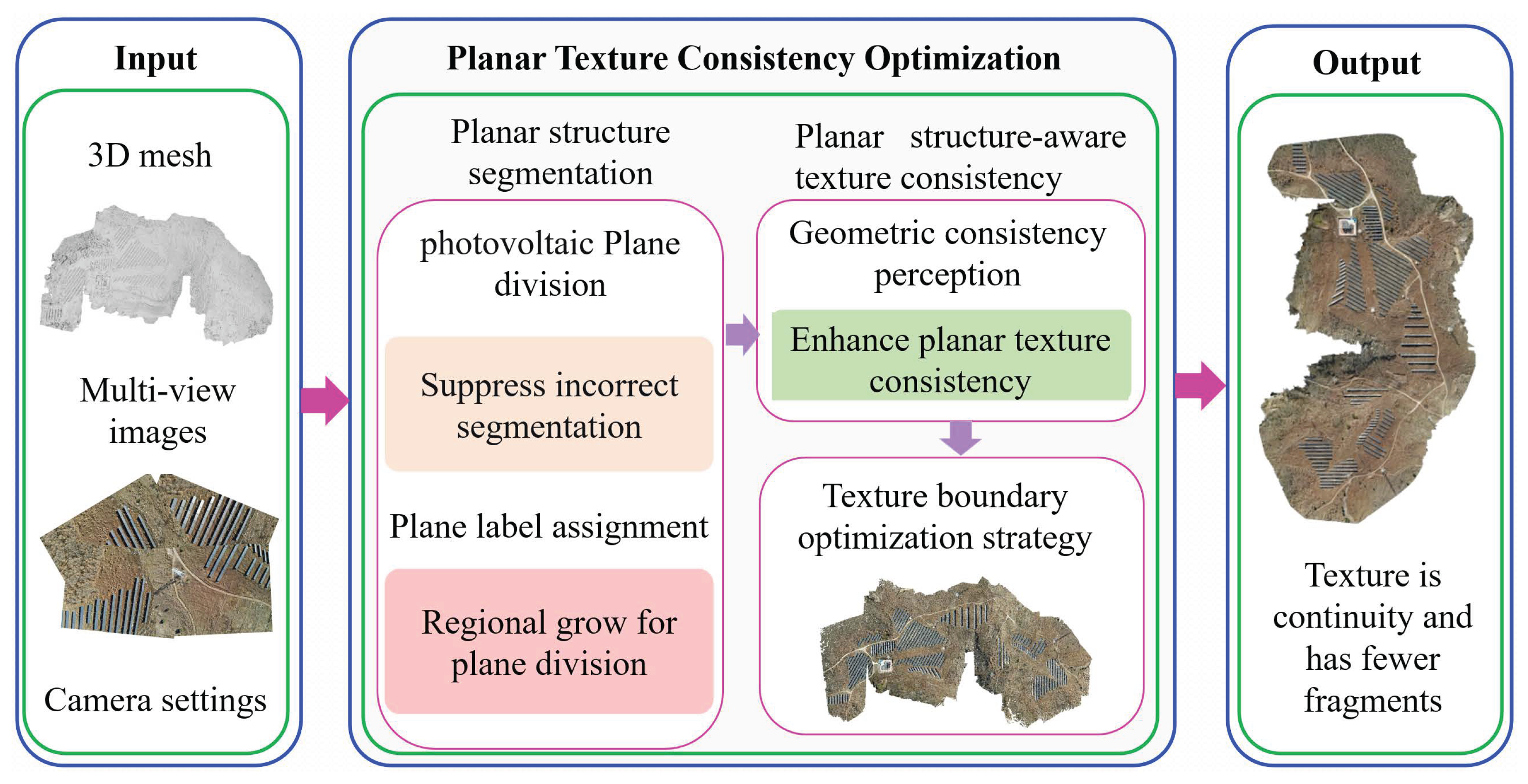
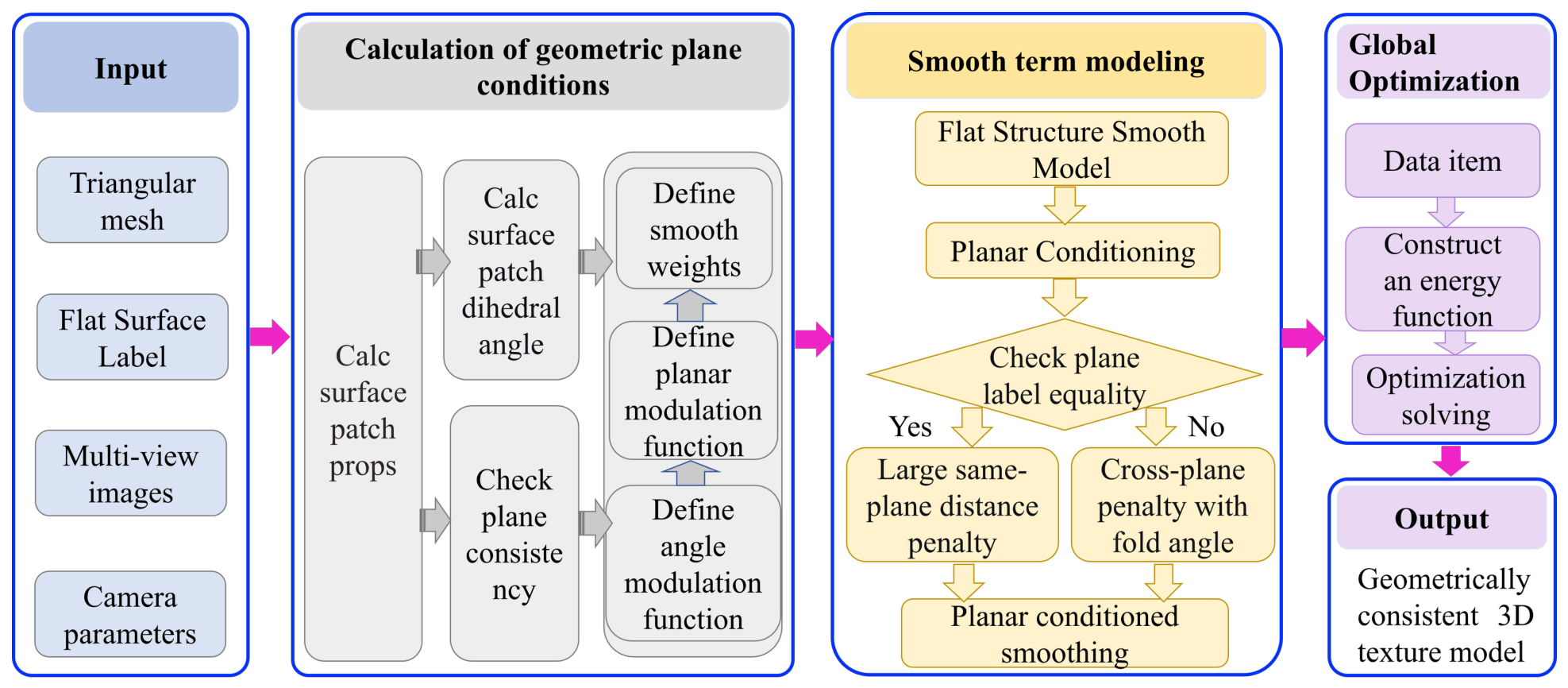
The pipeline of the proposed PSATM is illustrated in Figure 1. In contrast to existing texture optimization methods, such as those in [31], the key aspects of the PSATM are: (1) Planar structural information is explicitly represented as face-level attributes, rather than just being auxiliary segmentation outcomes; (2) In the Markov Random Field (MRF) energy function, both planar membership and dihedral angle geometric information are included in the smoothness term, allowing for the adaptive adjustment of texture label switching costs; (3) By integrating a texture boundary optimization strategy, texture continuity is simultaneously optimized at both the global and local scales.

3.1. Planar Structure Segmentation Mechanism

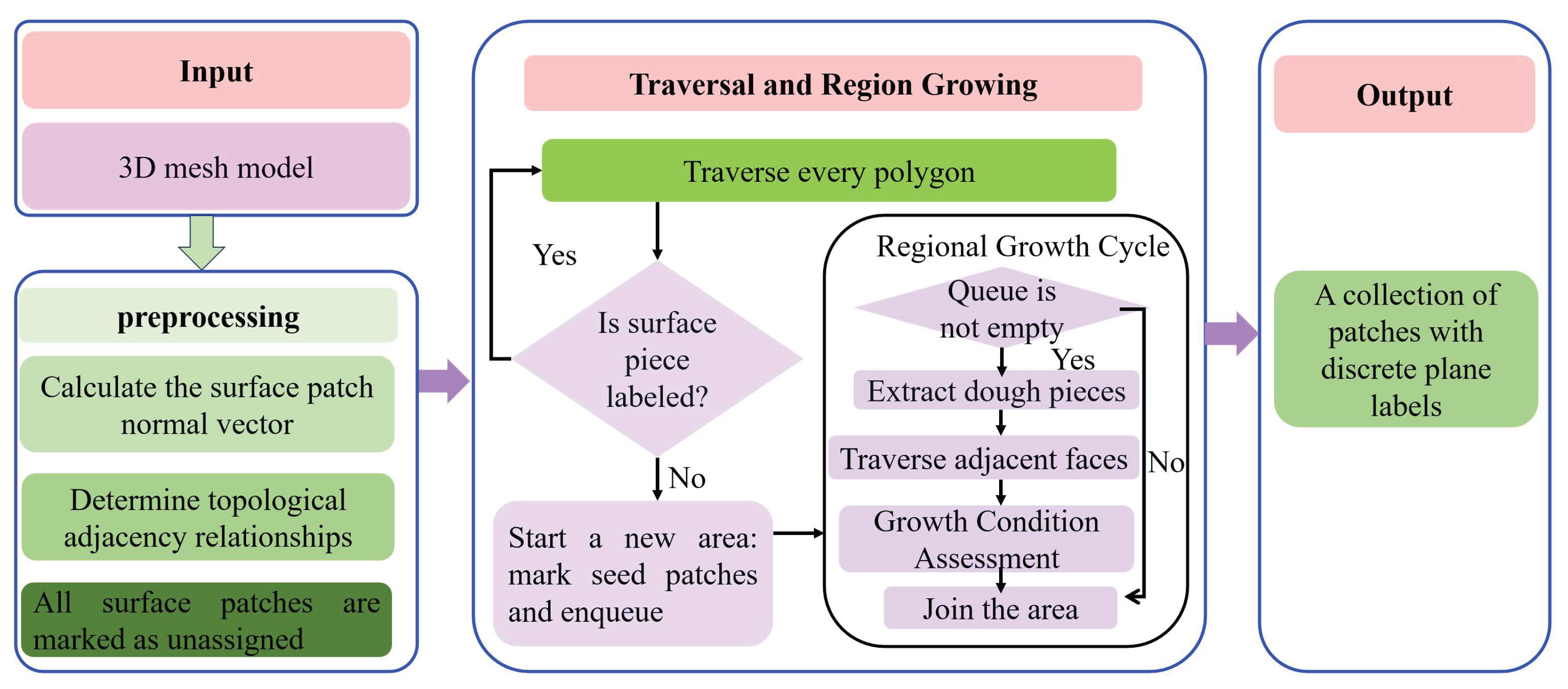
The flowchart depicting the Planar Structure Segmentation Mechanism (PSSM) is shown in Figure 2. In the context of texture mapping optimization, triangular facets of a 3D mesh are generally used as the basic units of processing. To incorporate geometric structural information into the texture optimization process, we first identify explicit planar characteristics from the reconstructed 3D mesh and use them as geometric references for subsequent texture optimization. We use triangular meshes as the geometric representation of the 3D model. Each triangular surface is formed by three vertices: f i = ( v i 1 , v i 2 , v i 3 ) R 3 × 3 . For each triangular facet f i , the following geometric attributes can be computed. The facet normal vector n i , which is obtained from the cross product of the three vertices of the facet:
n i = ( v i 2 v i 1 ) × ( v i 3 v i 1 ) ( v i 2 v i 1 ) × ( v i 3 v i 1 ) .
The facet adjacency relationship is defined as follows: Two facets are considered topologically adjacent when they share a common edge. This set of adjacent facets is referred to as:
N ( f i ) = { f j F edge ( f i ) edge ( f j ) } ,
where each triangular facet f i is modeled as a random variable node, whose value is a discrete texture label l i L , where L = { I 1 , I 2 , , I m } represents the set of candidate texture views. This modeling strategy facilitates unified optimization at the feature level and allows for the integration of geometric consistency constraints.
In the context of photovoltaic systems, numerous surfaces display distinct planar features, like those found in photovoltaic panels. It is ideal for these areas to retain consistency in texture mapping, meaning they should utilize the same or comparable textures whenever feasible. Current approaches, however, focus solely on facet adjacency and neglect fundamental planar structures, often resulting in unnecessary texture divisions within a single plane. To address this problem, we compute several geometric properties for each triangular face and then perform planar segmentation based on these attributes.
The angle between the normal vectors of two topologically adjacent facets is defined as follows: ϕ i j = arccos ( n i n j ) . If ϕ i j < ϕ m a x . The two facets are considered geometrically consistent in orientation, where ϕ max denotes the normal consistency threshold. We employ the region-growing method [41] for planar segmentation. This process begins with an unlabeled plane, which is then used to initialize a planar area. Subsequently, the neighboring planes are recursively analyzed to check if they adhere to the normal consistency condition. As a result, each plane f i is assigned a planar label p i N , indicating the index of the planar area it belongs to. Utilizing explicit planar features offers various benefits, such as improved geometric consistency, the capability to model weighted smoothness, and greater resistance to local noise.

3.2. Planar Structure-Aware Texture Consistency Model

Existing approaches generally assume that the texture inconsistency cost between neighboring facets is isotropic, which can easily result in texture fragmentation in regular planar structures. To address this issue, we propose a structure-aware smoothness model for planar structures, as depicted in Figure 3. Conventional Markov Random Field (MRF)-based texture mapping techniques often utilize the Potts model to define texture consistency constraints between adjacent facets. The fundamental principle is that a consistent penalty is applied when adjacent facets choose different texture sources. However, this model assumes isotropic adjacency relationships, implying that the texture inconsistency cost is the same for all neighboring facets.
While this assumption is typically valid in complex natural scenes, it often leads to significant texture fragmentation artifacts in human-made scenes with numerous regular structures, such as building roofs or photovoltaic panel arrays. The main reason is that the traditional Potts model relies solely on mesh topological adjacency relationships and ignores the geometric structure within the scene. For instance, within extensive planar areas, neighboring facets often display highly consistent normal distributions and are part of the same physical planar structure. In such cases, if a uniform adjacency penalty strategy is maintained, the MRF optimization process is likely to switch texture labels frequently based on local photometric variations, thereby creating numerous unnecessary texture boundaries within the same plane. To mitigate this problem, we introduce a structure-aware mechanism into the traditional Potts model, thereby extending it into a planar structure-aware smoothness model:
V i j ( l i , l j ) = w i j · I ( l i l j ) ,
where w i j represents the strength of the texture consistency constraint between adjacent facets. By designing this weight in a structured manner, the texture optimization process can adaptively adjust the smoothness constraint based on the geometric relationships among facets.
To characterize the geometric continuity between adjacent facets, the dihedral angle ϕ i j quantifies the degree of geometric folding. When the dihedral angle is small, the two facets in geometry are roughly coplanar. As a result, it is advisable to choose consistent texture sources for them. On the other hand, a large dihedral angle might indicate a real geometric boundary or a structural change. In such cases, variations in texture labels are permissible. Taking these observations into account, a specific angle-modulation function has been devised, as in Equation (4).
ω ϕ ( i , j ) = exp ϕ i j 2 2 σ ϕ 2 ,
where σ ϕ controls the sensitivity to dihedral angle variations. Through this continually degrading formula, the smoothness constraint intensity diminishes gradually as the geometric fold angle increases. Consequently, this enhances texture consistency within geometrically continuous regions while gradually easing the constraint near structural boundaries.
However, relying on local dihedral angles alone is not adequate to fully capture large-scale structural details. To more effectively utilize structural information in the scene, the explicit planar segmentation results from the previous section are integrated. Furthermore, a planar consistency indicator function is introduced and defined as Equation (5).
δ p ( i , j ) = I ( p i = p j ) .
When two surfaces are part of the same flat shape, the requirement for texture consistency is further enhanced by a specific method known as the planar modulation function, defined as Equation (6).
ω p ( i , j ) = 1 + α · δ p ( i , j ) ,
where α > 0 is used to enhance the strength of the texture consistency constraint within the same planar region.
By taking into account both geometric continuity and structural planar information, the weight for smoothness between adjacent facets is defined as follows:
w i j = ω ϕ ( i , j ) · ω p ( i , j ) .
The texture consistency constraint captures both local geometric details and global planar structure, addressing texture fragmentation commonly found in conventional techniques. Furthermore, it can be flexibly adjusted based on local geometry and planar characteristics, enhancing its effectiveness.
The model continues to employ the conventional Potts distance function, which solely determines if labels are the same. While this straightforward label distance metric offers beneficial optimization characteristics, its expressive capabilities remain limited and inadequate for fully capturing the various forms of texture transition interactions in intricate photovoltaic environments.
To improve the representation of structural relationships, the texture mapping issue is redefined as a label distance function that depends on plane conditions; the function is defined as Equation (8).
d i j ( l i , l j ) = 0 , l i = l j , β p , l i l j p i = p j , β ϕ ( ϕ i j ) , l i l j p i p j ,
where l i and l j denote the texture labels assigned to facets f i and f j , respectively, while p i and p j represent the corresponding planar labels of the two facets. According to their spatial relationships, the distance function can be divided into the following three cases.
(1) Same-texture case: When two adjacent facets select the same image as their texture source (i.e., l i = l j ), the system considers both the geometry and texture to be continuous. Therefore, the switching cost is set to 0.
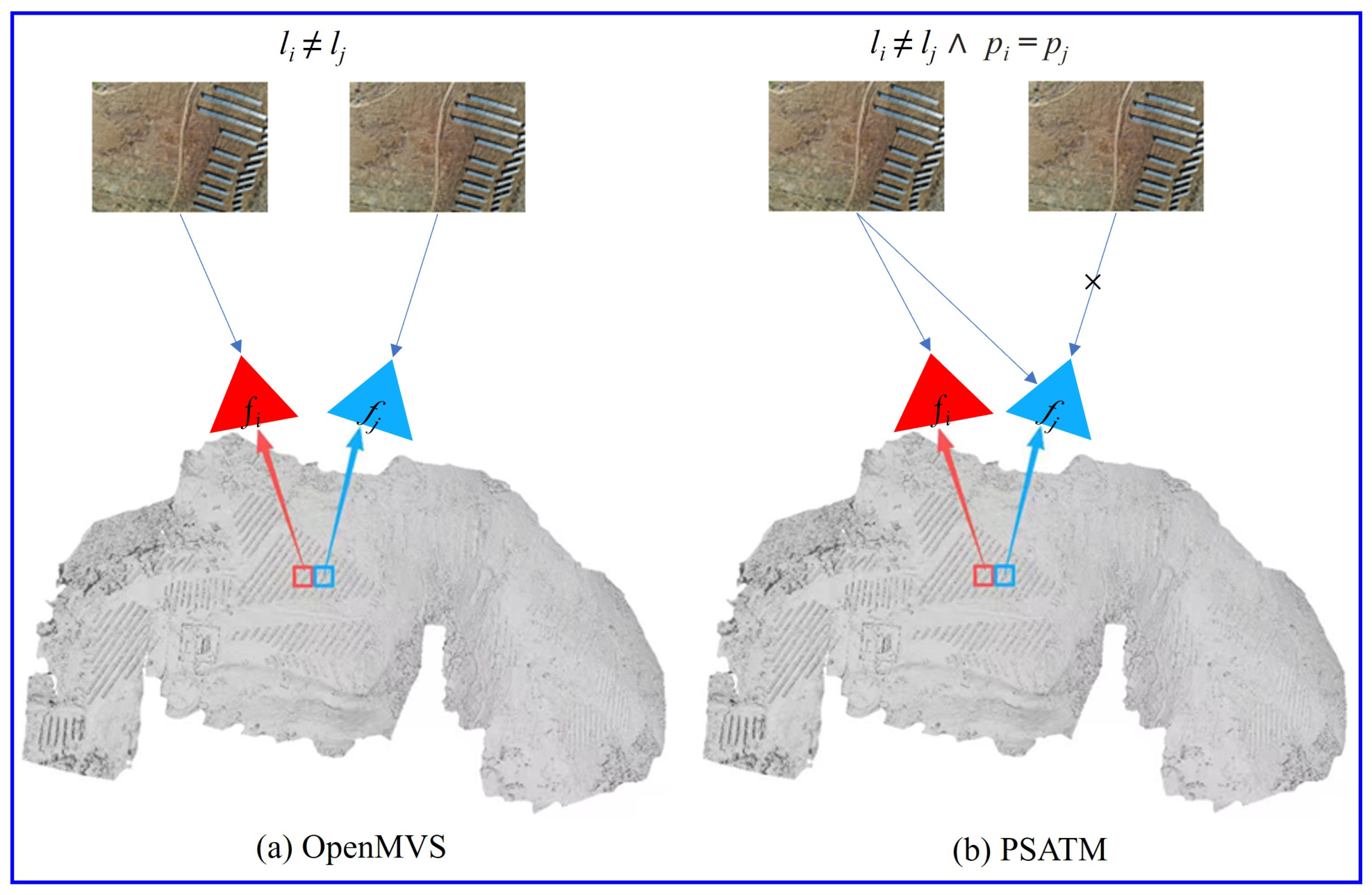
(2) When two adjacent surface elements are part of the same flat structure ( p i = p j ), but the algorithm assigns different texture labels to them ( l i l j ), the system applies a fixed penalty factor β p to deter random texture segmentation on smooth flat surfaces, as depicted in Figure 4. Conventional approaches impose a penalty only when adjacent elements have different texture labels, without accounting for their geometric structure. This approach often leads to rough segmentation boundaries between potential textures, causing fragmented texture patches and noticeable stitching artifacts. By incorporating flatness constraints, the segmentation cost increases significantly when ( p i = p j ) holds, even if the elements come from different images. As a result, the optimization process is more likely to choose a consistent texture source for the entire flat area.
In essence, this method incorporates a structural prior into texture optimization: the assumption that the same physical plane should have strong texture continuity. This assumption is particularly relevant in solar panel scenes, where solar panels often form large, orderly flat structures. This constraint effectively reduces texture fragmentation, enhancing the overall continuity and visual coherence of the texture mapping results.
(3) Cross-plane different-texture case: If two adjacent facets pertain to separate planar arrangements and are assigned distinct texture labels ( l i l j p i p j ), the switching cost is determined by the geometric dihedral angle function that exists between these planes, referred to as β ϕ ( ϕ i j ) . In the scenario of crossing planes, to guarantee the cost function’s continuity and reliability against spatial angular variations, a continuous truncated penalty function based on the dihedral angle is additionally defined as follows:
β ϕ ( ϕ i j ) = β 0 · min ( 1 , ϕ i j / ϕ m a x ) ,
where ϕ i j signifies the geometric fold angle, or dihedral angle, between planes i and j; ϕ max denotes the established fold-angle limit; and β 0 represents the maximum penalty constant for cross-plane scenarios, corresponding to the texture boundary cost in areas with significantly large-angle folds. This method dynamically adjusts and limits the angular penalty. When the geometric fold angle ϕ i j is small (i.e., ϕ i j < ϕ max ), the penalty cost rises linearly with the angle. However, once the fold angle surpasses the threshold ϕ max , the area is deemed to have a distinct texture boundary, and the penalty cost stabilizes at the maximum value β 0 .
By combining the data term and the plane-conditioned smoothness term, the formulation of the ultimate optimization objective is established as follows:
min L i D i ( l i ) + ( i , j ) E ω ϕ ( i , j ) · ω p ( i , j ) · d i j ( l i , l j ) ,
The α method, as described in [42], is utilized to refine the energy function established in Equation (10). This process aims to derive the most suitable texture label assignments.
The texture optimization model combines both planar structural details and geometric fold-angle relationships. This approach not only enhances texture coherence in extensive flat areas but also ensures sensible segmentation at actual structural junctures. Consequently, it significantly mitigates the texture fragmentation issue that often plagues traditional techniques, while concurrently enhancing the structural integrity and overall visual quality of the texture mapping outcomes.

3.3. Texture Boundary Optimization Strategy

Although explicit planar constraint-based graph-cut optimization can globally achieve high consistency in texture assignments, in practical photovoltaic applications, small areas with residual facets surrounded by different textures may still exist. This is often caused by local mesh noise, complex occlusion interactions, and variations in lighting conditions across input images. To improve the visual continuity of texture mapping results, a lightweight texture boundary optimization strategy (TBOS) is proposed. This strategy is implemented following texture label optimization to remove isolated texture fragments.
For any facet f i situated at a texture boundary (i.e., there exists at least one adjacent facet f j in the neighborhood N ( f i ) such that the lengths l j and l i differ), the support score for each neighboring texture label l k is calculated as follows:
S ( f i , l k ) = f j N ( f i ) , l j = l k Area ( f j ) · exp ϕ i j 2 2 σ 2 ,
where Area ( f j ) denotes the physical area of the adjacent face f j , which helps stabilize larger regions during the texture merging process. ϕ i j signifies the dihedral angle between faces f i and f j . Moreover, σ is a parameter that governs the degree of sensitivity to normal variations.
This weighting strategy gives greater importance to neighboring regions that share consistent geometric orientations and larger areas during the label competition process. This helps to minimize random fluctuations in texture labels. Let’s denote the current label of facet f i as l i . If there is a neighboring label l d o m that meets the condition S ( f i , l d o m ) > S ( f i , l i ) + τ s u p p o r t , then the label of the current facet is updated to l i l d o m . Here, τ s u p p o r t represents the support threshold. It is introduced to prevent frequent label changes when the support difference is slight, thus enhancing the stability of the label updating process.
Our TBOS technology efficiently removes isolated minor details from texture mapping outcomes and notably improves the smoothness of texture patch edges, thus ensuring a more precise alignment with the real physical structures. Particularly in photovoltaic systems, our TBOS can also eliminate leftover segmented textures in flat areas, enhancing the uniformity and coherence of the texture at a minimal computational expense.

4. Experimental Results

This research primarily concentrates on enhancing existing texture optimization techniques for 3D reconstruction. Because all images contribute to the reconstruction, traditional full-reference image quality metrics such as the Peak Signal-to-Noise Ratio (PSNR) [43] and the Structural Similarity Index (SSIM) [44,45] are not used for assessment. The analysis instead centers on comparing the overall model quality and fine details within local regions.
To validate the efficacy and excellence of the proposed PSATM for 3D reconstruction of photovoltaic landscapes, three distinct photovoltaic scene datasets are chosen for assessment. Comparative studies are then carried out to compare the outcomes with those obtained from OpenMVS (https://github.com/cdcseacave/openMVS (20 March 2025)).

4.1. Experimental Setup

All experiments were performed on a personal assembling machine with consistent hardware specifications: an Intel Core i7-9700 CPU clocked at 3.0 GHz, 32 GB of RAM, and an NVIDIA GeForce RTX 2060 GPU with 6 GB of VRAM. Each of the three experimental datasets had a resolution of 2048 × 1536 pixels. To obtain sparse point clouds and camera parameters, COLMAP 3.12.0 [15] was utilized. Subsequently, the multi-view stereo method from OpenMVS 2.3.0 was applied for 3D model reconstruction. Texture reconstruction was then carried out using the proposed PSATM 1.0 and OpenMVS techniques. Comparative evaluations were conducted on the resulting textured models.
To evaluate the effectiveness of the proposed planar structure-aware texture mapping technique, the hyperparameters governing feature extraction and energy function optimization are uniformly established. In the region-growing process that relies on facet normal consistency, the maximum deviation threshold for facet normals is set to ϕ m a x = 15 , and the maximum distance threshold between a facet and the fitted plane is set to d m a x = 0.1 m. Based on the distance function presented in Equation (8), the specific parameter settings are as follows:
(1) The penalty factor for the same-plane scene, β p , is set to 0.1 . This factor applies a modest penalty for label swaps between adjacent facets of the same plane, thereby promoting the merging of photovoltaic panel surfaces into coherent texture regions.
(2) The cross-plane penalty function β ϕ is influenced by the dihedral angle ϕ i j at structural interfaces where p i p j . The penalty weight is set to 0.5 and increases linearly with the change in the included angle.
Note that these parameter values were chosen based on specific application scenes. Therefore, for applications that are not related to photovoltaics, it may be necessary to adjust these parameter values in order to obtain better results. As is common in the field of 3D reconstruction, no single method can be applicable to all scenes; the parameters must be set according to the requirements of each application.

4.2. Qualitative Results

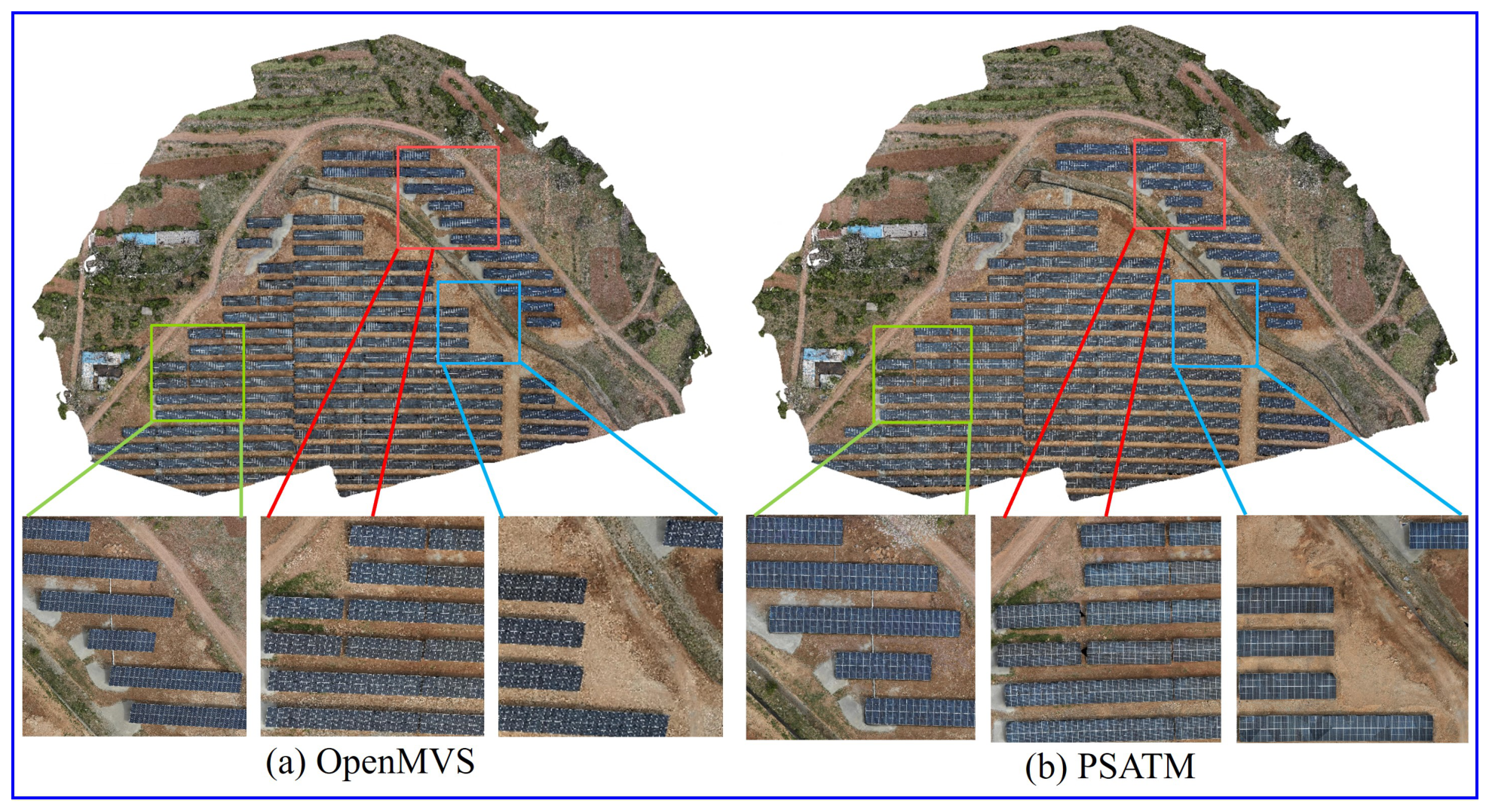
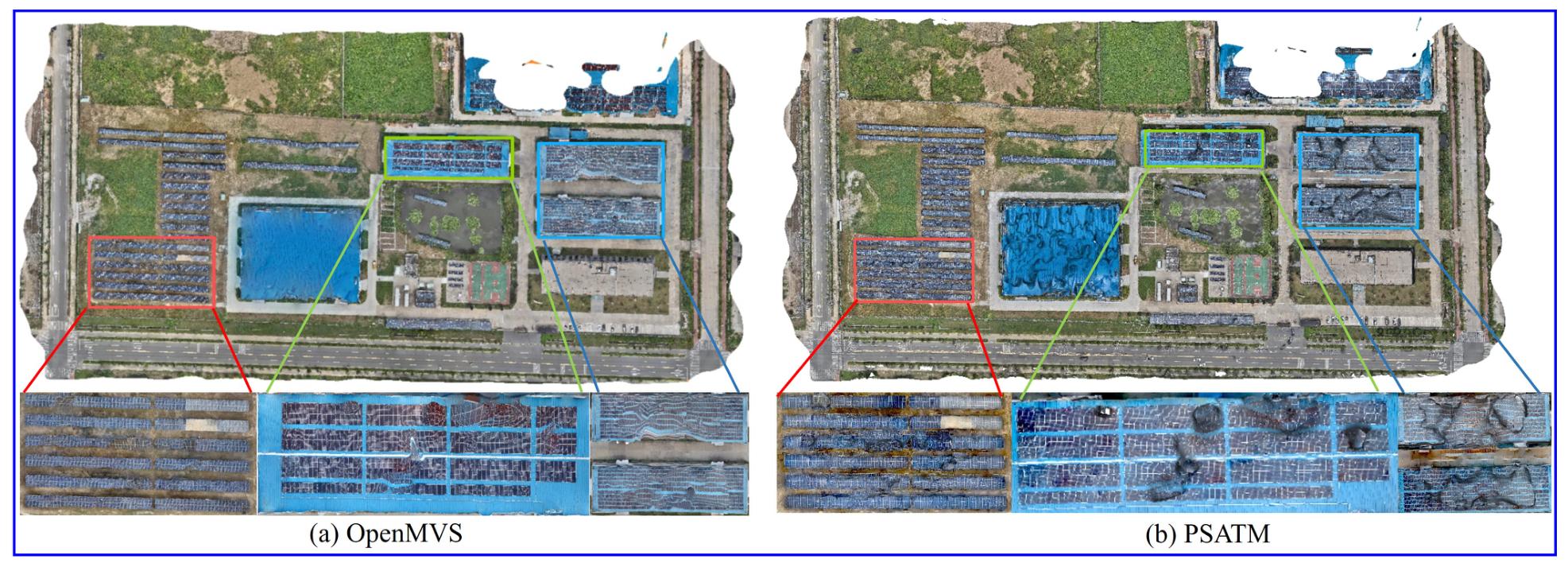
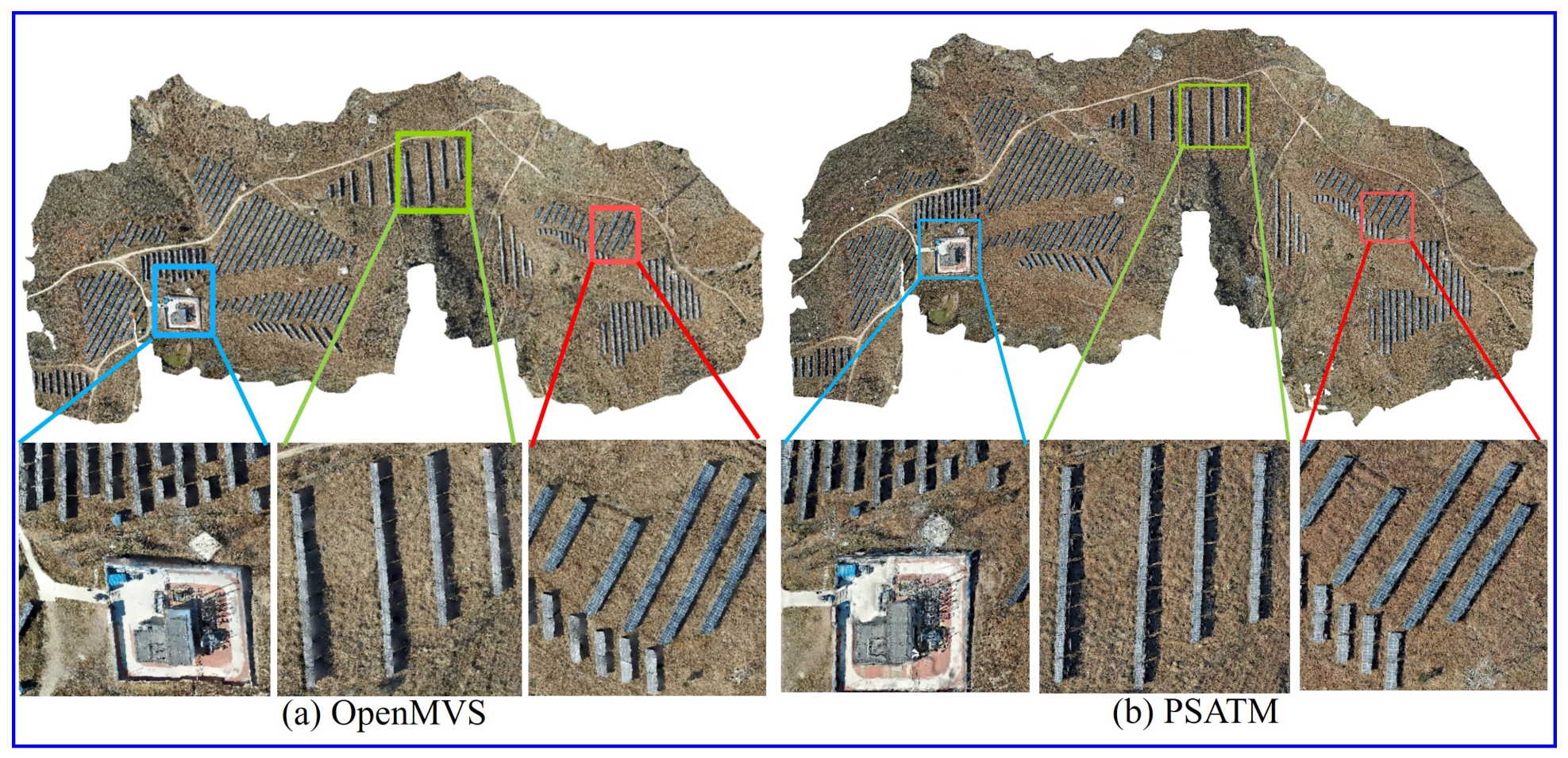
This section provides a qualitative assessment of the experimental outcomes from OpenMVS and the proposed PSATM. The visual quality, surface smoothness, and texture clarity of the reconstructed models are evaluated and compared. The results for the three datasets are depicted in Figure 5, Figure 6 and Figure 7, respectively.
The initial scene involves 350 UAV images taken over a rugged landscape, as depicted in Figure 5. This scene features extensively repeated photovoltaic arrays with a rather uniform texture, which can cause feature mismatches. When dealing with such repetitive structures, OpenMVS often encounters oscillations in label switching, leading to many fragmented texture patches within the arrays. Moreover, there are gaps in the textured model, significantly impacting rendering speed and visual quality. To address these issues, the proposed PSATM incorporates a planar structure-aware mechanism. Initially, the reconstructed mesh is divided into flat areas, grouping facets with consistent normals and spatial adjacency into single flat sections. With this segmentation, a cross-plane heterogeneous projection penalty term is integrated into the texture optimization energy function. This addition aims to limit label switching between planes while promoting facets on the same plane to choose matching texture views. Consequently, this approach enables texture edges to align with the actual physical boundaries of the photovoltaic modules, preventing chaotic texture fragmentation within flat areas and ensuring a more consistent spatial arrangement of texture labels that aligns more closely with the geometric structure of the real environment.
The second scene is composed of 450 images captured by UAVs of a complex photovoltaic landscape. The outcomes are presented in Figure 6. This scene encompasses factory roofs, agricultural land, and uniformly organized distributed photovoltaic panels, which involve varied object types and intricate structural borders. When OpenMVS processes extensive rooftop flat areas, it relies only on local facet adjacency, leading to fragmented texture labeling. Notably, jagged edges and color inconsistencies are evident around photovoltaic panel boundaries and roof intersections. In contrast, the proposed PSATM incorporates plane labels as structural guidelines, compelling facets within the same rooftop plane to prefer consistent texture sources. The proposed PSATM shows improved performance in photovoltaic landscapes, mainly due to clearer, more regular panel boundaries, better preservation of grid-line details, and a more uniform, continuous texture distribution over large rooftop areas, effectively removing the texture discontinuities and stitching artifacts found in conventional techniques. Overall, the proposed PSATM substantially enhances the visual coherence and structural depiction of the reconstructed models in environments where complex structures and regular flat areas are both present.
The third scene features 500 UAV images taken from a mountainous slope. The experimental outcomes are presented in Figure 7. This scene is situated in a mountainous area with considerable elevation changes, where solar panels are installed along the contour lines, leading to various dihedral angles and diverse viewing angles. In the regions where the slope transitions, the reconstruction from OpenMVS reveals noticeable texture distortion and ghosting artifacts. This is because OpenMVS cannot infer the terrain’s geometric fold angles and thus inaccurately smooths textures across flat areas, causing visual blurring. The proposed PSATM’s continuous, truncated penalty function, which is modulated by dihedral angles, plays a vital role in mitigating these problems. Experimental results indicate that solar panels on slopes exhibit distinct structural layers. Even in areas with significant viewpoint changes, the spaces between the panels remain clearly visible, accurately maintaining the geometric posture of the mountainous solar panel scene.
The proposed PSATM, based on the textured model’s comprehensive results, has generated structurally coherent and texture-continuous 3D models across all three datasets. The layout of the photovoltaic panels appears visually uniform, with clear spacing between neighboring modules, contributing to a more lifelike appearance. Conversely, OpenMVS tends to produce rather chaotic textures in densely packed photovoltaic areas, frequently showing texture disruptions, unclear panel edges, stretched textures, and occasionally inconsistent colors or misaligned textures.
These findings suggest that conventional texture mapping techniques are more susceptible to mismatches when selecting views and merging textures in photovoltaic scenes with highly repetitive textures and regular patterns. Detailed examinations of local magnified views show that the proposed PSATM maintains sharper panel edges, distinct spacing, and smoother texture transitions. In contrast, OpenMVS exhibits issues such as overlapping textures, blurred areas, and inconsistent texture assignments in regions with repetitive patterns.
The proposed PSATM enhances texture clarity and structural coherence by optimizing both the view selection approach and the texture merging process. This optimization effectively leverages redundant multi-view data. Experimental results show that, under the same hardware and dataset settings, the proposed PSATM outperforms OpenMVS in texture representation quality and robustness, especially in areas with dense repetitions of photovoltaic elements.

4.3. Quantitative Results

To evaluate the effectiveness of the proposed PSATM in reducing texture fragmentation and enhancing visual consistency, we utilize quantitative methods that assess the texture atlas’s topological integrity and the results of Markov Random Field (MRF) optimization. We examine the influence of planar priors on texture mapping by contrasting the reconstructed textures from PSATM and OpenMVS on the same geometric models. This comparison allows for a quantitative analysis of the advantages of using planar priors in texture mapping.
Considering the specifics of texture reconstruction in photovoltaic environments, we adopt two quantitative metrics: Total number of texture patches: This measure indicates the count of distinct texture patches on the textured model’s surface, directly reflecting the level of texture fragmentation. Excessive fragmentation in 3D reconstruction can lead to frequent rendering state changes and higher GPU memory usage. Fewer texture patches suggest improved texture continuity across geometric surfaces. Reconstruction time: This metric records the entire processing duration from the input mesh to the creation of the final textured model, serving as an indicator of algorithmic efficiency.
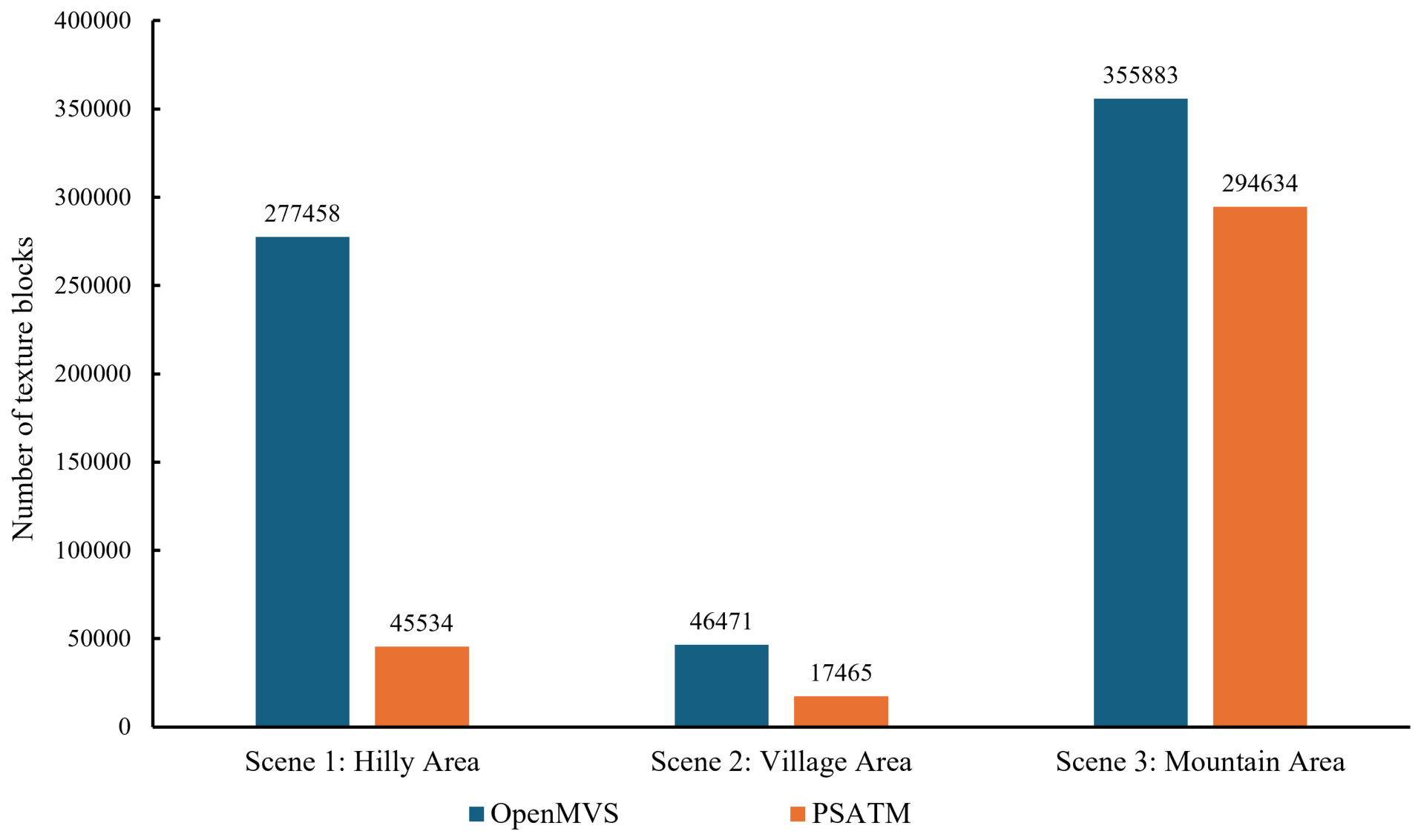
(1) Analysis of texture fragmentation degree. Table 1 illustrates that the proposed PSATM significantly reduces the total number of texture patches for all scenes. In Scene 1, with its extensive photovoltaic arrays, OpenMVS generates 277,458 texture patches, whereas the proposed PSATM reduces this to 45,534, a decrease of about 83.6%. This reduction suggests that planar structural priors effectively mitigate frequent label switching due to local illumination changes. In Scene 2, featuring intricate rooftop structures, the number of texture patches falls from 46,471 to 17,465, a reduction of roughly 62.4%. This outcome shows that imposing explicit planar constraints leads to consistent texture selection across facets in the same plane, enhancing texture continuity. In Scene 3, with its complex terrain and slopes, the texture patch count is cut from 355,883 to 294,634, a reduction of approximately 17.2%. While the improvement is less pronounced than in the earlier scenes, it still indicates that planar priors can help mitigate texture fragmentation in complex photovoltaic settings. Overall, the proposed PSATM effectively reduces texture fragmentation and enhances texture continuity and stability by integrating explicit planar structural information into the texture optimization process.
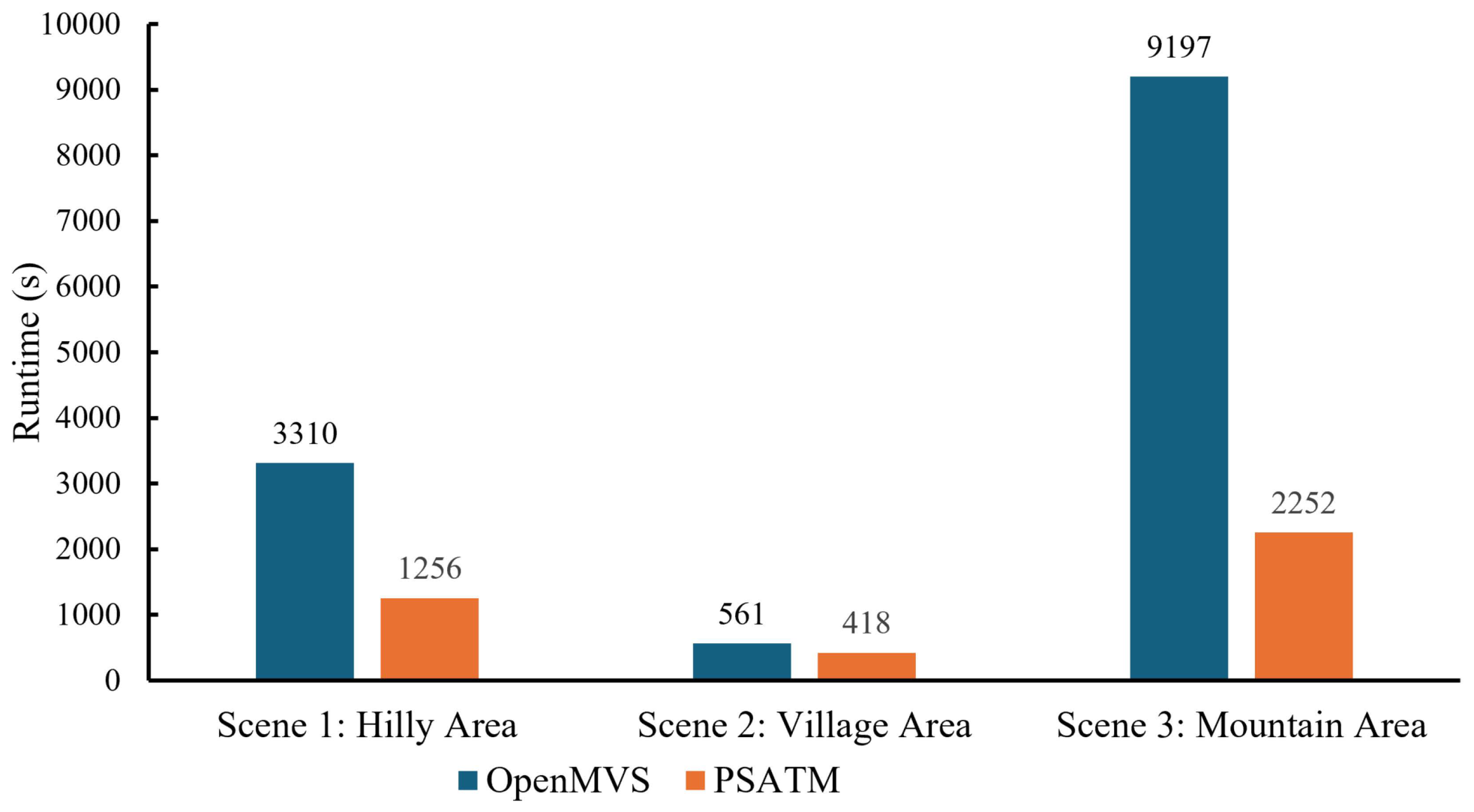
(2) Analysis of reconstruction time and computational efficiency. As illustrated in Table 2, the proposed PSATM effectively decreases computational time while preserving high-quality texture reconstruction outcomes across all tested scenes. For Scene 1 and Scene 2, the proposed PSATM takes 20 m 56 s and 6 m 58 s, respectively, as opposed to 55 m 10 s and 9 m 21 s required by OpenMVS, resulting in around 2.6× and 1.3× increases in computational efficiency. In the larger-scale Scene 3, the time is reduced from 2 h 33 m 17 s to 37 m 32 s, corresponding to roughly a 4.1× efficiency gain. The enhancement is primarily due to two factors. Firstly, explicit planar structural constraints substantially limit the solution space of graph-cut optimization, thereby speeding up energy convergence. Secondly, the considerable reduction in the number of texture patches minimizes the computational load on texture atlas creation and seam blending.
As depicted in Figure 8 and Figure 9, the proposed PSATM demonstrates greater stability and consistency in the number of texture patches and reconstruction time, especially as the dataset grows. This demonstrates superior stability and scalability over OpenMVS. Furthermore, the proposed PSATM minimizes texture fragmentation and improves continuity, greatly enhancing reconstruction efficiency. These features highlight its potential for extensive photovoltaic scene reconstructions.

4.4. Ablation Study

This section aims to evaluate the individual impact and value of each crucial component within the proposed PSATM. Specifically, it conducts ablation studies on the two primary optimization components discussed in Section 3: the Planar Structure-Aware Texture Consistency Model (PSATC) and the Texture Boundary Optimization Strategy (TBOS).
The experiments use the same three photovoltaic UAV datasets as previously tested environments. A quantitative assessment is carried out by comparing the texture mapping outcomes from various combinations of these modules.
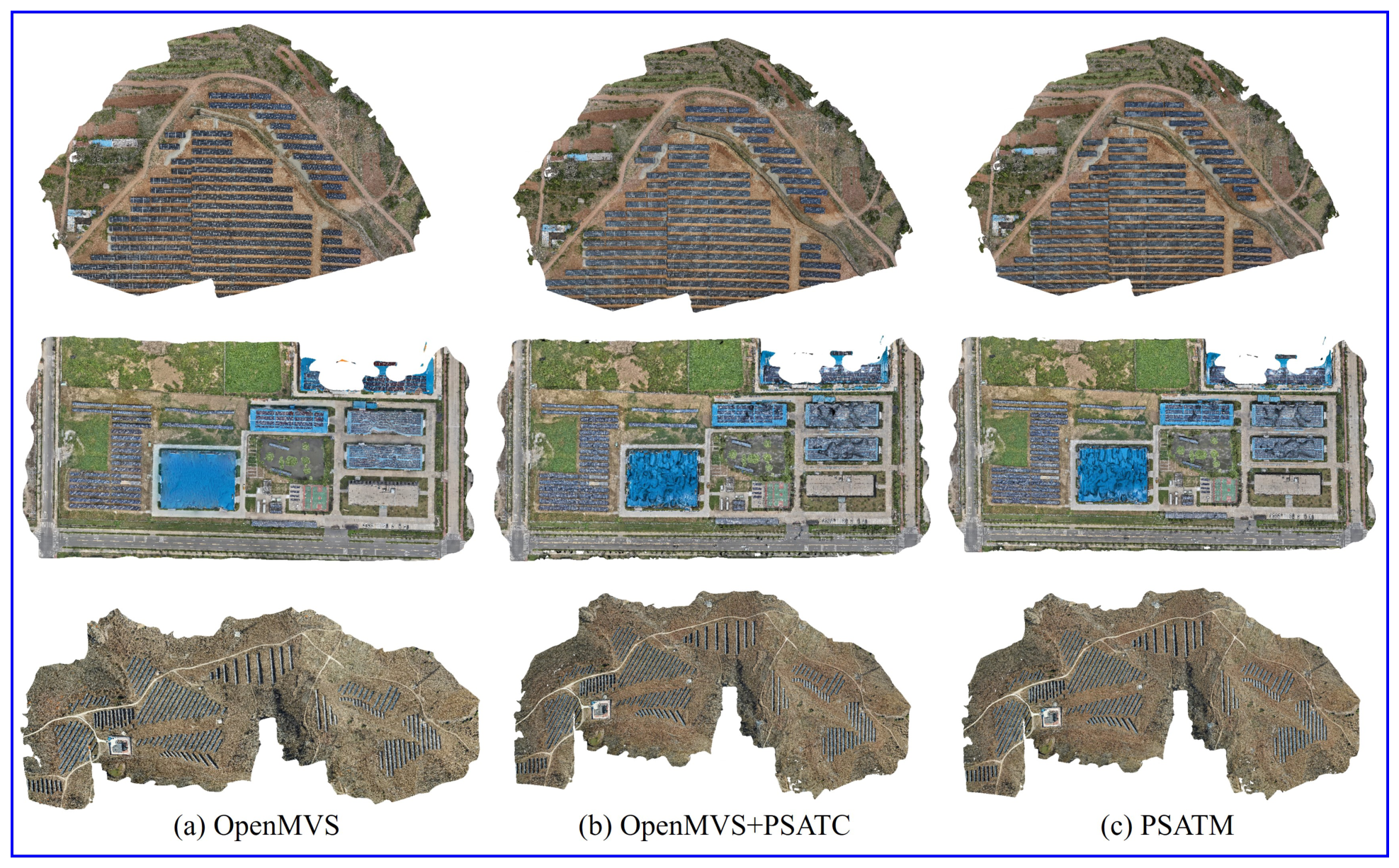
The three algorithmic variants are developed within the conventional MRF texture optimization context. OpenMVS (Baseline): It employs the standard Potts model for global graph-cut optimization without incorporating explicit planar structural constraints or conducting any subsequent boundary smoothing. OpenMVS + PSATC: This variant builds upon the baseline, substituting the smoothness term with the planar structure-aware texture consistency model. This model incorporates dihedral-angle modulation and planar consistency weighting, though no boundary post-processing is performed. PSATM (PSATC + TBOS): The PSATM encompasses both the consistency model and the texture boundary optimization strategy. To illustrate the individual suppression effects of each module on texture fragmentation, the total count of generated texture patches for all three variants across the three test scenes is presented in Table 3.
The comparison between the baseline model and the planar structure-aware model reveals that the structure-aware smoothness term substantially decreases the number of texture patches. Moreover, the computational time is notably reduced, as illustrated in Table 4. These findings suggest that incorporating explicit planar constraints not only improves texture consistency within photovoltaic panel regions but also narrows down the search space for candidate labels during graph-cut optimization, thereby expediting the convergence of the energy function.
Further analysis of OpenMVS + PSATC and the proposed PSATM reveals that, after integrating TBOS with PSATC, reconstruction time slightly increases due to additional post-processing computations. However, the number of texture patches is further decreased. For instance, in Scene 3, the number of texture patches is reduced from 315,683 to 294,634, which corresponds to a decrease of about 21,000 patches.
These outcomes indicate that, even after global graph-cut optimization, a few microscopic texture islands persist. Module B can effectively remove these localized residual fragments at a minimal additional computational expense, thereby enhancing the completeness and consistency of the texture atlas.
Figure 10 specifically zooms in on the intermediate states throughout the gradual integration of various modules, thereby elucidating the visual influence mechanism of each component. OpenMVS: The surfaces of photovoltaic panels feature dense seams and fragmented texture patches. Because it cannot physically detect flat structures, overall structural continuity is significantly impaired. Intermediate outcome after incorporating PSATC: Due to the application of plane constraints, the textures across large areas of photovoltaic panels achieve high consistency, greatly reducing macroscopic fragmentation. Nonetheless, on closer examination of the borders between diverse photovoltaic modules or physical edges, some abrupt label changes can be discerned, attributed to the nature of discrete optimization. Furthermore, sporadic, small, and noisy regions made up of few facets persist within flat regions. TBOS: Following local support-based filtering, the remaining irregular borders are forcibly smoothed and aligned, while the minimal residual noisy areas within flat regions are absorbed by the surrounding, dominant textures. This visually underscores that the proposed PSATC primarily governs the macrostructural arrangement of the texture atlas, whereas Module B primarily influences the naturalness of microscopic texture borders.
The quantitative data and microscopic visual results from the ablation studies conclusively indicate that the planar structure-aware texture consistency (PSATC) forms the cornerstone for enhancing large-scale geometric consistency and expediting the optimization process. In addition, the texture boundary post-processing strategy serves as a localized enhancement that subtly smooths texture boundaries with minimal computational cost. Together, these two components establish a comprehensive and effective system for high-quality multi-view texture mapping.

5. Conclusions

We propose a new method called Planar Structure-Aware Texture Mapping (PSATM) to address significant texture fragmentation in regular planar areas of solar photovoltaic scenes. The proposed PSATM begins by extracting planar priors from reconstructed meshes using a region-growing approach, which are then integrated into a Markov Random Field optimization process. A planar structure-aware texture consistency model is established to ensure that texture consistency is maintained within the same physical plane. Furthermore, a texture boundary optimization strategy is introduced to adaptively refine unusual texture labels and reduce texture seams and fragmentation artifacts. Experimental results show that the proposed PSATM effectively reduces texture fragmentation, enhances texture continuity, and improves the overall visual quality of textured 3D models. We will implement a parallel version of the proposed PSATM for acceleration in the future.

Author Contributions

Conceptualization, M.C., Z.W. and N.L.; methodology, Z.W. and N.L.; software, Z.W.; validation, Z.W. and M.C.; formal analysis, N.L. and M.C.; investigation, Z.W. and N.L.; resources, M.C. and H.Z.; data curation, Z.W. and N.L.; writing—original draft preparation, Z.W.; writing—review and editing, Z.W., N.L. and M.C.; visualization, Z.W. and N.L.; supervision, M.C. and H.Z.; project administration, M.C. and H.Z.; funding acquisition, M.C. All authors have read and agreed to the published version of the manuscript.

Funding

This work was supported in part by the National Natural Science Foundation of China (No. 62372153) and the Anhui Province Higher Education Scientific Research Project (No. 2024AH050045).

Data Availability Statement

The original contributions presented in this study are included in the article.

Conflicts of Interest

The authors declare no conflicts of interest.

References

  1. Praveenkumar, S. Enhancing the thermal and electrical efficiency of solar photovoltaic panels by integrating super max foam and zinc oxide nanofluids: An experimental approach. Renew. Energy 2026, 256, 124499. [Google Scholar] [CrossRef] [Scilit]
  2. Luwaca, E.; Krishnamurthy, S. Realization of a Gateway Device for Photovoltaic Application Using Open-Source Tools in a Virtualized Environment. Computers 2025, 14, 524. [Google Scholar] [CrossRef] [Scilit]
  3. Li, L.; Xie, G.; Wang, Y.; Yun, W.; Wang, J.; Zhao, Z. Advancing Small Defect Recognition in PV Modules with YOLO-FAD and Dynamic Convolution. Computers 2025, 14, 518. [Google Scholar] [CrossRef] [Scilit]
  4. Li, J.; Wang, S.; Yang, R.; Shi, S.; Liu, Z. DLG-GS: Dynamic Lighting-Aware Real-Time 3D Gaussian Splatting for Weak-Texture Tunnel Scenes. Remote Sens. 2026, 18, 1705. [Google Scholar] [CrossRef] [Scilit]
  5. Hoegner, L.; Stilla, U. Automatic 3D reconstruction and texture extraction for 3D building models from thermal infrared image sequences. Quant. InfraRed Thermogr. 2016. [Google Scholar] [CrossRef] [Scilit]
  6. Iizuka, S.; Simo-Serra, E.; Ishikawa, H. Let there be color! Joint end-to-end learning of global and local image priors for automatic image colorization with simultaneous classification. ACM Trans. Graph. (ToG) 2016, 35, 1–11. [Google Scholar]
  7. Liu, B.; Liu, W.; Lei, Z.; Zhang, F.; Huang, X.; Awwad, T.M. A Planar Feature-Preserving Texture Defragmentation Method for 3D Urban Building Models. Remote Sens. 2024, 16, 4154. [Google Scholar] [CrossRef] [Scilit]
  8. Espinosa-Bernal, O.A.; Pedraza-Ortega, J.C.; Aceves-Fernandez, M.A.; Ramos-Arreguín, J.M.; Tovar-Arriaga, S.; Gorrostieta-Hurtado, E. Modified Multiresolution Convolutional Neural Network for Quasi-Periodic Noise Reduction in Phase Shifting Profilometry for 3D Reconstruction. Computers 2024, 13, 290. [Google Scholar] [CrossRef] [Scilit]
  9. Zhang, J.; Wu, Y.; Jiang, H. Survey on Monocular Metric Depth Estimation. Computers 2025, 14, 502. [Google Scholar] [CrossRef] [Scilit]
  10. Cao, M.; Nian, S.; Li, N.; Zhao, H.; Xue, F.; Liu, R.; Lyu, Z. APMVS: Learning Multi-View Stereo Based on Adjacent Stage and Pair-Wise Stage Uncertainty Estimation. ACM Trans. Multimed. Comput. Commun. Appl. 2026, 22, 123. [Google Scholar] [CrossRef] [Scilit]
  11. Wang, H.; Huang, H. An Enhanced Image Feature Extraction and Matching Method for Three-Dimensional Reconstruction of Forest Scenes. Remote Sens. 2026, 18, 1681. [Google Scholar] [CrossRef] [Scilit]
  12. Lowe, D.G. Distinctive image features from scale-invariant keypoints. Int. J. Comput. Vis. 2004, 60, 91–110. [Google Scholar] [CrossRef] [Scilit]
  13. Bay, H.; Tuytelaars, T.; Van Gool, L. Surf: Speeded up robust features. In Proceedings of the European Conference on Computer Vision; Springer: Berlin/Heidelberg, Germany, 2006; pp. 404–417. [Google Scholar]
  14. Rublee, E.; Rabaud, V.; Konolige, K.; Bradski, G. ORB: An efficient alternative to SIFT or SURF. In Proceedings of the 2011 International Conference on Computer Vision; IEEE: Washington, DC, USA, 2011; pp. 2564–2571. [Google Scholar]
  15. Schonberger, J.L.; Frahm, J.M. Structure-from-motion revisited. In Proceedings of the IEEE Conference on Computer Vision and Pattern Recognition, Las Vegas, NV, USA, 27–30 June 2016; pp. 4104–4113. [Google Scholar]
  16. Adão, T.; Pádua, L.; Marques, P.; Sousa, J.J.; Peres, E.; Magalhães, L. Procedural Modeling of Buildings Composed of Arbitrarily-Shaped Floor-Plans: Background, Progress, Contributions and Challenges of a Methodology Oriented to Cultural Heritage. Computers 2019, 8, 38. [Google Scholar] [CrossRef] [Scilit]
  17. Wang, S.; Sun, J.; Hou, B.; Wang, Q.; Fan, B.; Li, B.; Lu, B.; Dai, Y. SPE-MVS: Spatial Position Encoding Enhanced Multi-View Stereo with Monocular Depth Priors. In Proceedings of the IEEE/CVF Conference on Computer Vision and Pattern Recognition (CVPR), Denver, CO, USA, 3–7 June 2026; pp. 14536–14545. [Google Scholar]
  18. Kazhdan, M.; Hoppe, H. Screened poisson surface reconstruction. ACM Trans. Graph. (ToG) 2013, 32, 1–13. [Google Scholar] [CrossRef] [Scilit]
  19. Zhou, Q.; Ren, N.; Zhu, C.; Cai, J. A Scene-Context-Aware Texture Privacy-Preserving Method for Photogrammetric 3D Urban Models. Remote Sens. 2026, 18, 1468. [Google Scholar] [CrossRef] [Scilit]
  20. Dostal, C.; Yamafune, K. Photogrammetric texture mapping: A method for increasing the Fidelity of 3D models of cultural heritage materials. J. Archaeol. Sci. Rep. 2018, 18, 430–436. [Google Scholar] [CrossRef] [Scilit]
  21. Li, S.; Xiao, X.; Guo, B.; Zhang, L. A novel OpenMVS-based texture reconstruction method based on the fully automatic plane segmentation for 3D mesh models. Remote Sens. 2020, 12, 3908. [Google Scholar] [CrossRef] [Scilit]
  22. Bi, S.; Kalantari, N.K.; Ramamoorthi, R. Patch-based optimization for image-based texture mapping. ACM Trans. Graph. 2017, 36, 1–11. [Google Scholar] [CrossRef] [Scilit]
  23. Inzerillo, L.; Di Paola, F.; Alogna, Y. High quality texture mapping process aimed at the optimization of 3D structured light models. Int. Arch. Photogramm. Remote Sens. Spat. Inf. Sci. 2019, 42, 389–396. [Google Scholar] [CrossRef] [Scilit]
  24. Xu, L.; Li, E.; Li, J.; Chen, Y.; Zhang, Y. A general texture mapping framework for image-based 3D modeling. In Proceedings of the 2010 IEEE International Conference on Image Processing; IEEE: Piscataway, NJ, USA, 2010; pp. 2713–2716. [Google Scholar]
  25. Yin, Y.; Chen, H.; Meng, X.; Yang, X.; Peng, X. Texture mapping based on photogrammetric reconstruction of the coded markers. Appl. Opt. 2018, 58, A48–A54. [Google Scholar] [CrossRef] [Scilit] [PubMed]
  26. Schuster, K.; Trettner, P.; Schmitz, P.; Kobbelt, L. A three-level approach to texture mapping and synthesis on 3D surfaces. Proc. ACM Comput. Graph. Interact. Tech. 2020, 3, 19. [Google Scholar] [CrossRef] [Scilit]
  27. Lempitsky, V.; Ivanov, D. Seamless mosaicing of image-based texture maps. In Proceedings of the 2007 IEEE Conference on Computer Vision and Pattern Recognition, Minneapolis, MN, USA, 17–22 June 2007; pp. 1–6. [Google Scholar]
  28. Cao, M.; Wang, Q.; Li, N.; Zhao, H. DOMVS: Unsupervised Multi-view Stereo for Dealing With Occlusion Scenes. In Proceedings of the Advances in Computer Graphics; Li, P., Ma, L., Wan, L., Sheng, B., Kim, J., Thalmann, D., Magnenat-Thalmann, N., Eds.; Springer Nature: Cham, Switzerland, 2026; pp. 313–325. [Google Scholar]
  29. Chen, Y.; Ni, J.; Jiang, N.; Zhang, Y.; Zhu, Y.; Huang, S. Single-view 3d scene reconstruction with high-fidelity shape and texture. In Proceedings of the 2024 International Conference on 3D Vision, Davos, Switzerland, 18–21 March 2024; pp. 1456–1467. [Google Scholar]
  30. Allene, C.; Pons, J.P.; Keriven, R. Seamless image-based texture atlases using multi-band blending. In Proceedings of the 2008 19th International Conference on Pattern Recognition, Tampa, FL, USA, 8–11 December 2008; pp. 1–4. [Google Scholar]
  31. Waechter, M.; Moehrle, N.; Goesele, M. Let there be color! Large-scale texturing of 3D reconstructions. In Proceedings of the European Conference on Computer Vision, Zurich, Switzerland, 6–12 September 2014; pp. 836–850. [Google Scholar]
  32. Hu, X.; Mordohai, P. Evaluation of stereo confidence indoors and outdoors. In Proceedings of the 2010 IEEE Computer Society Conference on Computer Vision and Pattern Recognition, San Francisco, CA, USA, 13–18 June 2010; pp. 1466–1473. [Google Scholar]
  33. Gal, R.; Wexler, Y.; Ofek, E.; Hoppe, H.; Cohen-Or, D. Seamless montage for texturing models. In Proceedings of the Computer Graphics Forum; Wiley Online Library: Hoboken, NJ, USA, 2010; Volume 29, pp. 479–486. [Google Scholar]
  34. Li, W.; Gong, H.; Yang, R. Fast texture mapping adjustment via local/global optimization. IEEE Trans. Vis. Comput. Graph. 2018, 25, 2296–2303. [Google Scholar] [CrossRef] [Scilit] [PubMed]
  35. Kang, D.; Kim, J.; Lee, J.; Lee, H.; Kim, J.; Byun, J. A study on vector-based processing and texture application techniques for 3D object creation and visualization. Appl. Sci. 2025, 15, 4011. [Google Scholar] [CrossRef] [Scilit]
  36. Qiao, L.; Qiu, L.; Meng, Z. Research on the refinement of 3D models based on oblique photography. In Proceedings of the International Conference on Remote Sensing, Surveying, and Mapping; SPIE: Bellingham, WA, USA, 2025; Volume 13642, pp. 521–529. [Google Scholar]
  37. Komodakis, N.; Paragios, N.; Tziritas, G. MRF energy minimization and beyond via dual decomposition. IEEE Trans. Pattern Anal. Mach. Intell. 2010, 33, 531–552. [Google Scholar] [CrossRef] [Scilit] [PubMed]
  38. Verdie, Y.; Lafarge, F.; Alliez, P. LOD Generation for Urban Scenes; Association for Computing Machinery: New York, NY, USA, 2015. [Google Scholar]
  39. Su, C.; Li, J.; Zhang, S.; Xing, J.; Gao, W.; Tian, Q. Pose-driven deep convolutional model for person re-identification. In Proceedings of the IEEE International Conference on Computer Vision; IEEE: Piscataway, NJ, USA, 2017; pp. 3960–3969. [Google Scholar]
  40. Mo’taz, A.; Lakaemper, R. Reconstructing 3D human poses from keyword based image database query. In Proceedings of the 2017 International Conference on 3D Vision; IEEE: Piscataway, NJ, USA, 2017; pp. 440–448. [Google Scholar]
  41. Barnes, C.; Shechtman, E.; Finkelstein, A.; Goldman, D.B. PatchMatch: A randomized correspondence algorithm for structural image editing. ACM Trans. Graph. 2009, 28, 24. [Google Scholar]
  42. Boykov, Y.Y.; Jolly, M.P. Interactive graph cuts for optimal boundary & region segmentation of objects in ND images. In Proceedings of the Eighth IEEE International Conference on Computer Vision; IEEE Computer Society: Los Alamitos, CA, USA, 2001; Volume 1, pp. 105–112. [Google Scholar]
  43. Hore, A.; Ziou, D. Image quality metrics: PSNR vs. SSIM. In Proceedings of the 2010 20th International Conference on Pattern Recognition, Istanbul, Turkey, 23–26 August 2010; pp. 2366–2369. [Google Scholar]
  44. Sara, U.; Akter, M.; Uddin, M.S. Image quality assessment through FSIM, SSIM, MSE and PSNR—A comparative study. J. Comput. Commun. 2019, 7, 8–18. [Google Scholar]
  45. Wang, Z.; Bovik, A.C.; Sheikh, H.R.; Simoncelli, E.P. Image quality assessment: From error visibility to structural similarity. IEEE Trans. Image Process. 2004, 13, 600–612. [Google Scholar] [CrossRef] [Scilit] [PubMed]
Figure 1. The pipeline of the proposed PSATM.
Computers 15 00537 g001
Figure 2. Flowchart of the proposed PSSM.
Computers 15 00537 g002
Figure 3. Planar structure-aware smoothness model.
Computers 15 00537 g003
Figure 4. Visual comparison of texture label selection between the proposed PSATM and OpenMVS.
Computers 15 00537 g004
Figure 5. Comparison of textured models generated by the proposed PSATM and OpenMVS in the hilly-area scene. These results show that the PSATM is smoother than that of OpenMVS.
Computers 15 00537 g005
Figure 6. Comparison of textured models generated by the proposed PSATM and OpenMVS in the village scene. The model output by PSATM has high geometric consistency with the real scene. The model output by OpenMVS is incomplete.
Computers 15 00537 g006
Figure 7. Comparison of textured models generated by the proposed PSATM and OpenMVS in the mountainous-area scene. The PSATM output model not only has high geometric consistency but also smooth texture.
Computers 15 00537 g007
Figure 8. Comparison of texture patch numbers. The number of texture blocks output by the proposed PSTAM is much lower than that of the OpenMVS method, indicating that the proposed PSTAM overcomes the problem of texture variation.
Computers 15 00537 g008
Figure 9. Comparison of texture reconstruction time. The proposed PSATM is much faster than OpenMVS.
Computers 15 00537 g009
Figure 10. Ablation results of texture reconstruction for different modules. Adding OpenMVS to the PSATC module makes the output texture model smoother, demonstrating the effectiveness of the PSATC model. In addition, the quality of the proposed PSATM output model is higher than that of OpenMVS.
Computers 15 00537 g010
Table 1. Quantitative comparison of texture patch numbers.
SceneNumber of ImagesMethodNumber of Texture Patches
Scene 1: Hilly Area350OpenMVS277,458
PSATM45,534
Scene 2: Village Area450OpenMVS46,471
PSATM17,465
Scene 3: Mountain Area500OpenMVS355,883
PSATM294,634
Table 2. Quantitative comparison of texture reconstruction time.
SceneNumber of ImagesMethodTexture Reconstruction Time
Scene 1: Hilly Area350OpenMVS55 m 10 s
PSATM20 m 56 s
Scene 2: Village Area450OpenMVS9 m 21 s
PSATM6 m 58 s
Scene 3: Mountain Area500OpenMVS2 h 33 m 17 s
PSATM37 m 32 s
Table 3. Ablation results of texture patch numbers for different modules.
SceneOpenMVSOpenMVS + PSATCPSATM (PSATC + TBOS)
Scene 1: Hilly Area277,45846,61145,534
Scene 2: Village Area46,47119,20917,465
Scene 3: Mountain Area355,883315,683294,634
Table 4. Ablation results of texture reconstruction time for different modules.
SceneOpenMVSOpenMVS + PSATCPSATM (PSATC + TBOS)
Scene 1: Hilly Area43 m 22 s20 m 02 s20 m 56 s
Scene 2: Village Area9 m 21 s4 m 34 s6 m 58 s
Scene 3: Mountain Area2 h 33 m 17 s35 m 26 s37 m 32 s
Disclaimer/Publisher’s Note: The statements, opinions and data contained in all publications are solely those of the individual author(s) and contributor(s) and not of MDPI and/or the editor(s). MDPI and/or the editor(s) disclaim responsibility for any injury to people or property resulting from any ideas, methods, instructions or products referred to in the content.