1. Introduction
Fingerprint evidence plays a crucial role in forensic investigation and personal identification because of the uniqueness and persistence of ridge patterns throughout an individual’s lifetime [
1,
2]. In automatic fingerprint identification systems (AFISs), the reliability of minutiae extraction and fingerprint matching depends strongly on the integrity and continuity of ridge structures. However, fingerprint images acquired in practical forensic scenarios are frequently affected by challenging acquisition conditions, substrate characteristics, latent-fingerprint development procedures, and environmental contamination. These factors may cause ridge fragmentation, diffusion blur, partial information loss, and background interference, leading to structural distortion and unreliable minutiae extraction [
3,
4]. Therefore, reconstructing continuous and identity-related ridge structures from severely degraded fingerprints remains an important challenge in forensic image analysis and biometric recognition [
5,
6].
Traditional fingerprint enhancement methods mainly rely on handcrafted filters based on local ridge characteristics. Sutthiwichaiporn and Areekul [
7] proposed adaptive boosted spectral filtering for progressive fingerprint enhancement. More recently, Kriangkhajorn et al. [
8] developed a spectral filter predictor for progressive latent fingerprint restoration. Other studies have investigated Hessian- and STFT-based contactless fingerprint enhancement [
9], CLAHE and Gaussian filtering for latent fingerprints [
10], and improved fingerprint frequency estimation [
11]. Several studies have also attempted to restore fragmented ridge patterns using geometric curve fitting and phase-field modeling, highlighting the importance of structural continuity in degraded fingerprint reconstruction [
12,
13]. With the development of deep learning, CNN-, U-Net-, Transformer-, and generative-model-based approaches have increasingly been investigated for fingerprint restoration and recognition. Jia et al. [
14] proposed the Finger Recovery Transformer for incomplete fingerprint recovery and identification. Recent work has also investigated joint minutiae extraction and restoration from low-quality fingerprints [
15]. Recent studies have further investigated deep generative reconstruction for low-quality and partial fingerprints [
16] and residual dense U-Net architectures for partial wet-fingerprint restoration and recognition [
17]. Peng and Huang [
18] provide a recent review of deep learning-based fingerprint recognition. CNN-based methods typically learn mappings between degraded and high-quality fingerprint images, improving noise suppression and local ridge-texture restoration. For example, U-Finger employs multi-scale dilated convolutions for fingerprint denoising and inpainting [
19]. Wong and Lai proposed a multi-task CNN that jointly reconstructs fingerprint images and estimates orientation fields to improve ridge recovery performance [
20]. Lightweight U-Net-based architectures, such as ResUNet, have also been investigated to reduce computational complexity while maintaining competitive enhancement performance [
6]. GAN-based methods have further introduced adversarial training into fingerprint reconstruction. FingerGAN, for example, combines adversarial learning with fingerprint-specific structural constraints to recover latent fingerprint patterns [
21]. Related studies have also explored adversarial frameworks for latent and contactless fingerprint enhancement, demonstrating their potential under challenging acquisition conditions [
22,
23].
Despite these advances, many existing methods primarily focus on restoring local ridge appearance or improving image-level fidelity, whereas the reconstruction of global ridge-flow organization under severe degradation has received comparatively limited attention. In practical forensic scenarios, degradation affects not only local pixel intensities and ridge textures but also the spatial organization and continuity of ridge-flow patterns. Consequently, the reconstructed fingerprints may still contain discontinuous ridges, distorted structural patterns, and spurious or missing minutiae, thereby limiting their effectiveness in subsequent fingerprint matching and identification [
6,
20,
21]. These limitations suggest that degraded fingerprint enhancement should not be treated solely as an image restoration problem, but also as a structure-aware reconstruction problem that requires the effective use of fingerprint-specific structural information.
To improve the preservation of fingerprint structures, several studies have incorporated fingerprint-specific structural information, including orientation fields, minutiae maps, and ridge-flow representations, into the reconstruction process [
20,
21,
24]. These representations provide useful geometric cues for fingerprint reconstruction. However, their reliability depends strongly on the quality of the structural information estimated from the degraded input. In practical forensic scenarios, severe degradation, missing ridges, and background contamination may lead to inaccurate orientation estimates, incomplete minutiae information, and unreliable ridge-flow representations. Directly treating such estimates as reliable structural guidance or strict constraints may introduce incorrect information and propagate estimation errors into the reconstruction process. Therefore, effectively exploiting imperfect structural information while limiting the influence of inaccurate guidance remains a key challenge.
Even severely degraded fingerprint observations may retain partial ridge-flow organization that reflects the coarse directional characteristics of the underlying ridge pattern [
20,
24]. Although this residual information is insufficient to uniquely determine the complete ridge topology, it can still provide useful directional cues for maintaining ridge continuity and orientation consistency. Based on this observation, we introduce a weak ridge-flow prior, in which ridge-flow information estimated from the degraded fingerprint is treated as an auxiliary structural cue rather than an exact constraint. This treatment differs from directly enforcing estimated structural information: the prior is allowed to guide feature reconstruction, while its influence is adaptively regulated to reduce the effect of potentially inaccurate local orientation estimates.
Accordingly, we propose a weak ridge-flow prior-guided conditional generative adversarial network (WRP-cGAN) for degraded fingerprint reconstruction. Rather than focusing solely on local image appearance, the proposed framework performs structure-aware reconstruction by incorporating weak ridge-flow information into multi-scale feature propagation. Specifically, a lightweight ridge-flow estimation module extracts a coarse structural prior directly from each degraded fingerprint. The estimated prior is then incorporated into the skip connections of a U-Net-based generator through prior-conditioned feature modulation (PCFM), which adaptively regulates multi-scale encoder features according to the structural cue rather than imposing the estimated ridge flow as a hard constraint. Furthermore, the generator is optimized using complementary adversarial, image-space reconstruction, ridge-flow orientation-consistency, and gradient-consistency objectives to encourage ridge continuity, structural coherence, and preservation of local ridge details.
The main contributions of this work are summarized as follows:
A weak ridge-flow prior-guided reconstruction framework is proposed for degraded fingerprint enhancement. The framework treats ridge-flow information estimated from degraded fingerprints as an auxiliary structural cue rather than an exact orientation constraint, allowing residual directional information to guide structure-aware reconstruction.
A prior-conditioned feature modulation mechanism is developed to incorporate the weak ridge-flow prior into multi-scale skip-feature propagation. The proposed PCFM mechanism adaptively modulates encoder features before their fusion with the corresponding decoder features, thereby introducing fingerprint-specific structural information into the reconstruction network.
A joint reconstruction objective combining adversarial, image-space reconstruction, ridge-flow orientation-consistency, and gradient-consistency losses is designed to encourage ridge continuity, directional coherence, and the preservation of local ridge details.
Experiments are conducted on an NIST SD301-derived synthetic dataset using mutually exclusive source-image-level training, validation, and test partitions. The evaluation covers recognition-oriented fingerprint quality, minutiae restoration, fingerprint identification, component ablation, computational efficiency, and qualitative cross-dataset transferability on FVC2004 DB1 without fine-tuning.
The remainder of this paper is organized as follows.
Section 2 presents the proposed weak ridge-flow prior-guided fingerprint reconstruction framework, including the problem formulation, weak ridge-flow prior extraction, PCFM, reconstruction network, and optimization objective.
Section 3 describes the dataset construction, experimental settings, evaluation metrics, and experimental results.
Section 4 discusses the effectiveness and limitations of the proposed framework and identifies directions for future research. Finally,
Section 5 concludes the paper.
2. Method
2.1. Problem Formulation and Framework Overview
Given a degraded fingerprint observation, the objective of fingerprint reconstruction is to recover a high-quality fingerprint while preserving identity-related ridge structures. Under severe degradation, ridge fragmentation, diffusion blur, partial information loss, and background contamination may corrupt local ridge textures and disrupt their spatial organization. Therefore, reconstruction based predominantly on image-level correspondence may produce visually plausible results that contain inaccurate ridge connections or structural patterns.
In addition to local ridge appearance, reliable fingerprint reconstruction requires the preservation of ridge continuity, orientation consistency, and minutiae-related topology. A degraded fingerprint may retain partial ridge-flow organization that provides coarse directional information about the underlying ridge pattern. Accordingly, we formulate degraded fingerprint enhancement as a reconstruction problem guided by a weak ridge-flow prior.
Let
denote a degraded fingerprint image and
its corresponding high-quality reference available during training, where
H and
W denote the image height and width, respectively. The reconstruction mapping is expressed as
where
denotes the reconstructed fingerprint,
denotes the reconstruction network, and
denotes the weak ridge-flow prior extracted from the degraded observation
x. Severe degradation and background interference may produce local errors in the estimated ridge-flow information. Therefore,
is treated as a weak structural cue rather than an exact orientation constraint. The network uses this prior to modulate intermediate feature propagation without forcing the reconstructed fingerprint to strictly follow the estimated orientation field.
From a conditional generative perspective, the objective is to make the conditional output distribution induced by the generator approximate the corresponding data distribution:
where
denotes the conditional distribution induced by the generator, and
denotes the distribution of the corresponding high-quality reference fingerprints. In the proposed framework, the reconstruction is conditioned on both the degraded observation and its estimated weak ridge-flow prior. This formulation incorporates fingerprint-specific structural information while avoiding the direct enforcement of locally inaccurate orientation estimates.
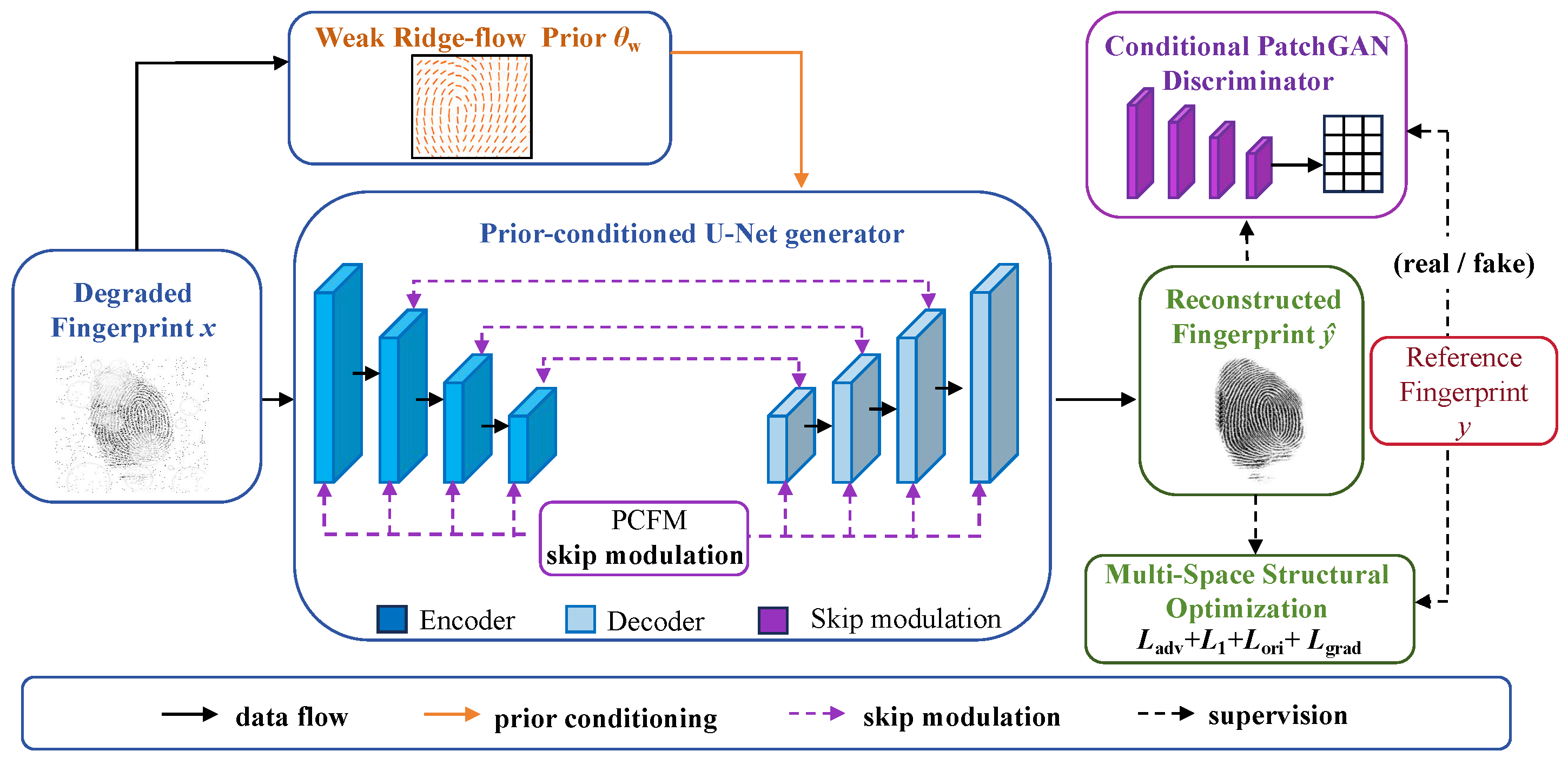
As illustrated in
Figure 1, the proposed framework consists of three main components: (1) a weak ridge-flow prior extraction module that estimates coarse directional information from the degraded fingerprint; (2) a U-Net-based reconstruction network equipped with prior-conditioned feature modulation (PCFM), which incorporates the weak ridge-flow prior into multi-scale skip-feature propagation; and (3) a conditional PatchGAN framework with complementary adversarial, image-space reconstruction, ridge-flow orientation-consistency, and gradient-consistency objectives.
During training, the conditional PatchGAN discriminator distinguishes the real pair from the generated pair , while the high-quality reference y provides image-space and structural supervision for the generator. During inference, only the degraded fingerprint x is required, and its weak ridge-flow prior is extracted internally by the prior-extraction module.
Rather than relying solely on local appearance restoration, the proposed framework incorporates residual fingerprint-specific ridge-flow information into multi-scale skip-feature propagation. The PCFM modules use the weak ridge-flow prior to modulate encoder features before their fusion with the corresponding decoder features, thereby encouraging ridge continuity and orientation consistency under severe degradation.
2.2. Weak Ridge-Flow Prior Extraction
Fingerprint ridges exhibit a directional spatial organization that may remain partially observable in degraded fingerprint images. Although this residual information is insufficient to determine the complete ridge structure, it can provide coarse directional guidance for maintaining ridge continuity and orientation consistency during reconstruction.
To extract this information, a lightweight weak ridge-flow prior extraction module is applied directly to the degraded fingerprint. Given an input fingerprint image x, two convolutional layers are used to obtain local gradient-sensitive features. Two directional response maps, denoted by and , are then produced from these features to represent the horizontal and vertical responses used for local ridge-orientation estimation.
The coarse ridge-flow orientation at pixel location
is estimated as
where
denotes the two-argument arctangent function, and
denotes the estimated orientation at pixel
. Because fingerprint orientations are defined modulo
,
and
represent the same local ridge direction. The orientation estimates over the entire image form the weak ridge-flow prior
, which provides coarse structural guidance to the subsequent reconstruction network.
Rather than directly imposing the estimated orientation field as an exact output constraint, the proposed framework treats it as a weak ridge-flow prior. Severe ridge fragmentation, diffusion blur, partial information loss, and background interference may introduce local errors into the estimated orientation field. Therefore, the extracted ridge-flow information is used as an auxiliary structural cue rather than as an exact representation of the underlying ridge pattern.
The weak ridge-flow prior is incorporated into multi-scale skip-feature propagation through PCFM. Because the modulation coefficients are jointly derived from the encoder features and the estimated prior, the contribution of the structural information can vary across spatial locations. This design allows the reconstruction network to use residual ridge-flow information as coarse directional guidance without explicitly forcing the reconstructed fingerprint to follow every local orientation estimate.
2.3. Weak Ridge-Flow Prior-Conditioned Feature Modulation
To incorporate the weak ridge-flow prior into the reconstruction network, we introduce a prior-conditioned feature modulation (PCFM) mechanism in the encoder–decoder skip connections. Rather than imposing the estimated orientation field directly on the reconstructed output, PCFM uses the ridge-flow prior together with intermediate encoder features to generate spatial modulation coefficients. These coefficients modulate the encoder features before they are propagated to the corresponding decoder stages, allowing the contribution of the structural prior to vary across spatial locations.
The reconstruction network adopts a U-Net-based encoder–decoder architecture. The encoder extracts hierarchical fingerprint features from the degraded input, while the decoder progressively reconstructs the ridge structure through multi-scale feature fusion. In a conventional U-Net, encoder features are directly propagated to the corresponding decoder stages through skip connections. Although this direct feature propagation helps preserve spatial details, it may also transmit degradation-related responses and background interference to the decoder. PCFM is therefore applied to the skip connections to modulate the encoder features before feature fusion.
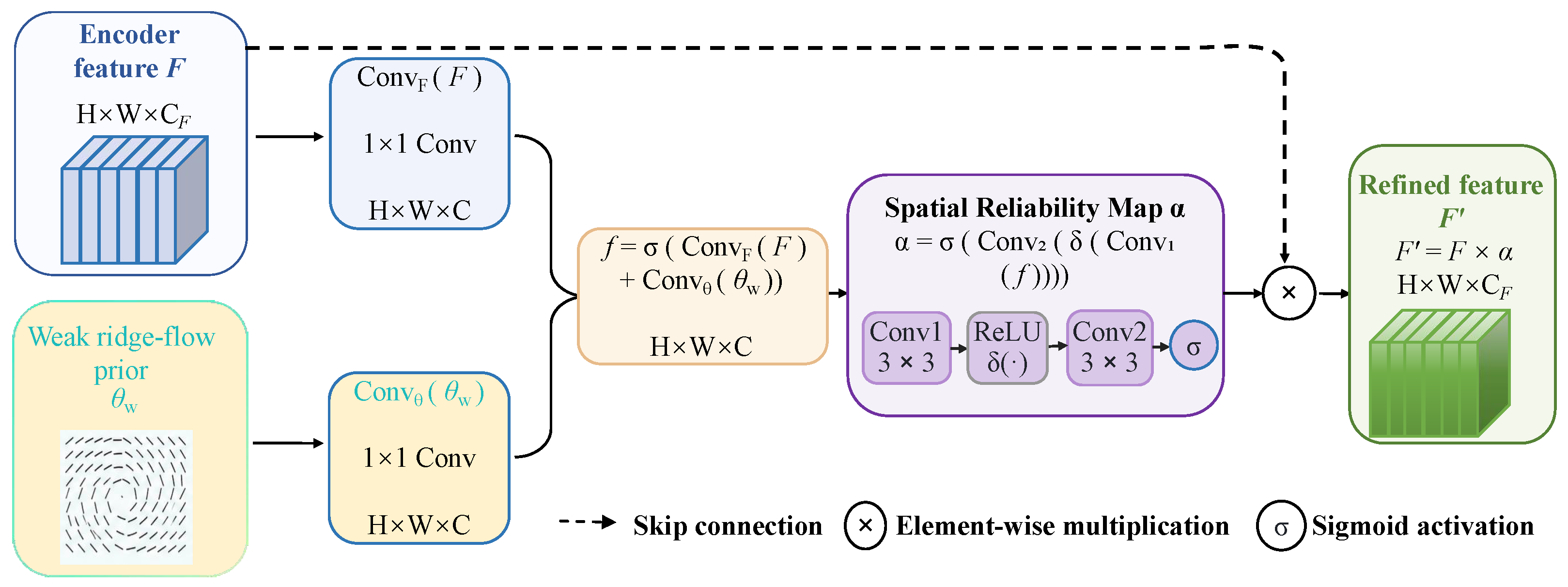
At a given encoder scale, let
denote the encoder feature map, and let
denote the weak ridge-flow prior spatially aligned with
F. The encoder feature and the ridge-flow prior are first projected into a shared embedding space:
where
denotes the sigmoid activation function, and
and
denote learnable projection operations for the encoder feature and weak ridge-flow prior, respectively. Both projection operations produce feature maps with the same spatial dimensions and number of channels, allowing them to be combined by element-wise addition. The sigmoid activation bounds the fused representation
f to the interval
before it is used to generate the spatial modulation coefficients.
Based on the fused representation
f, a spatial modulation map is generated to control the propagation of encoder features at different spatial locations:
where
denotes the ReLU activation function,
denotes the sigmoid activation function, and
and
denote learnable convolutional operations. The resulting modulation map
assigns a spatial weight to each location of the encoder feature map.
The modulated encoder feature is then obtained as
where ⊙ denotes element-wise multiplication with
broadcast along the channel dimension of
F. Because
is jointly generated from the encoder feature and the weak ridge-flow prior, the transmission of encoder features is spatially modulated using both appearance and structural information. The modulated feature
is subsequently propagated to the corresponding decoder stage through the skip connection.
Unlike feature modulation based solely on encoder activations, PCFM incorporates the weak ridge-flow prior when generating the spatial modulation map. Therefore, the propagation of skip features is conditioned on both the encoder representation and fingerprint-specific directional information. This design allows the contribution of encoder features to vary across spatial locations before they are fused with the corresponding decoder features.
The structure of PCFM is illustrated in
Figure 2.
2.4. Structure-Aware Fingerprint Reconstruction Network
The proposed generator adopts a U-Net-based encoder–decoder architecture and incorporates PCFM into its skip connections. The encoder–decoder structure combines hierarchical fingerprint features with fine-grained spatial information, which is useful for reconstructing both coarse ridge-flow organization and local ridge details.
The encoder progressively extracts multi-scale fingerprint features from the degraded input. Convolutional blocks with increasing channel dimensions are used to represent ridge patterns at different spatial resolutions. The decoder reconstructs the fingerprint through progressive upsampling and multi-scale feature fusion. At each corresponding encoder–decoder scale, PCFM modulates the encoder feature using the spatially aligned weak ridge-flow prior before the feature is fused with the decoder representation.
In a conventional U-Net, multi-scale encoder features are directly propagated to the corresponding decoder stages through skip connections. In the proposed generator, PCFM is applied to the encoder features before feature fusion. This operation allows skip-feature transmission to be spatially modulated using both the encoder representation and the weak ridge-flow prior, thereby limiting the direct propagation of degradation-related responses to the decoder.
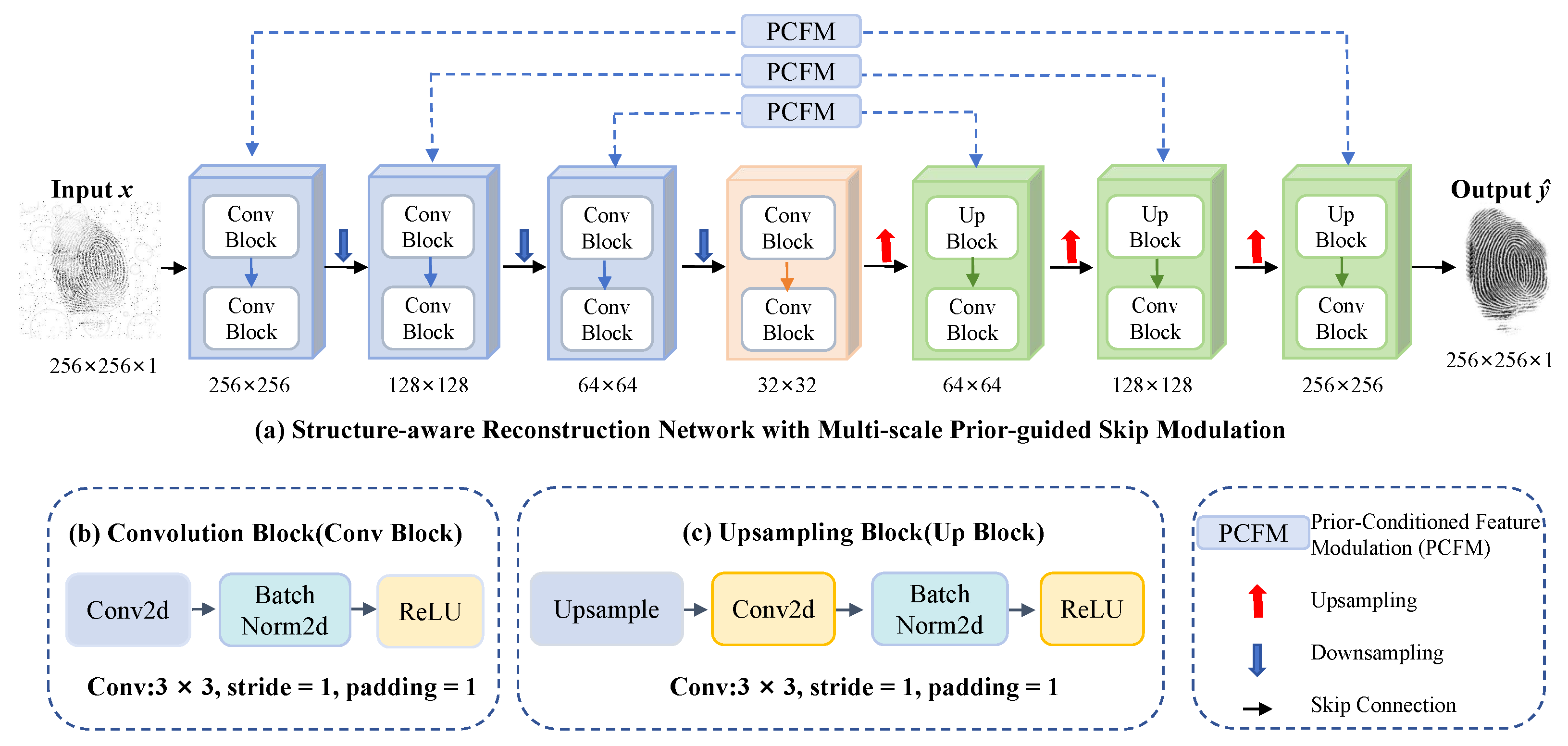
The complete generator architecture is illustrated in
Figure 3. Given a
degraded fingerprint, the encoder extracts hierarchical feature representations with channel dimensions of 64, 128, 256, and 512. The corresponding spatial resolutions are
,
,
, and
, respectively. The deepest 512-channel representation forms the bottleneck of the network. Each convolutional block consists of a Conv2d layer, a BatchNorm2d layer, and a ReLU activation.
The decoder progressively reconstructs the fingerprint through three upsampling stages with output channel dimensions of 256, 128, and 64. Each upsampling stage uses bilinear interpolation followed by convolution, which avoids the uneven overlap associated with transposed convolution. PCFM is applied to the three skip connections associated with the 64-, 128-, and 256-channel encoder features. The resulting modulated features are fused with the decoder features at the corresponding spatial scales. Finally, a convolution followed by a Tanh activation produces the reconstructed fingerprint .
2.5. Conditional Adversarial Learning
Although the proposed reconstruction network incorporates structural information through the weak ridge-flow prior, image-space reconstruction objectives alone may produce overly smooth ridge textures. Fingerprint reconstruction requires both structural consistency and locally realistic ridge–valley patterns, which are important for minutiae extraction and subsequent fingerprint matching.
A conditional adversarial learning strategy is therefore introduced to improve the local realism of the reconstructed fingerprints. As defined in Equation (
1), the generator produces
from the degraded fingerprint
x and its weak ridge-flow prior
. The conditional discriminator receives either the real pair
or the generated pair
and learns to distinguish between the two. Through adversarial optimization, the generator is encouraged to produce reconstructed ridge patterns whose local appearance is closer to that of the high-quality reference fingerprints.
A PatchGAN discriminator is employed to provide patch-level adversarial feedback. Rather than producing a single global classification score, PatchGAN evaluates overlapping local receptive fields and outputs a spatial discrimination map. This design is suitable for assessing local ridge patterns, including ridge endings, bifurcations, and ridge–valley transitions.
The discriminator is composed of convolutional blocks using LeakyReLU activations and, where applicable, batch-normalization layers. Its spatial output provides localized adversarial feedback that encourages the generator to reconstruct plausible ridge textures and reduce unrealistic local patterns. However, adversarial supervision alone does not explicitly enforce image-space correspondence, ridge-flow orientation consistency, or gradient consistency. Therefore, complementary constraints in the image, orientation, and gradient spaces are introduced in the following subsection.
2.6. Multi-Space Structural Consistency Optimization
Conditional adversarial learning encourages the reconstruction of locally realistic ridge textures. However, adversarial supervision alone does not ensure image-space correspondence or the preservation of fingerprint structure, particularly under severe degradation. In fingerprint reconstruction, the reconstructed image should maintain structural characteristics such as ridge continuity, ridge-flow orientation consistency, and local ridge–valley transitions.
The proposed framework therefore employs a multi-space optimization objective that supervises fingerprint reconstruction using complementary adversarial, image-space, orientation-space, and gradient-space criteria. The adversarial objective encourages locally realistic ridge patterns, the image-space objective maintains correspondence with the reference fingerprint, the orientation-space objective constrains ridge-flow organization, and the gradient-space objective preserves local ridge–valley transitions. Together, these objectives encourage the generator to reconstruct structurally consistent ridge patterns rather than optimizing visual appearance alone.
2.6.1. Adversarial Distribution Constraint
The adversarial objective encourages the distribution of reconstructed fingerprints to approach that of the high-quality reference fingerprints. Under the conditional adversarial framework, the generator attempts to produce reconstructed fingerprints that the discriminator cannot distinguish from the corresponding high-quality references.
For the
nth sample in a mini-batch, let
where
denotes the weak ridge-flow prior extracted from
. The generator adversarial loss is defined as
where
denotes the spatial probability map produced by the conditional PatchGAN discriminator,
N denotes the batch size, and
and
denote the spatial dimensions of the discriminator output.
The discriminator loss is defined as
where
denotes the high-quality reference corresponding to
. The discriminator learns to classify the real pair
and the generated pair
at the patch level, while the adversarial loss encourages the generator to produce locally plausible ridge textures.
2.6.2. Image-Space Reconstruction Constraint
Although adversarial learning encourages locally realistic ridge textures, it does not explicitly maintain pixel-wise correspondence between the reconstructed fingerprint and its high-quality reference. Therefore, an image-space reconstruction constraint is introduced to preserve their image-level correspondence.
The reconstruction loss is defined using the mean absolute error:
where
and
denote the pixel values of the reconstructed fingerprint and its corresponding high-quality reference, respectively. This constraint encourages the reconstructed image to remain aligned with the reference fingerprint and limits excessive pixel-level deviation during adversarial optimization.
2.6.3. Ridge-Flow Orientation-Consistency Constraint
The image-space reconstruction loss does not explicitly constrain the orientation of the reconstructed ridge patterns. Therefore, a ridge-flow orientation-consistency loss is introduced to encourage directional agreement between the reconstructed fingerprint and its corresponding high-quality reference.
Because fingerprint ridge orientations are defined modulo
, directly comparing orientation angles may introduce discontinuities at the angular boundary. Each orientation angle
is therefore represented using the double-angle vector
for which
. Let
and
denote the double-angle orientation vectors extracted from the high-quality reference and reconstructed fingerprints, respectively. The ridge-flow orientation-consistency loss is defined as
where
N denotes the batch size,
H and
W denote the spatial dimensions of the orientation fields, and
is a small positive constant introduced for numerical stability. Minimizing
encourages the reconstructed ridge orientations to remain consistent with those of the reference fingerprint while accounting for the
-periodicity of fingerprint orientations.
2.6.4. Gradient-Space Structural Constraint
Fingerprint matching depends on local ridge–valley transitions and ridge boundary structures. Excessive smoothing during reconstruction may remove such local details and reduce the reliability of subsequent minutiae extraction.
A gradient-space constraint is therefore introduced to encourage local structural sharpness. The horizontal and vertical image gradients are computed using fixed Sobel operators, denoted by
and
, respectively. The gradient-consistency loss is defined as
where ∗ denotes convolution. This loss penalizes differences between the horizontal and vertical gradients of the reconstructed fingerprint and its high-quality reference, thereby encouraging the preservation of local ridge boundaries and ridge–valley transitions.
2.6.5. Overall Optimization Objective
The overall generator objective combines the adversarial, image-space reconstruction, ridge-flow orientation-consistency, and gradient-consistency losses:
where
,
,
, and
are non-negative coefficients that balance the contributions of the four losses. Unless otherwise specified, they are empirically set to
The generator is optimized by minimizing
, whereas the discriminator is optimized separately by minimizing
in Equation (
9). The complementary objectives encourage locally plausible ridge textures, image-space correspondence, ridge-flow orientation consistency, and the preservation of local ridge–valley transitions.
2.7. Training Strategy and Implementation Details
The proposed framework is implemented using PyTorch and accelerated with CUDA. All experiments are conducted on a workstation equipped with an NVIDIA GeForce RTX 4070 Ti GPU with 12 GB of memory and an Intel Core i9-14900KF CPU.
The model is trained using the training subset described in
Section 3.1.1, while the validation subset is used exclusively for checkpoint selection. All fingerprint images are resized to
pixels and normalized to the range
, consistent with the Tanh activation of the generator output. The batch size is set to 8, and the framework is trained for 100 epochs.
The generator and discriminator are optimized using Adam with exponential decay rates and . Their initial learning rates are set to and , respectively. A stepwise learning-rate schedule is employed, in which both learning rates are multiplied by 0.9 every 20 epochs.
To stabilize adversarial optimization, a 10-epoch generator warm-up stage is employed. During this stage, the discriminator is frozen, and the adversarial-loss weight is set to zero. The generator is optimized using the image-space reconstruction, ridge-flow orientation-consistency, and gradient-consistency losses. Beginning with the 11th epoch, the discriminator is activated, and the generator and discriminator are optimized alternately. The generator minimizes the complete objective in Equation (
14), whereas the discriminator minimizes
in Equation (
9).
For each training iteration, the weak ridge-flow prior is first extracted from the degraded fingerprint. The generator then produces the reconstructed fingerprint through PCFM. During joint adversarial training, the discriminator is updated using the real pair and the generated pair . The generator is subsequently updated using the adversarial, image-space reconstruction, ridge-flow orientation-consistency, and gradient-consistency losses.
At the end of each epoch, the generator objective is evaluated on the validation subset. The checkpoint with the lowest mean validation objective is retained for final evaluation. Neither the test subset nor FVC2004 DB1 is used for checkpoint selection or hyperparameter optimization.
3. Experiments
3.1. Dataset and Experimental Settings
The proposed framework is evaluated on a synthetically degraded fingerprint dataset derived from NIST SD301. An independent real fingerprint dataset is additionally used for qualitative cross-dataset evaluation.
3.1.1. Synthetic Degraded Fingerprint Dataset
The synthetic dataset is constructed using fingerprint images selected from NIST Special Database 301 (SD301) [
25]. A total of 300 high-quality fingerprint images with NFIQ2 [
26] scores greater than 60 are selected as source reference images. Because large-scale paired datasets of severely degraded fingerprints and their corresponding high-quality references are difficult to obtain, a synthetic degradation procedure is used to generate degraded–reference image pairs.
Before degradation synthesis, the 300 source images are divided into mutually exclusive training, validation, and test subsets containing 200, 40, and 60 source images, respectively. The partition is performed at the source-image level, and all degraded variants generated from the same source image are assigned to the same subset. This strategy prevents different degraded versions of an identical reference image from being shared across the training, validation, and test sets.
To characterize the source-image quality after preprocessing and before synthetic degradation, NFIQ2 statistics were computed for each subset. The training set () had a mean score of (median: 43; range: 19–59), the validation set () had a mean score of (median: 40; range: 25–53), and the test set had a mean score of based on 59 valid NFIQ2 scores (median: 42; range: 25–54). NFIQ2 did not return a valid score for one preprocessed test image; this image was excluded only from the descriptive NFIQ2 statistics. The NFIQ2 selection criterion was applied to the original SD301 images before network-specific preprocessing.
The degradation procedure simulates several types of fingerprint quality degradation, including ridge fragmentation, local diffusion and dilation, Gaussian noise, salt-and-pepper noise, Gaussian blur, and resolution reduction. Multiple operations are randomly combined, and their parameters are sampled independently for each degraded variant. The degradation operations and parameter settings are summarized in
Table 1.
For each source image, 200 degraded variants are generated by independently sampling the degradation types and parameter values described above. This procedure produces 40,000, 8000, and 12,000 degraded–reference pairs for the training, validation, and test subsets, respectively, resulting in a total of 60,000 pairs. Each pair consists of a synthetically degraded image and the corresponding undegraded source image used as the reconstruction reference.
Although the dataset contains 60,000 degraded–reference pairs, these pairs are derived from 300 source images. The degraded variants generated from the same source image share an identical underlying ridge structure and are therefore not regarded as distinct finger identities or statistically independent source fingerprints. All degraded and reference images are resized to
pixels before being provided to the network. The composition of the dataset is summarized in
Table 2.
3.1.2. External Real Fingerprint Dataset
FVC2004 DB1 [
27] is used for qualitative cross-dataset evaluation. This dataset is completely excluded from model training, validation, checkpoint selection, and hyperparameter optimization.
FVC2004 DB1 contains multiple fingerprint impressions acquired under deliberately challenging conditions, including variations in finger placement, pressure, skin condition, and sensor interaction. Consequently, some images exhibit weak ridge–valley contrast, local deformation, incomplete fingerprint regions, and background interference. These characteristics make FVC2004 DB1 suitable for examining the transferability of the proposed method to acquisition conditions different from those represented by the NIST SD301-derived training set. The evaluated images are resized to pixels before being processed by the reconstruction network.
The model trained on the NIST SD301-derived dataset is directly applied to FVC2004 DB1 without fine-tuning or dataset-specific parameter adjustment. Because paired high-quality references are not used under the adopted evaluation setting, the dataset is used only for qualitative analysis. Accordingly, no conclusion regarding identity preservation or recognition-performance improvement is drawn solely from these visual results.
3.1.3. Experimental Settings
Unless otherwise specified, all methods in the primary NIST SD301-derived experiment are evaluated using identical preprocessing and test inputs. All trainable baseline models are trained and selected using the training and validation subsets described in
Section 3.1.1. Traditional non-learning-based methods are directly applied to the same test images using their specified parameter settings.
The NIST SD301-derived test subset is used for the primary in-domain quantitative evaluation. FVC2004 DB1 is used exclusively for qualitative cross-dataset evaluation and is not involved in model training, validation, checkpoint selection, or hyperparameter optimization. The model trained on the NIST SD301-derived dataset is directly applied to FVC2004 DB1 without fine-tuning or dataset-specific parameter adjustment.
The evaluated FVC2004 DB1 images are resized to pixels before reconstruction using the same deterministic preprocessing procedure, without image-specific adjustment.
The proposed framework is evaluated in terms of recognition-oriented fingerprint quality, qualitative ridge-structure reconstruction, minutiae restoration, and fingerprint identification performance. The corresponding metrics and evaluation protocols are described in the following subsection.
3.2. Evaluation Metrics
Unlike general image restoration, which is commonly evaluated primarily in terms of image-level similarity, fingerprint reconstruction also requires consideration of identity-related ridge information. The proposed framework is therefore evaluated from four complementary perspectives: (i) fingerprint quality; (ii) ridge-structure reconstruction; (iii) minutiae preservation; and (iv) fingerprint identification performance.
NFIQ2 [
26] is used to evaluate recognition-oriented fingerprint quality, with a higher score indicating greater predicted biometric utility. Ridge-structure reconstruction is qualitatively assessed by comparing ridge continuity, ridge-flow orientation consistency, ridge–valley separation, and local ridge details in the degraded, reconstructed, and high-quality reference fingerprints.
Minutiae preservation is quantitatively evaluated using Precision, Recall, and the
-score based on minutiae extracted by FpMV [
28]. Minutiae extracted from the corresponding high-quality reference fingerprints serve as the reference sets. Let
and
denote a detected minutia and a reference minutia, respectively, where
denotes the spatial coordinates,
denotes the discrete direction index exported by FpMV, and
i and
j index the detected and reference minutiae, respectively.
A minutia pair is considered a valid match when
According to the NIST MINDTCT direction encoding, the 32 direction bins cover with an interval of per bin. Thus, the direction threshold of three bins corresponds to . The spatial threshold of 10 pixels is evaluated at the image resolution used for minutiae extraction and matching. A one-to-one greedy nearest-neighbor assignment is used, and each reference minutia can be matched at most once. Minutiae-type consistency between ridge endings and bifurcations is not enforced during matching.
Matched pairs are counted as true positives (TP), unmatched detected minutiae as false positives (FP), and unmatched reference minutiae as false negatives (FN). The evaluation metrics are defined as
For dataset-level evaluation, TP, FP, and FN are accumulated over all evaluated fingerprints before computing the above metrics, corresponding to a micro-averaged evaluation.
Fingerprint identification performance is evaluated using SourceAFIS [
29] under a closed-set 1:N identification protocol. Rank-1, Rank-5, and Rank-10 identification rates are reported together with cumulative match characteristic (CMC) curves to evaluate the downstream biometric utility of the reconstructed fingerprints.
These complementary evaluations jointly assess fingerprint quality, local ridge reconstruction, minutiae preservation, and downstream biometric identification performance. The qualitative ridge comparisons provide visual evidence of structural reconstruction, whereas the quantitative minutiae and fingerprint identification evaluations objectively assess the consistency of the reconstructed fingerprints with their corresponding high-quality references.
3.3. Fingerprint Quality Evaluation
NFIQ2 is used to assess whether the proposed reconstruction framework improves the predicted biometric utility of the degraded fingerprints.
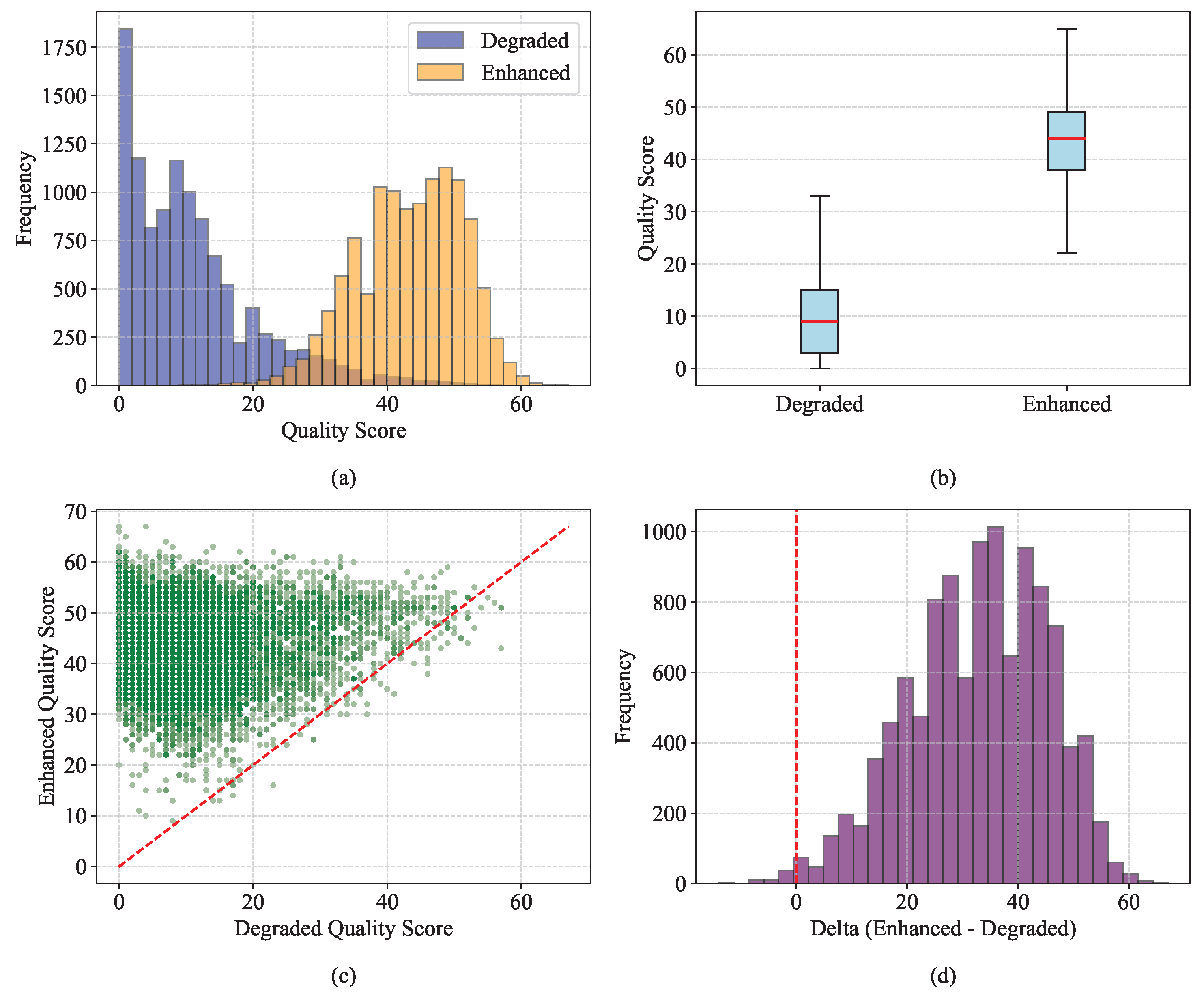
Figure 4 compares the NFIQ2 scores of the degraded inputs and their corresponding reconstructed fingerprints.
As shown in
Figure 4a, the image-level score distribution shifts toward higher values after reconstruction. The boxplot in
Figure 4b shows that the median NFIQ2 score increases from 9 to 44, while the mean score improvement is 32.79 points. The paired scatter plot in
Figure 4c shows that most reconstructed samples lie above the diagonal reference line. In addition, the score-difference distribution in
Figure 4d indicates that most image-level improvements are concentrated between 30 and 40 points.
Statistical significance was assessed using source-level average NFIQ2 scores to avoid treating multiple degraded variants generated from the same source fingerprint as independent observations. The Wilcoxon signed-rank test indicates a statistically significant increase in NFIQ2 scores after reconstruction (). Larger score increases are observed for many fingerprints with low initial NFIQ2 values, suggesting that the proposed method is particularly beneficial for low-quality inputs in the evaluated synthetic test set.
Overall, the NFIQ2 results indicate that the proposed method improves the predicted quality and biometric utility of the degraded fingerprints. These results do not independently establish the recovery of ridge topology or minutiae structure, which are evaluated separately in the following subsections.
3.4. Minutiae Restoration Evaluation
Fingerprint reconstruction should improve not only visual quality but also the recovery of identity-related local ridge structures. Minutiae, particularly ridge endings and bifurcations, are key local features used by automatic fingerprint identification systems. Therefore, minutiae preservation is evaluated to examine the agreement between the reconstructed fingerprints and their corresponding high-quality references.
FpMV [
28] is applied to the degraded, reconstructed, and corresponding high-quality reference fingerprints using identical extraction settings. Minutiae extracted from the high-quality reference fingerprints serve as the ground-truth reference sets. The extracted minutiae are matched according to the protocol described in
Section 3.2.
Table 3 summarizes the micro-averaged minutiae matching performance. Compared with the degraded inputs, the reconstructed fingerprints increase the number of matched reference minutiae from 967 to 2352. At the same time, the number of unmatched detected minutiae decreases from 2349 to 1919, and the number of unmatched reference minutiae decreases from 3432 to 2047. Consequently, the micro-averaged Precision increases from 0.2916 to 0.5507, Recall increases from 0.2198 to 0.5347, and the
-score increases from 0.2507 to 0.5426.
These results indicate that the reconstructed fingerprints contain substantially more correctly matched minutiae while producing fewer unmatched detected and reference minutiae. This demonstrates that the proposed reconstruction method substantially improves the preservation of local identity-related ridge information. However, minutiae agreement alone does not establish complete identity preservation; downstream fingerprint identification performance is evaluated separately in the following subsection.
Statistical significance was assessed using paired image-level Precision, Recall, and
-score values rather than the micro-averaged results reported in
Table 3. The Wilcoxon signed-rank test indicated statistically significant improvements in Precision, Recall, and the
-score, with
p-values of
,
, and
, respectively. All three values are below the significance threshold of 0.001.
3.5. Fingerprint Identification Evaluation
While minutiae preservation evaluates the agreement between the reconstructed and reference minutiae, fingerprint identification provides a direct assessment of the downstream biometric utility of the reconstructed fingerprints. Therefore, SourceAFIS [
29] is employed to compare the identification performance of the degraded and reconstructed fingerprints.
A closed-set 1:N identification experiment is conducted using the 60 high-quality reference fingerprints in the test subset as the gallery. The 12,000 degraded variants generated from these reference fingerprints constitute the degraded probe set, with 200 probes corresponding to each gallery image. The reconstructed versions of the same degraded variants form the reconstructed probe set. Each probe has exactly one corresponding reference fingerprint in the gallery.
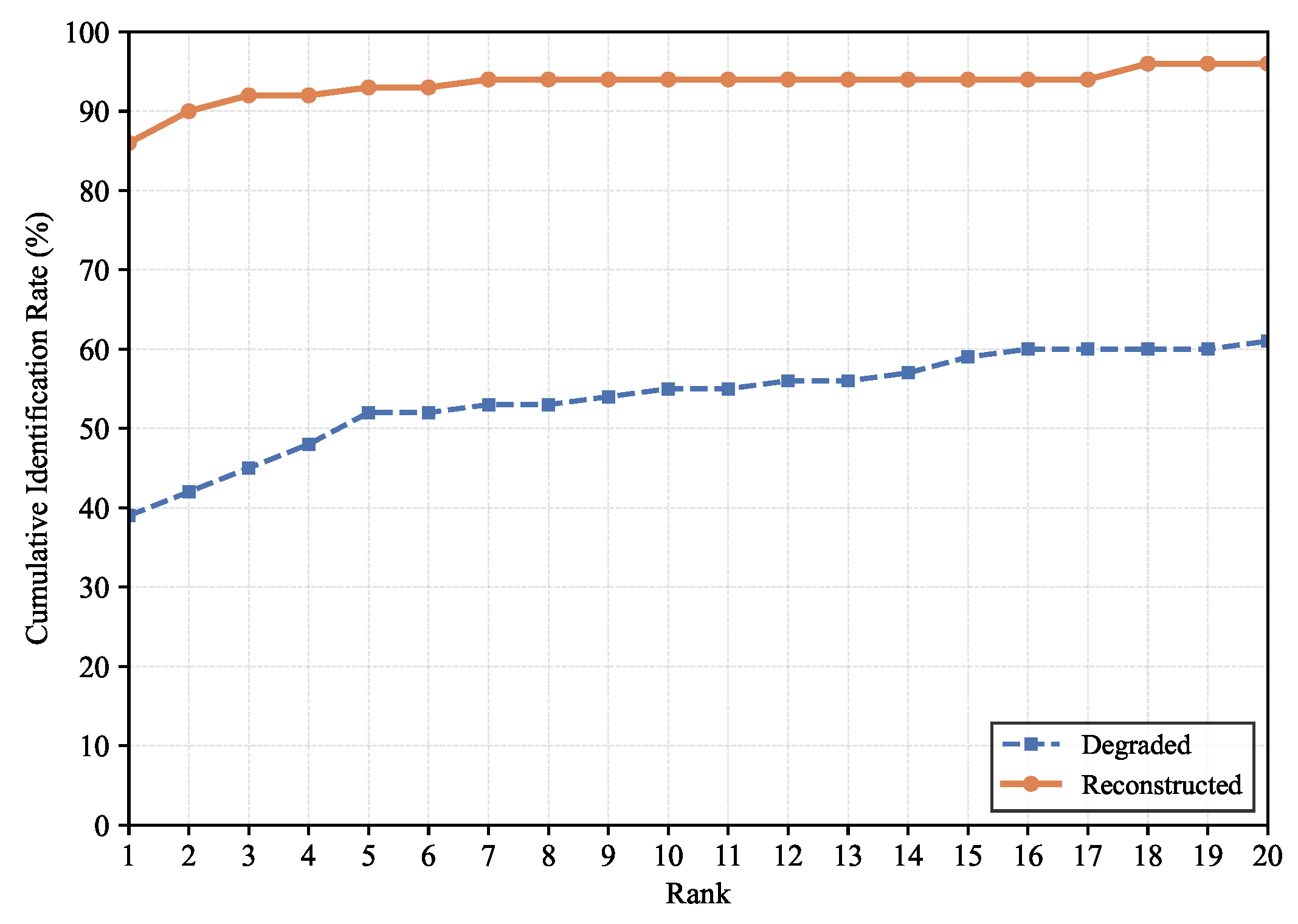
The degraded and reconstructed probe sets contain identical fingerprint instances and are evaluated against the same fixed gallery. Rank-1, Rank-5, and Rank-10 identification rates are reported.
As shown in
Table 4, the Rank-1 identification rate increases from 39% for the degraded probes to 86% for the reconstructed probes. The Rank-5 and Rank-10 identification rates increase from 48% to 92% and from 55% to 93%, respectively. The corresponding CMC curves are presented in
Figure 5, showing that the reconstructed probes consistently achieve higher cumulative identification rates over the evaluated rank range.
These results demonstrate that the reconstructed fingerprints provide substantially more discriminative representations for SourceAFIS identification than the degraded inputs. The improvement is consistent with the minutiae evaluation and indicates that the proposed method recovers fingerprint information relevant to downstream fingerprint matching. However, identification performance alone does not verify the correctness of every reconstructed ridge or minutiae.
3.6. Comparison with Existing Enhancement Methods
To further evaluate the proposed framework, comparisons are conducted with representative traditional and learning-based fingerprint enhancement methods. The evaluated methods include Gabor filtering, STFT enhancement, pix2pix [
30], and FingerGAN [
21]. All methods are evaluated using the same fixed test inputs and the gallery–probe protocol described in
Section 3.5.
Gabor filtering and STFT enhancement rely on manually designed models of local ridge orientation and frequency. Pix2pix learns a general image-to-image mapping from paired degraded and reference fingerprints, whereas FingerGAN introduces adversarial learning with fingerprint-specific structural constraints.
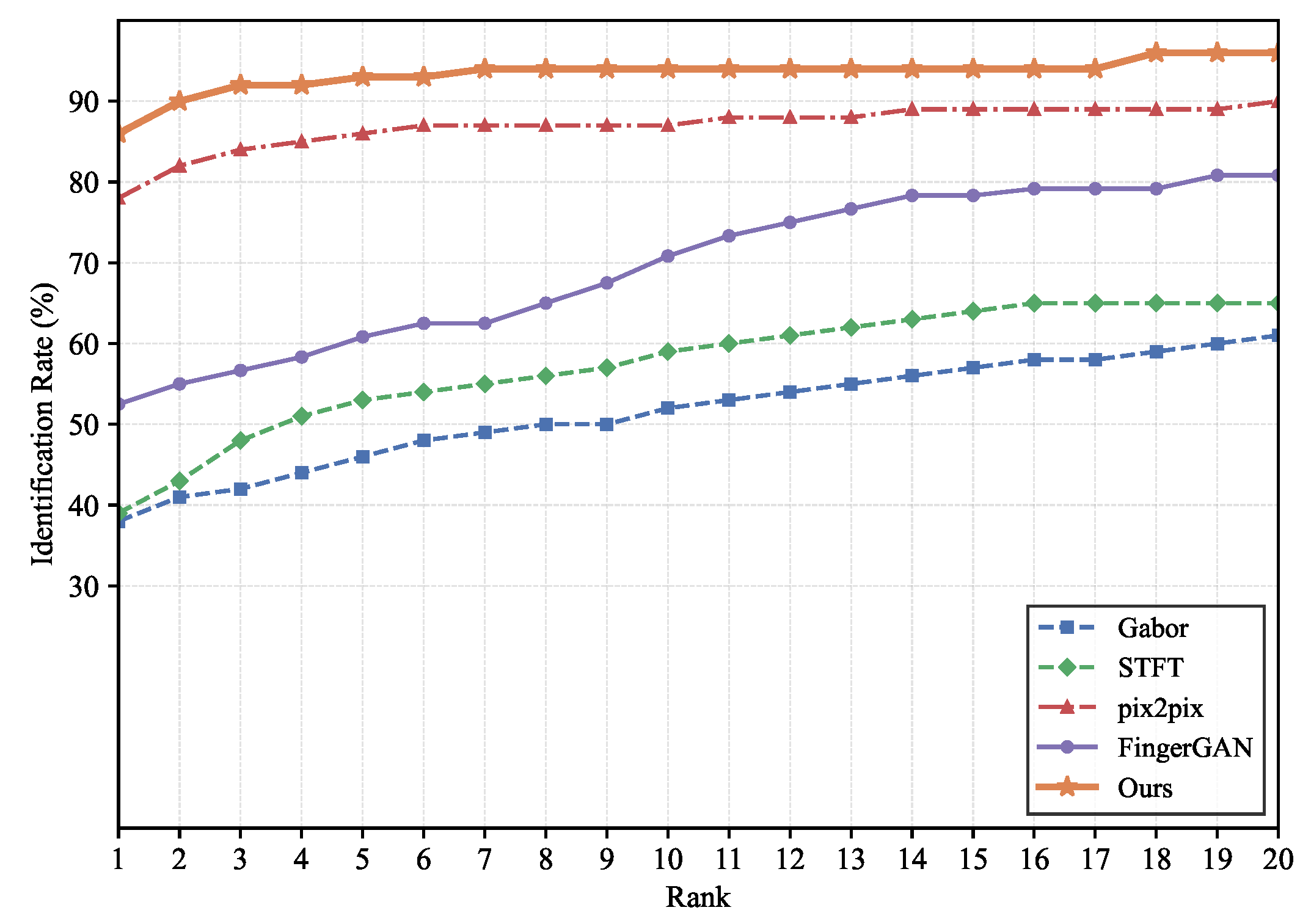
Table 5 summarizes the identification performance of the evaluated methods. Gabor filtering and STFT enhancement achieve Rank-1 identification rates of 38% and 39%, respectively. The learning-based methods exhibit higher but varying performance, with pix2pix and FingerGAN achieving Rank-1 rates of 78% and 53%, respectively.
Among the evaluated methods, the proposed framework achieves the highest Rank-1, Rank-5, and Rank-10 identification rates of 86%, 92%, and 93%, respectively. Compared with pix2pix, these results correspond to improvements of 8, 7, and 5 percentage points. Compared with FingerGAN, the corresponding improvements are 33, 31, and 22 percentage points.
The CMC curves in
Figure 6 further show that the proposed method achieves higher identification rates across the evaluated rank range. These results indicate that the complete proposed framework provides more useful reconstructed fingerprints for SourceAFIS identification than the evaluated baselines. The specific contributions of the weak ridge-flow prior and PCFM are examined separately in the ablation analysis.
3.7. Qualitative Cross-Dataset Evaluation on Real Fingerprints
To examine the transferability of the proposed framework beyond the NIST SD301-derived training distribution, a qualitative cross-dataset evaluation is conducted on FVC2004 DB1 using the protocol described in
Section 3.1.2. This dataset is completely excluded from model training, validation, checkpoint selection, and hyperparameter optimization. The model trained on the NIST SD301-derived synthetic dataset is directly applied to FVC2004 DB1 without fine-tuning or dataset-specific parameter adjustment.
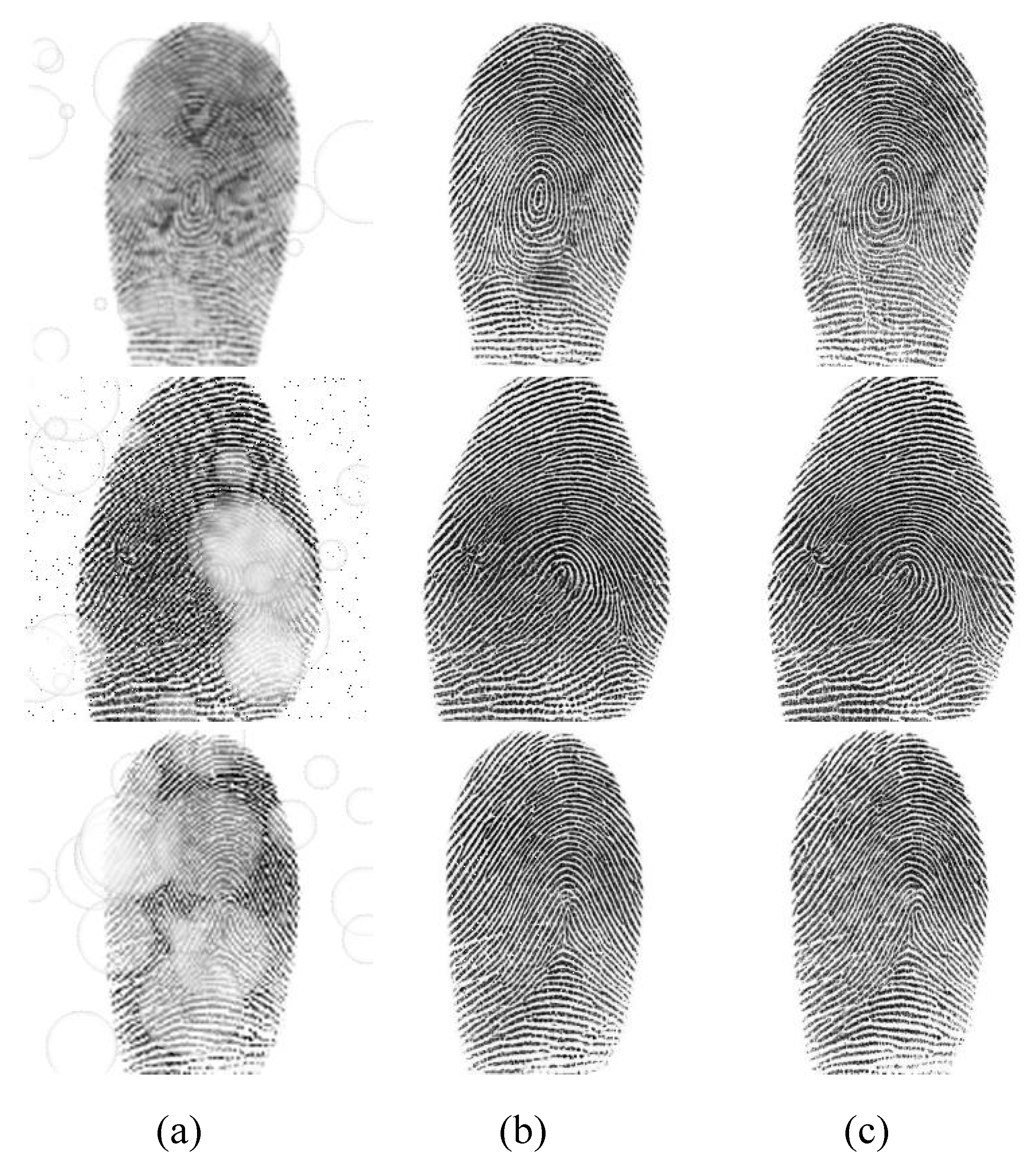
Representative results are shown in
Figure 7. Compared with the original inputs, the reconstructed fingerprints generally exhibit clearer ridge–valley separation and improved ridge visibility in regions affected by weak contrast and background interference. Some fragmented ridge regions also become more continuous after reconstruction. However, local ridge connections may remain incomplete or inaccurate when insufficient structural evidence is retained in the input.
Because paired high-quality references are not used in this evaluation, the results should be interpreted only as qualitative evidence of cross-dataset transferability. Visual improvement does not establish that every reconstructed ridge structure is identity-preserving. Quantitative evaluation using verified mated fingerprint impressions is required for further validation.
3.8. Ablation Analysis
Ablation and robustness experiments are conducted to determine whether the observed performance improvements arise from the proposed structural-prior design rather than solely from the underlying U-Net and adversarial reconstruction framework. The analysis focuses on three aspects: (1) the contributions of the weak ridge-flow prior and its PCFM-based integration strategy; (2) the robustness of the proposed model to estimation errors in the weak ridge-flow prior; and (3) the contributions of the individual optimization objectives.
For the component- and loss-ablation experiments, all model variants use the same dataset partitions, preprocessing pipeline, training schedule, checkpoint-selection criterion, and gallery–probe protocol. Unless otherwise specified, only the component or optimization objective under investigation is modified, while the remaining architecture and experimental settings are kept unchanged. For the weak-prior perturbation analysis, the trained full model is kept fixed, and only controlled angular perturbations are applied to the estimated ridge-flow prior during inference. This analysis is conducted using a larger probe set, as described in
Section 3.8.2.
3.8.1. Ablation of the Weak Ridge-Flow Prior and PCFM
To examine the contributions of the weak ridge-flow prior and PCFM, three progressive configurations are compared. The first configuration uses conventional skip connections without a structural prior. The second introduces the weak ridge-flow prior through direct concatenation with the encoder features. The third replaces direct concatenation with the proposed PCFM mechanism. All configurations use the same encoder–decoder backbone, training schedule, optimization objectives, and evaluation protocol.
As shown in
Table 6, introducing the weak ridge-flow prior through direct concatenation increases the Rank-1 identification rate from 78% to 81%. The Rank-5 and Rank-10 rates increase from 85% to 87% and from 88% to 90%, respectively. Because the first two configurations differ primarily in the inclusion of the ridge-flow prior, these results suggest that residual directional information provides complementary guidance for fingerprint reconstruction.
Replacing direct concatenation with PCFM further increases the Rank-1 identification rate from 81% to 86%. The Rank-5 and Rank-10 rates increase from 87% to 92% and from 90% to 93%, respectively. These results suggest that PCFM provides a more effective strategy than direct concatenation for incorporating the weak ridge-flow prior into multi-scale skip-feature propagation.
3.8.2. Robustness to Weak Ridge-Flow Prior Perturbations
Since the weak ridge-flow prior is estimated directly from degraded fingerprints, orientation-estimation errors are inevitable under severe degradation. To assess the sensitivity of WRP-cGAN to inaccuracies in the estimated prior, controlled angular perturbations were introduced into the ridge-flow prior while the trained reconstruction network and all other inference settings were kept fixed. Five perturbation levels, , , , , and , were evaluated on more than 8000 degraded probe instances. For each nonzero perturbation level, three independent perturbation realizations were generated using different random seeds, and the identification results are reported as mean ± standard deviation. The condition represents the original estimated ridge-flow prior without additional perturbation.
As shown in
Table 7, identification performance remains largely stable under small-to-moderate perturbations of the estimated ridge-flow prior. At
and
, the changes in Rank-1 accuracy relative to the unperturbed condition are limited to
and
percentage points, respectively. As the perturbation level increases, a more noticeable degradation emerges. At
, Rank-1 accuracy decreases to 70.10%, while at
it decreases to 68.97%, corresponding to reductions of 0.70 and 1.83 percentage points relative to the
condition, respectively. Similar overall trends are observed for the Rank-5 and Rank-10 identification rates. The minor fluctuations at small perturbation levels are consistent with the variation across different perturbation realizations rather than indicating a systematic performance improvement.
Because this robustness experiment uses more than 8,000 probe instances, whereas the primary comparative experiments use a smaller fixed probe subset, the absolute identification rates reported in
Table 7 are not directly comparable with those reported in the main identification experiments. The perturbation experiment is intended specifically to assess the relative sensitivity of the fixed trained model to increasing errors in the weak ridge-flow prior.
These results indicate that the proposed reconstruction framework exhibits robustness to moderate errors in ridge-flow estimation. This behavior is consistent with the intended role of the ridge-flow estimate as a weak structural prior: PCFM adaptively modulates feature propagation using the estimated structural information rather than enforcing it as a hard constraint. Nevertheless, the performance decline under larger perturbations indicates that severely inaccurate ridge-flow estimates can adversely affect reconstruction, motivating the incorporation of explicit prior-confidence estimation and uncertainty-aware modulation in future work.
3.8.3. Ablation of the Optimization Objectives
The complete generator objective combines adversarial, image-space reconstruction, ridge-flow orientation-consistency, and gradient-consistency losses. To examine the contribution of each objective, each loss term is removed individually while the remaining network architecture, training schedule, and evaluation protocol are kept unchanged. The results are reported in
Table 8.
The full objective achieves Rank-1, Rank-5, and Rank-10 identification rates of 86%, 92%, and 93%, respectively. Removing reduces these rates to 83%, 88%, and 89%, indicating that ridge-flow orientation consistency provides useful structural supervision for identity-preserving reconstruction. Removing results in larger reductions, with Rank-1, Rank-5, and Rank-10 rates decreasing to 68%, 79%, and 84%, respectively, demonstrating the importance of preserving local ridge transitions and gradient-level details.
Removing produces a more pronounced performance degradation, with the three identification rates falling to 24%, 36%, and 51%, respectively. Although the adversarial term is assigned a relatively small weight in the complete objective, these results indicate that it still provides important distribution-level supervision for generating realistic and discriminative ridge structures. When is removed, the resulting reconstructions do not yield valid identification results under the current evaluation protocol; the corresponding entries are therefore reported as N/A. Overall, the ablation results indicate that the four objectives play complementary roles in balancing image fidelity, structural consistency, local ridge detail, and reconstruction realism.
The loss weights were selected empirically through preliminary experiments on the validation subset. During the initial tuning stage, relatively large coefficients, namely , , , and , were examined. This configuration resulted in unstable optimization and inconsistent reconstruction quality, suggesting that excessively large adversarial and auxiliary-loss contributions can disrupt the balance among the reconstruction objectives.
We therefore used the image-space reconstruction term as the reference scale by setting and progressively reduced the relative contributions of the remaining objectives. In particular, a weak adversarial weight was adopted to limit excessive adversarial influence, which may otherwise favor visually plausible ridge textures without necessarily preserving the underlying identity-related structure. The final configuration was set to , , , and . Under this configuration, the term serves as the primary image-fidelity constraint, while the adversarial, orientation-consistency, and gradient-consistency terms provide complementary appearance and structural supervision. All loss weights were determined exclusively using the validation subset; neither the test set nor the external datasets were used for parameter selection.
3.9. Computational Efficiency Analysis
In addition to reconstruction performance, computational efficiency is an important consideration when fingerprint enhancement is used as a preprocessing stage in automatic fingerprint identification systems (AFIS). We therefore compare the model complexity, inference latency, throughput, and Rank-1 identification performance of the proposed framework with two representative reconstruction baselines, U-Net and pix2pix.
For a fair comparison, the parameter count includes all trainable components required during inference. For pix2pix, only the generator parameters are counted because the discriminator is not used at inference time. For the proposed method, the reported parameter count includes the reconstruction network, weak ridge-flow prior extraction module, and PCFM modules. Inference latency is measured for a single
fingerprint image on the same NVIDIA GeForce RTX 4070 Ti GPU, excluding data loading, preprocessing, postprocessing, and disk input/output. The corresponding throughput is computed as the reciprocal of the average per-image inference latency. The results are summarized in
Table 9.
As shown in
Table 9, the proposed framework contains 8.704 M trainable parameters, representing an increase of only 0.141 M, or approximately 1.65%, compared with the generators used by U-Net and pix2pix. The proposed method requires an average of 5.45 ms to process a
fingerprint image, corresponding to an equivalent throughput of approximately 183.5 images/s. Compared with pix2pix, this represents an increase of 0.85 ms in per-image inference latency.
Despite this modest computational overhead, the proposed framework achieves a Rank-1 identification rate of 86%, compared with 78% for pix2pix. These results indicate that incorporating weak ridge-flow prior extraction and PCFM substantially improves identification performance while introducing only a limited increase in model complexity and inference latency. The resulting efficiency–performance trade-off supports the potential use of the proposed framework as a preprocessing component in AFIS pipelines.
3.10. Qualitative Structural Analysis
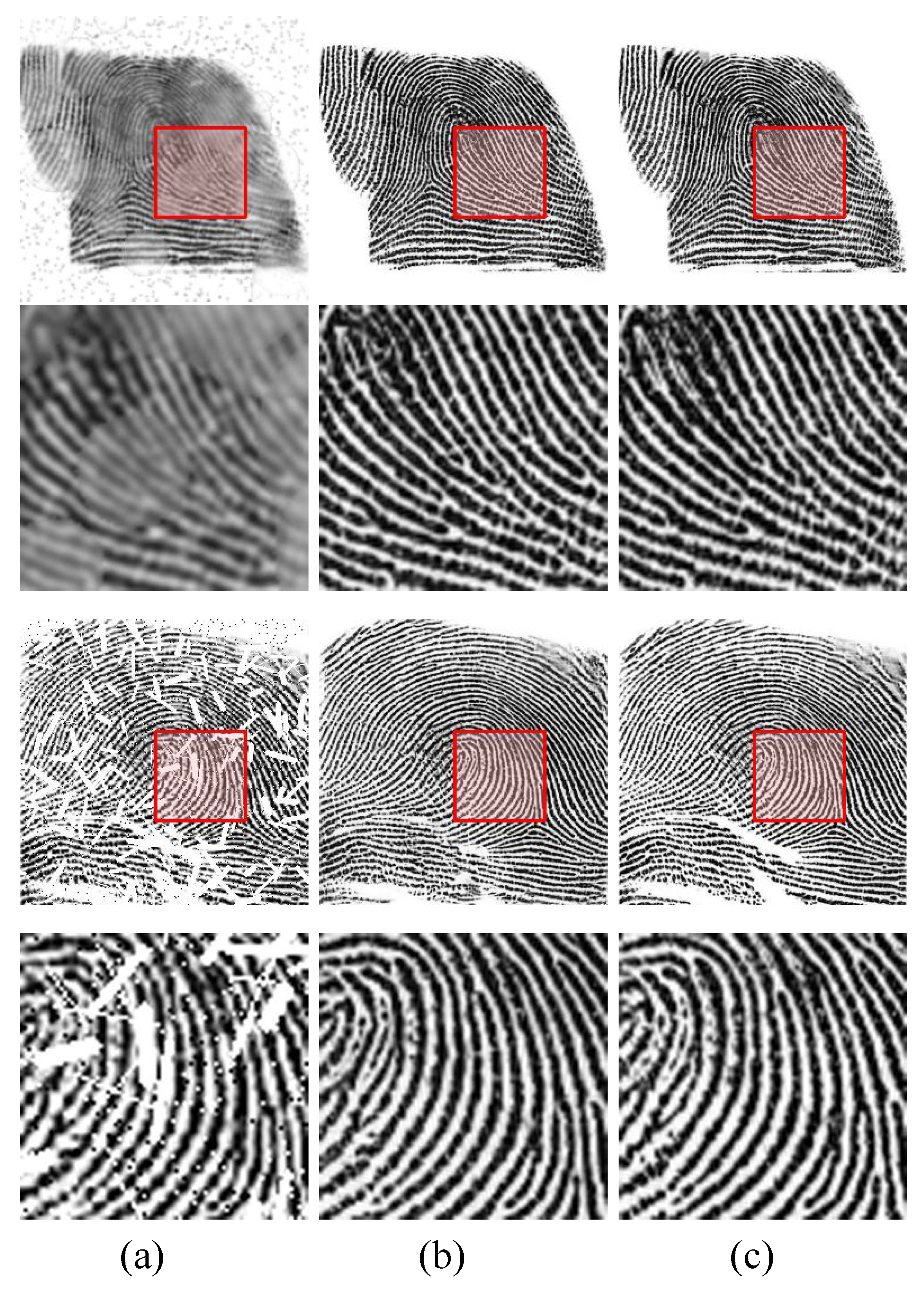
To complement the quantitative evaluation, qualitative comparisons are conducted among degraded fingerprints, reconstructed fingerprints, and their corresponding high-quality references. While the quantitative results characterize fingerprint quality, minutiae restoration, and identification performance, visual comparisons provide additional insight into ridge continuity, ridge–valley separation, and local structural reconstruction.
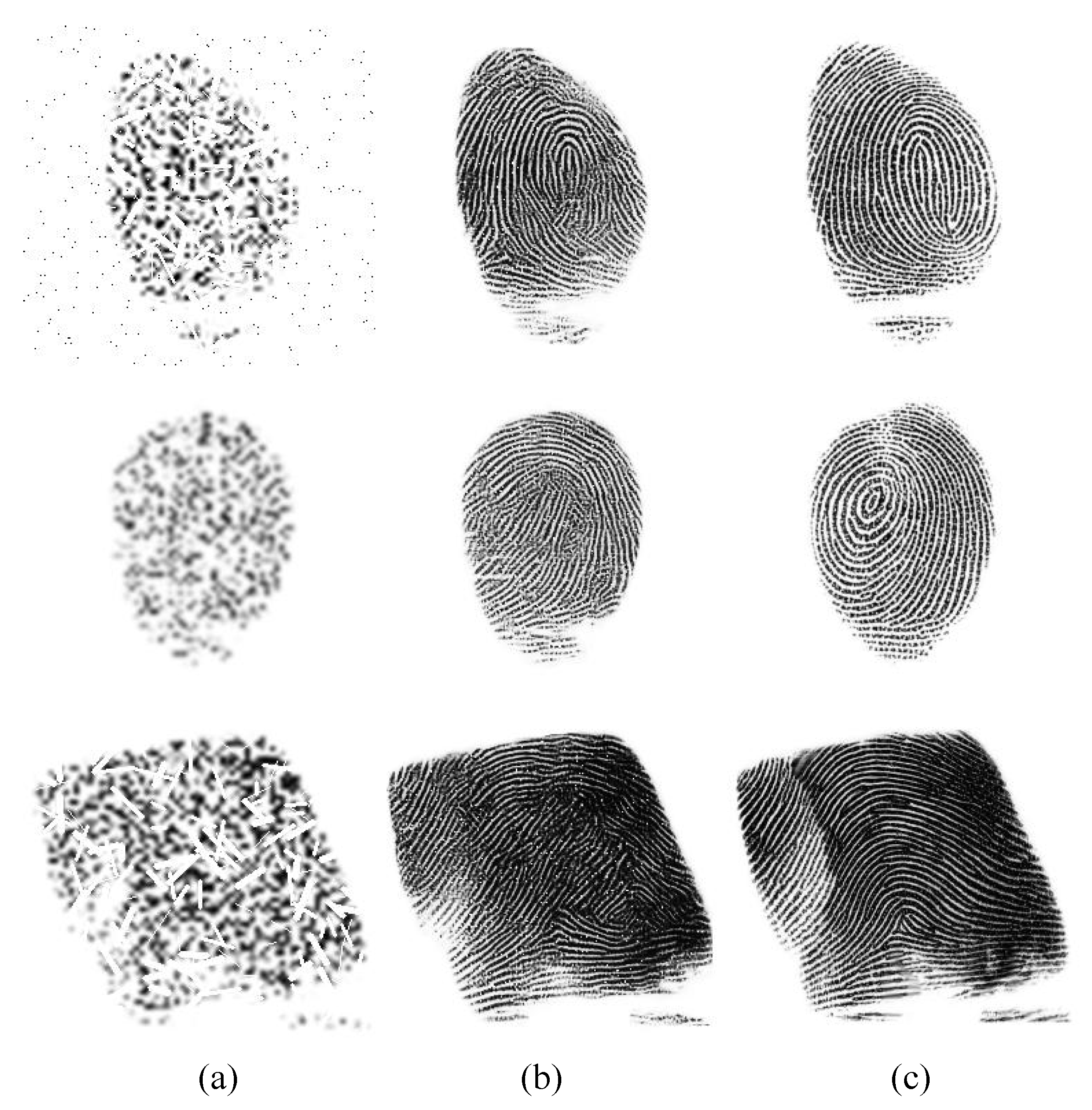
Representative results are presented in
Figure 8. Compared with the degraded inputs, the reconstructed fingerprints generally exhibit clearer ridge–valley separation, fewer visible background artifacts, and more continuous ridge patterns. In regions affected by ridge fragmentation and diffusion blur, interrupted ridge segments are partially reconnected, and the reconstructed ridge-flow patterns show greater visual consistency with the corresponding high-quality references. Background interference and isolated non-ridge responses are also reduced in most of the displayed examples.
These observations indicate that the proposed framework reconstructs fingerprint structures beyond simple contrast enhancement and noise suppression. In particular, the improved ridge continuity and ridge-flow organization are consistent with the intended role of weak ridge-flow guidance and prior-conditioned feature modulation. The specific contributions of these components are further supported by the ablation results.
To examine local structural reconstruction in greater detail,
Figure 9 presents comparisons of selected local ridge regions. The red boxes in
Figure 9 highlight representative ridge structures for visual inspection. Compared with the degraded inputs, the reconstructed regions exhibit clearer ridge boundaries, more continuous ridge segments, and better-defined ridge–valley transitions. Some minutia-related structures, including ridge-ending and bifurcation regions, also show greater visual agreement with the corresponding high-quality reference regions.
Nevertheless, visual similarity alone cannot establish that every reconstructed local structure is identity preserving. Therefore, these qualitative observations should be interpreted together with the minutiae restoration and fingerprint identification results reported in the preceding subsections.
3.11. Analysis of Failure Cases
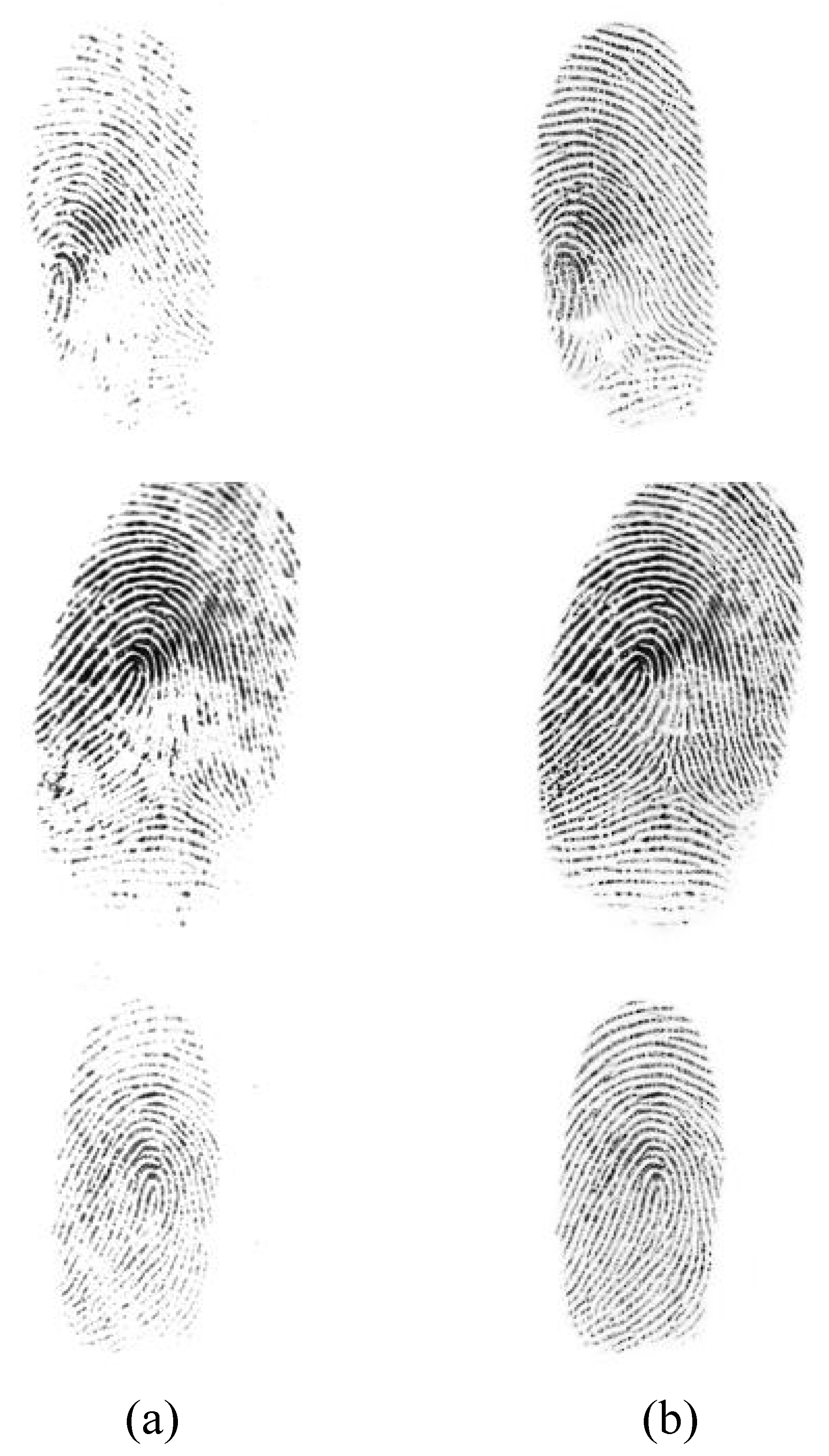
Despite the overall improvements observed in the preceding experiments, the proposed framework remains limited when the input fingerprint contains extensive ridge loss or severe structural distortion. Representative failure cases are presented in
Figure 10.
As shown in these examples, when large portions of the ridge pattern are missing, the reconstructed fingerprints may contain incomplete ridge segments, locally incorrect ridge connections, or ridge structures that do not fully correspond to the high-quality references. In such regions, the degraded observation retains insufficient structural evidence to determine the original ridge topology unambiguously.
One possible explanation is that severe ridge fragmentation and information loss also affect the ridge-flow information extracted from the degraded input. Consequently, the resulting weak ridge-flow prior may provide insufficient or locally inaccurate guidance for feature modulation. However, because the current framework does not explicitly estimate the confidence of the extracted prior, the reconstruction errors cannot be attributed exclusively to prior-estimation errors. They may also arise from the intrinsic ambiguity of reconstructing missing fingerprint structures and from the generative behavior of the reconstruction network.
Although the proposed method improves ridge visibility in some regions of these challenging inputs, it does not reliably recover the original ridge topology when identity-related evidence has been extensively lost. This limitation is particularly important in biometric applications because visually plausible ridge connections may not necessarily be identity preserving. Future work will investigate confidence-aware ridge-flow estimation, explicit modeling of prior uncertainty, and topology-preserving reconstruction constraints for fingerprints with extremely limited structural evidence.
4. Discussion, Limitations, and Future Work
The experimental results indicate that residual ridge-flow information can provide useful structural guidance for reconstructing severely degraded fingerprints. Unlike enhancement approaches that predominantly optimize local appearance or pixel-level fidelity, the proposed framework incorporates a weak ridge-flow prior into multi-scale feature propagation. The improvements in NFIQ2 scores, minutiae restoration, and fingerprint identification on the NIST SD301-derived test set suggest that fingerprint enhancement should be evaluated not only in terms of visual quality but also in terms of identity-related structural preservation and recognition-oriented performance. This interpretation is consistent with studies emphasizing the importance of fingerprint-specific representations, including orientation fields, minutiae distributions, and ridge topology, in fingerprint reconstruction and recognition [
18,
31].
The minutiae and identification results further indicate that improved visual appearance alone is insufficient for assessing fingerprint reconstruction. Under severe degradation, a reconstructed fingerprint may appear visually plausible while containing discontinuous ridges, spurious minutiae, or locally incorrect ridge connections. The proposed method is designed to mitigate this issue by incorporating residual ridge-flow information into feature reconstruction and jointly optimizing the output using image-space, ridge-flow orientation-consistency, gradient-consistency, and adversarial constraints. Rather than strictly forcing the reconstructed fingerprint to follow the estimated orientation field, PCFM uses the extracted ridge-flow prior to regulate skip-feature propagation. This design reduces the direct enforcement of potentially inaccurate orientation estimates. However, it does not explicitly estimate prior reliability or guarantee the suppression of all erroneous structural cues.
The quantitative results obtained on the synthetically degraded NIST SD301-derived test set support the effectiveness of the proposed design under the degradation operations considered in this study. In addition, the qualitative evaluation on FVC2004 DB1 provides preliminary evidence that the trained model can be transferred to fingerprint images acquired under sensing and acquisition conditions different from those represented in the training dataset. However, because this external evaluation is qualitative, the observed visual improvements do not establish that the reconstructed fingerprints consistently preserve identity information or improve recognition performance under real cross-dataset conditions.
Several limitations should therefore be acknowledged. First, the primary training and quantitative evaluation data are generated using predefined synthetic degradation operations. Although these operations simulate ridge fragmentation, local diffusion and dilation, noise, blur, and resolution loss, they cannot fully reproduce the coupled and unpredictable distortions encountered in real forensic fingerprints. The current dataset also contains only 300 source fingerprint images. The 200 degraded variants generated from each source image share the same underlying ridge structure and should not be interpreted as independent fingerprint identities. Although source-image-level separation prevents degraded variants of the same source image from appearing in different subsets, evaluation on larger and more diverse identity-disjoint datasets is still required.
Second, the current cross-dataset evaluation on FVC2004 DB1 is limited to qualitative comparison. Under the adopted protocol, paired high-quality references and verified gallery–probe matching experiments are not used for this dataset. Consequently, the observed improvements in ridge visibility and local continuity cannot be directly interpreted as quantitative evidence of identity preservation or recognition improvement. Future evaluations should include larger real degraded fingerprint datasets and report fingerprint-quality, minutiae, verification, and identification metrics under cross-sensor and cross-dataset settings.
Third, the weak ridge-flow extraction module does not explicitly estimate the confidence or uncertainty of the resulting orientation field. When extensive ridge loss leaves insufficient structural evidence in the input, the estimated prior may contain locally inaccurate directional information. Although PCFM adaptively modulates feature propagation using the weak ridge-flow prior, it does not guarantee that all unreliable prior information will be rejected. Future work may therefore introduce confidence-aware ridge-flow estimation or spatial uncertainty maps to regulate the contribution of structural priors more explicitly.
Fourth, the proposed generator produces a single deterministic reconstruction for each degraded input. When large ridge regions are missing, multiple ridge configurations may be visually plausible, and the original ridge topology may not be uniquely recoverable. Consequently, the model may generate locally plausible but identity-inconsistent ridge connections. Future research should investigate uncertainty-aware reconstruction, topology-preserving constraints, and mechanisms for identifying or rejecting reconstructions when insufficient identity-related evidence remains in the input.
From a practical forensic perspective, the proposed framework should therefore be regarded as an assistive preprocessing component rather than a replacement for the original fingerprint evidence or expert examination. For deployment in an AFIS pipeline, a confidence-based rejection mechanism could be incorporated to jointly consider the reliability of the estimated ridge-flow prior and the uncertainty of the reconstructed fingerprint. Reconstructions with confidence below a predefined threshold could be rejected or flagged for manual forensic review rather than being automatically passed to downstream matching. Such a mechanism would be particularly important under severe ridge loss, where the degraded input may contain insufficient identity-related evidence to support a reliable reconstruction.
Fifth, the current experimental comparison does not cover all recent reconstruction architectures. Although the evaluated baselines span traditional filtering, paired conditional generation, and fingerprint-specific adversarial reconstruction, recent Transformer- and diffusion-based reconstruction models are not quantitatively compared under the current protocol. Future work will therefore investigate fingerprint-specific Transformer and diffusion models under a unified training, degradation, and identity-oriented evaluation protocol to provide a broader comparison with recent reconstruction architectures.
Finally, the minutiae and identification results reported in this study are obtained using FpMV and SourceAFIS, respectively. Although these tools provide complementary evaluations of local structural correspondence and downstream identification performance, improvements obtained with a single minutia extractor and matcher may not generalize to other fingerprint recognition systems. Additional experiments using multiple extractors, matchers, sensors, and real forensic datasets are needed to assess the robustness and practical applicability of the proposed framework.
Future work will focus on integrating ridge-flow information with complementary fingerprint representations, such as minutiae distributions and ridge-topology constraints, while explicitly modeling both prior and reconstruction uncertainty. Confidence-aware rejection mechanisms will also be investigated so that low-confidence reconstructions can be flagged for manual review before downstream AFIS matching. Larger-scale evaluations under real degradation, cross-sensor, and cross-dataset conditions will further be conducted to determine whether reconstructed fingerprints consistently improve biometric recognition without introducing identity-inconsistent structures.
5. Conclusions
This paper presented a weak ridge-flow prior-guided conditional generative adversarial network (WRP-cGAN) for severely degraded fingerprint reconstruction. The central principle of the proposed approach is that incomplete and uncertain ridge-flow information can remain useful for reconstruction when treated as a weak, adaptively modulated structural cue rather than an exact constraint. This formulation shifts the focus from purely local texture restoration toward structure-aware reconstruction while reducing the risk of directly enforcing potentially inaccurate orientation estimates.
To realize this principle, a lightweight ridge-flow prior extraction module was developed to estimate coarse directional information from degraded inputs. The estimated prior was incorporated into multi-scale skip-feature propagation through prior-conditioned feature modulation (PCFM), enabling the network to adaptively regulate structural information during reconstruction. Adversarial, image-space reconstruction, ridge-flow orientation-consistency, and gradient-consistency losses were further combined to jointly constrain reconstruction fidelity, ridge organization, and local structural details.
Experiments on the NIST SD301-derived synthetic test set demonstrated consistent improvements across recognition-oriented quality, minutiae restoration, and fingerprint identification. Specifically, the median NFIQ2 score increased from 9 for the degraded inputs to 44 after reconstruction, the minutiae-restoration F1-score increased from 0.2507 to 0.5426, and the SourceAFIS Rank-1 identification rate increased from 39% to 86% under the main evaluation protocol. The weak-prior perturbation analysis further showed that identification performance remained relatively stable under small-to-moderate orientation errors, supporting the use of the estimated ridge flow as a weak rather than hard structural constraint. A qualitative evaluation on FVC2004 DB1 additionally provided preliminary evidence of cross-dataset transferability without fine-tuning, although this result should not be interpreted as quantitative evidence of identity preservation under real cross-dataset conditions.
Nevertheless, reliable reconstruction remains challenging when extensive ridge loss leaves insufficient identity-related evidence in the degraded input. The proposed method should therefore be regarded as an assistive preprocessing component for AFIS rather than a substitute for the original fingerprint evidence or expert examination. Future work will investigate confidence-aware ridge-flow estimation, reconstruction-uncertainty modeling, and topology-preserving constraints, together with a confidence-based rejection mechanism that flags low-confidence reconstructions for manual review before downstream AFIS matching. Quantitative evaluation on larger real degraded, cross-sensor, and cross-dataset fingerprint benchmarks, using multiple extractors and matchers, will also be conducted to further assess identity preservation and recognition performance under practical forensic conditions.