
Article

Solving Flow-Shop Scheduling Problems with Random Machine Breakdown and Limited Buffer Using a Pigeon-Inspired Hybrid Artificial Bee Colony Algorithm

by
Mariappan Kadarkarainadar Marichelvam
1,* and
Mariappan Geetha
2
1
Department of Mechanical Engineering, Mepco Schlenk Engineering College, Mepco Nagar, Sivakasi 626005, Tamilnadu, India
2
Department of Mathematics, Mepco Schlenk Engineering College, Mepco Nagar, Sivakasi 626005, Tamilnadu, India
*
Author to whom correspondence should be addressed.
Computers 2026, 15(8), 508; https://doi.org/10.3390/computers15080508
Submission received: 10 June 2026 / Revised: 31 July 2026 / Accepted: 4 August 2026 / Published: 6 August 2026
(This article belongs to the Special Issue Operations Research: Trends and Applications)

Abstract

A hybrid algorithm combining two metaheuristics is proposed to solve the flow-shop scheduling problem, aiming to minimise the makespan (Cmax). This approach accounts for random machine failures and limited buffer capacity between machines. Since flow-shop scheduling problems are NP-hard, the metaheuristics could be used to solve them effectively. Researchers proved that the hybridisation of metaheuristics would improve the solution quality. Therefore, this study hybridises the recently developed Pigeon-Inspired Optimisation Algorithm (PIOA) with the artificial bee colony (ABC) algorithm. The initial solutions are generated using a dynamic generation technique that relies on a set of constructive heuristics. The optimal solutions from the PIOA serve as input for the ABC algorithm. Various local search and variable neighbourhood search methods are also included to enhance solution quality. Extensive computational experiments, which focus on industrial scheduling scenarios and benchmark problem instances, are conducted to test the performance of the hybrid algorithm. Statistical analysis shows that the proposed algorithm outperforms other algorithms found in the existing literature.

Graphical Abstract

1. Introduction

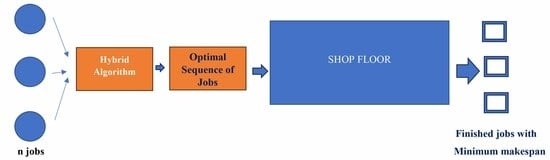
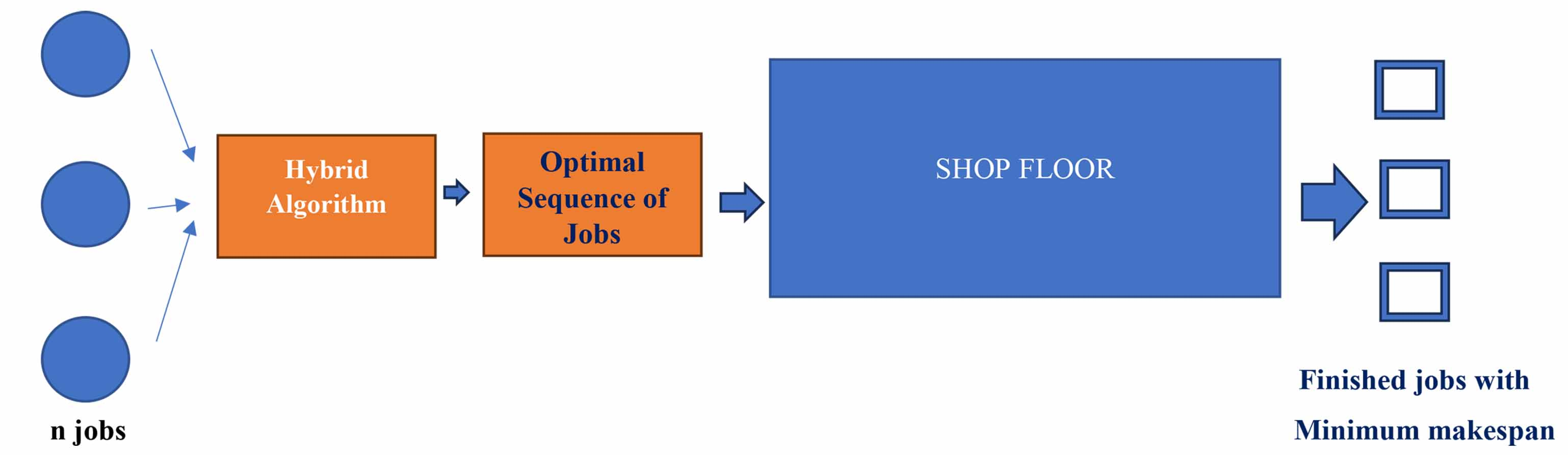
Scheduling plays a major role in the development of various organisations. Several researchers studied various scheduling problems with multiple objectives. Among these, single-machine scheduling, flow-shop scheduling, job-shop scheduling, the flexible job-shop scheduling problem, and the hybrid flow-shop problem are of major importance. The various major objective functions considered in scheduling are makespan, average flow time, total flow time, total tardiness, average tardiness, total weighted tardiness, total weighted earliness and tardiness, and number of tardy jobs [1,2]. For decades, thousands of researchers have worked on solving the flow-shop problem since its introduction in the literature by Johnson [3]. A flow shop can model several real-world production industries. Among those, automotive plants, chemical processing plants, and electronic plants are some examples. Figure 1 represents a basic diagram of a flow-shop environment with multiple jobs and machines.
Researchers used exact solution techniques, heuristics, and metaheuristics to address scheduling issues in flow shops [4]. Researchers have proposed various algorithms such as genetic algorithm [5], ant colony optimisation algorithm [6], scatter search algorithm [7], tabu search algorithm [8], differential evolution algorithm [9], migrating birds optimisation algorithm [10], cuckoo search algorithm [11], artificial bee colony algorithm [12], teaching-learning-based optimisation algorithm [13], bat algorithm [14], firefly algorithm [15], fruit fly algorithm [16], monkey search algorithm [17], African wild dog algorithm [18], and particle swarm optimisation algorithm [19] to solve the flow-shop scheduling problems with different objective functions. Recently, researchers have proposed new metaheuristics for solving optimisation problems. The Pigeon-Inspired Optimisation Algorithm (PIOA) is a recent metaheuristic developed by Duan and Qiao [20]. It is common in scheduling literature to combine metaheuristics to improve solution quality. Therefore, this research intends to solve flow-shop scheduling problems using a pigeon-inspired hybrid artificial bee colony algorithm (PIHABCA) that focuses on the makespan objective.
The rest of the paper is organised as follows. Section 2 provides a detailed literature review on the artificial bee colony algorithm, the Pigeon-Inspired Optimisation Algorithm, and the research gap. Section 3 presents the problem definition and mathematical model. Section 4 discusses the proposed algorithm in detail. Section 5 covers computational experiments and results. Section 6 includes the concluding remarks and future scope of the work.

2. Literature Review

This section has three parts. Section 2.1 reviews the literature on the artificial bee colony algorithm. Section 2.2 reviews the literature on PIOA. Section 2.3 discusses the research gap and the main contribution of this paper.

2.1. Literature Review on Artificial Bee Colony Algorithm to Solve Flow-Shop Scheduling Problems

Karaboga [21] first introduced the artificial bee colony (ABC) algorithm in a technical report. It is a swarm-based optimisation method that addresses numerical problems, inspired by the foraging behaviour of honeybees. This study led to one of the key methods of swarm intelligence in computational optimisation. Building on this work, Karaboga and Basturk [22] defined the ABC algorithm and showed its effectiveness and efficiency in optimising numerical functions. They highlighted its reliability, simplicity, and strong global search capability compared to traditional optimisation methods. Karaboga and Basturk [23] also conducted one of the first thorough evaluations of the ABC algorithm, examining its performance across a range of continuous numerical optimisation tasks. Their study examined three key behavioural components—employed bees, observer bees, and scout bees—to understand how these mechanisms influence convergence speed, solution accuracy, and resilience. The results showed that the ABC algorithm had better exploration abilities and was more resistant to premature convergence. It also outperformed well-known algorithms like genetic algorithm (GA) and particle swarm optimisation (PSO).
Later, Karaboga [24] provided a detailed theoretical analysis of the ABC method. He highlighted its structure, biological origin, and broad use in solving both continuous and discrete optimisation problems. Together, these significant studies by Karaboga and colleagues laid the foundations for the algorithm’s theory, confirmed its effectiveness, and demonstrated its value. This opened the door for its widespread use in scheduling, engineering design, and multi-objective optimisation. Banharnsakun et al. [25] developed the “best-so-far” selection mechanism within the ABC framework. This mechanism focuses the search on promising areas of the solution space and improves convergence without causing early stagnation. Kaur and Goyal [26] conducted a thorough review of the artificial bee colony (ABC) algorithm across various problem domains, such as scheduling, clustering, image processing, and network optimisation. Their review underscored the algorithm’s flexibility, simplicity, and robustness, demonstrating how well it can address challenging real-world optimisation problems. Pan et al. [27] proposed a discrete ABC algorithm for solving flow-shop scheduling problems with lot-streaming, aiming to minimise the total weighted earliness and tardiness. They introduced a self-adaptive strategy and an effective local search to boost the algorithm’s performance. The experimental results showed the algorithm’s effectiveness.
Tasgetiren et al. [28] solved permutation flow-shop scheduling problems using a discrete ABC algorithm combined with an iterated greedy algorithm. Their goal was to minimise the total flow time. They tested their algorithm’s performance on benchmark problems from the literature. Akay and Karaboga [29] introduced a modified artificial bee colony (ABC) algorithm that balances exploitation and exploration to improve real-parameter optimisation. By addressing the original ABC’s weaknesses in local search, they increased convergence speed and accuracy. Akbari et al. [30] extended the ABC framework to a multi-objective setting, enabling the algorithm to effectively employ a Pareto-based strategy to address problems with competing objectives. Cui and Gu [31] proposed an improved discrete version of the ABC algorithm for hybrid flow-shop scheduling problems. Their enhanced approach utilised specialised neighbourhood search techniques and discrete solution representations to effectively handle the combinatorial nature of scheduling. The improved ABC showed better convergence behaviour and solution quality, demonstrating its effectiveness for multi-stage, processing-constrained real-world production situations.
Han et al. [32] developed an improved ABC algorithm for blocking flow-shop scheduling. It prevents premature convergence and improves search efficiency by integrating advanced solution-update techniques and adaptive neighbourhood structures. These studies showed that ABC algorithms effectively maximise production flow and reduce delays in manufacturing systems. This significantly broadened their use in complex scheduling situations with blocking constraints.
Kashan et al. [33] extended the ABC framework to discrete domains with the Discrete Artificial Bee Colony (DisABC) algorithm for solving binary optimisation issues. They updated the continuous search operators of the original ABC to work effectively in binary solution spaces. This was done using a probabilistic bit-flipping technique and dynamic neighbourhood modification. Their method greatly enhanced the algorithm’s usefulness for combinatorial and discrete optimisation tasks, such as scheduling and feature selection. Together, these works represent a significant progression in ABC research. They expanded the algorithm’s flexibility and usefulness across various optimisation scenarios, from simple performance assessment in continuous optimisation to complex adaptations for discrete and binary problems. Li and Yin [34] proposed a discrete ABC algorithm to solve the permutation flow-shop scheduling problem, aiming to minimise the makespan and the total flow time. They introduced a composition mutation strategy and a fast local search to enhance solution quality. They used benchmark problems from the literature to demonstrate the effectiveness of their proposed algorithm.
Bansal et al. [35] carefully investigated the ABC algorithm and highlighted the key improvements that make ABC a strong and adaptable tool for swarm intelligence and optimisation research. They also discussed the variants of the algorithm, applications, and combined models. Chow et al. [36] solved flow-shop scheduling problems using the artificial bee colony (ABC) algorithm. They emphasised the algorithm’s ability to optimise work sequences to reduce makespan and improve overall production efficiency. Their results showed that the ABC algorithm offers a flexible and effective solution to complex scheduling problems, unlike traditional heuristic methods. Han et al. [37] introduced an effective hybrid discrete artificial bee colony (ABC) algorithm for blocking flow-shop scheduling problems. This method reduces total flow time by merging local search techniques with problem-specific heuristics to enhance convergence speed and solution quality. Their approach successfully managed the balance between exploration and exploitation, surpassing traditional metaheuristics.
Lin et al. [38] introduced a hybrid version of ABC algorithm to address hybrid flow-shop scheduling problems, aiming to minimise the makespan. The proposed method demonstrated better performance when tested with benchmark problems. Liu and Liu [39] addressed permutation flow-shop scheduling problems to minimise makespan using a hybrid discrete ABC algorithm. They enhanced initial solutions with a Greedy Randomised Adaptive Search Procedure. They evaluated how well their algorithm worked using benchmark problems. Xu et al. [40] presented a simple and effective ABC algorithm for solving benchmark problems described in the literature. They adjusted the bees’ search patterns in their study. Zhang et al. [41] proposed a hybrid ABC algorithm to minimise total weighted tardiness in job-shop scheduling problems. They employed a tree search algorithm to enhance solution quality. They confirmed the performance of their algorithm by using benchmark problems from existing studies. Chakaravarthy et al. [42] proposed an improved hybrid algorithm that combined the Sheep Flock Heredity algorithm with the ABC algorithm to address m-machine flow-shop scheduling problems with lot-streaming and equal-sized sublots. This hybrid approach resulted in a better convergence rate and greater variety of solutions, significantly enhancing production scheduling efficiency.
Tosun [12] solved flow-shop scheduling problems using a modified ABC algorithm. He combined local search methods with the algorithm to reduce the makespan. He performed computational experiments and statistical analysis to demonstrate the algorithm’s effectiveness. Yurtkuran and Emel [43] added several search strategies to adjust the ABC algorithm and tackled the p-centre problem to reduce the distance from each node in a network. They found that their proposed algorithm was more efficient than many others for solving a set of benchmark problems.
Han et al. [44] combined differential evolution with a discrete ABC framework to address flow-shop scheduling problems with blocking constraints. They improved convergence speed and global search ability, achieving better performance. Overall, these studies show the ongoing development of ABC-based algorithms and their ability to handle complex multi-objective and constrained flow-shop scheduling scenarios. Kheirandish et al. [45] solved a two-stage hybrid flow-shop scheduling problem that incorporated operational constraints and multilayer product structures using the ABC algorithm. Their research showed that the method effectively reduced makespan and total completion time while addressing hierarchical production limits. In another study, Khorramizadeh and Riahi [46] presented a bee colony optimisation method for mixed blocking constraint flow-shop scheduling problems. This strategy effectively manages the complexity of machine blocking and work sequencing. These studies show how ABC and BCO algorithms have moved from theoretical research to real-world hybrid implementations. They demonstrate their ability to tackle scheduling issues in more complex, constrained computational and industrial settings.
Li and Pan [47] combined the tabu search algorithm with the ABC algorithm to address hybrid flow-shop scheduling problems with limited buffers. Their goal was to minimise the makespan. They tested the hybrid algorithm on random problem instances and found it achieved better results. Li et al. [48] introduced an improved discrete ABC algorithm for hybrid flow-shop scheduling problems with multiple objectives. Their research included the option to skip operations. They demonstrated the effectiveness of their algorithm by using problems from the literature. Ribas et al. [49] proposed a better discrete artificial bee colony algorithm for blocking flow-shop scheduling problems to reduce total flow time. They introduced various strategies to achieve improved results and validated the performance of their method using benchmark problems from existing studies.
Zhang and Gu [50] developed a discrete version of ABC algorithm to tackle the flow-shop scheduling problem with intermediate buffers. Their goal was to minimise the makespan. They proposed a combined insertion-and-swap operator to improve results. They demonstrated the effectiveness of their method through simulation experiments. Deng et al. [51] suggested a new discrete ABC algorithm for solving permutation flow-shop scheduling problems with limited buffers. The objective was to minimise total flow time using improved neighbourhood structures and adaptive search methods. Yurtkuran and Emel [52] addressed the single-machine scheduling problem using a discrete ABC algorithm to minimise the total earliness and tardiness. They made several modifications to the original ABC algorithm to enhance the results. They tested their algorithm’s performance using benchmark problems from the literature and showed that it performed better.
Gong et al. [53] developed a hybrid discrete artificial bee colony (ABC) algorithm to solve multi-objective blocking lot-streaming flow-shop scheduling problems. This algorithm combines local search strategies to improve convergence and diversity of solutions. Li and Ma [54] addressed multi-objective flow-shop scheduling problems with sequence-dependent setup times using a multi-objective ABC algorithm. Their goal was to minimise the makespan and total flow time. They demonstrated the effectiveness of their algorithm using benchmark problems from the literature. Building on this research, Gong et al. [55] developed a more complex hybrid multi-objective ABC algorithm that effectively balanced exploration and exploitation. He et al. [56] introduced a unique binary ABC algorithm for solving the set-union knapsack problem. This algorithm significantly improved convergence accuracy and broadened the use of ABC for discrete combinatorial optimisation problems through binary encoding and new solution-update methods.
Peng et al. [57] proposed an improved version of ABC algorithm to address the scheduling problem in a casting industry. In their work, the authors developed two variable-neighbourhood search operators and a control parameter to improve results. Through computational experiments, the authors demonstrated that their algorithm was superior to other algorithms addressed in the literature. Xuan et al. [58] developed an enhanced discrete ABC algorithm to tackle the flexible flow-shop scheduling problem. They considered unrelated parallel machines at each stage, and the goal was to minimise the total weighted completion time. They introduced a dynamic method to generate initial solutions. They also proposed a modified variable neighbourhood search to achieve better results.
Arık [59] proposed an improved version of a hybrid ABC algorithm. This version of the ABC algorithm showed significant improvements in minimising makespan by combining elements of the Iterated Greedy Algorithm for permutation flow-shop scheduling problems. Li et al. [60] addressed a discrete artificial bee colony (DABC) method to tackle the distributed hybrid flow shop scheduling problem with sequence-dependent setup time. They suggested a machine position-based mathematical model to minimize the makespan. Extensive computational experiments proved the effectiveness of the proposed algorithm.
Li et al. [61] used the discrete version of the ABC method to address the distributed, heterogeneous, no-wait flow-shop scheduling problem. To improve the solution’s quality, they applied a variable neighbourhood descent (VND) algorithm based on local search techniques and four different neighbourhood search operators. They conducted detailed computational tests to assess the effectiveness of their approach. Zuo et al. [62] addressed the energy-efficient hybrid flow-shop scheduling problem with a multi-population ABC algorithm aiming to minimise makespan, total tardiness, and total energy consumption. They confirmed the performance of their proposed algorithm using benchmark problems found in the literature.
Peng et al. [63] addressed a quadratic assignment problem through a discrete version of the ABC algorithm. Moreover, Khedim et al. [64] introduced a combinatorial version of the ABC algorithm, along with an improved Iterated Local Search Technique to solve the Job-Shop Problem. By combining exploitation (local search methods) with diversification (global optimisation methods), Khedim’s method achieved faster convergence and improved accuracy.
Haoran et al. [65] proposed a discrete artificial bee colony (ABC) algorithm to effectively address various objectives in distributed heterogeneous no-wait flow-shop scheduling problems, thereby improving the complex issues in a distributed production model where machines may be heterogeneous. The algorithm proved successful by appropriately balancing conflicting objectives through adaptive search technologies, optimising the solution using a multi-objective optimisation strategy. Li et al. [66] adopted an improved artificial bee colony algorithm that incorporates Q-learning to effectively solve permutation flow-shop scheduling problems. They generated an initial solution by employing a renowned NEH constructive algorithm developed by Nawas et al. [67]. Then, other state-of-the-art methods are adopted to enhance the quality of the generated solutions through intensive computation, thereby establishing the validity of the suggested approach.
Zhao et al. [68] presented a solution to distributed heterogeneous no-wait flow-shop scheduling problems, considering sequence-dependent setups and minimising makespan, using an ABC algorithm and reinforcement learning. Ladj et al. [69] developed the ABC algorithm for solving flow-shop scheduling problems, minimising makespan. Flexible maintenance has been considered in this work. The results of solving flow-shop problems, compared with other methods available in the literature, were presented in this work as well. Li et al. [70] presented a discrete variant of the ABC algorithm for flexible flow-shop problems. This work accounted for machine deterioration and assembly processes. Several new issues were introduced to improve solution quality. In this work, in-depth testing of suggested algorithms was presented, and contrary to expectations, successful implementation of these algorithms for several issues was achieved.
Wang et al. [71] proposed an adaptive ABC algorithm for hybrid flow-shop scheduling problems to minimise the makespan. They considered a batch processing machine at a middle stage. They applied the proposed method to solve the scheduling problem of a casting industry. They presented the efficacy of the proposed method by extensive computational experiments. Davendra and Herrmann [72] proposed a chaos-driven discrete artificial bee colony (ABC) algorithm that balances exploration and exploitation to reduce tardiness in flow-shop scheduling problems with concurrently loaded stations.
In recent times, Dong et al. [73] utilised an improved version of the discrete pathfinder algorithm to minimise makespan and energy consumption in flow shops with specific buffers and constraints. To improve efficiency and quality in solution acquisition, the researchers used a multi-neighbourhood search strategy in the algorithm. To confirm the overall efficiency and performance of the algorithm, the researcher used benchmark problems to test the algorithm’s efficiency and the solution-acquisition strategy emphasised in the study. In another study on flow shops, namely, the variable-speed GHFS, Hu et al. [74] put forth the concept and efficiency of an efficient neighbour search algorithm based on an innovative version of the constructive-destructive algorithm and the ABC algorithm to ensure improved efficiency and performance while simultaneously reducing the makespan and energy consumption of the flow shops considered in the study and algorithm strategy. The researchers proposed and implemented an innovative version of the efficient ABC algorithm to increase the efficiency and performance of flow shops incorporating consistent sublots, ensuring the acquisition strategy was attuned to the need to reduce makespan and overall efficiency simultaneously [75].

2.2. Literature Review on PIOA

Duan and Qiao [20] developed the Pigeon-Inspired Optimisation Algorithm (PIOA) to address the robot path-planning problem. Various researchers have addressed different issues using PIOA. Duan and Wang [76] used PIOA for image restoration. They suggested an orthogonal design strategy to improve solution quality. They compared their results with those from other methods in the literature and showed that PIOA performed better than many different algorithms. Deng et al. [77] applied PIOA to solve design problems of brushless DC motors. They optimised five parameters using this algorithm and demonstrated its effectiveness through computational experiments. Pei et al. [78] enhanced the fuzzy control strategy with the quantum chaotic PIOA to improve fuel consumption and emissions in hybrid electric vehicles. They compared the results of their technique with other methods using simulation experiments and showed that it performed better.
Varun and Kumar [79] provided a thorough literature review on PIOA. They discussed the different problems that PIOA and its variants address. They noted that there is potential for further research in PIOA. Fu et al. [80] created a multi-objective PIOA (MOPIOA) to tackle production scheduling issues. They used triangular fuzzy numbers to represent production and maintenance times. They ran simulation experiments to test the performance of the proposed algorithm. Hu et al. [81] solved unmanned aerial vehicle path-planning problems using quantum-behaved PIOA. They implemented several strategies to improve solution quality. Their experiments showed that PIOA outperformed the particle swarm optimisation algorithm.
Liu et al. [82] developed an improved PIOA to address the parameter optimisation problem. In their improved PIOA, they included the particle swarm optimisation algorithm, an inverse factor, and a Gaussian factor. This approach yielded better results. Zhong et al. [83] introduced a discrete PIOA to tackle the travelling salesman problem. They resolved a range of issues to demonstrate the value of their algorithm. Bolaji et al. [84] created a modified binary Pigeon-Inspired Optimisation Algorithm for the multi-dimensional knapsack problem. They combined the crossover operator with the landmark operator to enhance solution diversity and quality. They validated their algorithm’s performance using benchmark problems from the literature.
Brajević et al. [85] developed a hybrid firefly-artificial bee colony algorithm. They tested the performance of this algorithm using benchmark functions found in the literature. Their results showed that the new algorithm outperformed both the simple firefly algorithm and the artificial bee colony algorithm. Chen et al. [86] introduced a modified version of the PIOA to address the power flow problem with multiple conflicting objectives. Wu et al. [87] addressed the flexible job-shop scheduling problem using PIOA to minimise the makespan. Lei et al. [88] presented a hybrid approach for crack detection in autonomous vehicle path-planning. They combined the bat algorithm with the PIOA. Their findings indicated that this hybrid approach achieved better results than many other algorithms mentioned in the literature.
Pan et al. [89] introduced a better binary PIOA to address feature selection issues. They proposed four new transfer functions, an improved speed-update scheme, and a second-stage position-update method to enhance the solution. The results were compared with other algorithms and showed better performance on benchmark problems. Zhun et al. [90] addressed the dynamic facility layout problem with uncertain demand using an enhanced PIOA to minimise total material-handling and facility-rearrangement costs while maximising area utilisation. Hussein and Algamal [91] proposed a binary version of PIOA to tackle the 0–1 knapsack problem. They improved solution quality with a new time-varying transfer function. They demonstrated the algorithm’s effectiveness through computational experiments using the high-dimensional knapsack problem.
Ramalingam et al. [92] tackled the non-convex economic load dispatch problem with an opposition-based PIOA. Their goal was to lower total power generation costs while meeting demand needs. They enhanced the solutions through opposition-based learning. Their method addressed a broad range of problems. Ding and Dong [93] examined the limitations of the PIOA and proposed several strategies to boost its performance in various situations. They confirmed the effectiveness of the PIOA using standard problems found in the literature. Geetha et al. [94] combined the PIOA with the firefly algorithm to address hybrid flow-shop scheduling problems, aiming to reduce carbon footprint. They assessed the performance of their method using real industrial data and random problem instances. Yu et al. [95] worked on the community detection problem in complex networks using a multi-objective PIOA. They evaluated the proposed algorithm using real networks and showed that it performed better.

2.3. Research Gap and Contribution of the Present Work

Most researchers studied flow-shop scheduling problems under several fixed assumptions to minimise makespan. They assumed machines are always available and that the buffer capacity between two machines is unlimited. However, these assumptions do not hold in real production settings. In actual manufacturing, machines can break down for various reasons such as wear and tear, poor maintenance, and unexpected failures. Likewise, due to limited space, buffer capacity between machines is usually restricted in many industries. Machine breakdowns, combined with limited buffer capacity, further complicate the problem. Therefore, it is better to address these issues using an efficient algorithm.
From Section 2.2, it is evident that PIOA has been applied to many optimisation problems. However, only a few scheduling researchers have addressed scheduling issues using PIOA. Additionally, researchers showed that combining metaheuristics can improve solution quality. As a result, there is a research gap in developing a hybrid metaheuristic to address scheduling problems involving machine breakdowns and limited buffer capacity. In this work, an attempt is made to minimise the makespan of a flow-shop scheduling problem with these conditions using a hybrid algorithm that combines PIOA and the artificial bee colony algorithm. The main contributions of this work are:
  • To develop a novel hybrid algorithm that combines the Pigeon’s navigation principle with the foraging behaviour of the artificial bee colony to enhance the solution quality.
  • To develop a mathematical model to solve flow-shop scheduling problems with machine breakdowns and limited buffer capacity, minimising the makespan.
  • To conduct extensive computational experiments using benchmark problems and random problem instances to validate the performance of the proposed algorithm.
  • To apply the proposed algorithm to a real scheduling problem in the automotive industry.

3. Problem Definition

There are ‘m’ machines and ‘n’ jobs on the shop floor. The jobs are processed in a sequence to reduce the makespan. This work aims to minimise the makespan in a flow shop where machine breakdowns occur randomly. Further, limited buffer capacity between machines is considered. The following assumptions are considered in this work.

3.1. Assumptions

  • The jobs are processed on the machines in the same order.
  • Each job can be processed by one machine at a time.
  • Each machine can work on only one job at a time.
  • The processing times for jobs on different machines are fixed and known in advance.
  • All the jobs are available at time zero.
  • Machines can break down unexpectedly, which will impact the process. The process will restart only after the machines are repaired.
  • The repair time for machines varies. The repair time may follow a set probability distribution.
  • The buffer capacity between two machines is limited.

3.2. Notations

3.2.1. Sets and Indices

j = 1, 2, …, n: job index
i = 1, 2, …, m: machine index

3.2.2. Parameters

Pji—Processing time of job j on machine i
P j i —Processing time of job j on machine i
Bi—Buffer capacity between machine i and i + 1
λ i —Failure rate of machine i
t —Processing dutation
M T B F i —Mean time between failures of machine i
M T T R i —Mean time to repair of machine j
W i t —number of waiting jobs in the buffer after machine j
R i —Reliability of machine i, calculated as R i = e λ i t .
δ i —Expected downtime due to breakdowns = 1 R i × M T T R i
K—A sufficiently large positive constant

3.2.3. Decision Variables

Sji—start time of job j on machine i
Cji—completion time of job j on machine i
Cmax—makespan
Xjkh—binary variable
x j k h = 1 , if   job   j   precedes   job   k   on   machine   h , 0 , otherwise .

3.3. Mathematical Model

The objective is to minimise the makespan. Makespan is the completion time of the last job in the last machine. Equation (1) represents the objective function. Equation (2) is used to determine the completion time of job j on machine i. A job cannot begin processing on the next machine until it has completed processing on the previous machine. This precedence constraint is determined by Equation (3). Equations (4) and (5) define the machine capacity constraint. According to this a machine could process only one job at a time. The effective processing time is increased by the expected repair delay and is estimated using Equation (6). From Equation (7), the impact of random machine failure on completion time of job can be understood. Machine reliability is calculated using Equation (8). Machines with lower reliability experience greater expected downtime. Equation (9) ensures that the number of waiting jobs never exceeds the available storage capacity. If the downstream buffer is full, the completed job remains on the current machine until space becomes available, blocking further processing. In this case, the start time can be calculated using Equation (10). Equations (11) and (12) are the non-negativity and binary constraints, respectively.
min C m a x = M a x C j m for   all   j
where
C j i = S j i + p j i + δ i , i ,   j .
Subject to
S j , i + 1 C j i , j ,   i = 1 , , m 1 .
S k h C j h K 1 x j k h   j < k ,   h m
S j h C k h K x j k h   j < k ,   h m
p j i = p j i + ( 1 R i ) × M T T R i
C j i = S j i + p j i
R i = e λ i t
W i ( t ) B i , i = 1 , , m 1
S j , i + 1 C j i
S j i , C j i ,   C m a x 0
x j k h { 0,1 }

4. Proposed Algorithm

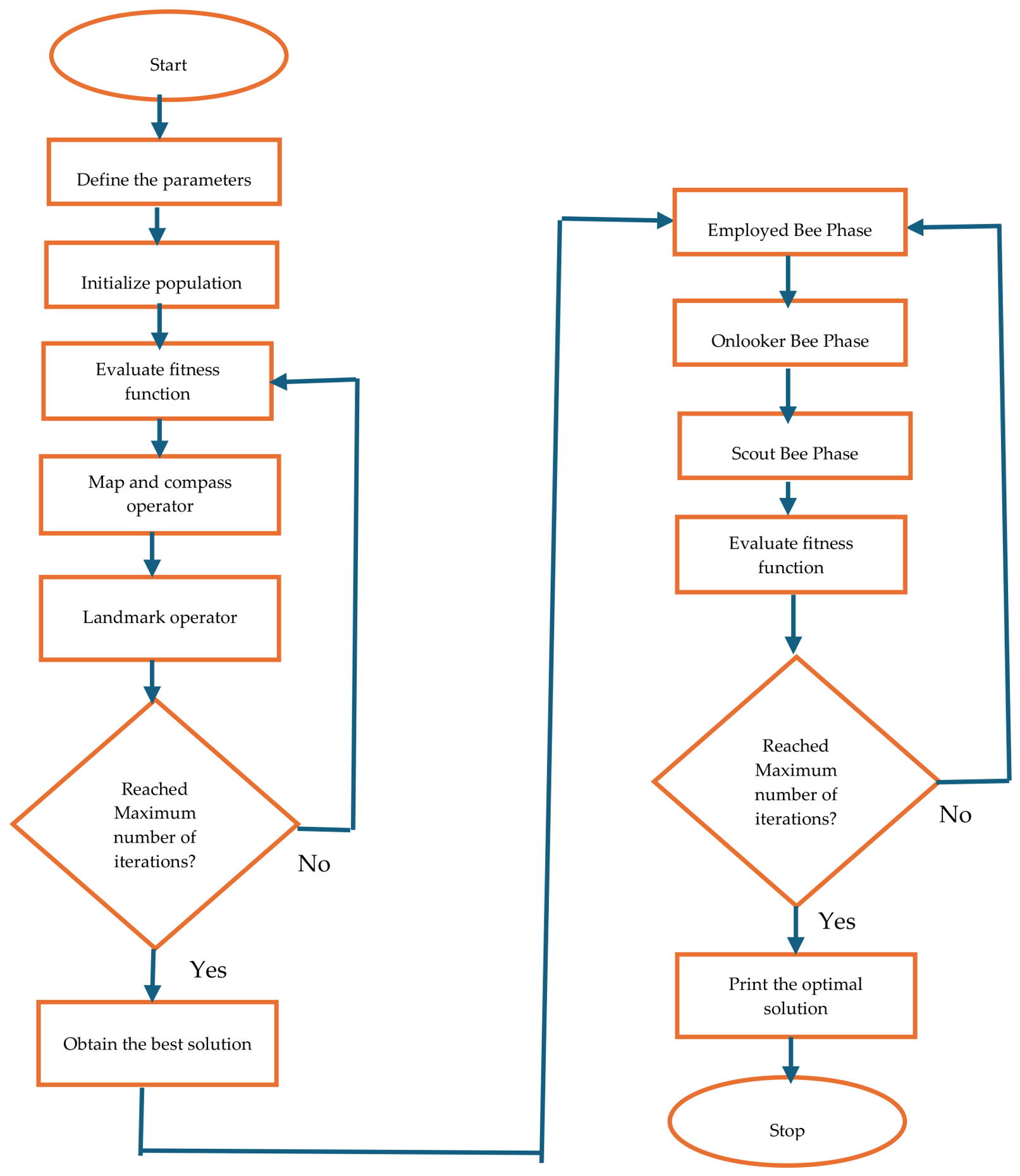
In this work, a pigeon-inspired hybrid artificial bee colony algorithm is proposed to solve the flow-shop scheduling problems with random machine breakdown and limited buffer to minimise the makespan. The flow chart of the proposed algorithm is depicted in Figure 2.

4.1. Artificial Bee Colony (ABC) Algorithm

The artificial bee colony (ABC) algorithm is a population-based metaheuristic that mimics the intelligent foraging behaviour of a honeybee colony. In a bee colony, every bee works together to find food sources that have high-quality nectar and share information about the best spots. This behaviour in a bee colony is mirrored in the ABC algorithm to tackle numerical and combinatorial optimisation problems. It does this by defining candidate solutions as food sources and their quality as fitness.

4.1.1. Colony Structure and Solution Representation

In ABC, the population consists of three types of artificial bees: employed bees, onlooker bees, and scout bees. Each employed bee is linked to one food source, representing a solution in the solution space. Onlooker bees watch the information provided by the employed bees and choose food sources based on their best values. Scout bees look for new food sources when the current ones become unprofitable. Let SN be the number of food sources in Stochastic Neighbourhood Exploration Strategy. Each solution X represents a candidate solution, and its quality is determined by the objective function.

4.1.2. Initialisation Phase

At the start, the algorithm creates SN random food sources within the feasible search space. Then, it evaluates the objective function for each food source and converts the result into a fitness value. The best solution from the initial population is noted. Additionally, a trial counter is set up for each food source to monitor stagnation.

4.1.3. Employed Bee Phase

In the employed bee phase, each employed bee searches around its food source. A trial solution is generated using a perturbation strategy. The fitness value of this trial solution is compared with that of the current solution. A greedy choice is used, meaning the better solution is selected. If no improvement is found in this step, the trial counter for that food source is increased. This phase mainly focuses on searching for the solution.

4.1.4. Onlooker Bee Phase

During the onlooker bee phase, the onlooker bees choose food sources based on their fitness values. The higher the fitness of a food source, the more likely it is to be selected. After choosing a food source, the onlooker bee creates a new solution using the same method as in the employed bee phase. Greedy selection is used again to update the solution. This probabilistic choice helps focus the search on the most promising areas while keeping diversity.

4.1.5. Scout Bee Phase

If a food source does not improve after a set number of trials, known as the abandonment limit, it is considered exhausted and abandoned. The employed bee from this source then acts as a scout bee and randomly creates a new food source within the search space. This process improves global exploration and stops the algorithm from getting stuck in local optima.

4.1.6. Fitness Evaluation and Selection

ABC is meant for solving maximisation problems. For minimisation goals, such as makespan, the objective value is converted to a fitness value using the appropriate fitness function. The algorithm selects solutions using the greedy replacement method. This method ensures the solution’s quality remains high.

4.1.7. Termination Criterion

The employed bee, observer bee, and scout bee phases repeat until a stopping condition is met. These conditions usually involve reaching the maximum allowed number of iterations or observing that the solutions have converged. The best solution found during the search is returned as a result.
The literature indicates that the ABC algorithm has simple implementation and strong exploration ability. The scout bee approach used in the algorithm effectively maintains population diversity, helping prevent the algorithm from converging to local optima too soon. However, the algorithm often struggles with convergence speed and poor exploitation, especially when handling highly constrained problems. The key takeaway is that the ABC algorithm is a solid method based on swarm intelligence. It mimics the behaviour of bees. Thanks to the teamwork of employed, onlooker, and scout bees, the algorithm successfully balances exploration and exploitation.

4.2. Pigeon-Inspired Optimisation Algorithm (PIOA)

4.2.1. Biological Motivation

The Pigeon-Inspired Optimisation Algorithm (PIOA) is a metaheuristic that uses swarms, inspired by how pigeons find their way home. Pigeons can navigate to their destinations from hundreds of kilometres away by relying on the Earth’s magnetic field, the position of the sun, and visual cues from the landscape. When homing, pigeons start with large-scale navigation and then switch to using landmarks as they get closer to their goal. PIOA uses pigeons’ homing skills to develop a method for improving a set of candidate solutions.

4.2.2. Population Representation

In the N-dimensional search space, the position of the ith particle in the swarming population is represented by the expression   X i = x i , 1 , x i , 2 , , x i , N . To show the change in the position of a pigeon, the velocity of the ith particle is expressed as V i = v i , 1 , v i , 2 , , v i , N . The index i = 1, 2, …, M represents the population. Finally, G = g 1 , g 2 , , g N is the global best position of the swarm, determined by examining all swarm positions.

4.2.3. Map-and-Compass Operator

A very common phenomenon called magnetoreception is one of the main reasons why pigeons are so important in helping to create a map using Earth’s magnetic field. Additionally, the sun’s height helps them orient toward their intended destination, much like a compass. However, their reliance on these two methods decreases as they approach their destination or hometown.
The new location and velocity information for pigeon i at the tth iteration can be expressed as
v i , j t = v i , j t 1 e R . t + ρ g j t 1 x i , j t 1
x i , j t = x i , j t 1 + v i , j t
The velocity information for each pigeon is calculated using Equation (13). This equation accounts for the pigeon’s previous velocity and its distance from the group’s overall location. The map-and-compass coefficient R ensures that the current velocity information is considered. The symbol ρ represents a reinitialization proportion, a random number between 0 and 1. The pigeon can change its location using Equation (14) based on changes in its velocity.

4.2.4. Landmark Operator

Just as we remember our surroundings to reach our destination, pigeons find their way using landmarks or familiar patterns. When the routes are similar, pigeons can easily identify their path and fly directly to their destination. However, in other situations, it is best to save energy and follow the pigeons that know the landmarks. The number of pigeons in the swarm is reduced by half in each generation based on their fitness. The main group follows the central pigeons, while the smaller group tracks the best subgroup. This approach is because the central pigeon is already headed in the right direction.
c j t = i = 1 N 1 x i , j t 1 f x i t 1 i = 1 N 1 f x i t 1
Equation (15) is used to select the middle pigeon. For i = 1, 2, …, N1, N1 is the number of better parts. F(x) is the fitness value from the ith pigeon at the tth generation. Equation (16) is the equation that may be used to update the position of a pigeon.
x i , j t = x i , j t 1 + r c j t x i t 1
With the two-step strategy, which first uses a map-and-compass operator and then a landmark operator, the efficiency of the PIOA improves as the exploration-exploitation trade-off balances.

4.2.5. Fitness Evaluation and Selection

After the application of the map-and-compass, along with the landmark operators, each pigeon’s fitness is evaluated. Greedy selection chooses better solutions. The global best solution gets updated whenever a pigeon with higher fitness is found.

4.2.6. Termination Criterion

The process involves applying the map-and-compass and landmark operators repeatedly until a specific stopping point is reached. This stopping point could be a set number of stagnant iterations or when the solutions converge. The best result from the entire process is then produced as output.
PIOA stands out for its quick convergence, thanks to directional guidance and a simple structure with few control parameters. It also has strong exploitation capabilities. However, PIOA can face issues with premature convergence and exploration, especially in complex or highly varied areas. This has led to a hybrid approach that combines PIOA with exploration-based algorithms like ABC.
In conclusion, the Pigeon-Inspired Optimisation Algorithm is a strong variant of the metaheuristic approach. It uses map-and-compass and landmark operators to imitate how pigeons find their way home. By combining global and local searches, the algorithm quickly finds high-quality solutions, making it a promising option for hybrid metaheuristics.

4.3. Pigeon-Inspired Hybrid Artificial Bee Colony Algorithm

This section introduces the Pigeon-Inspired Hybrid Artificial Bee Colony Algorithm (PIHABCA). It aims to improve global search, exploration, and convergence stability in complex optimisation problems. The technique combines the strengths of the Pigeon-Inspired Optimisation Algorithm (PIOA) and the artificial bee colony (ABC) algorithm. It uses an embedded cooperation method. This method controls the global search conducted by PIOA and enables periodic improvement via the ABC algorithm.
The PIHABCA approach combines two biologically inspired methods by periodically including ABC refinement cycles within the PIO framework. In this approach, PIOA conducts the main search by modelling homing behaviour using mapping and landmark operators. At regular intervals, the fittest individuals from PIOA move to ABC, which uses employed, onlooker, and scout bee behaviours to explore solutions. The improved results from the ABC method are then returned to PIOA. This ensures a cooperative search that aims for quick convergence while avoiding local optima.

4.3.1. Initialisation

The algorithm begins by randomly populating N pigeons within the possible search space. The solution is a vector candidate solution, X i = x i , 1 , x i , 2 , , x i , D where D indicates the number of dimensions. The population is examined to find the best solution, which becomes the initial global optimum solution. Several control parameters needed to be defined, including coefficients PIOA (alpha, beta), the abandonment limit of ABC algorithm, embedding frequency k, the number of elite pigeons e, and the number of ABC iterations I, among others.

4.3.2. Map-and-Compass Operator

The first stage of PIOA depends on the map-and-compass operator to mimic pigeons’ long-distance navigation skills. The pigeons at any iteration t update their position using this formula:
x i ( t + 1 ) = x i ( t ) + α ( C ( t ) x i ( t ) ) δ t
where C(t) is the population centre and δ(t) is the monotonically decreasing decay function. The decay function in the Pigeon-Inspired Optimisation (PIO) method is the mathematical mechanism that ensures a smooth shift from global exploration (wide searching) to local exploitation by progressively scaling down parameters over time. This operator propels pigeons towards the global search region by continuously decreasing the search radius, facilitating intensive exploration during the early stages of the search process.

4.3.3. Landmark Operator

After global navigation, a local refinement stage based on landmark recognition is applied to the top pigeons or those close to the global best. The position updating rule is as follows:
x i t + 1 = x i t + β N 0 , σ 2 λ t
where λ(t) is a decay coefficient that controls the resolution of the local search. The decay coefficient is an adaptation parameter that controls the algorithm’s exploration/exploitation trade-off, adjusts the velocity/position-update rules, or determines how quickly the population members’ proportion that are replaced during each iteration decreases. This operator intensifies by making smaller changes in promising areas of the search space.

4.3.4. Embedded Artificial Bee Colony Component

After every PIOA iteration, the process moves to the ABC refinement stage. The best e pigeons are chosen to act as food sources for ABC.
Employed Bee Phase
Each food source x i provides a neighbour solution by:
v i , j = x i , j + ϕ i , j ( x i , j x r , j ) ,
where x r is a randomly selected food source and ϕ i , j [ 1,1 ] . If the new food source has better fitness, it replaces the original one; otherwise, the trial counter increments.
Onlooker Bee Phase
Onlooker bees choose food sources randomly, with probabilities based on their normalised fitness:
p i = f i t i f i t i
The selected food sources create new neighbours using the employed bee strategy. This stage focuses more on calculations to improve exploitation efficiency.
Scout Bee Phase
Food sources that do not improve, within a predetermined limit, are abandoned:
x i random   solution   in   search   space .
This mechanism prevents population stagnation and helps maintain their diversity.
Reintegration into PIOA Population
After each round of ABC, the newly found better solutions replace their corresponding pigeons in the PIO population. The global best is also updated if a better solution is found, ensuring that ABC guides the next navigation step of the PIOA.
Detection of Stagnation and Management of Diversity
To avoid premature convergence, it monitors stagnation. If there is no improvement in the global best fitness for S consecutive iterations, the algorithm increases diversity by randomly reinitialising a small proportion p of pigeons or by boosting the scout activation rate in the ABC algorithm. This adaptive mechanism improves robustness and helps reintroduce exploratory behaviour.
Termination Criterion
The hybrid algorithm stops when it hits the total number of iterations. After it finishes, it provides the best solution found during the search as the optimal solution. The smallest position value described by Bean [96] is used to change the continuous solutions into discrete job permutations.

5. Computational Experiments

All algorithm implementations are written in C++ and run on a PC with a 2.80 GHz Intel Core i9-12900 K processor and 32 GB of RAM. This research looks at two types of computational experiments. It examines benchmark problems from the literature and a scheduling problem in the metal-spinning industry.

5.1. Benchmark Problems

Two benchmark problem sets from the literature are used in this work to validate the proposed algorithm’s performance.

5.1.1. Benchmark Problem Set I

Carlier’s benchmark problems are a well-known set of test cases introduced by Carlier [97]. These problems are important for testing new scheduling methods, hybrid algorithms, and optimisation techniques in flow-shop research. They typically consist of 11 jobs and 5 machines with fixed processing times. These instances are popular because they provide standard scenarios for comparing algorithm performance. They include challenging sequencing patterns that test the ability of heuristics and metaheuristics to minimise makespan (Cmax) and serve as baseline cases before applying algorithms to larger datasets. This section offers a detailed comparison of the proposed PIHABCA algorithm with several established metaheuristic and heuristic algorithms using the classical Carlier benchmark problems (Car-01 to Car-08). The algorithms being compared include the Simulated Annealing Algorithm (SAA) proposed by Rajkumar and Shahabudeen [98], the Improved Genetic Algorithm (IGA) addressed by Rajkumar and Shahabudeen [5], the Simple Genetic Algorithm (SGA) suggested by Rajkumar and Shahabudeen [5], the NEH heuristic [68], the Palmer heuristic proposed by Palmer [99], the CDS heuristic proposed by Campbell et al. [100], the Adaptive Learning approach (ALA) proposed by Agarwal et al. [101], the Improved Efficient Genetic Algorithm (IEGA), the Hybrid Improved Efficient Genetic Algorithm (HIEGA) proposed by Abdel-Basset et al. [102], the Clustering Genetic Algorithm (CGA) proposed by Zou et al. [103], PIOA proposed by Duan and Qiao [20], and the artificial bee colony (ABC) algorithm suggested by Tosun [12]. The best-known solutions (BKS) reported in the literature serve as a reference for evaluating solution quality.
Table 1 compares the proposed PIHABCA with well-known classical heuristics and modern metaheuristic methods on the Carlier flow-shop benchmark instances (Car-01 to Car-08). Each algorithm’s performance is measured by its makespan, using the best-known solution (BKS) as a reference. For the smaller instances (Car-01 and Car-02), most metaheuristic and hybrid algorithms, including SAA, IGA, SGA, ALA, IEGA, HIEGA, CGA, PIOA, and ABC, as well as the proposed PIHABCA, can reach the BKS. In contrast, classical heuristics like Palmer and NEH perform noticeably worse, with makespan values significantly higher than those of BKS. This shows that constructive heuristics lack enough search capability, even for simpler instances. As the problem becomes more complex (from Car-03 to Car-05), the differences in performance among algorithms become clearer. While modern evolutionary and hybrid methods still find optimal or near-optimal solutions, NEH and Palmer heuristics consistently miss the BKS, with the gaps widening as the number of jobs and machines increases. The CDS heuristic performs better than Palmer but still does not consistently match the BKS, showing its limited effectiveness in complex flow-shop environments. For larger instances (Car-06 to Car-08), the advantages of hybrid metaheuristic methods are particularly clear. Classical heuristics yield much higher makespan, indicating their inability to search the solution space effectively. Although SA shows competitive results, it does not reach the BKS in some instances. This highlights its sensitivity to parameter settings and initial solutions. In contrast, IGA, SGA, ALA, IEGA, HIEGA, CGA, PIOA, and ABC maintain strong performance, often achieving the BKS. Most importantly, the proposed PIHABCA algorithm consistently achieves the best-known solution for all eight Carlier instances, showing both reliability and scalability. This consistent performance across all problem instances indicates that combining pigeon-inspired navigation with artificial bee colony search effectively balances exploration and exploitation, preventing early convergence and improving solution quality. Overall, the results clearly show that hybrid metaheuristic approaches outperform classical heuristics in flow-shop scheduling problems. Among the methods compared, PIHABCA demonstrates the most stable and reliable performance, achieving zero deviation from the BKS across all instances. These findings confirm the proposed algorithm’s effectiveness and support its use in complex flow-shop scheduling problems. While the raw numerical results in Table 1 indicate PIHABCA’s superior performance, a formal statistical analysis was conducted to determine whether these differences are statistically significant.
Friedman Rank Analysis
Based on the makespan values in Table 1, we ranked all algorithms for each Carlier instance. Lower makespan values received better ranks. We addressed ties that often occur among top-performing algorithms due to identical BKS attainment by using average ranks.
The Friedman test produced a statistic of
χ F 2 = 46.82 d f = 12 ,   p < 0.001 ,
indicating significant differences among the algorithms. The mean rank of various algorithms is presented in Table 2, shows that PIHABCA achieves the best average rank (1.00). This confirms its consistent performance across all instances. In contrast, Palmer and CDS heuristics, which lead to the largest makespan deviations from the BKS in Table 1, receive the worst ranks. Therefore, the Friedman test supports the performance trends shown in Table 1.
Wilcoxon Signed-Rank Test
To further explore pairwise differences, we conducted Wilcoxon signed-rank tests using PIHABCA as the control algorithm. We based comparisons on the instance-wise makespan differences shown in Table 1. The Wilcoxon results indicate that PIHABCA is statistically better (p < 0.05) than traditional heuristics (NEH, Palmer, CDS) and standard evolutionary algorithms (SAA, IGA, SGA), which consistently show higher makespan values in Table 1. For the hybrid algorithms (ALA, IEGA, HIEGA, CGA, PIOA, ABC), we observe no statistically significant differences, as these methods often match the BKS, resulting in similar performance values. This shows that PIHABCA not only improves on weaker methods but also competes well with the strongest existing approaches. Overall, this supports the performance trends evident in Table 1.
Nemenyi Post-Hoc Analysis and Rank Separation
To evaluate rank separations both visually and quantitatively, we used a Nemenyi post-hoc test. We calculated the Critical Difference (CD) at the 5% significance level as follows:
C D = 6.46
When comparing the mean ranks in Table 1, the rank difference between PIHABCA and classical heuristics such as Palmer and CDS clearly exceeds the CD threshold. This shows that there are statistically significant performance gaps. In contrast, the rank differences between PIHABCA and other leading hybrid algorithms fall within the CD interval. This indicates that there is no statistically significant difference among the best solution methods.
By combining the numerical evidence from Table 1 with thorough nonparametric statistical tests, it is evident that PIHABCA offers a proven improvement over traditional heuristics and standard evolutionary algorithms for the Carlier benchmark problems. Its consistent achievement of the best-known solutions across all instances, along with strong Friedman ranks and Wilcoxon results, demonstrates its reliability and effectiveness. Overall, the combined results and statistical analysis confirm that PIHABCA is a leading solution for flow shop scheduling benchmark problems.

5.1.2. Benchmark Problem Set II

Demirkol et al. [104] introduced a well-known benchmark set to evaluate algorithms for the flow-shop scheduling problem. The benchmark suite contains 40 problem instances divided into four groups based on the number of jobs. Each group has 10 instances, all using 20 machines. For each instance, processing times are randomly generated from a uniform distribution, usually ranging from 1 to 99. The goal for these benchmarks is to minimise the makespan (Cmax), which is the total completion time of the last job on the last machine. These benchmark problems have become standard in scheduling research. They are widely used to compare heuristic, metaheuristic, and hybrid methods, such as genetic algorithms, simulated annealing, ant colony optimisation, and artificial bee colony algorithms, as well as other nature-inspired techniques. Their structured yet challenging design enables researchers to thoroughly evaluate algorithm performance under realistic, demanding scheduling conditions.
Discussion of Results
Table 3 presents a detailed comparison of the proposed PIHABCA algorithm with several leading metaheuristics. These include the ant colony system (ACS) proposed by Ying and Lin [105], the ant colony optimisation (ACO) algorithm by Rossi and Lanzetta [106], the simulated annealing heuristic (SAH) by Low et al. [107], the hybrid cuckoo search algorithm (HCSA) by Li and Yin [108], the firefly algorithm (FA) suggested by Sayadi et al. [109], the iterated greedy heuristics (IGH) proposed by Ying [110], the hybrid evolution strategies (HES) by Khurshid et al. [111], the PIOA proposed by Duan and Qiao [20], and the ABC algorithm suggested by Tosun [12]. The comparison includes 40 benchmark instances with various problem sizes. We assessed performance based on the makespan achieved, using the corresponding lower and upper bounds as reference points.
Performance on Small-Sized Instances (20 Jobs)
For the 20 job instances (Instances 1 to 10), PIHABCA often produces the best or nearly the best makespan values among the algorithms. Unlike traditional ACS variants and FA, which usually stay close to the upper limit, PIHABCA shows a noticeable drop in makespan. It often matches the performance of strong hybrids such as HES and ABC. Specifically, for instances such as flcmax_20_15_3, flcmax_20_15_6, and flcmax_20_15_5, PIHABCA achieves the lowest makespan among all algorithms. This highlights its strong ability to find good solutions, even with smaller problem sizes. It shows that the hybrid approach of combining pigeon-inspired methods and artificial bee colony techniques effectively balances local improvement and global exploration in the early stages.
Performance on Medium-Sized Instances (30 Jobs)
In the 30-job problems (Instances 11–20), the complexity increases significantly. The limitations of several algorithms become clearer. ACS variants and FA show larger differences from the lower bound. At the same time, IGH and PIOA demonstrate competitive but inconsistent performance. In contrast, PIHABCA consistently produces lower makespan values across nearly all instances. It outperforms ABC and PIOA in most cases. For example, in flcmax_30_20_3 and flcmax_30_20_10, PIHABCA achieves the best-known results and shows strong scalability. The improvements over ABC are particularly striking. This confirms that the hybrid strategy speeds up convergence and improves solution quality in moderately large scheduling environments.
Performance on Large-Sized Instances (40 Jobs)
For the 40 job instances (Instances 21–30), the search space increases significantly, posing serious challenges for traditional metaheuristics. While SAH and HCSA do well, they are often outperformed by PIHABCA. Algorithms like ACS and FA experience a notable decline in performance, often resulting in makespan values that are close to or exceed the reported upper limits. In contrast, PIHABCA consistently achieves the lowest or second-lowest makespan values, especially in the instances flcmax_40_15_5, flcmax_40_15_9, and flcmax_40_20_5. This indicates that the proposed algorithm maintains solution quality even under high combinatorial complexity, confirming its effective exploration method, which combines pigeon-inspired navigation with bee-based neighbourhood improvement.
Performance on Very Large Instances (50 Jobs)
The largest problem instances, 50 jobs from Instances 31 to 40, are the toughest test cases. In these cases, several algorithms fail to produce results, as indicated by the FA marked as NA. This highlights problems with computation or convergence. However, PIHABCA consistently delivers competitive and often better makespan values across all instances. For flcmax_50_20_2, flcmax_50_20_7, and flcmax_50_20_8, PIHABCA achieves the best-known solutions compared to all methods. It outperforms strong competitors like ABC, PIOA, and HES. The performance gap widens as problem size increases, clearly demonstrating the scalability and robustness of PIHABCA.
Overall Observations
Across all 40 benchmark instances, PIHABCA demonstrates strong, consistent performance. It achieves lower makespan values than most other algorithms while staying close to the lower bound. The results clearly indicate that:
  • PIHABCA scales well with larger problem sizes.
  • It outperforms traditional ACS variants and FA by a large margin.
  • It has distinct advantages over recent hybrid and swarm-based algorithms like ABC and PIOA, especially for large-scale instances.
  • The hybrid search strategy effectively reduces premature convergence and improves solution quality.
Overall, the experimental results strongly support the effectiveness, reliability, and scalability of the PIHABCA algorithm for solving large-scale flow-shop scheduling problems. This makes it a competitive and dependable option for complex real-world scheduling tasks.
Statistical Analysis of Results
To assess how well the proposed PIHABCA algorithm performs compared with current metaheuristics, we conducted a detailed nonparametric statistical analysis. The makespan values from different algorithms do not follow a normal distribution and are evaluated over several benchmark instances. Therefore, we used distribution-free statistical tests.
Friedman Ranking Test
First, the Friedman test is applied to check for significant differences among the competing algorithms across 40 benchmark instances. Each algorithm was ranked for each problem instance based on its makespan, with rank 1 corresponding to the best (lowest) makespan. Table 4 presents the mean Friedman rank values. The average Friedman ranks show that PIHABCA consistently has the lowest mean rank, followed by ABC, PIOA, HES, and IGH. In contrast, ACS variants and FA received significantly higher ranks, indicating poorer solution quality, especially for medium and large-scale instances. The degrees of freedom value is 9. The Friedman test statistic (329.5) exceeds the critical value at the 0.05 significance level, with a p-value less than 0.001. This rejects the null hypothesis that all algorithms perform equally and confirms significant performance differences among the methods.
Post-Hoc Wilcoxon Signed-Rank Test
To further explore the differences in performance between algorithms, we performed the Wilcoxon signed-rank test comparing PIHABCA with each competing algorithm. This test determines if the median difference in makespan values between two algorithms is statistically significant across all cases. The Wilcoxon results show that PIHABCA outperforms ACS [1], ACS [2], SAH, HCSA, FA, and IGH, with p-values well below 0.05. We also see significant improvements when comparing PIHABCA to newer algorithms such as HES, PIOA, and ABC, especially in large-scale cases (40 × 20 and 50 × 20). These findings suggest that PIHABCA’s superior performance is consistent and not due to random chance.
Nemenyi Post-Hoc Test and Critical Difference Analysis
After the Friedman test, we used the Nemenyi post-hoc test to identify pairs of algorithms with significant differences. The Critical Difference (CD) value, calculated at the 95% confidence level, serves as the threshold for significance. The CD value is 2.14 at the 5% significance level. The Nemenyi analysis shows that the average rank difference between PIHABCA and most competing algorithms is above the CD value, especially when compared with ACS variants, FA, and IGH. While the rank differences between PIHABCA and ABC/PIOA are smaller, they still exceed the CD in several large-scale cases, indicating meaningful and statistically significant superiority. The Critical Difference diagram clearly shows that PIHABCA stands out from lower-performing algorithms, placing it in the top group and highlighting its robustness and scalability.
Discussion of Statistical Findings
The combined analysis from Friedman, Wilcoxon, and Nemenyi shows strong statistical evidence that:
-
PIHABCA achieves better makespan values than all baseline algorithms and most recent hybrid algorithms.
-
Performance improvements stay consistent across all problem sizes, with even greater dominance in larger instances.
-
The hybrid pigeon-inspired and artificial bee colony search mechanism effectively balances exploration and exploitation, which helps prevent premature convergence.
Overall, the statistical analysis confirms the superiority, reliability, and scalability of the PIHABCA algorithm for solving large-scale flow-shop scheduling problems, supporting the empirical findings in the results table.

5.2. Case Study Problem

This paper examines the scheduling problem in a metal-spinning industry in Hosur, India. Ten jobs need to be processed on different machines. To deal with machine unreliability, this study uses breakdown-adjusted effective processing times. The effective processing time for job i on machine j is the sum of the regular processing time and the expected downtime due to machine failures. Specifically, the effective processing time is defined as
P i j ~ = P i j + q j × M T T R j
where P i j represents the nominal processing time, q j is the probability of machine failure and MTTR is the mean time to repair. This adjustment helps the scheduling model show the impact of unexpected machine breakdowns on production performance.
In a limited-buffer flow shop, machines can become blocked when downstream buffers fill up. This situation leads to longer actual job-occupancy times on machines. To address this issue and machine reliability problems, this research introduces a breakdown- and buffer-adjusted effective processing time. The effective processing time for job i on machine j is defined as
P i j L B ~ = P i j + q j × M T T R j + W i j
Here, P i j represents the nominal processing time, q j indicates the probability of machine failure, MTTR stands for the mean time to repair, and W i j denotes the expected blocking time due to limited buffer capacity. This method allows the scheduling model to realistically reflect the combined effects of machine breakdowns and buffer-limited blocking on production performance. The company estimates the probability of failure, MTTR, and expected blocking time from previous data.
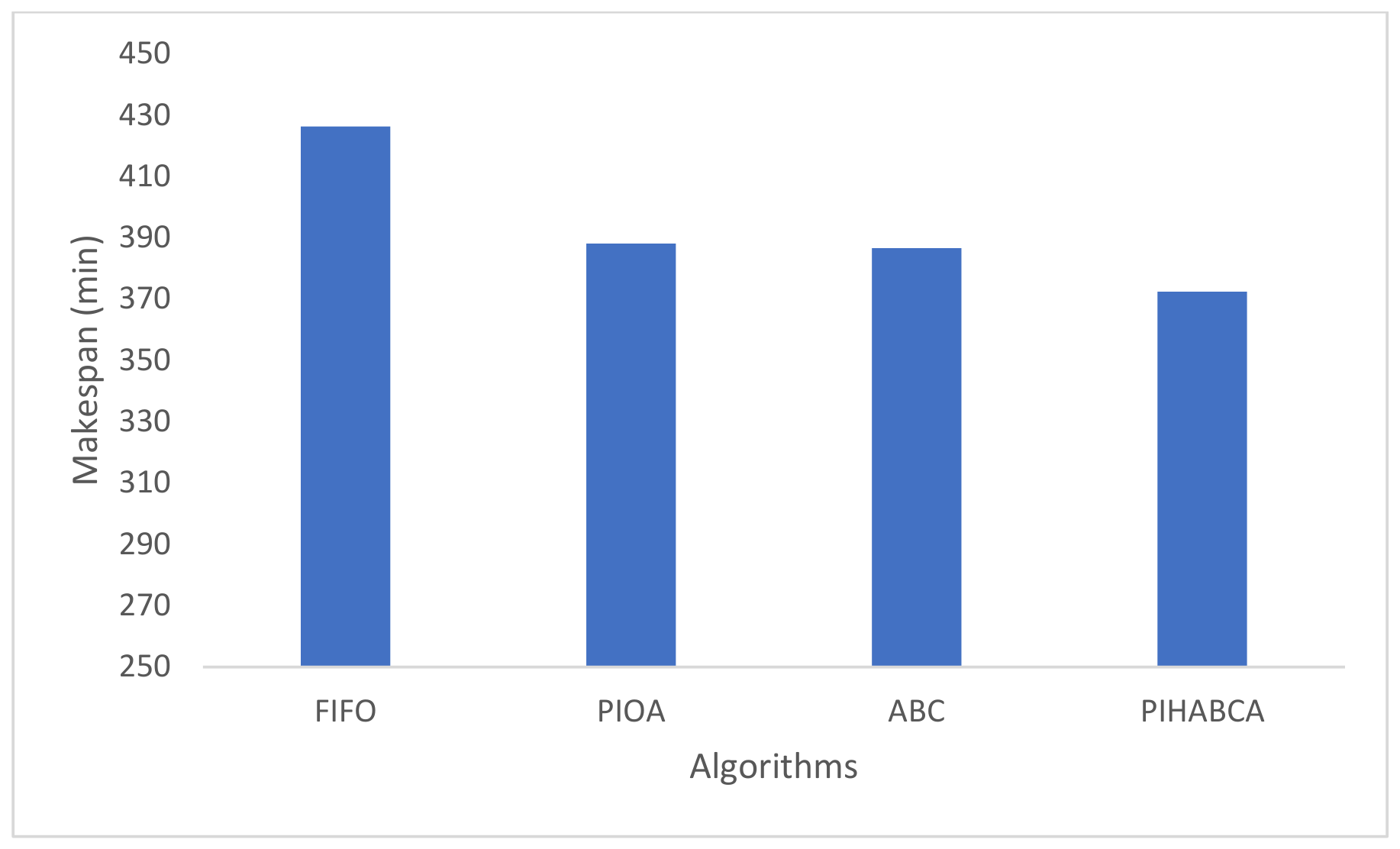
Table 5 shows the breakdown and buffer-adjusted effective processing times for different jobs on various machines. The company does not use any algorithms to find an optimal schedule; they only follow the first-in-first-out (FIFO) dispatching rule. According to FIFO, the estimated makespan was 426.3 min. After implementing the proposed PIHABCA, the makespan dropped to 372.4 min. Figure 3 illustrates the results from the FIFO dispatching rule, PIOA, ABC, and PIHABCA.
Figure 3 compares the performance of four scheduling algorithms: FIFO, PIOA, ABC, and the proposed PIHABCA. This comparison uses the makespan criterion, measured in minutes. Makespan is an essential measure in flow-shop scheduling because it affects overall production efficiency and resource use. The FIFO (first-in-first-out) rule yields the highest makespan of 426.3 min, indicating low scheduling efficiency. As a basic dispatching rule without optimisation, FIFO does not consider job sequences or machine workloads. This results in longer idle times and increased total completion time. The Pigeon-Inspired Optimisation Algorithm (PIOA) significantly improves solution quality, achieving a makespan of 388.1 min. This shows a 9.0% improvement over FIFO and highlights how bio-inspired methods can find solutions beyond simple heuristics. PIOA uses its map-and-compass and landmark operator mechanisms to enhance global search ability. The artificial bee colony (ABC) algorithm further improves performance, producing a makespan of 386.6 min. The improvement over PIOA is small at 0.39%. However, ABC’s employed, onlooker, and scout bee phases create a better balance between exploration and exploitation. This helps it find slightly more efficient job sequences. The proposed PIHABCA (Pigeon-Inspired Hybrid Artificial Bee Colony Algorithm) outperforms all other methods, achieving the lowest makespan of 372.4 min. This represents:
-
12.6% reduction compared to FIFO,
-
4.0% reduction compared to PIOA, and
-
3.7% reduction compared to ABC.
The effectiveness of PIHABCA may be ascribed to several features of its algorithmic construction. Pigeon-inspired search is able to successfully guide the population towards potentially useful areas at the initial stages of searching, thus facilitating faster convergence. Next, the use of artificial bee colony algorithm is capable of boosting local search by searching for adjacent schedules and refining solutions. This kind of searching allows combining both global and local searching effectively, thus preventing early convergence. In addition, the use of local search operations makes it possible to optimise job sequencing using the specifics of permutation flow-shop scheduling.
From a production viewpoint, the reduction in makespan realised through PIHABCA is significant. The shorter makespan implies a greater production throughput, better use of machinery, lesser work-in-process inventory, and better customer response. In a production environment that suffers from machine breakdowns and has limited buffer capacity, the reduction in makespan leads to lesser congestion and blocking of machines, which enhances the stability and efficiency of the production system.
As a result, through the comparative study, it has been found that although both PIOA and ABC are superior to the conventional dispatching rule of FIFO, no one of them alone can produce better results compared to the hybrid method proposed. It is clear from the results that PIHABCA always produces the smallest makespan using the synergistic effect of both PIOA and ABC algorithms. Thus, these results confirm the appropriateness of the proposed hybrid optimisation algorithm for complex flow-shop problems involving machine breakdowns and limited buffer capacities.

6. Conclusions

This paper introduces a Pigeon-Inspired Hybrid Artificial Bee Colony Algorithm (PIHABCA) to address flow-shop scheduling issues arising from unexpected machine breakdowns and limited buffer constraints. These factors closely resemble real-world manufacturing scenarios. By combining the global navigation and homing behaviours inspired by pigeons with the strong local search and exploitation capabilities of the artificial bee colony method, the algorithm strikes a good balance between exploration and exploitation. The proposed PIHABCA was rigorously tested on standard benchmark scenarios. This included classical flow-shop datasets and extended cases with random machine breakdowns and limited buffer capacities. Comparative experiments against established heuristics and top metaheuristic algorithms showed that PIHABCA consistently provides better or competitive makespan values while maintaining strong stability and convergence. Statistical tests, including Friedman, Wilcoxon signed-rank, and Nemenyi post-hoc tests, confirmed that the performance improvements are statistically significant, reinforcing the method’s effectiveness. The results demonstrate that the hybridisation strategy enables PIHABCA to effectively manage the complexity and uncertainty introduced by breakdowns and buffer constraints. Unlike traditional methods that often assume ideal machine availability or unlimited buffers, this algorithm accounts for realistic operational constraints. This enhances its practical relevance for today’s manufacturing systems. In conclusion, PIHABCA offers a robust, flexible, and scalable optimisation framework for complex flow-shop scheduling challenges in manufacturing environments focused on Industry 4.0. Future research could expand on this work by incorporating multi-objective optimisation, energy-efficient scheduling, preventive maintenance planning, or adaptive parameter control based on learning, thereby further broadening the algorithm’s applicability in dynamic and smart manufacturing systems.

Author Contributions

Writing—original draft, M.G.; Software, M.G.; Data curation, M.K.M.; review, M.K.M. and M.G.; editing, M.K.M.; Methodology, M.G.; Formal analysis, M.G. All authors have read and agreed to the published version of the manuscript.

Funding

This research received no external funding.

Data Availability Statement

The original contributions presented in this study are included in the article. Further inquiries can be directed to the corresponding author.

Conflicts of Interest

The authors declare no conflicts of interest.

References

  1. Baker, K.R. Introduction to Sequencing and Scheduling, 1st ed.; John Wiley: New York, NY, USA, 1974. [Google Scholar]
  2. Pinedo, M. Scheduling Theory, Algorithms and Systems; Prentice Hall: Englewood Cliffs, NJ, USA, 1995. [Google Scholar]
  3. Johnson, S.M. Optimal two-and three-stage production schedules with setup times included. Nav. Res. Logist. Q. 1954, 1, 61–68. [Google Scholar] [CrossRef]
  4. Zaied, A.N.H.; Ismail, M.M.; Mohamed, S.S. Permutation flow shop scheduling problem with makespan criterion: Literature review. J. Theor. Appl. Inf. Technol. 2021, 99, 830–848. [Google Scholar]
  5. Rajkumar, R.; Shahabudeen, P. An improved genetic algorithm for the flowshop scheduling problem. Int. J. Prod. Res. 2009, 47, 233–249. [Google Scholar]
  6. Engin, O.; Güçlü, A. A new hybrid ant colony optimization algorithm for solving the no-wait flow shop scheduling problems. Appl. Soft Comput. 2018, 72, 166–176. [Google Scholar] [CrossRef]
  7. Haq, A.N.; Saravanan, M.; Vivekraj, A.R.; Prasad, T. A scatter search approach for general flowshop scheduling problem. Int. J. Adv. Manuf. Technol. 2007, 31, 731–736. [Google Scholar]
  8. Gao, J.; Chen, R.; Deng, W. An efficient tabu search algorithm for the distributed permutation flowshop scheduling problem. Int. J. Prod. Res. 2013, 51, 641–651. [Google Scholar] [CrossRef]
  9. Li, Y.; Zheng, C.; Pei, X. Multi-search mechanism-improved differential evolution algorithm for the no-wait flow shop scheduling problem. Appl. Soft Comput. 2025, 175, 113094. [Google Scholar] [CrossRef]
  10. Meng, T.; Pan, Q.K.; Li, J.Q.; Sang, H.Y. An improved migrating birds optimization for an integrated lot-streaming flow shop scheduling problem. Swarm Evol. Comput. 2018, 38, 64–78. [Google Scholar] [CrossRef]
  11. Marichelvam, M.K. An improved hybrid Cuckoo Search (IHCS) metaheuristics algorithm for permutation flow shop scheduling problems. Int. J. Bio-Inspir. Comput. 2012, 4, 200–205. [Google Scholar] [CrossRef]
  12. Tosun, Ö. Using artificial bee colony algorithm for permutation flow shop scheduling problem under makespan criterion. Int. J. Math. Modell. Numer. Optim. 2014, 5, 191–209. [Google Scholar] [CrossRef]
  13. Shao, W.; Pi, D.; Shao, Z. An extended teaching-learning based optimization algorithm for solving no-wait flow shop scheduling problem. Appl. Soft Comput. 2017, 61, 193–210. [Google Scholar] [CrossRef]
  14. Zheng, J.; Wang, Y. A hybrid bat algorithm for solving the three-stage distributed assembly permutation flowshop scheduling problem. Appl. Sci. 2021, 11, 10102. [Google Scholar] [CrossRef]
  15. Marichelvam, M.K.; Geetha, M. A hybrid discrete firefly algorithm to solve flow shop scheduling problems to minimise total flow time. Int. J. Bio-Inspir. Comput. 2016, 8, 318–325. [Google Scholar] [CrossRef]
  16. Zeng, F.; Cui, J. Improved Fruit Fly Algorithm to Solve No-Idle Permutation Flow Shop Scheduling Problem. Processes 2025, 13, 476. [Google Scholar] [CrossRef]
  17. Marichelvam, M.K.; Tosun, Ö.; Geetha, M. Hybrid monkey search algorithm for flow shop scheduling problem under makespan and total flow time. Appl. Soft Comput. 2017, 55, 82–92. [Google Scholar] [CrossRef]
  18. Marichelvam, M.K.; Geetha, M. Solving flowshop scheduling problems using a discrete African wild dog algorithm. ICTACT J. Soft Comput. 2013, 3, 555–559. [Google Scholar] [CrossRef]
  19. Mansouri, M.; Bahmani, Y.; Smadi, H. Optimization of the Flow-Shop Scheduling Problem under Time Constraints with PSO Algorithm. Eng. Pro. 2023, 56, 220. [Google Scholar] [CrossRef]
  20. Duan, H.; Qiao, P. Pigeon-inspired optimization: A new swarm intelligence optimizer for air robot path planning. Int. J. Intell. Comput. Cybern. 2014, 7, 24–37. [Google Scholar] [CrossRef]
  21. Karaboga, D. An Idea Based on Honey Bee Swarm for Numerical Optimization (Technical Report No. TR06); Erciyes University, Engineering Faculty, Computer Engineering Department: Talas, Turkey, 2005. [Google Scholar]
  22. Karaboga, D.; Basturk, B. A powerful and efficient algorithm for numerical function optimization: Artificial bee colony (ABC) algorithm. J. Glob. Optim. 2007, 39, 459–471. [Google Scholar] [CrossRef]
  23. Karaboga, D.; Basturk, B. On the performance of Artificial Bee Colony (ABC) algorithm. Appl. Soft Comput. 2008, 8, 687–697. [Google Scholar] [CrossRef]
  24. Karaboga, D. Artificial bee colony algorithm. Scholarpedia 2010, 5, 6915. [Google Scholar] [CrossRef]
  25. Banharnsakun, A.; Achalakul, T.; Sirinaovakul, B. The best-so-far selection in Artificial Bee Colony algorithm. Appl. Soft Comput. 2011, 11, 2888–2901. [Google Scholar] [CrossRef]
  26. Kaur, A.; Goyal, S. A survey on the applications of bee colony optimization techniques. Int. J. Comput. Sci. Eng. 2011, 3, 3037. [Google Scholar]
  27. Pan, Q.K.; Tasgetiren, M.F.; Suganthan, P.N.; Chua, T.J. A discrete artificial bee colony algorithm for the lot-streaming flow shop scheduling problem. Inf. Sci. 2011, 181, 2455–2468. [Google Scholar] [CrossRef]
  28. Tasgetiren, M.F.; Pan, Q.K.; Suganthan, P.N.; Chen, A.H. A discrete artificial bee colony algorithm for the total flowtime minimization in permutation flow shops. Inf. Sci. 2011, 181, 3459–3475. [Google Scholar] [CrossRef]
  29. Akay, B.; Karaboga, D. A modified Artificial Bee Colony algorithm for real-parameter optimization. Inf. Sci. 2012, 192, 120–142. [Google Scholar] [CrossRef]
  30. Akbari, R.; Hedayatzadeh, R.; Ziarati, K.; Hassanizadeh, B. A multi-objective artificial bee colony algorithm. Swarm Evol. Comput. 2012, 2, 39–52. [Google Scholar] [CrossRef]
  31. Cui, Z.; Gu, X. An improved discrete Artificial Bee Colony Algorithm for hybrid flow shop problems. In International Conference on Intelligent Computing for Sustainable Energy and Environment; Springer: Berlin/Heidelberg, Germany, 2012; pp. 294–302. [Google Scholar]
  32. Han, Y.Y.; Pan, Q.K.; Li, J.Q.; Sang, H.Y. An improved artificial bee colony algorithm for the blocking flowshop scheduling problem. Int. J. Adv. Manuf. Technol. 2012, 60, 1149–1159. [Google Scholar]
  33. Kashan, M.H.; Nahavandi, N.; Kashan, A.H. DisABC: A new artificial bee colony algorithm for binary optimization. Appl. Soft Comput. 2012, 12, 342–352. [Google Scholar] [CrossRef]
  34. Li, X.T.; Yin, M.H. A discrete artificial bee colony algorithm with composite mutation strategies for permutation flow shop scheduling problem. Sci. Iran. 2012, 19, 1921–1935. [Google Scholar] [CrossRef]
  35. Bansal, J.C.; Sharma, H.; Jadon, S.S. Artificial bee colony algorithm: A survey. Int. J. Adv. Intell. Paradig. 2013, 5, 123–159. [Google Scholar] [CrossRef]
  36. Chow, H.Y.; Hasan, S.; Bareduan, S.A. Basic concept of implementing artificial bee colony (ABC) system in flow shop scheduling. Appl. Mech. Mater. 2013, 315, 385–388. [Google Scholar] [CrossRef]
  37. Han, Y.Y.; Liang, J.J.; Pan, Q.K.; Li, J.Q.; Sang, H.Y.; Cao, N.N. Effective hybrid discrete artificial bee colony algorithms for the total flowtime minimization in the blocking flowshop problem. Int. J. Adv. Manuf. Technol. 2013, 67, 397–414. [Google Scholar]
  38. Lin, S.W.; Ying, K.C.; Huang, C.Y. Multiprocessor task scheduling in multistage hybrid flowshops: A hybrid artificial bee colony algorithm with bi-directional planning. Comput. Oper. Res. 2013, 40, 1186–1195. [Google Scholar] [CrossRef]
  39. Liu, Y.F.; Liu, S.Y. A hybrid discrete artificial bee colony algorithm for permutation flowshop scheduling problem. Appl. Soft Comput. 2013, 13, 1459–1463. [Google Scholar] [CrossRef]
  40. Xu, Y.; Fan, P.; Yuan, L. A simple and efficient artificial bee colony algorithm. Math. Probl. Eng. 2013, 2013, 526315. [Google Scholar] [CrossRef]
  41. Zhang, R.; Chen, A.; Song, S. A hybrid artificial bee colony algorithm for the job-shop scheduling problem. Int. J. Prod. Econ. 2013, 142, 469–477. [Google Scholar]
  42. Chakaravarthy, G.V.; Marimuthu, S.; Ponnambalam, S.G.; Kanagaraj, G. Improved sheep flock heredity algorithm and artificial bee colony algorithm for scheduling m-machine flow shops lot streaming with equal size sub-lot problems. Int. J. Prod. Res. 2014, 52, 1509–1527. [Google Scholar]
  43. Yurtkuran, A.; Emel, E. A Modified Artificial Bee Colony Algorithm for p-Center Problems. Sci. World J. 2014, 2014, 824196. [Google Scholar] [CrossRef]
  44. Han, Y.Y.; Gong, D.; Sun, X. A discrete artificial bee colony algorithm incorporating differential evolution for the flow-shop scheduling problem with blocking. Eng. Optim. 2015, 47, 927–946. [Google Scholar]
  45. Kheirandish, O.; Tavakkoli-Moghaddam, R.; Karimi-Nasab, M. An artificial bee colony algorithm for a two-stage hybrid flowshop scheduling problem with multilevel product structures and requirement operations. Int. J. Comput. Integr. Manuf. 2015, 28, 437–450. [Google Scholar]
  46. Khorramizadeh, M.; Riahi, V. A bee colony optimization approach for mixed blocking constraints flow shop scheduling problems. Math. Probl. Eng. 2015, 2015, 612604. [Google Scholar] [CrossRef]
  47. Li, J.Q.; Pan, Q.K. Solving the large-scale hybrid flow shop scheduling problem with limited buffers by a hybrid artificial bee colony algorithm. Inf. Sci. 2015, 316, 487–502. [Google Scholar] [CrossRef]
  48. Li, J.Q.; Pan, Q.K.; Duan, P.Y. An improved artificial bee colony algorithm for solving hybrid flexible flowshop with dynamic operation skipping. IEEE Trans. Cybern. 2015, 46, 1311–1324. [Google Scholar] [PubMed]
  49. Ribas, I.; Companys, R.; Tort-Martorell, X. An efficient Discrete Artificial Bee Colony algorithm for the blocking flow shop problem with total flowtime minimization. Expert Syst. Appl. 2015, 42, 6155–6167. [Google Scholar] [CrossRef]
  50. Zhang, S.J.; Gu, X.S. An effective discrete artificial bee colony algorithm for flow shop scheduling problem with intermediate buffers. J. Cent. South Univ. 2015, 22, 3471–3484. [Google Scholar] [CrossRef]
  51. Deng, G.; Yang, H.; Zhang, S. An enhanced discrete artificial bee colony algorithm to minimize the total flow time in permutation flow shop scheduling with limited buffers. Math. Probl. Eng. 2016, 2016, 7373617. [Google Scholar] [CrossRef]
  52. Yurtkuran, A.; Emel, E. A discrete artificial bee colony algorithm for single machine scheduling problems. Int. J. Prod. Res. 2016, 54, 6860–6878. [Google Scholar] [CrossRef]
  53. Gong, D.; Han, Y.; Sun, J. A Hybrid Discrete Artificial Bee Colony Algorithm for Multi-objective Blocking Lot-Streaming Flow Shop Scheduling Problem. In Chinese Intelligent Systems Conference; Springer: Singapore, 2017; pp. 593–602. [Google Scholar]
  54. Li, X.; Ma, S. Multiobjective discrete artificial bee colony algorithm for multiobjective permutation flow shop scheduling problem with sequence dependent setup times. IEEE Trans. Eng. Manag. 2017, 64, 149–165. [Google Scholar] [CrossRef]
  55. Gong, D.; Han, Y.; Sun, J. A novel hybrid multi-objective artificial bee colony algorithm for blocking lot-streaming flow shop scheduling problems. Knowl.-Based Syst. 2018, 148, 115–130. [Google Scholar] [CrossRef]
  56. He, Y.; Xie, H.; Wong, T.L.; Wang, X. A novel binary artificial bee colony algorithm for the set-union knapsack problem. Future Gener. Comput. Syst. 2018, 78, 77–86. [Google Scholar] [CrossRef]
  57. Peng, K.; Pan, Q.; Zhang, B. An improved artificial bee colony algorithm for steelmaking–refining–continuous casting scheduling problem. Chin. J. Chem. Eng. 2018, 26, 1727–1735. [Google Scholar] [CrossRef]
  58. Xuan, H.; Zhang, H.; Li, B. An Improved Discrete Artificial Bee Colony Algorithm for Flexible Flowshop Scheduling with Step Deteriorating Jobs and Sequence-Dependent Setup Times. Math. Probl. Eng. 2019, 2019, 8520503. [Google Scholar] [CrossRef]
  59. Arık, O.A. Artificial bee colony algorithm including some components of iterated greedy algorithm for permutation flow shop scheduling problems. Neural Comput. Appl. 2021, 33, 3469–3486. [Google Scholar] [CrossRef]
  60. Li, Y.; Li, X.; Gao, L.; Zhang, B.; Pan, Q.K.; Tasgetiren, M.F.; Meng, L. A Discrete Artificial Bee Colony Algorithm for Distributed Hybrid Flowshop Scheduling Problem with Sequence-Dependent Setup Times. Int. J. Prod. Res. 2021, 59, 3880–3899. [Google Scholar] [CrossRef]
  61. Li, H.; Li, X.; Gao, L. A discrete artificial bee colony algorithm for the distributed heterogeneous no-wait flowshop scheduling problem. Appl. Soft Comput. 2021, 100, 106946. [Google Scholar] [CrossRef]
  62. Zuo, Y.; Fan, Z.; Zou, T.; Wang, P. A novel multi-population artificial bee colony algorithm for energy-efficient hybrid flow shop scheduling problem. Symmetry 2021, 13, 2421. [Google Scholar] [CrossRef]
  63. Peng, Z.Y.; Huang, Y.J.; Zhong, Y.B. A discrete artificial bee colony algorithm for quadratic assignment problem. J. High Speed Netw. 2022, 28, 131–141. [Google Scholar] [CrossRef]
  64. Khedim, A.O.; Souier, M.; Sari, Z. Combinatorial artificial bee colony algorithm hybridised with a new release of iterated local search for job shop scheduling problem. Int. J. Oper. Res. 2022, 44, 435–461. [Google Scholar] [CrossRef]
  65. Li, H.; Gao, L.; Li, X. Discrete artificial bee colony algorithm for multi-objective distributed heterogeneous no-wait flowshop scheduling problem. J. Mech. Eng. 2023, 59, 291–306. [Google Scholar] [CrossRef]
  66. Li, H.; Gao, K.; Duan, P.Y.; Li, J.Q.; Zhang, L. An improved artificial bee colony algorithm with Q-learning for solving permutation flow-shop scheduling problems. IEEE Trans. Syst. Man Cybern. Syst. 2023, 53, 2684–2693. [Google Scholar] [CrossRef]
  67. Nawaz, M.; Enscore, E.E., Jr.; Ham, I. A heuristic algorithm for the m-machine, n-job flow-shop sequencing problem. Omega 1983, 11, 91–95. [Google Scholar] [CrossRef]
  68. Zhao, F.; Wang, Z.; Wang, L. A reinforcement learning driven artificial bee colony algorithm for distributed heterogeneous no-wait flowshop scheduling problem with sequence-dependent setup times. IEEE Trans. Autom. Sci. Eng. 2023, 20, 2305–2320. [Google Scholar] [CrossRef]
  69. Ladj, A.; Benbouzid-Si Tayeb, F.; Dahamni, A.; Benbouzid, M. An Artificial Bee Colony Algorithm for Coordinated Scheduling of Production Jobs and Flexible Maintenance in Permutation Flowshops. Technologies 2024, 12, 45. [Google Scholar] [CrossRef]
  70. Li, M.; Chang, C.T.; Liu, Z. A discrete artificial bee colony algorithm and its application in flexible flow shop scheduling with assembly and machine deterioration effect. Appl. Soft Comput. 2024, 159, 111593. [Google Scholar] [CrossRef]
  71. Wang, J.; Lei, D.; Tang, H. An adaptive artificial bee colony for hybrid flow shop scheduling with batch processing machines in casting process. Int. J. Prod. Res. 2024, 62, 4793–4808. [Google Scholar] [CrossRef]
  72. Davendra, D.; Herrmann, F. Scheduling tardiness constrained flow shop with simultaneously loaded stations using the chaos driven discrete Artificial Bee Colony algorithm. Syst. Soft Comput. 2025, 7, 200401. [Google Scholar] [CrossRef]
  73. Dong, Y.; Wang, S.; Liu, X. Flow Shop Scheduling with Limited Buffers by an Improved Discrete Pathfinder Algorithm with Multi-Neighborhood Local Search. Processes 2025, 13, 2325. [Google Scholar] [CrossRef]
  74. Hu, D.; Wu, Y.; Qiu, L.; Mi, J.; Yang, Y. Constructive-destructive neighbor search drives artificial bee colony algorithm for variable speed green hybrid flowshop scheduling problem. Sci. Rep. 2025, 15, 9671. [Google Scholar] [CrossRef] [PubMed]
  75. Lu, B.; Gao, K.; Duan, P.; Slowik, A. Scheduling Bi-Objective Lot-Streaming Hybrid Flow Shops with Consistent Sublots via an Enhanced Artificial Bee Colony Algorithm. Complex Syst. Modell. Simul. 2025, 5, 46–67. [Google Scholar] [CrossRef]
  76. Duan, H.; Wang, X. Echo state networks with orthogonal pigeon-inspired optimization for image restoration. IEEE Trans. Neural Netw. Learn. Syst. 2015, 27, 2413–2425. [Google Scholar] [CrossRef] [PubMed]
  77. Deng, Y.; Zhu, W.; Duan, H. Hybrid membrane computing and pigeon-inspired optimization algorithm for brushless direct current motor parameter design. Sci. China Technol. Sci. 2016, 59, 1435–1441. [Google Scholar] [CrossRef]
  78. Pei, J.; Su, Y.; Zhang, D. Fuzzy energy management strategy for parallel HEV based on pigeon-inspired optimization algorithm. Sci. China Technol. Sci. 2017, 60, 425–433. [Google Scholar] [CrossRef]
  79. Varun, A.; Kumar, M.S. A comprehensive review of the pigeon-inspired optimization algorithm. Int. J. Eng. Technol. 2018, 7, 758–761. [Google Scholar] [CrossRef]
  80. Fu, X.; Chan, F.T.; Niu, B.; Chung, N.S.; Qu, T. A multi-objective pigeon inspired optimization algorithm for fuzzy production scheduling problem considering mould maintenance. Sci. Chin. Inf. Sci. 2019, 62, 70202. [Google Scholar] [CrossRef]
  81. Hu, C.; Xia, Y.; Zhang, J. Adaptive operator quantum-behaved pigeon-inspired optimization algorithm with application to UAV path planning. Algorithms 2018, 12, 3. [Google Scholar] [CrossRef]
  82. Liu, H.; Yan, X.; Wu, Q. An improved pigeon-inspired optimisation algorithm and its application in parameter inversion. Symmetry 2019, 11, 1291. [Google Scholar] [CrossRef]
  83. Zhong, Y.; Wang, L.; Lin, M.; Zhang, H. Discrete pigeon-inspired optimization algorithm with Metropolis acceptance criterion for large-scale traveling salesman problem. Swarm Evol. Comput. 2019, 48, 134–144. [Google Scholar] [CrossRef]
  84. Bolaji, A.L.A.; Okwonu, F.Z.; Shola, P.B.; Balogun, B.S.; Adubisi, O.D. A modified binary pigeon-inspired algorithm for solving the multi-dimensional knapsack problem. J. Intell. Syst. 2020, 30, 90–103. [Google Scholar] [CrossRef]
  85. Brajević, I.; Stanimirović, P.S.; Li, S.; Cao, X. A hybrid firefly and multi-strategy artificial bee colony algorithm. Int. J. Comput. Intell. Syst. 2020, 13, 810–821. [Google Scholar] [CrossRef]
  86. Chen, G.; Qian, J.; Zhang, Z.; Li, S. Application of modified pigeon-inspired optimization algorithm and constraint-objective sorting rule on multi-objective optimal power flow problem. Appl. Soft Comput. 2020, 92, 106321. [Google Scholar] [CrossRef]
  87. Wu, X.; Shen, X.; Zhao, N.; Wu, S. An improved discrete pigeon-inspired optimisation algorithm for flexible job shop scheduling problem. Int. J. Bio-Inspir. Comput. 2020, 16, 181–194. [Google Scholar] [CrossRef]
  88. Lei, T.; Luo, C.; Sellers, T.; Rahimi, S. A bat-pigeon algorithm to crack detection-enabled autonomous vehicle navigation and mapping. Intell. Syst. Appl. 2021, 12, 200053. [Google Scholar] [CrossRef]
  89. Pan, J.S.; Tian, A.Q.; Chu, S.C.; Li, J.B. Improved binary pigeon-inspired optimization and its application for feature selection. Appl. Intell. 2021, 51, 8661–8679. [Google Scholar] [CrossRef]
  90. Xu, Z.; Xu, L.; Ling, X. An improved pigeon-inspired optimization algorithm for solving dynamic facility layout problem with uncertain demand. Procedia CIRP 2021, 104, 1203–1208. [Google Scholar] [CrossRef]
  91. Hussein, R.B.; Algamal, Z. Solving 0–1 knapsack problem by an improved binary Pigeon Inspired Optimization Algorithm. Math. Stat. Eng. Appl. 2022, 71, 312–324. [Google Scholar]
  92. Ramalingam, R.; Karunanidy, D.; Alshamrani, S.S.; Rashid, M.; Mathumohan, S.; Dumka, A. Oppositional pigeon-inspired optimizer for solving the non-convex economic load dispatch problem in power systems. Mathematics 2022, 10, 3315. [Google Scholar] [CrossRef]
  93. Ding, G.; Dong, F. An improved pigeon-inspired optimisation for continuous function optimisation problems. Int. J. Comput. Sci. Math. 2023, 17, 207–219. [Google Scholar] [CrossRef]
  94. Geetha, M.; Chandra Guru Sekar, R.; Marichelvam, M.K.; Tosun, Ö. A sequential hybrid optimization algorithm (SHOA) to solve the hybrid flow shop scheduling problems to minimize carbon footprint. Processes 2024, 12, 143. [Google Scholar] [CrossRef]
  95. Yu, L.; Guo, X.; Zhou, D.; Zhang, J. A multi-objective pigeon-inspired optimization algorithm for community detection in complex networks. Mathematics 2024, 12, 1486. [Google Scholar] [CrossRef]
  96. Bean, J.C. Genetic algorithms and random keys for sequencing and optimization. ORSA J. Comput. 1994, 6, 154–160. [Google Scholar] [CrossRef]
  97. Carlier, J. Ordonnancements a contraintes disjonctives. RAIRO-Oper. Res. 1978, 12, 333–350. [Google Scholar] [CrossRef]
  98. Rajkumar, R.; Shahabudeen, P. Performance evaluation of simulated annealing algorithm for flowshop scheduling problems. Int. J. Appl. Manag. Technol. 2008, 5, 172–189. [Google Scholar]
  99. Palmer, D.S. Sequencing jobs through a multi-stage process in the minimum total time—A quick method of obtaining a near optimum. J. Oper. Res. Soc. 1965, 16, 101–107. [Google Scholar] [CrossRef]
  100. Campbell, H.G.; Dudek, R.A.; Smith, M.L. A heuristic algorithm for the n job, m machine sequencing problem. Manag. Sci. 1970, 16, B-630. [Google Scholar] [CrossRef]
  101. Agarwal, A.; Colak, S.; Eryarsoy, E. Improvement heuristic for the flow-shop scheduling problem: An adaptive-learning approach. Eur. J. Oper. Res. 2006, 169, 801–815. [Google Scholar] [CrossRef]
  102. Abdel-Basset, M.; Mohamed, R.; Abouhawwash, M.; Chakrabortty, R.K.; Ryan, M.J. A simple and effective approach for tackling the permutation flow shop scheduling problem. Mathematics 2021, 9, 270. [Google Scholar] [CrossRef]
  103. Zou, P.; Rajora, M.; Liang, S.Y. Multimodal optimization of permutation flow-shop scheduling problems using a clustering-genetic-algorithm-based approach. Appl. Sci. 2021, 11, 3388. [Google Scholar] [CrossRef]
  104. Demirkol, E.; Mehta, S.; Uzsoy, R. Benchmarks for shop scheduling problems. Eur. J. Oper. Res. 1998, 109, 137–141. [Google Scholar] [CrossRef]
  105. Ying, K.C.; Lin, S.W. Multi-heuristic desirability ant colony system heuristic for non-permutation flowshop scheduling problems. Int. J. Adv. Manuf. Technol. 2007, 33, 793–802. [Google Scholar] [CrossRef]
  106. Rossi, A.; Lanzetta, M. Native metaheuristics for non-permutation flowshop scheduling. J. Intell. Manuf. 2014, 25, 1221–1233. [Google Scholar] [CrossRef]
  107. Low, C.; Yeh, J.Y.; Huang, K.I. A robust simulated annealing heuristic for flow shop scheduling problems. Int. J. Adv. Manuf. Technol. 2004, 23, 762–767. [Google Scholar] [CrossRef]
  108. Li, X.; Yin, M. A hybrid cuckoo search via Lévy flights for the permutation flow shop scheduling problem. Int. J. Prod. Res. 2013, 51, 4732–4754. [Google Scholar] [CrossRef]
  109. Sayadi, M.K.; Ramezanian, R.; Ghaffari-Nasab, N. A discrete firefly meta-heuristic with local search for makespan minimization in permutation flow shop scheduling problems. Int. J. Ind. Eng. Comput. 2010, 1, 1–10. [Google Scholar] [CrossRef]
  110. Ying, K.C. Solving non-permutation flowshop scheduling problems by an effective iterated greedy heuristic. Int. J. Adv. Manuf. Technol. 2008, 38, 348–354. [Google Scholar] [CrossRef]
  111. Khurshid, B.; Maqsood, S.; Habib, M.S.; Omair, M.; Hwang, S.J. A hybrid evolution strategies algorithm for non-permutation flow shop scheduling problems. Sci. Rep. 2025, 15, 11856. [Google Scholar] [CrossRef] [PubMed]
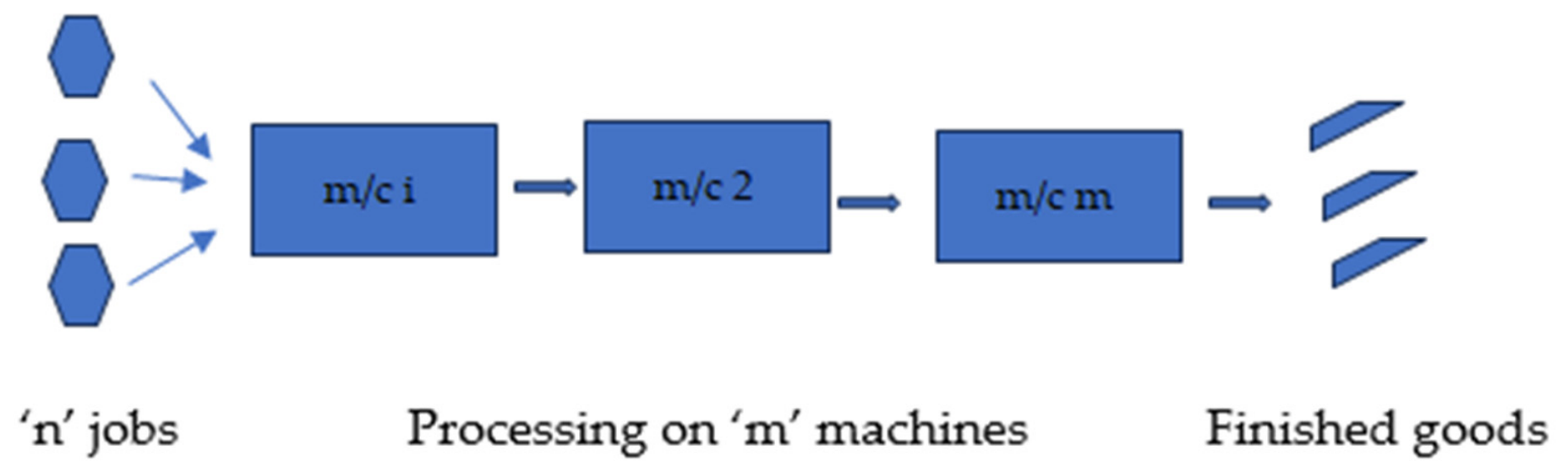
Figure 1. Layout of a flow-shop environment.
Computers 15 00508 g001
Figure 2. Flow chart of the proposed algorithm.
Computers 15 00508 g002
Figure 3. Result comparison of different algorithms for case study problem.
Computers 15 00508 g003
Table 1. Result comparison for benchmark problem set I.
Sl. No.Problem InstancesBest-Known SolutionSAA IGA SGA NEH Palmer CDSALA IEGA HIEGA CGA PIOA ABC PIHABCA
1Car-0170387038703870387038747272027038703870387038703870387038
2Car-0271667166716671667376794074107166716671667166716671667166
3Car-0373127312731273127443772573997312736673127312731273127312
4Car-0480038003800380038034842384238003800380038003800380038003
5Car-0577207743772077208047852086277720772077207720772077207720
6Car-0685058544850585058813948795538505850585058505850585058505
7Car-0765906590659065907008763968196590659065906590659065906590
8Car-0883668382836683668457902389038366836683668366836683668366
Table 2. Friedman mean rank table for benchmark problem set I.
Sl. No.AlgorithmMean Rank
1. SAA1.19
2. IGA1.00
3. SGA1.00
4. NEH 4.88
5. Palmer14.00
6. CDS10.25
7. ALA1.00
8. IEGA1.19
9. HIEGA1.00
10. CGA1.00
11. PIOA1.00
12. ABC1.00
13. PIHABCA1.00
Table 3. Result comparison for benchmark problem set II.
Sl. No.Problem InstancesLower Bound Upper Bound ACS ACOA SAH HCSA FA IGH HES PIOA ABC PIHABCA
1. flcmax_20_15_3335444374420404738993899416439153825392438723839
2. flcmax_20_15_6316841444044395037513751401037883808381237523738
3. flcmax_20_15_4299737793786369235183518373435583507358835163512
4. flcmax_20_15_10342043024265417640324032419240484013405640684016
5. flcmax_20_15_5349443734310409739103910421539103908399639183862
6. flcmax_20_20_1377648214819479045234523474045584517461745284504
7. flcmax_20_20_3375847794723469444244424451544324520459844284412
8. flcmax_20_20_9390249444922472045204520481045384450444045304518
9. flcmax_20_20_2388148864878473144964496473645064530452445064464
10. flcmax_20_20_10382347174715455443714371461943824499436243684362
11. flcmax_30_15_3402052265210492745434537508346024511456445304508
12. flcmax_30_15_4408053045284503346184617521846874699463446224596
13. flcmax_30_15_9402250795075491245474553504545934641456245544542
14. flcmax_30_15_8449056055593522048364828530850024931440248404812
15. flcmax_30_15_6418451475149509747574757505648154853477247504732
16. flcmax_30_20_3480661835987579453595351565854375357538453625278
17. flcmax_30_20_1477260375989617956545642612057035705568056385622
18. flcmax_30_20_6500462416195603957405743601258245715576457725698
19. flcmax_30_20_10489960955923588854405440585155385537547254385398
20. flcmax_30_20_2475758225840584253455352585954795327583258245316
21. flcmax_40_15_5556069866972652159795966634359946105598459565828
22. flcmax_40_15_9511963516310624456805680638557455891568856845468
23. flcmax_40_15_2529065066532630258605848645959235975588458465776
24. flcmax_40_15_10559668456712641358575856661259116061586858605704
25. flcmax_40_15_8557667836771652660406035671360926184605260485938
26. flcmax_40_20_3569371547132720865096509733065547201653265206488
27. flcmax_40_20_9599875287496738866396652745966877223666866626572
28. flcmax_40_20_6599074697476745568016772764668717226682467766764
29. flcmax_40_20_7617076087588740567536714744567867272678667346682
30. flcmax_40_20_5601172197217732665556545707265697221656865566492
31. flcmax_50_15_6629076737631755968216818763568557081683868326784
32. flcmax_50_15_5635576797496731766346638755670286901669466526618
33. flcmax_50_15_1619874167402720565426532743065926792656465466498
34. flcmax_50_15_8631275487558734867836791766768417018680267886768
35. flcmax_50_15_2653177507712754769506950744770737228697069626908
36. flcmax_50_20_2674088388836843676947674NA78937996768876647558
37. flcmax_50_20_1673685398521806472997328NA73587303734073327280
38. flcmax_50_20_7675684178425837075897576NA77527500762075887498
39. flcmax_50_20_8689785908536843074367430NA75297412747474527398
40. flcmax_50_20_4683084938502853877667753NA78967700778077587728
Table 4. Friedman mean rank table for benchmark problem set II.
Sl. No.Algorithm Mean Rank
1. ACS9.10
2. ACOA8.15
3. SAH2.73
4. HCSA2.38
5. FA9.65
6. IGH6.23
7. HES6.55
8. PIOA4.83
9. ABC4.13
10. PIHABCA1.25
Table 5. Breakdown- and buffer-adjusted effective processing times of jobs on different machines (in minutes).
JobsMachines
Blank CuttingPre-SpinningFinal SpinningTrimmingMachiningHeat
Treatment
Surface Finishing Coating Curing Inspection
J14.79.216.16.314.831.07.610.124.34.4
J25.58.117.27.113.828.08.49.222.13.4
J34.810.315.36.615.834.07.811.326.44.4
J43.99.518.55.716.836.09.512.329.65.4
J55.88.316.17.214.830.08.410.124.34.4
J66.211.419.37.818.238.010.213.631.85.9
J75.19.817.66.915.933.09.111.527.64.8
J86.512.120.48.219.540.011.314.234.16.2
J94.38.916.86.114.229.07.59.823.44.1
J106.011.018.97.617.435.010.013.030.25.6
Disclaimer/Publisher’s Note: The statements, opinions and data contained in all publications are solely those of the individual author(s) and contributor(s) and not of MDPI and/or the editor(s). MDPI and/or the editor(s) disclaim responsibility for any injury to people or property resulting from any ideas, methods, instructions or products referred to in the content.