1. Introduction
Generative artificial intelligence (AI) tools—including Google’s Gemini, OpenAI’s ChatGPT, Anthropic’s Claude, and other applications based on large language models (LLMs)—have rapidly become defining components of higher education learning environments. Their emergence is reshaping established practices of information access, knowledge processing, idea generation, and problem-solving [
1,
2]. Students increasingly incorporate these technologies into their academic work, using them to organize information, structure arguments, explore alternative solutions, and support tasks that require both creative and analytical thinking [
2,
3].
This transformation raises important research questions about how AI use relates to students’ independent thinking, creativity, and cognitive flexibility. Its influence, however, is not one-dimensional. While AI can function as a cognitive partner that extends and augments human capabilities, its uncritical use may lead to the superficial outsourcing of intellectual effort. Against this backdrop, the present study examines the transformative implications of AI use for student cognition, focusing on the tension between cognitive augmentation and cognitive replacement.
1.1. Research Problem
Although generative AI has become an increasingly prominent area of inquiry in higher education research, its cognitive consequences for students’ creativity, cognitive flexibility, and independent thinking remain insufficiently understood. Recent systematic reviews indicate that recurring areas of focus in this field include the integration of generative AI into teaching and learning, the redesign of assessment practices, academic integrity, ethical and regulatory issues, and the examination of student learning outcomes [
2,
4,
5]. These approaches highlight the pedagogical, methodological, and normative challenges faced by higher education institutions and instructors as generative AI becomes increasingly widespread. At the same time, the examination of internal cognitive mechanisms underlying creativity, originality, and cognitive flexibility constitutes a distinct theoretical and methodological problem, since the effects of AI use cannot be inferred solely from frequency of use or from the technology’s general educational applicability.
A differentiated understanding of creativity is particularly important when examining the cognitive consequences of AI use. Creativity cannot be reduced to a single performance dimension, as idea generation, divergent thinking, originality, and the quality of creative products may be associated with distinct cognitive mechanisms [
6,
7]. Experimental evidence from Doshi and Hauser suggests that access to generative AI may increase evaluations of individual creative performance, while the stories produced may become more similar to one another, indicating a potential decline in collective diversity [
8].
Furthermore, cognitive flexibility is essential in this context, as it refers to the ability to recognize alternative perspectives, adapt to changing situations, and reorganize thinking strategies [
9]. Generative AI may support this process by offering new perspectives and possible solutions. However, excessive reliance on AI may reduce internal cognitive effort and may be negatively associated with critical thinking [
10]. Consequently, AI use should not be treated as a single undifferentiated variable. It is necessary to examine separately whether students use the tool to complement their own thinking or to partially substitute cognitive operations. This approach provides the theoretical basis for examining AI use through the lenses of cognitive augmentation, cognitive offloading, and differentiated conceptions of creativity, with particular attention to perceived cognitive independence, idea generation, originality, and flexible problem solving. While objective performance tasks provide valuable quantifiable data, focusing on students’ subjective perceptions is crucial, as individual self-report measures capture the internalized, psychological framework that directly shapes daily AI adoption patterns and long-term cognitive reliance.
1.2. Literature Review
1.2.1. Extended Cognition
According to the theory of extended cognition, thinking extends beyond the individual’s biological cognitive system and, under certain conditions, may encompass external artifacts and technological systems. In Clark and Chalmers’ extended mind thesis, the boundary of a cognitive process cannot be automatically equated with the boundary of the biological individual: when an external representation or tool performs the same functional role in problem solving as an internal cognitive operation and is stably integrated into the organization of the individual’s behavior, it may be considered part of the cognitive system [
11] (pp. 8–9, 17).
Although the extended mind thesis has faced theoretical scrutiny—particularly regarding the exact criteria for cognitive coupling and the boundaries of mental architecture—it provides a relevant theoretical basis for investigating the pervasive integration of contemporary AI tools. With the development of digital technologies, the question of extended cognition has increasingly shifted toward examining human–technology collaboration and external cognitive resources. Within this framework, generative artificial intelligence can be understood as a technological environment that actively participates in the structuring of thinking processes [
12]. AI-based cognitive extension can be interpreted as cognitive augmentation, that is, as a supportive complement to thinking, when the responses generated by the tool prompt the user to engage in further interpretation, verification, and revision. Hernández-Orallo and Vold use the concept of AI extenders to refer to systems situated along a continuum between external tools and human cognitive functioning, thereby positioning AI as a technological component that expands human cognitive capacities [
13] (pp. 507–508). In this sense, generative AI may serve as a complement to students’ thinking when they use the tool to formulate questions, compare alternatives, refine their arguments, and reflectively develop their work.
1.2.2. Cognitive Offloading
The perspective of extended cognition highlights the augmentative potential of AI use, yet it does not fully account for situations in which reliance on external technological resources is accompanied by a reduction in one’s own cognitive effort. This issue can be examined through the theory of cognitive offloading.
Cognitive offloading is a strategy whereby individuals use external tools or environmental cues to reduce the cognitive demands of a task. According to Risko and Gilbert’s definition, cognitive offloading refers to modifying a task’s information-processing requirements through physical or technological means, thereby reducing internal cognitive load [
14]. This strategy can adaptively reduce working memory demands, accelerate task completion, and free cognitive resources for more complex operations. Its cognitive consequences depend on the type of operations being offloaded, as well as on the extent to which the user remains involved in interpreting information, verifying outputs, and participating in decision-making processes.
With the emergence of generative AI and large language models (LLMs), the dynamics of cognitive offloading have undergone a fundamental transformation. In the case of traditional digital tools, such as search engines or static databases, offloading was typically directed toward deterministic, well-defined information-retrieval operations. By contrast, interaction with AI-based systems gives rise to a stochastic, partly agentic form of partnership [
15,
16,
17,
18]. In this context, reducing internal cognitive load may paradoxically increase the need for metacognitive monitoring and critical verification, since users must also evaluate the epistemic reliability of AI-generated responses [
14]. This challenge becomes particularly salient in AI-assisted decision making, where users may over-rely on automated outputs unless they actively engage in critical evaluation [
19]. When users fail to verify AI-generated outputs retrospectively, the adaptive function of cognitive offloading becomes compromised. Automation bias refers to the tendency to over-trust automated recommendations even when they are incorrect [
20]. Automation complacency describes reduced vigilance during interaction with automated systems [
21]. A related phenomenon is the out-of-the-loop performance problem, whereby prolonged reliance on automation diminishes users’ ability to monitor system performance and intervene effectively [
22]. More recently, these mechanisms have also been interpreted as manifestations of cognitive underloading in AI-supported cognition [
19].
Over time, this process may lead to the gradual erosion of internal problem-solving competencies, or de-skilling, because the sustained absence of internal cognitive effort inhibits deep information processing, semantic elaboration, and schema formation [
22,
23,
24].
Accordingly, the effectiveness of contemporary AI-based cognitive extension depends on metacognitive control and epistemic integration. Building on Kirsh and Maglio’s classical distinction, AI use requires a differentiation between pragmatic actions, whose purpose is the physical and rapid execution of a task, and epistemic actions, whose purpose is to facilitate the internal mental representation and understanding of the task through iterative dialog with AI [
25] (pp. 513–515). AI can function as a genuine cognitive extender only when the tool keeps the individual’s executive functions engaged and, as part of a distributed cognitive architecture, prompts the human agent toward higher-level abstraction, conceptual validation, and continuous reinterpretation [
13,
26,
27].
1.2.3. Conceptualizations of Creativity
In the scientific study of creativity, the literature has traditionally drawn on Guilford’s model of divergent thinking, which operationalizes creative potential through subcomponents such as fluency in idea generation, flexibility in shifting between categories, and the uniqueness of ideas, that is, originality [
6,
7,
28,
29]. The integration of generative AI and large language models into higher education reconfigures the relationship among these components, giving rise to a paradox in which creative performance may be enhanced while creative outputs simultaneously become more homogenized [
8,
30,
31]. Although the present study does not directly assess creative performance, these conceptualizations provide the theoretical framework for interpreting students’ perceptions of AI’s role in creative thinking.
Beyond divergent thinking, creativity has also been linked to deep cognitive engagement and supportive learning environments. Flow theory emphasizes sustained attention and intrinsic engagement [
32], whereas Robinson and Aronica argue that educational contexts should encourage autonomy, experimentation, and intellectual risk-taking [
33]. From this perspective, generative AI raises important questions about whether it promotes creative autonomy or increases reliance on externally generated solutions.
Theoretical and empirical studies suggest that LLMs are well suited to supporting the early associative phase of divergent thinking. By combining semantically distant concepts, AI can provide rapid inspiration and facilitate perspective shifts, thereby functioning as a form of cognitive augmentation [
12,
17,
29,
30]. In this sense, AI may serve as an external associative resource that supports higher-order synthesis.
At the same time, originality—another critical component of creativity, defined in the literature as the combination of statistical rarity and contextual relevance—may be compromised when the interaction shifts into the domain of cognitive outsourcing [
7,
28]. When students use AI as a source of ready-made solutions rather than as a partner for initiating ideas, cognitive fixation, including design fixation, and response homogenization may occur [
34,
35]. Because LLM outputs are shaped by the statistical regularities of their training data, the ideas they generate, although relevant and linguistically fluent, tend to reflect high-probability cultural-semantic patterns. As a result, they may support fluent idea generation while also increasing the risk of response homogenization and reducing the likelihood of genuinely rare or conceptually original outputs [
17,
31].
If students abandon metacognitive monitoring and critical evaluation, they may rely uncritically on AI-generated responses [
14,
20,
36]. Such reliance may reduce deeper cognitive processing and increase the risk of apparent rather than genuinely original idea generation [
8,
23,
31]. Thus, AI may either stimulate divergent thinking as a cognitive complement or contribute to cognitive offloading and reduced originality when used as a substitute for thinking.
1.3. Research Gap and Objective
Existing research on generative AI in higher education has mainly examined adoption, usage frequency, pedagogical integration, academic integrity, and general learning support. Less is known about how students position AI within their own thinking processes and whether this perceived role is related to their sense of cognitive independence.
This study addresses this gap by examining the relationship between perceived AI role, AI usage patterns, perceived cognitive independence, and perceived cognitive augmentation among university students. Specifically, it investigates whether perceiving AI as a cognitive complement, rather than a cognitive replacement, is associated with higher perceived cognitive independence and whether specific AI use cases are linked to augmentation-oriented perceptions. Because the study focuses on students’ subjective positioning of AI within their own cognitive processes, the perceived role of AI was operationalized using a single self-classification item designed to capture this conceptual distinction.
By focusing on students’ subjective positioning of AI, the study contributes to a more differentiated understanding of generative AI use in higher education.
1.4. Research Questions and Hypotheses
Building on the literature concerning AI-supported learning, cognitive augmentation, and cognitive independence, this study addresses the following research questions:
RQ1. How does students’ perception of AI as a cognitive complement versus a cognitive replacement relate to their cognitive independence?
RQ2. To what extent do different AI usage patterns explain students’ cognitive independence?
RQ3. Which AI usage patterns are associated with the perception of AI as a cognitive augmentation tool?
The theoretical framework suggests that students’ perceptions of AI and the ways they use it reflect different modes of cognitive engagement. Accordingly, perceiving AI as a cognitive complement rather than a replacement was expected to be associated with higher perceived cognitive independence. At the same time, different AI usage patterns were expected to differ in their cognitive demands. Information seeking primarily supports information retrieval, whereas note-taking and summarization facilitate knowledge organization. Language support mainly assists linguistic formulation, while coding and problem solving require iterative reasoning, evaluation, and refinement. Creative content creation directly targets idea generation and divergent thinking. Consequently, these different usage patterns were expected to show different associations with perceived cognitive independence and cognitive augmentation. Based on these research questions, the following hypotheses were formulated:
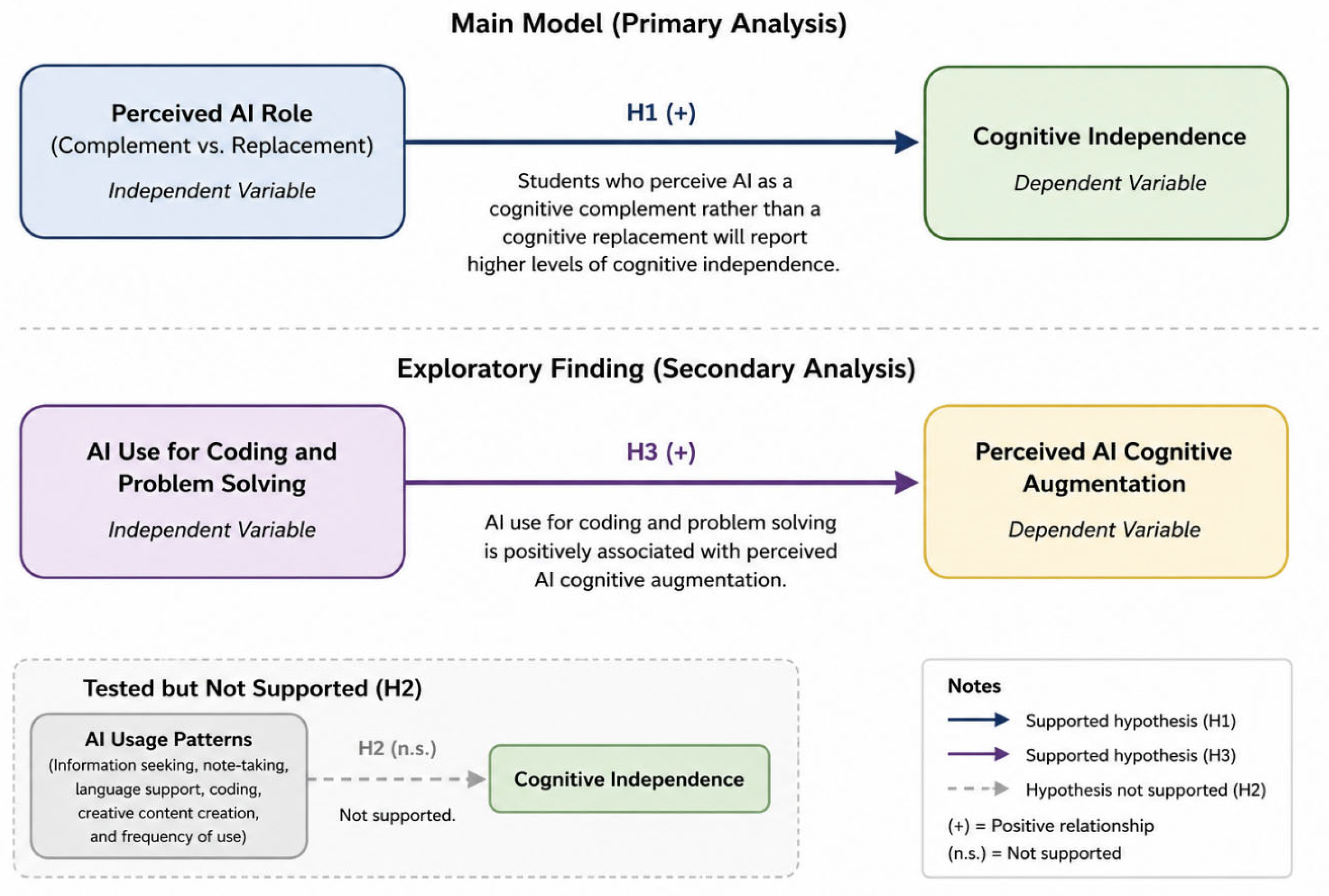
H1. Students who perceive AI as a cognitive complement rather than a cognitive replacement will report higher levels of cognitive independence.
H2. AI usage patterns (e.g., information seeking, note-taking, language support, coding, and creative content creation) significantly predict cognitive independence.
H3. AI use for coding and problem-solving is positively associated with perceived AI cognitive augmentation.
Figure 1 illustrates the conceptual model developed based on the analysis of the hypotheses.
2. Materials and Methods
This section describes the study participants, measurement instruments, and statistical procedures used to investigate the relationships between AI use, perceived AI role, cognitive independence, and perceived cognitive augmentation among university students. First, the characteristics of the study sample are presented, followed by a description of the survey measures and the data analysis procedures employed to test the research questions and hypotheses.
2.1. Participants
Data were collected at Eszterházy Károly Catholic University using a structured questionnaire designed to examine university students’ AI use, perceptions of AI, and cognitive characteristics related to learning and also problem solving. Participants were recruited using convenience sampling during university courses. Participation was voluntary and anonymous. A total of 93 part-time students completed this survey. Because the study’s primary focus was the relationship between AI use and cognitive outcomes, only respondents who reported using AI tools in education were included in the statistical analyses. Consequently, the final analytical sample consisted of 73 AI users (78.5% of the original sample), whereas the 20 participants who reported not using AI tools were excluded, as they could not provide meaningful responses to the AI-related constructs examined in this study. The original sample consisted of 53 females (57.0%) and 40 males (43.0%) participants. Respondents represented a broad range of age groups, with the largest proportion belonging to the 41–50 age category (38.7%), followed by the 34–41 age group (19.4%), the 26–33 age group (16.1%), the 18–25 age group (14.0%), and participants above 50 years of age (11.8%). Regarding educational attainment, most survey respondents held a Master’s degree (53.8%), followed by a Bachelor’s degree (19.4%), a college degree (16.1%), and a secondary school qualification (9.7%). One participant (1.1%) reported holding a PhD degree. Survey participants were also asked to identify the academic orientation that best described them. The majority classified themselves as belonging to humanities and education-related disciplines (63.4%), while 28.0% identified with science-related fields and 8.6% with public administration, law, military, or related disciplines. As the study was conducted at a single Hungarian university and the sample was predominantly composed of students from humanities and education-related disciplines, the findings should not be considered representative of the broader higher education student population or of all academic fields. This limitation should be considered when interpreting the results.
Furthermore, the demographic characteristics of the full sample are presented in
Table 1. All subsequent statistical analyses reported in this study were conducted using the AI-user subsample (
n = 73). The demographic characteristics of the sample are presented in
Table 1.
2.2. Measures
First and foremost, it is important to note that the study employed a structured questionnaire originally developed in Hungarian and subsequently translated into English for publication purposes. The questionnaire was administered in Hungarian, the native language of all participants. The English wording of the questionnaire items presented in this article was prepared solely for publication purposes. No formal back-translation procedure or pilot testing was conducted prior to data collection. Furthermore, the instrument assessed students’ AI use, perceptions of AI, and cognitive characteristics related to learning, creativity, and problem solving.
Participants first reported whether they used AI tools and indicated the frequency of their use. In addition, respondents identified the purposes for which they most frequently employed AI. Multiple responses were permitted, including information-seeking, note-taking and summarization, language support and translation, coding and problem-solving, creative content creation, and other purposes. For statistical analyses, these categories were transformed into binary variables indicating whether a particular use case was selected.
To assess the perceived role of AI in students’ thinking processes, respondents were asked to indicate the extent to which they viewed AI as complementing or replacing their own thinking. Responses were recorded on a five-point scale ranging from 1 (completely replaces) to 5 (completely complements), with higher values indicating a stronger perception of AI as a cognitive complement. Perceived AI role was assessed using a single-item measure. Although this approach enabled respondents to position AI along a complement–replacement continuum, single-item measures do not permit internal consistency estimation and may not fully capture the multidimensional nature of the construct. Consequently, findings related to this variable should be interpreted with appropriate caution.
The questionnaire further included ten self-developed statements, not adapted from an existing validated instrument, designed to measure creativity-related cognitions, cognitive flexibility, adaptive problem-solving tendencies, and perceived cognitive effects of AI use. Respondents evaluated each statement using a five-point Likert scale ranging from 1 (strongly disagree) to 5 (strongly agree). Two negatively worded items (“Using AI tools reduces my originality” and “Using AI makes it more difficult for me to think independently”) were reverse-coded prior to the factor and reliability analyses. These ten items were subsequently subjected to exploratory factor analysis, resulting in three latent dimensions: Cognitive Flexibility and Adaptive Problem Solving, Perceived AI Cognitive Augmentation, and Perceived Cognitive Independence.
In the present study, cognitive independence is operationalized as students’ self-reported perception of their ability to generate original ideas, identify novel connections, and maintain autonomous thinking when using AI-supported tools. Therefore, the construct reflects subjective perceptions of intellectual autonomy rather than objective measures of independent cognitive performance.
It should be noted that AI usage patterns were operationalized as binary indicators (0 = not used for a given purpose, 1 = used). This approach captures the presence of different AI use cases but does not reflect the intensity or frequency of use within each category.
2.3. Data Analysis
Data were analyzed using IBM SPSS Statistics for Windows, Version 31.0 (IBM Corp., Armonk, NY, USA). Prior to hypothesis testing, an exploratory factor analysis (EFA) was conducted to identify the latent structure underlying the ten cognitive and AI-related questionnaire items. The suitability of the data for factor analysis was assessed using the Kaiser-Meyer-Olkin (KMO) measure of sampling adequacy and Bartlett’s test of sphericity. Factors were extracted using Principal Axis Factoring (PAF) with Direct Oblimin rotation, allowing for potential correlations among the extracted dimensions. Internal consistency of the resulting factors was evaluated using Cronbach’s alpha coefficients.
Following factor extraction, descriptive statistics were calculated for all study variables, including means and standard deviations. Pearson correlation analyses were then performed to examine bivariate relationships among the identified factors, AI use frequency, AI usage patterns, and perceived AI role.
To test the proposed hypotheses, both simple and multiple linear regression analyses were conducted. The first regression model examined the relationship between perceived AI role and cognitive independence. Subsequently, a multiple regression model was estimated to assess the extent to which AI usage patterns and perceived AI role predicted cognitive independence. Finally, an exploratory regression analysis was conducted to investigate predictors of perceived AI cognitive augmentation. Statistical significance was evaluated at the 0.05 level for all analyses. Multicollinearity diagnostics indicated no substantial collinearity problems among the predictors (all VIF values were below 5).
A post hoc power analysis was conducted using G*Power 3.1.9.7 (Heinrich Heine University Düsseldorf, Düsseldorf, Germany) (F tests, linear multiple regression: fixed model, R2 deviation from zero). Based on the largest regression model (n = 73, seven predictors, α = 0.05, f2 = 0.295), the achieved statistical power was 0.918, indicating that the study had adequate power to detect medium-to-large effects.
Because the study included multiple correlation and regression analyses, no formal correction for multiple comparisons (e.g., Bonferroni adjustment) was applied. Given the exploratory nature of the study and its theory-driven hypotheses, statistical significance was evaluated using the conventional threshold of p < 0.05. Nevertheless, the possibility of Type I error inflation should be considered when interpreting the findings, particularly those from the exploratory analyses. Accordingly, emphasis was placed on the consistency and theoretical coherence of the overall pattern of findings rather than on isolated statistically significant results.
2.4. Ethical Considerations
Participation in the study was voluntary and anonymous. Prior to completing the questionnaire, respondents were informed about the purpose of the research and the intended use of the collected data. No personally identifiable information was collected, and all responses were processed confidentially and used exclusively for research purposes. Participants were free to discontinue their participation at any time without any consequences. Further details regarding the institutional ethical framework and informed consent procedures are provided in the Institutional Review Board Statement and Informed Consent Statement in the back matter.
2.5. Generative AI Statement
Generative AI tools were used exclusively for language editing, stylistic refinement, and the preparation of selected visual materials. All research design decisions, data analyses, interpretations, and scientific conclusions were performed and verified by the authors. No AI tools were used to generate, analyze, or interpret research data. All scientific decisions and conclusions were made by the authors.
3. Results
This section presents the results of statistical analyses examining the relationships among students’ AI-related perceptions, AI usage patterns, and cognitive outcomes. First, an exploratory factor analysis was performed to identify the underlying dimensions of the cognitive and AI-related questionnaire items and to assess the reliability of the resulting factors. Subsequently, descriptive statistics and correlation analyses were conducted. Finally, a series of regression analyses was performed to test the proposed hypotheses regarding cognitive independence and perceived AI cognitive augmentation.
3.1. Exploratory Factor Analysis and Reliability Assessment
To identify the underlying dimensions of the ten cognitive and AI-related questionnaire items, an exploratory factor analysis (EFA) was conducted using Principal Axis Factoring (PAF) with Direct Oblimin rotation. Prior to extraction, the suitability of the data for factor analysis was assessed. The Kaiser-Meyer-Olkin (KMO) measure of sampling adequacy was 0.636, indicating an acceptable level of common variance among the variables. Bartlett’s test of sphericity was statistically significant (χ2(45) = 172.714, p < 0.001), confirming that the correlation matrix was suitable for factor analysis.
Direct Oblimin rotation was selected because the study assumed that the underlying psychological constructs (cognitive flexibility, perceived AI cognitive augmentation, and perceived cognitive independence) were conceptually related rather than entirely independent. Oblique rotation is generally recommended when latent constructs are expected to exhibit at least some degree of correlation, even if the observed inter-factor correlations are modest. Consequently, Direct Oblimin was considered more theoretically appropriate than an orthogonal rotation (e.g., Varimax) for the purposes of this exploratory analysis. Although the observed inter-factor correlations were relatively low, they were not assumed to be strictly zero; therefore, an oblique rotation remained appropriate for the exploratory objectives of the study.
Based on the Kaiser criterion (eigenvalues > 1), three factors were retained, jointly explaining 60.68% of the total variance. Examination of the rotated factor structure revealed three interpretable dimensions. The first factor, labeled Cognitive Flexibility and Adaptive Problem Solving, consisted of four items reflecting flexible thinking, strategy adaptation, and openness to alternative solutions. The second factor, Perceived AI Cognitive Augmentation, included two items that captured the perceived contribution of AI to creativity and perspective-taking. The third factor, titled Perceived Cognitive Independence, consisted of four items reflecting perceived originality, independent thinking, and novel idea generation in the context of AI use.
Internal consistency was subsequently assessed using Cronbach’s alpha. The reliability coefficients were acceptable for exploratory research, with α = 0.679 for Cognitive Flexibility and Adaptive Problem Solving, α = 0.640 for Perceived AI Cognitive Augmentation, and α = 0.645 for Perceived Cognitive Independence. Given the exploratory nature of the study and the relatively small number of items loading on each factor, these values were considered satisfactory for subsequent analyses. Previous methodological literature suggests that Cronbach’s alpha coefficients above 0.60 may be acceptable in exploratory research and in the early stages of scale development [
37,
38].
The resulting factor scores were retained and used in subsequent correlation and regression analyses. Given the exploratory nature of the study and the relatively limited sample size, the factor structure should be considered preliminary and subject to further validation in future research. The factor structure and reliability statistics are summarized in
Table 2, while the complete rotated pattern matrix is presented in
Appendix A (
Table A1).
Although one item (“I often come up with new ideas while studying”) demonstrated a relatively weak factor loading, and another item (“I can easily identify novel connections between different pieces of information”) exhibited a secondary loading on another factor, both items were retained in the final solution. This decision was based on their theoretical relevance to the underlying constructs and the fact that the primary factor loading remained substantially stronger than the secondary loading. Given the exploratory nature of the study, the relatively small sample size, and the objective of exploring the latent structure of a newly developed instrument rather than optimizing a measurement scale, retaining these theoretically important items was considered methodologically appropriate.
Given the relatively small sample size and the exploratory nature of the analysis, the identified factor structure should be interpreted as preliminary. The results provide an initial indication of the latent structure of the measured constructs, which requires further validation using confirmatory factor analysis in larger and more diverse samples.
3.2. Descriptive Statistics and Correlations
Descriptive statistics were calculated for the three latent factors identified through the exploratory factor analysis, as well as for the frequency of AI tool use. Among the three factors, Perceived Cognitive Independence showed the highest mean score (M = 3.82, SD = 0.74), followed by Cognitive Flexibility and Adaptive Problem Solving (M = 3.79, SD = 0.68). The lowest mean was observed for Perceived AI Cognitive Augmentation (M = 3.45, SD = 1.02), indicating greater variability in respondents’ perceptions regarding AI as a cognitive enhancer. Frequency of AI tool use showed a moderate average level within the sample (M = 2.84, SD = 0.96).
Pearson correlation analyses revealed few significant relationships among the main study variables. A positive correlation was found among Cognitive Flexibility, Adaptive Problem Solving, and Perceived Cognitive Independence (r = 0.257, p = 0.028), suggesting that individuals reporting higher levels of cognitive flexibility also tended to perceive themselves as more cognitively independent. No significant correlations were observed between AI use frequency and any of the three latent factors. Likewise, Perceived AI Cognitive Augmentation was not significantly associated with either cognitive flexibility or cognitive independence.
Additional analyses examined the relationship between perceived AI role and the latent cognitive factors. Participants who viewed AI as a complement rather than a replacement for their own thinking reported significantly higher levels of Perceived Cognitive Independence (r = 0.431,
p < 0.001) and slightly higher levels of Perceived AI Cognitive Augmentation (r = 0.235,
p = 0.046). The relationship with Cognitive Flexibility and Adaptive Problem Solving was positive but did not reach statistical significance (r = 0.205,
p = 0.081). Furthermore, perceiving AI as a complement to one’s own thinking was positively associated with more frequent AI use (r = 0.237,
p = 0.043). As shown in
Table 3, respondents reported relatively high levels of cognitive flexibility (M = 3.79, SD = 0.68) and cognitive independence (M = 3.82, SD = 0.74). Participants also tended to perceive AI as a complement rather than a replacement for their own thinking (M = 3.71, SD = 0.95). Perceived AI cognitive augmentation received comparatively lower ratings (M = 3.45, SD = 1.02).
Although several statistically significant correlations were identified, particular caution is warranted when interpreting associations with p-values close to the conventional significance threshold (p < 0.05), especially those approaching the threshold of statistical significance. As described in the Data Analysis section, no formal correction for multiple comparisons was applied because the analyses were theory-driven and exploratory in nature. Consequently, correlations with marginal p-values should be regarded as preliminary and hypothesis-generating rather than confirmatory evidence, and should therefore be interpreted in conjunction with the overall pattern of results and replicated in future studies using larger samples and more conservative statistical procedures.
3.3. Testing H1: Perceived AI Role and Cognitive Independence
To examine the relationship between students’ perceptions of AI and their cognitive independence (RQ1), a correlation and regression analysis were conducted. The results revealed a significant positive association between Perceived AI Role and Perceived Cognitive Independence (r = 0.431, p < 0.001). Students who perceived AI primarily as a complement to their own thinking, rather than as a replacement for it, reported higher levels of cognitive independence.
To further assess the predictive power of perceived AI role, a simple linear regression analysis was performed with Perceived Cognitive Independence as the dependent variable. The model was statistically significant, F(1,71) = 16.226, p < 0.001, explaining 18.6% of the variance in cognitive independence (R2 = 0.186).
The regression coefficient indicated that perceived AI role was a significant positive predictor of cognitive independence (β = 0.431, B = 0.335, p < 0.001). Specifically, a stronger tendency to view AI as a cognitive complement rather than a cognitive replacement was associated with higher levels of perceived cognitive independence.
These findings support H1, suggesting that students’ perceptions of the role of AI in their thinking processes are positively associated with their perceived cognitive independence.
The regression model explained 18.6% of the variance in perceived cognitive independence. As shown in
Table 4, perceived AI role emerged as a significant positive predictor of cognitive independence (β = 0.431,
p < 0.001), supporting H1.
3.4. Testing H2: AI Usage Patterns and Cognitive Independence
To address RQ2, a multiple regression analysis was conducted to examine whether different AI usage patterns predict Perceived Cognitive Independence. The model included AI use frequency, information seeking, note-taking and summarization, language support and translation, coding and problem solving, creative content creation, and perceived AI role as predictors.
The overall regression model was statistically significant, F(7,65) = 2.740,
p = 0.015, explaining 22.8% of the variance in perceived cognitive independence (R
2 = 0.228, Adjusted R
2 = 0.145). As shown in
Table 5, Perceived AI Role was the only significant individual predictor of cognitive independence (β = 0.436,
p < 0.001), whereas none of the AI usage variables reached statistical significance.
These findings indicate that perceived cognitive independence was associated with students’ perception of AI as a cognitive complement rather than with the frequency or specific purposes of AI use. Consequently, H2 was not supported.
3.5. Exploratory Analysis: AI Coding and Perceived Cognitive Augmentation
As an exploratory analysis, the relationship between AI usage patterns and perceived AI Cognitive Augmentation was examined. A multiple regression model was estimated using AI use frequency, information seeking, note-taking and summarization, language support and translation, coding and problem solving, creative content creation, and perceived AI role as predictors. The overall model did not reach statistical significance, F(7,65) = 1.841,
p = 0.094, explaining 16.5% of the variance in perceived AI Cognitive Augmentation (R
2 = 0.165, Adjusted R
2 = 0.076). Within this non-significant model, the use of AI for coding and problem solving emerged as the only predictor reaching the conventional level of statistical significance (β = 0.247,
p = 0.046). Perceived AI role also showed a positive trend, although this association did not reach statistical significance (β = 0.221,
p = 0.064). None of the remaining AI usage variables significantly predicted perceived AI Cognitive Augmentation (
Table 6).
Given that the overall regression model was not statistically significant and that the observed effect for coding and problem solving was close to the conventional significance threshold, this finding should be interpreted with caution. Rather than providing confirmatory evidence, it should be regarded as a preliminary, hypothesis-generating result that requires replication in larger and independent samples before firm conclusions can be drawn.
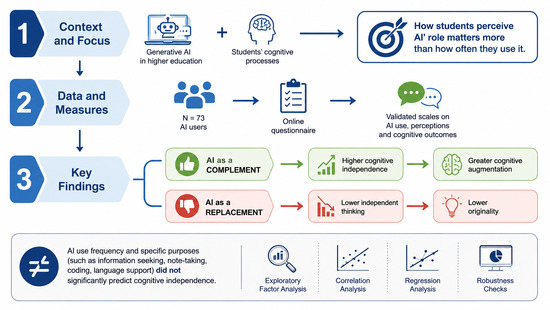
The present study examined the relationships between AI usage patterns, perceived AI role, cognitive independence, and perceived cognitive augmentation among university students. Three main findings emerged. First, students who perceived AI as a cognitive complement rather than a replacement reported higher levels of cognitive independence. Second, specific AI usage patterns did not significantly predict cognitive independence. Third, AI use for coding and problem-solving was positively associated with perceived cognitive augmentation, although this finding should be interpreted with caution because the overall regression model was not statistically significant.
4. Discussion
The present study examined how university students perceive the role of generative AI in their thinking processes and how these perceptions relate to cognitive independence and cognitive augmentation. Three main findings emerged, which are detailed below. First, perceiving AI as a cognitive complement rather than a cognitive replacement was positively associated with perceived cognitive independence. Second, neither the frequency nor the specific purposes of AI use significantly predicted cognitive independence. Third, an exploratory analysis suggested that the use of AI for coding and problem solving was positively associated with perceived cognitive augmentation. Overall, these findings contribute to the growing literature on human–AI interaction by demonstrating that students’ subjective understanding of AI may be more important than simple measures of AI usage frequency.
Furthermore, the strongest finding of the study supports H1 and is consistent with theoretical perspectives on extended cognition and cognitive augmentation. According to Clark and Chalmers’ extended mind framework, external technologies can become functional components of cognition when integrated into ongoing thought processes [
11]. More recent discussions of AI-supported cognition similarly emphasize that generative AI may serve as a cognitive extender, expanding human capabilities without replacing human agency [
12,
13,
39]. The present results suggest that students who conceptualize AI as a supportive partner rather than as a substitute for thinking report higher levels of cognitive independence. In addition, this finding indicates that cognitive independence and AI use are not necessarily contradictory phenomena. Instead, students may maintain a strong sense of intellectual autonomy while simultaneously benefiting from AI-supported idea generation, reflection, and problem solving.
At the same time, the present findings should not be interpreted as evidence of a causal relationship. Because the study employed a cross-sectional design, the direction of the observed association cannot be determined. An equally plausible explanation is that students who already perceive themselves as cognitively independent are more likely to conceptualize AI as a complementary cognitive tool rather than as a replacement for their own thinking. Consequently, the relationship between perceived AI role and cognitive independence may be reciprocal or bidirectional. Longitudinal and experimental studies are needed to clarify the causal direction of this relationship.
The findings also contribute to the literature on cognitive offloading. Previous research has shown that external cognitive aids can reduce mental effort and improve task efficiency, but excessive reliance on technological systems may lead to reduced cognitive engagement and overreliance on automated outputs [
14,
19,
20,
21,
22]. Interestingly, the present study suggests that the critical factor may not be whether students use AI, but how they position AI within their cognitive processes. Students who viewed AI primarily as a complement to their thinking reported higher levels of cognitive independence regardless of usage frequency. This observation supports the argument that cognitive offloading is not inherently detrimental; rather, its consequences depend on the degree of metacognitive control, verification, and active engagement the user maintains [
14,
25,
40,
41].
It is also important to highlight that the absence of support for H2 is equally informative. Contrary to expectations, neither the frequency of AI use nor specific AI usage patterns significantly predicted cognitive independence. This finding challenges common assumptions that more intensive AI use necessarily leads to reduced independent thinking. The results instead suggest that cognitive outcomes may be shaped less by behavioral indicators of AI use and more by the meanings students attribute to these technologies. From a theoretical perspective, this reinforces arguments that AI-related cognitive effects cannot be adequately understood through exposure measures alone. Two students may use AI equally often, yet experience substantially different cognitive consequences depending on whether they approach the technology as a tool for reflection or as a source of ready-made solutions.
The exploratory findings regarding coding and problem-solving provide further insight into the distinction between cognitive augmentation and cognitive replacement. Within an exploratory analysis, students who reported using AI for coding and problem-solving tasks tended to report higher levels of perceived AI Cognitive Augmentation. However, because the overall regression model did not reach statistical significance, this observation should be interpreted as preliminary rather than confirmatory. Although the overall regression model was not statistically significant and should therefore be interpreted with caution, it is consistent with the idea that cognitively demanding AI-supported activities may encourage active engagement with AI-generated outputs. Coding and problem-solving often require evaluation, debugging, modification, and iterative refinement, processes that keep users cognitively involved rather than passive recipients of AI-generated content. In this sense, such activities may be examples of augmentation-oriented AI use, in which the technology extends rather than replaces human cognitive effort.
The findings also have implications for creativity research. Although the present study did not directly assess objective creativity or creative performance, the observed relationships are relevant to theoretical discussions of creativity because the measured constructs reflect students’ subjective perceptions of cognitive processes associated with idea generation and independent thinking. Consequently, the following interpretations should be understood as theoretical implications rather than direct empirical evidence regarding creativity. The literature reviewed in this study suggests that generative AI can simultaneously support divergent thinking while potentially undermining originality [
8,
30,
31,
34,
35]. The present results align with this dual perspective. Students who perceived AI as a complement to their thinking reported stronger cognitive independence, suggesting that AI may facilitate idea generation and perspective-taking when used reflectively. At the same time, the results indirectly support concerns raised in the creativity literature regarding overreliance on externally generated solutions. If students perceive AI primarily as a replacement for their own thinking, the cognitive benefits associated with augmentation may diminish. This interpretation is consistent with theoretical discussions of design fixation, homogenization, and the risk of accepting statistically probable solutions without deeper critical evaluation [
17,
31,
34,
35,
42,
43].
From an educational perspective, the findings suggest that the central issue may not be whether students use AI, but how they are taught to use it. Higher education institutions frequently focus on controlling or restricting AI use, often emphasizing academic integrity concerns [
2,
5]. The present findings indicate that educational interventions may be more effective when they promote augmentation-oriented use of AI. Teaching students to critically evaluate AI outputs, compare alternative solutions, and integrate AI-generated content into their own reasoning processes may help preserve cognitive independence while still allowing learners to benefit from AI-supported learning. Such an approach is also compatible with Robinson and Aronica’s argument that educational environments should foster autonomy, exploration, and creative engagement rather than passive reproduction of existing knowledge [
33].
Overall, the results suggest that generative AI should not be conceptualized exclusively as either a threat to independent thinking or as an unequivocal cognitive enhancer. Instead, its cognitive consequences appear to depend on the interpretive framework through which students engage with the technology. The distinction between cognitive augmentation and cognitive replacement may therefore represent a particularly useful lens for understanding the educational implications of generative AI. Future research should investigate this distinction using larger samples, longitudinal designs, and objective measures of cognitive performance to determine how these perceptions develop over time and influence actual learning outcomes. Accordingly, this finding should be viewed as hypothesis-generating and requires replication in larger and more diverse samples before firm conclusions can be drawn.
5. Limitations and Future Research
Several limitations of the present study should be acknowledged. First, the study is based on a relatively small convenience sample drawn from a single higher education institution, which limits the generalizability of the findings across different educational contexts, disciplines, and cultural settings. Consequently, the generalizability of the findings to other universities, academic disciplines, and cultural contexts remains limited. Future studies should replicate the findings using larger and more diverse samples. Second, all variables were measured using self-report instruments administered at a single point in time. As a result, the findings may be influenced by common method variance and social desirability bias. Furthermore, the cross-sectional design does not permit causal inference from the observed relationships among AI use, perceived AI role, and cognitive outcomes. Third, although the exploratory factor analysis produced a theoretically interpretable three-factor structure, the sample size was relatively modest for latent variable modeling, and the reliability coefficients of the extracted factors were moderate. Therefore, the identified factor structure should be considered preliminary and requires further validation through confirmatory factor analysis (CFA) in larger samples. Fourth, the study’s central predictor, perceived AI role (AI as a cognitive complement versus replacement), was assessed using a single-item measure. Although this approach provided a direct and easily interpretable assessment of the construct, it did not permit reliability estimation and may not have fully captured its potentially multidimensional nature. Future research should develop and validate multi-item instruments to assess students’ perceptions of AI’s cognitive role more comprehensively. Fifth, the statistical analyses involved multiple correlation and regression tests without applying a formal correction for multiple comparisons. Because the analyses were theory-driven and exploratory, the conventional significance threshold (p < 0.05) was retained. Nevertheless, the possibility of Type I error cannot be excluded, particularly for findings with p-values close to the conventional significance threshold. Accordingly, these results should be interpreted with appropriate caution until replicated in larger and independent samples. Finally, the study focused on students’ subjective perceptions of cognitive independence and cognitive augmentation rather than objective measures of cognitive performance. In addition, the relatively low reliability coefficients of some scales and the exploratory nature of the factor structure suggest that measurement refinement is needed in future research. Consequently, the results reflect participants’ self-perceived cognitive experiences associated with AI use and should not be interpreted as direct evidence of actual cognitive enhancement or cognitive independence. The study also examined a limited set of AI usage patterns and did not account for potential moderating variables such as academic achievement, digital competence, AI literacy, field of study, or prior experience with generative AI tools. Future research should investigate these factors in order to develop a more comprehensive understanding of how AI use relates to cognitive development and learning processes.
6. Conclusions
The present study examined the relationships between AI usage patterns, perceived AI role, cognitive independence, and perceived cognitive augmentation among university students. The findings indicate that perceiving AI as a cognitive complement rather than a replacement for one’s own thinking was consistently associated with higher levels of perceived cognitive independence. In contrast, neither the frequency nor the specific purposes of AI use significantly predicted cognitive independence, suggesting that students’ subjective understanding of AI’s role may be more important than behavioral indicators of AI use.
The study provided support for H1, whereas H2 was not supported. An exploratory analysis offered preliminary support for H3, as AI use for coding and problem-solving emerged as the only statistically significant predictor within an otherwise non-significant regression model. Consequently, this finding should be interpreted with caution and regarded as hypothesis-generating rather than confirmatory until replicated in larger and independent samples.
Overall, the present findings suggest that the cognitive consequences of AI use are shaped less by how often students use AI than by how they conceptualize its role within their own thinking processes. Perceiving AI as a cognitive complement, rather than a substitute for independent thinking, was consistently associated with higher levels of perceived cognitive independence. From an educational perspective, these findings highlight the importance of fostering reflective and augmentation-oriented AI use that encourages students to critically engage with AI-generated content rather than rely on it uncritically. Although the findings should be interpreted in light of the study’s methodological limitations and exploratory design, they contribute to the growing literature on human–AI interaction by emphasizing the distinction between cognitive augmentation and cognitive replacement as a useful framework for understanding AI-supported learning in higher education.
Author Contributions
Conceptualization: D.L.D. and Z.S.; methodology, D.L.D., V.K. and S.C.; software, D.L.D., V.K. and S.C.; validation, D.L.D., V.K. and S.C.; formal analysis, D.L.D., V.K. and S.C.; investigation, D.L.D. and Z.S.; resources, D.L.D. and Z.S.; data curation, D.L.D. and Z.S.; writing—original draft preparation, D.L.D., V.K. and S.C.; writing—review and editing, D.L.D., V.K. and S.C.; visualization, D.L.D., V.K. and S.C.; supervision, D.L.D. and Z.S.; project administration, D.L.D. and Z.S.; funding acquisition, none. All authors have read and agreed to the published version of the manuscript.
Funding
This research received no external funding.
Institutional Review Board Statement
The study was conducted in accordance with the Declaration of Helsinki as part of the nationally funded research project TKP2021-NKTA-51 (Sustainable Governance and Innovative Public Services), supported by the National Research, Development and Innovation Office of Hungary under the Thematic Excellence Programme 2021 (TKP2021) (1 January 2021–31 December 2025). The project was awarded to the Ludovika University of Public Service and implemented in collaboration with Eszterházy Károly Catholic University. According to the institutional framework governing this nationally funded research project, no separate institutional ethics committee approval was required for this anonymous, voluntary questionnaire-based study. Participants were informed about the purpose of the research, participation was voluntary, and all data were collected anonymously. Project identification code: TKP2021-NKTA-51.
Informed Consent Statement
Informed consent was obtained from all subjects involved in the study. Before completing the questionnaire, participants were informed about the purpose of the research, the voluntary nature of their participation, and the anonymous processing of the collected data.
Data Availability Statement
The dataset underlying this study is currently being used in further analyses and related research projects. For this reason, it is not yet possible to make the data publicly available. The data will be made available once the ongoing research projects have been completed, in accordance with applicable institutional and ethical guidelines.
Conflicts of Interest
The authors declare no conflicts of interest.
Appendix A
Table A1.
Pattern Matrix and Extraction Communalities of the Exploratory Factor Analysis.
Table A1.
Pattern Matrix and Extraction Communalities of the Exploratory Factor Analysis.
| Item | F1 | F2 | F3 | Communality (Extraction) |
|---|
| I enjoy experimenting with new problem-solving strategies | 0.828 | | | 0.704 |
| I enjoy trying multiple solutions to a problem | 0.619 | | | 0.406 |
| If my usual approach does not work, I quickly find an alternative | 0.567 | | | 0.396 |
| I can easily switch from one task to another | 0.471 | | | 0.210 |
| Using AI tools increases the number of my creative ideas | | 0.769 | | 0.667 |
| AI tools help me consider multiple perspectives | | 0.626 | | 0.400 |
| Using AI tools reduces my originality | | | 0.728 | 0.485 |
| Using AI makes it more difficult for me to think independently | | | 0.649 | 0.533 |
| I can easily identify novel connections between different pieces of information | | 0.329 | −0.605 | 0.555 |
| I often come up with new ideas while studying * | | | −0.368 | 0.211 |
References
- Qian, Y. Pedagogical Applications of Generative AI in Higher Education: A Systematic Review of the Field. TechTrends 2025, 69, 1105–1120. [Google Scholar] [CrossRef]
- Batista, J.; Mesquita, A.; Carnaz, G. Generative AI and Higher Education: Trends, Challenges, and Future Directions from a Systematic Literature Review. Information 2024, 15, 676. [Google Scholar] [CrossRef]
- Johnston, H.; Eaton, M.; Henry, I.; Deeley, E.-M.; Parsons, B.N. Discovering How Students Use Generative Artificial Intelligence Tools for Academic Writing Purposes. J. Learn. Dev. High. Educ. 2025, 34, 1–28. [Google Scholar] [CrossRef]
- Ogunleye, B.; Zakariyyah, K.I.; Ajao, O.; Olayinka, O.; Sharma, H. A Systematic Review of Generative AI for Teaching and Learning Practice. Educ. Sci. 2024, 14, 636. [Google Scholar] [CrossRef]
- Bittle, K.; El-Gayar, O. Generative AI and Academic Integrity in Higher Education: A Systematic Review and Research Agenda. Information 2025, 16, 296. [Google Scholar] [CrossRef]
- Guilford, J.P. Creativity. Am. Psychol. 1950, 5, 444–454. [Google Scholar] [CrossRef] [PubMed]
- Runco, M.A.; Jaeger, G.J. The Standard Definition of Creativity. Creat. Res. J. 2012, 24, 92–96. [Google Scholar] [CrossRef]
- Doshi, A.R.; Hauser, O.P. Generative AI Enhances Individual Creativity but Reduces the Collective Diversity of Novel Content. Sci. Adv. 2024, 10, eadn5290. [Google Scholar] [CrossRef] [PubMed]
- Ionescu, T. Exploring the Nature of Cognitive Flexibility. New Ideas Psychol. 2012, 30, 190–200. [Google Scholar] [CrossRef]
- Gerlich, M. AI Tools in Society: Impacts on Cognitive Offloading and the Future of Critical Thinking. Societies 2025, 15, 6. [Google Scholar] [CrossRef]
- Clark, A.; Chalmers, D. The Extended Mind. Analysis 1998, 58, 7–19. [Google Scholar] [CrossRef]
- Clark, A. Extending Minds with Generative AI. Nat. Commun. 2025, 16, 4627. [Google Scholar] [CrossRef] [PubMed]
- Hernández-Orallo, J.; Vold, K. AI Extenders: The Ethical and Societal Implications of Humans Cognitively Extended by AI. In Proceedings of the 2019 AAAI/ACM Conference on AI, Ethics, and Society; ACM: New York, NY, USA, 2019; pp. 507–513. [Google Scholar] [CrossRef]
- Risko, E.F.; Gilbert, S.J. Cognitive Offloading. Trends Cogn. Sci. 2016, 20, 676–688. [Google Scholar] [CrossRef] [PubMed]
- Sparrow, B.; Liu, J.; Wegner, D.M. Google Effects on Memory: Cognitive Consequences of Having Information at Our Fingertips. Science 2011, 333, 776–778. [Google Scholar] [CrossRef] [PubMed]
- Fisher, M.; Goddu, M.K.; Keil, F.C. Searching for Explanations: How the Internet Inflates Estimates of Internal Knowledge. J. Exp. Psychol. Gen. 2015, 144, 674–687. [Google Scholar] [CrossRef] [PubMed]
- Bender, E.M.; Gebru, T.; McMillan-Major, A.; Shmitchell, S. On the Dangers of Stochastic Parrots: Can Language Models Be Too Big? In Proceedings of the 2021 ACM Conference on Fairness, Accountability, and Transparency; ACM: New York, NY, USA, 2021; pp. 610–623. [Google Scholar] [CrossRef]
- Bommasani, R.; Hudson, D.A.; Adeli, E.; Altman, R.; Arora, S.; Bernstein, M.S.; Bohg, J.; Bosselut, A.; Brunskill, E.; Brynjolfsson, E.; et al. On the Opportunities and Risks of Foundation Models. arXiv 2021, arXiv:2108.07258. [Google Scholar]
- Buçinca, Z.; Malaya, M.B.; Gajos, K.Z. To Trust or to Think: Cognitive Forcing Functions Can Reduce Overreliance on AI in AI-Assisted Decision-Making. Proc. ACM Hum.-Comput. Interact. 2021, 5, 1–21. [Google Scholar] [CrossRef]
- Parasuraman, R.; Manzey, D.H. Complacency and Bias in Human Use of Automation: An Attentional Integration. Hum. Factors 2010, 52, 381–410. [Google Scholar] [CrossRef] [PubMed]
- Parasuraman, R.; Riley, V. Humans and Automation: Use, Misuse, Disuse, Abuse. Hum. Factors 1997, 39, 230–253. [Google Scholar] [CrossRef]
- Bainbridge, L. Ironies of Automation. Automatica 1983, 19, 775–779. [Google Scholar] [CrossRef]
- Craik, F.I.M.; Lockhart, R.S. Levels of Processing: A Framework for Memory Research. J. Verbal Learn. Verbal Behav. 1972, 11, 671–684. [Google Scholar] [CrossRef]
- Sweller, J.; van Merriënboer, J.J.G.; Paas, F.G.W.C. Cognitive Architecture and Instructional Design. Educ. Psychol. Rev. 1998, 10, 251–296. [Google Scholar] [CrossRef]
- Kirsh, D.; Maglio, P. On Distinguishing Epistemic from Pragmatic Action. Cogn. Sci. 1994, 18, 513–549. [Google Scholar] [CrossRef] [PubMed]
- Hutchins, E. Cognition in the Wild; MIT Press: Cambridge, MA, USA, 1995. [Google Scholar]
- Hollan, J.; Hutchins, E.; Kirsh, D. Distributed Cognition: Toward a New Foundation for Human–Computer Interaction Research. ACM Trans. Comput.-Hum. Interact. 2000, 7, 174–196. [Google Scholar] [CrossRef]
- Runco, M.A.; Acar, S. Divergent Thinking as an Indicator of Creative Potential. Creat. Res. J. 2012, 24, 66–75. [Google Scholar] [CrossRef]
- Nijstad, B.A.; De Dreu, C.K.W.; Rietzschel, E.F.; Baas, M. The Dual Pathway to Creativity Model: Creative Ideation as a Function of Flexibility and Persistence. Eur. Rev. Soc. Psychol. 2010, 21, 34–77. [Google Scholar] [CrossRef]
- Hubert, K.F.; Awa, K.N.; Zabelina, D.L. The Current State of Artificial Intelligence Generative Language Models Is More Creative than Humans on Divergent Thinking Tasks. Sci. Rep. 2024, 14, 3440. [Google Scholar] [CrossRef] [PubMed]
- Anderson, B.R.; Shah, J.H.; Kreminski, M. Homogenization Effects of Large Language Models on Human Creative Ideation. arXiv 2024, arXiv:2402.01536. [Google Scholar]
- Csikszentmihalyi, M. Creativity: Flow and the Psychology of Discovery and Invention; HarperCollins: New York, NY, USA, 1996. [Google Scholar]
- Robinson, K.; Aronica, L. Creative Schools: The Grassroots Revolution That’s Transforming Education; Viking: New York, NY, USA, 2015. [Google Scholar]
- Jansson, D.G.; Smith, S.M. Design Fixation. Des. Stud. 1991, 12, 3–11. [Google Scholar] [CrossRef]
- Wadinambiarachchi, S.; Kelly, R.M.; Pareek, S.; Zhou, Q.; Velloso, E. The Effects of Generative AI on Design Fixation and Divergent Thinking. arXiv 2024, arXiv:2403.11164. [Google Scholar]
- Balazs, L.; Hulyak-Tomesz, T. Virtuality and Communication: Examining Reddit texts in terms of the transformation of digital communication norms and linguistic behaviour patterns. Magy. Nyelvőr 2025, 149, 714–730. [Google Scholar] [CrossRef]
- Hair, J.F.; Black, W.C.; Babin, B.J.; Anderson, R.E. Multivariate Data Analysis, 8th ed.; Cengage: London, UK, 2018. [Google Scholar]
- Taber, K.S. The Use of Cronbach’s Alpha When Developing and Reporting Research Instruments in Science Education. Res. Sci. Educ. 2018, 48, 1273–1296. [Google Scholar] [CrossRef]
- Balazs, L.; Rajcsanyi-Molnar, M.; Andras, I.; Sitku, K. Social Responsibility and Community Engagement at a Hungarian Regional University. J. High. Educ. Theory Pract. 2021, 21, 53–62. [Google Scholar] [CrossRef]
- Vaughan, G.; Jinil, Y.; Szűts-Novak, R. Wisdom of the Heart: A Contemporary Review of Religion and AI. Religions 2025, 16, 834. [Google Scholar] [CrossRef]
- Vaughan, G.; Szűts-Novák, R. What we talk about when we talk about AI: Artificial intelligence and language. Magy. Nyelvőr 2024, 148, 579–588. [Google Scholar] [CrossRef]
- Vaughan, G.; Szűts-Novák, R. Distant Noises: Expert Voices. Magy. Nyelvőr 2025, 149, 692–702. [Google Scholar] [CrossRef]
- Kokuti, T.; Balazs, L.; Rajcsanyi-Molnar, M.; Andras, I. Exploring the Role of Artificial Intelligence (AI) in the Education Process: AI that Supports Cognitive Processes. Acta Polytech. Hung. 2026, 23, 77–97. [Google Scholar] [CrossRef]
| Disclaimer/Publisher’s Note: The statements, opinions and data contained in all publications are solely those of the individual author(s) and contributor(s) and not of MDPI and/or the editor(s). MDPI and/or the editor(s) disclaim responsibility for any injury to people or property resulting from any ideas, methods, instructions or products referred to in the content. |