1. Introduction
In embedded real-time and control-oriented systems, temporal predictability is often prioritized over peak instruction throughput. For these environments, the reliability of a processor is defined by its capacity to minimize task response-time variations, bound activation jitter, and consistently meet deadlines despite frequent preemptions. As RISC-V microcontrollers increasingly target real-time and control-oriented embedded domains, evaluating their ability to sustain execution continuity under increasing task concurrency has become an important research challenge.
In this paper, increasing task concurrency denotes the controlled growth in the number of runnable periodic tasks that share the same execution substrate, scheduler, and timing budget. As the number of concurrent tasks increases, the scheduler must handle more task releases, ready-job competitions, preemptions, and task-to-task context switches within the same observation interval. If the execution organization is not optimized for scheduler-aware timing scalability, this additional scheduler pressure can reduce useful execution continuity, increase pipeline flush-and-recovery effects, amplify response-time spread and activation jitter, and increase the probability of deadline misses. Therefore, timing scalability is not only a throughput issue; it also reflects the ability of the execution model to preserve predictable task timing as scheduler-managed workload density grows.
Historically, the RISC-V ecosystem has benefited from robust simulation and virtual-platform tools. Frameworks such as gem5 [
1], FireSim [
2], and GVSoC [
3] provide comprehensive infrastructures for full-system execution, hardware/software co-design, and deep architectural exploration. However, these tools are not inherently optimized for the methodological demands of scheduler-aware timing scalability. Assessing how temporal behavior deteriorates as workload density grows requires more than just cycle-accurate modeling; it demands strict configuration control, automated scenario generation, and deterministic workload orchestration across massive design spaces. Without such a workflow, distinguishing genuine microarchitectural benefits from mere scheduling artifacts or workload inconsistencies becomes highly problematic.
This methodological gap is particularly evident when analyzing hardware-assisted scheduling mechanisms. In conventional shared-pipeline processors, preemptions forcefully flush in-flight instructions, forcing the system to incur a substantial recovery penalty before useful execution resumes. Previous work on predictable processor design has shown that architectural scheduling support can improve temporal isolation in mixed-criticality systems [
4], while recent RISC-V studies have highlighted the critical impact of interrupt latency and context-switch overhead [
5,
6,
7]. To counter this disruption, preserved-context execution models, such as the n-Multiple Pipeline Register Architecture (nMPRA) and its associated Hardware Scheduler Engine (nHSE) [
8,
9], replicate pipeline registers to retain task-specific architectural states across context switches. Quantifying the real-time advantages of such mechanisms requires subjecting both standard and preserved-context pipelines to identical, highly controlled scheduler pressure.
To facilitate this level of rigorous timing analysis, this paper presents nSim-RV: an automated RISC-V simulation and orchestration framework explicitly tailored for reproducible scalability studies. Rather than functioning as a full-system virtual platform, nSim-RV isolates and measures the temporal degradation induced by scheduler activity. The framework automates campaign execution, dataset aggregation, and metric extraction, ensuring methodological consistency across hundreds of configurations. This structure closely follows the broader requirements for reproducible experimental research and portable experiment workflows [
10,
11].
The nSim-RV is applied here to contrast a conventional standard shared-pipeline mode against an nMPRA-inspired preserved-context execution mode, tracing how execution continuity affects timing variability and deadline pressure as concurrent task counts scale from 2 to 32.
The main contributions of this work are as follows:
Scientific Contribution: nSim-RV, a configurable RISC-V simulation framework dedicated to scheduler-aware timing evaluation under controlled real-time workloads, together with a reproducible timing-scalability evaluation methodology based on response-time variability, execution jitter, deadline miss ratio, switch-overhead pressure, and scalability-phase characterization.
Theoretical Contribution: Formalization of timing-scalability assessment through a multidimensional metric framework and an operational scalability-phase classifier that distinguishes stable, tipping, saturation, and collapse execution regions under increasing workload density.
Practical Contribution: An automated orchestration workflow supporting campaign generation, execution, duplicate validation, dataset construction, and aggregated timing analysis across pipeline organizations, cache configurations, execution modes, observation windows, and task counts.
Derivative Contribution: A validated dataset comprising 864 scheduler-controlled configurations and a reusable experimental workflow that can support future investigations involving RTOS integration, hardware-assisted scheduling concepts, timing prediction techniques, and extended RISC-V execution organizations.
The nSim-RV targets scheduler-aware timing-scalability evaluation. Its focus is on how response-time variability, execution jitter, deadline miss ratio, switch-overhead pressure, and scalability-phase transitions change as workload density increases, rather than on maximizing throughput or reproducing hardware at cycle accuracy. Limitations of scope, including the absence of full RTOS integration, multicore modeling, and hardware-level validation, are discussed in
Section 5.4.
3. Materials and Methods
3.1. nSim-RV Timing-Oriented Framework
The experimental infrastructure used is built around nSim-RV, a configurable RISC-V simulation framework for timing evaluation under real-time workloads. The framework is designed to execute controlled experiments in which identical workload and scheduling conditions are preserved across different execution organizations. Its purpose is not to replace full-system architectural simulators, but to provide a compact and reproducible environment for observing timing variability, scheduler-induced execution effects, workload-density behavior, and deadline-oriented trends under periodic real-time workloads. nSim-RV advances execution in cycle steps and combines instruction-level execution control with explicit pipeline-state modeling.
This execution model allows the same experimental workload to be evaluated under different execution organizations while preserving a common scheduler, timing model, and instrumentation interface. The framework compares conventional Standard shared-pipeline execution with an nMPRA-inspired preserved-context execution mode. The nMPRA and nHSE concepts provide architectural background for preserved execution context and hardware-supported scheduling in real-time systems [
8,
9]. In nSim-RV, these concepts are modeled at the execution-organization level and are used as a controlled comparison case, rather than as a cycle-accurate reproduction of a specific hardware implementation.
At simulation level, the Standard mode uses a shared in-flight pipeline state across tasks. When a task switch occurs, the currently active pipeline context is interrupted, and useful pipeline progress must be rebuilt before the resumed task can continue. In the nMPRA-inspired mode, the task-specific architectural state and pipeline-related execution state are maintained per context, including the program counter, general-purpose register state, and modeled pipeline-stage registers. A resumed task can therefore continue from its preserved state rather than rebuilding execution progress in a shared pipeline. This abstraction captures the timing effect of preserved context on task resumption while avoiding claims of cycle-accurate equivalence to a specific hardware implementation.
The framework also supports configurable pipeline depth. The four-stage configuration merges execution and memory access into a combined EX/MEM stage followed by writeback, whereas the five-stage configuration follows the conventional IF, ID, EX, MEM, and WB organization. The five-stage configuration serves as the primary reference, while the four-stage configuration replicates the full experimental matrix to verify that timing-scalability trends are not specific to a single pipeline depth.
A central methodological requirement in nSim-RV is that scheduling conditions remain consistent across configurations. Task release, period, deadline, budget, and completion information are tracked through the same timing model, while context-switch and execution-progress indicators are collected through a common instrumentation interface. This makes it possible to compare execution modes and pipeline configurations without introducing additional variability caused by different scheduler policies or workload definitions.
The scheduler used in the evaluation is a fixed-priority preemptive scheduler. Each task is assigned a static priority in the workload configuration, and released jobs become eligible according to their configured period and release offset. At each scheduling decision point, the ready job with the highest priority is selected for execution; if multiple ready jobs share the same priority, a deterministic task-identifier order is used for tie-breaking. A newly released higher-priority job may preempt the currently executing task. The same scheduler policy, priority assignment, release model, execution budgets, and deadline definitions are preserved across Standard and nMPRA-inspired execution modes.
The current evaluation is therefore intentionally bound to fixed-priority preemptive scheduling semantics. This choice provides a deterministic and reproducible baseline for isolating execution-mode effects under identical scheduler and workload conditions. The orchestration workflow, however, separates scheduler-policy definition from workload generation, simulation execution, and metric extraction. Consequently, alternative policies such as earliest-deadline-first, round-robin, or mixed-criticality scheduling could be integrated by replacing the scheduler-selection rule while preserving the same configuration, aggregation, and analysis stages. The results reported in this paper should therefore be interpreted as fixed-priority scheduler-aware timing-scalability results, not as universal conclusions across all real-time scheduling policies.
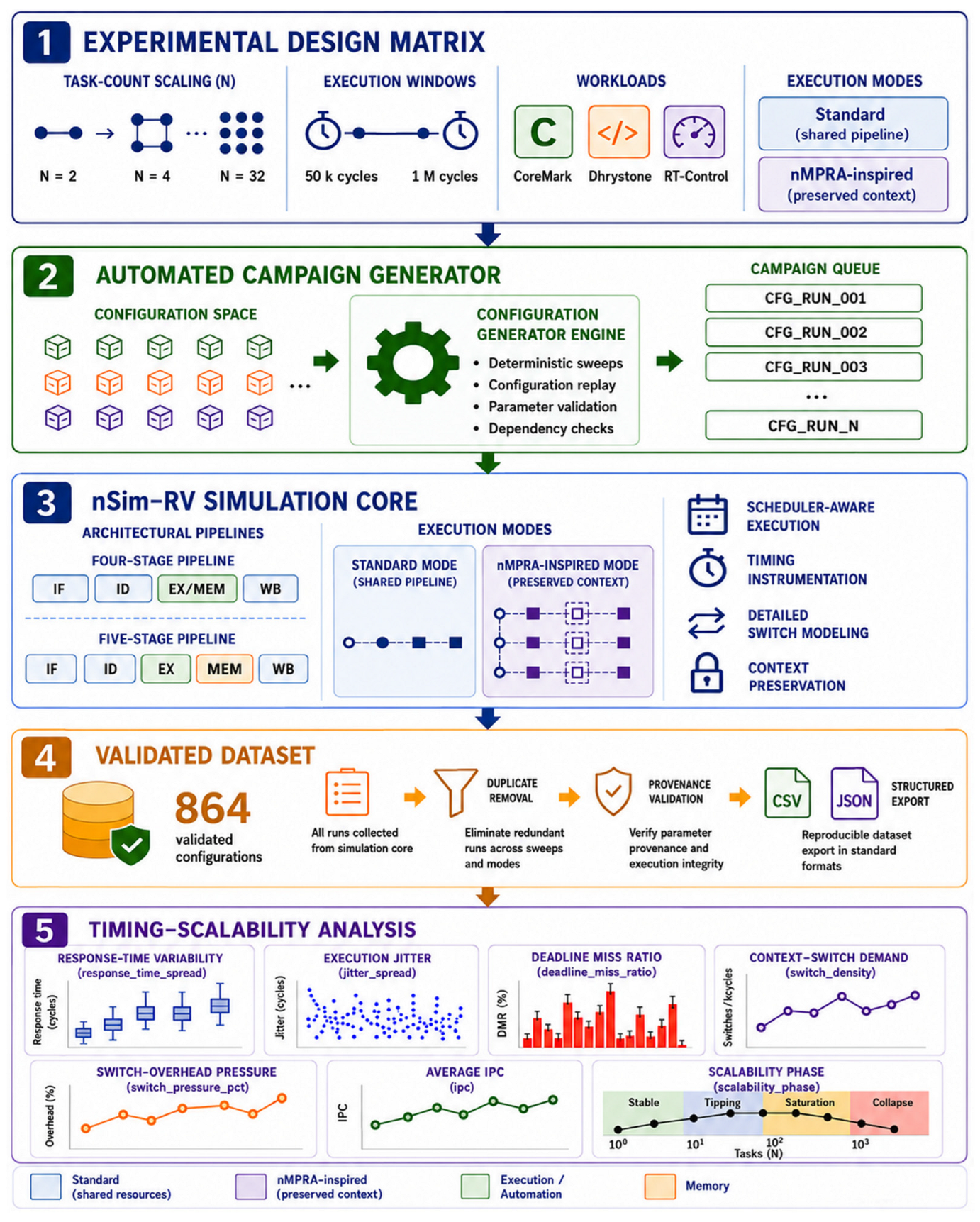
Figure 1 summarizes the nSim-RV evaluation workflow used in this study, from reproducible configuration inputs to automated campaign execution, dataset aggregation, and timing-scalability analysis.
The framework records both scheduler-level and execution-level timing information. At the scheduler level, it tracks task activations, completed jobs, response-time behavior, deadline misses, and context-switch activity. At the execution level, it records pipeline-related timing statistics and progress indicators needed to characterize workload-density effects. These measurements support the scalability-oriented metrics used, including response-time variability, execution jitter, deadline miss ratio, context-switch and switch-overhead indicators, and phase-oriented scalability behavior.
3.2. Experimental Orchestration Workflow
The experimental workflow implemented around nSim-RV is organized as a configuration-driven process. Each simulation run is generated from an explicit set of workload, timing, and execution parameters, including workload class, task count, observation window, execution mode, pipeline organization, and cache setting. This structure follows established reproducibility practices, where explicit configuration metadata and repeatable execution procedures support consistent evaluation across large design spaces [
10,
11].
The first stage defines the experimental design matrix. This matrix combines the selected workload classes, task-count settings, observation-window durations, execution modes, pipeline configurations, and cache modes. Each generated configuration therefore represents a unique experimental point that can be reproduced, inspected, or rerun under the same input conditions. By explicitly encoding these dimensions, the workflow reduces the risk of implicit configuration changes between simulation runs.
The second stage performs automated campaign generation and execution. The orchestration scripts expand the design matrix into executable simulation scenarios, instantiate the corresponding nSim-RV configuration files, launch the simulator, and store the raw outputs using consistent naming and metadata conventions. This automated process limits manual intervention and ensures consistent execution across all evaluated configurations.
Table 2 summarizes the main stages of the nSim-RV orchestration process and the artifacts generated at each stage.
During each run, nSim-RV executes the selected workload under the configured execution model and scheduler-controlled task model. The simulator records both raw execution outputs and structured timing information, including task-level response behavior, completed jobs, deadline-related data, context-switch activity, and execution-progress indicators. The same output structure is used across workloads, execution modes, and pipeline configurations, which simplifies aggregation and supports consistent comparison.
After simulation execution, the aggregation pipeline merges the per-run outputs into CSV and JSON datasets. Each row is associated with explicit metadata describing the corresponding experimental configuration. The aggregation process uses a composite configuration key based on pipeline stage count, execution mode, workload, task count, observation window, and cache mode. This key is used to identify duplicate configurations and retain a single authoritative result for each unique configuration.
The validated dataset is then used as input for timing-scalability analysis. The analysis stage derives the metrics used, including response-time variability, execution jitter, deadline miss ratio, context-switch demand, modeled switch-overhead pressure, average IPC, and scalability-phase behavior. Average IPC is retained as a secondary throughput reference for interpreting degradation trends under increasing task-count pressure, while the primary interpretation remains focused on timing variability, deadline pressure, and scheduler-induced execution effects.
The figures reported in
Section 4 are generated from the validated aggregated CSV dataset using Python(3.12.9)-based plotting scripts. The main cache-disabled timing plots reported in
Section 4 use the 1 M cycle subset of the dataset, filtered by workload, task count, execution mode, and pipeline organization. The plotted metrics are average IPC, normalized response-time spread, normalized execution-jitter spread, deadline miss ratio, and modeled switch-overhead pressure. The experimental workflow used the C++17 nSim-RV simulator together with Python scripts for campaign orchestration, aggregation, validation, phase classification, and figure generation. For reproducibility, the simulator is distributed in the accompanying package as a Windows x64 binary-only executable identified by the SHA-256 checksum 50513ea20d2a39ce78d8eb535e4b09580b2e5d4cab6d7b2fa683bd4fae902670 and validated against the reference dataset. The Python-based workflow was validated using Python 3.12.9, pandas 3.0.3, NumPy 2.4.5, Matplotlib 3.10.9, and Seaborn 0.13.2.
This separation of concerns, design-space generation, simulation execution, aggregation, validation, and metric extraction as distinct stages is what makes the methodology portable to alternative execution models, scheduling policies, or workload classes without re-engineering the orchestration layer.
3.3. Workload and Scalability Configuration
The evaluation configuration is designed to expose timing behavior under increasing workload density while preserving comparability across execution modes and pipeline organizations. For this reason, the experimental space combines workload diversity, task-count scaling, observation-window scaling, execution-mode variation, pipeline-depth variation, and cache configuration.
Three workload classes are used in the evaluation. CoreMark is included as a compute-oriented embedded benchmark designed to provide a compact and portable measure of processor execution capability [
24]. Dhrystone is included as a classical integer benchmark with branch and control-flow characteristics that remain useful for lightweight embedded evaluation contexts [
25]. In addition, RT-Control is used as a synthetic control-oriented workload designed to expose scheduler-induced timing variability under increasing task-count pressure. RT-Control is not treated as a standardized benchmark; instead, it provides controlled periodic task sets with reproducible activations, execution budgets, and deadline-pressure conditions.
These workloads are used as controlled evaluation inputs rather than as complete representatives of industrial cyber-physical applications. CoreMark and Dhrystone provide general-purpose embedded benchmark behavior, while RT-Control provides a deterministic synthetic periodic workload designed to expose scheduler-induced timing effects under increasing task density. Therefore, the reported results should be interpreted as controlled timing-scalability evidence for these workload classes, not as a direct characterization of arbitrary industrial control workloads. The study does not designate a single main benchmark. Instead, it uses three complementary workload classes to evaluate scheduler-aware timing scalability from different perspectives. CoreMark provides a compact embedded compute-oriented reference, Dhrystone provides a lightweight integer and control-flow-oriented reference, and RT-Control provides a deterministic synthetic periodic workload designed to expose scheduler-induced timing effects. This combination allows the evaluation to separate general embedded execution behavior from controlled real-time task-density effects.
The RT-Control workload used in the reported scalability evaluation is generated through a deterministic template-pool mechanism. Task sets are constructed by selecting the first N templates from a fixed pool, where N corresponds to the evaluated task count. In this study, the evaluated task-count values are N = 2, 4, 6, 8, 10, 12, 16, 20, and 32. This selection rule ensures that task-set generation is reproducible and that the same generated tasks are used across Standard and nMPRA-inspired execution modes.
For example, the
N = 2 configuration is deterministically generated from the first two templates of the pool: Task 0 uses priority 1, WCET 20,000 cycles, period 40,000 cycles, and release offset 0, while Task 1 uses priority 2, WCET 50 cycles, period 1000 cycles, and release offset 0. Larger task counts are generated by extending the same deterministic selection rule over the fixed template pool.
Table 3 summarizes the RT-Control workload-generation mechanism used for the unified scalability sweep reported in
Section 4.
For reproducibility, the complete RT-Control template pool, generated task-set files, workload program mappings, aggregation scripts, and phase-classification scripts are treated as experimental artifacts. The manuscript reports the workload-generation mechanism and representative N = 2 configuration, while the full generated task-set definitions are provided according to the Data Availability Statement.
Across all evaluated task-count configurations, the same scheduler semantics and generated task definitions are preserved when comparing Standard and nMPRA-inspired execution modes. This ensures that differences observed between the execution organizations are not caused by different workload definitions within the same evaluated configuration. The unified scalability sweep is therefore the sole RT-Control generation mechanism used for the task-count scalability analysis reported in
Section 4.
Task-count scaling uses the selected values of N = 2, 4, 6, 8, 10, 12, 16, 20, and 32 concurrent tasks. The selected task-count set covers low-density, intermediate, saturation-oriented, and high-pressure workload regions without assuming continuous coverage of every possible task count. This design allows the evaluation to observe how response-time variability, execution jitter, deadline miss behavior, switch-overhead pressure, and throughput retention evolve as the number of scheduler-managed execution contexts increases.
Observation-window scaling is performed using fixed execution intervals of 50 k, 100 k, 500 k, and 1 M simulation cycles. The use of fixed observation windows provides a common basis for comparing configurations under identical simulation budgets. Shorter windows capture bounded early run timing behavior, whereas longer windows expose sustained scheduler-pressure effects and phase transitions that may not be visible in compact runs. The 50 k and 100 k windows are therefore interpreted as compact observation intervals rather than as steady-state estimates.
The evaluated modes include Standard shared-pipeline execution and nMPRA-inspired preserved-context execution. Both modes are evaluated under identical scheduler and workload conditions, so that observed timing differences can be attributed to the execution mode rather than to scheduling policy or workload structure. The analysis therefore focuses on how timing variability and deadline-oriented behavior evolve under identical workload and scheduling conditions, rather than on isolated microarchitectural recovery mechanisms.
The evaluation includes both five-stage and four-stage pipeline organizations. The five-stage configuration is used as the reference pipeline organization, while the four-stage configuration was evaluated through a complete parity matrix that mirrors the same workload, task-count, observation-window, cache, and execution-mode structure. In the results, both matrices are reported together for the main cache-disabled timing analysis, while the interpretation remains focused on timing behavior rather than pipeline-depth optimization.
Table 4 summarizes the main experimental dimensions used in the evaluation.
The resulting configuration space supports a timing-scalability analysis centered on temporal stability and scheduler pressure. This configuration strategy provides the basis for the metrics defined in the next section.
3.4. Timing-Oriented Metrics
The performance and timing behavior of the evaluated configurations are characterized through a fixed set of performance parameters. These parameters are response-time variability, execution jitter, deadline miss ratio, context-switch demand, modeled switch-overhead pressure, average IPC, and operational scalability phase. Together, they describe how execution behavior evolves under increasing task-count pressure. Average IPC is retained as a secondary throughput reference, since the main objective of this study is not peak instruction retirement, but timing stability under scalable real-time workloads.
For each completed task job, response time is measured as the interval between job release and job completion. For job
k of task
i, response time is defined as:
where
R_(i,k) is the response time of job k of task
i,
t_(i,k)^release is the release cycle, and
t_(i,k)^finish is the completion cycle.
Response-time variability is represented by the spread between the maximum and minimum observed response times for a given task within the evaluated interval:
where
R_i^max and
R_i^min are the maximum and minimum observed response times for task
i. A lower response-time spread indicates more stable task completion behavior, whereas a larger spread reflects increased timing variability.
Execution jitter quantifies activation-level timing variation across repeated scheduler-controlled task releases. Unlike response-time spread, which captures completion-time dispersion, jitter is defined here as an activation-related timing-spread indicator:
where
A_i^max and
A_i^min denote the maximum and minimum observed activation-to-resumption timing values for task
i under the same configuration, measured from the cycle at which a released task becomes scheduler-eligible to the cycle at which it resumes useful modeled execution. This separates jitter from response-time variability: response-time variability describes the spread of job completion behavior, while jitter emphasizes activation-to-activation timing variation induced by scheduler activity and workload-density pressure.
Deadline behavior is evaluated using the deadline miss ratio. This metric normalizes the number of deadline violations by the number of evaluated jobs in the corresponding simulation interval:
where
N_miss is the number of jobs that miss their configured deadline and
N_jobs is the total number of evaluated jobs in the corresponding simulation interval. The deadline miss ratio provides a configuration-level view of deadline pressure and enables comparison across task-count settings, workloads, and observation windows.
Context-switch demand is used as a scheduler-level validation indicator. It captures the frequency of context-switch requests relative to the simulated execution interval:
where
N_switch is the number of observed task-to-task context-switch events and
C_total is the total number of simulated cycles in the observation window. This metric is used to verify that matched Standard and nMPRA-inspired configurations are subjected to comparable scheduler demand.
Switch-overhead pressure is used as a modeled execution-level indicator. It measures the fraction of the observation window accounted for by explicit context-switch overhead cycles in the simulator:
where
C_switch is the number of the cycles explicitly accounted as context-switch overhead by the simulator, and
C_total is the total number of simulated cycles in the observation window.
In Standard mode, this pressure reflects the pipeline-dependent penalty associated with task-to-task switching in the shared-pipeline organization. In the simulator, each Standard-mode task-to-task switch adds a modeled flush-and-recovery penalty of four cycles for the five-stage organization and three cycles for the four-stage organization. These constants represent the modeled recovery interval required before useful execution resumes after disrupting the shared in-flight pipeline state. In the nMPRA-inspired mode, this explicit modeled penalty is not applied because the task-specific pipeline-related state is preserved across activations. Switch-overhead pressure should therefore be interpreted as a modeled execution-organization effect, not as the number of scheduler switch requests or as a hardware measurement of a specific implementation.
Average IPC is retained as a secondary throughput indicator. It is computed directly from the number of retired instructions and the total number of simulated cycles:
where
N_retired is the number of retired instructions and
C_total is the number of simulated cycles in the observation window.
Average IPC provides a useful-work reference for interpreting throughput retention and degradation under increasing task-count pressure. However, timing-oriented interpretation remains centered on response-time variability, execution jitter, deadline miss ratio, context-switch demand, and switch-overhead pressure.
Table 5 summarizes the metrics used and their role in timing-scalability analysis.
Scalability-phase characterization summarizes timing behavior progression across the task-count axis. Phase labels are assigned using an operational rule applied independently to each trajectory: a unique combination of workload, execution mode, pipeline stage count, cache mode, and observation window. A trajectory is defined as a unique combination of workload, execution mode, pipeline stage count, cache mode, and observation window. For each trajectory, the maximum observed IPC is first identified, and each task-count configuration is then evaluated relative to this trajectory-specific peak.
The phase classifier uses IPC only to locate the empirical throughput peak and to detect post-peak degradation. The timing interpretation of the phases is based on the combined behavior of switch-overhead pressure and deadline-miss behavior, together with the response-time and jitter trends analyzed in the results. This avoids assigning phases from fixed task-count intervals and makes the classification reproducible from the validated dataset.
For a configuration with IPC value
IPC(N), the relative peak ratio is defined as:
The phase rules are applied in descending severity order. Because the IPC trajectory can increase toward an empirical peak before degrading at higher task counts, the IPC-based collapse condition is evaluated only on the post-peak branch of each trajectory. Let N_peak denote the task count at which the trajectory-specific maximum IPC is observed. A configuration is classified as collapse if N ≥ N_peak and IPC_peak_ratio(N) < 0.90, or if the deadline miss ratio exceeds 0.05. If the collapse condition is not met, the configuration is classified as saturation when switch-overhead pressure is at least 2.5% or the deadline miss ratio is at least 0.02. If neither collapse nor saturation is met, the configuration is classified as tipping when switch-overhead pressure is at least 1.0% or the deadline miss ratio is at least 0.005. All remaining configurations are classified as stable.
The selected thresholds were chosen as internal operational cut points after inspecting the distribution of switch-overhead pressure, deadline miss ratio, and post-peak IPC degradation in the validated dataset. They are intended to distinguish low-overhead operation, first observable timing stress, persistent deadline or switch-overhead pressure, and severe post-peak degradation. They should therefore be interpreted as reproducible dataset-level criteria rather than as universal real-time schedulability thresholds.
Table 6 summarizes the resulting phase-classification rule.
Microarchitectural continuity metrics such as Useful Work Ratio, Execution Disruption Ratio, and Resume Latency are excluded because their cross-mode comparability depends on implementation-level pipeline details outside the scope of nSim-RV’s execution-mode abstraction.
3.5. Dataset Aggregation and Validation
The experimental campaigns generate multiple per-run outputs that must be aggregated before comparative timing analysis can be performed. For consistency and reproducibility, each result is associated with explicit metadata describing the pipeline stage count, execution mode, workload, task count, observation window, cache mode, and scenario label where applicable. For a fixed configuration, nSim-RV produces deterministic execution behavior and identical metric values across repeated runs; therefore, the study reports configuration-level deterministic outcomes rather than statistical confidence intervals.
The journal-analysis dataset is organized around two pipeline-specific matrices. The primary five-stage scalability matrix contains 432 unique configurations. To provide a pipeline-depth parity evaluation, a complete four-stage matrix was generated using the same workload, task-count, observation-window, cache, and execution-mode structure, resulting in an additional 432 validated configurations. The combined evaluation therefore includes 864 validated pipeline-specific configurations. The four-stage matrix mirrors the five-stage configuration space and is used to assess whether the workflow and main timing-scalability trends remain consistent across pipeline depth.
The aggregation process also preserves row-level analysis outputs used by the figure-generation and phase-classification scripts. In the primary journal-analysis files, multiple rows may correspond to derived or expanded analysis views of the same unique configuration. For this reason, the manuscript uses validated unique configurations as the main dataset-size indicator; additional analysis rows are retained only for plotting, filtering, and phase characterization.
Table 7 summarizes the composition of the aggregated dataset and the validation rules applied during dataset construction.
To prevent repeated experimental configurations, duplicate detection uses a composite key composed of pipeline stage count, execution mode, workload, task count, observation window, cache mode, and scenario label where applicable. When duplicate entries are encountered during aggregation, a single authoritative result is retained for the corresponding unique configuration.
The validated dataset provides a unified basis for the analyses presented in this study. Response-time variability, execution jitter, deadline miss ratio, context-switch demand, modeled switch-overhead pressure, average IPC, and scalability-phase labels are derived from consistently structured data sources. For the operational scalability-phase classifier, both pipeline stage count and cache mode are included in the trajectory key so that pipeline-depth and cache configurations are evaluated relative to their own trajectory-specific IPC peaks.
By preserving configuration metadata, applying composite-key duplicate detection, and generating structured CSV/JSON outputs, the aggregation pipeline ensures that each row in the analysis dataset can be traced to its original simulation configuration, a prerequisite for the figure-generation and phase-classification scripts provided in the reproducibility package.
4. Comparative Timing-Scalability Evaluation
In the following cache-disabled timing figures, CoreMark and Dhrystone may show overlapping scheduler-level trajectories because both workloads use the same deterministic periodic task templates and fixed-latency memory model. Their instruction-level behavior remains distinct, as reflected by the IPC results. The comparative evaluation is therefore organized by performance parameter rather than by a single benchmark score: average IPC, response-time variability, execution jitter, deadline miss ratio, switch-overhead pressure, and scalability phase are analyzed across the three workload classes and the two execution modes.
4.1. Baseline Throughput Scaling
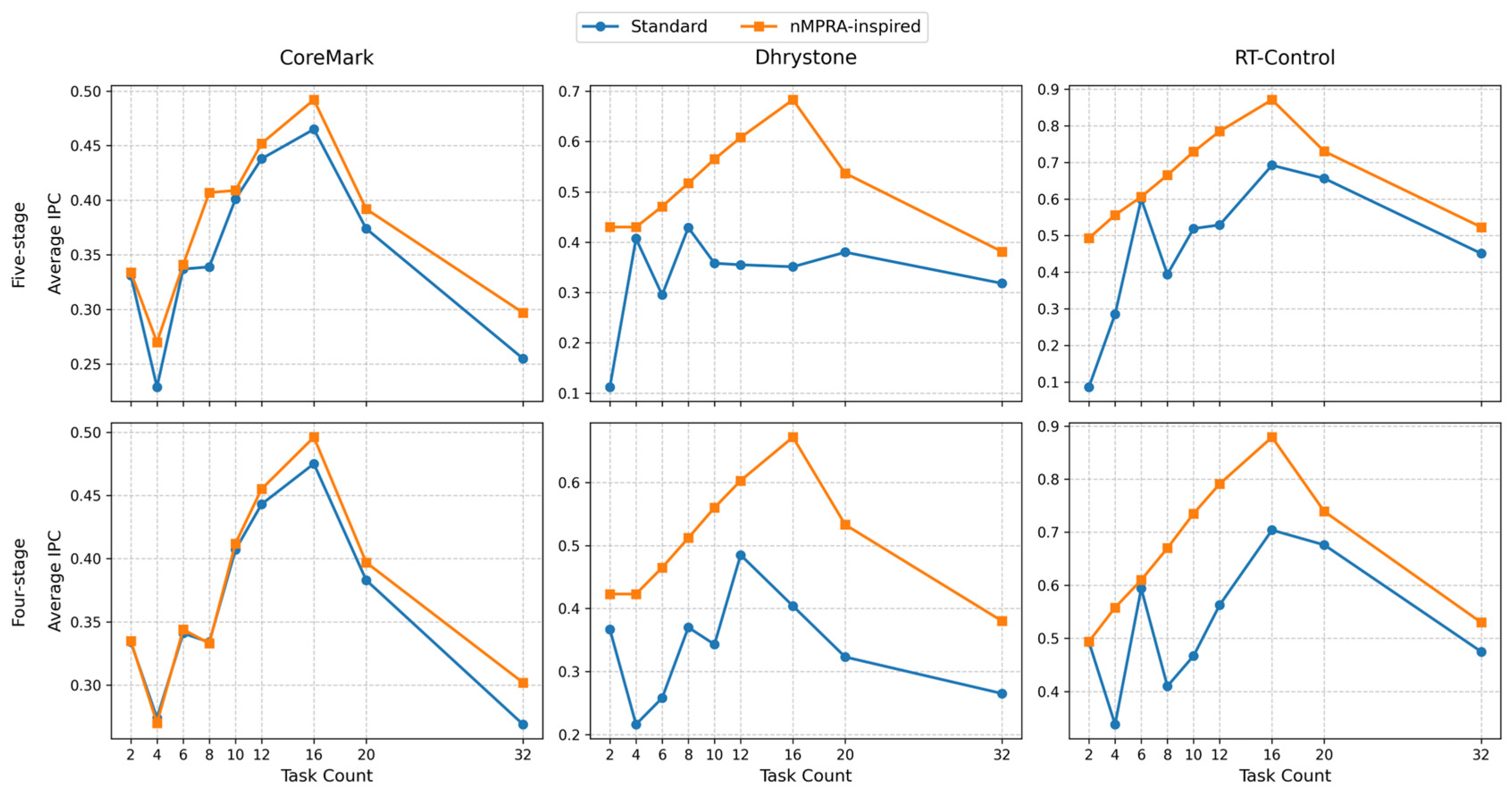
Figure 2 presents the average IPC obtained under task-count scaling for the cache-disabled configurations. The results are reported for the CoreMark, Dhrystone, and RT-Control workloads using both the Standard and nMPRA-inspired execution modes in the five-stage and four-stage pipeline organizations.
Average IPC increases with task count and reaches its highest values near
N = 16 tasks for most cache-disabled configurations (
Figure 2). This trend is visible across all evaluated workloads and both pipeline organizations. Beyond the peak region, throughput progressively declines as increasing scheduler activity, more frequent task releases, and deadline-related preemptions consume a larger fraction of the available execution cycles. Although the exact peak location varies slightly for some trajectories,
N = 16 represents the most common operating point at which useful execution throughput is maximized.
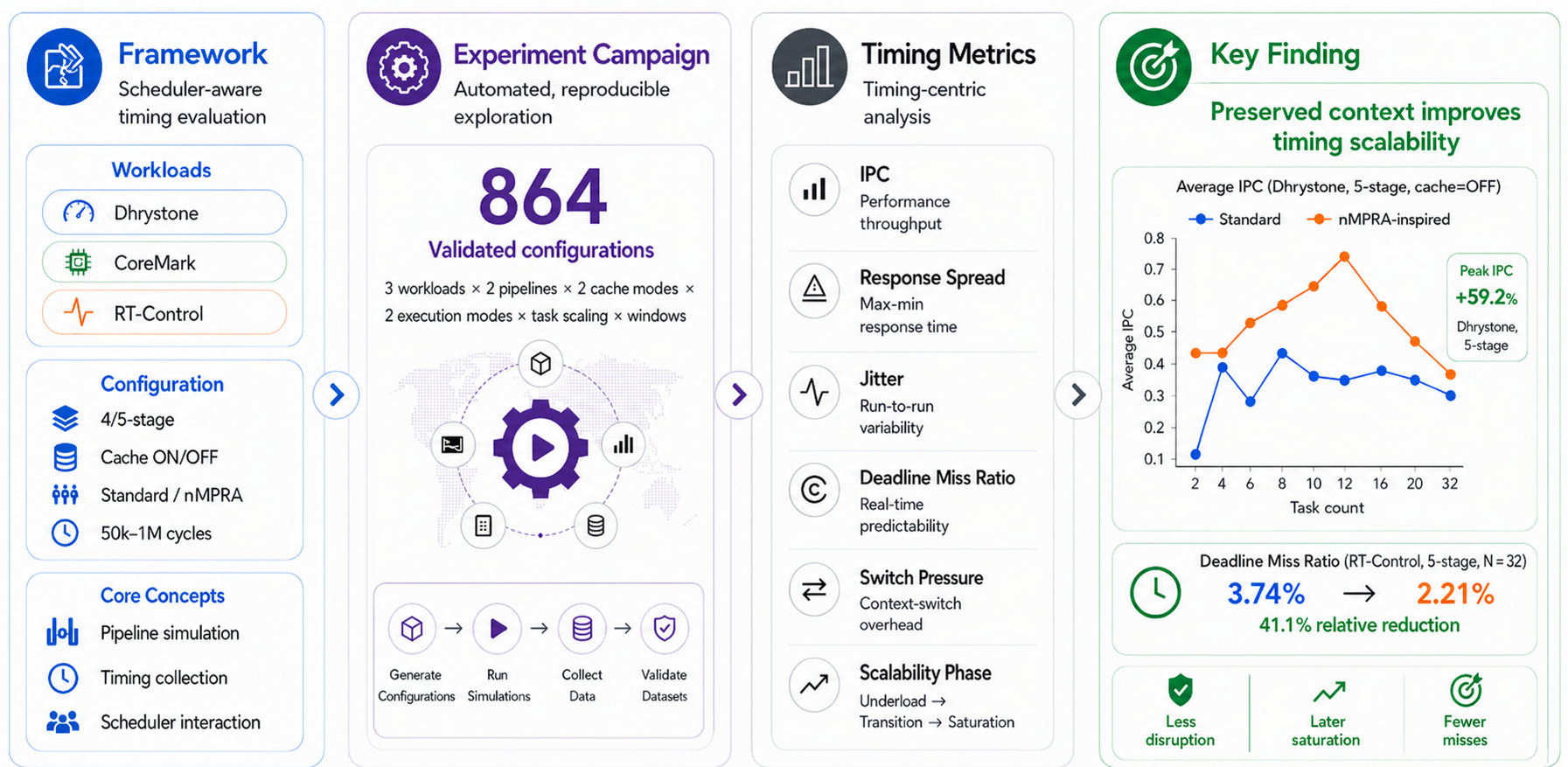
The advantage of preserved-context execution is particularly visible in Dhrystone and RT-Control. In the five-stage cache-disabled 1 M cycle configuration, the nMPRA-inspired mode reaches peak IPC values of 0.683 in Dhrystone and 0.871 in RT-Control, compared with 0.429 and 0.692 for the corresponding Standard configurations. These values represent peak-to-peak improvements of approximately 59.2% and 25.9%, respectively. CoreMark exhibits a smaller but still consistent peak-to-peak benefit, with peak IPC increasing from 0.465 to 0.492, corresponding to approximately 5.8%. These results indicate that preserving the task-specific execution state reduces the throughput loss associated with repeated pipeline disruption and recovery during scheduler-driven task switching.
Pipeline depth affects Standard-mode throughput more strongly than preserved-context throughput. The largest differences appear in Dhrystone and RT-Control, where the five-stage Standard configuration experiences a more pronounced throughput decline after the peak region than its nMPRA-inspired counterpart. In contrast, the four-stage organization exhibits a smaller separation between the execution modes, which is consistent with the reduced flush-and-rebuild penalty associated with the shorter pipeline. Nevertheless, both organizations eventually experience throughput degradation at high task counts, confirming that context preservation delays, but does not eliminate, the scalability limits imposed by dense scheduler-driven workloads.
4.2. Response-Time Variability Analysis
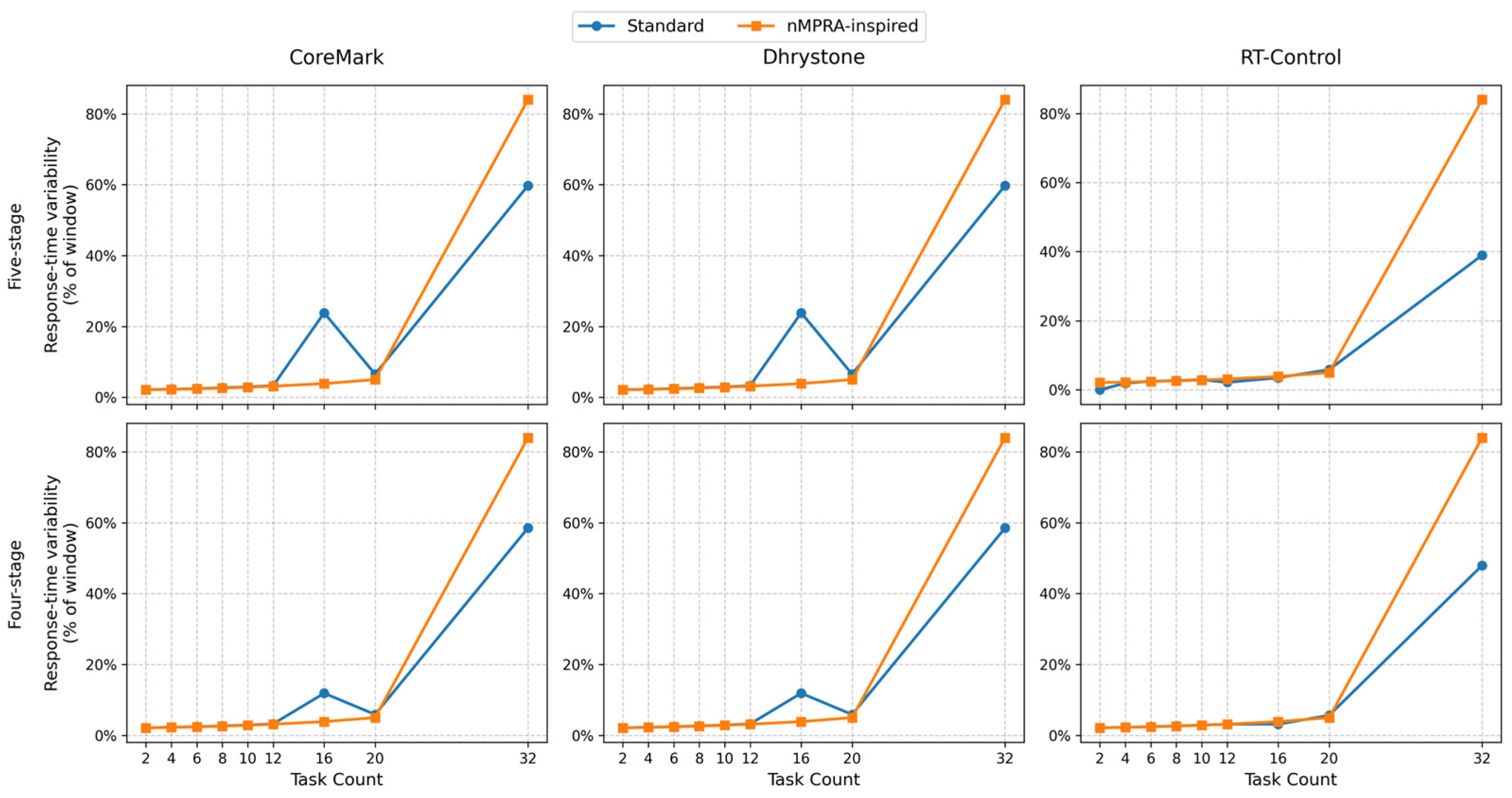
Response-time spread, normalized to the observation window, remains low up to intermediate task counts and increases sharply once scheduler pressure becomes dominant (
Figure 3). For the five-stage Standard mode, spread reaches 0.238 of the observation window at
N = 16 tasks in CoreMark and Dhrystone, compared with 0.039 for the corresponding nMPRA-inspired configuration, representing a reduction of approximately 83.8%. At N ≤ 12, both modes maintain spread below 0.033 of the observation window, indicating that scheduler demand at low and intermediate task counts is not sufficient to generate large timing dispersion.
The mechanism differs between modes. In Standard execution, each task switch interrupts the shared in-flight pipeline state, and the resuming task must rebuild execution progress before contributing useful work. At N = 16, the five-stage Standard configuration reaches 12,218 switches per 1 M cycles in CoreMark and Dhrystone, while the cumulative switch overhead accounts for 4.887% of the observation window. This recovery cost amplifies response-time dispersion because jobs completed under different preemption patterns accumulate different amounts of rebuild latency within the same observation interval.
In the nMPRA-inspired mode, the task-specific pipeline-related state is retained across activations, so resumed tasks can continue execution without the same shared-pipeline rebuild penalty. This explains the lower spread observed around the peak-throughput region. However, the residual spread increase at higher task counts, especially beyond N = 20, shows that context preservation does not remove release-density effects or deadline-pressure accumulation. At N = 32, both execution modes enter a high-pressure region, and response-time spread becomes dominated by workload density rather than by switch recovery alone.
CoreMark and Dhrystone produce overlapping response-time trajectories under cache-disabled conditions, as expected from their shared scheduler-level timing templates; their distinct IPC values in
Figure 2 confirm that instruction-level behavior remains different.
4.3. Execution Jitter Analysis
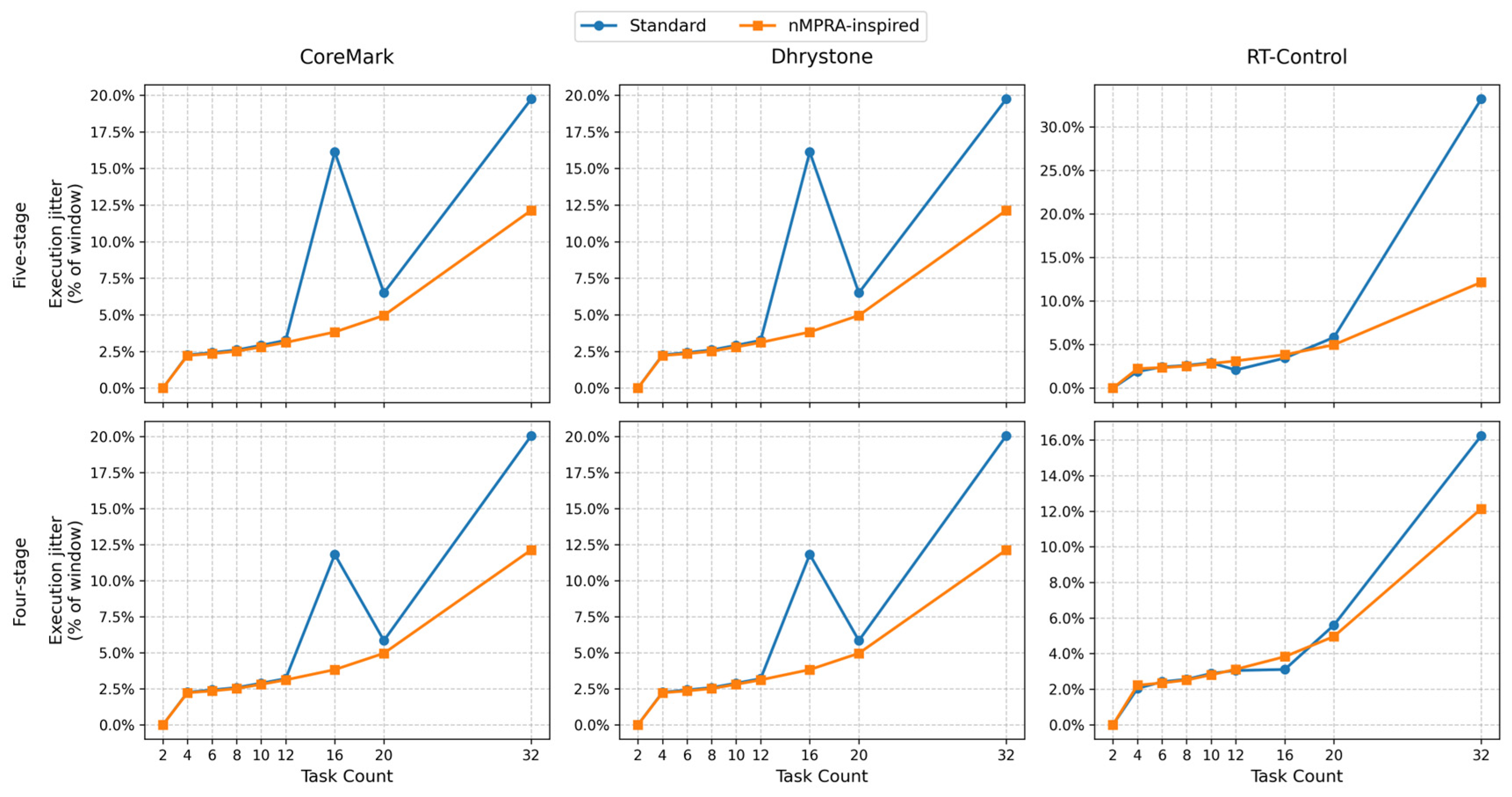
Activation-level jitter, normalized to the observation window, remains limited to low and intermediate task counts but rises sharply beyond
N = 16 tasks in Standard mode (
Figure 4). For the five-stage RT-Control configuration, jitter reaches approximately 33.0% of the observation window at
N = 32, whereas the corresponding nMPRA-inspired configuration reaches 12.1%, representing a reduction of approximately 63%. Below
N = 12, both execution modes generally remain below 3.5% of the observation window, indicating that activation-to-activation regularity is preserved when scheduler pressure remains moderate.
Jitter in Standard mode is driven by preemption-induced pipeline flushes that vary the cycle at which each task resumes useful execution. Because the recovery cost is affected by pipeline depth, the five-stage Standard configuration reaches 33.2% of the observation window at N = 32, compared with 16.2% for the corresponding four-stage Standard configuration. In contrast, both nMPRA-inspired configurations remain at approximately 12.1% of the observation window, indicating that preserved context reduces the sensitivity of activation-level timing regularity to pipeline depth in the evaluated high-density RT-Control case.
The RT-Control workload shows the steepest jitter growth after N = 16, increasing by approximately 1.65 percentage points per additional task up to N = 32. The RT-Control workload combines tighter deadline constraints with higher preemption pressure than CoreMark and Dhrystone, which accounts for its steeper jitter increase.
4.4. Deadline Miss Ratio Analysis
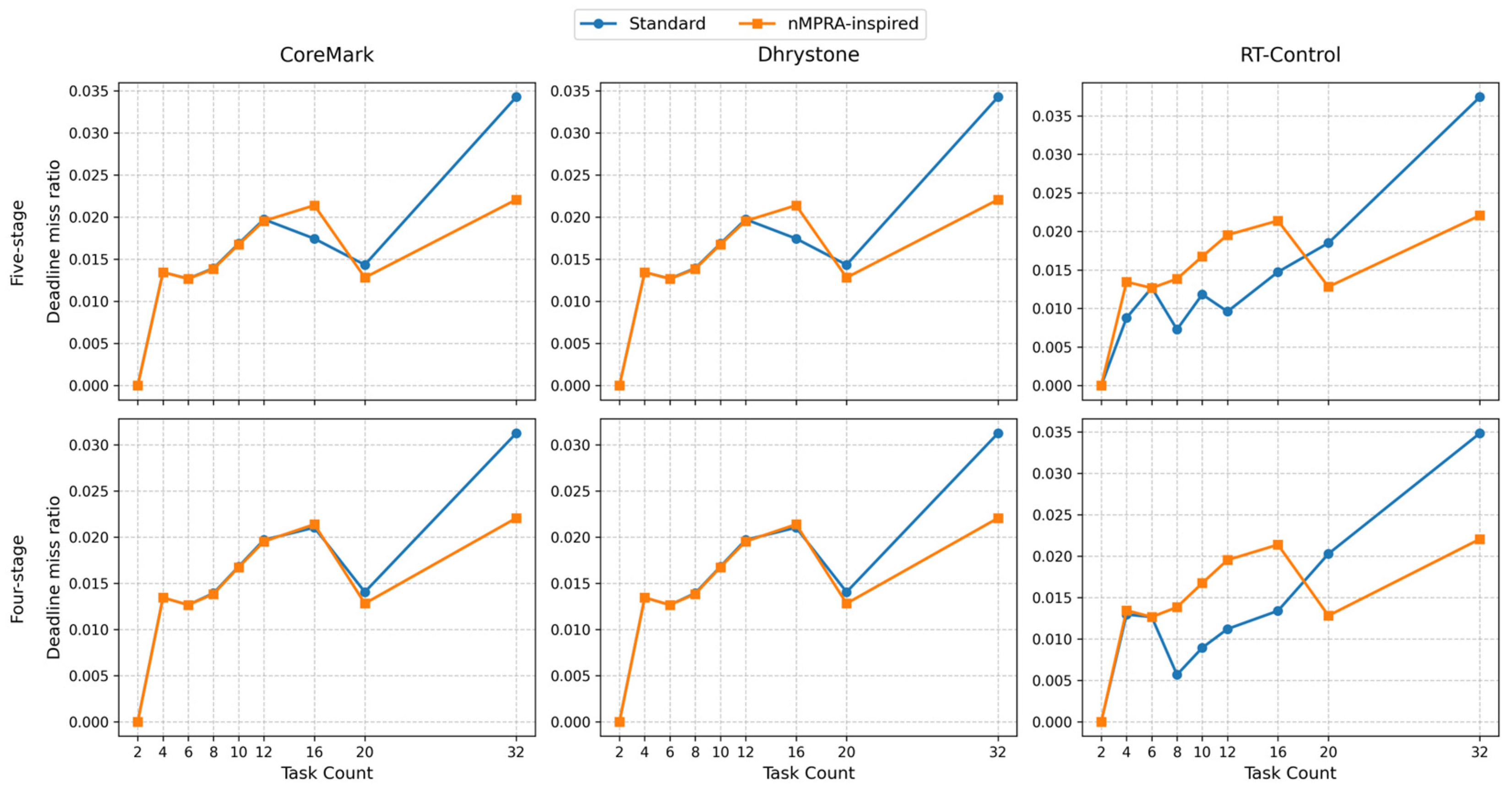
The deadline miss ratio remains negligible at low task counts across all evaluated workloads and execution modes (
Figure 5). For the five-stage RT-Control configuration, the Standard mode reaches a maximum deadline miss ratio of approximately 3.74% at
N = 32, whereas the corresponding nMPRA-inspired configuration reaches 2.21%, representing a reduction of approximately 41.1%. The divergence becomes visible beyond
N = 16 tasks, where increasing scheduler pressure and execution interference begin to consume a measurable fraction of the available timing budget.
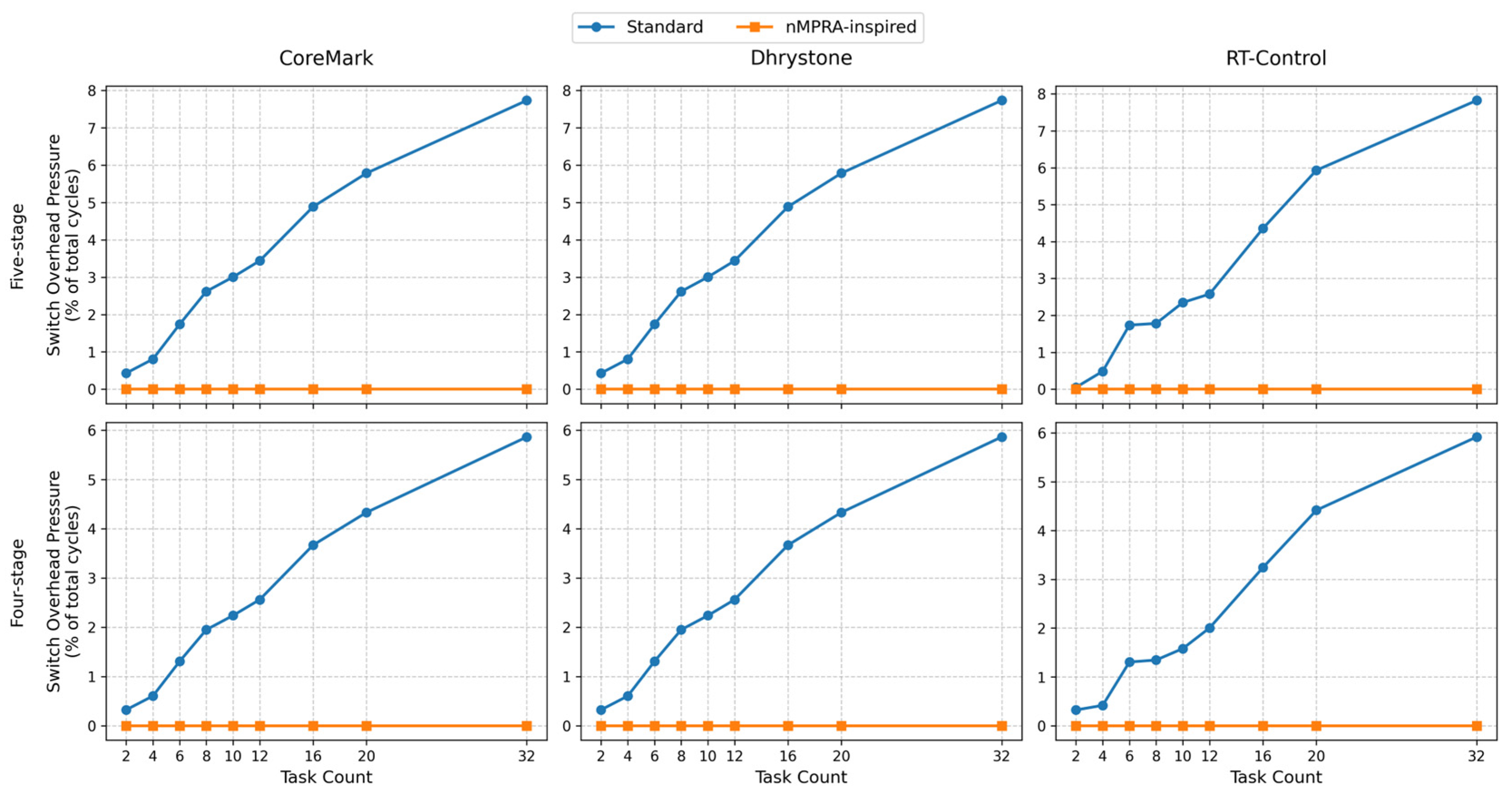
Figure 6 provides the corresponding switch-overhead pressure profiles for interpreting this deadline-miss growth. In Standard execution, each task switch interrupts the shared pipeline state and introduces a pipeline-depth-dependent recovery interval before useful work can resume. As task count increases, the accumulated recovery cost reduces the effective execution budget available between release and deadline, directly increasing the probability of deadline violations.
Preserved-context execution does not apply this modeled source of execution disruption within the evaluated execution model. Consequently, resumed tasks can continue execution without paying the same recovery penalty observed in the Standard mode. The resulting preservation of useful execution cycles delays the growth of deadline miss ratio and shifts the onset of deadline-pressure effects toward higher task counts.
The largest separation between execution modes is observed in the RT-Control workload, which combines tighter timing constraints with higher preemption activity. At N = 32, the five-stage Standard configuration reaches a deadline miss ratio of 3.74%, compared with 2.21% for the corresponding nMPRA-inspired configuration. In contrast, CoreMark and Dhrystone exhibit nearly identical deadline-miss trajectories, which is expected because both benchmarks share the same deterministic scheduler-level timing templates in the cache-disabled experiments.
4.5. Switch-Overhead Pressure Analysis
The previous metrics describe the visible timing effects of workload-density scaling. To relate these effects to the execution model, this section analyzes modeled switch-overhead pressure introduced by task-to-task context switches. This metric differs from scheduler demand: scheduler demand reflects how often the scheduler requests context switches, whereas switch-overhead pressure captures the fraction of the observation window consumed by the modeled switch penalty.
In the Standard shared-pipeline mode, switch-overhead pressure increases as task count grows. This follows from the larger number of task activations and preemptions generated by denser workload configurations. Because Standard mode uses a shared in-flight pipeline state, task-to-task switches introduce an explicit modeled penalty associated with interrupting and rebuilding useful pipeline progress. The effect is stronger in the five-stage configuration than in the four-stage configuration because the modeled Standard-mode penalty is pipeline-depth-dependent.
In the nMPRA-inspired preserved-context mode, explicit switch-overhead pressure remains zero by design. This does not mean that scheduler demand disappears; the scheduler still activates and switches tasks according to the same workload definitions. Rather, the preserved-context model does not apply the same explicit flush/rebuild penalty on task-to-task switches because the task-specific pipeline-related state is retained across activations.
The observed differences in average IPC, response-time variability, jitter, and deadline miss ratio therefore do not arise from a lower number of scheduler events in the nMPRA-inspired mode. Instead, they reflect how each execution model handles task interruption and resumption under comparable scheduler demand. Standard mode accumulates switch-overhead pressure as task density increases, while the nMPRA-inspired mode does not apply this explicit modeled overhead component within the adopted execution model.
The five-stage and four-stage results further confirm that pipeline depth affects the Standard-mode penalty path more strongly than the preserved-context path. The five-stage Standard configuration accumulates approximately 7.8% switch-overhead pressure at N = 32 tasks, compared with 5.9% for the four-stage Standard configuration, a ratio consistent with the four-cycle versus three-cycle flush-and-recovery penalty associated with each scheduler-driven switch event. In contrast, both nMPRA-inspired configurations maintain 0% explicit switch-overhead pressure across the entire task-count range because task-specific execution state is preserved across activations and no flush-and-rebuild sequence is required following a task switch.
Switch-overhead pressure is used here to relate scheduler-driven task switching to the modeled recovery cost of the selected execution organization; it is not treated as a standalone timing-quality metric. It helps explain why the Standard mode becomes more vulnerable under dense task sets, while the nMPRA-inspired mode maintains better execution continuity. However, zero explicit switch-overhead pressure does not imply absence of timing variability, since response-time spread, jitter, and deadline misses can still increase under high workload density.
4.6. Operational Scalability Phase Characterization
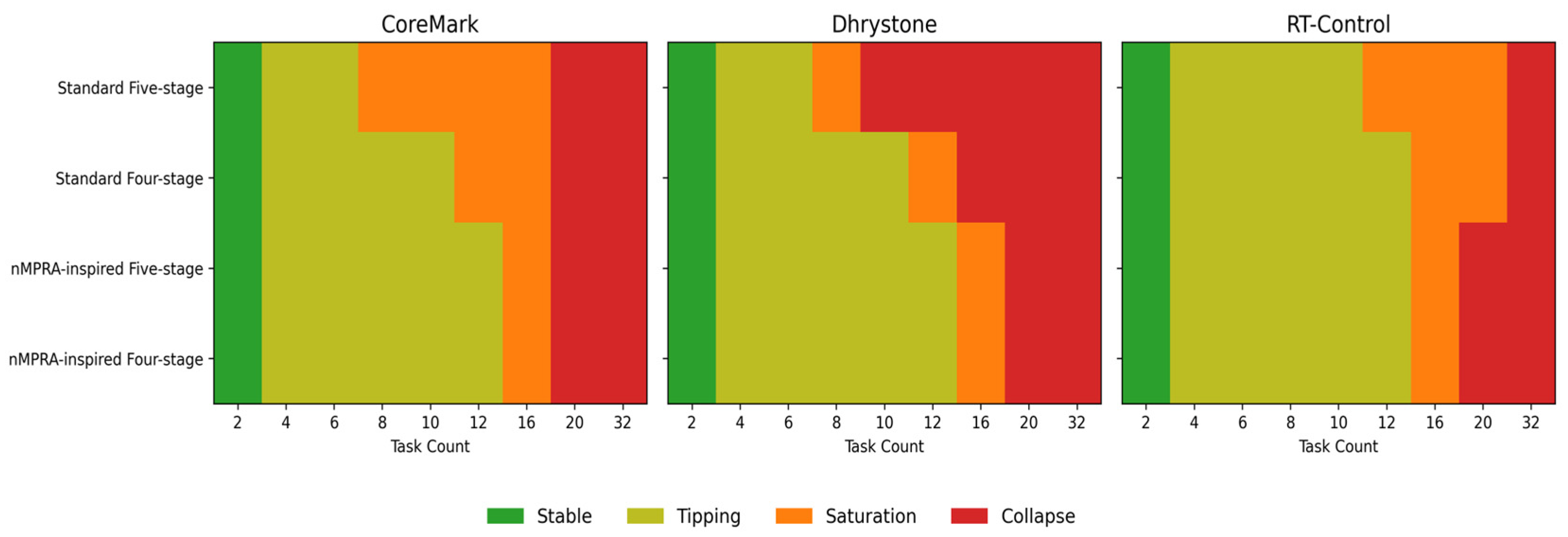
Figure 7 presents the scalability-phase characterization for the cache-disabled five-stage and four-stage configurations under the 1 M cycle observation window. Each panel corresponds to one workload, while the rows distinguish execution mode and pipeline depth. The phase labels are computed from the validated dataset rather than assigned from fixed task-count intervals. Each trajectory is defined by workload, execution mode, pipeline stage count, cache mode, and observation window, while task count remains the scaling axis.
The stable phase identifies configurations where switch-overhead and deadline pressure remain below the operational thresholds defined in
Table 6. These cases appear mainly at low task counts, where scheduler activity remains moderate and the evaluated execution modes accommodate the workload without visible timing degradation.
The tipping phase marks the first measurable departure from low-pressure behavior. Configurations enter this phase when switch-overhead pressure or deadline miss ratio reaches the onset thresholds, but severe post-peak degradation is not yet observed. This phase captures the beginning of scheduler-induced timing stress before saturation or collapse becomes dominant.
The saturation phase corresponds to configurations with sustained switch-overhead or deadline pressure, provided that the collapse condition is not yet met. In this region, the system operates close to its observed capacity, and additional task-count growth increasingly affects execution continuity and deadline behavior. Standard shared-pipeline configurations tend to reach higher-pressure phases earlier in several trajectories, consistent with the switch-overhead pressure reported in
Figure 6.
The collapse phase is assigned when IPC falls below the trajectory-specific post-peak threshold or when the deadline miss ratio exceeds the severe-pressure threshold defined in
Table 6. Its appearance at high task counts indicates that dense scheduler-driven workloads can exceed the effective timing capacity of both execution modes. Preserved-context execution generally delays or reduces the extent of high-pressure phases, but it does not remove the scalability limits imposed by dense task sets.
The phase-level view consolidates the trends observed in the individual metrics without relying on hardcoded task-count regions. Because pipeline depth and cache mode are included in the trajectory definition, four-stage, five-stage, cache-disabled, and cache-enabled configurations are evaluated relative to their own trajectory-specific IPC peaks. Under the cache-disabled 1 M cycle configuration (
Figure 7), the nMPRA-inspired mode remains in lower-pressure phases than the corresponding Standard mode in several CoreMark and Dhrystone trajectories, especially in the intermediate task-count range. For RT-Control, preserved-context execution delays the onset of saturation in the five-stage organization, but the corrected post-peak IPC criterion classifies the nMPRA-inspired trajectory as collapse from
N = 20 onward. This confirms that preserved-context execution reduces modeled switch-overhead pressure, but does not eliminate workload-density-induced scalability limits. Overall,
Figure 7 shows that the benefit of preserved context is trajectory-dependent and is most visible before the highest task-density region.
4.7. Cache-Configuration Robustness
The main scalability analysis was performed under cache-disabled conditions to isolate scheduler-driven timing effects from memory-hierarchy variability. The final evaluation matrix also includes cache-enabled configurations, which are used here to examine whether the main trends remain visible when an additional source of timing variation is introduced.
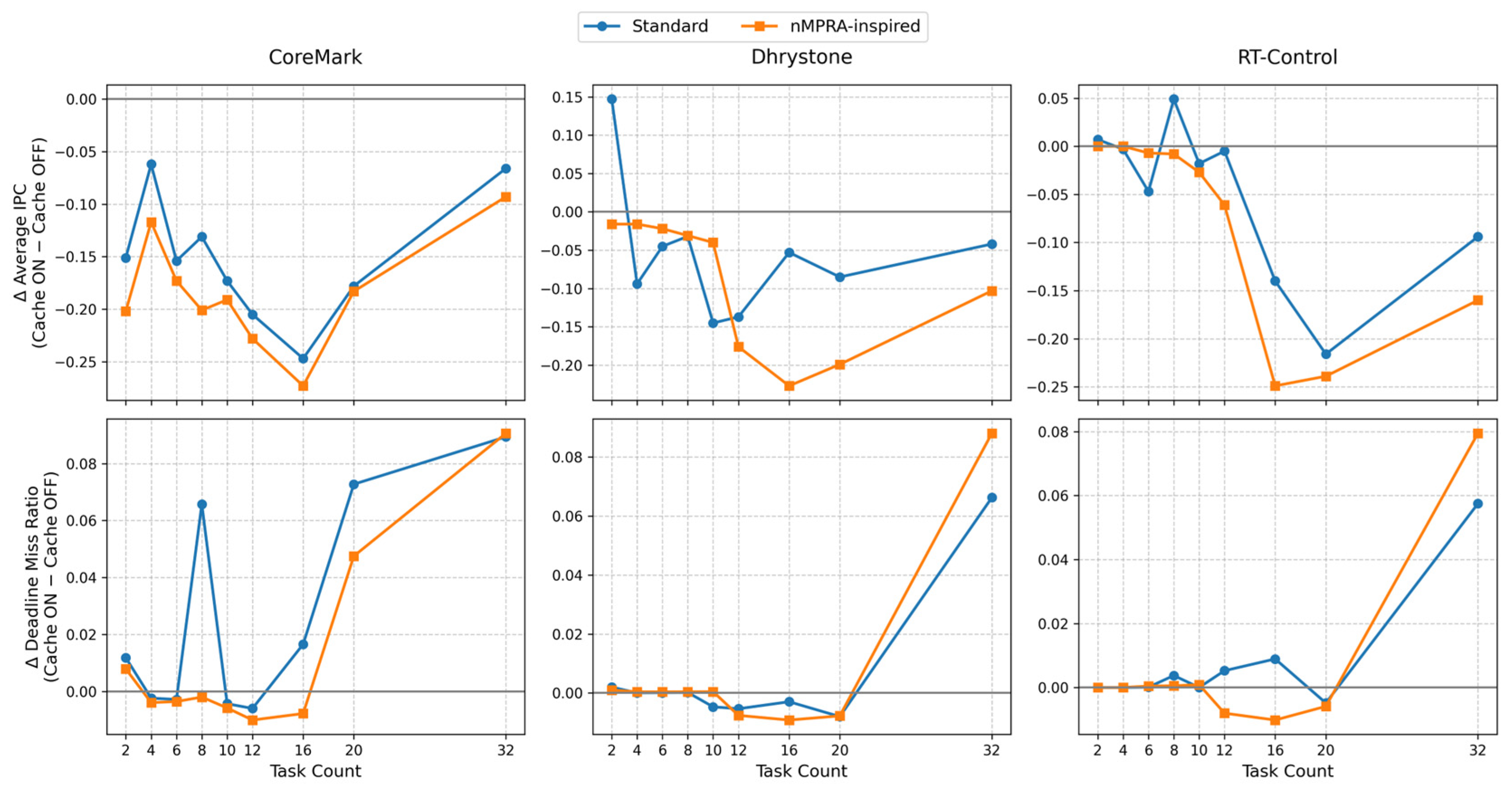
Figure 8 shows IPC delta (Cache ON − Cache OFF) and deadline-miss delta across task counts for the five-stage pipeline under the 1 M cycle window. At
N = 32 tasks, enabling the cache reduces IPC by 0.066 and 0.093 in CoreMark for the Standard and nMPRA-inspired modes, respectively, while the corresponding deadline-miss ratios increase by 0.089 and 0.091. In RT-Control, the IPC reduction reaches 0.094 in the Standard mode and 0.160 in the nMPRA-inspired mode, with deadline-miss increases of 0.057 and 0.079, respectively. Dhrystone shows a less monotonic IPC response, with deltas ranging from +0.147 to −0.227 across the evaluated task counts and execution modes. The negative IPC delta observed in most configurations indicates that, for these workloads under periodic scheduling, cache-miss variability introduces timing perturbations that often exceed the benefit of cache hits when compared with the deterministic cache-disabled baseline.
The deadline-miss deltas further indicate that cache-enabled execution can increase timing pressure at high task counts. This effect is most visible near the dense region of the task-count scale, where the baseline system is already close to saturation. At the same time, the cache-enabled results do not invalidate the main cache-disabled analysis. Instead, they show that memory-hierarchy effects act as a secondary source of variability superimposed on the scheduler-driven trends identified in the controlled baseline.
Therefore, the cache-enabled runs are interpreted as a robustness check rather than as the primary basis for scalability-phase analysis. The cache-disabled configuration remains the main reference because it provides a controlled setting for isolating execution-model effects, while the cache-enabled results indicate how these trends behave when additional memory-related perturbations are introduced.
5. Discussion and Methodological Implications
5.1. Interpretation of Timing Scalability
A recurring observation across all evaluated trajectories is the separation between throughput and timing stability. Several configurations maintain near-peak IPC while response-time spread and jitter continue to increase. This behavior follows directly from the different information captured by the evaluated metrics. IPC measures the aggregate retirement rate over the observation window, whereas response-time variability and jitter reflect the timing behavior of individual job activations. Consequently, high throughput does not necessarily imply stable timing behavior. In several cases, timing-oriented metrics indicate growing execution pressure before a substantial IPC reduction becomes visible. The phase-classification approach introduced in
Section 3.4 captures this intermediate operating region and helps distinguish early timing degradation from the more obvious throughput losses associated with saturation and collapse.
This pattern parallels findings from FlexPRET [
4], where fine-grained multithreading maintained throughput across task-count ranges that produced measurable jitter under conventional execution. The primary benefit of context-preservation mechanisms is improved timing predictability rather than higher throughput. Their contribution lies in eliminating switch-related recovery overhead, thereby reducing response-time variability and worst-case timing deviations that directly affect deadline satisfaction. nSim-RV quantifies this distribution effect rather than the average effect, which is why response-time spread and deadline miss ratio are more sensitive indicators of mode differences than average IPC at moderate task counts.
The operational scalability-phase classifier provides a compact synthesis of this multidimensional behavior. Fixed task-count breakpoints, common in prior timing studies, would misclassify configurations whose saturation onset is workload-dependent. The trajectory-relative IPC peak provides a workload-specific anchor that adapts the classifier to each evaluation context, making phase labels comparable across heterogeneous workloads and pipeline configurations within the same dataset.
Transition task counts differ primarily in the higher-pressure operating regions rather than at the initial stable-to-tipping boundary. In the evaluated cache-disabled configurations, all execution modes leave the stable region after the lowest task-count setting, but the subsequent transitions depend on workload, execution mode, pipeline organization, and the trajectory-specific IPC peak used by the corrected classifier. The nMPRA-inspired configurations remain in lower pressure phases than the corresponding Standard configurations in several CoreMark and Dhrystone trajectories, especially in the intermediate task-count range. For RT-Control, however, the corrected post-peak IPC criterion shows that preserved-context execution reduces modeled switch-overhead pressure but does not necessarily postpone collapse at the highest task densities. The RT-Control workload therefore illustrates that phase behavior is trajectory-dependent and that preserved context mitigates switch-induced disturbance without removing workload-density-induced scalability limits. Under cache-disabled conditions, CoreMark and Dhrystone share deterministic scheduler-level timing templates, explaining their overlapping timing trajectories; their instruction-level behavior remains distinguishable through IPC measurements.
The four-stage parity results confirm that these phase-transition patterns persist across pipeline organizations, supporting the conclusion that the identified trends reflect scheduler-induced timing behavior rather than a specific pipeline microarchitecture.
5.2. Impact of Preserved-Context Execution
Across the 432 paired configuration points, the nMPRA-inspired mode remains in a scalability phase no higher than the corresponding Standard mode in 409 cases and reaches a strictly lower-pressure phase in 107 cases at the same task count. This behavior is observed across the evaluated observation windows, pipeline depths, and cache settings, although the magnitude of the benefit varies with workload and task density. Considering the non-trivial scaling region (N ≥ 16), the largest IPC improvement is observed in Dhrystone at
N = 16, where the five-stage cache-disabled nMPRA-inspired configuration improves IPC by approximately 94.6% over the corresponding Standard configuration. This value is larger than the 59.2% peak-to-peak improvement reported in
Section 4.1 because the 94.6% value is based on a same-task-count comparison at
N = 16, by which point the Standard Dhrystone trajectory has already declined from its peak. The largest deadline-miss reduction in the cache-disabled configurations occurs in RT-Control at
N = 20, where the four-stage nMPRA-inspired mode reduces the deadline-miss ratio by approximately 54.0% relative to the Standard mode.
The context-switch demand and switch-overhead results are essential for interpreting these observations. Both execution modes operate under comparable scheduler demand and execute the same workloads, but they differ in how task-to-task switching is modeled. In the Standard mode, task switching disrupts the shared in-flight pipeline state, so useful progress can continue only after the affected state is recovered or rebuilt. As scheduler activity increases, repeated interruption and recovery consume a growing fraction of the available execution interval, contributing to throughput degradation, response-time dispersion, jitter growth, and deadline pressure.
The nMPRA-inspired mode reduces this source of disturbance by retaining the task-specific pipeline-related state across activations. Interrupted tasks can therefore resume with reduced recovery overhead, allowing a larger portion of the observation window to contribute to useful execution progress. This mechanism explains why preserved-context execution generally maintains more favorable timing behavior in medium- and high-density configurations.
This benefit should nevertheless be interpreted as a delay and reduction in switching-induced degradation, not as a complete removal of scalability limits. Under sufficiently dense workloads, both execution modes can still enter saturation or collapse phases according to the operational classifier. Preserved context reduces recovery-related disturbance, but it does not eliminate scheduler demand, release density, deadline constraints, or workload-specific execution effects.
Under the four-stage cache-disabled configuration, preserved-context execution provides an approximately 29.3% higher average IPC than the Standard mode at N = 16, where the nMPRA-inspired trajectories reach their highest average throughput. The stable-to-tipping boundary does not shift between execution modes; both Standard and nMPRA-inspired configurations leave the stable region at N = 4. The main benefit of preserved-context execution therefore appears after the initial tipping point, where it delays progression toward saturation or collapse in several trajectories. The reduced flush-and-recovery penalty of the four-stage Standard configuration narrows the overall gap relative to the five-stage case, but does not eliminate it, which is consistent with the interpretation that any non-zero per-switch rebuild cost accumulates over the execution window.
Preserved-context execution is therefore a scalability-extension mechanism: it shifts the task-count threshold at which timing degradation becomes RTOS-relevant, without removing the fundamental constraint imposed by workload utilization.
5.3. Methodological Implications
The scheduler-aware scalability methodology introduced in this work differs from prior evaluation approaches in one critical respect: it controls for scheduler pressure explicitly rather than treating task count as an implicit background variable. When gem5 or GVSoC are used for timing measurements, the scheduling behavior of the host OS or the simulation harness becomes an uncontrolled variable. nSim-RV makes the scheduler a first-class experimental parameter: its policy, priority assignment, release model, and task budgets are fully specified in the configuration matrix and preserved across all compared execution modes.
This control has a concrete consequence for result interpretation. The context-switch demand metric defined in
Section 3.4 confirms that the Standard and nMPRA-inspired modes are subjected to comparable scheduler event frequencies at each task count. Any difference in response-time spread, jitter, or deadline miss ratio can therefore be attributed to the execution mode’s response to switches, not to a difference in switching frequency. Without this control, the behavioral gap between execution modes could be partially or fully explained by scheduling-rate differences, a confound that would be invisible to a throughput-only evaluation.
Task-count scaling from N = 2 to N = 32 exposes transitions that would remain hidden in fixed-task evaluations. Low task-count configurations primarily characterize the baseline low-pressure region, whereas intermediate and high task counts reveal the progressive emergence of timing stress, saturation, or collapse depending on workload, pipeline organization, execution mode, and observation window. Because the corrected phase classifier evaluates IPC-based collapse only on the post-peak branch of each trajectory, phase transitions are interpreted relative to each trajectory’s own throughput peak rather than as fixed task-count thresholds. The differences that motivate preserved-context execution therefore become structurally relevant beyond the initial low-density region, where Standard and nMPRA-inspired trajectories begin to separate as switch-overhead pressure and deadline miss ratio increase. Evaluations conducted only at fixed low task counts would underestimate the role of execution-mode organization.
The multi-metric interpretation (IPC + response-time spread + jitter + deadline miss ratio + switch-overhead pressure + phase label) also has a direct practical implication: no single metric is sufficient to characterize timing scalability. In the full 864-configuration dataset, 218 configurations remain within 10% of their trajectory-specific peak IPC while the deadline-miss ratio has already reached at least 1%. Within the cache-disabled 1 M cycle subset, the same condition occurs in 20 configurations. A design evaluation that relied solely on IPC would therefore classify these cases as throughput-efficient even though timing-oriented metrics already indicate degraded real-time behavior.
5.4. Limitations
The results presented should be interpreted within the scope of the adopted evaluation methodology. Although the experimental campaign covers multiple workload classes, task-count levels, observation windows, cache settings, execution modes, and pipeline organizations, the objective is comparative timing analysis within nSim-RV rather than direct prediction of implementation-specific hardware behavior. The reported results therefore characterize the evaluated execution models within the proposed simulation and orchestration framework and should not be interpreted as cycle-accurate hardware performance measurements.
The nMPRA-inspired execution model used in this study is represented at the execution-organization level. It is intended to capture the timing effect of the preserved task-specific execution state under scheduler-driven workloads, not to reproduce all implementation details of a specific hardware processor. Consequently, the results should be interpreted as evidence of preserved-context behavior within the evaluated simulation model rather than as hardware validation of a particular nMPRA implementation.
The present study does not quantify the hardware cost of preserved-context execution. A physical implementation of an nMPRA-like organization would require additional task-specific state storage, replicated or banked pipeline-register resources, context-selection logic, and hardware scheduling support. These elements may increase silicon area, dynamic and static power, verification effort, timing-closure difficulty, and design complexity. The reported timing benefits should therefore be interpreted as simulation-level evidence of reduced switching-induced disturbance, not as a complete area-power-performance evaluation of an implementable processor.
The workload set also imposes limitations. CoreMark and Dhrystone provide embedded benchmark reference points, but they are not inherently real-time industrial control workloads. RT-Control provides a deterministic synthetic periodic workload for exposing scheduler-driven timing effects under controlled release, budget, and deadline conditions. However, its deterministic structure does not capture the full stochastic branching, memory-access variability, I/O behavior, or plant-interaction patterns found in deployed cyber-physical and industrial control systems. The reported findings should therefore be interpreted as validated on general-purpose embedded benchmarks and a synthetic control-oriented workload, while validation on representative industrial CPS workloads remains for future work.
The scheduling model also limits the generality of the reported results. All experiments in this study use a fixed-priority preemptive scheduler with deterministic tie-breaking. This design choice supports controlled cross-mode comparison, because Standard and nMPRA-inspired configurations are evaluated under identical scheduler semantics. However, real-time systems may also use earliest-deadline-first, round-robin, mixed-criticality, or application-specific scheduling policies. Since these policies can generate different preemption patterns, release-to-execution delays, and deadline-pressure profiles, the numerical results reported here should not be generalized directly to all scheduling policies. Extending the nSim-RV workflow to alternative scheduling semantics is left for future work.
The study includes both cache-disabled and cache-enabled configurations. The cache-disabled configurations isolate scheduler-driven timing behavior, while the selected cache-enabled configurations provide robustness evidence under memory-system effects. However, this work does not attempt a comprehensive analysis of cache hierarchy design, replacement policies, memory contention, or cache-induced timing variability. A cache-focused study would require dedicated experimental design and additional metrics.
The complete four-stage parity matrix strengthens the evaluation by showing that the workflow and main timing-scalability trends can be applied alongside the five-stage reference configuration. Nevertheless, the purpose of this comparison is not to rank four-stage and five-stage pipelines as optimized microarchitectural designs. Pipeline-depth trade-offs involving hazard behavior, forwarding strategies, implementation cost, area, energy, and timing closure are outside the scope of the present work and should be addressed through dedicated microarchitectural or hardware implementation studies.
Low-level pipeline-stall counters were used only for diagnostic checks and are not used as primary cross-pipeline comparison metrics, because stage partitioning affects how stalls are detected and counted in the four-stage and five-stage implementations. The cross-pipeline interpretation is therefore based on configuration-level timing metrics, average IPC, deadline behavior, switch-overhead pressure, and phase classification.
The operational scalability-phase classifier also has a bounded scope. Its phase labels are computed from dataset-level criteria based on trajectory-specific IPC peaks, switch-overhead pressure, and deadline-miss behavior. This makes the classification reproducible within the evaluated dataset, but the selected thresholds should not be interpreted as universal architectural limits. Different workloads, scheduling policies, execution models, or timing assumptions may require recalibration of the phase-classification criteria. A sensitivity analysis of the operational phase thresholds is outside the scope of the present study and is left for future work.
Finally, the current evaluation does not include full RTOS integration, interrupt-controller modeling, multicore resource sharing, or external I/O interactions. These factors are important in deploying real-time systems and may introduce additional sources of timing variability. The present study intentionally focuses on scheduler-aware timing behavior under controlled workload scaling, leaving RTOS-level integration, multicore extensions, and broader system-level validation for future work.
6. Conclusions
The nSim-RV was developed to fill a specific methodological gap: existing RISC-V simulation environments support architectural exploration and full-system evaluation, but do not provide the controlled, scheduler-driven configuration matrices required to study how timing behavior degrades across execution modes as workload density grows.
The framework was evaluated across 864 validated configurations covering CoreMark, Dhrystone, and RT-Control workloads; 2–32 concurrent tasks; 50 k–1 M cycle observation windows; cache-disabled and cache-enabled settings; Standard and nMPRA-inspired execution modes; and both five-stage and four-stage pipeline organizations. Average IPC peaks at intermediate task counts before declining as scheduler overhead and deadline pressure increase—a pattern observed in both execution modes across the evaluated workloads.
Scheduler-driven workload density affects timing behavior progressively and non-uniformly. The most actionable finding is the decoupling of throughput and timing stability: in the full 864-configuration dataset, 218 configurations remain within 10% of their trajectory-specific peak IPC while the deadline-miss ratio has already reached at least 1%. This asymmetry, which would be invisible to throughput-only evaluation, underlines the need to treat response-time spread, jitter, and deadline miss ratio as primary scalability indicators.
Preserved-context execution does not delay the initial stable-to-tipping boundary, which occurs at N = 4 in the evaluated cache-disabled 1 M cycle configurations. Its benefit appears in later operating regions, but the effect is trajectory-dependent: it reduces modeled switch-overhead pressure and improves several timing indicators, while saturation or collapse can still occur at high task densities under the corrected phase classifier. Under five-stage cache-disabled conditions at N = 32, the nMPRA-inspired mode reduces deadline miss ratio by approximately 41.1% in RT-Control, from 3.74% in Standard mode to 2.21%. The improvement is traceable to the absence of the modeled per-switch flush-and-rebuild penalty in the nMPRA-inspired execution model, as reflected by its zero switch-overhead pressure profile. The same trend persists in the four-stage parity matrix, confirming that the benefit is not pipeline-depth-specific. At the highest evaluated task counts, both modes enter saturation or collapse phases within the evaluated timing model, indicating the practical limits observed for context-preserved execution under the studied workload conditions. These benefits are not cost-free from a hardware-design perspective, because an implementation of preserved-context execution would require additional state storage and scheduling logic; quantifying the corresponding area, power, and verification costs remains for future work. The conclusions are bounded by the evaluated workload set: CoreMark, Dhrystone, and a deterministic synthetic RT-Control workload. Consequently, the results support controlled scheduler-aware timing-scalability analysis, but they should not be interpreted as direct evidence for all industrial cyber-physical workloads without further validation.
The immediate priority for future work is RTOS integration and broader scheduling-policy support. Connecting nSim-RV’s timing model to a real-time kernel will allow the framework to evaluate interrupt-controller effects, task-migration costs, earliest-deadline-first, round-robin, and mixed-criticality scheduling policies, which are the next major sources of timing variability not captured by the current fixed-priority evaluation model.