Article

STF-KernelSHAP: A Model-Agnostic Space–Time–Frequency Shapley Framework for Physiologically Informed EEG Explainability


by
Diego Armando Pérez-Rosero
1,*,
Andres Camilo Lopez-Boscan
1,
Andrés Marino Álvarez-Meza
1,
David Augusto Cárdenas-Peña
2 and
German Castellanos-Dominguez
1
1
Signal Processing and Recognition Group, Universidad Nacional de Colombia, Manizales 170003, Colombia
2
Automatics Research Group, Universidad Tecnológica de Pereira, Pereira 660003, Colombia
*
Author to whom correspondence should be addressed.
Computers 2026, 15(7), 428; https://doi.org/10.3390/computers15070428
Submission received: 3 June 2026 / Revised: 26 June 2026 / Accepted: 1 July 2026 / Published: 3 July 2026

Abstract

Interpretability is essential for deploying deep learning (DL) models in electroencephalography (EEG)-based neurotechnology, particularly in brain–computer interfaces and clinical decision-support settings. Existing post hoc explainable artificial intelligence (XAI) methods often yield single-domain attribution maps, limiting their capacity to characterize the joint spatial, temporal, and spectral structure of EEG dynamics. In addition, perturbation-based strategies may disrupt physiological signal organization, whereas gradient-based methods require access to model internals and are therefore tied to specific classifier architectures. Here, we introduce space–time–frequency KernelSHAP (STF-KernelSHAP), a model-agnostic Shapley framework for physiologically coherent EEG explainability. The method comprises three stages. First, EEG trials are decomposed into structured channel–time–frequency cells using segment-wise spectral analysis. Second, coalitions are formed over complete channel–time–frequency cells and reconstructed in the signal domain to support physiologically informed perturbations. Third, class-conditional relevance is estimated with a KernelSHAP-based weighted surrogate model that uses only model outputs, enabling architecture-independent Shapley estimation. We evaluate STF-KernelSHAP on two prerecorded public datasets: the GIGA motor imagery/movement execution (MI-ME) dataset for motor imagery (MI) decoding and the IEEE DataPort EEG Data for Attention-Deficit/Hyperactivity Disorder (ADHD)/Control Children dataset for ADHD detection. For ADHD detection, the T-GARNet base classifier interpreted with STF-KernelSHAP achieved 73.33% accuracy and 79.86% area under the curve (AUC); these values characterize classifier performance rather than the explainer itself. We compare the framework against KernelSHAP, local interpretable model-agnostic explanations (LIME), Occlusion, Integrated Gradients, and gradient-weighted class activation mapping++ (Grad-CAM++). Fidelity is assessed with Deletion and remove and debias (ROAD), while qualitative analyses examine topographic and frequency-band attribution maps. Results show that STF-KernelSHAP remains functionally competitive with established XAI methods while providing window-dependent and frequency-specific explanations. Overall, STF-KernelSHAP offers a physiologically informed and model-agnostic alternative for multidomain EEG interpretability.

1. Introduction

Decoding oscillatory brain dynamics is central to modern neurotechnology, supporting both active neural interfaces and clinical diagnostics [1]. In brain–computer interfaces (BCIs), motor imagery (MI) remains a foundational paradigm: the mental simulation of movement modulates sensorimotor rhythms that support rehabilitation and assistive communication [2]. Beyond BCI, intrinsic neural activity is relevant to computational psychiatry, where resting-state spectral markers help characterize neurodevelopmental alterations associated with Attention-Deficit/Hyperactivity Disorder (ADHD) [3]. Electroencephalography (EEG) is well suited to these scenarios because it offers high temporal resolution, portability, and comparatively low acquisition cost, making it practical for large-scale and real-world deployments [4].
As EEG-based applications expand, decoding complex space–time–frequency patterns has increasingly relied on deep learning (DL), which often outperforms classical machine learning approaches [5]. These gains introduce a critical challenge: the interpretability of DL models [6]. Because these models often operate as opaque systems, it is difficult to determine whether their decisions reflect meaningful neurophysiology or spurious correlations. This issue is especially important in clinical and neurotechnology settings, where explanations must be transparent and physiologically plausible [7]. These concerns have motivated growing interest in explainable artificial intelligence (XAI), which seeks to generate interpretable accounts of model behavior and to ensure that predictive performance is accompanied by reliable, human-understandable insights [8].
Despite the increasing adoption of XAI in neurotechnology, reliable EEG interpretability remains difficult because of two persistent limitations. The first is limited multidomain resolution. EEG signals distribute information jointly across space, time, and frequency, so analyses restricted to a single domain may miss spectral components that underpin core neurophysiological dynamics [9]. This restriction can produce explanations that overlook oscillatory patterns essential for decoding [10]. The second limitation is physiological coherence. Many current methods use perturbations or manipulations that ignore the functional organization of EEG signals, disrupt dependencies among neurophysiological features, and produce explanations that may be mathematically acceptable but biologically implausible [11]. A general solution should address both limitations while remaining architecture independent, supporting multidomain explanations through physiologically informed perturbations without relying on gradients or internal model parameters [12].
In response to these challenges, the literature has explored several interpretability strategies, usually addressing one limitation more directly than the other. Among architecture-independent approaches, LIME, KernelSHAP, and occlusion-based techniques estimate feature relevance through local perturbations, surrogate explanations, or partial input masking [13]. These methods are flexible and compatible with black-box models, but their perturbations may alter temporal, spatial, and spectral dependencies in EEG signals, reducing the physiological coherence of the explanations [14]. To improve multidomain resolution, hybrid techniques combine temporal attribution scores with attention, explicit time-windowing, or concept-based activation vectors [11]. These approaches can connect temporal activations with spectral modulations, but they usually infer frequency information from temporal proxies rather than manipulating the spectral domain directly. This can introduce spectral leakage and limit attribution to well-defined oscillatory bands [15]. Gradient-based methods such as Integrated Gradients and Grad-CAM++ use internal activations and backpropagated gradients to identify salient regions, but their dependence on network internals limits their use with black-box models and heterogeneous architectures [15].
To address physiological coherence, segmentation-based approaches inspired by superpixels or graph clustering group input features according to structural similarity and treat coherent regions as units of analysis [16]. These grouping methods were designed mainly for visual data, where spatial adjacency defines structure. They do not naturally extend to EEG, where meaningful dependencies can involve non-adjacent electrodes and cross-frequency interactions [17]. As a result, existing methods provide partial advances toward multidomain resolution or physiological coherence, but they do not jointly satisfy both requirements under architecture-independent conditions [18].
We propose Space–Time–Frequency KernelSHAPley Attribution (STF-KernelSHAP), a model-agnostic interpretability framework designed to provide multidomain EEG explanations using physiologically informed channel–time–frequency perturbations. The proposed framework addresses three main requirements in EEG explainability:
-
Multidomain EEG attribution: To address the lack of multidomain resolution, STF-KernelSHAP decomposes each EEG trial into structured channel–time–frequency cells using segment-wise spectral analysis. This representation allows the attribution process to operate directly over spatial locations, paradigm-specific temporal windows, and physiologically meaningful frequency bands rather than relying on flattened features or single-domain temporal explanations.
-
Physiologically informed perturbation: To promote the functional organization of EEG signals, STF-KernelSHAP defines coalitions over complete channel–time–frequency cells instead of isolated samples. Each coalition is mapped back to the signal domain through spectral reconstruction, allowing perturbations to be applied over physiologically informed EEG components and mitigating the risk of generating biologically implausible signal manipulations.
-
Architecture-independent Shapley estimation: To ensure applicability across heterogeneous classifiers, STF-KernelSHAP operates as a black-box explainer that only requires access to model outputs. Class-conditional relevance is estimated through a KernelSHAP-based weighted surrogate model without using gradients, internal activations, or architecture-specific parameters.
We evaluate STF-KernelSHAP on two EEG classification scenarios with distinct neurophysiological characteristics: MI decoding using the GIGA MI-ME dataset and ADHD detection using a pediatric EEG dataset. The proposed framework is applied to pre-trained EEG classifiers and compared against representative gradient-based and model-agnostic XAI methods, including Integrated Gradients, Grad-CAM++, Occlusion, LIME, and KernelSHAP. Quantitative fidelity is assessed using perturbation-based criteria such as Deletion and ROAD, whereas qualitative analyses examine the physiological plausibility of the resulting topographic and frequency-band attribution patterns. Overall, STF-KernelSHAP provides a unified explanation strategy that preserves standard spatial EEG interpretability while extending it toward structured space–time–frequency analysis.
The remainder of this paper is organized as follows: Section 2 presents the related work. Section 3 introduces the materials and methods. Section 4 describes the experimental setup. Section 5 presents and discusses the results. Finally, Section 6 provides the concluding remarks.

2. Related Work

This section reviews the EEG decoding architectures and post hoc XAI methods that motivate STF-KernelSHAP. It first summarizes the transition from handcrafted EEG decoding pipelines to DL models and then discusses the main interpretability strategies used in EEG analysis.

2.1. EEG Classification and Decoding Architectures

The evolution of EEG decoding has progressively transitioned from manual feature engineering toward end-to-end learning paradigms, largely driven by the increasing availability of large-scale neurophysiological datasets [19]. Early approaches relied extensively on statistical signal processing techniques to isolate informative components from noise, thereby establishing a rigorous foundation for handcrafted feature extraction prior to the emergence of DL methods [20].
In this context, comprehensive reviews have highlighted that DL has become a central technology for EEG decoding across applications that include rehabilitation and clinical diagnosis [21]. Beyond conventional laboratory paradigms, BCI applications have also been explored in scenarios such as brain-controlled vehicles and remote control based on movement imagination [22,23]. These data-driven approaches have shown competitive or superior performance relative to classical feature engineering techniques, such as Common Spatial Patterns (CSP), by learning hierarchical representations directly from raw signals [24]. CSP and Filter Bank CSP (FBCSP) are well-established classical decoding strategies in motor-imagery BCI, based on handcrafted spatial and spectral feature extraction [25]. Several CSP variants, including FBCSP and L1-norm CSP (L1CSP), were proposed to improve robustness, optimize frequency selection, and reduce artifact sensitivity [26]. In parallel, CSP/FBCSP-based pipelines have been combined with advanced classifiers, such as soft-margin SVMs and generalized RBF kernels, to enhance classification performance in motor-imagery BCI [27]. Nevertheless, traditional approaches remain dependent on predefined band-power and spatial-filter assumptions, reinforcing the intrinsic limitations of handcrafted pipelines. This transition from handcrafted spatial–spectral feature extraction toward DL-based EEG decoding also motivates the need for post hoc XAI methods capable of interpreting learned representations beyond predefined CSP-style feature spaces.
To bridge the gap between classical signal processing and neural representation learning, a class of specialized, neuro-inspired architectures has emerged, aiming to replicate traditional filtering operations within neural layers [28]. These models seek to preserve the interpretability of linear filters while leveraging the expressive power of deep networks, progressively moving away from generic computer vision architectures toward domain-specific designs optimized for time-series data [29].
Within this paradigm, EEGNet constitutes a seminal example, introducing temporal and depthwise convolutional layers to explicitly model spectral and spatial EEG features in a manner analogous to traditional filter banks [30]. Related architectures, such as ShallowConvNet and DeepConvNet, emphasize compact designs to efficiently capture band-power modulations [31]. Subsequent developments include TCFusionNet, which integrates dilated convolutions to enlarge the receptive field, as well as deep kernel learning approaches such as KREEGNet, which compute functional connectivity through Gaussian kernels [32]. Although these architectures encode spatial and temporal structure by design, they struggle to accommodate the pronounced non-stationarity of EEG signals across subjects and trials without complex adaptive mechanisms, such as deformable convolutions. As a result, their interpretability remains closely tied to specific architectural assumptions and geometric transformations [33].
More recently, EEG decoding has shifted toward modeling global dependencies and complex relational structures [34]. This transition reflects a broader view of the brain not merely as a grid of sensors, but as an interconnected network with long-range temporal and spatial interactions [35]. Representative examples include CT-Net, which combines convolutional neural networks and Transformers for refined feature extraction, as well as spatial graph neural networks, which explicitly encode electrode connectivity through graph topology [36]. In parallel, unsupervised architectures such as deep belief networks and autoencoders have been employed for feature reconstruction and dimensionality reduction [37]. Although these models improve multidomain representation learning, their interpretability is typically derived from attention weights or graph pooling scores [38]. In practice, such mechanisms often capture correlation rather than causal relevance, coupling explanations to internal model components rather than providing physiologically grounded insight [39].

2.2. Interpretability and Explainable AI in EEG Analysis

The increasing architectural complexity of EEG decoding models has amplified the demand for principled interpretability mechanisms, particularly in high-stakes clinical and BCI scenarios [40]. To address diverse explanatory requirements, the literature has converged on taxonomies that categorize XAI methods according to their operational principles [41].
A widely adopted taxonomy distinguishes XAI techniques into four categories: example-based, rule-based, hidden semantics, and attribution-based approaches [42]. Example-based methods, such as Influence Functions and prototype learning, explain predictions by identifying influential or representative training instances [43]. Rule-based approaches approximate complex decision boundaries through symbolic logic, often using decision trees or if–then rule sets [44]. Hidden semantics methods analyze internal neuron activations to associate them with abstract concepts, employing techniques such as activation maximization or network dissection [45].
For high-dimensional neurophysiological signals, however, attribution-based methods have emerged as the most relevant category [46]. These techniques explicitly map model predictions back to the input space, assigning quantitative relevance scores to individual features such as time samples or electrodes. Gradient-based approaches, including Saliency Maps and Layer-wise Relevance Propagation (LRP), exploit the differentiable structure of neural networks to trace activation flow from the output to the input [47]. Grad-CAM and its extensions, such as Grad-CAM++ and LayerCAM, have been adapted to one-dimensional biosignals to highlight discriminative temporal or spatial regions [48]. Despite their effectiveness within convolutional architectures, these methods require access to internal gradients and are therefore limited to differentiable models, restricting their applicability to heterogeneous or ensemble-based EEG pipelines [12].
To overcome these architectural constraints, perturbation-based methods have been proposed as model-agnostic alternatives [49]. By treating the classifier as an oracle and observing output variations in response to input perturbations, these approaches estimate feature importance without accessing internal parameters, often drawing on cooperative game theory [50]. SHAP represents a prominent example and has been applied to the interpretation of cognitive and emotional states in BCI systems, alongside LIME [51]. However, these general-purpose explainers typically rely on pointwise perturbations that assume feature independence, leading to physiologically implausible scenarios and a loss of signal coherence due to the violation of inherent dependencies [52].
Recent efforts have attempted to mitigate this limitation by grouping features based on correlation or spatial proximity, thereby preserving structural relationships during the explanation process [53]. CorrSHAP, for instance, groups correlated features to reduce computational cost and improve structural fidelity, while related segmentation and masking strategies have been explored to identify biomarkers in motor learning tasks [16]. Nevertheless, these approaches are largely adapted from computer vision, where dependencies are predominantly local and spatial [54]. As a result, they fail to capture the non-local functional connectivity and cross-frequency interactions characteristic of EEG signals, underscoring the need for domain-specific interpretability strategies [11].
Despite the breadth of existing methods, a persistent gap remains in consistently addressing the multidimensional nature of EEG, where spatial, temporal, and spectral components are intrinsically coupled [55]. Current approaches often impose a trade-off between physiological fidelity and architectural flexibility, motivating the search for unified frameworks that reconcile both aspects [56]. Explanation quality varies substantially across models and samples, and hybrid solutions frequently revert to temporal proxies that introduce spectral leakage or lack unified quantitative measures [57]. Consequently, increasing model complexity may enhance performance while simultaneously degrading interpretability [58]. This unresolved tension motivates the development of model-agnostic approaches that respect the tri-domain organization of EEG, namely space, time, and frequency, without relying on arbitrary segmentation or architectural constraints, thereby justifying the proposed STF-KernelSHAP framework.
Table 1 summarizes the main families of approaches discussed above according to dimensions that are central to EEG explainability: spatial, temporal, and frequency resolution; dependence on model internals; perturbation strategy; and physiological coherence.

3. Materials and Methods

This section describes the methodological elements used to evaluate STF-KernelSHAP. It first presents the MI and ADHD datasets, including preprocessing and segmentation choices, and then introduces the classification models used as predictive bases for post hoc explanation.

3.1. Tested Datasets

To assess the robustness and versatility of the proposed STF-KernelSHAP framework, experiments were conducted on two datasets drawn from distinct neurophysiological domains. The first dataset corresponds to a classical BCI paradigm based on voluntary motor control and high-density EEG recordings, whereas the second targets the clinical characterization of a neurodevelopmental disorder using a standard clinical montage. This dual selection enables a comprehensive evaluation of the interpretability of STF-KernelSHAP across heterogeneous acquisition systems, sampling rates, and cognitive states.
For the evaluation of MI, we employed the GIGAScience dataset [59]. The original dataset comprises EEG recordings from 52 healthy subjects; however, participants identified as 29 and 34 were excluded due to data inconsistencies, yielding a final cohort of 50 subjects. EEG signals were acquired using a 64-channel Ag/AgCl active electrode system (BioSemi ActiveTwo, BioSemi B.V., Amsterdam, The Netherlands), arranged according to the international 10–10 system (Figure 1), with a sampling rate of 512 Hz. Signal acquisition and experimental control were managed through the BCI2000 platform, which also delivered visual cues instructing left- or right-hand MI tasks. To ensure adherence to the MI paradigm and exclude overt motor execution, electromyographic (EMG) signals were recorded concurrently, allowing verification of the absence of actual physical movement during imagery intervals.
Complementing the analysis of oscillatory motor tasks, we extended the evaluation to a clinical cognitive context by incorporating a publicly available EEG dataset from IEEE DataPort [60]. This dataset comprises recordings from children aged 7 to 12 years, divided into an ADHD group and a healthy control group. Diagnoses were established by an experienced psychiatrist according to DSM-IV criteria; participants in the ADHD group had received Ritalin treatment for a period not exceeding six months, whereas control subjects had no history of psychiatric or neurological disorders. To ensure class balance in the classification tasks, one subject from the ADHD group was randomly excluded, resulting in a final balanced cohort of 120 participants (60 ADHD and 60 controls).
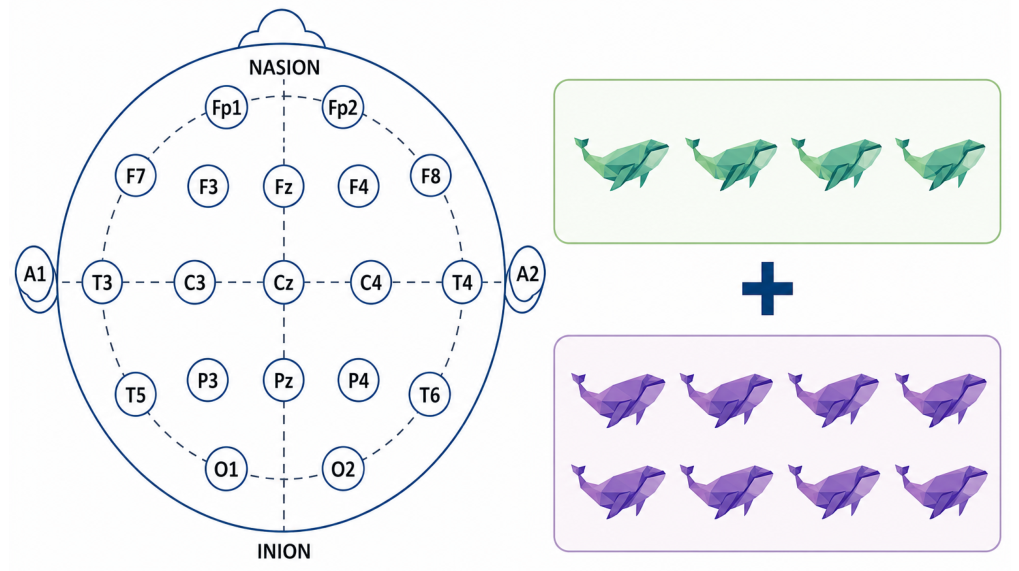
In this clinical setting, EEG signals were acquired at a sampling frequency of 128 Hz using a standard 19-electrode montage based on the international 10–20 system, referenced to the earlobes A1 and A2. The spatial configuration of the electrodes is depicted in Figure 2. The experimental protocol evaluated sustained visual attention, a cognitive function commonly impaired in ADHD, by means of a perceptual counting task involving sequential visual stimuli. For the subsequent analysis, the continuous EEG recordings were segmented into 4 s epochs (512 samples) with a 50% overlap. Each epoch was treated as an independent instance, while strictly preserving subject identity in order to prevent data leakage across validation folds.

3.2. Classification Deep Learning Models

Given an EEG trial represented as X n = { x c ˘ R T : c ˘ C ˘ } , and its corresponding ground-truth label y n { 0 , 1 } C , where C ˘ denotes the number of electrodes, T the number of temporal samples, and C the number of classes; a DL classifier is employed to map the resulting multichannel signal into a vector of class probabilities.
Specifically, a classifier F : R C ˘ × T [ 0 , 1 ] C produces a predicted class-probability vector y ^ n [ 0 , 1 ] C , which is defined through a composition of successive nonlinear transformations as follows:
y ^ n = F ( X n ) = f ˘ L f ˘ L 1 f ˘ 1 ( X n ) ,
where f ˘ l ( · ) denotes the l-th layer of the classifier for l { 1 , , L } , and ∘ represents the composition operator. The output vector satisfies the probability simplex constraints, namely c = 1 C y ^ n , c = 1 with each component y ^ n , c y ^ n .
For multi-class classification, the model output y ^ is interpreted as a categorical probability distribution over the C classes. Accordingly, the training objective is formulated using the cross-entropy loss function:
L CE = 1 N n = 1 N c = 1 C y n , c log y ^ n , c ,
Within this general learning formulation, the classifier F is not restricted to a particular EEG decoding architecture. Instead, it provides the predictive function whose decisions are subsequently explained by post hoc attribution methods. In this work, different DL models are used to evaluate whether the proposed STF-KernelSHAP framework can generate consistent explanations across architectures with distinct spatial, temporal, and spectral representation mechanisms. Therefore, classification performance is considered as the predictive basis for the interpretability analysis rather than as the main methodological contribution of the study.

3.3. SHAP Fundamentals

Due to the complex and highly non-linear composition of layers in F , as described in Equation (1), the resulting model operates effectively as a black box, which precludes direct inspection of its internal decision mechanisms. This intrinsic lack of transparency motivates the use of post hoc interpretability methods. In this context, additive feature attribution approaches are particularly relevant, as they seek to locally approximate the behavior of the classifier by means of a linear surrogate defined over a simplified and interpretable representation of the input [61].
Let M = { M 1 , , M M } denote the set of interpretable features, where M = C ˘ × T corresponds to the total number of interpretable components. For a given sample n, the simplified input representation is denoted by z n { 0 , 1 } M , whose binary entries indicate the presence or absence of each interpretable feature. To incorporate the bias term within a unified linear formulation, the extended representation z ˜ n = [ 1 , z n ] R M + 1 is introduced.
Within this framework, the surrogate output across all C classes is denoted by y ˘ n R C and is expressed as
y ˘ n = Φ n z ˜ n ,
where Φ n R C × ( M + 1 ) denotes the matrix of class-specific attribution coefficients. The c-th row of Φ n , given by ϕ n , c = [ ϕ n , c , 0 , ϕ n , c , 1 , , ϕ n , c , M ] , collects the base value together with the feature attributions associated with class c. The base value is defined as ϕ n , c , 0 = F ( X n , ) y n , where y n acts as a selector for the class of interest.
To connect the surrogate model with the original input space R C ˘ × T , the simplified representation z n is mapped back through a reconstruction function H X : { 0 , 1 } M R C ˘ × T . This mapping satisfies X n = H X ( 1 ) , where 1 denotes the all-ones vector. Under this construction, the surrogate output satisfies y ˘ n F H X ( z n ) for z n 1 , thereby ensuring local fidelity in the neighborhood of the original input.
Having defined the additive surrogate model, the remaining task is to determine the attribution coefficients in Φ n in a principled and theoretically grounded manner. This is achieved by adopting Shapley values, which provide a canonical mechanism for quantifying the contribution of each interpretable feature to the model output [62].
For a given feature m M , let S m = { S i } i = 1 2 M 1 , with S i M { m } , denote the set of all coalitions that exclude feature m. Each coalition S i defines a reference context against which the marginal contribution of feature m is evaluated. For any S i S m , the reconstructed input X n S i = H X ( z n S i ) corresponds to the original input X n restricted to the features in S i , while all remaining components are replaced by the reference values specified by H X .
Within this formulation, the Shapley value associated with feature m and class c is defined as
ϕ n , c , m = S i S m Π ( S i , M ) F ( X n S i { m } ) F ( X n S i ) y n ,
where the weighting function Π ( S i , M ) = | S i | ! M | S i | 1 ! M ! depends solely on the coalition cardinality and the total number of interpretable features.
While the exact Shapley formulation provides a rigorous attribution criterion, it becomes computationally intractable when the number of interpretable features M is large, due to the exhaustive enumeration of 2 M 1 possible coalitions. KernelSHAP addresses this limitation by introducing a finite-sampling approximation based on a set of sampled coalitions [50] Z n = { z n i } i = 1 N s { 0 , 1 } M , where N s denotes the number of coalitions independently and identically distributed (i.i.d.) according to a prescribed distribution over { 0 , 1 } M . This strategy enables the approximation of the expectations implicit in the theoretical Shapley definition using a finite number of classifier evaluations. Feature attributions are then obtained by fitting the additive surrogate model through a weighted least-squares procedure,
ϕ n , c = arg min ϕ n , c i = 1 N s Π z n i F H X z n i y n ϕ n , c z ˜ n i 2 s . t . ϕ n , c 0 ˜ = F H X ( 0 ) y n , s . t . ϕ n , c 1 ˜ = F H X ( 1 ) y n .
Here, z ˜ n i = [ 1 , ( z n i ) ] R M + 1 explicitly incorporates the bias term. The constraints are enforced via the extended representations of the empty coalition 0 ˜ = [ 1 , 0 ] and the full coalition 1 ˜ = [ 1 , 1 ] , thereby ensuring exactness at both boundary cases. The weighting function Π ( z n i ) = M 1 M | z n i | | z n i | ( M | z n i | ) corresponds to the Shapley kernel and depends exclusively on the coalition cardinality.
From this perspective, KernelSHAP provides a classical additive attribution formulation in which the Shapley values are estimated through a weighted linear surrogate fitted over sampled coalitions. When the weighted design matrix is well conditioned, Equation (5) can be solved using standard weighted least-squares solvers, whereas regularized variants may be adopted to improve numerical stability in ill-conditioned settings. In practical implementations, the boundary constraints associated with the empty and full coalitions are commonly enforced through anchor coalitions with large weights, ensuring local accuracy at both reference cases. Thus, KernelSHAP offers a general model-agnostic basis for estimating feature contributions, which is subsequently adapted in this work to structured EEG channel–time–frequency coalitions.
The relevance of Shapley values in the context of model interpretability stems from their axiomatic foundation. These properties establish formal requirements for additive feature attributions and justify the use of Shapley values as a principled mechanism for assigning relevance to individual interpretable components. In particular, the following properties are central to the SHAP formulation [63].
Property 1: Missingness. If a feature is absent from the simplified representation, i.e., z n , m = 0 , then it contributes nothing to the explanation, which implies ϕ n , c , m = 0 .
Property 2: Local accuracy. The explanation model must recover the model output for the original input, such that the sum of the base value and all feature attributions equals the target model score:
F ( X n ) y n = ϕ n , c , 0 + m = 1 M ϕ n , c , m .
Property 3: Consistency. Let F and F denote two predictive models with corresponding attribution coefficients ϕ n , c , m and ϕ n , c , m . If, for all coalitions S i S m , the marginal contribution of feature m under F is greater than or equal to that under F , namely,
F ( X n S i { m } ) y n F ( X n S i ) y n F ( X n S i { m } ) y n F ( X n S i ) y n ,
then the attribution assigned to feature m cannot decrease, i.e., ϕ n , c , m ϕ n , c , m .
These axioms are not merely desirable qualitative properties; rather, they uniquely characterize the Shapley value solution within the class of additive feature attribution methods, as formalized by the following theorem [64].
Theorem 1. 
Within the class of additive feature attribution methods, the Shapley value formulation in Equation (4) is the unique solution satisfying the standard SHAP axioms of local accuracy, missingness, and consistency.

3.4. EEG-Driven Multidomain Shapley Attribution Framework

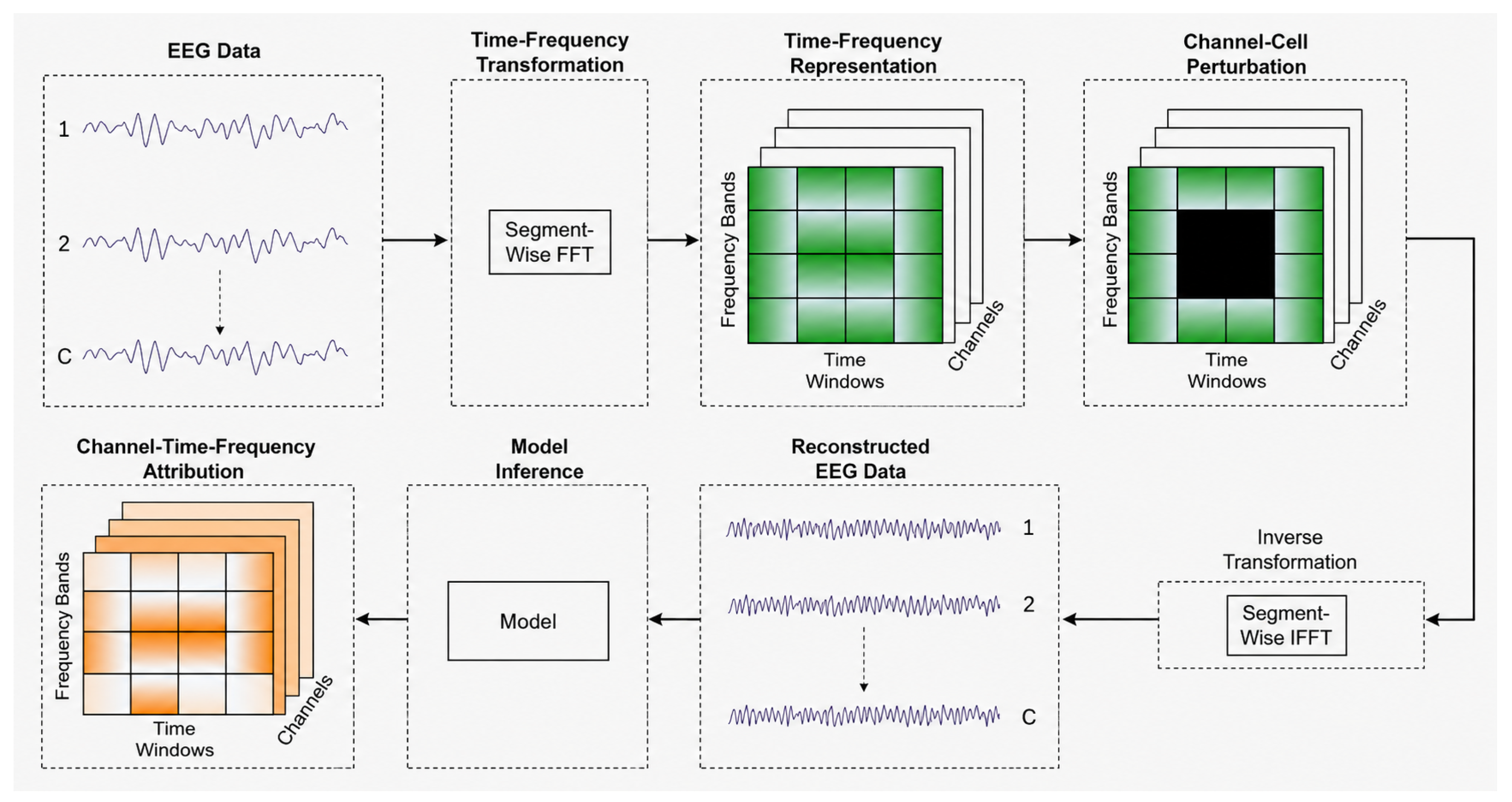
We instantiate the general SHAP framework introduced above for structured multichannel EEG signals by redefining the interpretable feature space over channel-wise time–frequency cells and by introducing a reconstruction operator that maps each sampled coalition back to the original signal domain.
Let X n R C ˘ × T denote the input signal for sample n. We first project X n onto the time–frequency domain through a deterministic transformation T : R C ˘ × T C C ˘ × T ˘ × K , yielding X ˘ n = T ( X n ) , where T ˘ denotes the number of temporal windows and K denotes the number of discrete spectral components.
The time–frequency plane { 1 , , T ˘ } × { 1 , , K } is partitioned into Q non-overlapping cells { G q } q = 1 Q , defined as disjoint window–band regions that jointly cover the plane, with Q = ( #   windows ) × ( #   bands ) . Accordingly, the interpretable feature space is defined as M ˘ = C ˘ × Q , so that each interpretable feature corresponds to one time–frequency cell within one channel. Coalitions are encoded by binary vectors z ˘ n i { 0 , 1 } M ˘ , collected in the finite set Z ˘ n = { z ˘ n i } i = 1 N s .
To evaluate each coalition in the original input space, we define the composite reconstruction mapping
H ˘ X = T 1 H TF H Q .
Here, H Q : { 0 , 1 } M ˘ R C ˘ × Q maps a binary coalition to a channel–cell representation by activating or deactivating complete time–frequency cells within each channel. The operator H TF : R C ˘ × Q C C ˘ × T ˘ × K expands this representation over the indices defined by G q , and T 1 : C C ˘ × T ˘ × K R C ˘ × T maps the reconstructed representation back to the temporal domain. In this way, each coalition S i induces a valid realization
X n S i = H ˘ X ( z ˘ n i ) ,
which can be directly evaluated by the classifier.
Under this structured coalition space, the attribution coefficients are estimated through the KernelSHAP weighted least-squares formulation adapted to the proposed EEG representation. For class c, this estimator is given by
ϕ n , c * = arg min ϕ n , c i = 1 N s Π z ˘ n i F H ˘ X z ˘ n i y n ϕ n , c z ^ n i 2 s . t . ϕ n , c 0 ^ = F H ˘ X ( 0 ˘ ) y n , s . t . ϕ n , c 1 ^ = F H ˘ X ( 1 ˘ ) y n .
where z ^ n i = [ 1 , ( z ˘ n i ) ] R M ˘ + 1 , 0 ^ = [ 1 , 0 ˘ ] , and 1 ^ = [ 1 , 1 ˘ ] . The Shapley kernel is preserved from the general formulation, with the argument now defined over the proposed channel–cell coalition space.
Finally, the resulting attributions are organized into the tensor Φ n R C × ( C ˘ Q + 1 ) , which aggregates, for each class, the contributions of all time–frequency cells across all channels, together with the bias term. The complete workflow of the proposed EEG-driven multidomain Shapley attribution strategy is summarized in Figure 3.

4. Experimental Setup

This section defines the experimental protocol used to train the classifiers and generate the post hoc explanations. It specifies the evaluation metrics, the XAI methods used for comparison, the preprocessing choices, and the parameter settings used to produce the attribution maps.

4.1. Assessment and Method Comparison

The experimental evaluation was structured to compare, under a common protocol, both the predictive performance of the EEG classifiers and the fidelity of the explanations generated by the considered XAI strategies. Accordingly, this subsection first presents the classification models employed and then describes the performance metrics, explanation methods, and perturbation-based fidelity criteria.
First, EEGNet was considered, a compact convolutional architecture specifically designed for EEG signal classification [65]. Likewise, ShallowConvNet was included as a shallow convolutional network aimed at capturing relevant spatio–temporal patterns in EEG signals [66]. Finally, T-GARNet was evaluated as an architecture that integrates temporal encoding and kernelized representations for EEG classification [67].
Once the classifiers were established, predictive performance was quantified using the following metrics:
  • Accuracy (ACC): measures the proportion of correctly classified trials with respect to the total number of evaluated samples:
    ACC = T P + T N T P + T N + F P + F N ,
    where T P and T N denote true positives and true negatives, whereas F P and F N correspond to false positives and false negatives.
  • Area under the ROC curve (AUC): quantifies the discriminative capability of the classifier by integrating the relationship between the true positive rate and the false positive rate across different thresholds:
    AUC = 0 1 TPR FPR 1 ( ν ) d ν ,
    where TPR represents the true positive rate, FPR the false positive rate, and ν [ 0 , 1 ] is an auxiliary integration variable.
  • Cohen’s kappa coefficient ( κ ): measures the agreement between the predicted labels and the ground-truth labels, correcting for the agreement expected by chance:
    κ = ϱ o ϱ e 1 ϱ e ,
    where ϱ o is the observed agreement and ϱ e is the agreement expected by chance.
From the trained and evaluated models, local explanations were subsequently generated to identify the signal regions that contributed to the decision of each classifier. In the following formulations, y n is used as a class-selector vector to extract the scalar model response associated with the class of interest. Its practical definition depends on the analysis: predicted classes are used for perturbation-based fidelity assessment, whereas ground-truth labels are used for class-wise topographic interpretation. To ensure a homogeneous comparison, all XAI strategies were applied to the same EEG trial X n , the same target class selected by y n , and the same scalar output F ( X n ) y n . Under this configuration, each method produces an attribution ϕ n , c ( · ) , which is then used to assess explanation fidelity through controlled perturbations of the signal.
The considered XAI strategies are described below:
  • KernelSHAP [68]: estimates the contribution of each interpretable feature by fitting a weighted additive surrogate model over perturbed coalitions of the input. In this work, KernelSHAP follows the constrained weighted least-squares formulation previously defined in Equation (5).
  • LIME [69]: fits an interpretable surrogate model in the neighborhood of the explained trial. To this end, let z { 0 , 1 } M be the interpretable representation associated with a perturbation of X n . In the linear formulation employed in this work, such a local surrogate is expressed as
    g ˘ β n , c ( z ) = β n , c , 0 + m = 1 M β n , c , m z m .
    The surrogate coefficients are estimated as
    β n , c LIME = arg min β n , c L loc F , g ˘ β n , c , π X n + Ω ( β n , c ) ,
    where L loc measures the local discrepancy between F and the surrogate, π X n weights the perturbations according to their proximity to X n , and Ω regulates the model complexity. Consequently, the optimal surrogate is determined by β n , c LIME , while the attributions are defined as
    ϕ n , c LIME = β n , c , 1 LIME , , β n , c , M LIME .
  • Integrated Gradients [70]: computes attributions by integrating the gradients of the output associated with the target class along a continuous path between a reference X B and the trial X n :
    ϕ n , c IG = X n X B 0 1 X F X B + η X n X B y n d η ,
    where η [ 0 , 1 ] is the interpolation parameter and ⊙ represents the Hadamard product.
  • Occlusion [46]: estimates the relevance of an input region by replacing it with a reference and quantifying the induced change in the target-class score. Let R = { r ˘ 1 , , r ˘ R } be the set of occlusion regions. For a region r ˘ R , let X n r ˘ denote the perturbed version of X n , in which only the region r ˘ is replaced by the reference. In this case, the regional attribution is defined as
    ϕ n , c Occ ( r ˘ ) = F ( X n ) y n F X n r ˘ y n .
    Therefore, the complete occlusion-based explanation is given by
    ϕ n , c Occ = ϕ n , c Occ ( r ˘ 1 ) , , ϕ n , c Occ ( r ˘ R ) .
  • Grad-CAM++ [71]: obtains a relevance map from the activations of an internal convolutional layer:
    ϕ n , c GC + + = ReLU k ¯ = 1 K ¯ ω n , c , k ¯ GC + + B n k ¯ ,
    where B n k ¯ is the k ¯ -th activation map of the selected layer, ω n , c , k ¯ GC + + represents its weight associated with the target class, and K ¯ is the number of activation maps considered.
Finally, explanation fidelity was evaluated using MoRF Deletion and ROAD. For each trial X n , a retention mask is defined as
z n , c ρ = z n , c , 1 ρ , , z n , c , M ρ { 0 , 1 } M ,
obtained by deactivating a fraction ρ [ 0 , 1 ] of the features with the highest attribution in ϕ n , c ( · ) , following the Most Relevant First criterion. Thus, z n , c , m ρ = 0 indicates the removal of feature m, whereas z n , c , m ρ = 1 indicates its preservation.
In MoRF Deletion, the perturbed trial and its deletion curve are defined as
X n , MoRF ρ = H X z n , c ρ , D MoRF ( ρ ) = F X n , MoRF ρ y n .
A rapid decrease in D MoRF ( ρ ) indicates that the removed features exert a relevant influence on the classifier decision.
In turn, in ROAD, the perturbation is performed using an explicit reference X ¯ n , and the post-removal performance is computed as
X n , ROAD ρ = H ¯ X z n , c ρ , X ¯ n , ROAD ( ρ ) = Q F X n , ROAD ρ , y n .
Here, Q ( · , · ) denotes a generic predictive evaluation criterion.

4.2. Training Details

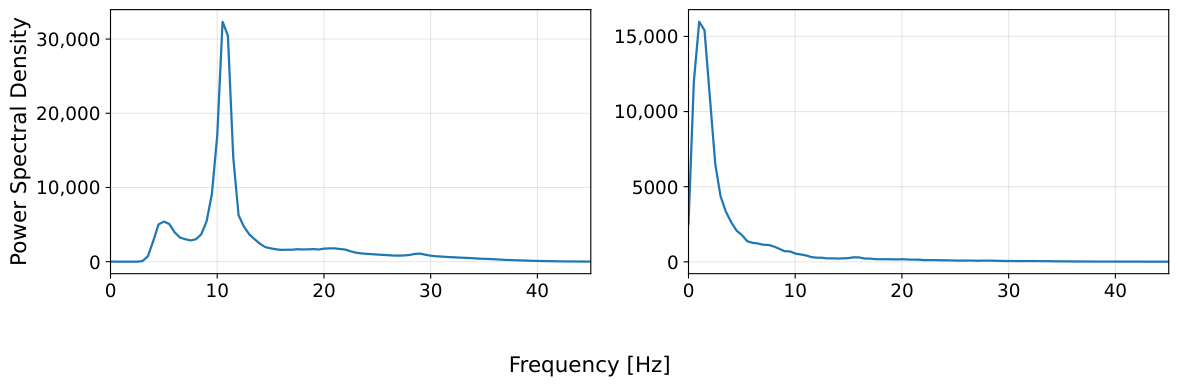
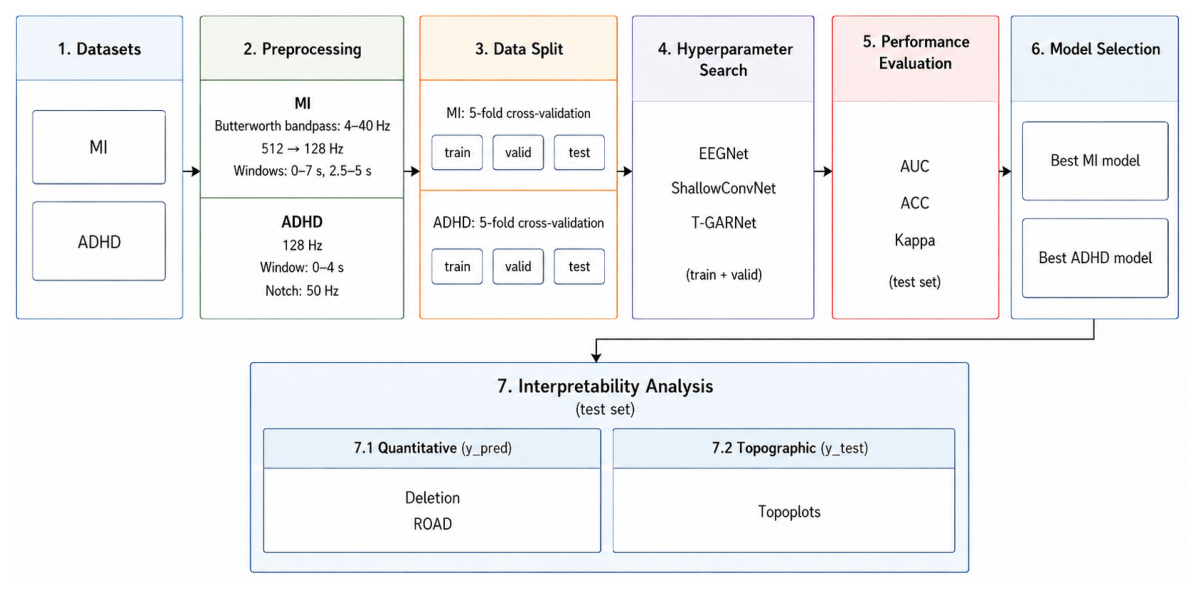
To ensure a fair and reproducible evaluation, all models were trained using stratified five-fold cross-validation, adapted to the structure of each database. In MI, EEG signals were filtered using a fifth-order Butterworth bandpass filter between 4 and 40 Hz, downsampled from 512 Hz to 128 Hz, and subsequently segmented into two temporal partitions: 0–7 s and 2.5–5 s. For this database, stratification was performed at the sample level independently for each subject. In ADHD, the signals were sampled at 128 Hz, a single 0–4 s window was used, and a notch filter was applied to suppress the 50 Hz power-line component. Unlike MI, the partitioning was carried out at the subject level to avoid information leakage between EEG segments from the same participant, assigning a single class label per subject. In both databases, each fold included an external training–test split with an 80%–20% ratio, while the training set was further divided into training and validation subsets, reserving 20% through a stratified random split. The average spectral behavior of both EEG databases after preprocessing is summarized in Figure 4.
Based on these partitions, training was implemented in TensorFlow using the Adam optimizer. All models were trained for a maximum of 100 epochs, with a batch size of 16 and a fixed seed of 42. To control overfitting, early stopping was applied to the validation loss, with a patience of 25 epochs, a minimum change of 10 4 , and restoration of the best weights. Additionally, the learning rate was automatically reduced when the validation loss stopped improving, using a reduction factor of 0.5, a patience of 10 epochs, and a minimum value of 10 6 . The main loss function was normalized binary cross-entropy, and performance was monitored using binary accuracy and AUC. In T-GARNet, this function was complemented with a kernel-based Rényi entropy regularization term, incorporated as a second auxiliary output during training.
Hyperparameter optimization was performed with Optuna, using GPSampler with seed 42, local JournalStorage, and MedianPruner with five warm-up steps. In each trial, the objective was to maximize the mean validation accuracy computed across the five folds, retaining only the weights associated with the best trial. The learning rate was explored as a continuous variable on a logarithmic scale within the interval ( 10 5 , 10 3 ) . For the three architectures, the dropout rate and norm constraint were explored as continuous variables in ( 0.1 , 0.75 ) with a step of 0.05. In EEGNet, the number of temporal filters was selected as an integer variable in [ 4 , 32 ] , with a step of 4; the depth multiplier in [ 1 , 4 ] ; the number of separable filters was defined as the product of both; and the temporal kernel length was selected from { 16 , 32 , 64 , 96 , 128 } . In ShallowConvNet, the number of filters, temporal kernel length, and pooling size were selected as integer variables in [ 8 , 64 ] , [ 8 , 128 ] , and [ 16 , 64 ] , respectively, all with a step of 8; whereas the pooling stride was explored in [ 2 , 32 ] , with a step of 2, constrained not to exceed the pooling size. In T-GARNet, the number of convolutional filters and the number of attention heads were selected as integer variables in [ 2 , 8 ] and [ 1 , 5 ] , respectively; the Gaussian kernel standard deviation was explored as a continuous variable in ( 1 , 20 ) ; the intermediate dimension of the Transformer block was selected from { 16 , 32 , 64 , 128 } ; and the relative weight of the classification loss was explored as a continuous variable in ( 0.1 , 0.9 ) , while the weight associated with Rényi entropy regularization was defined as its complement.
From the trained models, post hoc explanations were computed on the test-set samples to obtain relevance maps compatible with the input structure of each EEG signal. KernelSHAP was applied to the flattened representation of the signal, using a reference set adaptively defined as the minimum between 100 samples and 5% of the training set, thus ensuring there were at least 8 samples; for attribution estimation, 500 coalition samples were used, with regularization limited to 200 features. Similarly, LIME was applied to the flattened signal, using as reference the minimum between 200 samples and 10% of the training set, with a minimum of 30 samples; additionally, 1000 local perturbations were generated, and up to 200 relevant features were retained. In turn, Occlusion was implemented through channel-wise temporal perturbations, replacing 1 s windows with a 0.25 s stride by an average reference computed from the training set. Integrated Gradients used the stratified average of the training set as baseline and approximated the integral using 50 interpolation steps. Finally, Grad-CAM++ was applied to a compatible convolutional layer of each model, and the resulting relevance map was resized to the input shape to facilitate comparison with the remaining strategies. Specifically, Conv2D_1 was explicitly selected for ShallowConvNet, whereas the last convolutional layer was used for the remaining architectures.
For STF-KernelSHAP, each EEG signal was transformed using a segmented FFT with nfft = 512 , and coalitions were defined over the channel–time–frequency cells G q established in Section 3.4. In MI, the considered bands were ( 4 , 8 ) , ( 8 , 13 ) , ( 13 , 30 ) , and ( 30 , 40 ) Hz. For the full 0–7 s window, the temporal regions were ( 0 , 2 ) , ( 2 , 2.5 ) , ( 2.5 , 5 ) , and ( 5 , 7 ) s, whereas for the 2.5–5 s window, the entire available temporal interval was used. Analogously, in ADHD, the full duration of each EEG segment was employed, and the ( 0.5 , 4 ) Hz band was additionally included. In all cases, 500 coalition samples were used, with regularization limited to 200 features. Moreover, the baseline was fixed as null in the time–frequency domain, such that H ˘ X ( 0 ˘ ) represents the signal reconstruction when the spectro-temporal content of the cells is suppressed. This choice enables quantifying the contribution of each cell G q with respect to a reference state without active content in the corresponding region. For MI, the temporal partitions were defined according to the trial structure shown in Figure 1: the 0–7 s interval covers the complete trial, whereas the 2.5–5 s interval isolates the three-second motor-imagery period indicated by the cue-based paradigm. In ADHD, no event-specific temporal window was defined because the released recordings are not organized around an event-locked acquisition protocol comparable to MI; therefore, STF-KernelSHAP uses the complete 4 s EEG segment for each epoch and focuses the decomposition on canonical frequency bands.
To ensure methodological consistency and avoid information leakage, all methods requiring a reference used only information from the training set. Likewise, the reference-set sizes, number of perturbations, coalition samples, and regularization parameters were fixed by considering a balance between explanation stability and computational cost. Finally, the target-class source was defined according to the subsequent analysis. For perturbation-based fidelity analyses, including Deletion and ROAD, model predictions were used as the target class to evaluate whether the regions identified as relevant supported the decision made by the classifier; under this configuration, KernelSHAP, STF-KernelSHAP, LIME, and Occlusion were computed on probabilities, whereas Integrated Gradients and Grad-CAM++ were computed on logits to reduce saturation. In contrast, for scalp topographic maps, attributions were computed with respect to the ground-truth label, enabling the analysis of the spatial distribution of relevance associated with each real class; in this case, KernelSHAP, STF-KernelSHAP, Occlusion, Integrated Gradients, and Grad-CAM++ were computed on logits, whereas LIME was kept on probabilities, since its local formulation corresponds to a classification problem and the use of logits would shift its interpretation toward local regression.
All experiments were executed in Python v3.12.12 for model training and Python v3.12.13 for post hoc interpretability analysis. Model training was performed in a cloud-based Kaggle environment (Google LLC, Mountain View, CA, USA) under a 64-bit Ubuntu 22.04.5 LTS system, using GPU acceleration when available. The computational setup included an Intel Xeon CPU @ 2.00 GHz (Intel Corporation, Santa Clara, CA, USA) with 4 logical cores, 31 GB of RAM, and two NVIDIA Tesla T4 GPUs (NVIDIA Corporation, Santa Clara, CA, USA) with 15 GB of VRAM each, together with CUDA v13.0, CUDA compilation tools v12.8, and NVIDIA driver v580.105.08. Subsequently, the post hoc interpretability analyses were conducted in Google Colaboratory (Google LLC, Mountain View, CA, USA), also under a 64-bit Ubuntu 22.04.5 LTS system and using GPU acceleration when available; in this case, the setup included an Intel Xeon CPU @ 2.00 GHz (Intel Corporation, Santa Clara, CA, USA) with 2 logical cores, an NVIDIA Tesla T4 GPU (NVIDIA Corporation, Santa Clara, CA, USA) with 15 GB of VRAM, approximately 12.7 GB of system RAM, CUDA v13.0, CUDA compilation tools v12.8, and NVIDIA driver v580.82.07. The main libraries used throughout the complete workflow were NumPy v2.0.2, SciPy v1.16.3, scikit-learn v1.6.1, TensorFlow/Keras v2.19.0/v3.10.0 for model training and v2.20.0/v3.13.2 for interpretability analysis, KerasNLP v0.21.1 for model training and v0.26.0 for interpretability analysis, SHAP v0.50.0 for model training and v0.51.0 for interpretability analysis, LIME v0.2.0.1, Optuna v4.8.0, and tf-keras-vis v0.8.7. To ensure reproducibility, all source code, scripts, and configuration files will be publicly available at: https://github.com/Daprosero/STF-KernelSHAP (accessed on 26 June 2026). The complete experimental workflow is summarized in Figure 5.

5. Results and Discussion

5.1. Space–Time–Frequency Attribution Analysis in Motor Imagery

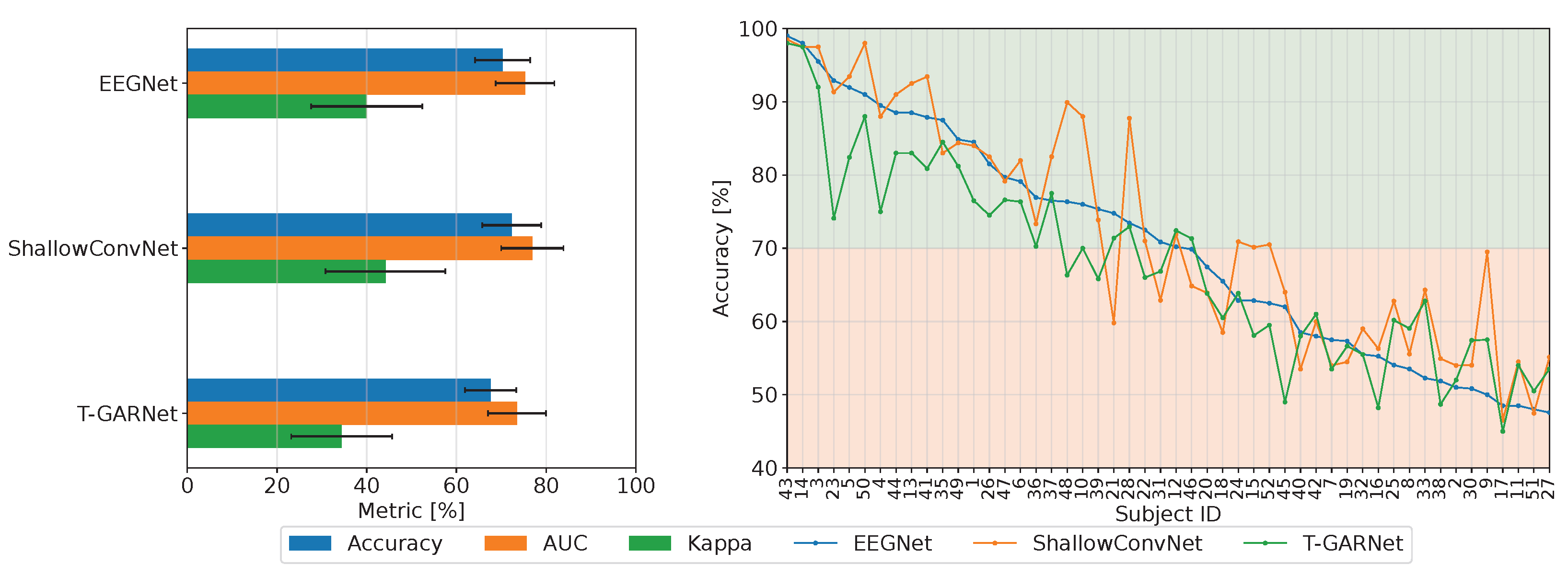
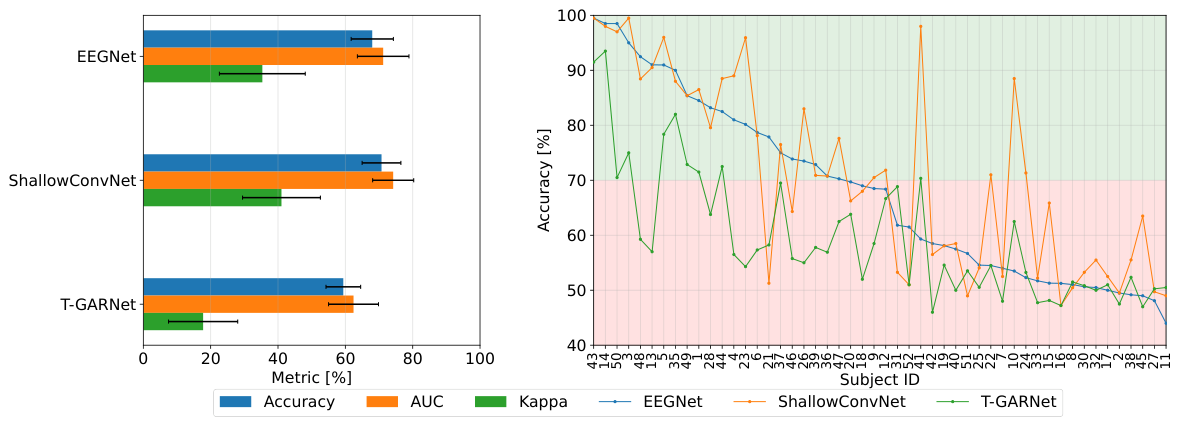
The classification results for the 0–7 s window reveal a marked inter-subject variability, as shown in Figure 6. Overall, EEGNet and ShallowConvNet achieve the highest accuracy and AUC values, whereas T-GARNet exhibits a lower performance under this configuration. In particular, ShallowConvNet was selected as the baseline model for the interpretability analysis due to its superior overall performance and relative stability across the evaluated metrics. However, the subject-wise analysis indicates that the classification problem is not determined solely by the model architecture, but also by the individual heterogeneity of EEG responses. In this context, subject 14 belongs to the group of subjects with favorable performance, whereas subject 12 is located in a lower-accuracy region. This contrast defines two complementary analysis scenarios: one in which the classifier learns a sufficiently stable discriminative representation, and another in which the model decision is less reliable.
Figure 7 allows us to assess whether STF-KernelSHAP remains comparable to conventional XAI methods when its attributions are projected onto the spatial domain. For subject 14, the evaluated strategies show contributions concentrated over central and centro-lateral regions, which are consistent with the expected sensorimotor activity in hand MI tasks. This behavior is relevant because MI activity is commonly reflected in modulations of mu/alpha and beta rhythms over sensorimotor areas, particularly around central electrodes such as C3, Cz, and C4. The concentration of relevance over these electrodes provides a scalp-level indication that the classifier is using spatial patterns compatible with imagined hand movement rather than diffuse or anatomically unrelated activity. In this scenario, STF-KernelSHAP produces an aggregated spatial map that preserves a topographic organization comparable to KernelSHAP, Occlusion, and Integrated Gradients, indicating that the proposed strategy does not lose the ability to provide a standard spatial interpretation. In contrast, for subject 12, the maps are less focalized and exhibit lower anatomical coherence across methods. This loss of sensorimotor reference is consistent with the reduced performance observed for this subject and suggests that, when the classifier decision boundary is weak, the spatial attributions produced by all methods tend to become less informative.
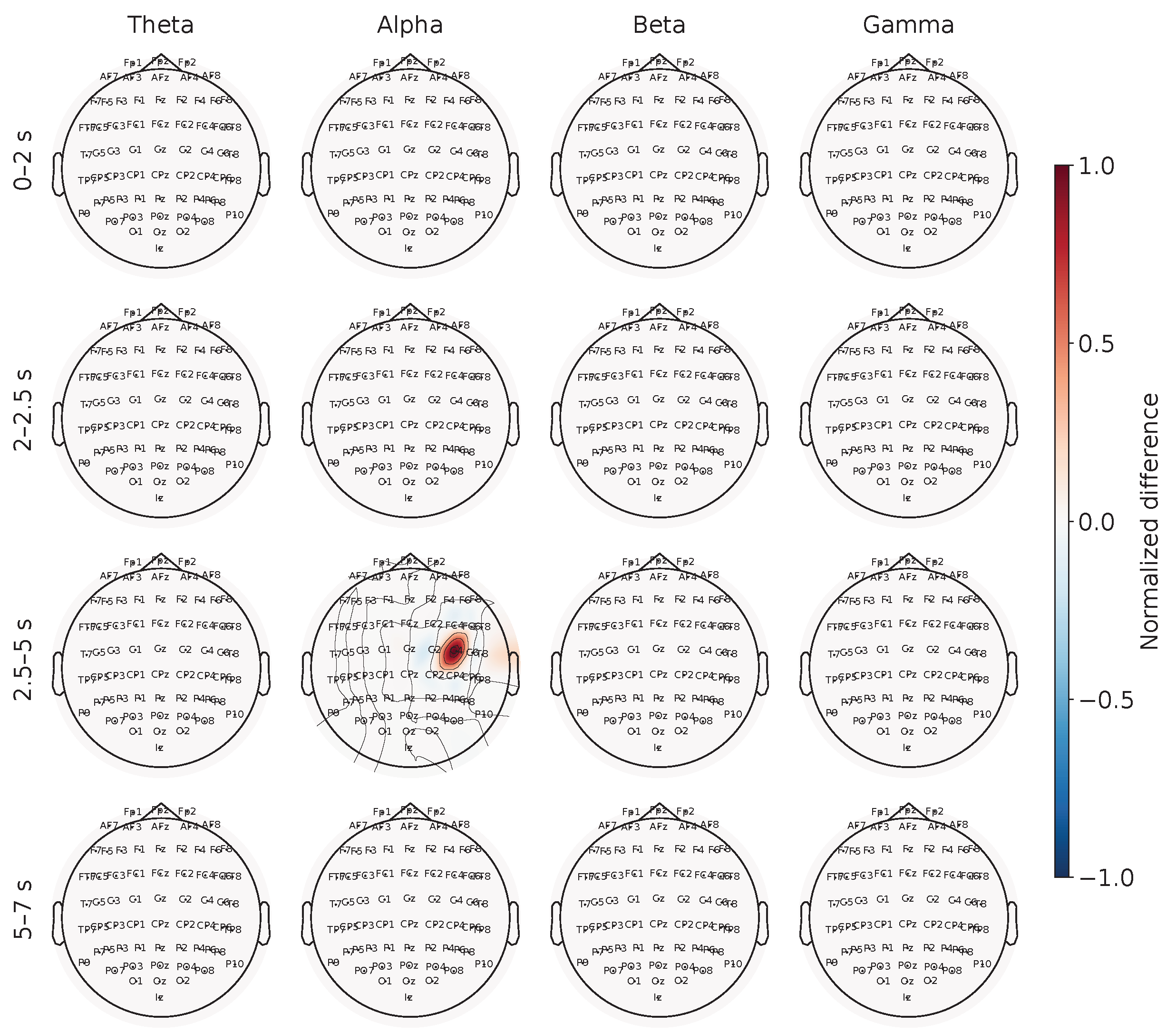
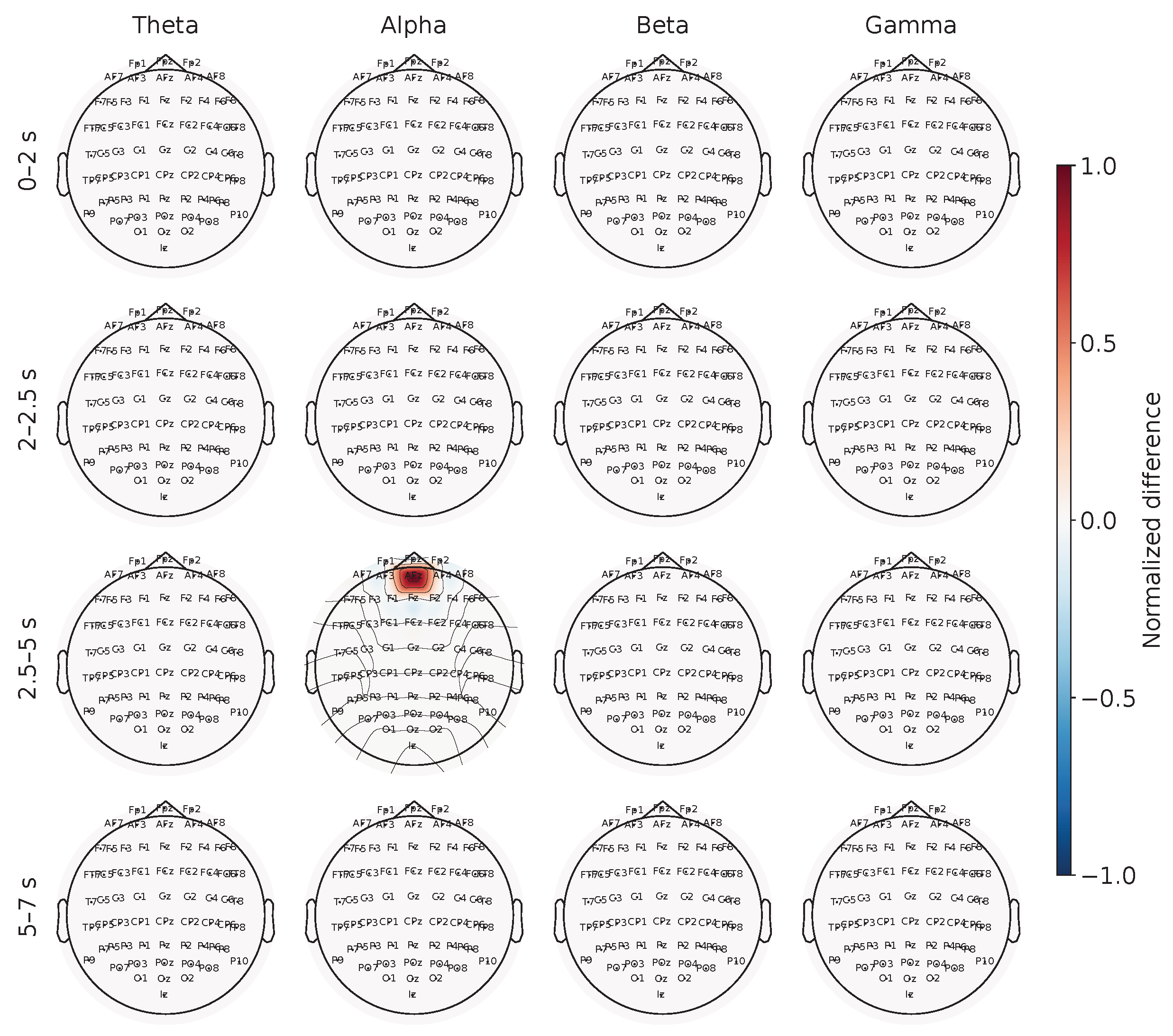
Figure 8 highlights the distinctive contribution of STF-KernelSHAP. Unlike conventional methods, which provide an aggregated spatial attribution, the proposed strategy preserves the space–time–frequency structure of relevance. For subject 14, the most informative contribution is concentrated within the 2.5–5 s window and the alpha band. This finding is consistent with the experimental protocol described in Figure 1, where the 2.5–5 s interval corresponds to the effective MI period. Moreover, the alpha band matches the mu/alpha range associated with sensorimotor modulation during imagined movement. This alpha-band relevance is consistent with the mu rhythm, whose modulation over sensorimotor regions is a characteristic component of MI-related cortical dynamics. Therefore, the explanation not only identifies a brain region compatible with the task, but also localizes the contribution within the expected temporal interval and spectral band. This point is central to the proposed approach: STF-KernelSHAP is not limited to competing with XAI methods through a global topographic map but also enables verification of whether the model decision relies on physiologically plausible components of the EEG signal.
Figure 9 presents a more critical case. For subject 12, the space–time–frequency representation does not clearly reproduce a focalized sensorimotor activation pattern, which is consistent with the previously observed low classifier performance. The reduced spatial focalization is therefore coherent with the weaker predictive behavior of the model for this subject. The absence of a well-defined sensorimotor topography indicates that the model did not learn a robust spatial representation for this case. Nevertheless, STF-KernelSHAP still identifies contributions within the 2.5–5 s window and the alpha band, both associated with the effective MI period and the expected sensorimotor modulation. The temporal–spectral localization remains compatible with MI physiology, although the weak topography limits the strength of the neurophysiological inference for this subject. Thus, although the spatial evidence is degraded, the proposed decomposition preserves a temporal–spectral interpretation of the decision process that is not accessible from aggregated XAI maps.
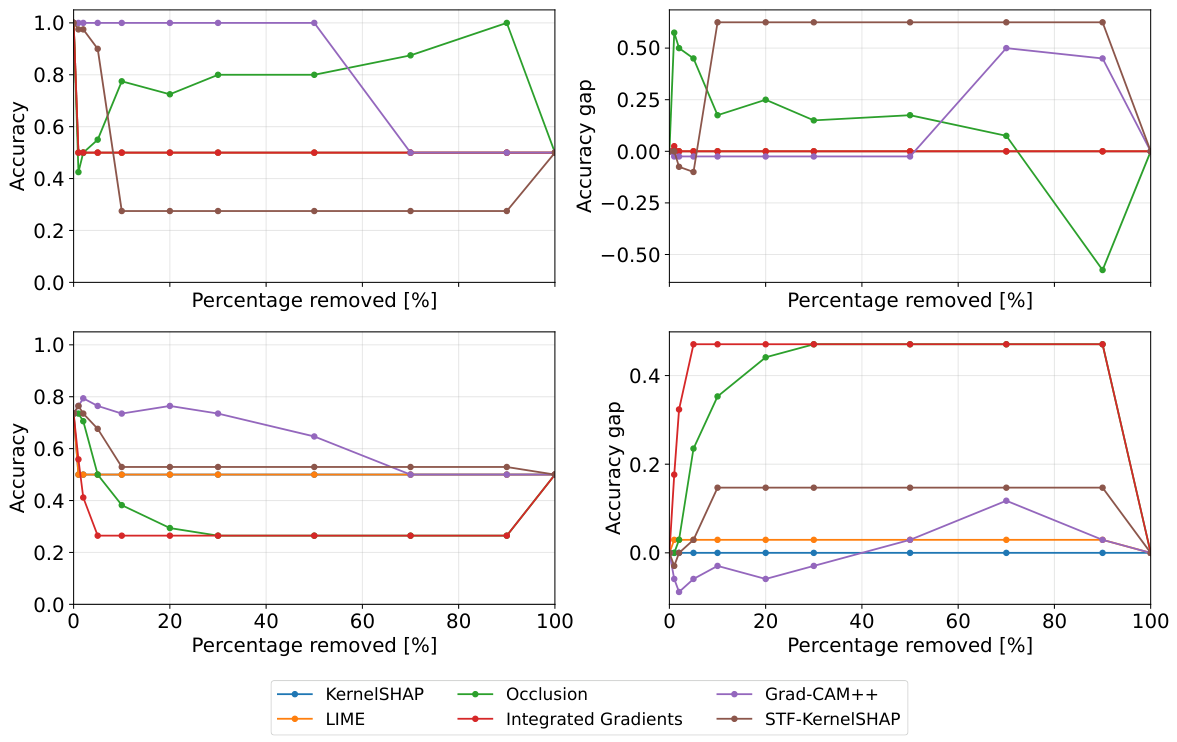
Figure 10 complements the visual analysis through a perturbation-based fidelity assessment. For subject 14, the Deletion MoRF and ROAD curves show that removing relevant regions modifies the classifier response, indicating that the attributions capture components functionally related to the model decision. In this case, STF-KernelSHAP exhibits competitive behavior compared with conventional strategies, confirming that the space–time–frequency decomposition does not compromise functional fidelity. For subject 12, the curves are less stable and less conclusive, which is expected given the lower model performance. In this scenario, perturbing supposedly relevant regions does not produce an ordered degradation pattern, because the initial classifier decision is already less reliable.
By restricting the analysis to the 2.5–5 s window, the results in Figure 11 directly assess the temporal interval most closely associated with the execution of the MI paradigm. Under this condition, subject 43 represents the best-performing scenario, whereas subject 12 maintains low performance, thereby enabling a renewed contrast between a case with reliable decisions and another with lower predictive stability. The relative improvement observed in the best-performing subjects suggests that focusing the analysis on the effective MI window reduces the influence of less informative trial segments, although it does not eliminate the inter-subject variability that characterizes EEG signals.
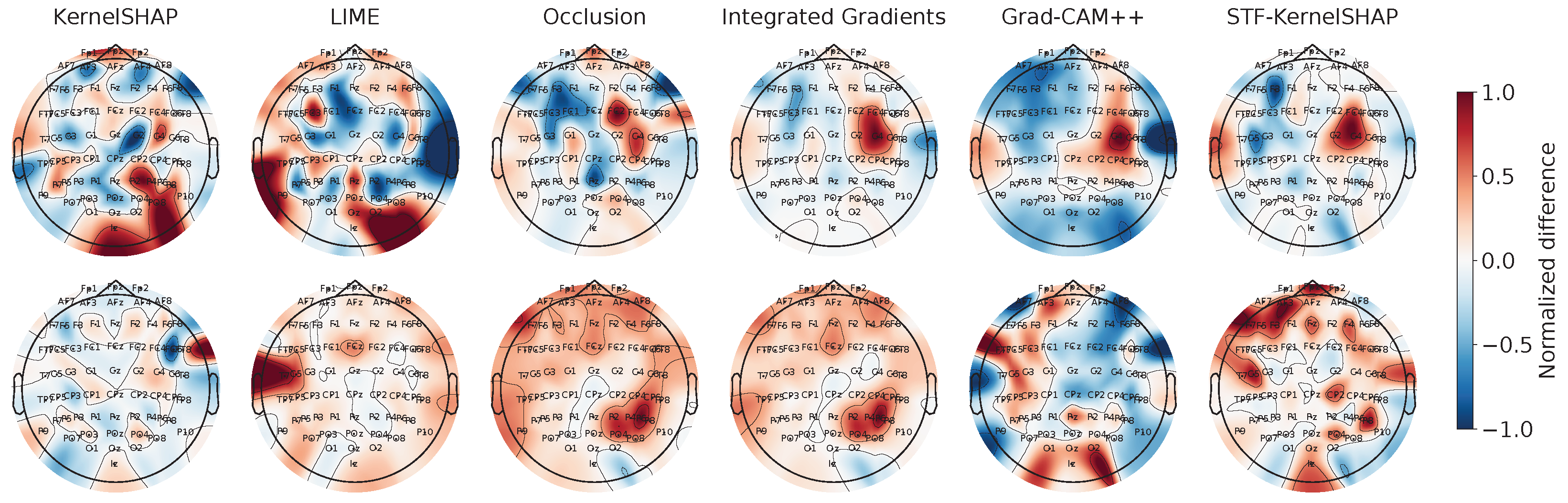
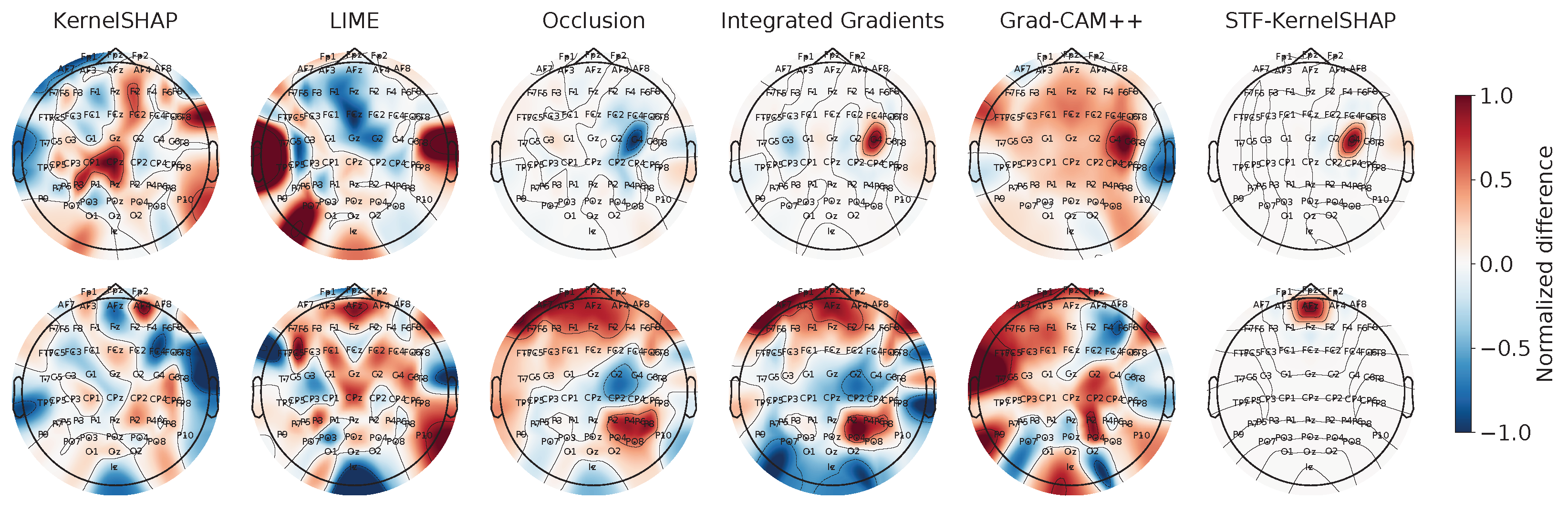
Figure 12 compares the spatial distribution of attribution differences obtained by the XAI methods within the 2.5–5 s window. For subject 43, the maps exhibit more defined and localized patterns than those observed for subject 12, in agreement with the higher classification performance. In particular, several methods concentrate relevance over central and centro-lateral regions, which is consistent with the involvement of sensorimotor areas during MI tasks, where mu/alpha and beta rhythms are commonly modulated over the sensorimotor cortex. This distribution, particularly around the C3–Cz–C4 axis, is compatible with sensorimotor cortical engagement during imagined hand movement. In this scenario, STF-KernelSHAP preserves a topographic representation comparable to conventional XAI strategies, since it allows spatial contribution regions to be inspected within the same analysis domain. Conversely, for subject 12, the attributions are more scattered and less consistent across methods, which is coherent with a less stable classifier decision.
Figure 13 confirms the central contribution of the proposed strategy. For subject 43, STF-KernelSHAP concentrates relevant contributions in the alpha and beta bands, which is consistent with the expected sensorimotor modulation during MI tasks. The joint alpha/mu and beta relevance is physiologically meaningful because MI is generally expressed through sensorimotor rhythm modulation rather than through a single isolated spectral component. This interpretation is more informative than the aggregated spatial map, as it verifies that the model decision is not only localized in plausible regions but is also supported by spectral components consistent with the task. For subject 12, the spatial organization is less clear, in agreement with the low classification performance; nevertheless, the attribution still enables band-wise inspection of the contribution, preserving a spectral reading that conventional XAI methods do not directly provide.
The fidelity assessment in Figure 14 reinforces this interpretation. For subject 43, the Deletion MoRF and ROAD curves show a more sensitive response to the perturbation of relevant regions, supporting the functional relationship between the attributions and the classifier decision. For subject 12, the curves are less stable and less conclusive, which is consistent with the lower predictive quality of the model. Thus, the comparison between both subjects indicates that the fidelity of the explanations depends on the classifier performance, whereas the STF decomposition preserves a temporal–spectral interpretation even when the spatial evidence becomes weaker.
Overall, the comparison between the 0–7 s and 2.5–5 s windows shows that STF-KernelSHAP can be evaluated under the same spatial conditions as conventional XAI methods, while it also verifies whether the explanation is coherent with the experimental structure of the paradigm. In the full window, the strategy identifies the contribution within the MI interval; when the analysis is restricted to 2.5–5 s, the explanation concentrates on the alpha and beta bands, which are the expected spectral components for MI. Together, the spatial emphasis over central sensorimotor regions and the alpha/mu–beta spectral profile provide a coherent interpretation of the model decision in terms of MI-related sensorimotor rhythm modulation. This behavior is consistent with the quantitative fidelity results reported in Table 2, where STF-KernelSHAP remains competitive with conventional post hoc strategies and achieves the highest ROAD-AUC in the 0–7 s window, suggesting that the most relevant components identified by the method preserve the model decision when physiologically meaningful information is retained. Although Integrated Gradients and Occlusion obtain lower Deletion-AUC values in some settings, their explanations remain defined over the original input space and do not explicitly disentangle the temporal and spectral structure of the MI paradigm. Therefore, the main advantage of STF-KernelSHAP is not merely its ability to produce maps comparable to KernelSHAP, LIME, Occlusion, Integrated Gradients, or Grad-CAM++, but rather its capacity to balance quantitative fidelity with structured neurophysiological interpretability across three complementary levels: spatial localization, temporal window, and spectral band.

5.2. Space–Frequency Attribution Analysis in ADHD

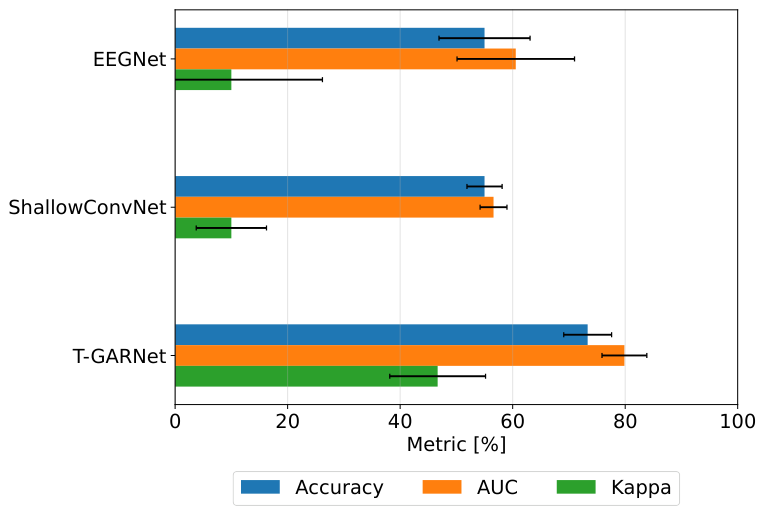
The classification results obtained for the ADHD database are presented in Figure 15. Unlike the MI analysis, this database is not associated with an event-segmented experimental protocol but rather with 4 s EEG windows extracted under a more general recording condition. Therefore, the interpretation does not aim to localize a specific phase of a paradigm, but instead to identify spatial and spectral patterns that are relevant for class discrimination. In this scenario, T-GARNet achieves competitive performance compared with the evaluated architectures, reaching 73.33% accuracy and 79.86% AUC. These values describe the predictive performance of the base classifier used for the subsequent explanation analysis rather than a performance score of STF-KernelSHAP itself, and they justify its use for analyzing whether STF-KernelSHAP can be coupled with an architecture different from those employed in MI.
Figure 16 shows the spatial distribution of attribution differences obtained by the XAI methods in ADHD. In contrast to MI, a focalized activation over a specific sensorimotor region is not expected, since the task is not linked to a motor event or to a cognitively bounded window defined by the protocol. Instead, the maps exhibit distributed contributions over frontal, central, and posterior regions, which is consistent with the more global nature of EEG alterations reported in ADHD. This frontal, central, and posterior relevance indicates that the classifier relies on distributed EEG patterns, consistent with the heterogeneous spatial expression of ADHD-related electrophysiological alterations rather than a single localized cortical source. In this context, STF-KernelSHAP preserves topographic comparability with KernelSHAP, LIME, Occlusion, Integrated Gradients, and Grad-CAM++, by producing an aggregated spatial map within the same domain of analysis.
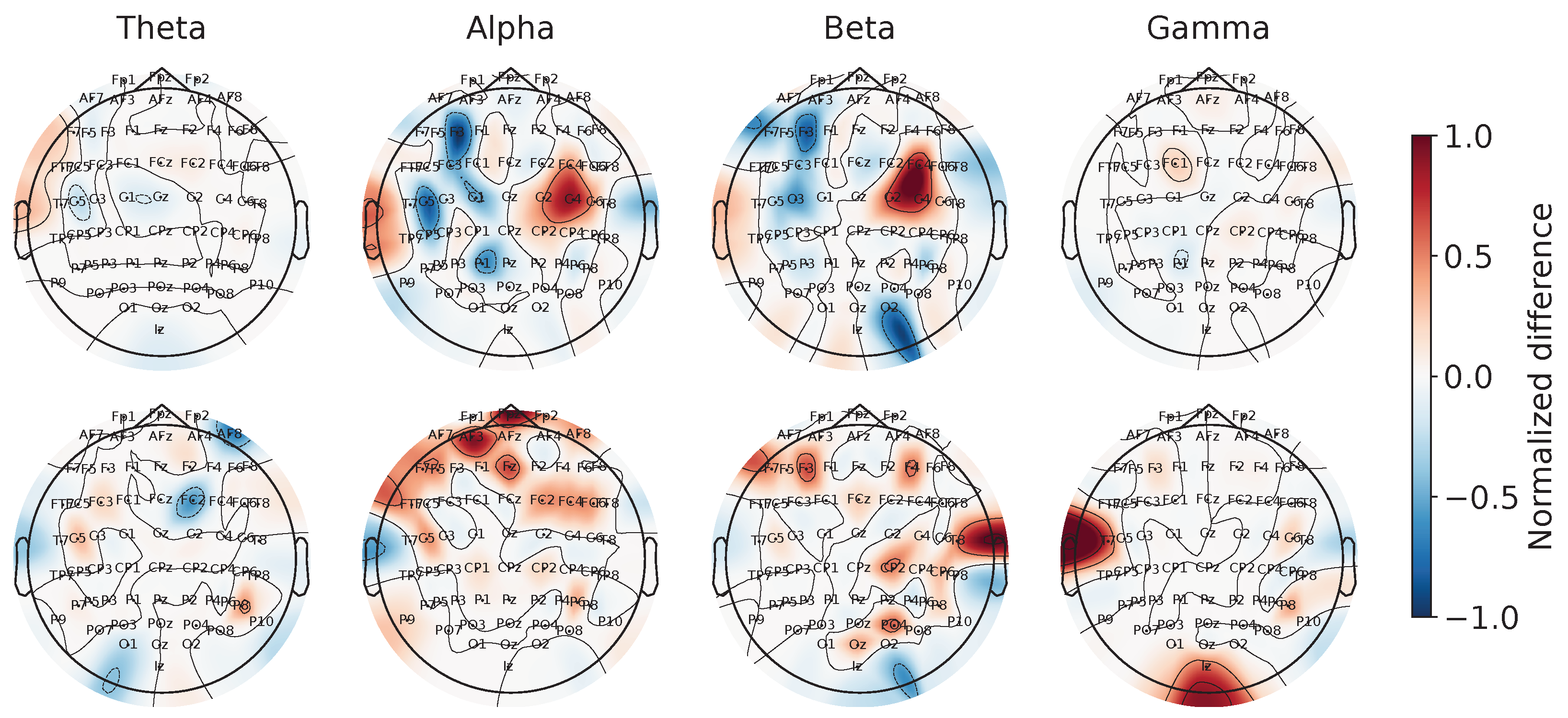
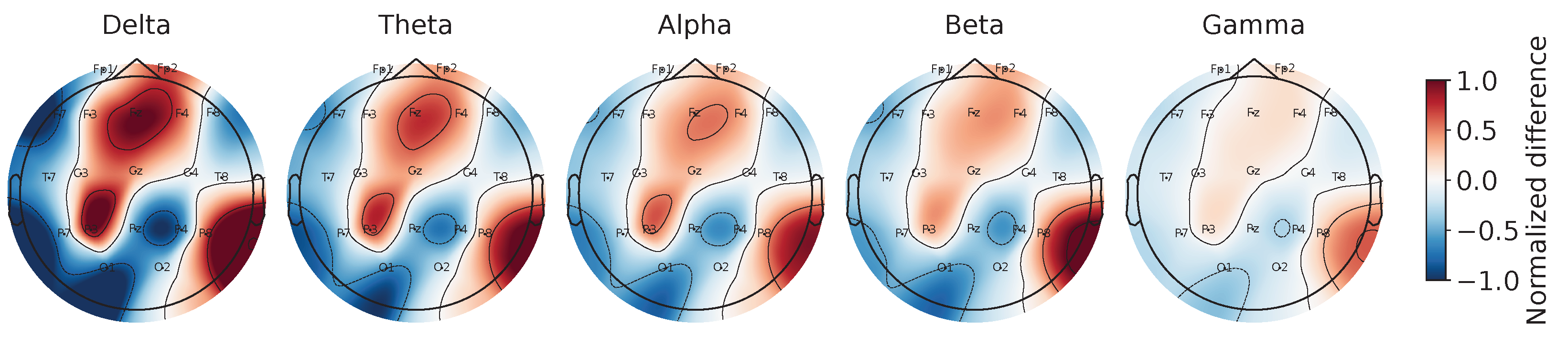
Figure 17 shows that, because a single 4 s EEG window is available, the STF-KernelSHAP interpretation is mainly concentrated in the spectral domain. This reading is consistent with Figure 4, where the power spectral density is concentrated at low frequencies and progressively decreases toward higher frequencies. Accordingly, the attributions exhibit more defined patterns in delta, theta, alpha, and beta, whereas in gamma the contribution is attenuated and the spatial structure becomes less evident. This correspondence indicates that STF-KernelSHAP captures dominant spectral components of the signal rather than producing arbitrarily distributed relevance. Moreover, the involvement of low and intermediate frequency bands is compatible with ADHD studies reporting EEG alterations in theta, alpha, and beta, although with sufficient heterogeneity to avoid interpreting a single band or spectral ratio as a universal diagnostic marker. Theta, alpha, and beta contributions should therefore be interpreted as model-relevant components within this dataset, not as standalone biomarkers; their spatially distributed expression suggests that STF-KernelSHAP captures low- and intermediate-frequency patterns that may vary across individuals and recording conditions.
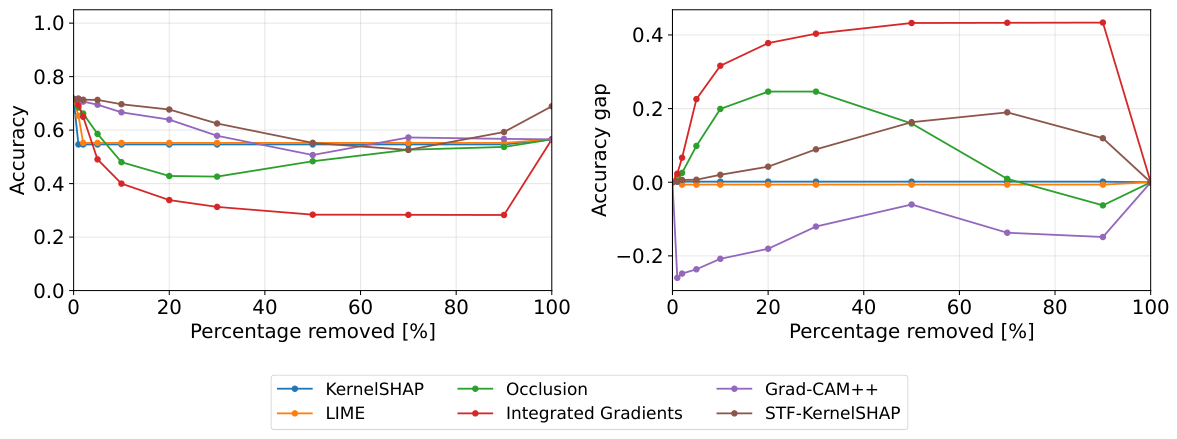
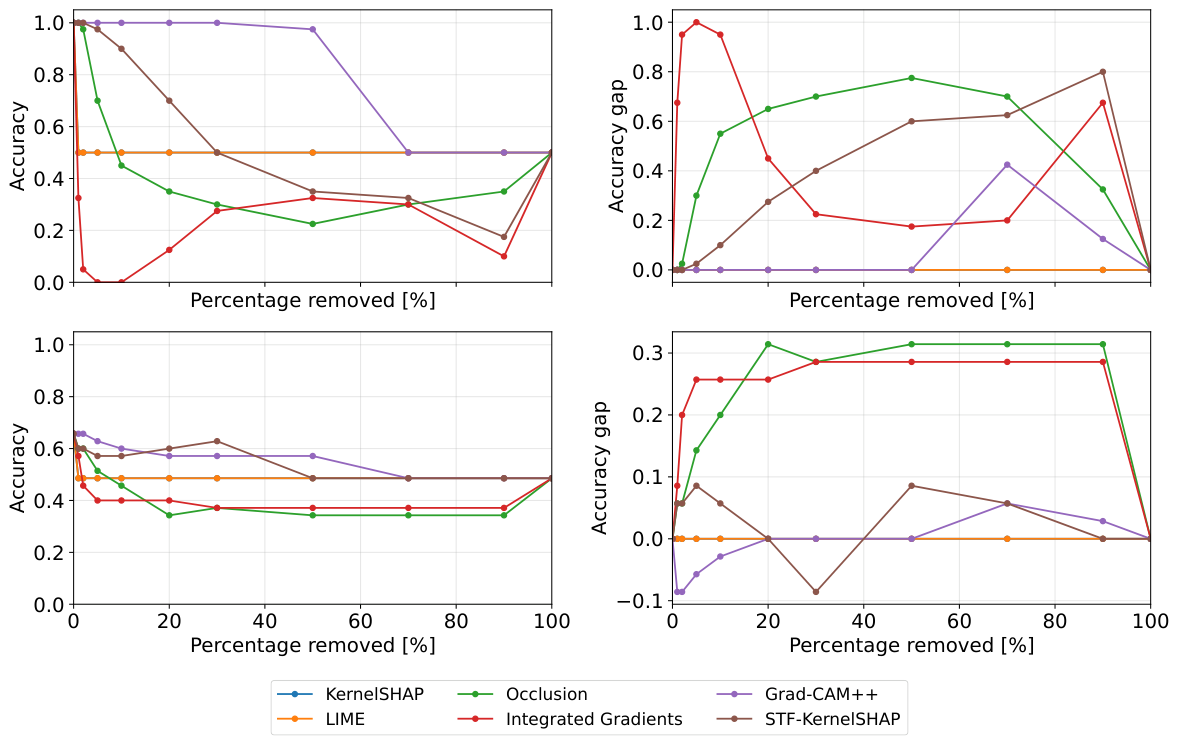
Figure 18 complements the analysis through perturbation-based fidelity metrics. In Deletion MoRF, Integrated Gradients exhibits a marked performance drop when the most relevant regions are removed, indicating a strong functional relationship between its attributions and the model decision. STF-KernelSHAP also shows a progressive degradation in accuracy, although less abruptly, which is consistent with an explanation constructed from more structured space–frequency blocks. In ROAD, Integrated Gradients and Occlusion produce larger accuracy gaps, whereas STF-KernelSHAP maintains an intermediate response. This suggests that the proposed strategy preserves functional fidelity, although its main objective is not to maximize the pointwise performance drop under perturbation, but to provide an explanation organized by regions and frequency bands.
Overall, the ADHD results show that STF-KernelSHAP can be applied to a non-event-locked clinical EEG scenario, where interpretation is driven primarily by spatial and spectral organization rather than by task-specific temporal intervals. In this setting, each 4 s epoch is analyzed as a complete segment, and the resulting explanations preserve the ability to generate spatial maps comparable with conventional XAI approaches while further decomposing relevance into EEG frequency bands. This decomposition is particularly useful in ADHD because informative activity may be distributed across frontal, central, and posterior regions and across low- to intermediate-frequency bands, making structured interpretation more appropriate than reducing the explanation to a single band or spectral ratio. This behavior is consistent with the quantitative fidelity results reported in Table 3, where Integrated Gradients achieves the strongest overall fidelity, while STF-KernelSHAP remains competitive with perturbation- and Shapley-based methods, outperforming KernelSHAP, LIME, and Grad-CAM++ in both Deletion-AUC and ROAD-AUC. Therefore, the ADHD results indicate that STF-KernelSHAP should not be interpreted solely as the best-performing fidelity method but also as a model-agnostic and structured XAI strategy that balances quantitative fidelity with spatial and spectral interpretability in heterogeneous clinical EEG recordings.
In the ADHD detection scenario, STF-KernelSHAP extends the interpretation to a different EEG montage, temporal configuration, and neurophysiological condition. The distributed frontal, central, and posterior relevance patterns suggest that the classifier relies on spatially dispersed information rather than on a single focal source. Likewise, the contribution of low- and intermediate-frequency components, especially theta, alpha, and beta, supports a cautious spectral interpretation that is consistent with the heterogeneous nature of ADHD-related EEG alterations. These findings should therefore be understood as model-specific relevance patterns within the analyzed dataset, not as standalone diagnostic evidence or as support for any universal frequency-band marker.
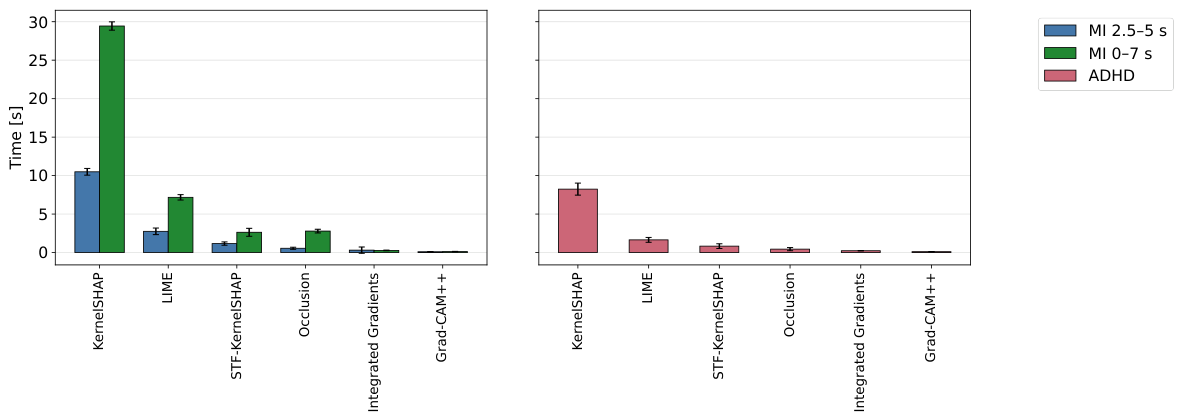
Beyond fidelity and neurophysiological plausibility, computational cost provides a complementary criterion for assessing the practical applicability of the evaluated XAI strategies. For one explained trial, the dominant cost of STF-KernelSHAP scales with the number of sampled coalitions, requiring one forward evaluation per coalition and a weighted surrogate fit over the selected channel–time–frequency features. This avoids the exhaustive enumeration of the exact Shapley formulation, which would require evaluating 2 M 1 coalitions for M interpretable features. Figure 19 reports the mean per-trial explanation time across the two studied paradigms: MI, evaluated in the 2.5–5 s and 0–7 s windows, and ADHD. The results show that STF-KernelSHAP is computationally competitive with the KernelSHAP baseline, with markedly lower runtime in all settings and consistently lower cost than LIME. This behavior suggests that the proposed channel–time–frequency structure reduces the effective perturbation space while preserving multidomain attribution. The ADHD setting shows lower per-trial runtime despite involving more samples, mainly because each epoch has fewer channels and a shorter effective representation. Conversely, the MI 0–7 s setting is the most expensive perturbation-based configuration up to Occlusion, reflecting the dependence of runtime on input dimensionality, particularly the number of channels and the temporal extent of the analyzed segment.
Taken together, these results show that STF-KernelSHAP extends standard EEG topographic interpretation toward structured multidomain analysis. In MI, the proposed representation links spatial relevance over central and centro-lateral sensorimotor regions with the cue-related temporal interval and alpha/mu–beta activity associated with imagined movement. Moreover, high-performing MI cases produced more stable and physiologically coherent attribution maps, whereas lower-performing cases yielded less focalized and less consistent explanations, indicating that weak predictive representations can reduce the physiological readability of post hoc interpretations. In ADHD, STF-KernelSHAP enabled a cautious interpretation of distributed frontal, central, and posterior relevance together with low- and intermediate-frequency contributions, especially theta, alpha, and beta. However, these patterns should be understood as model-specific relevance distributions conditioned by the heterogeneous and non-event-locked nature of the recordings rather than as evidence that any single band or spectral ratio constitutes a universal diagnostic marker. Overall, the proposed framework provides a compact space–time–frequency view of EEG relevance, where spatial distributions, oscillatory activity, and temporal structure can be interpreted jointly.

5.3. Limitations

Although STF-KernelSHAP provides a structured and model-agnostic strategy for EEG interpretability, some limitations should be acknowledged. The reliability of the explanations depends on the predictive quality of the underlying classifier. When the model exhibits poor or unstable performance, the resulting attribution maps may also become inconsistent, since the learned decision function may not encode robust neurophysiological patterns. This aspect is particularly relevant in EEG analysis, where inter-subject variability, non-stationarity, and low signal-to-noise ratios affect both classification and interpretation.
The proposed framework also depends on a predefined partition of the signal into temporal windows and frequency bands. While this design enables physiologically coherent perturbations over complete channel–time–frequency cells, it may overlook subject-specific rhythms, transient spectral events, or non-stationary responses that do not match the selected segmentation. Therefore, the resolution of the explanation is partly constrained by the prior definition of the time–frequency grid.
Another relevant aspect concerns the use of a reference baseline in the time–frequency domain to replace absent components during coalition reconstruction. Although this strategy is more structured than direct pointwise masking, the estimated marginal contributions may still depend on the selected baseline. In particular, zero-valued spectral references may not always represent physiologically plausible counterfactual states.
Finally, although the proposed channel–time–frequency grouping reduces the limitations of conventional KernelSHAP, the coalition sampling process still follows the standard approximation based on independently sampled binary masks. This formulation does not explicitly model statistical dependencies among electrodes, temporal windows, and frequency bands. Consequently, some sampled coalitions may remain only partially consistent with the dependency structure of EEG signals.

6. Conclusions

This work introduced STF-KernelSHAP, a model-agnostic space–time–frequency Shapley framework for physiologically informed EEG explainability. The method represents EEG trials as structured channel–time–frequency cells, perturbs complete multidomain components reconstructed in the signal domain, and estimates class-conditional relevance through a KernelSHAP surrogate that uses only model outputs. This formulation enables architecture-independent post hoc explanations while preserving the spatial, temporal, and spectral organization of EEG more explicitly than conventional single-domain attribution methods.
Across the evaluated BCI and clinical EEG scenarios, STF-KernelSHAP achieved competitive explanatory fidelity. In motor imagery, it obtained the highest ROAD-AUC in the 0–7 s window ( 0.460 ± 0.369 ) , suggesting that the retained structured components captured information relevant to the model decision. In ADHD detection, it reached a Deletion-AUC of 0.646 ± 0.317 and a ROAD-AUC of 0.331 ± 0.295 , outperforming KernelSHAP, LIME, and Grad-CAM++ under both fidelity criteria. Although Integrated Gradients yielded the strongest overall performance in this dataset, STF-KernelSHAP provided a more physiologically structured explanation by jointly localizing relevance across channels, time intervals, and frequency bands.
The resulting relevance maps were consistent with the neurophysiological characteristics of each task. In motor imagery, STF-KernelSHAP emphasized central and centro-lateral sensorimotor regions, including the C3–Cz–C4 area, during cue-related intervals and within alpha/mu–beta activity associated with imagined movement. In ADHD detection, the method generalized to a different montage and a non-event-locked 4 s setting, revealing distributed frontal, central, and posterior relevance with prominent theta, alpha, and beta contributions. These patterns were interpreted as model-specific explanatory evidence rather than universal diagnostic biomarkers. Overall, STF-KernelSHAP provides a practical, architecture-independent, and physiologically grounded alternative for multidomain EEG interpretability in BCI and clinical EEG applications.

Future Work

Future work will focus on adaptive time–frequency partitions, physiologically informed baselines, and more efficient coalition sampling strategies [72]. A promising direction consists of developing a variational extension of STF-KernelSHAP, in which the coalition distribution is learned from data rather than imposed through independent binary sampling [73]. This extension could better capture dependencies among electrodes, temporal windows, and frequency bands. In addition, relevance-guided interpolation could be explored to restrict perturbation trajectories to the most informative channel–time–frequency components, with the aim of improving attribution stability [74]. Further validation under subject-independent protocols, cross-dataset transfer, larger EEG cohorts, and expert-based neurophysiological assessment will also be necessary [75].

Author Contributions

Conceptualization, D.A.P.-R., A.C.L.-B., A.M.Á.-M., D.A.C.-P. and G.C.-D.; data curation, D.A.P.-R.; methodology, D.A.P.-R., A.C.L.-B. and A.M.Á.-M.; project administration, A.M.Á.-M. and D.A.C.-P.; supervision, A.M.Á.-M., D.A.C.-P. and G.C.-D.; resources, D.A.P.-R., A.C.L.-B. and A.M.Á.-M. All authors have read and agreed to the published version of the manuscript.

Funding

The authors gratefully acknowledge support from the program ‘Alianza científica con enfoque comunitario para mitigar brechas de atención y manejo de trastornos mentales relacionados con impulsividad en Colombia (ACEMATE)’, grant/project No. 91908. This research was supported by the project ‘Sistema multimodal apoyado en juegos serios orientado a la evaluación e intervención neurocognitiva personalizada en trastornos de impulsividad asociados a TDAH como soporte a la intervención presencial y remota en entornos clínicos, educativos y comunitarios’, grant/project No. 790-2023, funded by the Colombian Ministry of Science, Technology and Innovation (Minciencias). Also, A.M. Álvarez-Meza acknowledges support from the project ‘NatureTunes: Inteligencia artificial para el monitoreo de paisajes sonoros y visuales como fomento al aviturismo en el departamento de Caldas’, Hermes code 63421, funded by Universidad Nacional de Colombia.

Data Availability Statement

Data available upon reasonable request via email.

Acknowledgments

The authors gratefully acknowledge the Programa Iberoamericano de Ciencia y Tecnología para el Desarrollo (CYTED), through Red 225RT0169, for its academic and collaborative support.

Conflicts of Interest

The authors declare no conflicts of interest.

References

  1. Rohan, N.R.; Vigneswaran, C.; Ghosh, S.; Rajendran, K.; Gaurav, A.; Chakravarthy, V.S. Deep oscillatory neural network. Sci. Rep. 2025, 15, 40968. [Google Scholar] [CrossRef] [PubMed]
  2. Hamedi, M.; Salleh, S.H.; Noor, A.M. Electroencephalographic Motor Imagery Brain Connectivity Analysis for BCI: A Review. Neural Comput. 2016, 28, 999–1021. [Google Scholar] [CrossRef] [PubMed]
  3. Hurjui, I.A.; Hurjui, R.M.; Hurjui, L.L.; Serban, I.L.; Dobrin, I.; Apostu, M.; Dobrin, R.P. Biomarkers and Neuropsychological Tools in Attention-Deficit/Hyperactivity Disorder: From Subjectivity to Precision Diagnosis. Medicina 2025, 61, 1211. [Google Scholar] [CrossRef] [PubMed]
  4. Ramadan, R.A.; Altamimi, A.B. Unraveling the potential of brain-computer interface technology in medical diagnostics and rehabilitation: A comprehensive literature review. Health Technol. 2024, 14, 263–276. [Google Scholar] [CrossRef]
  5. Wang, X.; Liesaputra, V.; Liu, Z.; Wang, Y.; Huang, Z. An in-depth survey on Deep Learning-based Motor Imagery EEG classification. Neurocomputing 2024, 147, 102738. [Google Scholar] [CrossRef]
  6. Huang, G.; Li, Y.; Jameel, S.; Long, Y.; Papanastasiou, G. From explainable to interpretable deep learning for natural language processing in healthcare: How far from reality? Comput. Struct. Biotechnol. J. 2024, 24, 362–373. [Google Scholar] [CrossRef] [PubMed]
  7. Mayor Torres, J.M.; Medina-DeVilliers, S.; Clarkson, T.; Lerner, M.D.; Riccardi, G. Evaluation of interpretability for deep learning algorithms in EEG emotion recognition: A case study in autism. Artif. Intell. Med. 2023, 143, 102545. [Google Scholar] [CrossRef] [PubMed]
  8. Li, X.; Xiong, H.; Li, X.; Wu, X.; Zhang, X.; Liu, J.; Bian, J.; Dou, D. Interpretable deep learning: Interpretation, interpretability, trustworthiness, and beyond. Knowl. Inf. Syst. 2022, 64, 3197–3234. [Google Scholar] [CrossRef]
  9. Angkan, P.; Jalali, A.; Hungler, P.; Etemad, A. Multi-Domain EEG Representation Learning with Orthogonal Mapping and Attention-Based Fusion for Cognitive Load Classification. arXiv 2025, arXiv:2511.12394. [Google Scholar] [CrossRef]
  10. Liu, Z.; Fan, K.; Gu, Q.; Ruan, Y. Channel-Dependent Multilayer EEG Time-Frequency Representations Combined with Transfer Learning-Based Deep CNN Framework for Few-Channel MI EEG Classification. Bioengineering 2025, 12, 645. [Google Scholar] [CrossRef] [PubMed]
  11. Shawly, T.; Alsheikhy, A.A. Eeg-based detection of epileptic seizures in patients with disabilities using a novel attention-driven deep learning framework with SHAP interpretability. Egypt. Inform. J. 2025, 31, 100734. [Google Scholar] [CrossRef]
  12. Sylvester, S.; Sagehorn, M.; Gruber, T.; Atzmueller, M.; Schöne, B. SHAP value-based ERP analysis (SHERPA): Increasing the sensitivity of EEG signals with explainable AI methods. Behav. Res. Methods 2024, 56, 6067–6081. [Google Scholar] [CrossRef] [PubMed]
  13. Niu, Y.; Chen, X.; Fan, J.; Liu, C.; Fang, M.; Liu, Z.; Meng, X.; Liu, Y.; Lu, L.; Fan, H. Explainable machine learning model based on EEG, ECG, and clinical features for predicting neurological outcomes in cardiac arrest patient. Sci. Rep. 2025, 15, 11498. [Google Scholar] [CrossRef] [PubMed]
  14. Zhou, X.; Liu, C.; Wang, Z.; Zhai, L.; Jia, Z.; Guan, C.; Liu, Y. Interpretable and robust ai in eeg systems: A survey. arXiv 2023, arXiv:2304.10755. [Google Scholar]
  15. Raab, D.; Theissler, A.; Spiliopoulou, M. XAI4EEG: Spectral and spatio-temporal explanation of deep learning-based seizure detection in EEG time series. Neural Comput. Appl. 2023, 35, 10051–10068. [Google Scholar]
  16. Hasić, V.; Halilović, A.; Krivić, S. Superpixel Correlation for Explainable Image Classification; Springer: Cham Switzerland, 2025; pp. 27–44. [Google Scholar] [CrossRef]
  17. Gallego-Molina, N.J.; Ortiz, A.; Arco, J.E.; Martinez-Murcia, F.J.; Woo, W.L. Unraveling brain synchronisation dynamics by explainable neural networks using EEG signals: Application to dyslexia diagnosis. Interdiscip. Sci. Comput. Life Sci. 2024, 16, 1005–1018. [Google Scholar] [CrossRef]
  18. Presacan, O.; Ojha, J.; Yazidi, A.; Monteiro, E.; Lind, P.G. A Comprehensive Review of Explainable AI in Deep Learning Algorithms for EEG Analysis. Acm Trans. Comput. Healthc. 2025, 7, 1–28. [Google Scholar] [CrossRef]
  19. Ma, W.; Zheng, Y.; Li, T.; Li, Z.; Li, Y.; Wang, L. A comprehensive review of deep learning in EEG-based emotion recognition: Classifications, trends, and practical implications. PeerJ Comput. Sci. 2024, 10, e2065. [Google Scholar] [CrossRef] [PubMed]
  20. Zhang, S.; Zhu, Z.; Zhang, B.; Feng, B.; Yu, T.; Li, Z.; Zhang, Z.; Huang, G.; Liang, Z. Overall optimization of CSP based on ensemble learning for motor imagery EEG decoding. Biomed. Signal Process. Control 2022, 77, 103825. [Google Scholar] [CrossRef]
  21. Elashmawi, W.H.; Ayman, A.; Antoun, M.; Mohamed, H.; Mohamed, S.E.; Amr, H.; Talaat, Y.; Ali, A. A Comprehensive Review on Brain–Computer Interface (BCI)-Based Machine and Deep Learning Algorithms for Stroke Rehabilitation. Appl. Sci. 2024, 14, 6347. [Google Scholar] [CrossRef]
  22. Hekmatmanesh, A.; Nardelli, P.H.; Handroos, H. Review of the state-of-the-art of brain-controlled vehicles. IEEE Access 2021, 9, 110173–110193. [Google Scholar]
  23. Hekmatmanesh, A.; Wu, H.; Li, M.; Handroos, H. A combined projection for remote control of a vehicle based on movement imagination: A single trial brain computer interface study. IEEE Access 2022, 10, 6165–6174. [Google Scholar] [CrossRef]
  24. Miao, Y.; Jin, J.; Daly, I.; Zuo, C.; Wang, X.; Cichocki, A.; Jung, T.P. Learning Common Time-Frequency-Spatial Patterns for Motor Imagery Classification. IEEE Trans. Neural Syst. Rehabil. Eng. 2021, 29, 699–707. [Google Scholar] [CrossRef] [PubMed]
  25. Liang, W.; Jin, J.; Xu, R.; Wang, X.; Cichocki, A. Variance characteristic preserving common spatial pattern for motor imagery BCI. Front. Hum. Neurosci. 2023, 17, 1243750. [Google Scholar] [CrossRef] [PubMed]
  26. Saha, P.K.; Rahman, M.A.; Alam, M.K.; Ferdowsi, A.; Mollah, M.N. Common spatial pattern in frequency domain for feature extraction and classification of multichannel EEG signals. SN Comput. Sci. 2021, 2, 149. [Google Scholar] [CrossRef]
  27. Hekmatmanesh, A.; Wu, H.; Jamaloo, F.; Li, M.; Handroos, H. A combination of CSP-based method with soft margin SVM classifier and generalized RBF kernel for imagery-based brain computer interface applications. Multimed. Tools Appl. 2020, 79, 17521–17549. [Google Scholar] [CrossRef]
  28. Liu, K.; Yang, M.; Yu, Z.; Wang, G.; Wu, W. FBMSNet: A filter-bank multi-scale convolutional neural network for EEG-based motor imagery decoding. IEEE Trans. Biomed. Eng. 2022, 70, 436–445. [Google Scholar]
  29. Hong, X.; Du, C.; He, H. Adaptive Domain Alignment Neural Networks for Cross-Domain EEG Emotion Recognition. IEEE Trans. Affect. Comput. 2024, 16, 903–914. [Google Scholar] [CrossRef]
  30. Lawhern, V.J.; Solon, A.J.; Waytowich, N.R.; Gordon, S.M.; Hung, C.P.; Lance, B.J. EEGNet: A compact convolutional neural network for EEG-based brain–computer interfaces. J. Neural Eng. 2018, 15, 056013. [Google Scholar] [CrossRef] [PubMed]
  31. Kim, S.J.; Lee, D.H.; Lee, S.W. Rethinking CNN Architecture for Enhancing Decoding Performance of Motor Imagery-based EEG Signals. IEEE Access 2022, 10, 96984–96996. [Google Scholar] [CrossRef]
  32. Tobón-Henao, M.; Álvarez Meza, A.M.; Castellanos-Dominguez, C.G. Kernel-Based Regularized EEGNet Using Centered Alignment and Gaussian Connectivity for Motor Imagery Discrimination. Computers 2023, 12, 145. [Google Scholar] [CrossRef]
  33. Luo, J.; Wang, Y.; Xia, S.; Lu, N.; Ren, X.; Shi, Z.; Hei, X. A shallow mirror transformer for subject-independent motor imagery BCI. Comput. Biol. Med. 2023, 164, 107254. [Google Scholar] [CrossRef] [PubMed]
  34. Xiao, T.; Wang, Z.; Zhang, Y.; Wang, S.; Feng, H.; Zhao, Y. Self-supervised learning with attention mechanism for EEG-based seizure detection. Biomed. Signal Process. Control 2024, 87, 105464. [Google Scholar] [CrossRef]
  35. Xie, J.; Zhang, J.; Sun, J.; Ma, Z.; Qin, L.; Li, G.; Zhou, H.; Zhan, Y. A transformer-based approach combining deep learning network and spatial-temporal information for raw EEG classification. IEEE Trans. Neural Syst. Rehabil. Eng. 2022, 30, 2126–2136. [Google Scholar] [CrossRef] [PubMed]
  36. Liao, L.; Lu, J.; Wang, L.; Zhang, Y.; Gao, D.; Wang, M. CT-Net: An interpretable CNN-Transformer fusion network for fNIRS classification. Med. Biol. Eng. Comput. 2024, 62, 3233–3247. [Google Scholar] [CrossRef] [PubMed]
  37. Mirzaei, S.; Ghasemi, P. EEG motor imagery classification using dynamic connectivity patterns and convolutional autoencoder. Biomed. Signal Process. Control 2021, 68, 102584. [Google Scholar] [CrossRef]
  38. Khare, S.K.; Acharya, U.R. An explainable and interpretable model for attention deficit hyperactivity disorder in children using EEG signals. Comput. Biol. Med. 2023, 155, 106676. [Google Scholar] [CrossRef] [PubMed]
  39. Rahman, A.U.; Tubaishat, A.; Al-Obeidat, F.; Halim, Z.; Tahir, M.; Qayum, F. Extended ICA and M-CSP with BiLSTM towards improved classification of EEG signals. Soft Comput. 2022, 26, 10687–10698. [Google Scholar] [CrossRef]
  40. Bang, J.S.; Lee, S.W. Interpretable convolutional neural networks for subject-independent motor imagery classification. In Proceedings of the 2022 10th International Winter Conference on Brain-Computer Interface (BCI); IEEE: New York, NY, USA, 2022; pp. 1–5. [Google Scholar]
  41. Schwalbe, G.; Finzel, B. A comprehensive taxonomy for explainable artificial intelligence: A systematic survey of surveys on methods and concepts. Data Min. Knowl. Discov. 2024, 38, 3043–3101. [Google Scholar]
  42. Zhang, Y.; Tino, P.; Leonardis, A.; Tang, K. A Survey on Neural Network Interpretability. IEEE Trans. Emerg. Top. Comput. Intell. 2021, 5, 726–742. [Google Scholar] [CrossRef]
  43. Koh, P.W.; Liang, P. Understanding Black-box Predictions via Influence Functions. arXiv 2020, arXiv:1703.04730. [Google Scholar] [CrossRef]
  44. Averkin, A.; Yarushev, S. Review of research in the field of developing methods to extract rules from artificial neural networks. J. Comput. Syst. Sci. Int. 2021, 60, 966–980. [Google Scholar] [CrossRef]
  45. Olah, C.; Mordvintsev, A.; Schubert, L. Feature Visualization. Distill 2017, 2, e7. [Google Scholar] [CrossRef]
  46. Sujatha Ravindran, A.; Contreras-Vidal, J. An empirical comparison of deep learning explainability approaches for EEG using simulated ground truth. Sci. Rep. 2023, 13, 17709. [Google Scholar] [CrossRef] [PubMed]
  47. Nielsen, I.E.; Dera, D.; Rasool, G.; Ramachandran, R.P.; Bouaynaya, N.C. Robust explainability: A tutorial on gradient-based attribution methods for deep neural networks. IEEE Signal Process. Mag. 2022, 39, 73–84. [Google Scholar] [CrossRef]
  48. Jiang, P.T.; Zhang, C.B.; Hou, Q.; Cheng, M.M.; Wei, Y. Layercam: Exploring hierarchical class activation maps for localization. IEEE Trans. Image Process. 2021, 30, 5875–5888. [Google Scholar] [CrossRef] [PubMed]
  49. Zafar, M.R.; Khan, N. Deterministic local interpretable model-agnostic explanations for stable explainability. Mach. Learn. Knowl. Extr. 2021, 3, 525–541. [Google Scholar] [CrossRef]
  50. Chen, H.; Covert, I.C.; Lundberg, S.M.; Lee, S.I. Algorithms to estimate Shapley value feature attributions. Nat. Mach. Intell. 2023, 5, 590–601. [Google Scholar] [CrossRef]
  51. Sharma, N.; Bollu, T.R. Explainable AI Methods for Interpreting Emotions in Brain–Computer Interface EEG Data. In Discovering the Frontiers of Human-Robot Interaction: Insights and Innovations in Collaboration, Communication, and Control; Vinjamuri, R., Ed.; Springer Nature: Cham, Switzerland, 2024; pp. 419–436. [Google Scholar] [CrossRef]
  52. Vimbi, V.; Shaffi, N.; Mahmud, M. Interpreting artificial intelligence models: A systematic review on the application of LIME and SHAP in Alzheimer’s disease detection. Brain Inf. 2024, 11, 10. [Google Scholar] [CrossRef] [PubMed]
  53. Chen, H.; Lundberg, S.M.; Lee, S.I. Explaining a series of models by propagating Shapley values. Nat. Commun. 2022, 13, 4512. [Google Scholar] [CrossRef] [PubMed]
  54. Subudhi, S.; Patro, R.N.; Biswal, P.K.; Dell’Acqua, F. A survey on superpixel segmentation as a preprocessing step in hyperspectral image analysis. IEEE J. Sel. Top. Appl. Earth Obs. Remote Sens. 2021, 14, 5015–5035. [Google Scholar] [CrossRef]
  55. Cao, N.; Wen, X.; Hao, Y.; Cao, R.; Gao, C.; Cao, R. A Lightweight End-to-End Three-domain Feature Fusion Network for Motor Imagery Decoding. In Proceedings of the 2024 IEEE International Conference on Bioinformatics and Biomedicine (BIBM); IEEE: New York, NY, USA, 2024; pp. 1830–1837. [Google Scholar]
  56. Li, H.; Chen, Y.; Wang, Y.; Ni, W.; Zhang, H. Foundation models for cross-domain eeg analysis application: A survey. arXiv 2025, arXiv:2508.15716. [Google Scholar]
  57. Cui, J.; Yuan, L.; Wang, Z.; Li, R.; Jiang, T. Towards best practice of interpreting deep learning models for EEG-based brain computer interfaces. Front. Comput. Neurosci. 2023, 17, 1232925. [Google Scholar] [CrossRef] [PubMed]
  58. Abibullaev, B.; Keutayeva, A.; Zollanvari, A. Deep learning in EEG-based BCIs: A comprehensive review of transformer models, advantages, challenges, and applications. IEEE Access 2023, 11, 127271–127301. [Google Scholar] [CrossRef]
  59. Cho, H.; Ahn, M.; Ahn, S.; Kwon, M.; Jun, S.C. EEG datasets for motor imagery brain–computer interface. GigaScience 2017, 6, gix034. [Google Scholar] [CrossRef] [PubMed]
  60. Nasrabadi, A.M.; Allahverdy, A.; Samavati, M.; Mohammadi, M.R. EEG Data for ADHD/Control Children; IEEE DataPort: Piscataway, NJ, USA, 2020. [Google Scholar] [CrossRef]
  61. Cremades, A.; Hoyas, S.; Vinuesa, R. Additive-feature-attribution methods: A review on explainable artificial intelligence for fluid dynamics and heat transfer. Int. J. Heat Fluid Flow 2025, 112, 109662. [Google Scholar] [CrossRef]
  62. Li, M.; Sun, H.; Huang, Y.; Chen, H. Shapley value: From cooperative game to explainable artificial intelligence. Auton. Intell. Syst. 2024, 4, 2. [Google Scholar] [CrossRef]
  63. Rozemberczki, B.; Watson, L.; Bayer, P.; Yang, H.T.; Kiss, O.; Nilsson, S.; Sarkar, R. The shapley value in machine learning. In Proceedings of the 31st International Joint Conference on Artificial Intelligence and the 25th European Conference on Artificial Intelligence; International Joint Conferences on Artificial Intelligence Organization: Vienna, Austria, 2022; pp. 5572–5579. [Google Scholar]
  64. Olsen, L.H.; Glad, I.K.; Jullum, M.; Aas, K. Using Shapley values and variational autoencoders to explain predictive models with dependent mixed features. J. Mach. Learn. Res. 2022, 23, 1–51. [Google Scholar]
  65. Liu, B.; Chang, H.; Peng, K.; Wang, X. An end-to-end depression recognition method based on EEGNet. Front. Psychiatry 2022, 13, 864393. [Google Scholar] [CrossRef] [PubMed]
  66. Zhang, H.; Xie, J.; Liu, K.; Liu, Y.; Dong, W.; Xu, G. Time frequency transform kernel enhanced ShallowConvNet for auditory selective attention decoding with steady state motion auditory evoked potential. Biomed. Signal Process. Control 2026, 119, 109736. [Google Scholar]
  67. Salazar-Dubois, D.V.; Álvarez-Meza, A.M.; Castellanos-Dominguez, G. T-GARNet: A Transformer and Multi-Scale Gaussian Kernel Connectivity Network with Alpha-Rényi Regularization for EEG-Based ADHD Detection. Mathematics 2025, 13, 4026. [Google Scholar] [CrossRef]
  68. Roshan, K.; Zafar, A. Using kernel shap xai method to optimize the network anomaly detection model. In Proceedings of the 2022 9th International Conference on Computing for Sustainable Global Development (INDIACom); IEEE: New York, NY, USA, 2022; pp. 74–80. [Google Scholar]
  69. Raptis, S.; Ilioudis, C.; Theodorou, K. From pixels to prognosis: Unveiling radiomics models with SHAP and LIME for enhanced interpretability. Biomed. Phys. Eng. Express 2024, 10, 035016. [Google Scholar] [CrossRef]
  70. Lundstrom, D.D.; Huang, T.; Razaviyayn, M. A rigorous study of integrated gradients method and extensions to internal neuron attributions. In Proceedings of the International Conference on Machine Learning; PMLR: Brookline, MA, USA, 2022; pp. 14485–14508. [Google Scholar]
  71. Tripathi, S.; Arya, N.; Kaur, S.; Gupta, T.; Gupta, E. Grad-CAM++ Enhanced Hybrid CNN-Random Forest Model for Accurate and Transparent Brain Tumor Detection. In Proceedings of the 2025 5th International Conference on Intelligent Technologies (CONIT); IEEE: New York, NY, USA, 2025; pp. 1–6. [Google Scholar]
  72. Saranya, S.; Menaka, R. An explainable machine learning network for classification of autism spectrum disorder using optimal frequency band identification from brain EEG. IEEE Access 2025, 13, 32016–32030. [Google Scholar] [CrossRef]
  73. Xiao, C.; Dou, J.; Lin, Z.; Ke, Z.; Hou, L. From points to coalitions: Hierarchical contrastive shapley values for prioritizing data samples. In Proceedings of the AAAI Conference on Artificial Intelligence; AAAI Press: Palo Alto, CA, USA, 2026; Volume 40, pp. 15995–16003. [Google Scholar]
  74. Reuter, A.; Thielmann, A.; Saefken, B. Neural additive image model: Interpretation through interpolation. arXiv 2024, arXiv:2405.02295. [Google Scholar]
  75. Lasfar, R.; Tóth, G. The difference of model robustness assessment using cross-validation and bootstrap methods. J. Chemom. 2024, 38, e3530. [Google Scholar] [CrossRef]
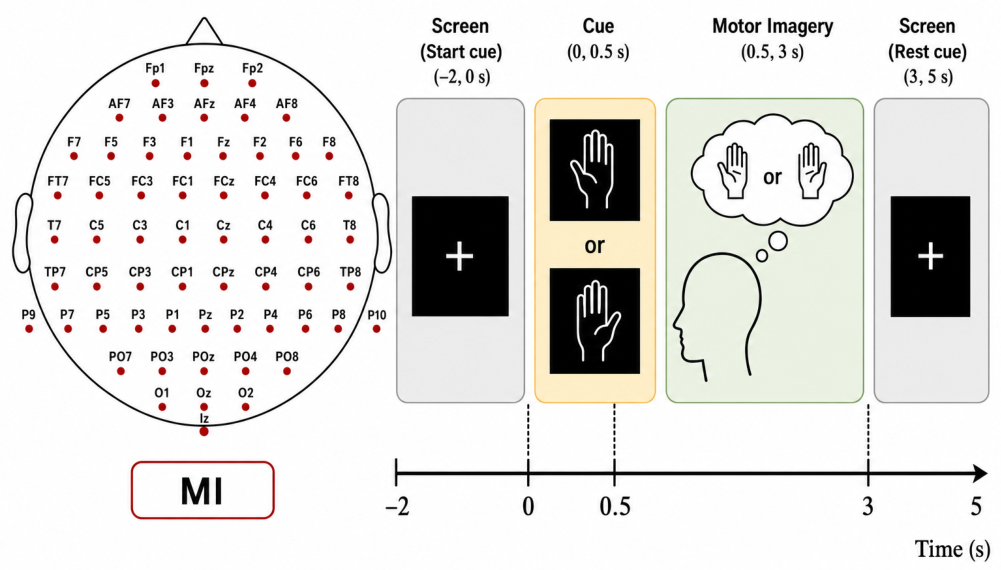
Figure 1. Experimental protocol and acquisition configuration of the GIGAScience dataset for MI–EEG classification. (Right): Temporal structure of a single trial, where a visual cue prepares the subject, followed by a three-second interval dedicated to the imagination of left- or right-hand movement. (Left): Spatial arrangement of EEG electrodes, illustrating the sequential channel layout from left frontal regions toward posterior areas and back along the central axis, in accordance with the international 10–10 system.
Computers 15 00428 g001
Figure 2. EEG channel configuration and visual-attention task of the ADHD dataset. (Left): Standard 19-channel EEG montage according to the international 10–20 system, referenced to A1 and A2. (Right): Visual perceptual counting task used to assess sustained attention.
Computers 15 00428 g002
Figure 3. Overview of the proposed EEG-driven multidomain Shapley attribution framework. The workflow starts from EEG data, applies a time–frequency transformation, performs channel–cell perturbation, reconstructs perturbed signals in the signal domain, obtains model inference from the trained classifier, and estimates space–time–frequency attributions.
Computers 15 00428 g003
Figure 4. Average power spectral density of the EEG signals. (Left): Mean frequency spectrum for the MI dataset. (Right): Mean frequency spectrum for the ADHD dataset.
Computers 15 00428 g004
Figure 5. Experimental workflow for model training, selection, performance evaluation, and post hoc interpretability analysis in the MI and ADHD datasets.
Computers 15 00428 g005
Figure 6. Classification performance obtained on the MI dataset using the 0–7 s temporal window. (Left): Global summary of the evaluated metrics across the considered DL models. (Right): Subject-wise accuracy distribution, highlighting inter-subject variability in classification performance.
Computers 15 00428 g006
Figure 7. Spatial distribution of the normalized attribution differences obtained on the MI dataset using the 0–7 s temporal window. (Top): Subject 14 evaluated in fold 4. (Bottom): Subject 12 evaluated in fold 5.
Computers 15 00428 g007
Figure 8. Time–frequency spatial attribution maps obtained with the proposed STF-KernelSHAP strategy on the MI dataset using the 0–7 s temporal window for subject 14 in fold 4. (Rows): Temporal segments used to localize the contribution of the EEG signal over time. (Columns): Frequency bands used to characterize the spectral contribution of EEG activity.
Computers 15 00428 g008
Figure 9. Space–time–frequency attribution maps obtained with the proposed STF-KernelSHAP strategy on the MI dataset using the 0–7 s temporal window for subject 12 in fold 5. (Rows): Temporal segments used to localize the contribution of the EEG signal over time. (Columns): Frequency bands used to characterize the spectral contribution of the EEG activity.
Computers 15 00428 g009
Figure 10. Perturbation-based fidelity analysis obtained on the MI dataset using the 0–7 s temporal window. (Top): Subject 14 evaluated in fold 4. (Bottom): Subject 12 evaluated in fold 5. (Left): Deletion MoRF. (Right): ROAD.
Computers 15 00428 g010
Figure 11. Classification performance obtained on the MI dataset using the 2.5–5 s temporal window. (Left): Global summary of the evaluated metrics across the considered DL models. (Right): Subject-wise accuracy distribution, highlighting inter-subject variability in classification performance.
Computers 15 00428 g011
Figure 12. Spatial distribution of the normalized attribution differences obtained on the MI dataset using the 2.5–5 s temporal window. (Top): Subject 43 evaluated in fold 1. (Bottom): Subject 12 evaluated in fold 3.
Computers 15 00428 g012
Figure 13. Frequency-band spatial attribution maps obtained with the proposed STF-KernelSHAP strategy on the MI dataset using the 2.5–5 s temporal window. (Top): Subject 43 evaluated in fold 1. (Bottom): Subject 12 evaluated in fold 3.
Computers 15 00428 g013
Figure 14. Perturbation-based fidelity analysis obtained on the MI dataset using the 2.5–5 s temporal window. (Top): Subject 43 evaluated in fold 1. (Bottom): Subject 12 evaluated in fold 3. (Left): Deletion MoRF. (Right): ROAD.
Computers 15 00428 g014
Figure 15. Classification performance obtained on the ADHD dataset.
Computers 15 00428 g015
Figure 16. Spatial distribution of the normalized attribution differences obtained on the ADHD dataset.
Computers 15 00428 g016
Figure 17. Frequency-band spatial attribution maps obtained with the proposed STF-KernelSHAP strategy on the ADHD dataset.
Computers 15 00428 g017
Figure 18. Perturbation-based fidelity analysis obtained on the ADHD dataset using fold 5. (Left): Deletion MoRF. (Right): ROAD.
Computers 15 00428 g018
Figure 19. Per-trial explanation runtime for the evaluated XAI methods. Bars show the mean runtime in seconds and error bars show the standard deviation across timed samples. (Left): MI. (Right): ADHD.
Computers 15 00428 g019
Table 1. Synthesis of EEG decoding and explainability approaches discussed in the related work.
Approach FamilySpatial ResolutionTemporal ResolutionFrequency ResolutionModel DependencePerturbation TypePhysiological Coherence
Classical CSP/FBCSP pipelines [24,26]Spatial filtersUsually predefined windowsExplicit filter banksDecoder or feature pipelineNot a post hoc perturbation methodPhysiologically motivated, but constrained by handcrafted assumptions
Gradient and activation methods [12,47,48]Architecture-dependent mapsInput or layer dependentMostly indirectRequires gradients or activationsNo explicit input perturbationLimited by the internal representation of the classifier
Model-agnostic surrogate or masking methods [49,50,51,52]Input-level relevanceSample, segment, or window levelAbsent unless manually engineeredBlack-box compatibleFlattened, pointwise, or window maskingMay disrupt EEG dependencies through independent perturbations
Correlation or segmentation-based grouping [11,16,53,54]Grouped spatial or correlated regionsLimited by the grouping ruleUsually not explicitOften model-agnosticGrouped perturbationsPartially preserves structure, but remains mostly spatial or correlation-driven
Table 2. Quantitative XAI fidelity results for the MI dataset. Temporal-window columns are expressed in seconds (0–7 s and 2.5–5 s). Methods are ordered according to their global mean rank across Deletion-AUC and ROAD-AUC. Lower Deletion-AUC and higher ROAD-AUC indicate better fidelity. The downward and upward arrows indicate that lower and higher values are better, respectively.
MethodDeletion-AUC ↓ROAD-AUC ↑
0–7 s2.5–5 s0–7 s2.5–5 s
Integrated Gradients 0 . 291 ± 0 . 400 0 . 207 ± 0 . 231 0.431 ± 0.466 0.597 ± 0.285
Occlusion 0.470 ± 0.389 0.310 ± 0.212 0.443 ± 0.427 0 . 639 ± 0 . 202
STF-KernelSHAP 0.420 ± 0.378 0.624 ± 0.339 0 . 460 ± 0 . 369 0.262 ± 0.273
KernelSHAP 0.543 ± 0.499 0.602 ± 0.490 0.000 ± 0.000 0.000 ± 0.002
LIME 0.548 ± 0.495 0.610 ± 0.478 0.009 ± 0.059 0.007 ± 0.059
Grad-CAM++ 0.752 ± 0.270 0.789 ± 0.265 0.090 ± 0.166 0.063 ± 0.108
Note: Bold numerical values indicate the best performance for each metric and temporal window. The bold method name denotes the proposed approach.
Table 3. Quantitative XAI fidelity results for the ADHD dataset. Methods are ordered according to their global mean rank across Deletion-AUC and ROAD-AUC. Lower Deletion-AUC and higher ROAD-AUC indicate better fidelity. The downward and upward arrows indicate that lower and higher values are better, respectively.
MethodDeletion-AUC ↓ROAD-AUC ↑
Integrated Gradients 0 . 107 ± 0 . 084 0 . 881 ± 0 . 083
Occlusion 0.496 ± 0.285 0.326 ± 0.361
STF-KernelSHAP 0.646 ± 0.317 0.331 ± 0.295
KernelSHAP 0.690 ± 0.337 0.025 ± 0.277
LIME 0.721 ± 0.310 0.039 ± 0.293
Grad-CAM++ 0.729 ± 0.224 0.286 ± 0.428
Note: Bold numerical values indicate the best performance for each metric. The bold method name denotes the proposed approach.
Disclaimer/Publisher’s Note: The statements, opinions and data contained in all publications are solely those of the individual author(s) and contributor(s) and not of MDPI and/or the editor(s). MDPI and/or the editor(s) disclaim responsibility for any injury to people or property resulting from any ideas, methods, instructions or products referred to in the content.