
Traffic Congestion Prediction Algorithms in Urban Environments: A Survey



Abstract
1. Introduction
2. Background
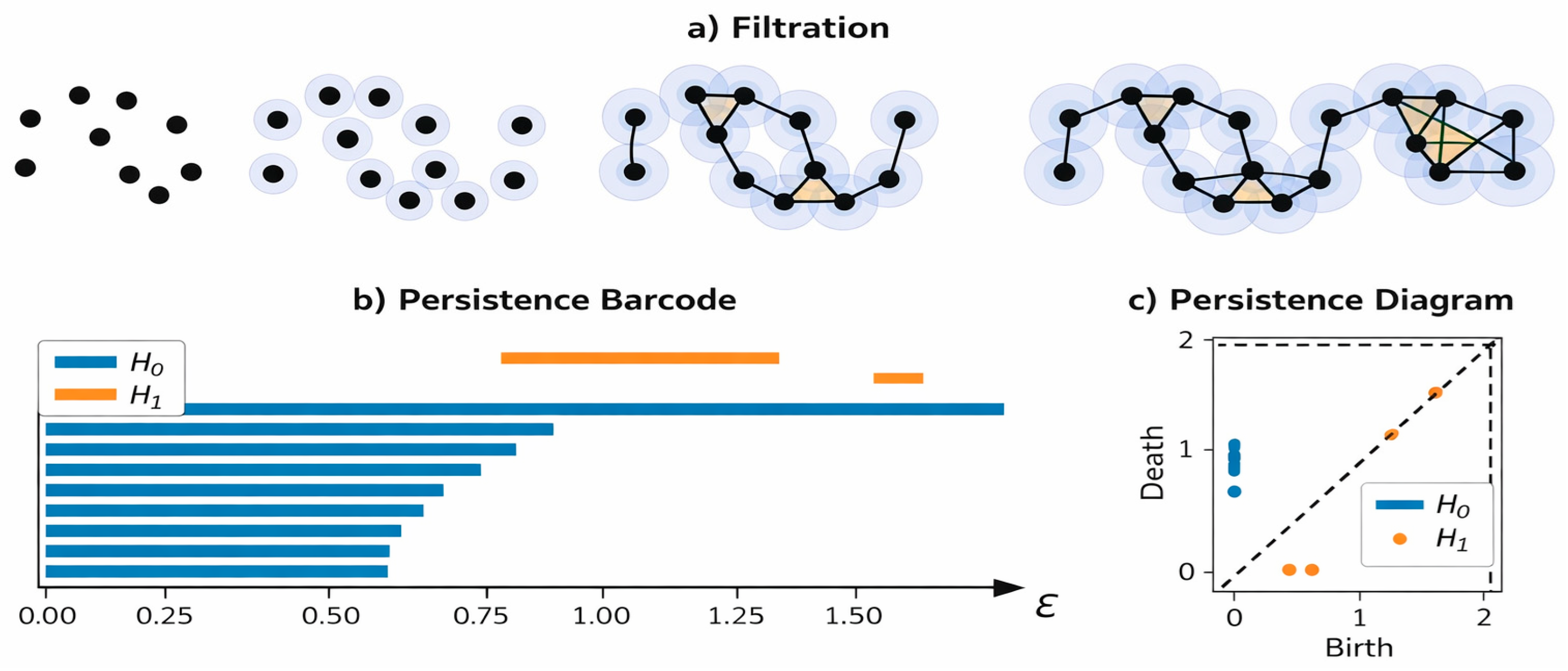
2.1. Persistent Homology
2.2. Topological Features in Traffic Data
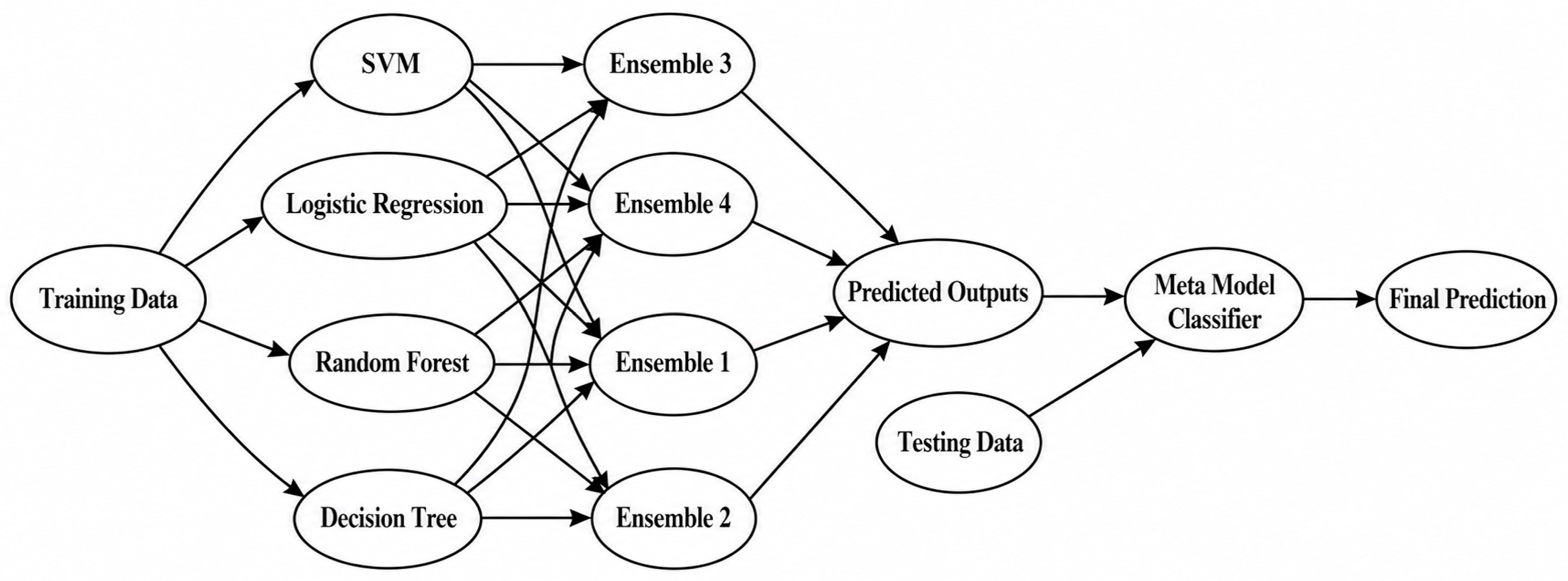
2.3. Ensemble Stacking Approach
2.4. Real-World Applications of ML, PH and DL Architectures
2.4.1. Graph Neural Networks
2.4.2. PH-Based Model
2.4.3. Critical Evaluation of Hybrid Models Using Ensemble Methods
3. Materials and Methods
3.1. Materials
3.2. Aim and Objectives
3.3. Data Source
3.4. Search Strategy
3.5. Inclusion and Exclusion Criteria
3.6. Quality Assessment
3.7. Data Extraction and Synthesis
3.8. Synthesis Outcomes
4. Results
4.1. Traditional Methods to Manage Traffic Congestion (RQ1)
4.2. Implementation and Application Context Challenges (RQ2)
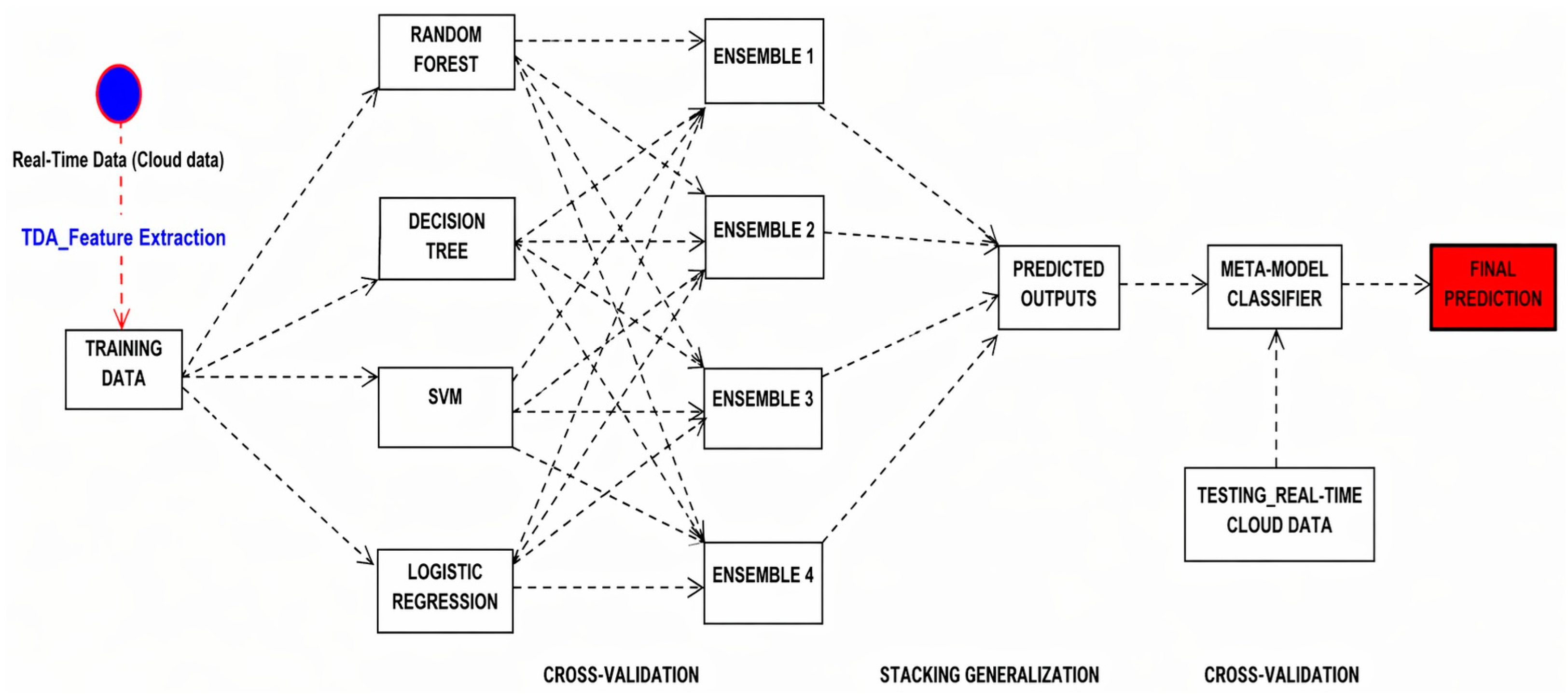
4.3. Predicting Traffic Congestion Using PH with Ensemble Stacking Algorithms (RQ3)
5. Conclusions
- First, we proposed architectural innovations that can use novel technologies to enable possible deployment of a predictive model to effectively bridge the accuracy efficiency gap in prediction of traffic congestion [79]. The proposed solution should offer more advantages in terms of transparency, strong prediction, and ease of operation, making it a valuable tool in scenarios where model interpretability is critical, particularly in prediction of traffic congestion.
- Second, the proposed solution should use representational power, enabling it to capture complex spatiotemporal dependencies and nonlinear interactions in the high-dimensional traffic datasets, specifically on urban roads, an aspect which was often overlooked by traditional methods. The novelty of integrating multiple frameworks defines the strength, originality and methodological rigor.
- Third, although the transition from theoretical validation to real-world deployment is still a critical challenge, the model demonstrates practical feasibility and effectiveness.
- Lastly, we recommend that future research focus not only on performance metrics or methods but also on the model’s explainability, transferability, adaptability across heterogeneous road environments as well as computational cost.
Author Contributions
Funding
Data Availability Statement
Conflicts of Interest
Abbreviations
| DL | Deep Learning |
| TDA | Topological Data Analysis |
| ML | Machine Learning |
| PH | Persistent Homology |
| SLR | Systematic Literature Review |
| SVM | Support Vector Machine |
| LR | Logistic Regression |
| RF | Radom Forest |
| GPS | Global Positioning Systems |
| GNN | Graph Neural Network |
| GCNN | Graph Convolutional Neural Network |
| CNN | Convolutional Neural Network |
| LSTM | Long Short-Term Memory |
| ITS | Intelligent Transport Systems |
References
- Munga, J.N.; Kasongo, R. Dynamic Management of Traffic Congestion-Case Study in Developing Countries. J. Transp. Eng. 2023, 12, 41–48. [Google Scholar]
- Faheem, H.B.; El Shorbagy, A.M.; Gabr, M.E. Impact of Traffic Congestion on Transportation Systems: Challenges and Remediation—A Review. Mansoura Eng. J. 2024, 49, 18. [Google Scholar] [CrossRef]
- Subair, S.O.; Ibitoye, B.A.; Kuranga, A.T. Evaluation of Traffic Congestion in an Urban Roads: A Review. ABUAD J. Eng. Appl. Sci. 2024, 2, 1–7. [Google Scholar] [CrossRef]
- Duan, L.; Song, L.; Wang, W.; Jian, X.; Heijungs, R.; Chen, W.-Q. Urbanization inequality: Evidence from vehicle ownership in Chinese cities. Humanit. Soc. Sci. Commun. 2024, 11, 703. [Google Scholar] [CrossRef]
- Wen, T.H.; Chin, W.; Lai, P. Understanding the topological characteristic and flow complexity of urban traffic congestion. Phys. A Stat. Mech. Its Appl. 2017, 473, 166–177. [Google Scholar] [CrossRef]
- Zhao, J.; Liu, Z.; Lin, J. The impact of urban traffic congestion on residents’ quality of life: A case study of Beijing. Sustainability 2018, 10, 1001. [Google Scholar]
- Guo, X. Research on Deep Learning Models for Traffic Flow prediction. Appl. Comput. Eng. 2024, 111, 87–96. [Google Scholar] [CrossRef]
- Tripathi, N.; Sharma, B. Evaluation of a Probabilistic Framework for Traffic Volume Forecasting Using Deep Learning and Traditional Models. Int. J. Exp. Res. Rev. (IJERR) 2024, 45, 237–250. [Google Scholar] [CrossRef]
- Ojo, O.; Blessing, K. Statistical challenges and solutions in multidisciplinary clinical research: Bridging the gap between. World J. Biol. Pharm. Health Sci. 2024, 19, 246–258. [Google Scholar]
- Xue, M. Comprehensive Approaches to Traffic Flow Prediction. Appl. Comput. Eng. 2024, 111, 60–65. [Google Scholar] [CrossRef]
- Samonte, M.J.; Balan, G.A.F.; Gaviño, P.P.; Monasterial, J.A.S.; Reforsado, R.A.C.; Samonte, D.C. Deep Learning in Traffic Flow Control and Prediction for Traffic Management. In Proceedings of the International Conference on Industrial Engineering and Operations Management, Istanbul, Turkey, 23–26 June 2023. [Google Scholar]
- Azizi, F.; Zhang, W.; Malik, A.; Shen, Z. Exploring the Potential of Crowdsourced Traffic Data for Improved Traffic Predictions: A Big Data Approach. In Research Square; Springer Nature: Durham, NC, USA, 2024. [Google Scholar]
- Ravishanker, N.; Chen, R. Topological Data Analysis (TDA) for Time Series. arXiv 2019, arXiv:1909.10604. [Google Scholar] [CrossRef]
- Cornell, F. Using topological autoencoders as a filtering function for global and local topology. arXiv 2020, arXiv:2012.03383. [Google Scholar]
- Patil, M.; Ahmed, Q.; Midlam-Mohler, S. Urban Traffic Forecasting with Integrated Travel Time and Data. In Proceedings of the 2024 IEEE 27th International Conference on Intelligent Transportation Systems (ITSC), Edmonton, AB, Canada, 24–27 September 2024. [Google Scholar]
- Feng, M.; Porter, M.A. Spatial applications of topological data analysis: Cities, Snowflakes, random structures, and spinning under the influence. Phys. Rev. Res. 2020, 2, 033426. [Google Scholar] [CrossRef]
- Nair, A. opological Methods in Data Analysis: Applications in Machine Learning. In Modern Dynamics: Mathematical Progressions; Modern Dynamics: Gurugram, India, 2024; Volume 1. [Google Scholar]
- Kumar, T.G.; Babu, G.S.; Murthy, D. Topological data analysis: Theory, methods, and practical applications. Int. J. Comput. Program. Database Manag. 2025, 6, 28–36. [Google Scholar] [CrossRef]
- Otter, N.; Porter, M.; Tillmann, U.; Grindrod, P.; Harrington, H.A. A roadmap for the computation of persistent homology. EPJ Data Sci. 2017, 6, 17. [Google Scholar] [CrossRef] [PubMed]
- Corcoran, P.; Deng, B. Regularization of Persistent Homology Gradient computation. arXiv 2020, arXiv:2011.05804. [Google Scholar] [CrossRef]
- Edelsbrunner, H.; Harer, J. Computational Topology: An Introduction; American Mathematical Society: Providence, RI, USA, 2010. [Google Scholar]
- Pun, C.S.; Lee, S.X.; Xia, K. Persistent-homology-based machine learning: A survey and a comparative study. Artif. Intell. Rev. 2022, 55, 5169–5213. [Google Scholar] [CrossRef]
- Pan, Y.A.; Hu, X.; Zhuo, X.S. A fundamental diagram-consistent fluid queue model for dynamic throughput under heavy traffic congestion. Transp. Res. Part C Emerg. Technol. 2026, 184, 105533. [Google Scholar]
- Rocks, J.W.; Liu, A.J.; Katifori, E. A revealing structure-functionn relationships in functional flow networks via persistent homology. Phys. Rev. Res. 2020, 2, 033234. [Google Scholar] [CrossRef]
- Ghorbanchian, R.; Restrepo, J.G.; Torres, J.J.; Bianconi, G.; Bianconi, G. Higher order simplical synchronization of coupled topolocal signals. Commun. Phys. 2021, 4, 120. [Google Scholar] [CrossRef]
- Aggarwal, M.; Periwal, V. Tight basis cycles representatives for persistent homology of large dataset. PLoS Comput. Biol. 2023, 19, e1010341. [Google Scholar]
- Turkeš, R.; Montúfar, G. On the Effectiveness of Persistent Homology. arXiv 2022, arXiv:2206.10551. [Google Scholar]
- Turner, K. Rips fitration for quasimetric spaces and asymmetric function with stability results. Algebr. Geom. Topol. 2019, 19, 1135–1170. [Google Scholar] [CrossRef]
- Kaji, S.; Sudo, T.; Ahara, K. Cubical Ripser: Software for computing persistent homology of image and volume data. arXiv 2020, arXiv:2005.12692. [Google Scholar] [CrossRef]
- Bauer, U. Ripser: Efficient computation of Vietoris–Rips persistence barcodes. J. Appl. Comput. Topol. 2021, 5, 391–423. [Google Scholar] [CrossRef]
- Nguyen, V.T.; Pham, D.A.; Le, A.T.; Peter, J.; Gust, G. Persistent Homology-induced Graph Ensembles for Time Series Regressions. arXiv 2025, arXiv:2503.14240. [Google Scholar] [CrossRef]
- Daniel, C.B.; Saravanan, S.; Mathew, S. GIS Based Road Connectivity Evaluation Using Graph Theory. In Transportation Research: Proceedings of CTRG 2017; Springer: Singapore, 2019; Volume 45, pp. 213–226. [Google Scholar]
- Povaliaev, N.D.; Krylatov, A.Y. Methods of cluster analysis of road networks for bottlenecks detection and traffc optimization. T-Comm 2025, 19, 34–40. [Google Scholar] [CrossRef]
- Košanin, M.; Macek, N. A Clustering-Based Approach to Detecting Critical Traffic Road. Axioms 2023, 12, 509. [Google Scholar] [CrossRef]
- Luo, J.; Zhang, Q. Subdivision of Urban Traffic Area Based on the Combination of Static Zoning and Dynamic Zoning. Discret. Dyn. Nat. Soc. 2021, 2021, 9954267. [Google Scholar] [CrossRef]
- Andrade-Girón, D.C.; Sandivar-Rosas, J.; Marin-Rodriguez, W.J. Comparison of Ensemble and Meta-Ensemble Models for Early Risk Prediction of Acute Myocardial Infarction. Informatics 2025, 12, 109. [Google Scholar] [CrossRef]
- Tavana, P.; Akraminia, M.; Koochari, A.; Bagherifard, A. An efficient ensemble method for detecting spinal curvature type using deep transfer learning and soft voting classifier. Expert Syst. Appl. 2023, 213, 119290. [Google Scholar] [CrossRef]
- Artin, J.; Valizadeh, A.; Ahmadi, M.; Kumar, S.A.; Sharifi, A. Presentation of a Novel Method for Prediction of Traffic with Climate Condition Based on Ensemble Learning of Neural Architecture Search (NAS) and Linear Regression. Complexity 2021, 2021, 8500572. [Google Scholar] [CrossRef]
- He, R.; Xu, Y. Overfitting Identification in Machine Learning Models with the Person-Fit Indicator; IEEE: New York, NY, USA, 2023; pp. 520–524. [Google Scholar]
- Zhu, Z. Systematic Optimization of Overfitting Problem in Machine Learning. Highlights Sci. Eng. Technol. 2024, 111, 353–359. [Google Scholar] [CrossRef]
- Barreñada, L.; Dhiman, P.; Timmerman, D.; Boulesteix, A.; Calster, B.V. Understanding overfitting in random forest for probability estimation: A visualization and simulation study. BMC Diagn. Progn. Res. 2024, 8, 6–14. [Google Scholar] [CrossRef]
- Mattei, P.-A.; Garreau, D. Are Ensembles Getting Better All the Time? J. Mach. Learn. Res. 2025, 26, 1–46. [Google Scholar]
- Gul, G.; Korejo, I.A.; Hakro, D.N.; Alqahtani, H.; Abbasi, A.; Babar, M.; Rahbi, O.A.; Ali, N.I. Machine Learning and Ensemble Methods for Cardiovascular Disease Prediction: A Systematic Review of Approaches, Performance Trends, and Research Challenges. Computers 2026, 15, 25. [Google Scholar] [CrossRef]
- Wang, H.; Ma, Z.; Qi, W.; Zhang, N.; Zhuang, H. A Research Review of the Stacking Classification Model. In Proceedings of the 2024 6th International Conference on Machine Learning, Big Data and Business Intelligence (MLBDBI), Hangzhou, China, 1–3 November 2024. [Google Scholar]
- Taiwo, E.O.; Ogunsanwo, G.O.; Alaba, O.B.; Ogu, V.I. A Comparative Study of Ensemble Methods for Predicting Road Traffic Congestion. Int. J. Traffic Transp. Eng. (IJTTE) 2021, 11, 1013–1027. [Google Scholar]
- Taiwo, E.O.; Ogunsanwo, G.O.; Alaba, O.B.; Ogunbanwo, A.S. Traffic Congestion Prediction using Supervised Machine Learning Algorithms. TASUED J. Pure Appl. Sci. 2023, 2, 110–116. [Google Scholar]
- Indah, D.; Mwakalonge, J.; Comert, G.; Siuhi, S.; Masau, H.; Osei, E.; Omulokoli, P.; Sulle, M.; Ruganuza, D.; Gyimah, N.K. Topological data analysis for driver behavior classification driven by vehicle trajectory data. J. Transp. Res. Board 2025, 21, 100719. [Google Scholar] [CrossRef]
- Wu, J.; Zhang, K.; Deng, K.; Chen, G.; Li, X. A machine learning approach for traffic congestion prediction in developing countries. Transp. Res. Part C Emerg. Technol. 2019, 99, 200–215. [Google Scholar]
- Song, W. Data Analysis and Congestion Prediction Model Intelligent Transportation Systems. J. Prog. Eng. Phiysical Sci. 2024, 3, 1–8. [Google Scholar] [CrossRef]
- Carmody, D.; Sowers, R. Topological Analysis of traffic pace via persistent homology. J. Phys. Complex. 2021, 2, 025007. [Google Scholar] [CrossRef]
- Huang, N.; Wu, Y. Unveiling activity-travel pattern through topological data analysis. arXiv 2024, arXiv:2406.16742. [Google Scholar] [CrossRef]
- Chazal, F.; Michel, B. An introduction to Topological Data Analysis: Fundamental and practical aspects for data scientists. Front. Artif. Intell. 2021, 4, 667963. [Google Scholar] [CrossRef] [PubMed]
- Qi, Y.; Cheng, Z. Research on Traffic Congestion Forecast Based on Deep Learning. Information 2023, 14, 108. [Google Scholar] [CrossRef]
- Kumar, K.D.; Anitha, M.L.; Veena, M.N. Real-Time Bengaluru City Traffic Congestion Prediction Using Deep Learning Models. Int. J. Transp. Dev. Integr. 2025, 9, 619–628. [Google Scholar] [CrossRef]
- Wang, J.; Chen, R.; He, Z. Traffic speed prediction for urban expressways using a deep learning approach. Transp. Res. Part C Emerg. Technol. 2019, 105, 372–385. [Google Scholar] [CrossRef]
- Lin, L.; Li, W.; Zhu, L. Data-Driven Graph Filter-Based Graph Convolutional Neural Network Approach for Network-Level Multi-Step Traffic Prediction. Sustainability 2022, 14, 16701. [Google Scholar] [CrossRef]
- Diao, Z.; Wang, X.; Zhang, D.; Liu, Y.; Xie, K.; He, S. Dynamic Spatial-Temporal Graph Convolutional Neural Networks for Traffic Forecasting. In Proceedings of the Thirty-Third AAAI Conference on Artificial Intelligence (AAAI-19), Honolulu, HI, USA, 27 January–1 February 2019. [Google Scholar]
- Zheng, G.; Chai, W.K.; Zhang, J.; Katos, V. Graph Convolution Neural Network and Transformer based Traffic Prediction. In Knowledge Based Systems; Elsevier: Amsterdam, The Netherlands, 2023. [Google Scholar]
- Yan, F.; Wang, J.; Zhang, Y. Traffic Flow Prediction Based on Pivotal Graph Convolutional Network and Transformer. In Proceedings of the 2025 6th International Conference on Computer Information and Big Data Applications (CIBDA 2025), Wuhan, China, 14–16 March 2025. [Google Scholar]
- Patil, M.; Ahmed, Q.; Midlam-Mohler, S. Travel Time and Weather-Aware Traffic Forecasting in a Conformal Graph Neural Network Framewor. IEEE Trans. Intell. Transp. Syst. 2025, 26, 21734–21744. [Google Scholar] [CrossRef]
- Neyipapula, B.S. Rsearch Square; Springer Nature: Durham, NC, USA, 2023. [Google Scholar]
- Ragiri, R.; Raza, Z. Traffic Congestion Prediction using graph convolutional Networks. Int. Res. J. Adv. Eng. Manag. 2024, 2, 2117–2122. [Google Scholar]
- Ma, G. Using Topological Data Analysis to Process Time-series Data: A Persistent Homology way. J. Phys. Conf. Ser. 2020, 1550, 032082. [Google Scholar] [CrossRef]
- Buffelli, D.; Soleymani, F.; Rieck, B. Clique PH: Higher-Order Information for Graph Neural Networks through Persistent Homology on Clique Graphs. arXiv 2024, arXiv:2409.08217. [Google Scholar] [CrossRef]
- Wu, W.; Tang, L.; Zhao, Z.; Teo, C.-P. Enhancing binary classification: A new stacking method via leveraging computational geometry. arXiv 2024, arXiv:2410.22722. [Google Scholar] [CrossRef]
- Attipoe, E.K.; Yussiff, A.-S.; Asante-Mensah, M.G.; Tetteh, E.D. An ensemble learning approach for diabetes prediction using the stacking method. Comput. Sci. Inf. Technol. 2025, 6, 102–111. [Google Scholar] [CrossRef]
- Proskura, P.; Zaytsev, A. Effective training-time stacking for ensembling of deep neural networks. In Proceedings of the 2022 5th International Conference on Artificial Intelligence and Pattern Recognition, Xiamen, China, 23–25 September 2022. [Google Scholar]
- Page, M.J.; McKenzie, J.E.; Bossuyt, P.M.; Boutron, I.; Hoffmann, T.C.; Mulrow, C.D.; Moher, D. The PRISMA 2020 statement: An updated guideline for reporting systematic reviews. BMJ 2021, 372, n71. [Google Scholar] [CrossRef]
- Shea, B.J.; Reeves, B.; Wells, G.A.; Thuku, M. AMSTAR 2: A Critical appraisal tool for systematic reviews that include radomise or non-randomised studies of healthcare interventions, or both. BMJ 2017, 358, j4008. [Google Scholar]
- Guo, S.; Qian, X. Optimal Drive-By Sensing in Urban Road Networks with Large-Scale Ridesourcing Vehicles. IEEE Trans. Intell. Transp. Syst. 2024, 25, 14389–14400. [Google Scholar] [CrossRef]
- Lavelle-Hill, R.; Smith, G.; Murayama, K. Bridging Traditional Statistics and Machine Learning Approaches in Psychology: Navigating Small Samples, Measurement Error, Non-independent Observations and Missing Data. Adv. Methods Pract. Psychol. Sci. 2025, 8, 25152459251345696. [Google Scholar]
- Lavelle-Hill, R.; Smith, G.; Murayama, K. Machine Learning Meets Traditional Statistical Methods in Pysychology: Challenges and Future Directions; OSF Preprints: Charlottesville, VA, USA, 2023. [Google Scholar]
- Yanpei, C.; Archana, G. Challenges and Opportunities for Managing Data Systems Using Statistical Models. IEEE Data Eng. Bull. 2011, 34, 53–60. [Google Scholar]
- Wasserman, L. A Topological data analysis. In Annual Review of Statistics and Its Application Topological Data Analysis; Annual Reviews: San Mateo, CA, USA, 2018; Volume 5, pp. 501–532. [Google Scholar]
- Solodkij, A.; Gorev, A. System Approach to Elimination of Traffic Jams in Large Cities in Russia. Int. J. Traffic Transp. Eng. 2013, 23, 1112–1117. [Google Scholar]
- Suryadevara, G.; Pachipulusu, P. Integrating Real-Time Data Streams. In Advances in Computational Intelligence and Robotics Book Series; IGI Global: Hershey, PA, USA, 2025; pp. 67–90. [Google Scholar]
- Bochenina1, K.; Agriesti, S.; Roncoli, C.; Ruotsalainen, L. From Urban Data to City-ScaleModels: A Review of Traffic Simulation Case Studies. IET Intell. Transp. Syst. 2025, 19, e70021. [Google Scholar] [CrossRef]
- Murtagh, F. Data Science Foundations: Geometry and Topology of Complex Hierarchic Systems and Big Data Analytics; CRC Press: Boca Raton, FL, USA, 2017. [Google Scholar]
- Wu, Y.; Shindnes, G.; Karve, V.; Yager, D.; Work, D.B.; Chakraborty, A.; Sowers, R.B. Congestion Barcodes:Exploring the topology of Urban congestion using persistent homology. In Proceedings of the IEEE 20th International Conference on Intelligent Transportation Systems 2017, Yokohama, Japan, 16–19 October 2017. [Google Scholar]
- Pereira, C.M.; de Mello, R. Persistent homology for time series and spatial data clustering. Expert Syst. Appl. 2015, 42, 6026–6038. [Google Scholar] [CrossRef]



| Model Type | Dataset | Prediction Target | RMSE | MAE | Sources |
|---|---|---|---|---|---|
| Traditional statistical model | Delhi-NCR UTF and CMP | Traffic Speed | 25.4 | 18.9 | [8] |
| Crowdsourced model | UTF and CMP | Traffic Speed | 18.1 | 12.1 | [12] |
| GPS-based model | UTF and CMP | Traffic Speed | 21.3 | 14.8 | [12] |
| Social media model | UTF and CMP | Traffic Speed | 19.7 | 13.5 | [12] |
| Method | Algorithms/Framework | Dataset | Input Features | Training Data | Hyper-Parameter Tuning | Implementation | Evaluation Metric | Prediction Target |
|---|---|---|---|---|---|---|---|---|
| DL | GCNN | Urban: Traffic flow | Traffic speed | Train: 80% Test: 20% | Grid search | TensorFlow 2.21.0 | RMSE Accuracy | Future speed |
| TDA | PH (Ripser 0.6.15) | Urban: Traffic flow | Traffic speed | Train: 80% Test: 20% | Grid search | PyTorch (CUDA 13.2)/ TensorFlow 2.21.0 | RMSE Accuracy | Persistence diagrams |
| ML | Ensemble (DT, RF, SVM, LR) | Urban: Traffic flow | Traffic speed | Train: 80% Test: 20% | Grid search | PyTorch (CUDA 13.2)/ TensorFlow 2.21.0 | RMSE, Accuracy | Congestion levels |
| Item | Organization/Manufacturer | City | State/Province | Country |
|---|---|---|---|---|
| AMSTAR 2 | McMaster University-led group | Hamilton | ON | Canada |
| PRISMA 2020 | PRISMA Group | Ottawa/Oxford | ON/Oxfordshire | Canada/UK |
| PyTorch | Meta → PyTorch Foundation | Menlo Park | CA | USA |
| TensorFlow | Mountain View | CA | USA | |
| CUDA | NVIDIA | Santa Clara | CA | USA |
| Ripser (PH) | TUM (Ulrich Bauer) | Munich | BY | Germany |
| Ensemble Methods | Statistics community | Berkeley | CA | USA |
| GCNN | Academic Research Community | Amsterdam | North Holland | Netherlands |
| StackingClassifier | Scikit-learn | Paris | Île-de-France | France |
| TomTom dataset (Online) | TomTom N.V. | Amsterdam | NH | Netherlands |
| Databases | Records | Search Keywords Used |
|---|---|---|
| ScienceDirect | 900 | “TDA tools” OR “Persistent homology algorithms”, “Benefits” OR “Challenges of TDA techniques”, “Machine learning” OR “Ensemble approach”, “Target type” OR “Prediction”, |
| ACM | 500 | “ML models” OR “Traditional methods”, “Benefits” OR” Challenges”, “Traffic Congestion” OR “Prediction horizon”, “Hidden patterns” OR “Fix adjacency matrices” |
| Springer Nature | 59 | “Current Approaches Challenges OR “Prediction of Traffic congestion” “Traffic Prediction models” OR “Real-Time monitoring”, “Local data source” OR “Real-Time data Stream”, “non-Euclidean traffic data” OR “exploiting spatial dependencies” |
| IEEE Xplore | 302 | “Intelligent Transport Systems” OR “Urban Road Networks”, “Ensemble learning” OR “Predictive model”, “Stacking strategies” OR “Boosting, Bagging” OR “Accuracy speed measurement” |
| MDPI | 36 | “Ensemble approach” OR “Traditional ML models”, “Benefits” OR “Challenges” |
| Google Scholar | 20 | “Traffic management infrastructure” OR “Machine learning models” “Urban roads” OR “Urban environment roads”, “GCNNs models” OR “deep learning models” |
| Category | Criteria | Application |
|---|---|---|
| Inclusion Criteria | ||
| I1 | Published date between January 2014 and February 2026 | Applied during database search |
| I2 | Peer-reviewed journals, conference proceedings in English | Applied to all 1857 initial records |
| I3 | Focus on traffic congestion prediction of urban roads in urban roads | Excluded 142 studies from databases and website search |
| I4 | Explicit discussion of machine learning and topological data analysis tools | Excluded 60 studies from database and website search |
| Category | Criteria | Application |
|---|---|---|
| Exclusion Criteria | ||
| E1 | Review articles, surveys, theses, or non-peer-reviewed works | Excluded during initial screening |
| E2 | Models without using topological data analysis or machine learning techniques | Excluded 5 studies during full-text review |
| E3 | Not addressing challenges current approach | Excluded 26 studies during full-text review |
| E4 | Not addressing using benefits TDA and ML techniques | Excluded 6 studies during full-text review |
| Quality Dimension | Assessment Criteria | Studies Meeting Criteria (n = 66) | Percentage |
|---|---|---|---|
| Experimental Rigor | Clear methods for predicting traffic congestion, clear TDA and ML prediction techniques, focus of road environment setting, adequate dataset; a total of 52 (80%) studies out of 66 met selection criteria, and 20% of the studies did not meet the criteria of experimental rigor. | 52 | 80 |
| Performance | Performance metrics description | 46 | 70 |
| Dataset | Detailed traffic dataset and feature information | 59 | 90 |
| Comparative Analysis | Comparison of PH, CNN, GCNN models | 25 | 38 |
| Limitations Discussion | Clear acknowledgment of study limitations | 43 | 65 |
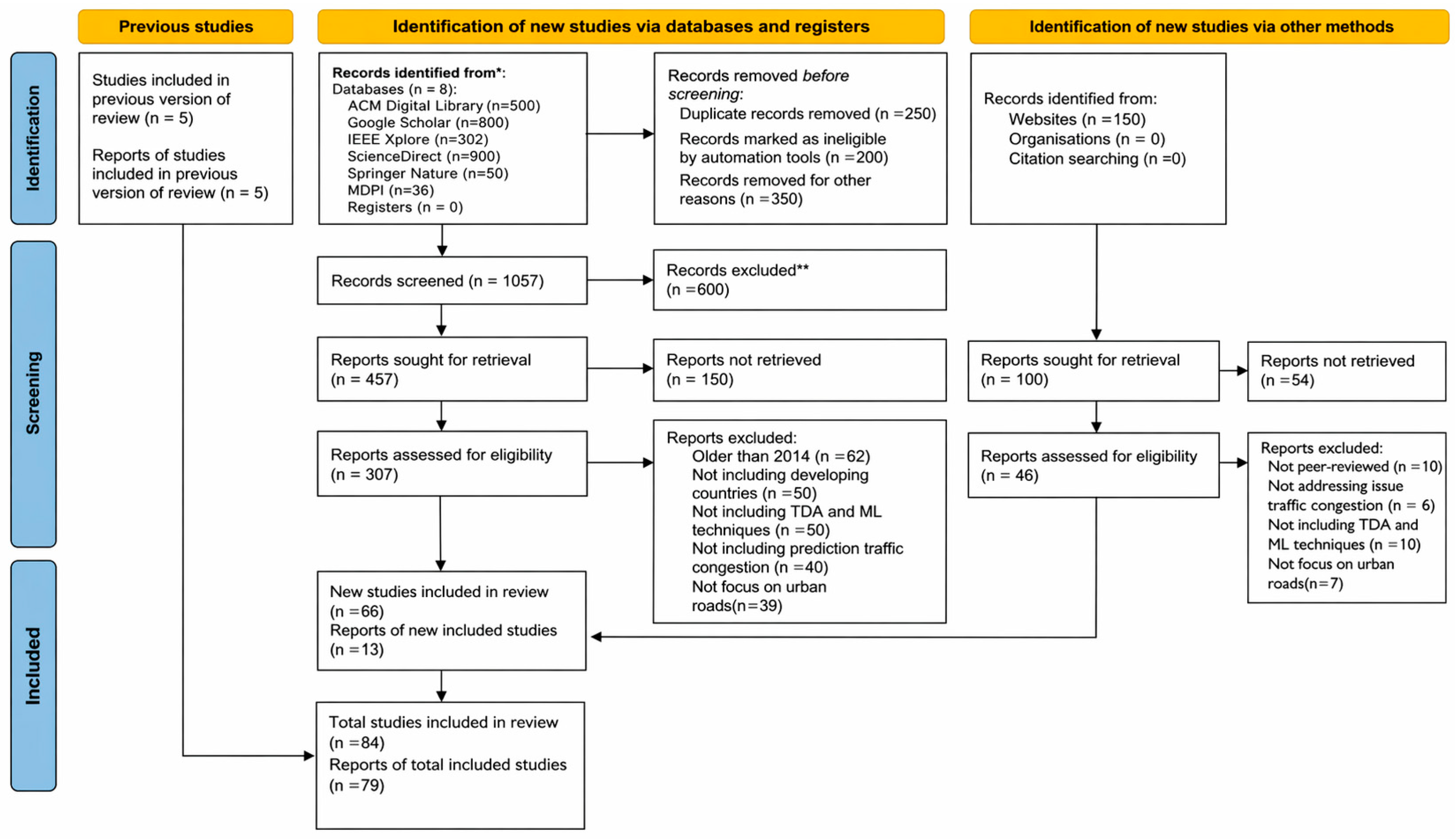
| Selection Phase | Records | Exclusion Reasons |
|---|---|---|
| Initial Identification | 1857 (6 databases) | (800) Duplicate removal |
| After Duplicate Removal | 1057 | (600) records irrelevant (350), Review article (150), non-English (100) |
| Title/Abstract Screening | 457 | 150 (Record not retrieved) |
| Full-Text Assessment | 307 | 241 records excluded irrelevant scope, Older than 2014 (62), Not conducted in urban roads (50), Not TDA or ML (50), Not Prediction of congestion (40), Not Focus urban roads (39) |
| Final Inclusion | 66 studies | None |
| Data Category | Studies | Completeness Rate | Key Findings |
|---|---|---|---|
| Architecture Details | 66 | 100% | TDA (PH) (16 studies) and ML (ensemble (15 studies)), Hybrid model (TDA and ML based model (10 studies)), Deep learning (GCNN and CNN (25 studies)) |
| Traffic Prediction | 59 | 90% | Urban traffic flow prediction (39 studies) |
| Evaluation Metrics | 46 | 70% | Average accuracy rate score: 90.8 |
| Dataset Information | 59 | 90% | Traffic congestion |
| Prediction Methods | 56 | 85% | Traditional ML model (26 studies) |
| Extraction Category | Specific Data Points | Extraction Methods |
|---|---|---|
| Model Architecture | Hybrid model PH with ensemble method, GPS and real-time traffic data source (online data source). | Direct extraction from method sections |
| Prediction Methods | Urban roads traffic flow prediction, category type: peak-hours traffic flow (low, moderate and congestion), non-peak-hours traffic flow (low, moderate and congestion) and unexpected (road works and accidents), short-time prediction of congestion between 15 min and 60 min (one hour). | Direct extraction from method sections |
| Performance Metrics | RMSE, MAE, confusion matrix (accuracy, precision, recall, and F1-score) and cross-validation approach (avoid overfitting). | Numerical extraction from results sections |
| Dataset Description | Urban roads real-time traffic dataset, topological features (covered): different roads, various road features, different time points of the day) and dataset size. | Systematic categorization |
| Synthesis Focus | Analysis Approach | Identified Pattern |
|---|---|---|
| Accuracy | Correlation analysis between identification of hidden features and accuracy prediction | Integration of PH in a model improves performance and accuracy prediction, captures local temporal dynamics and global structural patterns. PH alone cannot fully model temporal dependencies necessary for real-time prediction like deep learning models. Deep learning (CNN, GNN and GCNN) models require predefined assumptions. |
| Congestion prediction | Performance analysis | Traffic authorities and road users can receive help from prediction of traffic congestion and make travel decisions. |
| Architecture efficiency | Traditional methods vs. hybrid model analysis | Integrating PH with ensemble or deep learning frameworks may be an efficient way of modeling urban traffic prediction. |
| Dataset | Real-time dataset Vs. local dataset | Real-time datasets may improve accuracy of prediction and address data shortage and infrastructure gap. |
| Method Type | Temporal Modeling | Spatial Modeling | Complexity | Accuracy |
|---|---|---|---|---|
| Traditional Statistical Model | Yes | No | Low | Moderate |
| ML Model | Partial | No | Medium | Moderate–High |
| GCNN Model | Yes | Yes | Very High | Very High |
| Ensemble with PH | Yes | Yes | Very High | Very High |
Disclaimer/Publisher’s Note: The statements, opinions and data contained in all publications are solely those of the individual author(s) and contributor(s) and not of MDPI and/or the editor(s). MDPI and/or the editor(s) disclaim responsibility for any injury to people or property resulting from any ideas, methods, instructions or products referred to in the content. |
© 2026 by the authors. Licensee MDPI, Basel, Switzerland. This article is an open access article distributed under the terms and conditions of the Creative Commons Attribution (CC BY) license.
Share and Cite
Nyalugwe, S.F.; Kogeda, O.P.; Hans, R. Traffic Congestion Prediction Algorithms in Urban Environments: A Survey. Computers 2026, 15, 370. https://doi.org/10.3390/computers15060370
Nyalugwe SF, Kogeda OP, Hans R. Traffic Congestion Prediction Algorithms in Urban Environments: A Survey. Computers. 2026; 15(6):370. https://doi.org/10.3390/computers15060370
Chicago/Turabian StyleNyalugwe, Symon Fumu, Okuthe P. Kogeda, and Robert Hans. 2026. "Traffic Congestion Prediction Algorithms in Urban Environments: A Survey" Computers 15, no. 6: 370. https://doi.org/10.3390/computers15060370
APA StyleNyalugwe, S. F., Kogeda, O. P., & Hans, R. (2026). Traffic Congestion Prediction Algorithms in Urban Environments: A Survey. Computers, 15(6), 370. https://doi.org/10.3390/computers15060370