
Article

Expert-Informed Interval Type-2 Fuzzy Logic System for the Early Prediction of Support Needs and Failure Risk in Student Group Projects

by
Khalid Almohammadi
Computer Science Department, University of Tabuk, Tabuk 71491, Saudi Arabia
Computers 2026, 15(6), 347; https://doi.org/10.3390/computers15060347
Submission received: 25 April 2026 / Revised: 20 May 2026 / Accepted: 26 May 2026 / Published: 29 May 2026
(This article belongs to the Special Issue AI in Action: Innovations and Breakthroughs)

Abstract

Group projects are considered a fundamental component of higher education, as they enhance students’ competencies and problem-solving abilities within professional learning environments. Therefore, ensuring student success and providing effective supervision is essential. However, this remains a challenging task due to the reliance on supervisors’ expertise and the diverse characteristics and backgrounds of student groups. In this paper, we introduce a novel theoretical and practical interval type-2 fuzzy logic system (IT2FLS) for early prediction and guidance for novice supervisors by correlating and learning expert supervisors’ assessments according to the required level of support and the risk of failure for student groups needing early intervention. Experimental evaluation was performed based on assessments of 33 graduation projects conducted by expert supervisors, which served as the input–output data for developing interpretable white-box models that allow both novice and expert supervisors to transparently analyse reasoning processes and outcomes. The results demonstrate that the developed IT2FLS predicts the required level of support and the risk of failure for student groups with lower average error and standard deviation, outperforming the encountered Type-1 fuzzy logic systems. This study thus indicates the IT2FLS’s effectiveness in handling linguistic and numerical uncertainties in supervisors’ evaluations of students’ required early interventions.

1. Introduction

Group projects are a common pedagogical approach in higher education that enable students to address real-world problems that extend beyond the scope of individual work [1] in educational, professional, and industrial contexts [2,3,4]. Group projects are also widely recognised as being effective in fostering transferable competencies and skills, including collaboration, capability benchmarking, experiential learning, and collective management of complex tasks [5]. In professional higher education programmes, graduation projects are typically conducted under the supervision of academic faculty [6]. Supervisors have a challenging and complex role because they are often required to accommodate students’ diverse needs while helping them develop the knowledge and skills required for professional competence [7,8]. More specifically, supervising bachelor-level group projects is a fundamentally demanding pedagogical role. Conventionally, the effectiveness and quality of any supervisor-led intervention is linked to the supervisor’s skills and expertise [6,9], their ability to interact with students, and their subjective assessment of each student group’s abilities and progress [10].
As a direct result, there are significant differences in the outcomes of supervisory interventions because cognitive approaches and pedagogical styles vary among supervisors [11,12]. Further challenges emerge due to the student body’s diversity. For example, students have different backgrounds and cultures, possess different baseline knowledge and understanding, and exhibit different motivational levels. These variations require differentiation in supervisory responses and suggest that students might benefit more from working with different supervisors than with a single supervisor [13,14]. In combination with student groups’ inherent variations, prior studies have found that differences in supervisory pedagogy can result in a lack of timely consistency in student feedback, delays in identifying at-risk students, and failure to detect signs of students experiencing difficulties [15,16]. In addition, if supervisors do not have access to structured monitoring paradigms and student–supervisor expectations lack consistency, their ability to proactively identify issues and promptly intervene will be limited, often delaying completion of activities and undermining achievement of project outcomes [17,18]. Regardless of a supervisor’s pedagogical approach or experience [6,19], to mitigate these possibilities, predictive models can be key decision support mechanisms and assist in identifying at-risk student groups in a timely manner.
The use of machine learning (ML) in education has prompted a paradigm shift in pedagogy supported by advances in data-driven modelling and associated insights into teaching, learning, and supervision. ML has effectively identified students at risk of failing, supported adaptive learning approaches, and enhanced access to data mining and analysis [20,21,22]. In graduation group projects, these techniques provide a promising framework for modelling expert supervisors’ support decisions under uncertainty and for transferring expert knowledge to novice supervisors through a data-driven decision support framework with lifelong learning capabilities. Such approaches can support the development of proactive supervisory strategies learned from expert supervisors’ decision-making patterns. Therefore, predictive and interpretable (white-box) models, including decision trees, rule-based systems, and fuzzy logic classifiers, are appropriate because they generate human-readable decision rules transparent to academic supervisors [23,24]. Among various ML techniques, fuzzy logic represents a useful framework for modelling the subjectivity and uncertainty intrinsic to group projects’ supervisory assessments. Fuzzy logic can generate linguistically interpretable rationalisations that reinforce timely prediction of goal achievement and accelerate informed pedagogical mediation [25,26].
In this study, we develop an expert-informed IT2FLS framework for early prediction of student support needs and failure risk in student group projects. The proposed IT2FLS addresses the gap between supervisors’ subjective judgement and the need for interpretable early support in supervising students’ group projects. The proposed IT2FLS captures five inputs (i.e., project idea clarity, planning quality, student technical competency, group commitment, and teamwork quality), acquired via a supervisory questionnaire that models expert decisions. These inputs are represented as linguistic variables within a self-learning fuzzy system in which domain experts establish membership functions, and inference rules are learned from supervisory assessments to inform the ongoing development of group guidance recommendations. Consequently, supervisors’ prompt identification of students at risk of failure can facilitate timely corrective interventions for learned behaviour. Indeed, the I2TLFS supports proactive academic supervision, and its rule base’s interpretability can provide supervisors with useful insights into the logic supporting each assessment. In higher education, such transparency can help secure institutional trust and promote practical usability. The contribution of the proposed IT2FLS approach lies in combining expert-based interval type-2 fuzzy set construction with data-driven fuzzy rule extraction. This integration enables the system to model differences in expert interpretations and learn supervisory decision patterns according to the characteristics of student groups for early prediction of support needs and failure risk.
The remainder of this study is organized as follows: Section 2 reviews the literature on group learning and its implications for supervisory pedagogy in higher education. The section also provides an overview of ML approaches for assessing student groups’ characteristics and then briefly introduces the IT2FLS. Section 3 presents an in-depth explanation of the IT2FLS’s architecture and formulation. Section 4 discusses the proposed system’s experimental results and evaluation. Finally, Section 5 summarises the research findings and offers recommendations for future work.

2. Related Work

2.1. Group Learning and Its Implications for Supervisors in Higher Education

Group-based educational experiences and collaboration among students are universally recommended as a fundamental learning approach in higher education. The collaborative framework is underpinned by sociocultural learning theory [27], which emphasises the importance of social exchanges and student-to-student collaboration to promote cognitive development and knowledge construction. According to cooperative learning approaches, group-based educational experiences improve academic outcomes, enhance the development of interpersonal skills, and foster critical thinking [28]. Existing research [29] revealed that peer-learning projects support reflective practice and enhance conceptual understanding; moreover, problem-based tasks encourage self-directed analysis and development of versatile cognitive skills [30]. Group projects can be particularly useful in STEM subjects because they mirror the professional world’s cooperative and multidisciplinary approaches and help students develop the communication, problem-solving, and leadership skills needed in professional practice [31,32].
Supervisors’ previous experiences and pedagogical approaches heavily influence the effectiveness of group project supervision [6,11]. Prior studies on the correlation between supervisor experience level and outcomes have revealed that differences in experience directly translate to differences in how supervisors approach their pedagogical positions. Supervisors lacking significant experience often encounter challenges and have difficulty balancing contradictory pedagogical pressures, for instance, helping students act autonomously while simultaneously providing sufficient guidance. Novice supervisors have often yet to develop the frameworks needed to navigate these challenges [33]. Expert supervisors have various catalogues of experiences to draw from to recognise patterns in student behaviour, predict problems that may occur within specific group dynamics, and put interventions in place [34]. Research [35] on the quality of supervisor feedback has shown that supervisors who have previous experience in supervision activities can give students specific, measurable, actionable, realistic, and timely feedback. Novice supervisors often give students feedback that does not support their development [35].
This difference between the experiences of experts and novice supervisors can become clearer in group project work, where the challenges in supervising different students, resolving interpersonal disputes, and assessing cooperative activities necessitate a high level of pedagogical expertise. Novice supervisors may not have the experience needed to navigate these challenges. If they do not have access to the required support methods, they may engage in a process of trial and error, leading to inconsistency in the quality of supervision interventions [36]. Thus, there is a need to capture and systematically share the practical expertise of experienced supervisors with their novice peers to enhance the reliability of group project supervision [36].

2.2. An Overview of Machine Learning Techniques Used to Determine Student Group Characteristics

Application of computational methods to model students and learning environment characteristics has become a prominent research area in educational data mining and learning analytics. Comprehensive reviews of educational data mining research have classified numerous approaches for predicting student outcomes based on behavioural and academic indicators [37]. Analytics interventions informed by engagement metrics and initial assessment performance have significantly improved student retention [38]. Moreover, predictive modelling approaches have enabled early identification of academically vulnerable students and the development of proactive retention strategies [39]. In addition, virtual reality-based learning environments have been used as tools for supporting learning design and knowledge development [40].
Fuzzy logic, first introduced by Lotfi A. Zadeh in 1965, is a mathematical framework aiming to represent and model human reasoning and decision-making processes [41]. Because of its ability to manage uncertainty and imprecise information, fuzzy logic is commonly adopted in educational settings. Several studies have used fuzzy logic to evaluate student performance [42,43], predict academic achievement [44,45], and analyse learning–teaching environments to improve educational effectiveness and decision-making in learning systems [46,47]. Similarly, fuzzy decision support systems have demonstrated effectiveness in managing the ambiguity inherent in collaborative learning evaluation and supervisory judgement [47]. Intelligent decision support approaches emphasise adaptive systems’ potential to personalise instructional strategies using real-time performance data [48], whereas fuzzy logic enhances user acceptance by aligning computational reasoning more closely with natural human judgement processes [49].

2.3. Interval Type-2 Fuzzy Logic System Methodology

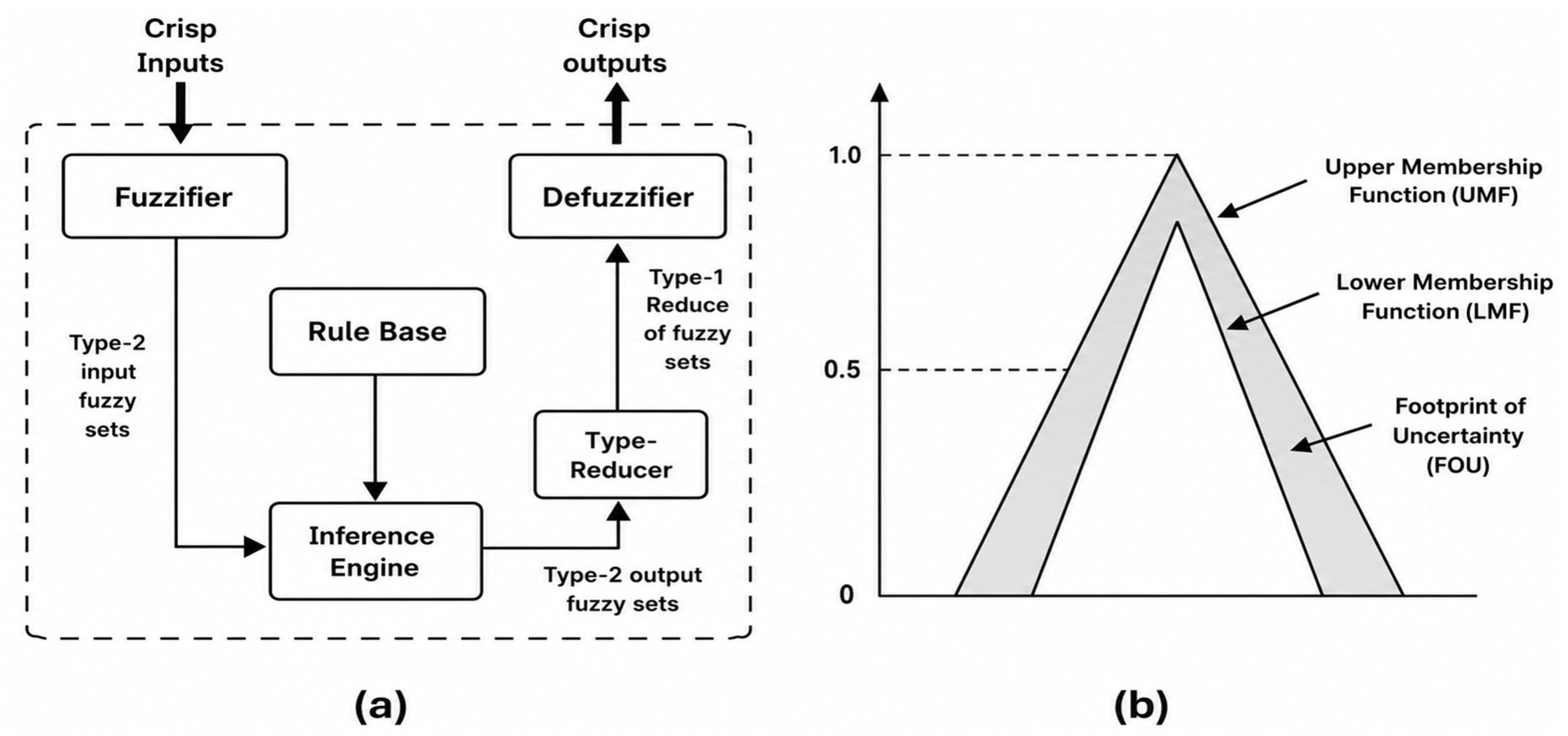
Figure 1a shows that the IT2FLS utilises interval type-2 fuzzy sets (as shown in Figure 1b) to model both input and output variables. In these sets, the membership values in the third dimension are uniformly equal to 1. As a result, the IT2FLS provides a simplified computational framework when compared with the general type-2 fuzzy logic system [50].
The IT2FLS functions through a series of sequential steps. First, crisp inputs are transformed into input type-2 fuzzy sets using singleton fuzzification due to its simplicity and suitability for the IT2FLS. The type-2 fuzzy set inputs subsequently activate the rule base along with the inference engine, which generates the corresponding type-2 fuzzy set outputs. While the rule-based structure is identical in both the type-1 fuzzy logic system (T1FLS) and IT2FLS, the key distinction lies in the membership functions, which are modelled in the T2FLS framework using interval type-2 fuzzy sets rather than conventional type-1 fuzzy sets.
The inference mechanism combines the activated rules to form a relationship between the input and the resulting type-2 fuzzy outputs. These type-2 fuzzy sets are subsequently handled by the type-reducer, which performs centroid calculations to obtain type-reduced type-1 fuzzy sets. Although several type reduction methods exist, the developed system adopts the centre-of-sets type reduction approach due to its relatively manageable computational complexity [50]. Finally, defuzzification is applied to the type-reduced sets to obtain crisp outputs. A comprehensive discussion of the IT2FLS is provided in [50].
The shaded region shown in Figure 1b corresponds to the Footprint of Uncertainty, primarily described by its lower and upper membership functions: μ _ A ~ x , μ ¯ A ~ x [50]. Accordingly, an interval type-2 fuzzy set can be expressed as
A ~ = x X [ u μ _ A ~ x , μ ¯ A ~ x 1 / u ] / x
In this paper, the FOU is used to capture differences among expert supervisors in interpreting linguistic assessment terms during early project evaluation. Each linguistic term is represented by an interval type-2 fuzzy set with upper and lower membership functions. The area between these two functions forms the FOU and represents the uncertainty associated with the linguistic term.

3. The Proposed Expert-Informed IT2FLS for Early Prediction of Support Needs and Failure Risks in Student Group Projects

The proposed system was developed to predict (a) the level of support needed by students and (b) the risk of failure in student group projects. In the first step, early-stage evaluation data collected from expert academic supervisors were analysed. The system examines the supervisor-evaluated student group inputs within the context of ongoing projects, whereby a designed questionnaire was developed to capture five inputs comprising expert supervisors’ assessments of project idea clarity, planning quality, technical competency, group commitment, and teamwork quality, which are aligned with the actual required level of support and the risk of failure for student groups needing early intervention during the initial weeks of project execution. These data are used as input variables for the developed system, while the amount of support required and the level of failure risk for the group project constitute the output variables. Informed consent was obtained from all participants via a questionnaire statement. Participation was voluntary, no identifiable data were collected, and all responses were fully anonymized.
Subsequently, data processing is performed through the generation of interval type-2 fuzzy sets designed for each specified input and output variable, based on the data-driven approach proposed by Liu and Mendel [52]. Then, the system extracts IT2FLS rules from the collected data using the unsupervised one-pass approach proposed in [50] to capture the decision-making patterns of experienced supervisors, which are then employed to construct a model that acquires knowledge of expert supervisors’ early intervention behaviours. The learned behaviour of expert supervisors is then incorporated and subsequently utilised to produce an output reflecting the current state of the group project inputs. As a result, the IT2FLS adjusts to the learned supervisory behaviours and supports the systematic modification and enhancement of rules. This promotes continuous learning through the evolution of supervisory decisions.
To make the sequence of the proposed methodology easier to follow, the proposed system consists of the following three distinct steps:
  • Input–output data collection and interval type-2 fuzzy set generation;
  • Extraction of IT2FLS rules from the gathered data;
  • Prediction of the level of student support needs and risk of failure.
Each step is described in detail in the following subsections.

3.1. Input–Output Data Collection and Interval Type-2 Fuzzy Set Generation

The model first collects student group data assessed by the expert supervisor, including early-stage performance evaluations. It subsequently utilises these inputs to associate with the system’s outputs and develop a framework capable of predicting failure risk and the level of support needed by processing multiple input and output datasets, as represented below [53,54].
x t ; y t
Here, N denotes the total number of data samples; x t R n represents the input vector for sample t ; and y t belongs to R k , representing the corresponding output vector. In the empirical study conducted within an academic context, the generated rules explain how the k output expert supervisor guidance output variables y = ( y 1 ,   ,   y k ) T are influenced by the input variables x = ( x 1 , ,   x n ) T . Five input variables are utilised to characterise student group project attributes, together with two output variables representing the level of support needed and the failure risk. By defining fuzzy rules, the model learns the mapping from input variables to output variables without requiring a predefined mathematical model, thereby improving the system’s flexibility in adapting individual rules to affect specific elements of the predictive model.
Following the collection of the input and output datasets, the corresponding variables are categorised using fuzzy membership functions. This process transforms raw variable values into interpretable linguistic categories, such as low, medium, and very high, thereby enabling the system to process information more effectively through well-defined membership functions. In this study, the data-driven approach proposed by Feng Liu and Jerry M. Mendel [52] is employed, where the interval type-2 fuzzy sets are constructed based on the evaluations of three experts. Each expert defines a triangular type-1 fuzzy set capturing their perception of a given linguistic label. These type-1 fuzzy sets are subsequently aggregated to construct the corresponding interval type-2 fuzzy sets.

3.2. Extraction of IT2FLS Rules from the Collected Dataset

To formulate rules that represent the behavioural patterns underlying group project guidance recommendations, the obtained interval type-2 fuzzy sets are integrated with the input and output data. The rule extraction approach used to develop the IT2FLS is derived from an improved and extended version of the Mendel–Wang method [53,54]. Based on multiple input–output data instances, the IT2FLS generates rules that capture the underlying functional mapping between the input vectors x = ( x 1 , ,   x n ) T and y = ( y 1 , ,   y n ) T , represented as follows [53,54]:
IF   x 1 is   A ~ 1 l and   and   x n is   A ~ n l , Then   y 1 is   B ~ 1 l and   and   y k is   B ~ k l
where l = 1,2 , , M , and M represents the total number of fuzzy rules, while l denotes the rule index. For each input variable x s   ( s = 1,2 , , n ), a set of V i interval type-2 fuzzy sets is defined and denoted as A ~ s q , where q = 1,2 , , V i . Similarly, for each output y c where c = 1,2 , , k , there are V o interval type-2 fuzzy sets represented by B ~ c h , with h = 1,2 , , V o .
Since the approach can be readily extended to rules with multiple outputs, single-output rules are adopted to simplify the subsequent notation [53,54]. The stages involved in the rule extraction process are outlined as follows:
Stage 1: For each data pair x t y t , where t = 1,2 , 3 , , N , both upper and lower membership degrees are calculated for all fuzzy sets associated with each input variable. Specifically, μ A ~ s q x s t and μ A ~ s q x s t are evaluated for q = 1 , 2 , , V i , and for every input variable, s = 1 , 2 , , n . Subsequently, the index q * { 1 , , V i } is determined according to the following equation [53,54]:
μ A ~ s q * c g x s t μ A ~ s q c g x s t
For all q = 1 , , V i , it is important to note that μ A ~ s q c g x s t corresponds to the centroid of the interval membership function of A ~ s q evaluated at x s t , as illustrated below [53,54].
μ A ~ s q c g x s t = 1 2 μ A ~ s q x s t μ A ~ s q x s t
Given the input–output pair x t y t , the following rule is derived [53,54]:
IF   x 1   is   A ~ 1 q 1 * ( t )   and     and   x n   is   A ~ n q n * ( t ) Then   y 1   is   centred   at   y t
Each input variable x s is partitioned into V i   interval type-2 fuzzy sets A ~ s q . This results in a maximum of V i n possible fuzzy rules. In practice, however, only those rules corresponding to dominant regions containing at least one data sample are generated from these V i n combinations.
During the first stage, a preliminary rule is derived for each pair of input and output. For every input variable, the fuzzy set corresponding to the highest membership degree at the specific data point is chosen and assigned to the rule antecedent. This rule is regarded as provisional and is further refined in the subsequent stage. The associated rule weight is then calculated as follows [53,54]:
w i t =   s = 1 n μ A ~ s q c g x s t
where the rule weight w i t quantifies the strength with which the data point x t is associated with the fuzzy region represented by the rule.
Stage 2: The procedure described in the first stage is applied to all data samples from t = 1 to N, leading to the generation of N rules in the form given in (6). However, since the dataset often contains many similar data points, Stage 1 may produce multiple rules that share identical IF parts but differ in their consequents, resulting in conflicting rules.
During this stage, rules that have the same IF parts are merged into a single representee rule. Consequently, all the N-generated rules are grouped according to their antecedents, such that all rules within the same group share the same IF part. Assuming that there are M groups and that the l-th group contains N l rules, the following relationship can be expressed [53,54]:
IF   x 1 is   A ~ 1 l and     and   x n is   A ~ n l , Then   y   is   centred   at   y t u l
where u = 1,2 , , N l , N l , denotes the number of rules in the l conflict group, and t u l identifies the corresponding data sample in group l. The weighted average of the conflict group rules is then calculated as follows [53,54]:
a v l = u = 1 N l y t u l w i t u l u = 1 N l w i t u l
Here, a v l represents the weighted average output value for the l-th conflict group. In this context, the N l rules are combined to produce a single rule, expressed as follows [53,54]:
IF   x 1   is   A ~ 1 l   and     and   x n   is   A ~ n l ,   THEN   y   is   B ~ l
The consequent fuzzy set B ~ l is determined as follows: among the V o interval type-2 output fuzzy sets B ~ 1 , , B ~ V o , fuzzy set B ~ h * is selected such that
μ B ~ h * c g a v l μ B ~ h c g a v l , h = 1,2 , , V o
The output fuzzy set B ~ l is identified as B ~ h * , in which μ B ~ h c g represents the centre of gravity of the interval fuzzy set of B ~ h evaluated at a v l , as defined in Equation (5).
As discussed above, the developed IT2FLS framework is designed to handle data pairs with multiple output variables. In Stage 1, variation arises from the number of outputs linked to each rule, whereas Stage 2 can be easily adapted for multiple outputs. The computations in Equations (9) and (10) are performed separately for each output [53,54].

3.3. Prediction of the Level of Student Group Support Needs and Risk of Failure

The fuzzy rules obtained from the collection of input and output data from experts’ supervision, combined with the generated interval type-2 fuzzy sets, enable the IT2FLS to capture the characteristics and needs associated with group project supervision. Accordingly, this system enables the prediction of students’ support needs and risk of failure in accordance with the specific situation and progress. Initially, the system responses are triggered based on the monitoring and evaluation of student-group-related inputs, which affect the supervision context, particularly based on the learned approximation of supervisors’ decision-making [51,54].
The developed IT2FLS operates as follows [51,54]:
  • Crisp inputs representing student group attributes assessed by the supervisor within the academic context are converted into input interval type-2 fuzzy sets via singleton fuzzification.
  • Next, the inference engine and rule base are utilised to generate output interval type-2 fuzzy sets representing student support needs and risk of failure levels.
  • The outputs of the inference engine are then passed through a type reduction step in which the output sets are combined, and centroid computations are performed to derive the type-reduced sets.
  • The type-reduced type-1 fuzzy outputs are subsequently defuzzified to yield crisp outputs.
  • Finally, crisp values are produced as the system outputs.

4. Experiments and Results

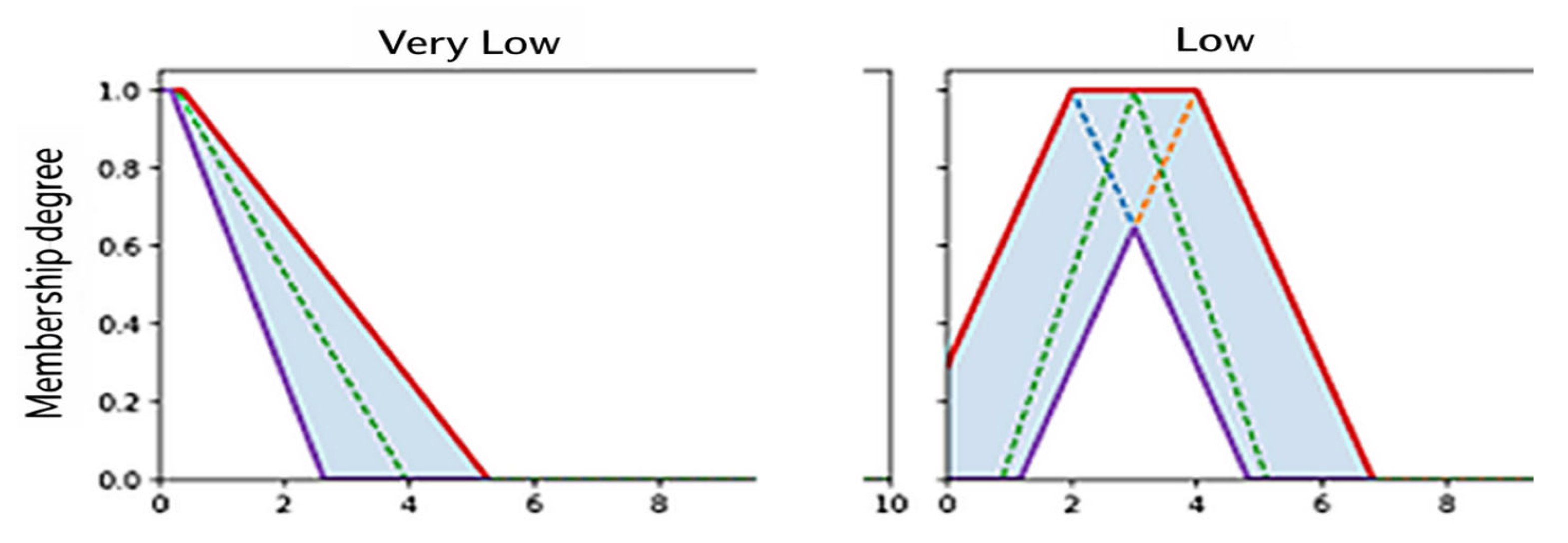
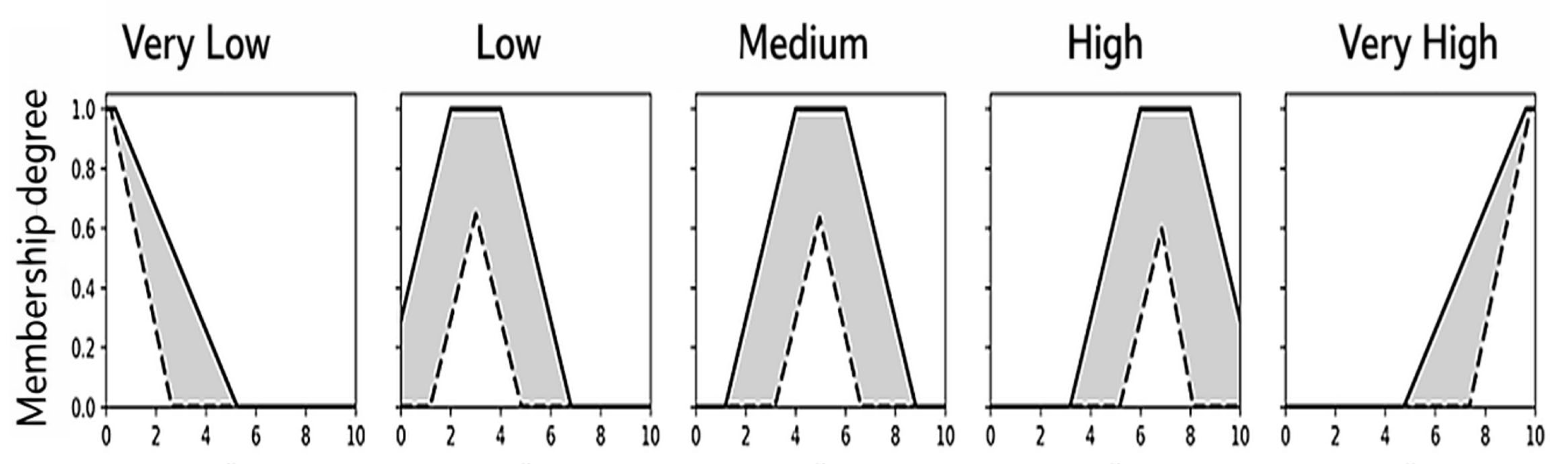
To evaluate the performance of the developed IT2FLS-based predictive model, an empirical experiment was conducted involving 33 graduation projects assessed by various expert supervisors at the University of Tabuk, Saudi Arabia. These 33 projects represent the supervised group projects available during the research period and were used for initial validation. Future work will test the framework with larger and more diverse datasets from other institutions and disciplines. Expert supervisors were invited to provide assessments of their respective groups’ performance during the early stages of project execution. The supervisor assessments covered five input variables: (1) clarity of the project idea, (2) quality of project planning, (3) overall technical competency, (4) early group commitment, and (5) teamwork and collaboration quality. The evaluated level of support needed and the failure risk were used as the system outputs. After the gathering of input and output data in this phase, the interval type-2 fuzzy sets were generated using the linguistic variables presented in Section 3.1 (see Figure 2 for the extracted interval type-2 fuzzy sets representing the required level of support). These fuzzy sets capture the uncertainty in each expert’s individual perspective regarding linguistic labels that describe the characteristics and support requirements. All experts were asked to represent and model linguistic variables from their perspectives, and then they were analysed using the method introduced in [52] (see Figure 3 for the obtained interval type-2 fuzzy set FOU for the “Very Low” and “Low” linguistic terms).
Subsequently, the rules were extracted from the collected data using the one-pass learning algorithm described in [53,54], as discussed in Section 3.2. Two of the extracted rules are presented as representative examples of two different supervisory decision situations generated by the proposed IT2FLS framework: R4 reflects a high-support and high-risk student group project, whereas R8 shows a low-support and low-risk project case.
  • R4: If the clarity of the project idea is low, the quality of group project planning is very low, the overall technical competency is medium, early group commitment is low, and the teamwork collaboration quality is medium, then the level of support needed is very high, and the failure risk is high.
  • R8: If the clarity of the project idea is very high, the quality of group project planning is very high, the overall technical competency is high, early group commitment is high, and the teamwork collaboration quality is high, then the level of support needed is low, and the failure risk is very low.
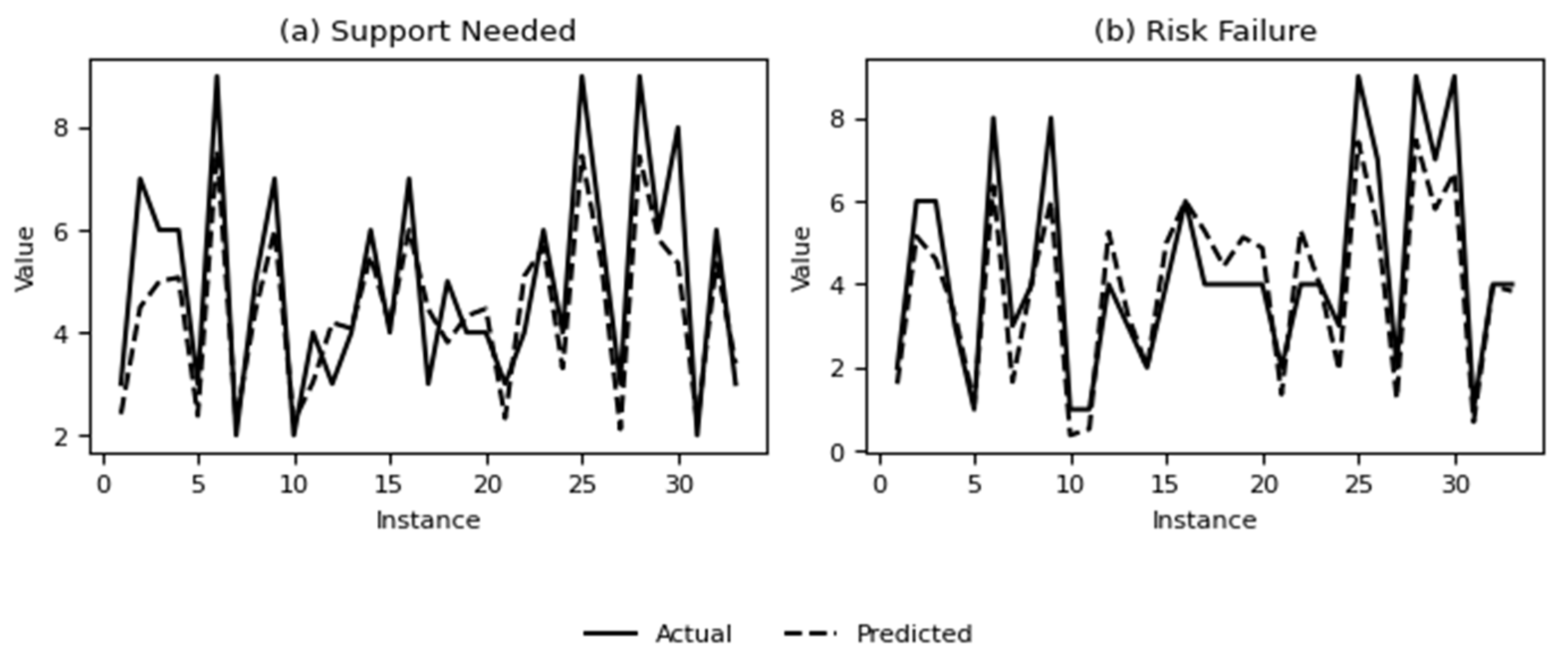
The predictive capability of the proposed IT2FLS was assessed, and the results demonstrate that it produces lower average prediction error and standard deviation when compared to the T1FLSs for both outputs: the actual level of support needed and the failure risk. The average prediction error was calculated as the average absolute difference between the system prediction and the corresponding expert supervisor’s evaluation. The standard deviation was used to show how much the prediction errors varied across the evaluated group projects. Lower values indicate more consistent prediction performance. The system achieved average prediction errors of 0.85 and 0.84 and average standard deviations of 0.92 and 0.98, respectively, for the two outputs. These results, presented in Table 1 and Figure 4, demonstrate a high degree of accuracy in modelling the relationship between early-stage performance inputs and the required intervention guidance for novice supervisors.
The findings indicate that the IT2FLS effectively captures the complex and qualitative aspects of group performance assessment while providing reliable predictions at early stages. Furthermore, the IT2FLS enhances the modelling of group dynamics and assessment outcomes, thus confirming the suitability of fuzzy logic as a decision support mechanism for academic project supervision.

5. Conclusions

This paper proposes an IT2FLS for predicting the early level of support needed and the failure risk for student group projects in higher education. The proposed theoretical and practical framework addresses a significant limitation in traditional supervisory assessment practices, which largely depend on supervisors’ expertise and subjective evaluations of project and student group characteristics during the project development process. This self-learning system correlates supervisors’ early-stage assessments of student group projects with their related early intervention decisions, enabling it to learn and predict the required level of support and the risk of failure based on evaluations of project idea clarity, planning effectiveness, technical competency, teamwork quality, and group commitment. This approach supports proactive evaluation and timely pedagogical intervention through a white-box, interpretable, and practical IT2FLS that enables novice academic supervisors to identify potential performance risks at an early stage within realistic educational contexts. The system achieved a lower average prediction error and standard deviation compared to the T1FLS, thus demonstrating its effectiveness in handling the numerical and linguistic uncertainties inherent in supervisors’ evaluations of group projects. This study has some limitations, as the evaluation used 33 student group projects from one higher education context. Therefore, the findings should be treated as an initial validation. In addition, the system depends on expert-learned rules and membership functions, which should be tested with larger and more diverse datasets.
Future work could benefit from improving the proposed system to integrate additional input variables and outputs. Furthermore, the model could be improved by employing larger experimental datasets while developing general type-2 fuzzy logic systems to address the significant linguistic and numerical uncertainties inherent in educational contexts. Future work will include comparisons with other machine learning methods and fuzzy-based models. Finally, additional evaluations could provide deeper insights into the application of the model and its impact on student outcomes in supervised group projects.

Funding

This research received no external funding. The APC was funded by the author.

Data Availability Statement

The data presented in this study are available on request from the author. The data are not publicly available due to privacy considerations related to student project records.

Conflicts of Interest

The author declares no conflicts of interest.

References

  1. Wang, Z.; Gupta, S.; Page, F.; Agg, C.; Spivey, A.C.; Hazeri, K.; Zou, Y.; Zhao, C.; Lucas, C.; Childs, P.R.N. Group Project Practices and Guidance in Higher Education Contexts. Front. Educ. 2025, 10, 1614627. [Google Scholar] [CrossRef]
  2. Zou, Y.; Luh, D.-B.; Pintong, S. Exploration on the Teaching Method of Professional Fashion Performance Based on the Model of Capstone Courses. Fibres Text. East. Eur. 2023, 31, 66–77. [Google Scholar] [CrossRef]
  3. Triantafyllou, E.; Xylakis, E.; Nilsson, N.C.; Timcenko, O. Employing Learning Analytics for Monitoring Student Learning Pathways during Problem-Based Learning Group Work: A Novel Approach. In Proceedings of the 7th International Research Symposium on PBL: Innovation, PBL and Competences in Engineering Education, Aalborg, Denmark, 19–21 October 2018; pp. 542–551. [Google Scholar]
  4. Volkov, A.; Volkov, M. Teamwork Benefits in Tertiary Education: Student Perceptions That Lead to Best Practice Assessment Design. Educ. Train. 2015, 57, 262–278. [Google Scholar] [CrossRef]
  5. UNESCO. School and Teaching Practices for Twenty-First Century Challenges: Lessons from the Asia-Pacific Region; UNESCO: Bangkok, Thailand, 2016. [Google Scholar]
  6. van der Marel, I.; Munneke, L.; de Bruijn, E. Supervising Graduation Projects in Higher Professional Education: A Literature Review. Educ. Res. Rev. 2022, 37, 100462. [Google Scholar] [CrossRef]
  7. Healey, M.; Lannin, L.; Stibbe, A.; Derounian, J. Developing and Enhancing Undergraduate Final Year Projects and Dissertations; Higher Education Academy: York, UK, 2013. [Google Scholar]
  8. Losse, M.; Nahuis, R. Professional Products as Curricular Backbone: A Model for Contextualizing Research Abilities in Higher Education. In Crossing Borders and Creating Future Competences; Aholaakko, T., Komulainen, K., Majakulma, A., Niinistö-Sivuranta, S., Eds.; Laurea Publications: Vantaa, Finland, 2016; pp. 58–66. [Google Scholar]
  9. Al-Doubi, S.; Fawzi, H.; Walters, J. Undergraduate Research Supervision: A Case Study of Supervisors’ Perceptions at Yanbu University College. High. Educ. Stud. 2019, 9, 112–121. [Google Scholar] [CrossRef]
  10. Mårtensson, M.; Söderström, J. How Does Supervision Shape Student Thesis Outcomes? Expanding the Theory and Measurement of Supervision and Its Impact. J. Polit. Sci. Educ. 2025, 22, 1–18. [Google Scholar] [CrossRef]
  11. Armstrong, S. The Impact of Supervisors’ Cognitive Styles on the Quality of Research Supervision in Management Education. Br. J. Educ. Psychol. 2004, 74, 599–616. [Google Scholar] [CrossRef]
  12. Veuger, S.; Gallagher, S.; Creighton, H.; Robson, I.; Cookson, L.; Ridley, M. Uncovering Expectations and Perceptions of the Final Year UG Dissertation—Supporting the Student Research Journey and Enhancing Their Graduate Attributes. In Proceedings of the 5th Teaching and Education Conference, Amsterdam, The Netherlands, 19–22 June 2018. [Google Scholar] [CrossRef]
  13. Flipsen, B.; Persaud, S.; Magyari, R. Students’ Perspectives on Challenges within Multi-Diverse Design Teams. In Proceedings of the 23rd International Conference on Engineering and Product Design Education (E&PDE), Herning, Denmark, 9–10 September 2021. [Google Scholar] [CrossRef]
  14. Mosher, G. Enhancing Team-Based Senior Capstone Projects: Opportunities and Challenges. In Proceedings of the ASEE North Midwest Section Conference, Iowa City, IA, USA, 17 October 2014. [Google Scholar] [CrossRef]
  15. Bahtilla, M. Supervisory Feedback: Supervisors’ Reasons for Not Giving Timely Feedback. Innov. Educ. Teach. Int. 2022, 60, 741–751. [Google Scholar] [CrossRef]
  16. Manathunga, C. Early Warning Signs in Postgraduate Research Education: A Different Approach to Ensuring Timely Completions. Teach. High. Educ. 2005, 10, 219–233. [Google Scholar] [CrossRef]
  17. Baltes, B.; Brown, M. Impact of Additional Early Feedback on Doctoral Capstone Proposal Approval. J. Online Grad. Educ. 2018, 1, n2. [Google Scholar] [CrossRef]
  18. Noor, M.M.; Turiman, S.; Suppiah, P.C.; Sankaran Nair, S.S.K.; Hussin, A.A. Undergraduate Final Year Project Supervision: A Preliminary Study of Supervisee-Supervisor’s Expectations. Int. J. Acad. Res. Progress. Educ. Dev. 2023, 12, 802–819. [Google Scholar] [CrossRef]
  19. Nouri, J.; Larsson, K.; Saqr, M. Bachelor Thesis Analytics: Using Machine Learning to Predict Dropout and Identify Performance Factors. Int. J. Learn. Anal. Artif. Intell. Educ. 2019, 1, 116–131. [Google Scholar] [CrossRef][Green Version]
  20. Ramos, D.X.; Jiménez Toledo, J.A. Machine Learning as a Teaching Strategy Education: A Review. EAI Endorsed Trans. Scalable Inf. Syst. 2024, 11. [Google Scholar] [CrossRef]
  21. Arishi, H.; Falkner, N.J.G.; Treude, C.; Atapattu, T. Systematic Literature Review on Machine Learning Research in Education. In Proceedings of the IEEE Frontiers in Education Conference (FIE), Washington, DC, USA, 13–16 October 2024. [Google Scholar] [CrossRef]
  22. Ersozlu, Z.; Taheri, S.; Koch, I. A Review of Machine Learning Methods Used for Educational Data. Educ. Inf. Technol. 2024, 29, 22125–22145. [Google Scholar] [CrossRef]
  23. Farooqui, Y.; Shekokar, K.; Bhatt, P.; Macwan, K. Explainable Fuzzy Logic in AI: Enhancing Transparency and Trust in Deep Learning Models. J. Mach. Comput. 2025, 5, 2241–2253. [Google Scholar] [CrossRef]
  24. Pintelas, E.G.; Livieris, I.; Pintelas, P. A Grey-Box Ensemble Model Exploiting Black-Box Accuracy and White-Box Intrinsic Interpretability. Algorithms 2020, 13, 17. [Google Scholar] [CrossRef]
  25. Casalino, G.; Ducange, P.; Fazzolari, M.; Pecori, R. Incremental and Interpretable Learning Analytics through Fuzzy Hoeffding Decision Trees. In Proceedings of the International Workshop on Higher Education Learning Methodologies and Technologies Online, Palermo, Italy, 21–23 September 2022. [Google Scholar] [CrossRef]
  26. Casalino, G.; Castellano, G.; Kaczmarek-Majer, K.; Schicchi, D.; Taibi, D.; Zaza, G. Evolving Fuzzy Classification for Human-Centered Explainable Learning Analytics in Virtual Environments. Evol. Syst. 2025, 16, 119. [Google Scholar] [CrossRef]
  27. Vygotsky, L.S. Mind in Society: The Development of Higher Psychological Processes; Harvard University Press: Cambridge, MA, USA, 1978. [Google Scholar]
  28. Johnson, D.W.; Johnson, R.T. Cooperation and Competition: Theory and Research; Interaction Book Company: Edina, MN, USA, 1989. [Google Scholar]
  29. Boud, D.; Cohen, R.; Sampson, J. Peer Learning in Higher Education: Learning from and with Each Other; Kogan Page: London, UK, 2001. [Google Scholar] [CrossRef]
  30. Hmelo-Silver, C.E. Problem-Based Learning: What and How Do Students Learn? Educ. Psychol. Rev. 2004, 16, 235–266. [Google Scholar] [CrossRef]
  31. Hussein, B. Addressing Collaboration Challenges in Project-Based Learning: The Student Perspective. Educ. Sci. 2021, 11, 434. [Google Scholar] [CrossRef]
  32. Passow, H.J.; Passow, C.H. What Competencies Should Undergraduate Engineering Programs Emphasize? A Systematic Review. J. Eng. Educ. 2017, 106, 475–526. [Google Scholar] [CrossRef]
  33. Vereijken, M.; van der Rijst, R.M.; van Driel, J.H.; Dekker, F.W. Novice Supervisors’ Practices and Dilemmatic Space in Supervision of Student Research Projects. Teach. High. Educ. 2018, 23, 522–542. [Google Scholar] [CrossRef]
  34. Daley, B.J. Novice to Expert: An Exploration of How Professionals Learn. Adult Educ. Q. 1999, 49, 133–147. [Google Scholar] [CrossRef]
  35. Govaerts, M.J.B.; van de Wiel, M.W.J.; van der Vleuten, C.P.M. Quality of Feedback Following Performance Assessments: Does Assessor Expertise Matter? Eur. J. Train. Dev. 2013, 37, 105–125. [Google Scholar] [CrossRef]
  36. Lindgren, U. Mentorship as a Tool for Transferring Knowledge and Experience to Novice Research Supervisors. In Proceedings of the European Conference on Educational Research (ECER), Geneva, Switzerland, 13–16 September 2006; pp. 1–8. [Google Scholar]
  37. Romero, C.; Ventura, S. Educational Data Mining: A Review of the State of the Art. IEEE Trans. Syst. Man. Cybern. Part C 2010, 40, 601–618. [Google Scholar] [CrossRef]
  38. Arnold, K.E.; Pistilli, M.D. Course Signals at Purdue: Using Learning Analytics to Increase Student Success. In Proceedings of the 2nd International Conference on Learning Analytics and Knowledge, Vancouver, BC, Canada, 29 April–2 May 2012; pp. 267–270. [Google Scholar] [CrossRef]
  39. Jayaprakash, S.M.; Moody, E.W.; Lauria, E.J.M.; Regan, J.R.; Baron, J.D. Early Alert of Academically At-Risk Students: An Open Source Analytics Initiative. J. Learn. Anal. 2014, 1, 6–47. [Google Scholar] [CrossRef]
  40. Fu, Q.-W.; Liu, Q.-H.; Hu, T. Multi-Objective Optimization Research on VR Task Scenario Design Based on Cognitive Load. Facta Univ. Ser. Mech. Eng. 2024, 22, 293–313. [Google Scholar] [CrossRef]
  41. Zadeh, L.A. Fuzzy Sets. Inf. Control 1965, 8, 338–353. [Google Scholar] [CrossRef]
  42. Anapalı Şenel, A.; Göksu, B.; Şenel, E.; Solmaz, F.İ. Predicting Academic Performance with Fuzzy Logic in Prospective Physical Education and Sports Teachers. Sci. Rep. 2025, 15, 28241. [Google Scholar] [CrossRef]
  43. Hu, J.; Wang, H.; Ji, D. Educational Performance Evaluation Based on Fuzzy Evaluation Model. Discov. Comput. 2025, 28, 345. [Google Scholar] [CrossRef]
  44. Izzati, A.N.; Latif, U.K.; Sintiya, E.S. Prediction of Higher Education Student Academic Achievement Using Mamdani Fuzzy Logic. J. Adv. Inf. Ind. Technol. 2025, 7, 71–82. [Google Scholar] [CrossRef]
  45. Hegazi, M.O.; Almaslukh, B.; Siddig, K. A Fuzzy Model for Reasoning and Predicting Students’ Academic Performance. Appl. Sci. 2023, 13, 5140. [Google Scholar] [CrossRef]
  46. Sweetlin, P.; Jayalalitha, G. Enhancing Educational Systems with Fuzzy Logic-Based Decision-Making Frameworks. In Proceedings of the 2025 International Conference on Networks and Cryptology (NETCRYPT), New Delhi, India, 29–31 May 2025; pp. 422–426. [Google Scholar] [CrossRef]
  47. Yang, J. Fuzzy Comprehensive Evaluation System and Decision Support System for Learning Management of Higher Education Online Courses. Sci. Rep. 2025, 15, 17515. [Google Scholar] [CrossRef] [PubMed]
  48. Troussas, C.; Krouska, A.; Sgouropoulou, C. Personalized Instructional Strategy Adaptation Using TOPSIS. Information 2025, 16, 409. [Google Scholar] [CrossRef]
  49. Zimmermann, H.J. Fuzzy Set Theory and Its Applications, 4th ed.; Kluwer Academic Publishers: Boston, MA, USA, 2001. [Google Scholar] [CrossRef]
  50. Mendel, J.M. Uncertain Rule-Based Fuzzy Logic Systems: Introduction and New Directions; Prentice Hall: Upper Saddle River, NJ, USA, 2001. [Google Scholar]
  51. Almohammadi, K.; Hagras, H. An Interval Type-2 Fuzzy Logic Based System for Customised Knowledge Delivery within Pervasive E-Learning Platforms. In Proceedings of the IEEE International Conference on Systems, Man, and Cybernetics, Manchester, UK, 13–16 October 2013; pp. 2872–2879. [Google Scholar] [CrossRef]
  52. Liu, F.; Mendel, J. An Interval Approach to Fuzzistics for Interval Type-2 Fuzzy Sets. In Proceedings of the IEEE International Conference on Fuzzy Systems, London, UK, 23–26 June 2007; pp. 1030–1035. [Google Scholar] [CrossRef]
  53. Wang, L.X. The WM Method Completed: A Flexible System Approach to Data Mining. IEEE Trans. Fuzzy Syst. 2003, 11, 768–782. [Google Scholar] [CrossRef]
  54. Hagras, H.; Doctor, F.; Lopez, A.; Callaghan, V. An Incremental Adaptive Life-Long Learning Approach for Type-2 Fuzzy Embedded Agents in Ambient Intelligent Environments. IEEE Trans. Fuzzy Syst. 2007, 15, 41–55. [Google Scholar] [CrossRef]
Figure 1. (a) Structure of the T2FLS; (b) interval type-2 fuzzy set with UMF, LMF, and FOU (adopted from [51]).
Computers 15 00347 g001
Figure 2. Obtained output interval type-2 fuzzy sets representing the level of support required. The horizontal axis represents the assessment scale; the vertical axis represents the membership degree. The solid line represents the upper membership function, the dashed line represents the lower membership function, and the shaded area between them represents the footprint of uncertainty.
Computers 15 00347 g002
Figure 3. Extracted “Very Low” and “Low” fuzzy sets derived from the opinions of multiple experts. The horizontal axis represents the assessment scale, and the vertical axis represents the membership degree. The red and purple boundary lines show the upper and lower membership functions. The shaded area represents the Footprint of Uncertainty (FOU), and the dashed lines represent the individual expert type-1 fuzzy sets.
Computers 15 00347 g003
Figure 4. Actual versus predicted outputs extracted by the IT2FLS for (a) support needed and (b) failure risk. The horizontal axis represents the evaluated group projects, and the vertical axis represents the output value. The solid lines represent the actual values, and the dashed lines represent the predicted values.
Computers 15 00347 g004
Table 1. Comparison of IT2FLS and T1FLS performance metrics.
Output NameIT2FLS
Average Error
IT2FLS
Average Standard Deviation
T1FLS
Average Error
T1FLS
Average Standard Deviation
Level of support needed0.85220.92150.99431.44
Level of failure risk0.84580.98090.89091.27
Disclaimer/Publisher’s Note: The statements, opinions and data contained in all publications are solely those of the individual author(s) and contributor(s) and not of MDPI and/or the editor(s). MDPI and/or the editor(s) disclaim responsibility for any injury to people or property resulting from any ideas, methods, instructions or products referred to in the content.