
Non-Standard Squat Posture Detection Method Using Human Skeleton

Abstract
1. Introduction
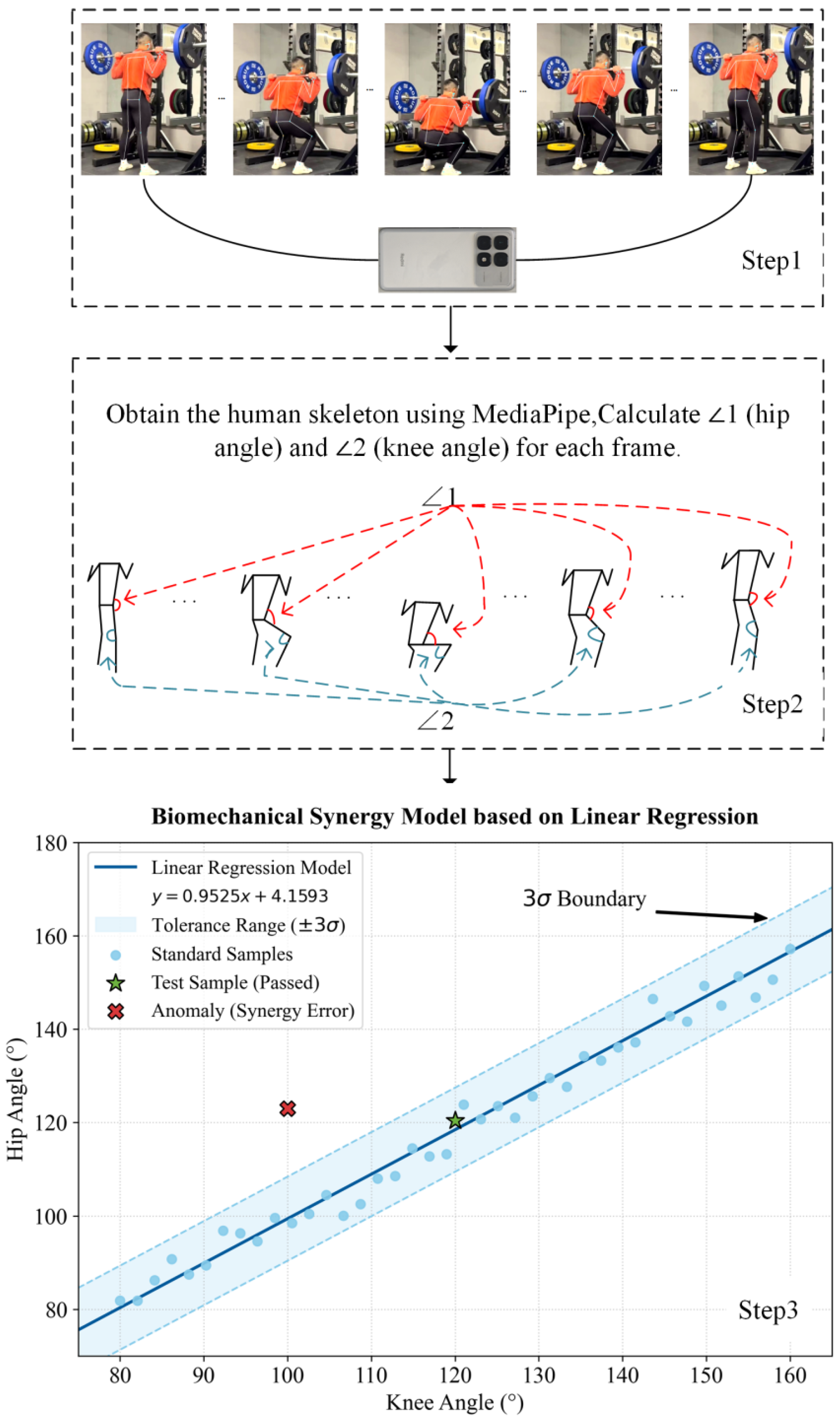
- Dynamic modeling of hip-knee coordination based on linear regression: Aiming at the limitation that conventional methods fail to adequately account for inter-joint synergism, this paper draws on the classical angle-angle diagram analysis concept from biomechanics, and refers to the work of Fuglsang et al. [23], who applied linear regression to evaluate limb motion characteristics. We innovatively introduce a linear regression model to quantify the dynamic correlation between hip and knee joint angles throughout the entire squat movement. By extracting the slope feature of the hip-knee angular change rate, the proposed algorithm achieves “de-absolutization” of the evaluation criterion. Specifically, the model no longer relies on the absolute height or limb length of individual subjects, but focuses instead on the relative rate of joint motion. This design enables the model to accurately identify synergistic movement errors such as good-morning squats (excessive hip-dominant motion) and knee-dominant squats, and significantly improves the generalizability of the algorithm across populations with diverse body types.
- Robust depth verification based on geometric tolerance: In accordance with Schoenfeld’s [24] biomechanical description of squat movements, the parallel squat (defined as the position where the thigh is parallel to the ground) is widely recognized as a standard squat depth. Nevertheless, Myer et al. [25] point out that a uniform squat depth standard is difficult to generalize for practical detection across individuals. To address this theoretical challenge as well as the joint coordinate jitter caused by mobile device cameras, this paper designs a depth judgment mechanism based on relative position. By calculating the vertical heights of the hip and knee joints and introducing a geometric tolerance, this mechanism allows for a reasonable margin of measurement error and effectively offsets data noise introduced by camera jitter. As a result, the proposed method not only adheres to established biomechanical principles but also greatly improves the system’s robustness in real-world application scenarios.
- Lightweight white-box detection architecture for mobile devices: Current mainstream deep learning-based human action recognition models, such as LSTM, STGCN, and VGG16, generally suffer from drawbacks including excessive parameter volume and substantial computational redundancy. Against this background, this paper innovatively constructs a hierarchical architecture of bottom-layer lightweight keypoint extraction + top-layer geometric statistics. Instead of adopting a black-box end-to-end deep neural network paradigm, the proposed structure does not require massive computational overhead. While maintaining an overall recognition accuracy of 91.67%, our method achieves an ultra-high inference speed of 98,000 FPS. This greatly lowers the deployment barrier for the algorithm on resource-constrained end devices such as ordinary mobile terminals, and provides a feasible, lightweight paradigm for low-latency, real-time movement correction in popular mass fitness scenarios.
- Step 1: A continuous sequence of squats is recorded using a mobile device and then segmented into individual squat clips, ensuring each clip contains one complete descent-and-ascent movement.
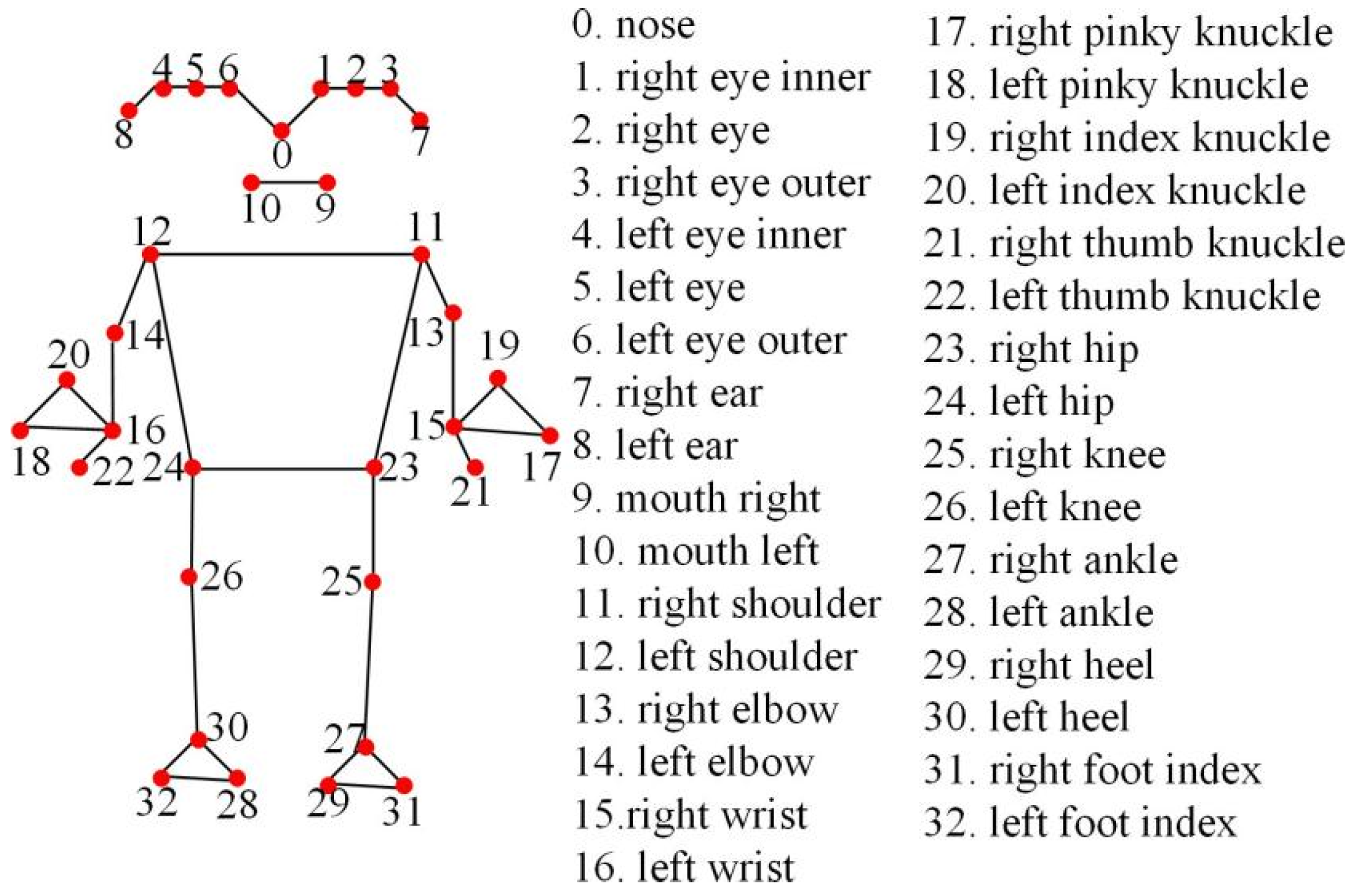
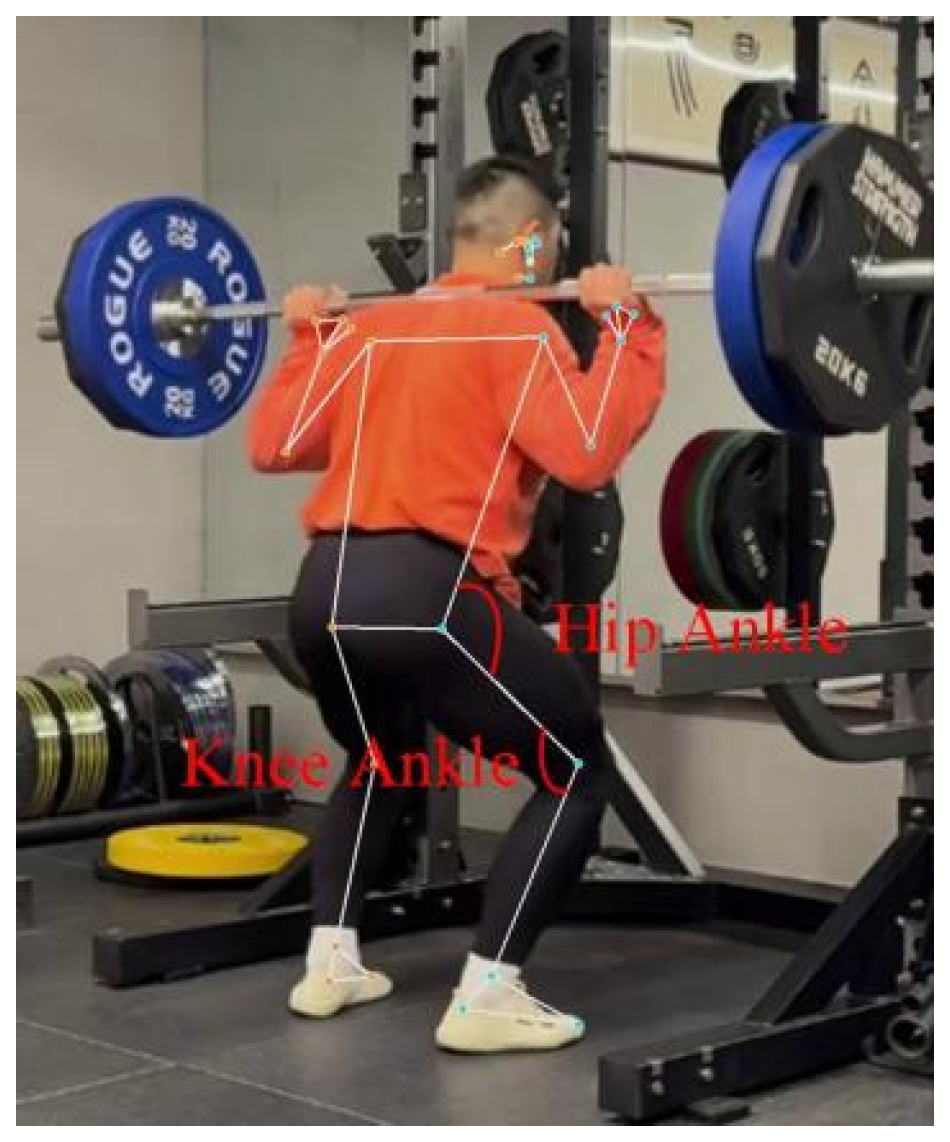
- Step 2: The MediaPipe framework is used to extract 33 human skeletal keypoint coordinates frame by frame for each action, and the left and right hip joint and knee joint angles are calculated for each frame of every sample (see Section 1.2 for details).
- Step 3: 80% of the samples in the standard squat category are selected to fit the slope, intercept, and threefold standard deviation of the left and right curves. The final fitting curve is obtained by averaging these values (see Section 1.3.1 for details). Combined with the designed squat depth judgment rule (see Section 1.3.2 for details), the entire model is constructed. A test sample is classified as a standard movement only if it passes both judgments.

1.1. MediaPipe
1.2. Key Joint Acquisition and Angle Calculation
1.3. Squat Standardization Determination Algorithm Based on Geometric Statistical Model
1.3.1. Hip-Knee Synergy Determination Based on Linear Regression
1.3.2. Squat Depth Validation Based on Geometric Tolerance
2. Experiments and Results
2.1. Experimental Environment and Dataset
2.2. Data Splitting Strategy
- Splitting of positive samples (standard squats): All standard squat samples were grouped by subject ID. Data from 80% of the subjects were allocated to the training set. This set was used to fit the linear regression model parameters (k, b). It also calculated the statistical tolerance threshold (σ). Data from the remaining 20% of the subjects formed the validation set. This set evaluated the model’s recognition rate for unseen standard movements.
- Splitting of negative samples: This study adopts an anomaly detection approach based on a normal distribution. Consequently, the model only needs to learn “what is correct.” Therefore, incorrect movement samples (shallow and good morning squats) were excluded from the training phase. Instead, they were entirely assigned to the test set. This verified the model’s interception capability against different types of incorrect movements.
2.3. Experimental Results and Analysis
- Performance on standard squats: On the validation set consisting of 72 standard squat samples, the system achieves a recognition accuracy of 98.61%, and the pass rate under the soft constraint (coordination judgment) reaches 100%. This demonstrates that the linear regression model based on the 3σ statistical interval can adapt to subjects with diverse body types and effectively compensate for joint coordinate jitter detected by MediaPipe.
- Performance on shallow squats: For the 38 shallow squat samples, the pass rate under the hard constraint is merely 23.68%, which effectively rejects most movements that fail to meet the required depth standard. Meanwhile, the pass rate of these samples under the soft constraint reaches 100%. This result carries important biomechanical implications, demonstrating that the proposed algorithm can independently evaluate motion trajectory and motion range. In other words, the system can identify that the subject’s hip-knee coordination mechanism is correct, while the squat depth fails to reach the parallel standard.
- Performance on “good morning” squats: In the test for “good morning squat” movements, the algorithm successfully rejected 100% of such samples. In this type of movement, the hip extension rate is significantly faster than the knee extension rate, which severely violates the linear linkage rule of k = 0.9525. Consequently, the residual far exceeds the 3σ tolerance threshold. This indicates that the linear regression–based dynamic modeling is highly sensitive for detecting such high-risk compensatory movements.
2.4. Comparison with Mainstream Methods
2.5. Hard Case Analysis
3. Conclusions and Future Work
Author Contributions
Funding
Data Availability Statement
Conflicts of Interest
References
- Kawada, K.; Yokoyama, Y.; Tamura, M.; Okazaki, Y.; Ozaki, T.; Furumatsu, T. Occupational motions such as kneeling and squatting are associated with theincreased development of medial meniscus posterior root tears. J. Orthop. Sci. 2025, 30, 106–114. [Google Scholar]
- Xie, P.; István, B.; Liang, M. The relationship between patellofemoral pain syndrome and hipbiomechanics: A systematic review with meta-analysis. Healthcare 2023, 11, 99. [Google Scholar] [CrossRef] [PubMed]
- García-Jaén, M.; Del Barrio-Ventura, A.; Sanchis-Soler, G.; Sebastiá-Amat, S. Exercise-based therapeutic interventions for lumbar disc herniation: A narrative review. J. Phys. Educ. Sport 2025, 25, 825–832. [Google Scholar]
- Yin, Y.; Xie, L.; Jiang, Z.; Xiao, F.; Cao, J.; Lu, S. A Systematic Review of Human Activity Recognition Based on Mobile Devices: Overview, Progress and Trends. IEEE Commun. Surv. Tutor. 2024, 26, 890–929. [Google Scholar] [CrossRef]
- Shin, J.; Hassan, N.; Miah, A.S.M.; Nishimura, S. A Comprehensive Methodological Survey of Human Activity Recognition Across Diverse Data Modalities. Sensors 2025, 25, 4028. [Google Scholar] [CrossRef]
- Kim, J.W.; Choi, J.Y.; Ha, E.J.; Choi, J.H. Human Pose Estimation Using MediaPipe Pose and Optimization Method Based on a Humanoid Model. Appl. Sci. 2023, 13, 2700. [Google Scholar] [CrossRef]
- Sejera, M.M.; Arzobal, E.A.B.; Soliongco, J.G.R. Real-time deadlift form analysis using support vector machine algorithm and Kinect V2 sensor. In Proceedings of the 5th Eurasia Conference on IoT, Communication and Engineering (ECICE), Yunlin, Taiwan, 27–29 October 2023; pp. 722–726. [Google Scholar]
- Wu, Z.; Gu, H.; Hong, R.; Xing, Z.; Zhang, Z.; Peng, K.; He, Y.; Xie, L.; Zhang, J.; Gao, Y.; et al. Kinect-based objective evaluation of bradykinesia in patients with Parkinson’s disease. Digit. Health 2023, 9, 20552076231176653. [Google Scholar] [CrossRef]
- Shanmugam, S.; Narayanan, R.S. An accurate estimation of hand gestures using optimal modified convolutional neural network. Expert Syst. Appl. 2024, 249, 123351. [Google Scholar] [CrossRef]
- Murad, K.; Alasadi, A.H.H. Advancements and Challenges in Hand Gesture Recognition: A Comprehensive Review. Iraqi J. Electr. Electron. Eng. 2024, 20, 154–164. [Google Scholar] [CrossRef]
- Dhiman, R.; Luthra, P.; Singh, N.T. Different categories of feature extraction and machine learning classification models used for hand gesture recognition systems: A review. In Proceedings of the 2023 IEEE 8th International Conference for Convergence in Technology (I2CT), Lonavla, India, 7–9 April 2023; pp. 1–7. [Google Scholar]
- Lin, B.S.; Liu, K.J.; Tseng, W.H.; Ahmed, A.M.; Wang, H.C.; Lin, B.S. A Deep Learning-Based Chair System That Detects Sitting Posture. IEEE J. Biomed. Health Inform. 2024, 28, 482–493. [Google Scholar] [CrossRef]
- Hu, H.; Shi, X.; Song, W.; Yang, Y.; Zhang, J. Research Progress of Intelligent Sitting Posture Monitoring Systems: A Survey. IEEE Trans. Instrum. Meas. 2025, 74, 9527923. [Google Scholar] [CrossRef]
- Jin, H.; He, X.; Wang, L.; Zhu, Y.; Jiang, W.; Zhou, X. SitPose: Real-Time Detection of Sitting Posture and Sedentary Behavior Using Ensemble Learning with Depth Sensor. IEEE Sens. J. 2024, 25, 12444–12454. [Google Scholar] [CrossRef]
- Owusu, E.; Acquah, I.; Asare, M.A.; Yeboah, B.A. LiteFallNet: A lightweight deep learning model for efficient real-time fall detection. Digit. Health 2025, 11, 20552076251386698. [Google Scholar] [CrossRef] [PubMed]
- Jiang, Z.; Al-Qaness, M.A.; Al-Alimi, D.; Ewees, A.A.; Abd Elaziz, M.; Dahou, A.; Helmi, A.M. Fall Detection Systems for Internet of Medical Things Based on Wearable Sensors: A Review. IEEE Internet Things J. 2024, 11, 34797–34810. [Google Scholar] [CrossRef]
- Liu, J.; Li, X.; Huang, S.; Chao, R.; Cao, Z.; Wang, S.; Wang, A.; Liu, L. A review of wearable sensors based fall-related recognition systems. Eng. Appl. Artif. Intell. 2023, 121, 105993. [Google Scholar] [CrossRef]
- Cao, M.; Wan, J.; Gu, X. CLEAR: Multimodal Human Activity Recognition via Contrastive Learning Based Feature Extraction Refinement. Sensors 2025, 25, 896. [Google Scholar] [CrossRef]
- Ko, Y.M.; Nasridinov, A.; Park, S.H. Real-time AI posture correction for powerlifting exercises using YOLOv5 and MediaPipe. IEEE Access 2024, 12, 195830–195853. [Google Scholar] [CrossRef]
- Lugaresi, C.; Tang, J.; Nash, H.; McClanahan, C.; Uboweja, E.; Hays, M.; Zhang, F.; Chang, C.L.; Yong, M.; Lee, J.; et al. MediaPipe: A framework for perceiving and processing reality. In Proceedings of the 3rd Workshop on Computer Vision for AR/VR at IEEE Conference on Computer Vision and Pattern Recognition (CVPR), Long Beach, CA, USA, 17 June 2019. [Google Scholar]
- Sirikongtham, P.; Nimkoompai, A. A new method for real-time fall detection based on MediaPipe pose estimation and LSTM. Int. J. Adv. Comput. Sci. Appl. 2025, 16, 107. [Google Scholar] [CrossRef]
- Garg, S.; Saxena, A.; Gupta, R. Yoga pose classification: A CNN and MediaPipe inspired deep learning approach for real-world application. J. Ambient Intell. Humaniz. Comput. 2023, 14, 16551–16562. [Google Scholar] [CrossRef]
- McKean, M.; Burkett, B.J. Does segment length influence the hip, knee, and ankle coordination during the squat movement? J. Fit. Res. 2012, 1, 23–30. [Google Scholar]
- Schoenfeld, B.J. Squatting kinematics and kinetics and their application to exercise performance. J. Strength Cond. Res. 2010, 24, 3497–3506. [Google Scholar] [CrossRef]
- Myer, G.D.; Kushner, A.M.; Brent, J.L.; Schoenfeld, B.J.; Hugentobler, J.; Lloyd, R.S.; Vermeil, A.; Chu, D.A.; Harbin, J.; McGill, S.M. The back squat: A proposed assessment of functional deficits and technical factors that limit performance. Strength Cond. J. 2014, 36, 4–27. [Google Scholar] [CrossRef]


| Category | Sample Size | Hard Constraint | Soft Constraint | Final Pass Rate |
|---|---|---|---|---|
| Standard Squat | 72 | 98.61% | 100% | 98.61% |
| Shallow Squat | 38 | 23.68% | 100% | 23.68% |
| Good Morning Squat | 10 | 0% | 0% | 0% |
| Method | TP | FP | FN | TN | Precision | Recall | F1-Score | Accuracy |
|---|---|---|---|---|---|---|---|---|
| LSTM | 54 | 13 | 0 | 0 | 80.60% | 100.00% | 0.8926 | 80.59% |
| ST-GCN | 48 | 1 | 6 | 12 | 97.96% | 88.89% | 0.9320 | 89.55% |
| VGG16 | 48 | 3 | 6 | 10 | 94.12% | 88.89% | 0.9143 | 86.56% |
| RESNET-50 | 43 | 0 | 11 | 13 | 100.00% | 79.63% | 0.8866 | 83.58% |
| 1D-CNN | 54 | 13 | 0 | 0 | 80.60% | 100.00% | 0.8926 | 80.59% |
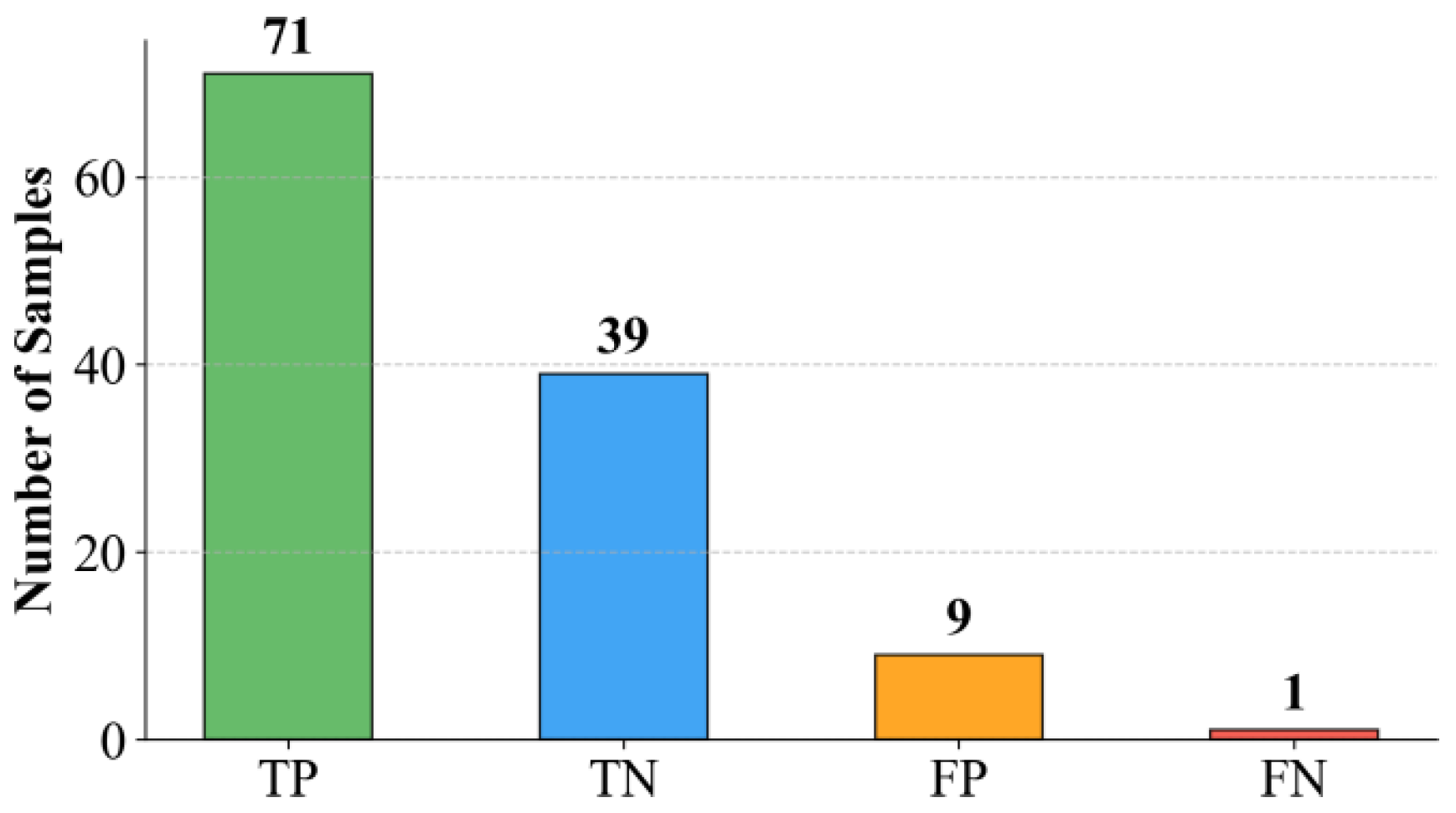
| Proposed | 71 | 9 | 1 | 39 | 88.75% | 98.61% | 0.9342 | 91.67% |
| Method | FPS |
|---|---|
| LSTM | 177 |
| ST-GCN | 955 |
| VGG16 | 30 |
| RESNET-50 | 73 |
| 1D-CNN | 3450 |
| Proposed Method | 98,000 |
Disclaimer/Publisher’s Note: The statements, opinions and data contained in all publications are solely those of the individual author(s) and contributor(s) and not of MDPI and/or the editor(s). MDPI and/or the editor(s) disclaim responsibility for any injury to people or property resulting from any ideas, methods, instructions or products referred to in the content. |
© 2026 by the authors. Licensee MDPI, Basel, Switzerland. This article is an open access article distributed under the terms and conditions of the Creative Commons Attribution (CC BY) license.
Share and Cite
Yao, L.; Dai, Z.; Xiong, K. Non-Standard Squat Posture Detection Method Using Human Skeleton. Computers 2026, 15, 293. https://doi.org/10.3390/computers15050293
Yao L, Dai Z, Xiong K. Non-Standard Squat Posture Detection Method Using Human Skeleton. Computers. 2026; 15(5):293. https://doi.org/10.3390/computers15050293
Chicago/Turabian StyleYao, Leiyue, Zhiqiang Dai, and Keyun Xiong. 2026. "Non-Standard Squat Posture Detection Method Using Human Skeleton" Computers 15, no. 5: 293. https://doi.org/10.3390/computers15050293
APA StyleYao, L., Dai, Z., & Xiong, K. (2026). Non-Standard Squat Posture Detection Method Using Human Skeleton. Computers, 15(5), 293. https://doi.org/10.3390/computers15050293