1. Introduction
General Matrix-Matrix Multiplication (GEMM) is one of the most fundamental computational kernels in scientific computing and is widely regarded as the “cornerstone of computing power” that underpins numerous complex applications. Its importance is reflected in both scientific research and engineering practice. In High-Performance Computing (HPC) [
1], widely used benchmarks such as HPL [
2] and HPCC [
3] indicate that GEMM operations account for more than 90% of the total workload [
4,
5,
6]. Consequently, the efficiency of GEMM implementations directly affects the achievable performance of modern supercomputing systems. In large-scale scientific computing scenarios, ranging from Computational Fluid Dynamics (CFD) [
7,
8] to Quantum Chemistry [
9], GEMM frequently becomes a performance-critical component due to its high computational intensity and extensive resource requirements. Given the growing computational demand, researchers have explored both algorithmic and hardware-level strategies to accelerate GEMM.
Specialized hardware accelerators, such as analog in-memory computing (IMC), have been proposed to perform matrix operations directly within memory arrays, reducing data movement and alleviating the memory wall problem [
10,
11,
12]. By exploiting the physical characteristics of emerging memory devices, IMC-based accelerators can achieve high energy efficiency and massive parallelism for linear algebra workloads. However, such accelerators often require specialized hardware and programming models, which limits their general applicability and makes optimization on widely deployed multi-core CPUs both practical and necessary.
Extensive efforts have been devoted to optimizing GEMM on conventional CPUs. Highly optimized linear algebra libraries, such as OpenBLAS [
13], BLIS [
14], and Arm Performance Libraries [
15], achieve near-peak performance for large dense matrices on modern CPU architectures, including ARM platforms, by employing blocking, cache-aware optimizations, and vectorization techniques. Although these libraries perform well for large dense matrices, many real-world workloads involve small-scale or irregular matrices with unbalanced dimensions, irregular shapes, or sparsity [
16]. Such matrices frequently arise in block matrix decomposition, iterative methods [
17], local updates in multiscale simulations [
18], and deep learning [
19] pipelines such as im2col [
20] transformations and attention mechanisms [
21].
While GPUs are commonly used to accelerate dense linear algebra workloads, CPU-only execution remains important in many practical scenarios. Small and irregular matrix multiplications often appear in CPU-resident pipelines or latency-sensitive workloads, where frequent data transfers to a GPU can offset the benefits of offloading. Previous studies have demonstrated that offloading GEMM operations to GPUs can significantly improve performance for large-scale dense computations [
22,
23]; however, these gains may be limited for small or irregular matrices due to kernel launch overhead and fine-grained parallelism constraints. Optimizing CPU-only GEMM is therefore still necessary, particularly in scenarios such as edge inference devices [
24], CPU-resident pre-and post-processing pipelines [
25], or heterogeneous scheduling [
26] where GPU resources are fully utilized. By improving CPU performance for small and irregular matrices, applications can maintain high efficiency without relying on discrete GPU accelerators.
Motivated by these observations, this work focuses on improving the efficiency of small and irregular GEMM operations on ARM-based multi-core processors. Our approach, AGP-GEMM (Adaptive Grouping and Partitioning GEMM), incorporates an adaptive core grouping strategy (ACG), which dynamically adjusts core grouping based on matrix size and available cores to achieve optimal load balancing. In addition, AGP-GEMM employs a block partition selection mechanism that generates optimized partitioning schemes according to the CPU memory hierarchy. This mechanism identifies the short and long dimensions of a matrix and applies tailored partitioning strategies. For example, in a 128 × 30,000 matrix, 128 is treated as the short dimension and 30,000 as the long dimension. Experimental results demonstrate that AGP-GEMM significantly improves GEMM performance for small and irregular matrices on the evaluated ARM platform. Based on this work, our main contributions are summarized as follows:
It proposes an ACG mechanism to dynamically adjust the grouping of CPU cores according to the size of input matrices and the number of available cores, thereby achieving near-optimal load balancing on the CPU.
Building on this, it presents a self-designed adaptive block partitioning mechanism that operates on top of the optimal ACG, generating the best block partitioning scheme for small and irregular matrices. This mechanism aims to enhance hardware utilization and maximize computational efficiency.
Furthermore, it shows that the integration of ACG and adaptive block partitioning significantly improves the performance of GEMM on CPU, particularly for small and irregular matrices, as validated by comparisons with the original linear algebra libraries.
The rest of the paper is organized as follows.
Section 2 discusses motivation, related work, and previous studies relevant to this article.
Section 3 introduces background techniques, such as GEMM and commonly used optimization methods: partitioning, data packing, and kernel. It also explains the differences between GEMM and small, irregular matrices, as well as the working characteristics of CPUs.
Section 4 provides a detailed description of the proposed method. This includes ACG grouping of cores based on matrices and selected cores, adaptive matrix partitioning after grouping, and a summary of both methods.
Section 5 presents and assesses the experimental results. It covers the experimental setup, comparison methods, evaluation indicators, and detailed analysis of results.
Section 6 concludes the article, including the overall summary and discussion of future work.
3. Background
3.1. General Matrix-Matrix Multiplication
GEMM is a fundamental operation in linear algebra, mathematically defined as
where matrix
A has dimensions
, matrix
B has dimensions
, and matrix
C has dimensions
. Scalars
and
are coefficients that scale the product and the existing matrix
C, respectively.
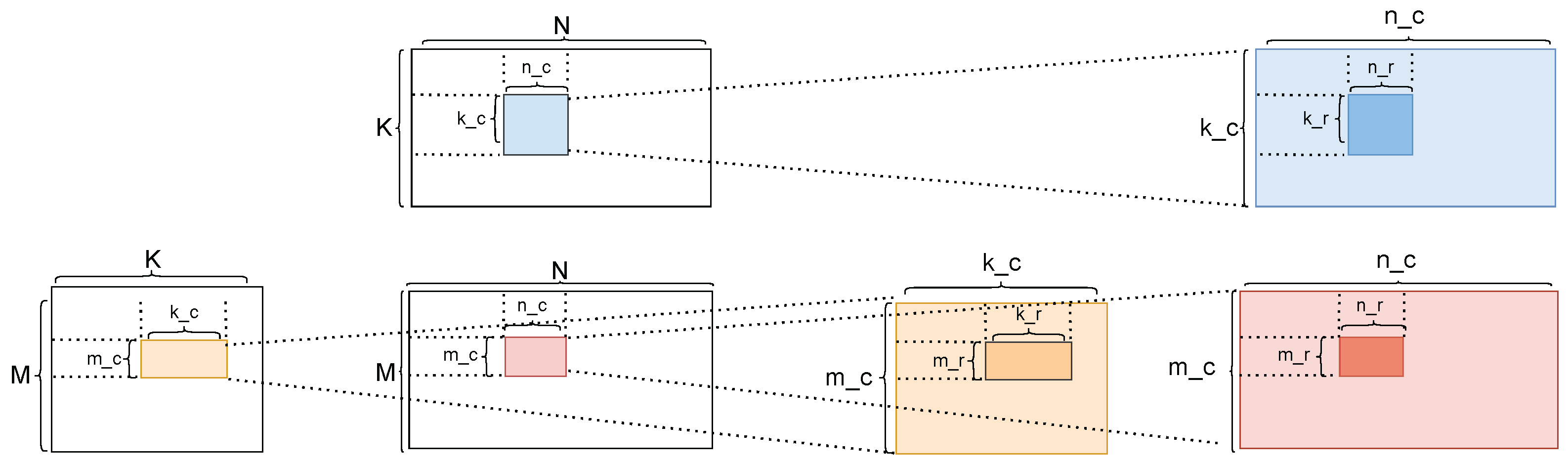
In CPU architectures, matrix multiplication is organized according to the hierarchical memory structure (main memory, cache, and registers), requiring layered blocking to match different access speeds and capacity constraints. First, the matrices are divided into large blocks of size
and
, ensuring that each block fits entirely into the cache and minimizing the need to fetch data from main memory. These cache-level blocks are then further subdivided into smaller sub-blocks of size
and
before computation, allowing the working data to reside completely within the registers. Through such hierarchical blocking, the CPU can effectively maximize register utilization and minimize memory access overhead, as illustrated in
Figure 1.
3.2. Partitioning
In matrix multiplication , blocking (or tiling) is a fundamental optimization technique to fully utilize registers and multi-level caches. Given the matrix dimensions M, N, and K, block sizes , , and are chosen according to the hardware characteristics, ensuring that each block can reside in registers or high-speed cache for multiple reuse, thus reducing memory traffic.
The blocking procedure is as follows: matrix A is partitioned along the M and K dimensions into blocks of size ; matrix B is partitioned along K and N into blocks of size ; matrix C is correspondingly partitioned into blocks. The outer loops iterate over the blocks of C, performing accumulation operations for each block. The inner loops traverse the corresponding dimension blocks to multiply the A and B blocks and accumulate the results into the C block.
3.3. Packing
Packing is a complementary technique to blocking. It reorganizes submatrices into a hardware-friendly memory layout. After blocking, panels of A and B may not be stored in contiguous memory locations. To resolve this, the algorithm repacks the selected sub-blocks into temporary buffers and . In the outer loop, a panel of size from matrix A is packed into a contiguous buffer . This step ensures that subsequent accesses by the kernel can exploit cache-line alignment and prefetching. Similarly, in the next loop, sub-blocks of B with dimensions are packed into , which is sized to fit the cache. This repacking allows data to be accessed in a streaming manner, with minimal stride. As a result, cache conflicts are reduced, and spatial locality is improved.
3.4. Micro-Kernel
The micro-kernel is the innermost computational unit of GEMM. It performs multiply–accumulate operations on packed submatrices. After blocking and packing panels of size and , the micro-kernel further divides the packed data into register-level tiles of size . The values of and are chosen based on the SIMD width and register capacity. For each tile, a block of size from multiplies a corresponding block of size from . The partial results are accumulated into a register-resident block of C. Once the full dimension has been traversed, the computed block is written back to memory. This hierarchical mapping from to ensures efficient register usage, data reuse, and SIMD parallelism.
3.5. Small and Irregular Matrices
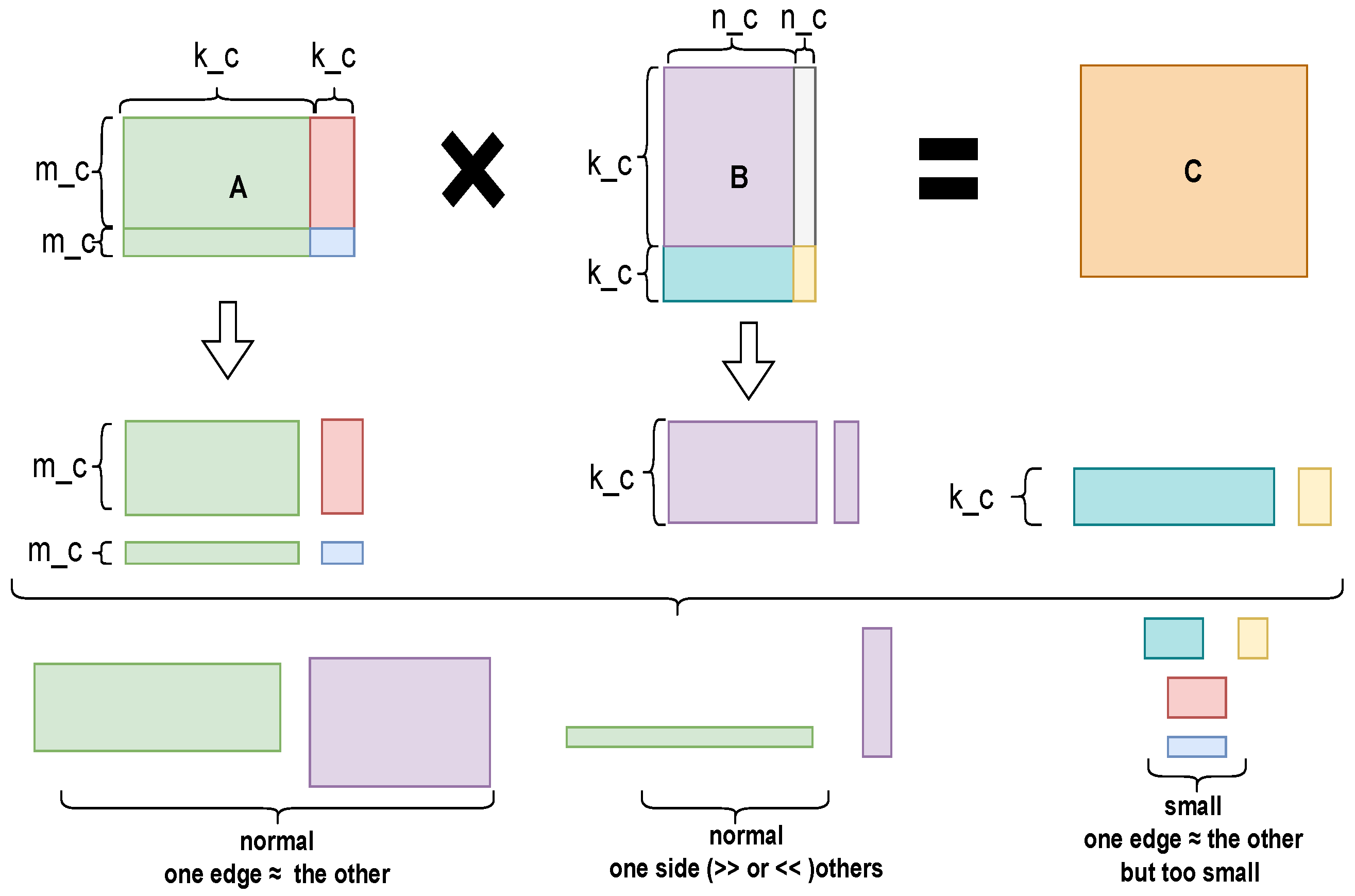
Small and irregular matrices typically refer to matrices whose sizes range from tens to a few hundred, and whose row and column dimensions are asymmetric or not evenly divisible. First, these matrices often have disproportionate row and column counts, making it difficult to align them with register or cache tiles of size
or
, respectively. Second, in GEMM and other matrix multiplication operations, matrices are typically blocked into fixed sizes (e.g.,
,
) to optimize cache and register utilization. However, when the matrix dimensions are not integer multiples of these block sizes, smaller submatrices form at the matrix boundaries. These submatrices remain small and irregular, making it hard to align them precisely with register tiles (
) or cache tiles (
), thus forming what are called “small and irregular matrices, as illustrated in
Figure 2.
4. Overview
4.1. Core Grouping Strategy
This section introduces a core grouping optimization strategy to maximize the utilization of computing units and improve inter-core coordination. Multiple physical cores are bound together to form an independent computing group. Each group shares cache resources and task logic, enabling operation as a cooperative execution unit. The mechanism leverages the low-latency interconnect and shared cache of ARM-based architectures (e.g., Kunpeng). This approach enhances cooperative execution efficiency, especially in small-scale matrix computations.
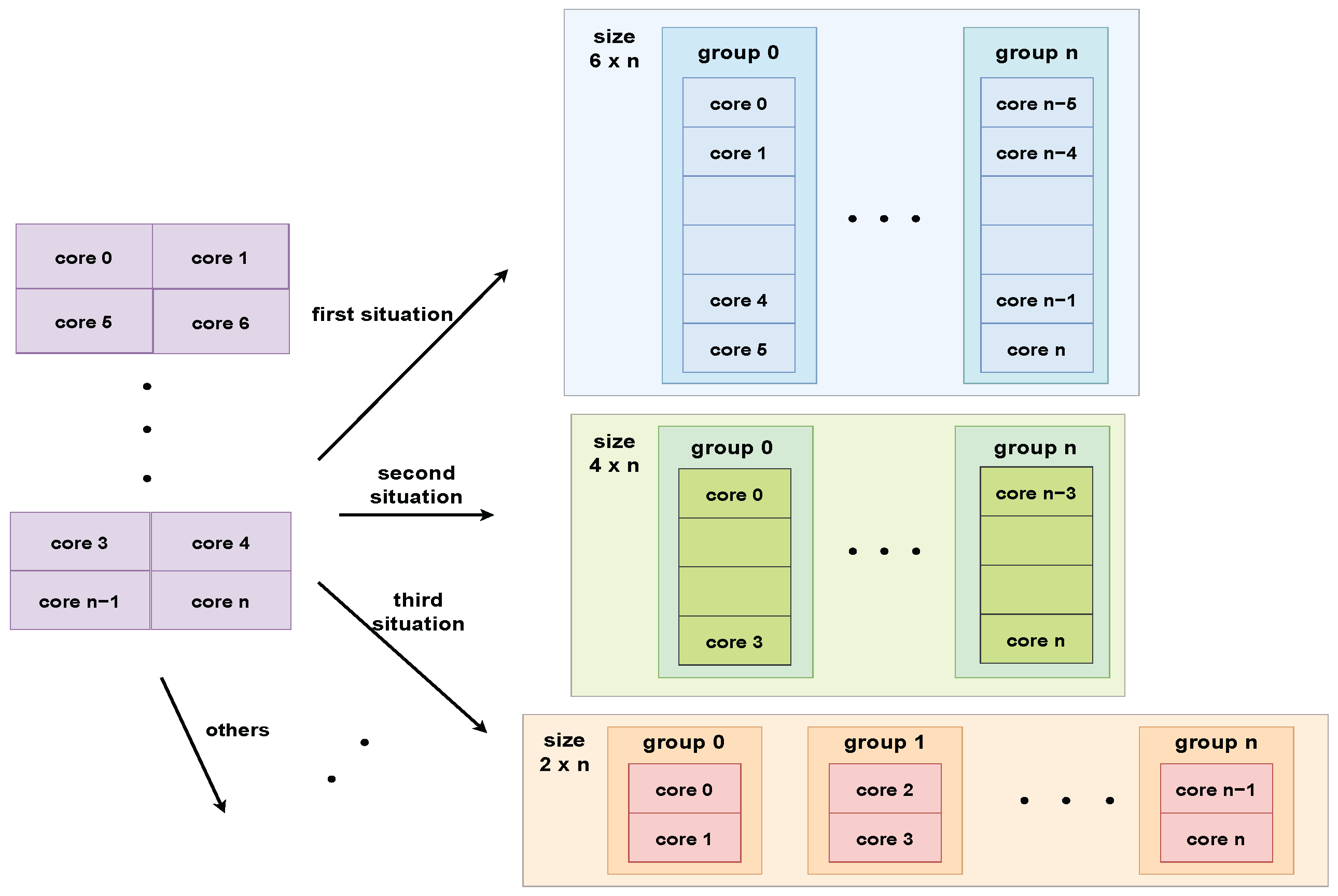
Assume the system contains
a physical cores. These cores are divided into a number of groups that is always a multiple of 2
. The size of each group is determined by dividing
a by the number of groups, so each group contains
, and so on cores, depending on the grouping. For instance, if
, organizing the system into 4 groups gives 8 cores per group; organizing into 8 groups gives 4 cores per group. This grouping is illustrated in
Figure 3.
To further refine the grouping approach, during initialization, the system determines the optimal core grouping level based on the matrix size, workload granularity, and the number of available threads. Let
M denote the matrix dimension along which the workload is partitioned, and let
B represent the block size for a single computation. The total number of computation rounds along this dimension is then given by:
where
R represents the number of
M-dimensional blocks to be processed. Given a candidate set of group numbers
, each grouping configuration
divides the total cores
C into
g groups, with each group containing
cores. To evaluate the efficiency of a particular grouping configuration, we define the intra-group task utilization as:
where
indicates the fraction of fully utilized computation slots for the group, considering both full rounds and any partially filled rounds. The optimal grouping configuration is then chosen to maximize efficiency:
where
is the optimal number of groups and
is the number of cores per group.
Practical Determination of and
In practice, the selection of is not solely determined by Equation (3), but also influenced by matrix dimensions and hardware characteristics.
(1) Matrix dimensions. The parameter M determines the number of computation rounds R. When m is small, increasing g improves parallelism and reduces idle cores. When M is large, smaller g (larger groups) reduces synchronization overhead. The dimension N affects inter-group scalability: larger N enables better load balancing across groups.
(2) Cache constraint. The block size
B and the derived
should satisfy:
to ensure that each group operates within its cache capacity.
(3) NUMA locality. Groups are formed within the same NUMA node or cache cluster to minimize cross-node communication.
Each group is bound as an independent computational unit with its own task queue and dedicated cache space. Cores within the same group collaborate through the shared task queue, ensuring that all tasks assigned to the group execute on physically adjacent cores, thereby minimizing inter-cluster communication overhead and fully leveraging the shared cache resources. To further enhance intra-group cooperation and cache efficiency, cores are assigned to groups according to consecutive core numbering. For example, cores 0–5 are assigned to Group 1, cores 6–11 to Group 2, and so on, ensuring that cores within the same group are physically proximate.
In this setup, each group has a designated lead core, which is statically assigned as the first core within that group. The lead core fetches input data from main memory or higher-level cache and distributes it to the other cores in the same group. Once each core completes its assigned computation, the results are synchronized within the group to ensure consistency. The lead core then collects the partial results and writes the final data back to global memory.
The complexity of Algorithm 1 is , since only a small number of candidate group configurations are evaluated. In practice, is small, making the overhead negligible. The grouping procedure is summarized in Algorithm 1 and consists of the following steps:
Enumerate all valid grouping configurations and compute the corresponding cores per group ;
Evaluate each configuration by estimating its utilization efficiency and applying hardware constraints, including cache capacity and NUMA locality;
Select the configuration that achieves the highest effective utilization and construct core groups accordingly.
| Algorithm 1 Hardware-Aware Adaptive Core Grouping |
- Require:
Matrix dimensions ; total cores C; candidate groups ; cache size - Ensure:
Optimal grouping - 1:
// Compute number of computation rounds - 2:
- 3:
- 4:
for each do - 5:
if then - 6:
continue - 7:
end if - 8:
- 9:
// Compute utilization (Equation (2)) - 10:
- 11:
// Apply cache capacity constraint - 12:
if then - 13:
- 14:
end if - 15:
// NUMA locality optimization - 16:
if cores of group within same NUMA node then - 17:
- 18:
end if - 19:
if then - 20:
- 21:
- 22:
end if - 23:
end for - 24:
return
|
4.2. High-Dimensional Partitioning Strategy
Once the core groups are established, the system maps the computational tasks of small and irregular matrices to different core groups. In such matrices, the high-dimensional axis (where the larger dimension is denoted as N) typically exhibits strong independence and weak data dependency, making it well-suited for inter-group parallel partitioning.
The
N dimension is evenly divided according to the number of core groups
G, with each group responsible for computing a sub-block of the high-dimensional space:
Here, denotes the high-dimensional range assigned to the i-th core group. To control task granularity and avoid oversized sub-blocks, we introduce a threshold parameter a, defined as the maximum size of a high-dimensional block that can be efficiently processed within a group. In practice, a is chosen based on cache capacity and memory bandwidth considerations.
If the size of a sub-block satisfies:
, the original division is retained;
, the sub-block is further partitioned into multiple blocks of size a, with the final block possibly smaller.
This threshold-based splitting ensures that each task fits within the effective working set of a core group and improves load balancing across groups.
For example, when totalcore = 32 physical cores are divided into G = 4 core groups with a threshold a = 4096, a high-dimensional space of N = 80,000 is initially partitioned into four sub-blocks, with each group assigned 80,000/4 = 20,000 units. Since 20,000 > a, each group further divides its assigned range into blocks of size a, with the last block containing 3616 units. If the number of core groups is increased to G = 8, each group is assigned 10,000 units, while the same threshold-based partitioning is applied, thereby increasing parallelism and improving load balancing.
4.3. Low-Dimension Partitioning Strategy
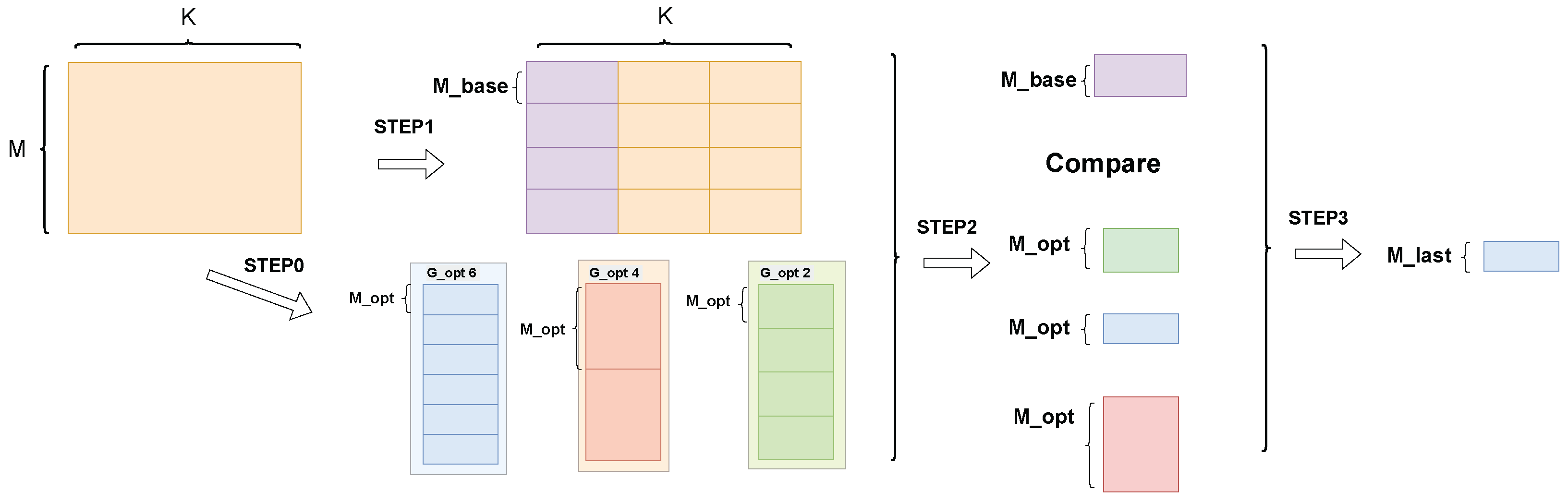
After completing the core grouping optimization, the partitioning of the matrix’s smaller dimension, where the smaller dimension is denoted as the M dimension, plays a crucial role in balancing the computational load and improving cache utilization. Unlike the grouping along the larger N dimension, which mainly focuses on inter-group parallelism, the M-dimension partitioning determines how much data each group processes and how effectively cache resources are used. To address this, we propose a group-prior adaptive block partitioning strategy along the M dimension, which balances both workload distribution and cache friendliness.
At the beginning of the partitioning process, the system first performs an initial division of the
M dimension based on the number of core groups determined in the previous stage:
Let
M denote the total size along this dimension. The baseline block size is defined as
This formula produces a concrete set of blocks, where each element represents a feasible partitioning strategy derived from the previous core grouping results. These initial blocks form the foundation for subsequent cache-aware adjustments and adaptive matching between blocks and core groups.
After the grouping phase, the optimal number of groups
(e.g., 2, 4, or 6) is determined based on the performance model derived in the previous section. Correspondingly, an initial block size along the
M dimension is obtained as:
To further refine cache efficiency and computational balance,
is mapped to a predefined candidate set of cache-friendly block sizes:
where each element in
corresponds to a tile size that is empirically optimized for cache locality and vectorized computation.
The selection of the final block size follows a deterministic rule:
If , then ;
Otherwise, .
This design ensures that the selected block size does not exceed the cache-friendly capacity while maintaining smooth granularity transitions across different matrix sizes.
Through this fine-grained tuning process, the partitioning along the M dimension achieves both cache efficiency and load balance across different core groups and hardware configurations Algorithm 2.
| Algorithm 2 Adaptive High- and Low-Dimensional Partitioning |
- Require:
Matrix dimensions ; group number ; threshold a; candidate set - Ensure:
Partitioned tasks - 1:
// High-dimensional partition (N) - 2:
- 3:
for each group i do - 4:
if then - 5:
assign directly - 6:
else - 7:
split into chunks of size a - 8:
end if - 9:
end for - 10:
// Low-dimensional partition (M) - 11:
- 12:
if then - 13:
- 14:
else - 15:
- 16:
end if - 17:
// Final task construction - 18:
Combine to form 2D tiles - 19:
return task set
|
For example, when
and the matrix is divided into four groups, the baseline block size is 96. The system first checks whether this value matches any element in the candidate set (e.g.,
). If an exact match is found, it is directly adopted as the final configuration. If not, the system selects the largest candidate smaller than 96 (i.e., the preceding value in the set) as the optimal candidate for subsequent performance testing and fine-tuning.
Figure 4.
5. Evaluation
5.1. Experiment Setup
Experimental Platform:
Table 2 shows the experimental platform configuration. The following text details the CPU information. To match typical large-model workloads while keeping the input matrices irregular, we use small-scale matrices for our experiments. The dimensions are chosen such that one of the inner GEMM dimensions is moderate, while the other varies over a wide range.
We evaluate the proposed methods on the Kunpeng 920F CPU. The CPU is a system on a chip integrating two computing dies within a single package. Each Die contains four NUMA domains equipped with on-package memory and off-die DDR memory. Each core supports double-precision floating-point SIMD instructions and offers an 8 × 8 matrix computation capability within its pipeline. To enhance data-movement efficiency between DDR and on-package memory, each Die incorporates a System Direct Memory Access (SDMA) interface.
Comparison Method: The Kunpeng CPU includes the BLAS-based Kunpeng Math Library (KML), a high-performance library optimized by Huawei. KML adopts a multi-core parallel strategy in which GEMM tasks are independently scheduled and executed across CPU cores. In our experiments, we compare the proposed AGP method with the native KML GEMM implementation.
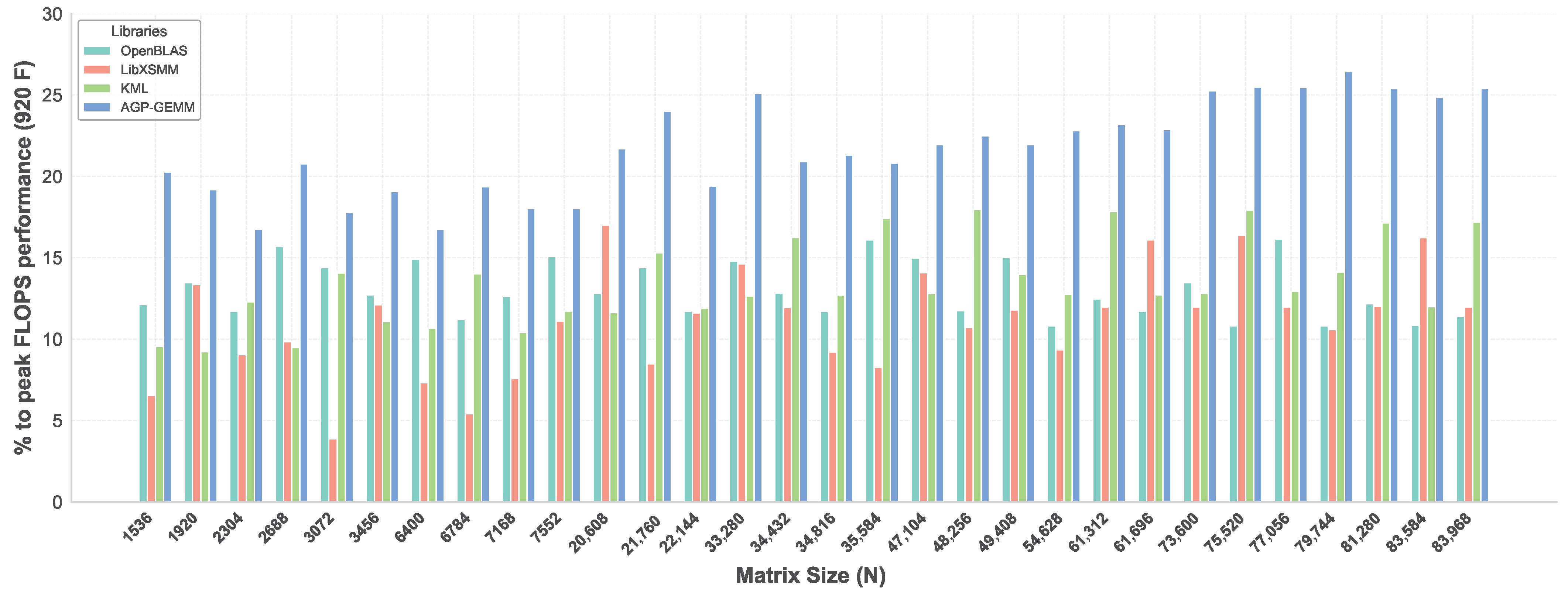
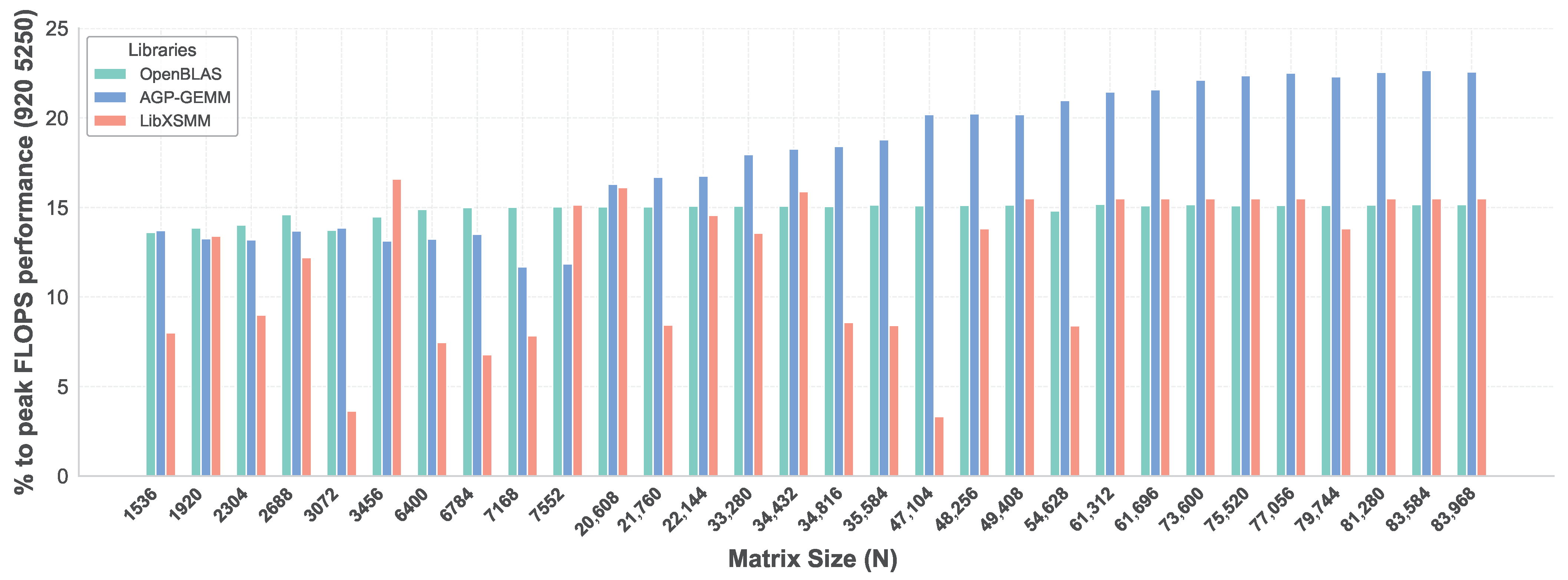
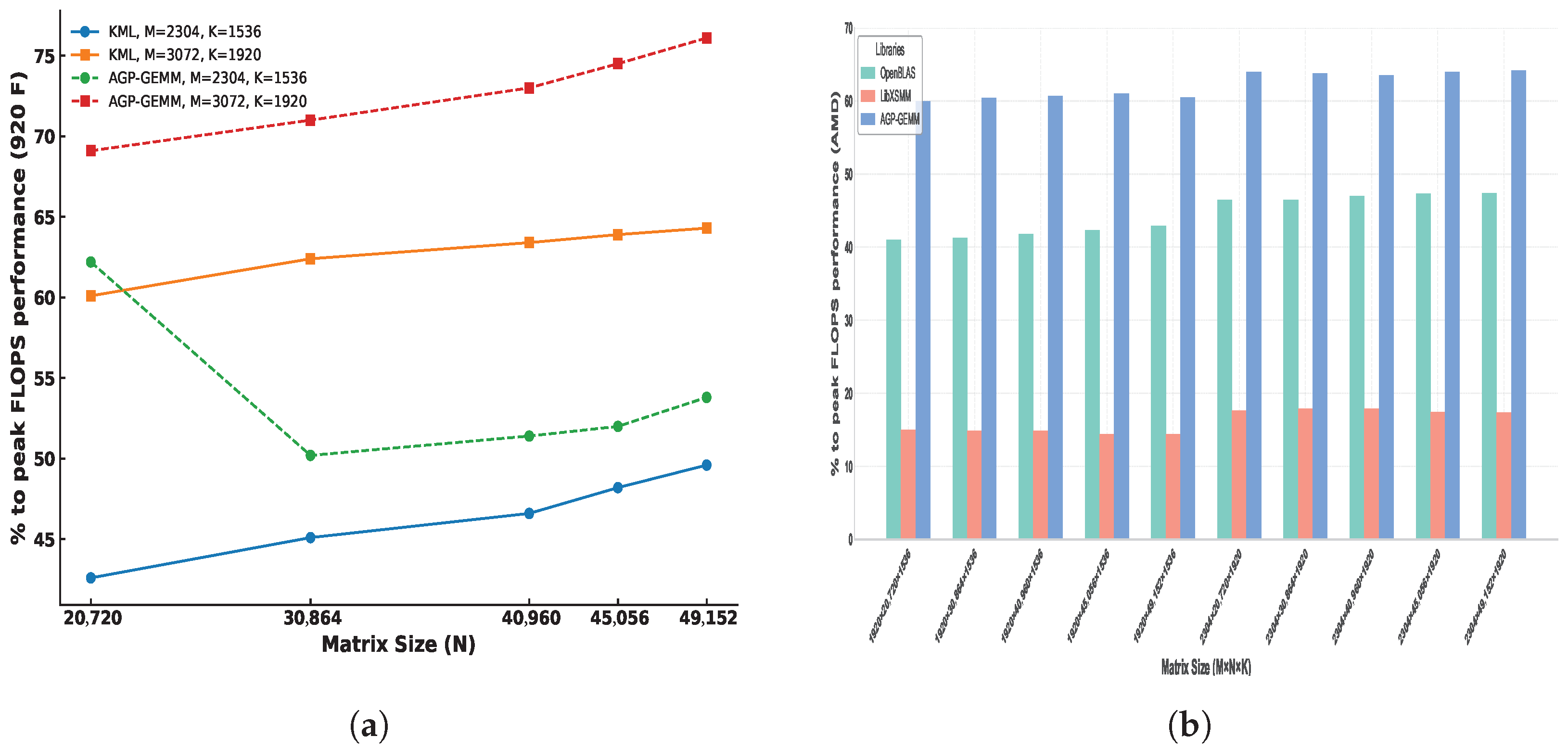
To comprehensively evaluate performance, we conduct experiments in three stages. First, we focus on small matrix sizes commonly observed in large model workloads, varying N while keeping the overall problem scale representative, and compare different libraries on both the 920F and 920 5250 platforms. Second, we extend the evaluation on the 920F by exploring more general configurations where M and K are not fixed, in order to assess performance under diverse matrix shapes. Finally, we perform cross-platform comparisons between the 920F and AMD architectures to evaluate the robustness and portability of AGP across different hardware designs.
Experimental criteria: To demonstrate the performance of the proposed method, comparative experiments were conducted on matrices of various shapes and dimensions. We denote the size of a GEMM operation as “”. In the following experiments, we compare the performance of different methods under small and irregular matrix conditions.
In the following comparative experiments, the experimental results are reported in terms of the average GFLOPS (Giga Floating-Point Operations Per Second), calculated as follows:
where
M,
N and
K represent the matrix dimensions, and
total_time denotes the execution time on the CPU. Each experiment is executed ten consecutive times, and the reported GFLOPS value represents the arithmetic mean rounded to two decimal places.
5.2. Speed Up with AGP-GEMM
To evaluate the effectiveness of different GEMM libraries for large and irregular matrix sizes, we conduct experiments on the Kunpeng 920F and 920 5250 CPUs. We focus on matrix multiplications with
, which corresponds to the hidden dimensions of key layers in large transformer models. In such models, the majority of compute is dominated by matrix multiplications with this hidden dimension. By varying
N, we simulate different sequence lengths or batch sizes commonly encountered in practical applications. This experimental setup enables a systematic comparison of baseline libraries (OpenBLAS, LIBXSMM, KML) with AGP-GEMM under realistic workloads, highlighting their performance differences across varying matrix shapes.The detailed experimental results are shown in
Figure 5 and
Figure 6.
Figure 5 shows the relative performance of all libraries on the 920F as
N increases. AGP-GEMM consistently achieves the highest performance, providing up to 2.1× speedup over the best-performing baseline. Across the tested matrices, AGP-GEMM achieves 1.5–2.5× speedup over OpenBLAS and 1.6–2.1× over KML, and 2.2–3.5× over LIBXSMM, reflecting its improved core utilization and memory scheduling.
Figure 6 shows the relative performance of all libraries on the 920 5250 as
N increases. AGP-GEMM consistently achieves the highest performance, providing up to 1.7× speedup over the best-performing baseline. Across the tested matrices, AGP-GEMM achieves 1.5–2.5× speedup over OpenBLAS and 1.2–2.1× over LIBXSMM, demonstrating its more efficient core utilization and memory scheduling.
To better understand this trend, we observe that as N increases, the available parallelism across core groups becomes fully exploited. Once all groups are actively engaged, further increases in N only enlarge the workload per group rather than increasing parallelism. As a result, performance gradually approaches a saturation point. In this regime, execution becomes bounded by hardware constraints such as peak compute throughput and memory bandwidth, rather than the efficiency of individual libraries. This behavior is consistently observed across both the 920F and 920 5250 platforms.
5.3. Performance Comparison on 920F and AMD Platforms
Figure 7a shows the relative performance of KML and AGP-GEMM on the 920F as
N increases. AGP-GEMM consistently achieves the highest performance, providing up to 2.3× speedup over the best-performing baseline. Across the tested matrices, AGP-GEMM achieves 1.5–2.5× speedup over OpenBLAS and 1.6–2.1× over KML, while consistently outperforming LIBXSMM. For instance, at moderate matrix sizes (e.g.,
,
,
), AGP-GEMM achieves around 2.0× speedup over OpenBLAS and 1.8× over KML. On larger matrices, such as
,
,
, AGP-GEMM maintains 1.5–1.8× speedup over OpenBLAS and 1.6–1.9× over KML, demonstrating its consistent advantage and efficient core utilization and memory scheduling across all sizes.
Figure 7b presents the relative performance of OpenBLAS, Libxsmm, and AGP-GEMM on the AMD platform as
N increases. AGP-GEMM consistently achieves the highest performance, providing up to 1.7× speedup over the best-performing baseline. Across the tested matrices, AGP-GEMM achieves 1.5–2.5× speedup over OpenBLAS and 1.2–2.1× over Libxsmm. For example, at smaller matrix sizes (
,
,
), AGP-GEMM shows approximately 2.0× speedup over OpenBLAS, while at larger sizes (
,
,
) it maintains 1.7–1.8× speedup. These results highlight AGP-GEMM’s consistent performance advantage and efficient utilization of computational resources compared to the baseline libraries.
5.4. The Ablation Experiment Result Analysis with AGP-GEMM
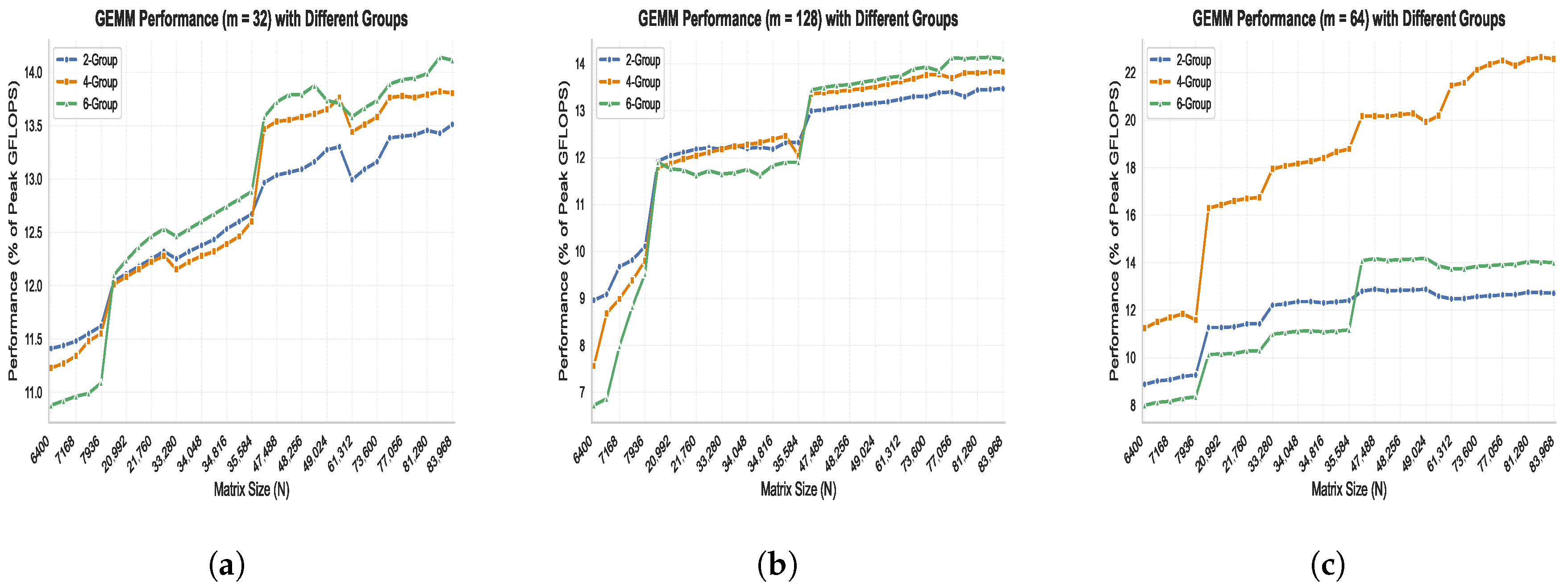
To provide a more thorough evaluation of the proposed method, we conduct an ablation study based on the techniques introduced in
Section 4, quantifying the individual performance contributions of each component. The detailed comparative results are presented in
Figure 8a–c.
When
, the performance of all grouping schemes increases steadily with
N. In the small-
N region, all schemes achieve around 10–11.5% of peak performance. As
N grows, the curves gradually separate, with the six-group scheme reaching about 14–14.5%, the four-group scheme around 13–14%, and the two-group scheme about 13%. The corresponding global peak speedups are approximately 1.77×, 1.72×, and 1.64× for the six-, four-, and two-group schemes, respectively (
Figure 8a).
When
, the performance becomes smoother and slightly higher overall. All schemes start from around 11–12% and gradually converge to 13–14% as
N increases. The performance differences among grouping strategies are relatively small, with all configurations achieving similar peak speedups of around 1.6× (
Figure 8b).
When
, the performance differences among grouping schemes become the most pronounced. In the small-
N region, all schemes operate at relatively low efficiency (8–11%). As
N increases, the four-group scheme improves significantly, reaching up to 18–19% of peak performance, while the six- and two-group schemes remain around 14% and 12%, respectively. Overall, the four-group configuration achieves the best performance, with an average speedup of approximately 1.64× and a peak speedup of up to 2.10× (
Figure 8c).
The observed performance differences across different M values mainly stem from the trade-off between task granularity and hardware resource utilization. Since the matrices considered are relatively small, overly fine partitioning along the M dimension allows more cores to be engaged but increases overhead and reduces per-core efficiency. Conversely, overly coarse partitioning underutilizes available cores, leading to lower performance. The case of represents a balanced regime where task size and core assignment achieve an effective compromise, maximizing parallelism while maintaining high resource utilization. Notably, this value of is determined by our adaptive low-dimensional partitioning algorithm, which selects a cache-friendly block size based on the number of core groups and candidate block sizes, rather than being chosen arbitrarily. As a result, produces the largest performance differences among grouping strategies.
5.5. Total Time with AGP-GEMM
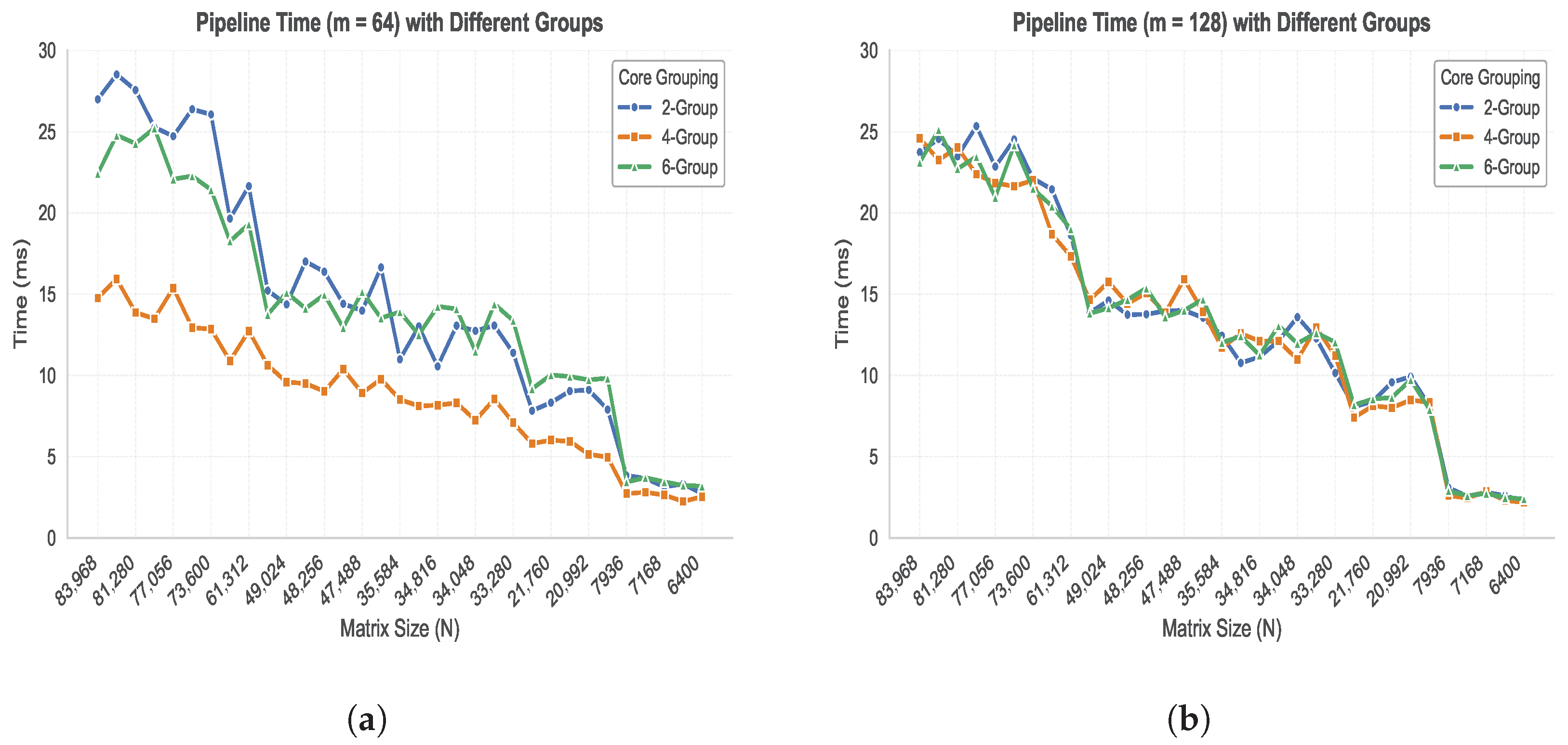
5.5.1. Pipeline Time with AGP-GEMM
For
, the pipeline execution times under different core grouping schemes are shown in
Figure 9a. Overall, the pipeline time increases with the matrix width
N, while both the growth rate and stability differ significantly across groupings. The two-core grouping exhibits pipeline times of approximately 2.7 ms to 3.8 ms for small matrices (
N < 10,000), which increase to 8 ms to 17 ms for medium-sized matrices (20,000 ≤
N ≤ 50,000), and further rise to 25 ms to 29 ms for large matrices (
N > 80,000). This behavior indicates limited pipeline depth and low parallel utilization.
In contrast, the four-core grouping demonstrates the most stable performance across all matrix sizes, achieving 2.5 ms to 2.8 ms for small N, 5 ms to 10 ms for medium N, and 13 ms to 16 ms for large N. This stability reflects effective overlap between computation and memory access. The six-core grouping slightly outperforms the two-core scheme in certain cases; however, it exhibits significant fluctuations as N increases (12 ms to 25 ms), mainly due to increased thread synchronization overhead and cache contention. Overall, the four-core grouping achieves the best balance among parallel depth, cache sharing, and thread coordination, thereby maximizing pipeline utilization and overall throughput.
For
, the pipeline execution times under different core grouping schemes are illustrated in
Figure 9b. Similar to the
case, the pipeline time generally increases with the matrix width
N, while the performance differences among grouping schemes become more pronounced. The two-core grouping performs relatively fast and stable for small matrices, with execution times of approximately 2.2 ms to 3 ms. However, as
N increases, the execution time grows rapidly, reaching 8 ms to 13 ms for medium-sized matrices and exceeding 20 ms for large matrices, indicating limited scalability.
The four-core grouping again exhibits the most stable behavior, achieving 2.1 ms to 2.8 ms for small matrices, 7 ms to 15 ms for medium-sized matrices, and 17 ms to 24 ms for large matrices, with only minor fluctuations. This trend demonstrates good overlap between computation and memory access. Although the six-core grouping attains the lowest execution times in some medium-sized cases (2.4 ms to 2.6 ms), its performance varies more significantly as N increases, and the execution time can exceed 20 ms for large matrices due to synchronization overhead and cache contention. Consequently, the four-core grouping provides the best compromise among parallel depth, cache sharing, and pipeline scheduling, making it the most effective and scalable configuration.
5.5.2. Synchronization Time Analysis with AGP-GEMM
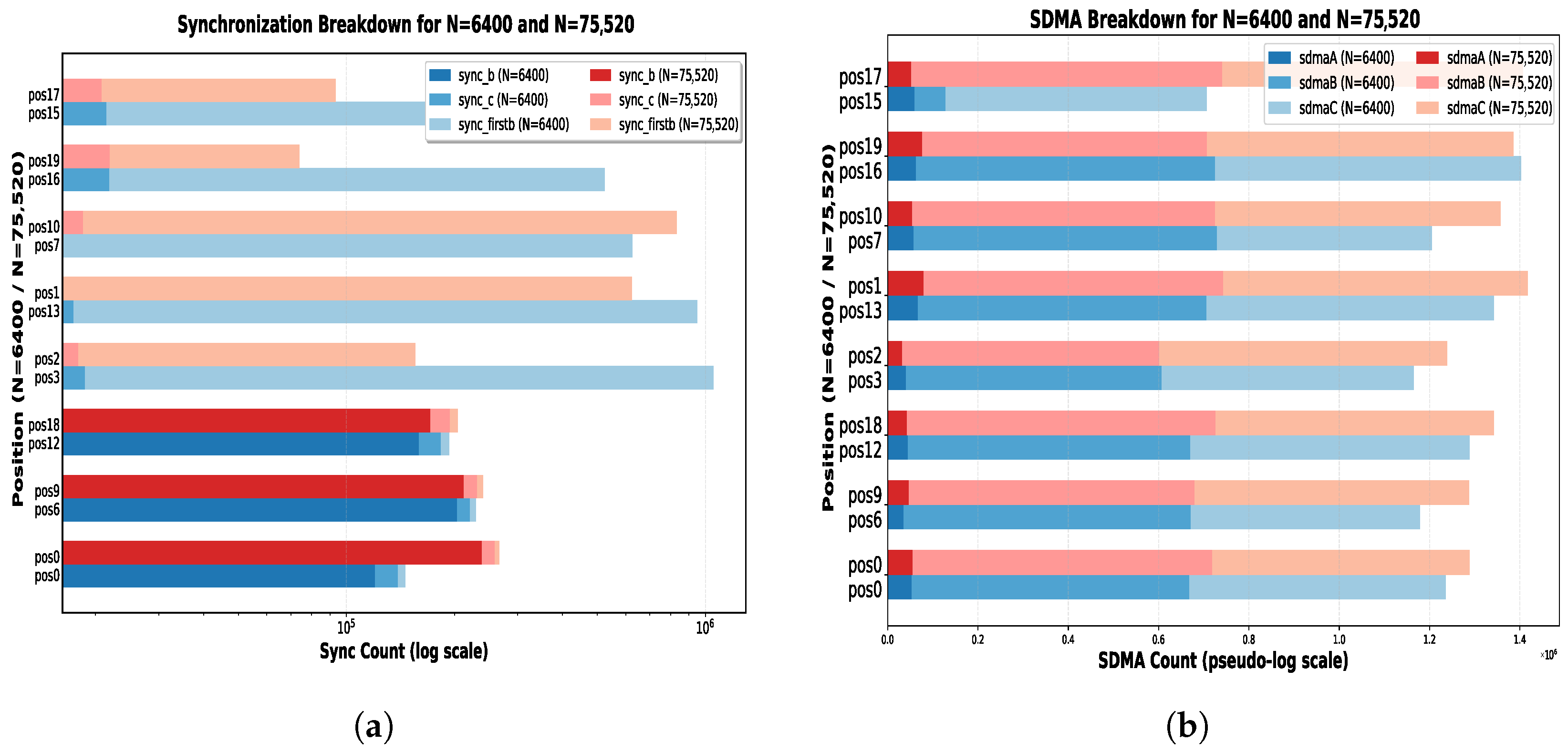
Figure 10 presents the synchronization and SDMA data transfer overheads across different thread positions for matrix sizes
and
. As shown in
Figure 10a, the synchronization overhead varies significantly across thread positions under both configurations. For synchronization associated with the high-dimensional matrix along the
N dimension, the
sync_b overhead is mainly concentrated at master thread positions (e.g., pos 0, 9, and 18 for
, and pos 0, 6, and 12 for
), remaining on the order of
cycles and exhibiting an increasing trend as
N grows.
In contrast, the first synchronization of the high-dimensional matrix, denoted as sync_first, shows pronounced peaks at non-master thread positions, with overheads typically reaching the order of cycles and dominating the overall synchronization cost. This phenomenon primarily occurs during the group initialization phase, reflecting the latency incurred while threads wait for matrix data to become fully available before computation begins. Although subsequent synchronization events occur more frequently, their per-event cost is significantly lower, resulting in a reduced amortized overhead.
As illustrated in
Figure 10b, the SDMA overhead also varies across thread positions for
and
. The SDMA cost associated with matrix A remains relatively low and stable due to its smaller data volume and limited pressure on memory bandwidth. In contrast, the SDMA overhead for the high-dimensional matrix along the
N dimension is substantially higher and increases noticeably with
N. Master threads incur relatively high SDMA costs because they are responsible for initiating and coordinating data transfers, while certain non-master threads experience even higher peaks when waiting for SDMA operations involving large data blocks to complete.
Although the grouped computation model introduces additional synchronization overhead—particularly at master thread positions responsible for coordinating data transfers—this cost is effectively offset by the significant improvement in computing core utilization, leading to an overall performance gain. Furthermore, SDMA data transfers can be overlapped with computation in a pipelined manner: while the SDMA hardware transfers the next block of high-dimensional matrix data, the computing threads simultaneously process the current block, thereby substantially reducing core idle time and improving overall execution efficiency.
6. Conclusions and Future Work
To address the issues of load imbalance and low hardware utilization in small and irregular matrix multiplication scenarios, this paper proposes a load-balanced GEMM acceleration method, AGP-GEMM. The approach employs a multi-threaded kernel to balance computational and data workloads, and introduces a dynamic core grouping strategy that partitions physical cores into cooperative groups sharing cache resources and task queues. The optimal grouping configuration is dynamically selected based on matrix size and task granularity. High-dimensional matrices are partitioned across groups to achieve inter-group parallelism, while low-dimensional matrices adopt an adaptive block partitioning strategy to improve cache utilization and load balance. Experiments on the Kunpeng platform demonstrate that AGP-GEMM achieves approximately 2.1× speedup over traditional CPU BLAS implementations (e.g., OpenBLAS, MKL), which is comparable to the performance improvements observed with GPU acceleration in scientific computing. In particular, CPU-only GEMM optimization remains highly relevant in scenarios where GPU resources are limited or host-side preprocessing is required.
This method provides a general and efficient framework for CPU-side small-matrix GEMM parallelization and lays the groundwork for future extensions. With the rapid development of large language models, GEMM operations are increasingly critical in both training and inference. However, modern models often rely on lower-precision formats such as FP16 and FP8, presenting new challenges for performance and storage efficiency. Therefore, future work may explore mixed-precision computation, adaptive data layout strategies, and support for diverse processor architectures and memory access patterns, further enhancing GEMM efficiency and scalability across different precision levels and hardware platforms.