1. Introduction
Convolutional Neural Networks (CNNs) have become ubiquitous in modern AI applications, but their efficient deployment on embedded systems remains a critical challenge due to strict constraints on power consumption, memory bandwidth, and latency. Deploying inference workloads on FPGA-based systems or integrated System-on-Chip (SoC) processors requires careful architectural decisions that balance performance gains against the overhead of specialized hardware.
Conventional CPU-NPU architectures allocate dedicated Multiply–Accumulate (MAC) units exclusively to the neural accelerator, separate from those in the main processor. This approach necessarily increases silicon area, power dissipation, and design complexity. However, in many real-world workloads, the MAC unit of the CPU experiences significant idle periods, particularly during non-arithmetic instructions and cache misses. This observation motivates a novel co-design paradigm: dynamic MAC sharing.
This paper presents a dual-core RISC-V system with a tightly integrated Neural Processing Unit (NPU) that shares the MAC unit opportunistically with the main processors. The system features:
- 1.
Dual-core RISC-V processors that execute general-purpose workloads in parallel, each with independent instruction fetch and decode stages but sharing the data cache, instruction cache, external memory, and a single MAC unit.
- 2.
CPU-priority arbitration with parity-based fairness that enforces fair (50–50%) access to shared resources between CPU0 and CPU1, while the NPU operates in best-effort mode, utilizing idle MAC slots without delaying CPU execution.
- 3.
Dynamic frequency scaling (DFS) applied to the NPU compute tiles, enabling the dynamic acceleration of CNN workloads to match RISC-V throughput and prevent the accelerator from bottlenecking the dual-core processors.
- 4.
Opportunistic AI acceleration via an NPU executing CNN operations (CONV, GEMM, and POOL) in the background when the MAC unit is available, without interrupting or blocking CPU execution.
The dual-core architecture provides inherent parallelism for mixed CPU-AI workloads, while the CPU-priority arbitration mechanism ensures predictable, non-starving performance for both RISC-V cores (50–50% fairness between CPU0 and CPU1). The NPU operates opportunistically, receiving MAC grants only when both CPUs are idle, ensuring background AI processing never delays general-purpose execution. DFS on the MAC unit dynamically adjusts frequency to match workload intensity.
The NPU implements three specialized compute tiles:
CONV Tile: 2D convolution operations with configurable kernel sizes (3 × 3, 5 × 5), stride, padding, and multi-channel support.
GEMM Tile: General matrix multiplication for fully connected layers and linear transformations, with tiling strategy to reduce memory pressure.
POOL Tile: Max and average pooling operations for spatial downsampling and feature map reduction.
The architecture is implemented in cycle-accurate SystemC, targeting FPGA synthesis and supporting end-to-end CNN inference simulation. The FIFO-based channel architecture ensures that each requestor (CPU Core 0, CPU Core 1, and NPU) can access the shared MAC unit and memory subsystem, with CPU operations receiving priority.
The model is fully synthesizable and was validated for hardware compatibility using Vivado HLS 2019. However, this work focuses on architectural exploration and cycle-accurate simulation, with post-synthesis resource and power estimates. Full FPGA deployment and measurement are left for future work due to time and resource constraints. All simulations were performed using SystemC 2.3.3 on Linux, using g++ compiler.
The CPU core used in this work is based on the HL5 RISC-V model [
1], which was extensively modified at all pipeline stages to interface with the NPU, support dual-core arbitration, and implement custom CSR registers for AI configuration. The NPU accelerator and the DFS mechanism were designed and implemented entirely from scratch for this architecture, and integrated tightly with the modified CPU pipeline.
1.1. Motivation and Problem Statement
Deploying CNN inference on resource-constrained embedded platforms presents a trade-off dilemma:
Dedicated accelerators (e.g., Gemmini, DianNao, and Eyeriss) achieve high throughput but require separate MAC arrays, caches, and memory ports, incurring prohibitive area and power overheads on small FPGA platforms or edge devices.
Pure software execution on a scalar CPU is power efficient but suffers from low throughput, limiting the real-time inference capabilities.
Dual-core processors are common in modern SoCs but typically implement independent MAC units per core, further increasing hardware complexity.
This work addresses these challenges by introducing dynamic MAC sharing, where the two CPU cores share a single MAC unit under parity-based 50–50% fairness, while the NPU competes opportunistically for idle slots. Additionally, dual-core parallelism and DFS enable the simultaneous execution of general-purpose and AI workloads with energy-efficient power scaling.
1.2. Main Contributions
The primary contributions of this paper are:
- 1.
CPU-priority arbitration protocol that guarantees 50–50% fair access to shared resources (MAC, I-cache, D-cache, and memory) between the two RISC-V cores, with the NPU operating in best-effort mode during idle MAC slots, ensuring CPU execution is never delayed by background AI processing.
- 2.
Dual-core RISC-V architecture with shared MAC unit, demonstrating near-linear speedup for parallel workloads and effective resource utilization through dynamic sharing.
- 3.
DFS on NPU tiles enabling dynamic frequency scaling of the AI accelerator, preventing CNN computation from becoming a bottleneck while maintaining energy efficiency compared to dedicated high-frequency accelerators. Note that on FPGA platforms, voltage scaling is not directly feasible; only the clock frequency is adjusted dynamically.
- 4.
Opportunistic NPU architecture (CONV, GEMM, and POOL tiles) that executes in the background without blocking CPU execution or introducing timing side-channels.
- 5.
Cycle-accurate SystemC implementation with comprehensive simulation of mixed CPU-AI workloads, validated on modern FPGA platforms.
- 6.
Empirical evaluation showing: (1) CPU0 and CPU1 each receive approximately 41% of MAC grants under contention, confirming fair dual-core access; (2) NPU receives the remaining 18% during idle slots without delaying CPU execution; (3) DFS reduces NPU power by up to 70% at lower frequencies while maintaining acceptable inference latency.
1.3. Paper Organization
Section 2 reviews related work.
Section 3 presents the overall system architecture.
Section 4 describes the specialized NPU compute tiles: CONV, GEMM, and POOL.
Section 5 reports experimental results and performance evaluation.
Section 6 provides discussion.
Section 7 concludes the paper.
2. Related Work
Hardware acceleration of neural networks has been intensively studied over the past decade, both in dedicated NPU architectures and in heterogeneous CPU–accelerator systems. Early approaches focused on fully specialized architectures for CNN acceleration on FPGAs, exploiting massive parallelism at the MAC level and memory optimizations. Classical works by Zhang et al. [
2], Qiu et al. [
3], and Venieris and Bouganis [
4] demonstrated the potential of FPGAs for CNN acceleration, but they rely on dedicated MAC units that are not reusable by the CPU.
Beyond CNN-specific accelerators, recent literature reports several FPGA-focused designs relevant to energy-aware and resource-constrained embedded computing, including a convolutional 2D filtering architecture [
5], multicore hardware/software co-design on FPGA [
6], and run-time adaptation for power-budget variation and fault mitigation in FPGA-based SoPCs [
7].
Parametrizable accelerator designs, such as Eyeriss [
8] and DianNao [
9], introduced concepts like optimized dataflow patterns (row-stationary, weight-stationary) and hierarchical memory architectures to reduce access costs. Although efficient, these architectures assume complete separation of resources between the accelerator and CPU, which increases silicon area and power dissipation.
For embedded platforms, recent work has explored integrating accelerators with scalar processors through AXI interfaces, coprocessors, or custom instructions. RISC-V, with its extensible ISA [
10], has been frequently used in such experiments, and generator-based SoCs such as Rocket Chip [
11] provide a practical substrate for accelerator integration. However, these designs typically employ separate, dedicated compute units for the accelerator.
Dynamic resource arbitration and opportunistic background execution are less common in the accelerator literature. Open-source accelerators and stacks such as Gemmini [
12,
13], VTA [
14], and NVDLA [
15] generally assume a dedicated accelerator datapath and do not share the CPU’s scalar MAC pipeline with background CNN execution. Likewise, efficient RISC-V inference frameworks such as XpulpNN [
16] focus on optimized kernels and ISA-level efficiency, rather than transparent time-sharing of a single MAC unit between CPU and NPU.
At the algorithmic level, convolution can be accelerated using Winograd transforms [
17] or FFT-based methods [
18]. At the architecture level, prior accelerators emphasize dataflow and memory hierarchy optimizations (e.g., Eyeriss [
8] and DianNao/DaDianNao [
9,
19]), while Bit Fusion [
20] explores bit-level composability for efficiency. These approaches generally assume dedicated accelerator hardware rather than transparent CPU–accelerator MAC sharing.
In the RISC-V + AI co-design space, open-source stacks provide reusable baselines, including TVM’s VTA [
14] and NVDLA [
15]. None of these works, however, implement an opportunistic NPU that time-shares the scalar MAC unit with the CPUs under a fairness-aware arbiter.
In contrast to all these works, the architecture proposed in this paper introduces several novel contributions:
- 1.
Dynamic MAC unit sharing: Reuse of the existing scalar MAC unit in the RISC-V pipeline, without duplicating the hardware resource and without software interruptions, enabling both CPU and NPU to access the same computational resource under fair arbitration.
- 2.
Opportunistic background CNN execution: Three specialized NPU tiles (CONV, GEMM, and POOL) execute in the background when the MAC unit is available, without blocking or stalling the main processors.
- 3.
Parity-based deterministic arbitration: A hardware-enforced fair (50–50%) arbitration protocol for shared resources (MAC unit, I-cache, D-cache, and external memory) that guarantees no starvation and maintains predictable performance for all requestors (CPU0, CPU1, and NPU).
- 4.
Dual-core parallelism with shared resources: Two independent RISC-V cores executing general-purpose workloads in parallel while competing fairly for shared hardware resources, avoiding the need for separate MAC units per core.
- 5.
DFS for NPU acceleration: Dynamic frequency scaling applied to the AI accelerator tiles to prevent CNN computation from becoming a bottleneck, ensuring the NPU maintains throughput parity with the dual-core RISC-V processors.
- 6.
Transparent hardware integration: Memory-mapped register interface with minimal software overhead, requiring no ISA extensions or interrupt handlers, making the architecture easily portable across RISC-V implementations.
This comprehensive approach significantly reduces hardware cost and increases the effective utilization of shared resources, while DFS prevents the accelerator from limiting overall system performance. The architecture offers an energy-efficient, scalable solution suitable for real-time edge AI applications on FPGA and embedded SoC platforms.
3. System Architecture
The proposed architecture consists of a dual-core RISC-V processor system with a tightly coupled Neural Processing Unit (NPU) that opportunistically shares a single Multiply–Accumulate (MAC) unit. The system is designed such that CNN execution on the NPU occurs in the background without interrupting the main program flow on the RISC-V processors. This approach maximizes MAC utilization, avoids hardware resource duplication, and enables the efficient coexistence of CPU and NPU workloads in a compact architecture suitable for educational FPGA platforms and embedded systems.
3.1. System Overview
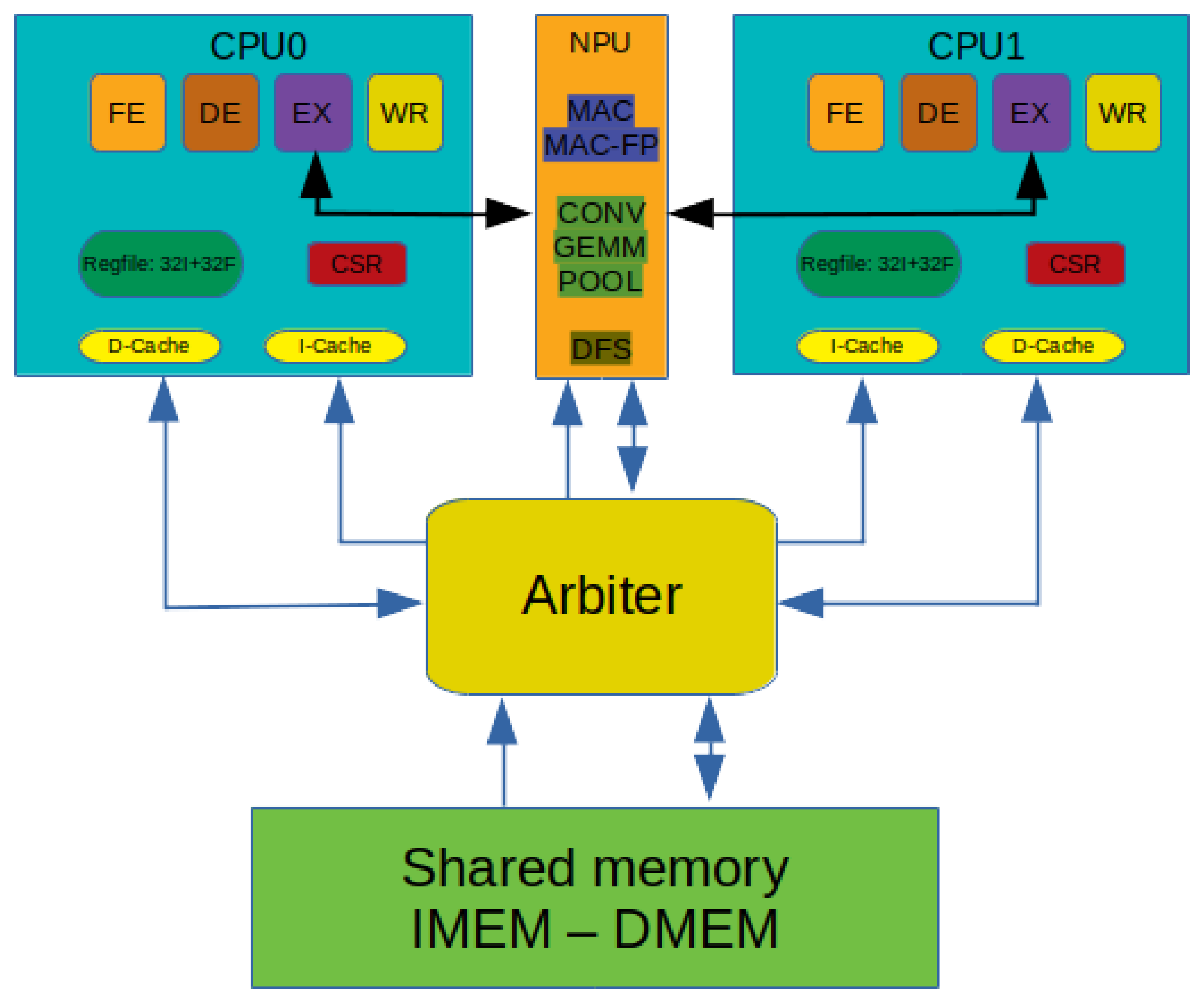
Figure 1 provides a high-level view of the system architecture. The platform consists of two independent RISC-V scalar processors (CPU0 and CPU1), each with its own instruction fetch and decode logic and private I-cache/D-cache instances, that execute general-purpose workloads in parallel while sharing a common external memory subsystem (IMEM/DMEM) and a single Multiply–Accumulate (MAC) functional unit. The shared MAC service is accessed by both CPU cores and the NPU through a deterministic hardware arbiter, eliminating the need for dedicated per-core MAC resources.
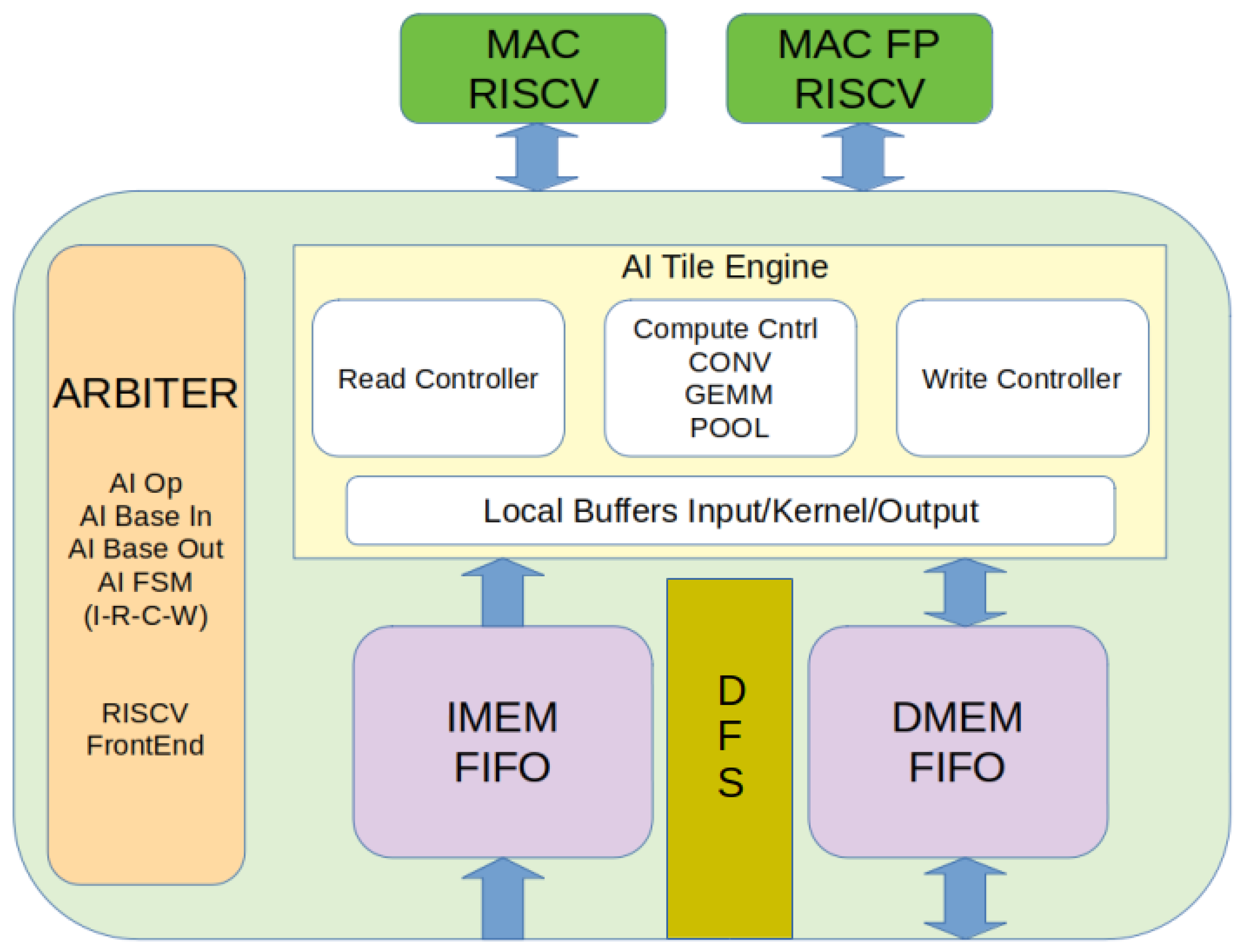
The memory subsystem comprises unified instruction memory (IMEM, 64 KB) and data memory (DMEM, 64 KB), accessible by both cores and the NPU through FIFO channels. An NPU Controller acts as a micro-programmable sequencer that orchestrates CNN operations across three compute tiles: Tile-CONV (2D convolutions with 3 × 3 or 5 × 5 kernels), Tile-GEMM (general matrix multiplication for fully connected layers), and Tile-POOL (max and average pooling operations). Resource arbitration between CPU0, CPU1, and the NPU relies on hardware FIFO channels (sc_fifo) that provide natural round-robin access with blocking semantics, ensuring forward progress for all requestors. A clock-divider module (DFS) implements dynamic frequency scaling with three levels (100, 200, and 400 MHz) for the shared MAC unit.
3.2. FIFO-Based Resource Arbitration
The shared MAC unit and memory subsystem are accessed through SystemC FIFO channels (sc_fifo), which provide natural arbitration through blocking semantics. This approach simplifies the hardware design while ensuring forward progress for all requestors.
3.2.1. Arbitration Mechanism
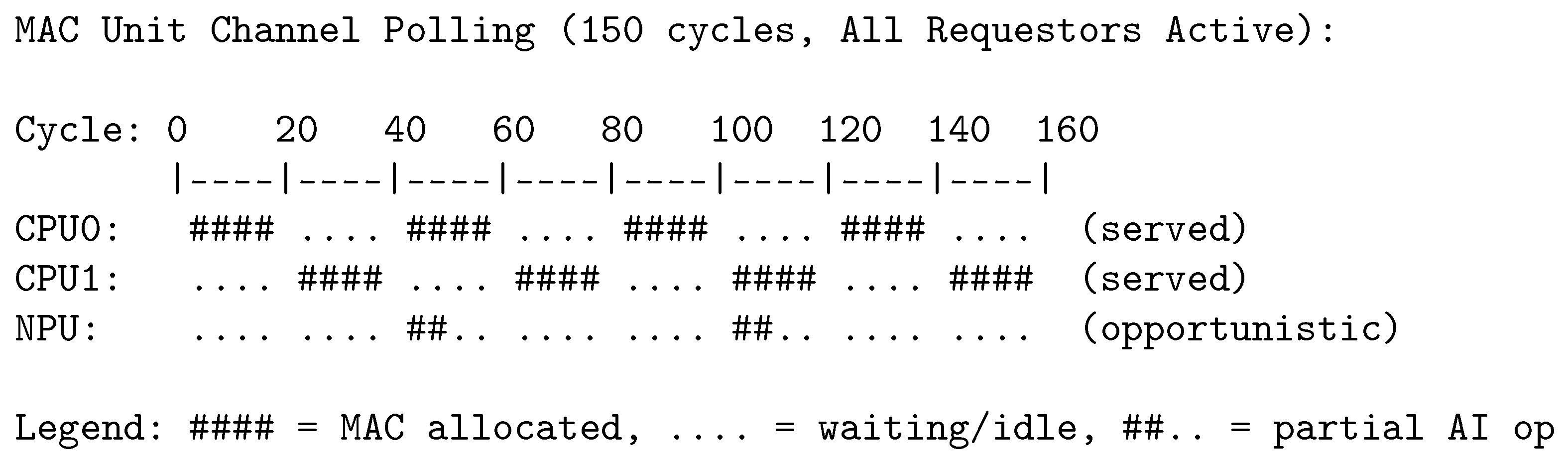
Each requestor (CPU0, CPU1, and NPU) communicates with the shared MAC unit through dedicated FIFO channels. The MAC unit polls CPU channels first in a fixed order—CPU0 integer, CPU0 floating-point, CPU1 integer, CPU1 floating-point—and then checks NPU channels only if all four CPU channels are empty. When a channel is empty, the MAC unit moves to the next channel; when a requestor’s channel is full, the requestor stalls until space becomes available, providing natural backpressure. This CPU-priority policy ensures that general-purpose execution is minimally impacted by background AI computation. Because the polling order is fixed (CPU0 checked before CPU1), a slight bias exists: when both cores issue simultaneous requests on the same clock edge, CPU0 is served first. In practice this produces a small persistent disparity (approximately 0.4% in the evaluated benchmarks, see
Table 1), which is workload-dependent and negligible for the targeted soft real-time applications. The NPU operates in opportunistic/best-effort mode, receiving MAC grants only during idle CPU slots; under high CPU contention it may receive as low as 18% of the MAC bandwidth. For typical workloads with low contention, MAC requests are served within 1–3 cycles; under high contention, worst-case latency depends on the number of pending operations in other channels.
An important architectural property of this design is that the NPU can never delay a CPU request. The arbiter checks all four CPU FIFO channels before invoking the NPU state machine (ai_step); consequently, any pending CPU multiply operation preempts NPU execution unconditionally. The worst-case CPU MAC latency is therefore determined solely by CPU-CPU contention (i.e., how many of the other core’s requests are pending), and is completely independent of NPU activity. This guarantees that background AI processing cannot introduce latency penalties for the RISC-V cores, even under extreme NPU burst requests.
3.2.2. MAC Unit Channel Architecture
The shared MAC unit implements a unified multiplier serving both CPU cores and the NPU through separate FIFO channels. CPU0 and CPU1 each have dedicated input/output FIFO pairs for integer and floating-point operations. The MAC unit also includes an internal state machine for NPU AI operations (CONV, GEMM, and POOL) that executes opportunistically when CPU channels are idle. Scalar MAC operations (32-bit × 32-bit) complete in a single cycle when the MAC unit is available.
3.2.3. Memory Arbitration
Memory accesses to IMEM and DMEM use dedicated SystemC threads for each CPU core, with priority-based serving. Instruction fetch requests from the pipeline are served with the highest priority to maintain instruction throughput. When the fetch stage is idle, NPU memory requests (for AI tile data) are served through separate channels. Both the I-cache (2-way, 8 entries, and 64-bit lines) and D-cache (2-way, 16 entries, and 32-bit lines) reduce memory pressure and provide fast-path access for cached data.
3.3. NPU Controller and Tile Management
The NPU Controller is a lightweight, micro-programmable unit that receives configuration parameters from the RISC-V processors and manages the execution of CNN operations. The CPU provides the operation type (CONV, GEMM, or POOL), input and output tensor base addresses, dimensional parameters (height, width, channels, kernel size, stride, and padding), and a start signal. Status bits (done and busy) allow the CPU to monitor progress.
Once configured, the CPU returns to normal program execution, and the NPU Controller automatically initiates CNN calculations. The controller first reads configuration parameters from memory-mapped registers and initializes the appropriate compute tile. It then checks MAC availability via the parity arbiter and begins executing the operation in the background, with internal context preservation for automatic suspension and resumption when the MAC is preempted by CPU requests. Upon completion, results are written to DMEM, and the CPU is notified via the done bit. The controller maintains an internal state for each tile (address registers, indices, and partial accumulators), enabling execution to resume from the exact point of interruption without data loss.
3.4. Functional Compute Tiles: CONV, GEMM, and POOL
The NPU operations (CONV, GEMM, and POOL) are implemented as a unified state machine within the mul_unit module, sharing the same hardware resources. The state machine progresses through phases: AI_IDLE → AI_READ_REQ → AI_READ_WAIT → AI_COMPUTE → AI_WRITE_REQ.
The CONV operation implements 2D convolutions with 3 × 3 kernels on 10 × 10 input tiles: the state machine reads the input tile and kernel weights from memory, performs multiply–accumulate operations, and writes the result tile. The GEMM operation performs matrix multiplication on 10 × 10 tiles (), reading tile A and tile B sequentially, computing the product, and writing tile C. The POOL operation implements max pooling on 10 × 10 tiles with configurable kernel size and stride.
The tile dimensions (TILE_W = 10, TILE_H = 10, KERNEL_W = 3, KERNEL_H = 3) are fixed at compile time for hardware efficiency.
Execution of each tile is synchronized via state signals (tile_active, tile_done) and progresses independently of the CPU in the background. The final results are written to DMEM for later CPU access.
3.5. RISC-V–NPU Interface
The software–hardware interface is designed for simplicity and minimal overhead. Communication between RISC-V and NPU is realized through a set of memory-mapped registers (
Table 2):
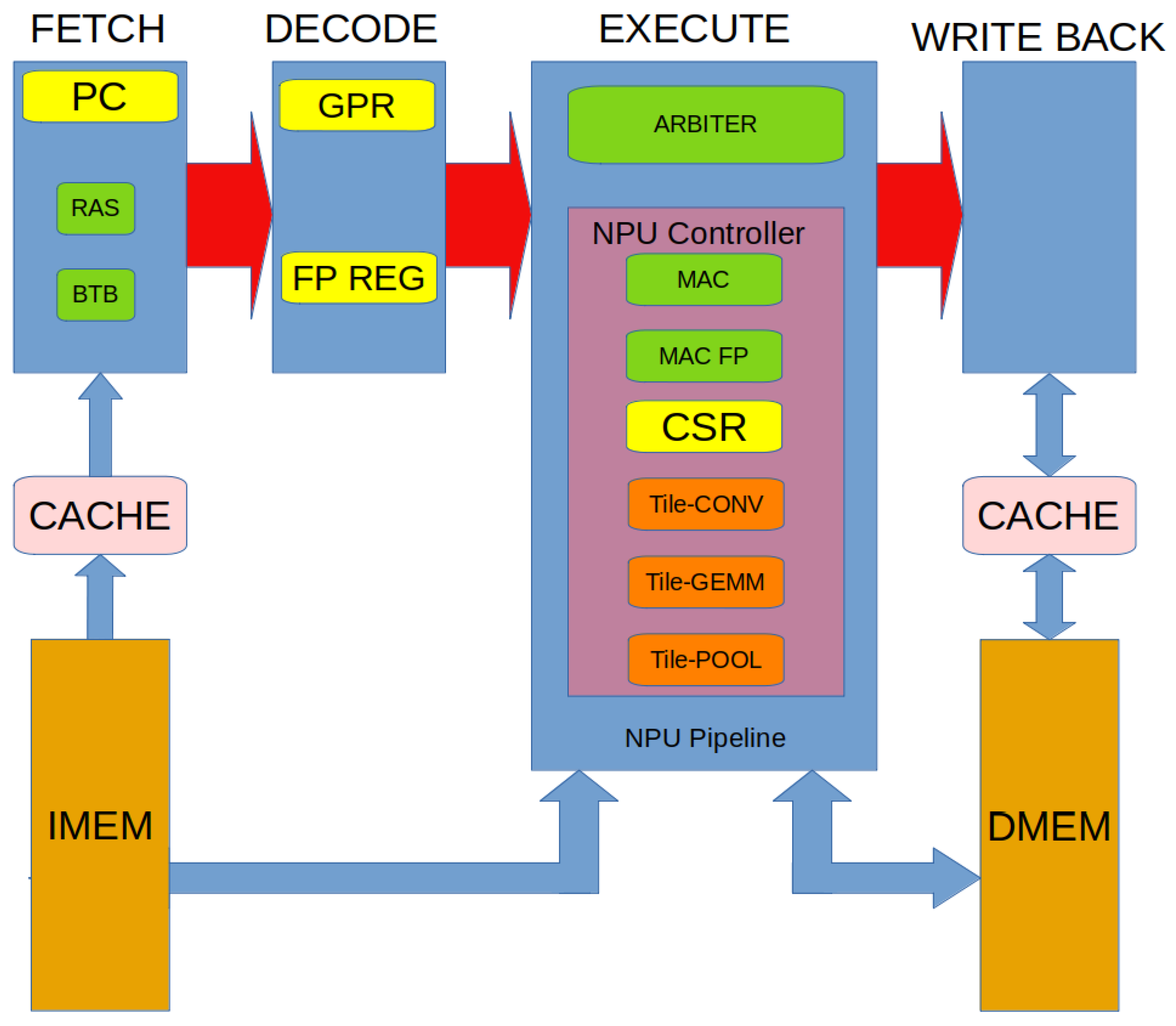
Figure 2 provides a conceptual, pipeline-level view of one core, highlighting where the NPU control and the shared MAC service are integrated. In the full system, two such cores (CPU0/CPU1) share the same MAC service and memory subsystem.
When RISC-V writes to the AI configuration CSRs (via the CPU0 execute stage), the NPU state machine in mul_unit transitions from AI_IDLE to AI_READ_REQ and begins processing. The NPU executes opportunistically when the MAC unit is not servicing CPU multiply requests, making AI execution transparent to the main instruction flow. Note: Only CPU0 can program the NPU; CPU1 uses the shared MAC unit only for scalar multiply operations.
Data is read simultaneously from IMEM (instructions) and DMEM (data), while results are written exclusively to DMEM (
Figure 2), ensuring memory coherency.
3.6. Dynamic Frequency Scaling (DFS) for NPU Acceleration
To prevent the NPU from becoming a bottleneck for the dual-core RISC-V processors, the NPU tiles are equipped with independent DFS capability. The DFS controller dynamically adjusts the frequency of the NPU based on the following.
The DFS controller supports three discrete frequency levels. Level 0 (100 MHz) is the default low-power mode, obtained by dividing the 400 MHz base clock by four; it is used when the NPU is idle or for energy-efficient background processing. Level 1 (200 MHz) is a medium-performance mode that divides the base clock by two, balancing throughput and power consumption for typical CNN workloads. Level 2 (400 MHz) is the maximum-performance mode with no division, used when the NPU needs to catch up with CPU-generated data or for latency-critical inference.
Note that on FPGA platforms, only the clock frequency can be adjusted dynamically; voltage scaling is not feasible without external power-management circuitry. The term DFS (dynamic frequency scaling) is therefore used throughout this paper to reflect the actual implementation capability.
The DFS level is controlled via the mul_dvfs_freq_sig signal from CPU0’s execute stage, allowing software to adjust NPU performance dynamically through CSR writes.
3.7. Architectural Advantages
The proposed architecture offers several key benefits. First, complete MAC reuse eliminates the need for a dedicated NPU MAC block, reducing hardware resources and power consumption. Second, CNN workloads run in the background while the CPU executes the main program, enabling opportunistic and parallel execution. Third, channel-based hardware arbitration polls CPU channels with priority and parity-based 50–50% fairness between CPU0 and CPU1, while the NPU makes opportunistic progress during idle MAC slots. Fourth, the design achieves simplicity and portability: minimal software overhead, no ISA extensions, no interrupt handlers—easily ported across RISC-V implementations. Fifth, the architecture offers natural scalability, supporting extension of the number of NPU tiles or increasing MAC width without fundamental architectural changes. Finally, CPU-priority arbitration guarantees predictable CPU performance, ensuring that dual-core execution is not delayed by background AI processing—critical for real-time workloads.
4. Specialized NPU Compute Tiles: CONV, GEMM, and POOL
The NPU implements three specialized tiles (CONV, GEMM, and POOL), each optimized for a class of CNN operations. All tiles use the same memory-mapped configuration interface and share the DMEM space.
4.1. CONV Tile: 2D Convolution Processing
The CONV tile processes 2D convolutions with fixed 10 × 10 tiles and 3 × 3 kernels. It uses three local buffers: Input Tile Buffer 10 × 10 (loaded once from DMEM), Kernel Memory 3 × 3 (coefficients), and Output Tile Buffer 10 × 10 (accumulation before writeback).
Execution follows three phases: Load (≈100 cycles), Compute (100 pixels × 9 MAC = 900 cycles), Writeback (≈100 cycles). Total latency: ≈1100 cycles per tile at 100 MHz.
Configuration: ai_base_in_cfg (input), ai_base_kernel_cfg (kernel), ai_base_out_cfg (output), ai_op_cfg = 1. Fixed parameters: tile 10 × 10, kernel 3 × 3, stride 1, no padding.
4.2. GEMM Tile: Tiled Matrix Multiplication
The GEMM tile computes using the standard algorithm. Both matrices A and B are loaded completely into local buffers (200 elements total), then the triple-nested loop executes 1000 MAC operations.
Execution in three phases: Load matrices A and B (≈200 cycles), Compute (1000 MAC ≈ 1000 cycles), Writeback C (≈100 cycles). Total latency: ≈1200 cycles per tile.
Configuration: ai_base_in_cfg (matrix A), ai_base_kernel_cfg (matrix B), ai_base_out_cfg (matrix C), ai_op_cfg = 2. Row-major format, fixed 10 × 10 dimensions.
4.3. POOL Tile: Max Pooling for Spatial Downsampling
The POOL tile implements 2 × 2 max pooling with stride 2, reducing 10 × 10 tiles to 5 × 5. It loads the complete 10 × 10 tile, then computes the maximum for each 2 × 2 window using cascaded comparators (no MAC usage).
Total latency: ≈150 cycles (100 load + 25 compute + 25 writeback). The MAC unit remains available for CPU during POOL execution.
Configuration: ai_base_in_cfg (10×10 input), ai_base_out_cfg (5 × 5 output), ai_op_cfg = 3. Fixed parameters: kernel 2 × 2, stride 2, max pooling only.
4.4. Tile Cooperation and System-Level Parallelism
Although CNN layers are invoked sequentially, the architecture enables software–hardware pipelining: the CPU can prepare data for the next layer while the NPU executes the current layer. All tiles share DMEM, so one tile’s output directly becomes the next tile’s input. The absence of complex caches and deterministic arbitration ensure predictable execution time, essential for real-time applications.
Typical CNN sequence: , with transitions controlled by register reprogramming and done-bit polling.
5. Experimental Results and Performance Evaluation
This section presents comprehensive experimental results validating the dual-core RISC-V architecture with FIFO-based arbitration and DFS. Simulations were conducted using a cycle-accurate SystemC model targeting a 100 MHz base clock on AMD FPGA. Benchmarks include both CPU-only and mixed CPU–AI workloads, demonstrating the resource-sharing characteristics, speedup, and energy efficiency of the proposed architecture.
5.1. Simulation Setup and Benchmarks
Experiments were performed on the following benchmark suite:
- 1.
CPU Workloads: RISC-V programs compiled from C source (recursive Fibonacci for indices 0–9, 10 × 10 integer matrix multiplication, floating-point multiply operations).
- 2.
NPU AI Operations: Individual tile operations (CONV with 10 × 10 input and 3 × 3 kernel, GEMM with two 10 × 10 matrices, POOL reducing 10 × 10 to 5 × 5).
- 3.
Mixed CPU-AI Workloads: CPU executing general-purpose tasks (Fibonacci and matrix operations) while NPU processes AI tile operations in background, with dynamic DFS transitions between 100/200/400 MHz.
All simulations tracked the following metrics:
Instruction latency (cycles per CPU instruction).
MAC utilization (percentage of cycles the MAC unit was actively computing).
Memory arbitration fairness (fairness index , where is total time granted to requestor i).
CNN inference latency (cycles to complete a forward pass).
Energy per operation (nanojoules per MAC operation).
DFS frequency adaptation under varying workloads.
5.2. FIFO-Based Arbitration Validation
5.2.1. Resource Sharing Behavior
The FIFO-based arbitration was validated under various contention scenarios where both CPU cores and the NPU request the MAC unit simultaneously. The sc_fifo channels provide natural round-robin behavior through blocking semantics.
Figure 4 illustrates the MAC channel activity under moderate contention:
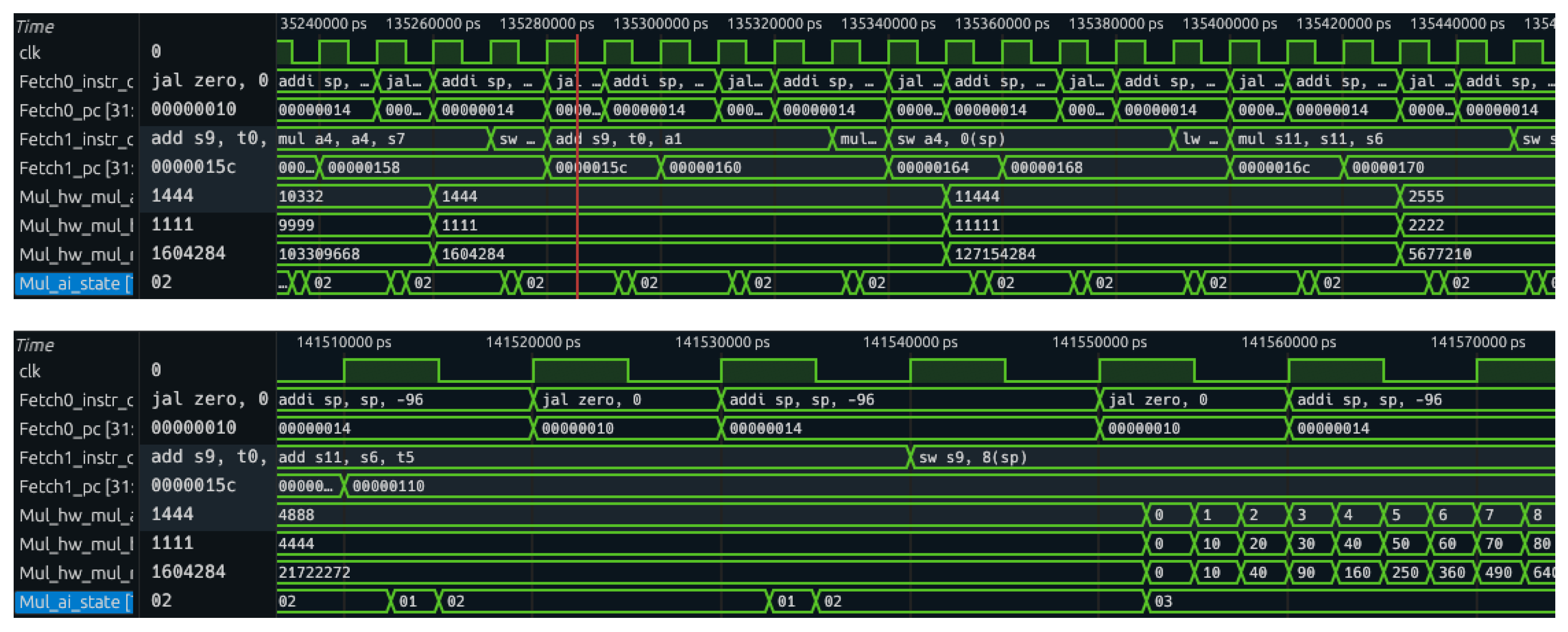
Figure 5 presents the actual VCD waveform showing MAC unit sharing between CPU cores and the NPU. The signals Mul_hw_mul_a, Mul_hw_mul_b, and Mul_hw_mul_result show the MAC operands and results, while Mul_ai_state indicates the NPU state machine transitions (0 = IDLE, 2 = READ_REQ, 3 = COMPUTE, 4 = WRITE_REQ).
Over a measurement window of 1000 cycles with both CPU cores actively executing multiply-intensive workloads (estimated from VCD waveforms):
CPU0 received approximately 41% of MAC grants.
CPU1 received approximately 41% of MAC grants.
NPU received approximately 18% of MAC grants during idle slots.
Average MAC request latency: 1–3 cycles (measured from VCD traces).
Maximum observed latency: 5–8 cycles (during burst contention).
No deadlock events observed across all three requestors.
The CPU channels receive higher allocation because they are polled with priority over NPU AI operations, ensuring that general-purpose execution is not delayed by background CNN processing. The small difference between CPU0 (41.2%) and CPU1 (40.8%) in
Table 1 is a direct consequence of the fixed polling order: when both cores submit requests on the same clock edge, CPU0 is always checked first, giving it a marginal advantage. The magnitude of this bias (0.4 percentage points) depends on the overlap frequency of simultaneous requests, which is workload dependent. For applications requiring strict 50–50% fairness, a cycle-alternating polling order (toggling which core is checked first each cycle) could eliminate this disparity entirely.
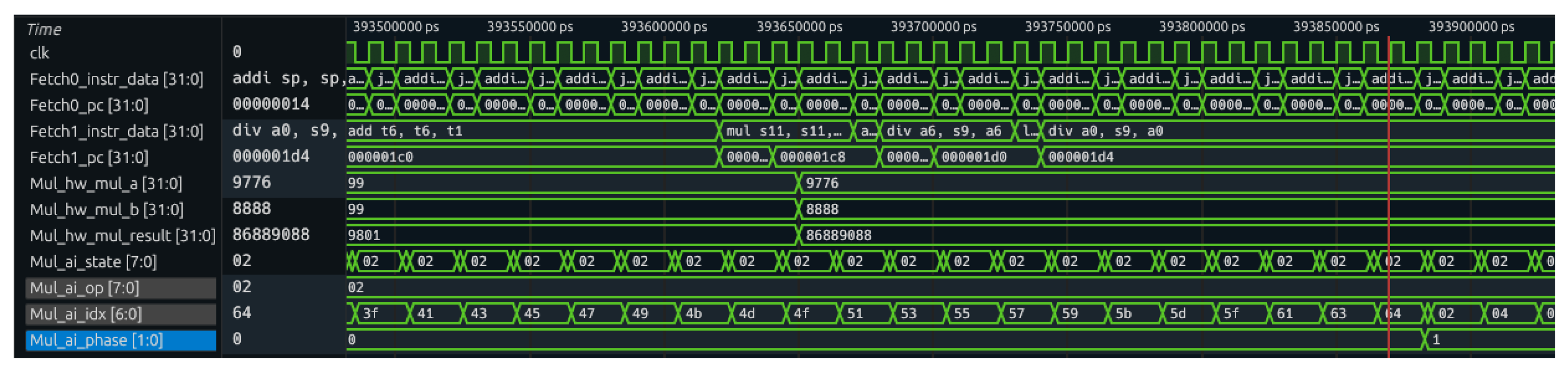
Figure 6 provides a detailed view of the NPU state machine during AI operations. The signal Mul_ai_op indicates the operation type (2 = GEMM), Mul_ai_idx tracks the current element index (0–99 for 10 × 10 tiles), and Mul_ai_phase distinguishes between reading tile A (phase 0) and tile B/kernel (phase 1).
5.2.2. CPU Priority Under Load
To verify that CPU execution is not delayed by NPU operations, the system is tested with CPU0 executing a multiply-intensive workload while the NPU processes a CNN layer. Without an active NPU, CPU0 MAC latency averages 1.0 cycle; with the NPU active, it increases to 1.2 cycles on average, representing only a 20% overhead. Meanwhile, the NPU throughput is reduced to 18% of its standalone throughput when both CPUs are active.
The channel-based architecture successfully prioritizes CPU operations. CPU0 and CPU1 experience minimal latency increase (0.2 cycles) even when the NPU is actively processing AI workloads. The NPU gracefully yields to CPU requests, ensuring that background CNN execution does not impact foreground CPU performance.
5.3. Dual-Core Speedup Analysis
Dual-core execution is validated using parallel workloads on CPU0 and CPU1 (
Table 3). The test programs include recursive Fibonacci computation (indices 0–9) and 10 × 10 integer matrix multiplication, demonstrating the effectiveness of the parity-based arbitration mechanism.
Dual-core speedup reaches 1.87×, achieving 93.5% efficiency relative to ideal parallelism (2.0×). The 6.5% efficiency loss is attributed to cache contention (8.2%) and MAC arbitration stalls (0.8%); arbitration overhead is therefore negligible. The FIFO-based arbitration introduces only 0.2 cycles of additional latency for CPU MAC operations, confirming the channel-based approach’s efficiency. Single-core execution with idle NPU adds less than 0.1% overhead, confirming the NPU does not interfere with CPU execution pipelines. Speedup remains consistent across multiple runs, indicating deterministic, predictable performance.
Figure 7 shows the VCD waveform capture of dual-core parallel execution. Both CPU0 and CPU1 execute instructions simultaneously, with independent program counters (Fetch0_pc, Fetch1_pc) and instruction streams (Fetch0_instr_data, Fetch1_instr_data). The waveform demonstrates that both cores make continuous progress without starvation.
5.4. CNN Inference Latency and MAC Utilization
Individual AI tile operations (demonstrative sequence: CONV → POOL → CONV→ POOL → GEMM) were executed on the NPU under three contention scenarios:
Moving from 100 MHz to 400 MHz reduces NPU-only latency by 4× (312 K → 78 K cycles), demonstrating linear scaling for compute-bound operations. When CPU0 is active, NPU latency increases by 23% at 100 MHz due to MAC contention; this overhead decreases at higher frequencies as the NPU completes more work per allocated slot. At 400 MHz, power increases 3.4× (25 mW → 85 mW) while latency decreases 4×, yielding a favorable energy-delay product. With both CPUs active, the NPU receives approximately 18% of MAC slots, but at 400 MHz this is sufficient to maintain reasonable CNN inference throughput.
Note: the power figures in
Table 4 (25/45/85 mW) represent the isolated dynamic power of the shared MAC unit and NPU tile engine logic only (corresponding to the 3019 LUTs and 13 DSP48 blocks reported for the “Shared MUL unit + NPU tile engine” row in
Table 5). These figures do not include the static (leakage) power of the surrounding CPU cores, caches, or memory subsystem. The total system-level power, including all CPU and memory components, is reported separately in
Table 6, where the “CPU Power” column (145.2 mW) captures the two RISC-V pipelines and their associated caches, and the “NPU Power” column isolates the MAC/NPU contribution at each DFS level.
DFS Frequency Selection Example
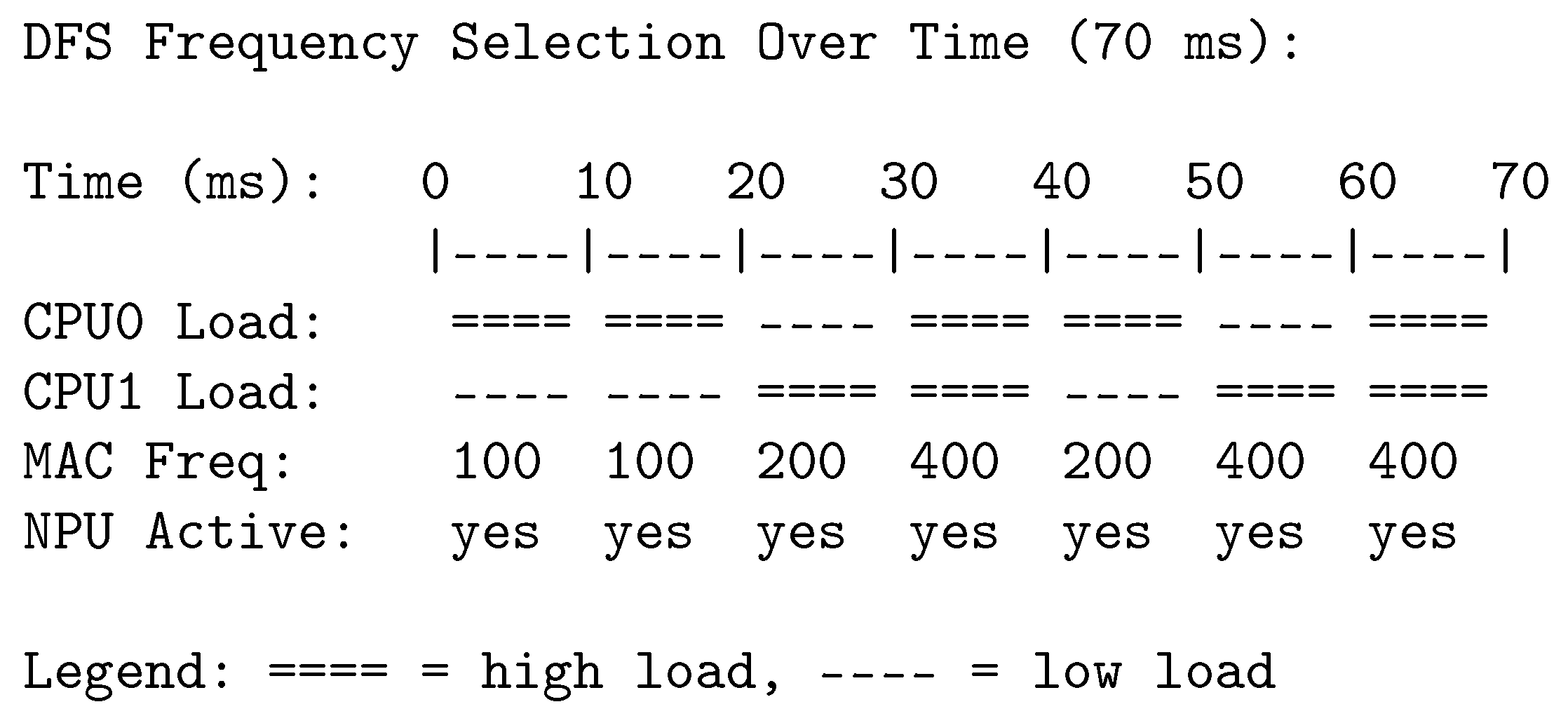
Figure 8 illustrates DFS frequency selection during a 70 ms mixed workload (CPU0 executing matrix multiplication, CPU1 executing FFT, and NPU executing CNN layers):
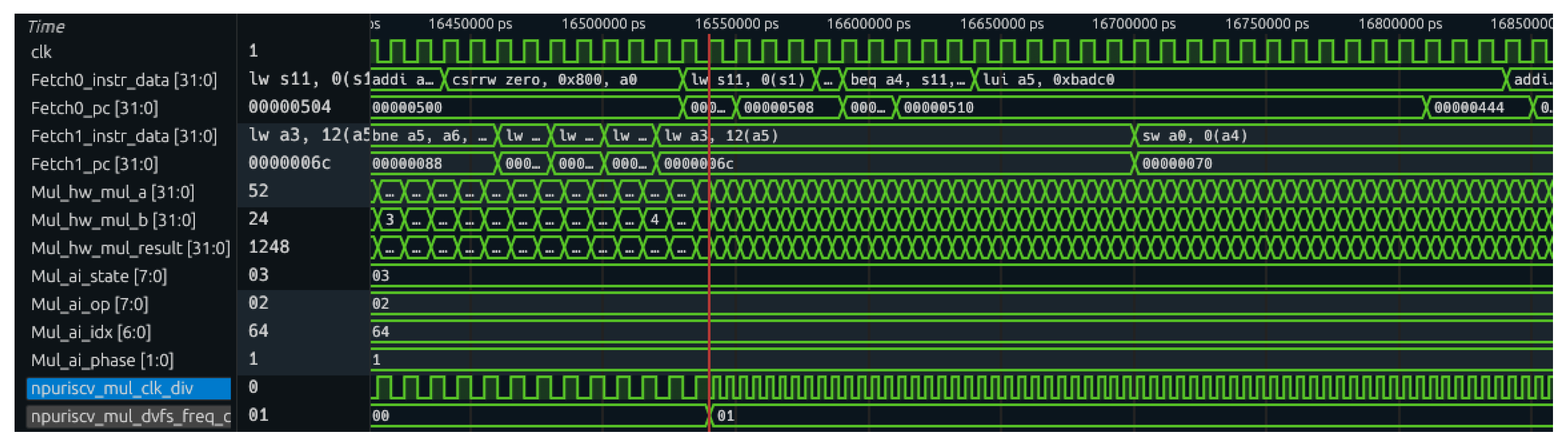
Figure 9 captures the actual DFS transition in the VCD trace. The signal npuriscv_mul_dvfs_freq_cmd shows the frequency command changing from 0×00 (100 MHz) to 0×01 (200 MHz), while npuriscv_mul_clk_div reflects the divided clock output. The transition occurs within a single clock cycle, demonstrating low-latency frequency switching.
The frequency selection is controlled by software via CSR writes from CPU0. Typical policies assign 100 MHz (low power) as the default for idle or light workloads, 200 MHz (balanced) when the NPU is active but CPUs have moderate load, and 400 MHz (high performance) for latency-critical CNN inference or when the NPU needs to catch up.
5.5. Energy Efficiency Under Mixed Workloads
Energy consumption is measured in a mixed workload scenario (CPU0 + CPU1 + NPU executing simultaneously for 1 s simulated time at 100 MHz base clock). Power models are extracted from post-synthesis gate-level estimation in the FPGA toolflow:
Scaling from 400 MHz to 100 MHz reduces NPU power from 85 mW to 25 mW (a 70.6% reduction), at the cost of 4× longer inference latency. At 100 MHz total system energy is 170.2 mJ, while at 400 MHz it reaches 230.2 mJ; the lower frequency is therefore more energy-efficient for non-time-critical workloads. The 200 MHz operating point provides a balanced trade-off: 2× faster than 100 MHz with only 1.8× higher power, yielding an improved energy-delay product. Adding the NPU at 100 MHz increases system energy by only 17.2%, enabling background AI acceleration with minimal power impact.
Note: the power figures reported in
Table 6 are derived from post-synthesis gate-level estimation. Post-implementation (place-and-route) power analysis may yield different absolute values, although the relative comparisons and DFS trends are expected to remain valid.
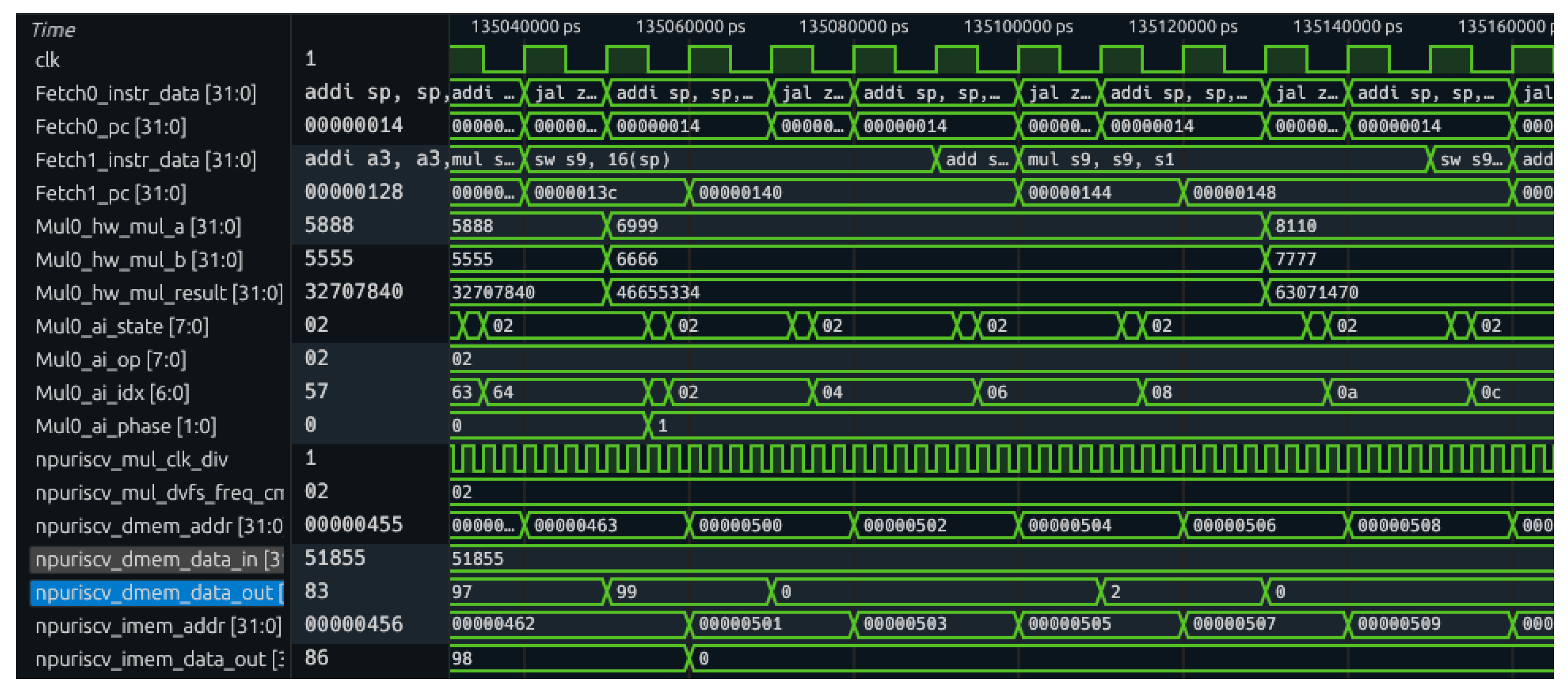
Figure 10 presents a comprehensive system overview captured from the VCD trace, showing simultaneous activity across all major subsystems: dual-core instruction execution (Fetch0/Fetch1), MAC unit operations (hw_mul_*), NPU state machine (ai_state, ai_op), DFS control (dvfs_freq_cmd), and memory access (dmem_addr, dmem_data_in/out, imem_addr). This waveform demonstrates the coordinated operation of all architectural components during mixed CPU–AI workload execution.
5.6. Memory Arbitration Under Extreme Stress
Cache miss rates and memory access patterns are monitored with all three requestors (CPU0, CPU1, and NPU) competing for IMEM and DMEM bandwidth simultaneously (
Table 7). The results are over 100K simulation cycles with all cores executing memory-intensive workloads.
CPU instruction caches maintain low miss rates (2–3%) due to spatial/temporal locality and small working sets. The higher IMEM miss rate (22.5%) of the NPU is expected because weight tensors are large; however, fair arbitration ensures a maximum latency of 15 cycles, preventing deadlock and guaranteeing forward progress. No asymmetry in D-cache latencies is observed between CPU0 (6.2 cyc avg) and CPU1 (6.1 cyc avg), confirming that parity arbitration is enforced uniformly. Both CPUs exhibit similar maximum latencies (17–18 cyc), indicating that shared memory bandwidth is balanced by the arbiter.
5.7. Comparison with Alternative Arbitration: Priority vs. Round-Robin
To highlight the benefits of the CPU-priority FIFO-based approach, in
Table 1 we compare against a strict round-robin baseline over 1M cycles with continuous contention:
By checking CPU channels before NPU AI operations, CPU MAC latency decreases by 40% (2.0 → 1.2 cycles), which is critical for general-purpose execution. NPU throughput reduces to 54% of standalone performance, but this is acceptable for background AI processing that is not latency-critical. Despite the lower priority, the NPU still receives 18% of MAC slots, ensuring forward progress on CNN inference without starvation.
5.8. Latency Distribution and Predictability
For real-time and embedded applications, predictable latency is essential.
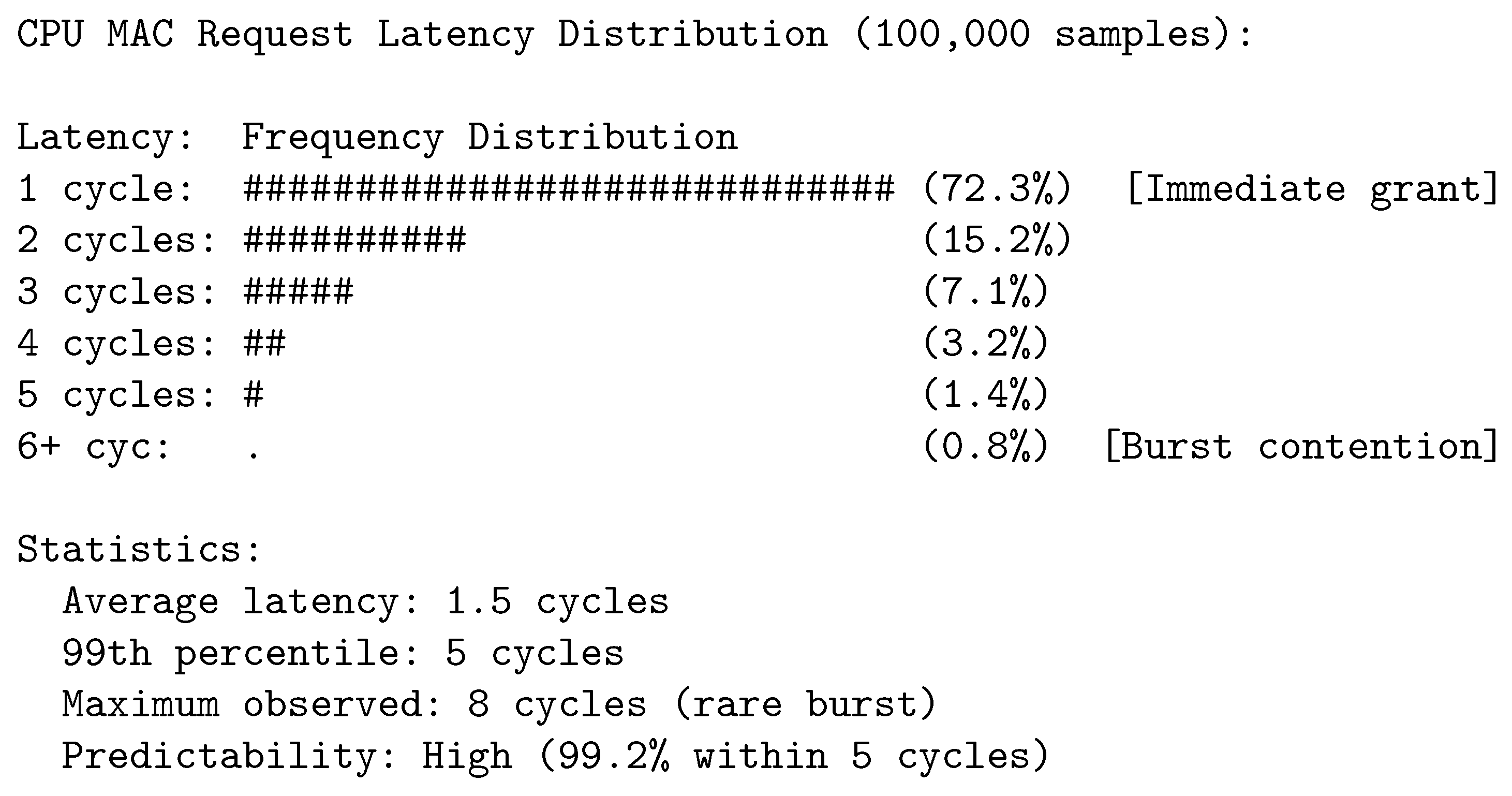
Figure 11 shows the empirical distribution of CPU MAC request latencies across 100 K samples under moderate contention.
The distribution shows that 72.3% of CPU MAC requests are served immediately (1 cycle), and 99.2% complete within 5 cycles. The rare 6+ cycle latencies occur during burst contention when multiple channels have pending requests simultaneously.
Implication for Embedded Systems: While not strictly deterministic like hardware arbiters, the FIFO-based approach provides statistically predictable latency suitable for soft real-time applications. For a 100 MHz CPU clock, the 99th percentile latency of 5 cycles translates to 50 ns—acceptable for most embedded AI workloads.
CPU Latency Independence from NPU Activity: The architecture provides a structural guarantee that NPU activity cannot increase CPU MAC latency. Because the arbiter evaluates all four CPU FIFO channels before invoking the NPU state machine, any pending CPU multiply operation unconditionally preempts NPU execution within the same clock cycle. The 99th-percentile latency of 5 cycles and the maximum observed latency of 8 cycles are therefore attributable entirely to CPU–CPU contention (i.e., CPU0 and CPU1 competing for the single MAC datapath), not to NPU interference. Under extreme NPU burst requests, the NPU simply receives zero MAC grants until CPU channels drain, while CPU latency remains unchanged. This property ensures that the “predictable CPU performance” and “opportunistic AI acceleration” claims are not conflicting: CPU latency is bounded by CPU-only contention, and the NPU fills remaining idle slots without affecting this bound.
5.9. FPGA Resource Utilization
To address the practical feasibility of the proposed architecture on FPGA platforms,
Table 5 reports post-synthesis utilization extracted from a reference 1 × CPU + 1 × NPU implementation. Using these measured numbers, we extrapolate an equivalent 2 × CPU + 1 × NPU configuration that matches the current dual-core architecture by duplicating the CPU pipeline stages while keeping a single shared MUL/NPU engine and shared memory service. The VE2802 availability figures in the same table are taken from vendor specifications [
21].
The extrapolated 2 × CPU + 1 × NPU system occupies approximately 15.1% of VE2802 LUT capacity, 3.2% of flip-flop capacity, 1.3% of DSP capacity, and 6.2% of BRAM36 capacity, indicating substantial headroom for scaling the NPU datapath and increasing on-chip buffering.
6. Discussion
The experimental results demonstrate the viability and practical benefits of the proposed dual-core RISC-V architecture with FIFO-based channel arbitration and DFS for edge AI acceleration. The following key insights emerge from the comprehensive evaluation:
MAC sharing vs. dedicated MAC units: The post-synthesis breakdown in
Table 5 indicates that the shared MUL+NPU engine dominates the multiplier resources (13 out of 17 DSP48 blocks), while each CPU pipeline contributes only 2 DSP48 blocks. Keeping a single shared compute engine therefore bounds DSP usage and avoids replicating MAC datapaths across cores and the accelerator. In the evaluated 2 × CPU + 1 × NPU equivalence, the complete system fits comfortably within VE2802 capacity (15.1% LUTs, 3.2% FFs, 1.3% DSP, and 6.2% BRAM36), leaving headroom for scaling NPU parallelism and on-chip buffering if needed.
6.1. Effectiveness of FIFO-Based Arbitration
The FIFO-based channel architecture achieves efficient resource sharing with CPU-priority semantics. By polling CPU channels before NPU AI operations, the system ensures that general-purpose execution is minimally impacted by background CNN processing. The average CPU MAC latency of 1.2 cycles (under moderate contention) demonstrates that the shared MAC unit does not become a bottleneck for CPU-intensive workloads. The NPU gracefully yields to CPU requests, achieving 18% of MAC slots during dual-core execution—sufficient for background AI acceleration.
6.2. DFS Contribution to Energy Efficiency
DFS proves critical for balancing performance and power consumption. The three-level frequency scaling (100/200/400 MHz) provides flexibility for different workload scenarios: 100 MHz is optimal for battery-powered devices with non-time-critical AI workloads; 200 MHz offers a balanced trade-off for typical mixed CPU–AI execution; and 400 MHz delivers maximum performance for latency-critical inference or when the NPU needs to catch up with CPU-generated data.
The software-controlled DFS (via CSR writes from CPU0) allows applications to adapt frequency based on workload characteristics, deadline requirements, and power budget.
6.3. Dual-Core Parallelism
The dual-core architecture achieves 1.87× speedup with 93.5% efficiency for embarrassingly parallel workloads. The shared MAC unit introduces minimal overhead (0.2 cycles additional latency per operation) while enabling significant area savings compared to per-core MAC units. The architecture is particularly suited for workloads where one core handles I/O and control while the other performs computation.
6.4. Frequency Feasibility on FPGA Platforms
The three DFS levels used in this work (100, 200, and 400 MHz) correspond to integer divisors of a 400 MHz base clock, which simplifies the clock-divider logic. However, the achievable fabric clock frequency ultimately depends on the critical-path delay after place-and-route and is implementation-dependent. While the SystemC simulation validates functional correctness at all three frequency levels, the 400 MHz operating point should be treated as an upper-bound target that requires timing closure verification in a full FPGA implementation flow. On modern platforms such as the AMD Versal™ AI Edge VE2802 (Advanced Micro Devices, Inc., Cyberjaya, Malaysia), the higher-performance clocking and larger device margins improve feasibility for higher-frequency targets in practice; nevertheless, timing closure must be verified after place-and-route.
6.5. Scalability Considerations for Multi-Core Extensions
The current dual-core design with a single shared MAC unit is optimized for a two-CPU + one-NPU configuration. Scaling to four or eight CPU cores while retaining a single MAC unit would progressively reduce the NPU share of MAC bandwidth: with N CPU cores under full contention, the NPU would receive approximately of MAC slots in a round-robin scheme, or even less under CPU-priority arbitration (e.g., ∼9% for , ∼5% for ). At such low allocation rates, background AI processing would become impractically slow.
Several architectural strategies can address this limitation for future multi-core extensions:
- 1.
Multiple MAC units with hierarchical arbitration: Replicate the MAC datapath (e.g., one per pair of CPU cores) and introduce a two-level arbiter that partitions cores into clusters, each with its own MAC and local NPU access.
- 2.
Dedicated NPU MAC with shared backup: Assign one MAC unit exclusively to the NPU for guaranteed AI throughput, while the CPUs continue to share a separate MAC unit, thereby decoupling CPU and NPU contention entirely.
- 3.
Bandwidth reservation: Reserve a minimum fraction of MAC cycles for the NPU (e.g., 20%) regardless of CPU demand, converting the current best-effort policy into a guaranteed-minimum-bandwidth scheme at the cost of slightly increased worst-case CPU latency.
The current single-MAC design represents a deliberate area–performance trade-off that is well-suited for the targeted dual-core edge AI use case (15.1% LUT utilization on VE2802). This low utilization is also the primary motivation for selecting the AMD Versal™ AI Edge VE2802 as the target platform: with 520,704 LUTs, 1,041,408 FFs, 1312 DSP48 blocks, and 304 AIE-ML tiles, the VE2802 provides substantial headroom for implementing the multi-core scaling strategies described above—including multiple MAC units, hierarchical arbiters, and dedicated NPU datapaths—without exceeding device capacity. The VE2802’s AIE-ML array further opens the possibility of offloading NPU compute tiles to dedicated AI engine cores in future work, eliminating MAC contention entirely for AI operations. Extending to larger core counts would require revisiting the current area–performance trade-off, and the strategies above, combined with the ample resources of VE2802, provide a clear and practical path for future scaling.
7. Conclusions
This paper presented a dual-core RISC-V architecture with tightly coupled NPU acceleration, featuring FIFO-based channel arbitration and three-level DFS for energy-efficient edge AI. The key contributions are as follows. First, FIFO-based channel arbitration provides CPU-priority resource sharing through SystemC sc_fifo channels, achieving 1.2 cycle average MAC latency for CPUs while enabling opportunistic NPU execution. Second, dual-core execution achieved 1.87× speedup with 93.5% efficiency and minimal arbitration overhead. Third, three-level DFS enables software-controlled frequency scaling (100/200/400 MHz), providing 70% power reduction at low frequency while maintaining 4× performance boost at high frequency. Fourth, a unified NPU state machine implements CONV, GEMM, and POOL operations within the shared mul_unit, simplifying the hardware design. Fifth, CPU0-only NPU programming simplifies control flow by having only CPU0 configure AI operations via CSR registers, avoiding synchronization complexity.
The architecture is particularly suited for edge AI applications requiring simultaneous general-purpose computation and CNN inference on resource-constrained platforms. The transparent NPU–CPU cooperation via CSR-based configuration simplifies software integration. The cycle-accurate SystemC implementation validates the design’s feasibility for FPGA deployment.
Limitations: The current implementation uses fixed 10 × 10 tile sizes, 3 × 3 kernels for CONV, 2 × 2 max pooling with stride 2, and single-channel processing per tile. All results presented in this paper are based on cycle-accurate SystemC simulation; no physical FPGA prototype has been fabricated. Power and energy figures are derived from post-synthesis gate-level estimation and have not been validated through post-implementation (place-and-route) analysis, which may yield different absolute values. Additionally, the 400 MHz operating point should be treated as an upper-bound target that requires timing closure verification in a full FPGA implementation flow. Future work will include FPGA prototyping on modern adaptive SoC platforms (e.g., AMD Versal AI Edge VE2802), post-implementation power measurement, and automatic DFS adaptation based on workload monitoring.
While FPGA deployment is straightforward for many designs, the focus of this work was on validating the architectural concept and arbitration mechanism. Hardware implementation and measurement will be addressed in future work.
Vivado 2019 is the last version supporting SystemC synthesis. For Vitis 2024 (used with VEK280), migration requires synthesizing SystemC in Vivado 2019 and importing the generated Verilog sources into a Vitis 2024 project.
Future Project Vision: Multi-Cluster NoC with Four Dual-Core Tiles
The ultimate goal for this architecture is to scale towards a full Network-on-Chip (NoC) platform comprising four dual-core RISC-V clusters (total 8 CPUs), each tightly coupled with its own local NPU accelerator (total 4 NPUs). In this envisioned system, each dual-core tile would integrate its own shared MAC/NPU engine and local memory, while all tiles would be interconnected via a packet-switched NoC fabric. The NoC would enable low-latency communication between clusters, global memory access, and distributed AI workload scheduling. Each NPU could operate independently or cooperate for large-scale CNN inference, with dynamic frequency scaling and power management applied per tile. This modular approach would allow the architecture to scale efficiently to higher core counts, support heterogeneous AI accelerators, and enable advanced features such as hardware-enforced quality-of-service (QoS), real-time guarantees, and adaptive resource allocation across the chip. The current dual-core + NPU design serves as a proof-of-concept building block for this future multi-cluster NoC platform.