1. Introduction
Engineering design optimization rarely involves a single smooth objective under simple constraints. In practice, many design problems are characterized by nonlinear objective functions, coupled variables, strict inequality and equality constraints, and search spaces containing multiple local optima. The problem addressed in this study is therefore the reliable solution of constrained engineering design problems in which an optimizer must simultaneously preserve feasibility, maintain population diversity, and refine promising regions with acceptable computational effort.
Classical optimization methods are effective when the problem is smooth, differentiable, and well-structured. However, many real engineering problems do not satisfy these assumptions. Discontinuous responses, non-convex feasible regions, mixed decision variables, and expensive black-box evaluations can reduce the effectiveness of deterministic and gradient-based techniques. For this reason, population-based metaheuristics have become attractive alternatives because they can search complex landscapes without requiring explicit derivative information and can be adapted to constrained optimization tasks.
At the same time, recent studies have emphasized that the design of new optimizers should be justified by effective search mechanisms rather than by metaphor alone. Samadi-Koucheksaraee et al. discussed this issue and highlighted the importance of moving toward optimization frameworks with clearer mathematical foundations and more interpretable search dynamics [
1]. In this direction, several mechanism-driven algorithms have been reported in the recent literature. Gradient-based optimizer (GBO) is an optimizer that relies on a gradient search rule and an operator to escape local minima that can be located too soon due to minimum exploration or a local minimum can occur too early in an exploration, as illustrated in
Figure 1 below [
2]. RUN compiles population updates using the numerical logic of the Runge–Kutta method and improves search performance with a better solution-quality mechanism to enhance convergence behavior [
3]. INFO produces candidate solutions using weighted-mean vector operations, combined with vector-combining and local-search processes, with vectors 2022info. Later on, LEE proposed a physics-inspired search strategy based on the Langevin equation, along with specific search, diversity enhancement, and local escape operators, to find local minimal energy points (LEEs) [
4]. All these studies demonstrate a clear trend in favor of optimization strategies, whose operators are more transparently characterized in a mechanism-oriented way.
Regardless of this development, constrained engineering design remains challenging, as no single optimizer can consistently achieve an optimal trade-off between exploration and exploitation across all problem classes. The high diversification can enhance global search and reduce convergence, but the intensive diversification can enhance convergence but at the expense of premature stagnation. This trade-off is exceptionally important in engineering design because any slight compromise in the quality of the solution may translate into a higher cost, lower efficiency, or a lower safety margin.
Frilled Lizard Optimization (FLO) is a recent algorithm that is a promising global search algorithm based on population methods [
5]. But even in hard-constrained problems, more vigorous adaptive exploitation and solution refinement may still be required to accelerate convergence and achieve higher final accuracy.
In contrast, JADE provides adaptive differential evolution operators with self-adjusting control parameters, which can strengthen exploitation while preserving diversity. Accordingly, the motivation for the present hybridization is operator-based rather than metaphor-based: FLO contributes diversified global search behavior, whereas JADE contributes adaptive search and refinement mechanisms.
Motivated by these considerations, this study proposes a hybrid FLO–JADE optimizer for engineering design problems. The aim is to improve convergence characteristics, enhance solution quality, and obtain a more reliable exploration–exploitation balance on complex constrained search spaces. The effectiveness of the proposed hybrid framework is then assessed through a set of representative engineering optimization problems.
Research Contributions
The main contributions of this study can be summarized as follows:
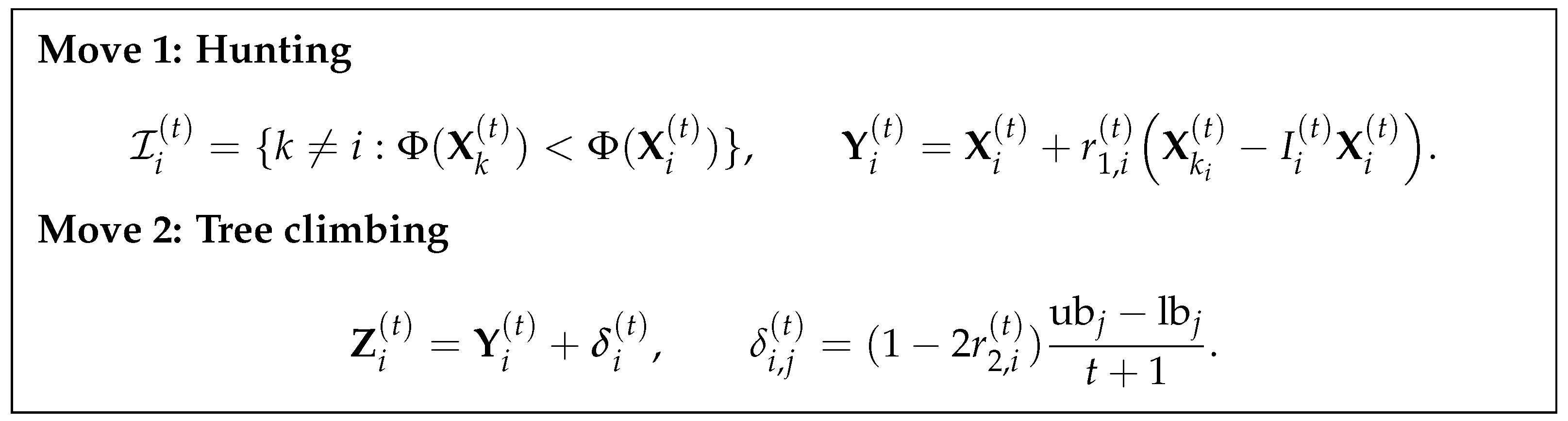
A new hybrid nature-inspired metaheuristic, called JADEFLO, is introduced. It couples Adaptive Differential Evolution with Optional External Archive (JADE) and Frilled Lizard Optimization (FLO) in a two-stage framework, where JADE performs adaptive global exploration and FLO carries out behaviorally inspired local exploitation via hunting and tree-climbing strategies.
A detailed algorithmic formulation and analysis of JADEFLO are provided, including the design of the JADE–FLO transition mechanism, a discussion of exploration–exploitation roles in each phase, and a complexity study showing that the hybridization preserves linear time complexity with respect to the number of iterations, population size, and problem dimension.
An extensive benchmarking campaign is conducted on the IEEE CEC2022 single-objective benchmark suite (F1–F12) using 30 independent runs. JADEFLO is compared against more than twenty classical and recent metaheuristics (such as GA, PSO, DE variants, GWO, WOA, MFO, MVO, SCA, and FLO), and achieves the best or near-best performance on most functions, with superior overall ranking, accuracy, convergence speed, and robustness.
The practical effectiveness of JADEFLO is validated on three representative constrained engineering design problems (Pressure Vessel, tension/compression spring, and speed reducer). The proposed algorithm will always produce viable designs with competitive objective values, or better than competitors’ in the market.
The detailed empirical behavioral analysis of JADEFLO search behavior is provided in terms of convergence curves, search-history plots, and average-fitness profiles on CEC2022 benchmarks, which provide further understanding of how the two phases are coordinated to trade between global exploration and local refinement.
The rest of this paper follows the following structure.
Section 2 reviews the associated literature and provides a summary of the main concepts of Frilled Lizard Optimization (FLO).
Section 3 defines the suggested JADEFLO algorithm, its reasoning, its formulation, the parameter settings, the constraint management strategy, and complexities.
Section 4 gives the report on the experimental setup and the results on the IEEE CEC2022 benchmark functions, convergence behavior, ablation analysis, and statistical comparisons. In
Section 5, the application of JADEFLO to three constrained engineering design problems is introduced. Lastly,
Section 6 concludes the paper and recommends future work.
2. Related Work
Significant advances in metaheuristic and evolutionary algorithms have been made to overcome the complexities and limitations encountered in real-world engineering optimization. One common theme in the literature has been to pair or combine algorithms or to incorporate specialized local search and control strategies in an attempt to achieve improved exploration versus exploitation. Specifically, hybridizations have often been based on Differential Evolution (DE), Particle Swarm Optimization (PSO), Estimation of Distribution Algorithms (EDAs), and many other swarm-intelligent approaches for constrained engineering design problems.
Forms of DE that combine with other algorithms have, on many occasions, demonstrated the ability to expose the beneficial properties of the other algorithm, particularly in addressing nonlinear or mixed-integer problems. Bai et al. [
6] introduced a better hybrid DE-EDA (IHDE-EDA) that combined information on differences and global statistics to better solve constrained engineering systems (Bai 2012, p. 1074). In a comparable study, Zhang et al. [
7] proposed a hybrid between Cuckoo Search and DE (CSDE) to preserve the global search capabilities of Cuckoo Search and refine locally with the help of DE (Zhang 2019, p. 254). Panigrahy and Samal [
8] later expanded on DE with Seagull Optimization and Wild Horse Optimization and showed that they can compete with the real world. These papers demonstrate that combining DE with local intensification or population partitioning methods often improves convergence and solution accuracy in complex engineering problems.
An increasing number of literature works focus on improving PSO or developing hybrid versions that reduce premature convergence and increase exploration of promising solutions. The whale-inspired spiral shrinking and Differential Evolution-based mutation were incorporated into PSO by Qiao et al. [
9] to improve diversity and exploitation within the population, and the results were reported to have improved on traditional design benchmarks. Fakhouri et al. [
10] note that in a different study, PSO was used in conjunction with sine-cosine and Nelder–Mead simplex methods to trade off the large-scale exploration and accurate local optimization, providing superior results on engineering problems such as the design of a welded beam and springs (Fakhouri et al., 2020, p. 3091). In the meantime, Sun et al. [
11] have used a political optimizer system that uses PSO-related ideas to properly manage engineering design constraints.
A variety of new methods involve new swarm algorithms (Marine Predators, Harris Hawks, Water Wave, Beluga Whale, and more) in local refinement processes or co-evolutionary systems. Ramezani et al. [
12] improved the Marine Predators Optimization by adding a local refinement to accelerate convergence. Multi-strategy improvements were applied to a Sand Cat algorithm for chemical reactor optimization by Hu and Mo [
13]; specifically, chaotic initialization and local random wandering were emphasized (Hu 2024, p. 85). Local search Local intensification is typically maintained by using local searches, typically with few tuned adjustments, including Nelder–Mead or simulated annealing [
14,
15]. Also, randomization and opposition-based methods tend to fix unwanted GWO-based metaheuristic tendencies to be trapped in suboptimal basins, an example of which is hybrid GWO simulated annealing [
16] or combined AOA Golden Sine solvers [
17].
The other theme is specialized mechanisms for constraint management, adaptive parameter control, and population diversity. Bai et al. [
6] used feasibility rules to reduce the population size to valid regions in a short period of time. Multi-population structures were applied in combination with local search by Panagant et al. [
18] to enhance global coverage, but a different algorithm was introduced by Barshandeh et al. [
19] that relies on chaos and quasi-oppositional learning to prevent stagnation. Some are based on dynamically adapted penalty techniques, such as the bracket operator penalty [
20], as proposed by penalty [
20], and adaptive penalties, such as proposed by Fan2016179. Some further methods applicable to support diversification in a large search space include quasi-oppositional initialization [
21,
22], which has been proposed many times, as well as chaotic expansions [
13], particularly when high-dimensional engineering problems are at stake.
Besides, numerous hybrid models have been tested over established engineering standards of tension/compression Spring design, welded beam design, Pressure Vessel design, and gear train optimization [
6,
7,
10,
18,
23]. It was also shown that hybrid Taguchi methods were faster and more accurate, such as the research by Yildiz and others Yildiz [
24] using Taguchi in water cycle modeling, and Moth Flame with Water Cycle to answer real-life structural optimization problems, created by Liu et al. [
25]. These hybrid metaheuristics have been found to be more robust, more accurate in the performance of solutions and converge faster than single-algorithm approaches in a variety of problem scenarios Khaililpourazari et al. [
26]. With the ongoing development of hybrid metaheuristics, scientists are also introducing multi-objective considerations, more complex local search modules, and dynamic parameter adjustment to address more complex situations. In fact, this steady effort to foster synergy among approaches and specialized constraint-handling methods is a harbinger of future progress in computational efficiency and reliability at large scale in engineering design.
2.1. Adaptive Penalty Techniques and Efficient Reduction of Constraint Violations
Constraint handling is a critical issue in constrained metaheuristic optimization because variation operators are usually designed to improve objective values rather than directly reduce infeasibility. Barbosa et al. [
27] reviewed adaptive penalty techniques and showed that, although penalty methods are simple and widely used, fixed penalty parameters are typically problem-dependent and can strongly affect search performance. When the penalty coefficient is too small, the population may spend many evaluations in highly infeasible regions; when it is too large, objective improvement may be suppressed, and the search may become overly conservative. Therefore, a static penalty can make it difficult for an optimizer to move toward the feasible region in a controlled and efficient manner.
This drawback is relevant to the present study because the constrained engineering experiments employ a fixed penalty coefficient for infeasible solutions. While this design is easy to implement and reproduce, it does not exploit feedback from the ongoing search, such as the proportion of feasible individuals in the population, the relative magnitude of aggregated constraint violations, or the current quality gap between feasible and infeasible candidates. As discussed by Barbosa et al. [
27], adaptive penalty methods are attractive precisely because they adjust the feasibility pressure online rather than relying on a single problem-dependent constant.
A closely related direction was recently illustrated for self-adaptive differential evolution by Hsieh [
28]. In that work, feasible solutions are biased over infeasible ones, and infeasible candidates are evaluated by considering both their constraint violations and the objective value of the best feasible solution in the current population. For a DE-based hybrid such as JADEFLO, this idea is especially relevant because it can embed constraint reduction into the selection logic itself, rather than treating it as a passive consequence of a fixed penalty coefficient.
Based on these works, a prospective enhancement of JADEFLO is to make the penalty always fixed with a feasible-solution-biased adaptive rule, for example,
where
is the set of feasible solutions in the current population,
is the best feasible solution available at iteration
t,
is a normalized aggregate constraint-violation measure, and
is updated adaptively according to the search state. Such a mechanism would allow JADEFLO to reduce violations more efficiently in the early stages while preserving objective-driven refinement after the population enters the feasible region. Accordingly, improving constraint handling through adaptive penalties and feasible-biased selection constitutes an important direction for enhancing the computational efficiency of JADEFLO on tightly constrained engineering design problems.
2.2. Overview of Frilled Lizard Optimization
Frilled Lizard Optimization (FLO) [
29] is a biologically inspired metaheuristic that draws on the distinctive predatory and evasion tactics of the frilled lizard, a reptile found in northern Australia and southern New Guinea. In essence, FLO models the lizard’s “sit-and-wait” strategy, followed by a rapid retreat to a tree after feeding, as a two-phase process of exploration and exploitation [
5].
The frilled lizard exhibits distinct behaviors that serve as a model for the optimization process. This arboreal species spends most of its time in trees but descends to the ground for feeding, socializing, and finding new trees. When hunting or escaping predators, it uses its ability to run bipedally, which helps in maintaining balance by aligning its head and tail [
29]. Its primary prey consists of insects like ants, termites, centipedes, and larvae, which it catches using a sit-and-wait strategy. Once it spots prey, the frilled lizard runs quickly to capture it and then retreats back to the safety of the trees. These actions, in particular, the fast movement toward the prey and the consequent retreat to the trees, are the main focus of the FLO algorithm.
The FLO algorithm uses frilled lizards as a population to represent possible solutions in the problem-solving space. The framed lizards are associated with the candidate solutions, and they are modeled mathematically as a vector. This population is represented as a matrix of decision variables, where the rows correspond to individuals in the frilled lizard population and the columns correspond to the dimensions of the solution space. The positions of the frilled lizards are randomly set at initial positions within the problem’s search space, which is bounded by the upper and lower limits of the decision variables.
The optimization process involves 2 steps. The first step is Exploration (Hunting Strategy): It involves the simulation of the movement of the frilled lizard towards its prey to enable extensive search space exploration. In the case of the frilled lizard, the location of potential prey (i.e., other solutions with better objective function values) is determined. The lizard will approach one of these prey and track its position depending on the target. A new position is accepted when it leads to improvement of the objective position. Exploitation (Moving Up the Tree): The frilled lizard moves back to a tree after its food intake, which symbolizes a more localized, focused search for the best solutions. During this stage, each frilled lizard undergoes only minor positional shifts, boosting the algorithm’s ability to refine solutions through local exploitation. If a lizard’s new position results in an improved objective function value, that position is retained.
FLO follows the main steps of initializing the population, evaluating the objective function, applying the exploration and exploitation phases, and updating the population’s best solution. The computational efficiency of FLO makes it suitable for handling complex optimization problems with multiple variables and constraints.
3. JADEFLO: Hybrid Adaptive Differential Evolution with Optional
External Archive (JADE) and Frilled Lizard Optimization (FLO)
3.1. JADEFLO: Novelty, Design Rationale, and Formulation
JADEFLO is not merely a serial concatenation of JADE and FLO. Its novelty lies in a mechanism-aware coupling between JADE’s adaptive global search and FLO’s behavior-based local refinement. In the first phase, JADE uses the DE/current-to-pbest/1 mutation with an external archive and self-adaptive control parameters, thereby generating a population that is simultaneously (i) quality-biased through the p-best guidance term and (ii) diversity-preserving through archive-assisted difference vectors and adaptive sampling of F and . In the second phase, FLO does not restart the search. Instead, it receives the entire ranked JADE population and exploits two complementary local mechanisms: movement toward a better prey selected from the current population and a shrinking tree-climbing displacement that decreases with the global iteration counter.
This coupling yields a concrete expected synergy. JADE is most effective when large, adaptive, diversity-preserving moves are needed to identify promising basins, whereas FLO is most effective when a meaningful fitness ranking already exists, and local refinement can be organized around better neighbors. Hence, the JADE phase constructs an informative and still diverse population geometry, and the FLO phase converts this geometry into local refinement directions. In other words, JADE supplies FLO with a structured search state, not just a single incumbent solution. This is the main mechanism by which JADEFLO improves robustness over either constituent algorithm used in isolation.
JADEFLO is also distinct from previously published JADE-based hybrids. Relative to JADESCA, which transfers JADE solutions to a trigonometric SCA update centered on the best solution, JADEFLO uses FLO’s prey-based neighbor-following rule together with a decaying ree-climbing displacement, thereby preserving multi-elite local refinement rather than forcing the entire population to orbit a single leader. Relative to JADEDO, where the non-JADE component is used to broaden exploration, and JADE is used later for refinement, JADEFLO deliberately reverses the order: JADE first builds a quality-ranked, archive-diversified population, and FLO then acts as a derivative-free local refiner. Finally, unlike JADE–BFGS and related memetic variants, JADEFLO remains fully derivative-free and population-based, which preserves applicability to black-box, noisy, and non-smooth objective functions, the pseudocode is shown in Algorithm 1.
3.2. Budget Allocation and Switching Rationale
Let
be the total number of iterations, and let
denote the fraction of the total budget assigned to JADE. JADEFLO uses
where
and
are the numbers of JADE and FLO iterations, respectively. In this work, the default choice is
, i.e., half of the budget is assigned to JADE and the remaining half to FLO.
We emphasize that
is adopted as a neutral default, not as a universally optimal value for all problem classes. The rationale is mechanistic. JADE requires an initial budget to (i) adapt
and
, (ii) populate the archive, and (iii) form a meaningful top-
elite set. FLO, in contrast, becomes progressively more exploitative because its tree-climbing displacement decreases with the iteration counter. Therefore, a switch that is too early may starve the search of global basin discovery, while a switch that is too late leaves insufficient budget for behavior-based local refinement.
| Algorithm 1 JADEFLO Pseudocode algorithm. |
- Require:
population size N, dimension D, bounds , total iterations T, switch ratio , p, c, initial means , , archive capacity - Ensure:
Best solution , raw objective , penalized fitness - 1:
Initialize population using ( 3) - 2:
Evaluate for all i - 3:
- 4:
for to do - 5:
Sort by ascending , - 6:
for to N do - 7:
Sample by ( 8), Sample by ( 9) - 8:
Choose uniformly from the first ranked individuals - 9:
Choose uniformly - 10:
Choose uniformly from - 11:
Form mutant using ( 10), Choose - 12:
Form trial using ( 11), Repair , Evaluate - 13:
if then - 14:
Insert into archive , , Add to and to - 15:
else - 16:
- 17:
end if - 18:
end for - 19:
if then - 20:
Randomly delete archive elements until - 21:
end if - 22:
Update by ( 16), Update by ( 17) - 23:
Update from using , - 24:
end for - 25:
- 26:
for to do - 27:
for to N do - 28:
Build prey set using ( 20) - 29:
if then - 30:
Choose uniformly from - 31:
else - 32:
- 33:
end if - 34:
Sample , and - 35:
Compute hunting using ( 23), tree-climbing candidate using ( 24), ( 25) - 36:
Repair - 37:
Evaluate - 38:
if then - 39:
- 40:
else - 41:
- 42:
end if - 43:
end for - 44:
Update from using - 45:
end for - 46:
return
|
To avoid an overly aggressive first FLO move, the FLO phase uses the global iteration counter after the switch, not a local counter reset to one. Consequently, the FLO exploitation step is already attenuated at the handoff, which is more consistent with its role as a second-stage refiner. A dedicated split-point ablation is introduced in
Section 4.10 to test the sensitivity of
under a fixed function-evaluation budget.
3.3. Notation and Conventions
To ensure consistent notation throughout the method description, bold lowercase letters denote D-dimensional vectors. The index denotes the individual, denotes the coordinate, denotes the JADE iteration index, and denotes the FLO iteration index. The JADE population is ; the mutant vector is ; and the trial vector is . The external archive is . The FLO population is , where and denote the intermediate candidates produced by the hunting and tree-climbing steps, respectively.
The raw objective function is
. For constrained problems, all ranking, selection, prey determination, and best-solution updates are performed using the scalar comparison function
defined in
Section 3.5. For unconstrained problems,
.
3.4. Mathematical Formulation of JADEFLO
3.4.1. Initialization and Boundary Repair
A population of
N candidate solutions is initialized as
where ⊙ denotes element-wise multiplication and
.
For both phases, out-of-bound coordinates are repaired by the projection operator
3.4.2. JADE Exploration Phase
At JADE iteration
l, the population is sorted in ascending order of
:
where
denotes the rank after sorting.
The number of elite solutions eligible for the
p-best choice is
and the corresponding elite set is
For each target vector
, one vector
is drawn uniformly from
. Thus, the
p-best guide is one member of the top
solutions, not their arithmetic mean.
The crossover rate and mutation factor are sampled as
where
is resampled until it is positive and truncated to 1 if it exceeds 1.
The JADE mutation step is
where
,
is selected uniformly from the current population, and
is selected uniformly from
subject to
and
.
The trial vector is generated by binomial crossover:
where
is chosen uniformly at random. The repaired trial vector is
Greedy selection is performed by
When the trial vector is accepted, the replaced parent is inserted into the external archive. The temporary archive after selection is
and the archive is then trimmed to its maximum size
:
where
removes randomly chosen archive elements until
.
The archive increases the diversity of the mutation step by enlarging the pool from which is sampled. At the same time, its bounded size prevents archive bloat and limits the effect of stale solutions. In the present implementation, random trimming with a hard size cap is sufficient; optional duplicate filtering or periodic age-based pruning may be used when stronger archive control is desired.
Let
and
denote the sets of successful
and
F values at iteration
l. The adaptive updates are
where the Lehmer mean is
3.4.3. Transition to FLO
After
JADE iterations, the FLO population is initialized directly from the final JADE population:
The best-so-far solution at the end of the JADE phase is retained as
.
3.4.4. FLO Exploitation Phase
The FLO phase refines the population through two sequential moves at each iteration: a hunting step, which guides each individual toward a better member of the current population, and a tree-climbing step, which applies a shrinking local perturbation around that hunted position.
For each FLO iteration
, define the candidate prey set for the
i-th individual as
If
, one prey is chosen uniformly at random:
where
Thus,
is the position of one selected better individual, not an average over multiple candidates.
The hunting update is
where
and
. When
, the move behaves as a direct attraction toward the prey; when
, the displacement becomes more aggressive.
The tree-climbing step performs local refinement around
. Define the coordinate-wise perturbation
and collect these terms into
. The updated candidate is then
The magnitude of this perturbation is bounded by
which shows that the local search radius decreases monotonically as the global iteration counter increases.
The candidate is repaired by projection
and accepted greedily:
3.5. Constraint Handling and Penalty Design
For constrained problems, JADEFLO compares candidate solutions using the penalized fitness
where
is the raw objective and
is the aggregate constraint violation. For inequality constraints
,
, and equality constraints
,
, the violation measure is
where
are violation scaling factors and
is the equality-constraint tolerance. If raw violations are used instead of normalized violations, one may set
for all
q.
This penalty framework is computationally simple and remains compatible with both JADE and FLO because only the comparison function changes from
to
. In the experiments, the penalty settings should be reported explicitly:
To assess robustness to penalty scaling, the following sensitivity setting may be included:
where
denotes the default penalty coefficient.
Alternative constraint-handling strategies include feasibility rules, stochastic ranking, and repair-based or adaptive hybrid schemes (See
Table 1). These methods can reduce sensitivity to manually chosen penalty coefficients, but the penalty model in (
29) and (
30) is used here because it preserves the simplicity and reproducibility of the proposed hybrid.
3.6. Parameter Settings
Table 2 lists the tunable parameters of JADEFLO. For unconstrained problems,
, and the penalty-related entries are not used. For constrained problems, the penalty coefficient, equality tolerance, and violation-scaling scheme should be reported explicitly.
3.7. Complexity
To formalize the computational cost of the proposed Hybrid JADEFLO algorithm, let N denote the population size, D the problem dimension, and L the total number of iterations. Since the algorithm allocates half of the iterations to JADE and half to FLO, we set . In addition, let denote the cost of one objective-function evaluation, since this term is problem-dependent and should be distinguished from the algorithmic overhead. For the JADE phase, we also denote by the cost of constructing or sampling the p-best pool used by the mutation operator.
The initialization stage generates
N candidate solutions, each of length
D, and therefore requires
operations for sampling the population matrix. The initial population must also be evaluated once, which requires
N objective-function calls. Hence, the initialization cost is
For one JADE iteration, the generation of
and
for all individuals requires
. Mutation produces one donor vector per individual, and each donor requires a constant number of vector additions/subtractions and scalar multiplications over
D components; therefore, the mutation step costs
. Crossover visits each coordinate once to decide whether the trial inherits from the target or mutant vector, which gives another
. Boundary handling is then applied componentwise to the trial vectors, adding another
. The trial population is evaluated once, which costs
. Greedy selection requires
comparisons. Updating the external archive copies at most the successful trial vectors; since the number of successful individuals in one generation is at most
N, archive maintenance is bounded by
. Finally, adaptation of
and
requires only population-level statistics over the successful set and thus costs
. Therefore, the cost of one JADE iteration can be written as
which simplifies to
Hence, over
iterations, the total cost of the JADE phase becomes
For one FLO iteration, the hunting move updates each individual over all
D variables, yielding a cost of
. The tree-climbing or exploitation move also updates each solution componentwise, thereby adding another
. Boundary handling after the FLO position update is likewise componentwise, which contributes
. The updated individuals are then evaluated, which requires
. Greedy replacement and updating the current best solution require only
. Thus, the cost of one FLO iteration is
Over
iterations, the FLO phase therefore has complexity
Combining initialization, JADE, and FLO, the total complexity of Hybrid JADEFLO is
which can be expressed more compactly as
Equation (
39) shows that the algorithmic overhead of the proposed method is linear in
L,
N, and
D. Moreover, when the objective-function evaluation scales linearly with the dimension, i.e.,
, and the
p-best pool is maintained without a full sort at each iteration so that
, the overall runtime reduces to
Therefore, under these commonly used implementation assumptions, the runtime grows linearly with the number of iterations, the population size, and the problem dimension. If the
p-best candidates are recomputed by full sorting at every JADE iteration, then an additional
term should be included in Equation (
39).
4. Experimental Analysis and Results Discussion
4.1. Experimental Setup
The proposed Hybrid JADEFLO algorithm was evaluated on the CEC2022 benchmark suite, which contains 12 functions with different landscape characteristics. Specifically, the suite includes one unimodal function (), four multimodal functions (–), three hybrid functions (–), and four composition functions (–). This set of tests has been chosen because it allows for investigating optimization behavior under increasingly demanding conditions. Specifically, the unimodal role mainly examines exploitation capabilities and convergence accuracy; the multimodal functions examine the capacity to avoid local optima; and the hybrid and composition functions examine adaptability to irregular, misleading, and highly nonseparating search spaces.
The algorithms were all run with the same computational budget of 30 independent runs, 1000 evaluations of the functions (FES), and 30 search agents or population size, where possible so that they could be fairly compared. For each benchmark function, the average objective value, standard deviation (Std), standard error of the mean (SEM), and rank were recorded. All of the CEC2022 problems evaluated here are minimization problems, so smaller mean values indicate a higher-quality solution, but smaller Std and SEM indicate higher robustness and repeatability across runs. It is particularly significant that 30 independent runs are used when utilizing stochastic optimizers, as it lessens the chances of a performance they report being due to a small group of positive runs.
4.2. Compared Algorithms
The list of compared algorithms was chosen to provide a wide, reliable assessment rather than a local comparison to only a few positive baselines. In the selection of benchmark algorithms, 30 algorithms were considered, and these algorithms were selected to reflect various paradigms of optimization and search bias. First, classical algorithms like GA and SA were provided to have reference points in the history and are commonly known algorithms. Second, powerful evolutionary and adaptive optimizers like CMA-ES, MTDE, and BBO were taken into consideration since they are reflective of an advanced search strategy with established competitiveness. Third, there was a high number of recent swarm and bio-inspired optimizers, such as GWO, WOA, HHO, MFO, AO, ROA, COA, FOX, RIME, SCSO, AVOA, and others, to compare Hybrid JADEFLO to the latest population-based techniques with various exploration and exploitation mechanisms. Lastly, the initial FLO algorithm was also taken as a direct baseline in order to isolate the proposed hybridization gain.
There are three reasons why this benchmark choice is appropriate. First, it addresses algorithms whose search dynamics are vastly different, and thus the comparison is not as one-sided as a particular optimization family. Second, it contains both old and new techniques, and therefore, the assessment of it is more reflective of the literature on metaheuristics. Third, FLO inclusion is quite essential as it enables the evaluation of the gain that has been implemented by the JADE-based hybridization to be evaluated as such, instead of attributing the observed gains to the novel implementation of FLO. As such, the chosen benchmark set will provide a moderate platform for assessing not only the competitiveness of Hybrid JADEFLO but also the contribution of the hybrid design.
Although many widely used optimizers exist in the literature, the benchmark set used in this study was designed to be representative rather than fully exhaustive. The compared methods were selected according to four criteria: (i) coverage of different optimization paradigms, including classical evolutionary methods, adaptive population-based methods, and recent swarm/metaheuristic optimizers; (ii) inclusion of both well-established baselines and recent competitive algorithms; (iii) availability of sufficiently clear and reproducible implementations under a common evaluation protocol; and (iv) computational feasibility under the same population size, function-evaluation budget, and number of independent runs. For this reason, some widely used optimizers were not included in the final benchmark tables, not because they are unimportant, but because adding every popular method would make the comparison unnecessarily large, harder to reproduce fairly, and less focused. In addition, when several algorithms belong to closely related families, only representative members were retained to avoid overpopulating the benchmark with highly similar variants. The selected set, therefore, aims to provide a broad and balanced assessment of JADEFLO across diverse search behaviors while keeping the experimental study manageable and reproducible.
4.3. IEEE CEC2022 Benchmark Functions
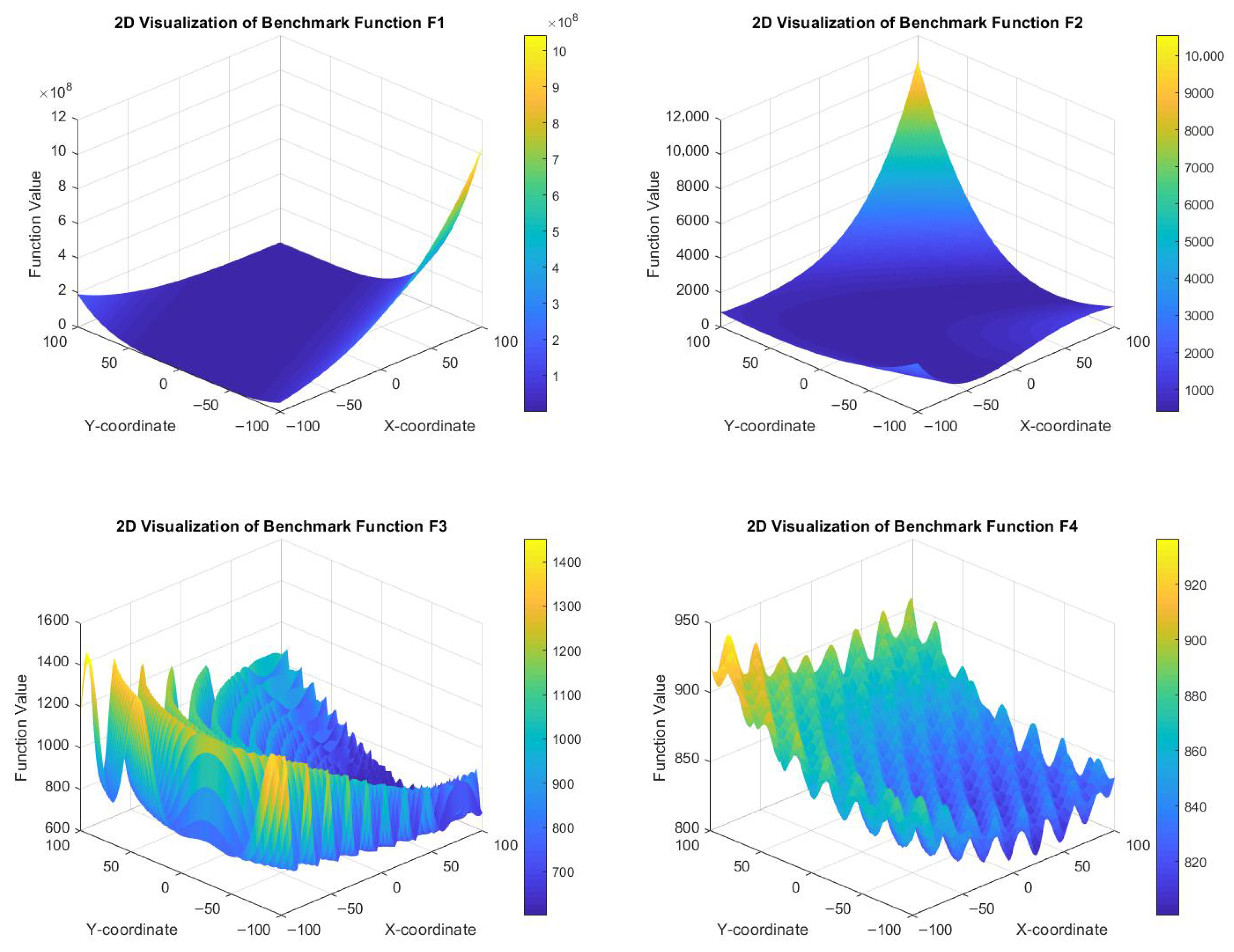
In this study, we use the IEEE CEC-2022 benchmark test functions (See
Figure 2), a collection of standardized problems designed to evaluate the performance of different optimization algorithms [
30]. The functions are extensions of the popular CEC suite, used extensively in the computational intelligence literature and in optimization contests. The CEC-2022 functions are organized into four core groups: unimodal, multimodal, hybrid, and composition functions, each presenting particular challenges for an algorithm’s search functionality.
4.3.1. Unimodal Functions
Unimodal functions have one global optimum and no local optima, which evaluate how accurately and quickly an algorithm converges. Given that they have only a single maximum, they serve as a gauge of the efficiency of an optimization approach in producing solutions as accurate as possible to the best achievable solutions to a given problem [
31].
4.3.2. Multimodal Functions
In comparison, multimodal functions have multiple local optima, and it has to strike the right balance between exploration and exploitation. These tasks are especially challenging because they pose the question of whether an algorithm can perform them while not getting stuck in local basins and yet converging to the actual global optimum [
32].
4.3.3. Hybrid Functions
The hybrid functions are a combination of several simpler benchmark functions, which creates a landscape that is similar to the complexity associated with real-world problems. They can thoroughly assess the strength and adaptability of an algorithm since the search environment is made up of varied elements combined within a single environment [
33].
4.3.4. Composition Functions
The most complex one under CEC-2022 is the composition functions. They are built by combining several sub-problems into a single high-dimensional surface, creating rugged terrain that is non-separable. These functions provide stress-testing of the capability of an algorithm to work with hard problems that demand a high degree of global exploration and a high degree of local refinement [
34].
4.4. Results and Discussion
Table 3,
Table 4 and
Table 5 shows the result of the Hybrid JADEFLO algorithm on the CEC2022 benchmark functions, and it has a good overall performance when compared to the rest of the optimizers. It is important to note that the Hybrid JADEFLO scores lowest on F1, which is why it won first place among all participants, underscoring its high performance on the task. Other benchmark functions are also solved competitively, with the algorithm again excelling on F2 and F4, often beating or closely matching FVIM, FLO, and the GA.
In terms of stability, Hybrid JADEFLO has an extremely small standard deviation (Std) and standard error of the mean (SEM), as shown in . These findings substantiate the quality of its solutions and the fact that it has high consistency. Compared to such strong competitors as FVIM and FOX, Hybrid JADEFLO has lower variance, which supports its strength. The total rankings of all functions suggest that the algorithm is quite versatile because it means that it usually wins other algorithms like STOA, SOA, and SPBO that have higher mean scores and higher variation.
In the case of F5, F6, and F7, they had the lowest mean values and the least variation; hence, they are stable and precise. Even with the growing F8 complexity, the optimizer did not lose efficiency, but its superiority margin decreased compared with other algorithms, such as SSOA or FLO.
In functions F9 to F12, there is a constant performance in the results. In the case of F9, Hybrid JADEFLO had the lowest mean and was ranked first, demonstrating a high capability of optimization. The optimizer was at an advantage in F10, ranking sixth, though with greater variability. In the case of F11, Hybrid JADEFLO was also placed at the top of the list, which indicates its stability and success in solving complex optimization problems. The optimizer did exceptionally well in F12, achieving fourth place with the least variance, demonstrating its robustness across various optimization tasks.
In addition to the above, JADEFLO’s performance over the CEC2022 functions of its analysis is elaborated below:
Unimodal Function (F1): JADEFLO achieves the optimal mean of 3.00 on , with a very small standard deviation (5.39 ). This result underlines a high exploitation ability of JADEFLO, which allows it to optimize the solutions to the global optimum with little variability. This is expected because unimodal functions make fine-tuning solutions more important than general exploration of the search space.
Multimodal Functions (F2 to F5): JADEFLO is also the best performer in (a multimodal problem) with a mean of 4.03 , which highlights its ability to search the search space effectively and prevent local optima. It has an intermediate standard deviation (3.72 ), which is indicative of consistency. In addition, JADEFLO retains the first-place in , , and . Since these functions have numerous local optima, they require effective exploration as well as exploitation. The fact that JADEFLO has ranked at the top across all these tasks indicates that it can traverse various local basins and streamline solutions with high confidence.
Hybrid Functions (F6 to F8): JADEFLO demonstrates good results in hybrid functions, being the top performer in the context of mean of 1.82 , beating other algorithms by a wide margin. These findings highlight the ability of JADEFLO to address the complexities of hybrid problems, in which a combination of diverse and disparate functions is used and demands extensive search and narrow fine-tuning. It is also in the first rank in and , which means that there is a stable flexibility in addressing the complexity of these tasks. It is worth noting that the standard deviations in these functions are low, indicating the stability of JADEFLO: once some promising areas of the search space are located, the search tries to effectively use these areas to find high-quality solutions.
Composition Functions (F9 to F12): JADEFLO also shows good results on the more complicated task, with first , , and , and 4th in the . Functional components incorporate different sub-elements and require a fine balance between exploration and exploitation. The success of JADEFLO implies that it can dynamically adjust its search strategies and therefore navigate and converge to optima in complex landscapes. The low standard deviations are also a sure sign of the consistency of the algorithm, even in such a difficult environment.
4.5. JADEFLO Performance Analysis over Several Benchmarks
The complementary nature of the two components of Hybrid JADEFLO can be attributed to explaining the high performance of the algorithm on the CEC2022 benchmark suite. The JADE-based component adds adaptive search behavior and efficient solution refinement, and the FLO-based component assists in preserving diversity in the populations and broadness of search. Consequently, the suggested hybridization offers a better balance between exploration and exploitation than alternative search strategies that rely too heavily on a single search mode. The balance is especially significant in CEC2022, since the benchmark set includes function classes with quite dissimilar landscape properties.
To the unimodal case (), the primary need is proper exploitation when a promising region has been identified. The best rank of Hybrid JADEFLO has a very small standard deviation, indicating that convergence is very reliable. Even though some competing methods achieve similar mean values at the presented precision, the lower variability of Hybrid JADEFLO indicates that it will converge more reliably and is less vulnerable to random initialisation. This act indicates that the JADE-based adaptive search mechanism enhances local refinement and avoids unneeded oscillation around the optimum.
The primary problem with the multimodal functions (–) is the risk associated with prematurely converging to local optima whilst retaining sufficient exploitation to optimize good solutions. Hybrid JADEFLO works best or ties-best on this group, a fact that means that the hybrid design can still cause useful diversity without deteriorating convergence quality. The effect is particularly apparent in the case of , , and with Hybrid JADEFLO having very low mean values alongside low Std and SEM. In the the reported mean is practically equal to the best displayed ones, however, Hybrid JADEFLO continues to display lower variability than a number of tied competitors, which confirms the argument that not only the performance is correct, but also stable.
The benefit of Hybrid JADEFLO is further enhanced by the hybrid functions, which combine landscape structures within the same problem (–). These functions are challenging because different search phases require different conduct. The algorithms in this category tend to fail either by searching too broadly or by meeting too soon. Hybrid JADEFLO is the best option, as it is more effective at switching between global and narrow searches. It is very evident in where Hybrid JADEFLO achieves a result of , with other competitors like FLO, SPBO, and SSOA having significantly higher values of , , and , respectively. Such a significant performance difference means that the given hybridization can enhance the adaptability significantly when used on diverse terrains. The same tendency can be noticed in the case of and , as Hybrid JADEFLO is either leading or is in the same position, with the best methods.
In the composition functions (–), even the landscapes are more deceptive, as several subcomponents are put together. These issues demand not only diversity maintenance but also steady convergence of the promising basins after they are identified. Hybrid JADEFLO is top on and , and competitive on and . It means the algorithm would perform well across different types of functions rather than being limited to one. Simultaneously, the performance margins of 0.6 and 0.7 on and , respectively, indicate that, with a low budget of 1000 FES, certain competing techniques are sometimes equivalent or slightly higher than the end-of-stage polishing of Hybrid JADEFLO on the selected composition scenarios. This observation is significant, as it demonstrates that the proposed method is not equally dominant across all problems; instead, it provides the best overall balance of accuracy, stability, and robustness across the whole benchmark suite.
In general, the findings indicate that Hybrid JADEFLO performs at a high level relative to a significant number of benchmark algorithms, not due to the presence of an aggressive search behavior, but due to the intrinsic characteristic of the hybrid design to achieve a balance in search during the optimization process. The approach capitalizes effectively on topographic smooths out, maintains variety on multimodal issues, and adapts itself effectively to the jagged outlines of multimodal hybrid and composition functions. This is the reason why the algorithm attains high overall ranks along with low consistency of variance in a large number of CEC2022 benchmarks.
4.6. Convergence Curve
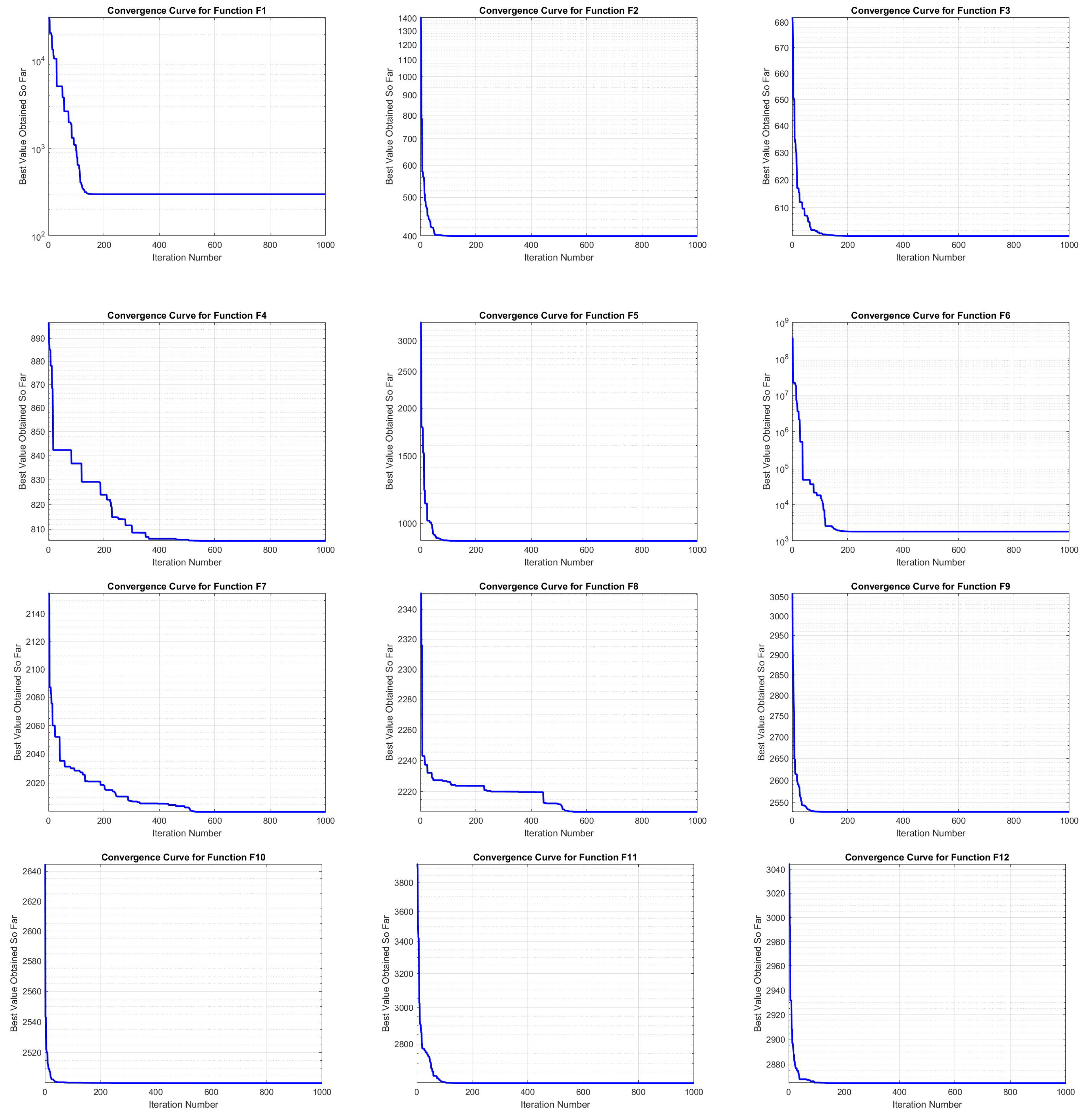
Figure 3 shows how JADEFLO converges to benchmark functions,
through
, in 500 iterations. The plots show that values of objective functions decrease at a high rate at the early stages (about the first 100 steps), providing evidence of efficient searching. This initial phase is succeeded by a less pronounced change in the course of the optimizer toward exploitation, when it is refining solutions in a narrower band of the search space.
An illustrative case is that of , wherein the objective function falls to the range of down to about . Similar trends can be observed in and , where there is a sharp decline at the start, followed by a flat curve. This kind of action highlights the flexibility of JADEFLO, demonstrating its ability to be broad in its exploration and to fine-tune in subsequent stages. The algorithm will achieve a balance between fast exploration of promising areas and systematic adjustment of candidate solutions as the number of iterations increases, leading to stable performance.
4.7. Search History Diagram
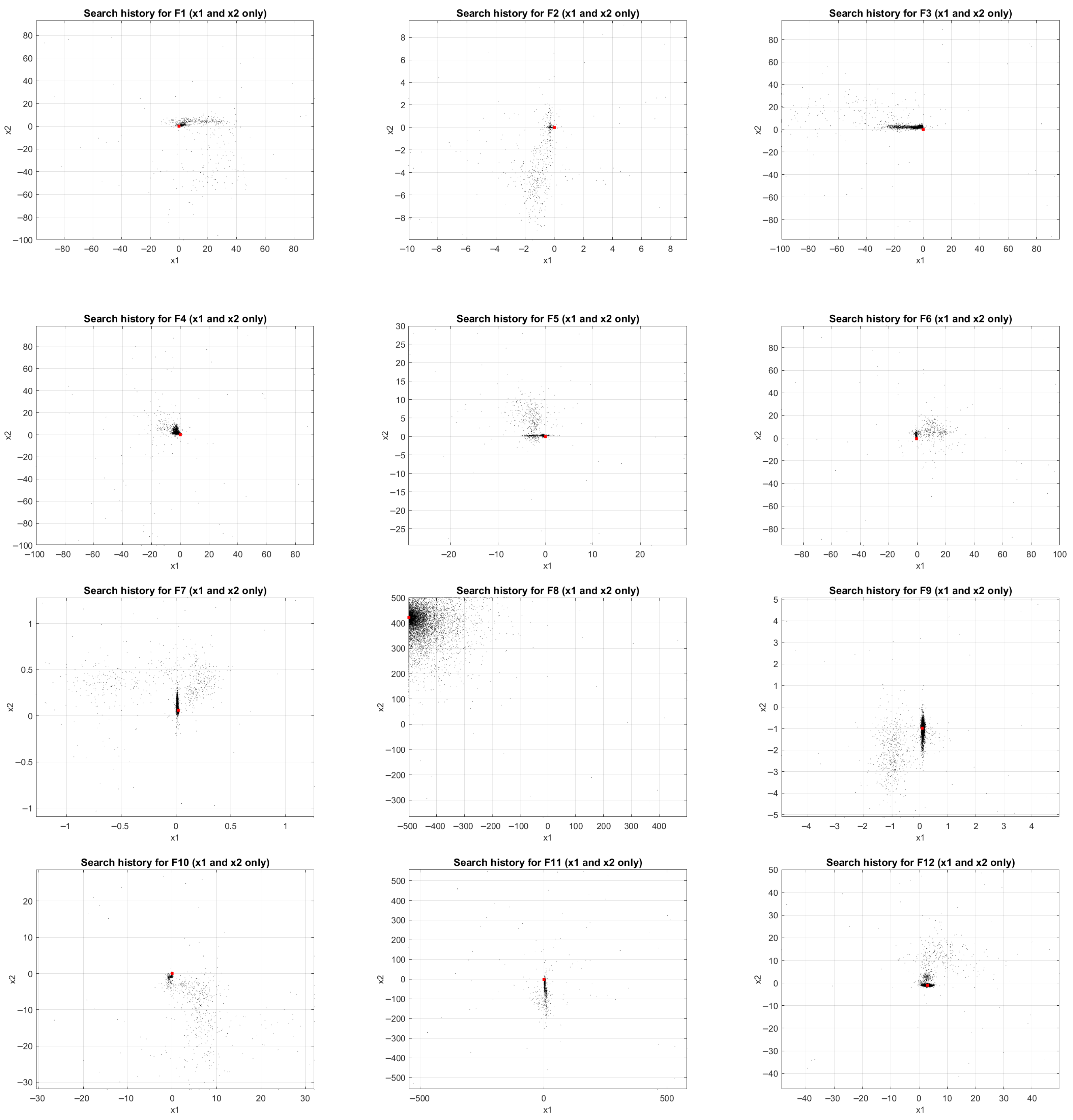
Figure 4 shows two-dimensional search history charts of the JADEFLO optimizer, with the emphasis on the variables
and
. The divergence of points at the initial stages of the process underlines the extensive search, where candidate solutions are chosen from a broad area of the search space. The points are increasingly concentrated in the center, indicating a shift toward exploitation and the subsequent refinement of solutions. The last best solution is indicated by using a red marker. The key point of this visualization is the necessity of the balance between exploration and exploitation: during the early phases, a vast pool of solution candidates is searched, and then the search becomes narrower and narrower, leading to the successful area. The narrowing around the final solution at subsequent iterations supports the ability of the optimizer to optimize its search, which brings the optimizer to efficient convergence.
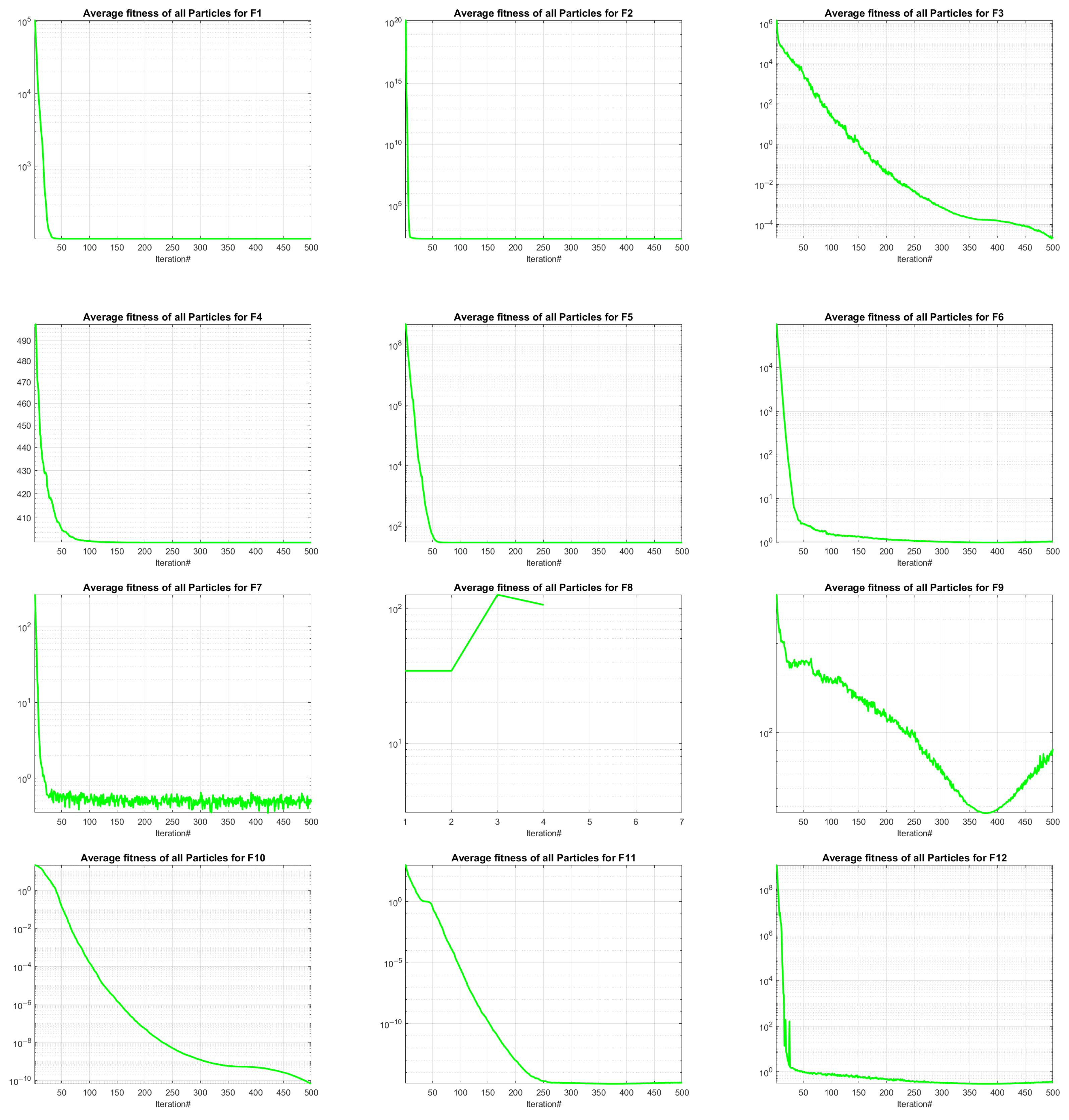
4.8. Average Fitness Diagram
Figure 5 below (Fitness) demonstrates how the average fitness of JADEFLO changes during 600 rounds, which also demonstrates its convergence behavior. The curves at the beginning show a sharp decline in fitness, which represents rapid increases in the quality of solutions as the approach performs extensive exploration. The loss of fitness becomes slower and slower as optimization continues and marks a transition to fine-tuning around the global optimum. Fitness loss is reduced at a decreasing rate as the optimization continues, thus moving towards fine-tuning towards the global optimum.
As the process continues in later iterations, there are random deviations that appear, indicating that JADEFLO restarts in some regions of the search space or increases local exploitation. All these trends will create an equilibrium for the optimizer: a faster initial search that will lead to a narrower refinement. All in all, the diagrams validate the efficiency of JADEFLO in minimizing fitness values, staying stable, and efficiently converging to the optimal solutions.
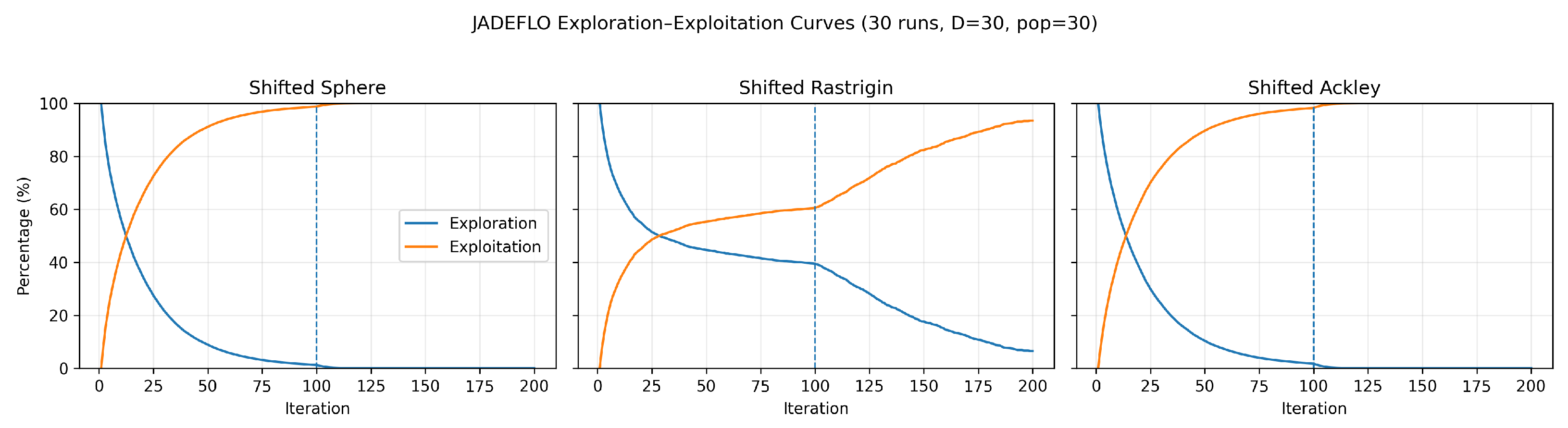
4.9. Exploration–Exploitation Behavior of JADEFLO
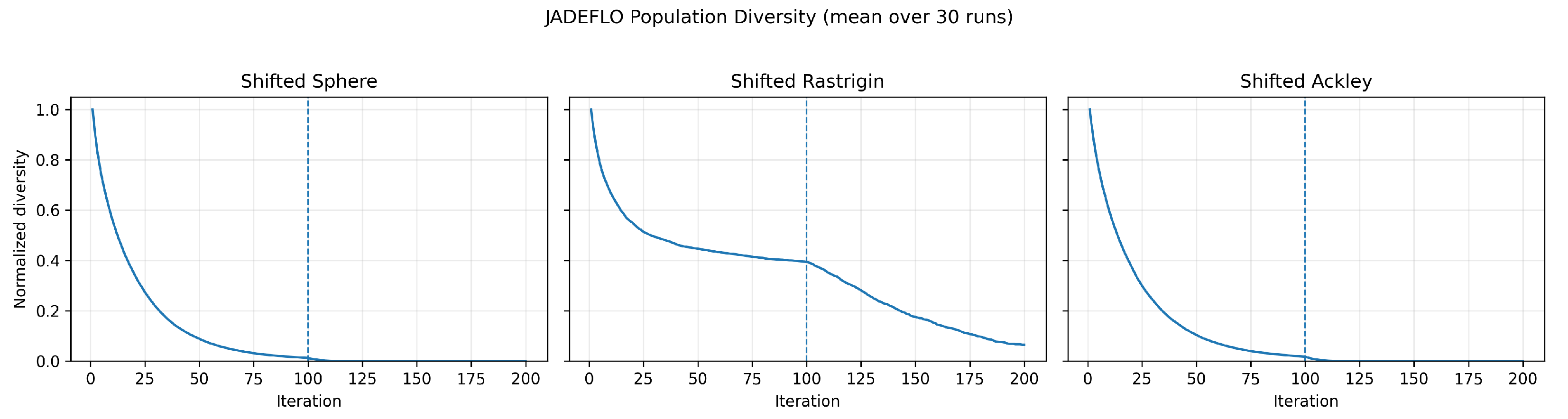
To visualize how JADEFLO balances global exploration and local exploitation, a diversity-based behavioral analysis was carried out on three representative shifted benchmark functions: shifted Sphere, shifted Rastrigin, and shifted Ackley. These functions were selected because they provide complementary landscape characteristics: smooth unimodal search (Sphere), highly multimodal search (Rastrigin), and a mixed landscape with a narrow optimum basin (Ackley). The experiments were conducted with population size , dimension , total iterations , and 30 independent runs. The dashed vertical line in the figures marks the JADE-to-FLO transition at iteration .
Let
denote the population at iteration
t. The population diversity indicator was computed as
where
is the population centroid in the
j-th dimension. This diversity was then normalized to obtain an exploration indicator:
and the corresponding exploitation level was defined as
These values are therefore normalized diversity-based indicators rather than absolute physical percentages.
Figure 6 shows that JADEFLO adapts its search balance according to landscape difficulty. On shifted Sphere and shifted Ackley, exploration decreases rapidly during the JADE half and exploitation becomes dominant early in the run. In the averaged results, exploitation exceeds
at approximately iteration 48 on the shifted Sphere and iteration 51 on the shifted Ackley. After the JADE-to-FLO handoff, diversity contracts to nearly zero, indicating that the FLO phase primarily serves as a local refinement mechanism for these two problems.
In contrast, shifted Rastrigin exhibits a much slower reduction in exploration. The algorithm preserves diversity for a substantially longer time, which is desirable in a highly multimodal landscape. The mean exploration level is during the JADE half and remains during the FLO half, while the final exploration level is still . Moreover, exploitation exceeds only near iteration 179, showing that JADEFLO postpones full intensification until the later part of the run when the search space is rugged and contains many local optima.
These observations are also confirmed by the diversity plots in
Figure 7. The JADE phase maintains a broader population spread, particularly on shifted Rastrigin, whereas the FLO phase causes a marked contraction of the population around promising regions. Therefore, the behavioral evidence supports the intended mechanism of JADEFLO: JADE provides diversity-preserving global search, and FLO converts that structured population into an efficient local exploitation phase. This result strengthens the claim that the proposed hybrid does not rely on a single search mode, but instead adapts the exploration–exploitation balance to the complexity of the objective landscape.
4.10. Ablation Study of JADE and FLO Variants
Experimental Setup and Detailed Analysis of the Ablation Study
To clarify the ablation protocol and isolate the contribution of each component, four algorithmic variants were compared: JADE, FLO, JADE–FLO with transition, and JADE–FLO without transition. The transition-enabled variant passes the final population produced by JADE to the FLO phase, whereas the transition-free variant removes this JADE-to-FLO handoff while keeping the remaining settings unchanged. This design makes it possible to evaluate three questions directly: (i) the contribution of FLO relative to JADE, (ii) the effect of combining JADE and FLO, and (iii) the specific value of the transition mechanism itself, Experimental settings used in the ablation study is shown in
Table 6.
Table 6.
Experimental settings used in the ablation study.
Table 6.
Experimental settings used in the ablation study.
| Item | Setting |
|---|
| Compared variants | JADE, FLO, JADE–FLO (with transition), and JADE–FLO (without transition) |
| Benchmark functions | Sphere, Rastrigin, and Ackley |
| Landscape role | Sphere: unimodal exploitation test; Rastrigin: highly multimodal global-search test; Ackley: multimodal function with a nearly flat outer region and a narrow optimum basin |
| Problem dimension | for all functions |
| Search domains | Sphere: ; Rastrigin: ; Ackley: |
| Population size | individuals |
| Optimization budget | 200 search steps per run; for the hybrid variants, the budget is divided equally between the JADE phase and the FLO phase |
| Independent runs | 10 |
| Recorded performance metrics | Best fitness per run, mean best fitness, standard deviation (Std), coefficient of variation (CV), and rank |
| Ranking criterion | Lower mean best fitness indicates better performance |
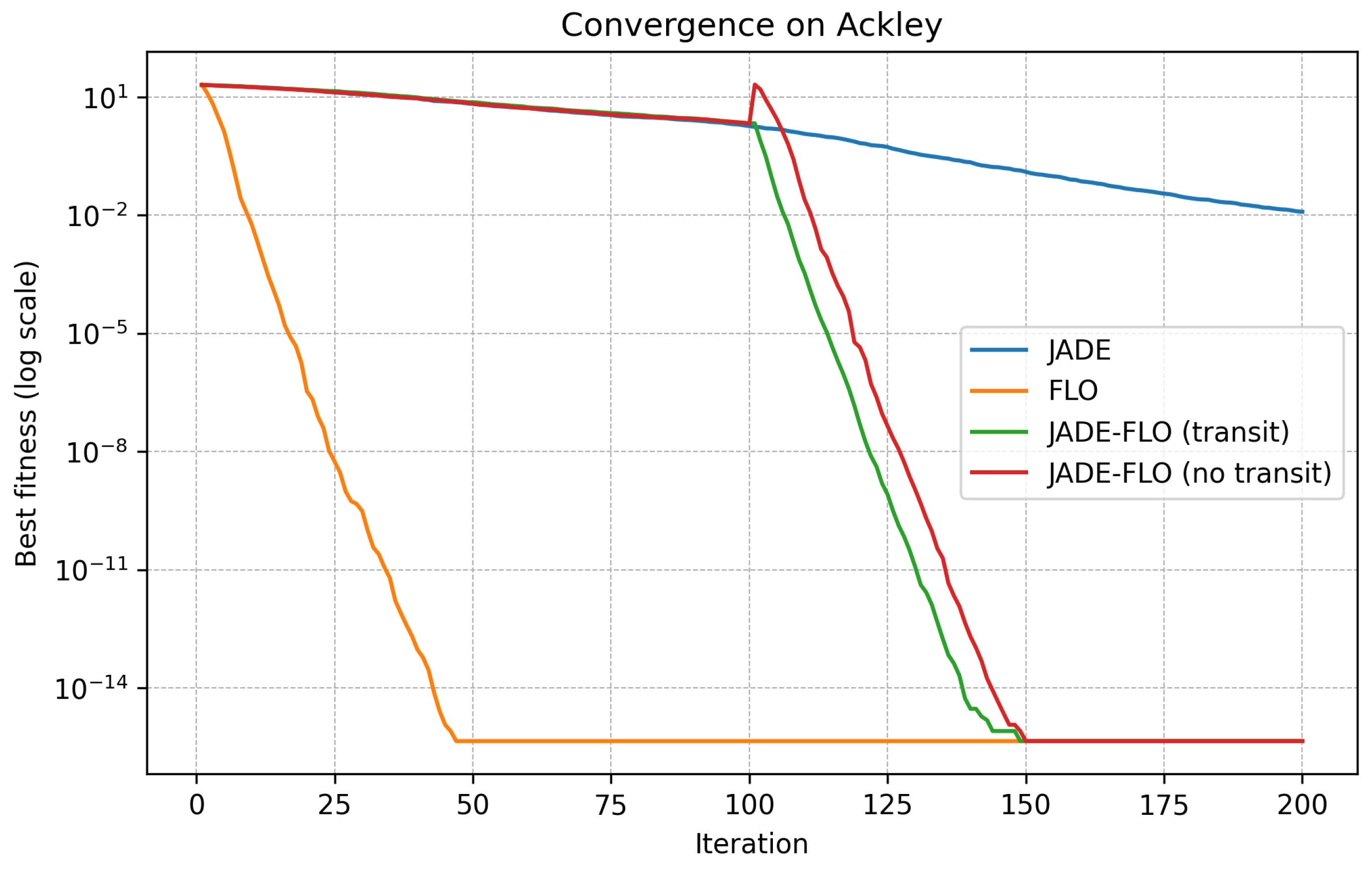
| Additional analysis | Average convergence curves shown in Figure 8, Figure 9 and Figure 10 |
The three benchmark functions were selected because they represent complementary search difficulties. The Sphere function evaluates pure exploitation ability on a smooth unimodal landscape. The Rastrigin function contains a large number of regularly distributed local optima and therefore tests global exploration and the ability to avoid premature convergence. The Ackley function combines a relatively flat outer region with a narrow basin around the optimum, which makes it useful for evaluating the balance between exploration and local refinement. For fairness, all compared variants were executed with the same population size, the same problem dimension, and the same computational budget. In addition, each algorithm was run independently 10 times to reduce the effects of random initialization and stochastic search behavior.
For each independent run, the best objective value obtained at the end of the run was recorded. The mean of these final best values measures overall solution quality, while the standard deviation quantifies run-to-run variability. To further assess robustness, the coefficient of variation was computed as
where
and
denote the mean and standard deviation of the final best fitness values, respectively. Lower CV values indicate more consistent behavior across repeated runs. When the mean value is exactly zero, the CV is not defined and is therefore reported as a dash in
Table 7. Finally, the algorithms were ranked on each benchmark function according to the mean best fitness, with rank 1 assigned to the lowest mean value.
Table 7 summarises the quantitative results. FLO and both JADE–FLO variants achieved perfect optimisation on the multi-modal Rastrigin and Ackley functions, reaching machine-level precision zero with no variability across runs, whereas JADE alone converged to small but non-zero errors. The hybrid algorithms and FLO again created very small errors in the convex Sphere function compared to those of JADE. JADE had the highest coefficient of variation in all functions, which means that its convergence was not reliable. The column of ranking proves the fact that FLO and JADE–FLO variants will always take the first position in all benchmarks.
Table 7.
Performance statistics for the JADE, FLO, and JADE–FLO variants. Mean best scores and standard deviations are reported over ten runs. CV denotes the coefficient of variation (std/mean). Lower values indicate better and more robust performance. The lowest mean on each function is highlighted in bold.
Table 7.
Performance statistics for the JADE, FLO, and JADE–FLO variants. Mean best scores and standard deviations are reported over ten runs. CV denotes the coefficient of variation (std/mean). Lower values indicate better and more robust performance. The lowest mean on each function is highlighted in bold.
| Function | Algorithm | Mean | Std | CV | Rank |
|---|
| Sphere | JADE | | | 0.83 | 2 |
| | FLO | | | 2.93 | 1 |
| | JADE–FLO (with trans.) | | | 2.02 | 1 |
| | JADE–FLO (no trans.) | | | 2.51 | 1 |
| Rastrigin | JADE | | | 0.06 | 2 |
| | FLO | 0 | 0 | — | 1 |
| | JADE–FLO (with trans.) | 0 | 0 | — | 1 |
| | JADE–FLO (no trans.) | 0 | 0 | — | 1 |
| Ackley | JADE | | | 0.40 | 2 |
| | FLO | | 0 | 0.00 | 1 |
| | JADE–FLO (with trans.) | | 0 | 0.00 | 1 |
| | JADE–FLO (no trans.) | | 0 | 0.00 | 1 |
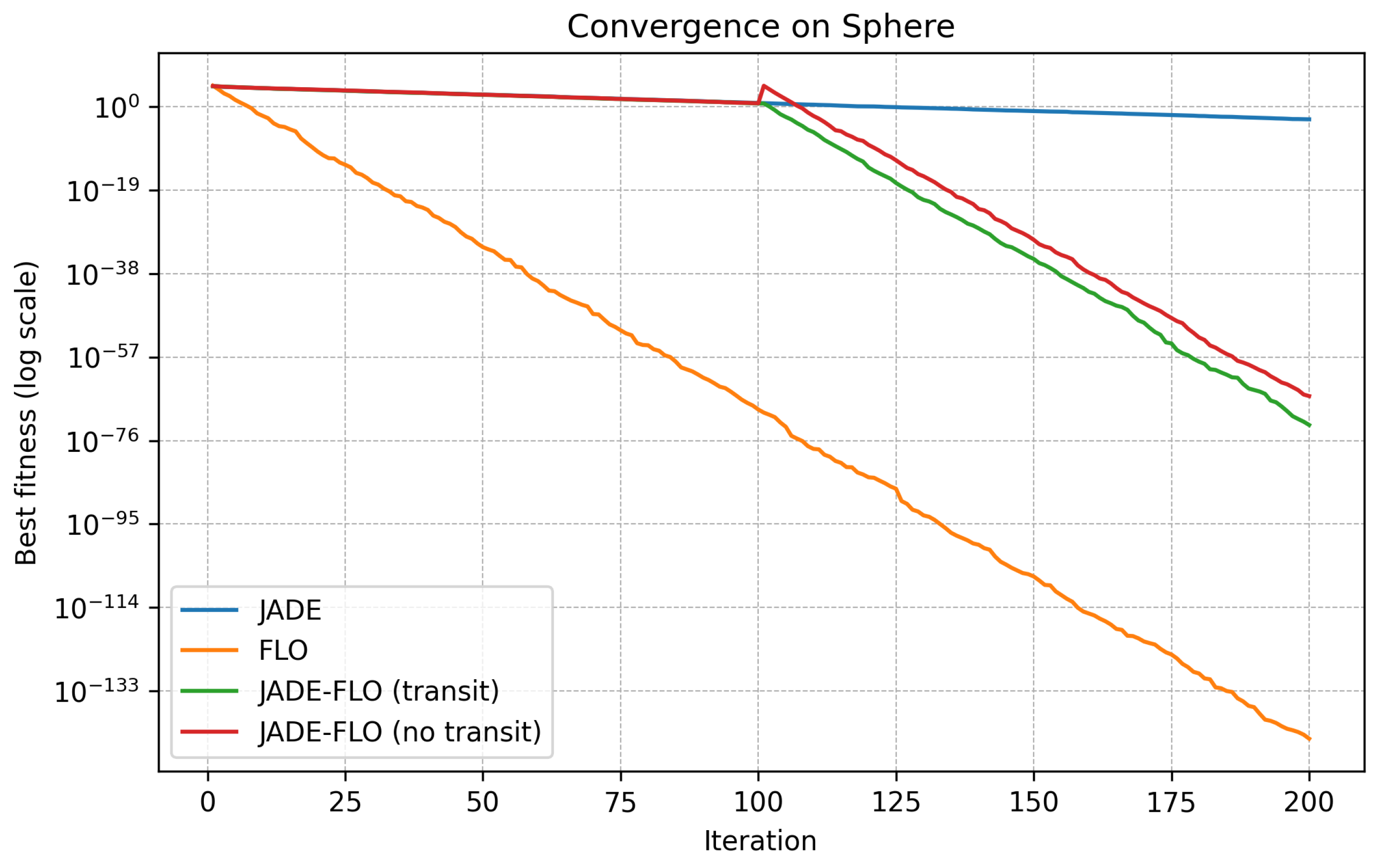
Figure 8.
Average convergence curves on the Sphere function. FLO and the hybrid variants quickly drive the best fitness below , whereas JADE alone stagnates around .
Figure 8.
Average convergence curves on the Sphere function. FLO and the hybrid variants quickly drive the best fitness below , whereas JADE alone stagnates around .
Figure 9.
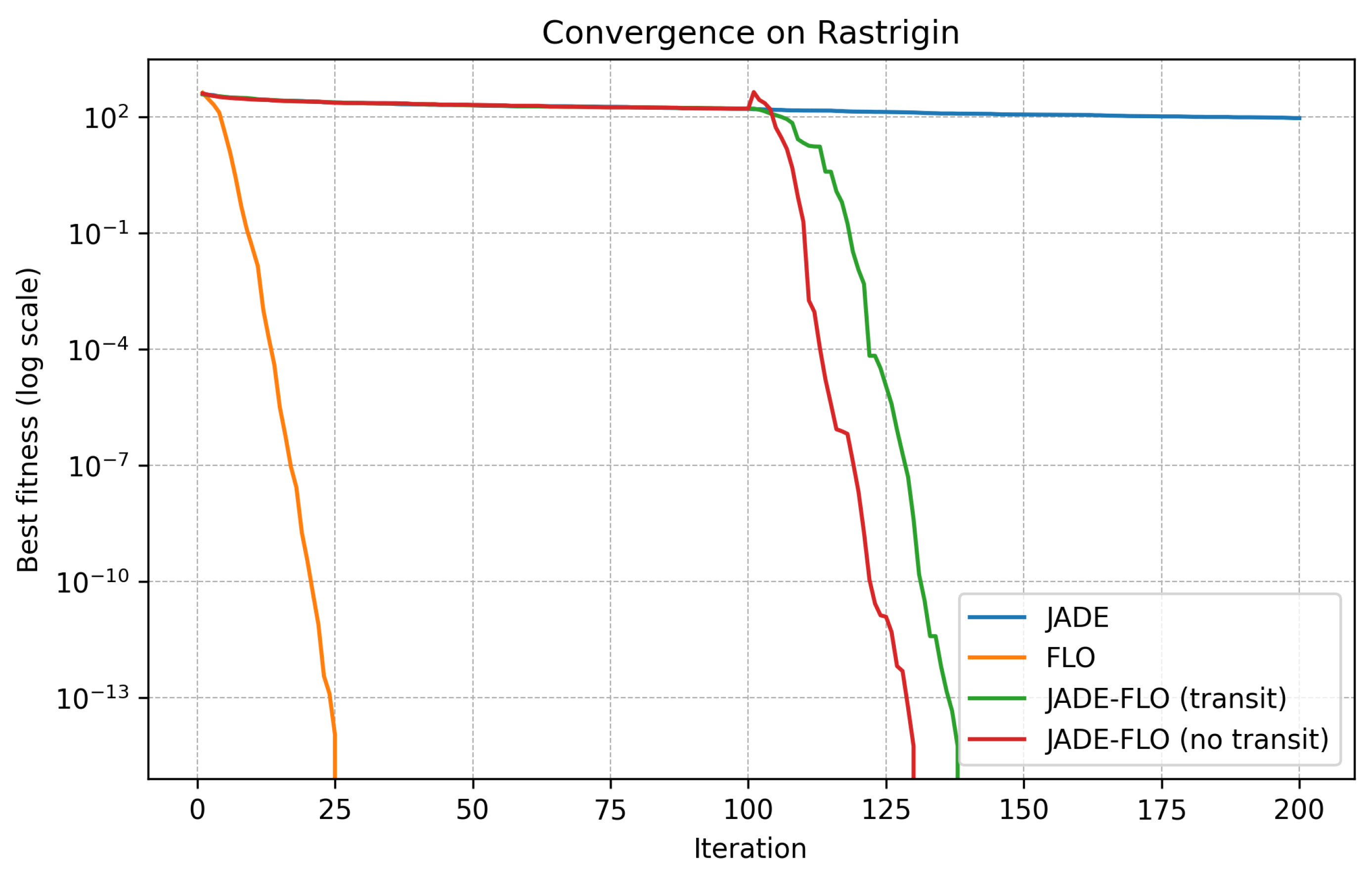
Average convergence curves on the Rastrigin function. FLO and the hybrid variants converge to the global optimum within a few dozen iterations. JADE maintains a larger residual error.
Figure 9.
Average convergence curves on the Rastrigin function. FLO and the hybrid variants converge to the global optimum within a few dozen iterations. JADE maintains a larger residual error.
Figure 10.
Average convergence curves on the Ackley function. Similar to Rastrigin, FLO, and hybrid variants rapidly achieve machine precision, while JADE converges more slowly and stops around .
Figure 10.
Average convergence curves on the Ackley function. Similar to Rastrigin, FLO, and hybrid variants rapidly achieve machine precision, while JADE converges more slowly and stops around .
The quantitative results reported in
Table 7 and the convergence curves in
Figure 8,
Figure 9 and
Figure 10 lead to three main observations. First, JADE is consistently the weakest of the four variants on all three benchmark functions. On the Sphere function, JADE converges only to
, whereas FLO and both hybrid variants reduce the error to values that are effectively at machine precision. A similar pattern appears in Rastrigin and Ackley, where JADE still exhibits residual errors of
and
, respectively, while FLO and the hybrid variants reach the global optimum or achieve numerically negligible error. This result indicates that, under the selected budget, the FLO phase is the main source of the strong final refinement behavior.
Second, the comparison between the two hybrid variants shows that the transition mechanism has a measurable effect. On the Sphere function, JADE–FLO with transition achieves a smaller mean error () than JADE–FLO without transition (). Although both values are extremely small, this difference still indicates that transferring the structured JADE population to FLO provides a better starting point for the second phase. In other words, the transition mechanism improves the quality of the handoff between the global-search stage and the local-refinement stage. On Rastrigin and Ackley, both hybrid variants reach the same final value, which suggests that these two functions are sufficiently easy for FLO under the chosen budget that the benefit of the transition is reflected more in convergence behavior than in the final score.
Third, the comparison between FLO and the two hybrid variants reveals that FLO alone is already very strong on this compact benchmark set. FLO reaches the same best final value as the hybrids on Rastrigin and Ackley and even obtains the smallest mean on Sphere. Therefore, the ablation study should not be interpreted as evidence that the hybrid always surpasses FLO on simple functions. Rather, it shows that the proposed hybridization preserves the strong search capability of FLO, clearly improves upon JADE alone, and benefits from the transition mechanism, especially when fine local refinement is important. These results are consistent with the design rationale of JADEFLO: JADE contributes an organized and informative search state, while FLO performs the decisive final exploitation.
Overall, the ablation study confirms that the FLO phase is responsible for most of the performance gain relative to JADE, while the transition mechanism contributes additional improvement by making the JADE-to-FLO handoff more effective. The findings therefore support the use of the full JADEFLO design, particularly when the objective is to combine a structured first-stage search with a strong second-stage local refinement process.
4.11. Discussion of Wilcoxon Rank-Sum Results
To further verify the statistical superiority of JADEFLO, the Wilcoxon rank-sum test, as shown in
Table A1,
Table A2 and
Table A3, was conducted against 30 competing optimizers over 12 benchmark functions. In
Table A1,
Table A2 and
Table A3, the symbols +, −, and = denote the number of benchmark functions on which JADEFLO performs better, worse, or equivalently to the compared algorithm, respectively. The obtained results reveal a highly dominant performance of JADEFLO across the test suite.
Specifically, JADEFLO achieved complete superiority, i.e., 12 wins with no losses or ties, against 19 optimizers, namely FVIM, STOA, SOA, SPBO, AO, SSOA, TTHO, Chimp, CPO, FOX, GWO, ZOA, MTDE, SCA, DOA, HHO, SCSO, AVOA, and SA. In addition, JADEFLO maintained a very strong advantage over CAMES, WOA, SHIO, RIME, and GA with 11 wins and only one tie, while it obtained 10 wins and 2 ties against ROA, MFO, and BBO. Even against COA, JADEFLO still demonstrated clear superiority with 9 wins and 3 ties. The comparison with the original FLO is also noteworthy, where JADEFLO recorded 6 wins, 1 loss, and 5 ties, indicating that the proposed improvements are generally effective and rarely lead to performance degradation.
Among all competitors, only FLO and OMA showed a single winning case against JADEFLO. However, JADEFLO still performed better than OMA on 11 out of 12 functions. In total, out of all the possible pairwise comparisons of the functions, i.e., all the 360 pairwise comparisons of functions, JADEFLO won 339 times, lost only 2 times, and the tie occurred 19 times. These findings confirm the fact that JADEFLO is not merely a competitive algorithm but also statistically sound and superior to most state-of-the-art optimizers across many optimization problems.
6. Conclusions and Future Work
In this paper, we presented JADEFLO, a hybrid optimizer that combines Adaptive Differential Evolution with Optional External Archive (JADE) and Frilled Lizard Optimization (FLO) within a two-stage search framework. In the proposed design, JADE is responsible for adaptive global exploration and diversity preservation, whereas FLO performs locally focused refinement through its hunting and tree-climbing mechanisms. The main goal of this hybridization is to improve the balance between exploration and exploitation when solving nonlinear, multimodal, and constrained optimization problems.
The experimental results on the IEEE CEC2022 benchmark suite showed that JADEFLO is highly competitive with a broad set of state-of-the-art optimizers. Across unimodal, multimodal, hybrid, and composition functions, the method achieved strong overall ranking, fast convergence, and low variability in many cases. The engineering-design experiments on the Pressure Vessel, tension/compression spring, and speed-reducer problems further demonstrated that JADEFLO can deliver high-quality, feasible solutions and, in several cases, match the best reported designs.
However, the results on the three engineering design problems also reveal some weaknesses that should be acknowledged. In the Pressure Vessel design problem, JADEFLO achieved the best minimum solution, but its mean performance and standard deviation were less competitive than those of some rival methods, indicating lower robustness across repeated runs. In the tension/compression Spring design problem, JADEFLO remained highly competitive, but the improvement over the strongest competitors was very small, suggesting that the practical benefit of hybridization is limited to a relatively low-dimensional problem with a narrow feasible region. In the speed-reducer design problem, JADEFLO again found a high-quality feasible solution, yet its run-to-run variability was higher than that of several competing algorithms, suggesting that the fixed JADE/FLO budget split and the adopted penalty-based constraint handling are not always optimal for problems with strongly coupled nonlinear constraints. Therefore, although JADEFLO is effective at locating high-quality designs, its consistency and problem-adaptiveness on constrained engineering applications can still be improved.
Future work will focus on addressing these limitations in addition to extending the algorithm to more complex optimization settings. One important direction is the development of adaptive constraint-handling strategies, such as feasibility-based selection, adaptive penalties, or repair operators, to improve robustness on engineering problems with tight feasible regions. Another promising direction is to replace the fixed two-stage budget allocation with a dynamic switching mechanism that adjusts the balance between JADE and FLO according to the search state.
A further extension is the adaptation of JADEFLO to multi-objective optimization. A natural approach is to replace single-objective fitness comparison with Pareto-dominance-based selection and to maintain an external archive of nondominated solutions throughout the search. In such a framework, the JADE phase could emphasize global movement toward promising leaders selected from the archive, while the FLO phase could refine search locally around nondominated or sparsely populated regions of the Pareto front. To preserve diversity, environmental selection could be combined with a density estimator such as crowding distance or reference-vector-based niching.
Future work will also investigate the use of machine learning techniques to adaptively regulate JADEFLO’s parameters during the search process. In addition, broader validation on dynamic optimization problems, constrained multi-objective benchmarks, and more complex real-world engineering applications would further establish the generality and practical value of the proposed method.




 ,
,