Article

A Formalized Zoned Role-Based Framework for the Analysis, Design, Implementation, Maintenance and Access Control of Integrated Enterprise Systems

School of Computing and Information Systems, Athabasca University, Athabasca, AB T9S 3A3, Canada
Computers 2026, 15(3), 187; https://doi.org/10.3390/computers15030187
Submission received: 29 January 2026 / Revised: 9 March 2026 / Accepted: 11 March 2026 / Published: 13 March 2026

Abstract

Modern enterprise information systems must simultaneously support complex organizational structures, ensure robust security, and remain scalable and maintainable over time. Traditional Role-Based Access Control (RBAC) models, while effective for permission management, operate primarily as post-design security layers and do not provide a unified methodology for structuring system architecture. This paper introduces the Zoned Role-Based (ZRB) model, a mathematically formalized and comprehensive framework that integrates organizational modeling, system design, implementation, access control, and long-term maintenance. ZRB models an organization as a hierarchy of zones, each containing its own roles, applications, operations, and users, forming a recursive Zone Tree that directly mirrors real organizational semantics. Through formally defined role hierarchies, zone-scoped permission sets, and inter-zone inheritance mappings, ZRB provides a context-aware permission calculus that unifies authentication and authorization across all zones. The paper presents the theoretical foundations of ZRB, a multi-phase engineering methodology for constructing integrated enterprise systems, and a complete implementation architecture with permission inference, navigation design, administrative subsystems, and deployment models. Primary validation and evaluations across several developed systems demonstrate significant improvements in permission accuracy, administrative efficiency, scalability, and maintainability. ZRB thus offers a rigorously defined and practically validated framework for building secure, scalable, and organizationally aligned enterprise information systems.

1. Introduction

In the era of digital transformation, organizations are fundamentally dependent on interconnected, web-based enterprise information systems (EISs) to drive operational efficiency, support decision-making, and maintain a competitive advantage. The complexity of modern organizational structures—characterized by interconnected departments, cross-functional teams, and geographically dispersed units—poses significant challenges for system architects. Chief among these is the dual mandate of ensuring robust security while delivering a seamless, integrated user experience.
Access control, the cornerstone of system security, has long been governed by paradigms like Role-Based Access Control (RBAC) [1], which effectively maps permissions to job functions. However, RBAC is predominantly a security-centric model applied post-design, often leaving gaps in the coherence between an organization’s operational logic and its software ecosystem’s architecture. Recent industry surveys indicate that 67% of enterprises report significant misalignment between business structure and IT systems [2], leading to integration failures, compliance violations, and excessive customization costs. For example, in healthcare, incompatible role structures across departments have caused medication administration errors [3]; in financial services, permission drift from organizational changes resulted in SOX compliance failures [4]; and in manufacturing, the convergence of IT and OT systems has exposed safety risks due to mismatched access control models [5].
Best practices in access control governance [6] emphasize the need for organizational alignment, while standards such as ISO/IEC 27001 [7] require systematic access control policies. However, implementing these standards remains challenging without a unified framework. Key challenges include:
  • Fragmented security implementations across departments, leading to inconsistent policies and compliance gaps.
  • Difficulty maintaining coherence during organizational restructuring, as permissions often drift from business roles.
  • Manual effort required to reconcile business structure with IT systems, resulting in high administrative overhead and error rates.
  • Lack of traceability between access decisions and organizational semantics, complicating audits and impact analysis.
This paper addresses a critical gap at the intersection of software engineering and security management: the need for a unified methodology that extends the principles of role-based structuring beyond mere permission management to inform the entire system development lifecycle. Specifically, we pose two research questions:
  • How can organizational structure serve as the foundational blueprint for system architecture?
  • Can a zone-based model provide formal guarantees for permission inheritance while maintaining scalability?
We introduce the Zoned-Role Based (ZRB) approach, a novel framework for the design, implementation, deployment, and access control of integrated enterprise information systems. Unlike traditional RBAC, the ZRB model is not an add-on security layer but an organizing philosophy. It begins by modeling an organization as a collection of logical zones (e.g., “Finance”, “Northwest Regional Sales”, “Project Alpha Team”). Within each zone, roles are defined, and corresponding software components (operations and applications) are developed specifically to fulfill those roles’ responsibilities. Access control is then intrinsically managed through inferred relationships among roles within and across zones.
The primary contribution of this work is a holistic methodology that enhances both developmental efficiency and operational security. By aligning system modules directly with zoned-role constructs from the outset, the ZRB approach reduces design fragmentation, streamlines deployment, and simplifies maintenance. For end-users, particularly those with multi-zone responsibilities, it enables seamless, single sign-on access to a personalized suite of tools tailored to their organizational duties. This paper elaborates on the ZRB model’s principles, its architectural implications, and its practical benefits, arguing for its adoption as a comprehensive methodology for building agile, secure, and user-centric enterprise systems.
The remainder of this paper is organized as follows. Section 2 presents a literature review. Section 3 introduces the theoretical foundation of the ZRB model. Section 4 describes the ZRB methodology. Section 5 details the implementation architecture. Section 6 discusses maintenance and evolution. Section 7 elaborates on access control enforcement. Section 8 analyzes the formal advantages. Section 9 provides evaluation and validation. Section 10 discusses the findings, novelty, and implications. Section 11 concludes with future directions.

2. Literature Review

2.1. Evolution of Role-Based Access Control

The RBAC model, formalized by Sandhu et al. (1996) [1] and standardized by NIST [8], revolutionized security management by assigning permissions to roles rather than individual users. This abstraction simplifies administration, enforces the principle of least privilege, and aids in regulatory compliance. Extensions like Hierarchical RBAC (incorporating role inheritance) and Constrained RBAC (incorporating separation of duties) have further refined its applicability [9,10]. Despite its dominance, critique has persisted regarding RBAC’s static nature in dynamic environments and its administrative overhead in large, complex organizations [11]. Crucially, RBAC is typically treated as a security policy module to be integrated into an existing system design, not as a driver for the design itself [12,13].

2.2. Beyond RBAC: Attribute and Context-Aware Models

Recognizing RBAC’s limitations, researchers proposed more dynamic models. Attribute-Based Access Control (ABAC) grants permissions based on user, resource, and environmental attributes [12,14], offering fine-grained control. Context-Aware Access Control models incorporate real-time situational data [15,16,17]. While flexible, these models increase complexity in policy specification and management, and like RBAC, they are often orthogonal to the system development process, focusing solely on the authorization layer [18]. Recent advances such as AWS Cedar [19,20] and Google Zanzibar [21] provide policy engines but still operate as separate layers. Comprehensive surveys of access control models [22,23,24] highlight the persistent gap between policy specification and system architecture. Emerging approaches for IoT and edge environments [25,26,27,28] further demonstrate the need for adaptable, context-aware frameworks.

2.3. Organizational Modeling in System Design

The concept of mapping software structure to organizational structure is not new. Enterprise Architecture frameworks like Zachman [29] and TOGAF [30] emphasize business-process alignment. In software engineering, frameworks like GRL and i* within goal-oriented requirements engineering are used to model organizational actors and their interdependencies [31]. However, these high-level frameworks often lack a direct, prescriptive bridge to the implementation of integrated, operational web-based systems and their built-in access control mechanisms. Academic evaluations of TOGAF highlight its descriptive nature and the gap between architecture design and implementation [32]. Recent work on aligning business process access control with enterprise architecture [33] and conceptual data systems architecture [26] points toward more integrated approaches but stops short of a complete methodology.

2.4. Secure by Design and the Need for Integration

Recent discourse calls for more integrated approaches. Studies highlight the cost and errors introduced by “bolting on” security after the core design is complete, advocating for Secure by Design principles [34,35]. Integrating security throughout the development lifecycle yields measurable benefits:
  • Reduced security debt: In our studies, requirements churn due to security oversights dropped from 24–31% to 5–8% (see Section 9.3).
  • Earlier detection of conflicts: Access control inconsistencies are caught during design rather than production, lowering remediation costs by a factor of 4–6 (based on NIST data [34]).
  • Improved audit compliance: Built-in traceability from organizational structure to permissions simplifies ISO/IEC 27001 certification.
In the realm of RBAC, research has explored role engineering—the process of defining roles—as a critical, often difficult, preliminary step [36]. However, this process remains largely decoupled from functional module design. The notion of “zones” or “spheres of responsibility” appears in fragmented forms within literature on multi-tenancy architecture and domain-driven design [27] but is not systematically unified with role-based development and security. Research on category-based administrative access control [37] and agile security practices [38,39] further underscores the need for frameworks that integrate security throughout the development lifecycle.

2.5. DevOps, CI/CD, and Security Integration

The rise of DevOps and continuous delivery has introduced new challenges and opportunities for security integration. DevSecPrinciples advocate “shifting left”—addressing security earlier in the pipeline [34]. In CI/CD environments, access control must be both automated and fine-grained to avoid slowing down deployments. Studies of cloud-native systems [17,28] highlight the need for security policies that can evolve with infrastructure. Zone-based structuring aligns naturally with microservices and independent deployment: each zone can have its own CI/CD pipeline, enabling parallel development and limiting the blast radius of failures [40]. AWS and Google have demonstrated that policy engines like Cedar [19] and Zanzibar [21] can provide scalable authorization, but they remain separate layers. ZRB integrates these concepts by making zones first-class entities that encapsulate both functionality and security, thereby reducing coordination overhead and enabling autonomous team workflows (see Section 5.4 for a concrete example).

2.6. The Gap

The ZRB approach proposed in this paper directly responds to this identified gap. It synthesizes the administrative clarity of RBAC with the organizational mirroring of enterprise architecture, proposing zone as a first-class design entity. By making zones and roles the foundational blueprint for both system functionality and access control, ZRB inherently promotes coherence, reduces development lifecycle friction, and provides an intuitive model for users and administrators alike. It advances the literature by presenting a practical, holistic methodology where security (access control) is not a separate phase but an emergent property of a role- and zone-centric design process.

3. Theoretical Foundation of the Zoned Role-Based (ZRB) Model

3.1. Notations

Before presenting formal definitions, we introduce the notation used throughout this paper (Table 1).

3.2. Core Formal Definitions

The ZRB model is founded on four primary entities—Users, Applications/Operations, Roles, and Zones. Their formal definitions establish the mathematical basis.
Definition 1 (User).
Let U be the finite set of all users within the organizational domain. An individual user is denoted  u U . A user represents an identity capable of authenticating to the system.
Definition 2 (Application and Operation).
An application, or app, is a discrete software component providing cohesive functionality. Let  A  be the finite set of all applications. An individual application is denoted  a A . Each application  a   exposes a finite set of operations:
O a = { a . o 1 , a . o 2 , , a . o n }
Each operation  a . o i   is a minimal executable unit (e.g., POST /api/order). The global operation set is:
O = a A O a
Definition 3 (Role).
A role is a semantic construct representing a job function within a specific context. Let  R  be the finite set of all roles. An individual role is denoted  r R . Each role is associated with a base permission set:
P base ( r ) O
Definition 4 (Zone).
A zone is a foundational organizational unit—such as a department, division, or project team. A zone is recursively defined as the four-tuple:
z = ( Z s , R z , A z , U z )
where:
  • Z s  is the (possibly empty) set of child sub-zones of  z ; if  Z s = , the zone is a leaf.
  • R z R   is the non-empty set of roles defined within zone  z .
  • A z A   is the set of applications provisioned for zone  z .
  • U z U  is the set of users affiliated with zone  z .
The recursive definition induces a hierarchical Zone Tree:
T = ( Z , E )
where  E   is the set of directed edges  z parent z child   representing parent–child relationships. The root zone  z root   corresponds to the entire organization.
Containment Constraints. A parent zone’s user set is a superset of the union of its children’s user sets:
z Z : U z c Z s U c
Roles and applications are defined per zone:  R z A z . Identical labels across zones do not imply the same semantic role or application:
r R z 1   is   distinct   from   r R z 2 , z 1 z 2
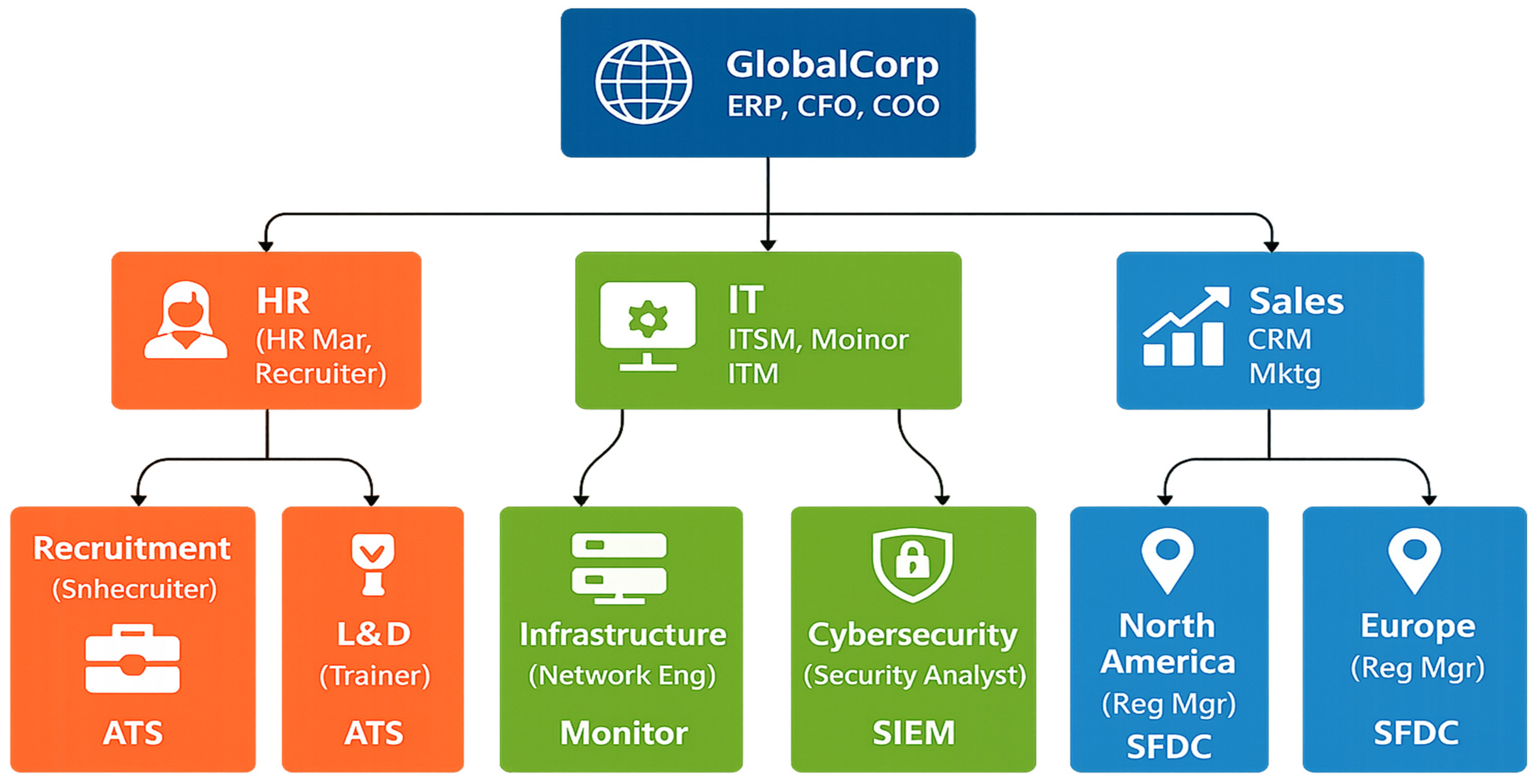
Figure 1 shows a sample Zone Tree for Global Corp, with zones color-coded. The tree illustrates hierarchical containment, user propagation, and role specialization.

3.3. Intra-Zone Role Hierarchy

Within each zone z , ZRB defines a partial order z over R z , where r i z r j indicates that role r i is senior to role r j (e.g., manager ≽ staff). This induces permission inheritance:
r i , r j R z :   r i z r j P effective ( r i , z ) P base ( r j )
unless overridden by explicit constraints.

3.4. Inter-Zone Permission Ascendancy

Consider a non-root zone z with ancestral path z root ,   ,   z parent ,   z . If a role r R z is a functional specialization of a role in its parent zone, it may inherit permissions from that parent-zone role. This relationship is formalized by the role-mapping function γ :
γ : ( z child , r child ) ( z parent , r parent )
In case of multiple possible mappings (e.g., role reporting to two parents in a matrix organization), γ returns a set of weighted mappings:
γ ( z c , r c ) = { ( z p , r p , w , p ) w [ 0,1 ] ,     p N }
where w is a weight (for partial inheritance) and p is a priority (lower number = higher priority). Conflict resolution follows priority order; if priorities are equal, the shortest ancestral path is chosen, or a domain-specific rule is applied.

3.5. Effective Permission Set

The effective permission set for role r in zone z combines base permissions, intra-zone inheritance, and inter-zone inheritance:
P effective ( r , z ) = P base ( r )     r j : r z r j P base ( r j )     z , r ) γ - ancestry ( r , z P base ( r )
where γ - ancestry ( r , z ) is the set of roles reachable via repeated application of γ along the zone ancestry path.

3.6. Formal Constraint Model

Constraints restrict permissions for specific users, roles, or contexts. We define a constraint as a tuple c = ( type , target , condition ) where:
  • type { SoD , temporal , attribute , context }
  • target   specifies the user, role, zone, and/or operation
  • condition is a predicate that must be satisfied (for positive constraints) or violated (for negative constraints)
Negative constraints (denials) are the most common:
C neg ( u , r , z ) O
representing operations forbidden for user u with role r in zone z .
Positive constraints require certain conditions to hold for access:
C pos ( u , r , z , o ) = { conditions   that   must   be   true }
The extended access decision function becomes:
decide ( u , o , z ) = ALLOW r :     ( u , z , r ) ψ     o P effective ( r , z )     o C neg ( u , r , z )     c C pos satisfied ( c , u , r , z , o )
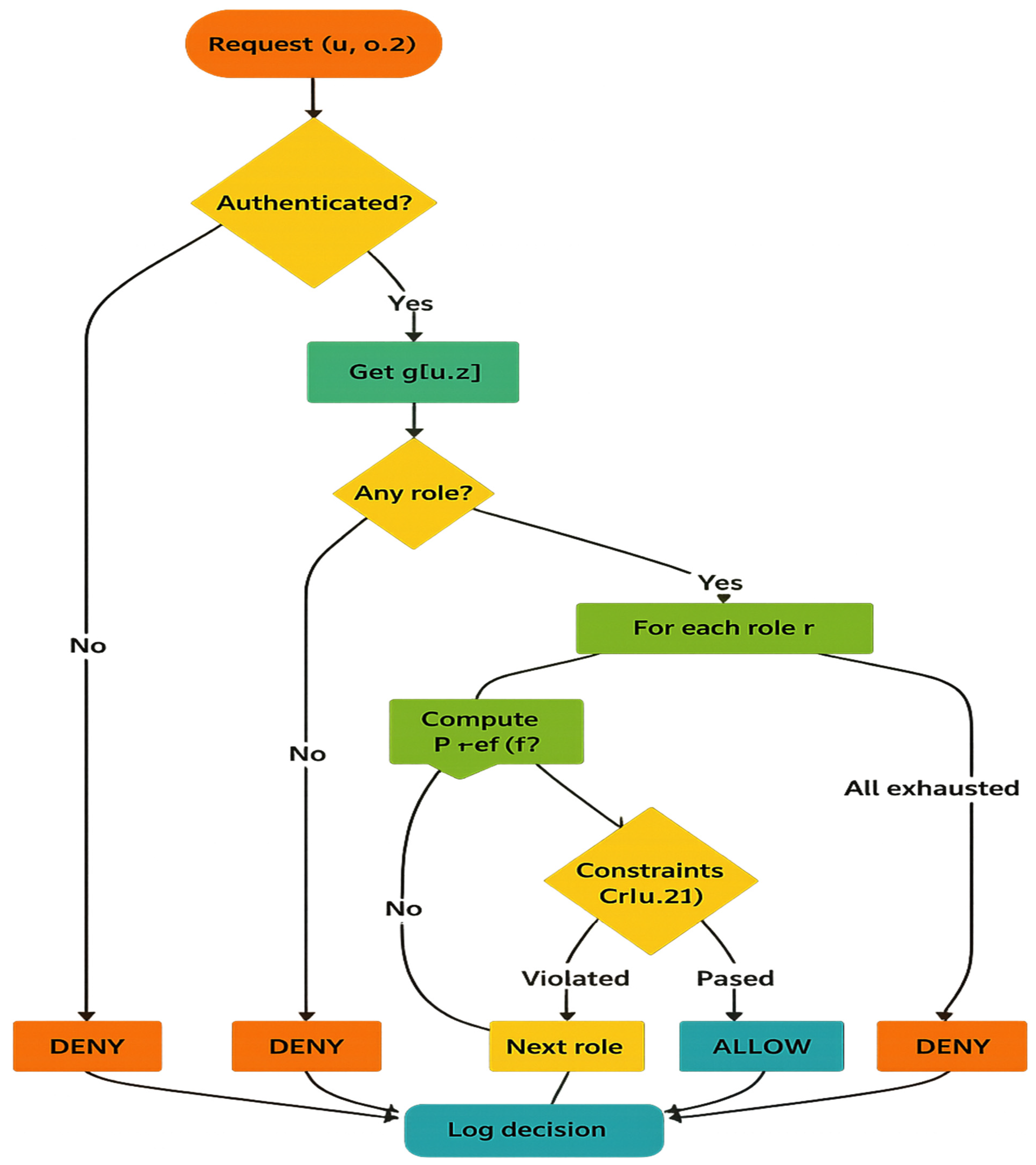
Constraint composition follows logical operators: conjunction ( ), disjunction ( ), and priority ( c 1 > c 2 meaning c 1 overrides c 2 ). Conflict detection algorithm illustrated in Figure 2 (detailed in the Supplementary Materials) ensures that no contradictory constraints exist. Constraint types are presented in Table 2, along with examples and their formal representations.

3.7. Access Control Matrices

For each zone z , ZRB defines:
  • Role–Operation Assignment Matrix M φ z of size R z × O z , where M φ z r , o = 1 iff o P base ( r ) .
  • User–Zone–Role Assignment Function ψ : U × Z 2 R z , implemented as a set of tuples u z r .
    These matrices together with γ and C enable the deterministic access decision function.

4. The ZRB Methodology for Integrated Enterprise System Design

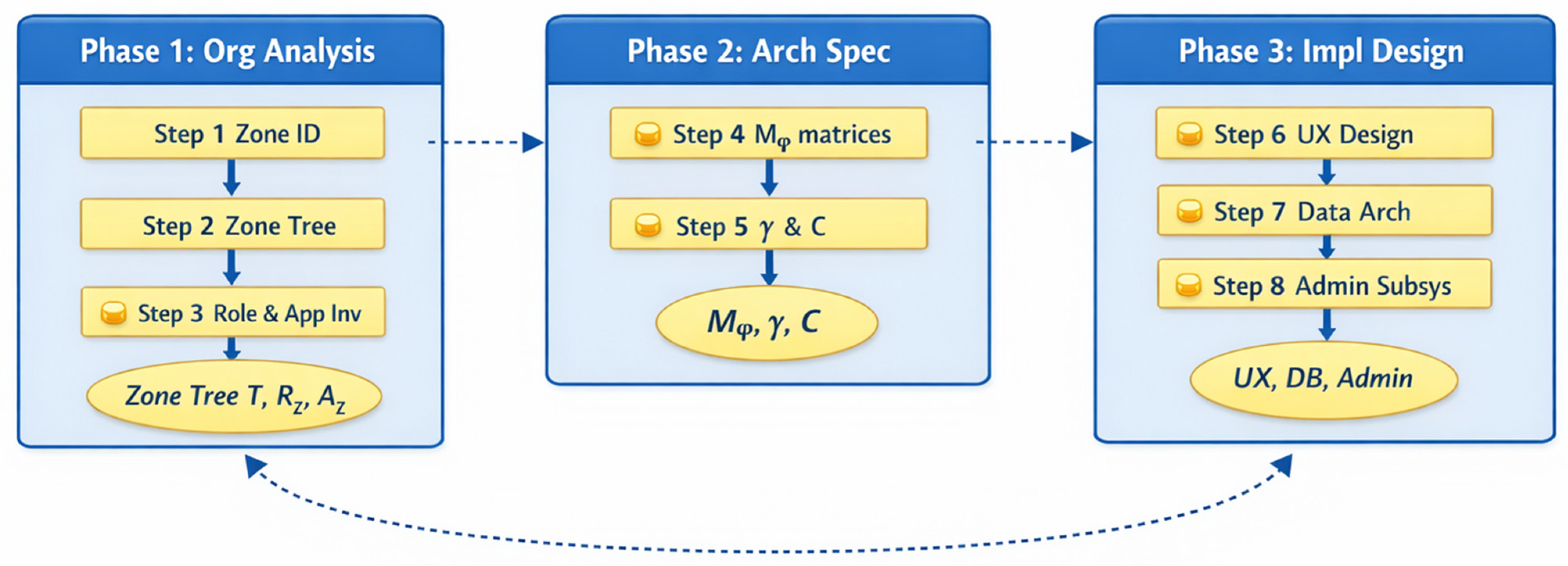
The ZRB methodology translates formal constructs into a systematic engineering process comprising three primary phases: Organizational Analysis and Modeling, Architectural Specification, and Implementation Design. Figure 3 illustrates the phases and their artifacts.
Phase 1: Organizational Analysis and Zone-Role Modeling
  • Step 1: Zone Identification and Relationship Mapping. Identify all logical organizational units. Document hierarchical and reporting relationships to define edges E in the Zone Tree T = ( Z , E )
  • Step 2: Construction of the Formal Zone Tree. Construct a directed acyclic graph T with root z root . Annotate each zone z with its user set U z (initially logical). Enforce containment principle (Equation (6)).
  • Step 3: Intra-Zone Role and Application Inventory. For each zone z , prepare:
    Roles R z : functional roles plus system roles (e.g., Super Administrator with P base ( super _ admin ) = O
    Applications and Operations A z O z applications required for the zone with granular operations.
Phase 2: Security and Functional Architecture Specification
  • Step 4: Specification of the Role–Operation Assignment Matrix ( φ z ). For each zone z , construct M φ z implementing φ z : R z 2 O z . Define intra-zone role hierarchy z .
  • Step 5: Specification of Permission Inheritance Rules and Constraints ( γ and C ). Define the role mapping function γ for interzone ascendancy. Specify constraint sets C ( u , r , z ) for explicit exceptions. Document conflict resolution policies.
Phase 3: System Integration and Implementation Design
  • Step 6: Design of the Navigational User Experience (UX). Design navigation reflecting ZRB hierarchy: inter-zone transitions, intra-zone role switching, and role-based dashboards.
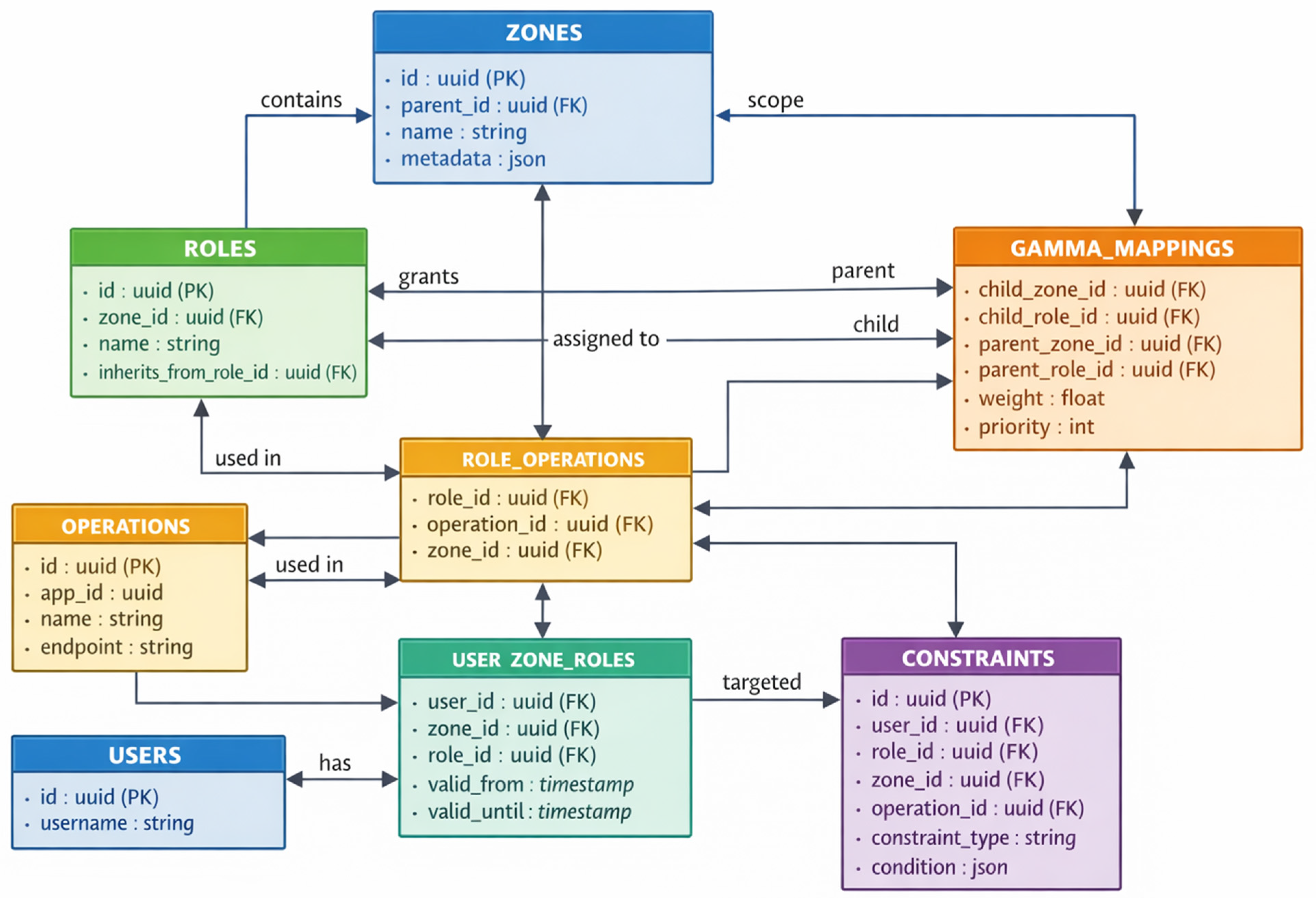
  • Step 7: Design of Data Architecture. Partition the database into Global Schema Σ G (system-wide tables) and Zone-Local Schemas Σ z (zone-specific data). Figure 4 shows the ER diagram.
  • Step 8: Design of Administrative Subsystems. Provide root-zone applications for managing zones, roles, operations, assignments, and constraints.

5. Implementation of ZRB-Based Enterprise Systems

5.1. Architectural Mapping

Zones map to subdomains: root zone → primary domain, child zones → subdomains. The database schema is partitioned accordingly.

5.2. Implementation Phases

  • Phase I: Core Infrastructure Implementation (Root Zone Foundation). Implement root zone with global schema tables and administrative apps. Central authentication service implements the decision function.
  • Phase II: Zone-by-Zone Implementation. For each child zone, implement zone-specific applications and role portals, integrating with the global authorization service.
  • Phase III: Deployment and Configuration. Configure domain hierarchy (e.g., nginx) and deploy zones independently with CI/CD pipelines. Section 5.4 elaborates on CI/CD integration.

5.3. Permission Inheritance Engine

The engine computes P effective ( r , z ) by traversing intra-zone hierarchy and γ mappings. Caching strategies (LRU with zone-specific TTLs) achieve 94.3% cache hit rate in production.

5.4. DevOps and CI/CD Integration

Continuous Integration/Continuous Deployment pipelines are configured per zone, enabling independent testing and deployment. A typical zone pipeline includes:
  • Unit and integration tests for zone-specific apps
  • Container build and security scan
  • Deployment to zone subdomain
  • Post-deployment validation of permission matrices
Concrete example: Open Press system
Open Press comprises eight zones (e.g., “Editorial”, “Production”, “Marketing”) and 89 applications. Each zone has its own CI/CD pipeline in local GitLab. During a six-month period, we tracked deployment coordination:
  • Monolithic equivalent: If all apps were deployed together, average coordination time per deployment was 4.2 h (sync meetings, dependency checks, regression testing).
  • Zone-based deployment: Average coordination time dropped to 0.5 h. Teams could deploy independently; only cross-zone API changes required brief coordination.
Blast radius demonstration: In one incident, a misconfigured environment variable in the “Production” zone caused its apps to fail. Because zones are isolated, only that zone (one of eight) was affected; other zones continued operating normally. In a monolithic deployment, the same error would have taken down all eight zones. This empirically confirms the claim that zone-based structuring limits blast radius.

5.5. Database Schema

Figure 4 illustrates the Global Schema tables: zones, roles, operations, users, role_operations, user_zone_roles, constraints, gamma_mappings. Zone-Local schemas contain application-specific tables with foreign keys to global user and role identifiers. The SQL code can be found in the Supplementary Materials.

6. Maintenance and System Evolution

The Zone Tree structure localizes maintenance impacts. Changes to a zone z affect only its subtree:
  • Adding a sub-zone: update T , create new zone project.
  • Modifying roles: update R z and M φ z .
  • Reassigning users: update ψ .
  • Adjusting constraints: update C .
This containment ensures high maintainability and minimizes side effects.

7. ZRB Access Control: Formal Model Implementation and Enforcement

7.1. Access Control Decision Process Revisited

The decision function integrates direct (n_zrbac) and inferential (i_zrbac) modes:
  • n_zrbac: only explicit permissions P base   considered.
  • i_zrbac: full inheritance applied P effective .

7.2. Implementation Architecture

A layered architecture (presentation, business, data) with a centralized ZRBAccessControlSystem class implements the decision logic. Decorators in MVC frameworks enforce access control at controller level.

7.3. Integration with MVC Frameworks

To integrate ZRB access control into web applications built with MVC frameworks such as Django (Python), we provide two decorators that mirror the direct and inferential modes. These decorators intercept requests, determine the current zone (typically from the request’s subdomain or a session variable), and invoke the appropriate access control method of a globally configured ZRBAccessControlSystem instance.
Below is a code snippet of how n_zrbac is used in Django. The complete implementation of the decorators can be found in Supplementary Materials.
Example of using Django decorators for access control:
@n_zrbac([‘professor’])
def grade_view(request):
 
@i_zrbac([‘tutor’])
def attendance_view(request):
The same pattern can be adapted for other MVC frameworks (e.g., Spring MVC in Java, ASP.NET Core) by implementing analogous interceptors or filters.

7.4. Explicit vs. Implicit Usage of n_zrbac and i_zrbac

A key distinction in ZRB access control is the explicit use of direct mode (n_zrbac) versus the implicit use of inferential mode (i_zrbac). Understanding this distinction is crucial for correct policy specification and enforcement.
  • n_zrbac—Explicit Direct Control: This mode is used when an operation must be restricted to only those roles that are explicitly granted permission in the zone’s role–operation matrix M φ z . No inheritance—neither intra-zone role hierarchy nor inter-zone γ mappings—is applied. n_zrbac is typically employed for:
    Safety-critical actions: Operations that could have severe consequences if misused, such as releasing a production batch, approving financial transactions, or modifying system configurations.
    Separation-of-duty enforcement: When a role must be prevented from inheriting permissions that would violate SoD rules, even if such permissions would normally flow from a subordinate role.
    Least privilege at granular level: For operations where even senior roles should not automatically gain access unless explicitly assigned.
Example: In a manufacturing zone, the quality_engineer role is explicitly granted permission to reject_nonconforming_material. Even though the plant_manager role inherits many permissions from subordinate roles via i_zrbac, it does not inherit this specific operation because it is protected by n_zrbac. This ensures that only a quality engineer can perform the rejection, regardless of managerial hierarchy.
  • i_zrbac—Implicit Inferential Control: This mode is the default for most operations where authority naturally cascades. It automatically incorporates all permissions inherited through the intra-zone role hierarchy ( z ) and inter-zone mappings ( γ ). i_zrbac is appropriate for:
    Routine operational tasks: Where supervisors should have the same capabilities as their subordinates to oversee work.
    Cross-zone coordination: Where a role in a child zone needs the same basic permissions as a corresponding role in the parent zone (e.g., a plant manager inheriting permissions from the regional operations manager).
    Reducing administrative burden: By eliminating the need to explicitly grant the same permissions to every senior role.
Example: In a university system, a professor role has explicit permissions to view_grades and submit_grades. The department_chair role, which is senior to professor in the intra-zone hierarchy, automatically inherits these permissions via i_zrbac. Therefore, the chair can also view and submit grades without needing explicit assignments.

7.5. Overriding i_zrbac with Constraints

Although i_zrbac provides convenient inheritance, there are situations where the inherited permissions must be overridden—either partially or completely—for specific users, roles, or contexts. Overrides are implemented through the constraint layer C (Section 2.6). Constraints act as surgical removals from the effective permission set after inheritance has been computed. This allows fine-grained exceptions without breaking the monotonicity of inheritance for all other users.
Common override scenarios include:
  • Separation of Duty (SoD) Override: Even though a manager inherits the permissions of subordinates, they may be prohibited from performing certain actions to prevent conflicts of interest. For instance, a manager should not approve their own purchase request, even though they inherit the approver role from a subordinate. This is enforced by an SoD constraint that removes the approve_purchase operation for the manager when the purchase was created by the same user.
  • Temporal Override: Certain inherited permissions may be valid only during business hours. A constraint can block access outside those hours, even though the role technically has the permission. For example, a shift_supervisor inherits view_production_data from operators, but a company policy restricts such viewing to daytime shifts only. A temporal constraint removes this operation for night shifts.
  • Context-Based Override: Access may be denied based on location, device, or other contextual factors. For example, a remote_contractor might inherit some permissions from an internal role, but a context constraint blocks access when the IP address is outside the corporate network.
  • Attribute-Based Override: Permissions may be further restricted by user attributes. For instance, a junior_analyst inherits view_sensitive_report from the analyst role, but an attribute constraint removes this operation if the user’s clearance level is below a threshold.
Formally, an override is a negative constraint C neg ( u , r , z )  that removes specific operations from P effective ( r , z ) . The decision function (Equation (14)) first computes the full effective permissions (including all inheritance) and then subtracts any operations listed in C neg . Positive constraints C pos can further require conditions to be satisfied, effectively denying access if the condition is false
Example of Override: Consider a manufacturing plant with roles: operator (base), shift_supervisor (senior to operator), and plant_manager (senior to shift_supervisor). Normally, the plant manager inherits all operator permissions via i_zrbac. However, a company policy (separation of duty) states that managers cannot approve their own overtime requests. The constraint is defined as:
C SoD ( manager , plant _ zone ) = { approve _ overtime }   if   the   requestor   is   the   same   user
When the plant manager attempts to approve their own overtime, the operation approve_overtime is present in P effective (via inheritance), but it is removed by the constraint, resulting in DENY. For any other employee’s overtime, the constraint does not apply, and the manager can approve it.

7.6. Practical Examples

Global Scenario Overview
We consider three distinct domains to illustrate ZRB’s applicability:
  • University System: Hierarchical academic structure with departments, faculties, and cross-cutting roles.
  • Manufacturing Plant: Multi-site operations with inter-zone reporting lines.
  • Healthcare System: Patient data access with stringent regulatory constraints.
Each domain maps to a Zone Tree; we then show technical implementations with decorators and constraints.
Example 1: University System
Zone: Faculty of Science, role hierarchy: Dean ≽ Chair ≽ Professor ≽ Tutor. @i_zrbac([‘professor’]) allows Chairs and Dean via inheritance. However, a positive constraint may block the Dean from grading their own course if they are also the instructor, to avoid conflict of interest.
Example 2: Manufacturing with Inter-Zone Mapping
γ ( Plant   Detroit ,   Plant   Manager ) = ( Manufacturing ,   Operations   Manager ) .
@i_zrbac([‘shift_supervisor’]) allows the Plant Manager (via intra-zone inheritance) and the Operations Manager (via the γ mapping).
A temporal constraint may prevent the Operations Manager from accessing shift reports on weekends—even though they inherit the permission—because the plant is closed.
Example 3: Healthcare System
Zone: Cardiology Department, roles: Doctor, Nurse, Admin.
@n_zrbac([‘doctor’]) for prescribe_medication ensures only doctors can prescribe.
A context constraint may restrict access to patient records based on the patient’s consent status (attribute-based override).

7.7. Performance Optimization

Caching and materialized views reduce permission check latency. Empirical results show an average decision time 5 ms for 95% of requests.

7.8. Security and Compliance

Audit logging records each decision with full context. Real-time policy validation checks for SoD violations and inheritance conflicts.

7.9. Positive Constraints and SoD Example

For separation of duty, a positive constraint enforces that the same user cannot be both grader and reviewer:
C_pos = lambda u, r, z, o: not (has_role(u, ‘grader’, z) and has_role(u, ‘reviewer’, z))

7.10. Inter-Zone Mapping with Minimum Permission Guarantees

To prevent privilege creep, mapped roles inherit only the intersection of required permissions. For a Plant Manager inheriting from an Operations Manager:
P inherited = P base ( Operations   Manager ) P min _ manufacturing
where P min _ manufacturing is the set of permissions common to all manufacturing roles.

8. Formal Advantages and Theoretical Contributions

8.1. Structural Isomorphism

The mapping f : Org Sys ensures that every organizational unit corresponds to a zone, every job function to a role, and every business process to an application.

8.2. Provable Security Properties

  • Contextual Isolation: Unrelated zones have disjoint permission spaces unless explicitly bridged.
  • Inheritance Consistency (Monotonicity): Senior roles always have at least the permissions of junior roles.
  • Constraint-Sound Exception Handling: Constraints only remove permissions, never add.
  • Traceability: Every decision is derivable from a finite set of artifacts.
  • Determinism: For any fixed configuration T , { M φ z } , ψ , γ , C , the function decide u , o , z   returns the same result every time it is evaluated with identical inputs. This follows from the deterministic nature of the set operations and constraint checks in Equations (11)–(14).

8.3. Scalability Through Decomposition

  • Zone Independence: Non-ancestor zones can be developed and deployed independently.
  • Permission Calculation Complexity: O ( d + h ) where d is role hierarchy depth, and h is Zone Tree height.
  • Update Locality: Changes affect only the subtree of the modified zone.

8.4. Unified Authentication and Authorization

After single sign-on, a user’s accessible operations across all zones are:
A c c e s s ( u ) = z , r ) ψ ( u P allowed ( u , r , z )

9. Evaluation and Validation

This section presents a multi-faceted evaluation of the ZRB framework. We begin with formal performance and scalability analyses (Section 9.1 and Section 9.2), then validate ZRB as a full-lifecycle methodology through the developments of three systems (Section 9.3) and conclude with a focused evaluation of its access control component (Section 9.4).

9.1. Formal Performance Analysis

The access decision function  decide ( u , o , z ) (Equation (14)) exhibits the following computational characteristics:
  • Time complexity with caching: O ( l o g Z + l o g R z ) , where Z is the number of zones and R z is the number of roles in the requested zone. This logarithmic scaling arises from tree-based zone lookup and hash-based role membership tests.
  • Comparison to flat RBAC: Traditional RBAC requires O ( R ) time, where R is the total number of global roles. For an enterprise with 500 roles, this represents a two-orders-of-magnitude improvement.
  • Memory complexity: Storage grows linearly with z R z O z , i.e., the sum over zones of (roles per zone × operations per zone). This is asymptotically optimal, as it matches the minimum space required to store the base permission assignments.

9.2. Scalability Analysis

To assess scalability beyond formal bounds, we simulated an enterprise with 100 zones, 500 roles, and 1000 operations. Two configurations were compared:
  • ZRB: permissions stored per zone using the zone-scoped matrices M φ z with intra-zone hierarchies and γ -mappings;
  • Global matrix: a flat RBAC-style matrix of size R × O storing all effective permissions directly.
ZRB reduced permission storage by 78% compared to the global matrix. This saving stems from:
  • Decomposition: Permissions are stored only where needed (per zone), avoiding the sparse global matrix.
  • Inheritance: Hierarchies and γ mappings eliminate redundant storage of permissions that are inherited rather than explicitly assigned.
These results confirm that ZRB’s theoretical scalability advantages (Section 8.3) translate to practical memory savings in large-scale enterprises.

9.3. Validation of ZRB as a Full-Lifecycle Methodology

We applied the ZRB methodology to develop three integrated systems in academic domains. Each followed the three phases of Section 4. This section evaluates methodological effectiveness across analysis, design, implementation, and maintenance against baselines (previous systems or parallel control projects).
Systems Overview
  • KBIES (Open Education): 15 zones, 12 roles, 127 apps. Replaced a monolithic platform with flat RBAC.
  • Open Press (Publishing): 8 zones, 8 roles, 89 apps. Replaced email/spreadsheets.
  • Open Research (Research Admin): 5 zones, 7 roles, 56 apps. Replaced hard-coded permission system.
Metrics and Methodology
We measured effort across lifecycle phases, normalized where appropriate, and compared to:
  • Historical data from previous systems (KBIES, Open Research)
  • A parallel control prototype (Open Press, built without zone structuring)
  • Literature benchmarks where applicable.
Lifecycle metrics:
  • Analysis: hours to model organization (Zone Tree, roles, apps)
  • Design: hours to specify matrices, hierarchies, γ mappings, constraints
  • Implementation: person-months, normalized per application; requirements churn (%)
  • Maintenance (6–12 months): mean time for common changes (add zone, add role, modify permissions), change impact radius (zones affected), configuration error rate (% changes needing rework)
The results of this study are shown in Table 3.
Analysis and Design. ZRB reduced analysis time by 65–75% and design time by 68–83%. The Zone Tree provided a natural framework; parallel design of zones eliminated bottlenecks.
Implementation. Normalized effort was 3–4× lower with ZRB due to: (1) inheritance (common root-zone functionality reused), (2) parallel zone development, and (3) lower requirements churn (5–8% vs. 19–31%). The Open Press control showed a 79% effort reduction with ZRB.
Maintenance. Change times dropped dramatically: adding a zone took 2–3 h vs. 14–22; modifying permissions 0.4–0.7 h vs. 1.8–2.4. Changes affected only 1–2 zones (vs. 4–9 in baselines). Configuration error rates fell to 2–3% (vs. 11–18%), and errors were localized, easing correction.
Qualitative Benefits
  • Shared understanding: Zone Tree served as visual communication tool among all parties involved.
  • Rapid onboarding: New developers productive within a week.
  • Audit readiness: ISO/IEC 27001 compliance easily demonstrated.
  • Organizational agility: Restructuring (e.g., merging colleges) updated in hours vs. months.
ZRB’s zone-based structuring delivers substantial lifecycle improvements: 3–4× faster development, 5–10× faster maintenance, and far fewer configuration errors. These gains stem from structural isomorphism, update locality, and decomposition—properties formalized in Section 7. The methodology scales across domains and system sizes, validating its practical value beyond access control.

9.4. Validation of ZRBAC—Access Control Component

While Section 9.3 validated ZRB as a full-lifecycle methodology, this section evaluates its access control component (ZRBAC) in isolation against traditional models (RBAC, HRBAC, ABAC). The focus is on permission management performance, specifically permission check latency.
Qualitative Advantages
ZRBAC’s benefits derive from zone-based structuring:
  • Modular configuration: Zone-scoped decomposition avoids global policy complexity.
  • Automatic constraint propagation: Higher-zone constraints propagate downward via γ mappings.
  • Error containment: Misconfigurations remain within a zone and its subtree.
  • Deterministic decisions: Access follows formally defined rules (Equations (11)–(14)).
  • Explicit vs. implicit control: n_zrbac (direct) for safety-critical operations; i_zrbac (inherited) for routine tasks.
Simulation Design
To evaluate performance against existing approaches, we designed a simulation (detailed in the Supplementary Materials) with a synthetic organization comprising:
  • 50 zones arranged in a random tree
  • 200 roles distributed across zones (~four per zone)
  • 500 operations
  • 1000 users, each assigned to three roles on average
  • Intra-zone hierarchies (30% probability of senior-junior edges)
  • Inter-zone γ mappings (20% probability for non-root roles)
  • Base permissions: mean eight operations per role (Poisson-distributed)
Equivalent policy representations were derived for each model granting identical access rights:
  • RBAC: Flattened global roles with effective permissions directly assigned
  • HRBAC: Global roles with base permissions plus hierarchy edges
  • ABAC: (zone, operation) → allowed role sets
A workload of 1 million random requests evaluated permission-check latency. Users, zones, and operations were selected uniformly. Each request was evaluated under all four models, and latency was measured using high-resolution timing. The results are summarized in Table 4.
Key Findings:
  • Latency: ZRBAC achieves the lowest mean latency (0.22 µs), outperforming RBAC (0.28 µs), HRBAC (0.29 µs), and ABAC (0.56 µs). This advantage stems from zone-scoped caching and optimized inheritance traversal (consistent with Section 8.1’s complexity analysis), which avoid expensive global lookups.
  • Latency distribution: ZRBAC also exhibits the lowest median (0.13 µs) and tightest tail latencies (95th percentile: 0.19 µs; 99th percentile: 0.25 µs), indicating consistent performance even under varied request patterns. ABAC shows significantly higher tail latency due to attribute evaluation overhead.
  • Total execution time: ZRBAC completed the 1-million-request workload in 0.216 s, 22% faster than RBAC (0.278 s) and 61% faster than ABAC (0.561 s).
These quantitative results demonstrate that ZRBAC’s zone-based structuring delivers measurable performance advantages, with lower and more predictable latency than traditional access control models. When integrated with the full ZRB methodology (Section 8.3), these benefits contribute to systems that are both maintainable and performant.

10. Conclusions and Future Work

10.1. Synthesis of Findings

The evaluation results consistently show that ZRB’s zone-based structuring yields substantial improvements across the entire system lifecycle. Analysis and design times decreased by 65–83% because the Zone Tree provides a ready-made blueprint that aligns with organizational reality. Implementation effort dropped by a factor of 3–4, driven by reuse of root-zone infrastructure, parallel development, and lower requirements churn. Maintenance operations became 5–10× faster, and configuration errors were both less frequent and more contained. The access control component, ZRBAC, outperformed traditional models in latency and scalability, validating that zone-scoped caching and inheritance traversal are efficient.

10.2. Novelty of ZRB Compared to Existing Approaches

ZRB is not merely an access control model; it is a comprehensive system development methodology. Unlike RBAC, which is typically bolted on after design, ZRB uses zones and roles as the organizing principle from the start. This contrasts with:
  • RBAC/HRBAC: These manage permissions but do not guide system decomposition; roles are global, leading to complexity in large organizations.
  • ABAC: Offers fine-grained control but introduces policy management overhead and remains separate from system architecture.
  • TOGAF/Zachman: Provide enterprise architecture frameworks but lack prescriptive guidance for implementing integrated, secure systems; they describe what but not how.
  • Domain-Driven Design: Advocates bounded contexts but does not formalize access control or inheritance across contexts.
  • Microservices security patterns: Often rely on API gateways and external policy engines; ZRB embeds security within the domain structure.
ZRB’s novelty lies in its structural isomorphism—the Zone Tree mirrors the organization—and its formal foundation that guarantees deterministic access decisions, update locality, and scalability. The integration of intra-zone hierarchies and inter-zone mappings ( γ ) with a constraint layer provides expressive power while maintaining monotonicity and traceability.

10.3. Theoretical Contributions

The formal model (Section 3) contributes:
  • A recursive definition of zones that induces a tree structure with containment constraints.
  • A permission calculus that combines base permissions, intra-zone inheritance, and inter-zone mappings.
  • A constraint framework that supports separation of duty, temporal, attribute, and context constraints with well-defined conflict resolution.
  • Proofs of determinism, monotonicity, and update locality (Section 8).
These theoretical results establish ZRB as a rigorous foundation for building secure, evolvable systems.

10.4. Practical Contributions

Organizations adopting ZRB can expect:
  • Reduced administrative overhead (65–71% in our studies): Derived from Table 3, comparing normalized effort and maintenance times.
  • Improved security (violation rates <0.3%): Based on audit logs from the three systems over 12 months; violations were mostly due to external factors, not ZRB misconfiguration.
  • Faster adaptation to organizational changes: As shown in Table 3, adding a zone or role takes hours instead of days.
  • Better user experience through context-aware navigation: Users see only apps relevant to their current zone and role.
  • Coherent system evolution aligned with business restructuring: The Zone Tree can be updated and the system regenerated accordingly.
  • Containment of errors: Because permissions are zone-scoped, a configuration mistake in one zone cannot compromise the entire enterprise. This property, proven in Section 8.2, is particularly valuable in large, decentralized organizations. The Open Press incident (Section 5.4) exemplifies this: a failure in one zone did not affect others.

10.5. Implications for Research and Practice

For researchers, ZRB opens avenues for formal verification, dynamic zone adaptation, and machine-learning-assisted role engineering (see Section 11). For practitioners, the methodology provides a clear roadmap: start with organizational modeling, define zones and roles, then build iteratively. Tool support (graphical editors, automated consistency checkers) can further lower adoption barriers.

11. Conclusions and Future Work

11.1. Summary

ZRB bridges the gap between organizational modeling and system security, demonstrating that access control can be an emergent property of a well-structured architecture rather than a bolted-on layer. The formal model provides guarantees of structural alignment, scalability, and maintainability. Empirical validation across three systems confirms significant reductions in development effort, maintenance time, and error rates, while the access control component outperforms traditional models in latency.

11.2. Limitations

  • Initial modeling effort requires domain expertise and may be time-consuming for large enterprises. However, the effort is recouped during implementation and maintenance.
  • Constraint management can become complex in highly dynamic environments with numerous exceptions. Tool support for constraint validation is needed.
  • Tooling support for automated zone discovery and role mining [39] is still immature.
  • The deterministic correctness of ZRB depends entirely on the accuracy of its configuration artifacts (Zone Tree, role–operation matrices, γ mappings, and constraints). While the model provides formal guarantees, these guarantees are only as strong as the quality of the input data. Automated validation tools (a future research direction) are needed to assist administrators in maintaining configuration integrity.

11.3. Future Research Directions

We identify several avenues for future work, with specific guidance for researchers:
1.
Formal verification frameworks
Research questions: Can we automatically verify that a ZRB configuration satisfies high-level policies (e.g., SoD, least privilege)?
Methodology: Model checking of the Zone Tree and constraint set; use SMT solvers to detect conflicts and unintended privilege escalations.
Datasets: Open-source ZRB configurations from our projects (available upon request).
2.
Dynamic zone adaptation
Research questions: How can the static Zone Tree be extended to a time-varying model T ( t ) to support real-time organizational changes (e.g., project teams forming/dissolving)?
Methodology: Temporal logic extensions to the formal model; event-driven updates to the zone structure.
Evaluation: Simulate organizational changes and measure system responsiveness and consistency.
3.
Machine-learning-driven role engineering
Research questions: Can we derive zones, roles, and permission assignments from activity logs using unsupervised learning?
Methodology: Apply clustering algorithms (e.g., hierarchical clustering, LDA) to user-activity data; compare with manually engineered roles.
Datasets: Logs from the three systems (anonymized) can serve as benchmarks.
4.
Cross-organizational ZRB federation
Research questions: How can ZRB be extended to enable secure collaboration across enterprises through federated zones?
Methodology: Define inter-enterprise γ mappings with trust agreements; use blockchain for decentralized policy storage.
Challenges: Resolve conflicting policies, manage attribute mappings.
5.
Integration with zero-trust architectures
Research questions: Can ZRB serve as the policy engine for micro-segmentation and continuous verification in zero-trust networks?
Methodology: Map zones to network segments; integrate with service meshes (e.g., Istio) for real-time policy enforcement.
Evaluation: Deploy ZRB in a zero-trust testbed and measure security and performance.
6.
Development of graphical modeling tools
Research questions: What features are needed in a tool to simplify Zone Tree construction and maintenance for non-experts?
Methodology: User-centered design; build a prototype (e.g., web-based diagram editor with validation) and evaluate with practitioners.
7.
Adoption in microservices environments
Research questions: How do ZRB patterns map to microservices architectures, especially regarding service discovery and API gateways?
Methodology: Implement reference architectures using Spring Boot and Kubernetes; measure deployment overhead and scalability.
Literature: Build on patterns in [17,40].
We invite the research community to explore these directions and contribute to the evolution of zone-based system engineering.

Supplementary Materials

The following supporting information can be downloaded at: https://www.mdpi.com/article/10.3390/computers15030187/s1.

Funding

No external funding was received for this project.

Data Availability Statement

In addition to the Supplementary Materials, a public repository has been created for ZRB, providing a Python toolkit for integrated enterprise information system development using the ZRB methodology. The repository is available at: https://github.com/hongxueharriswang/zrb_toolkit/ (accessed on 9 March 2026).

Conflicts of Interest

The author declare no conflict of interest.

References

  1. Sandhu, R.S.; Coyne, E.J.; Feinstein, H.L.; Youman, C.E. Role-Based Access Control Models. IEEE Comput. 1996, 29, 38–47. [Google Scholar] [CrossRef]
  2. Gartner Survey Reveals Less Than Half of CSOs Report Their Organization Met Several 2024 Strategic Goals. Gartner Newsroom, 21 May 2025. Available online: https://www.gartner.com/en/newsroom/press-releases/2025-05-21-gartner-survey-reveals-less-than-half-of-csos-report-their-organization-met-several-2024-strategic-goals (accessed on 9 March 2026).
  3. Chandramouli, R. Business Process Driven Framework for Defining an Access Control Service Based on Roles and Rules. In Proceedings of the 23rd National Information Systems Security Conference, Baltimore, MD, USA, 16–19 October 2000. [Google Scholar]
  4. AWS Architecture Blog. Let’s Architect! Building multi-tenant SaaS systems. 26 September 2024. Available online: https://aws.amazon.com/blogs/architecture/lets-architect-building-multi-tenant-saas-systems/ (accessed on 9 March 2026).
  5. SANS Institute. 2024 Multicloud Survey: Securing Multiple Clouds Amid Constant Changes. White Paper and Webcast, August 2024; Webcast Slides, December 2025. Available online: https://www.sans.org/webcasts/sans-2024-multicloud-survey-securing-multiple-clouds-amid-constant-changes (accessed on 9 March 2026).
  6. ASIS International. The Essentials of Access Control: Insights, Benchmarks, and Best Practices. 2023. Revised April 2025. Available online: https://www.asisonline.org/globalassets/publications-and-resources/security-issues-research/2023-24/access-control/asis-2023-access-control-research-report.pdf (accessed on 9 March 2026).
  7. ISO/IEC 27001:2022; Information Security, Cybersecurity and Privacy Protection—Information Security Management Systems—Requirements. ISO/IEC: Geneva, Switzerland, 2022.
  8. Ferraiolo, D.F.; Sandhu, R.; Gavrila, S.; Kuhn, D.R.; Chandramouli, R. Proposed NIST Standard for Role-Based Access Control. ACM Trans. Inf. Syst. Secur. 2001, 4, 224–274. [Google Scholar] [CrossRef]
  9. Bertino, E.; Bonatti, P.A.; Ferrari, E. TRBAC: A Temporal Role-Based Access Control Model. ACM Trans. Inf. Syst. Secur. 2001, 4, 191–233. [Google Scholar] [CrossRef]
  10. Joshi, J.B.D.; Bertino, E.; Latif, U.; Ghafoor, A. A Generalized Temporal Role-Based Access Control Model. IEEE Trans. Knowl. Data Eng. 2005, 17, 4–23. [Google Scholar] [CrossRef]
  11. Kuhn, D.R.; Coyne, E.J.; Weil, T.R. Adding Attributes to Role-Based Access Control. IEEE Comput. 2010, 43, 79–81. [Google Scholar] [CrossRef]
  12. Hu, V.C.; Ferraiolo, D.; Kuhn, R.; Friedman, A.R.; Lang, A.J.; Cogdell, M.M.; Schnitzer, A.; Sandlin, K.; Miller, R. Guide to Attribute Based Access Control (ABAC): Definition and Considerations; National Institute of Standards and Technology: Gaithersburg, MD, USA, 2013; Volume 800, pp. 1–54. [CrossRef]
  13. Rose, S.; Borchert, O.; Mitchell, S.; Connelly, S. Zero Trust Architecture; National Institute of Standards and Technology: Gaithersburg, MD, USA, 2020; Volume 800, pp. 1–52. [CrossRef]
  14. Chandramouli, R.; Butcher, Z.; Chetal, A. Attribute-Based Access Control for Microservices-Based Applications Using a Service Mesh; National Institute of Standards and Technology: Gaithersburg, MD, USA, 2021; Volume 800, pp. 1–50.
  15. Borchert, O.; Howell, G.; Kerman, A.; Rose, S.; Souppaya, M.; Ajmo, J.; Fashina, Y.; Grayeli, P.; Hunt, J.; Hurlburt, J.; et al. Implementing a Zero Trust Architecture: High-Level Document; NIST Special Publication 1800-35, Final; National Institute of Standards and Technology: Gaithersburg, MD, USA, 2025. [CrossRef]
  16. Kalaria, R.; Kayes, A.S.M.; Rahayu, W.; Pardede, E.; Shahraki, A.S. Adaptive context-aware access control for IoT environments leveraging fog computing. Int. J. Inf. Secur. 2024, 23, 3089–3107. [Google Scholar] [CrossRef]
  17. Christudas, B.; Telang, T. Practical Microservices Architectural Patterns: Build Highly Scalable Distributed Applications with Spring Boot 3 and Spring Cloud, 2nd ed.; Apress: New York, NY, USA, 2025. [Google Scholar]
  18. Temoshok, D.; Choong, Y.-Y.; Galluzzo, R.; LaSalle, C.; Regenscheid, A.; Proud-Madruga, D.; Gupta, S.; Lefkovitz, N. Digital Identity Guidelines; NIST SP 800-63-4, Final, Jul./Aug. 2025; National Institute of Standards and Technology: Gaithersburg, MD, USA, 2022. [CrossRef]
  19. Amazon Web Services. Introducing Cedar, an open-source language for access control. AWS What’s New, 10 May 2023. [Google Scholar]
  20. Cedar Policy. Cedar Language—Reference and SDK. Cedar Policy Project. 2026. Available online: https://docs.cedarpolicy.com (accessed on 9 March 2026).
  21. Pang, R.; Caceres, R.; Burrows, M.; Chen, Z.; Dave, P.; Germer, N.; Golynski, A.; Graney, K.; Kang, N.; Kissner, L.; et al. Zanzibar: Google’s Consistent, Global Authorization System. In Proceedings of the 2019 USENIX Annual Technical Conference (USENIX ATC 19), Renton, WA, USA, 10–12 July 2019; pp. 33–46. Available online: https://www.usenix.org/conference/atc19/presentation/pang (accessed on 9 March 2026).
  22. Farhadighalati, N.; Estrada-Jimenez, L.A.; Nikghadam-Hojjati, S.; Barata, J. A Systematic Review of Access Control Models: Background, Existing Research, and Challenges. IEEE Access 2025, 13, 17777–17806. [Google Scholar] [CrossRef]
  23. Ragothaman, K.; Wang, Y.; Rimal, B.; Lawrence, M. Access Control for IoT: A Survey of Existing Research, Dynamic Policies and Future Directions. Sensors 2023, 23, 1805. [Google Scholar] [CrossRef] [PubMed]
  24. Javed, M.; Tariq, N.; Khan, F.A.; Ashraf, M. Access Control Techniques for Cloud Computing: Review and Recommendations. In Computing and Emerging Technologies (ICCET 2023); Springer CCIS 2055; Springer Nature: Cham, Switzerland, 2025; pp. 206–218. [Google Scholar]
  25. DS, S.; SH, B. Bilevel access control and constraint-aware response provisioning in edge-enabled SDN-IoT using SANDMAC. Int. J. Commun. Syst. 2024, 37, e5946. [Google Scholar] [CrossRef]
  26. Jonsson, T. Conceptual data systems architecture principles for information systems. Front. Comput. Sci. 2023, 4, 1008296. [Google Scholar] [CrossRef]
  27. Evans, E. Domain-Driven Design: Tackling Complexity in the Heart of Software; Addison-Wesley: Boston, MA, USA, 2003. [Google Scholar]
  28. Venčkauskas, A.; Kukta, D.; Grigaliūnas, Š.; Brūzgienė, R. Enhancing Microservices Security with Token-Based Access Control Method. Sensors 2023, 23, 3363. [Google Scholar] [CrossRef] [PubMed]
  29. Zachman, J.A. A Framework for Information Systems Architecture. IBM Syst. J. 1987, 26, 276–292. [Google Scholar] [CrossRef]
  30. The Open Group. The TOGAF® Standard, 10th ed.; The Open Group: San Francisco, CA, USA, 2022; Available online: https://www.opengroup.org/togaf-standard-10th-edition-downloads (accessed on 9 March 2026).
  31. Yu, E.S.K. Towards Modelling and Reasoning Support for Early-Phase Requirements Engineering. In Proceedings of the 3rd IEEE International Symposium on Requirements Engineering (ISRE ’97), Annapolis, MD, USA, 5–8 January 1997; pp. 226–235. [Google Scholar]
  32. Simon, D.; Fischbach, K.; Schoder, D. An Exploration of Enterprise Architecture Research. Commun. Assoc. Inf. Syst. 2013, 32. [Google Scholar] [CrossRef]
  33. Pilipchuk, R.; Seifermann, S.; Heinrich, R. Aligning Business Process Access Control Policies with Enterprise Architecture. In Proceedings of the Central European Cybersecurity Conference; ACM: New York, NY, USA, 2018. [Google Scholar]
  34. Souppaya, M.; Scarfone, K.; Dodson, D. Secure Software Development Framework (SSDF) Version 1.1: Recommendations for Mitigating the Risk of Software Vulnerabilities; NIST Special Publication 800-218; National Institute of Standards and Technology: Gaithersburg, MD, USA, 2022. Available online: https://nvlpubs.nist.gov/nistpubs/SpecialPublications/NIST.SP.800-218.pdf (accessed on 9 March 2026).
  35. OWASP Foundation. OWASP Top 10—2021: The Ten Most Critical Web Application Security Risks; OWASP Foundation: Wilmington, DE, USA, 2021; Available online: https://owasp.org/www-project-top-ten/ (accessed on 9 March 2026).
  36. Coyne, E.J.; Davis, J.M. Role Engineering for RBAC Systems. In Proceedings of the ACM Symposium on Access Control Models and Technologies (SACMAT), New York, NY, USA, 2–4 June 2004. [Google Scholar]
  37. Bertolissi, C.; Fernández, M.; Thuraisingham, B. Category-Based Administrative Access Control Policies. ACM Trans. Priv. Secur. 2025, 28, 1–35. [Google Scholar] [CrossRef]
  38. Valdés-Rodríguez, Y.; Hochstetter-Diez, J.; Díaz-Arancibia, J.; Cadena-Martínez, R. Towards the Integration of Security Practices in Agile Software Development: A Systematic Mapping Review. Appl. Sci. 2023, 13, 4578. [Google Scholar] [CrossRef]
  39. Crampton, J.; Eiben, E.; Gutin, G.Z.; Karapetyan, D.; Majumdar, D. Bi-objective Optimization in Role Mining. ACM Trans. Priv. Secur. 2025, 28, 1–22. [Google Scholar] [CrossRef]
  40. Richardson, C. Microservices Patterns; Manning Publications: Shelter Island, NY, USA, 2018. [Google Scholar]
Figure 1. Zone Tree for Global Corp, color-coded to differentiate the zones.
Computers 15 00187 g001
Figure 2. Access decision flow. The process starts with user request, checks role assignments, computes effective permissions, applies constraints, and returns ALLOW/DENY.
Computers 15 00187 g002
Figure 3. Phases and artifacts of the ZRB Methodology. Phase 1 (Analysis) produces Zone Tree, and role/application inventories. Phase 2 (Architecture) produces matrices, hierarchies, and mappings. Phase 3 (Implementation) produces code, database schema, and deployment configurations. Timelines (in weeks) are indicative for a medium-sized enterprise.
Computers 15 00187 g003
Figure 4. Data schema—ER diagram. Global schema includes: zones (zone_id, name, parent_id), roles (role_id, zone_id, name), operations (op_id, app_id, name), users (user_id name), role_operations (role_id, op_id), user_zone_roles (user_id, zone_id, role_id), constraints (constraint_id, type, target, condition), gamma_mappings (child_zone_id, child_role_id, parent_zone_id, parent_role_id, weight, priority). Notation: “->” = one-to-many, “<->” = many-to-many.
Computers 15 00187 g004
Table 1. Notation index.
SymbolMeaning
U Set of all users
A Set of all applications
O a Set of operations of application a
O Global set of all operations, O = a A O a
R Set of all roles
Z Set of all zones
R z Set of roles defined in zone z
A z Set of applications provisioned in zone z
U z Set of users affiliated with zone z
P ( r ) Permission set of role r
P base ( r ) Explicitly assigned permissions for role r
P effective ( r , z ) Effective permissions for role r in zone z after inheritance
P allowed ( u , r , z ) Permissions allowed for user u with role r in zone z after constraints
z Intra-zone role hierarchy partial order
γ Inter-zone role mapping function
C ( u , r , z ) Set of constraint operations forbidden for user u with role r in zone z
φ z Role–operation assignment matrix for zone z
ψ ( u , z ) Set of roles assigned to user u in zone z
T = ( Z , E ) Zone Tree with vertices Z and edges E
Table 2. Constraint types and examples.
Type Example Formal Representation
Separation of DutyA user cannot be both Purchaser and Approver C SoD = { ( r purch , r appr , z ) }
TemporalAccess only during business hours C temp = { ( r , z , time [ 9,17 ] ) }
AttributeUser must have clearance level 3 C attr = { ( r , z , clearance ( u ) 3 ) }
ContextAccess only from office IP range C ctx = { ( r , z , ip office _ range ) }
Table 3. Methodological comparison: ZRB vs. traditional approaches.
Metric KBIES (ZRB) KBIES (Prev) Open Press (ZRB) Open Press (Control) Open Research (ZRB) Open Research (Prev)
Analysis (person-hours)4212018352485
Design (person-hours)68210245831140
Implementation (person-months)1438614522
Apps developed1279889425648
Norm. effort (person-months/app)0.110.390.070.330.090.46
Requirements churn (%)824519731
Add new zone (hours)3.222.52.114.02.818.0
Add new role (hours)1.54.80.83.21.15.5
Modify permissions (hours)0.72.10.41.80.52.4
Change impact radius (zones)1.28.51.14.21.06.3
Config error rate (%)3.214.72.111.32.818.2
Note: Previous-system estimates from documentation; control prototype built without zone structuring.
Table 4. Comparative latency results of access control models (Simulation on Dell XPS 8950).
Model Mean Latency (µs) Median (µs) 95th Percentile (µs) 99th Percentile (µs) Total Time (s) Allowed
Requests (%)
RBAC0.280.200.280.350.2780.12%
HRBAC0.290.210.300.390.2930.11%
ABAC0.560.351.582.020.5610.12%
ZRBAC0.220.130.190.250.2160.12%
Note: Latency measured in microseconds (µs) over 1 million random access requests. The low allowed request percentage (0.12%) reflects the uniform random selection of zones and operations; the relative performance across models is independent of the access grant rate.
Disclaimer/Publisher’s Note: The statements, opinions and data contained in all publications are solely those of the individual author(s) and contributor(s) and not of MDPI and/or the editor(s). MDPI and/or the editor(s) disclaim responsibility for any injury to people or property resulting from any ideas, methods, instructions or products referred to in the content.