1. Introduction
Global Navigation Satellite Systems (GNSSs) are integral to modern navigation systems, including military missile guidance, unmanned aerial vehicles (UAVs), and other defence platforms. In missile systems, GNSS provides positioning, velocity, and timing (PVT) information to support accurate trajectory tracking and targeting during flight. These systems typically operate within integrated navigation architectures, where GNSS is integrated with inertial navigation systems (INSs) to enhance accuracy and compensate inertial drift [
1]. Despite these advantages, GNSS signals exhibit inherent vulnerabilities due to their extremely low received power, susceptibility to interference, limited authentication in civil signals, and receiver-level software weaknesses [
2].
These vulnerabilities have enabled the development of spoofing attacks, in which counterfeit signals are used to mislead navigation receivers. Experimental studies have demonstrated a range of spoofing techniques, including replay attacks, meaconing (the interception, delay, and rebroadcast of authentic GNSS signals), power-dominance spoofing, and distance-decreasing strategies, often implemented using low-cost software-defined radios (SDR) [
3,
4,
5]. In response, a variety of detection and mitigation approaches have been proposed, including antenna array processing, beamforming, signal quality monitoring, multi-sensor integration, and cryptographic authentication mechanisms [
6,
7].
GNSS spoofing also poses significant risks beyond military applications. Recent studies have highlighted the impact of spoofing and interference on commercial aviation, maritime navigation, power-grid synchronisation, and autonomous transportation systems, where compromised positioning, navigation, and timing information can affect operational safety and reliability [
8]. As a result, considerable research attention has been directed toward developing robust spoofing detection and mitigation techniques across both civilian and military domains. While the present review focuses on military missile navigation systems, several of the countermeasures discussed have broader applicability to other GNSS-dependent platforms.
However, the existing body of research remains heterogeneous and fragmented across multiple application domains, including civilian navigation, UAVs, maritime platforms, and general electronic warfare studies. Evaluation methodologies vary, and most studies are conducted under static or low-dynamic conditions. As a result, limited work explicitly addresses spoofing protection and mitigation under missile-specific high-dynamic and operationally constrained environments [
7]. This lack of consistent evaluation and domain specific focus highlights a gap in consolidated understanding of spoofing threats and countermeasures effectiveness in military missile systems.
To address this gap, this study presents a scoping review that systematically maps and synthesises existing research on GNSS spoofing vulnerabilities, attack models, and countermeasure strategies relevant to military missile navigation. The review aims to identify current research trends, assess the extent to which existing approaches address high-dynamic conditions, and highlight key gaps requiring further investigation. Specifically, the study examines reported spoofing techniques, evaluates proposed detection and mitigation strategies, and analyses their applicability to missile-representative operational environments.
Unlike previous GNSS spoofing reviews that primarily focus on civilian navigation systems, UAV applications, or general anti-spoofing technologies, this review specifically synthesises the literature from a military missile-navigation perspective. The study consolidates spoofing attack techniques and countermeasure categories, identifies recurring evaluation approaches, and highlights critical research gaps related to high-dynamic missile environments, operational validation, and system-level integration. These findings provide a structured foundation for future research on resilient missile navigation systems.
2. Materials and Methods
2.1. Study Design
This study was conducted as a scoping review in accordance with the Preferred Reporting Items for Systematic Reviews and Meta-Analyses (PRISMA) 2020 guidelines. A scoping review approach was selected due to the breadth and heterogeneity of literature on GNSS spoofing threats and mitigation strategies across multiple application domains. The objective was to systematically map existing evidence rather than evaluate the effectiveness of intervention. The study selection process is illustrated using a PRISMA 2020 flow diagram. The review protocol was not prospectively registered.
2.2. Information Sources and Search Strategy
A structured literature search was performed across four selected databases: IEEE Xplore, ScienceDirect, Scopus, and Web of Science. These databases were selected for their comprehensive coverage of engineering, aerospace, navigation systems, and defence related research. Database searches were conducted between January and March 2026. Search terms were developed iteratively and combined using Boolean operators, including “GNSS spoofing”, “GPS spoofing”, “GNSS vulnerability”, “military GNSS”, “missile guidance GNSS”, “GNSS/INS integration”, “beamforming”, “CRPA”, and “anti-spoofing”. The search strategy was adapted to the syntax requirements of each database while maintaining the same Boolean search concept. The database-specific search strategies were as follows:
IEEE Xplore: (“GNSS spoofing” OR “GPS spoofing”) AND (“Military” OR “Missile” OR “Guided weapon”) AND (“Detection” OR “Mitigation” OR “Countermeasure”)
Scopus: TITLE-ABS-KEY (“GNSS spoofing” OR “GPS spoofing”) AND (“Military” OR “Missile” OR “Guided weapon”) AND (“Detection” OR “Mitigation” OR “Countermeasure”)
Web of Science: TS = (“GNSS spoofing” OR “GPS spoofing”) AND (“Military” OR “Missile” OR “Guided weapon”) AND (“Detection” OR “Mitigation” OR “Countermeasure”)
ScienceDirect: (“GNSS spoofing” OR “GPS spoofing”) AND (“Military” OR “Missile” OR “Guided weapon”) AND (“Detection” OR “Mitigation” OR “Countermeasure”)
In addition to database search, a snowballing approach was applied through backward reference screening and forward citation tracking. Studies identified through snowball sampling were incorporated into overall pool of records prior to screening.
2.3. Eligibility Criteria
Studies were eligible for inclusion if they were peer-reviewed journal articles, conference proceedings, or defence technical reports published between 2010 and 2026 and are written in English. Studies included address GNSS spoofing vulnerabilities, attack techniques, detection, or mitigation strategies, or GNSS integration within military or missile-related systems, and reported analytical, simulation-based, experimental, or architectural evaluation.
Studies were excluded if they focused solely on civilian applications without transferable military relevance, addressed GNSS topics unrelated to spoofing or spoofing protection, consisted of non-peer-reviewed materials, or lacked sufficient methodological detail.
2.4. Study Selection
All retrieved records were exported and screened in two stages: title and abstract screening, followed by full-text review using the predefined inclusion and exclusion criteria. Duplicate records were removed before screening. The first author conducted the primary screening and eligibility assessment. Any uncertainties regarding study eligibility were discussed with the supervising author until consensus was reached. Studies meeting the inclusion criteria were retained for data charting.
2.5. Data Charting and Extraction
A structured data charting process was used to extract relevant information from each included study. Extracted data included publication details, application domain, types of spoofing attack or vulnerability, system architecture, countermeasure approach, evaluation methodology, key findings, and identified limitations. The extracted data were organised thematically to support narrative synthesis.
2.6. Critical Appraisal
Consistent with scoping review methodology, a formal critical appraisal of individual studies was not conducted, as the aim was to map and categorise existing research rather than assess methodological quality or risk of bias.
2.7. Synthesis of Empirical Patterns and Research Gaps
The synthesised data were analysed using a narrative thematic synthesis approach appropriate for heterogeneous engineering literature. Given the diversity of study designs and evaluation conditions, quantitative meta-analysis was not feasible. Instead, comparative analysis was conducted to identify recurring methodological patterns, overlaps between attack and defence strategies, gaps in missile-specific validation under high-dynamic conditions.
3. Results
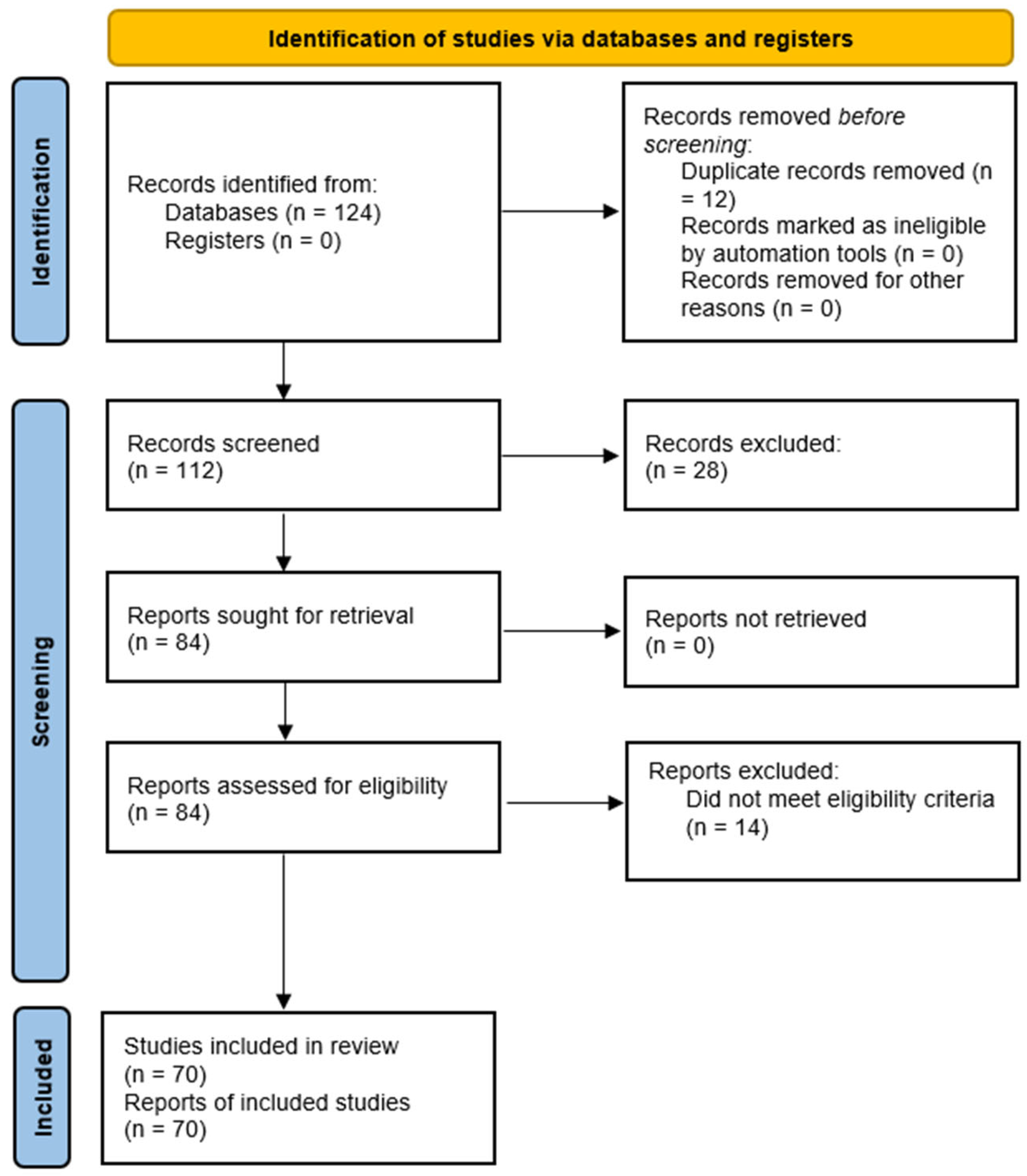
A total of 124 records were identified through structured database searches. Twelve duplicate records were removed prior to screening.
The remaining 112 records underwent title and abstract screening to assess their relevance to GNSS spoofing mechanisms, military navigation systems, missile guidance architectures, and countermeasure strategies. During this stage, twenty-eight records were excluded due to lack of relevance to GNSS spoofing, exclusive focus on unrelated civilian applications, or insufficient technical depth.
A total of eighty-four full-text articles were subsequently assessed for eligibility. Following a detailed evaluation, fourteen articles were excluded due to redundancy in methodological contribution, limited analytical validation, and absence of transferable insights into military navigation contexts.
Seventy studies were included in the qualitative thematic synthesis and formed the basis for the thematic analysis presented in the subsequent sections. The study selection process is summarised in
Figure 1.
The studies included were thematically categorised based on their primary research focus, including GNSS architecture, vulnerabilities, spoofing techniques, military navigation applications, and countermeasure strategies.
Table 1 summarises the thematic distribution of the studies included and their typical application contexts.
3.1. GNSS Overview
The studies categorised under GNSS overview provide foundational descriptions of GNSS architecture, signal structure, and receiver processing mechanisms relevant to spoofing susceptibility.
3.1.1. GNSS Constellations and Signal Structure
The reviewed literature describes GNSS as a satellite-based positioning system compromising multiple global constellations, including GPS (United States), GLONASS (Russia), Galileo (European Union), and BeiDou (China). These constellations transmit spread-spectrum signals containing pseudorandom noise (PRN) codes, navigating data, and precise timing information derived from onboard atomic clocks [
9,
10].
GNSS positioning is based on the principle of trilateration, whereby a receiver estimates its location by measuring distances to multiple satellites with known orbital positions. These distances are derived from pseudorange measurements calculated from the signal transmission time between satellites and the receiver. A minimum of four satellites is required to determine three-dimensional position coordinates and receiver clock bias. This positioning principle forms the basis of navigation across all major GNSS constellations [
11].
Several studies emphasise that civil GNSS signals are broadcasted at extremely low received power levels (typically below −130 dBm at the Earth’s surface), making them inherently susceptible to interference and signal manipulation. Signal bands such as L1, L2, and L5 are commonly referenced in relation to receiver acquisition and tracking processes [
12,
13,
14].
3.1.2. Receiver Architecture and Signal Processing
The reviewed studies identified two dominant receiver architectures which are traditional hardware-based receivers and SDR-based implementations. SDR receivers were frequently used in experimental spoofing studies due to their flexibility in signal generation and manipulation [
15,
16].
Signal processing stages commonly described in the literature include signal acquisition, code and carrier tracking, navigation message decoding, and PVT estimation. Tracking loop mechanisms, including Delay Lock Loops (DLL) and Phase Lock Loops (PLL), are consistently reported as critical components in maintaining signal lock and are frequently referenced in vulnerability and spoofing studies [
17]. These loops are particularly relevant in spoofing contexts, as controlled manipulation of correlation peaks directly affects tracking stability.
Collectively, these architectural characteristics establish the foundational conditions under which spoofing attacks exploit signal acquisition, tracking loops, and navigation message processing stages within GNSS receivers.
3.1.3. Civil and Military Signal Distinctions
Several studies distinguished between open civil signals and encrypted military signals. While encrypted military signals provide enhanced protection through authentication and anti-jamming measures, many military platforms including UAVs and certain missile guidance systems utilise civil GPS signals or combined GPS/INS architecture for positioning support [
18].
Recent GNSS modernisation efforts have sought to narrow the security gap between open civil signals and protected military services. Emerging authentication mechanisms, including Galileo Open Service Navigation Message Authentication (OSNMA) and GPS Chips-Message Robust Authentication (CHIMERA), provide cryptographic verification of signal authenticity and navigation message integrity [
19]. These mechanisms are intended to improve trustworthiness in open-service GNSS signals and reduce susceptibility to sophisticated spoofing attacks. Although their deployment remains recent, they represent a significant advancement in the security capabilities of civil GNSS services and may complement traditional anti-spoofing and multi-sensor navigation approaches.
In addition to authentication mechanisms, the literature also highlighted the increasing adoption of multi-constellation and multi-frequency receivers to improve robustness and redundancy in navigation systems.
3.2. GNSS Vulnerabilities
GNSS-based navigation systems are inherently vulnerable due to architectural, signal-level, and algorithmic characteristics that were originally designed for open-access civil use rather than adversarial environments. These vulnerabilities manifest across multiple layers, including signal propagation, receiver processing, software implementation, cryptographic design, and infrastructure dependence.
To provide analytical clarity, GNSS vulnerabilities are categorised into signal-level weaknesses, receiver and algorithmic vulnerabilities, spoofing attack mechanisms and exploitation pathways, synchronisation and infrastructure exploitation, and hardware and implementation-level weaknesses.
3.2.1. Signal-Level Vulnerabilities
GNSS signals are transmitted from medium Earth orbit satellites at extremely low received power levels, typically below the thermal noise floor at the antenna. This fundamental characteristic creates a power asymmetry vulnerability, whereby locally generated counterfeit signals can easily overpower authentic signals [
20].
Experimental studies demonstrate that during simplistic spoofing scenarios, carrier-to-noise density ratio (C/N
0) values can abruptly increase from nominal levels (30–35 dB-Hz) to spoofed values exceeding 50–60 dB-Hz once the receiver locks onto the counterfeit source [
4,
21]. Such transitions highlight the susceptibility of receivers to high-power local signal injections.
Additionally, pseudorange manipulation under spoofed conditions directly alters PVT solutions. When authentic signals are jammed or overshadowed, receivers may transition to tracking malicious signals, enabling controlled position displacement [
4].
Survey studies further indicate that the combination of weak received signal power and known signal structures make GNSS particularly susceptible to signal forgery and replay-based attacks. Once a receiver accepts counterfeit signals as authentic, subsequent navigation and timing outputs may be manipulated without obvious indications to the user [
22].
The weakness is further amplified indoors or in obstructed environments, where authentic satellite visibility is reduced and spoofed signals can dominate the correlation process. Controlled indoor experiments confirm successful manipulation of location, date, and time under such conditions [
20]. By contrast, open-sky environments exhibit greater resistance to spoofing attacks due to stronger authentic satellite geometry and signal dominance.
3.2.2. Receiver and Algorithmic Vulnerabilities
Beyond signal-level exposure, GNSS receivers exhibit internal processing vulnerabilities that may be exploited through parameter manipulation.
Sensitivity analyses of receiver navigational solution blocks show that corruption of specific ephemeris parameters, including the square root of the semi-major axis
, longitude of ascending node (
, and rate of right ascension (
, can include significant position deviations [
23]. Simulation and experimental validation indicate that ephemeris corruption can generate large least-squares solution instabilities, while certain parameter perturbations propagate through the position calculation matrix and are amplified by Earth-radius scaling factors. In addition, some errors increase progressively over time due to derivative propagation effects.
Receiver performance is also influenced by internal processing characteristics and susceptibility to signal distortions. Studies show that variations in receiver architecture, including tracking loop configuration, correlator design, and signal processing parameters, can affect positioning accuracy and integrity when distorted or corrupted GNSS signals are received [
24]. The impact of these distortions differs across receiver implementations, leading to varying levels of navigation performance degradation and error propagation under adverse signal conditions.
3.2.3. Almanac and Integrity Monitoring Exploitation
Many GNSS receivers perform integrity verification through range checking of ephemeris parameters, cross-validation against almanac data, and satellite consistency comparison.
However, integrity-monitoring approaches may be vulnerable to coordinated spoofing attacks. Conventional Receiver Autonomous Integrity Monitoring (RAIM) techniques rely on inconsistencies among satellite measurements to identify anomalies. When all receiver channels are simultaneously misled into tracking coordinated spoofing signals, these consistency checks may fail to detect the attack [
25].
Furthermore, RAIM requires sufficient satellite redundancy and may not always be available in constrained environments. When disabled or geometry-limited, receivers become more susceptible to accepting corrupted inputs [
26,
27].
3.2.4. Synchronisation and Infrastructure Vulnerabilities
GNSS is widely used not only for positioning but also for timing synchronisation in telecommunications, power grids, and defence infrastructure [
27].
Spoofing or meaconing attacks that alter time synchronisation can induce cascading system-level instability. Infrastructure systems that rely solely on GNSS timing without cross-referenced backup sources are particularly vulnerable [
28].
Recent analyses of operational spoofing incidents have demonstrated that the effects of spoofing can extend beyond individual receivers, potentially affecting large geographic areas and critical infrastructure systems that depend on GNSS-derived positioning and timing information [
29].
Emerging research also highlights exploitation pathways in 4G/5G networks and distributed systems dependent on GNSS-based timing signals [
30]. These attacks extend GNSS vulnerability beyond navigation and into broader cyber-physical domains.
3.2.5. Software and Implementation-Level Weakness
Receiver software implementations may introduce additional attack surfaces. Studies examining GPS receivers from a software-security perspective demonstrate that malformed navigation-message and ephemeris data can trigger unexpected receiver behaviour, software failures, and navigation-solution errors. Experimental evaluations showed that manipulation of critical ephemeris parameters may cause receivers to accept corrupted data, resulting in navigation disruptions, processing faults, or system instability [
31]. These findings indicate that vulnerabilities may arise not only from signal spoofing itself but also from the way receiver firmware processes and validates navigation data.
Security assessments of GNSS receiver design further indicate that implementation-level decisions, including firmware architecture and tamper-resistance mechanisms, significantly influence protection against spoofing and manipulation attacks [
32].
Consumer devices exhibit varying levels of protection against spoofing attacks depending on smartphone manufacturer, operating system, GNSS chipset, and signal processing architecture. Experimental evaluations conducted across multiple smartphone platforms demonstrate that device responses differ under record-and-replay and time-synchronised spoofing attacks. Although recent smartphones increasingly support multi-constellation and dual-frequency GNSS operation, successful manipulation of position and timing information remains feasible under controlled spoofing conditions. Experimental results further indicate that even devices capable of tracking L5 signals may remain vulnerable when subjected to sophisticated spoofing attacks [
33].
3.2.6. Summary of Vulnerability Landscape
GNSS vulnerabilities arise from multiple contributing factors, including low received signal power, open-access signal structures, lack of mandatory cryptographic authentication in civil signals, receiver algorithm sensitivity to ephemeris manipulation, dependence on external timing references, and architecture-dependent integrity monitoring mechanisms.
In military navigation and missile guidance contexts, these vulnerabilities present critical operational risks. Precision degradation, trajectory deviation, and time synchronisation corruption may occur if spoofing attacks bypass detection mechanisms. A layered understanding of these vulnerabilities is essential for the design of resilient countermeasures, as discussed in the subsequent section.
3.3. Spoofing Attack Techniques
The spoofing-focused studies examine a range of attack models differing in complexity, signal manipulation strategy, and operational intent. Across the reviewed literature, spoofing techniques can be broadly grouped into replay and meaconing attacks, power-dominance takeover strategies, gradual code- and carrier-phase manipulation (pull-off attacks), and coordinated multi-satellite signal generation using SDR platforms.
3.3.1. Spoofing Taxonomy and Classification
GNSS spoofing attacks are commonly categorised as simplistic, intermediate, and sophisticated.
Simplistic spoofing utilises low-cost SDR platforms and open-source GNSS simulators to generate counterfeit navigation signals that overpower authentic satellite transmissions [
34,
35]. Experimental demonstrations confirm that such attacks can be implemented using commercially available SDR hardware in controlled laboratory environments.
Intermediate spoofing synchronises malicious signals with authentic satellite timing and code phase to avoid abrupt tracking discontinuities, thereby reducing detection likelihood [
4]. This approach enables gradual position displacement while maintaining receiver lock.
Sophisticated spoofing employs coordinated multi-transmitter architectures to simulate constellation-level coherence, preserving inter-satellite consistency and geometry relationships. Such attacks are more difficult to detect because they replicate realistic satellite configurations and timing structures. This class of coordinated spoofing poses greater concern for safety-critical and military navigation systems, where continuity and integrity are essential [
35].
3.3.2. Replay and Meaconing Attacks
Replay and meaconing attacks represent simple spoofing approaches in which authentic GNSS signals are captured, delayed, and retransmitted toward a victim receiver. In a meaconing detection study using multiple commercial-off-the-shelf (COTS) receivers [
36], spoofing is modelled as a rebroadcast of authentic signals with an introduced delay, resulting in consistent position offsets across receivers. Because the rebroadcast signals preserve the original modulation and navigation message structure, the primary manipulation occurs through time delay, which directly affects pseudorange measurements.
The impact analysis using RINEX-based spoofing evaluation [
37] further confirms that delayed signal injection leads to measurable distortions in timing and positioning observables, particularly pseudorange and receiver clock estimates. These studies show that replay-based methods introduce detectable temporal inconsistencies, especially when multiple receiver or time-synchronisation cross-checks are employed.
Compared to more advanced attacks, replay and meaconing strategies require limited signal synthesis capability. However, they are more susceptible to detection through multi-receiver comparison, timing consistency checks, or signal-quality monitoring mechanisms.
3.3.3. Power-Dominance Takeover Strategies
More sophisticated spoofing approaches employ power-dominance takeover strategies, in which counterfeit GNSS signals are transmitted at power levels slightly exceeding those of authentic satellite signals. Experimental studies using SDR-based platforms, including HackRF devices combined with GPS-SDR-SIM, demonstrate that gradual power increases enable spoofed signals to capture receiver tracking loops without causing abrupt loss of lock [
38].
Experimental vehicle-mounted multi-sensor fusion (MSF) spoofing [
39] further formalises takeover into two stages: a constant-value spoofing phase to identify system vulnerability windows, followed by an exponential-value manipulation phase to accelerate lateral deviation while remaining below chi-square detection thresholds. This staged approach illustrates how power dominance can be combined with measurement consistent manipulation to achieve stealthy navigation deviation.
Collectively, these studies show that gradual power ramping is widely adopted to avoid abrupt signal discontinuities and maintain receiver tracking continuity during takeover.
3.3.4. Code-Phase and Carrier-Phase Pull-Off Attacks
Code-phase pull-off and carrier-phase pull-off strategies enable gradual pseudorange manipulation. In lift-off spoofing attacks, the spoofer first synchronises with the authentic GNSS signal and then incrementally alters the code phase of the counterfeit signal while maintaining signal continuity. This controlled displacement gradually shifts the receiver correlation peak away from the authentic signal, causing the tracking loops to follow the counterfeit signal and producing a slow but deliberate position drift [
40]. Such pull-off attacks can be implemented while maintaining signal consistency and avoiding abrupt tracking disruptions, thereby increasing the stealth of the attack.
The spoofing correlation peak cancellation (SCPC) mitigation study [
41] provides additional insight into this process by analysing the synchronisation, traction, and separation phases of the spoofing signal. The traction phase corresponds to gradual manipulation of the correlation peak, while separation reflects the complete displacement of authentic tracking by the spoofed signal.
In the MSF-targeted spoofing strategy [
39], pseudorange deviations are intentionally introduced while satisfying chi-square constraints of the Kalman filter-based fusion system. This demonstrates that pull-off attacks can be designed to remain statistically consistent with expected measurement noise models, making them difficult to detect through single observable thresholding.
Because these techniques preserve modulation structure and maintain Doppler and navigation message coherence, they are particularly challenging to identify without multi-feature consistency checks or cross-observable monitoring [
42].
3.3.5. Coordinated Multi-Satellite Signal Generation
Advanced spoofing scenarios involve coordinated multi-satellite signal synthesis using SDR platforms. Low-cost SDR-based spoofers can generate counterfeit GNSS signals that replicate the carrier, PRN code, and navigation data of multiple satellites simultaneously, enabling manipulation of the receiver’s complete position, velocity, and timing solution rather than a single satellite channel [
43].
The survey on GNSS spoofing and anti-spoofing technologies [
44], further notes that sophisticated attackers may emulate an entire satellite constellation, including realistic ephemeris data and synchronised Doppler shifts. This capability allows complete control over position, velocity, and timing outputs.
In constrained distributed spoofing scenarios, attackers coordinate multiple counterfeit satellite signals to emulate realistic constellation behaviour and maintain consistency across navigation measurements. Such constellation-level spoofing reduces geometric inconsistencies that simpler single-satellite spoofing attacks may introduce, thereby increasing attack realism and complicating detection [
45].
These studies collectively confirm that coordinated multi-satellite spoofing significantly increases attack realism and reduces detectability compared to isolated channel manipulation.
3.3.6. Summary of Spoofing Evolution
The reviewed literature indicates a clear progression in spoofing sophistication. Early replay and meaconing attacks primarily relied on signal delay and rebroadcast. Subsequent developments introduced gradual power-dominance takeover and code-phase pull-off strategies. More recent implementations demonstrate coordinated multi-satellite SDR-based spoofing capable of full navigation solution manipulation.
This evolution reflects a transition from simple rebroadcast mechanisms to highly controlled signal generation strategies designed for seamless receiver takeover and statistical stealth within integrated navigation systems.
Table 2 summarises the major GNSS spoofing attack techniques identified in the reviewed literature, together with their implementation methods and typical evaluation environments.
3.4. Military GNSS-Based Navigation Systems
The reviewed military-focused studies examine the integration of GNSS within missile guidance systems, UAVs, and uncrewed ground vehicles (UGVs). Across the literature, GNSS is consistently implemented as part of an integrated navigation architecture rather than as a standalone guidance mechanism.
3.4.1. GNSS/INS Integration in Missile Guidance Systems
Several studies describe GNSS as a key source of positioning, velocity, and timing information for missile trajectory guidance and target accuracy. Modern missile and aerospace navigation systems frequently employ integrated GNSS/INS architectures, where GNSS measurements are used to correct accumulated inertial drift and improve navigation continuity and positioning accuracy throughout flight operations [
46].
Missile guidance research emphasised subsystem reliability, fault detection, and data fusion. A grey model-based fault forecasting approach combined with multi-sensor data fusion was proposed for real-time prediction of guidance system faults [
47]. The method was designed to detect abnormal accelerometer outputs and adjust subsystem weighting within integrated navigation systems.
These works focused on maintaining integrated system stability and identifying internal subsystem degradation rather than evaluating adversarial signal manipulation.
3.4.2. GNSS Utilisation in Military UAV Systems
The UAV-focused study reported that GNSS is essential for long-range navigation and operation beyond visual line-of-sight. Autonomous flight modes such as GPS-ATTI and return-to-home were described as dependent on continuous GNSS signal availability [
48].
Recent research further demonstrates that GNSS spoofing can be employed against coordinated UAV formations and swarm systems. By manipulating navigation information received by multiple UAVs simultaneously, spoofing attacks can disrupt formation control, alter trajectories, and degrade mission effectiveness [
49]. These findings highlight the increasing relevance of GNSS security for autonomous and networked military platforms operating in contested environments.
The literature also documented GNSS vulnerabilities. Civilian GPS services were described as lacking encryption and authentication mechanisms, making them susceptible to spoofing and jamming. The distinction between encrypted military P(Y) signals and open civil C/A was outlined [
50].
3.4.3. GNSS in Uncrewed Ground Vehicles
UGVs commonly rely on GNSS to support waypoint navigation, path planning, and autonomous mission execution in environments where satellite signals are available. GNSS-derived positioning information is often integrated with onboard navigation and control systems to support autonomous movement, route following, and mission coordination across operational areas [
51,
52]. The dependence of these functions on reliable satellite navigation makes UGVs vulnerable to signal disruption, jamming, and spoofing attacks that may degrade navigation accuracy or alter vehicle behaviour.
The literature further documents operational scenarios involving GNSS-denied environments, where alternative localisation methods, such as simultaneous localisation and mapping (SLAM), are required [
53,
54]. Field experimentation studies include jamming assessments to evaluate system robustness under signal disruption conditions. These findings highlight the importance of navigation resilience in military UGV operations, particularly when vehicles are deployed in contested environments where GNSS availability cannot be guaranteed.
3.4.4. Signal Security Considerations
The reviewed UAV-focused studies identify spoofing and jamming as primary GNSS threats in military drone operations [
55]. Jamming attacks aim to deny positioning and navigation services, whereas spoofing attacks seek to manipulate navigation outputs through counterfeit GNSS signals. The increasing dependence of UAVs on satellite navigation has consequently made these threats a significant operational concern in contested environments.
Spoofing techniques are categorised into open and covert strategies, including gradual signal takeover and coordinated multi-satellite fabrication [
56]. Open attacks typically rely on overpowering authentic signals, while covert attacks gradually manipulate receiver tracking processes to avoid immediate detection. Coordinated spoofing approaches further increase attack effectiveness by maintaining consistency across multiple satellite signals.
Although encrypted military signals provide enhanced protection, several studies report continued reliance on civilian GPS frequencies or mixed GNSS architectures in operational systems, thereby maintaining exposure to spoofing vulnerabilities [
48].
3.5. Countermeasures
The reviewed studies propose spoofing detection and mitigation techniques operating at multiple architectural layers of the GNSS receiver and navigation processing chain. In the included literature, countermeasures are implemented at the signal processing level, antenna and spatial domain, integrated navigation filter level, machine learning classification layer, and signal authentication frameworks.
3.5.1. Signal-Level Monitoring and Detection
Several studies implement signal quality monitoring (SQM) mechanisms to detect distortions introduced during spoofing attacks. These methods operate primarily during the acquisition and tracking stages of the receiver [
57].
A two-stage detection framework integrating In-Band Signal Strength Monitoring (IBSSM) at acquisition and C/N
0 monitoring during tracking was experimentally evaluated using TEXBAT datasets [
58]. The IBSSM stage computed normalised in-band power variations and triggered detection when abrupt deviations exceeded adaptive thresholds. The C/N
0 monitoring stage analysed temporal deviations from moving averages to identify inconsistencies during both static and dynamic scenarios.
Simulation results demonstrated that IBSSM successfully detected abrupt power-dominance attacks like ds1 and ds2 scenarios, while C/N0 monitoring detected gradual and matched-power spoofing cases where signal strength remained consistent. The complementary behaviour of the two stages improved overall detection robustness across static and dynamic environments.
However, limitations are reported under closely power-matched spoofing conditions, where single-metric monitoring may fail if the spoofer closely mimics authentic signal characteristics.
To address these limitations, the study [
59] proposed a Multcorrelator-based spoofing detection and mitigation framework that combined iterative delay refinement with adaptive filtering. Using TEXBAT datasets, the method achieved spoofing detection rates exceeding 90% at a false alarm rate of 10
−5 when forty-one correlators were employed. The adaptive filtering component further maintained position and timing errors below 15 m following spoofing attacks, demonstrating the effectiveness of correlator-based signal quality monitoring for both spoofing detection and navigation recovery.
Additional signal-based approaches employed multi-feature monitoring strategies that combined GNSS observables such as pseudorange residuals, Doppler measurements, clock offset, clock drift, and C/N
0 rather than relying on single parameters [
60]. Correlation analysis revealed statistically significant relationships between spoofing indication and receiver clock drift, carrier variance, and C/N
0 variations, supporting multi-feature detection strategies.
3.5.2. Antenna-Based and Spatial Filtering Techniques
Antenna array-based countermeasures are widely reported in the reviewed literature. These include direction-of-arrival (DoA) estimation, Controlled Reception Pattern Antenna (CRPA) techniques, beamforming, null steering, and Space-Time Adaptive Processing (STAP).
These approaches exploit the spatial characteristic that spoofing signals typically originate from a single terrestrial source, whereas authentic satellite signals arrive from spatially distributed directions [
61].
Additional spatial-processing approaches employ multiple antennas to compare the spatial characteristics of received signals. Double-antenna detection methods exploit the common-source nature of spoofing transmissions and can distinguish counterfeit signals from authentic satellite signals without requiring strict antenna synchronisation, thereby improving practical deployment flexibility [
62].
Blind spatial spoofing detection approaches have also been investigated using multi-antenna snapshot receivers that analyse similarities between antenna-array steering vectors rather than relying on explicit direction-of-arrival estimation. Experimental evaluations demonstrated that eigenvalue-based analysis, clustering methods, and steering-vector correlation metrics can successfully identify spoofed GNSS constellations under controlled spoofing conditions [
63], highlighting the effectiveness of spatial diversity for spoofing detection while reducing calibration requirements associated with conventional array-processing approaches.
Experimental evaluations demonstrate that multi-element antenna arrays can suppress spoofing signals by steering nulls toward interference sources while preserving legitimate satellite signals. Rotating single-antenna methods have also been proposed as lower-complexity alternatives, exploiting azimuth-dependent variations in received signal power to distinguish spoofed signals originating from a common source while maintaining reduced hardware complexity [
64].
Beyond antenna-array and direction-of-arrival approaches, additional spatial-statistical approaches have been proposed for detecting coordinated spoofing attacks involving multiple distributed spoofers. These methods combine clustering techniques with likelihood-based hypothesis testing to detect spoofing activity when both the number of spoofers and attack strategies are unknown. Reported results demonstrated high detection probabilities across realistic signal-to-noise conditions, highlighting the potential of spatial-processing techniques for detecting complex multi-spoofer scenarios [
65].
These techniques operate at the RF front-end and provide both detection and mitigation capabilities, rather than detection alone.
3.5.3. INS/GNSS Integration-Based Detection
Multiple studies investigate spoofing detection within GNSS/INS integrated navigation frameworks. Innovation-based detection methods monitor Kalman filter residuals to identify inconsistencies between inertial predictions and GNSS measurements.
In loosely coupled architectures, spoofing detection is performed by analysing innovative sequences and velocity discrepancies, with threshold-based decision mechanisms implemented within the filtering framework. One study proposes spoofing mitigation through INS-only propagation following detection, followed by controlled GNSS reintegration [
66].
In addition to loosely coupled approaches, several studies investigate tightly coupled GNSS/INS integration for enhanced spoofing detection. In tightly coupled systems, raw GNSS measurements, such as pseudorange and Doppler, are directly fused with inertial sensor data within the navigation filter, rather than relying on standalone GNSS-derived position solutions [
67]. This measurement-level integration enables earlier detection of inconsistencies, thereby improving sensitivity to subtle spoofing-induced deviations.
The reviewed literature indicates that tightly coupled integration provides increased robustness against gradual and synchronised spoofing attacks, as measurement-level residuals are more responsive to anomalies compared to solution-level discrepancies [
68]. This is particularly relevant in high-dynamic environments, such as missile systems, where rapid motion amplifies inconsistencies between inertial predictions and corrupted GNSS measurements. Tightly coupled architectures are increasingly recognised as a critical component in the design of resilient military navigation systems.
Additional information-level approaches employ visual sensors to independently verify GNSS positioning and support navigation recovery following spoofing attacks. By matching real-time aerial imagery with satellite reference images using deep-learning-based feature extraction and image-matching techniques, these methods detect inconsistencies between reported GNSS positions and observed environmental features. Experimental evaluations reported spoofing detection accuracies of 89.5%, while 89.7% of positioning errors were maintained within 13.9 m during autonomous positioning recovery, demonstrating the potential of vision-assisted navigation for operation in GNSS-compromised environments [
69].
Performance analysis study [
70] indicates that detection sensitivity depends on system characteristics, including sensor behaviour and integration strategy. In loosely coupled GNSS/INSs, spoofing-induced inconsistencies may propagate through the filter before exceeding detection thresholds, as erroneous GNSS updates introduce abnormal Inertial Measurement Unit (IMU) error compensations.
3.5.4. Machine Learning-Based Approach
A number of reviewed literature implements supervised machine learning classifiers for spoofing detection.
One study applies Support Vector Machines (C-SVM) using multi-dimensional GNSS observables as input features [
42]. Training and validation on synthetic and real-world spoofing datasets which yield 97.8% classification accuracy on test datasets and 100% detection accuracy on an independent real-world spoofing dataset.
In this context, synthetic datasets refer to spoofing scenarios generated through simulation or SDR-based signal generation, whereas real-world datasets consist of GNSS measurements collected during field experiments or documented spoofing events.
Dataset availability varies across studies, with some datasets released through public repositories or
Supplementary Materials, while others remain proprietary and are available only upon request.
Principal Component Analysis (PCA) has been applied to identify the most informative spoofing-detection features while reducing redundancy among highly correlated GNSS observables. By transforming the original feature space into a smaller set of principal components, PCA-based approaches improve computational efficiency and mitigate dimensionality challenges associated with machine-learning-based spoofing detection. However, reducing feature dimensionality may involve a trade-off between computational efficiency and the preservation of discriminative information required for accurate classification [
71].
Deep-learning-based approaches have also been investigated for spoofing detection using GNSS signal acquisition outputs. These methods analyse Cross Ambiguity Function (CAF) representations through deep neural network architectures to distinguish authentic and spoofed signals while estimating the presence of multiple spoofing sources. Experimental results demonstrated improved detection performance compared with conventional acquisition-based approaches, particularly under moderate-to-high signal-to-noise conditions, highlighting the potential of artificial intelligence techniques for complex spoofing detection scenarios [
72].
More recent artificial intelligence approaches have focused on improving spoofing detection in previously unseen attack scenarios. Lightweight machine-learning frameworks combining Conditional Generative Adversarial Networks (CGANs) with Artificial Neural Networks (ANNs) have been proposed to enhance feature generalisation while reducing computational complexity [
73]. Using only a small set of receivers tracking and RF features, these approaches achieved detection rates exceeding 96% across unknown spoofing scenarios and average detection rates above 98%, while also reducing detection latency compared with conventional machine-learning classifiers.
Other machine learning approaches reported in the literature include Random Forest classifiers, backpropagation neural networks, multilayer perceptron, and time-series feature extraction methods [
74]. Reported detection rates frequently exceed 97% under controlled laboratory conditions, although dependency on training data representativeness and generalisation capability remain key limitations.
3.5.5. Authentication and Multi-Constellation Approach
Several studies examine signal authentication mechanisms as long-term mitigation strategies within GNSS security frameworks. These include delayed disclosure authentication schemes, such as TESLA, as well as signal structure verification mechanisms applied at both message and spreading code levels [
75].
Multi-constellation and multi-frequency GNSS receivers enhance spoofing resilience by enabling consistency checks across independent satellite systems and providing redundant measurements that can be integrated with inertial sensors to maintain navigation performance during spoofing events [
76,
77].
3.5.6. Summary of Countermeasures
The reviewed countermeasure literature demonstrates that spoofing mitigation strategies operate at multiple architectural layers within GNSS-enabled navigation systems.
Table 3 summarises the primary countermeasure categories identified in the selected studies, the operational layer at which they function, and the evaluation contexts reported in the literature.
3.6. Synthesis of Results
In the reviewed literature, GNSS spoofing research is focused on detection mechanisms and signal-level mitigation strategies, with comparatively fewer studies addressing missile-specific dynamic environments. Most experimental evaluations were conducted under static or low-dynamic conditions. While countermeasures diversity is evident in signal-processing, spatial filtering, and machine learning approaches, limited work directly investigates spoofing protection and mitigation performance in high-acceleration or operational missile contexts.
Table 4 provides a comparative synthesis of the major countermeasure categories identified in the reviewed literature. Although the reviewed studies demonstrate considerable progress in GNSS spoofing detection and mitigation, few explicitly evaluate countermeasure performance under missile-representative high-dynamic conditions. Missile navigation systems operate in environments characterised by rapid acceleration, high velocities, frequent attitude changes, structural vibration, and stringent real-time processing requirements. These operational characteristics impose additional challenges that may influence the effectiveness of existing spoofing countermeasures.
Signal-level monitoring techniques, including SQM, carrier-to-noise density ratio (C/N0) analysis, and correlation-based methods, have demonstrated effective detection of abrupt spoofing attacks in controlled environments. However, under high-dynamic missile flight conditions, rapidly varying Doppler shifts and changing signal characteristics may increase measurement variability, making it more difficult to distinguish legitimate navigation dynamics from spoofing-induced anomalies. Detection methods relying on fixed thresholds may require adaptive thresholding to maintain reliable performance under rapidly changing flight conditions.
Antenna-based and spatial filtering techniques, including beamforming, CRPA, and direction-of-arrival estimation, provide effective suppression of spoofing signals by exploiting their spatial characteristics. However, their application to missile systems may be constrained by platform size, aerodynamic requirements, weight, power availability, and antenna placement limitations. While these techniques demonstrate strong protection capabilities in larger platforms, their implementation within compact missile guidance systems requires further investigation.
GNSS/INS integration-based detection approaches appear particularly relevant to missile navigation because inertial sensors continue providing navigation information during GNSS signal degradation or manipulation. Innovation-residual monitoring and consistency checking between inertial and GNSS measurements can improve resilience against spoofing attacks. However, the reviewed studies indicate that gradual or well-synchronised spoofing attacks may remain below detection thresholds, particularly in loosely coupled integration architectures. Further validation under high-dynamic missile trajectories is therefore required to determine the robustness of these approaches under realistic operational conditions.
Machine learning-based approaches consistently report high spoofing detection accuracies in simulation studies, benchmark datasets, and controlled experiments. However, the training datasets used in most studies are generated under stable operating conditions and may not adequately represent the rapidly changing navigation states encountered during missile flight. The generalisability of these approaches to missile-representative environments remains uncertain and requires validation using realistic high-dynamic datasets.
Authentication-based mechanisms and multi-constellation or multi-frequency navigation approaches provide additional resilience by improving signal authenticity verification and navigation redundancy. Although these techniques offer strong theoretical protection against spoofing, the reviewed literature provides limited evidence of their evaluation within missile-specific operational environments. Their effectiveness under the stringent timing, processing, and environmental constraints associated with missile navigation therefore remains a key area for future investigation.
The synthesis indicates that no single countermeasure currently provides comprehensive protection against GNSS spoofing under missile-representative high-dynamic conditions. Instead, the reviewed evidence suggests that resilient missile navigation systems will require layered defence architectures that integrate complementary signal-level, navigation-level, spatial, and authentication-based techniques, supported by validation under operationally realistic high-dynamic scenarios.
4. Discussion
4.1. Summary of Evidence
This scoping review identified a broad range of GNSS spoofing detection and mitigation strategies spanning signal-level monitoring, antenna-based spatial filtering, integrated GNSS/INS consistency checks, machine learning classification, and signal authentication mechanisms. The literature demonstrates significant technical maturity in detection methodologies, particularly in signal-processing-based approaches and data-driven classifiers.
However, experimental validation environments were static or low-dynamic and frequently conducted in controlled laboratory conditions using SDR-based spoofing setups or benchmark datasets. While such environments enable controlled performance evaluation, they may not fully replicate operational electromagnetic conditions.
Notably, comparatively fewer studies examined spoofing countermeasure performance under missile-representative dynamics or high-acceleration environments. Military-focused research concentrated on integration architectures and navigation accuracy rather than adversarial spoofing robustness under operational constraints.
4.2. Interpretation in Relation to Missile GNSS-Based Navigation
The reviewed evidence suggests that GNSS in military systems is most implemented as an augmentation component within integrated navigation architectures, typically fused with INSs. While such integration improves positioning accuracy and reduces inertial drift, it does not inherently eliminate vulnerability to spoofing.
Innovation-based detection within Kalman filter frameworks provides a degree of internal consistency monitoring. However, gradual, or well synchronised spoofing attacks may propagate through loosely coupled systems before triggering detection thresholds. In high-speed missile scenarios, delayed detection may have disproportionate consequences due to limited correction windows.
4.3. Identified Research Gaps
The synthesis of the reviewed literature reveals three principal research gaps.
Firstly, a dynamic evaluation gap is evident, characterised by limited validation of spoofing countermeasures under high-acceleration and missile-representative trajectories. Most studies evaluate detection performance under static or low-dynamic conditions, which do not adequately reflect the kinematic and signal behaviour encountered in missile navigation environments.
Secondly, an operational environment gap is identified, with a predominant reliance on laboratory-based experiments or benchmark datasets rather than contested or adversarial field environments. While such controlled conditions enable reproducible evaluation, they do not fully capture the complexity of real-world electromagnetic interference, signal obstruction, and adversarial behaviour.
Thirdly, a system-level integration gap is observed, where many detection methods are evaluated in isolation rather than within complete guidance, navigation, and control (GNC) loops. As a result, the interaction between spoofing detection mechanisms and overall system performance, particularly under dynamic conditions, remains insufficiently understood.
These gaps indicate that, although spoofing detection technologies demonstrate a significant technical advancement, their validated operational resilience within missile-grade navigation systems remains limited.
4.4. Implications for Military-Based Navigation Systems
The findings of this review carry several important implications for military GNSS-based navigation architectures, particularly in missile guidance systems and other high-dynamic defence platforms.
Firstly, the predominance of signal-level detection techniques suggests that many existing countermeasures are primarily reactive rather than preventive. While signal quality monitoring and innovation-based residual analysis can detect anomalies, they do not inherently prevent initial signal takeover. In missile systems operating under strict timing and trajectory constraints, even brief spoofing-induced deviations may compromise mission objectives.
Secondly, reliance on loosely coupled GNSS/INS integration may introduce vulnerabilities during gradual or well-synchronised spoofing attacks. Although inertial systems provide short-term robustness against signal manipulation, prolonged spoofing may influence correction updates before detection thresholds are exceeded. This highlights the importance of adaptive thresholding and multi-layer consistency checks within high-speed navigation filters.
Thirdly, antenna array-based mitigation techniques offer strong theoretical resistance to single-source spoofing. However, their integration into missile platforms must consider constraints related to aerodynamic design, platform size, and power availability. As such, spatial filtering approaches may be more suitable for larger platforms, such as aircraft or naval systems, than for compact guided munitions.
Fourth, machine learning-based approaches demonstrate high detection accuracy under controlled conditions, but their operational deployment requires careful validation. Defence applications demand robustness against adversarial manipulation, generalisation across previously unseen spoofing strategies, and deterministic performance under real-time constraints. Without such validation, high laboratory accuracy may not translate into operational reliability.
The limited evaluation of countermeasures under missile-representative dynamic profiles indicates that system-level resilience remains only partially validated. Military navigation systems operating in contested electromagnetic environments are likely to require layered architectures that integrate signal-level anomaly detection, inertial consistency verification, spatial filtering, authentication mechanisms, and redundant navigation modalities.
The reviewed evidence suggests that effective spoofing protection against GNSS spoofing in military GNSS-based systems will require multi-layered defence architectures rather than reliance on a single detection mechanism.
4.5. Limitations of This Scoping Review
Several limitations should be considered when interpreting the findings of this review.
Firstly, as a scoping review, the objective was to map the breadth of available evidence rather than to conduct a quantitative synthesis or formal meta-analysis. This study does not provide comparative performance metrics or statistically pooled estimates of detection effectiveness in countermeasure categories. A formal critical appraisal of the included studies was not conducted, consistent with the methodology of a scoping review. As a result, this review maps and synthesises the available evidence without evaluating the methodological quality or risk of bias of the individual studies.
Secondly, although a structured screening and data charting process was applied, the studies included exhibit substantial heterogeneity in experimental design, spoofing scenarios, evaluation metrics, and reporting formats. Variations in dataset selection, such as laboratory-based SDR experiments versus field observations, along with differences in receiver types and dynamic conditions, limit direct cross-study comparability.
Thirdly, a considerable proportion of the reviewed studies rely on controlled laboratory environments or benchmark datasets. As a result, reported detection accuracies may not fully reflect operational performance under contested or adversarial field conditions. The predominance of static or low-dynamic evaluations further restricts the generalisability of findings to missile-representative high-dynamic scenarios.
Fourth, military-focused studies primarily emphasise system integration architectures and navigation accuracy, rather than explicit evaluation of protection against GNSS spoofing. This limits the availability of direct empirical evidence linking missile guidance performance to the effectiveness of spoofing countermeasures.
Fifth, publication bias cannot be excluded. Studies reporting successful detection outcomes are more likely to be published than those demonstrating limited or negative results, which may influence the perceived effectiveness of existing approaches.
Also, modern authenticated GNSS signals, such as GPS M-code, Galileo Open Service Navigation Message Authentication (OSNMA), and emerging CHIMERA-based authentication mechanisms, were only briefly discussed and were not a primary focus of the reviewed literature. These signals incorporate cryptographic authentication mechanisms designed to enhance resistance against spoofing attacks. Because the reviewed studies focused on conventional civil GNSS signals and receiver architectures, the findings are primarily applicable to systems relying on conventional GNSS signals and may not fully represent the performance of next-generation authenticated military navigation systems.
Despite these limitations, this review provides a structured synthesis of existing GNSS spoofing countermeasure strategies and highlights critical research gaps, particularly in relation to high-dynamic military navigation contexts.
4.6. Future Research Directions
The synthesis of evidence highlights several priority areas for future investigation.
Firstly, there is a clear need for empirical validation of spoofing countermeasures under high-dynamic and missile-representative conditions. Future studies should incorporate acceleration profiles, rapid attitude changes, and realistic electromagnetic interference scenarios that reflect operational military environments. Laboratory-based validation using static or low-dynamic datasets should be complemented with dynamic field experiments to assess detection latency and countermeasure performance under time-critical constraints.
Secondly, system-level integration testing is required. Many spoofing detection techniques are evaluated in isolation at the signal processing or filtering layer. Future research should assess performance within complete guidance, GNC architectures to determine how detection timing influences trajectory correction, system stability, and overall mission success.
Thirdly, layered defence architectures warrant further development. Rather than relying on a single detection mechanism, future designs should integrate signal-level monitoring, inertial consistency verification, spatial filtering, and authentication mechanisms within unified decision frameworks. Evaluating how these layers interact under coordinated spoofing scenarios would provide more realistic assessments of system resilience.
Fourth, machine learning-based approaches require further evaluation in operational contexts. Future work may investigate robustness against adversarial manipulation, generalisation to unseen spoofing strategies, computational constraints in embedded systems, and the explainability of classification decisions in safety-critical applications.
Fifth, authentication-based mechanisms and multi-constellation strategies should be examined beyond laboratory demonstrations. Field validation under intentional adversarial spoofing conditions is necessary to determine their practical effectiveness in contested environments.
Finally, there is a need for standardised dynamic spoofing test frameworks analogous to TEXBAT but tailored to high-acceleration and military-relevant scenarios. The development of such benchmarks would enable consistent cross-study comparison and accelerate progress toward operational readiness.
Future research may transition from detection performance optimisation in controlled environments toward system-level resilience validation under operationally realistic military conditions. Addressing this gap is essential for ensuring the integrity of GNSS-enabled missile navigation systems in contested electromagnetic domains.
5. Conclusions
This scoping review mapped the current landscape of GNSS spoofing vulnerabilities and countermeasure strategies, with specific attention to their implications for military and missile-based navigation systems. The findings indicate that GNSS spoofing detection research has achieved substantial technical maturity across signal-processing, filtering, spatial, and machine learning approaches. A diverse range of countermeasures has been proposed and experimentally validated, primarily under controlled laboratory and low-dynamic conditions.
However, the synthesis of evidence reveals a persistent gap between detection performance in controlled environments and validated spoofing protection performance under high-dynamic, missile-representative operational scenarios. While integrated GNSS/INS architectures, antenna-array techniques, and data-driven classifiers demonstrate promising results, limited empirical work directly evaluates spoofing robustness within complete missile guidance and control systems operating under contested electromagnetic conditions.
The review highlights the need for multi-layered defence architectures and system-level validation frameworks that account for countermeasure effectiveness under acceleration constraints, detection latency, and operational integration. Bridging the gap between laboratory-based detection research and field-level military deployment remains a critical step toward ensuring dependable GNSS-enabled navigation in adversarial environments.
Strengthening protection against GNSS spoofing in missile-based navigation systems requires not only improved spoofing detection algorithms but also comprehensive operational validation and integrated system-level design approaches.