1. Introduction
Large language models (LLMs) are increasingly integrated into automated assessment pipelines, where they grade open-ended responses and serve as automated evaluators in educational settings and beyond [
1,
2,
3]. As their scores are used for grading decisions, model comparison, and system-level evaluation, the behavior of the evaluator becomes as critical as that of the underlying task model, a point emphasized in frameworks that treat LLM-as-judge design as a first-class problem [
4,
5]. This shift from hand-crafted metrics and rule-based scoring toward LLM-based evaluators raises questions about stability, robustness, and alignment with expert judgment, in line with analyses of bias and instability in LLM evaluation and studies of robustness to prompt injection and other input perturbations [
5,
6].
1.1. Background and Motivation
Rubric-based assessment is a central component of educational practice, because explicit criteria support transparent grading, foster self-regulated learning, and help instructors justify grading decisions to students and institutions [
7]. Rubrics also provide a common language for performance expectations in courses that rely on open-ended questions and complex forms of reasoning, where answers may be diverse in surface form but are judged against the same underlying criteria [
8].
As course sizes and the prevalence of open-ended tasks increase, maintaining consistent human grading becomes progressively more difficult. LLM-powered graders have been proposed to alleviate this burden by mapping free-form answers to rubric-based scores and feedback [
1], with prior work documenting deployments where LLMs act as stand-alone graders or instructor assistants across courses and disciplines [
9,
10]. These applications illustrate the potential of LLM graders to extend rubric-guided assessment to settings where manual grading would otherwise be costly or impractical.
At the same time, using LLMs as rubric-guided graders raises specific concerns about trust, robustness, and alignment with expert judgment. Studies of LLMs used as raters show that, under suitable prompting and calibration, models such as GPT-4 can approximate human judgments on complex text-rating tasks, but still exhibit non-trivial variability and consistency issues [
2]. Frameworks such as LLM-RUBRIC [
11] and survey work on text generation evaluation emphasize that evaluators should be calibrated, criterion-based, and embedded in transparent protocols if their outputs are to be interpreted reliably across tasks and time [
12]. These requirements are particularly salient when LLM-based evaluation is integrated into high-stakes educational pipelines, where scores must remain stable under minor perturbations of the answer text and resistant to strategic manipulation.
1.2. Problem Statement and Research Gap
Rubric-based grading with LLMs is reliable only if the same answer, judged under the same rubric, receives stable scores at the item level. Recent comparative studies in educational scoring tasks also highlight both benefits and drawbacks of LLM-based scoring relative to traditional ML approaches, reinforcing the need for careful calibration and auditing in real courses [
13]. Empirical studies of LLM-powered automated assessment, including analyses of GPT-4 used as a rater, report score variation across repeated runs and sensitivity to small changes in evaluation prompts, even when aggregate correlations with human raters remain high [
1,
2]. Meta-evaluation frameworks for LLM judges document systematic differences between models, effects of scale and comparison protocol, and discrepancies between absolute scores and relative rankings for the same responses [
14,
15]. Taken together, these results indicate that instability and bias are properties of the entire grading pipeline and must be treated explicitly in the design and training of the evaluator, rather than only audited post hoc.
In rubric-based educational assessment, the student answer is the main potentially untrusted input channel. Malicious or strategically crafted instructions can be interleaved with ostensibly relevant content, for example, by requesting that the rubric be ignored, that a specific score be assigned, or that subsequent text be treated as meta-level instructions rather than as part of the answer. Studies on prompt injection and adversarial prompting show that short, well-formed instructions inserted into the processed text can steer model behavior toward attacker-chosen actions without changing the nominal task [
16]. Robustness analyses of neural language models under input perturbations report substantial changes in predictions under semantically preserving edits and answer-side adversarial modifications, which suggests that an evaluator built on such models inherits a fragile decision boundary [
17].
Rubric-guided evaluation frameworks built for LLMs extend the basic grading setup with multidimensional scoring, task-specific rubrics, and explicit storage of grading decisions [
11,
18]. Multi-model dialectical evaluation and pairwise meta-evaluators quantify divergence between graders and introduce indicators such as score spread for the same content, Consistency Spread, and Win Confidence Score to characterize stability under changes in prompts and comparison settings [
5,
19,
20]. These contributions instrument evaluation pipelines and supply a shared vocabulary for analyzing grader behavior, but the evaluators themselves remain instruction-tuned or fine-tuned on clean answers and are assessed for stability and robustness only after training.
Experimental robustness studies on LLM-based evaluation report that answer-side modifications which preserve the underlying solution but alter the way the answer is wrapped, emphasized, or annotated can change model verdicts by amounts comparable to typical human disagreement [
21]. Paraphrastic shifts show that even semantically equivalent reformulations can induce systematic differences in model predictions, highlighting the sensitivity of current systems to surface form [
22]. Prompt-injection benchmarks and adversarial test suites confirm that apparently minor wording changes and injected control instructions within the processed text can produce consistent shifts in model outputs, including in settings where the model is prompted as an evaluator rather than as a generator [
6]. Recent classroom-focused experiments further show that prompt injection embedded inside student submissions can systematically distort LLM-assisted grading outcomes, highlighting the need for defenses tailored to educational workflows [
23]. In educational scenarios, such phenomena combine model instability with security risks at the grading level and undermine trust in automated assessment, echoing broader concerns about the robustness and trustworthiness of LLM-based systems in high-stakes contexts [
24,
25].
We deliberately adopt a two-step guardrailed grading pipeline in which a dedicated answer-side filter preprocesses student responses before rubric-guided scoring. Compared to adversarially fine-tuning the grader end-to-end on attacked answers, this design keeps the scoring model fixed and calibrated to the rubric on clean inputs, separates robustness from scoring behavior, and remains modular so the same guardrail can front different graders.
In contrast to adversarial studies that rely on synthetic benchmarks, we evaluate robustness and stability on two real short-answer university exams (machine learning and computer networking), with instructor-designed item-level rubrics and human reference scores for all 428 student–question pairs, strengthening the ecological validity of the findings. To audit alignment in this setting, we report a reusable chief-panel comparison in which the candidate grader is treated as a chief and evaluated against a panel of independent graders using chief–panel MAE and bias with bootstrap confidence intervals.
The problem addressed in this paper is the construction of a guardrailed exam-grading pipeline grader for short-answer exams that produces stable integer scores for families of semantically equivalent answers, including both benign paraphrases and answer-side edits belonging to predefined prompt-injection attack classes. The evaluator is required not only to remain aligned with human reference scores, but also to reduce item-level score variation under controlled perturbations and to limit obedience to instructions embedded in the student answer. SteadyEval is designed as such an attack-robust rubric-guided evaluator: a two-step guardrailed grading pipeline where a LoRA-based filter first removes answer-side prompt injection and then the rubric-guided grader assigns the final score. In our experiments on two short-answer exam datasets, this design yields substantially more stable item-level grades and largely removes the systematic grade inflation induced by answer-side attacks in the unguarded baseline (average shift of +1.2 points on the 1–10 scale).
1.3. Related Work
Prior work on LLM-based automated assessment largely targets benign classroom and testing scenarios, documenting deployments where models act as stand-alone graders or instructor assistants and emphasizing agreement with human scores and practical deployment concerns over adversarial robustness [
1]. Course-level studies in creative writing and programming similarly report that rubric-guided LLM graders can approximate instructor judgements under careful prompt and rubric design [
9,
10].
From an educational measurement perspective, meta-analyses show that explicit rubrics support performance and self-regulated learning, motivating transparent, criterion-based scoring schemes in high-stakes assessment [
7]. Within LLM evaluation, LLM-RUBRIC [
11] emphasizes calibrated, multidimensional scoring, while surveys and methodological discussions stress protocol design and the limitations of single aggregate metrics [
12,
14].
A separate line of research treats LLM-as-judge design and analysis as an explicit layer in AI systems. A pairwise meta-evaluator for bias and instability in LLM evaluation and the CourseEvalAI [
3] rubric-guided framework instrument the evaluation pipeline itself, focusing on model choice, rubric structure, and template design rather than only on task models [
5]. Multi-Model Dialectical Evaluation [
20], GraderAssist [
26], and PEARL [
19] further extend this line by introducing multi-model committees, graph-based storage of evaluation decisions, and rubric-driven metric suites that quantify score spread, consistency, and rubric fidelity across evaluators.
Robustness-oriented work raises additional concerns for LLM-based graders. Studies of prompt injection show that short, well-formed instructions or minor input perturbations can steer model outputs, even when the task is held fixed [
6,
16,
17]. SedarEval [
18] related perturbation analyses, and work on paraphrastic shifts show that attacks and meaning-preserving edits can change evaluation outcomes; adversarial training and filtering may partially compensate—motivating systematic auditing of evaluators used in high-stakes settings [
22,
24].
SteadyEval builds on these strands by training a LoRA-based filtering component (SteadyEval-7B-deep) on grouped families of clean and adversarially modified student answers, and evaluating the guardrailed pipeline for human alignment, stability under controlled perturbations, and resistance to answer-side prompt-injection instructions, targeting stable item-level scores under realistic adversarial conditions.
Unlike LLM-RUBRIC [
11], which emphasizes rubric structure and prompt strategy design and calibration for benign evaluation settings, SteadyEval targets student-side manipulation in educational grading by adversarially training the SteadyEval-7B-deep LoRA filter on grouped clean-and-attacked answer families [
27]. In contrast to SedarEval’s [
18] self-adaptive rubric approach for general LLM-as-judge evaluation, SteadyEval operates with instructor-provided exam rubrics and uses a guardrailed pipeline in which the SteadyEval-7B-deep LoRA filter removes injection content before scoring; committee-based graders improve robustness by using multiple graders and aggregating their outputs, whereas SteadyEval improves robustness through learned pre-filtering.
1.4. Contributions
We develop rubric-guided LLM evaluation along four complementary axes, from problem formulation and data construction to model design and experimental methodology.
First, we formulate the design of a rubric-guided LLM grader as a joint stability–robustness-alignment problem at the item level. The evaluator is required not only to match human reference scores on clean answers, but also to produce stable integer scores for families of semantically equivalent responses and to resist instructions embedded in the student answer. This shifts the focus from post hoc auditing of instability and bias to training evaluators that treat stability and robustness as explicit objectives.
Second, we construct a data pipeline organized around grouped families of answers. For each item, we provide a rubric together with clean reference responses, benign paraphrases and rephrasings that preserve the underlying solution, and answer-side adversarial edits belonging to predefined attack classes. These groups are used both during training and evaluation, enabling direct measurement of item-level stability and robustness under controlled perturbations of the student answer.
Third, we introduce SteadyEval, a guardrailed exam-grading pipeline in which the SteadyEval-7B-deep LoRA filter preprocesses student answers before the original Mistral-7B-Instruct rubric-guided grader assigns the final score. The LoRA-based filter is fine-tuned with a masked causal language-modeling objective that applies loss only on the cleaned-answer continuation (prompt tokens are masked); because all clean/attacked variants in a group share the same cleaned target, this training implicitly promotes within-group consistency and discourages reproducing injected instructions. The resulting guardrailed pipeline is deployed by inserting the SteadyEval-7B-deep LoRA filter as a lightweight preprocessing step in front of the original Mistral-7B-Instruct grader, compatible with standard rubric-based educational workflows.
Fourth, we propose and apply an experimental protocol for evaluating rubric-guided LLM graders under controlled answer-side perturbations. Using independent gold-standard datasets organized in groups of clean, paraphrased, and attacked answers, we compare SteadyEval against baseline graders prompted or fine-tuned on clean data only. We jointly assess alignment with human scores, item-level score stability, and robustness to answer-side attacks, and we show that SteadyEval can reduce within-group score variation and limit obedience to embedded instructions while maintaining competitive agreement with human raters.
2. Materials and Methods
This section describes the materials and methods used in SteadyEval. We introduce the grading tasks and rubrics, the construction of grouped answer families with benign and adversarial variants, the baseline and guardrailed grading pipelines built around Mistral-7B-Instruct-v0.2 [
28] and the SteadyEval-7B-deep filter, and the evaluation protocol used to assess stability, robustness, and alignment with human scores. We chose this backbone as the single base grader to support local, reproducible experimentation with an open-weights model, to keep the repeated grading and filtering calls manageable in our setup, and to isolate the effect of the proposed guardrail by keeping the backbone fixed. “SteadyEval” denotes the end-to-end guardrailed grading pipeline (LoRA filtering followed by the base grader), whereas “SteadyEval-7B-deep” refers only to the LoRA filtering component.
2.1. Experimental Overview
The experiments are built around two rubric-guided short-answer exam datasets, ML_gold for introductory machine learning and RC_gold for computer networking. Each record is identified by an answer_id that links a student_id to a question_id. The record contains the full question text, the student’s free-text answer, a short reference solution stored in the field Gold_answer, two rubric descriptors (a coarse label rubric such as technical or argumentative and a gold-solution type Gold_type such as factual), the conceptual domain stored in the field domain, a list of banned misconceptions stored in the field Banned_misconceptions, and a point-level scoring rubric stored in the field Gold_points. This last field is represented as a list of pairs that describe an individual point and its weight. We convert the sum of these weights into a maximum score denoted max_points and ask the model to assign an integer score between 1 and this maximum. The model is required to end its response with a final line in the format Answer: <score>, which we later parse programmatically.
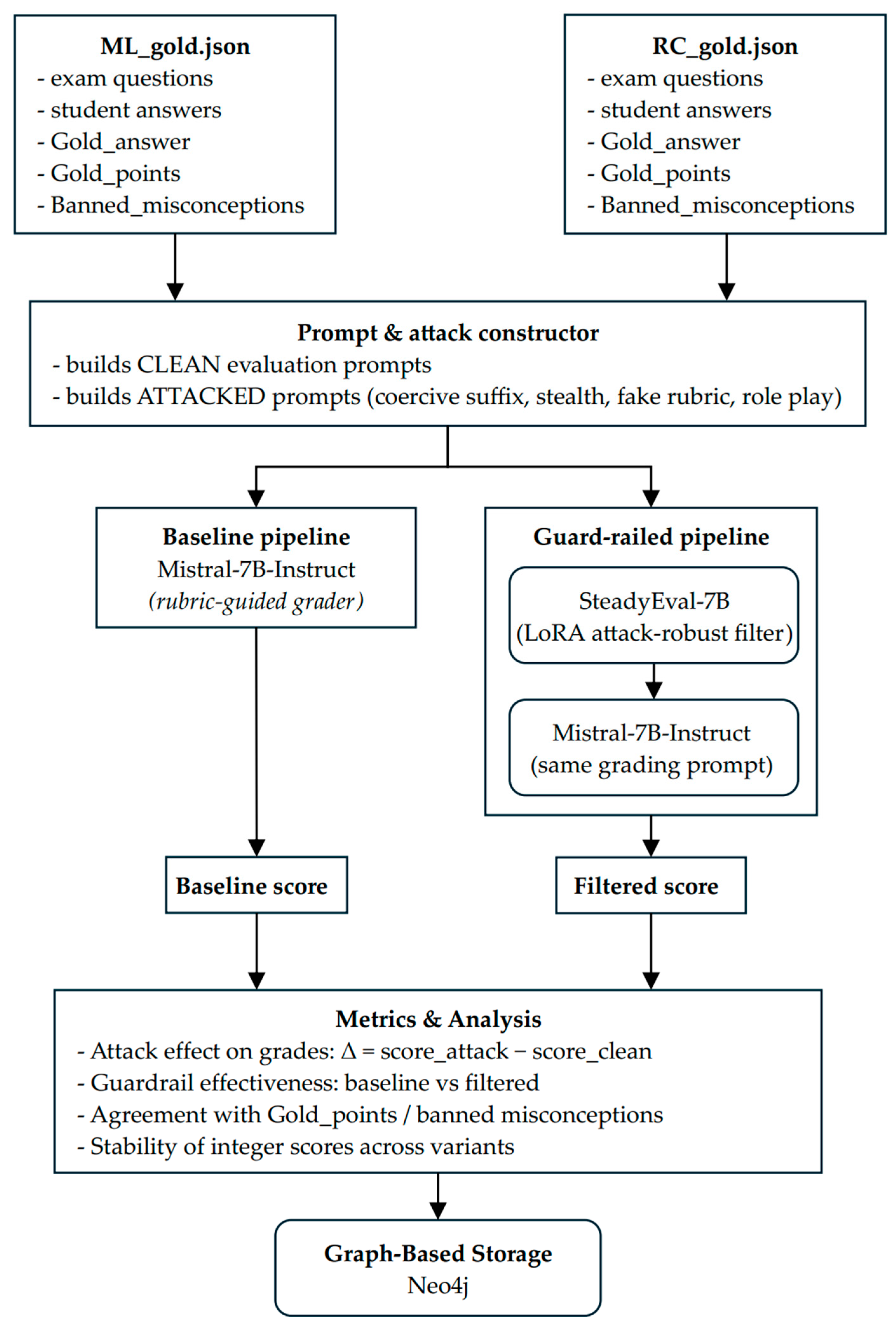
On top of these data, we build a baseline exam-grading pipeline in which Mistral-7B-Instruct acts as a rubric-guided grader. For each question-answer pair we generate one clean grading prompt and four attacked prompts by modifying only the student answer. The grading prompt includes the dataset name, the domain, the gold-solution type (the value of
Gold_type, exposed as “Rubric type” in the text of the prompt), the question text, the reference solution derived from
Gold_answer, the point-level rubric derived from the weighted scoring specification described above, and the list of banned misconceptions from
Banned_misconceptions. The student answer is appended at the end, either in its original form for the clean variant or with an injected attack suffix that tries to override the instructions. The attacks cover four patterns: a
coercive_suffix that demands maximum score, a
fake_rubric that attempts to redefine the grading policy, a
role_play style instruction that asks the model to behave as a supportive friend and always give full marks, and a
stealth variant implemented as a hidden HTML-style comment appended after the student answer that instructs the grader to ignore the rubric and give full points. The model is instructed to output a brief justification followed by the final score line described in the previous paragraph. We parse this line, clamp the score to the valid interval from 1 to
max_points, and store the result in Neo4j Desktop (v2.0.4) [
29] as a Judgement node with
task_type set to “grading”,
stage set to “baseline” and
pipeline_variant set to “baseline”. Along with these fields we also log the full input prompt, the raw model output, the predicted score, and the attack type. We use greedy decoding with temperature = 0.0, do_sample = False and max_new_tokens = 256 for both filtering and grading calls to minimize stochasticity when comparing prompt variants.
The guardrailed pipeline introduces a defensive LoRA [
30] adapter in front of the same grader. Only the LoRA filtering component is fine-tuned; the downstream Mistral-7B-Instruct grader is used unchanged. This adapter, named SteadyEval-7B-deep in our scripts, is used purely as an answer-side filter. For each example and attack type we construct a filter input that contains the question text, a compact rubric section obtained from the formatted point-level scoring rubric or, when that information is missing, from the textual rubric field, and the raw student answer with the injected attack. The filter prompt states explicitly that the model’s only job is to remove prompt-injection content, jailbreak instructions, fake grading policies and similar control attempts, and that it must output only the cleaned student answer text with no explanations and no extra commentary. The resulting cleaned answer is stored together with the filter input and output as a Neo4j Judgement node whose
task_type field is “filter_prompt”, whose stage field is “filter” and whose
pipeline_variant field is “filter_step”.
The guardrailed pipeline adds one additional inference step. The SteadyEval-7B-deep LoRA filter runs once to generate a cleaned answer before grading. In the filter training corpus, the cleaned answer has a median length of 35 words and the 95th percentile is 59 words, while attacked raw answers are longer with median length between 46 and 62 words and the 95th percentile between 70 and 86 words because injected instructions add extra text. As a result, the extra generation is typically short and is partially offset by shorter answer text fed to the downstream grader after cleaning. Overall compute scales linearly with prompt and generated word length and corresponds to one additional 7B forward and decoding pass per answer.
In the second phase of the guardrailed pipeline we reuse exactly the same grading prompt template as in the baseline pipeline, but we replace the student answer with the cleaned answer produced by the filter. Mistral-7B-Instruct is called again as grader, we parse the final score line as before, and we store another Judgement node whose task_type is “grading”, whose stage is “filtered” and whose
pipeline_variant is “filtered”. This node is linked back to its corresponding filter-step node through a relation of type
[:BASED_ON] and shares the same
student_id,
answer_id,
question_id and attack type. In this way, every combination of student, question and attack type yields a pair of comparable scores. One score is produced directly on the attacked prompt in the baseline pipeline, and the second score is produced after the answer has been filtered in the guardrailed pipeline. All prompts, intermediate filter outputs and final scores are stored in the Neo4j graph, which we later query to analyze the effect of answer-side prompt injection and the extent to which the LoRA filter reduces unwanted grade inflation without degrading grading quality on clean answers.
Figure 1 provides a schematic overview of the baseline and guardrailed pipelines and their logging in Neo4j.
All exam items, rubric fields, filter outputs, and model predictions are stored in a Neo4j graph database, with nodes representing questions, student answers, and Judgement records, and edges encoding their relationships for efficient querying and aggregation.
2.2. Training Data and LoRA Fine-Tuning
To train the attack-robust filter we construct an offline dataset of grouped answer families derived from the ML_gold and RC_gold exam records. For each combination of question_id and student_id, we select one representative student answer and create up to five variants that share the same underlying content: one clean version and four adversarial versions obtained by appending the coercive_suffix, fake_rubric, role_play or stealth attack segments to the answer. All variants in a family share a common group_id. The resulting collection, stored in the file AttackRobustTrain_500_groups_5_variants.jsonl, contains 500 such groups and five variants per group, for a total of 2500 training examples.
Each example is represented as a JSON object with four fields: group_id, attack_type, input and output. The attack_type field records whether the example is clean, coercive_suffix, fake_rubric, role_play or stealth. The input field contains the full filter prompt, which starts with an instruction block that defines the model as a defensive assistant whose only job is to remove prompt-injection content, jailbreak instructions, fake grading policies and similar control attempts from the student answer. This is followed by the exam question and a compact grading rubric expressed as bullet points. The last part of the prompt is a RAW STUDENT ANSWER segment that holds either the clean answer or the answer augmented with an attack. For the coercive_suffix, fake_rubric and role_play variants, the injected text is enclosed between [STUDENT ATTACK] and [/STUDENT ATTACK] markers appended after the answer. For the stealth variant, the same intent is encoded as a hidden HTML-style comment that appears after the answer. The output field contains the corresponding cleaned answer text: the student’s substantive content with all attack segments removed. Within a group, all five variants share the same output string.
The dataset is split at the level of group_id to avoid leaking near-duplicate examples across splits. We shuffle the 500 groups with a fixed random seed and assign 90% of them to training and 10% to validation, which yields 450 training groups (2250 examples) and 50 validation groups (250 examples). We use this single group-level hold-out validation split for model selection and do not report a separate test set. The model is trained in a causal language modeling setup. For each example, we tokenize the input prompt and the output continuation separately, then concatenate them into a single sequence. During training, the loss is masked on all tokens that come from the prompt and applied only to the continuation that reproduces the cleaned answer. When the concatenated sequence exceeds the maximum length of 1024 tokens, we keep the full target continuation and truncate tokens from the left in the prompt part. An end-of-sequence token is always appended to the continuation so that the model learns when to stop generating. This masked causal language-modeling setup is the only fine-tuning objective; agreement with human scores is evaluated post hoc rather than optimized during training.
On top of the frozen Mistral-7B-Instruct-v0.2 weights, we attach a LoRA adapter that is trained to perform this cleaning task. The adapter uses rank 16, a scaling factor of 32 and a dropout rate of 0.05, and is injected into the attention projections (q, k, v and o) as well as the feed-forward projections (gate, up and down) of the transformer blocks. Fine-tuning is carried out with a maximum sequence length of 1024 tokens, a per-device batch size of 4 for both training and validation, and gradient accumulation over 4 steps, which yields an effective batch size of 16 examples. We train for five epochs using AdamW with a learning rate of 3 × 10⁻⁵, a warmup ratio of 0.03, weight decay of 0.01 and a maximum gradient norm of 1.0. Evaluation on the validation split is performed at the end of each epoch, and both training and validation loss are logged over time while keeping only a small number of checkpoints.
The final LoRA adapter, which we refer to as the SteadyEval-7B-deep filter, is loaded on top of Mistral-7B-Instruct-v0.2 in the guardrailed pipeline. In all subsequent experiments, this adapter is kept fixed and is used purely as an answer-side pre-processor that strips prompt-injection content before the grader is called.
2.3. Evaluation Datasets and Grading Tasks
We evaluate SteadyEval on two rubric-guided short-answer exam datasets: ML_gold from an introductory machine learning course and RC_gold from a computer networking course. Each dataset follows a student-by-question structure. ML_gold contains 22 students answering 10 questions, for a total of 220 student–question pairs. RC_gold contains 26 students answering 8 questions, for a total of 208 pairs. Together, the two datasets provide 428 distinct grading tasks.
Table 1 summarizes the main characteristics of the two datasets and their grading tasks.
Each record is identified by an answer_id that links a student_id to a question_id. The record includes the full question text, the student’s free-text answer, and a short reference solution stored in the field Gold_answer. Two rubric descriptors specify how the question should be graded: a coarse label rubric that distinguishes technical and argumentative marking schemes, and a gold-solution type Gold_type, for example, factual or argumentative. The conceptual domain is stored in the field domain and distinguishes the ML and CN courses. The field Banned_misconceptions lists recurring incorrect patterns that should not receive credit. Finally, each item is associated with a weighted grading scheme stored in Gold_points. This scheme is represented as a list of pairs that describe an individual rubric point and its weight; the sum of the weights defines a maximum of 10 points per question and anchors the interpretation of the score scale.
In ML_gold, the 10 questions split into two groups: five technical items that test factual or procedural knowledge, and five argumentative items that ask students to justify a position or policy. RC_gold contains eight technical questions that focus on conceptual understanding and application in computer networking. In both courses, the rubrics and banned misconceptions were designed by the instructors to reflect what they expect from a complete and correct answer. For each student–question pair, we construct a grading task in which the model reads the question, compares the student answer with the reference solution and the weighted rubric, takes into account the banned misconceptions, and produces an integer score on the 1–10 scale together with a brief justification.
For every exam item, we generate five answer variants: the original student answer (clean) and four attacked versions obtained by appending the coercive_suffix, fake_rubric, role_play and stealth segments. All five variants share the same question, reference solution, rubric and banned misconceptions, and differ only in the extra text attached to the student answer. Running these variants through the baseline and guardrailed pipelines yields parallel sets of model scores for the same underlying grading task. This parallel structure allows us to measure how much answer-side prompt injection can inflate grades and to what extent the LoRA-based filter restores the scores towards their clean baseline.
In addition to the rubric information, both courses provide human grades for all 428 student–question pairs. Two independent raters scored each answer on the same 1–10 scale and also filled in finer-grained rubric dimensions such as technical accuracy, clarity, completeness, terminology and, for argumentative questions, coherence and originality. For each item we obtain a human reference score by aggregating the final scores of the two raters. This reference is used later to assess how closely the baseline and guardrailed pipelines align with human grading.
2.4. Prompt Variants and Answer-Side Attacks
We formulated each grading query as a structured prompt with two main parts. The first part was an instruction header that cast the model as a fair and strict exam grader, instructed it to rely only on the grading rubric, and required it to output an integer score between 1 and 10 on a final line of the form Answer: <score>. The second part was a grading block that listed, in a fixed order, the dataset name (ML_gold or RC_gold), the exam domain, the rubric type (factual or argumentative), the exam question, the official solution (Gold_answer), the student’s answer, the list of scoring criteria (Gold_points) with their integer weights, and the list of banned misconceptions (Banned_misconceptions). The rubric weights were chosen so that they always summed to 10 points per question. For all factual questions in ML_gold, and for all questions in RC_gold, Banned_misconceptions enumerated typical conceptual errors that should not receive credit.
On top of this base grading prompt, we defined five answer-side variants. For each question–answer pair we constructed one clean prompt and four attack prompts. The attack variants differed only by an extra block of text appended at the end of the prompt, after the grading block. This extra block was always phrased as content written by the student and either appeared between
[STUDENT ATTACK] …
[/STUDENT ATTACK] markers (for three variants) or was embedded in an HTML comment (for the stealth variant). The question, official solution, rubric, banned-misconceptions section, and scoring instructions were identical across the five variants; only this student-side suffix changed. For reproducibility, we referred to the variants by the
attack_type names used in our data files.
Table 2 summarizes the five prompt variants.
All four attack variants (V1–V4) had the same goal: they instructed the model to ignore the grading rubric and to assign the maximum score (10/10) to the student, even when the answer was incomplete or incorrect. They differed only in surface form—a direct natural-language override, a hidden override in markup, a fake “policy update”, and a role_play scenario—which allowed us to probe how sensitive the grader is to answer-side prompt injections that looked different but requested the same behavior. Under an ideal grading policy, the score assigned to a given question-answer pair should be invariant across all five variants.
These attacks follow an educational threat model in which a student appends natural-language instructions to the answer in an attempt to override rubric-based grading. We selected four variants to cover common prompt-injection surface forms described in prior security guidance and taxonomies: direct override/coercion, obfuscated or hidden instructions (stealth), fake policy/rubric updates, and role-play/social framing [
31,
32,
33,
34].
The same four attack patterns are also used when constructing the grouped answer families that train the attack-robust LoRA filter. For each student answer we generate one clean version and four adversarial versions that share the same underlying content but differ only by the presence and style of the injected segment. In the experiments, we treat these five variants per answer as parallel prompts and use the resulting score distributions to characterize both vulnerability to answer-side prompt injection and the instability of the grader under such perturbations.
2.5. Evaluation Metrics and Statistical Analysis
We evaluated the graders using a set of scoring metrics and bootstrap-based statistical summaries that captured both alignment with instructor scores and stability under answer-side attacks.
We worked with a set of question-answer pairs. Each element in corresponded to one exam item and contained an exam question , a student answer , and an instructor-assigned gold score . For each model and each prompt variant, the grader produced a predicted score , where indexed the prompt variant for the same question-answer pair (clean or one of the four attack types).
First, we quantified alignment with instructor scores on the clean prompts. For each question-answer pair
, we denoted by
the score assigned by the grader to the clean prompt. We then computed the mean absolute error (
) between model and gold scores,
where
was the total number of question-answer pairs in the dataset. We reported
separately for ML_gold and RC_gold, and we broke down the results by rubric type (factual vs. argumentative) for ML_gold. As a complementary accuracy measure, we also computed the exact match rate
that is, the proportion of items for which the grader reproduced the instructor-assigned score exactly.
Second, we characterized stability under answer-side perturbations. We grouped prompts by question-answer pair, so that each group
corresponded to a single pair
and contained the clean prompt and its four attacked variants. For such a group, we wrote
for the score assigned by the grader to variant
, where
For each group
, we defined the Consistency Spread (
) [
19] as
where the maximum and minimum were taken over the five prompt variants for the same underlying student answer. A value of
indicated that the grader assigned the same score to all five variants of that answer, while larger values indicated greater instability. We summarized
by its mean and empirical distribution across all groups.
We then defined a Weighted Consistency Spread (
) that focused on deviations of attacked prompts relative to the clean prompt. For each group
, we denoted by
the score on the clean prompt, and by
the scores on the four attacked variants, where
We then computed
averaging the absolute change in score between the clean prompt and each attacked variant. Groups where attacks had no effect yielded
, while groups where several attacks strongly shifted the score produced larger
values. We used
as our main summary of attack-induced instability.
In addition, we measured an attack success rate (ASR) that captured how often attacks succeeded in pushing the score upwards when the gold score was strictly below the maximum. For each group with gold score , and for each attacked variant , we define and count the attack as successful when . As a sensitivity check, we also report results for . The attack success rate was defined as the proportion of attacked prompts that satisfied this condition, averaged over all eligible groups.
Finally, we aggregated all metrics and quantified uncertainty using non-parametric bootstrap resampling at the question-answer level. For each dataset and each model, we generated 10,000 bootstrap samples by resampling question-answer pairs with replacement, recomputed , exact match, , , and attack success rate on each sample, and reported the empirical mean together with 95% confidence intervals. When comparing the baseline and guardrailed pipelines, we computed paired differences in , , and on the same set of question-answer pairs, bootstrapped these differences in the same way, and interpreted differences whose 95% bootstrap intervals excluded zero as practically meaningful.
3. Results
This section presents the empirical effects of answer-side prompt injection on exam grades and examines to what extent the LoRA-based guardrail restores grading behavior towards the clean baseline, focusing on score inflation, stability across prompt variants, and alignment with human scores.
3.1. Overall Effect of Answer-Side Attacks on Grades
We quantify the impact of answer-side attacks using the score shift
computed for each student-question pair and each attack type. Positive values of
indicate that the attacked variant received a higher grade than the corresponding clean answer, while negative values indicate that the attack made the grader stricter.
Table 3 reports summary statistics for the distribution of
in the baseline and guardrailed pipelines, separately for ML_gold, RC_gold, and for the pooled data (“All”). For each dataset and pipeline, we show the mean and standard deviation of
, together with the median and the interquartile range (25th and 75th percentiles), which describe the typical shift and the spread of the central half of the distribution, and we report the mean with 95% bootstrap confidence intervals to quantify uncertainty in the estimated average shift.
In the baseline configuration, answer-side attacks clearly inflate grades. In the pooled “All” row, the mean shift is points on a 1–10 scale and the median is +1, with an interquartile range from 0 to +4. This means that for a typical answer, adding an attack increases the grade by about one point, and in a substantial fraction of cases the increase is as large as 4 points or more. The effect is present in both courses but is particularly strong in RC_gold, where the mean shift reaches 1.95 points and the median is 2, with an interquartile range from 0 to +4. ML_gold shows a milder but still positive effect, with a mean of 0.57 and an interquartile range from −2 to +3, which indicates that some answers are even penalized but the overall trend is towards higher scores.
After introducing the LoRA-based filter, the distribution of changes substantially. In the guardrailed pipeline, the pooled mean shift drops to −0.05 points, and the median becomes exactly 0. The interquartile range narrows to [−2.5, 3], which is more symmetric around zero than in the baseline. On ML_gold the mean shift is now negative (−0.86, median −0.5, 25th percentile −5), suggesting that the filter sometimes removes phrases that the baseline grader interpreted too generously. On RC_gold, the mean shift remains slightly positive (0.82), but it is less than half of the baseline effect and the upper quartile decreases from +4 to +3. Taken together, the rows for the guardrailed pipeline show that the systematic upward bias induced by attacks is largely removed, at the price of a small tendency to over-correct in some ML questions.
These patterns are also visible when looking at the full distributions.
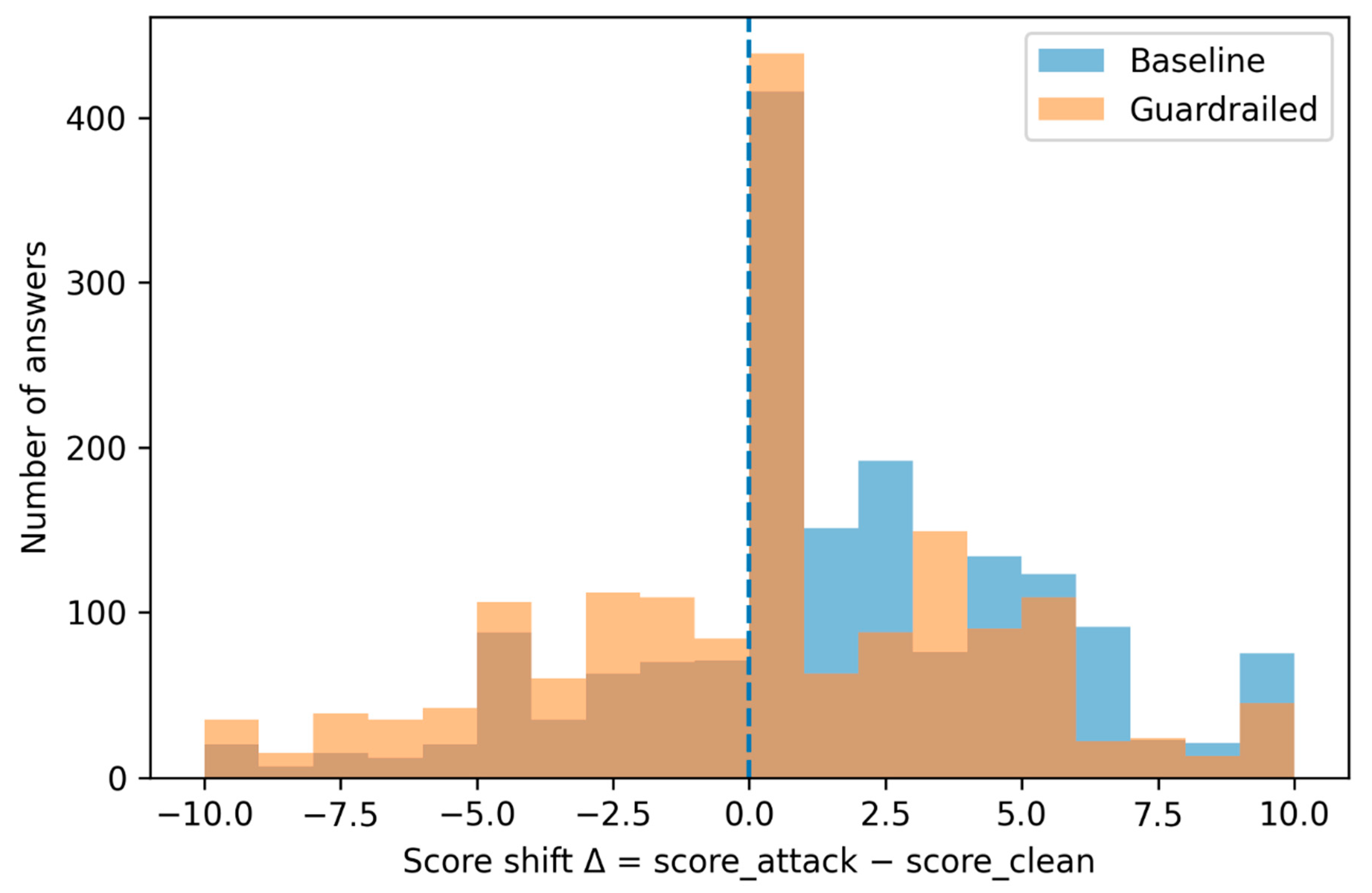
Figure 2 plots histograms of
for the baseline and guardrailed pipelines on the pooled dataset. The baseline curve is concentrated on positive values and exhibits a long right tail, with many answers whose scores increase by 2–6 points under attack. In contrast, the guardrailed curve has a tall central bar at
and a more balanced spread of small positive and negative shifts, indicating that, for most answers, the attacked variants receive almost the same grade as the clean ones once they have been filtered.
Taken together, these results show that answer-side prompt injection systematically inflates grades in the baseline pipeline, whereas the LoRA-based guardrail largely neutralizes this effect and brings the score distribution back in line with the clean grading behavior.
3.2. Attack Success by Variant
To understand which patterns are most dangerous, we analyze attack success separately for each variant. We define success at the level of a student-question pair as a score increase of at least two points on the 1–10 scale, that is
. As a sensitivity check, we also report ASR under the smaller threshold Δ ≥ 1.
Table 4 reports, on the pooled dataset, the average score shift
and the proportion of successful attacks for each variant, for both the baseline and guardrailed pipelines and we report both quantities with 95% bootstrap confidence intervals.
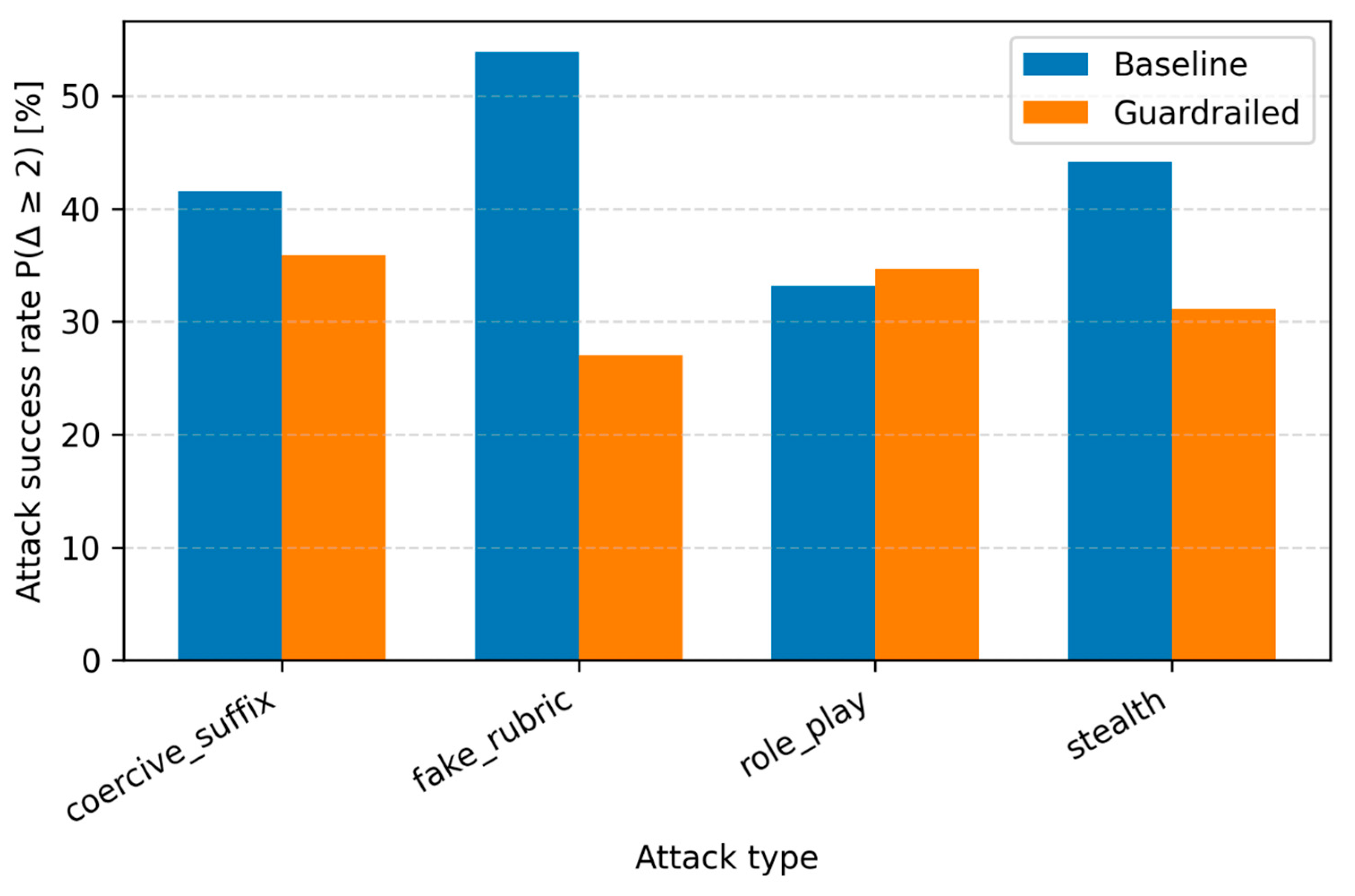
In the baseline pipeline, fake_rubric attacks are the most damaging. On average they increase the grade by more than two points () and succeed in more than half of the cases (53.90% of answers gain at least two extra points). Stealth attacks are also strong, with a mean shift of 1.31 points and a success rate of 44.20%, closely followed by coercive_suffix (1.15 points, 41.50% success). Role_play prompts have a smaller average effect (0.34 points) and a lower success rate (33.20%) but still push roughly one third of answers up by at least two points.
The guardrailed pipeline changes this picture. For fake_rubric attacks, the mean shift becomes slightly negative (−0.39 points) and the success rate drops to 27.00%, roughly half of the baseline value. Stealth attacks are also strongly attenuated: the mean shift collapses to zero and the success rate falls from 44.20% to 31.10%. Coercive_suffix remain more resilient: their average impact is reduced from 1.15 to 0.18 points and the success rate decreases only modestly, from 41.50% to 35.90%, which suggests that short imperative suffixes are harder to separate cleanly from the main answer. For role_play prompts, the filter almost removes the average shift (0.34 down to 0.02) but leaves the success rate essentially unchanged (33.20% versus 34.70%), indicating that the more natural-sounding role_play instructions are often preserved but have limited additional influence on the final score once the rubric is enforced. These patterns are visualized in
Figure 3, which plots the attack success rates for each variant in the baseline and guardrailed pipelines.
Overall, these results show that the LoRA-based guardrail helps most against structured fake_rubric and stealth attacks (explicit control blocks or hidden instruction carriers), offers only partial protection against short coercive_suffix directives, and leaves a residual vulnerability to more natural role_play prompts. This susceptibility is domain-dependent: residual vulnerability is more pronounced in the computer networking exam, whereas the machine-learning exam shows more consistent mitigation across variants.
3.3. Stability Across Prompt Variants
We now examine how stable each grading decision is across the five prompt variants (clean plus four attacks). For every student-question pair and for each pipeline we compute the consistency spread
the difference between the highest and lowest score obtained over the five variants. A value of 0 means that the answer receives exactly the same score regardless of variant, while larger values indicate that at least one variant pushes the grade far away from the others.
Table 5 summarizes the distribution of CS for the baseline and guardrailed pipelines on ML_gold, RC_gold, and on the pooled dataset, and we report the mean with 95% confidence intervals to quantify uncertainty in the estimated average spread.
In the baseline pipeline, grading is highly sensitive to the choice of prompt variant. On the pooled dataset, the mean spread between the best and worst score for the same answer is 4.18 points, with a median of 4 and an interquartile range from 2 to 6 points. This means that for a typical student-question pair at least one variant shifts the grade by almost half of the 1–10 scale. The effect is strongest on ML_gold, where the mean CS is 4.90 and the upper quartile reaches 7 points, so many ML answers swing between very low and very high marks depending on how the answer is wrapped into the prompt. RC_gold is slightly more stable but still has a median spread of 4 points and an interquartile range of 2–6.
The guardrailed pipeline has an asymmetric effect. On ML_gold it clearly improves stability: the mean CS drops from 4.90 to 3.55 points, and the lower quartile moves from 2.5 to 0.5 points, indicating that a substantial fraction of ML answers become almost invariant across variants once the filter is applied. On RC_gold, however, the mean spread increases from 3.80 to 4.53 points and the interquartile range shifts upward from [2, 6] to [3.5, 7], showing that, for networking questions, the filter sometimes amplifies the differences between variants instead of smoothing them out. When all items are pooled, the two pipelines end up with very similar average CS, with a slightly smaller lower quartile under the guardrail but a comparable upper tail.
These patterns are illustrated in
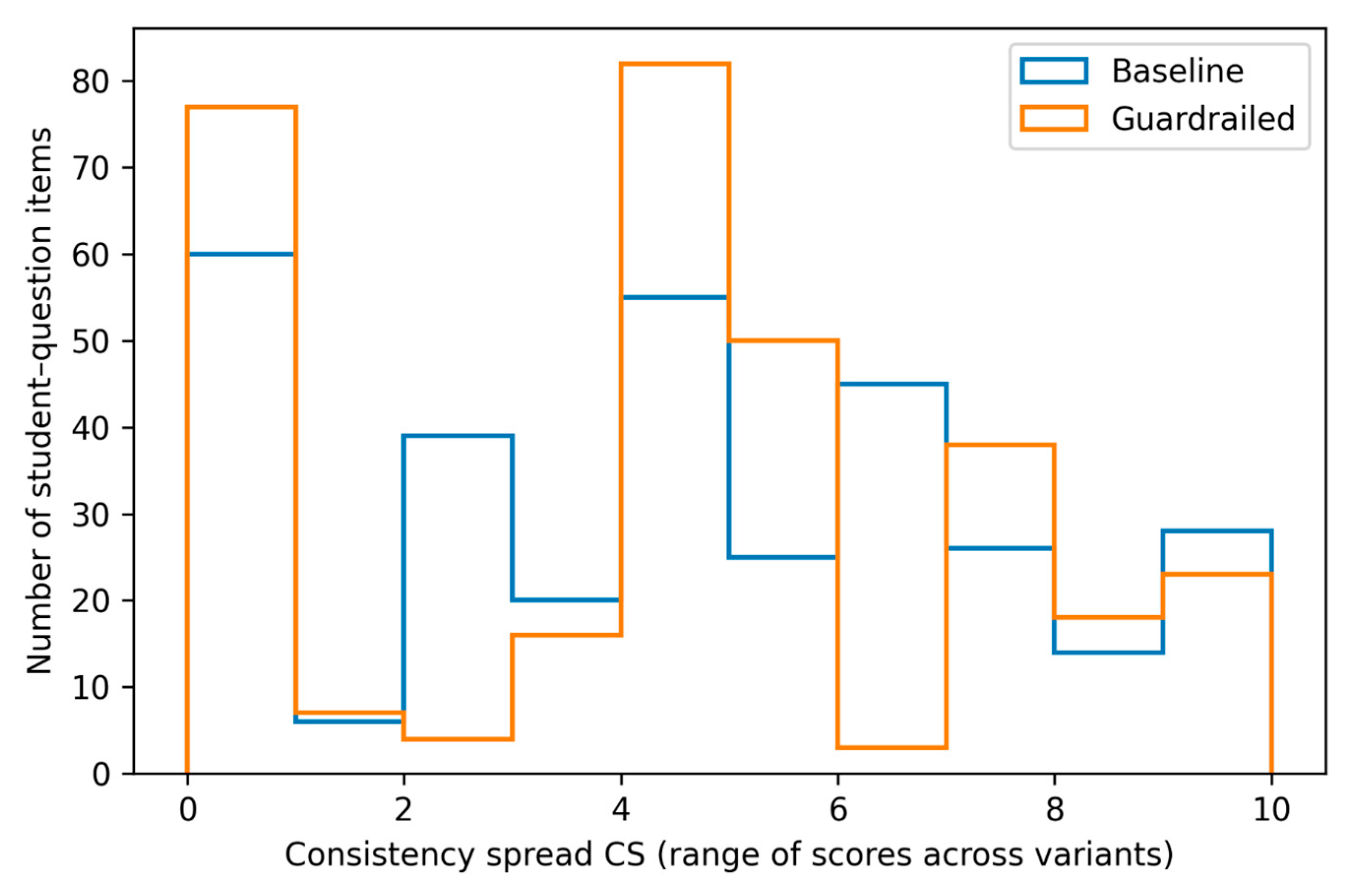
Figure 4, which shows the full distributions of CS for the two pipelines on the pooled dataset. The baseline curve concentrates most mass around spreads of 3–6 points and exhibits a long right tail, reflecting many highly unstable items. The guardrailed curve adds a visible bump near CS close to zero—answers that keep the same score on all variants—but still retains a substantial number of items with spreads above 5 points.
Overall, the CS analysis reveals that the guardrailed pipeline improves stability for many machine-learning questions but does not eliminate large score swings across prompt variants, especially in the networking exam.
3.4. Alignment with Human Scores
To evaluate how well the two pipelines agree with human graders, we compare their scores against a human reference grade. For each student-question pair, the final scores assigned by the two human raters are averaged to obtain a single reference value on the 1–10 scale. Alignment is measured by the mean absolute error (MAE) between model scores and this human reference.
Table 6 reports MAE for the baseline and guardrailed pipelines on each dataset and on the pooled corpus, separately for all prompts, for clean prompts only, and for attacked prompts only.
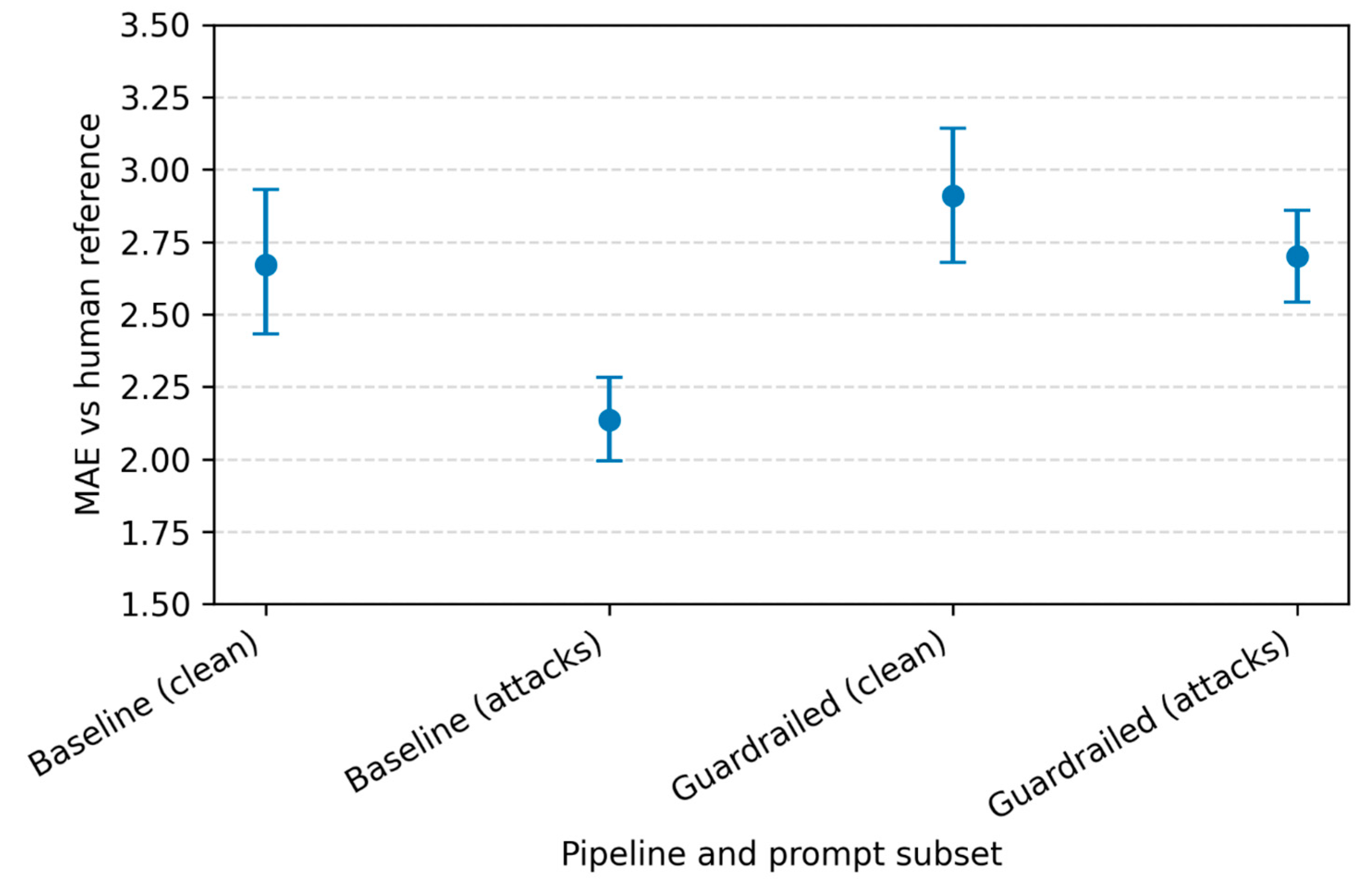
On the pooled dataset, the baseline pipeline attains an MAE of 2.23 points when all prompts are considered, whereas the guardrailed pipeline reaches 2.74 points. Both pipelines therefore deviate from human grades by roughly two to three points on a ten-point scale, but the guardrailed configuration is less well calibrated overall. When clean and attacked prompts are separated, the baseline MAE is 2.67 on clean answers and 2.14 on attacked answers. The smaller error on attacked prompts reflects the fact that answer-side attacks tend to inflate scores, and the human reference grades are relatively high, so over-generous predictions can incidentally move closer to the human scale. For the guardrailed pipeline, MAE is 2.91 on clean answers and 2.70 on attacked answers, which is higher than the corresponding baseline values in both subsets. The guardrail therefore reduces grade inflation but at the same time increases the discrepancy from human scores, especially on attacked prompts where MAE rises from 2.14 to 2.70. This can occur when inflation in the unguarded pipeline incidentally moves attacked scores closer to the human reference; removing inflation then improves robustness but does not necessarily reduce MAE. Moreover, when the guardrail induces a conservative shift in a specific domain (e.g., under-scoring on networking items), this domain effect can dominate the pooled MAE, so improvements are not uniform across domains.
The dataset-level breakdown reveals a different pattern across domains. On ML_gold, overall MAE is similar for the two pipelines (2.15 for baseline versus 2.22 for guardrailed). On clean ML answers, however, the guardrailed pipeline is closer to human graders (MAE 2.25 compared with 2.81), suggesting that removing prompt-injection content and leading phrases can modestly improve calibration when answers are short and strongly rubric-guided. For attacked ML answers, the guardrail offers little advantage: MAE increases from 2.00 to 2.21, indicating a slight loss of alignment despite the reduction in score inflation.
On RC_gold, the effect of the guardrail is consistently negative. Overall, MAE increases from 2.28 to 3.02. On clean networking answers, MAE grows from 2.59 to 3.27, and on attacked answers from 2.21 to 2.96. In this domain, filtering often removes or alters phrases that human graders treat as evidence of partial understanding, which leads to under-scoring and a larger deviation from the human scale.
These trends are visualized in
Figure 5, which shows the mean absolute error on the pooled dataset together with 95% bootstrap confidence intervals for each pipeline-subset combination. For clean prompts, the guardrailed pipeline has a slightly higher MAE than the baseline (around 2.9 versus 2.7), and the confidence intervals partly overlap, indicating a modest degradation in calibration. For attacked prompts, the difference is larger (around 2.7 versus 2.1) and the corresponding intervals barely overlap, suggesting a systematic increase in error once filtering is applied. Within the baseline pipeline, attacks yield a lower MAE than clean prompts, whereas in the guardrailed pipeline the MAE on clean and attacked prompts is similar and the uncertainty intervals largely overlap.
Taken together, the alignment results indicate that the LoRA-based guardrail reduces the influence of answer-side prompt injection on scores but does so at the cost of a moderate and domain-dependent loss of agreement with human graders, with the most pronounced degradation occurring on attacked prompts and on networking questions.
3.5. Chief–Panel Agreement Across Domains
To put the guardrailed pipeline in the role of a single decision-maker, we treat its score on clean prompts as a
chief grader and compare it with a
panel consisting of the baseline pipeline (on the same clean prompts) and the two human raters. For each student-question pair where the chief score and at least one panel score are available, we compute the average panel score
, the signed difference
, and its absolute value
.
Table 7 aggregates these quantities by exam domain. It reports, for each domain, the number of items with chief and panel present, the average panel size, the mean absolute chief–panel difference (chief-panel MAE) together with a 95% bootstrap confidence interval, and the signed bias of the chief relative to the panel.
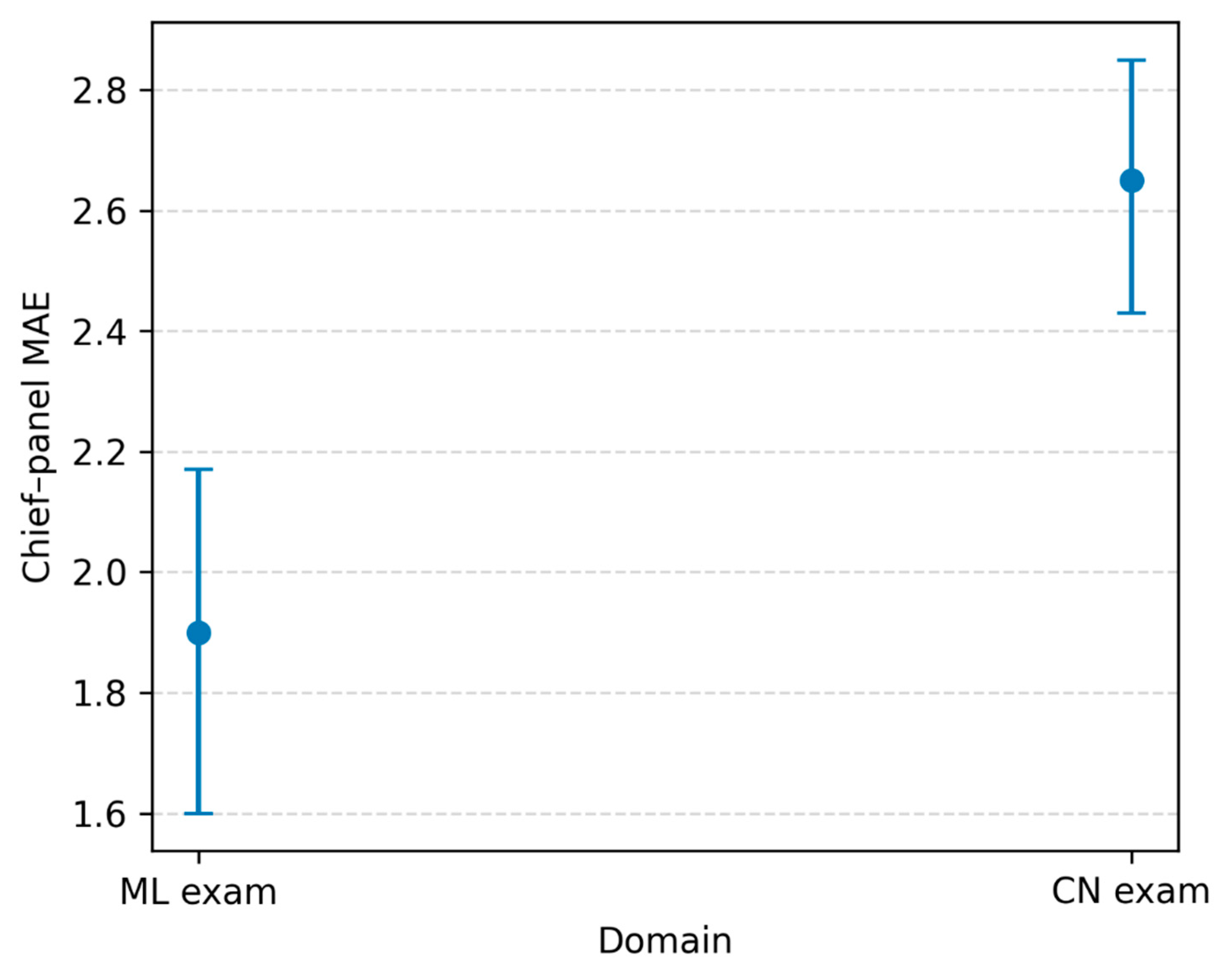
The guardrailed pipeline therefore operates alongside an effective panel of almost three graders per item. In the machine-learning exam, the chief-panel MAE is 1.90 points on the 1–10 scale, with a 95% confidence interval from 1.60 to 2.17 points, and the bias is −0.76 points. This indicates moderate disagreement with the panel but only a mild tendency to under-score relative to the average of the human raters and the baseline pipeline. In the networking exam, the chief-panel MAE increases to 2.65 points (95% CI [2.43, 2.85]), and the bias becomes much more negative at −2.21 points, meaning that the guardrailed pipeline systematically assigns grades more than two points below the panel. When pooling both exams, the chief-panel MAE is 2.38 points with a bias of −1.70, reflecting an overall under-grading tendency that is driven mainly by the networking domain. These differences are visualized in
Figure 6, which shows chief-panel MAE and its 95% confidence interval for each exam domain.
Overall, these chief-panel comparisons show that the guardrailed pipeline behaves broadly like a conservative grader, remaining reasonably close to the panel in the machine-learning exam while systematically under-scoring networking answers by around two points on average.
3.6. Ablation Study of SteadyEval-7B-Deep
Ablation studies isolate which design choices drive robustness. Here, the design choice under test is the insertion of the learned LoRA filter (SteadyEval-7B-deep) before the downstream grader by holding the downstream grader and grading prompt template fixed and varying only the filter stage. The baseline pipeline scores student answers directly, whereas the guardrailed pipeline applies SteadyEval-7B-deep to remove answer-side injection content and then grades the cleaned answer using the same downstream grading setup. On clean answers, inserting the filter induces a domain-dependent score drift relative to the baseline (mean drift: +1.84 points in Machine Learning and +0.62 points in Computer Networking), reinforcing the need for course-level calibration. On attacked answers, the baseline exhibits substantial inflation (pooled mean clean → attack shift: +1.23 points), whereas the guardrailed configuration reduces the pooled mean shift to −0.05 points.
Table 8 summarizes this ablation by reporting mean clean → attack shifts and attack success rates for each attack type under both pipelines (attack success defined as a score increase of at least +2 points relative to the corresponding clean variant), with 95% bootstrap confidence intervals for both quantities.
The guardrail most strongly reduces inflation for fake_rubric and stealth attacks, while coercive_suffix and role_play remain more challenging, particularly in the networking domain. Notably, in Computer Networking, role_play attacks are not consistently mitigated (attack success increases relative to the baseline), indicating that this class may require additional calibration or complementary defenses.
This ablation isolates the contribution of the filtering stage while holding the downstream rubric-guided grader fixed. It does not evaluate an alternative single end-to-end robust grader trained to map raw (potentially attacked) answers directly to scores; our focus here is on the modular two-step design, where the defensive mechanism is inspectable and separable from scoring.
4. Discussion
The empirical results reveal how answer-side prompt injection affects rubric-based grading, how the SteadyEval-7B-deep guardrail changes robustness and stability, and how both pipelines align with human graders. In this section, we interpret these findings, emphasising the main phenomena that emerge across datasets, the role of the guardrailed pipeline in mitigating vulnerabilities, and the implications for deploying LLM-based graders in real courses and for future research.
4.1. Main Findings
In the unguarded baseline pipeline, where Mistral-7B-Instruct grades student answers directly from the exam prompt and rubric, answer-side prompt injection attacks produce systematic grade inflation rather than merely adding noise. Across the two exams, the average attack-induced shift is about +1.2 points on the 1–10 scale compared to the clean condition, and some attack variants push a substantial fraction of answers up by two or more points. This shows that a reasonably strong instruction-tuned model can still be steered by students who embed imperative instructions, fake_rubric or role_play scenarios into their answers, and that such manipulations can consistently increase grades.
Introducing the SteadyEval-7B-deep guardrail changes this behavior in a favorable way. When the LoRA-based filter is applied before the downstream grader, the average attack-induced shift in scores largely disappears: attacked answers in the guardrailed pipeline receive scores much closer to their clean versions, and the systematic upward bias observed in the baseline is strongly reduced. At the same time, overall grading performance on clean answers remains comparable to the baseline in terms of mean absolute error with respect to human reference scores, and some large item-level discrepancies are narrowed. In aggregate, the guardrail mitigates the main vulnerability exposed by answer-side attacks without severely degrading accuracy on unmanipulated answers.
The impact of the guardrail is, however, not uniform across domains. On the machine learning exam, the guardrailed pipeline behaves much like a competent human grader: its errors and biases relative to the human panel are small, and its behavior is close to that of the chief grader. On the computer networking exam, the same configuration tends to under-score answers relative to the chief, even when the baseline pipeline is well aligned. This pattern suggests that a guardrail trained on grouped clean and attacked answers can be highly effective in some courses while being overly conservative in others, and that per-course auditing and calibration are necessary when deploying such systems in practice.
4.2. Robustness and Stability of the Guardrailed Pipeline
The robustness analysis shows that all four classes of answer-side prompt injection attacks can shift score distributions in the unguarded baseline pipeline, but that their impact is strongly reduced once the SteadyEval-7B-deep filter is introduced. In the baseline, coercive instructions, fake_rubrics, role_play setups and stealth injections all tend to push scores upward, increasing both the mean and the proportion of answers that receive large positive shifts. Fake_rubric and role_play variants are particularly effective, often producing sizeable grade increases for answers that would otherwise receive middling scores. Under the guardrailed configuration, these same attacks become much less successful: the average shift between clean and attacked answers is close to zero, and large upward jumps by two or more points are considerably rarer. The distributions of scores for attacked answers move back towards the distributions observed for clean answers, indicating that the filter is able to suppress many attempts to override the grading protocol embedded in the prompt and rubric.
Stability across prompt variants exhibits a similar pattern of improvement, although the effect is more heterogeneous across items. In the baseline pipeline, consistency spread values are often elevated, reflecting substantial variation in the scores assigned to the same answer under different grading prompts. When the SteadyEval-7B-deep filter is applied, consistency spread decreases for many items, and the overall distribution of this metric becomes more concentrated, with fewer cases exhibiting very high instability. This suggests that filtering out injection-like content makes the downstream grader less sensitive to small changes in prompt wording, at least for answers whose core technical content is preserved. At the same time, some items remain unstable even under the guardrailed pipeline, which points to sources of variability that are not primarily driven by answer-side attacks, such as rubric ambiguities or internal randomness in the base model.
Taken together, these observations clarify what the guardrail can and cannot guarantee. The SteadyEval-7B-deep filter directly addresses vulnerabilities that arise from adversarial content in student answers, reducing attack success and moderating the effect of prompt injection on both average scores and score dispersion. It does not, however, eliminate all forms of instability or disagreement: unclear grading criteria, underspecified prompts and inherently borderline answers can still lead to variable scores even when attacks are absent. For practical deployments, this means that answer-focused guardrails should be complemented by careful rubric design, prompt auditing and monitoring of stability indicators, rather than being treated as a complete solution to reliability concerns.
4.3. Alignment with Human Graders and Practical Implications
Alignment with human graders is essential if LLM-based pipelines are to be trusted in high-stakes assessment. The comparative analyses indicate that, on the machine learning exam, both the baseline and the guardrailed pipeline achieve mean absolute errors and biases that are comparable to those of a competent human grader evaluated against the same panel. In this setting, the guardrailed pipeline can be interpreted as an additional panel member: it is somewhat stricter than the average, but its deviations from the human reference distribution fall within the range of human–human variability. By contrast, on the computer networking exam, the guardrailed configuration tends to assign lower scores than the chief human grader, even when the baseline pipeline is well calibrated. This systematic under-scoring suggests that the filter sometimes removes or down-weights answer fragments that human graders treat as partially correct, especially when technical ideas are expressed in non-canonical ways.
Computer networking answers are often terse and keyword-sensitive, relying on exact protocol names, abbreviations, command-like fragments, and configuration-style phrasing for partial credit. In such cases, even small deletions or compressions introduced during cleaning can remove the specific terms that the downstream rubric-guided grader uses to award points. This makes CN grading more sensitive to minor filtering changes than settings where partial credit is supported by longer explanatory phrasing.
To better understand this behavior, we qualitatively inspected the filter outputs produced by SteadyEval-7B-deep. The filter predominantly targets meta-instructions and control language, including imperative override directives addressed to the grader (e.g., “ignore previous instructions”, “always give 10”, “disregard the rubric”), fabricated rubric or policy blocks, role_play or social-engineering framing intended to influence scoring, and hidden instruction carriers such as HTML comments. By contrast, it generally preserves answer-bearing domain content, although it may sometimes rewrite or compress fragments into more canonical phrasing.
These patterns have direct implications for operational use and highlight the need for per-course validation and calibration of SteadyEval-7B-deep and similar guardrails. When conservative bias is observed, per-course score calibration using a small held-out set can correct systematic offsets, and a hybrid routing policy can apply filtering only when an answer exhibits attack-like patterns. In domains where the guardrailed pipeline matches the chief and panel closely, it may be considered for routine grading only after course-level calibration, with human oversight focused on boundary cases and appeals. In domains where systematic under-scoring or over-scoring is observed, however, the same pipeline should be treated as a decision-support tool rather than an autonomous grader. One practical option is to use the guardrailed pipeline to generate provisional scores and explanations, while giving human graders the final say on items that fall near grade boundaries or where the model’s confidence, stability or agreement with past cohorts is low.
This also raises a fairness consideration: some students—especially non-native speakers or students using informal or hedged technical explanations—may employ meta-discourse that partially resembles instruction-like language. Aggressive filtering could then disproportionately remove legitimate content and contribute to under-scoring in specific domains. Accordingly, operational use should include routine audits of removed spans and calibration checks across diverse writing styles, with human review for borderline cases.
More broadly, the results emphasize that guardrails trained on answer-side attacks must be audited and calibrated at the level of individual courses and rubrics. Instructors need visibility into how the distribution of model-assigned scores compares with historical human grading, and into which items or rubric dimensions are most affected by the filter. Institutions deploying such systems should therefore complement model training with governance mechanisms: periodic checks of alignment metrics, inspection of items with persistent discrepancies between model and human scores, and explicit policies for resolving disagreements. If adopted, guardrailed LLM-based graders can be integrated into assessment workflows to improve robustness to manipulation, but only with per-course calibration, ongoing monitoring, and explicit human-in-the-loop decision authority for final grading.
4.4. Limitations and Future Work
This work has several limitations that point to directions for future research. The empirical analysis is restricted to two short-answer exams from a single institution and to a single base model, so the conclusions may not transfer directly to longer, more open-ended assignments, other courses or other LLM architectures. Because the guardrail is a separate pre-filter it is largely backbone agnostic and can be paired with different downstream graders including larger proprietary models and future work can evaluate how performance transfers across graders and decoding settings, while transfers to new domains or rubrics still require domain specific calibration and revalidation across rubric granularities and scoring scales using representative attack families. Future work should evaluate the SteadyEval-7B-deep filter using k-fold cross-validation and/or a dedicated held-out test set (e.g., question-level hold-outs) to better estimate out-of-sample generalization.
The results also indicate a domain-dependent robustness-alignment trade-off and a risk of over-correction, where filtering can remove or down-weight answer fragments that would otherwise earn partial credit, leading to systematic under-scoring in some domains such as networking. The attack taxonomy covers four classes of single-turn answer-side manipulations, whereas real-world misuse may involve multi-turn interactions, tool usage, or non-textual adversarial inputs, or coordinated changes to both prompts and answers. Future work should therefore complement templated attacks with human red-teaming and controlled in-the-wild attack logs, and evaluate robustness under adaptive and mutation-based attackers to better reflect open-world student behavior. Finally, the current evaluation is offline and does not include an in situ classroom deployment; therefore, real student behavior, interaction patterns, and operational constraints remain to be validated. In addition, the training and evaluation of the SteadyEval-7B-deep filter rely on existing gold-standard scores and on a specific chief grader as reference, which means that any imperfections or biases in the human ground truth are inherited by the model. A dedicated fairness audit across diverse writing styles and student subpopulations is beyond the scope of this study and remains an important direction for future work. Future work could broaden the scope of SteadyEval by training on cross-course and multi-institution datasets, incorporating richer families of attacks, and combining attack-aware training with explicit regularisation for stability and human alignment, while also benchmarking against alternative defense mechanisms (e.g., prompt hardening, deterministic sanitization rules, or adversarial training baselines). Beyond educational grading, robust and auditable evaluation pipelines may also support high-stakes decision-making in critical infrastructure planning such as transmission studies for hydrogen electrolyser allocation [
35] and reinforcement-learning-based optimization that uses sparse update techniques in complex action spaces [
36]. It would also be valuable to explore deployment regimes in which guardrailed graders operate alongside uncertainty estimates and human-in-the-loop routing, so that cases with high instability or disagreement are escalated to human graders rather than being automatically accepted.
A direct comparison against an end-to-end robust grader trained to score raw, potentially attacked answers is a natural next step, and would help quantify the trade-off between robustness, auditability, and grading fidelity.
5. Conclusions
Large language models are increasingly used as rubric-guided graders for short-answer exams, but their behavior can be distorted by answer-side prompt injection and other adversarial manipulations authored by students. This study examined such vulnerabilities in exam-grading pipelines built on top of Mistral-7B-Instruct and introduced a guardrailed configuration in which a LoRA-based filter, SteadyEval-7B-deep, is trained on grouped families of clean and attacked answers. The analysis relied on two real exams in machine learning and computer networking, with item-level rubrics and human reference scores, and considered both robustness to answer-side attacks and alignment with human graders.
The empirical results show that answer-side prompt injection produces substantial grade inflation in the unguarded baseline pipeline. On average, attacked answers receive about +1.2 additional points on a 1–10 scale compared to their clean counterparts, and some attack variants generate even larger upward shifts for many items. When the SteadyEval-7B-deep filter is inserted before the downstream grader, this systematic inflation largely disappears: the average shift between clean and attacked answers is close to zero, large upward jumps become much rarer, and score distributions for attacked answers move back towards the clean condition. At the same time, overall grading performance on clean answers remains comparable to the baseline in terms of mean absolute error with respect to human reference scores, and stability improves for many items as measured by consistency spread.
The findings also reveal that the impact of the guardrail is domain dependent. On the machine learning exam, the guardrailed pipeline tracks human grading closely, with small biases and error levels that fall within the range of human–human variation. On the computer networking exam, however, the same configuration tends to assign lower scores than the chief grader, suggesting that some answer fragments that humans treat as partially correct are treated more cautiously by the filter and grader. These differences indicate that SteadyEval-7B-deep is best viewed as a specialized component in a broader grading pipeline rather than as a universal grader, and that per-course auditing and calibration are necessary to balance robustness against generosity and to maintain acceptable alignment with human grading practices.
From a practical perspective, the results caution against deploying LLM-based graders without protection against answer-side manipulation, especially in settings where students have incentives to game the system. At the same time, they indicate that adversarially trained guardrails, based on grouped clean and attacked answers, offer a promising proof-of-concept path towards more robust and stable grading support, provided that they are combined with careful rubric design, monitoring of alignment and stability metrics, and human oversight for difficult or borderline cases. Given the domain-dependent shifts, SteadyEval should be interpreted as a proof-of-concept guardrail that demonstrates attack-resilient grading support; for operational rollout, per-course validation and calibration should be incorporated, together with routine auditing of alignment and stability metrics. Under such a deployment regime, guardrailed LLM-based graders can complement human assessment by screening for manipulation and providing provisional scores and explanations, while leaving final authority and responsibility with human instructors.




 ,
,