Article

Flexural Eigenfrequency Analysis of Healthy and Pathological Tissues Using Machine Learning and Nonlocal Viscoelasticity

1
Adelaide Medical School, University of Adelaide, The Queen Elizabeth Hospital, Woodville South, SA 5011, Australia
2
Robinson Research Institute, University of Adelaide, Adelaide, SA 5006, Australia
*
Author to whom correspondence should be addressed.
Computers 2024, 13(7), 179; https://doi.org/10.3390/computers13070179

Submission received: 19 June 2024 / Revised: 12 July 2024 / Accepted: 17 July 2024 / Published: 19 July 2024
(This article belongs to the Special Issue Machine and Deep Learning in the Health Domain 2024)

Abstract

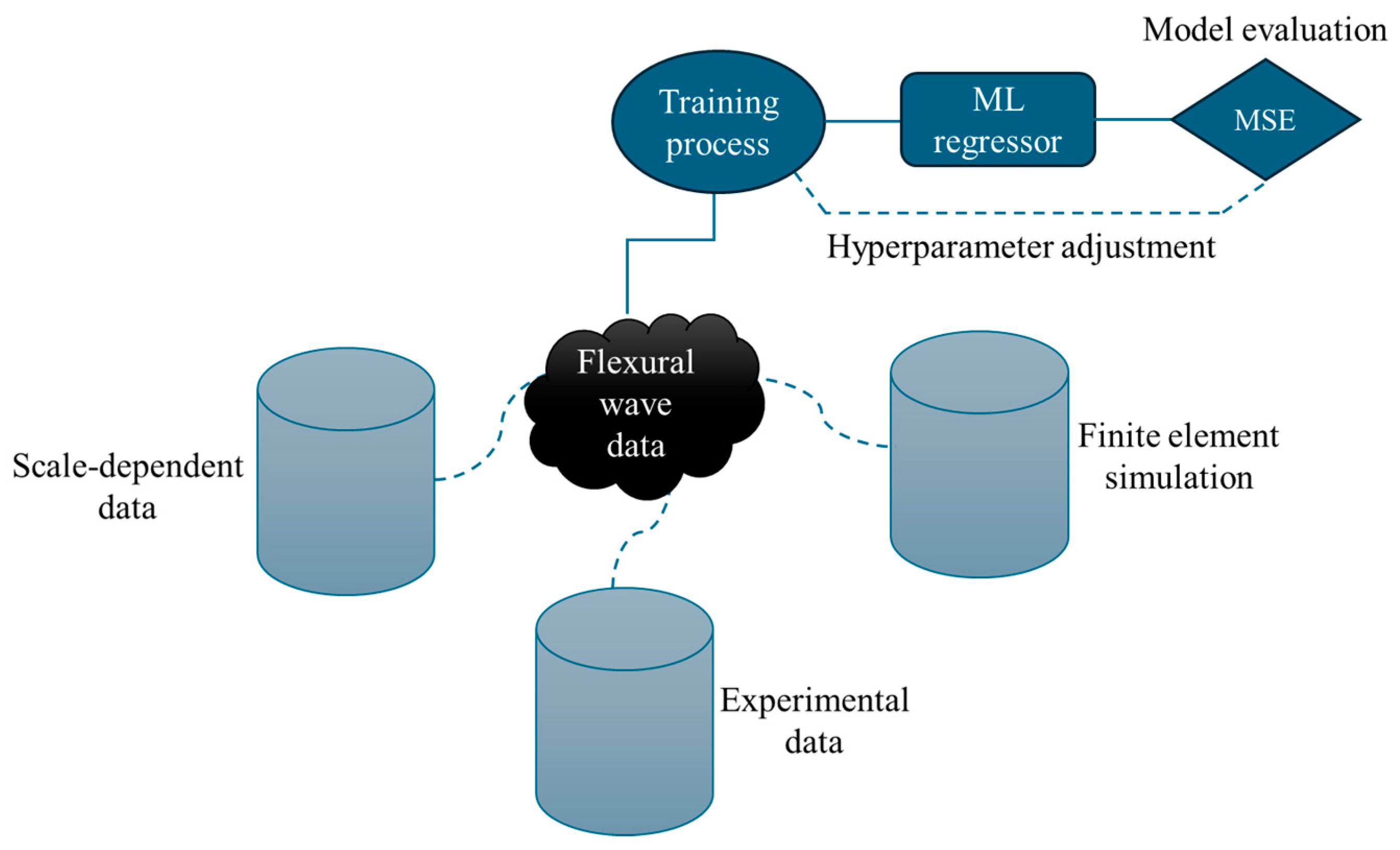
Biomechanical characteristics can be used to assist the early detection of many diseases, including breast cancer, thyroid nodules, prostate cancer, liver fibrosis, ovarian diseases, and tendon disorders. In this paper, a scale-dependent viscoelastic model is developed to assess the biomechanical behaviour of biological tissues subject to flexural waves. The nonlocal strain gradient theory, in conjunction with machine learning techniques such as extreme gradient boosting, k-nearest neighbours, support vector machines, and random forest, is utilised to develop a computational platform for biomechanical analysis. The coupled governing differential equations are derived using Hamilton’s law. Transverse wave analysis is conducted to investigate different normal and pathological human conditions including ovarian cancer, breast cancer, and ovarian fibrosis. Viscoelastic, strain gradient, and nonlocal effects are used to describe the impact of fluid content, stiffness hardening caused by the gradients of strain components, and stiffness softening associated with the nonlocality of stress components within the biological tissues and cells. The integration of the scale-dependent biomechanical continuum model with machine learning facilitates the adoption of the developed model in practical applications by allowing for learning from clinical data, alongside the intrinsic mechanical laws that govern biomechanical responses.
Keywords: flexural eigenfrequency response; nonlocal stress; strain gradient; machine learning; ovarian cancer; breast cancer; ovarian fibrosis flexural eigenfrequency response; nonlocal stress; strain gradient; machine learning; ovarian cancer; breast cancer; ovarian fibrosis