


Abstract
Wind forecasting, which is essential for numerous services and safety, has significantly improved in accuracy due to machine learning advancements. This study reviews 23 articles from 1983 to 2023 on machine learning for wind speed and direction nowcasting. The wind prediction ranged from 1 min to 1 week, with more articles at lower temporal resolutions. Most works employed neural networks, focusing recently on deep learning models. Among the reported performance metrics, the most prevalent were mean absolute error, mean squared error, and mean absolute percentage error. Considering these metrics, the mean performance of the examined works was 0.56 m/s, 1.10 m/s, and 6.72%, respectively. The results underscore the novel effectiveness of machine learning in predicting wind conditions using high-resolution time data and demonstrated that deep learning models surpassed traditional methods, improving the accuracy of wind speed and direction forecasts. Moreover, it was found that the inclusion of non-wind weather variables does not benefit the model’s overall performance. Further studies are recommended to predict both wind speed and direction using diverse spatial data points, and high-resolution data are recommended along with the usage of deep learning models.
1. Introduction
According to the World Meteorological Organization (WMO), nowcasting is the process of providing short-term high-resolution forecasts with a detailed description of current weather conditions over a time horizon of up to six hours. Although nowcasting has implications in diverse application fields such as hydrology, aviation, road safety, civil protection, and industry or energy, it is notably relevant for examining severe weather phenomena such as high wind conditions [1,2,3,4].
The conventional forecast employs numerical weather prediction models that have limited capacity for predicting the timing and location of rapidly evolving weather patterns due to the complexity of the mathematical and physical equations that they must process and solve. Additionally, due to their high computational requirements, these systems are limited in producing rapid results and normally can only perform one or two computations per day [5]. The need to explore alternative solutions has arisen due to these limitations. One promising option is using data-driven pattern recognition models, which have garnered significant attention in numerous fields. These models fall under the category of Machine Learning (ML) techniques and are considered one of the emerging frontiers in wind engineering [6]. Showcasing the potential of ML in the field, a classification approach to wind gust occurrence showed that it was possible to improve prediction from around 20% to 2.4% [7]; however, regression methodologies have been mainly utilized in the wind power sector for nowcasting wind-related data [8]. Although Cook et al. (2023) addressed predicting wind gusts using classification methods, the ML literature still lacks comprehensive regression approaches for these events. Therefore, wind gusts were not considered for this study.
Nevertheless, wind speed and direction nowcasting have the potential to improve management and reduce costs in other fields, such as in air-traffic operations, where wind speed and direction prediction is identified as one of the more challenging tasks for the aviation field [9].
There are several literature reviews on wind speed prediction using ML, mainly focusing on wind forecasting. A review from 2007 [10] provides a comprehensive analysis of wind speed forecasting, highlighting that Artificial Neural Networks (ANN) methods, which emulate the human body’s capacity to learn from experience [11], yield more accurate results for very short-term forecasts, based on observations. However, the authors mainly focus on power forecasting. Other literature reviews primarily concentrate on wind speed associated with wind power forecasting [8,12,13,14,15,16] or wind power short-term prediction [17,18]. Although the authors mention wind speed nowcasting to some extent, it is apparent that wind speed nowcasting, as a distinct field, has yet to be specifically targeted. Consequently, this article identifies a gap in the literature which calls for an in-depth analysis of meteorological wind speed and direction nowcasting.
Therefore, this review aims to assess recent advancements in wind speed and direction nowcasting using ML, therefore seeking to provide an overview of the techniques used to enhance temporal resolution and performance. The primary focus is on the prediction process itself, leaving the applicability of this work the potential to extend beyond specific fields. The objective is to identify potential weaknesses and limitations by critically assessing the effectiveness of the methods employed and their capability of producing accurate and effective wind nowcasts and providing recommendations that may improve further work.
ML has demonstrated effectiveness across various domains, from time-series analysis to computer vision [19]. Its performance largely hinges on selected training methodologies and criteria, including choices of loss functions and evaluation metrics such as accuracy, precision, recall, rank, and root mean squared error [20,21].
Following this success pattern of ML, the main research question for this systematic review was: are ML-based techniques suitable for wind speed and direction nowcasting?
2. Materials and Methods
The purpose of this section is to present a detailed account of the methods utilized to search and analyze articles. In adherence with the 2020 Preferred Reporting Items for Systematic Reviews and Meta-Analyses (PRISMA) guidelines [22], this review seeks to ensure the reproducibility of its examination. Hence, the eligibility criteria employed to determine the inclusion or exclusion of studies in this review are expounded, outlining the data sources, search strategy, collection, and selection methods.
2.1. Search Strategy
The present study conducted a comprehensive search for articles across three databases: Web of Science, Institute of Electrical and Electronics Engineers (IEEE), and ScienceDirect. Web of Science provides a comprehensive and multidisciplinary database that provides access to a vast number of indexed journals across various fields of study. The IEEE Xplore Digital Library is a specialized database focusing on electrical engineering, computer science, and electronics. ScienceDirect, a database from Elsevier, offers a broad range of scientific resources, including articles from numerous journals, books, and reference works, covering a range of scientific disciplines. Cumulatively, the use of these databases ensured a rigorous and thorough search due to their extensive coverage of multiple fields and publishers, allowing for an extensive and comprehensive examination of the topic under analysis.
The search for articles in these databases was carried out on 1 February 2023, and was filtered to scan only the article’s title, abstract, and author-defined keywords published in the 1983–2023 timeframe. The search string utilized to filter and narrow down the search results according to the topic of interest is presented in Table 1, where the “AND” operator is applied horizontally and the “OR” operator is applied vertically. A reading example is “Wind AND Nowcast AND Machine learning”, while the complete string with all possibilities was utilized to perform the search.

Table 1.
Keywords arrangement for the search string.
The keywords were selected to maximize the retrieval of pertinent information while minimizing the loss caused by adjectival usage. Specifically, the keyword “wind” was used to ensure that all search results were related to wind. In addition, the keywords “nowcast” and “short-term forecast” were used in conjunction with the “OR” operator to filter the results to the field of very short-term prediction. To ensure the inclusion of standard machine learning terms, the keywords “machine learning”, “deep learning”, “neural network”, and “artificial intelligence” were used together with the “OR” operator.
2.2. Eligibility Criteria
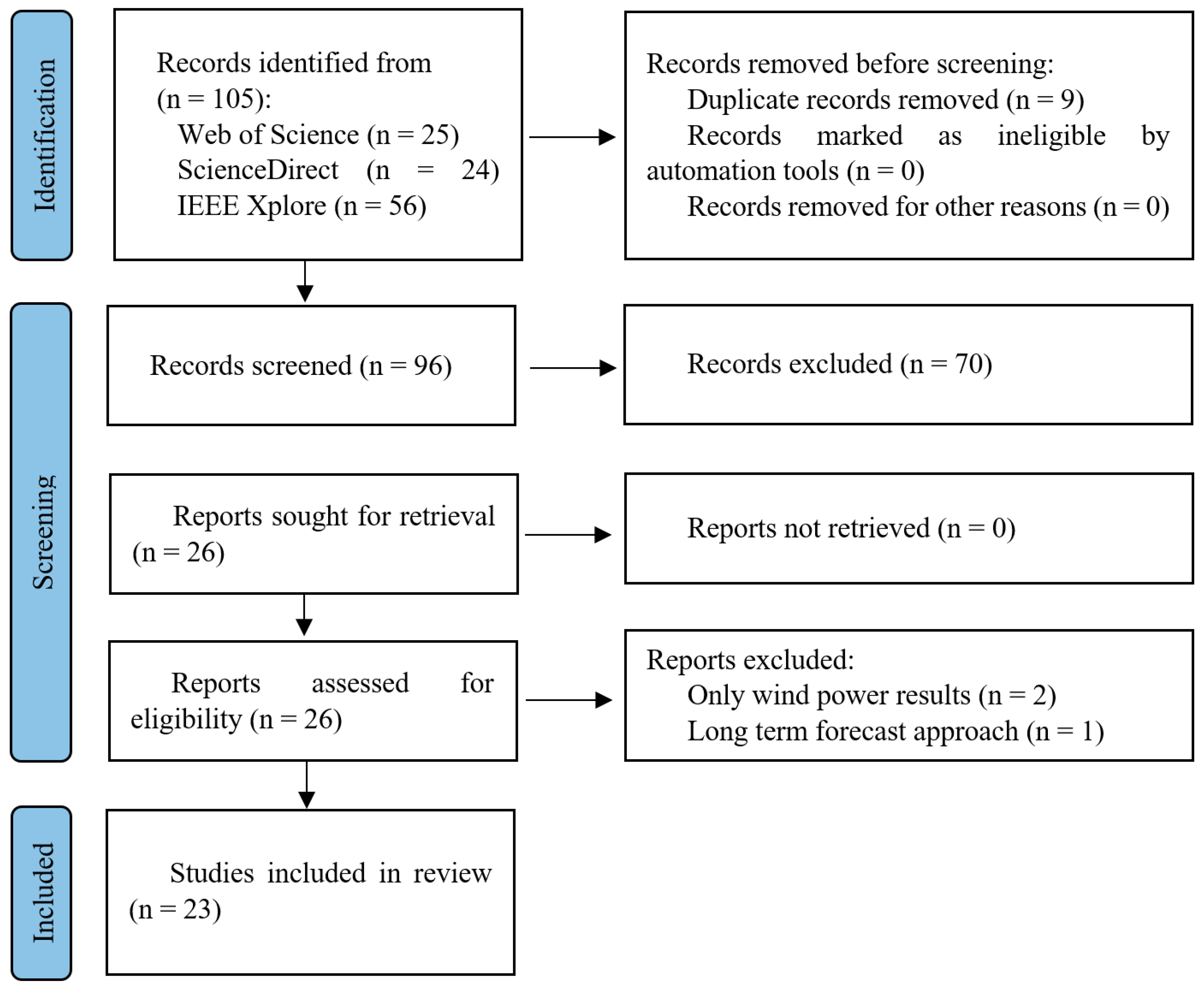
Figure 1 shows the PRISMA diagram of the performed systematic article selection process. The search query across three distinct databases yielded a total of 105 articles, the details of which are provided in Figure 1. It was observed that the IEEE had the highest number of publications, with 56 articles, representing the largest contribution among the three databases.
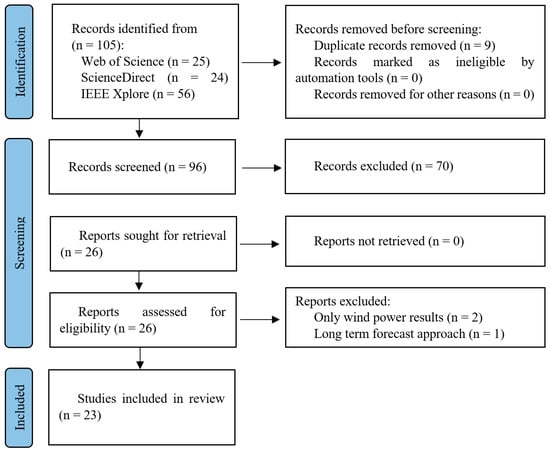
Figure 1.
PRISMA flow diagram of the conducted systematic review.
A duplicate records elimination process was conducted before passing the articles to the initial screening phase, where three independent scorers evaluated the relevance of each article. The inclusion criterion was defined as “studies that employed some form of machine learning to provide short-term forecasts or nowcasts of wind speed or direction”. The exclusion criteria were “studies that focused solely on wind power calculation or prediction or other aspects of wind measurement that did not directly relate to wind speed or direction” and “articles not written in English”.
During this procedure, a voting system was employed, wherein each scorer evaluated the title and abstract of each article and voted for inclusion, exclusion, or further discussion. Articles receiving two votes for inclusion were automatically included, while those receiving two votes for exclusion were automatically excluded. One article [23] received one vote for inclusion, one vote for exclusion, and one vote for further discussion, not being automatically included or excluded. After debate, to evaluate in more detail its relevance for the review, all scorers agreed to include the article in the further analysis process, passing a total of 26 articles for the second screening analysis.
During the second screening analysis, which involved the full article screening process, three articles were excluded due to their lack of wind speed or direction prediction or the absence of respective results presentation [23,24], and one [25] which focused solely on long-term wind forecasting. The selection process resulted in a total of 23 articles that were included in the systematic review.
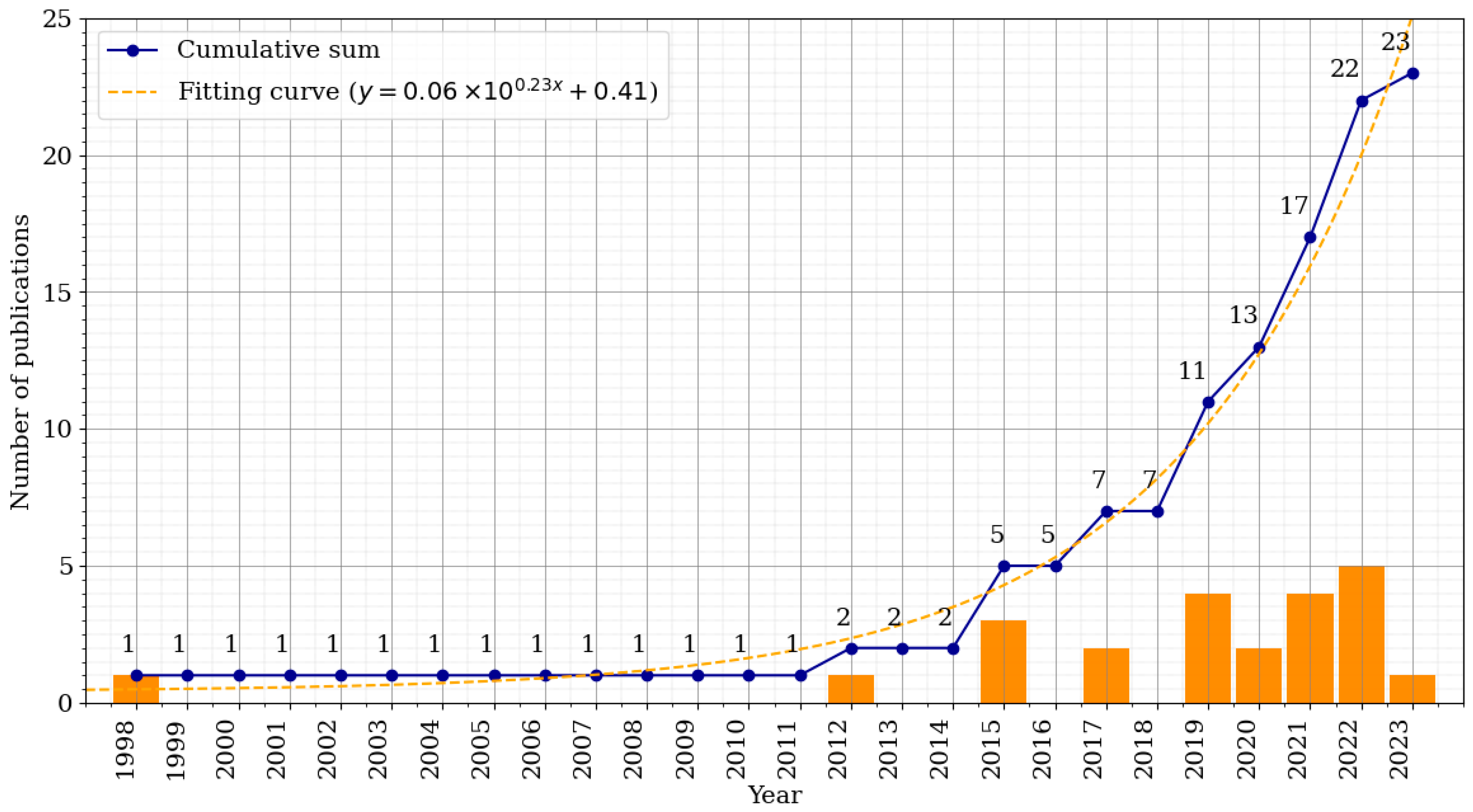
By examining the year of publication of the included articles, it was observed that the research activity on the studied subject commenced more than two decades ago, as demonstrated in Figure 2, which shows the distribution of the published articles by the year, followed by a noticeable gap in publications from 1998 to 2012. Furthermore, article publications until 2019 are sparse, with temporal gaps superior to one year. However, the gradual surge in the number of publications after 2019 suggests increasing interest in the topic, while the peak in 2022 indicates that the subject has recently attracted significant attention. At the beginning of 2023, the time when the database search was conducted, two articles had already been published, indicating the continuation of the exponential increase in publications. The prevalence of this trend emphasizes the contemporary significance of the examined subject matter. It sturdily advocates the need for this review to consolidate knowledge and point out new directions for future research.
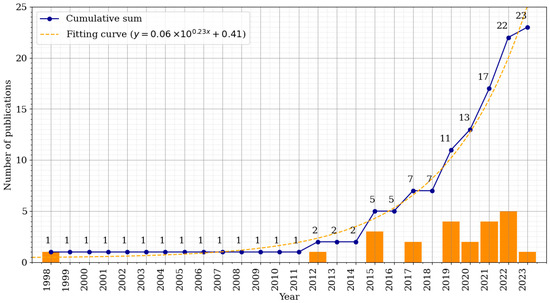
Figure 2.
Annual Published Articles (represented by orange bars), Cumulative Total of Works (illustrated by the blue line), and Exponential Trendline Reflecting Publishing Trajectory (denoted by the dashed orange line).
2.3. Method of Analysis
All the articles included in this review employ some form of machine learning to predict wind speed or direction. However, there is significant variation in terms of the used temporal window for the prediction, performance analysis metrics, type, and characteristics of data utilized, and the kind of machine learning models. To simplify the analysis and group the articles, these variables were adapted into categories.
For the temporal window of the prediction, the minimum value was one minute, so this was set as the minimum threshold. The 10 min, 30 min, and 1 h temporal steps, commonly used in the field [26], were selected as grouping alternatives up to the nowcasting half time and limit of 3 h and 6 h, respectively.
The most frequently used metrics in the reviewed articles were Mean Absolute Error (MAE), Root Mean Absolute Error (RMAE), Mean Squared Error (MSE), Root Mean Squared Error (RMSE), and Mean Absolute Percentage Error (MAPE). Hence, all articles were grouped and analyzed accordingly, calculating the MAE and MSE from the RMAE and RMSE when not directly available to compare the results better. Any other reported metrics were grouped. The employed data were also evaluated based on their temporal resolution and the number of different spatial collecting points.
Most machine learning models in the reviewed articles used Feed Forwards Neural Networks (FFNN). However, other models and classifiers were also utilized and some hybrid solutions were proposed. Thus, the articles were also grouped and evaluated based on this characteristic. To present a comprehensive summary of the effectiveness of machine learning for wind nowcasting, an overview of the same metric is shown for all articles where it is available and shown as a single primary result. To access the main research questions, the results were submitted to statistical significance tests using both the t-test and Welch’s t-test along with the respective null hypotheses.
3. Results and Discussion
This section is divided into two segments where the findings of the included research papers are presented. The first segment assesses the temporal periods and data resolution that the studies concentrate on, while the second segment evaluates the performance achieved through model-based and approach-based analyses.
In this section, the findings of the included research article are organized into two subsections. The first aims to evaluate the temporal periods and data resolution that the studies focus on, while the second segment intends to evaluate the performance achieved in terms of a model-based and an approach-based analysis.
3.1. Nowcasting Resolution and Range Distribution
The maximum resolution, corresponding to the minimum temporal step achieved in the prediction, is 1 min [27,28,29], followed by a non-standard resolution of 2 min and 45 s, used by Gao et al. [30,31], derived from the plan position indicator delay of the used light detection and ranging device to collect the data. At the 1 min resolution, the maximum range achieved was 2 h, as reported by Hu et al. [28], while Gao et al. [30,31] were able to reach a 27 min forecast.
Using a resolution of 10 min [32,33,34,35,36,37,38,39], it was possible to predict wind characteristics up to 1008 steps [37], which is equivalent to one week. Sunglee et al. [40] utilized high-resolution 5-s wind data to realize 20 min resolution predictions up to one hour ahead. Furthermore, using an interval of 1 h steps [41,42,43,44,45,46,47,48,49] it was possible to forecast a maximum range of one week [42].
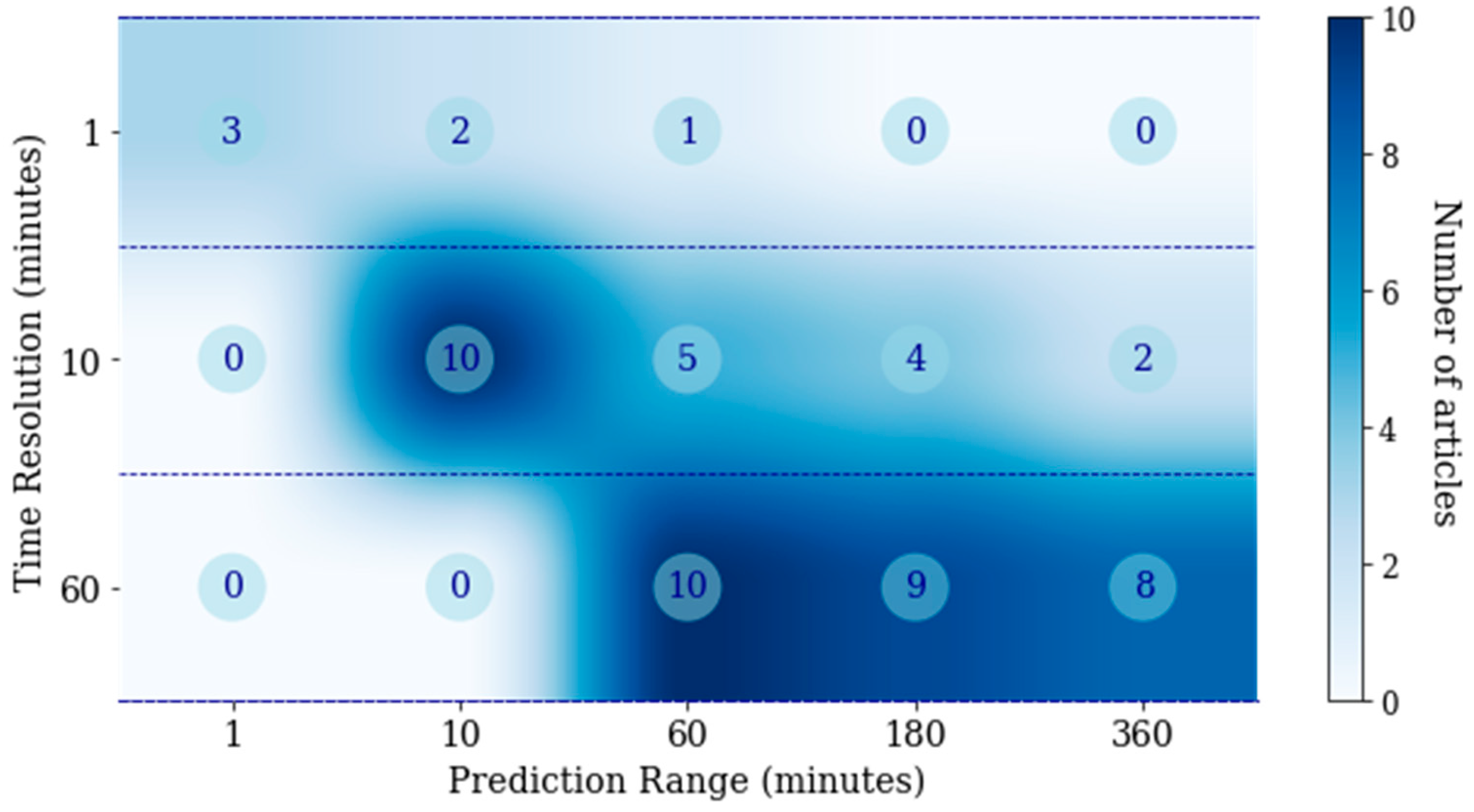
In Figure 3, the number of articles published about the maximum prediction range for each resolution is represented, grouped by the timeframes previously defined, and limited to the nowcasting range of 6 h. This data visualization takes the form of a heatmap-type chart, presenting a broad illustration of the relationship between the number of articles and both the prediction range and time resolution.
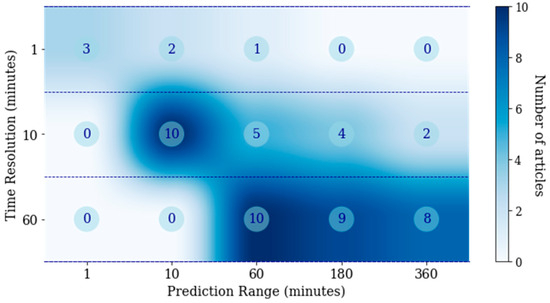
Figure 3.
Heatmap depicting article distribution by prediction range (x-axis) and time resolution (y-axis). Darker shades indicate a higher count of articles for a given combination. The numbers correspond to the number of published articles.
Upon observing Figure 3, it becomes clear that the quantity of published articles is noticeably diminished for high-resolution time intervals compared to the number of articles published, where temporal steps are in the order of 10 min or 60 min, shown as darker zones in the figure. Additionally, the overall data distribution suggests a correlation between decreasing resolution and an extension of the prediction range. For example, for a 60 min ahead prediction, there is only one article with a 1 min resolution, five articles with a 10 min time-step, and ten articles with the lowest resolution of a 60 min step.
3.2. Model Performance Analysis
Table 2 presents a summary breaking down the studies into key events and rounding metric values to two decimal places to provide a more comprehensive evaluation of the performance reported by all the reviewed articles. Therefore, the presented information includes article identification with the used forecasted data, ML model, resolution, and performance metrics. The articles are organized by MAE, progressing toward high error results. All metrics provided are extracted from the highest resolution forecast and minimum steps forward, according to the grouping method previously referred to, and from the top performance method or model when the authors tested more than one. When various tests are presented, the metrics extracted correspond to the best performance achieved or, when not available, the mean for test or validation.
Table 2.
Performance summary of the reviewed articles.
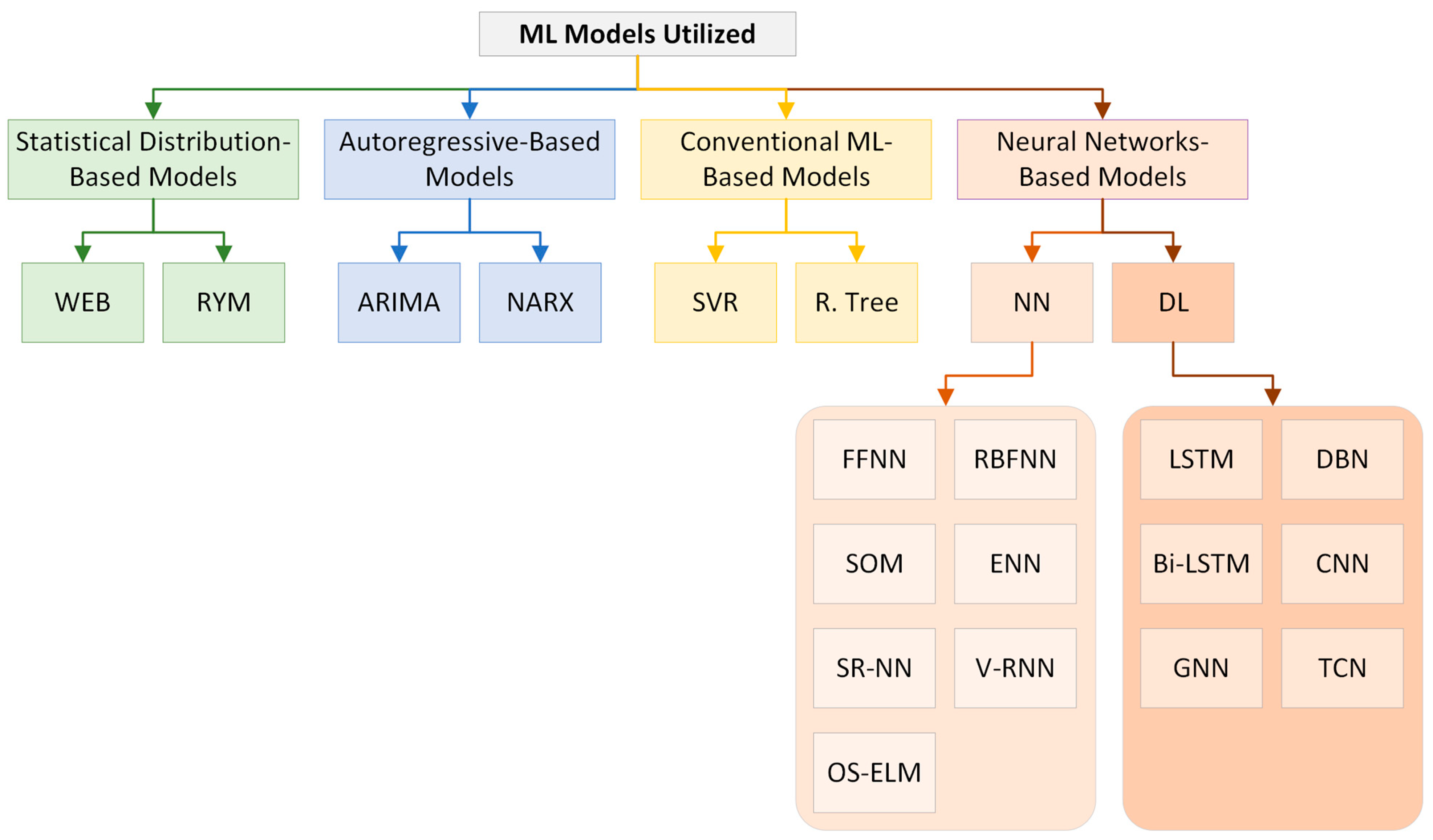
The ML models utilized can be grouped in categories as: two Wind Speed Prediction (WSP) based models, Weibull-Distribution-Based (WEB) and Rayleigh-Distribution-Based (RYM); two autoregressive-based, AutoRegressive Integrated Moving Average (ARIMA) and Nonlinear AutoRegressive with exogenous inputs (NARX); two conventional ML-based (non-neural networks), Support Vector Regression (SVR) and regression tree; and twelve neural-network-based, among them, seven conventional neural networks, specifically, FFNN, Radial Basis Function Neural Network (RBFNN), Self-Organizing Map (SOM), Elman Neural Network (ENN), Sinusoidal Rough Neural Network (SR-NN), Vanilla Recurrent Neural Network (V-RNN), Online Sequential Extreme Learning Machine (OS-ELM); and eight deep learning, precisely, Long Short-Term Memory (LSTM), Deep Belief Network (DBN), Bi-directional Long Short-Term Memory (Bi-LSTM), Convolutional Neural Network (CNN), Graph Neural Network (GNN), and Temporal Convolutional Network (TCN). Figure 4 summarizes the employed models in a taxonomy diagram.
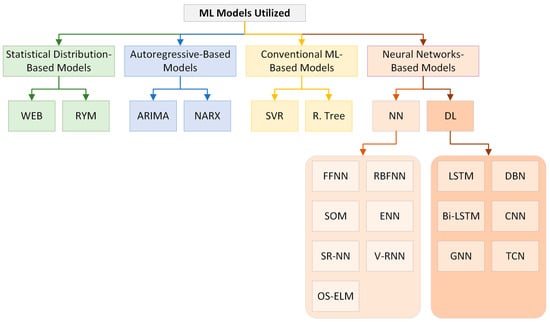
Figure 4.
Classification schematic of employed models.
3.2.1. Assessment of Frequently Employed Models
The data available were further compiled, grouping the results according to the model. The most used machine learning approach was FFNN, representing eight of the analyzed articles [32,34,36,40,41,43,44,49]. The second most published approach, with three articles [30,31,38], was LSTM, and the remaining eleven studies were dispersed over a variety of models, therefore grouped as “other” [27,28,29,33,35,37,39,42,45,46,47,48].
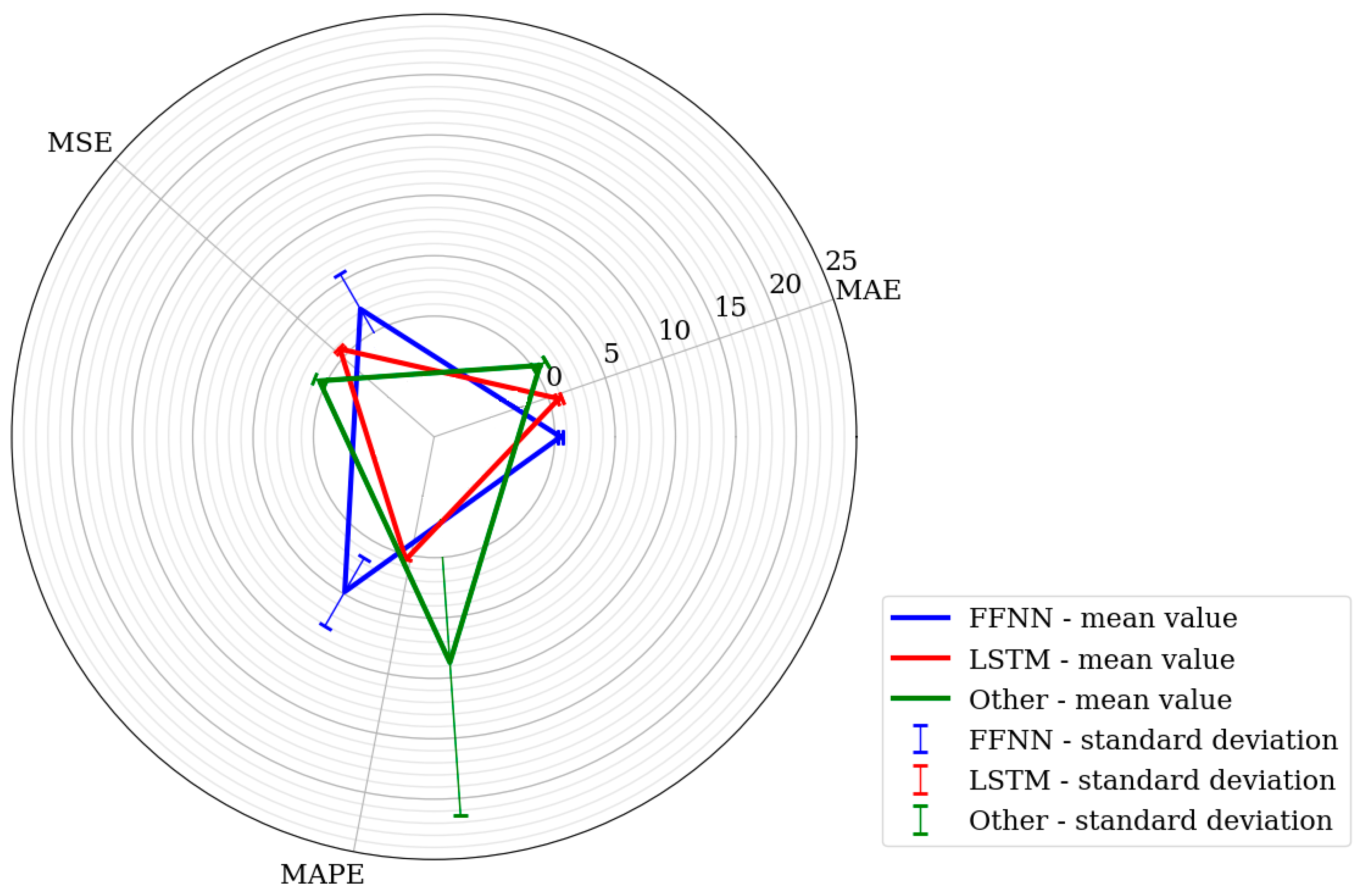
Figure 5 resumes the performance of the grouped approaches, plotting the models as polygons on a polar coordinate system, where each metric forms a polygon vertex. The length of each spoke represents the mean value for that metric, and the error bars around each point represent the standard deviation.
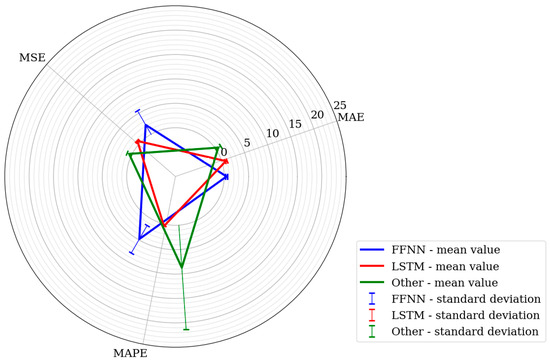
Figure 5.
Performance metrics by ML model.
The MAE’s mean value for the FFNN was 0.47, indicating that the average difference between the predicted and actual values was relatively small. The standard deviation of 0.23 suggests that the data points were clustered around the mean, indicating that the model was relatively consistent in its predictions. In contrast, LSTM had a higher mean MAE of 0.81, which indicates a larger average difference between predicted and actual values. However, its standard deviation of 0.18 indicates that the predictions were more tightly clustered around the mean than the other models’ group. The models classified as “other” had a mean MAE of 0.58 and a standard deviation of 0.59, suggesting that they had a higher level of inconsistency in their predictions, taking the FFNN model to the best position regarding performance and consistency in its predictions when analyzing this metric.
Analyzing the MSE, the FFNN model had a mean value of 2.22, suggesting a relatively large difference between the predicted and actual values. The standard deviation value of 3.42 indicates that the data points were widely spread around the mean, showing an inconsistency in the model’s predictions. In contrast, the LSTM model had a much lower mean MSE value of 0.67, indicating a lower difference between the predicted and actual values. The standard deviation value of 0.13 suggests that the predictions were more tightly clustered around the mean, indicating greater consistency. The other models had a mean MSE value of 0.57 and a standard deviation of 0.48, relatively indicating more inconsistent predictions than LSTM.
Comparing these results to the MAE results, we can observe some differences. The FFNN model had a higher mean value for MSE than MAE, suggesting that the squared difference between the predicted and actual values was significantly larger than the absolute difference. The LSTM model, on the other hand, had a lower mean MSE value than MAE, indicating that the squared difference between the predicted and actual values was relatively smaller than the absolute difference. The results of these two metrics already suggest that the LSTM model had better performance in predicting wind speed as it had a lower mean and standard deviation for MAE and slightly higher, but more consistent, MSE compared to the other models.
For the last metric, MAPE, the FFNN mean value indicates that the model’s predictions were off by 4.83%. The standard deviation of 3.26 suggests that the error rates varied widely from the mean, indicating that the model’s predictions were relatively inconsistent. In contrast, the LSTM model had a much lower mean MAPE value of 0.43, suggesting that the model’s predictions were more accurate, with an average error rate of 0.43%. The standard deviation value for this model is 0 due to only one study presenting the results with this metric. The “other” models group had a mean MAPE value of 8.73 and a standard deviation of 12.71, indicating that the error rates were widely spread around the mean, signaling inconsistency in their predictions.
When examining all models and metrics, the results suggest that the LSTM had the best performance among the three models in terms of predicting the outcome variable with the lowest average error rate and the most consistent predictions. The FFNN performed worse than the LSTM but had relatively consistent predictions, while the models grouped as “other” had the highest average error rate and the most inconsistency in their predictions. This result can be observed in Figure 5, where LSTM is represented with the smallest area, followed by the FFNN polygon and the group of other models, which is the wider polygon.
3.2.2. Comparison Based on Model Deepness
To evaluate the performance, two groups were constituted based on the deepness of the models, where all models that employed deep learning methods, singularly or in an ensemble approach, were classified as “deep learning models” [29,30,31,38,39,47,48]. The remaining models were grouped as “conventional ML methods”.
It is relevant to mention that deep-learning articles only started in 2021, with Liu et al. [29], and both articles published in 2023 [39,48] are also based on deep learning methods, suggesting a positive trend in the approach.
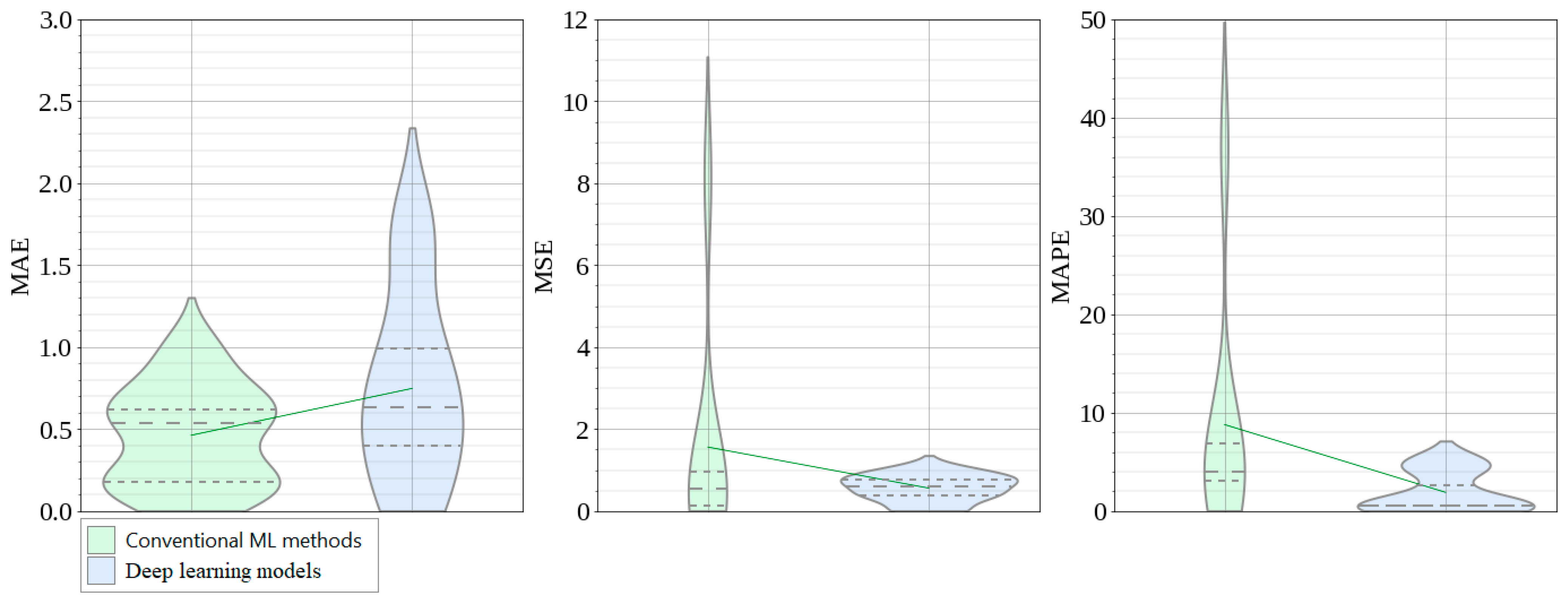
As depicted in Figure 6, deep learning shows a decrease in mean error, mainly demonstrated by MSE, where deep learning shows a value of 0.56 compared to 1.56 of the conventional ML models. The standard deviation was 0.33, whereas conventional models are less consistent, with a value of 2.72. The MAPE values also indicate a performance improvement, with a mean value of 1.9 versus 8.79, and a standard deviation of 1.98 for the deep learning models compared to the 11.74 presented by conventional ML. The MAE values are slightly better for the conventional models, with a mean value of 0.46 and a standard deviation of 0.29. In contrast, deep learning models presented 0.75 and 0.57 for mean and standard deviation, respectively.
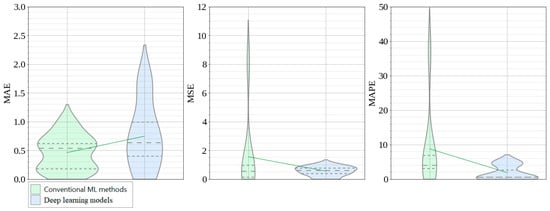
Figure 6.
Violin plots of the performance according to the model deepness; the green line connects the average value of both violins.
To assess which model approach performs better, a statistical Welch’s t-test, which does not assume equal variances between the two groups, was performed with the significance level set to 0.05. The null hypothesis was “the performance of deep learning models is analogous to conventional ML models for wind prediction” [50,51]. Statistical relevance was observed for one performance metric (MSE), but it was not achieved for all MAE and MAPE. Although the use of deep learning shows promise with these results, as the findings of the statistical test are mixed, the outcome cannot be conclusively determined and the null hypothesis was not rejected.
3.2.3. Time Resolution and General Results
For the performance evaluation based on forecasted time resolution, the 1 min time step was not fully accessed due to the incompatibility of the data or the lack of precise information. Tagliaferri et al.’s [27] study was based only on wind direction, and the author did not provide MAE, MSE, or MAPE metrics. Hu et al. [28] only present the RMSE, plotted as a chart without referencing the exact values achieved. In this regard, Table 3 presents the summary for nowcasting error parameters by available temporal resolution, where it is shown that the tighter timescale shows a smaller order of magnitude errors. For example, the MAE for the resolution of 10 min is 0.73, decreasing to 0.50 for the 10 min steps and falling to 0.02 at the higher resolution of 1 min.
Table 3.
Mean error metrics by the time resolution.
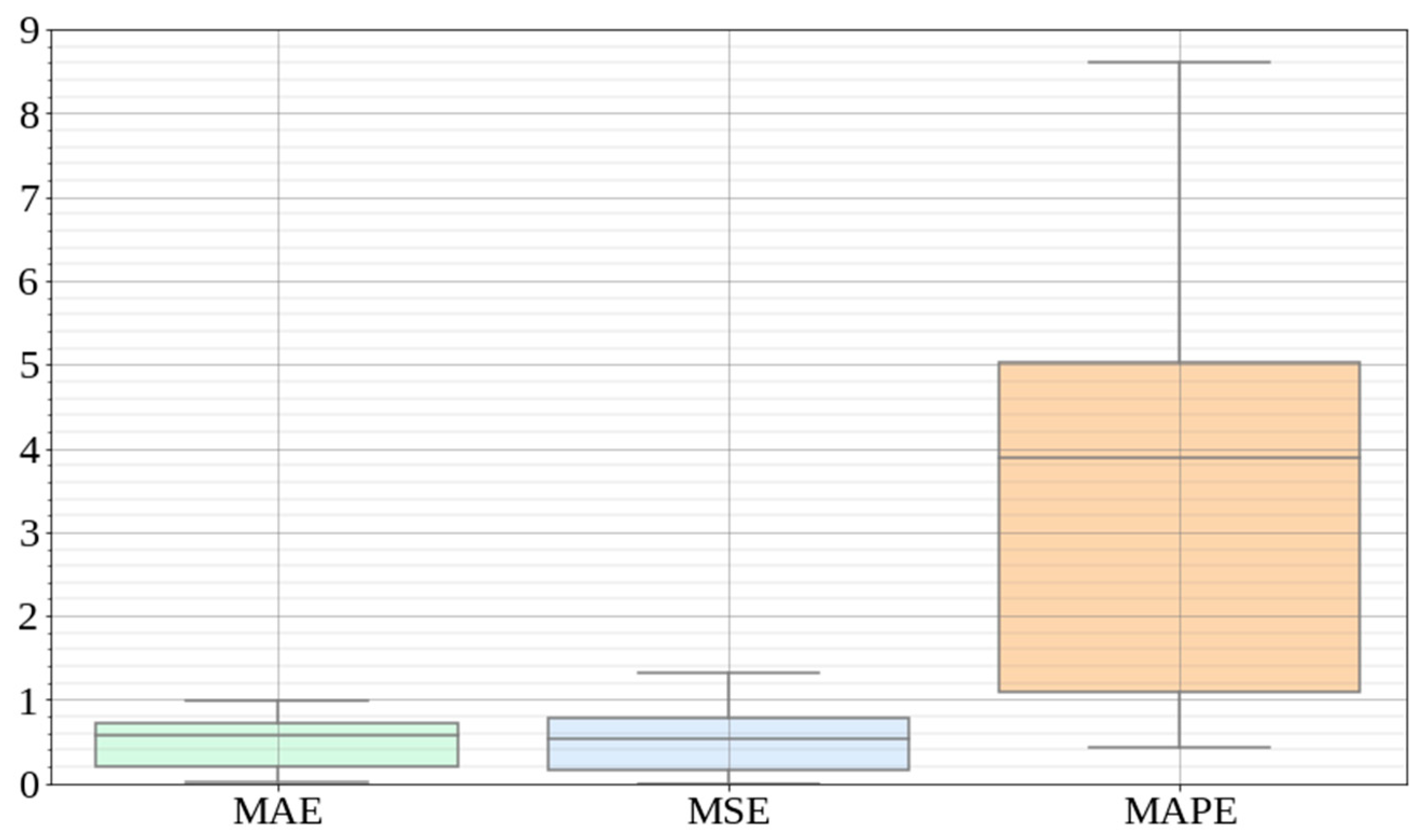
Based on all reviewed works where the data could be extracted, the general ML mean performance, represented in Figure 7, achieved (on average) an MAE of 0.56, MSE of 1.10, and MAPE of 6.72. WMO set the minimum accuracy for wind nowcasting to have an RMSE under 2 m/s [1]. Therefore, to validate the viability of ML for wind nowcasting, a statistical test (t-test) was conducted, confirming that there is a statistical significance (p-value lower than 0.05) of the calculated mean RMSE (0.81 m/s), showing that the null hypothesis “ML wind nowcast is not possible” is disproved.
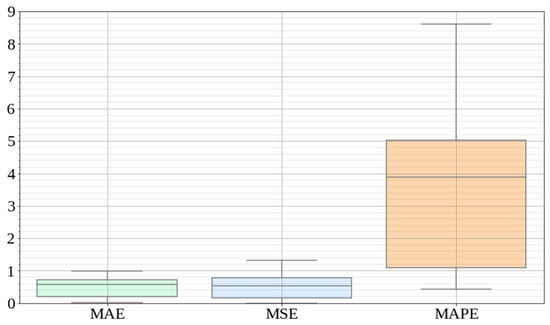
Figure 7.
General performance of the reviewed articles.
As these results derive from data extracted and grouped, it is relevant to mention that the best results achieved in wind speed prediction, based on the analyzed articles, were attained by Liu et al. [29], which reached an MAE of 0.02 and an MAPE behind the 1% mark (0.57). This result was obtained by predicting the mean 1 min wind speed for the next minute with an ensemble machine learning approach denominated by EOD (ELM + ORELM + DBN), which combines several different techniques to create a more accurate and efficient model.
Regarding the datasets referenced by the authors in the reviewed articles, many either do not specify where the data can be accessed or obtained, or they simply mention that they do not have permission to share the data. However, Piazza et al., 2021 [46] states that the data used were retrieved from a publicly available database published by the U.S. National Renewable Energy Laboratory (NREL), Sunglee et al., 2022, obtained data from AccuWeather [40], Bentsen et al., 2023 [39] downloaded the data using the Frost API and Tagliaferri et al., 2015 [27] acquired the data from America’s Cup Event Authority.
3.3. Input Features Effect
The features that are fed to ML models play a crucial role in determining performance. The studies reviewed in this research varied in terms of the features included in the models, with some utilizing only wind-related data, while others incorporated additional variables.
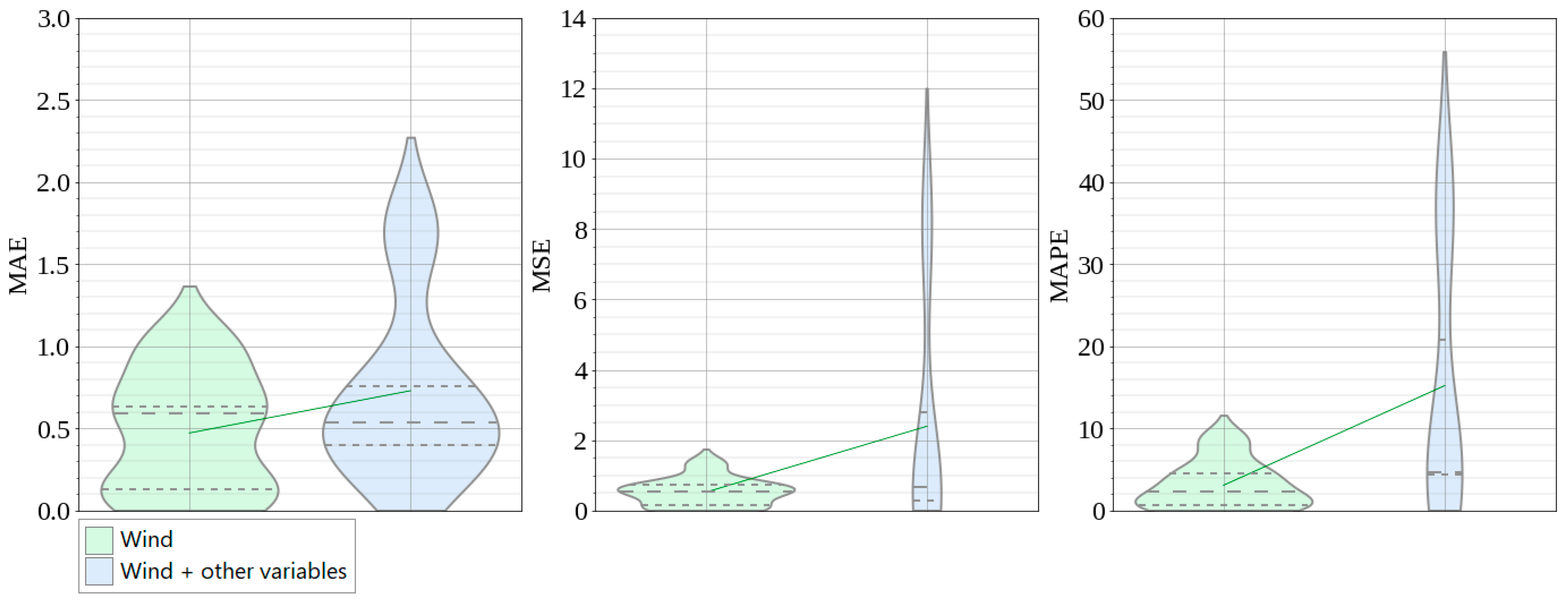
Despite Dupuy et al.’s [34] findings that temperatures demonstrated a positive correlation in downhill wind predictions when measured at relevant different altitudes, the remaining authors did not provide information on the direct comparison of predictions with or without these extra features. To compare the overall performance based on the use of other variables versus wind features, an overview is depicted in Figure 8, where the results were grouped by the input features. While the inclusion of supplementary data may intuitively seem beneficial in enhancing the performance of the models, the findings of this study suggest that it may not be necessary.
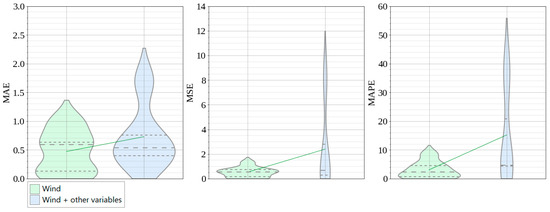
Figure 8.
Violin plots of the performance according to the employed input features; the green line connects the average value of both violins.
Incorporating non-wind-related weather variables did not improve the results obtained compared to the other works that used only wind-related variables. Conversely, using a higher resolution of wind data had a clear association with reduced errors and better performance, as described in Table 3.
To address this topic, a statistical Welch’s t-test was performed on the retrieved data [50]. The considered null hypothesis was “the use of wind variables in conjunction with other weather-related variables are comparable to using only wind variables to nowcast wind with ML approach”, and the significance level was defined as 0.05 [51]. The obtained results show that there is no statistical significance in the data. Therefore, the null hypotheses cannot be rejected, indicating no clear advantage regarding the use of additional weather-related variables.
As for the wind features nowcast, only Dupy et al. [34] predict wind speed and direction, decomposing the wind into its base vectors (, ). Tagliaferri et al. [27] could output a wind direction prediction but it does not present wind speed. The remaining reviewed articles provide forecasting only for wind speed, lacking the integration of the wind direction. The distribution of studies by predicted wind using only wind speed is 91.3%, while only 4.3% for each wind direction and wind speed and direction predictions.
In examining the domain of research that addresses wind direction, it is clear that most studies come from sectors such as sail yachting or the meteorology field where direction is crucial. With most of the current research stemming from the energy sector, wind direction has not received extensive attention. Another challenge is the nature of wind direction measurements, which range from 0 to 360 degrees. This continuous range can be complex to integrate into machine learning models. The high variability of wind direction further complicates its application, making it a significant challenge for researchers. As a result, while wind speed is a common focus in many studies, wind direction often remains overlooked.
4. Conclusions
This article explored the potential of ML for accurate wind speed and direction nowcasting through a systematic review. The search for articles was conducted across three databases, namely Web of Science, IEEE, and ScienceDirect, using a thorough search string and applying filters. The employed eligibility criteria was applied to further screen the initially identified articles, using the 2020 PRISMA guidelines to ensure the reproducibility of the examination.
The reviewed articles used ML-based techniques to predict wind speed or direction, but there was significant variation in terms of the prediction window, performance analysis metrics, data used, and examined models. To simplify the analysis, the variables were grouped into categories. The most common metrics used were MAE, MSE, and MAPE, and the articles were evaluated accordingly.
The temporal window for wind prediction varies, with a minimum value of 1 min and a maximum range of 1 week. The maximum resolution was 1 min, while the maximum steps were 60 min. The number of published articles is higher for lower temporal steps, with a correlation between decreasing resolution and an extension of the prediction range.
Evaluating the performance of the models highlighted that LSTM attained, on average, the utmost mean performance, with an MAE of 0.81, an MSE of 0.67, and an MAPE of 0.43. The analysis of the deepness performance also shows that deep learning models show MSE (0.75) and MAPE (0.56), reaching better results in these metrics when compared to the conventional ML approach. Nevertheless, the best performance for wind speed nowcasting in the reviewed articles was achieved by Liu et al. [29], using a hybrid ensemble model. The overall mean performance values based on all articles present an MAE below 1 m/s with an MSE of 1.10 m/s and an MAPE lower than 7%.
It was concluded that the average performance of the reviewed articles is significantly below the minimum accuracy established by the WMO. Therefore, it is possible to conclude that ML-based algorithms are suitable for wind speed nowcasting, positively addressing the formulated research question.
In a deepness analysis, deep learning models surpassed conventional methods with a lower MSE (0.56) and MAPE (1.90), while the MAE was slightly higher, with a value of 0.75. A statistical t-test was executed in all metrics and relevance was obtained in MSE, suggesting that deep learning usage can be significantly capable of outperforming conventional methods, and further investigation in the field is suggested to confirm these findings.
Considering that all articles used wind features as input data, some researchers also tried to include other weather variables. It was concluded that the input of weather variables was not linked to better general results when accessing and comparing to most reviewed articles.
It was found that there is a lack of research in wind direction nowcasting either in the singular forecast or in a joint forecast with wind speed, demonstrated by the high percentage (91.3%) of articles that only predict wind speed, as opposed to 4.3% that considered wind direction nowcast.
Further investigation is suggested to include wind speed and direction at very high-resolution temporal steps; according to the exhibited results, higher resolutions tend to achieve better nowcasts. As weather-related variables other than the wind were not linked to better outcomes, new research is also suggested to increase the number of wind inputs, such as different spatial wind data, instead.
As previously stated by Wang et al. [35], there is no universal criterion for error evaluation in the field, and Koutsandreas et al. [52] conclude that the variations among the different error measures are minimal, particularly within each category of measures, such as percentage, relative, or scaled. Within this, as most of the articles present MAE, MSE, and MAPE metrics, it is suggested that further works publish these metrics to standardize how results are evaluated for wind speed or direction nowcast with the use of an ML approach.
The main limitation of this study is that different works have considered data from dissimilar locations. Hence, there is an inherent bias. Furthermore, some works have not reported the same performance metrics, making their analysis unfeasible. Lastly, the review only considered articles written in English; thus, it is possible that some works were not included.
Author Contributions
Conceptualization, D.A. and F.M.; methodology, D.A. and F.M.; software, D.A.; validation, D.A., F.M. and S.S.M.; formal analysis, D.A., F.M., S.S.M. and F.M.-D.; investigation, F.M.-D.; resources, D.A.; data curation, D.A.; writing—original draft preparation, D.A. and F.M.; writing—review and editing, D.A., F.M., S.S.M. and F.M.-D.; visualization, D.A., F.M., S.S.M. and F.M.-D.; supervision, F.M., S.S.M. and F.M.-D.; project administration, D.A.; funding acquisition, D.A. All authors have read and agreed to the published version of the manuscript.
Funding
This research was funded by LARSyS (Project—UIDB/50009/2020), Portuguese Foundation for Science and Technology (FCT) for support through Projeto Estratégico LA 9—UIDB/50009/2020, ARDITI—Agência Regional para o Desenvolvimento da Investigação, Tecnologia e Inovação under the scope of the project M1420-09-5369-FSE-000002—Post-Doctoral Fellowship, co-financed by the Madeira 14-20 Program—European Social Fund. This research was sponsored by OET—Ordem dos Engenheiros Técnicos.
Data Availability Statement
All data analyzed in this review were sourced from scientific articles, with references provided in the manuscript.
Conflicts of Interest
The authors declare no conflict of interest.
References
- WMO-No. 1198—Guidelines for Nowcasting Techniques; World Meteorological Organization: Geneva, Switzerland, 2017.
- Lim, J.-Y.; Kim, S.; Kim, H.-K.; Kim, Y.-K. Long short-term memory (LSTM)-based wind speed prediction during a typhoon for bridge traffic control. J. Wind. Eng. Ind. Aerodyn. 2021, 220, 104788. [Google Scholar] [CrossRef]
- Liu, H.; Tian, H.-Q.; Li, Y.-F. An EMD-recursive ARIMA method to predict wind speed for railway strong wind warning system. J. Wind. Eng. Ind. Aerodyn. 2015, 141, 27–38. [Google Scholar] [CrossRef]
- Giersch, S.; El Guernaoui, O.; Raasch, S.; Sauer, M.; Palomar, M. Atmospheric flow simulation strategies to assess turbulent wind conditions for safe drone operations in urban environments. J. Wind. Eng. Ind. Aerodyn. 2022, 229, 105136. [Google Scholar] [CrossRef]
- Wapler, K.; de Coning, E.; Buzzi, M. Nowcasting. In Reference Module in Earth Systems and Environmental Sciences; Elsevier: Amsterdam, The Netherlands, 2019. [Google Scholar] [CrossRef]
- Kareem, A. Emerging frontiers in wind engineering: Computing, stochastics, machine learning and beyond. J. Wind. Eng. Ind. Aerodyn. 2020, 206, 104320. [Google Scholar] [CrossRef]
- Cook, N.J. Automated classification of gust events in the contiguous USA. J. Wind. Eng. Ind. Aerodyn. 2023, 234, 105330. [Google Scholar] [CrossRef]
- Soman, S.S.; Zareipour, H.; Malik, O.; Mandal, P. A review of wind power and wind speed forecasting methods with different timehorizons. In Proceedings of the North-American Power Symposium (NAPS) 2010, Arlington, TX, USA, 26–28 September 2010; pp. 1–8. [Google Scholar] [CrossRef]
- Kim, J.; Lee, K. Unscented Kalman Filter-Aided Long Short-Term Memory Approach for Wind Nowcasting. Aerospace 2021, 8, 236. [Google Scholar] [CrossRef]
- Wu, Y.-K.; Hong, J.-S. A literature review of wind forecasting technology in the world. In Proceedings of the 2007 IEEE Lausanne Power Tech, Lausanne, Switzerland, 1–5 July 2007; pp. 504–509. [Google Scholar] [CrossRef]
- Rehman, S.U.; Tu, S.; Waqas, M.; Huang, Y.; Rehman, O.U.; Ahmad, B.; Ahmad, S. Unsupervised pre-trained filter learning approach for efficient convolution neural network. Neurocomputing 2019, 365, 171–190. [Google Scholar] [CrossRef]
- Lei, M.; Shiyan, L.; Chuanwen, J.; Hongling, L.; Yan, Z. A review on the forecasting of wind speed and generated power. Renew. Sustain. Energy Rev. 2009, 13, 915–920. [Google Scholar] [CrossRef]
- Wang, J.; Song, Y.; Liu, F.; Hou, R. Analysis and application of forecasting models in wind power integration: A review of multi-step-ahead wind speed forecasting models. Renew. Sustain. Energy Rev. 2016, 60, 960–981. [Google Scholar] [CrossRef]
- Bokde, N.; Feijóo, A.; Villanueva, D.; Kulat, K. A Review on Hybrid Empirical Mode Decomposition Models for Wind Speed and Wind Power Prediction. Energies 2019, 12, 254. [Google Scholar] [CrossRef]
- Wang, Y.; Zou, R.; Liu, F.; Zhang, L.; Liu, Q. A review of wind speed and wind power forecasting with deep neural networks. Appl. Energy 2021, 304, 117766. [Google Scholar] [CrossRef]
- Wu, Z.; Luo, G.; Yang, Z.; Guo, Y.; Li, K.; Xue, Y. A comprehensive review on deep learning approaches in wind forecasting applications. CAAI Trans. Intell. Technol. 2022, 7, 129–143. [Google Scholar] [CrossRef]
- Tascikaraoglu, A.; Uzunoglu, M. A review of combined approaches for prediction of short-term wind speed and power. Renew. Sustain. Energy Rev. 2014, 34, 243–254. [Google Scholar] [CrossRef]
- Lydia, M.; Kumar, G.E.P. Deep Learning Algorithms for Wind Forecasting: An Overview. In Artificial Intelligence for Renewable Energy Systems; Wiley: Hoboken, NJ, USA, 2022; pp. 129–145. [Google Scholar] [CrossRef]
- Rehman, S.U.; Tu, S.; Shah, Z.; Ahmad, J.; Waqas, M.; Rehman, O.U.; Kouba, A.; Abbasi, Q.H. Deep Learning Models for Intelligent Healthcare: Implementation and Challenges. In Proceedings of the Artificial Intelligence and Security: 7th International Conference, ICAIS 2021, Dublin, Ireland, 19–23 July 2021; pp. 214–225. [Google Scholar] [CrossRef]
- Tu, S.; Rehman, S.U.; Waqas, M.; Rehman, O.U.; Yang, Z.; Ahmad, B.; Halim, Z.; Zhao, W. Optimisation-based training of evolutionary convolution neural network for visual classification applications. IET Comput. Vis. 2020, 14, 259–267. [Google Scholar] [CrossRef]
- Ullah, Z.; Mohmand, M.I.; Rehman, S.U.; Zubair, M.; Driss, M.; Boulila, W.; Sheikh, R.; Alwawi, I. Emotion Recognition from Occluded Facial Images Using Deep Ensemble model. Comput. Mater. Contin. 2022, 73, 4465–4487. [Google Scholar] [CrossRef]
- Page, M.J.; McKenzie, J.E.; Bossuyt, P.M.; Boutron, I.; Hoffmann, T.C.; Mulrow, C.D.; Shamseer, L.; Tetzlaff, J.M.; Akl, E.A.; Brennan, S.E.; et al. The PRISMA 2020 statement: An updated guideline for reporting systematic reviews. Int. J. Surg. 2021, 88, 105906. [Google Scholar] [CrossRef]
- Zhang, S. Wind Power Forecasting Technology in Wind Farm Based on Artificial Neural Network. In Proceedings of the International Conference on Electrical, Control and Automation Engineering (ECAE 2013); Momani, S., Ed.; DEStech Publications: Lancaster, PA, USA, 2013; pp. 154–158. [Google Scholar]
- Chen, Q.; Folly, K. Wind Power Forecasting. IFAC-PapersOnLine 2018, 51, 414–419. [Google Scholar] [CrossRef]
- Neshat, M.; Nezhad, M.M.; Mirjalili, S.; Piras, G.; Garcia, D.A. Quaternion convolutional long short-term memory neural model with an adaptive decomposition method for wind speed forecasting: North aegean islands case studies. Energy Convers. Manag. 2022, 259, 115590. [Google Scholar] [CrossRef]
- Tian, Z.; Li, S.; Wang, Y. A prediction approach using ensemble empirical mode decomposition-permutation entropy and regularized extreme learning machine for short-term wind speed. Wind Energy 2019, 23, 177–206. [Google Scholar] [CrossRef]
- Tagliaferri, F.; Viola, I.; Flay, R. Wind direction forecasting with artificial neural networks and support vector machines. Ocean Eng. 2015, 97, 65–73. [Google Scholar] [CrossRef]
- Hu, R.; Hu, W.; Gökmen, N.; Li, P.; Huang, Q.; Chen, Z. High resolution wind speed forecasting based on wavelet decomposed phase space reconstruction and self-organizing map. Renew. Energy 2019, 140, 17–31. [Google Scholar] [CrossRef]
- Liu, H.; Yang, R.; Wang, T.; Zhang, L. A hybrid neural network model for short-term wind speed forecasting based on decomposition, multi-learner ensemble, and adaptive multiple error corrections. Renew. Energy 2020, 165, 573–594. [Google Scholar] [CrossRef]
- Gao, H.; Shen, C.; Zhou, Y.; Wang, X.; Chan, P.-W.; Hon, K.-K.; Zhou, D.; Li, J. A Spatio-Temporal Neural Network for Fine-Scale Wind Field Nowcasting Based on Lidar Observation. IEEE J. Sel. Top. Appl. Earth Obs. Remote Sens. 2022, 15, 5596–5606. [Google Scholar] [CrossRef]
- Gao, H.; Shen, C.; Zhou, Y.; Wang, X.; Chan, P.-W.; Hon, K.-K.; Li, J. A Deep Learning-Based Wind Field Nowcasting Method with Extra Attention on Highly Variable Events. IEEE Geosci. Remote Sens. Lett. 2022, 19, 1–5. [Google Scholar] [CrossRef]
- Alexiadis, M.; Dokopoulos, P.; Sahsamanoglou, H.; Manousaridis, I. Short-term forecasting of wind speed and related electrical power. Sol. Energy 1998, 63, 61–68. [Google Scholar] [CrossRef]
- Chang, G.; Lu, H.; Chang, Y.; Lee, Y. An improved neural network-based approach for short-term wind speed and power forecast. Renew. Energy 2017, 105, 301–311. [Google Scholar] [CrossRef]
- Dupuy, F.; Duine, G.-J.; Durand, P.; Hedde, T.; Roubin, P.; Pardyjak, E. Local-Scale Valley Wind Retrieval Using an Artificial Neural Network Applied to Routine Weather Observations. J. Appl. Meteorol. Clim. 2019, 58, 1007–1022. [Google Scholar] [CrossRef]
- Wang, J.; Wang, S.; Yang, W. A novel non-linear combination system for short-term wind speed forecast. Renew. Energy 2019, 143, 1172–1192. [Google Scholar] [CrossRef]
- Dupré, A.; Drobinski, P.; Alonzo, B.; Badosa, J.; Briard, C.; Plougonven, R. Sub-hourly forecasting of wind speed and wind energy. Renew. Energy 2020, 145, 2373–2379. [Google Scholar] [CrossRef]
- Jahangir, H.; Golkar, M.A.; Alhameli, F.; Mazouz, A.; Ahmadian, A.; Elkamel, A. Short-term wind speed forecasting framework based on stacked denoising auto-encoders with rough ANN. Sustain. Energy Technol. Assess. 2020, 38, 100601. [Google Scholar] [CrossRef]
- Neshat, M.; Nezhad, M.M.; Abbasnejad, E.; Mirjalili, S.; Tjernberg, L.B.; Garcia, D.A.; Alexander, B.; Wagner, M. A deep learning-based evolutionary model for short-term wind speed forecasting: A case study of the Lillgrund offshore wind farm. Energy Convers. Manag. 2021, 236, 114002. [Google Scholar] [CrossRef]
- Bentsen, L.; Warakagoda, N.D.; Stenbro, R.; Engelstad, P. Spatio-temporal wind speed forecasting using graph networks and novel Transformer architectures. Appl. Energy 2023, 333, 120565. [Google Scholar] [CrossRef]
- Sunglee, J.; Beeharry, Y. Analyzing predictive ability of artificial neural network–based short-term forecasting algorithms for temperature and wind speed. In Artificial Intelligence for Renewable Energy Systems; Elsevier: Amsterdam, The Netherlands, 2022; pp. 25–68. [Google Scholar] [CrossRef]
- Liu, H.; Chen, C.; Tian, H.-Q.; Li, Y.-F. A hybrid model for wind speed prediction using empirical mode decomposition and artificial neural networks. Renew. Energy 2012, 48, 545–556. [Google Scholar] [CrossRef]
- Troncoso, A.; Salcedo-Sanz, S.; Casanova-Mateo, C.; Riquelme, J.; Prieto, L. Local models-based regression trees for very short-term wind speed prediction. Renew. Energy 2015, 81, 589–598. [Google Scholar] [CrossRef]
- Schicker, I.; Papazek, P.; Kann, A.; Wang, Y. Short-range wind speed predictions for complex terrain using an interval-artificial neural network. Energy Procedia 2017, 125, 199–206. [Google Scholar] [CrossRef]
- Ferreira, M.; Santos, A.; Lucio, P. Short-term forecast of wind speed through mathematical models. Energy Rep. 2019, 5, 1172–1184. [Google Scholar] [CrossRef]
- Zucatelli, P.; Nascimento, E.; Santos, A.; Arce, A.; Moreira, D. An investigation on deep learning and wavelet transform to nowcast wind power and wind power ramp: A case study in Brazil and Uruguay. Energy 2021, 230, 120842. [Google Scholar] [CrossRef]
- Di Piazza, A.; Di Piazza, M.C.; La Tona, G.; Luna, M. An artificial neural network-based forecasting model of energy-related time series for electrical grid management. Math. Comput. Simul. 2021, 184, 294–305. [Google Scholar] [CrossRef]
- Dhakal, R.; Sedai, A.; Pol, S.; Parameswaran, S.; Nejat, A.; Moussa, H. A Novel Hybrid Method for Short-Term Wind Speed Prediction Based on Wind Probability Distribution Function and Machine Learning Models. Appl. Sci. 2022, 12, 9038. [Google Scholar] [CrossRef]
- Baïle, R.; Muzy, J.-F. Leveraging data from nearby stations to improve short-term wind speed forecasts. Energy 2023, 263, 125644. [Google Scholar] [CrossRef]
- Maatallah, O.A.; Achuthan, A.; Janoyan, K.; Marzocca, P. Recursive wind speed forecasting based on Hammerstein Auto-Regressive model. Appl. Energy 2015, 145, 191–197. [Google Scholar] [CrossRef]
- Haslwanter, T. An Introduction to Statistics with Python. In Statistics and Computing; Springer International Publishing: Cham, Switzerland, 2022. [Google Scholar] [CrossRef]
- Jim, F. Hypothesis Testing: An Intuitive Guide for Making Data Driven Decisions; Statistics by Jim Publishing; Amazon: Bellevue, WA, USA, 2020. [Google Scholar]
- Koutsandreas, D.; Spiliotis, E.; Petropoulos, F.; Assimakopoulos, V. On the selection of forecasting accuracy measures. J. Oper. Res. Soc. 2021, 73, 937–954. [Google Scholar] [CrossRef]
Disclaimer/Publisher’s Note: The statements, opinions and data contained in all publications are solely those of the individual author(s) and contributor(s) and not of MDPI and/or the editor(s). MDPI and/or the editor(s) disclaim responsibility for any injury to people or property resulting from any ideas, methods, instructions or products referred to in the content. |
© 2023 by the authors. Licensee MDPI, Basel, Switzerland. This article is an open access article distributed under the terms and conditions of the Creative Commons Attribution (CC BY) license (https://creativecommons.org/licenses/by/4.0/).