
Design of a Mixed Reality Application for STEM Distance Education Laboratories
 , ,
, ,  , ,
, ,  ,
,  and
and 
Abstract
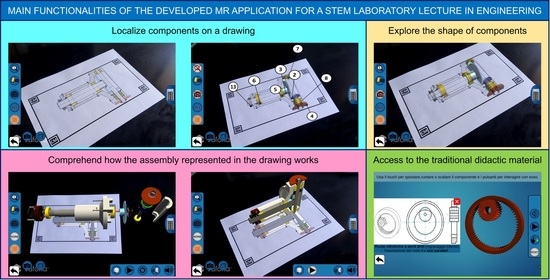
Share and Cite
Gattullo, M.; Laviola, E.; Boccaccio, A.; Evangelista, A.; Fiorentino, M.; Manghisi, V.M.; Uva, A.E. Design of a Mixed Reality Application for STEM Distance Education Laboratories. Computers 2022, 11, 50. https://doi.org/10.3390/computers11040050
Gattullo M, Laviola E, Boccaccio A, Evangelista A, Fiorentino M, Manghisi VM, Uva AE. Design of a Mixed Reality Application for STEM Distance Education Laboratories. Computers. 2022; 11(4):50. https://doi.org/10.3390/computers11040050
Chicago/Turabian StyleGattullo, Michele, Enricoandrea Laviola, Antonio Boccaccio, Alessandro Evangelista, Michele Fiorentino, Vito Modesto Manghisi, and Antonio Emmanuele Uva. 2022. "Design of a Mixed Reality Application for STEM Distance Education Laboratories" Computers 11, no. 4: 50. https://doi.org/10.3390/computers11040050
APA StyleGattullo, M., Laviola, E., Boccaccio, A., Evangelista, A., Fiorentino, M., Manghisi, V. M., & Uva, A. E. (2022). Design of a Mixed Reality Application for STEM Distance Education Laboratories. Computers, 11(4), 50. https://doi.org/10.3390/computers11040050