
Article

The Application of Deep Learning Algorithms for PPG Signal Processing and Classification
by
Filipa Esgalhado
1,2,3,*,
Beatriz Fernandes
3,
Valentina Vassilenko
1,2,3,
Arnaldo Batista
1,4 and
Sara Russo
1
1
NOVA School of Science and Technology, NOVA University Lisbon, 2829-516 Caparica, Portugal
2
LIBPhys-Laboratory of Instrumentation, Biomedical Engineering and Radiation Physics, 2829-516 Caparica, Portugal
3
NMT, S.A., Parque Tecnológico de Cantanhede, Núcleo 04, Lote 3, 3060-197 Cantanhede, Portugal
4
UNINOVA CTSNOVA, School of Science and Technology, NOVA University Lisbon, 2829-516 Caparica, Portugal
*
Author to whom correspondence should be addressed.
Computers 2021, 10(12), 158; https://doi.org/10.3390/computers10120158

Submission received: 30 October 2021 / Revised: 12 November 2021 / Accepted: 22 November 2021 / Published: 25 November 2021
(This article belongs to the Special Issue Computing, Electrical and Industrial Systems 2021)

Abstract

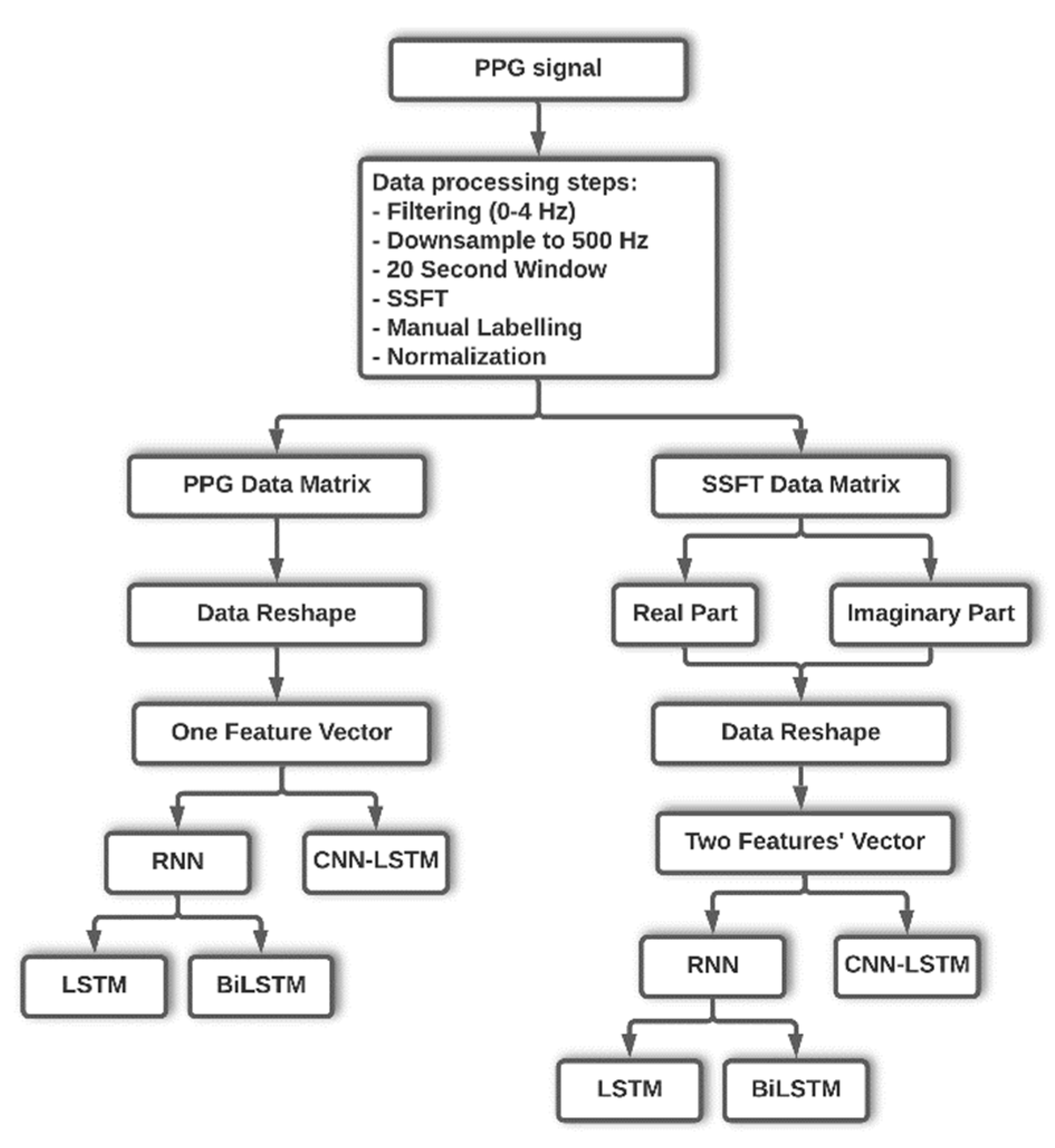
Photoplethysmography (PPG) is widely used in wearable devices due to its conveniency and cost-effective nature. From this signal, several biomarkers can be collected, such as heart and respiration rate. For the usual acquisition scenarios, PPG is an artefact-ridden signal, which mandates the need for the designated classification algorithms to be able to reduce the noise component effect on the classification. Within the selected classification algorithm, the hyperparameters’ adjustment is of utmost importance. This study aimed to develop a deep learning model for robust PPG wave detection, which includes finding each beat’s temporal limits, from which the peak can be determined. A study database consisting of 1100 records was created from experimental PPG measurements performed in 47 participants. Different deep learning models were implemented to classify the PPG: Long Short-Term Memory (LSTM), Bidirectional LSTM, and Convolutional Neural Network (CNN). The Bidirectional LSTM and the CNN-LSTM were investigated, using the PPG Synchrosqueezed Fourier Transform (SSFT) as the models’ input. Accuracy, precision, recall, and F1-score were evaluated for all models. The CNN-LSTM algorithm, with an SSFT input, was the best performing model with accuracy, precision, and recall of 0.894, 0.923, and 0.914, respectively. This model has shown to be competent in PPG detection and delineation tasks, under noise-corrupted signals, which justifies the use of this innovative approach.
Keywords: PPG; biomedical signal processing; deep learning; neural networks; RNN; CNN; LSTM PPG; biomedical signal processing; deep learning; neural networks; RNN; CNN; LSTM
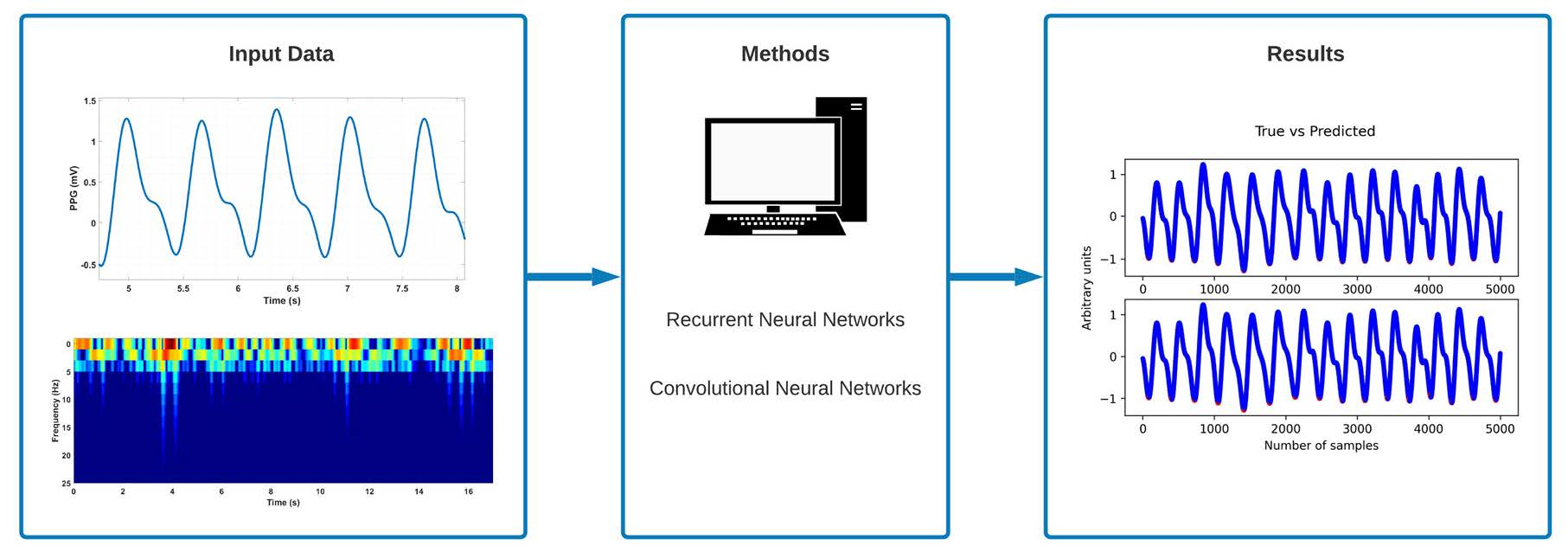
Graphical Abstract