


Simple Summary
Ovarian cancer has the poorest survival outcomes among all gynaecological cancers. Body composition has been identified as a modifiable patient-related factor with the potential to enhance how patients are evaluated to identify risk of poorer outcomes. Our retrospective study aimed to identify pretreatment body composition phenotypes in women with ovarian cancer and investigate relationships with treatment outcomes, including survival. In this cohort of 99 women, we found most women had low muscle mass, over half had poor muscle composition, and only four had a normal body composition before starting treatment. We also found that post-menopausal women had higher amounts of visceral fat. Women who had low muscle mass or poor muscle composition occurring alongside high adiposity before treatment had the poorest survival outcomes. These findings suggest potentially additive effects when body composition phenotypes occur together. Future studies should continue to consider the complexity of body composition when assessing pretreatment risk.
Abstract
Background/Objectives: In ovarian cancer, the association between low muscle mass and outcomes is unclear, despite well-established evidence in other cancer diagnoses. Overall body composition may have greater prognostic value. This study aimed to investigate associations between body composition and clinical outcomes. Methods: Retrospective study of women diagnosed with ovarian cancer between August 2020 and March 2024. Clinical characteristics were extracted from medical records. Body composition phenotypes (low skeletal muscle index [SMI], low skeletal muscle density [SMD], high subcutaneous [SATI], visceral [VATI] and total adipose tissue index [TATI]) were assessed from pre-treatment CT images. Logistic regression, chi-squared, Fisher’s exact tests, and Mann–Whitney U tests were used to assess associations between body composition phenotypes, patient characteristics and study outcomes. Cox proportional hazards models were fitted to examine associations with survival. Results: Ninety-nine patients [mean (SD) age 61 (12.7) years, 80% stage III/IV] were included. Overall, 67 (67%) women had low SMI, 57 (57%) low SMD, and 49 (49%) high TATI. Thirty-seven (37%) women had low SMI and low SMD, 23 (23%) low SMI with high TATI, and 33 (33%) low SMD with high TATI. Post-menopausal status was associated with higher VAT (p = 0.004). Low SMI or low SMD co-occurring with high adiposity was associated with a 1.91–2.03 and 2.15–2.49 higher hazard mortality. There was insufficient or weak evidence of an association between body composition and other treatment outcomes. Conclusion: These findings suggest additive effects when phenotypes co-occur. In ovarian cancer, singular assessments may be an oversimplification. Future studies should continue to consider co-occurring phenotypes to adequately capture risk.
1. Introduction
Globally, cancer is a leading cause of death [1]. The increasing pressure on health systems in every country, as the burden of cancer continues to grow, requires high-quality, equitable care across cancer diagnoses [1]. Ovarian cancer continues to have the poorest survival outcomes among all gynaecological cancers worldwide [2]. In Australia, ovarian cancer accounts for 26% of all gynaecological cancers, yet is responsible for 48% of all gynaecological cancer deaths [3]. Most women are diagnosed with an advanced-stage, high-grade disease, and less than 50% will survive five years [4]. Reducing these discrepancies requires care equipped to address the entire cancer continuum, including innovations in predictive biomarkers to tailor treatment and enhance risk stratification [1,5].
Maximal cytoreductive surgery with platinum-based chemotherapy prior to (neoadjuvant) and/or after (adjuvant) surgery remain central in the treatment of ovarian cancer [6,7,8]. The ability to tolerate, adhere to and recover from the prescribed treatment schedule, including the achievement of maximal cytoreduction, is highly dependent upon both tumour- and patient-related factors [9]. While established clinical prognostic factors such as age at diagnosis, disease stage, histological subtype, performance status, menopausal status, ascites and degree of residual disease following surgery are well-established in ovarian cancer [10,11], increasing attention is being placed upon modifiable patient-related factors. Among them, computed tomography (CT) quantification of muscle morphology (mass and composition) and body composition, specifically the distribution of muscle and adipose tissue, have been identified as modifiable factors with predictive and prognostic significance [12,13].
In other cancer diagnoses, low muscle mass is consistently associated with increased postoperative complications, treatment-related toxicity, and overall survival [14,15,16]; however, these associations in ovarian cancer are not as clear. Several meta-analyses have investigated the prognostic value of low muscle mass in ovarian cancer with mixed results [11,17,18,19,20,21,22]. Similarly, the relationship between overweight and obesity and survival outcomes in ovarian cancer is unclear [23,24]. This uncertainty may in part be explained by the limitations of using body mass index (BMI) as a proxy for adiposity [25,26]. More recently, a meta-analysis of CT assessed adiposity by Cheng et al. [27] reported no associations between visceral, subcutaneous or total adiposity and survival outcomes in ovarian cancer, with data pooled from four studies. Low muscle mass and adiposity, however, represent single body composition phenotypes that are not mutually exclusive [28]. The cumulative burden of low muscle mass co-existing with high adiposity and low muscle quality may have greater prognostic significance [17,18,20,29,30,31,32,33]. Given the majority of women with ovarian cancer (~75%) are diagnosed at a menopausal age, this population also represents an important intersection between cancer and age-related changes in body composition [34]. The composition of the skeletal muscle, which reflects the degree of lipid deposition into muscle, is represented by skeletal muscle radiodensity (SMD), a prognostic marker inversely related to muscle lipid deposition [35]. Across the ovarian cancer literature, low SMD is consistently associated with poorer overall survival [17,18,20,29,30,31] and may be a more robust predictor for postoperative complications [20].
To date, most research in ovarian cancer has evaluated a singular muscle phenotype, primarily low muscle mass, and focused on survival outcomes, postoperative complications and hospitalisation [11,17,21]. More recently, investigations have begun to examine the differential and combined effects of adipose tissue compartments with muscle mass on survival, and chemotoxicity [29,30,31,32]. However, across all investigations, co-occurring low SMD has not yet been considered. Earlier research in other cancer types has shown that while low muscle mass and low SMD are distinct phenotypes, when they occur together, they have additive effects [36,37]. In patients with pancreatic and periampullary cancers (n = 123), neither low skeletal muscle index (SMI) nor SMD alone was associated with worse overall survival, whereas the co-occurring SMI and SMD phenotype was associated with 3.08-fold increased hazard for mortality (95% CI: 1.01–9.43, p = 0.048) [36], and similar associations were observed in colorectal cancer [37]. Given the multifaceted nature of body composition, comprehensive assessment that considers the differential and combined effects of all potential phenotype combinations, including low SMD, is required to build on the emerging body composition research.
Accordingly, this study comprehensively evaluates pretreatment body composition and its associations with key treatment-related outcomes in a cohort of women diagnosed with epithelial ovarian cancer. First, muscle mass, SMD, and adipose tissue areas (visceral, subcutaneous, total) were quantified from secondary analysis of routine CT imaging. We then examined pretreatment body composition phenotypes and associations between independently and concurrently occurring phenotypes with surgical outcomes, chemotherapy-related outcomes, hospitalisation and survival. This approach considers the influences of all body composition phenotypic combinations, extending the literature beyond singular assessments across several clinically important outcomes, including chemotoxicity.
2. Materials and Methods
2.1. Ethics Approval and Reporting
This study was approved by the Peter MacCallum Cancer Centre Human Research Ethics Committee with waiver of informed consent (24/39L, HREC/1066859/PMCC) and Deakin University Research Ethics. This study is reported according to the Strengthening the Reporting of Observational studies in Epidemiology (STROBE) statement [38].
2.2. Study Design and Population
A retrospective, observational cohort study was conducted in patients newly diagnosed with epithelial ovarian cancer (EOC) who received first-line treatment at Peter MacCallum Cancer Centre from the inception of electronic medical records (EMRs) in September 2020 until March 2024. Inclusion criteria included adult females (≥18 years), a histologically confirmed diagnosis of EOC, and the availability of any pretreatment CT image acquired for staging, diagnosis, or treatment planning. Exclusion criteria included a previous or concurrent cancer diagnosis, co-morbidities known to affect body composition (e.g., muscular dystrophy, other degenerative muscular conditions), CT images without suitable quality for analysis or images that did not contain the third lumbar vertebrae (L3).
2.3. Clinical Data Extraction
Baseline patient demographics, clinicopathological data, ovarian cancer-specific characteristics and treatment schedules were extracted from the EMR. Demographic and clinicopathological data included age at diagnosis, weight (kg), height (cm), BMI (kg/m2), Charlson co-morbidity score [39], Eastern Cooperative Oncology group (ECOG) performance status [40], and menopausal status (postmenopausal, yes/no). Ovarian cancer-specific data included International Federation of Gynaecology and Obstetrics stage of disease (stage I to IV) [41] and histological subtype(s) (high-grade serous, low-grade serous, endometrioid, clear cell, mucinous, other). Treatment schedules for chemotherapy (neoadjuvant and/or adjuvant), surgery type, including primary debulking (PDS), interval debulking surgery (IDS), and surgery with intraperitoneal chemotherapy (IP) (hyperthermic or normothermic), and any additional treatment with radiotherapy, hormone therapy, and targeted therapies (bevacizumab and PARP inhibitors) were extracted from the EMR.
2.4. Body Composition Analysis by Computed Tomography
Routine pretreatment CT images acquired for staging and treatment planning were assessed. SliceOmatic® software Version 6.0 (Tomovision, Quebec, QC, Canada) was used to assess body composition and quantify skeletal muscle area (SMA), SMD, and adipose tissue areas (visceral and subcutaneous) using the Alberta Protocol [42,43]. A range of −29 to 150 Hounsfield Units (HU) was used to distinguish SMA at L3. SMA was normalised for height (m2) to determine SMI (cm2/m2). For SMD (representing muscle composition), the mean muscle attenuation (HU) was reported. Low SMI was defined as <41 cm2/m2 for patients of any BMI. Low SMD was defined by a threshold of <41 HU for patients with a BMI ≤ 24.5 kg/m2 and <33 HU for patients with a BMI ≥ 25.0 kg/m2 [44]. The thresholds used to define low SMI and SMD were according to the widely used sex-and-BMI-specific cut-points proposed by Martin et al. [44], derived from a Canadian cancer population and appropriately similar to the Australian population in our study.
For adipose tissues, a range of −30 to −190 HU was used to distinguish subcutaneous adipose tissue (SAT), and a range of −50 to −150 HU to distinguish visceral adipose tissue (VAT). The sum of SAT and VAT were normalised for height (m2) to generate total adipose tissue index (TATI cm2/m2). The cross-sectional areas for SAT and VAT individually were normalised for height (m2) to generate SATI (cm2/m2) and VATI (cm2/m2). In the absence of validated cut-off points to define high adipose tissue areas, SATI, VATI and TATI were dichotomised using the median as the cut-point, a sample-derived approach used in other studies [45,46]. All segmentation was completed by a single certified researcher (SBD) and reviewed for accuracy by a second researcher with expertise in this methodology (NK).
2.5. Outcome Measures
Surgical outcomes, including the occurrence and severity of postoperative complications and degree of residual disease following surgery, were extracted from medical records. Postoperative complications were classified according to the Clavien–Dindo scale of surgical complications [47], with a complication grade of ≥3 used to define severe complications. Degree of residual disease following surgery was reported as complete (no macroscopic disease), optimal debulk (≤1 cm) or suboptimal debulk (>1 cm) [8].
Hospitalisation outcomes included length of surgical admission and 30-day readmissions following surgery. Readmission was defined as any inpatient or emergency admission within 30 days of first surgical discharge.
Chemotherapy-related outcomes included time (in days) to commencement of adjuvant chemotherapy, toxicities from the first chemotherapy cycle, dose modifications, reductions in number of planned cycles and discontinuation during any schedule (neo/adjuvant). Chemotherapy toxicities were defined using the Common Terminology Criteria for Adverse Events (CTCAE) [48], and when documented, the complication grade (Grade 0 [nil] to 4 [life threatening]) were extracted from the medical records.
Overall survival was defined as the date of diagnosis until death of any cause or date of censoring 2 July 2025.
Death data were ascertained from the Victorian Registry of Births, Deaths and Marriages. Death dates were reviewed and cross-referenced with the hospital medical records, which are immediately updated to account for reporting delays, deaths outside jurisdiction and limitations to data matching with registry data [49].
2.6. Statistical Analysis
Descriptive statistics were reported as mean ± SD or median [IQR] for continuous variables and counts (percentages) for categorical variables. Continuous variables were checked for normality using histograms and Q-Q plots. There was <5% missing data overall, and all analyses were conducted on an available case basis. Patient and clinical characteristics between body composition phenotypes (e.g., low SMI vs. normal SMI, low SMD vs. normal SMD, high TATI vs. normal TATI) were compared using chi-squared and Fisher’s exact tests for categorical variables and independent t-tests and Mann–Whitney U tests for continuous variables. The differential and combined effects (where sample size permitted) of each body composition phenotype on treatment-related outcomes were evaluated using Mann–Whitney U tests for continuous outcomes, chi-squared or Fisher’s exact tests for associations between categorical variables and logistic regression for binary outcomes. Associations between pretreatment body composition with complication grade, 30-day readmission, chemotherapy toxicity and dose modifications were examined using chi-squared and Fisher’s exact tests. Associations with LOS and time to adjuvant chemotherapy were assessed using Mann–Whitney U tests due to non-normality. Potential confounding factors were identified a priori using directed acyclic graphs (DAGs) with DAGitty software version 3.1 [50,51]. Age (continuous), tumour stage (binary) and CCI (continuous) were identified as potential confounders, with BMI (continuous) an additional potential confounder for low SMD models (Supplementary Material Figure S1). Logistic regression models were fitted to examine postoperative complication occurrence by phenotype. Given the limited number of events, the models were adjusted for age and tumour stage based on their strong prognostic associations with survival in ovarian cancer [51] and their influence on pretreatment body composition.
Cox proportional hazards models were fitted and adjusted to estimate the association between pretreatment body composition phenotype and survival. All models were adjusted for age, tumour stage and CCI. Low SMD models were further adjusted for BMI. The proportional hazards assumptions were tested and met for all models. Leave-one-out analysis was performed, and no influential observations were identified. Covariate-adjusted Kaplan–Meier curves were constructed for overall survival for each body composition phenotype. All statistical analyses were two-sided and conducted in Stata/SE version 18.0 (College Station, TX USA). Figure 1 was generated using R version 4.4.0 (Vienna, Austria). The strength of the evidence against the null hypothesis (i.e., no association) was interpreted as: p < 0.001 very strong evidence, p < 0.01 strong evidence, p < 0.05 moderate evidence, p < 0.1 weak evidence, p > 0.1 insufficient evidence [52]. As analysis was considered exploratory, no adjustment was made for multiple testing.
Figure 1.
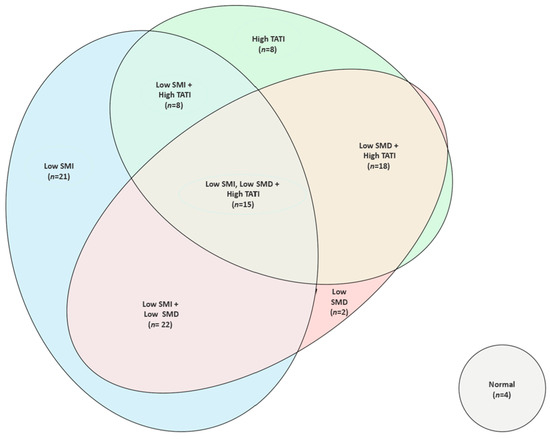
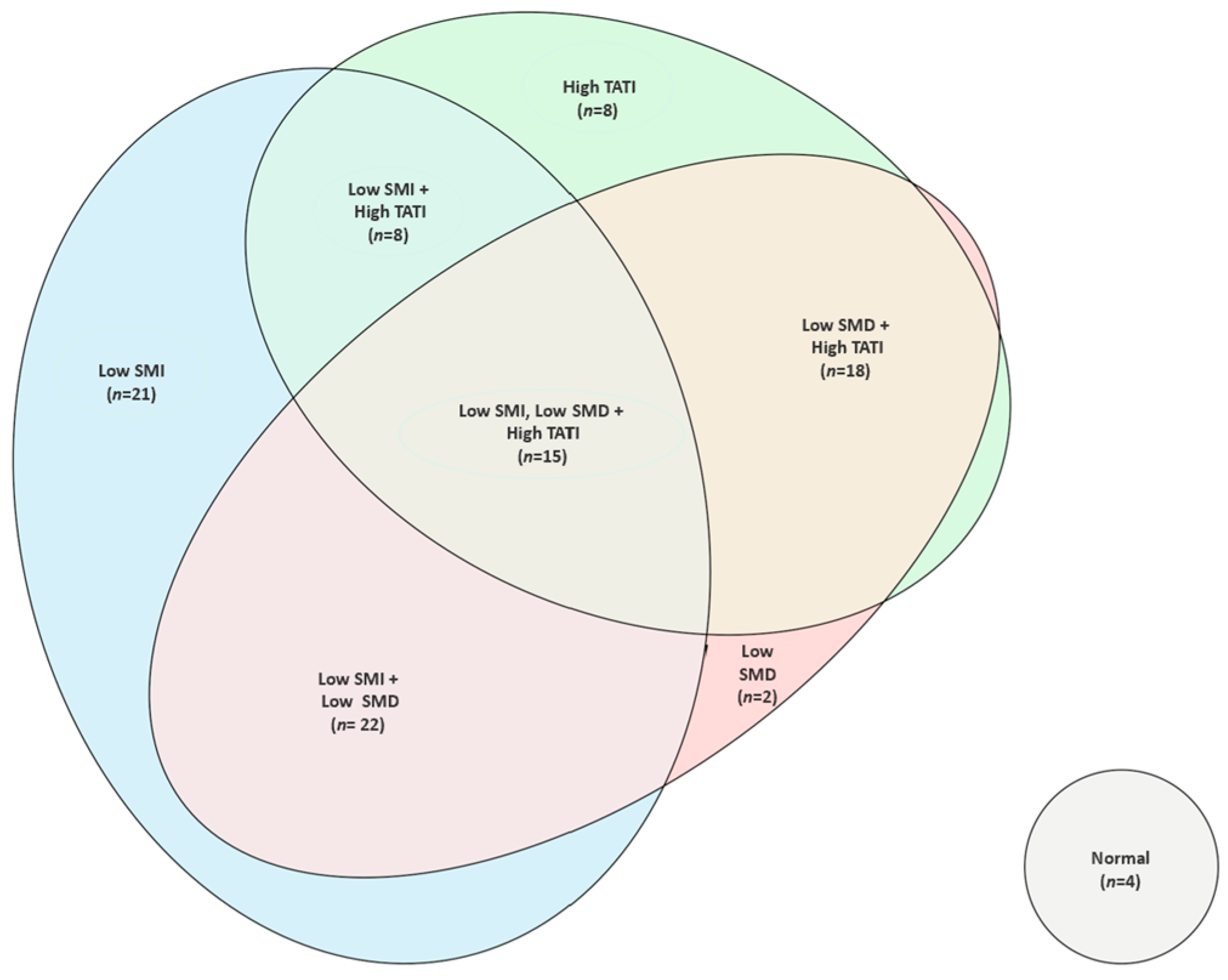
Euler diagram demonstrating proportion of each body composition phenotype across the sample.
3. Results
A total of 99 patients were included in the study. Patient characteristics are described in Table 1. Mean age at diagnosis was 61 ± 12.7 (range 28–89), 67% (n = 66) had high-grade serous histology, and 83% (n = 80) had an advanced stage of disease (III/IV). Of the included women, 75 (76%) were treated with surgery, 24 (24%) with neoadjuvant chemotherapy only, 19 (19%) with adjuvant chemotherapy only, 33 (33%) received both schedules, while 32 (32%) received maintenance targeted therapy. Overall, 67% had low SMI, 57% had low SMD and 37% had both low SMI and SMD prior to commencing treatment. Using the median (≥107.9 cm2/m2) to define high total adiposity, 49% had high TATI. Among them, 23% had high TATI with low SMI, 33% high TATI with low SMD and 15% had high TATI with low SMI and low SMD. When evaluating the distribution of each body composition phenotype exclusively, only four patients had normal body composition at treatment commencement (Figure 1). The mean time between CT scan and treatment commencement was 20.7 ± 24.7 days.
Table 1.
Demographic and clinical characteristics (N = 99).
3.1. Associations Between Patient Characteristics and Body Composition
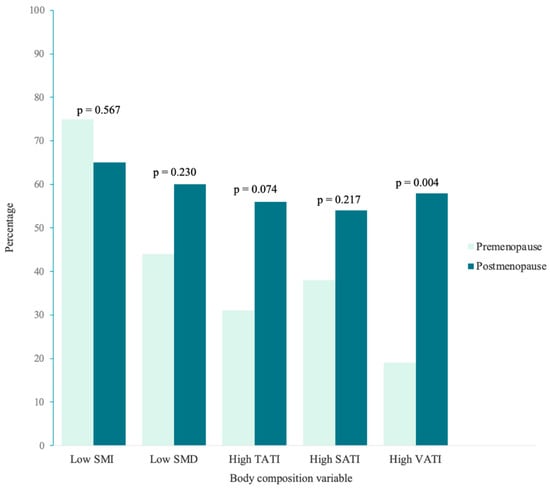
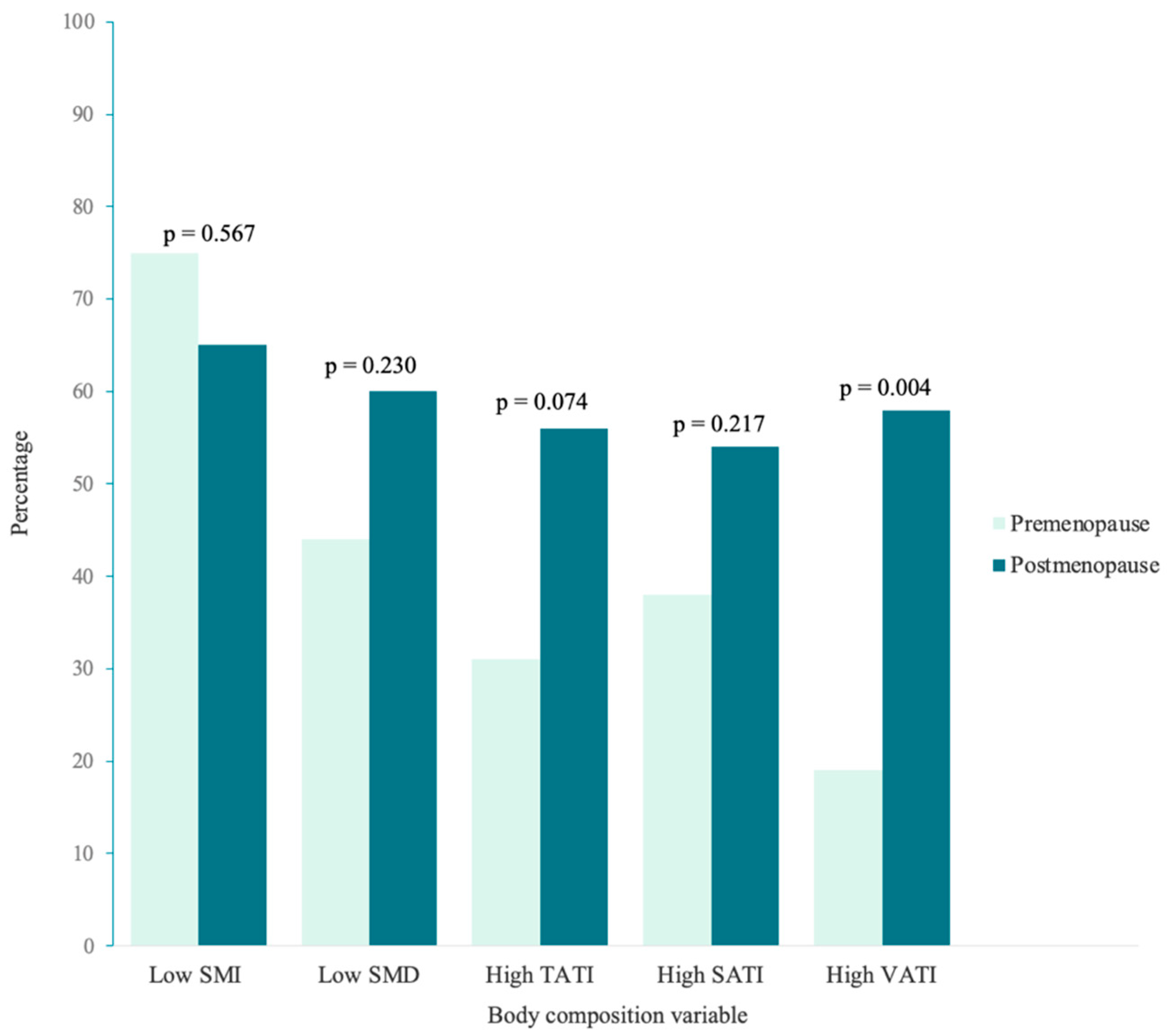
There was very strong evidence that both low body weight and low BMI were associated with low SMI (p < 0.001). For SMD, there was strong evidence that an impaired performance status was associated with low SMD (p = 0.006), moderate evidence that older age (p = 0.012), a higher BMI (p = 0.012) and higher body weight (p = 0.048) were associated with low SMD and weak evidence that a higher comorbidity score was associated with low SMD (p = 0.057). There was very strong evidence that a higher body weight (p < 0.001) and higher BMI (p < 0.001), moderate evidence that a higher comorbidity score (p = 0.017) and weak evidence that post-menopausal status (p = 0.074) were associated with high TATI. When investigating body composition by menopausal status, there was strong evidence of an association between post-menopausal status and high VATI (p = 0.004), weak evidence of an association with high TATI (p = 0.074), and no evidence of an association with high SATI (p = 0.217). There was no evidence of association between skeletal muscle phenotypes (low SMI and low SMD) and menopausal status. Body composition by menopausal status is shown in Figure 2. No other variables were associated with pretreatment body composition (Table 2).
Figure 2.
Prevalence of body composition phenotypes by menopausal status.
Table 2.
Association between patient and clinical characteristics and pretreatment body composition.
3.2. Surgical Outcomes
Of the 75 patients treated with surgery, 34 (45%) experienced a postoperative complication. The most common complications were non-infections (79%, n = 27), with 35% (n = 12) requiring a blood transfusion, and gastrointestinal complications (35%, n = 12), with 16% (n = 9) experiencing postoperative ileus. Eighteen (53%) patients had multiple complications, five (15%) were admitted to intensive care following surgery, and two (6%) were returned to theatre due to complications. There was no evidence of an association between any body composition phenotype and postoperative complications (Supplementary Table S1). Median LOS for surgical admission was 3 [2-7] days, and 10 (13%) women were readmitted within 30 days of surgical discharge. There was no evidence of an association between any body composition phenotype with LOS, and weak evidence that high TATI was associated with fewer 30-day readmissions (p = 0.086) (Table 3). Of the 34 women who experienced a postoperative complication, 23 (68%) were minor, and 11 (32%) were severe (Clavien–Dindo classification ≥ grade 3). There was no evidence of an association between any body composition phenotype and complication severity (Table 3).
Table 3.
Associations between pretreatment body composition and hospitalisation, complication severity and chemotherapy-related outcomes.
3.3. Chemotherapy-Related Outcomes
Of the 57 women treated with neoadjuvant chemotherapy, 42 (74%) experienced toxicity (≥Grade 1) from chemotherapy cycle one, and 27 (47%) required a dose modification. For those treated with adjuvant chemotherapy following surgery (n = 52), median time to chemotherapy commencement was 24.5 [21-29] days (range 2–63), 31 (60%) experienced a toxicity (≥Grade 1) from the first cycle, and 33 (63%) required a dose modification. There was no evidence of an association between neoadjuvant chemotherapy-related outcomes and any body composition phenotype. For adjuvant chemotherapy, there was weak evidence of an association between low SMI and low SMD combined phenotype and shorter time to adjuvant chemotherapy (p = 0.050). There was also weak evidence that high VATI was associated with reduced toxicity from adjuvant chemotherapy cycle one (p = 0.089) (Table 3).
3.4. Survival
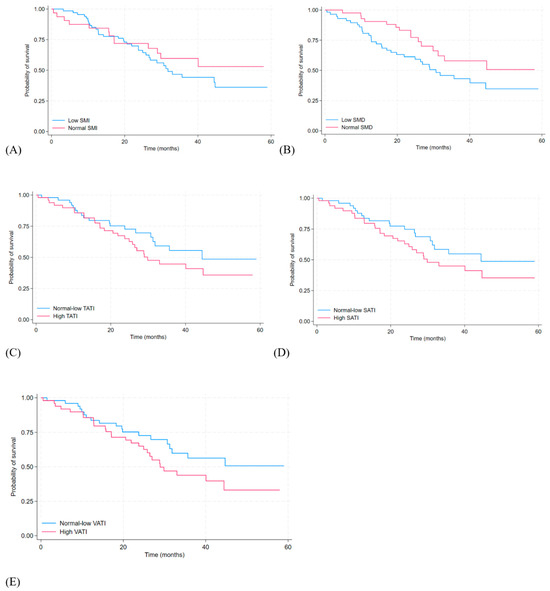
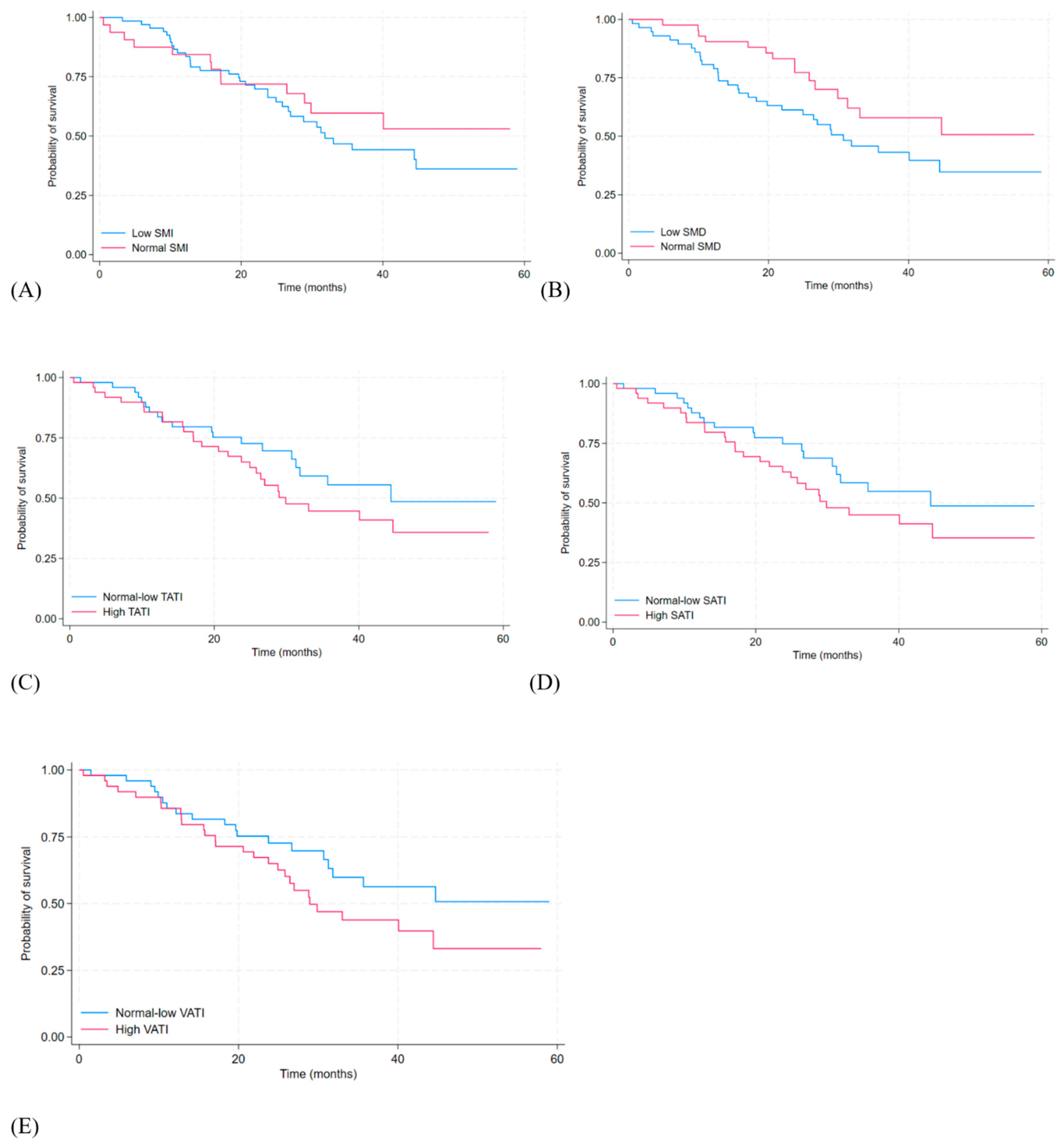
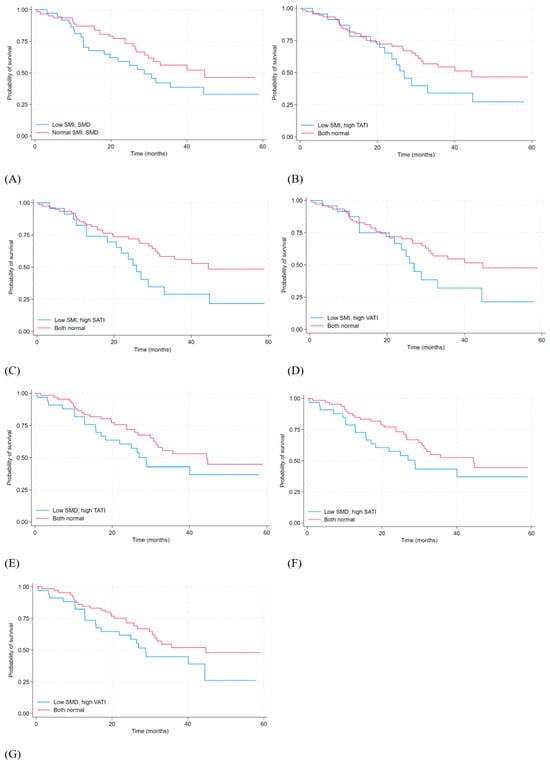
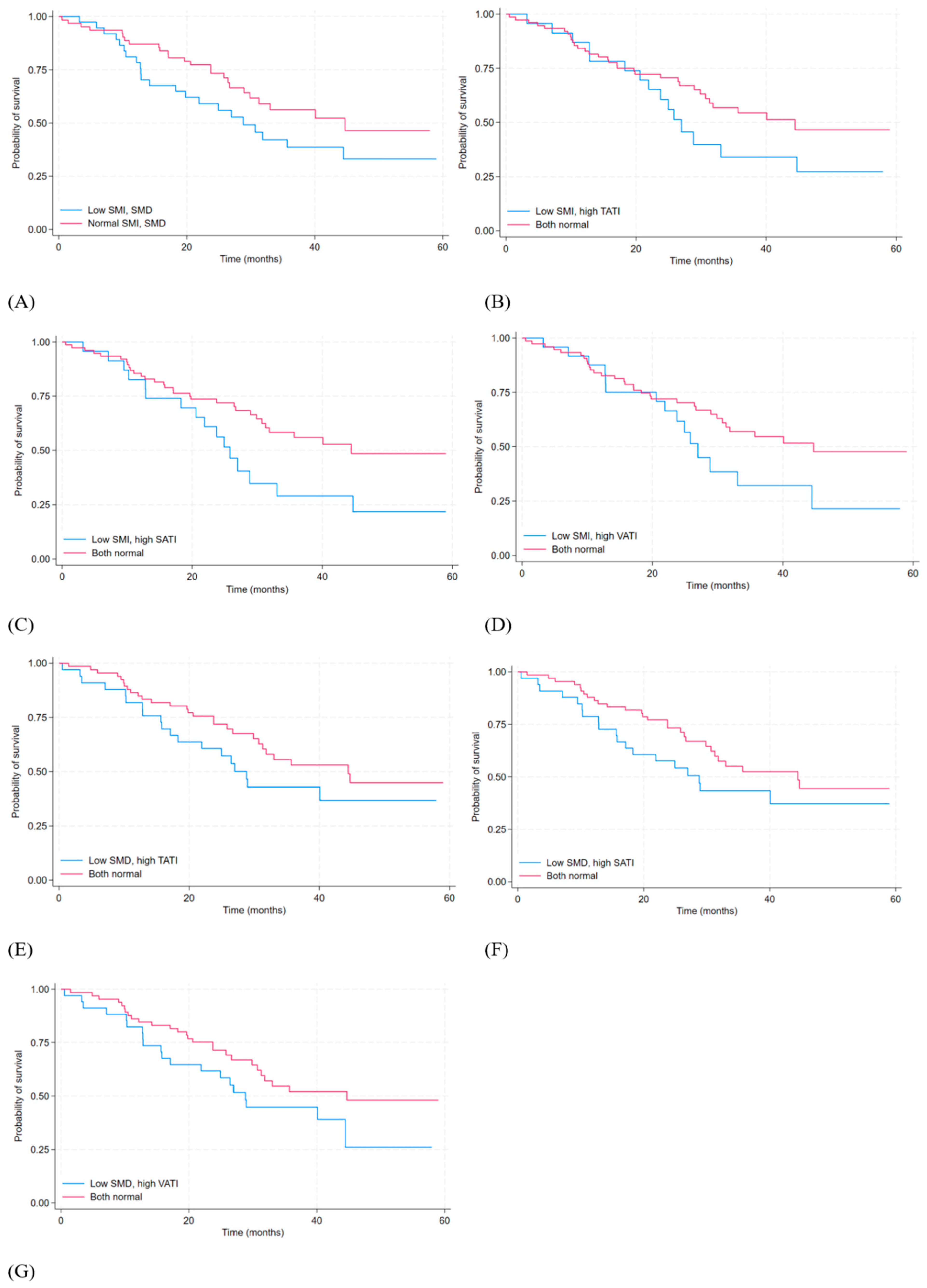
The median follow-up time was 26 months, during which time 48 (48%) of the 99 included patients died. There was weak evidence that low SMD (HR: 1.74, 95% CI: 0.90–3.37, p = 0.098) and high VATI (HR: 1.87; 95% CI: 0.97–3.58; p = 0.060) as singular phenotypes were associated with a higher risk of mortality. There was insufficient evidence of an association between low SMI, high TATI or high SATI and mortality (Table 4). Among co-occurring phenotypes, there was moderate evidence of higher mortality in patients with low SMI with high TATI (HR: 1.91, 95% CI: 1.01–3.61; p = 0.046) and high SATI (HR: 2.03, 95% CI: 1.10–3.78; p = 0.025). There was weak evidence of higher mortality in patients with low SMI with high VATI (HR: 1.91, 95% CI: 0.98–3.72; p = 0.057). There was moderate evidence of higher mortality in patients with low SMD alongside high TATI (HR: 2.33, 95% CI: 1.03–5.28; p = 0.043) and high VATI (HR: 2.49, 95% CI: 1.10–5.67; p = 0.029) and weak evidence for higher mortality in patients with low SMD with high SATI (HR: 2.15, 95% CI: 0.99–4.67; p = 0.053). All results of the Cox proportional hazards analysis are shown in Table 4. Kaplan–Meier curves are presented for overall survival (Figure 3 and Figure 4).
Table 4.
Association between pretreatment body composition and overall survival.
Figure 3.
Kaplan–Meier survival curves for singular phenotypes: (A) low SMI, (B) low SMD, (C) high TATI, (D) high SATI, (E) high VATI. SMI: skeletal muscle index, SMD: skeletal muscle density, TATI: total adipose tissue, SATI: subcutaneous adipose tissue index, VATI: visceral adipose tissue index.
Figure 4.
Kaplan–Meier survival curves for combined phenotypes: (A) low SMI and low SMD, (B) low SMI and high TATI, (C) low SMI and high SATI, (D) low SMI and high VATI, (E) low SMD and high TATI, (F) low SMD and high SATI, (G) low SMD and high VATI, SMI: skeletal muscle index, SMD: skeletal muscle density, TATI: total adipose tissue, SATI: subcutaneous adipose tissue index, VATI: visceral adipose tissue index.
4. Discussion
In this retrospective cohort study of 99 women with epithelial ovarian cancer (EOC), we found two-thirds of women had low muscle mass, over half had poor muscle composition, and only four women had normal body composition at the commencement of treatment. Low muscle mass in combination with high adiposity was associated with 1.91 to 2.03 times higher hazard of mortality, while low muscle density (reflecting muscle composition) in combination with high adiposity was associated with 2.15 to 2.49 times higher hazard of mortality. These associations, while exploratory, were independent of age, tumour stage, comorbidities and BMI. Interestingly, when single body composition phenotypes were examined, there was only moderate evidence of a higher hazard of mortality with low muscle density and high visceral adiposity. Although 45% experienced a postoperative complication, 13% were readmitted within 30 days, and 47% of those treated with neoadjuvant and 63% with adjuvant chemotherapy required a dose modification; there was no evidence of an association between these outcomes and body composition phenotype.
Throughout the literature in EOC, the influence of low SMI on survival is conflicting [17,18,19,20,21,22], and while low SMD is relatively novel, the association with survival is largely consistent [11,18,20,22,33]. However, binary investigations focusing on a single phenotype fail to recognise that body composition is multifaceted beyond skeletal muscle alone. Our analysis found that women with low SMI or low SMD who also had high adiposity had the highest risk of mortality. Conversely, as independent phenotypes, there was only weak or insufficient evidence of an association of low SMD and low SMI with mortality, suggesting the additive effect of adiposity is important. In this analysis, mortality risk was highest for women with low SMD co-occurring with high total and visceral adiposity. While the additive effects of low SMI co-occurring with high adiposity, referred to as sarcopenic obesity, have been identified as a unique phenotype associated with poor prognosis across numerous cancer types [53,54], the effects of low SMD co-occurring with high adiposity in both EOC and cancer more broadly are largely unexplored. In patients with head and neck cancer, Findlay et al. [55] did not detect any significant associations with survival for patients with low SMD and obesity (aHR: 0.79, 95% CI: 0.27–3.39, p = 0.70). However, Findlay et al. [55] used BMI to define obesity, potentially obscuring the true effect of adiposity. Although BMI is still widely utilised clinically, it is an imprecise measure of body composition, often misclassifying adipose tissue level due to its inability to distinguish skeletal muscle [26]. The importance of adiposity and need for precise evaluations of body composition are further underscored by our finding that low SMI was only associated with worse overall survival in the presence of high adiposity. These findings are aligned with four earlier studies using CT-based evaluations of body composition in EOC in samples ranging from 197 to 500 women with primarily advanced-stage disease. Collectively, these investigations showed high visceral fat-to-muscle [30], high total fat-to-muscle-ratio [31] and high adiposity co-occurring with low SMI [32], or low psoas indices [29] were associated with between a 1.55 and 3.3 increased hazard for mortality [29,30,31,32]. Despite the heterogeneity among the studies and psoas evaluations as a proxy for the muscle mass, together with our exploratory findings, these highlight the limitation of focusing on single phenotypes in ovarian cancer, which risks oversimplification.
Our results investigating associations between low SMI as a single phenotype aid in clarifying the discordant literature. Our finding that low SMI was not associated with survival is consistent with other recent studies in EOC [56,57] and aligned with meta-analyses that examined eight studies collectively [11,17,18,22]. Although, two additional meta-analyses reported low SMI was associated with a 30% increased hazard for mortality (95% CI: 1.07–1.58, p value not reported, n = 15 studies) [20] and 35% higher odds of mortality (95% CI: 1.05–1.74, p = 0.02, n = 8 studies) [21]; the conflicting findings from these analyses are likely attributable to methodological difference. In these analyses, studies evaluating SMI as a continuous variable, SMI from psoas or total SMA, and those with small sample sizes (n = 12) and unadjusted analyses were pooled together [20,21], and one meta-analysis used a different statistical approach (odds ratio) [21]. Our findings reinforce that in women with EOC, muscle mass must be assessed within the context of adipose tissue to adequately identify risk of adverse outcomes. For SMD as a single phenotype, in contrast to the existing body of literature both in EOC and across multiple diagnoses [58], our study showed only a weak association with survival (p = 0.098). In EOC, six meta-analyses collectively evaluating seven studies [11,17,18,20,22,33] have consistently reported strong associations between low SMD and survival. The lack of association in our study may, in part, be due to sample size; however, across this literature, there is substantial heterogeneity in methods used to define low SMD. In the absence of standardised cut points, most studies in EOC have utilised sample-derived definitions, including median, tertile, and mean-based methods ranging from <21.24 to <39 HU [59,60,61,62,63,64,65], and importantly, none were stratified by BMI. While the relevance of BMI-corrected cut points has been questioned due to its limitations in patients with ascites [61,65,66], lipid accumulation in skeletal muscle is associated with obesity [35], and SMD is negatively correlated with BMI [67]. One other study in women with predominantly advanced, high-grade EOC (n = 140) has used the same BMI-adjusted cut points by Martin et al. [44] to investigate associations with survival and reported no evidence of an association after adjustment for confounders (HR 1.44, 95% CI: 0.73–2.86, p = 0.297) [65]. However, when using a sample-derived cut point (<39 HU), SMD was an independent predictor for survival (HR: 2.25, 95% CI: 1.09–4.65, p = 0.028), highlighting the need to clarify clinically translatable definitions of low SMD.
In this study, 67% of women had low SMI, and 57% had poor muscle composition prior to commencing treatment. This is higher than estimates in previous studies of women with EOC. In 2022, a meta-analysis by Tranoulis et al. [17] found 41% had low SMI prior to treatment, with data pooled from fifteen studies including 2009 women with cut-off points ranging from 38.5 to 41.5 cm2/m2. Where reported, low SMD has ranged from 21 to 50% in samples of 140 to 323 women [11,20,33]. Differences in prevalence are likely explained by the definitions used to define low SMI and low SMD. In addition, we found 49% of women presented with high adiposity (based on the median) before treatment. Comparisons of the prevalence of high adiposity across the literature in EOC are limited by variations in the definition and cut points used for high adiposity, which encompass sample-dependent definitions using tertiles [32,64] or assessment of adipose tissue area [27,29,68] rather than index. In our cohort, only four women had normal body composition prior to commencing treatment, highlighting that for women with EOC, changes in body composition occur early in or prior to diagnosis, are pervasive, and represent a modifiable prognostic factor with important clinical implications.
A novel aspect of this study was the evaluation of body composition by menopausal status. We found moderate evidence that visceral adipose tissue distribution was associated with menopausal status, alongside weak evidence that high VATI was associated with poorer overall survival. Although EOC can occur at any age, most women are diagnosed post menopause (85% in this study), and this life stage is largely characterised by a shift in adipose tissue distribution, irrespective of body weight changes, with an observed increase in visceral fat [34,69]. This disproportionate shift also represents a transition to a metabolically unfavourable phenotype. Adipose tissue is an active endocrine and immunomodulatory organ with distinct patterns of adipokine secretion between subcutaneous and visceral tissue compartments [70,71,72]. The accumulation of visceral adipose tissue is characterised by dysregulated production of pro-inflammatory adipokines and immune activation, which may influence both tumour progression and the pharmacokinetics and pharmacodynamics of anti-cancer therapies [69,70,73]. Our finding that muscle mass and composition were not associated with menopausal status was unexpected, given the research showing accelerated gains in fat mass with concurrent loss of lean mass are a menopause-related phenomenon [74]. In this cohort, only 16 women were premenopausal at diagnosis, which may not be sufficient to detect true differences in skeletal muscle morphology and also warrants cautious interpretation of visceral adiposity differences, which require further validation. However, most women in this study also had an advanced stage of disease (83%); therefore, it is difficult to distinguish menopause-related from cancer-related changes in muscle morphology. Whereas, the redistribution of adipose tissue with increased accumulation of visceral fat is not commonly associated with the cancer-induced pro-catabolic shift in metabolism [75].
Although 45% of women in this study who underwent surgery experienced a postoperative complication, and 47% of those treated with neoadjuvant and 63% treated with adjuvant chemotherapy required a dose reduction, we found no evidence of an association of these outcomes with body composition. This may be a reflection of sample size and the number of events recorded. Notably, these findings are aligned with two earlier systematic reviews collectively evaluating postoperative complications in six studies in EOC [18,22], and more recently, two studies with 298 [76] and 192 [77] women, reporting no associations between low SMI and postoperative complications. While two other meta-analyses in EOC, with four additional studies, have reported low muscle mass was associated with increased complication risk, these analyses pooled studies with psoas evaluations and unadjusted results, which may explain the discrepancy in these findings [17,20]. Less research has investigated the influence of muscle composition and adipose tissue on postoperative complications in EOC. Evidence from a 2023 meta-analysis [20] and 2024 systematic review [78], together evaluating five original studies in EOC (samples ranging from 62 to 111) suggest poor muscle composition may be a risk factor for postoperative complications. While the results of our study are not aligned with these findings, sample-based definitions of low SMD in these studies may explain differences. Four studies with samples ranging from 61 to 298 women have evaluated the effect of adiposity on postoperative complications in EOC [68,76,77,79], with only one study detecting any association [76]. In this study by Heus et al. [76] (n = 298 women with advanced EOC), visceral obesity, defined as >100 cm2, was associated with a higher occurrence of postoperative complications. In colorectal cancer surgery, a recent meta-analysis of 28 studies with 11,129 patients reported high visceral adiposity was associated with higher rates of postoperative complications (OR: 1.96, 95% CI: 1.22–1.96, p = 0.003) [80]. Another single study on colorectal cancer (n = 1630) evaluating SMD reported that low preoperative muscle composition was associated with higher odds of having a major postoperative complication (OR: 2.42, 95% CI: 1.44–4.04) [37]. Increased lipid accumulation in muscle is associated with higher frailty and functional impairments, which are important factors for preoperative risk assessment [58]. In addition, elevated visceral adiposity increases surgical complexity and together contribute to local and systemic inflammation, potentially aggravating the surgically induced metabolic response, compromising recovery and wound healing [58,80]. In EOC, the achievement of optimal cytoreduction remains the strongest independent prognostic factor for survival, which often necessitates complex and aggressive procedures [6] and increasing risk of postoperative complications [81]. Preoperative risk prediction tools are critically important in major abdominal procedures, particularly among high-risk patients [82]. These findings highlight that in EOC, muscle composition may be more important than muscle quantity, and that the distribution of adipose tissue may be more important than the amount. While this research remains in its infancy, more detailed assessments of body composition could hold potential for enhanced personalisation of preoperative risk assessment and access to early interventions.
Combination chemotherapy with taxane and platinum-based drugs are important first-line treatments for EOC [6]. Traditionally, body surface area (BSA) is utilised to determine the dosage and prescription of systemic anti-cancer treatments [83]. One of the challenges with chemotherapy dosing is balancing treatment efficacy with treatment tolerability [84]. As our understanding of body composition has evolved, the continued use of BSA-based dosing has been questioned [83]. The potential for harnessing more detailed measures of body composition for chemotherapy dosing was recently demonstrated by Assenat et al. [85] in patients with colon cancer. In this investigation, chemotherapy was dosed according to muscle mass rather than BSA in patients with low muscle mass, resulting in reduced oxaliplatin-induced peripheral neuropathy without compromising efficacy [85]. In EOC, chemotherapy-induced peripheral neuropathy is one of the most important dose-limiting toxicities experienced by women [86]. In 2019, an international survey with 1360 women treated for ovarian cancer found obesity was independently associated with higher rates of neuropathy [87], while two retrospective analyses in EOC with 192 [88] and 105 [89] medical records reported 45% and 48% of women required a modification, with one study finding modifications were associated with worse overall survival (HR: 2.09, 95% CI: 1.24–3.51, p = 0.05) [88]. Similarly, it has been suggested that higher adiposity may reduce the efficacy of antiangiogenic agents such as bevacizumab; however, a study in 218 women with EOC did not find adiposity to be associated with reduced treatment efficacy [90]. Therefore, any potential for enhancing chemotherapy tolerance with more sophisticated and personalised dosing strategies is clinically meaningful. A systematic review by Rizzo et al. [84] with six studies in EOC (n = 761) found body composition was associated with cycle delays, neuropathy, grade 3 toxicities, toxicity-induced modifications to treatment and early discontinuation of chemotherapy. However, these studies varied substantially in body composition compartments assessed. In this review, SMA was associated with chemotherapy discontinuation [91], whereas SMI was not associated with any chemotherapy-related outcomes [91,92]. Muscle composition and adipose tissue were associated with cycle delays and toxicity severity [59,91], while fat-to-muscle ratio was associated with toxicity in overweight and obese patients only [93]. Another retrospective study with 173 medical records of women treated for advanced-stage ECO found that patients with low SMI (<39 cm2/m2) were less likely to complete the recommended six cycles of chemotherapy [94], and the mean relative dose intensity was lower for patients with low muscle mass compared to those with normal muscle mass. Although our study did not detect any associations between body composition and chemotherapy-related outcomes, additional research is needed to clarify the effect of body composition on chemotherapy drug distribution, both to improve survival outcomes and to enhance quality of life during intensive treatment.
The strengths of this study include the evaluation of all body composition compartments available for assessment on a CT scan. Our analysis also considered the differential and combined effects of co-occurring phenotypes, where sample size permitted, and the effect of menopausal status on body composition. Limitations include the retrospective nature of the study, which relied on data reported in the medical record. This investigation was a single-centre evaluation and likely influenced by selection bias, given pretreatment CT images were required for inclusion. Although multivariable models were used, the sample size (e.g., 99 observations total with 48 deaths during the study period) limited statistical power and the number of confounders that could be adjusted for in the analysis. These limitations should be considered when interpreting the findings.
5. Conclusions
In summary, in this cohort of patients with ovarian cancer, only four women had normal body composition prior to commencing treatment. Of the phenotypes evaluated, evidence of an association with poorer overall survival was greatest for women with low muscle mass or poor muscle composition who also had high adiposity, highlighting the complexity of body composition. Post-menopausal women were more likely to present with a metabolically unfavourable phenotype characterised by high visceral adiposity. Although our study did not detect any evidence of an association between surgical and chemotherapy-related outcomes with body composition, additional research is warranted to clarify whether more sophisticated evaluations of body composition could enhance chemotherapy dosing methods to improve efficacy and tolerability and better personalise preoperative risk stratification. Overall, leveraging routinely acquired CT images to comprehensively quantify body composition may enable more precise risk stratification across treatment modalities and support personalised oncology care. Future studies should continue to consider the multifaceted nature of body composition and the potentially additive effects of co-occurring phenotypes to adequately capture high-risk phenotypes and inform clinical practice.
Supplementary Materials
The following supporting information can be downloaded at https://www.mdpi.com/article/10.3390/cancers18091478/s1. Table S1: Directed acyclic graphs (DAGitty graphs) of proposed relationships between body composition variable (exposure) and survival and postoperative complications(outcomes). Figure S1: Directed acyclic graphs (DAGitty graphs) of proposed relationships between body composition variable (exposure) and survival and postoperative complications (outcomes).
Author Contributions
Conceptualization, S.B.-D., N.K., E.L. and B.J.B.; methodology, S.B.-D., N.K., E.L., B.J.B., N.H. and G.A.; validation, S.B.-D. and N.K.; formal analysis, S.B.-D., N.K. and G.A.; investigation, S.B.-D., E.L. and N.H.; resources, S.B.-D. and N.K.; data curation, S.B.-D., N.K. and N.H.; writing—original draft preparation, S.B.-D. and N.K.; writing—review and editing, S.B.-D., N.K., B.J.B., E.L., N.H. and G.A.; visualization, S.B.-D., N.K., B.J.B., E.L. and N.H.; supervision, N.K., B.J.B. and E.L.; project administration, S.B.-D. and N.K. All authors have read and agreed to the published version of the manuscript.
Funding
S.B.-D is supported by an Australian Government Research Training Program (RTP) Scholarship. B.J.B is the recipient of a Victorian Government Early Career Fellowship through the Victorian Cancer Agency. N.H. receives research funding from Varian Medical Systems for unrelated research. NH is a paid consultant of SeeTreat Medical.
Institutional Review Board Statement
This study was conducted in accordance with the Declaration of Helsinki, and approved by the Peter MacCallum Cancer Centre Human Research Ethics Committee with a waiver of informed consent (24/39L, HREC/1066859/PMCC, 1 July 2024) and Deakin University Research Ethics.
Informed Consent Statement
A waiver of informed consent was approved by Peter MacCallum Cancer Centre Human Research Ethics Committee on 28 March 2024. Due to the retrospective nature of the study and research objectives (e.g., investigating survival) it was impracticable to obtain consent. The study was lower than low risk, involving no direct contact from participants. All data was collected and analysed in de-identified form.
Data Availability Statement
The de-identified data collected in this study was obtained from a retrospective analysis of medical records and routine CT imaging. Due to institutional governance and privacy restrictions, the data are not publicly available. The data may be made available upon request to the corresponding author, and subject to approval from the relevant hospital governance and ethics committees.
Acknowledgments
The authors would like to thank Rosemary McBain for her clinical expertise and assistance with the interpretation of surgical records and review of postoperative complications.
Conflicts of Interest
The authors declare they have no competing interests.
Abbreviations
| CT | Computed Tomography |
| BMI | Body Mass Index |
| SMD | Skeletal Muscle Density |
| SMI | Skeletal Muscle Index |
| EOC | Epithelial Ovarian Cancer |
| EMR | Electronic Medical Records |
| CCI | Charlson Co-Morbidity Score |
| ECOG | Eastern Cooperative Oncology Group (ECOG) performance status |
| PDS | Primary Debulking Surgery |
| IDS | Interval Debulking Surgery |
| SMA | Skeletal Muscle Area |
| VAT | Visceral Adipose Tissue |
| SAT | Subcutaneous Adipose Tissue |
| TATI | Total Adipose Tissue |
| SATI | Subcutaneous Adipose Tissue Area |
| VATI | Visceral Adipose Tissue Area |
| CTCAE | Common Terminology Criteria for Adverse Events |
| LOS | Length of Stay |
| BSA | Body Surface Area |
References
- Force, L.M.; Kocarnik, J.M.; May, M.L.; Bhangdia, K.; Crist, A.; Penberthy, L.; Pritchett, N.; Acheson, A.; Deitesfeld, L.; A, B.; et al. The global, regional, and national burden of cancer, 1990–2023, with forecasts to 2050: A systematic analysis for the Global Burden of Disease Study 2023. Lancet 2025, 406, 1565–1586. [Google Scholar] [CrossRef] [Scilit]
- Sung, H.Y.; Ferlay, J.A.; Siegel, R.E.; Laversanne, M.A.; Soerjomataram, I.S.; Jemal, A.H.; Bray, F.R. Global Cancer Statistics 2020: GLOBOCAN Estimates of Incidence and Mortality Worldwide for 36 Cancers in 185 Countries. CA Cancer J. Clin. 2021, 71, 209–249. [Google Scholar] [CrossRef] [Scilit]
- Australian Institute of Health and Welfare & Cancer Australian. Cancer Data in Australia. Available online: https://www.aihw.gov.au/reports/cancer/cancer-data-in-australia/contents/overview (accessed on 28 July 2025).
- Reid, B.R.; Permuth, J.E.; Sellers, T.H. Epidemiology of ovarian cancer: A review. Cancer Biol. Med. 2017, 14, 9. [Google Scholar] [CrossRef] [Scilit]
- McGovern, J.; Dolan, R.D.; Horgan, P.G.; Laird, B.J.; McMillan, D.C. Computed tomography-defined low skeletal muscle index and density in cancer patients: Observations from a systematic review. J. Cachexia Sarcopenia Muscle 2021, 12, 1408–1417. [Google Scholar] [CrossRef] [Scilit]
- Neesham, D.E.; Richards, A.N.; McGauran, M.E. Advances in epithelial ovarian cancer. Aust. J. Gen. Pract. 2020, 49, 665–669. [Google Scholar] [CrossRef] [Scilit]
- Hall, M.; Savvatis, K.; Nixon, K.; Kyrgiou, M.; Hariharan, K.; Padwick, M.; Owens, O.; Cunnea, P.; Campbell, J.; Farthing, A.; et al. Maximal-Effort Cytoreductive Surgery for Ovarian Cancer Patients with a High Tumor Burden: Variations in Practice and Impact on Outcome. Ann. Surg. Oncol. 2019, 26, 2943–2951. [Google Scholar] [CrossRef] [Scilit] [PubMed]
- Elattar, A.; Bryant, A.; Winter-Roach, B.A.; Hatem, M.; Naik, R. Optimal primary surgical treatment for advanced epithelial ovarian cancer. Cochrane Database Syst. Rev. 2011. [Google Scholar] [CrossRef] [PubMed]
- Coşkun, G.; Karabacak, U.; Türkan, H.; Mollaoğlu, M.C.; Bostancı, M.E.; Karadayı, K. The role of sarcopenia in the development of early complications in patients with advanced epithelial ovarian carcinoma undergoing cytoreductive surgery. Langenbeck’s Arch. Surg. 2025, 410, 190. [Google Scholar] [CrossRef] [Scilit]
- Trifanescu, O.G.; Mitrica, R.I.; Gales, L.N.; Marinescu, S.A.; Motas, N.; Trifanescu, R.A.; Rebegea, L.; Gherghe, M.; Georgescu, D.E.; Serbanescu, G.L.; et al. Validation of a New Prognostic Score in Patients with Ovarian Adenocarcinoma. Medicina 2023, 59, 229. [Google Scholar] [CrossRef] [Scilit] [PubMed]
- McSharry, V.E.; Mullee, A.M.; McCann, L.A.; Rogers, A.I.; McKiernan, M.A.; Brennan, D.O. The Impact of Sarcopenia and Low Muscle Attenuation on Overall Survival in Epithelial Ovarian Cancer: A Systematic Review and Meta-analysis. Ann. Surg. Oncol. 2020, 27, 3553–3564. [Google Scholar] [CrossRef] [Scilit]
- Couderc, A.-L.; Liuu, E.; Boudou-Rouquette, P.; Poisson, J.; Frelaut, M.; Montégut, C.; Mebarki, S.; Geiss, R.; ap Thomas, Z.; Noret, A.; et al. Pre-Therapeutic Sarcopenia among Cancer Patients: An Up-to-Date Meta-Analysis of Prevalence and Predictive Value during Cancer Treatment. Nutrients 2023, 15, 1193. [Google Scholar] [CrossRef] [Scilit]
- Brown, J.C.; Cespedes Feliciano, E.M.; Caan, B.J. The evolution of body composition in oncology-epidemiology, clinical trials, and the future of patient care: Facts and numbers. J. Cachexia Sarcopenia Muscle 2018, 9, 1200–1208. [Google Scholar] [CrossRef] [Scilit]
- Anjanappa, M.I.; Corden, M.I.; Green, A.N.; Roberts, D.A.; Hoskin, P.E.; McWilliam, A.L.; Choudhury, A.N. Sarcopenia in cancer: Risking more than muscle loss. Tech. Innov. Patient Support. Radiat. Oncol. 2020, 16, 50–57. [Google Scholar] [CrossRef] [Scilit]
- Cruz-Jentoft, A.L.; Bahat, G.ü.; Bauer, J.ü.; Boirie, Y.V.; Bruyère, O.L.; Cederholm, T.O. Sarcopenia: Revised European consensus on definition and diagnosis. Age Ageing 2019, 48, 16–31. [Google Scholar] [CrossRef] [Scilit] [PubMed]
- Muscaritoli, M.A.; Bar-Sela, G.I.; Battisti, N.I.; Belev, B.O.; Contreras-Martínez, J.O.; Cortesi, E.N.; de Brito-Ashurst, I.O.; Prado, C.A.; Ravasco, P.A.; Yalcin, S.U. Oncology-Led Early Identification of Nutritional Risk: A Pragmatic, Evidence-Based Protocol (PRONTO). Cancers 2023, 15, 380. [Google Scholar] [CrossRef] [Scilit] [PubMed]
- Tranoulis, A.N.; Kwong, F.O.; Lakhiani, A.A.; Georgiou, D.I.; Yap, J.A.; Balega, J.A. Prevalence of computed tomography-based sarcopenia and the prognostic value of skeletal muscle index and muscle attenuation amongst women with epithelial ovarian malignancy: A systematic review and meta-analysis. Eur. J. Surg. Oncol. 2022, 48, 1441–1454. [Google Scholar] [CrossRef] [Scilit]
- Stelten, S.T.; Schofield, C.H.; Hartman, Y.V.; Lopez, P.E.; Kenter, G.E.; Newton, R.O.; Galvão, D.A.; Hoedjes, M.E.; Taaffe, D.E.; van Lonkhuijzen, L.U.; et al. Association between Energy Balance-Related Factors and Clinical Outcomes in Patients with Ovarian Cancer: A Systematic Review and Meta-Analysis. Cancers 2022, 14, 4567. [Google Scholar] [CrossRef] [Scilit] [PubMed]
- Ubachs, J.O.; Ziemons, J.A.; Minis-Rutten, I.R.; Kruitwagen, R.O.; Kleijnen, J.O.; Lambrechts, S.A.; Olde Damink, S.T.; Rensen, S.A.; Van Gorp, T.O. Sarcopenia and ovarian cancer survival: A systematic review and meta-analysis. J. Cachexia Sarcopenia Muscle 2019, 10, 1165–1174. [Google Scholar] [CrossRef] [Scilit]
- Ge, H.P.; Song, D.F.; Wu, P.; Xu, H.F. Impact of sarcopenia and low muscle attenuation on outcomes of ovarian cancer: A systematic review and meta-analysis. Eur. Rev. Med. Pharmacol. Sci. 2023, 27, 4544–4562. [Google Scholar] [CrossRef] [Scilit]
- Jin, Y.U.; Ma, X.I.; Yang, Z.H.; Zhang, N.A. Low L3 skeletal muscle index associated with the clinicopathological characteristics and prognosis of ovarian cancer: A meta-analysis. J. Cachexia Sarcopenia Muscle 2023, 14, 697–705. [Google Scholar] [CrossRef] [Scilit]
- Rinninella, E.M.; Fagotti, A.N.; Cintoni, M.A.; Raoul, P.A.; Scaletta, G.I.; Scambia, G.I.; Gasbarrini, A.N.; Mele, M.A. Skeletal muscle mass as a prognostic indicator of outcomes in ovarian cancer: A systematic review and meta-analysis. Int. J. Gynecol. Cancer 2020, 30, 654–663. [Google Scholar] [CrossRef] [Scilit]
- Protani, M.M.; Nagle, C.M.; Webb, P.M. Obesity and Ovarian Cancer Survival: A Systematic Review and Meta-analysis. Cancer Prev. Res. 2012, 5, 901–910. [Google Scholar] [CrossRef] [Scilit]
- Petrelli, F.; Cortellini, A.; Indini, A.; Tomasello, G.; Ghidini, M.; Nigro, O.; Salati, M.; Dottorini, L.; Iaculli, A.; Varricchio, A.; et al. Association of Obesity With Survival Outcomes in Patients With Cancer: A Systematic Review and Meta-analysis. JAMA Netw. Open 2021, 4, e213520. [Google Scholar] [CrossRef] [Scilit]
- Strulov Shachar, S.; Williams, G.R. The Obesity Paradox in Cancer-Moving Beyond BMI. Cancer Epidemiol. Biomark. Prev. 2017, 26, 13–16. [Google Scholar] [CrossRef] [Scilit]
- Caan, B.J.; Cespedes Feliciano, E.M.; Kroenke, C.H. The Importance of Body Composition in Explaining the Overweight Paradox in Cancer—Counterpoint. Cancer Res. 2018, 78, 1906–1912. [Google Scholar] [CrossRef] [Scilit] [PubMed]
- Cheng, E.; Kirley, J.; Cespedes Feliciano, E.M.; Caan, B.J. Adiposity and cancer survival: A systematic review and meta-analysis. Cancer Causes Control 2022, 33, 1219–1246. [Google Scholar] [CrossRef] [Scilit] [PubMed]
- Prado, C.A.; Landi, F.R.; Chew, S.A.; Atherton, P.H.; Molinger, J.E.; Ruck, T.O.; Gonzalez, M.A. Advances in muscle health and nutrition: A toolkit for healthcare professionals. Clin. Nutr. 2022, 41, 2244–2263. [Google Scholar] [CrossRef] [Scilit]
- Cuello, M.A.; Gómez, F.E.; Wichmann, I.G.; Suárez, F.E.; Kato, S.U.; Orlandini, E.L.; Brañes, J.O.; Ibañez, C.A. Body Composition and Metabolic Dysfunction Really Matter for the Achievement of Better Outcomes in High-Grade Serous Ovarian Cancer. Cancers 2023, 15, 1156. [Google Scholar] [CrossRef] [Scilit] [PubMed]
- Ham, S.O.; Choi, J.I.; Shin, S.O.; Lee, E.U. High visceral fat-to-muscle ratio is an independent factor that predicts worse overall survival in patients with primary epithelial ovarian, fallopian tube, and peritoneal cancer. J. Ovarian Res. 2023, 16, 19. [Google Scholar] [CrossRef] [Scilit]
- Kim, S.E.; Kim, T.A.; Lee, M.A.; Kim, H.E.; Chung, H.Y.; Cho, J.E.; Song, Y.O. Impact of CT-Determined Sarcopenia and Body Composition on Survival Outcome in Patients with Advanced-Stage High-Grade Serous Ovarian Carcinoma. Cancers 2020, 12, 559. [Google Scholar] [CrossRef] [Scilit]
- Davis, E.W.; Attwood, K.; Prunier, J.; Paragh, G.; Joseph, J.M.; Klein, A.; Roche, C.; Barone, N.; Etter, J.L.; Ray, A.D.; et al. The association of body composition phenotypes before chemotherapy with epithelial ovarian cancer mortality. JNCI J. Natl. Cancer Inst. 2024, 116, 1513–1524. [Google Scholar] [CrossRef] [Scilit]
- Cao, H.O.; Gong, Y.A.; Wang, Y.U. The prognostic impact of myosteatosis on overall survival in gynecological cancer patients: A meta-analysis and trial sequential analysis. Int. J. Cancer 2022, 151, 1997–2003. [Google Scholar] [CrossRef] [Scilit]
- Opoku, A.A.; Abushama, M.; Konje, J.C. Obesity and menopause. Best Pract. Res. Clin. Obstet. Gynaecol. 2023, 88, 102348. [Google Scholar] [CrossRef] [Scilit]
- Aubrey, J.; Esfandiari, N.; Baracos, V.E.; Buteau, F.A.; Frenette, J.; Putman, C.T.; Mazurak, V.C. Measurement of skeletal muscle radiation attenuation and basis of its biological variation. Acta Physiol. 2014, 210, 489–497. [Google Scholar] [CrossRef] [Scilit]
- Stretch, C.; Aubin, J.M.; Mickiewicz, B.; Leugner, D.; Al-Manasra, T.; Tobola, E.; Salazar, S.; Sutherland, F.R.; Ball, C.G.; Dixon, E.; et al. Sarcopenia and myosteatosis are accompanied by distinct biological profiles in patients with pancreatic and periampullary adenocarcinomas. PLoS ONE 2018, 13, e0196235. [Google Scholar] [CrossRef] [Scilit]
- Xiao, J.I.; Caan, B.E.; Cespedes Feliciano, E.M.; Meyerhardt, J.A.; Peng, P.E.; Baracos, V.I.; Lee, V.A.; Ely, S.O.; Gologorsky, R.E.; Weltzien, E.R.; et al. Association of Low Muscle Mass and Low Muscle Radiodensity With Morbidity and Mortality for Colon Cancer Surgery. JAMA Surg. 2020, 155, 942–949. [Google Scholar] [CrossRef] [Scilit]
- von Elm, E.; Altman, D.G.; Egger, M.; Pocock, S.J.; Gøtzsche, P.C.; Vandenbroucke, J.P. Strengthening the Reporting of Observational Studies in Epidemiology (STROBE) statement: Guidelines for reporting observational studies. BMJ 2007, 335, 806–808. [Google Scholar] [CrossRef] [Scilit] [PubMed]
- Charlson, M.E.; Pompei, P.; Ales, K.L.; MacKenzie, C.R. A new method of classifying prognostic comorbidity in longitudinal studies: Development and validation. J. Chronic Dis. 1987, 40, 373–383. [Google Scholar] [CrossRef] [Scilit] [PubMed]
- Oken, M.M.; Creech, R.H.; Tormey, D.C.; Horton, J.; Davis, T.E.; McFadden, E.T.; Carbone, P.P. Toxicity and response criteria of the Eastern Cooperative Oncology Group. Am. J. Clin. Oncol. 1982, 5, 649–655. [Google Scholar] [CrossRef] [Scilit] [PubMed]
- Berek, J.O.; Renz, M.A.; Kehoe, S.E.; Kumar, L.A.; Friedlander, M.I. Cancer of the ovary, fallopian tube, and peritoneum: 2021 update. Int. J. Gynaecol. Obstet. 2021, 155, 61–85. [Google Scholar] [CrossRef] [Scilit]
- Prado, C.A.; Lieffers, J.E.; McCargar, L.I.; Reiman, T.O.; Sawyer, M.I.; Martin, L.I.; Baracos, V.I. Prevalence and clinical implications of sarcopenic obesity in patients with solid tumours of the respiratory and gastrointestinal tracts: A population-based study. Lancet Oncol. 2008, 9, 629–635. [Google Scholar] [CrossRef] [Scilit]
- Mourtzakis, M.A.; Prado, C.A.; Lieffers, J.E.; Reiman, T.O.; McCargar, L.I.; Baracos, V.I. A practical and precise approach to quantification of body composition in cancer patients using computed tomography images acquired during routine care. Appl. Physiol. Nutr. Metab. 2008, 33, 997–1006. [Google Scholar] [CrossRef] [Scilit]
- Martin, L.I.; Birdsell, L.A.; MacDonald, N.E.; Reiman, T.O.; Clandinin, T.H.; McCargar, L.I.; Murphy, R.A.; Ghosh, S.U.; Sawyer, M.I.; Baracos, V.I. Cancer Cachexia in the Age of Obesity: Skeletal Muscle Depletion Is a Powerful Prognostic Factor, Independent of Body Mass Index. J. Clin. Oncol. 2013, 31, 1539–1547. [Google Scholar] [CrossRef] [Scilit]
- Kapoor, N.D.; Twining, P.K.; Groot, O.Q.; Pielkenrood, B.J.; Bongers, M.E.R.; Newman, E.T.; Verlaan, J.J.; Schwab, J.H. Adipose tissue density on CT as a prognostic factor in patients with cancer: A systematic review. Acta Oncol. 2020, 59, 1488–1495. [Google Scholar] [CrossRef] [Scilit] [PubMed]
- Guiu, B.; Petit, J.M.; Bonnetain, F.; Ladoire, S.; Guiu, S.; Cercueil, J.-P.; Krausé, D.; Hillon, P.; Borg, C.; Chauffert, B.; et al. Visceral fat area is an independent predictive biomarker of outcome after first-line bevacizumab-based treatment in metastatic colorectal cancer. Gut 2010, 59, 341. [Google Scholar] [CrossRef] [Scilit] [PubMed]
- Dindo, D.A.; Demartines, N.I.; Clavien, P.I. Classification of surgical complications: A new proposal with evaluation in a cohort of 6336 patients and results of a survey. Ann. Surg. 2004, 240, 205–213. [Google Scholar] [CrossRef] [Scilit]
- US Department of Health and Human Services. Common Terminology Criteria for Adverse Events (CTCAE). Available online: https://dctd.cancer.gov/research/ctep-trials/for-sites/adverse-events/ctcae-v6.pdf (accessed on 27 March 2026).
- AIHW. National Death Index (NDI), Data Quality Statement. Available online: https://meteor.aihw.gov.au/content/480010 (accessed on 12 July 2025).
- Textor, J.; van der Zander, B.; Gilthorpe, M.S.; Liskiewicz, M.; Ellison, G.T. Robust causal inference using directed acyclic graphs: The R package ‘dagitty’. Int. J. Epidemiol. 2016, 45, 1887–1894. [Google Scholar] [CrossRef] [Scilit] [PubMed]
- Clark, T.G.; Stewart, M.E.; Altman, D.G.; Gabra, H.; Smyth, J.F. A prognostic model for ovarian cancer. Br. J. Cancer 2001, 85, 944–952. [Google Scholar] [CrossRef] [Scilit]
- Ganesh, S.; Cave, V. P-values, p-values everywhere! N. Z. Vet. J. 2018, 66, 55–56. [Google Scholar] [CrossRef] [Scilit]
- Baracos, V.E.; Arribas, L. Sarcopenic obesity: Hidden muscle wasting and its impact for survival and complications of cancer therapy. Ann. Oncol. 2018, 29, ii1–ii9. [Google Scholar] [CrossRef] [Scilit]
- Gao, Q.; Hu, K.; Gao, J.; Shang, Y.; Mei, F.; Zhao, L.; Chen, F.; Ma, B. Prevalence and prognostic value of sarcopenic obesity in patients with cancer: A systematic review and meta-analysis. Nutrition 2022, 101, 111704. [Google Scholar] [CrossRef] [Scilit]
- Findlay, M.; White, K.; Brown, C.; Bauer, J.D. Nutritional status and skeletal muscle status in patients with head and neck cancer: Impact on outcomes. J. Cachexia Sarcopenia Muscle 2021, 12, 2187–2198. [Google Scholar] [CrossRef] [Scilit]
- Benouali, W.; Dolly, A.; Bleuzen, A.; Servais, S.; Dumas, J.-F.; Vandier, C.; Goupille, C.; Ouldamer, L. Adipose tissue loss during neoadjuvant chemotherapy: A key prognostic factor in advanced epithelial ovarian cancer. Front. Physiol. 2025, 16, 1537484. [Google Scholar] [CrossRef] [Scilit] [PubMed]
- Norppa, N.; Tolonen, A.; Reijonen, M.; Lindgren, A.; Staff, S.; Rinta-Kiikka, I.; Saarelainen, S.; Arponen, O. The association between low muscle mass and sarcopenic obesity, survival, and major complications in patients with advanced ovarian cancer undergoing primary cytoreductive surgery: A retrospective study. Eur. J. Surg. Oncol. 2025, 51, 110286. [Google Scholar] [CrossRef] [Scilit] [PubMed]
- Aleixo, G.F.P.; Shachar, S.S.; Nyrop, K.A.; Muss, H.B.; Malpica, L.U.; Williams, G.R. Myosteatosis and prognosis in cancer: Systematic review and meta-analysis. Crit. Rev. Oncol./Hematol. 2020, 145, 102839. [Google Scholar] [CrossRef] [Scilit] [PubMed]
- Bruno, K.d.A.; Sobreira da Silva, M.J.; Chaves, G.V. Association of body composition with toxicity to first-line chemotherapy and three-year survival in women with ovarian adenocarcinoma. Acta Oncol. 2021, 60, 1611–1620. [Google Scholar] [CrossRef] [Scilit]
- Ataseven, B.E.; Luengo, T.E.; du Bois, A.N.; Waltering, K.A.; Traut, A.L.; Heitz, F.L.; Alesina, P.I.; Prader, S.O.; Meier, B.E.; Schneider, S.T.; et al. Skeletal Muscle Attenuation (Sarcopenia) Predicts Reduced Overall Survival in Patients with Advanced Epithelial Ovarian Cancer Undergoing Primary Debulking Surgery. Ann. Surg. Oncol. 2018, 25, 3372–3379. [Google Scholar] [CrossRef] [Scilit]
- van der Zanden, V.E.; van Soolingen, N.E.; Viddeleer, A.L.; Trum, J.O.; Amant, F.R.; Mourits, M.A.; Portielje, J.O.; van den Bos, F.R.; de Kroon, C.O.; Kagie, M.A.; et al. Low preoperative skeletal muscle density is predictive for negative postoperative outcomes in older women with ovarian cancer. Gynecol. Oncol. 2021, 162, 360–367. [Google Scholar] [CrossRef] [Scilit]
- Rutten, I.J.; Ubachs, J.; Kruitwagen, R.F.; van Dijk, D.P.; Beets-Tan, R.G.; Massuger, L.F.; Olde Damink, S.W.; Van Gorp, T. The influence of sarcopenia on survival and surgical complications in ovarian cancer patients undergoing primary debulking surgery. Eur. J. Surg. Oncol. 2017, 43, 717–724. [Google Scholar] [CrossRef] [Scilit]
- Kumar, A.M.; Moynagh, M.I.; Multinu, F.R.; Cliby, W.I.; McGree, M.I.; Weaver, A.M.; Young, P.H.; Bakkum-Gamez, J.A.; Langstraat, C.A.; Dowdy, S.E.; et al. Muscle composition measured by CT scan is a measurable predictor of overall survival in advanced ovarian cancer. Gynecol. Oncol. 2016, 142, 311–316. [Google Scholar] [CrossRef] [Scilit]
- Huang, C.Y.; Sun, F.J.; Lee, J. Prognostic value of muscle measurement using the standardized phase of computed tomography in patients with advanced ovarian cancer. Nutrition 2020, 72, 110642. [Google Scholar] [CrossRef] [Scilit]
- Aust, S.T.; Knogler, T.H.; Pils, D.I.; Obermayr, E.V.; Reinthaller, A.L.; Zahn, L.I.; Radlgruber, I.L.; Mayerhoefer, M.A.; Grimm, C.H.; Polterauer, S.T. Skeletal Muscle Depletion and Markers for Cancer Cachexia Are Strong Prognostic Factors in Epithelial Ovarian Cancer. PLoS ONE 2015, 10, e0140403. [Google Scholar] [CrossRef] [Scilit]
- Ebadi, M.; Tsien, C.; Bhanji, R.A.; Dunichand-Hoedl, A.R.; Rider, E.; Motamedrad, M.; Mazurak, V.C.; Baracos, V.; Montano-Loza, A.J. Skeletal Muscle Pathological Fat Infiltration (Myosteatosis) Is Associated with Higher Mortality in Patients with Cirrhosis. Cells 2022, 11, 1345. [Google Scholar] [CrossRef] [Scilit]
- van der Werf, A.; Langius, J.A.E.; Beeker, A.; ten Tije, A.J.; Vulink, A.J.; Haringhuizen, A.; Berkhof, J.; van der Vliet, H.J.; Verheul, H.M.W.; de van der Schueren, M.A.E. The effect of nutritional counseling on muscle mass and treatment outcome in patients with metastatic colorectal cancer undergoing chemotherapy: A randomized controlled trial. Clin. Nutr. 2020, 39, 3005–3013. [Google Scholar] [CrossRef] [Scilit]
- Torres, M.I.; Hartmann, L.Y.; Cliby, W.I.; Kalli, K.I.; Young, P.H.; Weaver, A.M.; Langstraat, C.A.; Jatoi, A.M.; Kumar, S.A.; Mariani, A.N. Nutritional status, CT body composition measures and survival in ovarian cancer. Gynecol. Oncol. 2013, 129, 548–553. [Google Scholar] [CrossRef] [Scilit]
- Lysaght, J.; Conroy, M.J. The multifactorial effect of obesity on the effectiveness and outcomes of cancer therapies. Nat. Rev. Endocrinol. 2024, 20, 701–714. [Google Scholar] [CrossRef] [Scilit]
- Kim, J.W.; Kim, J.H.; Lee, Y.J. The Role of Adipokines in Tumor Progression and Its Association with Obesity. Biomedicines 2024, 12, 97. [Google Scholar] [CrossRef] [Scilit] [PubMed]
- Ibrahim, M.M. Subcutaneous and visceral adipose tissue: Structural and functional differences. Obes. Rev. 2010, 11, 11–18. [Google Scholar] [CrossRef] [Scilit]
- Francisco, V.; Pino, J.; Campos-Cabaleiro, V.; Ruiz-Fernández, C.; Mera, A.; Gonzalez-Gay, M.A.; Gómez, R.; Gualillo, O. Obesity, Fat Mass and Immune System: Role for Leptin. Front. Physiol. 2018, 9, 640. [Google Scholar] [CrossRef] [Scilit] [PubMed]
- Crudele, L.; Piccinin, E.; Moschetta, A. Visceral Adiposity and Cancer: Role in Pathogenesis and Prognosis. Nutrients 2021, 13, 2101. [Google Scholar] [CrossRef] [Scilit] [PubMed]
- Greendale, G.A.; Sternfeld, B.; Huang, M.; Han, W.; Karvonen-Gutierrez, C.; Ruppert, K.; Cauley, J.A.; Finkelstein, J.S.; Jiang, S.F.; Karlamangla, A.S. Changes in body composition and weight during the menopause transition. JCI Insight 2019, 4, e124865. [Google Scholar] [CrossRef] [Scilit]
- Baracos, V.E. Cancer-associated malnutrition. Eur. J. Clin. Nutr. 2018, 72, 1255–1259. [Google Scholar] [CrossRef] [Scilit]
- Heus, C.; Smorenburg, A.; Stoker, J.; Rutten, M.J.; Amant, F.C.H.; van Lonkhuijzen, L.R.C.W. Visceral obesity and muscle mass determined by CT scan and surgical outcome in patients with advanced ovarian cancer. A retrospective cohort study. Gynecol. Oncol. 2021, 160, 187–192. [Google Scholar] [CrossRef] [Scilit] [PubMed]
- Wood, N.I.; Morton, M.O.; Shah, S.H.; Yao, M.E.; Barnard, H.A.; Tewari, S.U.; Suresh, A.B.; Kollikonda, S.W.; AlHilli, M.A. Association between CT-based body composition assessment and patient outcomes during neoadjuvant chemotherapy for epithelial ovarian cancer. Gynecol. Oncol. 2023, 169, 55–63. [Google Scholar] [CrossRef] [Scilit] [PubMed]
- Heus, C.; Stelten, S.; Kenter, G.G.; Buffart, L.M.; van Lonkhuijzen, L.R.C.W. Body composition and peri- and postoperative complications in patients with gynaecological malignancies: A systematic review. Gynecol. Oncol. 2024, 190, 131–138. [Google Scholar] [CrossRef] [Scilit]
- Gadelhak, B.N.; Tawfik, A.M.; Batouty, N.M.; Sobh, D.M.; Refky, B.; Gaballah, K.; AbdelKhalek, M.; Hamdy, O.; Saleh, G.A. Sarcopenia and CT Body Composition as a Prognostic Factor in Ovarian Cancer Patients Prior to Interval Debulking Surgery. Indian J. Gynecol. Oncol. 2024, 22, 150. [Google Scholar] [CrossRef] [Scilit]
- Wang, Y.; Liu, X.; Feng, X.; Jiang, X.; Huang, L. Impact of visceral obesity on postoperative outcomes in colorectal cancer: A systematic review and meta-analysis. Front. Oncol. 2025, 15, 1538073. [Google Scholar] [CrossRef] [Scilit]
- Heikkinen, J.; Kärkkäinen, H.; Eloranta, M.L.; Anttila, M. Postoperative Complications of Upfront Ovarian Cancer Surgery and Their Effects on Chemotherapy Delay. Curr. Oncol. 2024, 31, 5630–5642. [Google Scholar] [CrossRef] [Scilit]
- Sevinyan, L.; Tailor, A.; Prabhu, P.; Williams, P.; Flint, M.; Madhuri, T.K. Perioperative Risk Prediction in Major Gynaecological Oncology Surgery: A National Diagnostic Survey of UK Clinical Practice. Diagnostics 2025, 15, 1723. [Google Scholar] [CrossRef] [Scilit]
- Thelwell, M.; Masters, N.; Appleyard, R.; Bullas, A.M. Advanced Body Measurement Techniques Can Complement Current Methods of Cytotoxic Chemotherapy Dose Prescription. Appl. Sci. 2024, 14, 834. [Google Scholar] [CrossRef] [Scilit]
- Rizzo, S.T.; Raia, G.I.; Del Grande, M.A.; Gasparri, M.A.; Colombo, I.L.; Manganaro, L.U.; Papadia, A.N.; Del Grande, F.L. Body composition as a predictor of chemotherapy-related toxicity in ovarian cancer patients: A systematic review. Front. Oncol. 2022, 12, 1057631. [Google Scholar] [CrossRef] [Scilit] [PubMed]
- Assenat, E.; Ben Abdelghani, M.; Gourgou, S.; Perrier, H.; Akouz, F.K.; Desgrippes, R.; Galais, M.P.; Janiszewski, C.; Mazard, T.; Rinaldi, Y.; et al. Impact of Lean Body Mass-Based Oxaliplatin Dose Calculation on Neurotoxicity in Adjuvant Treatment of Stage III Colon Cancer: Results of the Phase II Randomized LEANOX Trial. J. Clin. Oncol. 2025, 43, 2616–2627. [Google Scholar] [CrossRef] [Scilit]
- Oneda, E.; Abeni, C.; Zanotti, L.; Zaina, E.; Bighè, S.; Zaniboni, A. Chemotherapy-induced neurotoxicity in the treatment of gynecological cancers: State of art and an innovative approach for prevention. World J. Clin. Oncol. 2021, 12, 458–467. [Google Scholar] [CrossRef] [Scilit]
- Webber, K.; Carolus, E.; Mileshkin, L.; Sommeijer, D.; McAlpine, J.; Bladgen, S.; Coleman, R.L.; Herzog, T.J.; Sehouli, J.; Nasser, S.; et al. OVQUEST—Life after the diagnosis and treatment of ovarian cancer—An international survey of symptoms and concerns in ovarian cancer survivors. Gynecol. Oncol. 2019, 155, 126–134. [Google Scholar] [CrossRef] [Scilit]
- Hatsy, S.; Brambs, C.; Kiechle, M. Incidence and predictors for chemotherapy modifications and their impact on the outcome of ovarian cancer patients. Arch. Gynecol. Obstet. 2023, 307, 1891–1899. [Google Scholar] [CrossRef] [Scilit]
- GouvÊA, T.A.; Chaves, G.V.; Sobreira-Da-Silva, M.J. Análise de toxicidades relacionadas ao protocolo carboplatina e paclitaxel em pacientes com câncer de ovário. Rev. Bras. Farmácia Hosp. Serviços Saúde 2022, 13, 823. [Google Scholar] [CrossRef] [Scilit]
- Wade, K.N.S.; Brady, M.F.; Thai, T.; Wang, Y.; Zheng, B.; Salani, R.; Tewari, K.S.; Gray, H.J.; Bakkum-Gamez, J.N.; Burger, R.A.; et al. Measurements of adiposity as prognostic biomarkers for survival with anti-angiogenic treatment in epithelial ovarian cancer: An NRG Oncology/Gynecologic Oncology Group ancillary data analysis of GOG 218. Gynecol. Oncol. 2019, 155, 69–74. [Google Scholar] [CrossRef] [Scilit]
- Del Grande, M.A.; Rizzo, S.T.; Nicolino, G.A.; Colombo, L.O.; Rossi, L.U.; Manganaro, L.; Del Grande, F.I. Computed Tomography-Based Body Composition in Patients With Ovarian Cancer: Association With Chemotoxicity and Prognosis. Front. Oncol. 2021, 11, 718815. [Google Scholar] [CrossRef] [Scilit]
- Staley, S.; Tucker, K.A.; Newton, M.E.; Ertel, M.I.; Oldan, J.O.; Doherty, I.R.; West, L.I.; Zhang, Y.I.; Gehrig, P.A. Sarcopenia as a predictor of survival and chemotoxicity in patients with epithelial ovarian cancer receiving platinum and taxane-based chemotherapy. Gynecol. Oncol. 2020, 156, 695–700. [Google Scholar] [CrossRef] [Scilit] [PubMed]
- Prado, C.A.; Baracos, V.I.; Xiao, J.I.; Birdsell, L.A.; Stuyckens, K.I.; Park, Y.O.; Parekh, T.R.; Sawyer, M.I. The association between body composition and toxicities from the combination of Doxil and trabectedin in patients with advanced relapsed ovarian cancer1. Appl. Physiol. Nutr. Metab. 2014, 39, 693–698. [Google Scholar] [CrossRef] [Scilit] [PubMed]
- Shah, R.; Polen-De, C.; McGree, M.; Fought, A.; Kumar, A. Re-Evaluating Chemotherapy Dosing Strategies for Ovarian Cancer: Impact of Sarcopenia. Curr. Oncol. 2023, 30, 9501–9513. [Google Scholar] [CrossRef] [Scilit] [PubMed]

Disclaimer/Publisher’s Note: The statements, opinions and data contained in all publications are solely those of the individual author(s) and contributor(s) and not of MDPI and/or the editor(s). MDPI and/or the editor(s) disclaim responsibility for any injury to people or property resulting from any ideas, methods, instructions or products referred to in the content. |
© 2026 by the authors. Licensee MDPI, Basel, Switzerland. This article is an open access article distributed under the terms and conditions of the Creative Commons Attribution (CC BY) license.