Oral Cancer Screening: A Biosocial Analysis of Global Barriers—A Narrative Review of Who Screens, Who Gets Screened, and Why

Simple Summary
Abstract
1. Background
Incidence, Mortality Rate, and Global Burden of Oral Cancer
2. Materials and Methods
2.1. Review Design
- What are the key risk factors for oral cancer that justify the need for screening?
- What are the current screening practices and entry points for oral cancer detection?
- What screening guidelines and protocols are recommended by major national and international bodies?
- What biosocial barriers prevent those at highest risk from accessing screening services?
- How might screening programs be reformed to provide more equitable and effective detection?
2.2. Search Strategy
2.3. Eligibility Criteria
- (1)
- Were published in English;
- (2)
- Reported on oral cancer screening practices, access, barriers, disparities, or screening-related recommendations;
- (3)
- Included original studies, systematic reviews, narrative reviews, or policy/guideline documents relevant to oral cavity cancer screening.
- (1)
- Focused exclusively on oropharyngeal cancer without separately reporting oral cavity findings or clearly distinguishing the two disease entities;
- (2)
- Were case reports, commentaries, or editorials without substantive primary or policy-relevant content;
- (3)
- Were not directly relevant to the review questions.
2.4. Study Selection and Data Handling
2.5. Narrative Synthesis
- (1)
- Screening practices and entry points;
- (2)
- Disparities in access and uptake;
- (3)
- Variability in guidelines and recommendations; and
- (4)
- Structural and policy determinants of screening implementation.
2.6. Conceptual Framework
- (1)
- Social suffering, referring to the ways in which socioeconomic and political forces generate conditions that may increase disease burden [27]; and
- (2)
- Social institutions and healthcare bureaucracies: although structured around guidelines and protocols intended to promote positive change, social institutions and healthcare bureaucracies can give rise to unintended outcomes, spanning both beneficial and adverse consequences [27].
3. Results and Discussion
3.1. Oral Cancer Risk Factors and Clinical Imperative
3.2. Current Oral Cancer Screening Practices
3.2.1. Understanding Low Oral Cancer Screening Rates:
3.2.2. Who Has Access to Screening?
3.2.3. Entry Points: Who Screens for Oral Cancer?
3.2.4. Review of Major Oral Cancer Screening Protocols and Recommendations from National and International Bodies
3.2.5. Biosocial Analysis of the Problem
3.3. Oral Cancer Disparities and Social Medicine Practices
3.4. Examining the Intersection Between Social Conditions, Healthcare Access, and Oral Cancer Outcomes
3.5. Victim Blaming: Patients’ Lack of Knowledge, Agency, and Risk Factors
3.6. Who Gets Screened? Healthcare Providers’ Biases
3.7. The Importance of Political Economy and Cost-Effectiveness in Agenda Setting
3.8. Recommendations and Future Directions
3.9. Limitations of the Review Method
4. Paper Context
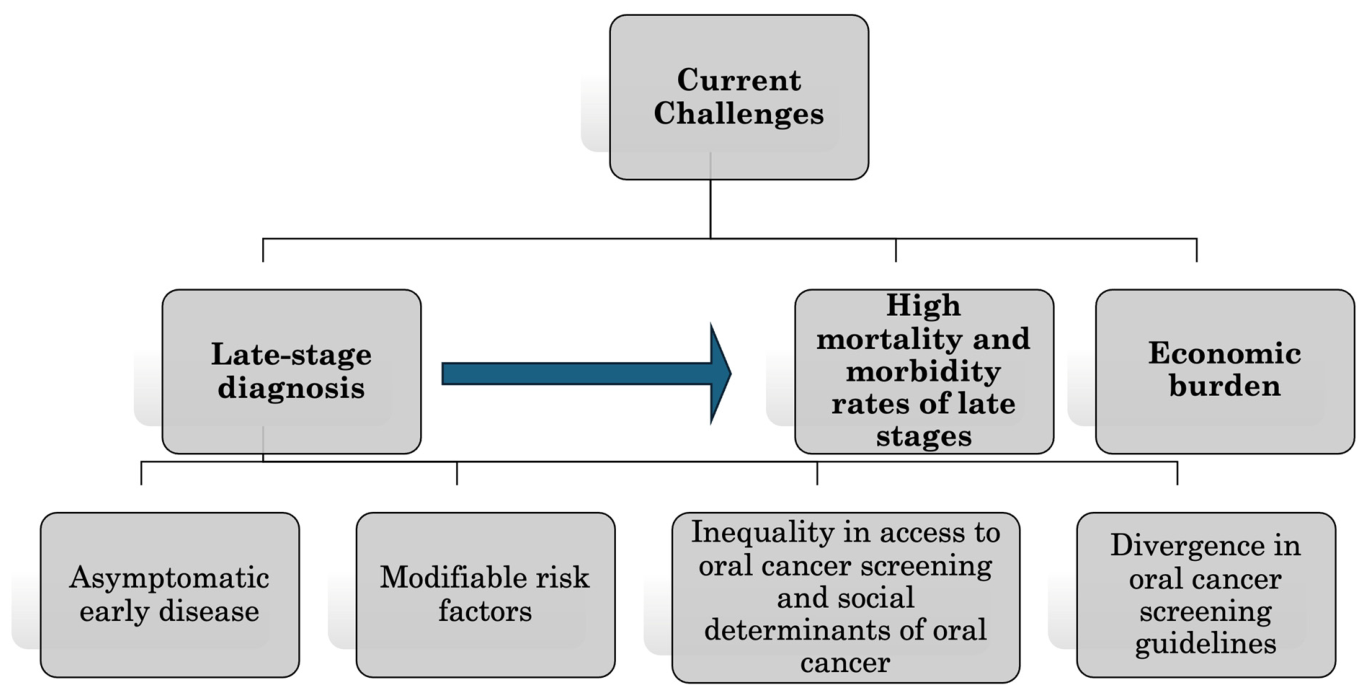
- Main findings: The implementation of oral cancer screening faces complex logistical, political, economic, and methodological challenges that are deeply intertwined with social conditions, where those most at risk of oral cancer (low-income, minority populations) paradoxically have the least access to screening services.
- Added knowledge: While previous research focuses primarily on technical aspects of screening and cost-effectiveness, this paper provides the first comprehensive biosocial analysis of oral cancer screening barriers, revealing how social determinants, healthcare provider biases, and political–economic factors collectively influence screening access and outcomes globally.
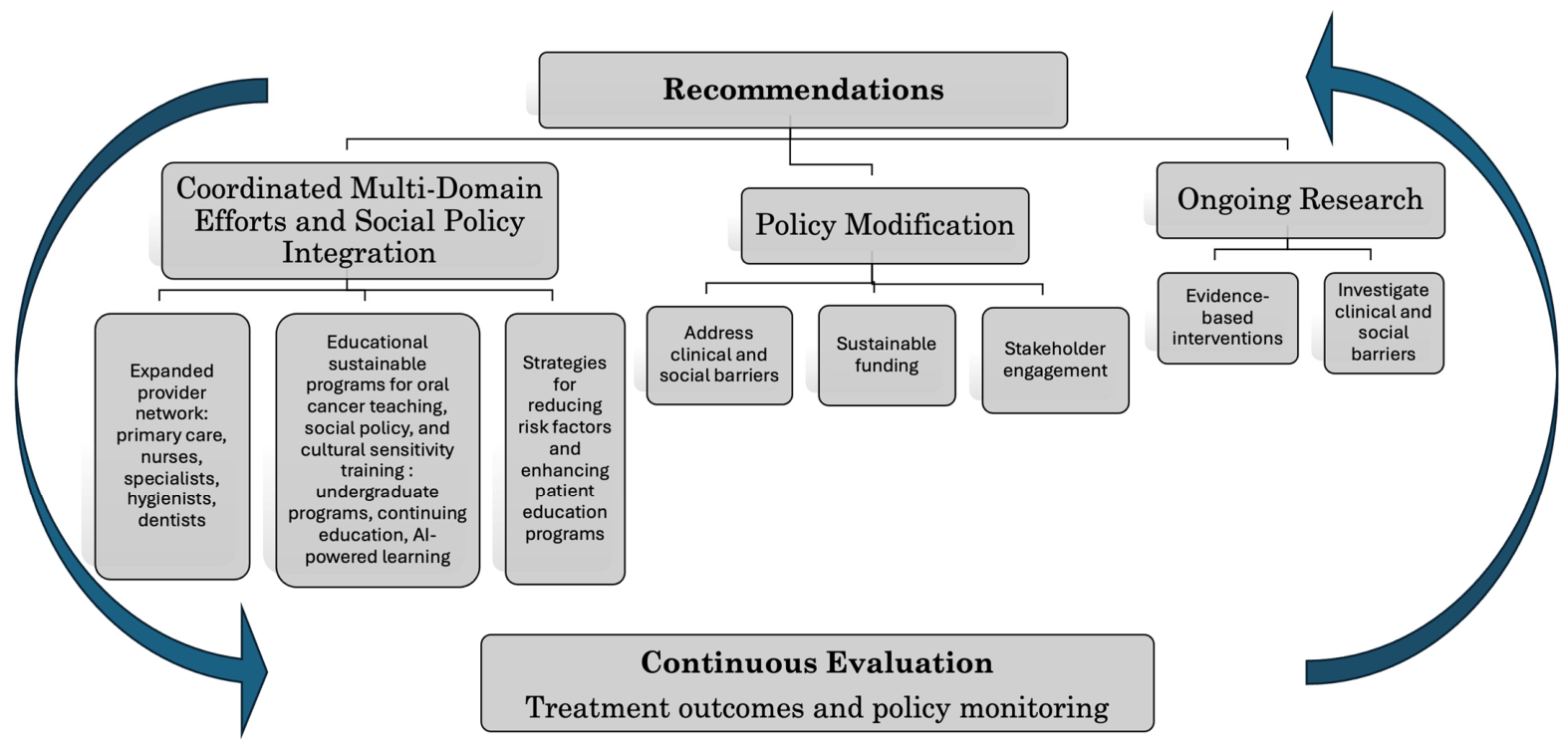
- Global health impact for policy and action: The paper’s proposed three-pillar framework (multi-domain initiatives, systematic policy modification, and rigorous empirical investigation) provides actionable guidance for policymakers to expand screening beyond traditional dental settings, reform healthcare delivery systems, and prioritize vulnerable populations.
5. Conclusions
Author Contributions
Funding
Institutional Review Board Statement
Informed Consent Statement
Data Availability Statement
Acknowledgments
Conflicts of Interest
References
- Lingen, M.W.; Kalmar, J.R.; Karrison, T.; Speight, P.M. Critical evaluation of diagnostic aids for the detection of oral cancer. Oral Oncol. 2008, 44, 10–22. [Google Scholar] [CrossRef]
- Rivera, C. Essentials of oral cancer. Int. J. Clin. Exp. Pathol. 2015, 8, 11884–11894. [Google Scholar]
- Gupta, N.; Gupta, R.; Acharya, A.K.; Patthi, B.; Goud, V.; Reddy, S.; Garg, A.; Singla, A. Changing Trends in oral cancer—A global scenario. Nepal J. Epidemiol. 2017, 6, 613–619. [Google Scholar] [CrossRef]
- Varela-Centelles, P. Early Diagnosis and Diagnostic Delay in Oral Cancer. Cancers 2022, 14, 1758. [Google Scholar] [CrossRef] [PubMed]
- Warnakulasuriya, S. Significant oral cancer risk associated with low socioeconomic status. Evid.-Based Dent. 2009, 10, 4–5. [Google Scholar] [CrossRef] [PubMed]
- Brandizzi, D.; Chuchurru, J.; Lanfranchi, H.; Cabrini, R. Analysis of the epidemiological features of oral cancer in the city of Buenos Aires. Acta Odontol. Latinoam. 2005, 18, 31–35. [Google Scholar] [PubMed]
- Natarajan, P.M.; Swamikannu, B.; Sivaraman, N.M.; Stylin, A.G.S.Q. Prevention of Oral Cancer: A Comprehensive Guide. J. Pharm. Bioallied Sci. 2024, 16, S4239–S4241. [Google Scholar] [CrossRef]
- National Cancer Institute. The Surveillance Epidemiology and End Results. Cancer Stat Facts: Oral Cavity and Pharynx Cancer; National Cancer Institute: Bethesda, MD, USA, 2022.
- Semprini, J. Oral cancer screening prevalence in low-income adults before and after the ACA. Oral Oncol. 2022, 134, 106055. [Google Scholar] [CrossRef]
- Howlader, N.; Noone, A.M.; Krapcho, M.; Miller, D.; Brest, A.; Yu, M.; Ruhl, J.; Tatalovich, Z.; Mariotto, A.; Lewis, D.R.; et al. SEER Cancer Statistics Review, 1975–2017; National Cancer Institute: Bethesda, MD, USA, 2020. Available online: https://seer.cancer.gov/csr/1975_2017/ (accessed on 23 May 2023).
- Kavyashree, C.; Vimala, H.; J., S. A systematic review of artificial intelligence techniques for oral cancer detection. Healthc. Anal. 2024, 5, 100304. [Google Scholar] [CrossRef]
- Epstein, J.D.; Knight, T.K.; Epstein, J.B.; Bride, M.A.; Nichol, M.B. Cost of care for early- and late-stage oral and pharyngeal cancer in the California Medicaid population. Head Neck 2007, 30, 178–186. [Google Scholar] [CrossRef]
- Sineshaw, H.M.; Ellis, M.A.; Yabroff, K.R.; Han, X.; Jemal, A.; Day, T.A.; Graboyes, E.M. Association of Medicaid Expansion Under the Affordable Care Act With Stage at Diagnosis and Time to Treatment Initiation for Patients With Head and Neck Squamous Cell Carcinoma. Arch. Otolaryngol. Neck Surg. 2020, 146, 247–255. [Google Scholar] [CrossRef] [PubMed]
- Osazuwa-Peters, N.; Barnes, J.M.; Megwalu, U.; Boakye, E.A.; Johnston, K.J.; Gaubatz, M.E.; Johnson, K.J.; Panth, N.; Sethi, R.K.; Varvares, M.A. State Medicaid expansion status, insurance coverage and stage at diagnosis in head and neck cancer patients. Oral Oncol. 2020, 110, 104870. [Google Scholar] [CrossRef]
- Sankaranarayanan, R.; Ramadas, K.; Thara, S.; Muwonge, R.; Thomas, G.; Anju, G.; Mathew, B. Long term effect of visual screening on oral cancer incidence and mortality in a randomized trial in Kerala, India. Oral Oncol. 2013, 49, 314–321. [Google Scholar] [CrossRef]
- D’cRuz, A.K.; Vaish, R. Risk-based oral cancer screening—Lessons to be learnt. Nat. Rev. Clin. Oncol. 2021, 18, 471–472. [Google Scholar] [CrossRef]
- Agarwal, P.; Agrawal, R.R.; Jones, E.A.; Devaiah, A.K. Social Determinants of Health and Oral Cavity Cancer Treatment and Survival: A Competing Risk Analysis. Laryngoscope 2020, 130, 2160–2165. [Google Scholar] [CrossRef]
- Akinkugbe, A.A.; Garcia, D.T.; Brickhouse, T.H.; Mosavel, M. Lifestyle risk factor related disparities in oral cancer examination in the U.S: A population-based cross-sectional study. BMC Public Health 2020, 20, 153. [Google Scholar] [CrossRef]
- Ramos, L.; Sobrinho, A.; Ribeiro, L.; Martins-De-Barros, A.; Maurício, H.; Ferreira, S.; Carvalho, M.d.V. Racial disparity and prognosis in patients with mouth and oropharynx cancer in Brazil. Med. Oral Patol. Oral Y Cirugia Bucal 2022, 27, e392–e396. [Google Scholar] [CrossRef]
- Agarwal, S.; Charlesworth, M.; Elrakhawy, M. How to write a narrative review. Anaesthesia 2023, 78, 1162–1166. [Google Scholar] [CrossRef]
- Turner, D.P.; Winn, R.A.; Findlay, V.J. Biosocial determinants inform on enduring cancer disparities. Trends Cancer 2024, 10, 673–676. [Google Scholar] [CrossRef] [PubMed]
- Bray, F.; Laversanne, M.; Sung, H.; Ferlay, J.; Siegel, R.L.; Soerjomataram, I.; Jemal, A. Global cancer statistics 2022: GLOBOCAN estimates of incidence and mortality worldwide for 36 cancers in 185 countries. CA A Cancer J. Clin. 2024, 74, 229–263. [Google Scholar] [CrossRef] [PubMed]
- World Health Organization. Global Oral Health Status Report: Towards Universal Health Coverage for Oral Health by 2030; World Health Organization: Geneva, Switzerland, 2022. [Google Scholar]
- Sofi-Mahmudi, A.; Masinaei, M.; Shamsoddin, E.; Tovani-Palone, M.R.; Heydari, M.-H.; Shoaee, S.; Ghasemi, E.; Azadnajafabad, S.; Roshani, S.; Rezaei, N.; et al. Global, regional, and national burden and quality of care index (QCI) of lip and oral cavity cancer: A systematic analysis of the Global Burden of Disease Study 1990–2017. BMC Oral Health 2021, 21, 558. [Google Scholar] [CrossRef] [PubMed]
- GBD 2019 Lip, Oral, and Pharyngeal Cancer Collaborators. The Global, Regional, and National Burden of Adult Lip, Oral, and Pharyngeal Cancer in 204 Countries and Territories. JAMA Oncol. 2023, 9, 1401–1416. [CrossRef] [PubMed]
- Mathunny, M.M.S.; Sivakumar, R.; Padmakumar, S.K. A comparative analysis of the burden of lip and oral cavity cancers in the Indian subcontinent. J. Oral Maxillofac. Pathol. 2024, 28, 565–569. [Google Scholar] [CrossRef] [PubMed]
- Kleinman, A. Four social theories for global health. Lancet 2010, 375, 1518–1519. [Google Scholar] [CrossRef]
- Bouvard, V.; Nethan, S.T.; Singh, D.; Warnakulasuriya, S.; Mehrotra, R.; Chaturvedi, A.K.; Chen, T.H.-H.; Ayo-Yusuf, O.A.; Gupta, P.C.; Kerr, A.R.; et al. IARC Perspective on Oral Cancer Prevention. N. Engl. J. Med. 2022, 387, 1999–2005. [Google Scholar] [CrossRef]
- Johnson, N. Tobacco Use and Oral Cancer: A Global Perspective. J. Dent. Educ. 2001, 65, 328–339. [Google Scholar] [CrossRef]
- IARC. Oral cancer prevention. In IARC Handbooks of Cancer Prevention; IARC: Lyon, France, 2023. [Google Scholar]
- American Cancer Society. Risk Factors for Oral Cavity and Oropharyngeal Cancers 2021. Available online: https://www.cancer.org/cancer/oral-cavity-and-oropharyngeal-cancer/causes-risks-prevention/risk-factors.html (accessed on 13 April 2023).
- Lee, Y.-C.A.; Al-Temimi, M.; Ying, J.; Muscat, J.; Olshan, A.F.; Zevallos, J.P.; Winn, D.M.; Li, G.; Sturgis, E.M.; Morgenstern, H.; et al. Risk Prediction Models for Head and Neck Cancer in the US Population From the INHANCE Consortium. Am. J. Epidemiol. 2020, 189, 330–342. [Google Scholar] [CrossRef]
- Marron, M.; Boffetta, P.; Zhang, Z.-F.; Zaridze, D.; Wünsch-Filho, V.; Winn, D.M.; Wei, Q.; Talamini, R.; Szeszenia-Dabrowska, N.; Sturgis, E.M.; et al. Cessation of alcohol drinking, tobacco smoking and the reversal of head and neck cancer risk. Leuk. Res. 2009, 39, 182–196. [Google Scholar] [CrossRef]
- De Stefani, E.; Boffetta, P.; Deneo-Pellegrini, H.; Ronco, A.L.; Acosta, G.; Ferro, G.; Oreggia, F.; Leiva, J. The effect of smoking and drinking in oral and pharyngeal cancers: A case-control study in Uruguay. Cancer Lett. 2006, 246, 282–289. [Google Scholar] [CrossRef]
- Radoï, L.; Paget-Bailly, S.; Cyr, D.; Papadopoulos, A.; Guida, F.; Schmaus, A.; Cénée, S.; Menvielle, G.; Carton, M.; Lapôtre-Ledoux, B.; et al. Tobacco smoking, alcohol drinking and risk of oral cavity cancer by subsite: Results of a French population-based case-control study, the ICARE study. Eur. J. Cancer Prev. 2013, 22, 268–276. [Google Scholar] [CrossRef]
- Warnakulasuriya, S.; Kerr, A. Oral Cancer Screening: Past, Present, and Future. J. Dent. Res. 2021, 100, 1313–1320. [Google Scholar] [CrossRef]
- Warnakulasuriya, S.; Greenspan, J.S. Epidemiology of oral and oropharyngeal cancers. In Textbook of Oral Cancer, Editor; Springer: Berlin/Heidelberg, Germany, 2020; pp. 5–22. [Google Scholar]
- Gupta, A.; Sonis, S.; Uppaluri, R.; Bergmark, R.W.; Villa, A. Disparities in Oral Cancer Screening Among Dental Professionals: NHANES 2011–2016. Am. J. Prev. Med. 2019, 57, 447–457. [Google Scholar] [CrossRef]
- Coppola, N.; Mignogna, M.D.; Rivieccio, I.; Blasi, A.; Bizzoca, M.E.; Sorrentino, R.; Muzio, L.L.; Spagnuolo, G.; Leuci, S. Current Knowledge, Attitudes, and Practice among Health Care Providers in OSCC Awareness: Systematic Review and Meta-Analysis. Int. J. Environ. Res. Public Health 2021, 18, 4506. [Google Scholar] [CrossRef] [PubMed]
- Applebaum, E.; Ruhlen, T.N.; Kronenberg, F.R.; Hayes, C.; Peters, E.S. Oral cancer knowledge, attitudes and practices: A survey of dentists and primary care physicians in Massachusetts. J. Am. Dent. Assoc. 2009, 140, 461–467. [Google Scholar] [CrossRef] [PubMed]
- Gigliotti, J.; Madathil, S.; Makhoul, N. Delays in oral cavity cancer. Int. J. Oral Maxillofac. Surg. 2019, 48, 1131–1137. [Google Scholar] [CrossRef] [PubMed]
- Galeș, L.N.; Păun, M.-A.; Anghel, R.M.; Trifănescu, O.G. Cancer Screening: Present Recommendations, the Development of Multi-Cancer Early Development Tests, and the Prospect of Universal Cancer Screening. Cancers 2024, 16, 1191. [Google Scholar] [CrossRef]
- Dwojak, S.; Bhattacharyya, N. Racial disparities in preventable risk factors for head and neck cancer. Laryngoscope 2017, 127, 1068–1072. [Google Scholar] [CrossRef]
- Massachusetts Health Policy Commission. HPC DataPoints, Issue 20: Oral Health Access and Equity in the Commonwealth 2021. Available online: https://masshpc.gov/publications/datapoints-series/issue-20-oral-health-access-and-equity-commonwealth (accessed on 13 April 2023).
- Moyer, V.A. U.S. Preventive Services Task Force. Screening for Oral Cancer: U.S. Preventive Services Task Force Recommendation Statement. Ann. Intern. Med. 2014, 160, 55–60. [Google Scholar] [CrossRef]
- American Cancer Society. Can Oral Cavity and Oropharyngeal Cancers Be Found Early? 2021. Available online: https://www.cancer.org/cancer/oral-cavity-and-oropharyngeal-cancer/detection-diagnosis-staging/detection.html (accessed on 13 April 2023).
- Lingen, M.W.; Abt, E.; Agrawal, N.; Chaturvedi, A.K.; Cohen, E.; D’sOuza, G.; Gurenlian, J.; Kalmar, J.R.; Kerr, A.R.; Lambert, P.M.; et al. Evidence-based clinical practice guideline for the evaluation of potentially malignant disorders in the oral cavity: A report of the American Dental Association. J. Am. Dent. Assoc. 2017, 148, 712–727.e10. [Google Scholar] [CrossRef]
- Speight, P.; Warnakulasuriya, S.; Ogden, G. Early Detection and Prevention of Oral Cancer: A Management Strategy for Dental Practice; The British Dental Association: London, UK, 2010. [Google Scholar]
- Farmer, P.; Kleinman, A.; Kim, J.; Basilico, M. Reimagining Global Health: An Introduction; University of California Press: Oakland, CA, USA, 2013. [Google Scholar]
- Burns, P.B.; Rohrich, R.J.; Chung, K.C.M. The Levels of Evidence and Their Role in Evidence-Based Medicine. Plast. Reconstr. Surg. 2011, 128, 305–310. [Google Scholar] [CrossRef]
- Johnson, N.; Warnakulasuriya, S.; Gupta, P.; Dimba, E.; Chindia, M.; Otoh, E.; Sankaranarayanan, R.; Califano, J.; Kowalski, L. Global oral health inequalities in incidence and outcomes for oral cancer: Causes and solutions. Adv. Dent. Res. 2011, 23, 237–246. [Google Scholar] [CrossRef] [PubMed]
- Fonseca, S. Latin American Social Medicine: The Making of a Thought Style. Ph.D. Thesis, King’s College, London, UK, 2020. [Google Scholar]
- National Cancer Institute. Cancer Disparities 2022. Available online: https://www.cancer.gov/about-cancer/understanding/disparities (accessed on 10 April 2023).
- Dantas, M.N.P.; de Souza, D.L.B.; de Souza, A.M.G.; Aiquoc, K.M.; de Souza, T.A.; Barbosa, I.R. Fatores associados ao acesso precário aos serviços de saúde no Brasil. Rev. Bras. Epidemiol. 2021, 24, e210004. [Google Scholar] [CrossRef]
- CDC. Disparities in Oral Health. Division of Oral Health, National Center for Chronic Disease Prevention and Health Promotion 2021. Available online: https://www.cdc.gov/oral-health/health-equity/?CDC_AAref_Val=https://www.cdc.gov/oralhealth/oral_health_disparities/index.htm (accessed on 15 December 2022).
- Massachusetts Department of Public Health. Oropharyngeal Cancer: Status in Massachusetts; Massachusetts Department of Public Health: Boston, MA, USA, 2021.
- Mukherjee, J.S. Understanding and Practicing Social Medicine. In An Introduction to Global Health Delivery; Oxford University Press: Oxford, UK, 2021; pp. 100–133. [Google Scholar]
- Farmer, P. Dr. Paul Farmer: Medicine and liberation theology. America Magazine, 15 July 1995; pp. 1–10.
- Pierson, L.; Verguet, S. When should global health actors prioritise more uncertain interventions? Lancet Glob. Health 2023, 11, e615–e622. [Google Scholar] [CrossRef]
- Farmer, P.E. Chapter 5 Health, Healing, and Social Justice Insights from Liberation Theology Making a Preferential Option for the Poor. In Pathologies of Power: Health, Human Rights, and the New War on the Poor, 1st ed.; University of California Press: Oakland, CA, USA, 2004; pp. 379–402. [Google Scholar]
- Kasper, J.; Greene, J.A.; Farmer, P.E.; Jones, D.S. All Health Is Global Health, All Medicine Is Social Medicine: Integrating the Social Sciences Into the Preclinical Curriculum. Acad. Med. 2016, 91, 628–632. [Google Scholar] [CrossRef] [PubMed]
- Kleinman, A. The Soul of Care: The Moral Education of a Husband and a Doctor; Penguin Books: London, UK, 2019. [Google Scholar]
- Stahl, S.; Meskin, L.H.; Brown, L.J. The American Dental Association’s oral cancer campaign: The impact on consumers and dentists. J. Am. Dent. Assoc. 2004, 135, 1261–1267. [Google Scholar] [CrossRef] [PubMed]
- Maybury, C.; Horowitz, A.M.; Goodman, H.S. Outcomes of oral cancer early detection and prevention statewide model in Maryland. J. Public Health Dent. 2012, 72, S34–S38. [Google Scholar] [CrossRef]


Disclaimer/Publisher’s Note: The statements, opinions and data contained in all publications are solely those of the individual author(s) and contributor(s) and not of MDPI and/or the editor(s). MDPI and/or the editor(s) disclaim responsibility for any injury to people or property resulting from any ideas, methods, instructions or products referred to in the content. |
© 2026 by the authors. Licensee MDPI, Basel, Switzerland. This article is an open access article distributed under the terms and conditions of the Creative Commons Attribution (CC BY) license.
Share and Cite
Baabdullah, R.M.; Gordon, L.; Gigliotti, J. Oral Cancer Screening: A Biosocial Analysis of Global Barriers—A Narrative Review of Who Screens, Who Gets Screened, and Why. Cancers 2026, 18, 1381. https://doi.org/10.3390/cancers18091381
Baabdullah RM, Gordon L, Gigliotti J. Oral Cancer Screening: A Biosocial Analysis of Global Barriers—A Narrative Review of Who Screens, Who Gets Screened, and Why. Cancers. 2026; 18(9):1381. https://doi.org/10.3390/cancers18091381
Chicago/Turabian StyleBaabdullah, Razan M., Lillian Gordon, and Jordan Gigliotti. 2026. "Oral Cancer Screening: A Biosocial Analysis of Global Barriers—A Narrative Review of Who Screens, Who Gets Screened, and Why" Cancers 18, no. 9: 1381. https://doi.org/10.3390/cancers18091381
APA StyleBaabdullah, R. M., Gordon, L., & Gigliotti, J. (2026). Oral Cancer Screening: A Biosocial Analysis of Global Barriers—A Narrative Review of Who Screens, Who Gets Screened, and Why. Cancers, 18(9), 1381. https://doi.org/10.3390/cancers18091381