Deep-Learning with Domain-Specific Pretraining for Breast Cancer Neoadjuvant Chemotherapy Response Prediction from Pre-Treatment B-Mode Ultrasound

 , , , and
Simple Summary
Abstract
1. Introduction
2. Materials and Methods
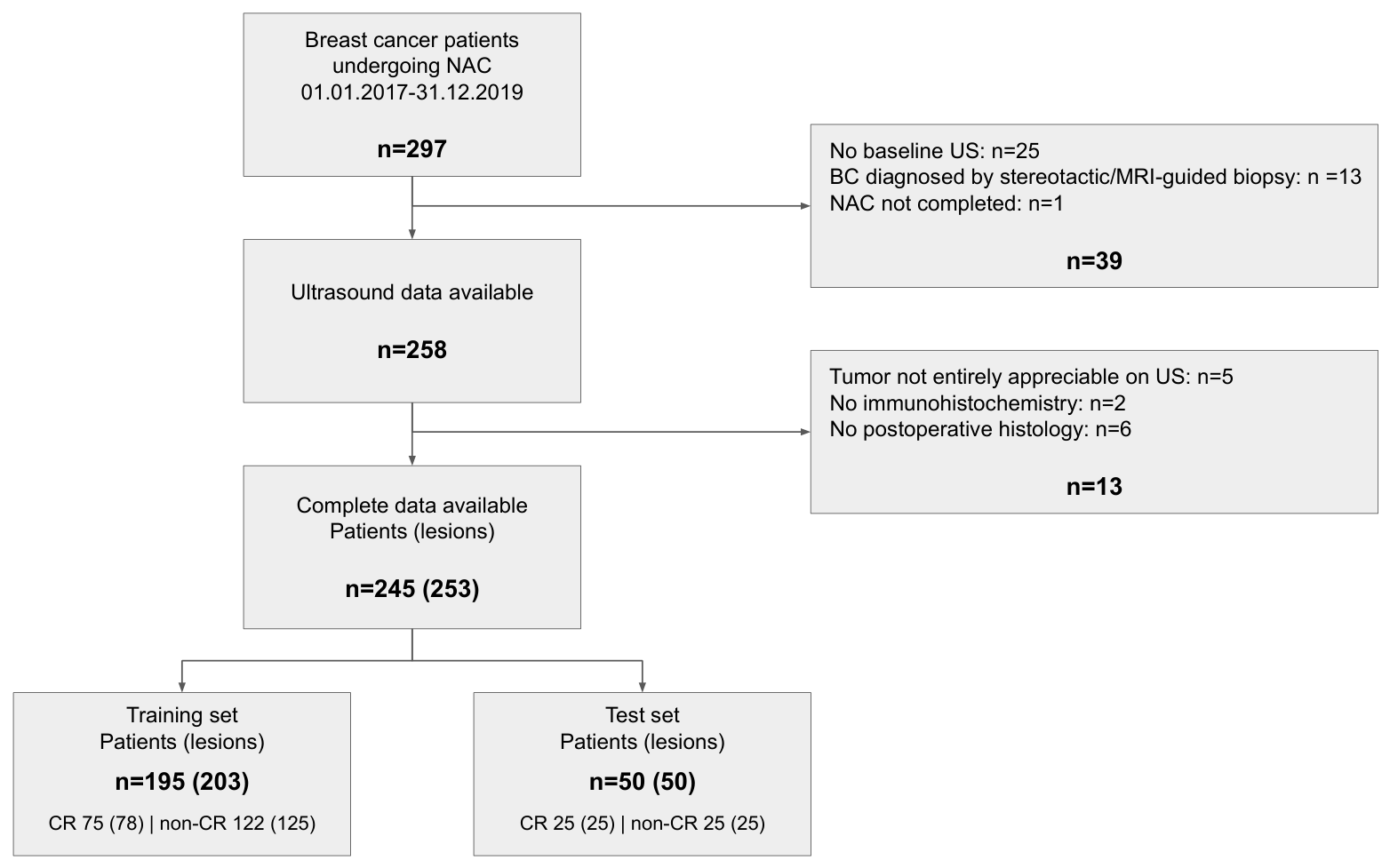
2.1. Dataset

| Clinical Characteristic | CR | Non-CR | p Value |
|---|---|---|---|
| Total lesions | 103 | 150 | |
| Age (average) | 25–83 (53) | 29–80 (56) | 0.1001 |
| Tumor size (average) | 5–60 (21) mm | 7–100 (28) mm | 0.0004 |
| Laterality | 0.9585 | ||
| Right | 52 (50%) | 74 (49%) | |
| Left | 51 (50%) | 76 (51%) | |
| Tumor grade | 0.0290 | ||
| Tumor grade I (%) | 1 (1%) | 4 (3%) | |
| Tumor grade II (%) | 13 (13%) | 43 (28%) | |
| Tumor grade III (%) | 89 (86%) | 103 (69%) | |
| Molecular subtype | <0.0001 | ||
| Luminal A (%) | 0 (0%) | 4 (2%) | |
| Luminal B HER2- (%) | 14 (14%) | 73 (49%) | |
| Luminal B HER2+ (%) | 25 (24%) | 27 (18%) | |
| HER2 positive (%) | 22 (21%) | 12 (8%) | |
| Triple-negative (%) | 42 (41%) | 34 (23%) | |
| Histopathological type | 0.5400 | ||
| ICNST no DCIS (%) | 58 (56%) | 93 (62%) | |
| ICNST DCIS (%) | 39 (38%) | 35 (23%) | |
| ILC (%) | 2 (2%) | 12 (8%) | |
| Other histopathological type (%) | 4 (4%) | 10 (7%) |
2.2. Non-Image Features
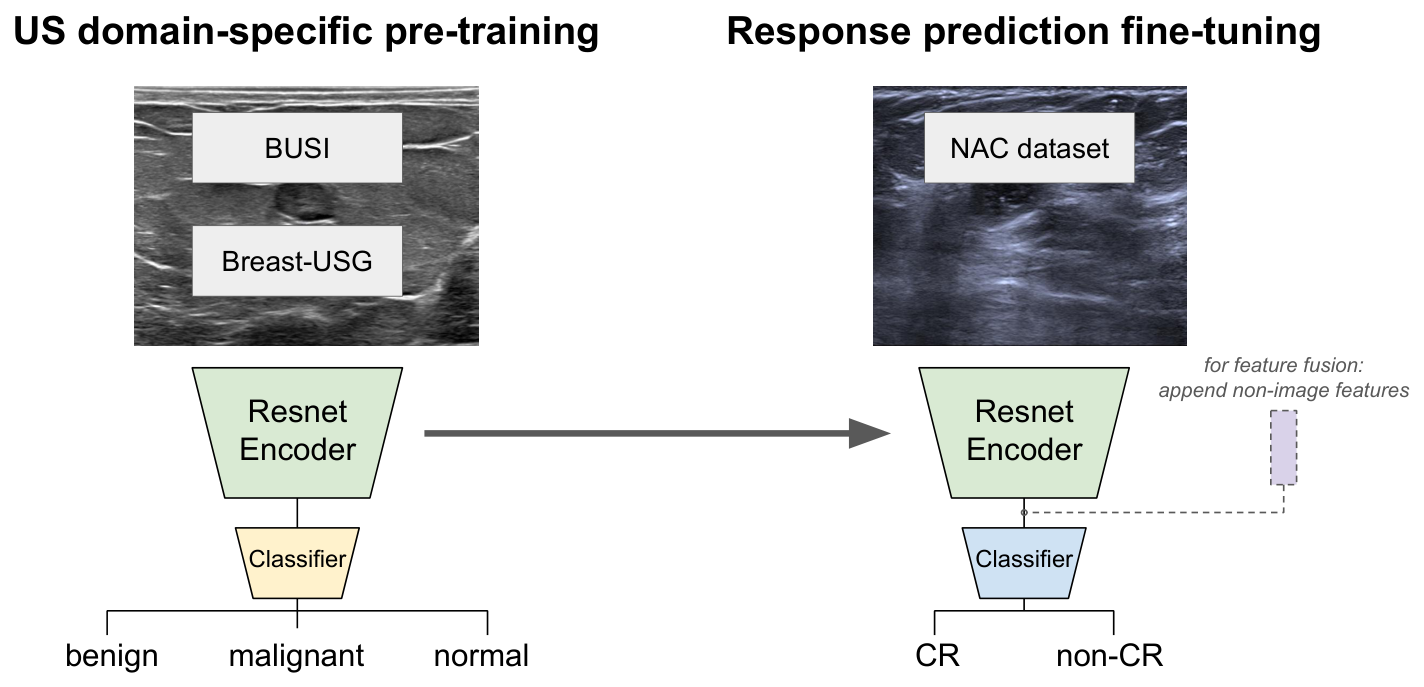
2.3. Model Development
2.4. Evaluation and Statistical Analysis
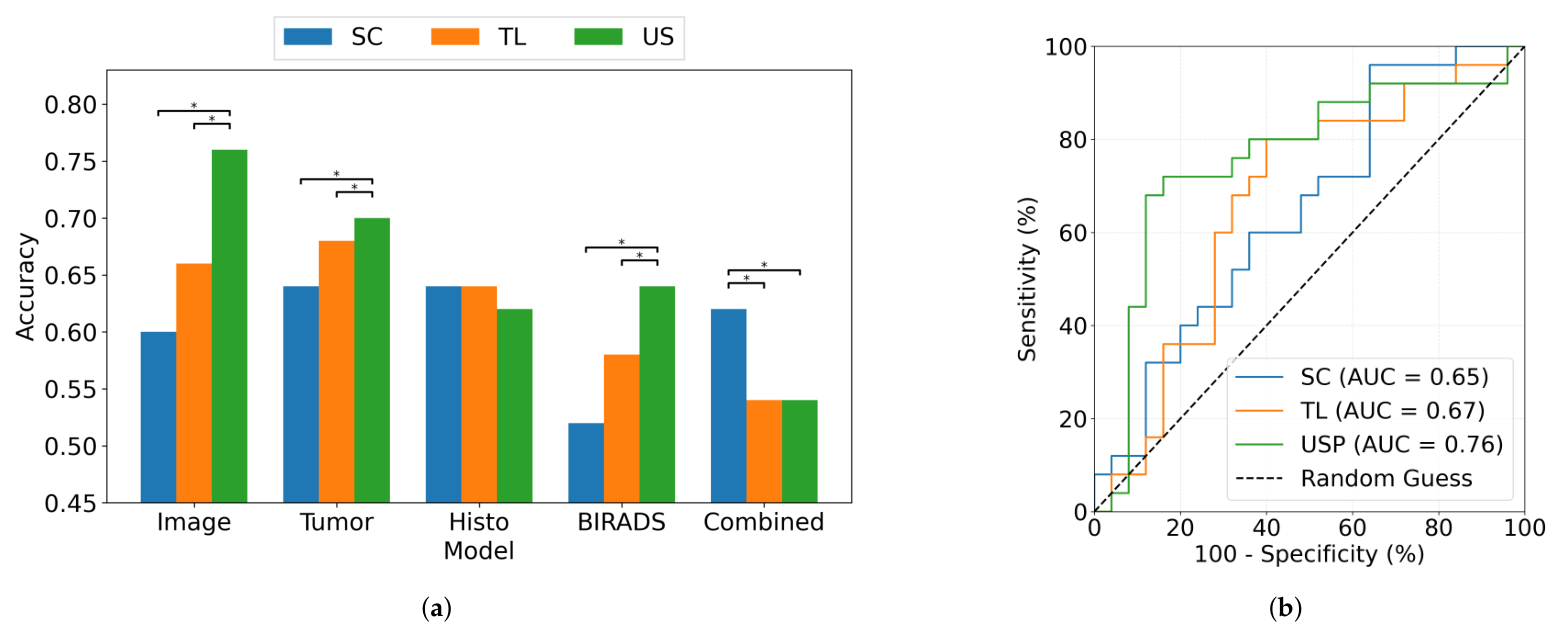
3. Results
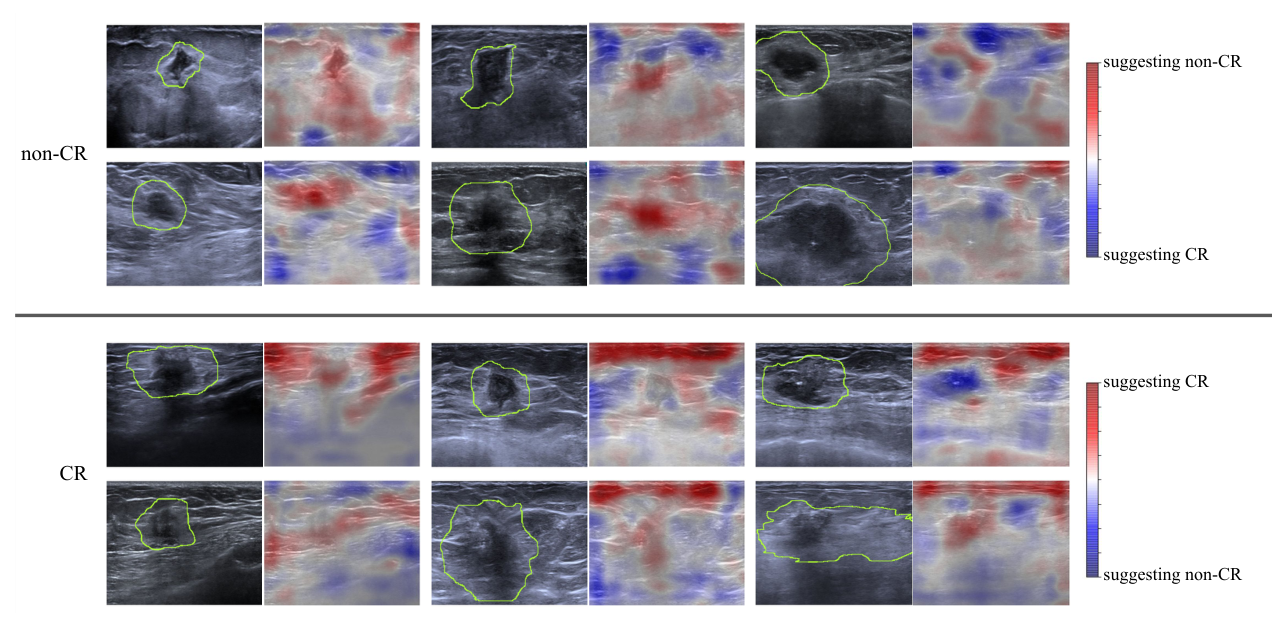
4. Discussion
5. Conclusions
Author Contributions
Funding
Institutional Review Board Statement
Informed Consent Statement
Data Availability Statement
Acknowledgments
Conflicts of Interest
Abbreviations
| NAC | Neoadjuvant chemotherapy |
| CR | Complete response |
| SC | Training from scratch |
| TL | Transfer learning |
| USP | Ultrasound domain-specific pre-training |
| CAM | Class activation map |
| BC | Breast cancer |
| MRO | Magnetic resonance imaging |
| US | Ultrasound |
| CNN | Convolutional neural network |
| TNBC | Triple-negative breast cancer |
| FF | Feature fusion |
| ICNST | Invasive carcinoma, no special type |
| DCIS | Ductal carcinoma in situ |
| ILC | Invasive lobular carcinoma |
References
- Bray, F.; Laversanne, M.; Sung, H.; Ferlay, J.; Siegel, R.L.; Soerjomataram, I.; Jemal, A. Global cancer statistics 2022: GLOBOCAN estimates of incidence and mortality worldwide for 36 cancers in 185 countries. CA Cancer J. Clin. 2024, 74, 229–263. [Google Scholar] [CrossRef]
- Huber, S.; Wagner, M.; Zuna, I.; Medl, M.; Czembirek, H.; Delorme, S. Locally advanced breast carcinoma: Evaluation of mammography in the prediction of residual disease after induction chemotherapy. Anticancer Res. 2000, 20, 553–558. [Google Scholar]
- Dubsky, P.; Pinker, K.; Cardoso, F.; Montagna, G.; Ritter, M.; Denkert, C.; Rubio, I.T.; de Azambuja, E.; Curigliano, G.; Gentilini, O.; et al. Breast conservation and axillary management after primary systemic therapy in patients with early-stage breast cancer: The Lucerne toolbox. Lancet Oncol. 2021, 22, e18–e28. [Google Scholar] [CrossRef]
- Cortazar, P.; Zhang, L.; Untch, M.; Mehta, K.; Costantino, J.P.; Wolmark, N.; Bonnefoi, H.; Cameron, D.; Gianni, L.; Valagussa, P.; et al. Pathological complete response and long-term clinical benefit in breast cancer: The CTNeoBC pooled analysis. Lancet 2014, 384, 164–172. [Google Scholar] [CrossRef]
- Azim, H., Jr.; de Azambuja, E.; Colozza, M.; Bines, J.; Piccart, M. Long-term toxic effects of adjuvant chemotherapy in breast cancer. Ann. Oncol. 2011, 22, 1939–1947. [Google Scholar] [CrossRef]
- Hassett, M.J.; O’Malley, A.J.; Pakes, J.R.; Newhouse, J.P.; Earle, C.C. Frequency and cost of chemotherapy-related serious adverse effects in a population sample of women with breast cancer. J. Natl. Cancer Inst. 2006, 98, 1108–1117. [Google Scholar] [CrossRef]
- De Los Santos, J.F.; Cantor, A.; Amos, K.D.; Forero, A.; Golshan, M.; Horton, J.K.; Hudis, C.A.; Hylton, N.M.; McGuire, K.; Meric-Bernstam, F.; et al. Magnetic resonance imaging as a predictor of pathologic response in patients treated with neoadjuvant systemic treatment for operable breast cancer: Translational Breast Cancer Research Consortium trial 017. Cancer 2013, 119, 1776–1783. [Google Scholar] [CrossRef]
- Comes, M.C.; Fanizzi, A.; Bove, S.; Didonna, V.; Diotaiuti, S.; La Forgia, D.; Latorre, A.; Martinelli, E.; Mencattini, A.; Nardone, A.; et al. Early prediction of neoadjuvant chemotherapy response by exploiting a transfer learning approach on breast DCE-MRIs. Sci. Rep. 2021, 11, 14123. [Google Scholar] [CrossRef]
- Yang, L.; Wang, S.; Zhang, L.; Sheng, C.; Song, F.; Wang, P.; Huang, Y. Performance of ultrasonography screening for breast cancer: A systematic review and meta-analysis. BMC Cancer 2020, 20, 499. [Google Scholar] [CrossRef]
- Brunetti, N.; Calabrese, M.; Martinoli, C.; Tagliafico, A.S. Artificial intelligence in breast ultrasound: From diagnosis to prognosis—A rapid review. Diagnostics 2022, 13, 58. [Google Scholar] [CrossRef]
- Peng, Y.; Zhang, X.; Qiu, Y.; Li, B.; Yang, Z.; Huang, J.; Lin, J.; Zheng, C.; Hu, L.; Shen, J. Development and validation of MRI radiomics models to differentiate HER2-zero,-low, and-positive breast cancer. Am. J. Roentgenol. 2024, 222, e2330603. [Google Scholar] [CrossRef]
- Gu, Y.; Xu, W.; Lin, B.; An, X.; Tian, J.; Ran, H.; Ren, W.; Chang, C.; Yuan, J.; Kang, C.; et al. Deep learning based on ultrasound images assists breast lesion diagnosis in China: A multicenter diagnostic study. Insights Imaging 2022, 13, 124. [Google Scholar] [CrossRef]
- Wei, Q.; Yan, Y.J.; Wu, G.G.; Ye, X.R.; Jiang, F.; Liu, J.; Wang, G.; Wang, Y.; Song, J.; Pan, Z.P.; et al. The diagnostic performance of ultrasound computer-aided diagnosis system for distinguishing breast masses: A prospective multicenter study. Eur. Radiol. 2022, 32, 4046–4055. [Google Scholar] [CrossRef] [PubMed]
- Luccas, V.A.; Azimbagirad, M.; Cabrelli, L.C.; Grillo, F.W.; Pavan, T.Z.; Otavio Murta, L., Jr.; Elias, J., Jr.; Carneiro, A.A. 3D automated breast ultrasound imaging: Equipment and image reconstruction. Res. Biomed. Eng. 2021, 37, 519–533. [Google Scholar] [CrossRef]
- Erickson, B.J.; Korfiatis, P.; Akkus, Z.; Kline, T.L. Machine learning for medical imaging. Radiographics 2017, 37, 505–515. [Google Scholar] [CrossRef]
- Deng, J.; Dong, W.; Socher, R.; Li, L.J.; Li, K.; Fei-Fei, L. Imagenet: A large-scale hierarchical image database. In Proceedings of the 2009 IEEE Conference on Computer Vision and Pattern Recognition; IEEE: New York, NY, USA, 2009; pp. 248–255. [Google Scholar]
- Ke, A.; Ellsworth, W.; Banerjee, O.; Ng, A.Y.; Rajpurkar, P. CheXtransfer: Performance and parameter efficiency of ImageNet models for chest X-Ray interpretation. In Proceedings of the Conference on Health, Inference, and Learning; Association for Computing Machinery: New York, NY, USA, 2021; pp. 116–124. [Google Scholar]
- Chen, Y.; Zhang, C.; Liu, L.; Feng, C.; Dong, C.; Luo, Y.; Wan, X. USCL: Pretraining deep ultrasound image diagnosis model through video contrastive representation learning. In Proceedings of the International Conference on Medical Image Computing and Computer-Assisted Intervention; Springer: Berlin/Heidelberg, Germany, 2021; pp. 627–637. [Google Scholar]
- Matsoukas, C.; Haslum, J.F.; Sorkhei, M.; Söderberg, M.; Smith, K. What makes transfer learning work for medical images: Feature reuse & other factors. In Proceedings of the IEEE/CVF Conference on Computer Vision and Pattern Recognition; IEEE: New York, NY, USA, 2022; pp. 9225–9234. [Google Scholar]
- Mei, X.; Liu, Z.; Robson, P.M.; Marinelli, B.; Huang, M.; Doshi, A.; Jacobi, A.; Cao, C.; Link, K.E.; Yang, T.; et al. RadImageNet: An open radiologic deep learning research dataset for effective transfer learning. Radiol. Artif. Intell. 2022, 4, e210315. [Google Scholar] [CrossRef] [PubMed]
- Punn, N.S.; Agarwal, S. BT-Unet: A self-supervised learning framework for biomedical image segmentation using barlow twins with U-net models. Mach. Learn. 2022, 111, 4585–4600. [Google Scholar] [CrossRef]
- Wang, J.; Yang, X.; Jia, X.; Xue, W.; Chen, R.; Chen, Y.; Zhu, X.; Liu, L.; Cao, Y.; Zhou, J.; et al. Thyroid ultrasound diagnosis improvement via multi-view self-supervised learning and two-stage pre-training. Comput. Biol. Med. 2024, 171, 108087. [Google Scholar] [CrossRef]
- He, K.; Zhang, X.; Ren, S.; Sun, J. Deep residual learning for image recognition. In Proceedings of the IEEE Conference on Computer Vision and Pattern Recognition; IEEE: New York, NY, USA, 2016; pp. 770–778. [Google Scholar]
- Kapetas, P.; Aggarwal, R.; Altuwayjiri, B.; Pinker, K.; Clauser, P.; Helbich, T.H.; Baltzer, P.A. A model combining BI-RADS® descriptors from pre-treatment B-mode breast ultrasound with clinicopathological tumor features shows promise in the prediction of residual disease after neoadjuvant chemotherapy. Eur. J. Radiol. 2024, 178, 111649. [Google Scholar] [CrossRef]
- Guerini-Rocco, E.; Botti, G.; Foschini, M.P.; Marchiò, C.; Mastropasqua, M.G.; Perrone, G.; Roz, E.; Santinelli, A.; Sassi, I.; Galimberti, V.; et al. Role and evaluation of pathologic response in early breast cancer specimens after neoadjuvant therapy: Consensus statement. Tumori J. 2022, 108, 196–203. [Google Scholar] [CrossRef] [PubMed]
- Al-Dhabyani, W.; Gomaa, M.; Khaled, H.; Fahmy, A. Dataset of breast ultrasound images. Data Brief 2020, 28, 104863. [Google Scholar] [CrossRef]
- Pawłowska, A.; Ćwierz-Pieńkowska, A.; Domalik, A.; Jaguś, D.; Kasprzak, P.; Matkowski, R.; Fura, Ł.; Nowicki, A.; Żołek, N. Curated benchmark dataset for ultrasound based breast lesion analysis. Sci. Data 2024, 11, 148. [Google Scholar] [CrossRef] [PubMed]
- Goldhirsch, A.; Winer, E.P.; Coates, A.S.; Gelber, R.; Piccart-Gebhart, M.; Thürlimann, B.; Senn, H.J.; Albain, K.S.; André, F.; Bergh, J.; et al. Personalizing the treatment of women with early breast cancer: Highlights of the St Gallen International Expert Consensus on the Primary Therapy of Early Breast Cancer 2013. Ann. Oncol. 2013, 24, 2206–2223. [Google Scholar] [CrossRef] [PubMed]
- Mendelson, E.B.; Böhm-Vélez, M.; Berg, W.A.; Whitman, G.; Feldman, M.; Madjar, H. Acr bi-rads® ultrasound. In ACR BI-RADS® Atlas, Breast Imaging Reporting and Data System; American College of Radiology: Reston, VA, USA, 2013; Volume 2013. [Google Scholar]
- He, K.; Zhang, X.; Ren, S.; Sun, J. Delving deep into rectifiers: Surpassing human-level performance on imagenet classification. In Proceedings of the IEEE International Conference on Computer Vision; IEEE: New York, NY, USA, 2015; pp. 1026–1034. [Google Scholar]
- Kingma, D.P.; Ba, J. Adam: A method for stochastic optimization. arXiv 2014, arXiv:1412.6980. [Google Scholar]
- Rubin, D.B. The bayesian bootstrap. Ann. Stat. 1981, 9, 130–134. [Google Scholar] [CrossRef]
- Efron, B. Bootstrap methods: Another look at the jackknife. In Breakthroughs in Statistics: Methodology and Distribution; Springer: Berlin/Heidelberg, Germany, 1992; pp. 569–593. [Google Scholar]
- Demšar, J. Statistical comparisons of classifiers over multiple data sets. J. Mach. Learn. Res. 2006, 7, 1–30. [Google Scholar]
- Selvaraju, R.R.; Cogswell, M.; Das, A.; Vedantam, R.; Parikh, D.; Batra, D. Grad-CAM: Visual explanations from deep networks via gradient-based localization. Int. J. Comput. Vis. 2020, 128, 336–359. [Google Scholar] [CrossRef]
- Houssami, N.; Macaskill, P.; von Minckwitz, G.; Marinovich, M.L.; Mamounas, E. Meta-analysis of the association of breast cancer subtype and pathologic complete response to neoadjuvant chemotherapy. Eur. J. Cancer 2012, 48, 3342–3354. [Google Scholar] [CrossRef]
- Cho, N. Molecular subtypes and imaging phenotypes of breast cancer. Ultrasonography 2016, 35, 281–288. [Google Scholar] [CrossRef] [PubMed]
- Braman, N.M.; Etesami, M.; Prasanna, P.; Dubchuk, C.; Gilmore, H.; Tiwari, P.; Plecha, D.; Madabhushi, A. Intratumoral and peritumoral radiomics for the pretreatment prediction of pathological complete response to neoadjuvant chemotherapy based on breast DCE-MRI. Breast Cancer Res. 2017, 19, 57. [Google Scholar] [CrossRef]
- Tadayyon, H.; Sannachi, L.; Gangeh, M.J.; Kim, C.; Ghandi, S.; Trudeau, M.; Pritchard, K.; Tran, W.T.; Slodkowska, E.; Sadeghi-Naini, A.; et al. A priori prediction of neoadjuvant chemotherapy response and survival in breast cancer patients using quantitative ultrasound. Sci. Rep. 2017, 7, 45733. [Google Scholar] [CrossRef] [PubMed]
- Sannachi, L.; Gangeh, M.; Tadayyon, H.; Sadeghi-Naini, A.; Gandhi, S.; Wright, F.C.; Slodkowska, E.; Curpen, B.; Tran, W.; Czarnota, G.J. Response monitoring of breast cancer patients receiving neoadjuvant chemotherapy using quantitative ultrasound, texture, and molecular features. PLoS ONE 2018, 13, e0189634. [Google Scholar] [CrossRef]
- DiCenzo, D.; Quiaoit, K.; Fatima, K.; Bhardwaj, D.; Sannachi, L.; Gangeh, M.; Sadeghi-Naini, A.; Dasgupta, A.; Kolios, M.C.; Trudeau, M.; et al. Quantitative ultrasound radiomics in predicting response to neoadjuvant chemotherapy in patients with locally advanced breast cancer: Results from multi-institutional study. Cancer Med. 2020, 9, 5798–5806. [Google Scholar] [CrossRef]
- Peng, J.; Pu, H.; Jia, Y.; Chen, C.; Ke, X.K.; Zhou, Q. Early prediction of response to neoadjuvant chemotherapy using contrast-enhanced ultrasound in breast cancer. Medicine 2021, 100, e25908. [Google Scholar] [CrossRef] [PubMed]
- Semiglazov, V. RECIST for response (clinical and imaging) in neoadjuvant clinical trials in operable breast cancer. J. Natl. Cancer Inst. Monogr. 2015, 2015, 21–23. [Google Scholar] [CrossRef] [PubMed]
- Ravichandran, K.; Braman, N.; Janowczyk, A.; Madabhushi, A. A deep learning classifier for prediction of pathological complete response to neoadjuvant chemotherapy from baseline breast DCE-MRI. In Proceedings of the Medical Imaging 2018: Computer-Aided Diagnosis; SPIE: Bellingham, DC, USA, 2018; Volume 10575, pp. 79–88. [Google Scholar]
- Ha, R.; Chin, C.; Karcich, J.; Liu, M.Z.; Chang, P.; Mutasa, S.; Pascual Van Sant, E.; Wynn, R.T.; Connolly, E.; Jambawalikar, S. Prior to initiation of chemotherapy, can we predict breast tumor response? Deep learning convolutional neural networks approach using a breast MRI tumor dataset. J. Digit. Imaging 2019, 32, 693–701. [Google Scholar] [CrossRef]


| Feature Set | Feature |
|---|---|
| Tumor | Max size (mm/100) |
| Molecular subtype (Luminal, HER2+, TNBC) | |
| Grade (low, high) | |
| Age (years/100) | |
| Histo | ER status (negative, positive) |
| PR status (negative, positive) | |
| HER2 status (negative, positive) | |
| BIRADS | Tissue composition (homogenous fatty, homogeneous fibroglandular, heterogeneous) |
| Shape (oval, round, irregular) | |
| Margin (circumscribed, indistinct, microlobulated, angular, spiculated) | |
| Orientation (parallel, non-parallel) | |
| Echo pattern (anechoic, hyperechoic, isoechoic, hypoechoic, | |
| complex cystic and solid, heterogeneous) | |
| Posterior features (none, enhancement, shadowing, combined) | |
| Calcifications (no, yes) | |
| Edema (no, yes) | |
| Skin changes (no, yes) | |
| Duct changes (no, yes) |
| Metric | |||||
|---|---|---|---|---|---|
| Training Approach | Model | Specificity | Sensitivity | Accuracy | ROC AUC |
| Training from scratch (SC) | Image | 0.60 [0.40, 0.77] | 0.60 [0.40, 0.78] | 0.60 [0.46, 0.73] | 0.65 [0.49, 0.78] |
| Tumor | 0.68 [0.50, 0.84] | 0.60 [0.42, 0.77] | 0.64 [0.51, 0.76] | 0.66 [0.50, 0.80] | |
| Histo | 0.44 [0.28, 0.67] | 0.84 [0.46, 0.81] | 0.64 [0.42, 0.70] | 0.58 [0.41, 0.74] | |
| BIRADS | 0.48 [0.29, 0.67] | 0.56 [0.37, 0.74] | 0.52 [0.38, 0.66] | 0.62 [0.46, 0.77] | |
| Combined | 0.64 [0.45, 0.82] | 0.60 [0.41, 0.78] | 0.62 [0.49, 0.75] | 0.68 * [0.54, 0.81] | |
| Training learning (TL) | Image | 0.64 [0.45, 0.81] | 0.68 [0.49, 0.85] | 0.66 [0.53, 0.78] | 0.67 [0.50, 0.81] |
| Tumor | 0.80 [0.64, 0.93] | 0.56 [0.39, 0.75] | 0.68 [0.55, 0.80] | 0.71 * [0.56, 0.84] | |
| Histo | 0.68 [0.49, 0.85] | 0.60 [0.41, 0.79] | 0.64 [0.50, 0.77] | 0.67 [0.52, 0.81] | |
| BIRADS | 0.68 [0.50, 0.84] | 0.48 [0.29, 0.69] | 0.58 [0.45, 0.72] | 0.64 [0.49, 0.79] | |
| Combined | 0.52 [0.32, 0.71] | 0.56 [0.37, 0.75] | 0.54 [0.40, 0.67] | 0.59 [0.42, 0.73] | |
| Domain-specific pre-training (USP) | Image | 0.80 [0.62, 0.93] | 0.72 [0.53, 0.88] | 0.76 [0.63, 0.87] | 0.76 * [0.59, 0.89] |
| Tumor | 0.72 [0.53, 0.88] | 0.68 [0.50, 0.83] | 0.70 [0.57, 0.81] | 0.71 [0.55, 0.84] | |
| Histo | 0.68 [0.48, 0.85] | 0.56 [0.36, 0.74] | 0.62 [0.48, 0.75] | 0.64 [0.47, 0.78] | |
| BIRADS | 0.64 [0.44, 0.81] | 0.64 [0.44, 0.80] | 0.64 [0.52, 0.76] | 0.67 [0.50, 0.80] | |
| Combined | 0.44 [0.26, 0.65] | 0.64 [0.46, 0.82] | 0.54 [0.41, 0.67] | 0.50 [0.35, 0.66] | |
Disclaimer/Publisher’s Note: The statements, opinions and data contained in all publications are solely those of the individual author(s) and contributor(s) and not of MDPI and/or the editor(s). MDPI and/or the editor(s) disclaim responsibility for any injury to people or property resulting from any ideas, methods, instructions or products referred to in the content. |
© 2026 by the authors. Licensee MDPI, Basel, Switzerland. This article is an open access article distributed under the terms and conditions of the Creative Commons Attribution (CC BY) license.
Share and Cite
Fürböck, C.; Janickova, I.; Langs, G.; Helbich, T.H.; Clauser, P.; Varga, R.; Baltzer, P.; Kapetas, P. Deep-Learning with Domain-Specific Pretraining for Breast Cancer Neoadjuvant Chemotherapy Response Prediction from Pre-Treatment B-Mode Ultrasound. Cancers 2026, 18, 1345. https://doi.org/10.3390/cancers18091345
Fürböck C, Janickova I, Langs G, Helbich TH, Clauser P, Varga R, Baltzer P, Kapetas P. Deep-Learning with Domain-Specific Pretraining for Breast Cancer Neoadjuvant Chemotherapy Response Prediction from Pre-Treatment B-Mode Ultrasound. Cancers. 2026; 18(9):1345. https://doi.org/10.3390/cancers18091345
Chicago/Turabian StyleFürböck, Christoph, Ivana Janickova, Georg Langs, Thomas H. Helbich, Paola Clauser, Raoul Varga, Pascal Baltzer, and Panagiotis Kapetas. 2026. "Deep-Learning with Domain-Specific Pretraining for Breast Cancer Neoadjuvant Chemotherapy Response Prediction from Pre-Treatment B-Mode Ultrasound" Cancers 18, no. 9: 1345. https://doi.org/10.3390/cancers18091345
APA StyleFürböck, C., Janickova, I., Langs, G., Helbich, T. H., Clauser, P., Varga, R., Baltzer, P., & Kapetas, P. (2026). Deep-Learning with Domain-Specific Pretraining for Breast Cancer Neoadjuvant Chemotherapy Response Prediction from Pre-Treatment B-Mode Ultrasound. Cancers, 18(9), 1345. https://doi.org/10.3390/cancers18091345