Article

Immune Aging Within the Tumor Microenvironment Predicts Survival in Lung Adenocarcinoma

1
Division of Pulmonology, Department of Internal Medicine, Kosin University College of Medicine, Kosin University Gospel Hospital, Busan 49267, Republic of Korea
2
Department of Laboratory Medicine, Kosin University College of Medicine, Kosin University Gospel Hospital, Busan 49267, Republic of Korea
*
Author to whom correspondence should be addressed.
These authors contributed equally as a first author.
Cancers 2026, 18(9), 1343; https://doi.org/10.3390/cancers18091343
Submission received: 20 March 2026 / Revised: 18 April 2026 / Accepted: 20 April 2026 / Published: 23 April 2026
(This article belongs to the Special Issue Lung Cancer: Diagnosis and Targeted Therapy)

Simple Summary

Immune aging has been linked to adverse clinical outcomes in various diseases, but its role within the tumor microenvironment (TME) of lung adenocarcinoma (LUAD) remains unclear. In this study, we applied a validated 121-gene immune aging signature, originally derived from peripheral blood, to tumor transcriptomic data. We found that higher immune aging within the TME was associated with distinct immunologic features, including reduced T-cell–mediated activity and increased myeloid-driven inflammation. Importantly, patients with higher tumor immune aging showed significantly worse overall survival, independent of conventional clinical factors. These findings suggest that immune aging within the TME reflects biologically meaningful immune dysfunction beyond chronological age and may serve as a novel prognostic biomarker in LUAD.

Abstract

Background/Objectives: Immune aging has been associated with survival outcomes in patients with lung adenocarcinoma (LUAD), but its relevance within the tumor microenvironment (TME) remains unclear. Methods: Clinical, RNA-sequencing, and somatic mutation data from the TCGA LUAD cohort were analyzed. Immune aging score within the TME was quantified using a predefined blood-driven 121-gene immune aging signature (IAS-121), and patients were categorized into the lowest versus the highest IAS-121 tertiles. Immune cell composition in the TME was inferred using xCell. Overall survival (OS) was evaluated using Kaplan–Meier analysis, Cox proportional hazards models adjusted for age, sex, tumor stage, smoking status, and EGFR mutation status, and restricted cubic spline analysis to examine the dose–response relationship between IAS-121 and mortality risk. Sensitivity analyses comparing the highest versus lowest quartiles or higher than median versus lower than median of IAS-121 were performed. Two independent LUAD cohorts (GSE68465 and GSE50081) were employed for validation. Results: A total of 518 patients with LUAD from the TCGA cohort were analyzed. Restricted cubic spline analysis showed a linear association between IAS-121 and OS. Patients in the highest IAS-121 tertile showed significantly better survival than those in the lowest tertile in both the TCGA cohort (p < 0.001) and the external validation cohorts (p = 0.003). In multivariable-adjusted Cox models, the lowest IAS-121 tertile was associated with worse survival in TCGA (adjusted HR 1.87, 95% CI 1.20–2.92) and in the pooled external cohorts (adjusted HR 1.57, 95% CI 1.02–2.43). Subgroup analyses showed generally consistent associations across clinical strata. Tumors with higher IAS-121 exhibited lower CD8+ and CD4+ naïve T-cell enrichment but higher neutrophil infiltration. Conclusions: Immune aging within TME is associated with poorer survival in LUAD. Given this study is hypothesis-generating, further investigations integrating tissue- and blood-based measures of immune aging are warranted to clarify its clinical and biological implications.

1. Introduction

Non–small cell lung cancer (NSCLC) remains the leading cause of cancer-related death worldwide, and survival outcomes vary widely even among patients with similar clinical and genomic profiles [1]. In recent years, increasing attention has focused on the tumor microenvironment (TME) as a critical determinant of tumor progression, immune evasion, and response to therapies [2]. The TME comprises diverse immune and stromal cell populations whose composition and functional states dynamically interact with tumor cells [3]; thus, characterizing the immunologic landscape within the TME has become essential for understanding heterogeneity in clinical outcomes in patients with NSCLC [4,5].
Aging is accompanied by a progressive decline in immune competence—termed immune aging (immunosenescence)—which includes reduced naïve T-cell pools, expansion of terminally differentiated effector cells, impaired cytokine signaling, and chronic low-grade inflammation [6]. However, immune aging does not necessarily correlate with chronological age. For example, a recent longitudinal multi-omics study established a clinically meaningful metric of immune age derived from immune profiling of healthy adults over nine years [7]. In this study, immune age was heterogeneous across individuals and predicted all-cause cardiovascular mortality more robustly than epigenetic aging markers.
In NSCLC, particularly in the most common subtype, lung adenocarcinoma (LUAD), evidence about the link between immune aging and clinical outcomes remains limited [8,9]. Although older patients may show altered responses to immune checkpoint inhibitors (ICIs) [10], such findings cannot be extrapolated to the biological effects of immune aging within tumors [7]. Traditional age-related assessments—such as performance status [11] or geriatric scoring [12]—capture functional decline but do not reflect the molecular alterations underlying immune aging. Given that immune cells within TME undergo chronic antigenic stimulation, exhaustion, and phenotypic remodeling [13], the assessment of immune aging within the TME would more accurately capture the local anti-tumor immune capacity than chronological age or systemic immune markers.
In this context, the present study aims to evaluate the prognostic significance of TME-specific immune aging in LUAD using a validated immune aging gene-expression signature derived from prior multi-omic analyses. By quantifying immune aging within tumor tissue, this study was conducted to investigate whether TME immune age provides prognostic value in NSCLC LUAD.

2. Materials and Methods

2.1. Data Source and Study Participants

We performed a retrospective analysis of patients with NSCLC included in The Cancer Genome Atlas (TCGA) LUAD cohorts. Clinical, RNA-sequencing, and somatic mutation data were obtained from the Genomic Data Commons (GDC) portal using the TCGAbiolinks R package. For each project, we queried tumor samples with “Transcriptome Profiling—Gene Expression Quantification—STAR—Counts” workflow and “Simple Nucleotide Variation—Masked Somatic Mutation” files, together with curated clinical data.
For clinical information, we collected age, sex, tumor stage, smoking status, and the presence of EGFR mutation. Tumor stage was recategorized into three groups: stage I–II, stage III, and Stage IV. Smoking status was categorized into never, former, and current smokers. Age was dichotomized into <65 versus ≥65 years. We also collected the presence of EGFR mutation (mutated versus wild type). Overall survival (OS) was defined as time from the TCGA index date to death or last follow-up, calculated as the number of days to death or, if unavailable, days to last follow-up. OS time was converted to months.

2.2. Immune Aging Score (IAS)-121 Calculation

2.2.1. RNA-Seq Data Preprocessing

Raw gene-level count matrices were normalized and transformed using a standard pipeline: Ensembl gene identifiers were mapped to HUGO Gene Nomenclature Committee gene symbols. Then, library size normalization and log2-counts-per-million (logCPM) transformation were applied prior to downstream analyses.

2.2.2. xCell-Derived Immune Cell Scores

To characterize TME, we applied xCell to the logCPM expression matrix to infer enrichment scores for immune cell subpopulations. Six immune cell types conceptually reflecting immune aging—CD8+ T cells, CD4+ naïve T cells, NK cells, regulatory T cells (Tregs), M2 macrophages, and neutrophils—were selected a priori. Selected immune cell populations were chosen based on their established roles in immunosenescence and tumor immune regulation, representing both effector and immunosuppressive components of the TME. For each tumor sample, xCell scores for these six cell types were extracted and standardized to z-scores across samples. When multiple tumor samples were available for the same patient, we aggregated to the patient level.

2.2.3. IAS-121 Calculation

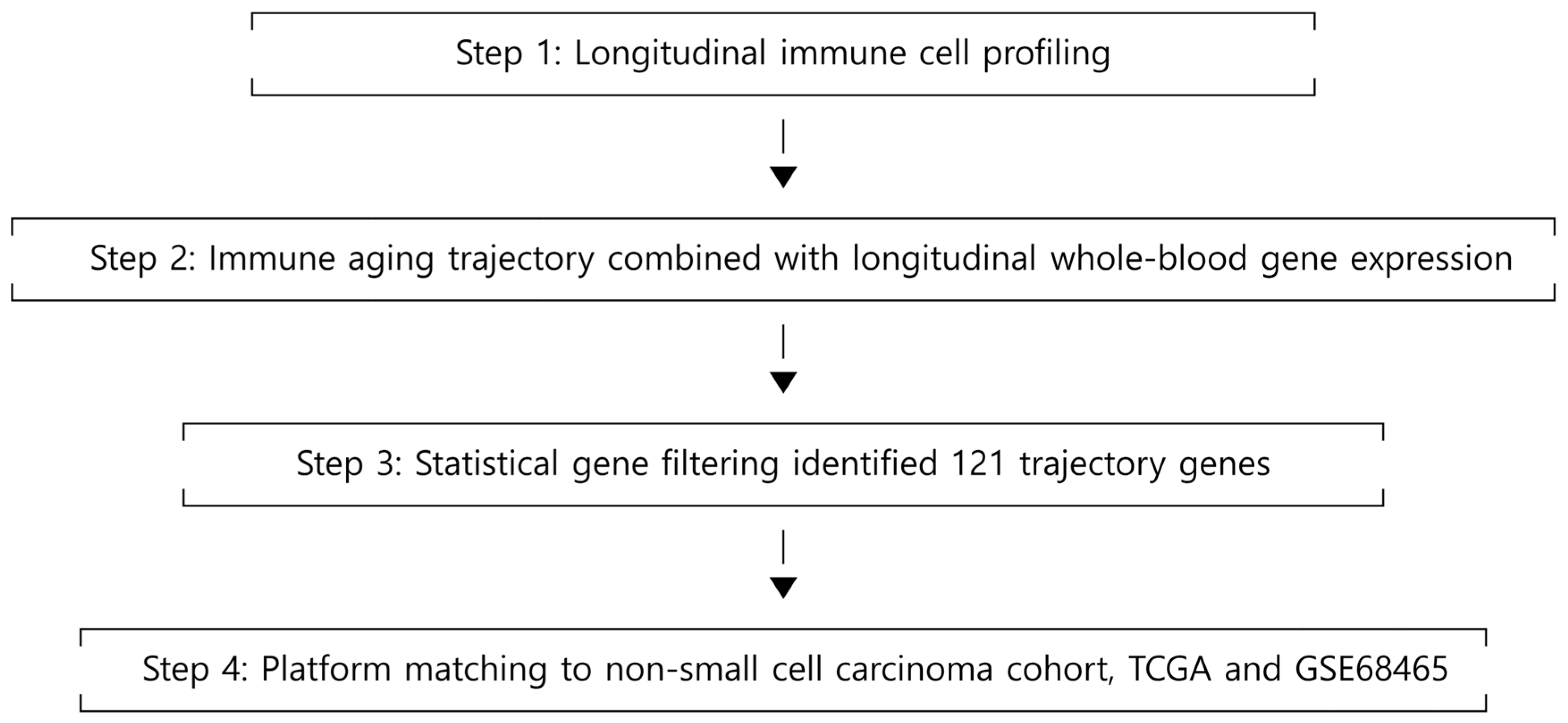
The immune aging (IMM-AGE) score was originally developed by modeling the longitudinal trajectory of immune aging using peripheral blood samples [7]. The 121-gene transcriptional signature derived from this model comprises genes that show consistent changes across both chronological and immunologic aging trajectories [7]. We extracted this 121-gene set and mapped it to the TCGA tumor transcriptome. The schematic illustrating the IMM-AGE modeling process and its application to our study is shown in Figure 1. For each gene, expression values were standardized across samples using gene-wise z-scoring, and the published IMM-AGE direction coefficient was applied as a gene-specific weight. A sample-level IMM-AGE score was then calculated as the mean of the weighted standardized gene expression values. When multiple tumor samples were available for a single patient, sample-level scores were averaged to obtain a patient-level IAS-121 value. The resulting IAS-121 distribution was trichotomized (highest tertile vs. lowest tertile) and additionally categorized into quartiles for sensitivity analyses.

2.3. Statistical Analysis

All analyses were conducted in R version 4.2.1, and two-sided p values < 0.05 were considered statistically significant. Baseline clinicopathologic characteristics were summarized by IAS-121 tertile groups.
OS was evaluated using Kaplan–Meier curves with log-rank tests. Cox proportional hazards models were fitted to assess whether IAS-121 remained an independent prognostic factor. The proportional hazards assumption was assessed using Schoenfeld residuals, and no significant violations were detected. Model diagnostics were performed to evaluate the adequacy of the fitted models. Restricted cubic spline models were constructed to evaluate the potential non-linear association between IAS-121 and survival outcomes. Four knots were placed at the 5th, 35th, 65th, and 95th percentiles of the IAS-121 distribution, following commonly recommended practices. The models were fitted using adjusted Cox proportional hazards regression, and the linearity assumption was assessed based on the spline terms. We also employed a forest plot to identify any interaction between subgroups. Subgroups were stratified by age, sex, stage, smoking status, and EGFR mutation. Sensitivity analysis was performed by categorizing IAS-121 into quartile and median groups. HR and 95% CI were estimated. To validate the results, we performed an additional pooled analysis using other LUAD cohorts, GSE68465 [14] and GSE50081 [15].
To evaluate immunologic differences associated with tumor immune aging, xCell-derived standardized scores for several immune cell types (CD8+ T cells, CD4+ naïve T cells, NK cells, Tregs, M2 macrophages, neutrophils) were compared between IAS-121 groups using Wilcoxon rank-sum tests and visualized with boxplots.
For LUAD samples, the 121-gene signature was visualized using a heatmap. Gene-wise z-scored expression values were ordered by increasing IAS-121, with annotations for clinical variables. Hierarchical clustering was applied to genes only.

3. Results

A total of 518 LUAD patients in TCGA were included. Baseline characteristics by IAS-121 tertile (173 in lowest vs. 173 in highest) groups are shown in Table 1. Patients with higher IAS-121 were younger, more often male, and current smokers; smoking status and EGFR mutation were similar between groups.
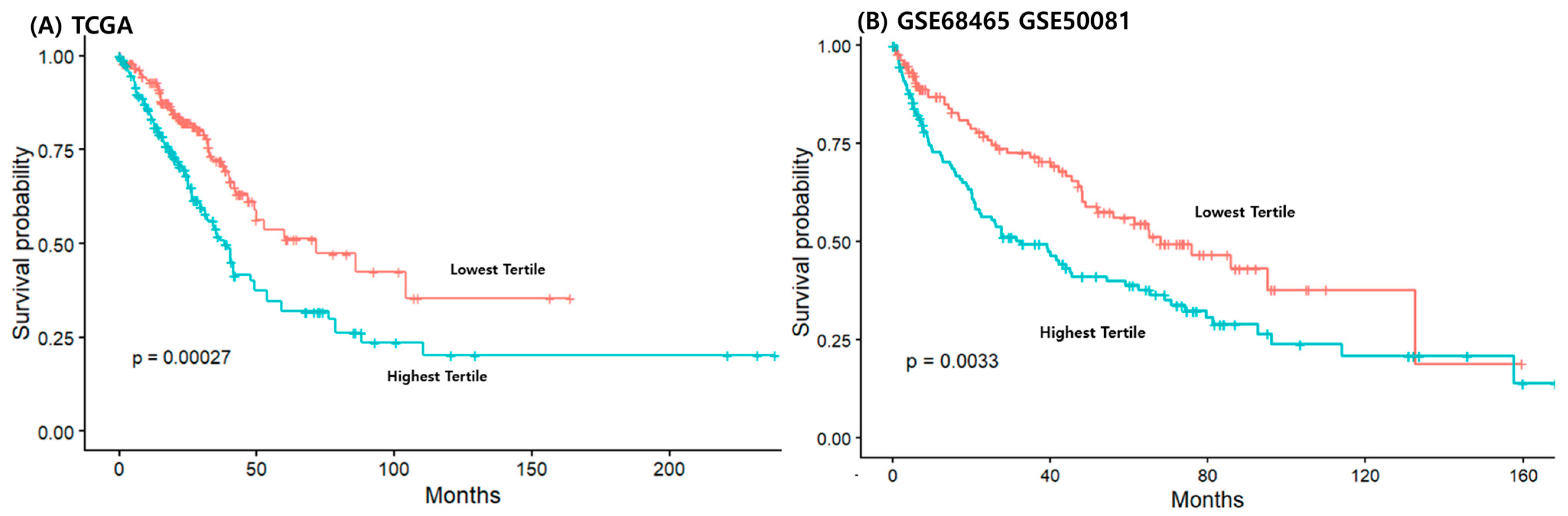
Restricted cubic spline analysis showed a linear relationship between IAS-121 and OS in LUAD patients (Figure S1). The highest IAS-121 tertile group showed lower survival compared with the lowest tertile group (Figure 2A, p < 0.001). This was similar in another pooled analysis using two cohorts, GSE68465 and GSE50081 (Figure 2B, p = 0.003). A sensitivity analysis comparing patients in the lowest quartile and the highest quartile showed similar results in both TCGA and external cohorts, GSE68465 and GSE50081 (Figure S2). Another analysis based on the median value of IAS-121 was also consistent (Figure S3).
The Cox proportional hazard model showed that in the TCGA LUAD, patients in the highest tertile of the IAS-121 had significantly worse overall survival compared with those in the lowest tertile in the crude model (HR, 1.86; 95% CI, 1.33–2.62; p < 0.001, Table 2). This association remained significant after adjustment for age, sex, tumor stage, smoking status, and EGFR mutation status (adjusted HR, 1.87; 95% CI, 1.20–2.92; p = 0.006). Consistent findings were observed in the external validation cohort combining GSE68465 and GSE50081, where the highest tertile was associated with poorer survival in both the crude model (HR, 1.68; 95% CI, 1.19–2.39; p = 0.004) and the multivariable-adjusted model (adjusted HR, 1.57; 95% CI, 1.02–2.43; p = 0.007).
The forest plot showed generally consistent subgroup interaction across age, sex, tumor stage, smoking status, and EGFR mutation, although the statistical significance was only obtained in LUAD (Figure S4).
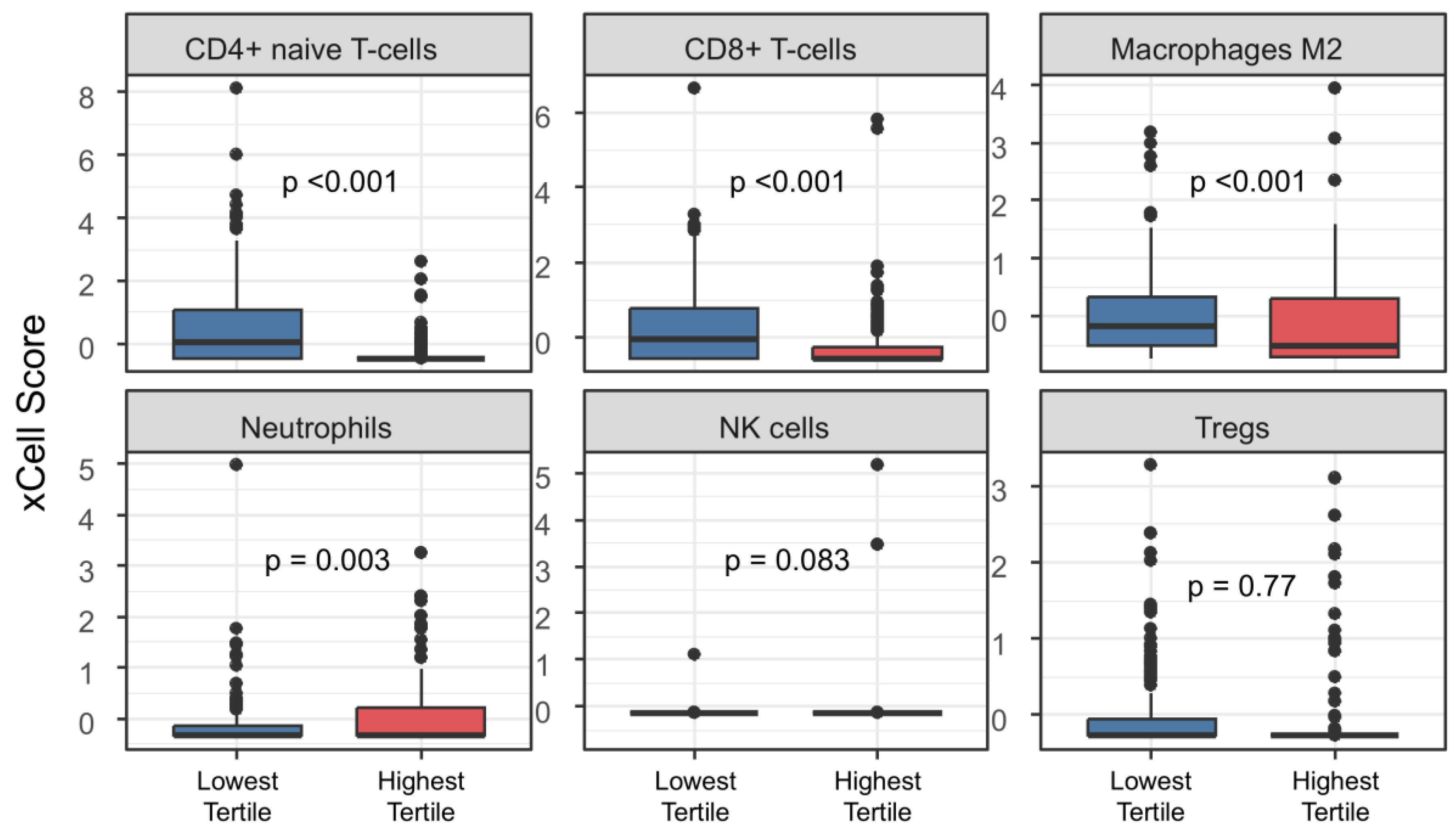
Higher IAS-121 was associated with a distinct TME characterized by lower CD8+ T-cell, CD4+ naïve T-cell, and macrophage enrichment (Figure 3). Whereas, in patients with high IAS-121, neutrophil enrichment scores were higher than in patients with low IAS-121 scores.
To examine transcriptional patterns underlying tumor immune aging, we constructed a heatmap of the 121 immune aging-related genes in the LUAD sample (Figure S5). Although the discriminative pattern was not visually significant, samples ordered by increasing IAS-121 showed a coordinated shift in gene expression across the signature. Clinical annotations showed no clustering driven by stage, smoking status, or EGFR mutation.

4. Discussion

This study is not confirmatory, but rather hypothesis-generating. Immune aging is an important determinant of survival in patients with LUAD. In this study, we applied a validated blood sample-driven immune-aging gene signature to tumor tissue samples to evaluate the prognostic role of immune aging in LUAD. Our study is the first to show that immune aging within the TME also carries significant prognostic relevance in patients with LUAD. Using applied tumor transcriptomes in TCGA, GSE68465, and GSE50081 cohorts, we found that higher intra-tumoral immune aging was associated with reduced lymphocytic activity, increased myeloid-inflammatory features, and poorer OS. These associations were consistent across multiple subgroup analyses, highlighting the robustness of TME-specific immune aging as a prognostic factor. Together, our findings suggest that tumor immune aging captures biologic dysfunction not merely reflected by chronological age alone and may offer a useful framework for risk stratification in LUAD.
One of the main findings is that immune aging as a determinant of survival in LUAD is not confined to systemic or peripheral blood measures but also manifests within the TME. Prior research has mainly characterized immune aging through circulating immune profiles [10,16,17,18], which could overlook the cumulative antigenic stimulation, exhaustion, and remodeling that occur locally within tumors. However, recent studies on TME consistently show that local immune dynamics are strongly shaped by persistent antigen exposure, metabolic stress, and immunosuppressive signaling, leading to distinct immune phenotypes that are not fully reflected in peripheral blood [19,20]. By applying a validated immune-aging gene signature to tumor tissue, intra-tumoral immune aging does capture distinct immunologic alterations linked to poorer clinical outcomes. We observed that higher TME immune aging was characterized by increased myeloid-cell signatures and reduced T-cell activity, reflecting a shift toward a more suppressive and less cytotoxic immune landscape. This pattern is consistent with blood-based findings showing that elevated neutrophil–lymphocyte ratios (NLRs) are associated with worse survival in NSCLC [21,22]. A high NLR reflects increased neutrophil-driven inflammation and reduced lymphocyte-mediated anti-tumor immunity. This imbalance promotes an immunosuppressive environment that facilitates tumor progression, explaining its association with poor survival. Treatment response to ICI was lower in NSCLC patients with higher baseline NLR [22].
In this study, we used data from tissue samples derived from the TCGA dataset. To account for immune aging within NSCLC tumor tissue, we employed previously confirmed gene signatures related to aging. The 121-gene signature was originally developed as an RNA-based approximation of systemic immune age rather than as a metric of intratumoral immunity. In contrast, TCGA bulk RNA-seq reflects transcriptional programs of tumor-infiltrating immune cells and surrounding stromal and malignant components, which represent a biologically distinct context. Consequently, the IAS-121 score used in our analysis should not be interpreted as a direct surrogate of systemic immune age; instead, it reflects a tumor immune aging–like transcriptional program, characterized by shifts toward terminal differentiation, cytotoxic/exhausted phenotypes, and reduced naïve-like signatures within the tumor microenvironment. Tumor-infiltrating lymphocytes are recruited from the circulating immune pool through chemokine-mediated trafficking from peripheral blood into tumor sites, and their differentiation and exhaustion states mirror systemic, age-related remodeling of T-cell immunity observed in cancer patients [23,24,25]. Therefore, a blood-derived immunosenescence signature may still capture the extent to which intratumoral immune cells manifest systemic immune aging within the TME. In a clinical context, recent studies in this field have robustly proven a clear association between peripheral gene signature and immune profiles within TME of breast [26] and head and neck cancer [27]. However, such associations do not imply direct biological equivalence. Therefore, further study is needed to clarify how this tumor-derived immune-aging relates to systemic immune aging and to its clinical relevance in LUAD.
It is well known that the immune landscape is different between LUAD and LUSC [28]. LUAD may be more sensitive to immune-aging–related alterations because its TME generally exhibits greater variability in lymphocytic infiltration and myeloid-driven inflammation than LUSC [28,29]. Immune aging in LUAD, therefore, more effectively captures the shift toward reduced T-cell competence and increased myeloid activation, features that have been linked to adverse prognosis. In contrast, the more uniform and less immunologically plastic landscape of LUSC may limit the prognostic value of immune aging [30]. These differences may explain why TME immune aging emerged as a stronger prognostic marker solely in LUAD.
Immunosenescence refers to the progressive, age-associated deterioration and reconfiguration of immune function. It encompasses a decline in naïve T-cell generation, reduced proliferative and cytotoxic capacity, chronic low-grade inflammation, and expansion of terminally differentiated or exhausted lymphocyte subsets [6,7,13,31,32]. However, this process does not completely correlate with chronological aging [7]. Especially within TME, persistent tumor antigen stimulation, metabolic stress, and suppressive cues originating from malignant and stromal compartments make heterogeneity in immune aging even among similar age groups [13,33]. Within this context, persistent antigen exposure and metabolic constraints can drive T cells into dysfunctional states such as exhaustion and senescence, characterized by impaired cytotoxic function despite their presence. These processes may contribute to ineffective antitumor immunity within the TME [34]. Meanwhile, it has also been reported that the aging TME is characterized by increased neutrophil infiltration [35], which was similarly observed in our study. Neutrophils within the TME may exhibit functional heterogeneity, with both pro-tumorigenic and anti-tumor roles depending on the local context. Tumor-associated neutrophils may promote tumor progression through immunosuppression and angiogenesis [36], while certain subsets may also contribute to antitumor immune responses [37]. This drives a differential transcriptional landscape characterized by diminished adaptive immune competence and heightened myeloid-inflammatory activity. In this study, higher levels of intratumoral immune aging were strongly associated with inferior survival, particularly in LUAD, suggesting that immunosenescence may actively reshape antitumor immunity and associate with tumor progression. Therefore, it is warranted to keep focusing on tumor immune aging as a distinct and biologically meaningful dimension of LUAD pathophysiology, with potential implications for prognostic stratification and therapeutic response, including immunotherapy.

Limitations

Our study has several limitations. First, although external validation was performed using two independent cohorts, these datasets were retrospective in nature, and prospective or multi-center validation was not available. Therefore, the generalizability of our findings remains to be confirmed in more diverse and clinically representative populations. Second, as discussed above, the IAS-121 signature was originally developed from peripheral blood transcriptomes; therefore, its application to tumor RNA-seq requires cautious interpretation. It may reflect a tumor-adapted immune aging–like program rather than systemic immune aging. Further studies with paired blood–tumor data are needed to validate this approach. Third, other important clinical confounders—such as detailed treatment information, PD-L1 status, comorbidity burden, and broader genomic alterations—were unavailable in TCGA and could not be incorporated into the models. Fourth, because the cohorts used in this study (TCGA and GSE68465) predominantly consisted of early-stage disease, our findings may not fully represent the biology of advanced LUAD. Given that LUAD is the most common subtype of non-small cell lung cancer worldwide and that the global population is aging, the concept of immune aging within the TME may have broad relevance across diverse populations and warrants further investigation in future studies.

5. Conclusions

This hypothesis-generating study shows that immune aging within TME is associated with distinct immunologic features and poorer survival in LUAD. By applying a validated immune-aging gene signature to tumor transcriptomes, we showed that intra-tumoral immune aging reflects a shift toward immunosuppressive myeloid activation and diminished adaptive immune competence. These findings highlight tumor immune aging as a biologically meaningful dimension of LUAD heterogeneity, with potential relevance for prognostic stratification. Future studies warrant focusing on integrating tissue- and blood-based immune aging metrics to better define systemic and intratumoral immune aging relationships, as well as on validating these findings in prospective cohorts.

Supplementary Materials

The following supporting information can be downloaded at: https://www.mdpi.com/article/10.3390/cancers18091343/s1, Figure S1: Restricted cubic spline curve for the association between IAS-121 and overall survival in patients with TCGA-LUAD; Figure S2: Overall survival according to immune aging score-121 quartiles in TCGA and External Validation Cohorts; Figure S3: Overall survival according to immune aging score-121 median cut-off in TCGA and External Validation Cohorts; Figure S4: Forest plot of subgroup analyses; Figure S5: Heatmap of immune aging-related 121-gene expression in LUAD.

Author Contributions

T.K. and H.C.: Writing—Original Draft, Methodology, Software, Formal Analysis, Data Curation, and Visualization. T.W.J.: Writing—Review and Editing and Validation. C.-H.O.: Project Administration, Writing—Review and Editing and Validation. All the authors discussed the results and approved the final version of the manuscript. The authors meet the authorship criteria recommended by the International Committee of Medical Journal Editors. All authors have read and agreed to the published version of the manuscript.

Funding

This work was supported by the Busan Regional Innovation System & Education (RISE) Project, funded by the Ministry of Education and Busan Metropolitan City.

Institutional Review Board Statement

The study was conducted in accordance with the Declaration of Helsinki. This study used publicly available, de-identified datasets (TCGA and GEO). No identifiable personal data were used, and additional institutional review board approval and informed consent were not deemed necessary.

Informed Consent Statement

Patient consent was waived due to this study uses data from public-use data sets.

Data Availability Statement

This study is based upon data generated by the TCGA Research Network, which can be found at https://www.cancer.gov/tcga, and Gene Expression Omnibus, which can be found at https://www.ncbi.nlm.nih.gov/geo/query/acc.cgi?acc=GSE68465.

Conflicts of Interest

The authors declare no conflicts of interest.

Abbreviations

CIConfidence Interval
GDCGenomic Data Commons
HRHazard Ratio
IAS-121121-Gene Immune Aging Score
LUADLung Adenocarcinoma
TMETumor Microenvironment
TCGAThe Cancer Genome Atlas

References

  1. de Jager, V.D.; Timens, W.; Bayle, A.; Botling, J.; Brcic, L.; Büttner, R.; Fernandes, M.G.O.; Havel, L.; Hochmair, M.J.; Hofman, P.; et al. Developments in predictive biomarker testing and targeted therapy in advanced stage non-small cell lung cancer and their application across European countries. Lancet Reg. Health–Eur. 2024, 38, 100838. [Google Scholar] [CrossRef]
  2. Rahal, Z.; El Darzi, R.; Moghaddam, S.J.; Cascone, T.; Kadara, H. Tumour and microenvironment crosstalk in NSCLC progression and response to therapy. Nat. Rev. Clin. Oncol. 2025, 22, 463–482. [Google Scholar] [CrossRef]
  3. de Visser, K.E.; Joyce, J.A. The evolving tumor microenvironment: From cancer initiation to metastatic outgrowth. Cancer Cell 2023, 41, 374–403. [Google Scholar] [CrossRef]
  4. Wu, F.; Fan, J.; He, Y.; Xiong, A.; Yu, J.; Li, Y.; Zhang, Y.; Zhao, W.; Zhou, F.; Li, W.; et al. Single-cell profiling of tumor heterogeneity and the microenvironment in advanced non-small cell lung cancer. Nat. Commun. 2021, 12, 2540. [Google Scholar] [CrossRef]
  5. Mi, K.; Chen, F.; Qian, Z.; Chen, J.; Lv, D.; Zhang, C.; Xu, Y.; Wang, H.; Zhang, Y.; Jiang, Y.; et al. Characterizing heterogeneity of non-small cell lung tumour microenvironment to identify signature prognostic genes. J. Cell. Mol. Med. 2020, 24, 14608–14618. [Google Scholar] [CrossRef] [PubMed]
  6. Liao, S.; Ning, Q.; Chen, Y.; Zhao, X.; Tang, S. Interaction of aging and Immunosenescence: New therapeutic targets of aging. Int. Immunopharmacol. 2022, 113, 109397. [Google Scholar] [CrossRef]
  7. Alpert, A.; Pickman, Y.; Leipold, M.; Rosenberg-Hasson, Y.; Ji, X.; Gaujoux, R.; Rabani, H.; Starosvetsky, E.; Kveler, K.; Schaffert, S.; et al. A clinically meaningful metric of immune age derived from high-dimensional longitudinal monitoring. Nat. Med. 2019, 25, 487–495. [Google Scholar] [CrossRef] [PubMed]
  8. Alexa-Stratulat, T.; Pavel-Tanasa, M.; Cianga, V.A.; Antoniu, S. Immune senescence in non-small cell lung cancer management: Therapeutic relevance, biomarkers, and mitigating approaches. Expert. Rev. Anticancer Ther. 2022, 22, 1197–1210. [Google Scholar] [CrossRef]
  9. Ferrara, R.; Mezquita, L.; Auclin, E.; Chaput, N.; Besse, B. Immunosenescence and immunecheckpoint inhibitors in non-small cell lung cancer patients: Does age really matter? Cancer Treat. Rev. 2017, 60, 60–68. [Google Scholar] [CrossRef] [PubMed]
  10. Zhang, J.; Zhao, L.; Li, H.; Jia, Y.; Kong, F. Immunosenescence and immunotherapy in older NSCLC patients. J. Cancer Res. Ther. 2024, 20, 9–16. [Google Scholar] [CrossRef]
  11. Ready, N.E.; Audigier-Valette, C.; Goldman, J.W.; Felip, E.; Ciuleanu, T.E.; Rosario García Campelo, M.; Jao, K.; Barlesi, F.; Bordenave, S.; Rijavec, E.; et al. First-line nivolumab plus ipilimumab for metastatic non-small cell lung cancer, including patients with ECOG performance status 2 and other special populations: CheckMate 817. J. Immunother. Cancer 2023, 11, e006127. [Google Scholar] [CrossRef]
  12. Gomes, F.; Lorigan, P.; Woolley, S.; Foden, P.; Burns, K.; Yorke, J.; Blackhall, F. A prospective cohort study on the safety of checkpoint inhibitors in older cancer patients—The ELDERS study. ESMO Open 2021, 6, 100042. [Google Scholar] [CrossRef]
  13. Jiang, Y.; Li, Y.; Zhu, B. T-cell exhaustion in the tumor microenvironment. Cell Death Dis. 2015, 6, e1792. [Google Scholar] [CrossRef]
  14. Shedden, K.; Taylor, J.M.; Enkemann, S.A.; Tsao, M.S.; Yeatman, T.J.; Gerald, W.L.; Eschrich, S.; Jurisica, I.; Giordano, T.J.; Misek, D.E.; et al. Gene expression-based survival prediction in lung adenocarcinoma: A multi-site, blinded validation study. Nat. Med. 2008, 14, 822–827. [Google Scholar] [CrossRef]
  15. Der, S.D.; Sykes, J.; Pintilie, M.; Zhu, C.Q.; Strumpf, D.; Liu, N.; Jurisica, I.; Shepherd, F.A.; Tsao, M.S. Validation of a histology-independent prognostic gene signature for early-stage, non-small-cell lung cancer including stage IA patients. J. Thorac. Oncol. 2014, 9, 59–64. [Google Scholar] [CrossRef]
  16. Cao, J.; Zhang, Y.; Guo, S.; Wu, Z.; Guo, X.; Zhang, R.; Zhang, L.; Liu, Y.; Li, X.; Yang, C.; et al. Immune biomarkers in circulating cells of NSCLC patients can effectively evaluate the efficacy of chemotherapy combined with anti-PD-1 therapy. Front. Immunol. 2025, 16, 1521708. [Google Scholar] [CrossRef]
  17. Kim, K.H.; Pyo, H.; Lee, H.; Oh, D.; Noh, J.M.; Ahn, Y.C.; Kim, C.G.; Yoon, H.I.; Lee, J.; Park, S.; et al. Association of T Cell Senescence with Radiation Pneumonitis in Patients with Non-small Cell Lung Cancer. Int. J. Radiat. Oncol. Biol. Phys. 2023, 115, 464–475. [Google Scholar] [CrossRef]
  18. Zhuang, W.; Wang, M.; Jiang, L.; Su, Z.; Lin, S. The peripheral CD4(+) T cells predict efficacy in non-small cell lung cancer (NSCLC) patients with the anti-PD-1 treatment. Transl. Cancer Res. 2024, 13, 4052–4061. [Google Scholar] [CrossRef]
  19. Wang, Y.; Xu, Y.; Song, J.; Liu, X.; Liu, S.; Yang, N.; Wang, L.; Liu, Y.; Zhao, Y.; Zhou, W.; et al. Tumor Cell-Targeting and Tumor Microenvironment-Responsive Nanoplatforms for the Multimodal Imaging-Guided Photodynamic/Photothermal/Chemodynamic Treatment of Cervical Cancer. Int. J. Nanomed. 2024, 19, 5837–5858. [Google Scholar] [CrossRef]
  20. Wang, J.; Luo, J.; Rotili, D.; Mai, A.; Steegborn, C.; Xu, S.; Jin, Z.G. SIRT6 Protects Against Lipopolysaccharide-Induced Inflammation in Human Pulmonary Lung Microvascular Endothelial Cells. Inflammation 2024, 47, 323–332. [Google Scholar] [CrossRef]
  21. Scilla, K.A.; Bentzen, S.M.; Lam, V.K.; Mohindra, P.; Nichols, E.M.; Vyfhuis, M.A.; Bhooshan, N.; Feigenberg, S.J.; Edelman, M.J.; Feliciano, J.L. Neutrophil-Lymphocyte Ratio Is a Prognostic Marker in Patients with Locally Advanced (Stage IIIA and IIIB) Non-Small Cell Lung Cancer Treated with Combined Modality Therapy. Oncologist 2017, 22, 737–742. [Google Scholar] [CrossRef] [PubMed]
  22. Valero, C.; Lee, M.; Hoen, D.; Weiss, K.; Kelly, D.W.; Adusumilli, P.S.; Paik, P.K.; Plitas, G.; Ladanyi, M.; Postow, M.A.; et al. Pretreatment neutrophil-to-lymphocyte ratio and mutational burden as biomarkers of tumor response to immune checkpoint inhibitors. Nat. Commun. 2021, 12, 729. [Google Scholar] [CrossRef]
  23. Zhang, W.; Li, Y.; Lyu, J.; Shi, F.; Kong, Y.; Sheng, C.; Wang, S.; Wang, Q. An aging-related signature predicts favorable outcome and immunogenicity in lung adenocarcinoma. Cancer Sci. 2022, 113, 891–903. [Google Scholar] [CrossRef] [PubMed]
  24. Paijens, S.T.; Vledder, A.; de Bruyn, M.; Nijman, H.W. Tumor-infiltrating lymphocytes in the immunotherapy era. Cell Mol. Immunol. 2021, 18, 842–859. [Google Scholar] [CrossRef]
  25. Jeske, S.S.; Schuler, P.J.; Doescher, J.; Theodoraki, M.N.; Laban, S.; Brunner, C.; Hoffmann, T.K.; Wigand, M.C. Age-related changes in T lymphocytes of patients with head and neck squamous cell carcinoma. Immun. Ageing 2020, 17, 3. [Google Scholar] [CrossRef]
  26. Balko, J.; Sun, X.; Hanna, A.; Ocampo, A.; Taylor, B.; Marshall, J.; Steele, J.; Axelrod, M.; Wescott, E.; Opalenik, S.; et al. Peripheral blood gene expression signatures of systemic immunity predict tumor microenvironment biology and therapeutic response in breast cancer. Res. Sq. 2025. Preprint. [Google Scholar] [CrossRef]
  27. Cao, Y.; Chang, T.; Schischlik, F.; Wang, K.; Sinha, S.; Hannenhalli, S.; Jiang, P.; Ruppin, E. Inferring Characteristics of the Tumor Immune Microenvironment of Patients with HNSCC from Single-Cell Transcriptomics of Peripheral Blood. Cancer Res. Commun. 2024, 4, 2335–2348. [Google Scholar] [CrossRef]
  28. Wang, C.; Yu, Q.; Song, T.; Wang, Z.; Song, L.; Yang, Y.; Shao, J.; Li, J.; Ni, Y.; Chao, N.; et al. The heterogeneous immune landscape between lung adenocarcinoma and squamous carcinoma revealed by single-cell RNA sequencing. Signal Transduct. Target. Ther. 2022, 7, 289. [Google Scholar] [CrossRef]
  29. Fang, X.; Li, D.; Wan, S.; Hu, J.; Zhang, P.; Jie, D.; Chen, L.; Jiang, G.; Song, N. Insights into the heterogeneity of the tumor microenvironment in lung adenocarcinoma and squamous carcinoma through single-cell transcriptomic analysis: Implications for distinct immunotherapy outcomes. J. Gene Med. 2024, 26, e3694. [Google Scholar] [CrossRef]
  30. Qu, Y.; Cheng, B.; Shao, N.; Jia, Y.; Song, Q.; Tan, B.; Wang, J. Prognostic value of immune-related genes in the tumor microenvironment of lung adenocarcinoma and lung squamous cell carcinoma. Aging 2020, 12, 4757–4777. [Google Scholar] [CrossRef] [PubMed]
  31. Zhang, H.; Weyand, C.M.; Goronzy, J.J. Hallmarks of the aging T-cell system. FEBS J. 2021, 288, 7123–7142. [Google Scholar] [CrossRef]
  32. Elyahu, Y.; Hekselman, I.; Eizenberg-Magar, I.; Berner, O.; Strominger, I.; Schiller, M.; Mittal, K.; Nemirovsky, A.; Eremenko, E.; Vital, A.; et al. Aging promotes reorganization of the CD4 T cell landscape toward extreme regulatory and effector phenotypes. Sci. Adv. 2019, 5, eaaw8330. [Google Scholar] [CrossRef]
  33. Huang, L.; Zhang, C.; Jiang, A.; Lin, A.; Zhu, L.; Mou, W.; Zeng, D.; Liu, Z.; Tang, B.; Zhang, J.; et al. T-cell Senescence in the Tumor Microenvironment. Cancer Immunol. Res. 2025, 13, 618–632. [Google Scholar] [CrossRef]
  34. Zhao, Y.; Shao, Q.; Peng, G. Exhaustion and senescence: Two crucial dysfunctional states of T cells in the tumor microenvironment. Cell Mol. Immunol. 2020, 17, 27–35. [Google Scholar] [CrossRef] [PubMed]
  35. Duan, R.; Jiang, L.; Wang, T.; Li, Z.; Yu, X.; Gao, Y.; Jia, R.; Fan, X.; Su, W. Aging-induced immune microenvironment remodeling fosters melanoma in male mice via γδ17-Neutrophil-CD8 axis. Nat. Commun. 2024, 15, 10860. [Google Scholar] [CrossRef] [PubMed]
  36. Masucci, M.T.; Minopoli, M.; Carriero, M.V. Tumor Associated Neutrophils. Their Role in Tumorigenesis, Metastasis, Prognosis and Therapy. Front. Oncol. 2019, 9, 1146. [Google Scholar] [CrossRef] [PubMed]
  37. Eruslanov, E.B.; Bhojnagarwala, P.S.; Quatromoni, J.G.; Stephen, T.L.; Ranganathan, A.; Deshpande, C.; Akimova, T.; Vachani, A.; Litzky, L.; Hancock, W.W.; et al. Tumor-associated neutrophils stimulate T cell responses in early-stage human lung cancer. J. Clin. Investig. 2014, 124, 5466–5480. [Google Scholar] [CrossRef]
Figure 1. IMM-AGE modeling and its integration into the current study design.
Cancers 18 01343 g001
Figure 2. Overall survival according to immune aging score-121 tertiles in TCGA and external validation cohorts (GSE68465 and GSE50081).
Cancers 18 01343 g002
Figure 3. Immune cell enrichment score in LUAD according to IAS-121.
Cancers 18 01343 g003
Table 1. Characteristics of patients according to IAS-121 tertile group.
Lowest (n = 173)Highest (n = 173)p
Age (SD)67.3 (8.9)62.6 (10.7)0.001
Gender, n (%) 0.031
  Female103 (59.5)82 (47.4)
  Male70 (40.5)91 (52.6)
AJCC stage, n (%) 0.058
  1 & 2144 (83.2)125 (76.5)
  321 (12.1)34 (18.0)
  45 (2.9)12 (4.3)
Smoking, n (%) 0.009
  Never29 (16.8)18 (10.4)
  Former109 (63.0)95 (54.9)
  Current30 (17.3)56 (32.4)
EGFR, n (%) 0.628
  Mutated20 (11.6)24 (8.6)
  Wild type153 (88.4)149 (91.4)
SD = standard deviation; AJCC = American Joint Committee on Cancer; IAS = immune aging score; EGFR = epidermal growth factor receptor.
Table 2. Cox proportional hazards models comparing the lowest versus the highest tertile of immune aging score-121 and overall survival in lung adenocarcinoma.
TCGAGSE68465 Plus GSE50081
HR (95% CI)pHR (95% CI)p
Crude1.86 (1.33–2.62)<0.0011.68 (1.19–2.39)0.004
Adjusted1.87 (1.20–2.92)0.0061.57 (1.02–2.43)0.007
Models adjusted for age, sex, tumor stage, smoking status, and EGFR mutation status for TCGA dataset and age, sex, tumor stage for GSE68465 plus GSE50081 cohorts. HR = hazard ratio; CI = confidence level.
Disclaimer/Publisher’s Note: The statements, opinions and data contained in all publications are solely those of the individual author(s) and contributor(s) and not of MDPI and/or the editor(s). MDPI and/or the editor(s) disclaim responsibility for any injury to people or property resulting from any ideas, methods, instructions or products referred to in the content.