Immunohistological Characterization of Actinic Keratoses with Varying Degrees of Proliferation

 ,
, 
 and
and
Simple Summary
Abstract
1. Introduction
2. Materials and Methods
2.1. Study Population
2.2. Microscopic Evaluation
2.3. Statistical Analysis
3. Results
4. Discussion
5. Conclusions
6. Limitations of the Study
Author Contributions
Funding
Institutional Review Board Statement
Informed Consent Statement
Data Availability Statement
Conflicts of Interest
References
- Schmitz, L.; Oster-Schmidt, C.; Stockfleth, E. Nonmelanoma skin cancer—From actinic keratosis to cutaneous squamous cell carcinoma. J. Dtsch. Dermatol. Ges. 2018, 16, 1002–1013. [Google Scholar] [CrossRef]
- Green, A.C. Epidemiology of actinic keratoses. In Current Problems in Dermatology; S. Karger AG: Basel, Switzerland, 2015; Volume 46, pp. 1–7. [Google Scholar] [CrossRef]
- Leiter, U.; Keim, U.; Eigentler, T.; Katalinic, A.; Holleczek, B.; Martus, P.; Garbe, C. Incidence, Mortality, and Trends of Nonmelanoma Skin Cancer in Germany. J. Investig. Dermatol. 2017, 137, 1860–1867. [Google Scholar] [CrossRef]
- Blauvelt, A.; Kempers, S.; Lain, E.; Schlesinger, T.; Tyring, S.; Forman, S.; Ablon, G.; Martin, G.; Wang, H.; Cutler, D.L.; et al. Phase 3 Trials of Tirbanibulin Ointment for Actinic Keratosis. N. Engl. J. Med. 2021, 384, 512–520. [Google Scholar] [CrossRef]
- Schmitz, L.; Gambichler, T.; Gupta, G.; Stücker, M.; Dirschka, T. Actinic keratosis area and severity index (AKASI) is associated with the incidence of squamous cell carcinoma. J. Eur. Acad. Dermatol. Venereol. 2018, 32, 752–756. [Google Scholar] [CrossRef]
- Glogau, R.G. The risk of progression to invasive disease. J. Am. Acad. Dermatol. 2000, 42, 23–24. [Google Scholar] [CrossRef]
- Röwert-Huber, J.; Patel, M.J.; Forschner, T.; Ulrich, C.; Eberle, J.; Kerl, H.; Sterry, W.; Stockfleth, E. Actinic keratosis is an early in situ squamous cell carcinoma: A proposal for reclassification. Br. J. Dermatol. 2007, 156, 8–12. [Google Scholar] [CrossRef]
- Fernández-Figueras, M.T.; Carrato, C.; Sáenz, X.; Puig, L.; Musulen, E.; Ferrándiz, C.; Ariza, A. Actinic keratosis with atypical basal cells (AK I) is the most common lesion associated with invasive squamous cell carcinoma of the skin. J. Eur. Acad. Dermatol. Venereol. 2015, 29, 991–997. [Google Scholar] [CrossRef] [PubMed]
- Schmitz, L.; Gambichler, T.; Gupta, G.; Stücker, M.; Stockfleth, E.; Szeimies, R.M.; Dirschka, T. Actinic keratoses show variable histological basal growth patterns—A proposed classification adjustment. J. Eur. Acad. Dermatol. Venereol. 2018, 32, 745–751. [Google Scholar] [CrossRef] [PubMed]
- Schmitz, L.; Brehmer, A.; Falkenberg, C.; Gambichler, T.; Heppt, M.V.; Steeb, T.; Gupta, G.; Malvehy, J.; Dirschka, T. Treatment-resistant actinic keratoses are characterized by distinct clinical and histological features. Ital. J. Dermatol. Venerol. 2021, 156, 213–219. [Google Scholar] [CrossRef] [PubMed]
- Wojciechowska-Zdrojowy, M.; Szepietowski, J.C.; Matusiak, Ł.; Dzięgiel, P.; Puła, B. Expression of Podoplanin in Non-melanoma Skin Cancers and Actinic Keratosis. Anticancer Res. 2016, 36, 1591–1597. [Google Scholar]
- Remmele, W.; Stegner, H.E. Recommendation for uniform definition of an immunoreactive score (IRS) for immunohistochemical estrogen receptor detection (ER-ICA) in breast cancer tissue. Pathologe 1987, 8, 138–140. [Google Scholar]
- Olsen, E.A.; Abernethy, M.L.; Kulp-Shorten, C.; Callen, J.P.; Glazer, S.D.; Huntley, A.; McCray, M.; Monroe, A.B.; Tschen, E.; Wolf, J.E., Jr. A double-blind, vehicle-controlled study evaluating masoprocol cream in the treatment of actinic keratoses on the head and neck. J. Am. Acad. Dermatol. 1991, 24, 738–743. [Google Scholar] [CrossRef] [PubMed]
- Schmitz, L.; Gambichler, T.; Kost, C.; Gupta, G.; Stücker, M.; Stockfleth, E.; Dirschka, T. Cutaneous squamous cell carcinomas are associated with basal proliferating actinic keratoses. Br. J. Dermatol. 2019, 180, 916–921. [Google Scholar] [CrossRef]
- Kanitakis, J. Acantholytic Nodular Basal Cell Carcinoma. Am. J. Dermatopathol. 2023, 45, 639–641. [Google Scholar] [CrossRef]
- Bakshi, A.; Shafi, R.; Nelson, J.; Cantrell, W.C.; Subhadarshani, S.; Andea, A.; Athar, M.; Elmets, C.A. The clinical course of actinic keratosis correlates with underlying molecular mechanisms. Br. J. Dermatol. 2020, 182, 995–1002. [Google Scholar] [CrossRef] [PubMed]
- Elsbroek, L.; Reuschlein, K.; Karsai, S.; Geueke, A.; von Petersdorff-Campen, M.; Bresch, M.; Steinkraus, V.; Weisenseel, P.; Wolf, P.; Winnefeld, M.; et al. Primary keratinocyte model of actinic keratosis reveals UV-induced DNA damage accumulation and persistent IFN signaling. J. Investig. Dermatol. 2025. Online ahead of print. [Google Scholar] [CrossRef]
- Falkenberg, C.; Dirschka, T.; Gilbert, G.; Stockfleth, E.; Homey, B.; Schmitz, L. Basal Proliferation and Acantholysis May Represent Histological High-Risk Factors for Progression into Invasive Squamous Cell Carcinoma: A Comparison Study in Solid Organ Transplant Recipients and Matched Immunocompetent Patients. Cancers 2023, 15, 1765. [Google Scholar] [CrossRef]
- Thamm, J.R.; Schuh, S.; Welzel, J. Epidemiology and Risk Factors of Actinic Keratosis. What is New for The Management for Sun-Damaged Skin. Dermatol. Pract. Concept. 2024, 14, e2024146S. [Google Scholar] [CrossRef]
- Talghini, S.; Halimi, M.; Baybordi, H. Expression of P27, Ki67 and P53 in squamous cell carcinoma, actinic keratosis and Bowen disease. Pak. J. Biol. Sci. 2009, 12, 929–933. [Google Scholar] [CrossRef]
- Marinescu, A.; Stepan, A.E.; Mărgăritescu, C.; Marinescu, A.M.; Zăvoi, R.E.; Simionescu, C.E.; Niculescu, M. P53, p16 and Ki67 immunoexpression in cutaneous squamous cell carcinoma and its precursor lesions. Rom. J. Morphol. Embryol. 2016, 57, 691–696. [Google Scholar]
- Oh, C.W.; Penneys, N. P27 and mib1 expression in actinic keratosis, Bowen disease, and squamous cell carcinoma. Am. J. Dermatopathol. 2004, 26, 22–26. [Google Scholar] [CrossRef] [PubMed]
- Sim, C.S.; Slater, S.; McKee, P.H. Mutant p53 expression in solar keratosis: An immunohistochemical study. J. Cutan. Pathol. 1992, 19, 302–308. [Google Scholar] [CrossRef]
- Shimizu, T.; Oga, A.; Murakami, T.; Muto, M. Overexpression of p53 protein associated with proliferative activity and histological degree of malignancy in solar keratosis. Dermatology 1999, 199, 113–118. [Google Scholar] [CrossRef]
- Neto, P.D.; Alchorne, M.; Michalany, N.; Abreu, M.; Borra, R. Reduced P53 Staining in Actinic Keratosis is Associated with Squamous Cell Carcinoma: A Preliminary Study. Indian J. Dermatol. 2013, 58, 325. [Google Scholar] [CrossRef]
- Harvey, N.T.; Leecy, T.; Wood, B.A. Immunohistochemical staining for p16 is a useful adjunctive test in the diagnosis of Bowen’s disease. Pathology 2013, 45, 402–407. [Google Scholar] [CrossRef] [PubMed]
- Hodges, A.; Smoller, B.R. Immunohistochemical comparison of p16 expression in actinic keratoses and squamous cell carcinomas of the skin. Mod. Pathol. 2002, 15, 1121–1125. [Google Scholar] [CrossRef] [PubMed]
- Schwab, M.; Lohr, S.; Schneider, J.; Kaiser, M.; Krunic, D.; Helbig, D.; Géraud, C.; Angel, P. Podoplanin is required for tumor cell invasion in cutaneous squamous cell carcinoma. Exp. Dermatol. 2021, 30, 1619–1630. [Google Scholar] [CrossRef] [PubMed]
- Hesse, K.; Satzger, I.; Schacht, V.; Köther, B.; Hillen, U.; Klode, J.; Schaper, K.; Gutzmer, R. Characterisation of Prognosis and Invasion of Cutaneous Squamous Cell Carcinoma by Podoplanin and E-Cadherin Expression. Dermatology 2016, 232, 558–565. [Google Scholar] [CrossRef] [PubMed]



| Characteristics | Overall (N = 97) | Proliferative AK (Pro III) (N = 48) | Non-Proliferative AK (Pro I) (N = 49) | p-Value |
|---|---|---|---|---|
| n (%) | n (%) | n (%) | (Pro I vs. { XE “vs.” \t “versus” }Pro III) | |
| Demography | ||||
| Sex # | 0.0207 * | |||
| Male | 66 (68%) | 38 (79.2%) | 28 (57%) | |
| Female | 31 (32%) | 10 (20.8%) | 21 (43%) | |
| Age, years # | 77 (68–82) a | 78 (69.75–84) a | 73 (64–79) a | |
| Location of lesion | ||||
| Bald scalp # | 26 (26.8%) | 7 (14.6%) | 19 (38.8%) | 0.0075 * |
| Forehead # | 28 (28.9%) | 19 (39.6%) | 9 (18.4%) | 0.0218 * |
| Left side of the face (+ear) | 22 (22.7%) | 12 (25%) | 10 (20.4%) | 0.5912 |
| Right side of the face (+ear) | 21 (21.6%) | 10 (20.8%) | 11 (22.4%) | 0.8476 |
| Histological Characteristics | ||||
| Histological Severity # | 0.0005 * | |||
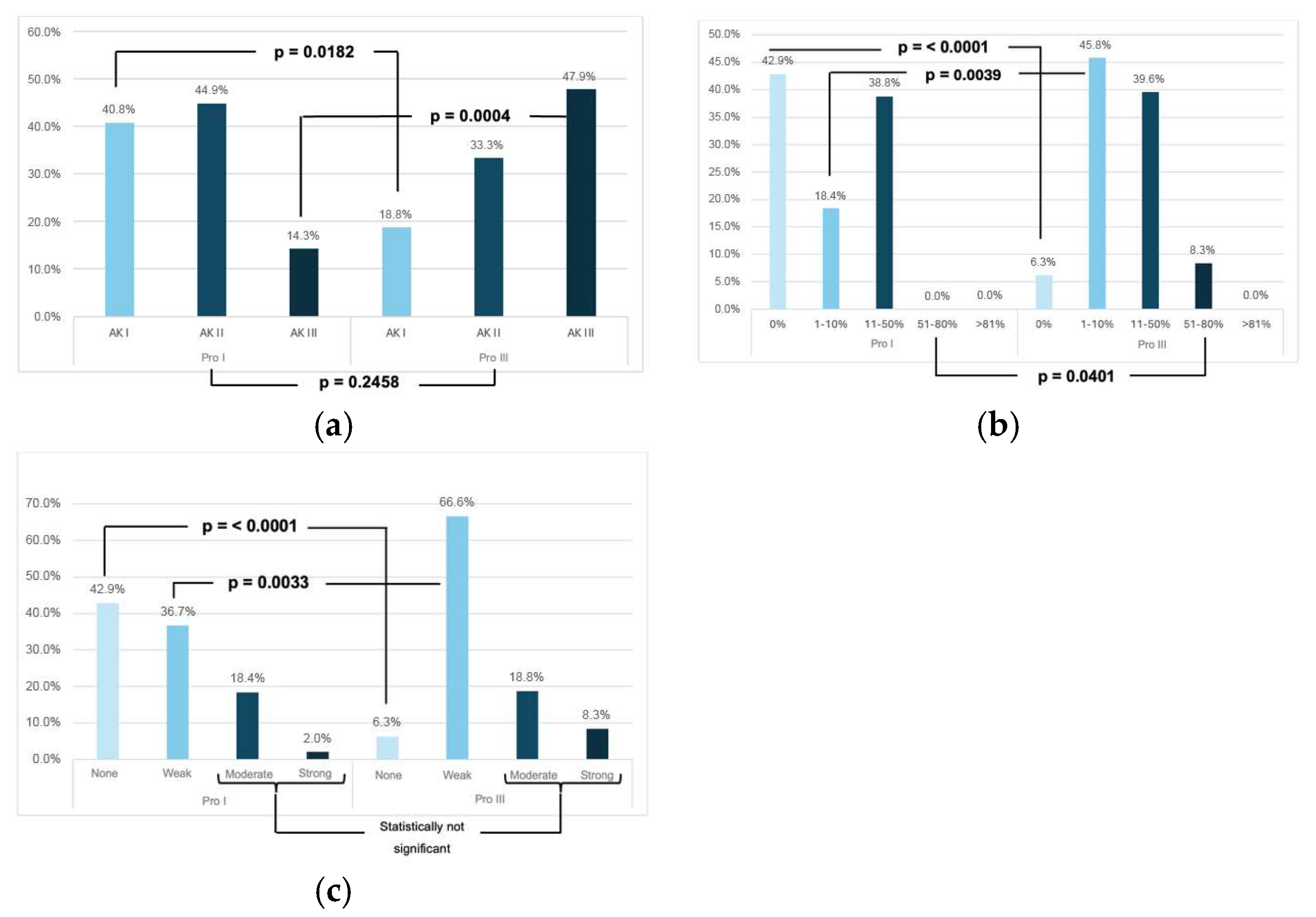
| AK I # | 29 (29.9%) | 9 (18.8%) | 20 (40.8%) | 0.0182 * |
| AK II | 38 (39.2%) | 16 (33.3%) | 22 (44.9%) | |
| AK III # | 30 (30.9%) | 23 (47.9%) | 7 (14.3%) | 0.0004 * |
| Parakeratosis | 0.0588 | |||
| Mild | 69 (71.2%) | 30 (62.4%) | 39 (79.6%) | |
| Moderate | 24 (24.7%) | 15 (31.3%) | 9 (18.4%) | |
| Severe | 4 (4.1%) | 3 (6.3%) | 1 (2%) | |
| Elastosis | 0.2600 | |||
| Mild | 29 (29.9%) | 12 (25%) | 17 (34.7%) | |
| Moderate | 65 (67%) | 34 (70.8%) | 31 (63.3%) | |
| Severe | 3 (3.1%) | 2 (4.2%) | 1 (2%) | |
| Infiltrate # | <0.0001 * | |||
| None # | 25 (25.8%) | 3 (6.3%) | 22 (44.9%) | <0.0001 * |
| Mild | 52 (53.6%) | 28 (58.3%) | 24 (49%) | |
| Moderate # | 17 (17.5%) | 14 (29.2%) | 3 (6.1%) | 0.0030 * |
| Severe | 3 (3.1%) | 3 (6.3%) | 0 (0%) | |
| Acantholysis # | 0.0004 * | |||
| Yes # | 11 (11.3%) | 11 (22.9%) | 0 (0%) | |
| No # | 86 (88.7%) | 37 (77.1%) | 49 (100%) | |
| Characteristics | Overall (N = 97) | Proliferative AK (Pro III) (N = 48) | Non-Proliferative AK (Pro I) (N = 49) | p-Value | |
|---|---|---|---|---|---|
| n (%) | n (%) | n (%) | (Pro I vs. { XE “vs.” \t “versus” } Pro III) | ||
| Ki-67 Immunoreactivity | |||||
| Percentage of positive cells | 0.3588 | ||||
| No expression | <1% | 1 (1%) | 1 (2.1%) | 0 (0%) | |
| Weak | 1–20% | 53 (54.6%) | 28 (58.3%) | 25 (51%) | |
| Moderate | 21–40% | 35 (36.1%) | 15 (31.3%) | 20 (40.8%) | |
| Strong | >41% | 8 (8.3%) | 4 (8.3%) | 4 (8.2%) | |
| Ki-67 Localization in the epidermis | 0.1833 | ||||
| Lower third (AK I) | 54 (55.7%) | 24 (50%) | 30 (61.2%) | ||
| Lower two-thirds (AK II) | 40 (41.2%) | 21 (43.8%) | 19 (38.8%) | ||
| Entire Epidermis (AK III) | 2 (2.1%) | 2 (4.2%) | 0 (0%) | ||
| Not assessable | 1 (1%) | 1 (2%) | 0 (0%) | ||
| P53 Immunoreactivity | |||||
| Percentage of positive cells | 0.4683 | ||||
| No expression. | <1% | 11 (11.3%) | 4 (8.3%) | 7 (14.3%) | |
| Weak | 1–25% | 36 (37.1%) | 19 (39.6%) | 17 (34.7%) | |
| Moderate | 26–50% | 14 (14.5%) | 5 (10.4%) | 9 (18.4%) | |
| Strong | >51% | 36 (37.1%) | 20 (41.7%) | 16 (32.6%) | |
| P53 staining intensity | 0.4409 | ||||
| None | 11 (11.3%) | 4 (8.3%) | 7 (14.3%) | ||
| Weak | 39 (40.2%) | 18 (37.5%) | 21 (42.9%) | ||
| Moderate | 32 (33%) | 14 (29.2%) | 18 (36.7%) | ||
| Strong # | 15 (15.5%) | 12 (25%) | 3 (6.1%) | 0.0105 * | |
| P53 Localization in the epidermis | 0.3476 | ||||
| Lower third (AK I) | 27(27.9%) | 16 (33.3%) | 11 (22.4%) | ||
| Lower two-thirds (AK II) | 43 (44.3%) | 19 (39.6%) | 24 (49%) | ||
| Entire Epidermis (AK III) | 16 (16.5%) | 9 (18.8%) | 7 (14.3%) | ||
| Not assessable | 11 (11.3%) | 4 (8.3%) | 7 (14.3%) | ||
| P53 positive cells | 0.6126 | ||||
| Not only in pro zones | 60 (61.9%) | 27 (56.3%) | 33 (67.3%) | ||
| Only in proliferative zones | 26 (26.8%) | 17 (35.4%) | 9 (18.4%) | ||
| Not assessable | 11 (11.3%) | 4 (8.3%) | 7 (14.3%) | ||
| Podoplanin-Immunoreactivity | |||||
| Podoplanin Immunoreactivity | 73 (75.3%) | 45 (93.75%) | 28 (57.1%) | ||
| Percentage of positive cells # | 0.0056 * | ||||
| No positive cells # | 24 (24.7%) | 3 (6.3%) | 21 (42.9%) | <0.0001 * | |
| 1–10% # | 31 (32%) | 22 (45.8%) | 9 (18.4%) | 0.0039 * | |
| 11–50% | 38 (39.2%) | 19 (39.6%) | 19 (38.8%) | ||
| 51–80% # | 4 (4.1%) | 4 (8.3%) | 0 (0%) | 0.0401 * | |
| >81% | 0 (0%) | 0 (0%) | 0 (0%) | ||
| Podoplanin staining intensity # | 0.0029 * | ||||
| None # | 24 (24.7%) | 3 (6.3%) | 21 (42.9%) | <0.0001 * | |
| Weak # | 49 (50.5%) | 32 (66.7%) | 17 (34.7%) | 0.0017 * | |
| Moderate | 19 (19.6%) | 9 (18.8%) | 10 (20.4%) | ||
| Strong | 5 (5.2%) | 4 (8.3%) | 1 (2%) | ||
| Remmele and Stegner Score # | 0.0016 * | ||||
| No expression # | 24 (24.7%) | 3 (6.3%) | 21 (42.9%) | <0.0001 * | |
| Weak # | 50 (51.5%) | 32 (66.6%) | 18 (36.7%) | 0.0033 * | |
| Moderate | 18 (18.6%) | 9 (18.8%) | 9 (18.4%) | ||
| Strong | 5 (5.2%) | 4 (8.3%) | 1 (2%) | ||
| Podoplanin Localization in the epidermis # | 0.0003 * | ||||
| Lower third (AK I) | 70 (72.2%) | 42 (87.5%) | 28 (57.1%) | 0.0009 * | |
| Lower two-thirds (AK II) | 2 (2.1%) | 2 (4.2%) | 0 (0%) | ||
| Entire Epidermis (AK III) | 1 (1%) | 1 (2%) | 0 (0%) | ||
| Not assessable | 24 (24.7%) | 3 (6.3%) | 21 (42.9%) | ||
| P16 Immunoreactivity | |||||
| P16 Positivity | 0.2601 | ||||
| No expression | <1% | 54 (55.7%) | 25 (52.1%) | 29 (59.2%) | |
| Weak to moderate | 1–30% | 31 (32%) | 14 (29.2%) | 17 (34.7%) | |
| Strong | >31% | 12 (12.3%) | 9 (18.8%) | 3 (6.1%) | |
| P16 staining intensity | 0.5952 | ||||
| None | 54 (55.7%) | 25 (52.1%) | 29 (59.2%) | ||
| Weak | 15 (15.5%) | 8 (16.6%) | 7 (14.3%) | ||
| Moderate | 19 (19.6%) | 9 (18.8%) | 10 (20.4%) | ||
| Strong | 9 (9.2%) | 6 (12.5%) | 3 (6.1%) | ||
| P16 Localization | 0.0034 * | ||||
| Lower third (AK I) | 25 (25.8%) | 9 (18.8%) | 16 (32.6%) | ||
| Lower two-thirds (AK II) | 15 (15.5%) | 11 (22.8%) | 4 (8.2%) | 0.0456 * | |
| Entire Epidermis (AK III) | 3 (3%) | 3 (6.3%) | 0 (0%) | ||
| Not assessable | 54 (55.7%) | 25 (52.1%) | 29 (59.2%) | ||
Disclaimer/Publisher’s Note: The statements, opinions and data contained in all publications are solely those of the individual author(s) and contributor(s) and not of MDPI and/or the editor(s). MDPI and/or the editor(s) disclaim responsibility for any injury to people or property resulting from any ideas, methods, instructions or products referred to in the content. |
© 2026 by the authors. Licensee MDPI, Basel, Switzerland. This article is an open access article distributed under the terms and conditions of the Creative Commons Attribution (CC BY) license.
Share and Cite
Dervenis, V.; Falkenberg, C.; Knebel, A.; Schmitz, L.; Dirschka, T. Immunohistological Characterization of Actinic Keratoses with Varying Degrees of Proliferation. Cancers 2026, 18, 1340. https://doi.org/10.3390/cancers18091340
Dervenis V, Falkenberg C, Knebel A, Schmitz L, Dirschka T. Immunohistological Characterization of Actinic Keratoses with Varying Degrees of Proliferation. Cancers. 2026; 18(9):1340. https://doi.org/10.3390/cancers18091340
Chicago/Turabian StyleDervenis, Vasileios, Conrad Falkenberg, Alexandra Knebel, Lutz Schmitz, and Thomas Dirschka. 2026. "Immunohistological Characterization of Actinic Keratoses with Varying Degrees of Proliferation" Cancers 18, no. 9: 1340. https://doi.org/10.3390/cancers18091340
APA StyleDervenis, V., Falkenberg, C., Knebel, A., Schmitz, L., & Dirschka, T. (2026). Immunohistological Characterization of Actinic Keratoses with Varying Degrees of Proliferation. Cancers, 18(9), 1340. https://doi.org/10.3390/cancers18091340