Modeling Urothelial Carcinoma and Immunotherapy Response Using Organoid Platforms: From Epithelial Tumor Organoids to Multilineage Systems

Simple Summary
Abstract
1. Introduction and Historical Perspective
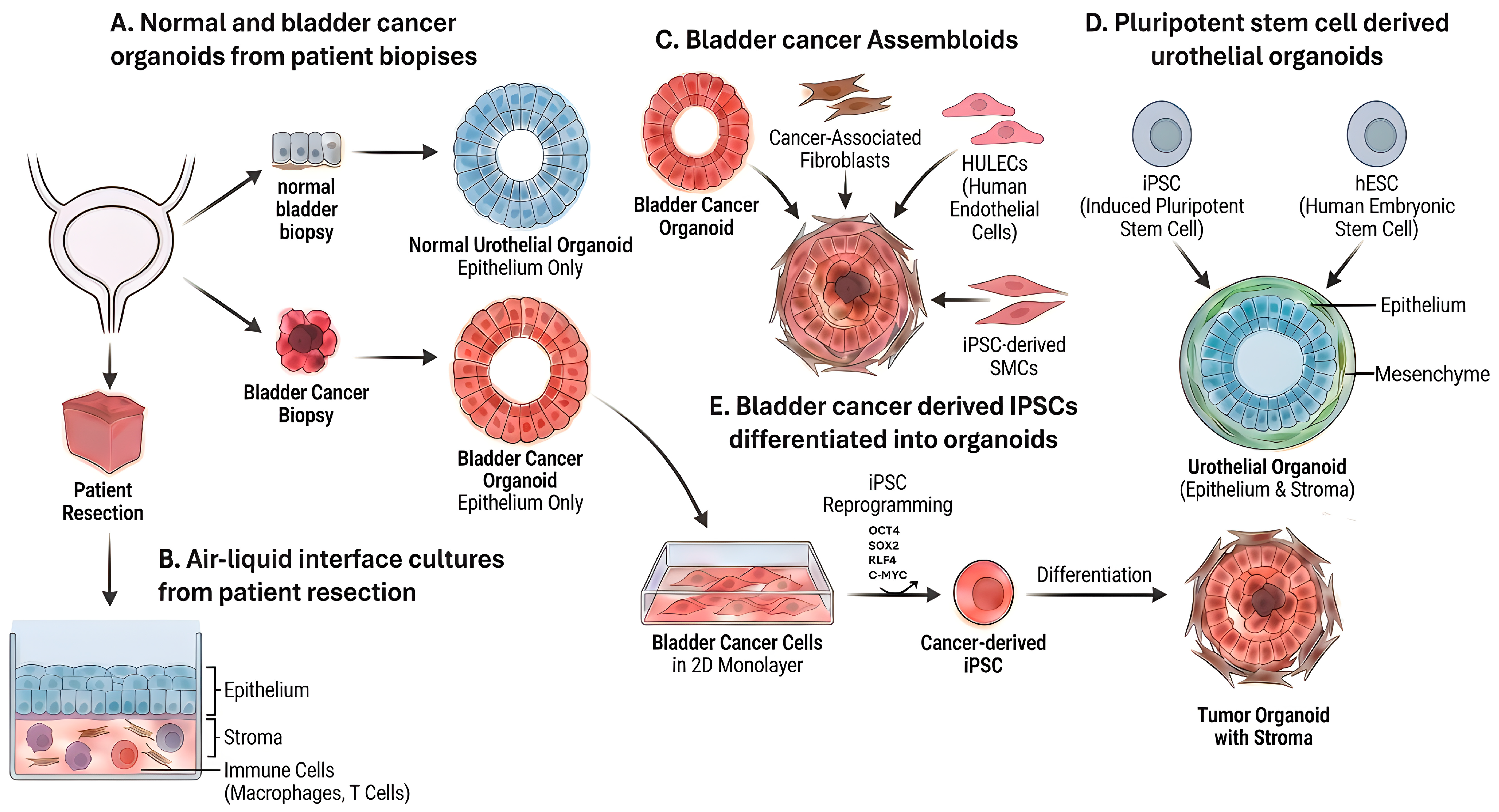
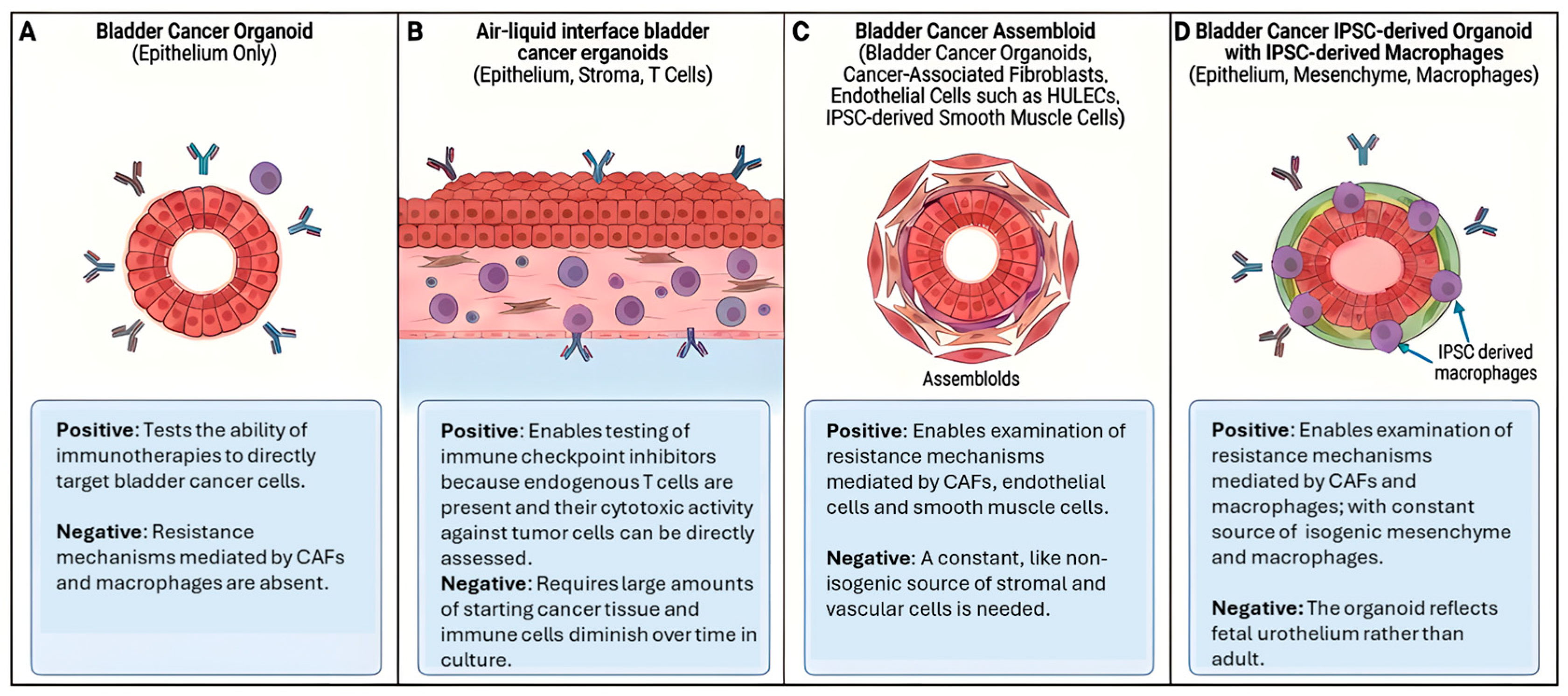
2. Patient-Derived Urothelial Carcinoma Organoids
3. Air–Liquid Interface Cultures
4. Assembloids
5. Pluripotent Stem Cell-Derived Urothelial Organoids
6. Translational Implications and Future Directions
Funding
Institutional Review Board Statement
Informed Consent Statement
Data Availability Statement
Conflicts of Interest
References
- Lopez-Beltran, A.; Cookson, M.S.; Guercio, B.J.; Cheng, L. Advances in diagnosis and treatment of bladder cancer. BMJ 2024, 384, e076743. [Google Scholar] [CrossRef]
- Siegel, R.L.; Kratzer, T.B.; Giaquinto, A.N.; Sung, H.; Jemal, A. Cancer statistics, 2025. CA Cancer J. Clin. 2025, 75, 10–45. [Google Scholar] [CrossRef] [PubMed]
- Morales, A.; Eidinger, D.; Bruce, A.W. Intracavitary bacillus calmette-guerin in the treatment of superficial bladder tumors. J. Urol. 1976, 116, 180–183. [Google Scholar] [CrossRef]
- de Reijke, T.M.; de Boer, E.C.; Kurth, K.H.; Schamhart, D.H. Urinary cytokines during intravesical bacillus calmette-guerin therapy for superficial bladder cancer: Processing, stability and prognostic value. J. Urol. 1996, 155, 477–482. [Google Scholar] [CrossRef] [PubMed]
- Saint, F.; Patard, J.J.; Maille, P.; Soyeux, P.; Hoznek, A.; Salomon, L.; Abbou, C.C.; Chopin, D.K. Prognostic value of a t helper 1 urinary cytokine response after intravesical bacillus calmette-guerin treatment for superficial bladder cancer. J. Urol. 2002, 167, 364–367. [Google Scholar] [CrossRef]
- Kates, M.; Matoso, A.; Choi, W.; Baras, A.S.; Daniels, M.J.; Lombardo, K.; Brant, A.; Mikkilineni, N.; McConkey, D.J.; Kamat, A.M.; et al. Adaptive immune resistance to intravesical bcg in non-muscle invasive bladder cancer: Implications for prospective bcg-unresponsive trials. Clin. Cancer Res. 2020, 26, 882–891. [Google Scholar] [CrossRef]
- Rosenberg, J.E.; Hoffman-Censits, J.; Powles, T.; van der Heijden, M.S.; Balar, A.V.; Necchi, A.; Dawson, N.; O’Donnell, P.H.; Balmanoukian, A.; Loriot, Y.; et al. Atezolizumab in patients with locally advanced and metastatic urothelial carcinoma. Lancet 2016, 387, 1909–1920. [Google Scholar] [CrossRef]
- Bellmunt, J.; de Wit, R.; Vaughn, D.J.; Fradet, Y.; Lee, J.-L.; Fong, L.; Vogelzang, N.J.; Climent, M.A.; Petrylak, D.P.; Choueir, T.K.; et al. Pembrolizumab for advanced urothelial carcinoma after platinum-based chemotherapy. N. Engl. J. Med. 2017, 376, 1015–1026. [Google Scholar] [CrossRef]
- Sharma, P.; Retz, M.; Siefker-Radtke, A.; Baron, A.; Necchi, A.; Bedke, J.; Plimack, E.R.; Vaena, D.; Grimm, M.O.; Bracarda, S.; et al. Nivolumab in metastatic urothelial carcinoma after platinum therapy (checkmate 275): A multicentre, single-arm, phase 2 trial. Lancet Oncol. 2017, 18, 312–322. [Google Scholar] [CrossRef]
- Powles, T.; O’Donnell, P.H.; Massard, C.; Arkenau, H.T.; Friedlander, T.W.; Hoimes, C.J.; Lee, J.L.; Ong, M.; Sridhar, S.S.; Vogelzang, N.J.; et al. Efficacy and safety of durvalumab in locally advanced or metastatic urothelial carcinoma: Updated results from a phase 1/2 open-label study. JAMA Oncol. 2017, 3, e172411. [Google Scholar] [CrossRef] [PubMed]
- Patel, M.R.; Ellerton, J.; Infante, J.R.; Agrawal, M.; Gordon, M.; Aljumaily, R.; Britten, C.D.; Dirix, L.; Lee, K.W.; Taylor, M.; et al. Avelumab in metastatic urothelial carcinoma after platinum failure (javelin solid tumor): Pooled results from two expansion cohorts of an open-label, phase 1 trial. Lancet Oncol. 2018, 19, 51–64. [Google Scholar] [CrossRef]
- Powles, T.; Park, S.H.; Voog, E.; Caserta, C.; Valderrama, B.P.; Gurney, H.; Kalofonos, H.; Radulovic, S.; Demey, W.; Ullen, A.; et al. Avelumab maintenance therapy for advanced or metastatic urothelial carcinoma. N. Engl. J. Med. 2020, 383, 1218–1230. [Google Scholar] [CrossRef]
- Balar, A.V.; Castellano, D.; O’Donnell, P.H.; Grivas, P.; Vuky, J.; Powles, T.; Plimack, E.R.; Hahn, N.M.; de Wit, R.; Pang, L.; et al. First-line pembrolizumab in cisplatin-ineligible patients with locally advanced and unresectable or metastatic urothelial cancer (keynote-052): A multicentre, single-arm, phase 2 study. Lancet Oncol. 2017, 18, 1483–1492. [Google Scholar] [CrossRef] [PubMed]
- Snyder, A.; Nathanson, T.; Funt, S.A.; Ahuja, A.; Buros Novik, J.; Hellmann, M.D.; Chang, E.; Aksoy, B.A.; Al-Ahmadie, H.; Yusko, E.; et al. Contribution of systemic and somatic factors to clinical response and resistance to pd-l1 blockade in urothelial cancer: An exploratory multi-omic analysis. PLoS Med. 2017, 14, e1002309. [Google Scholar] [CrossRef]
- Mariathasan, S.; Turley, S.J.; Nickles, D.; Castiglioni, A.; Yuen, K.; Wang, Y.; Kadel, E.E., III; Koeppen, H.; Astarita, J.L.; Cubas, R.; et al. Tgfbeta attenuates tumour response to pd-l1 blockade by contributing to exclusion of t cells. Nature 2018, 554, 544–548. [Google Scholar] [CrossRef]
- Wang, L.; Sfakianos, J.P.; Beaumont, K.G.; Akturk, G.; Horowitz, A.; Sebra, R.P.; Farkas, A.M.; Gnjatic, S.; Hake, A.; Izadmehr, S.; et al. Myeloid cell-associated resistance to pd-1/pd-l1 blockade in urothelial cancer revealed through bulk and single-cell rna sequencing. Clin. Cancer Res. 2021, 27, 4287–4300. [Google Scholar] [CrossRef]
- Clevers, H. Modeling development and disease with organoids. Cell 2016, 165, 1586–1597. [Google Scholar] [CrossRef]
- Kretzschmar, K.; Clevers, H. Organoids: Modeling development and the stem cell niche in a dish. Dev. Cell 2016, 38, 590–600. [Google Scholar] [CrossRef] [PubMed]
- Date, S.; Sato, T. Mini-gut organoids: Reconstitution of the stem cell niche. Annu. Rev. Cell Dev. Biol. 2015, 31, 269–289. [Google Scholar] [CrossRef] [PubMed]
- Lee, S.H.; Hu, W.; Matulay, J.T.; Silva, M.V.; Owczarek, T.B.; Kim, K.; Chua, C.W.; Barlow, L.J.; Kandoth, C.; Williams, A.B.; et al. Tumor evolution and drug response in patient-derived organoid models of bladder cancer. Cell 2018, 173, 515–528.e517. [Google Scholar] [CrossRef]
- Minoli, M.; Cantore, T.; Hanhart, D.; Kiener, M.; Fedrizzi, T.; La Manna, F.; Karkampouna, S.; Chouvardas, P.; Genitsch, V.; Rodriguez-Calero, A.; et al. Bladder cancer organoids as a functional system to model different disease stages and therapy response. Nat. Commun. 2023, 14, 2214. [Google Scholar] [CrossRef]
- Mullenders, J.; de Jongh, E.; Brousali, A.; Roosen, M.; Blom, J.P.A.; Begthel, H.; Korving, J.; Jonges, T.; Kranenburg, O.; Meijer, R.; et al. Mouse and human urothelial cancer organoids: A tool for bladder cancer research. Proc. Natl. Acad. Sci. USA 2019, 116, 4567–4574. [Google Scholar] [CrossRef]
- Viergever, B.J.; Raats, D.A.E.; Geurts, V.; Mullenders, J.; Jonges, T.N.; van der Heijden, M.S.; van Es, J.H.; Kranenburg, O.; Meijer, R.P. Urine-derived bladder cancer organoids (urinoids) as a tool for cancer longitudinal response monitoring and therapy adaptation. Br. J. Cancer 2024, 130, 369–379. [Google Scholar] [CrossRef] [PubMed]
- Zhao, Z.; Zhang, S.; Jiang, N.; Zhu, W.; Song, D.; Liu, S.; Yu, W.; Bai, Y.; Zhang, Y.; Wang, X.; et al. Patient-derived immunocompetent tumor organoids: A platform for chemotherapy evaluation in the context of t-cell recognition. Angew. Chem. Int. Ed. Engl. 2024, 63, e202317613. [Google Scholar] [CrossRef]
- Neal, J.T.; Li, X.; Zhu, J.; Giangarra, V.; Grzeskowiak, C.L.; Ju, J.; Liu, I.H.; Chiou, S.H.; Salahudeen, A.A.; Smith, A.R.; et al. Organoid modeling of the tumor immune microenvironment. Cell 2018, 175, 1972–1988.e16. [Google Scholar] [CrossRef]
- Ootani, A.; Li, X.; Sangiorgi, E.; Ho, Q.T.; Ueno, H.; Toda, S.; Sugihara, H.; Fujimoto, K.; Weissman, I.L.; Capecchi, M.R.; et al. Sustained in vitro intestinal epithelial culture within a wnt-dependent stem cell niche. Nat. Med. 2009, 15, 701–706. [Google Scholar] [CrossRef]
- Kim, E.; Choi, S.; Kang, B.; Kong, J.; Kim, Y.; Yoon, W.H.; Lee, H.R.; Kim, S.; Kim, H.M.; Lee, H.; et al. Creation of bladder assembloids mimicking tissue regeneration and cancer. Nature 2020, 588, 664–669. [Google Scholar] [CrossRef] [PubMed]
- Yu, L.; Li, Z.; Mei, H.; Li, W.; Chen, D.; Liu, L.; Zhang, Z.; Sun, Y.; Song, F.; Chen, W.; et al. Patient-derived organoids of bladder cancer recapitulate antigen expression profiles and serve as a personal evaluation model for car-t cells in vitro. Clin. Transl. Immunol. 2021, 10, e1248. [Google Scholar] [CrossRef] [PubMed]
- Takahashi, K.; Tanabe, K.; Ohnuki, M.; Narita, M.; Ichisaka, T.; Tomoda, K.; Yamanaka, S. Induction of pluripotent stem cells from adult human fibroblasts by defined factors. Cell 2007, 131, 861–872. [Google Scholar] [CrossRef]
- Thomson, J.A.; Itskovitz-Eldor, J.; Shapiro, S.S.; Waknitz, M.A.; Swiergiel, J.J.; Marshall, V.S.; Jones, J.M. Embryonic stem cell lines derived from human blastocysts. Science 1998, 282, 1145–1147. [Google Scholar] [CrossRef]
- Suzuki, K.; Koyanagi-Aoi, M.; Uehara, K.; Hinata, N.; Fujisawa, M.; Aoi, T. Directed differentiation of human induced pluripotent stem cells into mature stratified bladder urothelium. Sci. Rep. 2019, 9, 10506. [Google Scholar] [CrossRef]
- Kang, M.; Kim, H.H.; Han, Y.M. Generation of bladder urothelium from human pluripotent stem cells under chemically defined serum- and feeder-free system. Int. J. Mol. Sci. 2014, 15, 7139–7157. [Google Scholar] [CrossRef] [PubMed]
- Moad, M.; Pal, D.; Hepburn, A.C.; Williamson, S.C.; Wilson, L.; Lako, M.; Armstrong, L.; Hayward, S.W.; Franco, O.E.; Cates, J.M.; et al. A novel model of urinary tract differentiation, tissue regeneration, and disease: Reprogramming human prostate and bladder cells into induced pluripotent stem cells. Eur. Urol. 2013, 64, 753–761. [Google Scholar] [CrossRef] [PubMed]
- Osborn, S.L.; Thangappan, R.; Luria, A.; Lee, J.H.; Nolta, J.; Kurzrock, E.A. Induction of human embryonic and induced pluripotent stem cells into urothelium. Stem Cells Transl. Med. 2014, 3, 610–619. [Google Scholar] [CrossRef]
- Qu, N.; Daoud, A.; Kechele, D.O.; Cleary, C.E.; Munera, J.O. Differentiation of human pluripotent stem cells into urothelial organoids via transient activation of wnt signaling. iScience 2025, 28, 112398. [Google Scholar] [CrossRef] [PubMed]
- Xu, Q.; Halle, L.; Hediyeh-Zadeh, S.; Kuijs, M.; Riedweg, R.; Kilik, U.; Recaldin, T.; Yu, Q.; Rall, I.; Frum, T.; et al. An integrated transcriptomic cell atlas of human endoderm-derived organoids. Nat. Genet. 2025, 57, 1201–1212. [Google Scholar] [CrossRef] [PubMed]
- Geraghty, R.J.; Capes-Davis, A.; Davis, J.M.; Downward, J.; Freshney, R.I.; Knezevic, I.; Lovell-Badge, R.; Masters, J.R.; Meredith, J.; Stacey, G.N.; et al. Guidelines for the use of cell lines in biomedical research. Br. J. Cancer 2014, 111, 1021–1046. [Google Scholar] [CrossRef] [PubMed]
- Munera, J.O.; Kechele, D.O.; Bouffi, C.; Qu, N.; Jing, R.; Maity, P.; Enriquez, J.R.; Han, L.; Campbell, I.; Mahe, M.M.; et al. Development of functional resident macrophages in human pluripotent stem cell-derived colonic organoids and human fetal colon. Cell Stem Cell 2023, 30, 1434–1451.e1439. [Google Scholar] [CrossRef]
- Jing, R.; Falchetti, M.; Han, T.; Najia, M.; Hensch, L.T.; Meader, E.; Lummertz da Rocha, E.; Kononov, M.; Wang, S.; Bingham, T.; et al. Maturation and persistence of car t cells derived from human pluripotent stem cells via chemical inhibition of g9a/glp. Cell Stem Cell 2025, 32, 71–85.e75. [Google Scholar] [CrossRef]
- Jing, R.; Scarfo, I.; Najia, M.A.; Lummertz da Rocha, E.; Han, A.; Sanborn, M.; Bingham, T.; Kubaczka, C.; Jha, D.K.; Falchetti, M.; et al. Ezh1 repression generates mature ipsc-derived car t cells with enhanced antitumor activity. Cell Stem Cell 2022, 29, 1181–1196.e1186. [Google Scholar] [CrossRef]



| Platform | Structural Complexity | Source of Immune Cells | Immune Fidelity | Source of Tissue | Scalability | Immune Modeling Functions | Key Limitations |
|---|---|---|---|---|---|---|---|
| Epithelial Tumor Organoids | Epithelial only | Not applicable | Not applicable | Direct from patient fine needle biopsies | High; rapid expansion possible | Not applicable | Lacks microenvironment; phenotype drift in vitro |
| Air–Liquid Interface (ALI) | Preserves native architecture, includes stroma and immune cells | Endogenous from patient tissue; declines over time | Moderate; retains endogenous repertoire short-term | Direct from patient tumor resections | Low to moderate; tissue quality-dependent, short-term viability | Antigen presentation, native T cell activation, short-term myeloid function | Immune decline over time, limited duration |
| Assembloids | Engineered assembly of epithelial, stromal, vascular, immune components | Exogenous cells introduced by co-culture with epithelial tumor organoids, e.g., CAR-T, autologous lymphocytes | High in concept but variable; limited by sourcing and lifespan | Non-isogenic mix; tumor organoids + third-party components | Low; technical burden for synchronization and reproducibility | CAR-T cytotoxicity, immune-epithelial signaling pathways | Difficult to scale, non-isogenic limitations |
| iPSC-Derived Organoids | Multilineage from single iPSC source, includes stromal and vascular cells | Theoretical; possible via isogenic derivation from the same source iPSCs | Currently limited to monocytes although T cell generation possible; immune components may be immature | Potential for isogenic reconstruction via iPSC reprogramming | Moderate; renewable but complex differentiation needed | Under development; potential for engineered immune interfaces | Fetal-like phenotype, oncogenic stroma unless corrected |
Disclaimer/Publisher’s Note: The statements, opinions and data contained in all publications are solely those of the individual author(s) and contributor(s) and not of MDPI and/or the editor(s). MDPI and/or the editor(s) disclaim responsibility for any injury to people or property resulting from any ideas, methods, instructions or products referred to in the content. |
© 2026 by the author. Licensee MDPI, Basel, Switzerland. This article is an open access article distributed under the terms and conditions of the Creative Commons Attribution (CC BY) license.
Share and Cite
Múnera, J.O. Modeling Urothelial Carcinoma and Immunotherapy Response Using Organoid Platforms: From Epithelial Tumor Organoids to Multilineage Systems. Cancers 2026, 18, 1338. https://doi.org/10.3390/cancers18091338
Múnera JO. Modeling Urothelial Carcinoma and Immunotherapy Response Using Organoid Platforms: From Epithelial Tumor Organoids to Multilineage Systems. Cancers. 2026; 18(9):1338. https://doi.org/10.3390/cancers18091338
Chicago/Turabian StyleMúnera, Jorge O. 2026. "Modeling Urothelial Carcinoma and Immunotherapy Response Using Organoid Platforms: From Epithelial Tumor Organoids to Multilineage Systems" Cancers 18, no. 9: 1338. https://doi.org/10.3390/cancers18091338
APA StyleMúnera, J. O. (2026). Modeling Urothelial Carcinoma and Immunotherapy Response Using Organoid Platforms: From Epithelial Tumor Organoids to Multilineage Systems. Cancers, 18(9), 1338. https://doi.org/10.3390/cancers18091338