1. Introduction
Colorectal cancer (CRC) remains a major global health burden. GLOBOCAN 2022 estimates place CRC among the most frequently diagnosed cancers worldwide and among the leading causes of cancer death, while the most recent United States cancer statistics show that an estimated 158,850 new CRC cases and 55,230 CRC deaths will occur in the United States in 2026, and that CRC is now the second most common cause of cancer-related death overall and the leading cause of cancer-related death in adults younger than 50 years in that country [
1,
2]. Contemporary CRC management has also become increasingly dependent on molecularly informed risk stratification and treatment selection, particularly in advanced disease [
3].
These epidemiological observations are directly relevant to the present review because sex-associated differences are evident at multiple levels of CRC burden. Men consistently have higher incidence and mortality rates [
4,
5,
6,
7,
8,
9]. By contrast, women are more often diagnosed with proximal or right-sided tumors and are relatively enriched for selected molecular contexts, including deficient mismatch repair (dMMR), microsatellite instability-high (MSI-H), CpG island methylator phenotype-high (CIMP-high), and
BRAF-associated disease, especially in right-sided colon cancer [
4,
7,
8,
9,
10,
11,
12]. Yet sex is still often handled as a background demographic covariate rather than as a biologically informative stratification variable.
A second source of confusion is the frequent conflation of sex and gender. Sex refers to biological attributes, including chromosomes, reproductive anatomy, and hormone milieu; gender refers to sociobehavioral constructs that can influence risk exposure, screening uptake, diagnostic interval, treatment allocation, toxicity reporting, and survivorship [
4,
5,
6,
7,
8]. Direct CRC studies that formally model sex and gender simultaneously remain limited, in part because most clinical and registry datasets still record sex more reliably than gender-related variables. Nevertheless, contemporary reviews and population-based analyses indicate that gender-shaped processes influence screening uptake, route to diagnosis, treatment allocation, survival, and time to treatment, whereas mechanistic tumor biology is more appropriately discussed within sex-aware analyses [
4,
8,
13,
14]. Accordingly, tumor biology is discussed primarily under sex in this review, whereas pathways of care, survivorship, and exposure-related behaviors are highlighted as domains in which gender should also be measured and modeled.
The central limitation of both the earlier manuscript and much of the existing literature is structural rather than purely factual. Sex-related differences in CRC are often reviewed as three parallel narratives—genetics, estrogen signaling, and microbiota—without first identifying the biological settings in which sex meaningfully changes interpretation. This review therefore advances a more selective thesis: sex is most clinically useful when understood as a contextual modifier whose effects depend on tumor sidedness, molecular subtype, immune microenvironment, and age at onset. The key question is not whether CRCs from women and men differ in the abstract, but when, where, and through which mechanisms those differences become biologically and translationally consequential. Accordingly, descriptive epidemiology, mechanistic inference, and clinically actionable implications are treated as related but distinct levels of interpretation throughout this review.
Review Scope and Evidence Prioritization
For transparency, the literature discussed in this narrative review was identified through focused searches of PubMed, Web of Science, and Scopus using combinations of the terms colorectal cancer, sex, gender, sidedness, mismatch repair, microsatellite instability, KRAS, BRAF, estrogen receptor, microbiome, immune microenvironment, and early-onset colorectal cancer. Searches were updated through April 2026. Priority was given to contemporary human studies, tissue-based analyses, clinically annotated cohorts, and high-impact translational papers published from 2019 onward, whereas earlier seminal studies were retained when they remained mechanistically foundational. Preclinical studies were used primarily to support biologic plausibility, whereas clinically actionable statements were preferentially anchored in human cohorts and clinically annotated datasets. Where relevant, the review specifies whether evidence derives from preclinical models, retrospective cohorts, pooled analyses, prospective tissue studies, or hypothesis-generating translational work.
2. From Descriptive Sex Differences to Contextual Sex Biology
Earlier work established an important descriptive foundation by documenting epidemiological and molecular differences between men and women patients with CRC. Those observations remain valuable, but descriptive comparisons alone have limited explanatory power because CRC is not a single biological entity. Right-sided and left-sided tumors differ in embryologic origin, stromal organization, mutational architecture, metabolic state, immune tone, and response to systemic therapy; similarly, MSI-H, chromosomally unstable,
KRAS-driven, and
BRAF-associated CRCs represent biologically distinct disease contexts [
7,
8,
9,
15,
16,
17].
Once this heterogeneity is acknowledged, a clearer pattern emerges: many apparent sex effects become stronger after stratification and weaker when all CRCs are pooled together. The enrichment of women in proximal tumors, MSI-related biology, and
BRAF-mutated disease is more informative than a crude all-comer comparison, and the same is true for men-linked
KRAS-associated programs. Conversely, the
KDM5D program identified in men with
KRAS-mutant colon cancer is informative precisely because it is mechanistically tied to a defined oncogenic background rather than to male sex alone [
7,
8,
15,
16,
17]. In practical terms, sex behaves like an effect modifier. A prognosis model or treatment analysis that ignores sex × sidedness or sex × molecular-subtype interactions can dilute signals that become visible only inside defined biological strata. This is why right-sided dMMR/MSI-H disease,
BRAF-associated metastatic CRC, and
KRAS-mutant tumors are more informative test beds for sex-aware interpretation than unselected CRC cohorts.
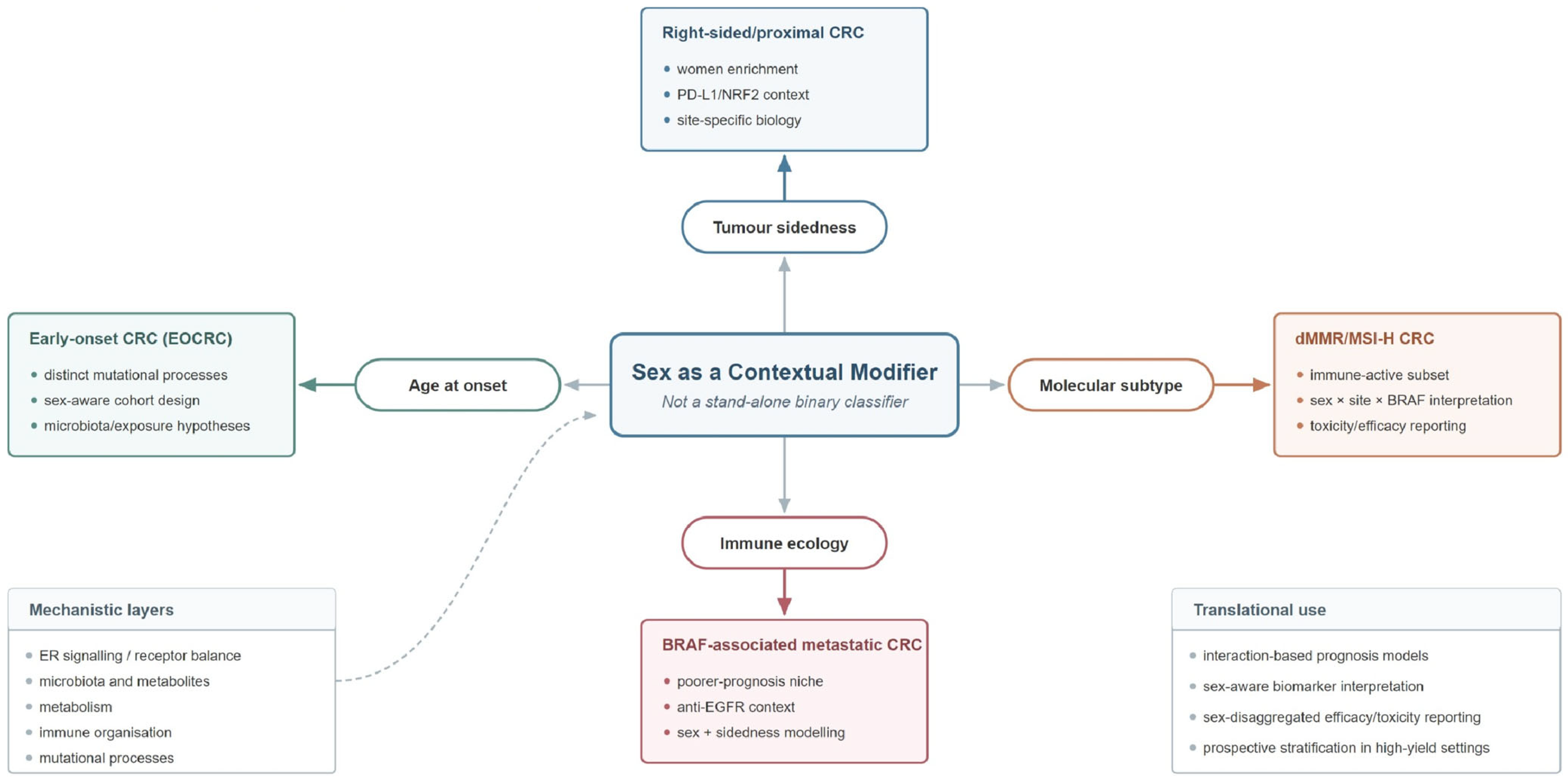
This contextual approach also changes how the older estrogen and microbiota literature should be interpreted. Estrogen signaling, estrogen receptor beta (ERβ) loss, G protein-coupled estrogen receptor (GPER) activity, and the gut microbial ecosystem remain relevant in CRC. However, they are better understood as biological layers that modify selected CRC states—especially proximal disease, immune-active tumors, and early-onset CRC (EOCRC)-related ecological exposures—rather than as universal explanations for all sex-related heterogeneity in CRC. Accordingly, receptor signaling, epigenetic circuitry, microbiota, and immunity are discussed here as nested mechanistic layers within interaction-based disease contexts rather than as parallel standalone themes. This interaction-based framework is summarized in
Figure 1. To improve continuity, the remainder of the review proceeds from disease context to mechanistic layer:
Section 3 first defines the sidedness- and subtype-dependent settings in which sex is most informative,
Section 4 then revisits ER-associated signaling within those contexts rather than as a stand-alone explanatory model, and
Section 5,
Section 6,
Section 7 and
Section 8 extend the same logic to microbiota, immune organization, biomarker/therapeutic implications, and EOCRC.
3. Sex, Tumor Sidedness, and Molecular Architecture
One of the most reproducible findings in this field is the non-random anatomical distribution of CRC by sex. Women are more likely to develop proximal or right-sided colon cancer, whereas men more often present with distal colon and rectal tumors and a higher overall disease burden [
6,
7,
8,
9]. Tumor sidedness is not merely descriptive. Right-sided CRC is enriched for MSI-H, CIMP-high,
BRAF V600E mutations, and serrated-pathway biology, whereas left-sided CRC more commonly exhibits chromosomal instability,
APC alteration,
TP53 mutation, and aneuploidy [
15,
17].
The mechanism of this location bias is not yet fully resolved, and direct proof that embryologic origin, vascular supply, or microbial gradients by themselves generate sex-specific right-sided risk remains limited. However, recent organoid and animal studies make it increasingly difficult to dismiss the signal as purely descriptive. Human normal-colon organoids show sex- and location-dependent transcriptional responses to calcium, indicating that epithelial programs already differ by colon site and sex before overt malignancy [
18]. In AOM/DSS-based mouse models, estradiol restrains inflammatory signaling and tumor development, and sex-specific inflammatory responses correlate with ERβ and macrophage-associated cytokine programs [
19,
20]. These models do not yet prove a single mechanism for women-biased right-sided CRC, but they support the plausibility of site-specific sex effects arising from differences in epithelial responsiveness, inflammation, and microenvironmental gradients.
Sex intersects with this location gradient in clinically meaningful ways. Multivariable analyses have demonstrated location-dependent sex differences in programmed death-ligand 1 (PD-L1) expression, mismatch repair or microsatellite instability status, and epidermal growth factor receptor (EGFR) expression. In one study, women with proximal CRC were enriched for dMMR/MSI-H and high EGFR expression, whereas men with proximal disease showed an inverse association with PD-L1 expression [
10]. More recent work suggests that right-sided CRC in women represents a particularly distinctive molecular niche: women with right-sided tumors were more likely to harbor a
BRAF V600E-mutated/MSI-H combination and showed higher PD-L1 messenger RNA expression and nuclear factor erythroid 2-related factor 2 (NRF2) protein expression, together with lower NRF2 promoter methylation, than both men and women with left-sided disease [
10,
11].
These observations argue against treating sex and sidedness as competing variables. In CRC, the two often need to be modeled together because sidedness appears to expose, rather than obscure, important sex-linked biology. This is also the clearest setting in which an interaction model can be stated explicitly: the prognostic or biomarker meaning of sex differs according to whether the tumor is right-sided and whether that right-sided tumor is dMMR/MSI-H or BRAF-associated.
Sex-associated genomic architecture also extends beyond anatomical site. Women show higher frequencies of CIMP-high and
PIK3CA-mutated disease in selected cohorts, and multiple datasets indicate enrichment of
BRAF-associated and MSI-related tumors in women, particularly in proximal disease [
10,
11,
21]. By contrast, one of the most compelling men-linked mechanisms identified to date is the
KRAS–
STAT4–
KDM5D axis. In
KRAS-mutant colon cancer, the Y-chromosome-encoded histone demethylase
KDM5D is upregulated through
STAT4-mediated transcription, promoting loss of epithelial barrier integrity, increased metastatic potential, and impaired tumor immune recognition [
16]. At present, this axis should be viewed as a compelling but still incompletely validated model rather than as a definitive explanation of male CRC biology. Its plausibility is strengthened by independent evidence linking male
KRAS-mutant CRC to suppressed ferroptosis programs and by emerging studies showing
KRAS-associated cetuximab-resistance states and sex-linked
RAS-associated recurrence patterns in rectal cancer [
22,
23,
24]. However, direct multi-cohort validation of
KDM5D-dependent effects remains a priority.
The same principle is apparent in younger patients. In a multi-ethnic AACR GENIE analysis of non-hypermutated EOCRC,
EP300 mutation was more frequent in younger men and substantially less frequent in younger women, while
KRAS,
AXIN2,
WRN,
BRAF, and additional genes also differed by sex [
25]. A separate analysis integrating mutation patterns into a prognostic model further suggested that the clinical meaning of recurrent CRC mutations is itself sex-modulated rather than sex-neutral [
26].
Metabolic studies reinforce the same contextual interpretation. Right-sided tumors in women display a nutrient-depleted phenotype with increased asparagine synthesis, and asparagine synthetase (ASNS)-related metabolic signatures have been linked to poorer survival in women [
27,
28]. In contrast,
KRAS-mutant tumors in men have been associated with reduced ferroptotic activity and glutathione- and iron-handling programs linked to adverse outcome [
22]. These are not simply parallel male and female metabolic signatures; they are genotype-aware and site-aware subphenotypes that support a contextual model of sex biology in CRC. These high-confidence sex-associated contexts are summarized in
Table 1.
4. Estrogen Signaling and Epigenetic Circuitry: Still Important, but No Longer Sufficient
The earlier version of this review placed estrogen and epigenetics at the conceptual center of CRC sex-related biology. That emphasis captured an important part of the field, but as a stand-alone organizing framework it was too broad. Estrogen signaling is clearly relevant to CRC; however, its explanatory value increases when linked to specific receptors, transcriptional states, and disease contexts rather than invoked as a general protective umbrella. Recent data further support a receptor-specific interpretation of estrogen biology while underscoring that ER-associated signaling alone cannot account for the full spectrum of sex-related heterogeneity in CRC.
ERβ remains the most biologically persuasive node in this literature. It is the predominant estrogen receptor in normal colonic epithelium, is frequently reduced during tumor progression, and exerts anti-inflammatory and antitumor effects in colon cancer models [
37,
38,
39,
40]. ERβ can alter the microRNA repertoire of CRC cells, restrain metastasis through the miR-205–PROX1 axis, and associate with distinct tumor methylation programs [
38,
39,
40]. Importantly, the human tissue literature is broader than we previously conveyed. In a prospective CRC cohort with 1101 tumors, loss of ERβ expression was associated with more advanced stage and poorer survival [
41]. In female CRC cohorts, higher ERβ expression correlated with better overall and disease-free survival, and combined ERβ-high/ERα-negative expression identified a more favorable prognostic state [
42,
43]. A smaller paraffin-tissue series reported weaker prognostic association, underscoring that receptor isoform, cohort composition, and assay design matter [
44]. Taken together, these studies support the interpretation that loss of ERβ function is one mechanism by which colonic epithelium may lose a sex-linked protective program during tumorigenesis.
At the same time, the estrogen story is more nuanced than a simple protective model in women. GPER can mediate differential proliferative and migratory effects under normoxic and hypoxic conditions, and epigenetic downregulation of GPER has been described as a tumor-suppressive event in CRC [
45,
46]. More recent work further suggests that GPER-related effects may themselves differ by sex, implying that receptor balance, oxygen tension, and molecular background all influence how estrogenic signaling is interpreted by tumor cells [
47]. Preclinical AOM/DSS studies likewise show that estradiol, ERβ, and inflammatory polarization are linked in a sex-dependent manner [
19,
20].
A particularly important update is that sex-hormone signaling should now be connected to immunity rather than discussed only through proliferation or apoptosis. Intestinal ERβ has been shown to modulate the murine colon tumor immune microenvironment, linking classical hormone biology to checkpoint-relevant tumor ecology [
48]. This bridge matters because it places estrogen-related biology within the same conceptual framework as sidedness, molecular subtype, and immune context, which is where its translational value becomes most visible. Conversely, the insufficiency of a receptor-only explanation becomes obvious when human sex effects persist in settings where ER status, microbiota, mutational subtype, and immune architecture do not move in parallel. This is why ER signaling is best interpreted as one mechanistic layer within a broader interaction framework rather than as a universal master explanation. Clinically, ER-related findings do not align uniformly with sidedness, KRAS/BRAF context, MMR/MSI status, or immune state across available cohorts, which is precisely why receptor biology alone cannot serve as a comprehensive explanatory framework for sex-related CRC heterogeneity.
The same logic applies to biomarker development. Machine-learning analyses have identified sex-contingent prognostic candidates in CRC [
49]. Tissue-based and liquid-biopsy studies also report sex-related microRNA differences [
50,
51]. In parallel, epigenetic studies indicate that both background colonic methylation and cancer-associated methylation biomarkers can vary by anatomical site, sex, and age, with potential consequences for risk modeling and assay performance [
52,
53,
54,
55]. Taken together, these data suggest that sex-linked epigenetic variation is currently more informative for biomarker performance and assay interpretation than as a stand-alone explanation of CRC pathogenesis. Current evidence therefore supports sex-linked epigenetic variation more strongly as a modifier of biomarker context than as an independent driver framework for CRC pathogenesis.
5. Microbiota as an Ecological Amplifier of Sex Effects
Microbial ecology remains one of the most plausible routes through which sex, diet, inflammation, and environmental exposure converge in CRC. At the same time, microbiota research in this field is particularly vulnerable to overinterpretation. Heterogeneity arises not only from geography and diet, but also from whether studies use stool, mucosal, tumor-adjacent, or tumor-core specimens; whether profiling relies on 16S sequencing, shotgun metagenomics, metatranscriptomics, or metabolomics; and whether cohorts differ in bowel preparation, antibiotic exposure, body composition, tumor site, treatment status, or definition of control samples [
56,
57,
58]. Recent location-aware multi-omics work further reinforces that host-microbe associations differ materially between right-sided and left-sided CRC, which is precisely why sex effects should not be interpreted without anatomic context [
59]. These design differences likely contribute to the poor cross-cohort reproducibility of many purported sex-associated taxa and argue against treating any single microbiome signature as a universal sex marker in CRC without harmonized validation.
The most defensible position is therefore not that the microbiota explains CRC sex differences in general, but that it can amplify sex-linked risk or progression in selected biological settings. Human cohort studies have reported sex-associated differences in microbial richness, discriminatory taxa, and metabolite patterns in CRC, although the direction and magnitude of these differences vary across cohorts [
60,
61,
62,
63]. Experimental work provides more direct mechanistic support: men-biased microbiota and their metabolites can aggravate colorectal tumorigenesis, whereas specific bacterial species such as
Carnobacterium maltaromaticum may suppress tumor development in a women-biased, vitamin D receptor-dependent manner [
64,
65].
Microbial effects are also anatomically contextual. Multi-omics analyses of right-sided and left-sided colon cancer have identified distinct microbe–metabolite–host networks, while bile-acid profiling has revealed sex-specific distributions associated with prognosis [
59,
66]. These findings are important because they align with the broader conclusion of this review: sex effects in CRC become most interpretable when layered onto anatomical site and metabolic state rather than analyzed in isolation.
The sex hormone–gut microbiome axis remains a useful conceptual framework, but it should be applied with caution [
56]. The concept of the microgenderome describes bidirectional interactions among the microbiota, hormones, immunity, and disease susceptibility [
58]. Experimental models further show that orchiectomy, testosterone administration, and estradiol exposure can reshape the gut microbiome during colorectal carcinogenesis, with downstream consequences for tumor development and immune tone [
67,
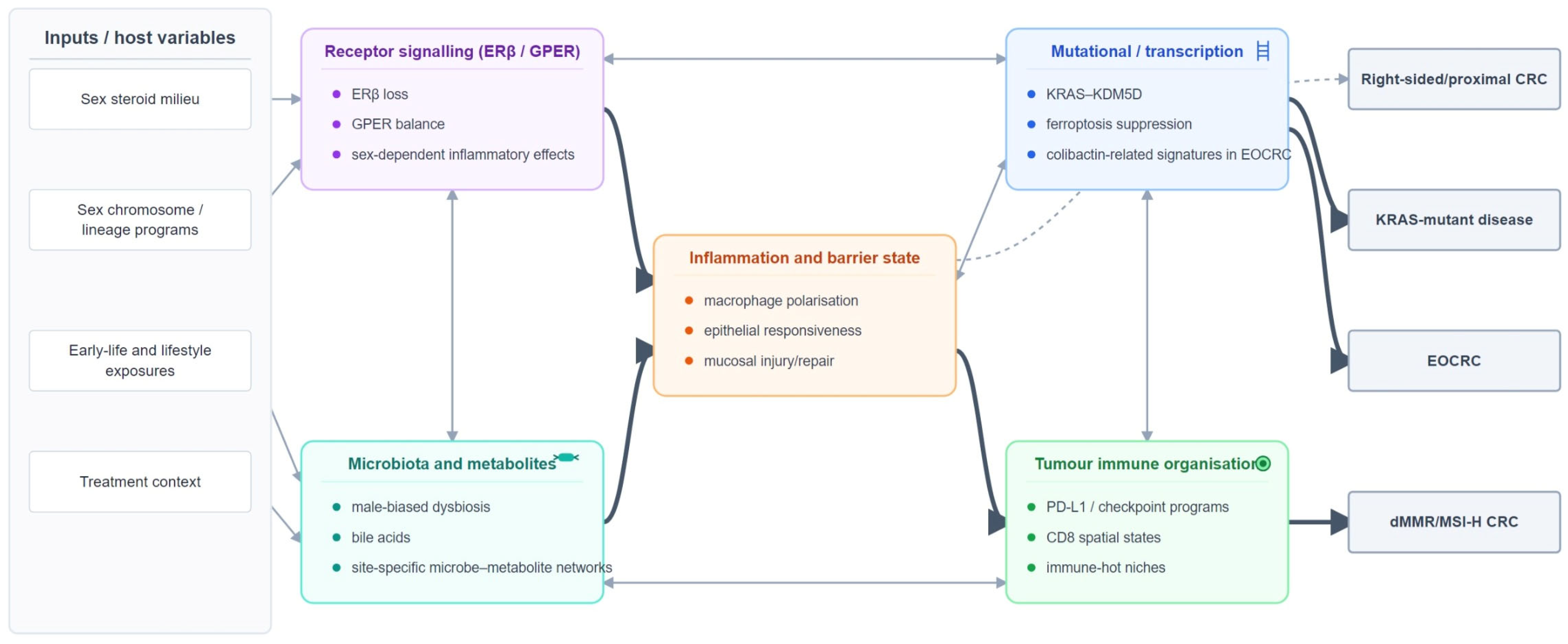
68]. This ecological framing is especially relevant to EOCRC and mutational-process research: sex-differential early-life exposures could plausibly influence colibactin-producing taxa, bile-acid biology, mucosal inflammation, or epithelial repair capacity, even though direct sex-dependent evidence for these initiation pathways is still sparse. The cross-talk among hormone signaling, microbiota, metabolic state, and immune ecology is integrated schematically in
Figure 2. A more explicit testable model is that sex-dependent hormonal tone and immune-metabolic maturation influence mucosal barrier integrity, microbial persistence, and bile-acid ecology early in life, thereby affecting whether genotoxic communities such as colibactin-producing bacteria leave durable mutational footprints in susceptible epithelium.
6. Immune Microenvironment as the Central Translational Bridge
If one domain most directly links sex biology to clinical interpretation in CRC, it is the tumor immune microenvironment. CRC progression is strongly shaped by reciprocal interactions among malignant cells, stromal architecture, innate and adaptive immune compartments, and treatment-induced remodeling. Contemporary syntheses of the CRC immune microenvironment emphasize that immune evasion, immunosuppression, and therapeutic immune reprogramming are central to prognosis and to the selective success of immunotherapy, particularly in dMMR/MSI-H disease [
69,
70].
Quantification of CD8+ T-cell populations deserves more explicit attention because large multiplex immunofluorescence analyses of stage II–III CRC have shown that intratumoral CD8+ and FoxP3+ cell states carry independent prognostic information, and that immune context becomes more informative when quantified spatially rather than by crude density alone [
71]. More granular multiplex studies further show that activated tissue-resident CD8+CD103+CD39+ cells are especially prognostic in left-sided “immune-hot” CRC, whereas terminally exhausted CD8+ states mark a distinct, genomically associated immune ecology in CRC [
72,
73].
Sex clearly matters in this space, but not through a simplistic rule that women always mount stronger antitumor immunity or that men are uniformly more immunosuppressed. Instead, the available evidence points to context dependence. In metastatic CRC models, men and women differ in cytokine patterns and in the balance of innate and adaptive immune compartments [
69]. In right-sided human CRC, women tumors can show stronger PD-L1 and NRF2-related programs [
11]. In hormone-linked preclinical systems, ERβ can reshape the colon tumor immune microenvironment [
48]. Recent tumor-intrinsic work also shows that cell-cycle regulators such as LRRC19 can couple tumor suppression to immune microenvironment remodeling, illustrating the type of integrative biology needed for future sex-aware studies [
74]. Taken together, these data support a model in which sex influences immune organization and checkpoint biology within specific molecular niches rather than across all CRCs equally.
This is precisely why the immune microenvironment functions as the central translational bridge in the present review. It provides a mechanistic explanation for why sex may be clinically silent in one CRC subgroup yet highly informative in another. A sex signal diluted in an unselected cohort may become obvious in right-sided immune-active tumors, in dMMR/MSI-H or BRAF-mutated metastatic CRC, or in younger patients with distinct mutational processes. Without an immune-context framework, sex differences remain largely descriptive; with it, they become biologically interpretable and potentially clinically actionable.
7. Biomarkers and Therapeutic Implications
The literature on sex-aware biomarkers in CRC is expanding, but its translational value depends on methodological discipline. Machine-learning analyses of paired normal and tumor tissues have identified men-biased and women-biased prognostic candidates such as ESM1, GUCA2A, VWA2, CLDN1, and FUT1 [
49]. Other studies have reported sex-dependent microRNA patterns in tumor tissue and liquid biopsy [
50,
51]. Epigenetic analyses further indicate that methylation landscapes in normal colon and CRC can vary with anatomical location, age, and sex, which may influence the performance and interpretation of methylation-based assays [
52,
53,
54,
55].
The practical question is therefore not whether a biomarker differs between women and men in isolation. The more relevant question is whether incorporating sex materially improves discrimination, calibration, or treatment stratification once tumor site, molecular subtype, and immune context are already known. That is the threshold at which sex-aware biomarker work becomes clinically meaningful rather than merely descriptive. Accordingly, future biomarker studies should prespecify sex interaction testing, report model performance before and after adding sex, and annotate biospecimens with tumor sidedness, MMR/MSI status, BRAF/KRAS context, and treatment exposure. These requirements are more actionable than generic calls to “consider sex” and move the field toward deployable biomarker models. At minimum, prospective biomarker studies should prespecify sex as an interaction variable rather than merely a baseline covariate and should report discrimination and calibration before and after sex is added to the model.
Therapeutic data point in the same direction. In
BRAF-mutated metastatic CRC, primary tumor sidedness and sex both influence prognosis and the activity of anti-epidermal growth factor receptor therapy, indicating that sex may interact with established clinical stratifiers rather than supersede them [
12]. The FIRE-3 subgroup analysis likewise suggests that the efficacy of cetuximab plus FOLFIRI in
RAS/
BRAF wild-type metastatic CRC is associated with sex and primary tumor sidedness, supporting the inclusion of sex in the design and reporting of future trials [
30]. In parallel,
KRAS-mutant resistance biology is increasingly linked to male-associated transcriptional programs and cetuximab resistance states [
16,
22,
23].
Immune-checkpoint-treated CRC offers an even clearer example of context-dependent sex effects. In MSI-H metastatic CRC with
BRAF V600E mutation, outcomes after immune checkpoint inhibition differed according to the interaction between sex and
BRAF context rather than according to sex alone. Men treated with anti-PD-(L)1 monotherapy had the poorest outcomes, whereas regimens containing anti-CTLA-4 appeared to attenuate this disadvantage; women, by contrast, showed a higher frequency of any-grade immune-related adverse events [
29]. These results are hypothesis-generating rather than practice-changing, but they illustrate why sex should be prespecified in efficacy and toxicity analyses instead of being relegated to a post hoc demographic descriptor.
Accordingly, sex should not yet be used as a stand-alone treatment selector in CRC. The current evidence base is not strong enough for that. What the available literature does justify is a more rigorous analytical framework in which sex is modeled as an interaction term in biomarker studies, translational drug-response analyses, and prospective trial stratification—especially for right-sided disease, dMMR/MSI-H CRC, BRAF-mutant metastatic CRC, and anti-EGFR-treated populations. Protocol templates, translational substudies, and regulatory reporting standards should at minimum require sex-disaggregated efficacy and toxicity reporting in these high-yield settings. In practice, trials in these high-yield settings should prespecify sex-by-treatment interaction testing in the statistical analysis plan, provide sex-stratified efficacy and toxicity tables, and bank biospecimens with linked sidedness/MMR/MSI/BRAF/KRAS annotation for correlative analyses.
8. Early-Onset Colorectal Cancer as a High-Priority Context
Among emerging CRC contexts, EOCRC is arguably the most informative setting for future sex-aware research. The latest United States statistics show that CRC incidence and mortality are increasing in adults younger than 65 years, with particularly concerning trends in those aged 20–49 years; global registry analyses similarly show that EOCRC incidence is rising in many countries, often more rapidly than in older adults [
2,
31]. This epidemiological shift alone justifies increased attention to EOCRC. More importantly, accumulating evidence indicates that EOCRC is biologically distinct rather than simply a younger presentation of conventional later-onset CRC.
Large-scale sequencing studies support that view. A 1209-patient next-generation sequencing analysis identified a distinctive molecular fingerprint in EOCRC [
32]. An international multicohort study further showed that genomic mutational patterns differ between EOCRC and later-onset CRC according to hypermutation context [
33]. Together, these findings make two points clear: EOCRC is not biologically uniform, and age of onset interacts with mutational architecture in ways that standard pooled CRC analyses can obscure.
Recent work on mutational processes has widened the etiologic horizon. In a Nature study of 981 CRC genomes from 11 countries, the colibactin-related mutational signatures SBS88 and ID18 were enriched in EOCRC, were especially common in individuals diagnosed before 40 years of age, and were linked to early
APC driver events [
34]. These data do not prove a sex mechanism by themselves, but they strongly support models that integrate age, ecological exposure, and host biology when evaluating CRC initiation and progression. A plausible next step is to test whether sex-dependent differences in hormones, barrier function, inflammatory tone, or microbiota composition alter the likelihood that early-life bacterial genotoxins leave persistent mutational footprints. This question is not yet answered, but EOCRC is precisely the setting in which it becomes experimentally and clinically tractable. This places mutational-process work within the same host-microbe-sex framework discussed above rather than treating SBS88/ID18 as age-only phenomena.
Sex remains underdeveloped in EOCRC research, but it is already testable. Younger-age sequencing data show sex-differential mutation patterns [
25], and recent educational and translational reviews emphasize the need for EOCRC-specific molecular profiling and study design [
35]. Population-level analyses have also begun to show sex-related differences in EOCRC survival and treatment pathways, underscoring that biologic sex and gender-shaped care processes may both contribute to observed disparities [
14,
36]. EOCRC should therefore be treated as a high-priority context for sex-aware CRC biology: not because current evidence is already definitive, but because rising incidence, distinct mutational processes, and major unmet clinical need together make EOCRC the most informative setting in which to validate sex-aware models. An evidence-and-gap overview of sex-aware EOCRC research is provided in
Table 2. For this reason, sex-aware EOCRC research should integrate biologic sampling with diagnosis-to-treatment pathway data rather than assuming that all observed disparities are tumor intrinsic.
9. Conclusions and Future Directions
The most useful contemporary view of sex-related heterogeneity in CRC is not that male and female CRCs constitute two separate diseases, nor that estrogen or the microbiota alone explains the observed disparities. Rather, sex acts as a contextual modifier whose biological and clinical relevance becomes most visible when layered onto tumor sidedness, molecular subtype, immune ecology, and age at onset. Within this framework, women are enriched for selected right-sided, MSI-related, and BRAF-associated disease states, whereas men carry a higher overall burden of CRC and show distinctive programs such as KRAS–KDM5D-linked metastatic and immune-evasive biology. Estrogen signaling, ERβ loss, GPER activity, and sex-linked microbial ecology remain important, but their translational significance lies in how they shape specific CRC states rather than in their ability to explain all sex-related differences at once.
Three testable propositions emerge from this revised framework. First, the strongest clinical value of sex in CRC is likely to come from interaction models—especially sex × sidedness × dMMR/MSI-H/BRAF context—rather than from sex-alone subgrouping. Second, KRAS-mutant disease remains the leading setting in which male-associated metastatic and therapy-resistance programs may prove mechanistically and therapeutically relevant, but this requires external validation before clinical use. Third, EOCRC is the most informative setting in which to determine whether sex improves etiologic inference, biomarker calibration, and prospective trial design.
Several priorities follow from this framework. Future studies should separate sex from gender at the design stage and should specify whether they are testing biological sex, gender-related behavior, or both, because risk exposure, screening uptake, diagnostic interval, treatment experience, and survivorship are not interchangeable constructs [
4,
8,
13,
14]. In EOCRC particularly, sex-aware designs should also capture time to diagnosis and time to treatment, because care-pathway disparities can otherwise be misread as purely biologic effects [
14,
36]. Sex should also be analyzed through interactions rather than through simple frequency comparisons. The most informative models will test sex together with tumor sidedness, dMMR/MSI-H status, BRAF or KRAS context, immune state, and age at onset. Without this step, sex-associated signals will continue to appear fragmented and inconsistently reproducible across cohorts.
Biomarker development should move beyond descriptive subgrouping. Liquid biopsy, methylation, microRNA, spatial transcriptomic, and single-cell platforms should ask whether sex improves model performance in defined clinical contexts, not merely whether a biomarker differs by sex in the abstract [
49,
50,
51,
52,
53,
54,
55,
70]. Translational work should prioritize the settings in which sex already appears biologically non-random: right-sided CRC, dMMR/MSI-H disease,
BRAF-associated metastatic CRC, male
KRAS-linked metastatic programs, and EOCRC. These are more likely to yield clinically useful findings than unselected all-stage CRC cohorts. Therapeutic studies should routinely report sex-disaggregated efficacy and toxicity data and prespecify how sex will be handled analytically. This is particularly important for anti-EGFR strategies and immune checkpoint blockade, where emerging evidence suggests that sex modifies treatment interpretation but does not yet justify sex-based prescribing decisions on its own [
29,
30]. At the level of research practice, protocol templates, translational substudies, and biobanking pipelines should incorporate mandatory sex annotation, interaction testing, and sex-stratified reporting in the high-yield settings identified in this review. Near-term priorities should now be stated more explicitly: prospective cohorts should prespecify sex × sidedness × dMMR/MSI-H/BRAF interactions; multicenter
KRAS-mutant studies should validate
KDM5D-, ferroptosis-, and treatment-resistance signatures with matched outcome data; and EOCRC programs should integrate mutational signatures, early-life exposure metrics, and microbiome profiling from enrollment onward.
Accordingly, the future value of sex-aware CRC research will lie less in repeatedly showing that differences exist and more in defining where those differences alter biomarker interpretation, prognostic modeling, therapeutic benefit, toxicity, and etiologic inference. A sex-aware, subtype-aware, and location-aware framework is therefore increasingly necessary for a biologically mature and clinically useful understanding of CRC. As the evidence matures, guideline panels and trial-reporting standards should move from optional subgroup description toward prespecified sex-aware interaction analyses in the specific CRC contexts identified here.
Author Contributions
Conceptualization, B.L. and D.X.; investigation, B.L., X.L. and T.Z.; visualization, T.Z.; writing—original draft preparation, B.L.; writing—review and editing, D.X.; supervision, D.X.; funding acquisition, B.L. All authors have read and agreed to the published version of the manuscript.
Funding
This work was supported by the Natural Science Foundation of Shandong Province, China (ZR2023QC117).
Data Availability Statement
No new data were created or analyzed in this study. Data sharing is not applicable to this article.
Acknowledgments
Generative artificial intelligence tools were used during revision for language editing and editorial assistance. All literature selection, interpretation, fact-checking, and final writing decisions were performed and verified by the authors.
Conflicts of Interest
The authors declare no conflicts of interest.
References
- Bray, F.; Laversanne, M.; Sung, H.; Ferlay, J.; Siegel, R.L.; Soerjomataram, I.; Jemal, A. Global cancer statistics 2022: GLOBOCAN estimates of incidence and mortality worldwide for 36 cancers in 185 countries. CA Cancer J. Clin. 2024, 74, 229–263. [Google Scholar] [CrossRef] [Scilit] [PubMed]
- Siegel, R.L.; Wagle, N.S.; Star, J.; Kratzer, T.B.; Smith, R.A.; Jemal, A. Colorectal cancer statistics, 2026. CA Cancer J. Clin. 2026, 76, e70067. [Google Scholar] [CrossRef] [Scilit]
- Pathak, P.S.; Chan, G.; Deming, D.A.; Chee, C.E. State-of-the-Art Management of Colorectal Cancer: Treatment Advances and Innovation. Am. Soc. Clin. Oncol. Educ. Book 2024, 44, e438466. [Google Scholar] [CrossRef] [Scilit] [PubMed]
- Baraibar, I.; Ros, J.; Saoudi, N.; Salvà, F.; García, A.; Castells, M.R.; Tabernero, J.; Élez, E. Sex and gender perspectives in colorectal cancer. ESMO Open 2023, 8, 101204. [Google Scholar] [CrossRef] [Scilit] [PubMed]
- Rubin, J.B.; Lagas, J.S.; Broestl, L.; Sponagel, J.; Rockwell, N.; Rhee, G.; Rosen, S.F.; Chen, S.; Klein, R.S.; Imoukhuede, P.; et al. Sex differences in cancer mechanisms. Biol. Sex Differ. 2020, 11, 17. [Google Scholar] [CrossRef] [Scilit]
- Kim, S.E.; Paik, H.Y.; Yoon, H.; Lee, J.E.; Kim, N.; Sung, M.K. Sex- and gender-specific disparities in colorectal cancer risk. World J. Gastroenterol. 2015, 21, 5167–5175. [Google Scholar] [CrossRef] [Scilit]
- Tsokkou, S.; Konstantinidis, I.; Papakonstantinou, M.; Chatzikomnitsa, P.; Liampou, E.; Toutziari, E.; Giakoustidis, D.; Bangeas, P.; Papadopoulos, V.; Giakoustidis, A. Sex Differences in Colorectal Cancer: Epidemiology, Risk Factors, and Clinical Outcomes. J. Clin. Med. 2025, 14, 5539. [Google Scholar] [CrossRef] [Scilit]
- González-Flores, E.; Garcia-Carbonero, R.; Élez, E.; Redondo-Cerezo, E.; Safont, M.J.; Vera García, R. Gender and sex differences in colorectal cancer screening, diagnosis and treatment. Clin. Transl. Oncol. 2025, 27, 2825–2837. [Google Scholar] [CrossRef] [Scilit]
- Joo, H.J.; Lee, H.S.; Jang, B.I.; Kim, D.B.; Kim, J.H.; Park, J.J.; Kim, H.G.; Baek, I.H.; Lee, J.; Kim, B. Sex-specific differences in colorectal cancer: A multicenter retrospective cohort study. Cancer Rep. 2023, 6, e1845. [Google Scholar] [CrossRef] [Scilit]
- Choi, J.; Kim, N.; Nam, R.H.; Kim, J.W.; Song, C.-H.; Na, H.Y.; Kang, G.H. Influence of location-dependent sex difference on PD-L1, MMR/MSI, and EGFR in colorectal carcinogenesis. PLoS ONE 2023, 18, e0282017. [Google Scholar] [CrossRef] [Scilit]
- Song, C.H.; Choi, Y.; Kim, N.; Nam, R.H.; Kim, J.W.; Jang, J.Y.; Kim, E.H.; Ha, S.; Lee, H.N. Sex-Specific Molecular Markers NRF2 and PD-L1 in Colon Carcinogenesis: Implications for Right-Sided Colon Cancer. Cancer Res. Treat. 2025, 57, 1090–1103. [Google Scholar] [CrossRef] [Scilit]
- Alig, A.H.S.; Modest, D.P.; Stintzing, S.; Heinrich, K.; Geissler, M.; Fischer von Weikersthal, L.; Decker, T.; Vehling-Kaiser, U.; Held, S.; Moosmann, N.; et al. Impact of primary tumor sidedness and sex on prognosis and anti-epidermal growth factor receptor antibody efficacy in BRAF-mutant metastatic colorectal cancer: A pooled analysis of AIO studies FIRE-1, CIOX, FIRE-3, XELAVIRI, and VOLFI. ESMO Open 2024, 9, 103677. [Google Scholar] [CrossRef] [Scilit] [PubMed]
- van Erning, F.N.; Greidanus, N.E.M.; Verhoeven, R.H.A.; Buijsen, J.; de Wilt, H.W.; Wagner, D.; Creemers, G.J. Gender differences in tumor characteristics, treatment and survival of colorectal cancer: A population-based study. Cancer Epidemiol. 2023, 86, 102441. [Google Scholar] [CrossRef] [Scilit] [PubMed]
- Tsai, M.H.; Coughlin, S.S.; Cortes, J.; Vega, K.J. Geographic, Racial, and Sex Disparities in Time to Treatment for Early-Onset Colorectal Cancer. JAMA Netw. Open 2026, 9, e261980. [Google Scholar] [CrossRef] [Scilit] [PubMed]
- Lee, M.S.; Menter, D.G.; Kopetz, S. Right Versus Left Colon Cancer Biology: Integrating the Consensus Molecular Subtypes. J. Natl. Compr. Cancer Netw. 2017, 15, 411–419. [Google Scholar] [CrossRef] [Scilit]
- Li, J.; Lan, Z.; Liao, W.; Horner, J.W.; Xu, X.; Liu, J.; Yoshihama, Y.; Jiang, S.; Shim, H.S.; Slotnik, M.; et al. Histone demethylase KDM5D upregulation drives sex differences in colon cancer. Nature 2023, 619, 632–639. [Google Scholar] [CrossRef] [Scilit]
- Abdel Hamid, M.; Pammer, L.M.; Oberparleiter, S.; Günther, M.; Amann, A.; Gruber, R.A.; Mair, A.; Nocera, F.I.; Ormanns, S.; Zimmer, K.; et al. Multidimensional differences of right- and left-sided colorectal cancer and their impact on targeted therapies. NPJ Precis. Oncol. 2025, 9, 116. [Google Scholar] [CrossRef] [Scilit]
- Devall, M.A.M.; Dampier, C.H.; Eaton, S.; Ali, M.W.; Plummer, S.J.; Bryant, J.; Gauderman, W.J.; Peters, U.; Powell, S.M.; Casey, G. Transcriptomic Response to Calcium in Normal Colon Organoids is Impacted by Colon Location and Sex. Cancer Prev. Res. 2022, 15, 679–688. [Google Scholar] [CrossRef] [Scilit]
- Song, C.-H.; Kim, N.; Hee Nam, R.; In Choi, S.; Hee Son, J.; Eun Yu, J.; Shin, E.; Lee, H.-N.; Kim, D.-H.; Surh, Y.-J. 17β-Estradiol strongly inhibits azoxymethane/dextran sulfate sodium-induced colorectal cancer development in Nrf2 knockout male mice. Biochem. Pharmacol. 2020, 182, 114279. [Google Scholar] [CrossRef] [Scilit]
- Jang, S.; Han, H.; Oh, Y.; Kim, Y. Sex differences in inflammation correlated with estrogen and estrogen receptor-β levels in azoxymethane/dextran sodium sulfate-induced colitis-associated colorectal cancer mice. Heliyon 2024, 10, e28121. [Google Scholar] [CrossRef] [Scilit]
- Phipps, A.I.; Makar, K.W.; Newcomb, P.A. Descriptive profile of PIK3CA-mutated colorectal cancer in postmenopausal women. Int. J. Color. Dis. 2013, 28, 1637–1642. [Google Scholar] [CrossRef] [Scilit] [PubMed]
- Yan, H.; Talty, R.; Jain, A.; Cai, Y.; Zheng, J.; Shen, X.; Muca, E.; Paty, P.B.; Bosenberg, M.W.; Khan, S.A.; et al. Discovery of decreased ferroptosis in male colorectal cancer patients with KRAS mutations. Redox Biol. 2023, 62, 102699. [Google Scholar] [CrossRef] [Scilit] [PubMed]
- Ma, Y.; Lin, Y.; Wang, C.; Lv, Y.; Chen, W. YY1 as a mediator to enhance the resistance of KRAS mutant colorectal cancer cells to cetuximab. J. Genet. 2025, 104, 3. [Google Scholar] [CrossRef] [Scilit] [PubMed]
- Isnard, A.; Cramier, L.A.; Vergara, R.; Boubaddi, M.; Fouche, D.; Fernandez, B.; Senant, N.; Denost, Q.; Rullier, É.; Dubus, P.; et al. Association Between CD147 Expression, RAS Mutational Status, and Local Recurrence in Resected Locally Advanced Rectal Cancer. Cancer Med. 2025, 14, e71087. [Google Scholar] [CrossRef] [Scilit]
- Holowatyj, A.N.; Wen, W.; Gibbs, T.; Seagle, H.M.; Keller, S.R.; Edwards, D.R.V.; Washington, M.K.; Eng, C.; Perea, J.; Zheng, W.; et al. Racial/Ethnic and Sex Differences in Somatic Cancer Gene Mutations among Patients with Early-Onset Colorectal Cancer. Cancer Discov. 2023, 13, 570–579. [Google Scholar] [CrossRef] [Scilit]
- Su, Z.; El Hage, M.; Linnebacher, M. Mutation patterns in colorectal cancer and their relationship with prognosis. Heliyon 2024, 10, e36550. [Google Scholar] [CrossRef] [Scilit]
- Shen, X.; Cai, Y.; Lu, L.; Huang, H.; Yan, H.; Paty, P.B.; Muca, E.; Ahuja, N.; Zhang, Y.; Johnson, C.H.; et al. Asparagine Metabolism in Tumors Is Linked to Poor Survival in Females with Colorectal Cancer: A Cohort Study. Metabolites 2022, 12, 164. [Google Scholar] [CrossRef] [Scilit]
- Cai, Y.; Rattray, N.J.W.; Zhang, Q.; Mironova, V.; Santos-Neto, A.; Hsu, K.-S.; Rattray, Z.; Cross, J.R.; Zhang, Y.; Paty, P.B.; et al. Sex Differences in Colon Cancer Metabolism Reveal A Novel Subphenotype. Sci. Rep. 2020, 10, 4905. [Google Scholar] [CrossRef] [Scilit]
- Nasca, V.; Zhao, J.; Ros, J.; Lonardi, S.; Zwart, K.; Cohen, R.; Fakih, M.; Jayachandran, P.; Roodhart, J.M.L.; Derksen, J.; et al. Sex and outcomes of patients with microsatellite instability-high and BRAF V600E mutated metastatic colorectal cancer receiving immune checkpoint inhibitors. J. Immunother. Cancer 2025, 13, e010598. [Google Scholar] [CrossRef] [Scilit]
- Heinrich, K.; Stintzing, S.; von Weikersthal, L.F.; Decker, T.; Kiani, A.; Kaiser, F.; Al-Batran, S.-E.; Heintges, T.; Lerchenmüller, C.; Kahl, C.; et al. Impact of sex on efficacy and safety of 1st-line treatment with FOLFIRI plus cetuximab or bevacizumab in RAS/BRAF wildtype metastatic colorectal cancer—A subgroup analysis of the FIRE-3 (AIO KRK-0306) trial. Eur. J. Cancer 2026, 232, 116133. [Google Scholar] [CrossRef] [Scilit]
- Sung, H.; Siegel, R.L.; Laversanne, M.; Jiang, C.; Morgan, E.; Zahwe, M.; Cao, Y.; Bray, F.; Jemal, A. Colorectal cancer incidence trends in younger versus older adults: An analysis of population-based cancer registry data. Lancet Oncol. 2025, 26, 51–63. [Google Scholar] [CrossRef] [Scilit]
- Pretta, A.; Nasca, V.; Marmorino, F.; Intini, R.; Ziranu, P.; Randon, G.; Carullo, M.; Cerma, K.; Donisi, C.; Damonte, C.; et al. Early-onset colorectal cancer patients exhibit a distinct molecular fingerprint: Insights from a large-scale NGS study of 1209 patients. ESMO Open 2025, 10, 105756. [Google Scholar] [CrossRef] [Scilit]
- Li, J.; Pan, Y.; Guo, F.; Wang, C.; Liang, L.; Li, P.; Liang, W.; Lian, P.; Chen, Y.; Yang, Y.; et al. Patterns in genomic mutations among patients with early-onset colorectal cancer: An international, multicohort, observational study. Lancet Oncol. 2025, 26, 1055–1066. [Google Scholar] [CrossRef] [Scilit]
- Díaz-Gay, M.; Dos Santos, W.; Moody, S.; Kazachkova, M.; Abbasi, A.; Steele, C.D.; Vangara, R.; Senkin, S.; Wang, J.; Fitzgerald, S.; et al. Geographic and age variations in mutational processes in colorectal cancer. Nature 2025, 643, 230–240. [Google Scholar] [CrossRef] [Scilit] [PubMed]
- Turk, A.; Mondaca, S.; Nervi, B.; Morris, A.D.; Finer, Z.; Holowatyj, A.N. Early-Onset Colorectal Cancer: From Genetic Discovery to Clinical Innovation. Am. Soc. Clin. Oncol. Educ. Book 2025, 45, e473618. [Google Scholar] [CrossRef] [Scilit] [PubMed]
- Afify, A.Y.; Ashry, M.H.; Hassan, H. Sex differences in survival outcomes of early-onset colorectal cancer. Sci. Rep. 2024, 14, 22041. [Google Scholar] [CrossRef] [Scilit] [PubMed]
- Edvardsson, K.; Ström, A.; Jonsson, P.; Gustafsson, J.; Williams, C. Estrogen receptor β induces antiinflammatory and antitumorigenic networks in colon cancer cells. Mol. Endocrinol. 2011, 25, 969–979. [Google Scholar] [CrossRef] [Scilit]
- Edvardsson, K.; Nguyen-Vu, T.; Kalasekar, S.M.; Pontén, F.; Gustafsson, J.; Williams, C. Estrogen receptor β expression induces changes in the microRNA pool in human colon cancer cells. Carcinogenesis 2013, 34, 1431–1441. [Google Scholar]
- Neumeyer, S.; Popanda, O.; Edelmann, D.; Butterbach, K.; Toth, C.; Roth, W.; Bläker, H.; Jiang, R.; Herpel, E.; Jäkel, C.; et al. Genome-wide DNA methylation differences according to oestrogen receptor beta status in colorectal cancer. Epigenetics 2019, 14, 477–493. [Google Scholar] [CrossRef] [Scilit]
- Nguyen-Vu, T.; Wang, J.; Mesmar, F.; Mukhopadhyay, S.; Saxena, A.; McCollum, C.W.; Gustafsson, J.; Bondesson, M.; Williams, C. Estrogen receptor beta reduces colon cancer metastasis through a novel miR-205—PROX1 mechanism. Oncotarget 2016, 7, 42159–42171. [Google Scholar] [CrossRef] [Scilit]
- Rudolph, A.; Toth, C.; Hoffmeister, M.; Roth, W.; Herpel, E.; Jansen, L.; Marx, A.; Brenner, H.; Chang-Claude, J. Expression of oestrogen receptor β and prognosis of colorectal cancer. Br. J. Cancer 2012, 107, 831–839. [Google Scholar] [CrossRef] [Scilit] [PubMed]
- Topi, G.; Ehrnström, R.; Jirström, K.; Palmquist, I.; Lydrup, M.-L.; Sjölander, A. Association of the oestrogen receptor beta with hormone status and prognosis in a cohort of female patients with colorectal cancer. Eur. J. Cancer 2017, 83, 279–289. [Google Scholar] [CrossRef] [Scilit] [PubMed]
- Topi, G.; Ghatak, S.; Satapathy, S.R.; Ehrnström, R.; Lydrup, M.L.; Sjölander, A. Combined Estrogen Alpha and Beta Receptor Expression Has a Prognostic Significance for Colorectal Cancer Patients. Front. Med. 2022, 9, 739620. [Google Scholar] [CrossRef] [Scilit] [PubMed]
- Pérez-Ruiz, E.; Rueda, A.; Pérez, L.; Rivas-Ruiz, F.; Torres, E.; de Luque, V.; Álvarez, M.; Sevilla, I.; Redondo, M.; Padilla-Ruiz, M.; et al. Expression and Prognostic Value of Oestrogen Receptor Beta in Colorectal Cancer. Pathol. Oncol. Res. 2018, 24, 871–879. [Google Scholar] [CrossRef] [Scilit]
- Liu, Q.; Chen, Z.; Jiang, G.; Zhou, Y.; Yang, X.; Huang, H.; Liu, H.; Du, J.; Wang, H. Epigenetic down regulation of G protein-coupled estrogen receptor (GPER) functions as a tumor suppressor in colorectal cancer. Mol. Cancer 2017, 16, 87. [Google Scholar] [CrossRef] [Scilit]
- Bustos, V.; Nolan, Á.M.; Nijhuis, A.; Harvey, H.; Parker, A.; Poulsom, R.; McBryan, J.; Thomas, W.; Silver, A.; Harvey, B.J. GPER mediates differential effects of estrogen on colon cancer cell proliferation and migration under normoxic and hypoxic conditions. Oncotarget 2017, 8, 84258–84275. [Google Scholar] [CrossRef] [Scilit]
- Herichová, I.; Reis, R.; Vanátová, D. Differences in the role of Gper1 in colorectal cancer progression depending on sex. Oncol. Lett. 2025, 29, 305. [Google Scholar] [CrossRef] [Scilit]
- Birgersson, M.; Holm, M.; Gallardo-Dodd, C.J.; Chen, B.; Stepanauskaitė, L.; Hases, L.; Kutter, C.; Archer, A.; Williams, C. Intestinal estrogen receptor beta modulates the murine colon tumor immune microenvironment. Cancer Lett. 2025, 622, 217661. [Google Scholar] [CrossRef] [Scilit]
- Hases, L.; Ibrahim, A.; Chen, X.; Liu, Y.; Hartman, J.; Williams, C. The Importance of Sex in the Discovery of Colorectal Cancer Prognostic Biomarkers. Int. J. Mol. Sci. 2021, 22, 1354. [Google Scholar] [CrossRef] [Scilit]
- Tomeva, E.; Krammer, U.D.B.; Switzeny, O.J.; Haslberger, A.G.; Hippe, B. Sex-Specific miRNA Differences in Liquid Biopsies from Subjects with Solid Tumors and Healthy Controls. Epigenomes 2023, 7, 2. [Google Scholar] [CrossRef] [Scilit]
- Hasáková, K.; Bezakova, J.; Vician, M.; Herichova, I. Gender-dependent expression of leading and passenger strand of miR-21 and miR-16 in human colorectal cancer and adjacent colonic tissues. Physiol. Res. 2017, 66, S575–S582. [Google Scholar] [CrossRef] [Scilit]
- Overs, A.; Peixoto, P.; Hervouet, E.; Molimard, C.; Monnien, F.; Durand, J.; Guittaut, M.; Vienot, A.; Viot, J.; Herfs, M.; et al. COL25A1 and METAP1D DNA methylation are promising liquid biopsy epigenetic biomarkers of colorectal cancer using digital PCR. Clin. Epigenetics 2024, 16, 146. [Google Scholar] [CrossRef] [Scilit] [PubMed]
- Fan, Z.; Edelmann, D.; Yuan, T.; Köhler, B.C.; Hoffmeister, M.; Brenner, H. Developing survival prediction models in colorectal cancer using epigenome-wide DNA methylation data from whole blood. NPJ Precis. Oncol. 2024, 8, 191. [Google Scholar] [CrossRef] [Scilit] [PubMed]
- Bi, H.; Liu, Y.; Pu, R.; Xia, T.; Sun, H.; Huang, H.; Zhang, L.; Zhang, Y.; Liu, Y.; Xu, J.; et al. CHST7 Gene Methylation and Sex-Specific Effects on Colorectal Cancer Risk. Dig. Dis. Sci. 2019, 64, 2158–2166. [Google Scholar] [CrossRef] [Scilit]
- Kaz, A.M.; Wong, C.J.; Dzieciatkowski, S.; Luo, Y.; Schoen, R.E.; Grady, W.M. Patterns of DNA methylation in the normal colon vary by anatomical location, gender, and age. Epigenetics 2014, 9, 492–502. [Google Scholar] [CrossRef] [Scilit] [PubMed]
- Wu, Z.; Huang, Y.; Zhang, R.; Zheng, C.; You, F.; Wang, M.; Xiao, C.; Li, X. Sex differences in colorectal cancer: With a focus on sex hormone-gut microbiome axis. Cell Commun. Signal. 2024, 22, 167. [Google Scholar] [CrossRef] [Scilit]
- Wong, S.H.; Yu, J. Gut microbiota in colorectal cancer: Mechanisms of action and clinical applications. Nat. Rev. Gastroenterol. Hepatol. 2019, 16, 690–704. [Google Scholar] [CrossRef] [Scilit]
- Vemuri, R.; Sylvia, K.E.; Klein, S.L.; Forster, S.C.; Plebanski, M.; Eri, R.; Flanagan, K.L. The microgenderome revealed: Sex differences in bidirectional interactions between the microbiota, hormones, immunity and disease susceptibility. Semin. Immunopathol. 2019, 41, 265–275. [Google Scholar] [CrossRef] [Scilit]
- Liang, L.; Kong, C.; Li, J.; Liu, G.; Wei, J.; Wang, G.; Wang, Q.; Yang, Y.; Shi, D.; Li, X.; et al. Distinct microbes, metabolites, and the host genome define the multi-omics profiles in right-sided and left-sided colon cancer. Microbiome 2024, 12, 274. [Google Scholar] [CrossRef] [Scilit]
- He, F.; Huang, X.; Wang, Z.; Qin, M.; Chen, C.; Huang, Z.; Wu, Y.; Huang, Y.; Tang, B.; Long, C.; et al. The Effect of Gender on the Intestinal Flora of Colorectal Cancer Under Different Stages. Mol. Carcinog. 2025, 64, 526–542. [Google Scholar] [CrossRef] [Scilit]
- Yu, S.; Chu, J.; Wu, Y.; Zhuang, J.; Qu, Z.; Song, Y.; Wu, X.; Han, S. Third-generation PacBio sequencing to explore gut bacteria and gender in colorectal cancer. Microb. Pathog. 2024, 192, 106684. [Google Scholar] [CrossRef] [Scilit] [PubMed]
- Yang, X.; Li, P.; Qu, Z.; Zhuang, J.; Wu, Y.; Wu, W.; Wei, Q. Gut bacteria and sex differences in colorectal cancer. J. Med. Microbiol. 2023, 72, 176. [Google Scholar] [CrossRef] [Scilit] [PubMed]
- Liao, H.; Li, C.; Ai, Y.; Kou, Y. Gut microbiome is more stable in males than in females during the development of colorectal cancer. J. Appl. Microbiol. 2021, 131, 435–448. [Google Scholar] [CrossRef] [Scilit] [PubMed]
- Wang, L.; Tu, Y.X.; Chen, L.; Zhang, Y.; Pan, X.L.; Yang, S.Q.; Zhang, S.J.; Li, S.H.; Yu, K.C.; Song, S.; et al. Male-Biased Gut Microbiome and Metabolites Aggravate Colorectal Cancer Development. Adv. Sci. 2023, 10, e2206238. [Google Scholar] [CrossRef] [Scilit]
- Li, Q.; Chan, H.; Liu, W.X.; Liu, C.A.; Zhou, Y.; Huang, D.; Wang, X.; Li, X.; Xie, C.; Liu, W.Y.; et al. Carnobacterium maltaromaticum boosts intestinal vitamin D production to suppress colorectal cancer in female mice. Cancer Cell 2023, 41, 1450–1465.e8. [Google Scholar] [CrossRef] [Scilit]
- Cai, Y.; Shen, X.; Lu, L.; Yan, H.; Huang, H.; Gaule, P.; Muca, E.; Theriot, C.M.; Rattray, Z.; Rattray, N.J.W.; et al. Bile acid distributions, sex-specificity, and prognosis in colorectal cancer. Biol. Sex Differ. 2022, 13, 61. [Google Scholar] [CrossRef] [Scilit]
- Song, C.H.; Kim, N.; Nam, R.H.; Choi, S.I.; Jang, J.Y.; Lee, H.N. Changes in Gut Microbiome upon Orchiectomy and Testosterone Administration in AOM/DSS-Induced Colon Cancer Mouse Model. Cancer Res. Treat. 2023, 55, 196–218. [Google Scholar] [CrossRef] [Scilit]
- Song, C.H.; Kim, N.; Nam, R.H.; Choi, S.I.; Yu, J.E.; Nho, H.; Shin, E.; Lee, H.N.; Surh, Y.J. Testosterone strongly enhances azoxymethane/dextran sulfate sodium-induced colorectal cancer development in C57BL/6 mice. Am. J. Cancer Res. 2021, 11, 3145–3162. [Google Scholar]
- Ray, A.L.; Nofchissey, R.A.; Khan, M.A.; Reidy, M.A.; Lerner, M.R.; Wu, X.; Guo, S.; Hill, S.L.; Weygant, N.; Adams, S.F.; et al. The role of sex in the innate and adaptive immune environment of metastatic colorectal cancer. Br. J. Cancer 2020, 123, 624–632. [Google Scholar] [CrossRef] [Scilit]
- Kennel, K.B.; Greten, F.R. The immune microenvironment of colorectal cancer. Nat. Rev. Cancer 2025, 25, 945–964. [Google Scholar] [CrossRef] [Scilit]
- Frei, A.L.; McGuigan, A.; Sinha, R.R.A.K.; Jabbar, F.; Gneo, L.; Tomasevic, T.; Harkin, A.; Iveson, T.; Saunders, M.P.; Oien, K.A.; et al. Multiplex analysis of intratumoral immune infiltrate and prognosis in patients with stage II-III colorectal cancer from the SCOT and QUASAR 2 trials: A retrospective analysis. Lancet Oncol. 2024, 25, 198–211. [Google Scholar] [CrossRef] [Scilit]
- Talhouni, S.; Fadhil, W.; Mongan, N.P.; Field, L.; Hunter, K.; Makhsous, S.; Maciel-Guerra, A.; Kaur, N.; Nestarenkaite, A.; Laurinavicius, A.; et al. Activated tissue resident memory T-cells (CD8+CD103+CD39+) uniquely predict survival in left sided “immune-hot” colorectal cancers. Front. Immunol. 2023, 14, 1057292. [Google Scholar] [CrossRef] [Scilit]
- Lee, J.A.; Park, H.E.; Lee, D.W.; Han, S.W.; Kim, T.Y.; Jeong, S.Y.; Park, K.J.; Bae, J.M.; Kang, G.H. Immunogenomic characteristics and prognostic implications of terminally exhausted CD8(+) T cells in colorectal cancers. Front. Immunol. 2025, 16, 1601188. [Google Scholar] [CrossRef] [Scilit]
- Huang, S.S.; Chen, W.; Vaishnani, D.K.; Huang, L.J.; Li, J.Z.; Huang, S.R.; Li, Y.Z.; Xie, Q.P. Leucine-rich repeat-containing protein 19 suppresses colorectal cancer by targeting cyclin-dependent kinase 6/E2F1 and remodeling the immune microenvironment. World J. Gastroenterol. 2025, 31, 107893. [Google Scholar] [CrossRef] [Scilit]
| Disclaimer/Publisher’s Note: The statements, opinions and data contained in all publications are solely those of the individual author(s) and contributor(s) and not of MDPI and/or the editor(s). MDPI and/or the editor(s) disclaim responsibility for any injury to people or property resulting from any ideas, methods, instructions or products referred to in the content. |