Spatial Dosimetric-Based Prediction of Long-Term Urinary Toxicity After Permanent Prostate Brachytherapy
 ,
,
Simple Summary
Abstract
1. Introduction
2. Methods and Materials
2.1. Treatment Characteristics and Patient Cohort
2.2. Outcome Measurement
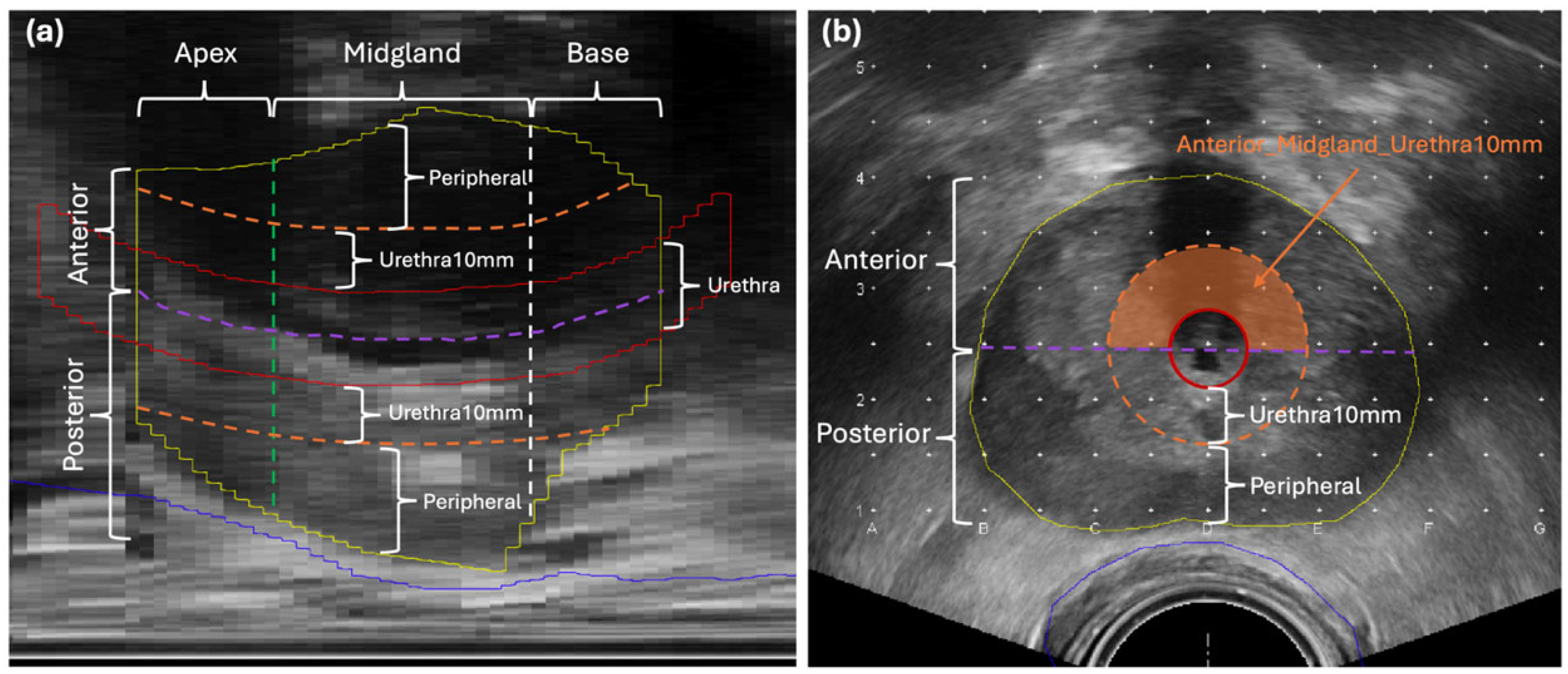
2.3. Spatial Dose Characteristics
2.4. Additional Dosimetric, Implantation-Related and Clinical Parameters
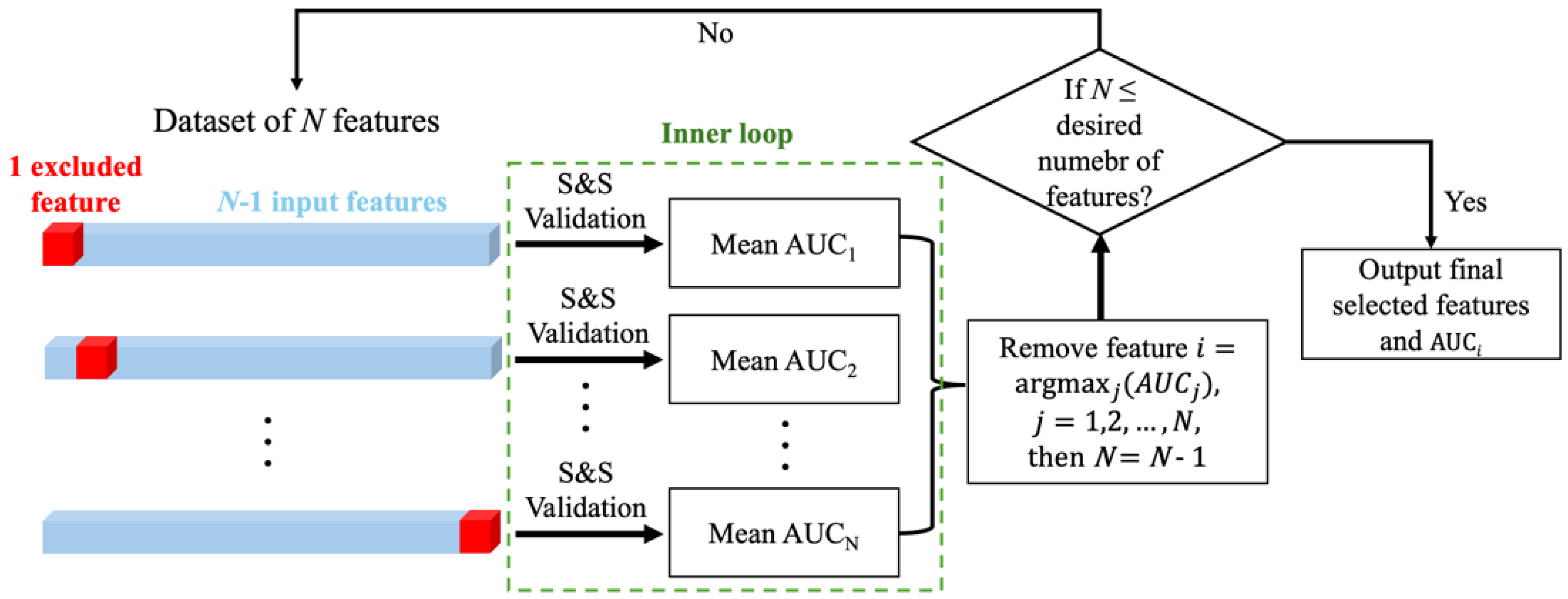
2.5. ML-Based Prediction Model
2.6. Univariate Statistics Analysis
3. Results
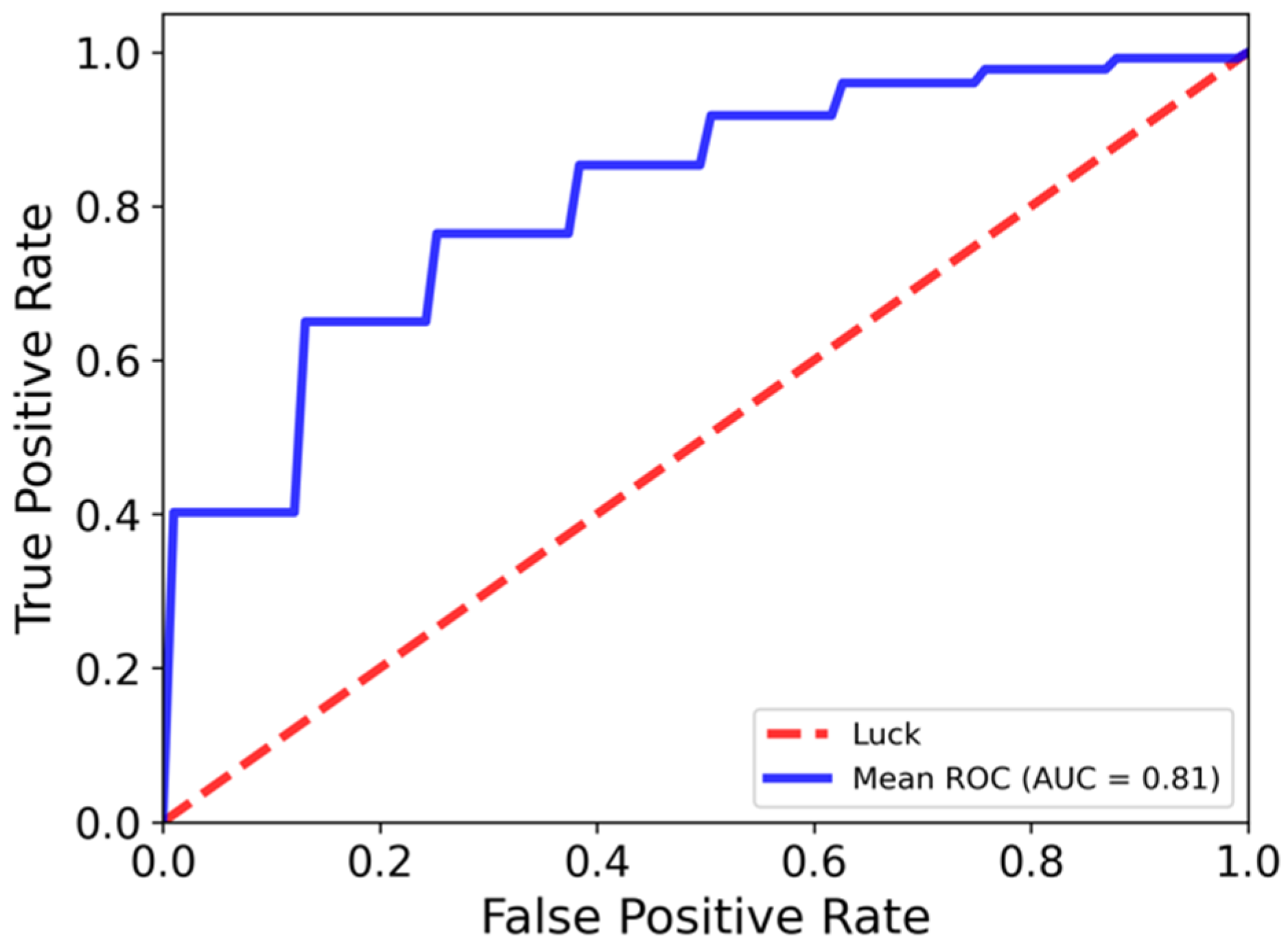
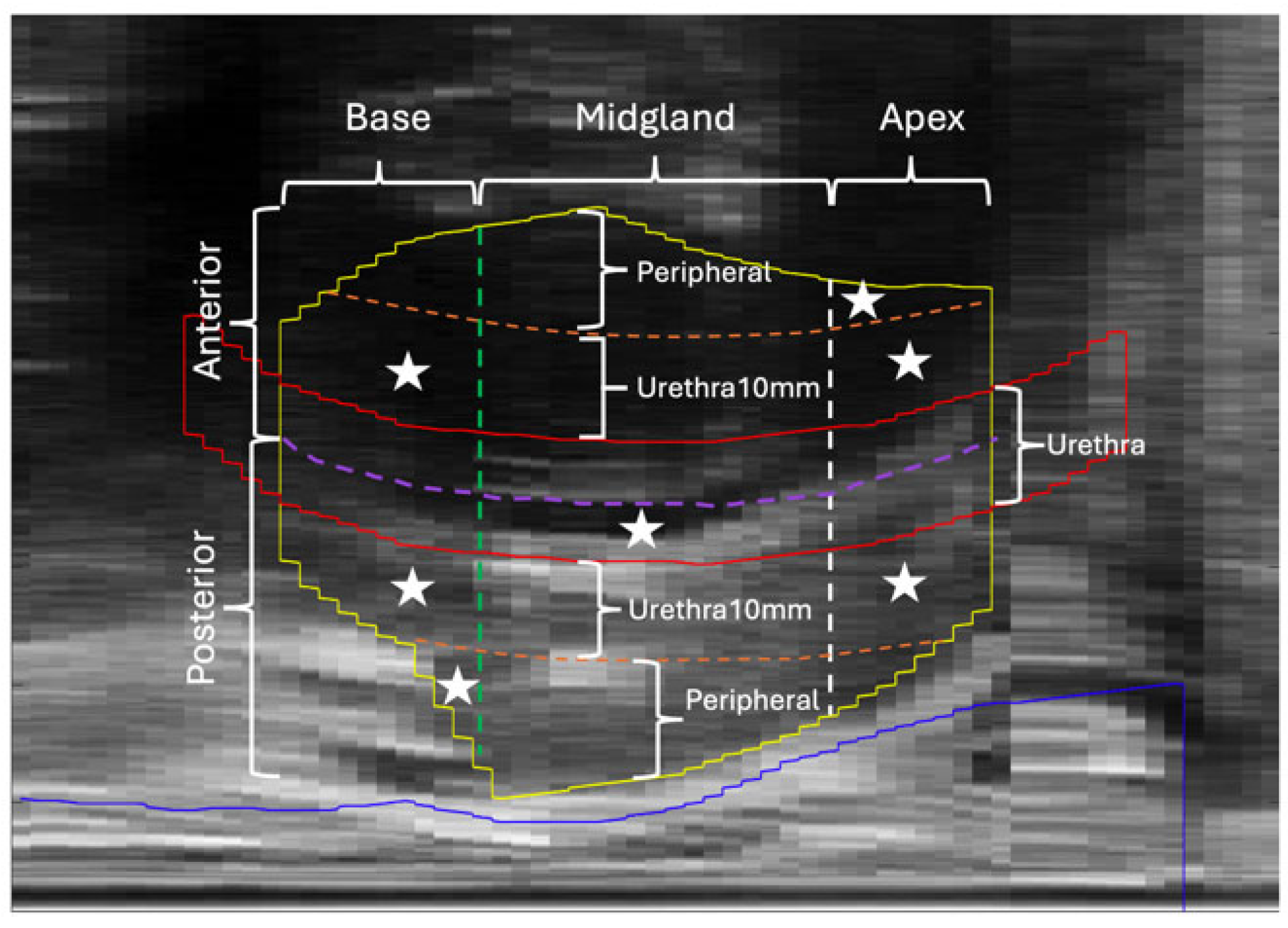
3.1. Model Performance and Selected Features
3.2. Results of Univariate Statistics Analysis
4. Discussions
5. Conclusions
Author Contributions
Funding
Institutional Review Board Statement
Informed Consent Statement
Data Availability Statement
Acknowledgments
Conflicts of Interest
References
- Grimm, P.; Billiet, I.; Bostwick, D.; Dicker, A.P.; Frank, S.; Immerzeel, J.; Keyes, M.; Kupelian, P.; Lee, W.R.; MacHtens, S.; et al. Comparative Analysis of Prostate-Specific Antigen Free Survival Outcomes for Patients with Low, Intermediate and High Risk Prostate Cancer Treatment by Radical Therapy. Results from the Prostate Cancer Results Study Group. BJU Int. 2012, 109, 22–29. [Google Scholar] [CrossRef]
- Morton, G.C.; Hoskin, P.J. Brachytherapy: Current Status and Future Strategies-Can High Dose Rate Replace Low Dose Rate and External Beam Radiotherapy? Clin. Oncol. 2013, 25, 474–482. [Google Scholar] [CrossRef] [PubMed]
- Eastham, J.A.; Boorjian, S.A.; Kirkby, E. Clinically Localized Prostate Cancer: AUA/ASTRO Guideline. J. Urol. 2022, 208, 505–507. [Google Scholar] [CrossRef]
- Henry, A.; Pieters, B.R.; André Siebert, F.; Hoskin, P. GEC-ESTRO ACROP Prostate Brachytherapy Guidelines. Radiother. Oncol. 2022, 167, 244–251. [Google Scholar] [CrossRef]
- Stone, N.N.; Gerber, N.K.; Blacksburg, S.; Stone, J.; Stock, R.G. Factors Influencing Urinary Symptoms 10 Years after Permanent Prostate Seed Implantation. J. Urol. 2012, 187, 117–123. [Google Scholar] [CrossRef]
- Keyes, M.; Miller, S.; Pickles, T.; Halperin, R.; Kwan, W.; Lapointe, V.; McKenzie, M.; Spadinger, I.; Pai, H.; Chan, E.K.; et al. Late Urinary Side Effects 10 Years after Low-Dose-Rate Prostate Brachytherapy: Population-Based Results from a Multiphysician Practice Treating with a Standardized Protocol and Uniform Dosimetric Goals. Int. J. Radiat. Oncol. Biol. Phys. 2014, 90, 570–578. [Google Scholar] [CrossRef]
- Eriguchi, T.; Yorozu, A.; Kuroiwa, N.; Yagi, Y.; Nishiyama, T.; Saito, S.; Toya, K.; Hanada, T.; Shiraishi, Y.; Ohashi, T.; et al. Predictive Factors for Urinary Toxicity after Iodine-125 Prostate Brachytherapy with or without Supplemental External Beam Radiotherapy. Brachytherapy 2016, 15, 288–295. [Google Scholar] [CrossRef]
- Lee, D.J.; Barocas, D.A.; Zhao, Z.; Huang, L.C.; Resnick, M.J.; Koyoma, T.; Conwill, R.; McCollum, D.; Cooperberg, M.R.; Goodman, M.; et al. Comparison of Patient-Reported Outcomes After External Beam Radiation Therapy and Combined External Beam with Low-Dose-Rate Brachytherapy Boost in Men with Localized Prostate Cancer. Int. J. Radiat. Oncol. Biol. Phys. 2018, 102, 116–126. [Google Scholar] [CrossRef]
- Helou, J.; Morton, G.; Zhang, L.; Deabreu, A.; D’Alimonte, L.; Elias, E.; Musunuru, H.B.; Mamedov, A.; Ravi, A.; Chung, H.; et al. A Comparative Study of Quality of Life in Patients with Localized Prostate Cancer Treated at a Single Institution: Stereotactic Ablative Radiotherapy or External Beam + High Dose Rate Brachytherapy Boost. Radiother. Oncol. 2014, 113, 404–409. [Google Scholar] [CrossRef] [PubMed]
- Pasalic, D.; Barocas, D.A.; Huang, L.C.; Zhao, Z.; Koyama, T.; Tang, C.; Conwill, R.; Goodman, M.; Hamilton, A.S.; Wu, X.C.; et al. Five-Year Outcomes from a Prospective Comparative Effectiveness Study Evaluating External-Beam Radiotherapy with or without Low-Dose-Rate Brachytherapy Boost for Localized Prostate Cancer. Cancer 2021, 127, 1912–1925. [Google Scholar] [CrossRef] [PubMed]
- Parry, M.G.; Nossiter, J.; Sujenthiran, A.; Cowling, T.E.; Patel, R.N.; Morris, M.; Berry, B.; Cathcart, P.; Clarke, N.W.; Payne, H.; et al. Impact of High-Dose-Rate and Low-Dose-Rate Brachytherapy Boost on Toxicity, Functional and Cancer Outcomes in Patients Receiving External Beam Radiation Therapy for Prostate Cancer: A National Population-Based Study. Int. J. Radiat. Oncol. Biol. Phys. 2021, 109, 1219–1229. [Google Scholar] [CrossRef]
- Slevin, F.; Zattoni, F.; Checcucci, E.; Cumberbatch, M.G.K.; Nacchia, A.; Cornford, P.; Briers, E.; De Meerleer, G.; De Santis, M.; Eberli, D.; et al. A Systematic Review of the Efficacy and Toxicity of Brachytherapy Boost Combined with External Beam Radiotherapy for Nonmetastatic Prostate Cancer. Eur. Urol. Oncol. 2024, 7, 677–696. [Google Scholar] [CrossRef]
- Morris, W.J.; Tyldesley, S.; Rodda, S.; Halperin, R.; Pai, H.; McKenzie, M.; Duncan, G.; Morton, G.; Hamm, J.; Murray, N. Androgen Suppression Combined with Elective Nodal and Dose Escalated Radiation Therapy (the ASCENDE-RT Trial): An Analysis of Survival Endpoints for a Randomized Trial Comparing a Low-Dose-Rate Brachytherapy Boost to a Dose-Escalated External Beam Boost for High- and Intermediate-risk Prostate Cance. Int. J. Radiat. Oncol. Biol. Phys. 2017, 98, 275–285. [Google Scholar] [CrossRef]
- Abugharib, A.E.; Dess, R.T.; Soni, P.D.; Narayana, V.; Evans, C.; Gaber, M.S.; Feng, F.Y.; McLaughlin, P.W.; Spratt, D.E. External Beam Radiation Therapy with or without Low-Dose-Rate Brachytherapy: Analysis of Favorable and Unfavorable Intermediate-Risk Prostate Cancer Patients. Brachytherapy 2017, 16, 782–789. [Google Scholar] [CrossRef] [PubMed]
- Jiang, R.; Tomaszewski, J.J.; Ward, K.C.; Uzzo, R.G.; Canter, D.J. The Burden of Overtreatment: Comparison of Toxicity between Single and Combined Modality Radiation Therapy among Low Risk Prostate Cancer Patients. Can. J. Urol. 2015, 22, 7648–7655. [Google Scholar]
- Keyes, M.; Schellenberg, D.; Moravan, V.; McKenzie, M.; Agranovich, A.; Pickles, T.; Wu, J.; Liu, M.; Bucci, J.; Morris, W.J. Decline in Urinary Retention Incidence in 805 Patients after Prostate Brachytherapy: The Effect of Learning Curve? Int. J. Radiat. Oncol. Biol. Phys. 2006, 64, 825–834. [Google Scholar] [CrossRef]
- Hathout, L.; Folkert, M.R.; Kollmeier, M.A.; Yamada, Y.; Cohen, G.N.; Zelefsky, M.J. Dose to the Bladder Neck Is the Most Important Predictor for Acute and Late Toxicity After Low-Dose-Rate Prostate Brachytherapy: Implications for Establishing New Dose Constraints for Treatment Planning. Int. J. Radiat. Oncol. Biol. Phys. 2014, 90, 312–319. [Google Scholar] [CrossRef]
- Rodda, S.; Tyldesley, S.; Morris, W.J.; Keyes, M.; Halperin, R.; Pai, H.; McKenzie, M.; Duncan, G.; Morton, G.; Hamm, J.; et al. ASCENDE-RT: An Analysis of Treatment-Related Morbidity for a Randomized Trial Comparing a Low-Dose-Rate Brachytherapy Boost with a Dose-Escalated External Beam Boost for High- and Intermediate-Risk Prostate Cancer. Int. J. Radiat. Oncol. Biol. Phys. 2017, 98, 286–295. [Google Scholar] [CrossRef] [PubMed]
- Keyes, M.; Miller, S.; Moravan, V.; Pickles, T.; McKenzie, M.; Pai, H.; Liu, M.; Kwan, W.; Agranovich, A.; Spadinger, I.; et al. Predictive Factors for Acute and Late Urinary Toxicity After Permanent Prostate Brachytherapy: Long-Term Outcome in 712 Consecutive Patients. Int. J. Radiat. Oncol. Biol. Phys. 2009, 73, 1023–1032. [Google Scholar] [CrossRef] [PubMed]
- Hamilton, S.; Keyes, M.; Moravan, V.; Spadinger, I.; Morris, W.J. Regional Quadrant Dosimetry and Late Genitourinary Toxicity After Low-Dose-Rate Prostate Brachytherapy. Int. J. Radiat. Oncol. Biol. Phys. 2015, 93, E189–E190. [Google Scholar] [CrossRef]
- Spadinger, I.; Chu, J.; Afsari Golshan, M.; Keyes, M.; Pickles, T.; Hamm, J.; Morris, W.J. Regional Dose Metrics as Predictors of Biochemical Failure and Local Recurrence after Low-Dose-Rate Prostate Brachytherapy. Brachytherapy 2015, 14, 350–358. [Google Scholar] [CrossRef]
- Yuan, X.; Ma, C.; Hu, M.; Qiu, R.L.J.; Salari, E.; Martini, R.; Yang, X. Machine Learning in Image-Based Outcome Prediction after Radiotherapy: A Review. J. Appl. Clin. Med. Phys. 2025, 26, e14559. [Google Scholar] [CrossRef]
- Isaksson, L.J.; Pepa, M.; Zaffaroni, M.; Marvaso, G.; Alterio, D.; Volpe, S.; Corrao, G.; Augugliaro, M.; Starzyńska, A.; Leonardi, M.C.; et al. Machine Learning-Based Models for Prediction of Toxicity Outcomes in Radiotherapy. Front. Oncol. 2020, 10, 790. [Google Scholar] [CrossRef]
- Yang, Z.; Noble, D.J.; Shelley, L.; Berger, T.; Jena, R.; McLaren, D.B.; Burnet, N.G.; Nailon, W.H. Machine-Learning with Region-Level Radiomic and Dosimetric Features for Predicting Radiotherapy-Induced Rectal Toxicities in Prostate Cancer Patients. Radiother. Oncol. 2023, 183, 109593. [Google Scholar] [CrossRef]
- Neill, M.; Studer, G.; Le, L.; McLean, M.; Yeung, I.; Pond, G.; Crook, J.M. The Nature and Extent of Urinary Morbidity in Relation to Prostate Brachytherapy Urethral Dosimetry. Brachytherapy 2007, 6, 173–179. [Google Scholar] [CrossRef]
- Niehaus, A.; Merrick, G.S.; Butler, W.M.; Wallner, K.E.; Allen, Z.A.; Galbreath, R.W.; Adamovich, E. The Influence of Isotope and Prostate Volume on Urinary Morbidity after Prostate Brachytherapy. Int. J. Radiat. Oncol. Biol. Phys. 2006, 64, 136–143. [Google Scholar] [CrossRef]
- Karius, A.; Lotter, M.; Kreppner, S.; Schaller, V.; Lubgan, D.; Grigo, J.; Fietkau, R.; Strnad, V.; Bert, C. Permanent LDR Prostate Brachytherapy: Comprehensive Characterization of Seed-Dynamics within the Prostate on a Seed-Only Level. Brachytherapy 2022, 21, 635–646. [Google Scholar] [CrossRef]
- Karius, A.; Schweizer, C.; Strnad, V.; Lotter, M.; Kreppner, S.; Lamrani, A.; Fietkau, R.; Bert, C. Seed-Displacements in the Immediate Post-Implant Phase in Permanent Prostate Brachytherapy. Radiother. Oncol. 2023, 183, 109590. [Google Scholar] [CrossRef] [PubMed]
- Christophides, D.; Appelt, A.L.; Gusnanto, A.; Lilley, J.; Sebag-montefiore, D. Method for Automatic Selection of Parameters in Normal Tissue Complication Probability Modeling. Radiat. Oncol. Biol. 2018, 101, 704–712. [Google Scholar] [CrossRef] [PubMed]
- Söhn, M.; Alber, M.; Yan, D. Physics Contribution Principal Component Analysis-Based Pattern Analysis Of Dose–Volume Histograms And Influence On Rectal Toxicity. Int. J. Radiat. Oncol. Biol. Phys. 2007, 69, 230–239. [Google Scholar] [CrossRef] [PubMed]
- Harrell, F.E.; Lee, K.L.; Mark, D.B. Multivariable Prognostic Models: Issues in De0veloping Models, Evaluating Assumptions and Adequacy, and Measuring and Reducing Errors. Stat. Med. 1996, 15, 361–387. [Google Scholar] [CrossRef]
- Ma, C.; Tian, Z.; Wang, R.; Feng, Z.; Jiang, F.; Hu, Q.; Yang, F.; Shi, A.; Wu, H. A Prediction Model for Dosimetric-based Lung Adaptive Radiotherapy. Med. Phys. 2022, 49, 6319–6333. [Google Scholar] [CrossRef] [PubMed]
- Pedregosa, F.; Varoquaux, G.; Gramfort, A.; Michel, V.; Thirion, B.; Grisel, O.; Blondel, M.; Prettenhofer, P.; Weiss, R.; Dubourg, V.; et al. Scikit-Learn: Machine Learning in Python. J. Mach. Learn. Res. 2011, 12, 2825–2830. [Google Scholar]
- Shi, Y.; Eberhart, R.C. Parameter Selection in Particle Swarm Optimization. In Evolutionary Programming VII; Springer: Berlin/Heidelberg, Germany, 1998; Volume 1447, pp. 591–600. [Google Scholar]
- Claesen, M.; Simm, J.; Popovic, D.; Moreau, Y.; De Moor, B. Easy Hyperparameter Search Using Optunity. arXiv 2014. [Google Scholar] [CrossRef]
- Register, S.P.; Kudchadker, R.J.; Levy, L.B.; Swanson, D.A.; Pugh, T.J.; Bruno, T.L.; Frank, S.J. An MRI-Based Dose-Response Analysis of Urinary Sphincter Dose and Urinary Morbidity after Brachytherapy for Prostate Cancer in a Phase II Prospective Trial. Brachytherapy 2013, 12, 210–216. [Google Scholar] [CrossRef][Green Version]
- Boyce-Fappiano, D.; Bathala, T.K.; Ye, R.; Pasalic, D.; Gjyshi, O.; Pezzi, T.A.; Noticewala, S.S.; McGinnis, G.J.; Maroongroge, S.; Kuban, D.A.; et al. Predictors of Urinary Toxicity with MRI-Assisted Radiosurgery for Low-Dose-Rate Prostate Brachytherapy. Brachytherapy 2020, 19, 574–583. [Google Scholar] [CrossRef]
- Gardner, U.; Sherwani, Z.; Prajapati, S.; Vergalasova, I.; Zhang, H.; Roumeliotis, M.; Patel, P.; Kamrava, M.; Hathout, L.; Song, D.Y. American Brachytherapy Society Education Committee Technical Report: A Resident’s Guide to Evaluation of Prostate Low-Dose-Rate Brachytherapy Treatment Plans. Pract. Radiat. Oncol. 2025, 16, e125–e130. [Google Scholar] [CrossRef]



| Parameter | Value/Description | |
|---|---|---|
| Patient Demographics | Total Patients | 85 (consecutive, January 2021–December 2023) |
| Median Age | 70 years | |
| Risk Group | Unfavorable Intermediate or High-Risk | |
| Treatment Regimen | Modality | LDR Brachytherapy + EBRT |
| LDR Prescription Dose | 110 Gy | |
| EBRT Dose | 45 Gy (start ~6 weeks post-implant) | |
| Follow-up | Minimum 12 months | |
| Planning Goals | Prostate D90% | ≥100% |
| Prostate V150% | <50% | |
| OAR Constraints | Rectal Wall V100% | ≤1 cc |
| Urethra Dmax | <150% |
| Zone Category | Zone Names |
|---|---|
| Individual subzones | Prostate, Anterior, Posterior, Urethra, Urethra10mm, Peripheral, Base, MidGland, Apex |
| Base Region | Base_Anterior, Base_Anterior_Peripheral, Base_Anterior_Urethra, Base_Anterior_Urethra10mm, Base_Posterior, Base_Posterior_Peripheral, Base_Posterior_Urethra, Base_Posterior_Urethra10mm, Base_Peripheral, Base_Urethra, Base_Urethra10mm |
| Midgland Region | MidGland_Anterior, MidGland_Anterior_Peripheral, MidGland_Anterior_Urethra, MidGland_Anterior_Urethra10mm, MidGland_Posterior, MidGland_Posterior_Peripheral, MidGland_Posterior_Urethra, MidGland_Posterior_Urethra10mm, MidGland_Peripheral, MidGland_Urethra, MidGland_Urethra10mm |
| Apex Region | Apex_Anterior, Apex_Anterior_Peripheral, Apex_Anterior_Urethra, Apex_Anterior_Urethra10mm, Apex_Posterior, Apex_Posterior_Peripheral, Apex_Posterior_Urethra, Apex_Posterior_Urethra10mm, Apex_Peripheral, Apex_Urethra, Apex_Urethra10mm |
| Anterior Region | Anterior_Peripheral, Anterior_Urethra, Anterior_Urethra10mm |
| Posterior Region | Posterior_Peripheral, Posterior_Urethra, Posterior_Urethra10mm |
| Category | Parameters |
|---|---|
| DVH | Prostate (D90%, V100%, and V150%) Urethra (D5%, D30%, and V150%) |
| Implant-based | Number of needles Number of seeds Prostate volume |
| Clinical | Baseline IPSS |
| Selected Features | Mean AUC |
|---|---|
| Apex_Urethra10mm_PCA1 | 0.693 |
| Base_Urethra10mm_PCA2 | 0.714 |
| Baseline IPSS | 0.722 |
| Apex_Anterior_Urethra10mm_PCA1 | 0.724 |
| Apex_Anterior_Peripheral_PCA2 | 0.741 |
| Base_Posterior_Peripheral_PCA2 | 0.765 |
| MidGland_Posterior_Urethra_PCA2 | 0.767 |
| Base_Urethra10mm_PCA1 | 0.781 |
| Significant Features | p-Value | AUC |
|---|---|---|
| Baseline IPSS | <0.001 | 0.708 |
| Apex_Posterior_Urethra10mm_PCA1 | 0.048 | 0.625 |
| Apex_Posterior_PCA1 | 0.047 | 0.624 |
| Apex_Posterior_Peripheral_PCA2 | 0.054 | 0.621 |
| Posterior_PCA1 | 0.067 | 0.615 |
| MidGland_Posterior_Urethra_PCA1 | 0.070 | 0.625 |
Disclaimer/Publisher’s Note: The statements, opinions and data contained in all publications are solely those of the individual author(s) and contributor(s) and not of MDPI and/or the editor(s). MDPI and/or the editor(s) disclaim responsibility for any injury to people or property resulting from any ideas, methods, instructions or products referred to in the content. |
© 2026 by the authors. Licensee MDPI, Basel, Switzerland. This article is an open access article distributed under the terms and conditions of the Creative Commons Attribution (CC BY) license.
Share and Cite
Ma, C.; Hou, Y.; Badkul, R.; Setianegara, J.; Shen, X.; Shiao, J.; Li, H.; Chen, R.C. Spatial Dosimetric-Based Prediction of Long-Term Urinary Toxicity After Permanent Prostate Brachytherapy. Cancers 2026, 18, 1287. https://doi.org/10.3390/cancers18081287
Ma C, Hou Y, Badkul R, Setianegara J, Shen X, Shiao J, Li H, Chen RC. Spatial Dosimetric-Based Prediction of Long-Term Urinary Toxicity After Permanent Prostate Brachytherapy. Cancers. 2026; 18(8):1287. https://doi.org/10.3390/cancers18081287
Chicago/Turabian StyleMa, Chaoqiong, Ying Hou, Rajeev Badkul, Jufri Setianegara, Xinglei Shen, Jay Shiao, Harold Li, and Ronald C. Chen. 2026. "Spatial Dosimetric-Based Prediction of Long-Term Urinary Toxicity After Permanent Prostate Brachytherapy" Cancers 18, no. 8: 1287. https://doi.org/10.3390/cancers18081287
APA StyleMa, C., Hou, Y., Badkul, R., Setianegara, J., Shen, X., Shiao, J., Li, H., & Chen, R. C. (2026). Spatial Dosimetric-Based Prediction of Long-Term Urinary Toxicity After Permanent Prostate Brachytherapy. Cancers, 18(8), 1287. https://doi.org/10.3390/cancers18081287