Optic Pathway Glioma in Adults: A Systematic Review and Individual Patient-Level Analysis of Clinical Characteristics and Prognostic Factors
 , , , ,
Simple Summary
Abstract
1. Introduction
2. Methods
2.1. Study Selection
2.2. Data Extraction and Statistical Analysis
3. Results
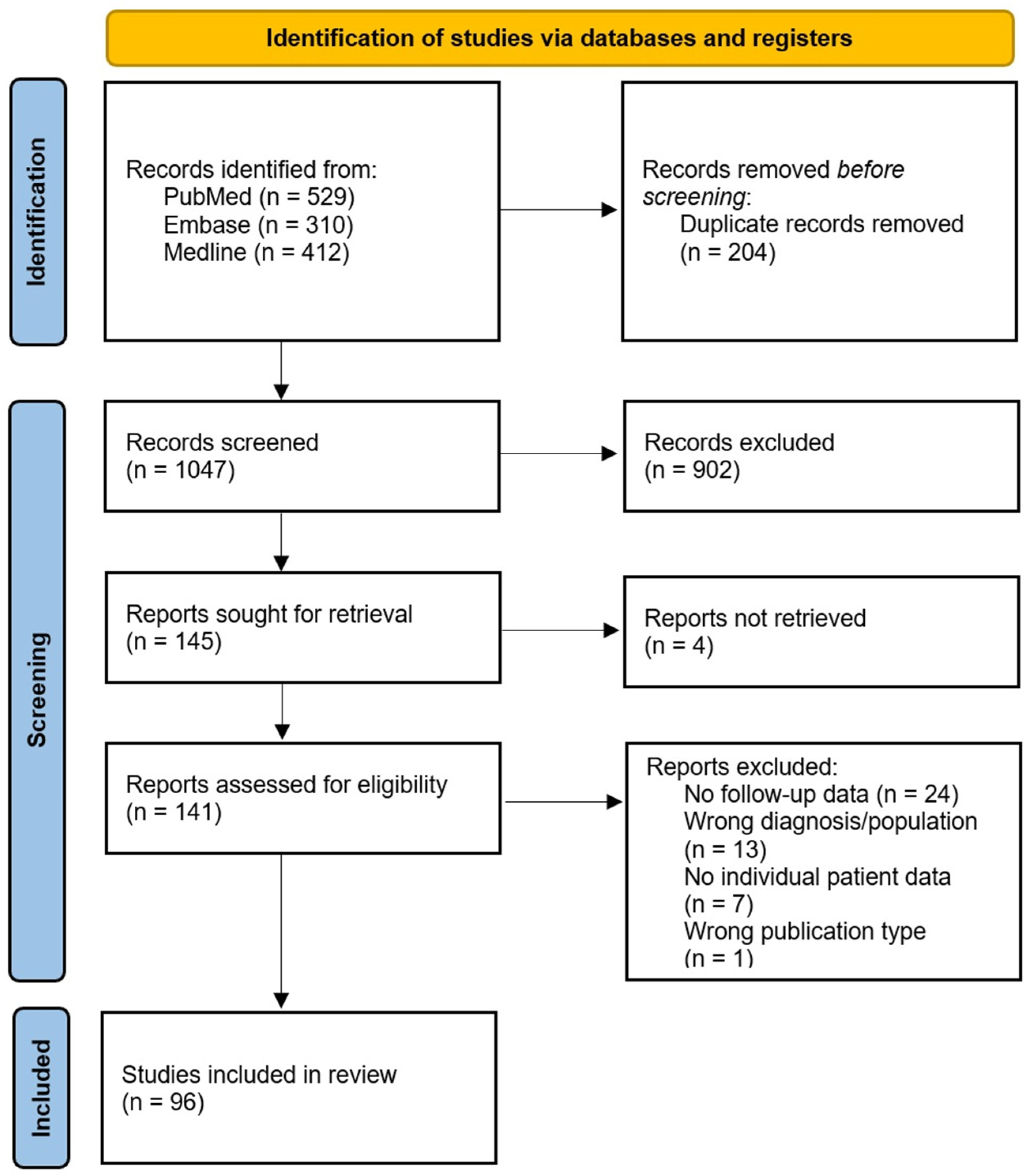
3.1. Study Selection
3.2. Patient and Case Characteristics
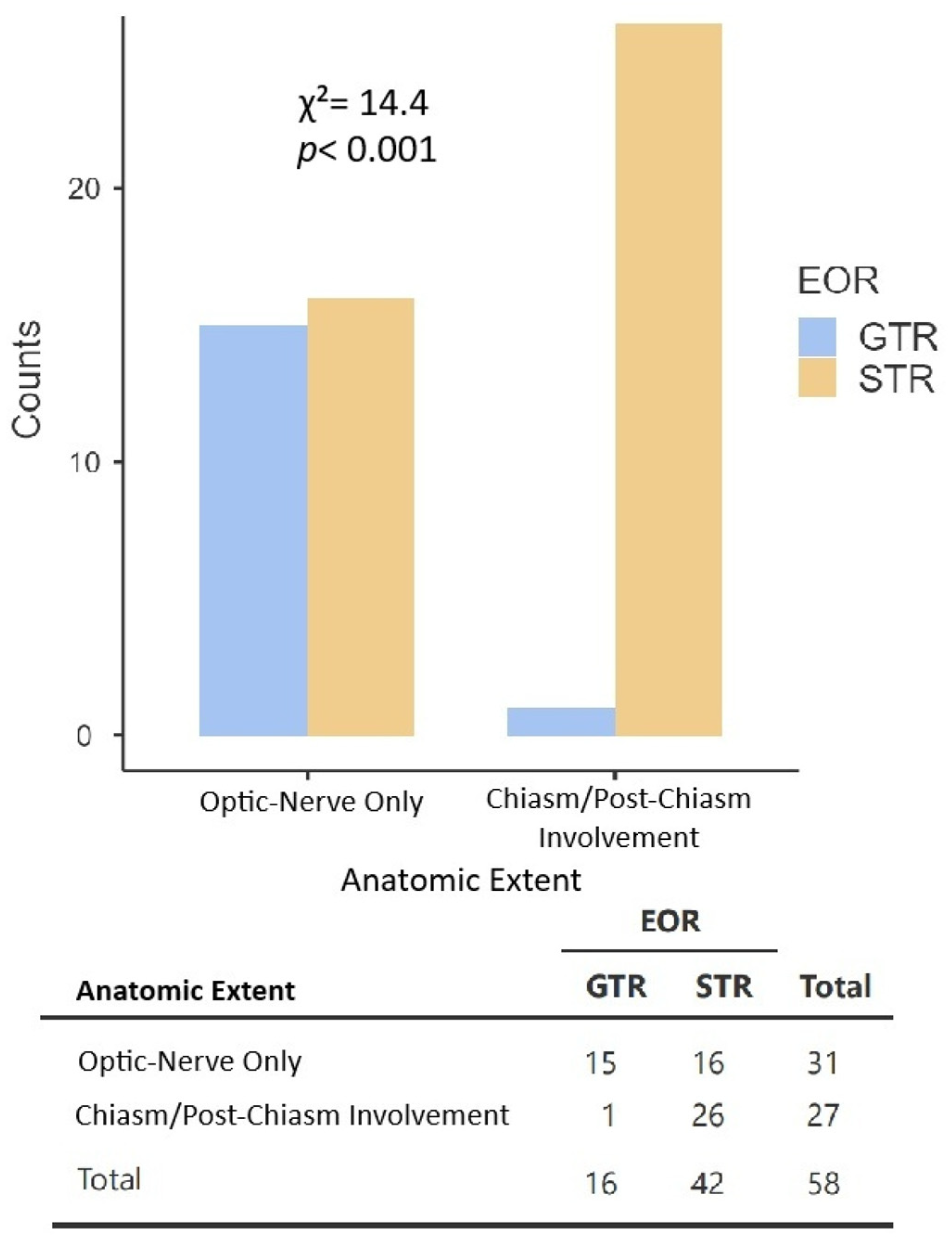
3.3. Clinical Management
3.4. Molecular Findings
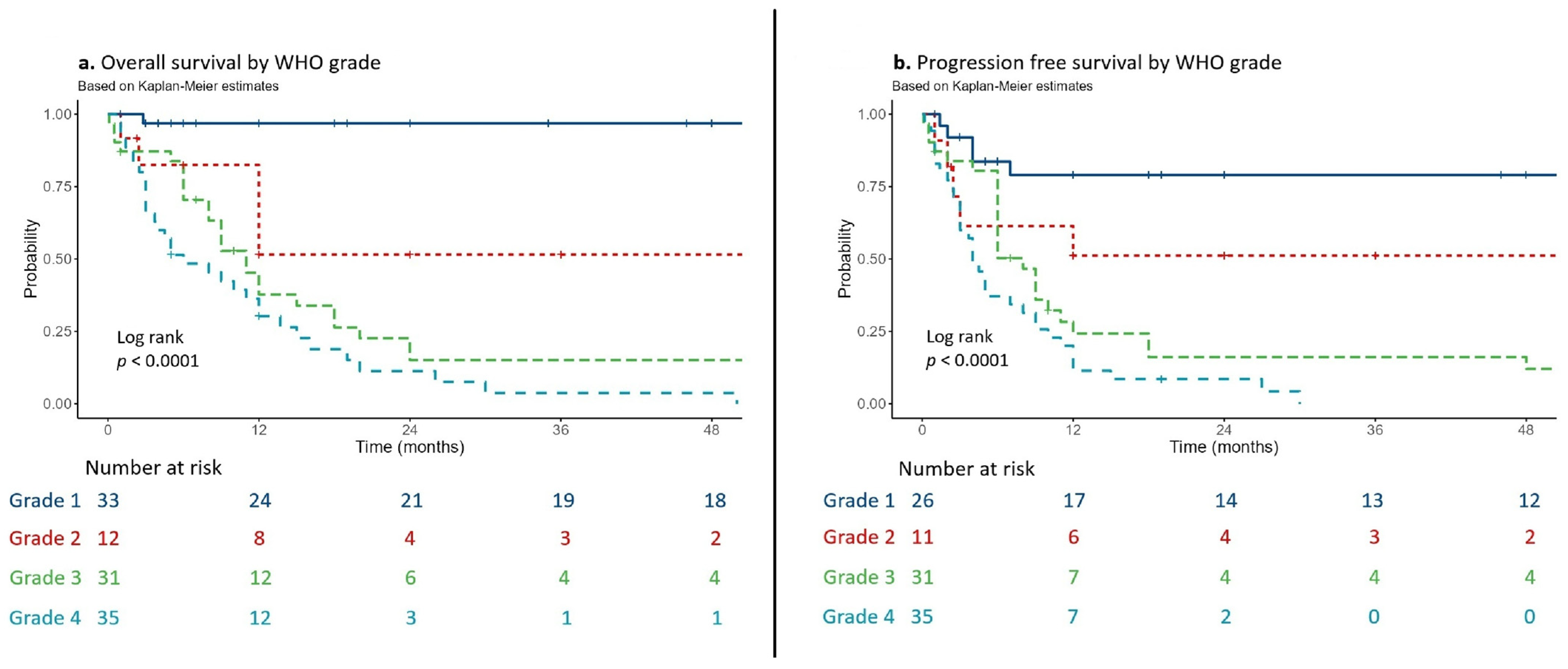
3.5. Survival Analysis
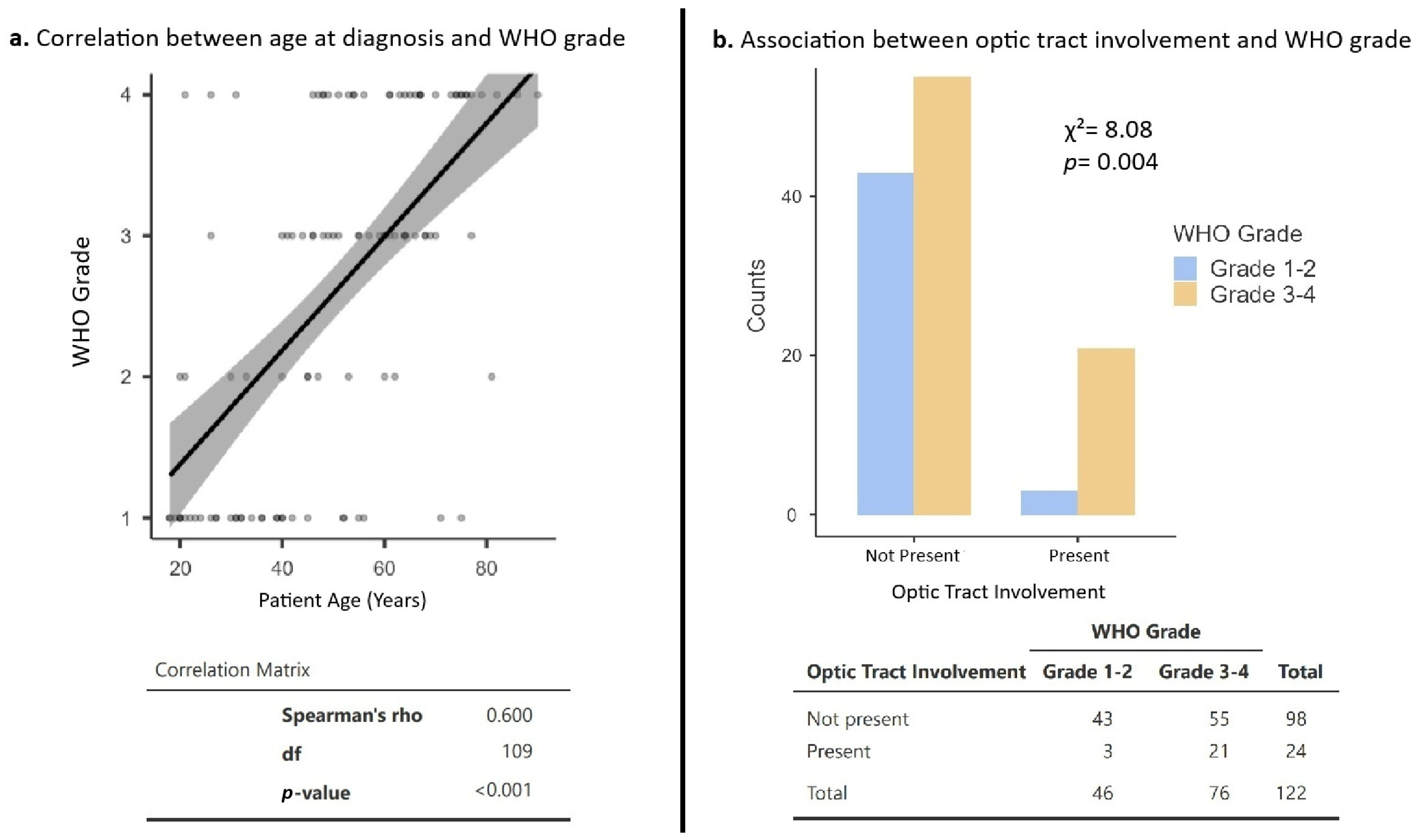
3.6. Clinical Correlates of WHO Grade
4. Discussion
4.1. Patient and Tumor Characteristics
4.2. Clinical Management
4.3. Survival and Outcomes
4.4. Molecular Observations
4.5. Limitations
5. Conclusions
Supplementary Materials
Author Contributions
Funding
Institutional Review Board Statement
Informed Consent Statement
Data Availability Statement
Conflicts of Interest
References
- Bao, J.; Xu, X.; Pan, Z.; Wei, S. Decoding Optic Pathway Gliomas: Molecular Insights and Emerging Therapies. Crit. Rev. Oncol. Hematol. 2025, 216, 104953. [Google Scholar] [CrossRef]
- Fried, I.; Tabori, U.; Tihan, T.; Reginald, A.; Bouffet, E. Optic Pathway Gliomas: A Review. CNS Oncol. 2013, 2, 143–159. [Google Scholar] [CrossRef]
- Liu, H.; Chen, Y.; Qin, X.; Jin, Z.; Jiang, Y.; Wang, Y. Epidemiology and Survival of Patients with Optic Pathway Gliomas: A Population-Based Analysis. Front. Oncol. 2022, 12, 789856. [Google Scholar] [CrossRef] [PubMed]
- Farazdaghi, M.K.; Katowitz, W.R.; Avery, R.A. Current Treatment of Optic Nerve Gliomas. Curr. Opin. Ophthalmol. 2019, 30, 356–363. [Google Scholar] [CrossRef] [PubMed]
- Dal Bello, S.; Martinuzzi, D.; Tereshko, Y.; Veritti, D.; Sarao, V.; Gigli, G.L.; Lanzetta, P.; Valente, M. The Present and Future of Optic Pathway Glioma Therapy. Cells 2023, 12, 2380. [Google Scholar] [CrossRef] [PubMed]
- Rodriguez, F.J.; Ligon, A.H.; Horkayne-Szakaly, I.; Rushing, E.J.; Ligon, K.L.; Vena, N.; Garcia, D.I.; Cameron, J.D.; Eberhart, C.G. BRAF Duplications and MAPK Pathway Activation Are Frequent in Gliomas of the Optic Nerve Proper. J. Neuropathol. Exp. Neurol. 2012, 71, 789–795. [Google Scholar] [CrossRef]
- Wladis, E.J.; Adamo, M.A.; Weintraub, L. Optic Nerve Gliomas. J. Neurol. Surg. B Skull Base 2021, 82, 091–095. [Google Scholar] [CrossRef]
- Page, M.J.; McKenzie, J.E.; Bossuyt, P.M.; Boutron, I.; Hoffmann, T.C.; Mulrow, C.D.; Shamseer, L.; Tetzlaff, J.M.; Akl, E.A.; Brennan, S.E.; et al. The PRISMA 2020 Statement: An Updated Guideline for Reporting Systematic Reviews. BMJ 2021, 372, n71. [Google Scholar] [CrossRef]
- Peyton, M.A.; Cano, C.A. Severe Sleep-Wake Disturbances in a Patient with Rapidly Progressive Optic Pathway Glioma. Sleep Med. 2025, 132, 106561. [Google Scholar] [CrossRef]
- Kassotis, A.S.; Garcia, M.D.L.; Sun, Y.; Mbekeani, J.N.; Kazim, M. Clinically Aggressive Low-Grade Optic Nerve Glioma in an Adult Treated with Selumetinib. J. Neuro-Ophthalmol. 2024, 44, e575–e577. [Google Scholar] [CrossRef]
- Magharious, M.M.; Pekmezci, M.; Mamlouk, M.D.; Horton, J.C.; Levin, M.H. Revised Diagnosis from Histiocytic Neoplasm to Optic Chiasm Glioblastoma After Genetic Analysis. J. Neuro-Ophthalmol. 2024, 44, 582–586. [Google Scholar] [CrossRef]
- Ng, F.J.; Wang, W.; Satgunaseelan, L.; Verma, N. Rapid Vision Loss Due to Multifocal Glioma: A Diagnostic Challenge. Ophthalmol. Ther. 2024, 13, 1399–1405. [Google Scholar] [CrossRef]
- Amisaki, H.; Kambe, A.; Tetsuji, U.; Sakamoto, M.; Yamasaki, A.; Kurosaki, M. High-Grade Optic Glioma in an Elderly Patient with Neurofibromatosis Type 1. J. Neuro-Ophthalmol. 2023, 43, e221–e223. [Google Scholar] [CrossRef]
- Dung, L.T.; Hung, N.D.; Hung, N.K.; Khuong, N.H.; Thien, L.Q.; Duy, N.Q.; Duc, N.M. Magnetic Resonance Imaging Characteristics of Glioblastoma of the Optic Pathway during Adulthood. Radiol. Case Rep. 2023, 18, 2628–2632. [Google Scholar] [CrossRef] [PubMed]
- Li, W.; Li, M.; Luo, L.; Hu, Y.; Liu, X.; Yang, H.; Guo, Y.; He, H. Prechiasmatic Transection of the Unilateral Dodge Class I Optic Pathway Glioma without Neurofibromatosis Type 1: Technical Description and Clinical Prognosis. World Neurosurg. 2024, 181, e648–e654. [Google Scholar] [CrossRef] [PubMed]
- Mulhem, A. Primary Glioblastoma Multiform (GBM) of the Optic Nerve and Chiasma: A Case Report and Systematic Review of the Literature. Clin. Case Rep. 2024, 12, e8636. [Google Scholar] [CrossRef]
- Cao, Y.; Tang, X.; Zan, X.; Li, S. Benign Optic Nerve Gliomas in an Adult: A Case Report. Medicine 2022, 101, e30132. [Google Scholar] [CrossRef]
- Sun, M.J.; Tran, A.Q.; Dinkin, M.J.; Kazim, M.; Tooley, A.A. An Elusive Case of Malignant Optic Nerve Glioma with a Suprasellar Mass. Orbit 2024, 43, 240–243. [Google Scholar] [CrossRef]
- Prado, R.M.D.A.; Tamura, B.P.; Gomez, G.D. Optic Pathway Gliosarcoma: A Very Rare Location for a Rare Disease. Radiol. Case Rep. 2021, 16, 1665–1668. [Google Scholar] [CrossRef] [PubMed]
- Heiland, T.; Karpel-Massler, G.; Scheuerle, A.; Wirtz, C.-R.; Halatsch, M.-E. Rare Case of Sporadic Malignant Optic Pathway Glioma in 71-Year-Old Woman. World Neurosurg. 2020, 133, 413–415. [Google Scholar] [CrossRef]
- Hong, C.S.; Fliney, G.; Fisayo, A.; An, Y.; Gopal, P.P.; Omuro, A.; Pointdujour-Lim, R.; Erson-Omay, E.Z.; Omay, S.B. Genetic Characterization of an Aggressive Optic Nerve Pilocytic Glioma. Brain Tumor Pathol. 2021, 38, 59–63. [Google Scholar] [CrossRef]
- Ramakrishnan, M.S.; Vora, R.A.; Gilbert, A.L. Glioblastoma Multiforme Mimicking Optic Neuritis. Am. J. Ophthalmol. Case Rep. 2020, 17, 100594. [Google Scholar] [CrossRef]
- Shoji, T.; Kanamori, M.; Saito, R.; Watanabe, Y.; Watanabe, M.; Fujimura, M.; Ogawa, Y.; Sonoda, Y.; Kumabe, T.; Kure, S.; et al. Frequent Clinical and Radiological Progression of Optic Pathway/Hypothalamic Pilocytic Astrocytoma in Adolescents and Young Adults. Neurol. Med. Chir. 2020, 60, 277–285. [Google Scholar] [CrossRef]
- Bayley V, J.C.; Goethe, E.A.; Srinivasan, V.M.; Klisch, T.J.; Mandel, J.J.; Patel, A.J. Newly Diagnosed Optic Pathway Glioma During Pregnancy. World Neurosurg. 2019, 127, 58–62. [Google Scholar] [CrossRef] [PubMed]
- Lv, Y.; Zhang, J.; Liu, F.; Song, M.; Hou, Y.; Liang, N. Targeted Therapy with Anlotinib for Patient with Recurrent Glioblastoma: A Case Report and Literature Review. Medicine 2019, 98, e15749. [Google Scholar] [CrossRef] [PubMed]
- Bin Abdulqader, S.; Al-Ajlan, Z.; Albakr, A.; Issawi, W.; Al-Bar, M.; Recinos, P.F.; Alsaleh, S.; Ajlan, A. Endoscopic Transnasal Resection of Optic Pathway Pilocytic Astrocytoma. Childs Nerv. Syst. 2019, 35, 73–81. [Google Scholar] [CrossRef]
- Mastorakos, P.; Hays, M.A.; Caruso, J.P.; Chen, C.-J.; Ding, D.; Taylor, D.G.; Beatriz Lopes, M.; Shaffrey, M.E. Transtentorial Dissemination of Optic Nerve Glioblastoma: Case Report. J. Neurosurg. 2018, 128, 406–413. [Google Scholar] [CrossRef]
- Wang, J.; Jia, J.; Hou, Z.; Yuan, X.; Sun, G.; Niu, J.; Li, Z. Endoscopic Transsphenoidal Surgery for an Adult Patient with Giant Exophytic Chiasmatic/Hypothalamic Glioma. J. Craniofac. Surg. 2018, 29, e499–e502. [Google Scholar] [CrossRef]
- Alireza, M.; Amelot, A.; Chauvet, D.; Terrier, L.-M.; Lot, G.; Bekaert, O. Poor Prognosis and Challenging Treatment of Optic Nerve Malignant Gliomas: Literature Review and Case Report Series. World Neurosurg. 2017, 97, 751.e1–751.e6. [Google Scholar] [CrossRef]
- Lin, C.-Y.; Huang, H.-M. Unilateral Malignant Optic Glioma Following Glioblastoma Multiforme in the Young: A Case Report and Literature Review. BMC Ophthalmol. 2017, 17, 21. [Google Scholar] [CrossRef] [PubMed]
- Menon, S.G.; Raju, V.; Bhandary, S.; Addoor, K. Recurrent Optic Nerve Pilocytic Astrocytoma: A Rare Case. J. Clin. Diagn. Res. 2017, 11, ND03. [Google Scholar] [CrossRef]
- Borghei-Razavi, H.; Shibao, S.; Schick, U. Prechiasmatic Transection of the Optic Nerve in Optic Nerve Glioma: Technical Description and Surgical Outcome. Neurosurg. Rev. 2017, 40, 135–141. [Google Scholar] [CrossRef]
- Cimino, P.J.; Sychev, Y.V.; Gonzalez-Cuyar, L.F.; Mudumbai, R.C.; Keene, C.D. Primary Gliosarcoma of the Optic Nerve: A Unique Adult Optic Pathway Glioma. Ophthalmic Plast. Reconstr. Surg. 2017, 33, e88–e92. [Google Scholar] [CrossRef]
- Lyapichev, K.; Bregy, A.; Cassel, A.; Handfield, C.; Velazquez-Vega, J.; Kay, M.; Basil, G.; Komotar, R. Glioblastoma Multiforme of the Optic Chiasm: A Rare Case of Common Pathology. Surg. Neurol. Int. 2016, 7, S485. [Google Scholar] [CrossRef]
- Nagaishi, M.; Sugiura, Y.; Takano, I.; Tanaka, Y.; Suzuki, K.; Yokoo, H.; Hyodo, A. Clinicopathological and Molecular Features of Malignant Optic Pathway Glioma in an Adult. J. Clin. Neurosci. 2015, 22, 207–209. [Google Scholar] [CrossRef] [PubMed]
- Nagia, L.; Doyle, J.I.; Hackney, J.R.; Vaphiades, M.S.; Kline, L.B.; Levin, M.H. Second Chances. Surv. Ophthalmol. 2015, 60, 596–599. [Google Scholar] [CrossRef] [PubMed]
- Traber, G.L.; Pangalu, A.; Neumann, M.; Costa, J.; Weller, M.; Huna-Baron, R.; Landau, K. Malignant Optic Glioma—The Spectrum of Disease in a Case Series. Graefe’s Arch. Clin. Exp. Ophthalmol. 2015, 253, 1187–1194. [Google Scholar] [CrossRef] [PubMed]
- Arrese, I.; Sarabia, R.; Zamora, T. Chiasmal Haemorrhage Secondary to Glioma with Unusual MRI Appearance. Neurocirugía 2014, 25, 136–139. [Google Scholar] [CrossRef]
- Bhaker, P.; Tyagi, R.; Mahajan, D.; Mohindra, S.; Vasishta, R. Optic Nerve Glioma: A Great Mimicker. Surg. Neurol. Int. 2014, 5, 9. [Google Scholar] [CrossRef] [PubMed]
- Bilgin, G.; Al-Obailan, M.; Bonelli, L.; Glasgow, B.J.; Vinters, H.V.; Arnold, A.C. Aggressive Low-Grade Optic Nerve Glioma in Adults. Neuro-Ophthalmol. 2014, 38, 297–309. [Google Scholar] [CrossRef]
- Caignard, A.; Faguer, R.; Mercier, P.; Menei, P.; Milea, D. Optic Nerve and Visual Pathways Primary Glioblastoma Treated with Radiotherapy and Temozolomide Chemotherapy. Eur. J. Ophthalmol. 2014, 24, 637–640. [Google Scholar] [CrossRef]
- Colpak, A.I.; Isikay, I.; Mut, M.; Soylemezoglu, F.; Kansu, T.; Foroozan, R. Acute Visual Loss: Just the Beginning? Surv. Ophthalmol. 2014, 59, 548–552. [Google Scholar] [CrossRef]
- Della Puppa, A.; Rustemi, O.; Gioffre’, G. The Rare Event of Optic-Chiasmatic Hemorrhagic Low Grade Glioma in Adulthood. Considerations on Treatment Strategy. Neurol. Sci. 2014, 35, 623–625. [Google Scholar] [CrossRef]
- Kim, A.W. Diffusion-Weighted Imaging in a Case of Malignant Optic Glioma. Neur Clin. Pract. 2014, 4, 362–364. [Google Scholar] [CrossRef] [PubMed]
- Pecen, P.E.; Bhatti, M.T. Clinical Reasoning: A 61-Year-Old Woman with a Swollen Optic Nerve and Progressive Visual Loss. Neurology 2014, 82, e205–e209. [Google Scholar] [CrossRef]
- Sarkar, S.; Rajaratnam, S.; Backianathan, S.; Chacko, G.; Chacko, A.G. Radiation-Induced Opticochiasmatic Glioblastoma Multiforme Following Conventional Radiotherapy for Cushing’s Disease. Br. J. Neurosurg. 2014, 28, 510–512. [Google Scholar] [CrossRef]
- Theeler, B.J.; Ellezam, B.; Yust-Katz, S.; Slopis, J.M.; Loghin, M.E.; De Groot, J.F. Prolonged Survival in Adult Neurofibromatosis Type I Patients with Recurrent High-Grade Gliomas Treated with Bevacizumab. J. Neurol. 2014, 261, 1559–1564. [Google Scholar] [CrossRef] [PubMed]
- Ashur-Fabian, O.; Blumenthal, D.T.; Bakon, M.; Nass, D.; Davis, P.J.; Hercbergs, A. Long-Term Response in High-Grade Optic Glioma Treated with Medically Induced Hypothyroidism and Carboplatin: A Case Report and Review of the Literature. Anti-Cancer Drugs 2013, 24, 315–323. [Google Scholar] [CrossRef] [PubMed]
- Jiang, X.; Cummings, T. Glioblastoma of the Optic Nerve. Lab. Investig. 2013, 93, 413–420. [Google Scholar] [CrossRef][Green Version]
- Liu, Y.; Zhang-Nunes, S.; Zhu, X.; Xu, X.; Sun, X.; Wu, Y. Late Adult Onset Optic Pathway Astrocytoma. J. Clin. Neurosci. 2013, 20, 1610–1612. [Google Scholar] [CrossRef]
- Gacic, E.M.M.; Skender-Gazibara, M.K.; Gazibara, T.M.; Nagulic, M.A.; Nikolic, I.M. Intraorbital Ganglioglioma of Optic Nerve in a Patient with Neurofibromatosis Type 1. J. Neuro-Ophthalmol. 2012, 32, 350–353. [Google Scholar] [CrossRef]
- Shriver, E.M.; Ragheb, J.; Tse, D.T. Combined Transcranial-Orbital Approach for Resection of Optic Nerve Gliomas: A Clinical and Anatomical Study. Ophthalmic Plast. Reconstr. Surg. 2012, 28, 184–191. [Google Scholar] [CrossRef] [PubMed]
- Matloob, S.; Fan, J.C.; Danesh-Meyer, H.V. Multifocal Malignant Optic Glioma of Adulthood Presenting as Acute Anterior Optic Neuropathy. J. Clin. Neurosci. 2011, 18, 974–977. [Google Scholar] [CrossRef]
- Simao, L.M.; Dine Sultan, E.N.E.; Hall, J.K.; Reardon, D.A.; Bhatti, M.T. Knee Deep in the Nerve. Surv. Ophthalmol. 2011, 56, 362–370. [Google Scholar] [CrossRef]
- Chacko, J.G.; Lam, B.L.; Adusumilli, J.; Dubovy, S.R. Multicentric Malignant Glioma of Adulthood Masquerading as Optic Neuritis. Br. J. Ophthalmol. 2010, 94, 782–783. [Google Scholar] [CrossRef]
- Pasol, J.; Sternau, L.; Luetmer, P.; Giannini, C. Rapid Progressive Unilateral Visual Loss in an Elderly Man. J. Neuro-Ophthalmol. 2010, 30, 188–192. [Google Scholar] [CrossRef]
- Kawasaki, A. Optic Tract Syndrome: An Unusual Presentation of Multicentric Malignant Optic Glioma of Adulthood. Am. J. Case Rep. 2009, 10, 213–215. [Google Scholar]
- Wu-Chen, W.Y.; Jacobs, D.A.; Volpe, N.J.; Dalmau, J.O.; Moster, M.L. Intracranial Malignancies Occurring More Than 20 Years After Radiation Therapy for Pituitary Adenoma. J. Neuro-Ophthalmol. 2009, 29, 289–295. [Google Scholar] [CrossRef]
- Abou-Zeid, A.; Duplessis, D.; Gnanalingham, K.K. Blindness from Multiple Cerebral Gliomas Mimicking Metastatic Brain Disease. Br. J. Neurosurg. 2008, 22, 772–773. [Google Scholar] [CrossRef]
- Dinh, T.T.; Wang, Y.Y.; Rosenfeld, J.V.; Cherny, M. Glioblastoma of the Optic Chiasm. J. Clin. Neurosci. 2007, 14, 502–505. [Google Scholar] [CrossRef] [PubMed]
- Miyamoto, J.; Sasajima, H.; Owada, K.; Mineura, K. Surgical Decision for Adult Optic Glioma Based on [18F] Fluorodeoxyglucose Positron Emission Tomography Study—Case Report. Neurol. Med. Chir. 2006, 46, 500–503. [Google Scholar] [CrossRef][Green Version]
- Sharif, S.; Ferner, R.; Birch, J.M.; Gillespie, J.E.; Gattamaneni, H.R.; Baser, M.E.; Evans, D.G.R. Second Primary Tumors in Neurofibromatosis 1 Patients Treated for Optic Glioma: Substantial Risks After Radiotherapy. J. Clin. Oncol. 2006, 24, 2570–2575. [Google Scholar] [CrossRef]
- Danesh-Meyer, H.V. Aggressive Glioma of Adulthood Simulating Ischemic Optic Neuropathy. Arch. Ophthalmol. 2005, 123, 694. [Google Scholar] [CrossRef]
- Kwon, Y.; Bae, J.S.; Kim, J.M.; Lee, D.H.; Kim, S.Y.; Ahn, J.S.; Kim, J.H.; Kim, C.J.; Kwun, B.D.; Lee, J.K. Visual Changes after Gamma Knife Surgery for Optic Nerve Tumors: Report of Three Cases. J. Neurosurg. 2005, 102, 143–146. [Google Scholar] [CrossRef]
- Albayrak, R.; Albayram, S.; Port, J.; Değirmenci, B.; Acar, M.; Yücel, A. Ganglioglioma of the Right Optic Tract: Case Report and Review of the Literature. Magn. Reson. Imaging 2004, 22, 1047–1051. [Google Scholar] [CrossRef]
- Chernov, M.F.; Ivanov, P.I.; Zhinzhina, I.V.; Getmanova, O.Y.; Zabrodskaya, J.M.; Tigliev, G.S. Complete Recovery of Visual Functions After Multimodality Treatment for Intrinsic Chiasmatic-Hypothalamic Astrocytoma—Case Report. Neurol. Med. Chir. 2004, 44, 129–132. [Google Scholar] [CrossRef][Green Version]
- Wabbels, B.; Demmler, A.; Seitz, J.; Woenckhaus, M.; Bloß, H.-G.; Lorenz, B. Unilateral Adult Malignant Optic Nerve Glioma. Graefe’s Arch. Clin. Exp. Ophthalmol. 2004, 242, 741–748. [Google Scholar] [CrossRef] [PubMed]
- Murphy, M.; Timms, C.; Mckelvie, P.; Dowling, A.; Trost, N. Malignant Optic Nerve Glioma: Metastases to the Spinal Neuraxis: Case Illustration. J. Neurosurg. Spine 2003, 98, 110. [Google Scholar] [CrossRef]
- Yokoyama, S.; Takayama, K.; Sueda, M.; Ishikawa, Y.; Hirano, H. Optic Nerve Glioma Manifesting as Intratumoral Hemorrhage in a Pregnant Woman—Case Report. Neurol. Med. Chir. 2003, 43, 559–562. [Google Scholar] [CrossRef] [PubMed]
- Synowitz, M.; Von Eckardstein, K.; Brauer, C.; Hoch, H.H.; Kiwit, J.C.W. Case History: Multicentric Glioma with Involvement of the Optic Chiasm. Clin. Neurol. Neurosurg. 2002, 105, 66–68. [Google Scholar] [CrossRef] [PubMed]
- Colosimo, C.; Cerase, A.; Maira, G. Regression after Biopsy of a Pilocytic Opticochiasmatic Astrocytoma in a Young Adult without Neurofibromatosis. Neuroradiology 2000, 42, 352–356. [Google Scholar] [CrossRef]
- Dario, A.; Ladini, A.; Cerati, M.; Marra, A. Malignant Optic Glioma of Adulthood. Case Report and Review of the Literature. Acta Neurol. Scand. 1999, 100, 350–353. [Google Scholar] [CrossRef] [PubMed]
- Friedman, D.P.; Hollander, M.D. Neuroradiology Case of the Day. Malignant Optic Glioma of Adulthood. RadioGraphics 1998, 18, 1046–1048. [Google Scholar] [CrossRef] [PubMed]
- Brodovsky, S.; ten Hove, M.; Pinkerton, R.; Ludwin, S.; Smith, R. An Enhancing Optic Nerve Lesion: Malignant Glioma of Adulthood. Can. J. Ophthalmol. 1997, 32, 409–413. [Google Scholar] [PubMed]
- Liauw, L.; Vielvoye, G.J.; De Keizer, R.J.W.; Van Duinen, S.G. Optic Nerve Glioma Mimicking an Optic Nerve Meningioma. Clin. Neurol. Neurosurg. 1996, 98, 258–261. [Google Scholar] [CrossRef]
- Lim, Y.J.; Leem, W. Two Cases of Gamma Knife Radiosurgery for Low-Grade Optic Chiasm Glioma. Stereotact. Funct. Neurosurg. 1996, 66, 174–183. [Google Scholar] [CrossRef]
- Millar, W.; Tartaglino, L.; Sergott, R.; Friedman, D.; Flanders, A. MR of Malignant Optic Glioma of Adulthood. Am. J. Neuroradiol. 1995, 16, 1673–1676. [Google Scholar]
- Woiciechowsky, C.; Vogel, S.; Meyer, R.; Lehmann, R. Magnetic Resonance Imaging of a Glioblastoma of the Optic Chiasm: Case Report. J. Neurosurg. 1995, 83, 923–925. [Google Scholar] [CrossRef]
- Taphoorn, M.J.B.; De Vries-Knoppert, W.A.E.J.; Ponssen, H.; Wolbers, J.G. Malignant Optic Glioma in Adults: Case Report. J. Neurosurg. 1989, 70, 277–279. [Google Scholar] [CrossRef]
- Topliss, D.J. Optic-nerve Glioma and Pregnancy. Med. J. Aust. 1989, 150, 287–288. [Google Scholar] [CrossRef]
- Wulc, A.E. Orbital Optic Nerve Glioma in Adult Life. Arch. Ophthalmol. 1989, 107, 1013. [Google Scholar] [CrossRef]
- Albers, G.W.; Hoyt, W.F.; Forno, L.S.; Shratter, L.A. Treatment Response in Malignant Optic Glioma of Adulthood. Neurology 1988, 38, 1071. [Google Scholar] [CrossRef]
- Hufnagel, T.J. Malignant Glioma of the Optic Chiasm Eight Years After Radiotherapy for Prolactinoma. Arch. Ophthalmol. 1988, 106, 1701. [Google Scholar] [CrossRef]
- Ramani, A.; Raja, A.; Lakshmaiah, V.; Kundaje, G.; Ramnarayan, K.; Balasundaram, V. Optic Glioma Masquerading as Optic Neuritis. J. Assoc. Physicians India 1988, 36, 335–337. [Google Scholar] [PubMed]
- Svitra, P.; Saint-Louis, L. Magnetic Resonance Imaging for Evaluation of Tumors Involving the Optic Pathways and Orbit. Semin. Neurol. 1986, 6, 79–83. [Google Scholar] [CrossRef]
- Horwich, A.; Bloom, H.J.G. Optic Gliomas: Radiation Therapy and Prognosis. Int. J. Radiat. Oncol. Biol. Phys. 1985, 11, 1067–1079. [Google Scholar] [CrossRef]
- Barbaro, N.M.; Rosenblum, M.L.; Maitland, C.G.; Hoyt, W.F.; Davis, R.L. Malignant Optic Glioma Presenting Radiologically as a “Cystic” Suprasellar Mass: Case Report and Review of the Literature. Neurosurgery 1982, 11, 787–789. [Google Scholar] [CrossRef] [PubMed]
- Borit, A.; Richardson, E.P. The Biological and Clinical Behaviour of Pilocytic Astrocytomas of The Optic Pathways. Brain 1982, 105, 161–187. [Google Scholar] [CrossRef] [PubMed]
- Shapiro, S.; Shapiro, I.; Wirtschafter, J.; Mastri, A. Malignant Optic Glioma in an Adult: Initial CT Abnormality Limited to the Posterior Orbit, Leptomeningeal Seeding of the Tumor. Minn. Med. 1982, 65, 155–159. [Google Scholar]
- Kupersmith, M.J.; Siegel, I.M.; Carr, R.E.; Ransohoff, J.; Flamm, E.; Shakin, E. Visual Evoked Potentials in Chiasmal Gliomas in Four Adults. Arch. Neurol. 1981, 38, 362–365. [Google Scholar] [CrossRef]
- Dosoretz, D.E.; Blitzer, P.H.; Wang, C.C.; Linggood, R.M. Management of Glioma of the Optic Nerve and/or Chiasm: An Analysis of 20 Cases. Cancer 1980, 45, 1467–1471. [Google Scholar] [CrossRef] [PubMed]
- Spoor, T.C.; Kennerdell, J.S.; Martinez, A.J.; Zorub, D. Malignant Gliomas of the Optic Nerve Pathways. Am. J. Ophthalmol. 1980, 89, 284–292. [Google Scholar] [CrossRef]
- Wright, J.E.; McDonald, W.I.; Call, N.B. Management of Optic Nerve Gliomas. Br. J. Ophthalmol. 1980, 64, 545–552. [Google Scholar] [CrossRef] [PubMed]
- Enoksson, P.; Johansson, J. Altitudinal Field Defects and Retinal Nerve Fibre Degeneration in Optic Nerve Lesions. Acta Ophthalmol. 1978, 56, 957–968. [Google Scholar] [CrossRef]
- Harper, C.G.; Stewart-Wynne, E.G. Malignant Optic Gliomas in Adults. Arch. Neurol. 1978, 35, 731–735. [Google Scholar] [CrossRef] [PubMed]
- Harter, D.J.; Caderao, J.B.; Leavens, M.E.; Ellen Young, S. Radiotherapy in the Management of Primary Gliomas Involving the Intracranial Optic Nerves and Chiasmt. Int. J. Radiat. Oncol. Biol. Phys. 1978, 4, 681–686. [Google Scholar] [CrossRef]
- Lowes, M.; Bojsen-Møller, M.; Vorre, P.; Hedegaard, O. An Evaluation of Gliomas of the Anterior Visual Pathways. A 10-Year Survey. Acta Neurochir. 1978, 43, 201–216. [Google Scholar] [CrossRef]
- Manor, R.S.; Israeli, J.; Sandbank, U. Malignant Optic Glioma in a 70-Year-Old Patient. Arch. Ophthalmol. 1976, 94, 1142–1144. [Google Scholar] [CrossRef]
- Miller, N.R.; Iliff, W.J.; Green, W.R. Evaluation and Management of Gliomas of the Anterior Visual Pathways. Brain 1974, 97, 743–754. [Google Scholar] [CrossRef]
- Gibberd, F.B.; Miller, T.N.; Morgan, A.D. Glioblastoma of the Optic Chiasm. Br. J. Ophthalmol. 1973, 57, 788–791. [Google Scholar] [CrossRef][Green Version]
- Hamilton, A.M.; Garner, A.; Tripathi, R.C.; Sanders, M.D. Malignant Optic Nerve Glioma. Report of a Case with Electron Microscope Study. Br. J. Ophthalmol. 1973, 57, 253–264. [Google Scholar] [CrossRef][Green Version]
- Hoyt, W.F.; Meshel, L.G.; Lessell, S.; Schatz, N.J.; Suckling, R.D. Malignant Optic Glioma of Adulthood. Brain 1973, 96, 121–132. [Google Scholar] [CrossRef]
- Spencer, W. Primary Neoplasms of the Optic Nerve and Its Sheaths: Clinical Features and Current Concepts of Pathogenetic Mechanisms. Trans. Am. Ophthalmol. Soc. 1972, 70, 490–528. [Google Scholar]
- Otenasek, F.J.; Otenasek, R.J. Optic Glioma and Pituitary Adenoma in the Same Patient: Case Report. J. Neurosurg. 1968, 28, 274–276. [Google Scholar] [CrossRef] [PubMed]
- Modrzejewska, M.; Olejnik-Wojciechowska, J.; Roszyk, A.; Szychot, E.; Konczak, T.D.; Szemitko, M.; Peregud-Pogorzelski, J.W. Optic Pathway Gliomas in Pediatric Population—Current Approach in Diagnosis and Management: Literature Review. JCM 2023, 12, 6709. [Google Scholar] [CrossRef] [PubMed]
- Yousefi, O.; Azami, P.; Sabahi, M.; Dabecco, R.; Adada, B.; Borghei-Razavi, H. Management of Optic Pathway Glioma: A Systematic Review and Meta-Analysis. Cancers 2022, 14, 4781. [Google Scholar] [CrossRef]
- Jo, J.; Mondia, M.W.L.; Arewa, J.; How, A.; Patrie, J.; Dueck, N.; Gilbow, R.; Goschka, A.; Joyner, D.; Patel, S.H.; et al. Presenting Clinical and Radiographic Features of Diffuse Glioma Molecular Subtypes in Accordance with the 2021 CNS5 WHO Classification. Neuro-Oncol. Pract. 2025, 12, 1030–1039. [Google Scholar] [CrossRef]
- Rasmussen, B.K.; Hansen, S.; Laursen, R.J.; Kosteljanetz, M.; Schultz, H.; Nørgård, B.M.; Guldberg, R.; Gradel, K.O. Epidemiology of Glioma: Clinical Characteristics, Symptoms, and Predictors of Glioma Patients Grade I–IV in the the Danish Neuro-Oncology Registry. J. Neurooncol. 2017, 135, 571–579. [Google Scholar] [CrossRef] [PubMed]
- Samples, D.C.; Mulcahy Levy, J.M.; Hankinson, T.C. Neurosurgery for Optic Pathway Glioma: Optimizing Multidisciplinary Management. Front. Surg. 2022, 9, 884250. [Google Scholar] [CrossRef]
- Kebudi, R.; Yildirim, U.M.; İribaş, A.; Tuncer, S. Optic Pathway Gliomas in Children: Clinical Characteristics, Treatment, and Outcome of 95 Patients in a Single Center over a 31-year Period. Can We Avoid Radiotherapy? Pediatr. Blood Cancer 2024, 71, e31337. [Google Scholar] [CrossRef]
- Rajagopal, R.; Khan, M.; Lethbridge, R.; Lee, G.; Lee, S.; Dyke, J.; Fabian, V.; McGrath, A.; Taylor, M.; Jacoby, P.; et al. Long-Term Outcomes of Symptomatic Optic Pathway Glioma: 32-Year Experience at a Single Western Australian Tertiary Pediatric Oncology Center. Front. Oncol. 2023, 13, 1157909. [Google Scholar] [CrossRef] [PubMed]
- Krigers, A.; Demetz, M.; Thomé, C.; Freyschlag, C.F. Age Is Associated with Unfavorable Neuropathological and Radiological Features and Poor Outcome in Patients with WHO Grade 2 and 3 Gliomas. Sci. Rep. 2021, 11, 17380. [Google Scholar] [CrossRef] [PubMed]
- Cassina, M.; Frizziero, L.; Opocher, E.; Parrozzani, R.; Sorrentino, U.; Viscardi, E.; Miglionico, G.; Midena, E.; Clementi, M.; Trevisson, E. Optic Pathway Glioma in Type 1 Neurofibromatosis: Review of Its Pathogenesis, Diagnostic Assessment, and Treatment Recommendations. Cancers 2019, 11, 1790. [Google Scholar] [CrossRef]
- Legius, E.; Dierick, H.; Wu, R.; Hall, B.K.; Marynen, P.; Cassiman, J.; Glover, T.W. TP53 Mutations Are Frequent in Malignant NF1 Tumors. Genes Chromosomes Cancer 1994, 10, 250–255. [Google Scholar] [CrossRef]
- Zhu, Y.; Guignard, F.; Zhao, D.; Liu, L.; Burns, D.K.; Mason, R.P.; Messing, A.; Parada, L.F. Early Inactivation of P53 Tumor Suppressor Gene Cooperating with NF1 Loss Induces Malignant Astrocytoma. Cancer Cell 2005, 8, 119–130. [Google Scholar] [CrossRef] [PubMed]
- Zhang, Y.; Dube, C.; Gibert, M.; Cruickshanks, N.; Wang, B.; Coughlan, M.; Yang, Y.; Setiady, I.; Deveau, C.; Saoud, K.; et al. The P53 Pathway in Glioblastoma. Cancers 2018, 10, 297. [Google Scholar] [CrossRef]
- Giotta Lucifero, A.; Luzzi, S. Immune Landscape in PTEN-Related Glioma Microenvironment: A Bioinformatic Analysis. Brain Sci. 2022, 12, 501. [Google Scholar] [CrossRef]
- D’Angelo, F.; Ceccarelli, M.; Tala; Garofano, L.; Zhang, J.; Frattini, V.; Caruso, F.P.; Lewis, G.; Alfaro, K.D.; Bauchet, L.; et al. The Molecular Landscape of Glioma in Patients with Neurofibromatosis 1. Nat. Med. 2019, 25, 176–187. [Google Scholar] [CrossRef]
- Lai, G.; Li, K.; Deng, J.; Liu, H.; Xie, B.; Zhong, X. Identification and Validation of a Gene Signature for Lower-Grade Gliomas Based on Pyroptosis-Related Genes to Predict Survival and Response to Immune Checkpoint Inhibitors. J. Healthc. Eng. 2022, 2022, 8704127. [Google Scholar] [CrossRef]
- Zhao, S.; Chi, H.; Ji, W.; He, Q.; Lai, G.; Peng, G.; Zhao, X.; Cheng, C. A Bioinformatics-Based Analysis of an Anoikis-Related Gene Signature Predicts the Prognosis of Patients with Low-Grade Gliomas. Brain Sci. 2022, 12, 1349. [Google Scholar] [CrossRef]
- Lai, G.; Zhong, X.; Liu, H.; Deng, J.; Li, K.; Xie, B. Development of a Hallmark Pathway-Related Gene Signature Associated with Immune Response for Lower Grade Gliomas. Int. J. Mol. Sci. 2022, 23, 11971. [Google Scholar] [CrossRef] [PubMed]




| JBI Risk of Bias for Included Case Series (JBI Level of Evidence 4.c) | ||||||||||||||||||
| Study Author | Year | Q1 | Q2 | Q3 | Q4 | Q5 | Q6 | Q7 | Q8 | Q9 | Q10 | % Yes | Risk | |||||
| Li et al. [3] | 2023 | √ | √ | √ | √ | U | √ | √ | √ | √ | U | 80 | Low | |||||
| Shoji et al. [23] | 2020 | √ | √ | √ | √ | U | √ | √ | √ | √ | √ | 90 | Low | |||||
| Bin Abdulqader et al. [26] | 2018 | √ | √ | √ | U | U | √ | √ | √ | √ | √ | 80 | Low | |||||
| Alireza et al. [29] | 2017 | √ | √ | √ | U | U | √ | √ | √ | √ | X | 70 | Moderate | |||||
| Borghei-Razavi et al. [32] | 2016 | √ | √ | √ | √ | U | √ | √ | √ | √ | X | 80 | Low | |||||
| Traber et al. [37] | 2015 | √ | √ | √ | U | U | √ | √ | √ | √ | √ | 80 | Low | |||||
| Bilgin et al. [40] | 2014 | √ | √ | √ | X | X | √ | √ | √ | √ | √ | 80 | Low | |||||
| Caignard et al. [41] | 2014 | √ | √ | √ | U | X | √ | √ | √ | √ | √ | 80 | Low | |||||
| Theeler et al. [47] | 2014 | √ | √ | U | √ | √ | √ | √ | √ | √ | √ | 90 | Low | |||||
| Shriver et al. [52] | 2012 | √ | √ | U | √ | √ | √ | √ | √ | √ | √ | 90 | Low | |||||
| Wu-Chen et al. [58] | 2009 | √ | √ | √ | U | X | √ | √ | √ | U | X | 70 | Moderate | |||||
| Sharif et al. [62] | 2006 | √ | √ | √ | U | √ | √ | √ | √ | √ | √ | 90 | Low | |||||
| Danesh-Meyer et al. [63] | 2005 | √ | √ | √ | U | X | √ | √ | √ | √ | √ | 80 | Low | |||||
| Kwon et al. [64] | 2005 | √ | √ | U | U | X | √ | √ | √ | √ | √ | 70 | Moderate | |||||
| Wulc et al. [81] | 1989 | √ | √ | √ | X | U | √ | √ | √ | √ | √ | 80 | Low | |||||
| Albers et al. [82] | 1988 | √ | √ | √ | X | X | √ | √ | √ | √ | √ | 80 | Low | |||||
| Svitra et al. [85] | 1986 | X | √ | √ | X | X | √ | √ | √ | √ | X | 60 | Moderate | |||||
| Horwich et al. [86] | 1985 | √ | √ | √ | U | U | √ | √ | √ | √ | √ | 80 | Low | |||||
| Borit et al. [88] | 1982 | √ | √ | √ | U | U | √ | √ | √ | √ | √ | 80 | Low | |||||
| Kupersmith et al. [90] | 1981 | √ | √ | √ | U | U | √ | √ | √ | √ | √ | 80 | Low | |||||
| Dosoretz et al. [91] | 1980 | √ | √ | √ | U | U | √ | √ | √ | √ | √ | 80 | Low | |||||
| Spoor et al. [92] | 1980 | √ | √ | √ | X | X | √ | √ | √ | √ | √ | 80 | Low | |||||
| Wright et al. [93] | 1980 | √ | √ | √ | U | U | √ | √ | √ | √ | X | 70 | Moderate | |||||
| Enoksson et al. [94] | 1978 | X | √ | √ | U | X | √ | √ | √ | √ | √ | 70 | Moderate | |||||
| Harper et al. [95] | 1978 | √ | √ | √ | U | X | √ | √ | √ | √ | √ | 80 | Low | |||||
| Harter et al. [96] | 1978 | √ | √ | √ | U | U | √ | √ | √ | √ | √ | 80 | Low | |||||
| Lowes et al. [97] | 1978 | √ | √ | √ | U | U | √ | √ | √ | √ | √ | 80 | Low | |||||
| Miller et al. [99] | 1974 | √ | √ | √ | √ | √ | √ | √ | √ | √ | X | 90 | Low | |||||
| Hoyt et al. [102] | 1973 | √ | √ | √ | X | X | √ | √ | √ | √ | √ | 80 | Low | |||||
| Spencer [103] | 1972 | X | √ | √ | X | X | √ | √ | √ | √ | X | 60 | Moderate | |||||
| Total Studies: 30 | Total %: | 90% | 100% | 90% | 20% | 13% | 100% | 100% | 100% | 97% | 73% | |||||||
| JBI Risk of Bias for Included Case Reports (JBI Level of Evidence 4.d) | ||||||||||||||||||
| Study Author | Year | Q1 | Q2 | Q3 | Q4 | Q5 | Q6 | Q7 | Q8 | % Yes | Risk | |||||||
| Peyton et al. [9] | 2025 | √ | √ | √ | √ | √ | √ | X | √ | 87.5 | Low | |||||||
| Kassotis et al. [10] | 2024 | √ | √ | √ | √ | √ | √ | √ | √ | 100 | Low | |||||||
| Magharious et al. [11] | 2024 | √ | √ | √ | √ | √ | √ | U | √ | 87.5 | Low | |||||||
| Ng et al. [12] | 2024 | √ | √ | √ | √ | √ | √ | X | √ | 87.5 | Low | |||||||
| Amisaki et al. [13] | 2023 | √ | √ | √ | √ | √ | √ | √ | √ | 100 | Low | |||||||
| Dung et al. [14] | 2023 | √ | √ | √ | √ | √ | √ | X | √ | 87.5 | Low | |||||||
| Mulhem [16] | 2023 | √ | √ | √ | √ | √ | √ | √ | √ | 100 | Low | |||||||
| Cao et al. [17] | 2022 | √ | √ | √ | √ | √ | √ | X | √ | 87.5 | Low | |||||||
| Sun et al. [18] | 2022 | √ | √ | √ | √ | √ | √ | U | √ | 87.5 | Low | |||||||
| Prado et al. [19] | 2021 | √ | √ | √ | √ | √ | √ | √ | √ | 100 | Low | |||||||
| Heiland et al. [20] | 2020 | √ | √ | √ | √ | √ | √ | X | √ | 87.5 | Low | |||||||
| Hong et al. [21] | 2020 | √ | √ | √ | √ | √ | √ | √ | √ | 100 | Low | |||||||
| Ramakrishnan et al. [22] | 2020 | √ | √ | √ | √ | √ | √ | X | √ | 87.5 | Low | |||||||
| Bayley et al. [24] | 2019 | √ | √ | √ | √ | √ | √ | X | √ | 87.5 | Low | |||||||
| Lv et al. [25] | 2019 | √ | √ | √ | √ | √ | √ | √ | √ | 100 | Low | |||||||
| Mastorakos et al. [27] | 2018 | √ | √ | √ | √ | √ | √ | X | √ | 87.5 | Low | |||||||
| Wang et al. [28] | 2018 | √ | √ | √ | √ | √ | √ | X | √ | 87.5 | Low | |||||||
| Lin et al. [30] | 2017 | √ | √ | √ | √ | √ | √ | X | √ | 87.5 | Low | |||||||
| Menon et al. [31] | 2017 | √ | √ | √ | √ | √ | √ | X | √ | 87.5 | Low | |||||||
| Cimino et al. [33] | 2016 | √ | √ | √ | √ | √ | √ | X | √ | 87.5 | Low | |||||||
| Lyapichev et al. [34] | 2016 | √ | √ | √ | √ | √ | √ | X | √ | 87.5 | Low | |||||||
| Nagaishi et al. [35] | 2015 | √ | √ | √ | √ | √ | √ | X | √ | 87.5 | Low | |||||||
| Nagia et al. [36] | 2015 | √ | √ | √ | √ | √ | √ | X | √ | 87.5 | Low | |||||||
| Arrese et al. [38] | 2014 | √ | √ | √ | √ | √ | √ | X | √ | 87.5 | Low | |||||||
| Bhaker et al. [39] | 2014 | √ | √ | √ | √ | √ | √ | X | √ | 87.5 | Low | |||||||
| Colpak et al. [42] | 2014 | √ | √ | √ | √ | √ | √ | X | √ | 87.5 | Low | |||||||
| Della Puppa et al. [43] | 2014 | √ | √ | √ | √ | √ | √ | X | √ | 87.5 | Low | |||||||
| Kim [44] | 2014 | √ | √ | √ | √ | √ | √ | X | √ | 87.5 | Low | |||||||
| Pecen et al. [45] | 2014 | √ | √ | √ | √ | √ | √ | X | √ | 87.5 | Low | |||||||
| Sarkar et al. [46] | 2014 | √ | √ | √ | √ | √ | √ | X | √ | 87.5 | Low | |||||||
| Ashur-Fabian et al. [48] | 2013 | √ | √ | √ | √ | √ | √ | √ | √ | 100 | Low | |||||||
| Jiang et al. [49] | 2013 | √ | √ | √ | √ | X | √ | X | √ | 75 | Moderate | |||||||
| Liu et al. [50] | 2013 | √ | √ | √ | √ | √ | √ | X | √ | 87.5 | Low | |||||||
| Manojlovic Gacic et al. [51] | 2012 | √ | √ | √ | √ | √ | √ | X | √ | 87.5 | Low | |||||||
| Matloob et al. [53] | 2011 | √ | √ | √ | √ | √ | √ | X | √ | 87.5 | Low | |||||||
| Simao et al. [54] | 2011 | √ | √ | √ | √ | √ | √ | X | √ | 87.5 | Low | |||||||
| Chacko et al. [55] | 2010 | √ | √ | √ | √ | √ | √ | X | √ | 87.5 | Low | |||||||
| Pasol et al. [56] | 2010 | √ | √ | √ | √ | √ | √ | X | √ | 87.5 | Low | |||||||
| Kawasaki [57] | 2009 | √ | √ | √ | √ | √ | √ | X | √ | 87.5 | Low | |||||||
| Abou-Zeid et al. [59] | 2008 | √ | √ | √ | √ | √ | √ | X | √ | 87.5 | Low | |||||||
| Dinh et al. [60] | 2007 | √ | √ | √ | √ | √ | √ | X | √ | 87.5 | Low | |||||||
| Miyamoto et al. [61] | 2006 | √ | √ | √ | √ | √ | √ | √ | √ | 100 | Low | |||||||
| Albayrak et al. [65] | 2004 | √ | √ | √ | √ | √ | √ | X | √ | 87.5 | Low | |||||||
| Chernov et al. [66] | 2004 | √ | √ | √ | √ | √ | √ | X | √ | 87.5 | Low | |||||||
| Wabbels et al. [67] | 2004 | √ | √ | √ | √ | √ | √ | X | √ | 87.5 | Low | |||||||
| Murphy et al. [68] | 2003 | √ | √ | √ | √ | √ | √ | X | √ | 87.5 | Low | |||||||
| Yokoyama et al. [69] | 2003 | √ | √ | √ | √ | √ | √ | X | √ | 87.5 | Low | |||||||
| Synowitz et al. [70] | 2002 | √ | √ | √ | √ | √ | √ | X | √ | 87.5 | Low | |||||||
| Colosimo et al. [71] | 1999 | √ | √ | √ | √ | √ | √ | X | √ | 87.5 | Low | |||||||
| Dario et al. [72] | 1999 | √ | √ | √ | √ | √ | √ | X | √ | 87.5 | Low | |||||||
| Friedman et al. [73] | 1998 | √ | U | √ | √ | X | X | X | √ | 50 | Moderate | |||||||
| Brodovsky et al. [74] | 1997 | √ | √ | √ | √ | √ | √ | √ | √ | 100 | Low | |||||||
| Liauw et al. [75] | 1996 | √ | √ | √ | √ | √ | √ | X | √ | 87.5 | Low | |||||||
| Lim et al. [76] | 1996 | √ | √ | √ | √ | √ | √ | √ | √ | 100 | Low | |||||||
| Millar et al. [77] | 1995 | √ | √ | √ | √ | √ | √ | X | √ | 87.5 | Low | |||||||
| Woiciechowsky et al. [78] | 1995 | √ | √ | √ | √ | √ | √ | X | √ | 87.5 | Low | |||||||
| Taphoorn et al. [79] | 1989 | √ | √ | √ | √ | √ | √ | X | √ | 87.5 | Low | |||||||
| Topliss [80] | 1989 | √ | √ | √ | √ | √ | √ | X | √ | 87.5 | Low | |||||||
| Hufnagel et al. [83] | 1988 | √ | √ | √ | √ | √ | √ | X | √ | 87.5 | Low | |||||||
| Ramani et al. [84] | 1988 | √ | √ | √ | √ | √ | √ | X | √ | 87.5 | Low | |||||||
| Barbaro et al. [87] | 1982 | √ | √ | √ | √ | √ | √ | X | √ | 87.5 | Low | |||||||
| Shapiro et al. [89] | 1982 | √ | √ | √ | √ | √ | √ | √ | √ | 100 | Low | |||||||
| Manor et al. [98] | 1976 | √ | √ | √ | √ | X | √ | X | √ | 75 | Moderate | |||||||
| Gibberd et al. [100] | 1973 | √ | √ | √ | √ | X | √ | √ | √ | 87.5 | Low | |||||||
| Hamilton et al. [101] | 1973 | √ | √ | √ | √ | √ | √ | √ | √ | 100 | Low | |||||||
| Otenasek et al. [104] | 1968 | √ | √ | √ | √ | √ | √ | X | √ | 87.5 | Low | |||||||
| Total Studies: 66 | Total %: | 100% | 98% | 100% | 100% | 94% | 98% | 20% | 100% | |||||||||
| Characteristic (No. of Patients for Whom Information Is Available) | Median or N | Range or % |
|---|---|---|
| Cohort size | 149 | |
| Demographics (n = 149) | ||
| Age (years) | 47 | 18–90 |
| Gender (n = 149) | ||
| Male | 79 | 53.0 |
| Female | 70 | 47.0 |
| Presenting symptoms/physical exam findings (n = 135) * | ||
| Vision loss | 134 | 99.3 |
| Bilateral | 67 | 49.6 |
| Unilateral | 65 | 48.1 |
| Unspecified | 2 | 1.5 |
| Raised intracranial pressure | 55 | 40.7 |
| Visual field deficit | 32 | 23.7 |
| Eye/facial pain | 18 | 13.3 |
| Proptosis | 15 | 11.1 |
| Motor deficits | 9 | 6.7 |
| Color vision deficit | 9 | 6.7 |
| Swelling | 3 | 2.2 |
| Stabismus | 1 | 0.7 |
| Sensory deficit | 1 | 0.7 |
| Hallucinations | 1 | 0.7 |
| Dysphagia | 1 | 0.7 |
| Babinski response | 1 | 0.7 |
| Duration of symptoms prior to presentation (months) (n = 97) | 2 | 0.07–156 |
| Location of lesion (n = 149) * | ||
| Optic nerve | 109 | 73.2 |
| Optic chiasm | 90 | 60.4 |
| Optic tract | 25 | 16.8 |
| Invasion of adjacent structures (n = 26) * | ||
| Diencephalon | 18 | 69.2 |
| Cerebrum | 9 | 34.6 |
| Ventricular system | 6 | 23.1 |
| Midbrain region | 3 | 11.5 |
| Basal ganglia | 2 | 7.7 |
| Corpus callosum | 1 | 3.8 |
| Pituitary fossa | 1 | 3.8 |
| Histologic classification (n = 149) | ||
| Glioblastoma | 34 | 22.8 |
| Low-grade astrocytic tumor | 34 | 22.8 |
| Anaplastic astrocytoma | 33 | 22.1 |
| Ganglioglioma | 4 | 2.7 |
| Gliosarcoma | 2 | 1.3 |
| Ependymoma | 1 | 0.7 |
| Unspecified glioma | 41 | 27.5 |
| Characteristic (No. of Patients for Whom Information Is Available) | Median or N | Range or % |
|---|---|---|
| Tumor WHO Grade (n = 149) | ||
| Unspecified | 38 | 25.5 |
| High grade | 10 | 6.7 |
| Low grade | 1 | 0.7 |
| Grade 4 | 35 | 23.5 |
| Grade 3 | 31 | 20.8 |
| Grade 2 | 12 | 8.1 |
| Grade 1 | 33 | 22.1 |
| Primary treatment modality (n = 149) | ||
| Surgical treatment | 81 | 54.4 |
| STR | 42 | 28.2 |
| GTR | 16 | 10.7 |
| Unspecified | 23 | 15.4 |
| Non-surgical treatment | 52 | 34.9 |
| Radiation | 27 | 18.1 |
| Chemoradiotherapy | 18 | 12.1 |
| Chemotherapy | 7 | 4.7 |
| Observation/steroid only | 16 | 10.7 |
| Adjuvant therapy after surgical resection (n = 73) | ||
| None | 31 | 42.5 |
| Radiation | 29 | 39.7 |
| Chemoradiotherapy | 11 | 15.1 |
| Chemotherapy | 2 | 2.7 |
| Post-operative complications (n = 18) * | ||
| Visual deterioration | 7 | 38.9 |
| Mental status decline | 5 | 27.8 |
| Focal motor deficits | 5 | 27.8 |
| Seizures | 4 | 22.2 |
| Endocrine disturbance | 3 | 16.7 |
| Ataxia | 2 | 11.1 |
| Incontinence | 1 | 5.6 |
| Tumor progression/recurrence (n = 96) | ||
| Progression | 49 | 51.0 |
| None | 44 | 45.8 |
| Recurrence | 3 | 3.1 |
| Symptom assessment at last follow-up (n = 78) | ||
| Worse | 50 | 64.1 |
| Improved | 17 | 21.8 |
| No change | 11 | 14.1 |
| Length of progression-free survival (months) (n = 130) | 7.5 | 0.1–271.2 |
| Length of last follow-up (months) (n = 149) | 12 | 0.1–420 |
| Survival status at last follow-up (n = 149) | ||
| Dead | 75 | 50.3 |
| Alive | 74 | 49.7 |
| Study Author | Age (Years) | Tumor Location | WHO Grade * | Reported Molecular Alterations | |||||
|---|---|---|---|---|---|---|---|---|---|
| BRAF | NF1 | MGMT | IDH1 | TP53 | Other Reported Alterations | ||||
| Wulc et al. [81] | 31 | ON, OC | 1 | Y | |||||
| Sharif et al. [62] | 34 | ON, OC | 1 | Y | |||||
| 21 | ON, OC | 1 | Y | ||||||
| 22 | ON, OC | 1 | Y | ||||||
| Manojlovic et al. [51] | 55 | ON | 1 | Y | |||||
| Ashur-Fabian et al. [48] | 64 | ON, OC, OT | 4 | Unmethylated | PTEN deletion, 1q36/19q13 loss | ||||
| Bilgin et al. [40] | 45 | ON | 2 | Y | |||||
| Caignard et al. [41] | 74 | ON, OC | 4 | WT | Y | ||||
| 74 | OC, OT | 4 | WT | Y | |||||
| Colpak et al. [42] | 47 | OC, OT | 4 | WT | |||||
| Theeler et al. [47] | 27 | OC | NOS | Y | |||||
| Nagaishi et al. [35] | 64 | ON, OC | 3 | Y | Unmethylated | WT | Y | ||
| Nagia et al. [36] | 81 | ON | 2 | MT | Y | ||||
| Lyapichev et al. [34] | 82 | OC | 4 | Y | |||||
| Alireza et al. [29] | 49 | OC | 4 | WT | EGFR mutant | ||||
| 67 | ON, OC | 4 | WT | ||||||
| 86 | ON | 4 | Methylated | WT | |||||
| Mastorakos et al. [27] | 66 | ON | 4 | Methylated | WT | Y | |||
| Heiland et al. [20] | 71 | ON | 1 | ||||||
| Hong et al. [21] | 39 | ON, OC | 1 | Y | FGFR1, PTPN11 | ||||
| Ramakrishnan et al. [22] | 48 | ON, OC | 4 | Unmethylated | WT | ||||
| Sun et al. [18] | 67 | ON | 4 | Unmethylated | WT | Y | Amplified MYC and CDK4 | ||
| Amisaki et al. [13] | 66 | ON | 3 | Y | Unmethylated | WT | Y | ||
| Kassotis et al. [10] | 35 | ON | NOS | Y | Unmethylated | CDKN2A/B deletion | |||
| Magharious et al. [11] | 46 | OC | 4 | WT | PTEN mutation, TERT mutation, amplified CDK4 and MDM2 | ||||
| Ng et al. [12] | 73 | ON | 4 | WT | TERT mutation, CDKN2A deletion | ||||
| Total (n = 26): No. (%) | 1 (3.8) | 9 (34.6) | Unmethylated: 6 (23.1) | WT: 13 (50.0) | 9 (34.6) | ||||
| Methylated: 2 (7.7) | MT: 1 (3.8) | ||||||||
| Variable | Baseline | Comparison | HR | 95% CI | p-Value |
|---|---|---|---|---|---|
| Age | N/A | Years | 1.04 | 1.02–1.06 | <0.001 |
| WHO grade | Low Grade | High grade | 5.72 | 2.19–14.93 | 0.005 |
| Primary Treatment | Observation/steroid only | Surgical treatment | 0.30 | 0.13–0.70 | 0.005 |
| Non-surgical treatment * | 0.36 | 0.17–0.78 | 0.009 | ||
| Optic tract involvement | Not present | Present | 1.53 | 0.88–2.68 | 0.132 |
| Sex | Male | Female | 0.71 | 0.42–1.19 | 0.195 |
Disclaimer/Publisher’s Note: The statements, opinions and data contained in all publications are solely those of the individual author(s) and contributor(s) and not of MDPI and/or the editor(s). MDPI and/or the editor(s) disclaim responsibility for any injury to people or property resulting from any ideas, methods, instructions or products referred to in the content. |
© 2026 by the authors. Licensee MDPI, Basel, Switzerland. This article is an open access article distributed under the terms and conditions of the Creative Commons Attribution (CC BY) license.
Share and Cite
O’Connor, D.; Qiu, H.; Balasubramanian, K.; Ye, R.; Graffeo, C.S.; Feldman, M.J.; Balsara, K.E. Optic Pathway Glioma in Adults: A Systematic Review and Individual Patient-Level Analysis of Clinical Characteristics and Prognostic Factors. Cancers 2026, 18, 1225. https://doi.org/10.3390/cancers18081225
O’Connor D, Qiu H, Balasubramanian K, Ye R, Graffeo CS, Feldman MJ, Balsara KE. Optic Pathway Glioma in Adults: A Systematic Review and Individual Patient-Level Analysis of Clinical Characteristics and Prognostic Factors. Cancers. 2026; 18(8):1225. https://doi.org/10.3390/cancers18081225
Chicago/Turabian StyleO’Connor, Daniel, Hanyu Qiu, Kishore Balasubramanian, Ruoqi Ye, Christopher S. Graffeo, Michael J. Feldman, and Karl E. Balsara. 2026. "Optic Pathway Glioma in Adults: A Systematic Review and Individual Patient-Level Analysis of Clinical Characteristics and Prognostic Factors" Cancers 18, no. 8: 1225. https://doi.org/10.3390/cancers18081225
APA StyleO’Connor, D., Qiu, H., Balasubramanian, K., Ye, R., Graffeo, C. S., Feldman, M. J., & Balsara, K. E. (2026). Optic Pathway Glioma in Adults: A Systematic Review and Individual Patient-Level Analysis of Clinical Characteristics and Prognostic Factors. Cancers, 18(8), 1225. https://doi.org/10.3390/cancers18081225