Perioperative Blood Transfusion Impairs Overall Survival Following Radical Resection for Colorectal Cancer: A Propensity Score-Matched Analysis

Simple Summary
Abstract
1. Introduction
2. Materials and Methods
2.1. Design and Patients
2.2. Variables and Outcomes
2.3. Definition of Perioperative Blood Transfusion (BTF)
2.4. Propensity Score Matching (PSM)
2.5. Statistical Analysis
2.6. Postoperative Follow-Up and Surveillance
3. Results
3.1. Characteristics of Patients and Blood Transfusion
3.2. Risk of Perioperative Blood Transfusion
3.3. Propensity Score Matching to Minimize Selection Bias
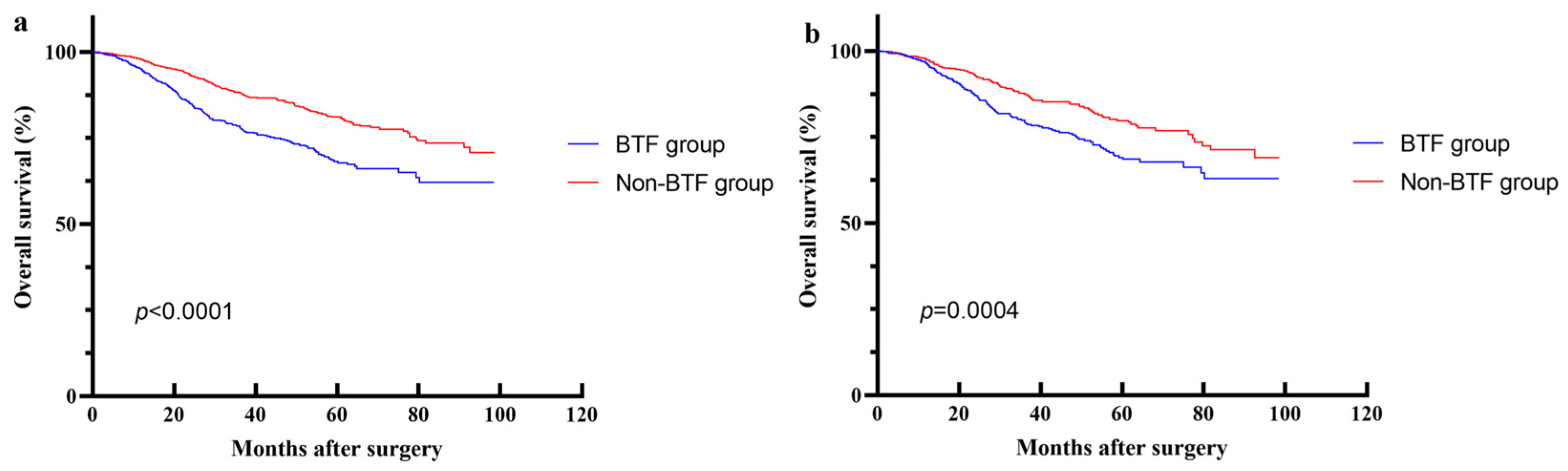
3.4. Long-Term Survival Analysis in CRC Patients
3.5. Post-Propensity Score Matching Survival Outcomes
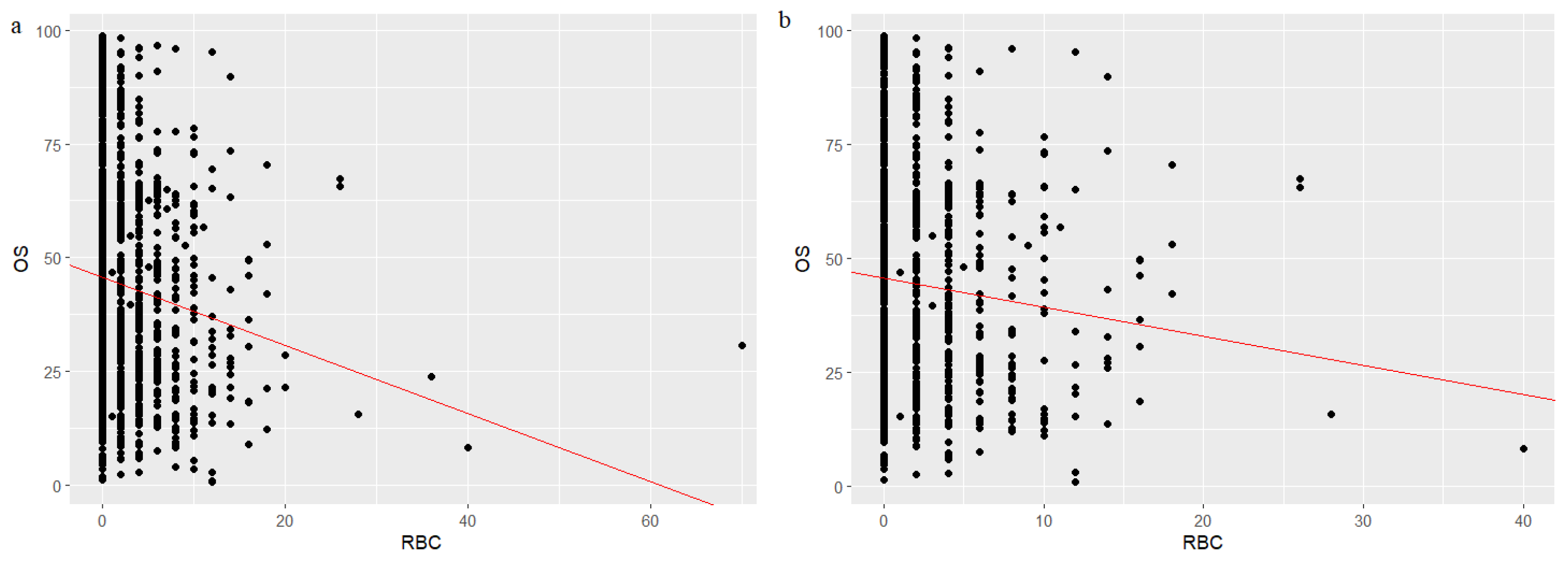
3.6. Linear Regression Analysis of Blood Transfusion Volume and Prognosis
3.7. Perioperative Blood Transfusion Volume Influences Overall Survival in CRC Patients
4. Discussion
5. Conclusions
Supplementary Materials
Author Contributions
Funding
Institutional Review Board Statement
Informed Consent Statement
Data Availability Statement
Acknowledgments
Conflicts of Interest
Abbreviations
| CRC | Colorectal cancer |
| BTF | Blood transfusion |
| TRIM | Transfusion-related immune modulation |
| PSM | Propensity score matching |
| CI | Confidence interval |
| OS | Overall survival |
| HR | Hazard ratio |
| SD | Standard deviation |
| SBTF | Small-volume blood transfusion |
| MBTF | Massive-volume blood transfusion |
| OR | Odds ratio |
| CVP | Central venous pressure |
| DFS | Disease-free survival |
| RFS | Recurrence-free survival |
References
- Siegel, R.L.; Miller, K.D.; Wagle, N.S.; Jemal, A. Cancer statistics, 2023. CA Cancer J. Clin. 2023, 73, 17–48. [Google Scholar] [CrossRef] [PubMed]
- Brody, H. Colorectal cancer. Nature 2015, 521, S1. [Google Scholar] [CrossRef]
- Xia, C.; Dong, X.; Li, H.; Cao, M.; Sun, D.; He, S.; Yang, F.; Yan, X.; Zhang, S.; Li, N.; et al. Cancer statistics in China and United States, 2022: Profiles, trends, and determinants. Chin. Med. J. 2022, 135, 584–590. [Google Scholar] [CrossRef]
- Zhang, Y.; Zhu, M.; Wu, X.; Meng, Y.; Pu, F.; Zhang, M. Factors associated with returning to work and work ability of colorectal cancer survivors. Support. Care Cancer 2022, 30, 2349–2357. [Google Scholar] [CrossRef]
- Wang, W.; Yin, P.; Liu, Y.N.; Liu, J.M.; Wang, L.J.; Qi, J.L.; You, J.L.; Lin, L.; Meng, S.D.; Wang, F.X.; et al. Mortality and years of life lost of colorectal cancer in China, 2005-2020: Findings from the national mortality surveillance system. Chin. Med. J. 2021, 134, 1933–1940. [Google Scholar] [CrossRef]
- Peng, D.; Cheng, Y.X.; Cheng, Y. Improved Overall Survival of Colorectal Cancer under Multidisciplinary Team: A Meta-Analysis. BioMed Res. Int. 2021, 2021, 5541613. [Google Scholar] [CrossRef]
- Nanji, S.; Mir, Z.M.; Karim, S.; Brennan, K.E.; Patel, S.V.; Merchant, S.J.; Booth, C.M. Perioperative blood transfusion and resection of colorectal cancer liver metastases: Outcomes in routine clinical practice. HPB 2021, 23, 404–412. [Google Scholar] [CrossRef]
- McSorley, S.T.; Tham, A.; Dolan, R.D.; Steele, C.W.; Ramsingh, J.; Roxburgh, C.; Horgan, P.G.; McMillan, D.C. Perioperative Blood Transfusion is Associated with Postoperative Systemic Inflammatory Response and Poorer Outcomes Following Surgery for Colorectal Cancer. Ann. Surg. Oncol. 2020, 27, 833–843. [Google Scholar] [CrossRef]
- Skånberg, J.; Lundholm, K.; Haglind, E. Effects of blood transfusion with leucocyte depletion on length of hospital stay, respiratory assistance and survival after curative surgery for colorectal cancer. Acta Oncol. 2007, 46, 1123–1130. [Google Scholar] [CrossRef] [PubMed]
- Gruttadauria, S.; Saint Georges Chaumet, M.; Pagano, D.; Marsh, J.W.; Bartoccelli, C.; Cintorino, D.; Arcadipane, A.; Vizzini, G.; Spada, M.; Gridelli, B. Impact of blood transfusion on early outcome of liver resection for colorectal hepatic metastases. J. Surg. Oncol. 2011, 103, 140–147. [Google Scholar] [CrossRef] [PubMed]
- Hallet, J.; Kulyk, I.; Cheng, E.; Truong, J.; Hanna, S.S.; Law, C.; Coburn, N.G.; Tarshis, J.; Lin, Y.; Karanicolas, P.J. The impact of red blood cell transfusions on perioperative outcomes in the contemporary era of liver resection. Surgery 2016, 159, 1591–1599. [Google Scholar] [CrossRef]
- Okamura, R.; Hida, K.; Hasegawa, S.; Sakai, Y.; Hamada, M.; Yasui, M.; Hinoi, T.; Watanabe, M. Impact of intraoperative blood loss on morbidity and survival after radical surgery for colorectal cancer patients aged 80 years or older. Int. J. Colorectal. Dis. 2016, 31, 327–334. [Google Scholar]
- Egenvall, M.; Mörner, M.; Påhlman, L.; Gunnarsson, U. Degree of blood loss during surgery for rectal cancer: A population-based epidemiologic study of surgical complications and survival. Color. Dis. 2014, 16, 696–702. [Google Scholar] [CrossRef]
- Menocha, S.; Muszynski, J.A. Transfusion-related immune modulation: Functional consequence of extracellular vesicles. Transfusion 2019, 59, 3553–3555. [Google Scholar] [PubMed]
- Qiu, L.; Wang, D.R.; Zhang, X.Y.; Gao, S.; Li, X.X.; Sun, G.P.; Lu, X.B. Impact of perioperative blood transfusion on immune function and prognosis in colorectal cancer patients. Transfus. Apher. Sci. 2016, 54, 235–241. [Google Scholar] [CrossRef]
- Kang, B.; Liu, X.Y.; Li, Z.W.; Yuan, C.; Zhang, B.; Wei, Z.Q.; Peng, D. The Effect of the Intraoperative Blood Loss and Intraoperative Blood Transfusion on the Short-Term Outcomes and Prognosis of Colorectal Cancer: A Propensity Score Matching Analysis. Front. Surg. 2022, 9, 837545. [Google Scholar] [CrossRef]
- Suresh, R.S.; Diaz, S.; Stem, M.; Brown, L.B.; Consul, M.S.; Chung, H.; Bafford, A.C.; Gabre-Kidan, A. The Impact of Operative Time on Morbidity in Synchronous Colorectal Cancer and Liver Metastasis Resections. Dis. Colon Rectum 2025, 68, 1197–1206. [Google Scholar] [CrossRef]
- Tilsed, J.V. Recent advances in surgery for colorectal cancer. Crit. Rev. Oncol. Hematol. 1999, 30, 201–205. [Google Scholar] [PubMed]
- Bertelsen, C.A.; Neuenschwander, A.U.; Jansen, J.E.; Tenma, J.R.; Wilhelmsen, M.; Kirkegaard-Klitbo, A.; Iversen, E.R.; Bols, B.; Inge-holm, P.; Rasmussen, L.A.; et al. 5-year outcome after complete mesocolic excision for right-sided colon cancer: A population-based cohort study. Lancet Oncol. 2019, 20, 1556–1565. [Google Scholar]
- Ejaz, A.; Frank, S.M.; Spolverato, G.; Kim, Y.; Pawlik, T.M. Defining Transfusion Triggers and Utilization of Fresh Frozen Plasma and Platelets Among Patients Undergoing Hepatopancreaticobiliary and Colorectal Surgery. Ann. Surg. 2015, 262, 1079–1085. [Google Scholar] [CrossRef] [PubMed]
- Dickson, E.A.; Acheson, A.G. Allogeneic blood and postoperative cancer outcomes: Correlation or causation. Anaesthesia 2020, 75, 438–441. [Google Scholar] [CrossRef]
- Kim, T.; Purdy, M.P.; Kendall-Rauchfuss, L.; Habermann, E.B.; Bews, K.A.; Glasgow, A.E.; Khan, Z. Myomectomy associated blood transfusion risk and morbidity after surgery. Fertil. Steril. 2020, 114, 175–184. [Google Scholar] [CrossRef]
- CReST Collaborative Group. Colorectal Endoscopic Stenting Trial (CReST) for obstructing left-sided colorectal cancer: Randomized clinical trial. Br. J. Surg. 2022, 109, 1073–1080. [Google Scholar] [CrossRef]
- Gupta, D.; Lammersfeld, C.A.; Burrows, J.L.; Dahlk, S.L.; Vashi, P.G.; Grutsch, J.F.; Hoffman, S.; Lis, C.G. Bioelectrical impedance phase angle in clinical practice: Implications for prognosis in advanced colorectal cancer. Am. J. Clin. Nutr. 2004, 80, 1634–1638. [Google Scholar] [CrossRef]
- FOxTROT Collaborating Group. Risk of Bowel Obstruction in Patients Undergoing Neoadjuvant Chemotherapy for High-risk Colon Cancer: A Nested Case-control-matched Analysis of an International, Multicenter, Randomized Controlled Trial (FOxTROT). Ann. Surg. 2024, 280, 283–293. [Google Scholar] [CrossRef]
- Anthony, P.; Wu, M.; Shanmugalingam, A.; Ng, C.H.; Wright, D. Preoperative iron infusion does not reduce the requirement for blood transfusion in colorectal cancer surgery. Minerva Surg. 2024, 79, 28–32. [Google Scholar] [CrossRef]
- Yang, D.; Chen, C.; Cheng, F.; Huang, C.; Luo, Z.; Qin, L.; Tan, B. The Effect of Preoperative Anemia on the Odds of Allogeneic Blood Transfusion and Patient Outcomes in Colorectal Neoplasm Patients. Clin. Lab. 2024, 70. [Google Scholar] [CrossRef] [PubMed]
- Bennett, S.; Baker, L.K.; Martel, G.; Shorr, R.; Pawlik, T.M.; Tinmouth, A.; McIsaac, D.I.; Hébert, P.C.; Karanicolas, P.J.; McIntyre, L.; et al. The impact of perioperative red blood cell transfusions in patients undergoing liver resection: A systematic review. HPB 2017, 19, 321–330. [Google Scholar] [CrossRef] [PubMed]
- Cannon, R.M.; Brown, R.E.; St Hill, C.R.; Dunki-Jacobs, E.; Martin, R.C., 2nd; McMasters, K.M.; Scoggins, C.R. Negative effects of transfused blood components after hepatectomy for metastatic colorectal cancer. Am Surg 2013, 79, 35–39. [Google Scholar] [CrossRef] [PubMed]
- Shiba, H.; Ishida, Y.; Haruki, K.; Furukawa, K.; Fujiwara, Y.; Iwase, R.; Ohkuma, M.; Ogawa, M.; Misawa, T.; Yanaga, K. Negative impact of fresh-frozen plasma transfusion on prognosis after hepatic resection for liver metastases from colorectal cancer. Anticancer Res. 2013, 33, 2723–2728. [Google Scholar] [PubMed]
- Sultana, A.; Meng, R.; Piantadosi, C.; Brooke-Smith, M.; Chen, J.; Dolan, P.; Maddern, G.; Price, T.; Padbury, R. Liver resection for colorectal cancer metastases: A comparison of outcomes over time in South Australia. HPB 2018, 20, 340–346. [Google Scholar] [CrossRef]
- Hallet, J.; Tsang, M.; Cheng, E.S.; Habashi, R.; Kulyk, I.; Hanna, S.S.; Coburn, N.G.; Lin, Y.; Law, C.H.; Karanicolas, P.J. The Impact of Perioperative Red Blood Cell Transfusions on Long-Term Outcomes after Hepatectomy for Colorectal Liver Metastases. Ann. Surg. Oncol. 2015, 22, 4038–4045. [Google Scholar] [CrossRef] [PubMed]
- Blajchman, M.A.; Bardossy, L.; Carmen, R.; Sastry, A.; Singal, D.P. Allogeneic blood transfusion-induced enhancement of tumor growth: Two animal models showing amelioration by leukodepletion and passive transfer using spleen cells. Blood 1993, 81, 1880–1882. [Google Scholar] [CrossRef] [PubMed]
- Przepiorka, D.; Smith, T.L.; Folloder, J.; Anderlini, P.; Chan, K.W.; Körbling, M.; Lichtiger, B.; Norfleet, F.; Champlin, R. Controlled trial of filgrastim for acceleration of neutrophil recovery after allogeneic blood stem cell transplantation from human leukocyte antigen-matched related donors. Blood 2001, 97, 3405–3410. [Google Scholar] [CrossRef] [PubMed]




| Variables | Total Cohort (n = 1777) | Propensity Score Matched Cohort (n = 1048) | ||||
|---|---|---|---|---|---|---|
| Non-BTF Group (n = 1048) | BTF Group (n = 729) | OR (Univariable) | Non-BTF Group (n = 524) | BTF Group (n = 524) | OR (Univariable) | |
| Gender | ||||||
| Female | 408 (38.9%) | 358 (49.1%) | 237 (45.2%) | 254 (48.5%) | 0.88 (0.69–1.12, p = 0.293) | |
| Male | 640 (61.1%) | 371 (50.9%) | 0.66 (0.55–0.80, p < 0.001) | 287 (54.8%) | 270 (51.5%) | |
| Age (Mean ± SD) | 60.9 ± 11.7 | 62.0 ± 12.9 | 1.01 (1.00–1.02, p = 0.069) | 61.1 ± 12.0 | 62.1 ± 12.8 | 1.01 (1.00–1.02, p = 0.188) |
| Age group | ||||||
| <60 years | 405 (38.6%) | 268 (36.8%) | 206 (39.3%) | 192 (36.6%) | ||
| ≥60 years | 643 (61.4%) | 461 (63.2%) | 1.08 (0.89–1.32, p = 0.421) | 318 (60.7%) | 332 (63.4%) | 1.12 (0.87–1.44, p = 0.373) |
| Comorbidities | ||||||
| Any comorbidities | 45 (4.3%) | 48 (6.6%) | 20 (3.8%) | 36 (6.9%) | ||
| Non-comorbidities | 1003 (95.7%) | 681 (93.4%) | 0.64 (0.42–0.97, p = 0.034) | 504 (96.2%) | 488 (93.1%) | 0.54 (0.31–0.94, p = 0.030) |
| Hb 1 (Mean ± SD) | 134.5 ± 19.3 | 113.2 ± 25.5 | 0.96 (0.95–0.96, p < 0.001) | 133.2 ± 19.8 | 115.0 ± 25.4 | 0.97 (0.96–0.97, p < 0.001) |
| Blood loss 2 (Mean ± SD) | 34.4 ± 4.9 | 269.0 ± 274.4 | 1.17 (1.13–1.21, p < 0.001) | 34.4 ± 4.9 | 249.7 ± 222.3 | 1.15 (1.10–1.20, p < 0.001) |
| Diabetes | ||||||
| Diabetes | 61 (5.8%) | 59 (8.1%) | 41 (7.8%) | 40 (7.6%) | ||
| Non-diabetes | 987 (94.2%) | 670 (91.9%) | 0.70 (0.48–1.02, p = 0.061) | 483 (92.2%) | 484 (92.4%) | 1.03 (0.65–1.62, p = 0.908) |
| Hypertension | ||||||
| Hypertension | 202 (19.3%) | 156 (21.4%) | 104 (19.8%) | 115 (21.9%) | ||
| Non-hypertension | 846 (80.7%) | 573 (78.6%) | 0.88 (0.69–1.11, p = 0.272) | 420 (80.2%) | 409 (78.1%) | 0.88 (0.65–1.19, p = 0.404) |
| Tumor.size.cm (Mean ± SD) | 4.1 ± 1.8 | 5.4 ± 2.3 | 1.37 (1.30–1.45, p < 0.001) | 4.7 ± 2.0 | 4.7 ± 1.9 | 1.02 (0.96–1.08, p = 0.597) |
| Hospitalization days (Mean ± SD) | 15.5 ± 3.9 | 17.4 ± 4.2 | 1.12 (1.09–1.15, p < 0.001) | 17.0 ± 4.2 | 16.8 ± 3.9 | 0.99 (0.96–1.02, p = 0.591) |
| T stage | ||||||
| T1 | 39 (3.7%) | 13 (1.8%) | 10 (1.9%) | 11 (2.1%) | ||
| T2 | 149 (14.2%) | 58 (8%) | 1.17 (0.58–2.34, p = 0.663) | 49 (9.4%) | 54 (10.3%) | 1.00 (0.39–2.56, p = 0.997) |
| T3 | 316 (30.2%) | 219 (30%) | 2.08 (1.08–3.99, p = 0.028) | 167 (31.9%) | 163 (31.1%) | 0.89 (0.37–2.15, p = 0.791) |
| T4 | 544 (51.9%) | 439 (60.2%) | 2.42 (1.28–4.59, p = 0.007) | 298 (56.9%) | 296 (56.5%) | 0.90 (0.38–2.16, p = 0.818) |
| N stage | ||||||
| N0 | 692 (66%) | 418 (57.3%) | 316 (60.3%) | 310 (59.2%) | ||
| N1 | 238 (22.7%) | 200 (27.4%) | 1.39 (1.11–1.74, p = 0.004) | 131 (25%) | 136 (26%) | 1.06 (0.79–1.41, p = 0.699) |
| N2 | 118 (11.3%) | 111 (15.2%) | 1.56 (1.17–2.07, p = 0.002) | 77 (14.7%) | 78 (14.9%) | 1.03 (0.73–1.47, p = 0.858) |
| M stage | ||||||
| M0 | 1039 (99.1%) | 711 (97.5%) | 515 (98.3%) | 516 (98.5%) | ||
| M1 | 9 (0.9%) | 18 (2.5%) | 2.92 (1.31–6.54, p = 0.009) | 9 (1.7%) | 8 (1.5%) | 0.89 (0.34–2.32, p = 0.807) |
| pTNM stage | ||||||
| I | 166 (15.8%) | 59 (8.1%) | 52 (9.9%) | 54 (10.3%) | ||
| II | 525 (50.1%) | 354 (48.6%) | 1.90 (1.37–2.63, p < 0.001) | 262 (50%) | 254 (48.5%) | 0.93 (0.61–1.42, p = 0.747) |
| III | 343 (32.7%) | 295 (40.5%) | 2.42 (1.73–3.38, p < 0.001) | 200 (38.2%) | 206 (39.3%) | 0.99 (0.65–1.52, p = 0.970) |
| IV | 14 (1.3%) | 21 (2.9%) | 4.22 (2.02–8.83, p < 0.001) | 10 (1.9%) | 10 (1.9%) | 0.96 (0.37–2.50, p = 0.938) |
| Combined multiorgan resection | ||||||
| No | 1001 (95.5%) | 655 (89.8%) | 492 (93.9%) | 489 (93.3%) | ||
| Yes | 47 (4.5%) | 74 (10.2%) | 2.41 (1.65–3.51, p < 0.001) | 32 (6.1%) | 35 (6.7%) | 1.10 (0.67–1.81, p = 0.705) |
| Tumor site | ||||||
| Left colon cancer | 943 (90%) | 525 (72%) | 431 (82.3%) | 439 (83.8%) | ||
| Right colon cancer | 105 (10%) | 204 (28%) | 3.49 (2.69–4.52, p < 0.001) | 93 (17.7%) | 85 (16.2%) | 0.90 (0.65–1.24, p = 0.511) |
| Tumor location | ||||||
| Colon cancer | 310 (29.6%) | 334 (45.8%) | 187 (35.7%) | 183 (34.9%) | ||
| Rectal cancer | 738 (70.4%) | 395 (54.2%) | 0.50 (0.41–0.60, p < 0.001) | 337 (64.3%) | 341 (65.1%) | 1.03 (0.80–1.33, p = 0.796) |
| Surgical type | ||||||
| Laparoscopic surgery | 373 (35.6%) | 206 (28.3%) | 164 (31.3%) | 174 (33.2%) | ||
| Laparotomy | 675 (64.4%) | 523 (71.7%) | 1.40 (1.14–1.72, p = 0.001) | 360 (68.7%) | 350 (66.8%) | 0.92 (0.71–1.19, p = 0.509) |
| Pathological type | ||||||
| Highly and moderately differentiated adenocarcinoma | 943 (90%) | 630 (86.4%) | 469 (89.5%) | 464 (88.5%) | ||
| Mucinous adenocarcinoma | 73 (7%) | 67 (9.2%) | 1.37 (0.97–1.94, p = 0.072) | 39 (7.4%) | 42 (8%) | 1.09 (0.69–1.71, p = 0.714) |
| Other | 8 (0.8%) | 10 (1.4%) | 1.87 (0.73–4.77, p = 0.189) | 3 (0.6%) | 5 (1%) | 1.68 (0.40–7.09, p = 0.477) |
| Poorly differentiated adenocarcinoma | 24 (2.3%) | 22 (3%) | 1.37 (0.76–2.47, p = 0.291) | 13 (2.5%) | 13 (2.5%) | 1.01 (0.46–2.20, p = 0.979) |
| Tumor thrombus | ||||||
| Non-tumor thrombus | 1026 (97.9%) | 708 (97.1%) | 510 (97.3%) | 510 (97.3%) | ||
| Tumor thrombus | 22 (2.1%) | 21 (2.9%) | 1.38 (0.75–2.53, p = 0.294) | 14 (2.7%) | 14 (2.7%) | 1.00 (0.47–2.12, p = 1.000) |
| Family history | ||||||
| No | 968 (92.4%) | 676 (92.7%) | -- | -- | ||
| Yes | 80 (7.6%) | 53 (7.3%) | 0.95 (0.66–1.36, p = 0.775) | -- | -- | -- |
| Cooccurrence of other tumor | ||||||
| No | 1046 (99.8%) | 715 (98.1%) | 522 (99.6%) | 521 (99.4%) | ||
| Yes | 2 (0.2%) | 14 (1.9%) 1 | 0.24 (2.32–45.20, p = 0.002) | 2 (0.4%) | 3 (0.6%) | 1.50 (0.25–9.03, p = 0.656) |
| Obstruction | ||||||
| Non-obstruction | 966 (92.2%) | 579 (79.4%) | 472 (90.1%) | 433 (82.6%) | ||
| obstruction | 82 (7.8%) | 150 (20.6%) | 3.05 (2.29-4.07, p<0.001) | 52 (9.9%) | 91 (17.4%) | 1.91 (1.32–2.75, p<0.0001) |
| Variables | Total Cohort (n = 1777) | Propensity Score Matched Cohort (n = 1048) | ||||
|---|---|---|---|---|---|---|
| Non-BTF Group (n = 1048) | BTF Group (n = 729) | OR (Multivariable) | Non-BTF Group (n = 524) | BTF Group (n = 524) | OR (Multivariate) | |
| Gender | ||||||
| Female | 408 (38.9%) | 358 (49.1%) | 237 (45.2%) | 254 (48.5%) | ||
| Male | 640 (61.1%) | 371 (50.9%) | 0.56 (0.45–0.70, p < 0.001) | 287 (54.8%) | 270 (51.5%) | 0.85 (0.66–1.09, p = 0.209) |
| Age(Mean ± SD) | 60.9 ± 11.7 | 62.0 ± 12.9 | 1.01 (0.99–1.02, p = 0.363) | 60.9 ±11.9 | 62.0 ±12.8 | 1.01 (0.99–1.03, p = 0.195) |
| Age group | ||||||
| <60 years | 405 (38.6%) | 268 (36.8%) | 206 (39.3%) | 193 (36.8%) | ||
| ≥60 years | 643 (61.4%) | 461 (63.2%) | 0.98 (0.68–1.42, p = 0.928) | 318 (60.7%) | 331 (63.2%) | 0.88 (0.57–1.35, p = 0.562) |
| Hb 1 (Mean ± SD) | 134.5 ± 19.3 | 113.2 ± 25.5 | 0.96 (0.95–0.97, p < 0.001) | 133.2 ± 19.8 | 115.0 ± 25.4 | 0.97 (0.96–0.98, p < 0.001) |
| Blood loss 2 (Mean ± SD) | 34.4 ± 4.9 | 269.0 ± 274.4 | 1.12 (1.08–1.16, p < 0.001) | 34.4 ± 4.9 | 249.7 ± 222.3 | 1.12 (1.08–1.17, p < 0.001) |
| Comorbidities | ||||||
| Any comorbidities | 45 (4.3%) | 48 (6.6%) | 19 (3.6%) | 36 (6.9%) | ||
| Non-comorbidities | 1003 (95.7%) | 681 (93.4%) | 0.61 (0.38–0.99, p = 0.045) | 505 (96.4%) | 488 (93.1%) | 0.51 (0.28–0.94, p = 0.030) |
| Diabetes | ||||||
| Diabetes | 61 (5.8%) | 59 (8.1%) | 39 (7.4%) | 40 (7.6%) | ||
| Non-diabetes | 987 (94.2%) | 670 (91.9%) | 1.04 (0.68–1.60, p = 0.856) | 485 (92.6%) | 484 (92.4%) | 1.10 (0.68–1.77, p = 0.710) |
| Hypertension | ||||||
| Hypertension | 202 (19.3%) | 156 (21.4%) | 105 (20%) | 115 (21.9%) | ||
| Non-hypertension | 846 (80.7%) | 573 (78.6%) | 0.93 (0.71–1.22, p = 0.589) | 419 (80%) | 409 (78.1%) | 0.96 (0.70–1.32, p = 0.822) |
| Tumor size(cm) (Mean ± SD) | 4.1 ± 1.8 | 5.4 ± 2.3 | 1.29 (1.21–1.38, p < 0.001) | 4.7 ±2.0 | 4.7 ±1.9 | 1.02 (0.95–1.10, p = 0.512) |
| Hospitalization days (Mean ± SD) | 15.5 ± 3.9 | 17.4 ± 4.2 | 1.12 (1.09–1.15, p < 0.001) | 17.0 ±4.2 | 16.8 ±3.9 | 0.98 (0.95–1.02, p = 0.322) |
| T stage | ||||||
| T1 | 39 (3.7%) | 13 (1.8%) | 10 (1.9%) | 11 (2.1%) | ||
| T2 | 149 (14.2%) | 58 (8%) | 0.84 (0.40–1.78, p = 0.646) | 49 (9.4%) | 54 (10.3%) | 0.94 (0.36–2.45, p = 0.899) |
| T3 | 316 (30.2%) | 219 (30%) | 0.78 (0.29–2.10, p = 0.630) | 167 (31.9%) | 163 (31.1%) | 0.55 (0.15–1.99, p = 0.363) |
| T4 | 544 (51.9%) | 439 (60.2%) | 0.61 (0.23–1.63, p = 0.327) | 298 (56.9%) | 296 (56.5%) | 0.52 (0.14–1.86, p = 0.312) |
| N stage | ||||||
| N0 | 692 (66%) | 418 (57.3%) | 316 (60.3%) | 310 (59.2%) | ||
| N1 | 238 (22.7%) | 200 (27.4%) | 0.88 (0.23–3.37, p = 0.858) | 131 (25%) | 136 (26%) | 0.95 (0.18–4.89, p = 0.950) |
| N2 | 118 (11.3%) | 111 (15.2%) | 1.01 (0.27–3.79, p = 0.988) | 77 (14.7%) | 78 (14.9%) | 0.91 (0.18–4.61, p = 0.909) |
| M stage | ||||||
| M0 | 1039 (99.1%) | 711 (97.5%) | 515 (98.3%) | 516 (98.5%) | ||
| M1 | 9 (0.9%) | 18 (2.5%) | 1.38 (0.32–5.93, p = 0.666) | 9 (1.7%) | 8 (1.5%) | 0.68 (0.12–3.76, p = 0.662) |
| pTNM stage | ||||||
| I | 166 (15.8%) | 59 (8.1%) | 52 (9.9%) | 54 (10.3%) | ||
| II | 525 (50.1%) | 354 (48.6%) | 1.43 (0.63–3.23, p = 0.390) | 262 (50%) | 254 (48.5%) | 1.53 (0.55–4.25, p = 0.417) |
| III | 343 (32.7%) | 295 (40.5%) | 2.30 (0.52–10.13, p = 0.271) | 200 (38.2%) | 206 (39.3%) | 1.62 (0.26–10.20, p = 0.610) |
| IV | 14 (1.3%) | 21 (2.9%) | 1.80 (0.33–9.89, p = 0.500) | 10 (1.9%) | 10 (1.9%) | 1.81 (0.21–15.65, p = 0.588) |
| Combined multiorgan resection | ||||||
| No | 1001 (95.5%) | 655 (89.8%) | 492 (93.9%) | 489 (93.3%) | ||
| Yes | 47 (4.5%) | 74 (10.2%) | 1.73 (1.05–2.86, p = 0.032) | 32 (6.1%) | 35 (6.7%) | 1.24 (0.68–2.24, p = 0.481) |
| Tumor site | ||||||
| Left colon cancer | 943 (90%) | 525 (72%) | 431 (82.3%) | 439 (83.8%) | ||
| Right colon cancer | 105 (10%) | 204 (28%) | 2.57 (1.80–3.68, p < 0.001) | 93 (17.7%) | 85 (16.2%) | 0.82 (0.54–1.26, p = 0.369) |
| Tumor location | ||||||
| Colon cancer | 310 (29.6%) | 334 (45.8%) | 187 (35.7%) | 183 (34.9%) | ||
| Rectal cancer | 738 (70.4%) | 395 (54.2%) | 0.87 (0.65–1.18, p = 0.375) | 337 (64.3%) | 341 (65.1%) | 0.98 (0.70–1.39, p = 0.932) |
| Surgical type | ||||||
| Laparoscopic surgery | 373 (35.6%) | 206 (28.3%) | 164 (31.3%) | 174 (33.2%) | ||
| Laparotomy | 675 (64.4%) | 523 (71.7%) | 0.98 (0.77–1.23, p = 0.845) | 360 (68.7%) | 350 (66.8%) | 0.92 (0.70–1.21, p = 0.565) |
| Pathological type | ||||||
| Highly and moderately differentiated adenocarcinoma | 943 (90%) | 630 (86.4%) | 471 (89.9%) | 464 (88.5%) | ||
| Mucinous adenocarcinoma | 73 (7%) | 67 (9.2%) | 0.96 (0.64–1.44, p = 0.849) | 37 (7.1%) | 42 (8%) | 1.16 (0.72–1.89, p = 0.544) |
| Other | 8 (0.8%) | 10 (1.4%) | 1.15 (0.37–3.60, p = 0.815) | 3 (0.6%) | 5 (1%) | 1.70 (0.39–7.39, p = 0.479) |
| Poorly differentiated adenocarcinoma | 24 (2.3%) | 22 (3%) | 0.75 (0.38–1.49, p = 0.415) | 13 (2.5%) | 13 (2.5%) | 0.92 (0.40–2.11, p = 0.848) |
| Tumor thrombus | ||||||
| Non-tumor thrombus | 1026 (97.9%) | 708 (97.1%) | 510 (97.3%) | 510 (97.3%) | ||
| Tumor thrombus | 22 (2.1%) | 21 (2.9%) | 0.97 (0.49–1.91, p = 0.923) | 14 (2.7%) | 14 (2.7%) | 1.03 (0.47–2.25, p = 0.949) |
| Family history | ||||||
| No | 968 (92.4%) | 676 (92.7%) | NA | NA | ||
| Yes | 80 (7.6%) | 53 (7.3%) | 1.05 (0.70–1.58, p = 0.810) | NA | NA | |
| Cooccurrence of other tumor | ||||||
| No | 1046 (99.8%) | 715 (98.1%) | 522 (99.6%) | 521 (99.4%) | ||
| Yes | 2 (0.2%) | 14 (1.9%) 5 | 0.87 (1.15–30.01, p = 0.033) | 2 (0.4%) | 3 (0.6%) | 1.11 (0.18–6.96, p = 0.909) |
| Obstruction | ||||||
| Non-obstruction | 966 (92.2%) | 579 (79.4%) | 472 (90.1%) | 433 (82.6%) | ||
| Obstruction | 82 (7.8%) | 150 (20.6%) | 2.06 (1.48–2.86, p < 0.001) | 52 (9.9%) | 91 (17.4%) | 2.06 (1.40–3.02, p < 0.001) |
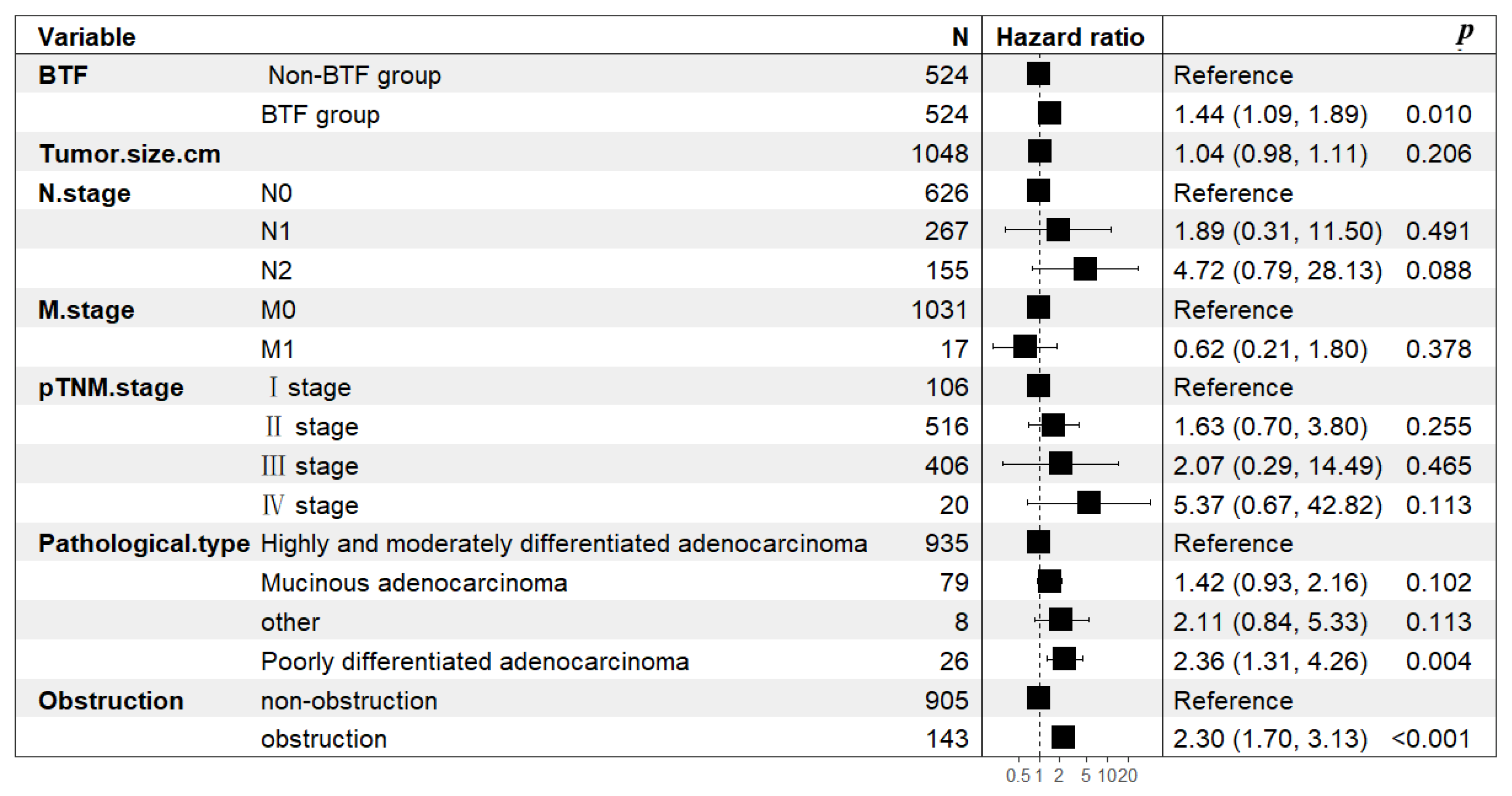
| Variables | Total Cohort | Propensity Score Matched Cohort | ||
|---|---|---|---|---|
| p Value | HR (95% CI) | p Value | HR (95% CI) | |
| BTF | <0.001 | 1.816 (1.473–2.239) | 0.001 | 1.563 (1.193–2.048) |
| Gender | 0.316 | 0.899 (0.729–1.108) | 0.467 | 0.906 (0.694–1.182) |
| Age | 0.593 | 1.002 (0.994–1.011) | 0.891 | 0.999 (0.989–1.010) |
| Age group | 0.635 | 0.949 (0.765–1.178) | 0.726 | 0.952 (0.721–1.256) |
| Comorbidities | 0.976 | 1.007 (0.627–1.619) | 0.765 | 0.915 (0.511–1.638) |
| Diabetes | 0.230 | 0.783 (0.525–1.167) | 0.431 | 0.819 (0.499–1.345) |
| Hypertension | 0.796 | 0.966 (0.742–1.257) | 0.667 | 0.929 (0.665–1.299) |
| Tumor size (cm) | <0.001 | 1.127 (1.082–1.174) | 0.007 | 1.085 (1.023–1.151) |
| Hospitalization days | 0.107 | 1.020 (0.996–1.045) | 0.871 | 0.997 (0.965–1.030) |
| Combined multiorgan resection | 0.022 | 1.511 (1.061–2.152) | 0.699 | 1.106 (0.665–1.840) |
| Tumor site | 0.039 | 1.320 (1.014–1.718) | 0.963 | 1.009 (0.702–1.448) |
| Tumor location | 0.008 | 0.748 (0.604–0.926) | 0.791 | 1.039 (0.782–1.380) |
| Surgical type | 0.022 | 1.320 (1.041–1.675) | 0.305 | 1.168 (0.868–1.570) |
| Tumor thrombus | 0.042 | 1.775 (1.020–3.090) | 0.014 | 2.139 (1.166–3.924) |
| Family history | 0.086 | 0.653 (0.401–1.063) | -- | -- |
| Cooccurrence of other tumor | 0.241 | 0.309 (0.043–2.199) | 0.970 | 0.963 (0.135–6.872) |
| Pathological type | ||||
| Mucinous adenocarcinoma | <0.001 | 2.035 (1.494–2.773) | <0.001 | 2.150 (1.450–3.188) |
| Other | 0.018 | 2.478 (1.170–5.246) | <0.001 | 7.024 (2.877–17.150) |
| Poorly differentiated adenocarcinoma | <0.001 | 3.578 (2.295–5.577) | <0.001 | 4.056 (2.305–7.137) |
| T stage | ||||
| T2 | 0.861 | 1.118 (0.3213–3.890) | 0.570 | 1.821 (0.231–14.380) |
| T3 | 0.055 | 3.084 (0.9769–9.737) | 0.184 | 3.816 (0.529–27.540) |
| T4 | 0.007 | 4.825 (1.545–15.068) | 0.082 | 5.734 (0.802–40.980) |
| N stage | ||||
| N1 | <0.001 | 2.788 (2.148–3.617) | <0.001 | 2.494 (1.762–3.528) |
| N2 | <0.001 | 6.853 (5.323–8.821) | <0.001 | 7.259 (5.280–9.979) |
| M stage | <0.001 | 3.186 (1.746–5.815) | 0.031 | 2.447 (1.086–5.513) |
| Obstruction | <0.001 | 2.675 (2.107–3.396) | <0.001 | 2.791 (2.071–3.759) |
| pTNM stage | ||||
| II | 0.017 | 1.980 (1.133–3.460) | 0.175 | 1.718 (0.786–3.759) |
| III | <0.001 | 7.086 (4.128–12.160) | <0.001 | 6.348 (2.972–13.561) |
| IV | <0.001 | 9.564 (4.490–20.370) | <0.001 | 9.746 (3.529–26.916) |
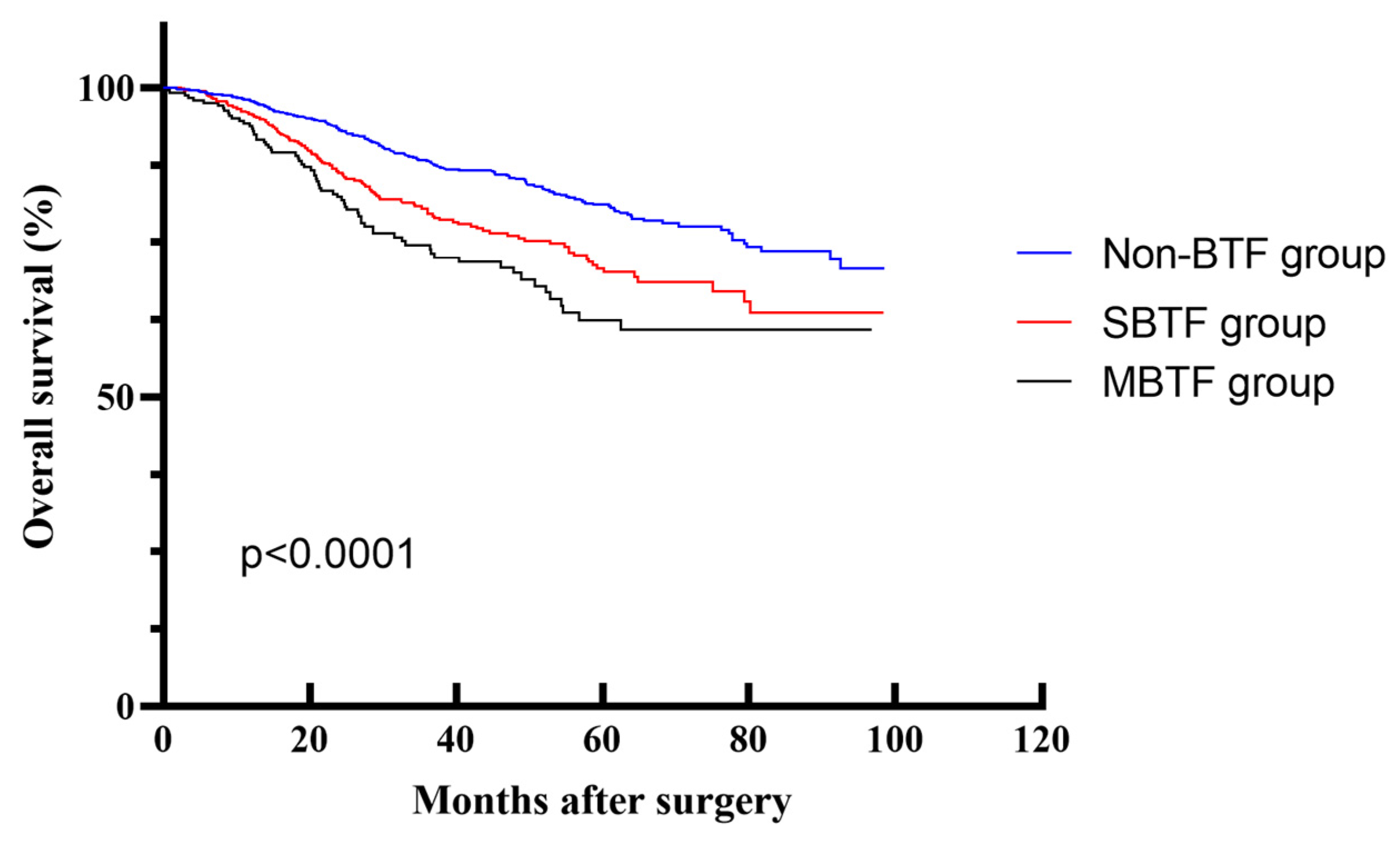
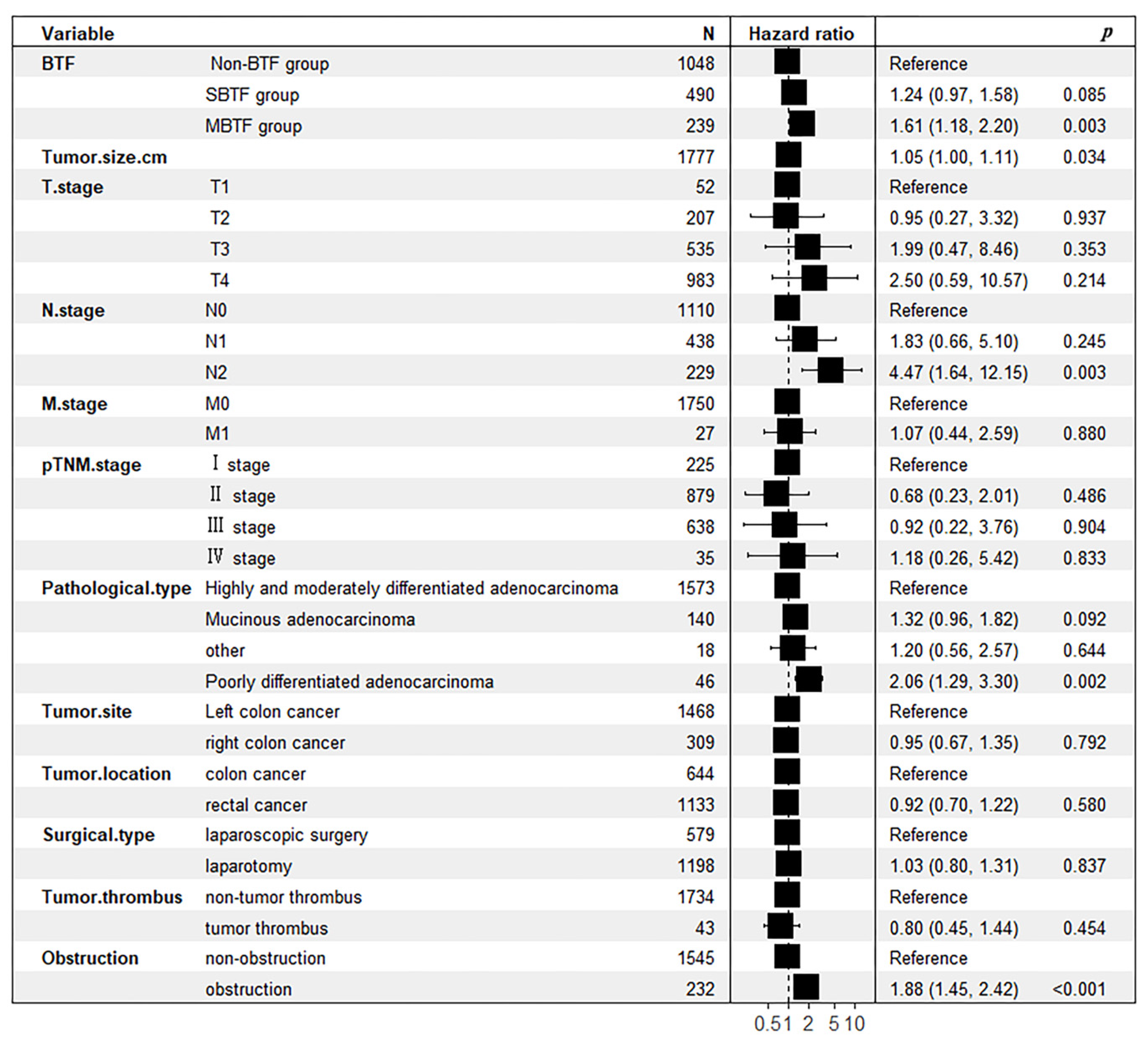
| Variables | p Value | HR (95% CI) |
|---|---|---|
| BTF group | ||
| SBTF | <0.001 | 1.642 (1.296–2.080) |
| MBTF | <0.001 | 2.222 (1.675–2.947) |
| Obstruction | <0.001 | 2.675 (2.107-3.396) |
| Gender | 0.316 | 0.899 (0.729–1.108) |
| Age | 0.593 | 1.002 (0.994–1.011) |
| Age group | 0.635 | 0.949 (0.765–1.178) |
| Comorbidities | 0.976 | 1.007 (0.627–1.619) |
| Diabetes | 0.230 | 0.783 (0.525–1.167) |
| Hypertension | 0.796 | 0.966 (0.742–1.257) |
| Tumor size cm | <0.001 | 1.127 (1.082–1.174) |
| Hospitalization days | 0.107 | 1.020 (0.996–1.045) |
| Combined multiorgan resection | 0.022 | 1.511 (1.061–2.152) |
| Tumor site | 0.039 | 1.320 (1.014–1.718) |
| Tumor location | 0.008 | 0.748 (0.604–0.926) |
| Surgical type | 0.022 | 1.320 (1.041–1.675) |
| Tumor thrombus | 0.042 | 1.775 (1.020–3.090) |
| Family history | 0.086 | 0.653 (0.401–1.063) |
| Cooccurrence of other tumor | 0.241 | 0.309 (0.043–2.199) |
| Pathological type | ||
| Mucinous adenocarcinoma | <0.001 | 2.035 (1.494–2.773) |
| Other | 0.018 | 2.478 (1.170–5.246) |
| Poorly differentiated adenocarcinoma | <0.001 | 3.578 (2.295–5.577) |
| T stage | ||
| T2 | 0.861 | 1.118 (0.321–3.890) |
| T3 | 0.055 | 3.084 (0.977–9.737) |
| T4 | 0.007 | 4.825 (1.545–15.068) |
| N stage | ||
| N1 | <0.001 | 2.788 (2.148–3.617) |
| N2 | <0.001 | 6.853 (5.323–8.821) |
| M stage | 0.000 | 3.186 (1.746–5.815) |
| pTNM stage | ||
| II | 0.017 | 1.980 (1.133- 3.460) |
| III | <0.001 | 7.086 (4.128–12.160) |
| IV | <0.001 | 9.564 (4.490–20.370) |
Disclaimer/Publisher’s Note: The statements, opinions and data contained in all publications are solely those of the individual author(s) and contributor(s) and not of MDPI and/or the editor(s). MDPI and/or the editor(s) disclaim responsibility for any injury to people or property resulting from any ideas, methods, instructions or products referred to in the content. |
© 2026 by the authors. Licensee MDPI, Basel, Switzerland. This article is an open access article distributed under the terms and conditions of the Creative Commons Attribution (CC BY) license.
Share and Cite
Wang, X.; Meng, Z.; Wang, G.; Wang, G.; Liu, L. Perioperative Blood Transfusion Impairs Overall Survival Following Radical Resection for Colorectal Cancer: A Propensity Score-Matched Analysis. Cancers 2026, 18, 1198. https://doi.org/10.3390/cancers18081198
Wang X, Meng Z, Wang G, Wang G, Liu L. Perioperative Blood Transfusion Impairs Overall Survival Following Radical Resection for Colorectal Cancer: A Propensity Score-Matched Analysis. Cancers. 2026; 18(8):1198. https://doi.org/10.3390/cancers18081198
Chicago/Turabian StyleWang, Xiaoran, Zesong Meng, Guangjun Wang, Guiying Wang, and Lihua Liu. 2026. "Perioperative Blood Transfusion Impairs Overall Survival Following Radical Resection for Colorectal Cancer: A Propensity Score-Matched Analysis" Cancers 18, no. 8: 1198. https://doi.org/10.3390/cancers18081198
APA StyleWang, X., Meng, Z., Wang, G., Wang, G., & Liu, L. (2026). Perioperative Blood Transfusion Impairs Overall Survival Following Radical Resection for Colorectal Cancer: A Propensity Score-Matched Analysis. Cancers, 18(8), 1198. https://doi.org/10.3390/cancers18081198