Article

Perioperative Outcomes of Neoadjuvant Immunochemotherapy for Locally Resectable Oesophageal Squamous Cell Carcinoma in Geriatric Patients Aged 70 Years or Older

1
Department of Critical Care, Sichuan Clinical Research Center for Cancer, Sichuan Cancer Hospital & Institute, Sichuan Cancer Center, University of Electronic Science and Technology of China, Chengdu 610041, China
2
Radiation Oncology Key Laboratory of Sichuan Province, Department of Radiation Oncology, Sichuan Clinical Research Center for Cancer, Sichuan Cancer Hospital & Institute, Sichuan Cancer Center, University of Electronic Science and Technology of China, Chengdu 610041, China
3
Department of Thoracic Surgery, Sichuan Clinical Research Center for Cancer, Sichuan Cancer Hospital & Institute, Sichuan Cancer Center, University of Electronic Science and Technology of China, Chengdu 610041, China
*
Authors to whom correspondence should be addressed.
Cancers 2026, 18(8), 1192; https://doi.org/10.3390/cancers18081192
Submission received: 27 February 2026 / Revised: 3 April 2026 / Accepted: 6 April 2026 / Published: 8 April 2026
(This article belongs to the Section Cancer Therapy)

Simple Summary

Oesophageal cancer is highly prevalent in elderly patients, yet data on neoadjuvant immunochemotherapy for patients aged 70 and older with resectable oesophageal squamous cell carcinoma (ESCC) are limited. In this study, the perioperative outcomes of 132 geriatric patients who received neoadjuvant immunochemotherapy (nICT) and chemoradiotherapy (nCRT) were compared, and the results revealed that the two treatments had comparable intraoperative outcomes and most postoperative outcomes. Notably, nICT reduced the risk of pulmonary complications and increased the rate of pathological response to lymph nodes, whereas the primary tumour response to chemoradiotherapy was greater. These results support nICT as a safe, valuable treatment alternative for elderly ESCC patients, guiding clinical treatment decisions for this vulnerable population.

Abstract

Background: Neoadjuvant chemoradiotherapy (nCRT) followed by surgery has become the standard treatment for oesophageal cancer. However, data on the outcomes of neoadjuvant immunochemotherapy (nICT) in geriatric patients (≥70 years) who face higher perioperative risks are limited. Objective: This study aimed to compare the perioperative outcomes of nICT versus nCRT in elderly patients with locally advanced oesophageal squamous cell carcinoma (ESCC). Method: This retrospective cohort study included 132 geriatric patients (median age: 72 years) treated with nICT (n = 51) or nCRT (n = 81) followed by esophagectomy at Sichuan Cancer Hospital (2021–2024). Intraoperative outcomes, postoperative pathologic stages, and complications, including pneumonia and anastomotic leakage, were assessed. Propensity score matching (PSM), overlap weighting (OW), and inverse probability of treatment weighting (IPTW) were used to adjust for baseline covariate imbalances in the sensitivity analysis. Results: Pathologic ypT0 stage tended to be higher in the nCRT group (p = 0.014), whereas ypN0 was higher in the nICT group (p = 0.035). No significant differences in intraoperative or postoperative outcomes between the two groups, except for pulmonary complications (p > 0.05). Compared with nCRT patients, nICT patients had significantly lower pulmonary complication rates (13.7% vs. 32.1%, p = 0.030), and multivariable analysis confirmed these findings (adjusted OR = 0.26; 95% CI: 0.08–0.85; p = 0.026). Sensitivity analyses showed consistent results. Conclusions: The safety of nICT is comparable to that of nCRT in geriatric ESCC patients, with significantly fewer pulmonary complications. These findings support nICT as a valuable alternative for elderly populations.

1. Introduction

Oesophageal cancer ranks as the fifth most common cause of cancer-related mortality globally, imposing a significant public health burden [1]. In China, it constitutes the fourth most common cause of cancer-related death [2], with oesophageal squamous cell carcinoma (ESCC) accounting for more than 90% of cases [3]. Neoadjuvant chemoradiotherapy (nCRT) followed by radical resection has become the standard of care for patients with locally advanced ESCC [4]. However, evidence indicates that the recurrence rates among ESCC patients treated with this regimen exceed 30% within 3–5 years [4,5], underscoring the need for improved therapeutic strategies.
Recently, neoadjuvant immunochemotherapy (nICT) followed by surgery has emerged as a promising approach for reducing recurrence and enhancing long-term survival for patients with ESCC. Several studies have demonstrated that, compared with nCRT, nICT yields comparable or even superior perioperative outcomes in this patient population [6,7].
With the ageing of the population in China and the West, along with increasing life expectancy, the number of older patients diagnosed with oesophageal cancer has increased significantly. Geriatric patients often present with an increased risk of multiple comorbidities and frailty, which are associated with adverse postoperative outcomes after esophagectomy [8,9]. However, previous investigations have largely overlooked this subgroup, with limited inclusion of patients aged 70 years or older. Multiple studies have reported that elderly patients (≥70 years) face an increased risk of post-esophagectomy mortality [10,11,12]. Consequently, the applicability of existing findings on nICT and nCRT to this vulnerable population remains unclear.
This study aims to address this knowledge gap by comparing the perioperative outcomes of elderly patients with locally advanced ESCC who received nICT versus those who received nCRT followed by esophagectomy. By examining this specific cohort, our study seeks to inform treatment decisions and optimize outcomes for geriatric patients with ESCC.

2. Methods

2.1. Study Design and Participants

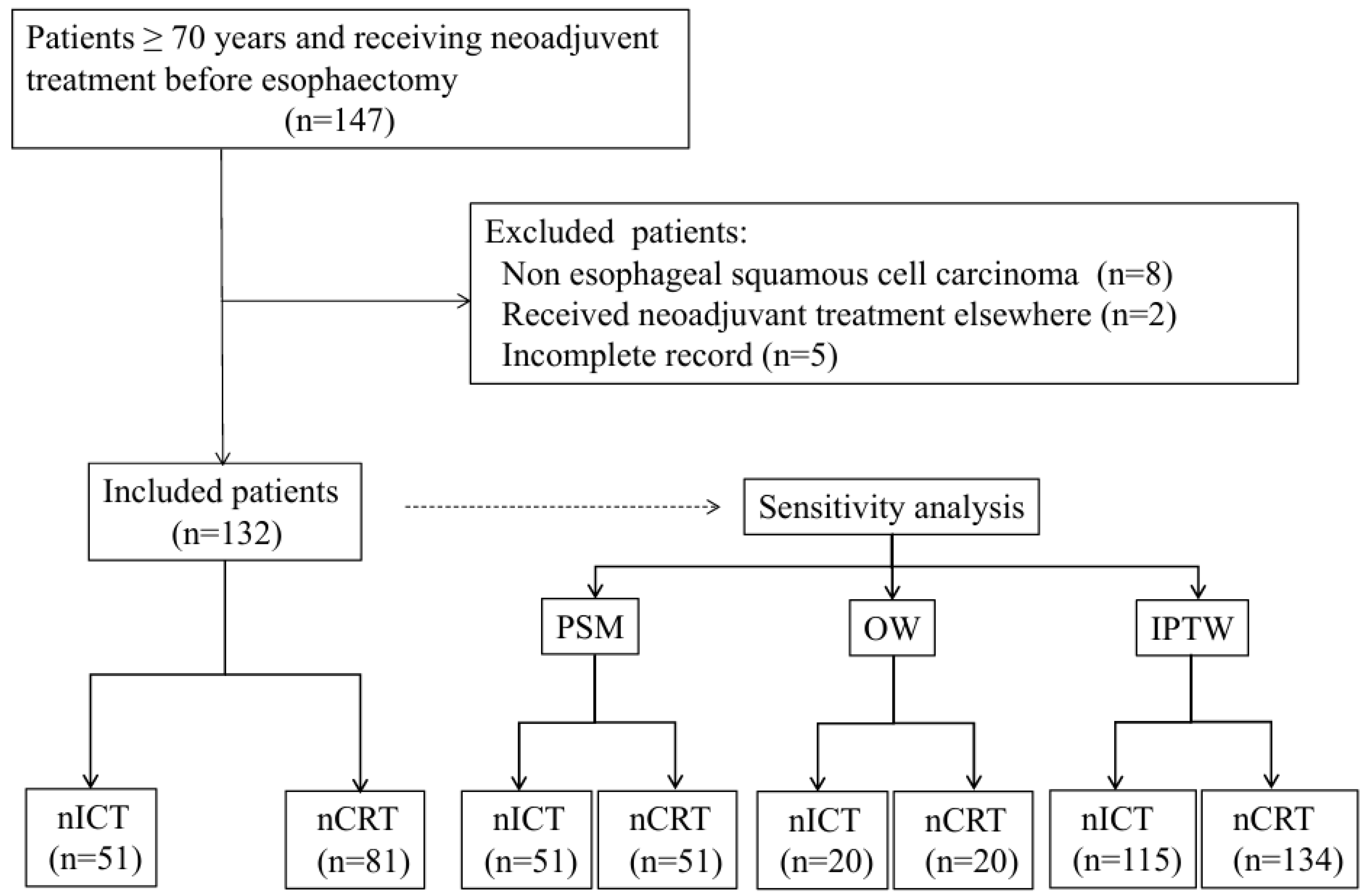
In accordance with the ethical review board of the hospital (SCCHEC-02-2023-029), this retrospective cohort study included patients aged ≥70 years with ESCC who underwent nICT or nCRT followed by radical esophagectomy at Sichuan Cancer Hospital between January 2021 and October 2024. Informed consent was waived due to the retrospective nature of the study. The exclusion criteria included non-ESCC histology, incomplete medical records, and the use of neoadjuvant treatment at external institutions. The screening flowchart is shown in Figure 1.
Patient demographics, preoperative characteristics, intraoperative data, and postoperative outcomes were extracted from electronic medical records. The age-adjusted Charlson Comorbidity Index (CCI) was used to assess the severity of comorbid disease [13]. Clinical and postoperative pathologic tumour stage (ypTNM) was classified according to the eighth edition of the AJCC/UICC criteria [14].

2.2. Neoadjuvant Treatment and Esophagectomy

All participants received 2–4 cycles of neoadjuvant treatment. For the nICT group, immunotherapy was administered as a PD-1 inhibitor at the following standard doses: 240 mg of toripalimab, 200 mg of camrelizumab, 200 mg of sintilimab, 100–200 mg of pembrolizumab, or 360 mg of nivolumab combined with chemotherapy every 21 days. The predominant chemotherapy regimen was platinum-taxane (paclitaxel 175 mg/m2 plus cisplatin/nedaplatin 80 mg/m2 or carboplatin AUC = 5), with a platinum–fluorouracil regimen (platinum agents 75–80 mg/m2 plus fluorouracil 800 mg/m2) as an alternative. For the nCRT group, chemotherapy was delivered weekly with concurrent radiotherapy: the main regimen was 25 mg/m2 cisplatin or a carboplatin AUC = 2 plus 50 mg/m2 paclitaxel (or the alternative platinum–fluorouracil regimen), and radiotherapy was performed at a total dosage ranging from 37.6 to 50.2 Gy in 1.8 to 2.0 Gy fractions over 10 to 33 sessions (5 fractions/week). To protect normal lung tissue, predefined dose constraints were strictly applied: lung V5 ≤ 60%, V20 ≤ 30%, V30 ≤ 20%, and mean lung dose (MLD) < 18 Gy. The therapeutic regimens were decided by the physicians and patients on the basis of the patient’s choice and physical state.
Surgery was scheduled 4–8 weeks after the final neoadjuvant treatment session in the absence of surgical contraindications. The surgical options were selected on the basis of performance status and tumour location and extent. The surgical approaches included McKeown or Ivor–Lewis esophagectomy via da Vinci robot-assisted esophagectomy, minimally invasive esophagectomy (MIE), transthoracic open esophagectomy, or the conversion method (from video-assisted thoracoscopic with laparoscopic to open operations). Lymphadenectomy was routinely conducted.

2.3. Postoperative Complications

Postoperative complications were graded according to the Clavien–Dindo (CD) classification, with grade 3 or higher defined as major complications [15]. Pulmonary complications included pneumonia, pleural effusion, acute respiratory distress syndrome (ARDS), pneumothorax, and empyema. Pneumonia was diagnosed on the basis of clinical and radiographic criteria. Anastomotic complications included anastomotic leakage, conduit necrosis, anastomotic stricture, and anastomotic inflammation. Anastomotic leakage was diagnosed by the presence of contrast extravasation detected via radiographic examination or endoscopy. Other complications included arrhythmias requiring pharmacological treatment or cardioversion, severe diarrhoea, incision infection, and septic shock.

2.4. Statistical Analysis

Statistical analyses were performed using R (R Foundation for Statistical Computing Platform, version 4.4.0). Quantitative variables are presented as medians with interquartile ranges (25th quartile–75th quantile) or means ± SDs (standard deviations). Comparisons between two groups were conducted using the Wilcoxon test or Student’s t test, as appropriate. The Kolmogorov–Smirnov test was used to test the normal distribution. Categorical variables are expressed as frequencies (percentages) and were compared using Pearson’s chi-square test with Yates’ continuity correction or Fisher’s exact test.
Univariate and multivariate logistic regression analyses were employed to assess the impact of neoadjuvant treatment on postoperative complications, with all preoperative (baseline) variables incorporated into the multivariate analysis via backward stepwise selection, removing variables with p ≥ 0.05. Due to the unbalanced sample size and baseline covariates between the two groups, propensity score matching (PSM, 1:1 k-nearest neighbour matching without preset callipers), propensity score-based overlap weighting (OW), and inverse probability of treatment weighting (IPTW) were utilized for sensitivity analysis. The propensity score was estimated using a logistic regression model including all baseline covariates. A standardized mean difference (SMD) ≤ 0.1 was considered indicative of covariate balance. All p values were two-sided, and p < 0.05 was considered statistically significant.

3. Results

3.1. Baseline Characteristics

A total of 132 patients were included, with a median age of 72 years (83.3% male). The demographic, CCI, preoperative neutrophil, lymphocyte, haemoglobin, and albumin levels, as well as cardiac function (ejection fraction), pulmonary function, American Society of Anaesthesiologists (ASA) Physical Status Classification, clinical tumour stage, and tumour location, are shown in Table 1. Group comparisons revealed significant differences in smoking history, CCI score, lymphocytes, FVC% (forced vital capacity percent of the predicted), FEV1% (forced expiratory volume in 1 s percent of the predicted), and clinical N stage (p < 0.05).

3.2. Intraoperative and Postoperative Outcomes

The majority of patients received MIE (81.8%) and the McKeown procedure (92.4%). Significant differences in ypT (p = 0.014) and ypN stages (p = 0.035) were observed between the nICT and nCRT groups (Table 2). No between-group differences were observed in terms of surgical approach, procedure type, surgery time, estimated blood loss, blood transfusion, postoperative haemoglobin and albumin, pCR, ypTNM, continuous renal replacement therapy (CRRT), ventilator use in the ICU, ICU stay, hospital length of stay (LOS), 24 h reoperation, 24 h ICU readmission, 30-day ICU readmission, 30-day rehospitalization, or 30-day mortality (all p > 0.05).

3.3. Postoperative Complications

Forty-five patients (34.1%) developed postoperative complications, and pulmonary complications accounted for the majority (25.0%) of the complications. The nICT group had a significantly lower rate of pulmonary complications than the nCRT group (13.7% vs. 32.1%, p = 0.030), as shown in Table 3. The specific diagnoses of pulmonary complications are illustrated in Figure S1. Univariable and multivariable logistic analyses confirmed this association (crude OR = 0.34, 95% CI = 0.13–0.85; p = 0.021; adjusted OR = 0.26, 95% CI = 0.08–0.85; p = 0.026; Table 4).
Furthermore, we observed a reduced occurrence of pneumonia (3.9% vs. 18.5%, p = 0.030) and a crude OR = 0.18 (95% CI, 0.04–0.82; p = 0.027), although this difference was not significant in the multivariable analysis (adjusted OR, 95% CI, 0.21, 0.03–1.52; p = 0.123). Anastomotic leakage rates did not differ between the two groups (3.9% vs. 9.9%, p = 0.315).
All complications, major all complications, major pulmonary complications, anastomotic complications, major anastomotic complications, other complications, and major other complications were comparable (all p > 0.05; Table 3 and Table 4).

3.4. Sensitivity Analysis

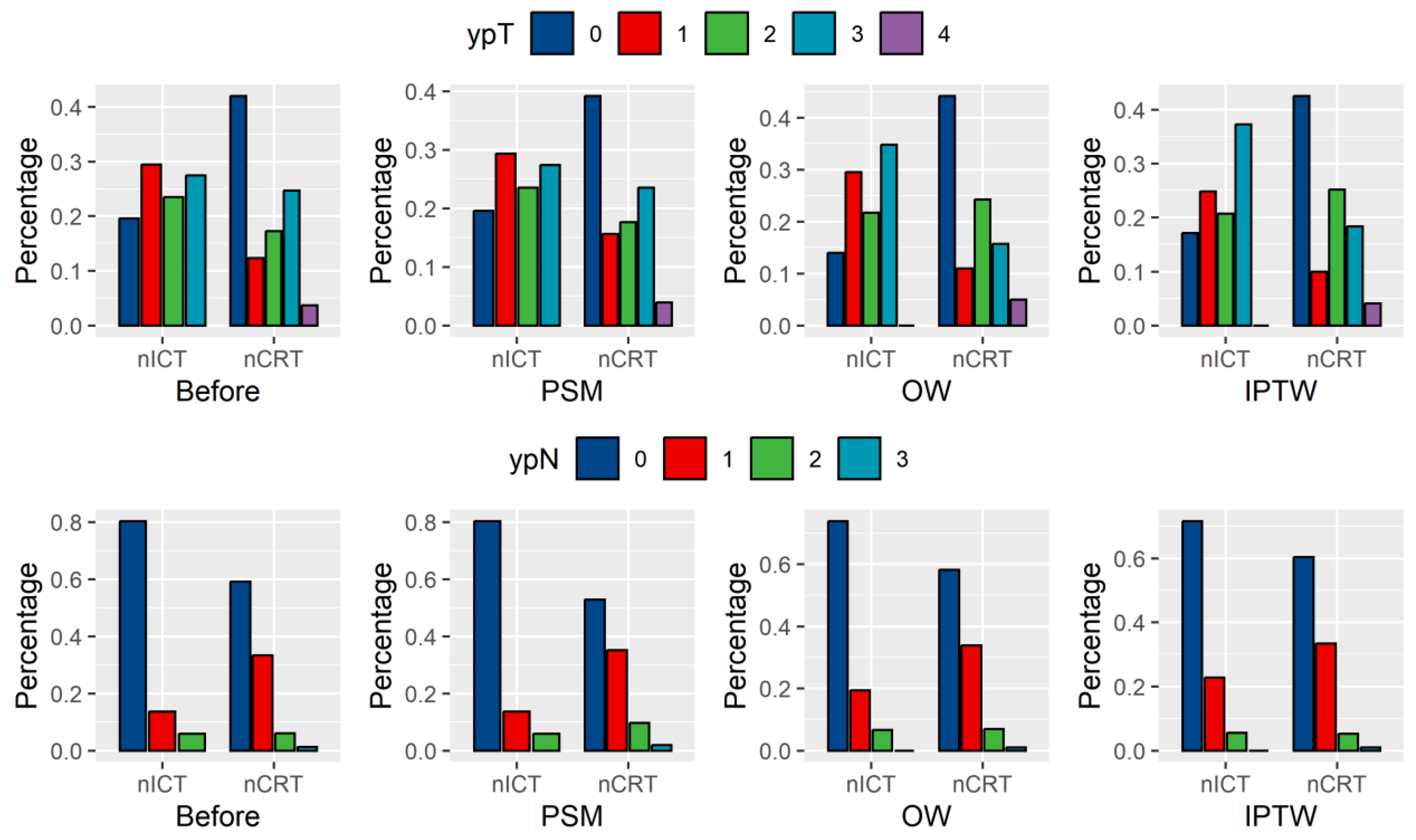
PSM, OW, and IPTW achieved covariate balance, and the distributions of baseline covariates after matching or weighing are shown in Tables S1–S3. A trend towards higher ypT0 proportions in patients receiving nICT was observed (Figure 2), although significance was not always achieved (p = 0.089 after PSM, p = 0.088 after OW, p < 0.001 after IPTW). However, the proportion of patients who received nICT was greater for ypN0 (p = 0.015 after PSM, p = 0.731 after OW, p = 0.164 after IPTW).
Consistent with these findings, significantly fewer postoperative pulmonary complications were observed in patients who underwent nICT after PSM (adjusted OR, 95% CI: 0.17, 0.03–0.82; p = 0.027), after OW (adjusted OR, 95% CI: 0.26, 0.07–0.88; p = 0.031), and after IPTW (adjusted OR, 95% CI: 0.30, 0.11–0.79, p = 0.015). The results are shown in Table S4.
nICT did not lead to an increased risk of postoperative complications, including pneumonia and anastomotic leakage, as shown after PSM, OW, and IPTW (p > 0.05 for all; Table S4).

4. Discussion

Accumulating evidence reveals that elderly patients with locally advanced oesophageal cancer can benefit from multimodal therapy, including esophagectomy, chemotherapy, and radiotherapy [16,17,18]. Esophagectomy remains the mainstay of treatment for localized oesophageal cancer, and immunotherapy has emerged as a promising treatment because of its favourable efficacy and safety profile [19]. To date, research investigating the perioperative outcomes of nICT followed by esophagectomy in elderly patients (≥70 years) remains limited.
In the nCRT group, a greater proportion of patients had ypT0 disease, which is consistent with the findings of prior studies [7,20,21]; this finding likely reflects the potent local control of primary lesions by radiotherapy. Conversely, the nICT group had a greater proportion of ypN0 patients, which is consistent with the systemic anti-tumour mechanism of immunotherapy and may confer advantages in controlling metastatic lymph node disease. However, the literature on the impact of nICT on ypN0 is inconsistent, with some studies reporting increased [21] or decreased ypN0 rates [20,22] compared with those of nCRT. Moreover, significance was not consistently maintained after the propensity score-based adjustments were made, suggesting that unmeasured covariates may influence postoperative pathological staging. Ultimately, differences in ypN0 and ypT0 stages were detected between nICT and nCRT, whereas no significant differences were detected in ypTNM stage or pCR. The potential differences in the long-term prognosis between nICT and nCRT in geriatric ESCC patients require clarification through rigorously designed larger prospective trials.
Postoperative pulmonary complications are the most common morbidities after oesophagectomy and are associated with increased mortality and decreased health-related quality of life [23]. Advanced age is an independent risk factor for such complications after esophagectomy [24], likely due to age-related physiological declines, including postoperative diaphragmatic dysfunction [25], sarcopenia [26], and impaired pulmonary function [27]. Our study revealed that compared with nCRT, nICT was associated with fewer pulmonary complications in older patients, a finding that was sustained after multivariable adjustment and sensitivity analyses.
Prior studies in mixed-age ESCC cohorts reported comparable pulmonary complication rates between nICT and nCRT [7,21,22]. Theoretically, adding radiotherapy to chemotherapy may increase complication risks due to radiation-induced tissue injury near the oesophagus. However, clinical research investigating the impact of nCRT on pulmonary complications is debated: one meta-analysis linked nCRT to increased pulmonary complications compared with neoadjuvant chemotherapy [28], whereas another found no difference [29]. This heterogeneity may stem from variations in radiotherapy techniques, surgical approaches, chemotherapy regimens, or patient populations. Two recent insightful studies highlight that patients with reduced lung volumes or preexisting pulmonary disease—more prevalent in older adults—are at higher risk of pulmonary complications [30,31]. nICT does not cause radiation-induced lung injury, and these findings underscore the clinical relevance of our results.
Pneumonia and anastomotic leakage are among the most critical postesophagectomy complications [32]. Our data revealed that compared with nCRT, nICT did not increase the risk of these events in elderly ESCC patients, which is consistent with the findings of prior studies [21] and a meta-analysis [33] in mixed-age patients. Notably, univariable analysis revealed a significantly lower pneumonia rate in the nICT group, although this difference was attenuated in multivariate analysis. Yang GZ et al. [34] reported a similar trend in younger patients (≤60 years, 50.5%), where compared with nCRT, nICT was associated with a lower pneumonia incidence (5.70% vs. 14.58%, p = 0.062), suggesting potential benefits of nICT.
To date, several novel neoadjuvant immunotherapy regimens have been investigated in trials for patients with resectable locally advanced ESCC. A prospective randomized phase III clinical trial enrolling 252 patients revealed that compared with neoadjuvant chemotherapy, nICT combined with postoperative immunotherapy (toripalimab) resulted in a higher pCR rate (18.6% vs. 4.6%) and improved the 1-year event-free survival (EFS) rate (77.9% vs. 64.3%) and 1-year overall survival (OS) rate (94.1% vs. 83.0%) [35]. The rates of postoperative Clavien–Dindo grade and morbidity did not differ between the two groups. An open-label, single-arm, single-institution phase II trial including 21 patients receiving neoadjuvant immunotherapy (tislelizumab) with chemoradiotherapy showed promising efficacy (pCR rate 52.6%, 3-year DFS 65.2%, and OS 95.2%) and a manageable safety profile [36]. A single-arm, phase 1b trial of neoadjuvant PD-L1 blockade with adebrelimab provided a potential rationale for neoadjuvant anti-PD-L1 monotherapy with a pCR rate of 8%, a 2-year OS of 92%, and acceptable adverse events [37]. These studies were not designed for elderly patients, especially those aged 70 years or older. Although perioperative immunotherapy, neoadjuvant chemoradiotherapy combined with immunotherapy, and neoadjuvant PD-L1 blockade may improve treatment efficacy, they might increase perioperative risks in this population. Our study demonstrates the perioperative safety of neoadjuvant immunochemotherapy in elderly patients aged 70 years or older, highlighting the need for more research on the perioperative risk assessment of these novel immunotherapeutic regimens.
Our research has several limitations. First, this was a retrospective study with a modest sample size, and the treatment allocation was not randomized; although multiple covariate balance methods were applied, potential biases such as selection bias could not be eliminated. Therefore, our findings should be interpreted with caution. A prospective randomized trial is needed to validate these findings. Second, we focused solely on short-term postoperative outcomes; the differences in survival between the mid-term and long-term outcomes need further investigation. Third, the immunotherapy, radiotherapy, and chemotherapy administered varied across patients, which mirrored real-world practice but limited the ability to derive definitive conclusions. Fourth, this study did not include comprehensive geriatric assessment tools or performance status scales, which may limit the generalizability of our findings. Finally, caution is advised when these results are generalized to nonsquamous histological subtypes, as the cohort included only ESCC patients.

5. Conclusions

Compared with nCRT, nICT was associated with a higher proportion of ypN0 and a lower proportion of ypT0. The two groups did not significantly differ in terms of the majority of postoperative complications. Notably, nICT was linked to a reduced incidence of pulmonary complications. Importantly, nICT did not increase the risk of anastomotic leakage and tended to decrease pneumonia. These findings support the safety profile of nICT in elderly populations.

Supplementary Materials

The following supporting information can be downloaded at https://www.mdpi.com/article/10.3390/cancers18081192/s1; Figure S1: Types of pulmonary complications; Table S1: Baseline characteristics of the patients after PSM; Table S2: Baseline characteristics of the patients after OW; Table S3: Baseline characteristics of the patients after IPTW; Table S4: The logistic regression analysis of postoperative complications after matching/weighting.

Author Contributions

Q.L. and S.L. designed the study, recruited participants, performed literature searches, analysed the data, and wrote the manuscript. Q.L. and S.L. recruited participants, performed literature searches, and interpreted the data. Y.W. recruited participants and performed literature searches. G.L. and Z.L. designed the study and reviewed and revised the manuscript. All authors have read and agreed to the published version of the manuscript.

Funding

This work was supported by the Key Clinical Construction Project of Sichuan Province.

Institutional Review Board Statement

The study protocol was approved by the Ethics Committee for Medical Research of Sichuan Cancer Hospital (SCCHEC-02-2023-029, 1 March 2023).

Informed Consent Statement

Informed consent was waived due to the retrospective nature of the study.

Data Availability Statement

The data for this study are available upon request from the corresponding author.

Conflicts of Interest

The authors declare that they have no competing or financial interests.

References

  1. Bray, F.; Laversanne, M.; Sung, H.; Ferlay, J.; Siegel, R.L.; Soerjomataram, I.; Jemal, A. Global Cancer Statistics 2022: GLOBOCAN Estimates of Incidence and Mortality Worldwide for 36 Cancers in 185 Countries. CA Cancer J. Clin. 2024, 74, 229–263. [Google Scholar] [CrossRef] [PubMed]
  2. Wang, Y.; Yan, Q.; Fan, C.; Mo, Y.; Wang, Y.; Li, X.; Liao, Q.; Guo, C.; Li, G.; Zeng, Z.; et al. Overview and Countermeasures of Cancer Burden in China. Sci. China Life Sci. 2023, 66, 2515–2526. [Google Scholar] [CrossRef] [PubMed]
  3. Chen, W.; Zheng, R.; Baade, P.D.; Zhang, S.; Zeng, H.; Bray, F.; Jemal, A.; Yu, X.Q.; He, J. Cancer Statistics in China, 2015. CA Cancer J. Clin. 2016, 66, 115–132. [Google Scholar] [CrossRef] [PubMed]
  4. Yang, H.; Liu, H.; Chen, Y.; Zhu, C.; Fang, W.; Yu, Z.; Mao, W.; Xiang, J.; Han, Y.; Chen, Z.; et al. Neoadjuvant Chemoradiotherapy Followed by Surgery Versus Surgery Alone for Locally Advanced Squamous Cell Carcinoma of the Esophagus (NEOCRTEC5010): A Phase III Multicenter, Randomized, Open-Label Clinical Trial. J. Clin. Oncol. Off. J. Am. Soc. Clin. Oncol. 2018, 36, 2796–2803. [Google Scholar] [CrossRef]
  5. Kong, M.; Shen, J.; Zhou, C.; Yang, H.; Chen, B.; Zhu, C.; Wang, G. Prognostic Factors for Survival in Esophageal Squamous Cell Carcinoma (ESCC) Patients with a Complete Regression of the Primary Tumor (ypT0) after Neoadjuvant Chemoradiotherapy (NCRT) Followed by Surgery. Ann. Transl. Med. 2020, 8, 1129. [Google Scholar] [CrossRef]
  6. Wang, Y.; Ma, K.; Zhang, H.; Wu, L.; Liu, L.; Zhou, Y.; Peng, L.; Wang, Q.; Zhuang, X. Comparison of Pathologic Response and Survival Outcomes between Neoadjuvant Chemoradiotherapy (nCRT) and Neoadjuvant Immunochemotherapy (nICT) in Patients with Locally Advanced Esophageal Squamous Cell Carcinoma: A Propensity Score-Matched Analysis. BMC Cancer 2024, 24, 1228. [Google Scholar] [CrossRef]
  7. Yang, X.; Yin, H.; Zhang, S.; Jiang, T.; Gu, J.; Jiao, H.; Wang, H.; Liang, F.; Xu, S.; Fan, H.; et al. Perioperative Outcomes and Survival after Neoadjuvant Immunochemotherapy for Locally Advanced Esophageal Squamous Cell Carcinoma. J. Thorac. Cardiovasc. Surg. 2025, 169, 289–300.e6. [Google Scholar] [CrossRef]
  8. Boerner, T.; Sewell, M.; Tin, A.L.; Vickers, A.J.; Harrington-Baksh, C.; Bains, M.S.; Bott, M.J.; Park, B.J.; Sihag, S.; Jones, D.R.; et al. A Novel Frailty Index Can Predict the Short-Term Outcomes of Esophagectomy in Older Patients with Esophageal Cancer. Curr. Oncol. Tor. Ont. 2024, 31, 4685–4694. [Google Scholar] [CrossRef]
  9. Backemar, L.; Lagergren, P.; Djärv, T.; Johar, A.; Wikman, A.; Lagergren, J. Comorbidities and Risk of Complications After Surgery for Esophageal Cancer: A Nationwide Cohort Study in Sweden. World J. Surg. 2015, 39, 2282–2288. [Google Scholar] [CrossRef]
  10. Rice, D.C.; Correa, A.M.; Vaporciyan, A.A.; Sodhi, N.; Smythe, W.R.; Swisher, S.G.; Walsh, G.L.; Putnam, J.B.; Komaki, R.; Ajani, J.A.; et al. Preoperative Chemoradiotherapy Prior to Esophagectomy in Elderly Patients Is Not Associated with Increased Morbidity. Ann. Thorac. Surg. 2005, 79, 391–397; discussionn 391–397. [Google Scholar] [CrossRef]
  11. Laurent, A.; Marechal, R.; Farinella, E.; Bouazza, F.; Charaf, Y.; Gay, F.; Van Laethem, J.-L.; Gonsette, K.; El Nakadi, I. Esophageal Cancer: Outcome and Potential Benefit of Esophagectomy in Elderly Patients. Thorac. Cancer 2022, 13, 2699–2710. [Google Scholar] [CrossRef]
  12. Law, S.; Wong, K.-H.; Kwok, K.-F.; Chu, K.-M.; Wong, J. Predictive Factors for Postoperative Pulmonary Complications and Mortality after Esophagectomy for Cancer. Ann. Surg. 2004, 240, 791–800. [Google Scholar] [CrossRef] [PubMed]
  13. Charlson, M.E.; Pompei, P.; Ales, K.L.; MacKenzie, C.R. A New Method of Classifying Prognostic Comorbidity in Longitudinal Studies: Development and Validation. J. Chronic Dis. 1987, 40, 373–383. [Google Scholar] [CrossRef] [PubMed]
  14. Rice, T.W.; Ishwaran, H.; Kelsen, D.P.; Hofstetter, W.L.; Apperson-Hansen, C.; Blackstone, E.H.; Worldwide Esophageal Cancer Collaboration Investigators. Recommendations for Neoadjuvant Pathologic Staging (ypTNM) of Cancer of the Esophagus and Esophagogastric Junction for the 8th Edition AJCC/UICC Staging Manuals. Dis. Esophagus Off. J. Int. Soc. Dis. Esophagus 2016, 29, 906–912. [Google Scholar] [CrossRef] [PubMed]
  15. Clavien, P.A.; Barkun, J.; de Oliveira, M.L.; Vauthey, J.N.; Dindo, D.; Schulick, R.D.; de Santibañes, E.; Pekolj, J.; Slankamenac, K.; Bassi, C.; et al. The Clavien–Dindo Classification of Surgical Complications: Five-Year Experience. Ann. Surg. 2009, 250, 187–196. [Google Scholar] [CrossRef]
  16. Trumper, M.; Ross, P.J.; Cunningham, D.; Norman, A.R.; Hawkins, R.; Seymour, M.; Harper, P.; Iveson, T.; Nicolson, M.; Hickish, T. Efficacy and Tolerability of Chemotherapy in Elderly Patients with Advanced Oesophago-Gastric Cancer: A Pooled Analysis of Three Clinical Trials. Eur. J. Cancer Oxf. Engl. 2006, 42, 827–834. [Google Scholar] [CrossRef]
  17. Lavergne, C.; Youssef, A.; Niglas, M.; Humphreys, D.N.; Youssef, Y. Outcomes from a Single Institution Cohort of 248 Patients with Stage I-III Esophageal Cancer Treated with Radiotherapy: Comparison of Younger and Older Populations. Tech. Innov. Patient Support Radiat. Oncol. 2024, 31, 100260. [Google Scholar] [CrossRef]
  18. Dezube, A.R.; Cooper, L.; Mazzola, E.; Dolan, D.P.; Lee, D.N.; Kucukak, S.; De Leon, L.E.; Dumontier, C.; Ademola, B.; Polhemus, E.; et al. Long-Term Outcomes Following Esophagectomy in Older and Younger Adults with Esophageal Cancer. J. Gastrointest. Surg. Off. J. Soc. Surg. Aliment. Tract 2022, 26, 1119–1131. [Google Scholar] [CrossRef]
  19. Pyreddy, S.; Kim, S.; Miyamoto, W.; Talib, Z.; GnanaDev, D.A.; Rahnemai-Azar, A.A. Current Advances in Immunotherapy Management of Esophageal Cancer. Cancers 2025, 17, 851. [Google Scholar] [CrossRef]
  20. Tian, Y.; Shi, Z.; Wang, C.; Ke, S.; Qiu, H.; Zhao, W.; Wu, Y.; Chen, J.; Zhang, Y.; Chen, Y. A Comparison of Clinicopathologic Outcomes and Patterns of Lymphatic Spread Across Neoadjuvant Chemotherapy, Neoadjuvant Chemoradiotherapy, and Neoadjuvant Immunochemotherapy in Locally Advanced Esophageal Squamous Cell Carcinoma. Ann. Surg. Oncol. 2024, 31, 860–871. [Google Scholar] [CrossRef] [PubMed]
  21. Xu, L.; Wei, X.-F.; Li, C.-J.; Yang, Z.-Y.; Yu, Y.-K.; Li, H.-M.; Xie, H.-N.; Yang, Y.-F.; Jing, W.-W.; Wang, Z.; et al. Pathologic Responses and Surgical Outcomes after Neoadjuvant Immunochemotherapy versus Neoadjuvant Chemoradiotherapy in Patients with Locally Advanced Esophageal Squamous Cell Carcinoma. Front. Immunol. 2022, 13, 1052542. [Google Scholar] [CrossRef] [PubMed]
  22. Duan, X.; Zhao, F.; Shang, X.; Yue, J.; Chen, C.; Ma, Z.; Chen, Z.; Zhang, C.; Pang, Q.; Zhang, W.; et al. Neoadjuvant Chemoimmunotherapy Was Associated with Better Short-Term Survival of Patients with Locally Advanced Esophageal Squamous Cell Carcinoma Compared to Neoadjuvant Chemoradiotherapy. Cancer Med. 2024, 13, e70113. [Google Scholar] [CrossRef] [PubMed]
  23. Singh, P.; Gossage, J.; Markar, S.; Pucher, P.H.; Wickham, A.; Weblin, J.; Chidambaram, S.; Bull, A.; Pickering, O.; Mythen, M.; et al. Association of Upper Gastrointestinal Surgery of Great Britain and Ireland (AUGIS)/Perioperative Quality Initiative (POQI) Consensus Statement on Intraoperative and Postoperative Interventions to Reduce Pulmonary Complications after Oesophagectomy. Br. J. Surg. 2022, 109, 1096–1106. [Google Scholar] [CrossRef]
  24. Chen, H.; Dong, M.; Xu, Y.; Ma, D.-C. Factors Affecting Pulmonary Complications after Combined Thoracolaparoscopic Radical Esophagectomy for Esophageal Cancer in Elderly Patients. J. Coll. Physicians Surg.-Pak. JCPSP 2023, 33, 433–437. [Google Scholar] [CrossRef]
  25. Liu, F.; Wen, Q.; Yang, Y.; Chen, J.; Jin, G.; Yu, L.; He, J. Diaphragmatic Dysfunction Is Associated with Postoperative Pulmonary Complications in the Aged Patients Underwent Radical Resection of Esophageal Cancer: A Prospective Observational Study. J. Thorac. Dis. 2024, 16, 3623–3635. [Google Scholar] [CrossRef]
  26. Chen, F.; Chi, J.; Zhao, B.; Mei, F.; Gao, Q.; Zhao, L.; Ma, B. Impact of Preoperative Sarcopenia on Postoperative Complications and Survival Outcomes of Patients with Esophageal Cancer: A Meta-Analysis of Cohort Studies. Dis. Esophagus Off. J. Int. Soc. Dis. Esophagus 2022, 35, doab100. [Google Scholar] [CrossRef]
  27. Hong, Z.-N.; Weng, K.; Chen, Z.; Peng, K.; Kang, M. Difference between “Lung Age” and Real Age as a Novel Predictor of Postoperative Complications, Long-Term Survival for Patients with Esophageal Cancer after Minimally Invasive Esophagectomy. Front. Surg. 2022, 9, 794553. [Google Scholar] [CrossRef]
  28. Zhao, X.; Ren, Y.; Hu, Y.; Cui, N.; Wang, X.; Cui, Y. Neoadjuvant Chemotherapy versus Neoadjuvant Chemoradiotherapy for Cancer of the Esophagus or the Gastroesophageal Junction: A Meta-Analysis Based on Clinical Trials. PLoS ONE 2018, 13, e0202185. [Google Scholar] [CrossRef]
  29. Kumagai, K.; Rouvelas, I.; Tsai, J.A.; Mariosa, D.; Klevebro, F.; Lindblad, M.; Ye, W.; Lundell, L.; Nilsson, M. Meta-Analysis of Postoperative Morbidity and Perioperative Mortality in Patients Receiving Neoadjuvant Chemotherapy or Chemoradiotherapy for Resectable Oesophageal and Gastro-Oesophageal Junctional Cancers. Br. J. Surg. 2014, 101, 321–338. [Google Scholar] [CrossRef]
  30. Populaire, P.; Defraene, G.; Nafteux, P.; Depypere, L.; Moons, J.; Isebaert, S.; Haustermans, K. Clinical Implications of Dose to Functional Lung Volumes in the Trimodality Treatment of Esophageal Cancer. Acta Oncol. Stockh. Swed. 2023, 62, 1488–1495. [Google Scholar] [CrossRef]
  31. Beier, M.A.; Greenbaum, A.A.; Kangas-Dick, A.W.; August, D.A. Does Neoadjuvant Radiation Therapy Contribute to the Incidence of Pulmonary Complications Following Esophagectomy for Malignant Neoplasm? Am. Surg. 2023, 89, 4780–4788. [Google Scholar] [CrossRef]
  32. Edmondson, J.; Hunter, J.; Bakis, G.; O’Connor, A.; Wood, S.; Qureshi, A.P. Understanding Post-Esophagectomy Complications and Their Management: The Early Complications. J. Clin. Med. 2023, 12, 7622. [Google Scholar] [CrossRef]
  33. Zhou, D.; Chen, D.; Song, P.; Hu, Z.; Xu, S.; Zhu, R.; Chen, Y. Does Neoadjuvant Therapy Contribute to Increased Risk in Anastomotic Leakage of Esophageal Cancer? A Network Meta-Analysis. J. Evid.-Based Med. 2024, 17, 559–574. [Google Scholar] [CrossRef]
  34. Yang, G.; Yue, H.; Zhang, X.; Zeng, C.; Tan, L.; Zhang, X. Comparison of Neoadjuvant Chemotherapy or Chemoradiotherapy plus Immunotherapy for Locally Resectable Esophageal Squamous Cell Carcinoma. Front. Immunol. 2024, 15, 1336798. [Google Scholar] [CrossRef] [PubMed]
  35. Zheng, Y.; Liang, G.; Yuan, D.; Liu, X.; Ba, Y.; Qin, Z.; Shen, S.; Li, Z.; Sun, H.; Liu, B.; et al. Perioperative toripalimab plus neoadjuvant chemotherapy might improve outcomes in resectable esophageal cancer: An interim analysis of a phase III randomized clinical trial. Cancer Commun. 2024, 44, 1214–1227. [Google Scholar] [CrossRef] [PubMed]
  36. Jin, P.; Yang, W.; Gao, Y.; Fu, Z.; Wang, L.; Cao, L.; Meng, X. Neoadjuvant tislelizumab with chemoradiotherapy for resectable locally advanced esophageal squamous cell carcinoma. Int. J. Surg. 2026, 112, 3494–3507. [Google Scholar] [CrossRef] [PubMed]
  37. Yin, J.; Yuan, J.; Li, Y.; Fang, Y.; Wang, R.; Jiao, H.; Tang, H.; Zhang, S.; Lin, S.; Su, F.; et al. Neoadjuvant adebrelimab in locally advanced resectable esophageal squamous cell carcinoma: A phase 1b trial. Nat. Med. 2023, 29, 2068–2078. [Google Scholar] [CrossRef]
Figure 1. Flowchart of patient enrolment. nICT, neoadjuvant immunochemotherapy; nCRT, neoadjuvant chemoradiotherapy; PSM, propensity score matching; OW, overlap weighting; IPTW, inverse probability of treatment weighting.
Cancers 18 01192 g001
Figure 2. Proportion of ypT0 and ypN0 in the nICT and nCRT. nICT, neoadjuvant immunochemotherapy; nCRT, neoadjuvant chemoradiotherapy.
Cancers 18 01192 g002
Table 1. Baseline characteristics of the patients.
OverallnICTnCRTp ValueSMD
Variables(n = 132)(n = 51)(n = 81)
Age (years)72 (71–74)73 (71–74)72 (70–74)0.244−0.148
Male gender110 (83.3%)39 (76.5%)71 (87.7%)0.1500.295
BMI (kg/m2)23.23 ± 3.0622.86 ± 2.4923.47 ± 3.370.266−0.206
Smoking history68 (51.5%)19 (37.3%)49 (60.5%)0.0150.478
Drinking history58 (43.9%)17 (33.3%)41 (50.6%)0.0770.356
Family history of oesophageal cancer17 (12.9%)5 (9.8%)12 (14.8%)0.5690.153
CCI score6.0 (6.0–7.0)6.0 (6.0–6.5)6.0 (6.0–7.0)0.004−0.551
Neutrophil (×109/L)3.01 (2.41–3.84)3.10 (2.61–4.03)2.92 (2.25–3.78)0.2260.086
Lymphocyte (×109/L)0.95 (0.69–1.23)1.17 (0.96–1.39)0.85 (0.63–1.06)<0.0010.701
Platelet (×109/L)158.50 (131.00–196.75)167.00 (130.50–199.00)157.00 (132.00–183.00)0.6500.061
Haemoglobin (g/L)116.94 ± 14.37115.90 ± 14.64117.59 ± 14.260.513−0.116
Albumin (g/L)37.31 ± 3.6537.97 ± 3.8636.89 ± 3.460.0970.296
FVC (L)2.81 ± 0.602.89 ± 0.652.77 ± 0.570.2560.266
FVC(% pred)90.25 (81.30–104.38)97.20 (83.95–108.10)88.50 (81.00–100.00)0.0430.317
FEV1 (L)2.21 ± 0.492.28 ± 0.552.16 ± 0.440.1680.241
FEV1 (% pred)93.60 (84.22–107.60)97.90 (86.35–113.55)90.90 (84.00–99.60)0.0320.391
FEV1/FVC (% pred)79.19 (73.05–84.60)78.69 (74.16–83.81)80.25 (73.00–84.68)0.483−0.079
DLCO (L)5.96 ± 1.546.10 ± 1.485.87 ± 1.590.4140.101
DLCO (% pred)84.10 (71.80–94.70)83.90 (75.05–93.50)84.50 (68.60–94.70)0.6950.066
EF (%)68.00 (65.00–70.00)68.00 (65.50–70.00)68.00 (65.00–70.00)0.4040.169
ASA2.11 ± 0.342.06 ± 0.312.15 ± 0.360.144−0.267
Clinical T stage 0.6810.101
23 (2.3%)1 (2.0%)2 (2.5%)
3113 (85.6%)42 (82.4%)71 (87.7%)
416 (12.1%)8 (15.7%)8 (9.9%)
Clinical N stage 0.018−0.520
01 (0.8%)1 (2.0%)0 (0.0%)
147 (35.6%)25 (49.0%)22 (27.2%)
274 (56.1%)21 (41.2%)53 (65.4%)
310 (7.6%)4 (7.8%)6 (7.4%)
Clinical TNM 0.125−0.308
II2 (1.5%)2 (3.9%)0 (0.0%)
III106 (80.3%)38 (74.5%)68 (84.0%)
IV24 (18.2%)11 (21.6%)13 (16.0%)
Tumour location 0.8980.083
Upper23 (17.4%)9 (17.6%)14 (17.3%)
Middle78 (59.1%)29 (56.9%)49 (60.5%)
Lower31 (23.5%)13 (25.5%)18 (22.2%)
nICT, neoadjuvant immunochemotherapy; nCRT, neoadjuvant chemoradiotherapy; SMD, standardized mean difference; BMI, body mass index; CCI, Charlson Comorbidity Index; FVC, forced vital capacity; % pred, percent of the predicted; FEV1, forced expiratory volume in 1 s; DLCO, diffusing capacity of the lung for carbon monoxide; EF, ejection fraction; ASA, American Society of Anaesthesiologists Physical Status Classification.
Table 2. Intraoperative and postoperative outcomes.
OverallnICTnCRTp Value
Variables(n = 132)(n = 51)(n = 81)
Surgical approach 0.526
Robot-assisted10 (7.6%)3 (5.9%)7 (8.6%)
MIE108 (81.8%)42 (82.4%)66 (81.5%)
Open12 (9.1%)6 (11.8%)6 (7.4%)
Converted to open2 (1.5%)0 (0.0%)2 (2.5%)
Procedure type 0.538
Ivor–Lewis8 (6.1%)4 (7.8%)4 (4.9%)
McKeown122 (92.4%)47 (92.2%)75 (92.6%)
Others2 (1.5%)0 (0.0%)2 (2.5%)
Surgery time (hours)4.08 ± 0.944.15 ± 1.124.03 ± 0.820.466
Estimated blood loss (mL)177.88 ± 108.33171.76 ± 115.01181.73 ± 104.460.609
Blood transfusion10 (7.6%)6 (11.8%)4 (4.9%)0.269
Haemoglobin (g/L)110.33 ± 16.10109.39 ± 16.60110.93 ± 15.850.596
Albumin (g/L)30.59 ± 4.2231.26 ± 4.5630.16 ± 3.970.148
ypT stage 0.014
T044 (33.3%)10 (19.6%)34 (42.0%)
T125 (18.9%)15 (29.4%)10 (12.3%)
T226 (19.7%)12 (23.5%)14 (17.3%)
T334 (25.8%)14 (27.5%)20 (24.7%)
T43 (2.3%)0 (0.0%)3 (3.7%)
ypN stage 0.035
N089 (67.4%)41 (80.4%)48 (59.3%)
N134 (25.8%)7 (13.7%)27 (33.3%)
N28 (6.1%)3 (5.9%)5 (6.2%)
N31 (0.8%)0 (0.0%)1 (1.2%)
ypTNM stage 0.129
I78 (59.1%)32 (62.7%)46 (56.8%)
II16 (12.1%)9 (17.6%)7 (8.6%)
III35 (26.5%)10 (19.6%)25 (30.9%)
IV3 (2.3%)0 (0.0%)3 (3.7%)
pCR38 (28.8%)10 (19.6%)28 (34.6%)0.099
ICU CRRT use1 (0.8%)0 (0.0%)1 (1.2%)>0.999
ICU ventilator use9 (6.8%)1 (2.0%)8 (9.9%)0.152
ICU stay (days)1.3 (1.0,1.5)1.2 (1.1,1.4)1.2 (1.0–1.5)0.083
LOS (days)13.6 (11.3–17.4)13.5 (11.3–16.8)13.4 (11.3–18.3)0.710
24-Hour reoperation3 (2.3%)1 (2.0%)2 (2.5%)>0.999
24-Hour ICU readmission5 (3.8%)1 (2.0%)4 (4.9%)0.648
30-Day ICU readmission6 (4.5%)1 (2.0%)5 (6.2%)0.405
30-Day rehospitalization1 (0.8%)1 (2.0%)0 (0.0%)0.386
30-Day mortality1 (0.8%)0 (0.0%)1 (1.2%)>0.999
nICT, neoadjuvant immunochemotherapy; nCRT, neoadjuvant chemoradiotherapy; MIE, minimally invasive oesophagectomy; pCR, pathological complete regression; CRRT, continuous renal replacement therapy; ICU, intensive care unit; LOS, hospital length of stay.
Table 3. Postoperative complications.
OverallnICTnCRTp Value
Variables(n = 132)(n = 51)(n = 81)
All complications45 (34.1%)12 (23.5%)33 (40.7%)0.065
Major all complications32 (24.2%)9 (17.6%)23 (28.4%)0.232
Pulmonary complications33 (25.0%)7 (13.7%)26 (32.1%)0.030
Major pulmonary complications23 (17.4%)5 (9.8%)18 (22.2%)0.111
Anastomotic complications13 (9.8%)3 (5.9%)10 (12.3%)0.361
Major anastomotic complications12 (9.1%)3 (5.9%)9 (11.1%)0.368
Other complications8 (6.1%)5 (9.8%)3 (3.7%)0.260
Major other complications6 (4.5%)3 (5.9%)3 (3.7%)0.676
Pneumonia17 (12.9%)2 (3.9%)15 (18.5%)0.030
Anastomotic leakage10 (7.6%)2 (3.9%)8 (9.9%)0.315
nICT, neoadjuvant immunochemotherapy; nCRT, neoadjuvant chemoradiotherapy.
Table 4. Logistic regression analysis of postoperative complications.
ComplicationsTreatmentCrude OR (95% CI)p ValueAdjusted OR (95% CI)p Value
All complications
nCRTReference
nICT0.45 (0.20–0.98)0.0450.47 (0.17–1.29)0.141
Major all complications
nCRTReference
nICT0.54 (0.23–1.29)0.1640.56 (0.19–1.64)0.291
Pulmonary complications
nCRTReference
nICT0.34 (0.13–0.85)0.0210.26 (0.08–0.85)0.026
Major pulmonary complications
nCRTReference
nICT0.38 (0.13–1.10)0.0740.34 (0.09–1.34)0.123
Anastomotic complications
nCRTReference
nICT0.44 (0.12–1.70)0.2350.20 (0.03–1.18)0.076
Major anastomotic complications
nCRTReference
nICT0.50 (0.13–1.94)0.3170.28 (0.04–1.71)0.167
Other complications
nCRTReference
nICT2.83 (0.65–12.38)0.1683.26 (0.33–32.21)0.313
Major other complications
nCRTReference
nICT1.62 (0.32–8.38)0.5621.72 (0.15–19.14)0.659
Pneumonia
nCRTReference
nICT0.18 (0.04–0.82)0.0270.21 (0.03–1.52)0.123
Anastomotic leakage
nCRTReference
nICT0.37 (0.08–1.83)0.2240.21 (0.03–1.66)0.139
nICT, neoadjuvant immunochemotherapy; nCRT, neoadjuvant chemoradiotherapy; OR, odds ratio; CI, confidence interval.
Disclaimer/Publisher’s Note: The statements, opinions and data contained in all publications are solely those of the individual author(s) and contributor(s) and not of MDPI and/or the editor(s). MDPI and/or the editor(s) disclaim responsibility for any injury to people or property resulting from any ideas, methods, instructions or products referred to in the content.