Integrating Artificial Intelligence into Breast Cancer Histopathology: Toward Improved Diagnosis and Prognosis
 ,
,  , ,
, ,  , ,
, ,  and
and 
Simple Summary
Abstract
1. Introduction
2. The Performance of AI-Driven Models in the Diagnosis of BC
3. AI-Driven Models in the Neoadjuvant Setting of BC
4. AI-Driven Models and Prognosis in BC
5. AI-Driven Models for Biomarker Prediction and Tumor Classification
6. Reducing Inter-Observer Variability in BC Histopathology: AI Applications of AI-Assisted Pathology and Inter-Observer Variability
7. Comprehensive Application of AI-Driven Models in BC
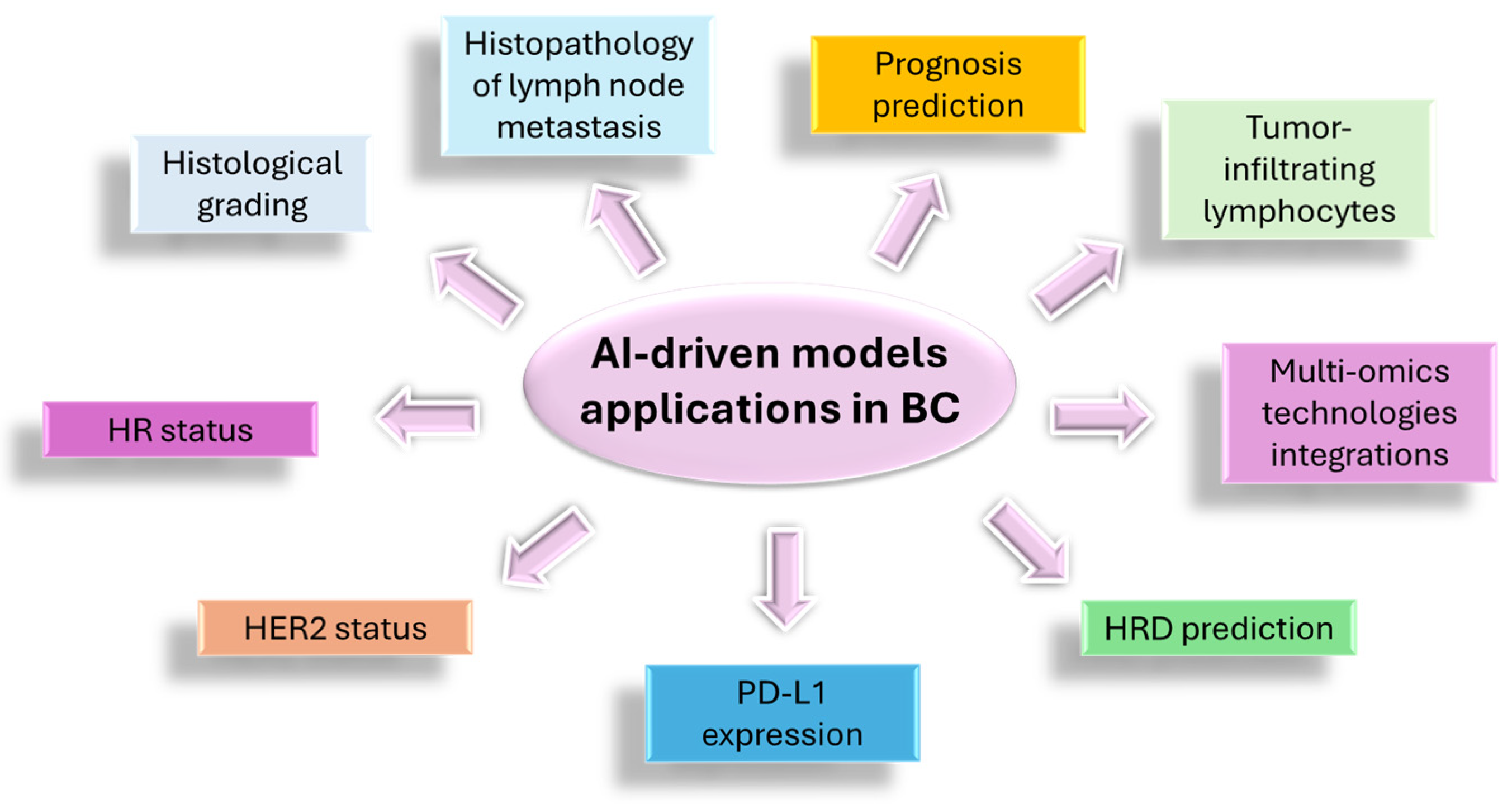
- Histological grading. Histological grading is a process aimed at determining the aggressiveness and potential for spread of cancer cells based on their histological appearance. This grading is utilized, in clinical practice, to guide treatment decisions in BC patients [62]. In histopathology practice, mitotic activity, the number of mitotic figures in a given tumor area, is considered the most important grading component in BC [63]. More recently, immunoreactivity of phosphorylated Histone H3 (PHH3) has been introduced as an indicator of mitosis by revealing proliferating cancer cells in the M phase [64]. In recent years, a CNN model was proposed for detecting the mitotic index in H&E-stained WSI of BC after training on PHH3-immunostained sections [65]. This model showed the ability to define the BC mitotic index with similar accuracy to that of expert pathologists. The role of AI-driven models in BC grading and in the evaluation of the mitotic count has been confirmed in a recent review [61].
- Histopathology of lymph node metastases. An algorithm, named smuLymphNet, has been developed to analyze axillary lymph node metastases, a finding associated with an increased risk of recurrence in BC patients [24]. Interestingly, this DL model was able to extract relevant information about cancer behavior, even in lymph nodes unaffected by cancer, through the quantification of germinal centers in triple-negative BC (TNBC) carriers. Lymph nodes with >2 germinal centers were associated with better prognosis and higher distant metastasis-free survival compared with patients whose cancer-affected lymph nodes showed fewer than 2 germinal centers. A study by Verghese et al. stresses the ability of AI models to effectively link some critical subtle features of axillary lymph nodes through their capacity to process WSI adeptly with BC patient prognosis [27].
- Prognosis prediction based on histopathology. A DL model, named DeepGrade (DG), was proposed some years ago to evaluate the risk of recurrence in BC carriers based on H&E-stained WSI [49]. This model allowed the stratification of patients into two groups: DG1 and DG2. The latter were characterized by a higher risk of recurrence, suggesting that the AI-driven model could identify subtle histological features associated with a more aggressive BC subtype.
- Tumor-infiltrating lymphocytes and prognosis. Tumor-infiltrating lymphocytes (TILs) are a very important tool for the evaluation of the immune response against BC cells [66]. In TNBC, TILs showed a correlation with improved prognosis and better response to immuno-oncology target agents [67]. Saltz J and coworkers showed that the spatial organization of TILs plays a key role and is associated with clinical outcome and prognosis [21]. Further studies based on the application of AI to assess the prognostic significance of TILs in luminal BC revealed that high stromal TILs and intra-tumoral TILs counts and their proximity to stromal and cancer cells were associated with poor clinical outcome, high tumor grade and lymph node metastasis. The spatial distribution of TILs and their relationship with cancer cells and with cells of the tumor microenvironment (TME) were evidenced by the AI model and were not assessed using the routine histological approach [68]. Another DL model confirmed that stromal TILs play a key role in predicting the response to neoadjuvant chemotherapy in BC patients [69]. In this study, the algorithm utilized appeared to be a useful tool for assessing prognosis and treatment response in both TNBC and HER2-positive BC carriers. All these data taken together suggest analytical and clinical validity of AI algorithms for the evaluation of TILs in BC [70].
- Homologous recombination deficiency (HRD) prediction. HRD is a state where cells have difficulty repairing double-strand breaks. In BC, HRD is a significant factor in BRCA1 and BRCA2 mutations [71]. Recently, a DL model was proposed that is able to identify morphological patterns associated with HRD status in BC from H&E-stained WSI [72]. The model predicted HRD with high accuracy at an AUC of 0.86. The ability of AI-driven models to predict HRD from histology alone has been confirmed by more recent studies in which a new algorithm, named DeepHRD, predicted HRD without requiring molecular profiling in BC and ovarian cancer [73,74].
- HR status prediction. HR status, including progesterone receptor and estrogen receptor expression, is an important factor for the stratification of BC patients into very high-, high- and low-risk subgroups, a key step for a proper treatment and prognosis [75]. DL models have shown their ability to enable HR status without the use of IHC, from base-level H&E-stained WSI [38,76]. The usefulness of AI in automated analysis of BC, including the prediction of HR status, has been confirmed by more recent studies [77].
- Programmed Death Ligand-1 (PD-L1) expression. PD-L1 expression is an important biomarker for stratifying patients for PD-1/PD-L1 targeted immunotherapy. The first studies on the usefulness of AI models to assist PD-L1 scoring in BC were based on the analysis of BC sections immunostained for PD-L1 [78]. Further studies showed the ability of DL models to predict PD-L1 expression status from H&E-stained histopathology images in BC [79]. The proposed AI-assisted method was able to improve the ability and accuracy of pathologists in scoring PD-L1 expression [80,81].
- HER2 status prediction. HER2 status represents an important prognostic and predictive marker in BC. The initial classification into two classes, HER2-positive and HER2-negative, has been successfully modified into a classification with three classes, including HER2 low status (score 1+ and 2+ without amplification) [82]. HER2 is a critical factor in BC treatment, and accurate differentiation of HER2 scores is crucial; therefore, AI has emerged as a promising tool for this challenging task. Tarantino and coworkers have developed an algorithm that differentiates between HER2-positive and HER2-negative BC [83]. Farahmand S and coworkers developed a DL model able to predict from H&E-stained WSI HER2 status and trastuzumab treatment response [26].
- 9.
- Integration of histological data with multi-omics technologies. By combining histological, IHC, clinical, genomic, epigenomic, proteomic, transcriptomic and metabolomic data of a given patient, DL systems have been shown to provide relevant information regarding personalized treatment strategies for BC patients [85]. AI’s ability to integrate multi-omics might improve the development of precision oncology [86]. The topic of multimodal AI has been discussed in a recent study by Hanna MG and coworkers [87]. According to these authors, multimodal AI models may offer several advantages in oncology by integrating histopathologic, clinical, radiological and omics data.
8. Publicly Available BC WSI Datasets
9. Methodological Challenges and Reproducibility in Computational Pathology
- Overlap of patients between training and testing datasets;
- Tile-level data leakage during patch extraction;
- Lack of patient-level data splitting;
- Insufficient reporting of dataset composition and preprocessing procedures [95].
10. Regulatory Considerations and Clinical Implementation
11. Challenges in Computational BC Pathology
12. Future Directions in WSI Search Regarding BC
- Development of novel multimodal models.
- For pairing each WSI with other clinical, radiological and laboratory parameters.
- For pairing each WSI with the patient’s clinical record.
- For pairing each WSI with molecular tests.
- For guiding diagnoses and clinical decision making.
- To reach a system that can present a holistic view for pathologists, given a query WSI.
- Prepare large WSI repositories of BC.
- Growing to millions of slides, the new datasets will allow DL systems to operate without pixel-level annotations.
- The use of large datasets will favor the validation of novel algorithms.
- The validation of new AI systems will favor their introduction in clinical practice and their acceptance in pathology departments.
- Development of fast and scalable search engines for multiplex transcriptomics and IHC data.
13. Conclusions
Author Contributions
Funding


Institutional Review Board Statement
Informed Consent Statement
Data Availability Statement
Conflicts of Interest
Abbreviations
| AI | Artificial intelligence. |
| BC | Breast cancer. |
| CNNs | Convolutional neural networks. |
| DG | DeepGrade. |
| DL | Deep learning. |
| FDA | Food and Drug Administration. |
| HER2 | Human epidermal growth factor receptor 2. |
| H&E | Hematoxylin and eosin. |
| HR | Hormone receptor. |
| HRD | Homologous recombination deficiency. |
| IHC | Immunohistochemistry. |
| ML | Machine learning. |
| OS | Overall survival. |
| PD-L1 | Programmed Death Ligand-1. |
| PHH3 | Phosphorylated Histone H3. |
| ROI | Regions of interest. |
| SISH | Self-supervised image search for histology. |
| TILs | Tumor infiltrating lymphocytes. |
| TNBC | Triple-negative breast cancer. |
| TME | Tumor microenvironment. |
| WSI | Whole-slide imaging. |
References
- Elmore, J. The gold standard cancer diagnosis: Studies of physician variability, interpretive behavior, and the impact of AI. Cancer Res. 2021, 81, SY01-03. [Google Scholar] [CrossRef]
- Faa, G.; Lai, E.; Ziranu, P.; Pretta, A.; Tiwari, E.; Dessì, M.; Solinas, C.; Saba, G.; Loi, F.; Codipietro, C.; et al. Estrogen Receptor-Low Positive (ER-Low) Breast Cancer: A Unique Clinical and Pathological Entity. Curr. Oncol. 2026, 33, 122. [Google Scholar] [CrossRef] [PubMed]
- Khened, M.; Kori, A.; Rajkumar, H.; Krishnamurthi, G.; Srinivasan, B. A generalized deep learning framework for whole-slide image segmentation and analysis. Sci. Rep. 2021, 11, 11579. [Google Scholar] [CrossRef]
- Waqas, A.; Bui, M.M.; Glassy, E.F.; El Naqa, I.; Borkowski, P.; Borkowski, A.A.; Rasool, G. Revolutionizing digital pathology with the power of generative artificial intelligence and foundation models. Lab. Investig. 2023, 103, 100255. [Google Scholar] [CrossRef]
- Faa, G.; Castagnola, M.; Didaci, L.; Coghe, F.; Scartozzi, M.; Saba, L.; Fraschini, M. The quest for the application of artificial intelligence to whole slide imaging: Unique prospective from new advanced tools. Algorithms 2024, 17, 254. [Google Scholar] [CrossRef]
- Cooper, M.; Ji, Z.; Krishnan, R.G. Machine learning in computational histopathology: Challenges and opportunities. Genes Chromosomes Cancer 2023, 62, 540–556. [Google Scholar] [CrossRef]
- Faa, G.; Fraschini, M.; Barberini, L. Reproducibility and explainability in digital pathology: The need to make black-box artificial intelligence systems more transparent. J. Public Health Res. 2024, 13, 22799036241284898. [Google Scholar] [CrossRef]
- Faa, G.; Fraschini, M.; Didaci, L.; Saba, L.; Scartozzi, M.; Orvieto, E.; Rugge, M. “Artificial histology” in colonic neoplasia: A critical approach. Dig. Liver Dis. 2025, 57, 663–668. [Google Scholar] [CrossRef] [PubMed]
- Fu, Y.; Jung, A.W.; Torne, R.V.; Gonzalez, S.; Vöhringer, H.; Shmatko, A.; Yates, L.R.; Jimenez-Linan, M.; Moore, L.; Gerstung, M. Pan-cancer computational histopathology reveals mutations, tumor composition and prognosis. Nat. Cancer 2020, 1, 800–810. [Google Scholar] [CrossRef] [PubMed]
- Faa, G.; Coghe, F.; Pretta, A.; Castagnola, M.; Van Eyken, P.; Saba, L.; Scartozzi, M.; Fraschini, M. Artificial intelligence models for the detection of microsatellite instability from whole-slide imaging of colorectal cancer. Diagnostics 2024, 14, 1605. [Google Scholar] [CrossRef] [PubMed]
- Rugge, M.; Fraschini, M.; D’Amuri, A.; Faa, G. Pathology asks for global regulations in artificial intelligence employment. Mod. Pathol. 2025, 38, 100754. [Google Scholar] [CrossRef] [PubMed]
- Ehteshami Bejnordi, B.; Veta, M.; van Diest, P.J.; van Ginneken, B.; Karssemeijer, N.; Litjens, G.; van der Laak, J.A.W.M.; Hermsen, M.; Manson, Q.F.; Balkenhol, M.; et al. Diagnostic assessment of deep learning algorithms for detection of lymph node metastases in women with breast cancer. JAMA 2017, 318, 2199–2210. [Google Scholar] [CrossRef]
- Steiner, D.F.; MacDonald, R.; Liu, Y.; Truszkowski, P.; Hipp, J.D.; Gammage, C.; Thng, F.; Peng, L.; Stumpe, M.C. Impact of deep learning assistance on the histopathologic review of lymph nodes for metastatic breast cancer. Am. J. Surg. Pathol. 2018, 42, 1636–1646. [Google Scholar] [CrossRef]
- Liu, Y.; Kohlberger, T.; Norouzi, M.; Dahl, G.E.; Smith, J.L.; Mohtashamian, A.; Olson, N.; Peng, L.H.; Hipp, J.D.; Stumpe, M.C. Artificial intelligence-based breast cancer nodal metastasis detection: Insights into the black box for pathologists. Arch. Pathol. Lab. Med. 2019, 143, 859–868. [Google Scholar] [CrossRef] [PubMed]
- Mukhopadhyay, S.; Feldman, M.D.; Abels, E.; Ashfaq, R.; Beltaifa, S.; Cacciabeve, N.G.; Cathro, H.P.; Cheng, L.; Cooper, K.; Dickey, G.E.; et al. Whole slide imaging versus microscopy for primary diagnosis in surgical pathology: A multicenter blinded randomized noninferiority study of 1992 cases. Am. J. Surg. Pathol. 2018, 42, 39–52. [Google Scholar] [CrossRef]
- Zeiser, F.P.; Da Costa, C.A.; Roehe, A.V.; da Rosa Righi, R.; Cavalheiro Marques, N.M. Breast cancer intelligent analysis of histopathological data: A systematic review. Appl. Soft Comput. 2021, 107, 107886. [Google Scholar] [CrossRef]
- Hoffer, E.; Hubara, I.; Soudry, D. Train longer, generalize better: Closing the generalization gap in large batch training of neural networks. Adv. Neural Inf. Process. Syst. 2017, 30, 1731–1741. [Google Scholar] [CrossRef]
- Guerrisi, N. Seminars in cancer biology. Semin. Cancer Biol. 2021, 72, 226–237. [Google Scholar] [CrossRef]
- Ciga, O.; Xu, T.; Nofech-Mozes, S.; Noy, S.; Lu, F.I.; Martel, A.L. Overcoming the limitations of patch-based learning to detect cancer in whole slide images. Sci. Rep. 2021, 11, 8894. [Google Scholar] [CrossRef] [PubMed]
- Campanella, G.; Hanna, M.G.; Geneslaw, L.; Miraflor, A.; Werneck Krauss Silva, V.; Busam, K.J.; Brogi, E.; Reuter, V.E.; Klimstra, D.S.; Fuchs, T.J. Clinical-grade computational pathology using weakly supervised deep learning on whole slide images. Nat. Med. 2019, 25, 1301–1309. [Google Scholar] [CrossRef] [PubMed]
- Saltz, J.; Gupta, R.; Hou, L.; Kurc, T.; Singh, P.; Nguyen, V.; Samaras, D.; Shroyer, K.R.; Zhao, T.; Batiste, R.; et al. Spatial organization and molecular correlation of tumor-infiltrating lymphocytes using deep learning on pathology images. Cell Rep. 2018, 23, 181–193.e7. [Google Scholar] [CrossRef]
- Couture, H.D.; Williams, L.A.; Geradts, J.; Nyante, S.J.; Butler, E.N.; Marron, J.S.; Perou, C.M.; Troester, M.A.; Niethammer, M. Image analysis with deep learning to predict breast cancer grade, ER status, histologic subtype, and intrinsic subtype. npj Breast Cancer 2018, 4, 30. [Google Scholar] [CrossRef]
- Schmauch, B.; Romagnoni, A.; Pronier, E.; Saillard, C.; Maillé, P.; Calderaro, J.; Kamoun, A.; Sefta, M.; Toldo, S.; Zaslavskiy, M.; et al. A deep learning model to predict RNA-Seq expression of tumours from whole slide images. Nat. Commun. 2020, 11, 3877. [Google Scholar] [CrossRef] [PubMed]
- Verghese, G.; Li, M.; Liu, F.; Lohan, A.; Kurian, N.C.; Meena, S.; Gazinska, P.; Shah, A.; Oozeer, A.; Chan, T.; et al. Multiscale deep learning framework captures systemic immune features in lymph nodes predictive of triple negative breast cancer outcome in large-scale studies. J. Pathol. 2023, 260, 376–389. [Google Scholar] [CrossRef] [PubMed]
- Kather, J.N.; Heij, L.R.; Grabsch, H.I.; Loeffler, C.; Echle, A.; Muti, H.S.; Krause, J.; Niehues, J.M.; Sommer, K.A.J.; Bankhead, P.; et al. Pan-cancer image-based detection of clinically actionable genetic alterations. Nat. Cancer 2020, 1, 789–799. [Google Scholar] [CrossRef] [PubMed]
- Farahmand, S.; Fernandez, A.I.; Ahmed, F.S.; Rimm, D.L.; Chuang, J.H.; Reisenbichler, E.; Zarringhalam, K. Deep learning trained on hematoxylin and eosin tumor region of interest predicts HER2 status and trastuzumab treatment response in HER2+ breast cancer. Mod. Pathol. 2022, 35, 44–51. [Google Scholar] [CrossRef]
- Jiang, B.; Bao, L.; He, S.; Chen, X.; Jin, Z.; Ye, Y. Deep learning applications in breast cancer histopathological imaging: Diagnosis, treatment, and prognosis. Breast Cancer Res. 2024, 26, 137. [Google Scholar] [CrossRef]
- Yao, Q.; Gong, X. Saliency guided self-attention network for weakly and semi-supervised semantic segmentation. IEEE Access 2020, 8, 14413–14423. [Google Scholar] [CrossRef]
- Martel, A.L.; Nofech-Mozes, S.; Salama, S.; Akbar, S.; Peikari, M. Assessment of residual breast cancer cellularity after neoadjuvant chemotherapy using digital pathology. Cancer Imaging Arch. 2019, 10. [Google Scholar] [CrossRef]
- Kim, Y.G.; Kim, S.; Cho, C.E.; Song, I.H.; Lee, H.J.; Ahn, S.; Park, S.Y.; Gong, G.; Kim, N. Effectiveness of transfer learning for enhancing tumor classification with a convolutional neural network on frozen sections. Sci. Rep. 2020, 10, 21899. [Google Scholar] [CrossRef] [PubMed]
- Huang, Z.; Shao, W.; Han, Z.; Alkashash, A.M.; De la Sancha, C.; Parwani, A.V.; Nitta, H.; Hou, Y.; Wang, T.; Salama, P.; et al. Artificial intelligence reveals features associated with breast cancer neoadjuvant chemotherapy responses from multi-stain histopathologic images. npj Precis. Oncol. 2023, 7, 14. [Google Scholar] [CrossRef]
- Wulczyn, E.; Steiner, D.F.; Xu, Z.; Sadhwani, A.; Wang, H.; Flament-Auvigne, I.; Mermel, C.H.; Chen, P.C.; Liu, Y.; Stumpe, M.C. Deep learning-based survival prediction for multiple cancer types using histopathology images. PLoS ONE 2020, 15, e0233678. [Google Scholar] [CrossRef]
- Ejiyi, C.J.; Qin, Z.; Agbesi, V.K.; Yi, D.; Atwereboannah, A.A.; Chikwendu, I.A.; Bamisile, O.F.; Kissanga, G.-M.B.; Bamisile, O.O. Advancing cancer diagnosis and prognostication through deep learning mastery in breast, colon and lung histopathology with ResoMergeNet. Comput. Biol. Med. 2025, 185, 109494. [Google Scholar] [CrossRef] [PubMed]
- Anand, D.; Kurian, N.C.; Dhage, S.; Kumar, N.; Rane, S.; Gann, P.H.; Sethi, A. Deep learning to estimate human epidermal growth factor receptor 2 status from hematoxylin and eosin-stained breast tissue images. J. Pathol. Inform. 2020, 11, 19. [Google Scholar] [CrossRef] [PubMed]
- Mukundan, R. Analysis of image feature characteristics for automated scoring of HER2 in histology slides. J. Imaging 2019, 5, 35. [Google Scholar] [CrossRef]
- La Barbera, D.; Polónia, A.; Roitero, K.; Conde-Sousa, E.; Della Mea, V. Detection of HER2 from haematoxylin-eosin slides through a cascade of deep learning classifiers via multi-instance learning. J. Imaging 2020, 6, 82. [Google Scholar] [CrossRef] [PubMed]
- Oliveira, S.P.; Ribeiro Pinto, J.; Gonçalves, T.; Canas-Marques, R.; Cardoso, M.-J.; Oliveira, H.P.; Cardoso, J.S. Weakly-supervised classification of HER2 expression in breast cancer haematoxylin and eosin stained slides. Appl. Sci. 2020, 10, 4728. [Google Scholar] [CrossRef]
- Naik, N.; Madani, A.; Esteva, A.; Keskar, N.S.; Press, M.F.; Ruderman, D.; Agus, D.B.; Socher, R. Deep learning-enabled breast cancer hormonal receptor status determination from base-level H&E stains. Nat. Commun. 2020, 11, 5727. [Google Scholar] [CrossRef]
- He, B.; Bergenstråhle, L.; Stenbeck, L.; Abid, A.; Andersson, A.; Borg, Å.; Maaskola, J.; Lundeberg, J.; Zou, J. Integrating spatial gene expression and breast tumour morphology via deep learning. Nat. Biomed. Eng. 2020, 4, 827–834. [Google Scholar] [CrossRef]
- Phan, N.N.; Huang, C.C.; Tseng, L.M.; Chuang, E.Y. Predicting breast cancer gene expression signature by applying deep convolutional neural networks from unannotated pathological images. Front. Oncol. 2021, 11, 769447. [Google Scholar] [CrossRef]
- Wang, Y.; Kartasalo, K.; Weitz, P.; Ács, B.; Valkonen, M.; Larsson, C.; Ruusuvuori, P.; Hartman, J.; Rantalainen, M. Predicting molecular phenotypes from histopathology images: A transcriptome-wide expression-morphology analysis in breast cancer. Cancer Res. 2021, 81, 5115–5126. [Google Scholar] [CrossRef] [PubMed]
- Monjo, T.; Koido, M.; Nagasawa, S.; Suzuki, Y.; Kamatani, Y. Efficient prediction of a spatial transcriptomics profile better characterizes breast cancer tissue sections without costly experimentation. Sci. Rep. 2022, 12, 4133. [Google Scholar] [CrossRef]
- Chen, C.L.; Chen, C.C.; Yu, W.H.; Chen, S.H.; Chang, Y.C.; Hsu, T.I.; Hsiao, M.; Yeh, C.Y.; Chen, C.Y. An annotation-free whole-slide training approach to pathological classification of lung cancer types using deep learning. Nat. Commun. 2021, 12, 1193. [Google Scholar] [CrossRef]
- Das, K.; Conjeti, S.; Chatterjee, J.; Sheet, D. Detection of Breast Cancer from Whole Slide Histopathological Images Using Deep Multiple Instance CNN. IEEE Access 2020, 8, 213502–213511. [Google Scholar] [CrossRef]
- Sui, D.; Liu, W.; Chen, J.; Zhao, C.; Ma, X.; Guo, M.; Tian, Z. A pyramid architecture-based deep learning framework for breast cancer detection. BioMed Res. Int. 2021, 2021, 2567202. [Google Scholar] [CrossRef] [PubMed]
- Sheikh, T.S.; Lee, Y.; Cho, M. Histopathological classification of breast cancer images using a multi-scale input and multi-feature network. Cancers 2020, 12, 2031. [Google Scholar] [CrossRef]
- Araújo, T.; Aresta, G.; Castro, E.; Rouco, J.; Aguiar, P.; Eloy, C.; Polónia, A.; Campilho, A. Classification of breast cancer histology images using convolutional neural networks. PLoS ONE 2017, 12, e0177544. [Google Scholar] [CrossRef]
- Kanavati, F.; Tsuneki, M. Breast invasive ductal carcinoma classification on whole slide images with weakly-supervised and transfer learning. Cancers 2021, 13, 5368. [Google Scholar] [CrossRef]
- Wang, Y.; Acs, B.; Robertson, S.; Liu, B.; Solorzano, L.; Wählby, C.; Hartman, J.; Rantalainen, M. Improved breast cancer histological grading using deep learning. Ann. Oncol. 2022, 33, 89–98. [Google Scholar] [CrossRef] [PubMed]
- Elsharawy, K.A.; Gerds, T.A.; Rakha, E.A.; Dalton, L.W. Artificial intelligence grading of breast cancer: A promising method to refine prognostic classification for management precision. Histopathology 2021, 79, 187–199. [Google Scholar] [CrossRef]
- Cho, S.Y.; Lee, J.H.; Ryu, J.M.; Lee, J.E.; Cho, E.Y.; Ahn, C.H.; Paeng, K.; Yoo, I.; Ock, C.Y.; Song, S.Y. Deep learning from HE slides predicts the clinical benefit from adjuvant chemotherapy in hormone receptor-positive breast cancer patients. Sci. Rep. 2021, 11, 17363. [Google Scholar] [CrossRef] [PubMed]
- Boyce, B.F. An update on the validation of whole slide imaging systems following FDA approval of a system for a routine pathology diagnostic service in the United States. Biotech. Histochem. 2017, 92, 381–389. [Google Scholar] [CrossRef]
- Chen, C.; Lu, M.Y.; Williamson, D.F.K.; Chen, T.Y.; Schaumberg, A.J.; Mahmood, F. Fast and scalable search of whole-slide images via self-supervised deep learning. Nat. Biomed. Eng. 2022, 6, 1420–1434. [Google Scholar] [CrossRef]
- Lu, M.Y.; Chen, T.Y.; Williamson, D.F.K.; Zhao, M.; Shady, M.; Lipkova, J.; Mahmood, F. AI-based pathology predicts origins for cancers of unknown primary. Nature 2021, 594, 106–110. [Google Scholar] [CrossRef]
- Tizhoosh, H.R.; Diamandis, P.; Campbell, C.J.V.; Safarpoor, A.; Kalra, S.; Maleki, D.; Riasatian, A.; Babaie, M. Searching images for consensus: Can AI remove observer variability in pathology? Am. J. Pathol. 2021, 191, 1702–1708. [Google Scholar] [CrossRef] [PubMed]
- Montgomery, E. Archives of pathology and laboratory medicine. Arch. Pathol. Lab. Med. 2005, 129, 174–176. [Google Scholar] [CrossRef] [PubMed]
- Berman, A.G.; Orchard, W.R.; Gehrung, M.; Markowetz, F. SliDL: A toolbox for processing whole-slide images in deep learning. PLoS ONE 2023, 18, e0289499. [Google Scholar] [CrossRef]
- Zhang, D.Y.; Venkat, A.; Khasawneh, H.; Sali, R.; Zhang, V.; Pei, Z. Implementation of digital pathology and artificial intelligence in routine pathology practice. Lab. Investig. 2024, 104, 102111. [Google Scholar] [CrossRef]
- Chang, J.; Hatfield, B. Advancements in computer vision and pathology: Unraveling the potential of artificial intelligence for precision diagnosis and beyond. Adv. Cancer Res. 2024, 161, 431–478. [Google Scholar]
- Jain, E.; Patel, A.; Parwani, A.V.; Shafi, S.; Brar, Z.; Sharma, S.; Mohanty, S.K. Whole slide imaging technology and its applications: Current and emerging perspectives. Int. J. Surg. Pathol. 2024, 32, 433–448. [Google Scholar] [CrossRef]
- Soliman, A.; Li, Z.; Parwani, A.V. Artificial intelligence’s impact on breast cancer pathology: A literature review. Diagn. Pathol. 2024, 19, 38. [Google Scholar] [CrossRef]
- van Dooijeweert, C.; van Diest, P.J.; Ellis, I.O. Grading of invasive breast carcinoma: The way forward. Virchows Arch. 2022, 480, 33–43. [Google Scholar] [CrossRef] [PubMed]
- Medri, L.; Volpi, A.; Nanni, O.; Vecci, A.M.; Mangia, A.; Schittulli, F.; Padovani, F.; Giunchi, D.C.; Zito, A.; Amadori, D.; et al. Prognostic relevance of mitotic activity in patients with node-negative breast cancer. Mod. Pathol. 2003, 16, 1067–1075. [Google Scholar] [CrossRef] [PubMed]
- Mirzaiian, E.; Tabatabaei Ghods, Z.S.; Tavangar, S.M.; Emami, B.; Oraie, M.; Safyari, R.; Saffar, H. Utility of PHH3 in evaluation of mitotic index in breast carcinoma and impact on tumor grade. Asian Pac. J. Cancer Prev. 2020, 21, 63–66. [Google Scholar] [CrossRef]
- Tellez, D.; Balkenhol, M.; Otte-Holler, I.; van de Loo, R.; Vogels, R.; Bult, P.; Wauters, C.; Vreuls, W.; Mol, S.; Karssemeijer, N.; et al. Whole-slide mitosis detection in H&E breast histology using PHH3 as a reference to train distilled stain-invariant convolutional networks. IEEE Trans. Med. Imaging 2018, 37, 2126–2136. [Google Scholar]
- Ciarka, A.; Piątek, M.; Pęksa, R.; Kunc, M.; Senkus, E. Tumor-infiltrating lymphocytes (TILs) in breast cancer: Prognostic and predictive significance across molecular subtypes. Biomedicines 2024, 12, 763. [Google Scholar] [CrossRef] [PubMed]
- Valenza, C.; Taurelli Salimbeni, B.; Santoro, C.; Trapani, D.; Antonarelli, G.; Curigliano, G. Tumor infiltrating lymphocytes across breast cancer subtypes: Current issues for biomarker assessment. Cancers 2023, 15, 767. [Google Scholar] [CrossRef]
- Makhlouf, S.; Wahab, N.; Toss, M.; Ibrahim, A.; Lashen, A.G.; Atallah, N.M.; Ghannam, S.; Jahanifar, M.; Lu, W.; Graham, S.; et al. Evaluation of tumour infiltrating lymphocytes in luminal breast cancer using artificial intelligence. Br. J. Cancer 2023, 129, 1747–1758. [Google Scholar] [CrossRef]
- Choi, S.; Cho, S.I.; Jung, W.; Lee, T.; Choi, S.J.; Song, S.; Park, G.; Park, S.; Ma, M.; Pereira, S.; et al. Deep learning model improves tumor-infiltrating lymphocyte evaluation and therapeutic response prediction in breast cancer. npj Breast Cancer 2023, 9, 71. [Google Scholar] [CrossRef]
- Vidal, J.M.; Tsiknakis, N.; Staaf, J.; Bosch, A.; Ehinger, A.; Nimeus, E.; Salgado, R.; Bai, Y.; Rimm, D.L.; Hartman, J.; et al. The analytical and clinical validity of AI algorithms to score TILs in TNBC: Can we use different machine learning models interchangeably? eClinicalMedicine 2024, 78, 102928. [Google Scholar] [CrossRef]
- Ali, R.M.M.; McIntosh, S.A.; Savage, K.I. Homologous recombination deficiency in breast cancer: Implications for risk, cancer development, and therapy. Genes Chromosomes Cancer 2021, 60, 358–372. [Google Scholar] [CrossRef] [PubMed]
- Lazard, T.; Bataillon, G.; Naylor, P.; Popova, T.; Bidard, F.C.; Stoppa-Lyonnet, D.; Stern, M.H.; Decencière, E.; Walter, T.; Vincent-Salomon, A. Deep learning identifies morphological patterns of homologous recombination deficiency in luminal breast cancers from whole slide images. Cell Rep. Med. 2022, 3, 100872. [Google Scholar] [CrossRef]
- Bergstrom, E.N.; Abbasi, A.; Díaz-Gay, M.; Galland, L.; Ladoire, S.; Lippman, S.M.; Alexandrov, L.B. Deep learning artificial intelligence predicts homologous recombination deficiency and platinum response from histologic slides. J. Clin. Oncol. 2024, 42, 3550–3560. [Google Scholar] [CrossRef]
- Bayer, M. AI outperforms standard HRD tests for breast, ovarian cancers. Target. Ther. Oncol. 2024, 13, 13. [Google Scholar]
- Rios-Hoyo, A.; Xiong, K.; Dai, J.; Yau, C.; Marczyk, M.; Garcia-Milian, R.; Wolf, D.M.; Huppert, L.A.; Nanda, R.; Hirst, G.L.; et al. Hormone receptor-positive HER2-negative/MammaPrint High-2 breast cancers closely resemble triple-negative breast cancers. Clin. Cancer Res. 2025, 31, 403–413. [Google Scholar] [CrossRef]
- Shamai, G.; Binenbaum, Y.; Slossberg, R.; Duek, I.; Gil, Z.; Kimmel, R. Artificial intelligence algorithms to assess hormonal status from tissue microarrays in patients with breast cancer. JAMA Netw. Open 2019, 2, e197700. [Google Scholar] [CrossRef] [PubMed]
- Yan, S.; Li, J.; Wu, W. Artificial intelligence in breast cancer: Application and future perspectives. J. Cancer Res. Clin. Oncol. 2023, 149, 16179–16190. [Google Scholar] [CrossRef]
- Wang, X.; Wang, L.; Bu, H.; Zhang, N.; Yue, M.; Jia, Z.; Cai, L.; He, J.; Wang, Y.; Xu, X.; et al. How can artificial intelligence models assist PD-L1 expression scoring in breast cancer: Results of multi-institutional ring studies. npj Breast Cancer 2021, 7, 61. [Google Scholar] [CrossRef]
- Shamai, G.; Livne, A.; Polónia, A.; Sabo, E.; Cretu, A.; Bar-Sela, G.; Kimmel, R. Deep learning-based image analysis predicts PD-L1 status from H&E-stained histopathology images in breast cancer. Nat. Commun. 2022, 13, 6753. [Google Scholar]
- Baxi, V.; Lee, G.; Duan, C.; Pandya, D.; Cohen, D.N.; Edwards, R.; Chang, H.; Li, J.; Elliott, H.; Pokkalla, H.; et al. Association of artificial intelligence-powered and manual quantification of programmed death-ligand 1 (PD-L1) expression with outcomes in patients treated with nivolumab ± ipilimumab. Mod. Pathol. 2022, 35, 1529–1539. [Google Scholar] [CrossRef]
- Li, J.; Dong, P.; Wang, X.; Zhang, J.; Zhao, M.; Shen, H.; Cai, L.; He, J.; Han, M.; Miao, J.; et al. Artificial intelligence enhances whole-slide interpretation of PD-L1 CPS in triple-negative breast cancer: A multi-institutional ring study. Histopathology 2024, 85, 451–467. [Google Scholar] [CrossRef] [PubMed]
- Doucet, M.; De Berti, M.; Arbion, F.; Goupille, C.; Body, G.; Ouldamer, L. The impact of the new histological classification of breast cancer with the introduction of HER2 low status. J. Gynecol. Obstet. Hum. Reprod. 2025, 54, 102928. [Google Scholar] [CrossRef]
- Tarantino, P.; Viale, G.; Press, M.F.; Hu, X.; Penault-Llorca, F.; Bardia, A.; Batistatou, A.; Burstein, H.J.; Carey, L.A.; Cortes, J.; et al. ESMO expert consensus statements (ECS) on the definition, diagnosis, and management of HER2-low breast cancer. Ann. Oncol. 2023, 34, 645–659. [Google Scholar] [CrossRef]
- Albuquerque, D.A.N.; Vianna, M.T.; Sampaio, L.A.F.; Vasiliu, A.; Neves Filho, E.H.C. Systematic review and meta-analysis of artificial intelligence in classifying HER2 status in breast cancer immunohistochemistry. npj Digit. Med. 2025, 8, 144. [Google Scholar] [CrossRef]
- Neagu, A.N.; Whitham, D.; Bruno, P.; Morrissiey, H.; Darie, C.A.; Darie, C.C. Omics-based investigations of breast cancer. Molecules 2023, 28, 4768. [Google Scholar] [CrossRef] [PubMed]
- Hassan, A.M.; Naeem, S.M.; Eldosoky, M.A.A.; Mabrouk, M.S. Multi-omics-based machine learning for the subtype classification of breast cancer. Arab. J. Sci. Eng. 2025, 50, 1339–1352. [Google Scholar] [CrossRef]
- Hanna, M.G.; Pantanowitz, L.; Dash, R.; Harrison, J.H.; Deebajah, M.; Pantanowitz, J.; Rashidi, H.H. Future of artificial intelligence-machine learning trends in pathology and medicine. Mod. Pathol. 2025, 38, 100705. [Google Scholar] [CrossRef]
- Tafavvoghi, M.; Bongo, L.A.; Shvetsov, N.; Busund, L.R.; Møllersen, K. Publicly available datasets of breast histopathology H&E whole-slide images: A scoping review. J. Pathol. Inform. 2024, 15, 100363. [Google Scholar] [CrossRef] [PubMed]
- Echle, A.; Rindtorff, N.T.; Brinker, T.J.; Luedde, T.; Pearson, A.T.; Kather, J.N. Deep learning in cancer pathology: A new generation of clinical biomarkers. Br. J. Cancer 2021, 124, 686–696. [Google Scholar] [CrossRef]
- Willemink, M.J.; Koszek, W.A.; Hardell, C.; Wu, J.; Fleischmann, D.; Harvey, H.; Folio, L.R.; Summers, R.M.; Rubin, D.L.; Lungren, M.P. Preparing Medical Imaging Data for Machine Learning. Radiology 2020, 295, 4–15. [Google Scholar] [CrossRef] [PubMed]
- Zech, J.R.; Badgeley, M.A.; Liu, M.; Costa, A.B.; Titano, J.J.; Oermann, E.K. Variable generalization performance of a deep learning model to detect pneumonia in chest radiographs: A cross-sectional study. PLoS Med. 2018, 15, e1002683. [Google Scholar] [CrossRef]
- Badgeley, M.A.; Zech, J.R.; Oakden-Rayner, L.; Glicksberg, B.S.; Liu, M.; Gale, W.; McConnell, M.V.; Percha, B.; Snyder, T.M.; Dudley, J.T. Deep learning predicts hip fracture using confounding patient and healthcare variables. npj Digit. Med. 2019, 2, 31. [Google Scholar] [CrossRef]
- Stacke, K.; Eilertsen, G.; Unger, J.; Lundstrom, C. Measuring Domain Shift for Deep Learning in Histopathology. IEEE J. Biomed. Health Inform. 2021, 25, 325–336. [Google Scholar] [CrossRef]
- Tellez, D.; Litjens, G.; Bándi, P.; Bulten, W.; Bokhorst, J.M.; Ciompi, F.; van der Laak, J. Quantifying the effects of data augmentation and stain color normalization in convolutional neural networks for computational pathology. Med. Image Anal. 2019, 58, 101544. [Google Scholar] [CrossRef]
- Roberts, M.; Driggs, D.; Thorpe, M.; Gilbey, J.; Yeung, M.; Ursprung, S.; Aviles-Rivero, A.I.; Etmann, C.; McCague, C.; Beer, L.; et al. Common pitfalls and recommendations for using machine learning to detect and prognosticate for COVID-19 using chest radiographs and CT scans. Nat. Mach. Intell. 2021, 3, 199–217. [Google Scholar] [CrossRef]
- Collins, G.S.; Reitsma, J.B.; Altman, D.G.; Moons, K.G. Transparent reporting of a multivariable prediction model for individual prognosis or diagnosis (TRIPOD): The TRIPOD statement. BMJ 2015, 350, g7594. [Google Scholar] [CrossRef] [PubMed]
- Liu, X.; Cruz Rivera, S.; Moher, D.; Calvert, M.J.; Denniston, A.K.; SPIRIT-AI and CONSORT-AI Working Group. Reporting guidelines for clinical trial reports for interventions involving artificial intelligence: The CONSORT-AI extension. Lancet Digit. Health 2020, 2, e537–e548. [Google Scholar] [CrossRef] [PubMed]
- Topol, E.J. High-performance medicine: The convergence of human and artificial intelligence. Nat. Med. 2019, 25, 44–56. [Google Scholar] [CrossRef] [PubMed]
- Available online: https://www.imdrf.org/documents/software-medical-device-samd-key-definitions (accessed on 27 March 2026).
- Available online: https://www.fda.gov/ (accessed on 27 March 2026).
- Park, C.-W.; Seo, S.; Kang, N.; Ko, B.; Choi, B.W.; Park, C.M.; Chang, D.K.; Kim, H.; Kim, H.; Lee, H.; et al. Artificial Intelligence in Health Care: Current Applications and Issues. J. Korean Med. Sci. 2020, 35, 42. [Google Scholar] [CrossRef] [PubMed]
- Available online: https://eur-lex.europa.eu/eli/reg/2017/745/oj/eng (accessed on 27 March 2026).
- Jiang, F.; Jiang, Y.; Zhi, H.; Dong, Y.; Li, H.; Ma, S.; Wang, Y.; Dong, Q.; Shen, H.; Wang, Y. Artificial intelligence in healthcare: Past, present and future. Stroke Vasc. Neurol. 2017, 2, 230–243. [Google Scholar] [CrossRef]
- Evans, A.J.; Salama, M.E.; Henricks, W.H.; Pantanowitz, L. Implementation of Whole Slide Imaging for Clinical Purposes: Issues to Consider from the Perspective of Early Adopters. Arch. Pathol. Lab. Med. 2017, 141, 944–959. [Google Scholar] [CrossRef] [PubMed]
- Lambin, P.; Leijenaar, R.T.H.; Deist, T.M.; Peerlings, J.; de Jong, E.E.C.; van Timmeren, J.; Sanduleanu, S.; Larue, R.T.H.M.; Even, A.J.G.; Jochems, A.; et al. Radiomics: The bridge between medical imaging and personalized medicine. Nat. Rev. Clin. Oncol. 2017, 14, 749–762. [Google Scholar] [CrossRef] [PubMed]
- Kelly, C.J.; Karthikesalingam, A.; Suleyman, M.; Corrado, G.; King, D. Key challenges for delivering clinical impact with artificial intelligence. BMC Med. 2019, 17, 195. [Google Scholar] [CrossRef] [PubMed]
- Lee, M. Recent advancements in deep learning using whole slide imaging for cancer prognosis. Bioengineering 2023, 10, 897. [Google Scholar] [CrossRef]
- McGenity, C.; Clarke, E.L.; Jennings, C.; Matthews, G.; Cartlidge, C.; Freduah-Agyemang, H.; Stocken, D.D.; Treanor, D. Artificial intelligence in digital pathology: A systematic review and meta-analysis of diagnostic test accuracy. npj Digit. Med. 2024, 7, 114. [Google Scholar] [CrossRef]
- Baxi, V.; Edwards, R.; Montalto, M.; Saha, S. Digital pathology and artificial intelligence in translational medicine and clinical practice. Mod. Pathol. 2022, 35, 23–32. [Google Scholar] [CrossRef]
- Omar, M.; Alexanderani, M.K.; Valencia, I.; Loda, M.; Marchionni, L. Applications of digital pathology in cancer: A comprehensive review. Annu. Rev. Cancer Biol. 2024, 8, 245–268. [Google Scholar] [CrossRef]
- Reis-Filho, J.S.; Kather, J.N. Overcoming the challenges to implementation of artificial intelligence in pathology. J. Natl. Cancer Inst. 2023, 115, 608–612. [Google Scholar] [CrossRef]
- Cruz-Roa, A.; Gilmore, H.; Basavanhally, A.; Feldman, M.; Ganesan, S.; Shih, N.N.C.; Tomaszewski, J.; González, F.A.; Madabhushi, A. Accurate and reproducible invasive breast cancer detection in whole-slide images: A deep learning approach for quantifying tumor extent. Sci. Rep. 2017, 7, 46450. [Google Scholar] [CrossRef]
- Liu, H.; Kurc, T. Deep learning for survival analysis in breast cancer with whole slide image data. Bioinformatics 2022, 38, 3629–3637. [Google Scholar] [CrossRef]
- Al-Thelaya, K.; Gilal, N.U.; Alzubaidi, M.; Majeed, F.; Agus, M.; Schneider, J.; Househ, M. Applications of discriminative and deep learning feature extraction methods for whole slide image analysis: A survey. J. Pathol. Inform. 2023, 14, 100335. [Google Scholar] [CrossRef] [PubMed]


| Study | Task | Dataset/Cohort | AI Approach | Key Findings |
|---|---|---|---|---|
| Bejnordi et al., 2017 [12] | Detection of lymph node metastases | Camelyon16 challenge dataset | CNNs | DL models achieved diagnostic performance comparable to pathologists in identifying lymph node metastases in WSI |
| Campanella et al., 2019 [20] | Tumor detection in histopathology slides | Multi-institutional WSI dataset | Weakly supervised DL | Demonstrated high sensitivity for cancer detection using slide-level annotations without exhaustive pixel-level labeling |
| Saltz et al., 2018 [21] | Spatial analysis of TILs | TCGA BC dataset | DL + spatial analysis | Spatial organization of immune cells was associated with patient survival and TME characteristics |
| Couture et al., 2018 [22] | Mitotic figure detection for tumor grading | Annotated histopathology images | CNNs-based detection models | Automated detection of mitotic figures demonstrated accuracy comparable to expert pathologists in grading tasks |
| Schmauch et al., 2020 [23] | Prediction of molecular alterations from histology | TCGA multi-cancer dataset | DL models | Demonstrated feasibility of predicting several genomic alterations directly from histological images |
| Verghese et al., 2023 [24] | Lymph node microenvironment analysis | BC lymph node dataset | DL WSI analysis | Germinal center quantification in lymph nodes correlated with prognosis in TNBC |
| Kather et al., 2020 [25] | Prediction of molecular biomarkers from histology | TCGA datasets | DL models | Demonstrated that histological patterns may correlate with molecular features across multiple cancers |
| Farahmand et al., 2022 [26] | HER2 status prediction | BC WSI dataset | DL classification | Demonstrated potential for predicting HER2 status from H&E slides with promising diagnostic performance |
| Jiang et al., 2023 [27] | Histopathological classification of BC | Public BC datasets | DL CNNs architectures | High classification accuracy for distinguishing malignant and benign breast tissue patterns |
Disclaimer/Publisher’s Note: The statements, opinions and data contained in all publications are solely those of the individual author(s) and contributor(s) and not of MDPI and/or the editor(s). MDPI and/or the editor(s) disclaim responsibility for any injury to people or property resulting from any ideas, methods, instructions or products referred to in the content. |
© 2026 by the authors. Licensee MDPI, Basel, Switzerland. This article is an open access article distributed under the terms and conditions of the Creative Commons Attribution (CC BY) license.
Share and Cite
Faa, G.; Lai, E.; Cau, F.; Coghe, F.; Rugge, M.; Suri, J.S.; Codipietro, C.; Congiu, B.; Graziano, S.; Tiwari, E.; et al. Integrating Artificial Intelligence into Breast Cancer Histopathology: Toward Improved Diagnosis and Prognosis. Cancers 2026, 18, 1184. https://doi.org/10.3390/cancers18071184
Faa G, Lai E, Cau F, Coghe F, Rugge M, Suri JS, Codipietro C, Congiu B, Graziano S, Tiwari E, et al. Integrating Artificial Intelligence into Breast Cancer Histopathology: Toward Improved Diagnosis and Prognosis. Cancers. 2026; 18(7):1184. https://doi.org/10.3390/cancers18071184
Chicago/Turabian StyleFaa, Gavino, Eleonora Lai, Flaviana Cau, Ferdinando Coghe, Massimo Rugge, Jasjit S. Suri, Claudia Codipietro, Benedetta Congiu, Simona Graziano, Ekta Tiwari, and et al. 2026. "Integrating Artificial Intelligence into Breast Cancer Histopathology: Toward Improved Diagnosis and Prognosis" Cancers 18, no. 7: 1184. https://doi.org/10.3390/cancers18071184
APA StyleFaa, G., Lai, E., Cau, F., Coghe, F., Rugge, M., Suri, J. S., Codipietro, C., Congiu, B., Graziano, S., Tiwari, E., Pretta, A., Ziranu, P., Scartozzi, M., & Fraschini, M. (2026). Integrating Artificial Intelligence into Breast Cancer Histopathology: Toward Improved Diagnosis and Prognosis. Cancers, 18(7), 1184. https://doi.org/10.3390/cancers18071184