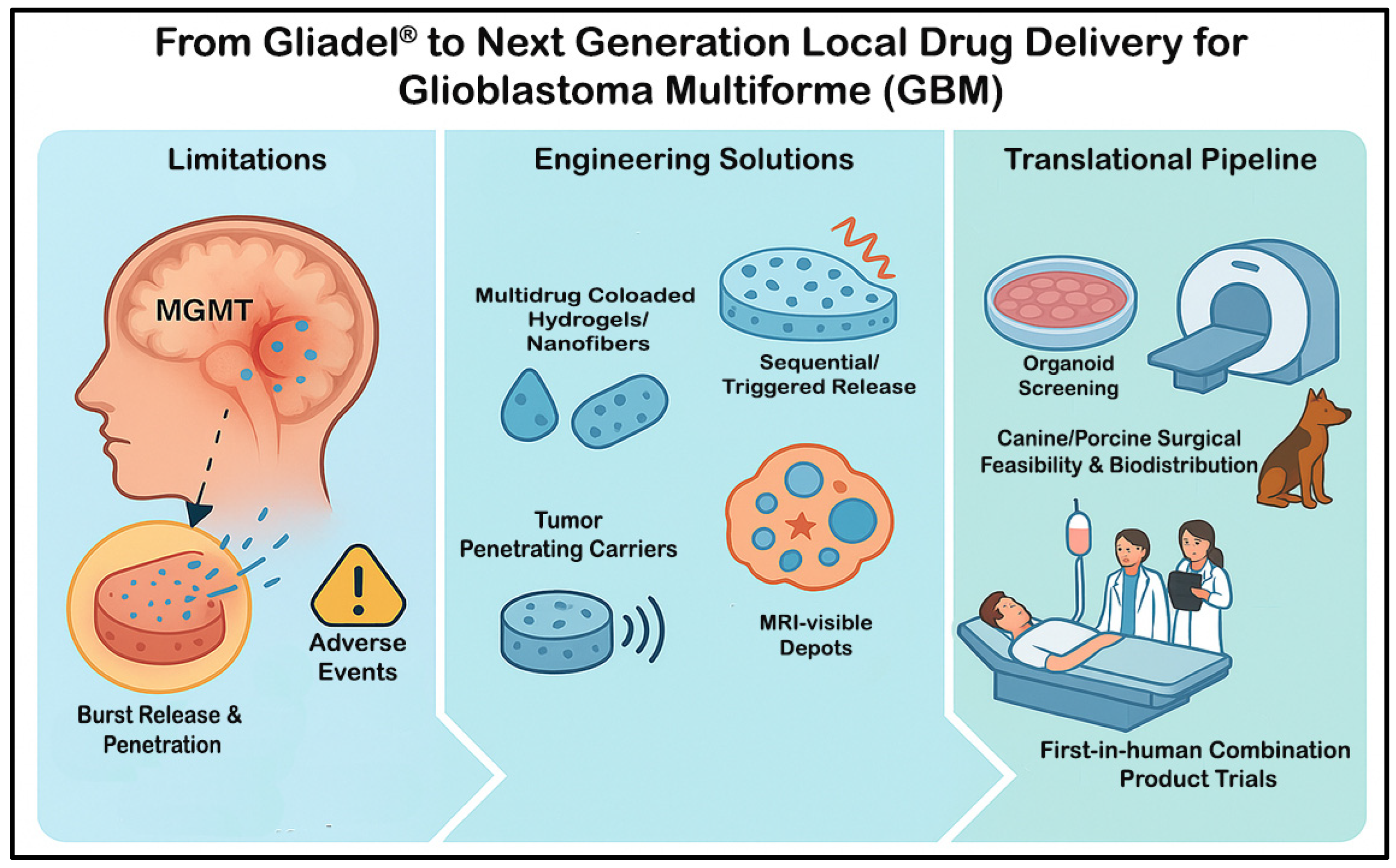
Limitations of Gliadel Wafers and Strategies for Next-Generation Local Delivery Systems for Glioblastoma


Simple Summary
Abstract
1. Introduction
Literature Search Strategy
2. Current Limitations of Gliadel Wafers
2.1. Limited Efficacy of Carmustine as a Single Agent
2.2. Pharmacokinetic Constraints
2.3. Safety, Adverse Effects, and Handling Constraints
3. Emerging Strategies to Overcome Current Limitations
3.1. Multidrug Local Delivery Systems
3.2. Engineering-Enhanced Wafer Systems
3.3. Targeted Therapeutics
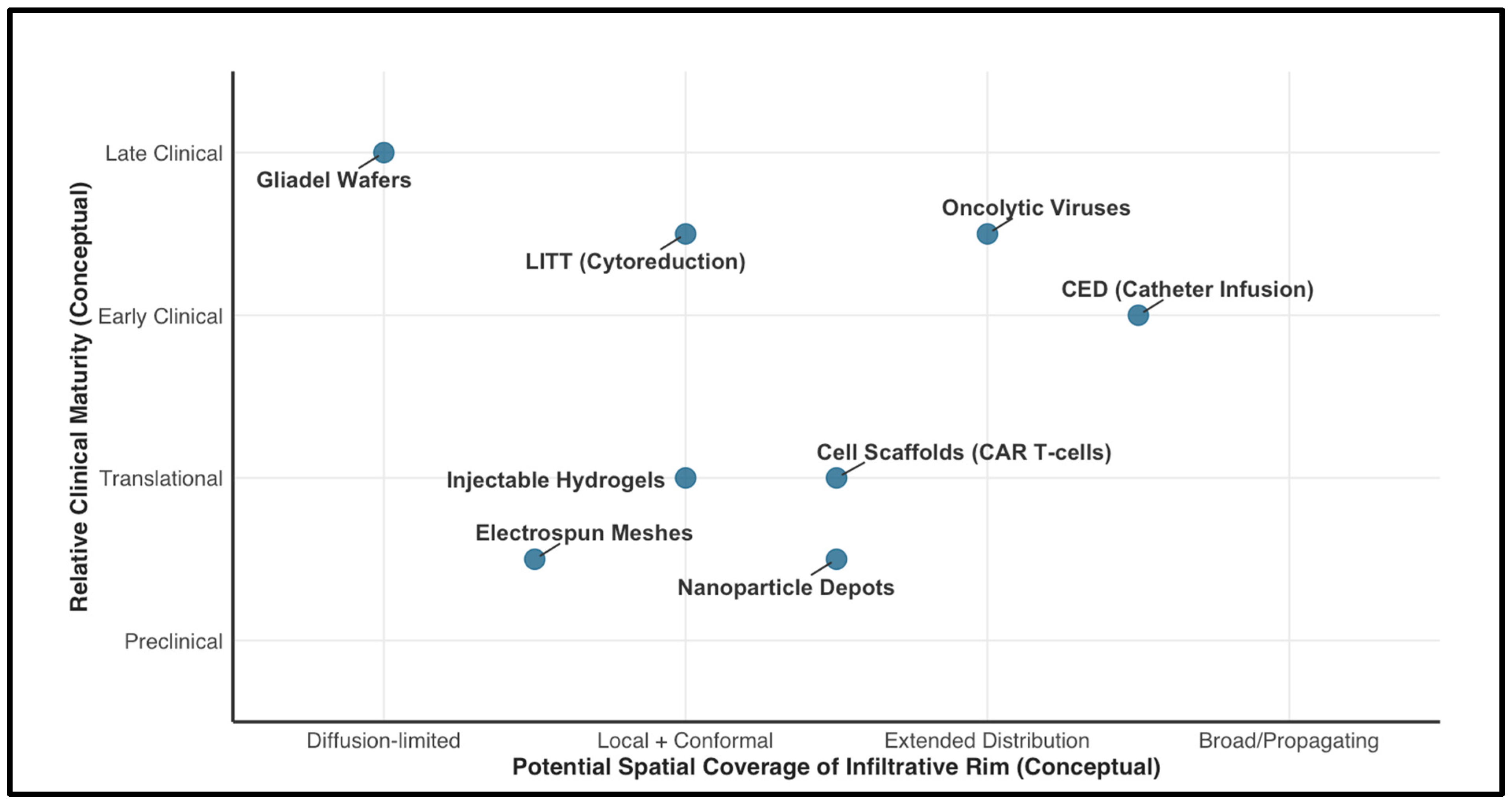
3.4. Comparative Readiness and Translational Barriers
4. Translational Path: Beyond Traditional Preclinical Models
4.1. Efficacy Preclinical Studies
4.2. Safety and Biodistribution Preclinical Studies
5. Conclusions
Author Contributions
Funding
Data Availability Statement
Conflicts of Interest
Abbreviations
| Abbreviation | Definition |
| μMESH | Micro-mesh |
| ADC | Antibody-drug conjugate |
| ABT-414 | Depatuxizumab mafodotin |
| BBB | Blood–brain barrier |
| BCNU | Carmustine (1,3-bis[2-chloroethyl]-1-nitrosourea) |
| CAR | Chimeric antigen receptor |
| CD44 | Cluster of differentiation 44 |
| CDK4/6 | Cyclin-dependent kinases 4 and 6 |
| CED | Convection-enhanced delivery |
| CMC | Chemistry, manufacturing, and controls |
| CNS | Central nervous system |
| CPT-11 | Irinotecan |
| CSF | Cerebrospinal fluid |
| DNA | Deoxyribonucleic acid |
| DNX-2401 | Delta-24-RGD oncolytic adenovirus |
| EGFR | Epidermal growth factor receptor |
| FDA | U.S. Food and Drug Administration |
| G47Δ | Oncolytic herpes simplex virus (G47Δ) |
| GBM | Glioblastoma |
| GBO | Glioblastoma organoid |
| GMP | Good Manufacturing Practice |
| GSC | Glioblastoma stem-like cell |
| HA | Hyaluronic acid |
| HA-NP | Hyaluronic acid-nanoparticle |
| ICP | Intracranial pressure |
| IDH | Isocitrate dehydrogenase |
| IL13Rα2 | Interleukin-13 receptor alpha 2 |
| iRGD | Internalizing arginine-glycine-aspartic acid |
| LbL | Layer-by-layer |
| LITT | Laser interstitial thermal therapy |
| MAPK | Mitogen-activated protein kinase |
| MGMT | O6-methylguanine-DNA methyltransferase |
| MRI | Magnetic resonance imaging |
| mTOR | Mammalian target of rapamycin |
| PARP | Poly(ADP-ribose) polymerase |
| PD | Pharmacodynamic(s) |
| PDX | Patient-derived xenograft |
| PI3K | Phosphoinositide 3-kinase |
| PK/PD | Pharmacokinetics/pharmacodynamics |
| PRO | Patient-reported outcome |
| QA | Quality assurance |
| QOL | Quality of life |
| RANO | Response Assessment in Neuro-Oncology |
| RANO-PRO | Response Assessment in Neuro-Oncology Patient-Reported Outcomes |
| RAS | Rat sarcoma |
| RGD | Arginine-glycine-aspartic acid |
| RT | Radiotherapy |
| RTK | Receptor tyrosine kinase |
| TERT | Telomerase reverse transcriptase |
| TMZ | Temozolomide |
| WHO | World Health Organization |
References
- Louis, D.N.; Perry, A.; Wesseling, P.; Brat, D.J.; Cree, I.A.; Figarella-Branger, D.; Hawkins, C.; Ng, H.K.; Pfister, S.M.; Reifenberger, G.; et al. The 2021 WHO Classification of Tumors of the Central Nervous System: A summary. Neuro Oncol. 2021, 23, 1231–1251. [Google Scholar] [CrossRef] [Scilit]
- Stupp, R.; Mason, W.P.; van den Bent, M.J.; Weller, M.; Fisher, B.; Taphoorn, M.J.; Belanger, K.; Brandes, A.A.; Marosi, C.; Bogdahn, U.; et al. Radiotherapy plus concomitant and adjuvant temozolomide for glioblastoma. N. Engl. J. Med. 2005, 352, 987–996. [Google Scholar] [CrossRef] [Scilit]
- Stupp, R.; Taillibert, S.; Kanner, A.; Read, W.; Steinberg, D.; Lhermitte, B.; Toms, S.; Idbaih, A.; Ahluwalia, M.S.; Fink, K.; et al. Effect of Tumor-Treating Fields Plus Maintenance Temozolomide vs Maintenance Temozolomide Alone on Survival in Patients With Glioblastoma: A Randomized Clinical Trial. JAMA 2017, 318, 2306–2316. [Google Scholar] [CrossRef] [Scilit]
- Kotecha, R.; Odia, Y.; Khosla, A.A.; Ahluwalia, M.S. Key Clinical Principles in the Management of Glioblastoma. JCO Oncol. Pract. 2023, 19, 180–189. [Google Scholar] [CrossRef] [Scilit]
- Langhans, M.; Popp, I.; Grosu, A.L.; Shusharina, N.; Binder, H.; Baltas, D.; Bortfeld, T. Recurrence analysis of glioblastoma cases based on distance and dose information. Radiother. Oncol. 2023, 183, 109600. [Google Scholar] [CrossRef] [Scilit] [PubMed]
- Bastiancich, C.; Malfanti, A.; Préat, V.; Rahman, R. Rationally designed drug delivery systems for the local treatment of resected glioblastoma. Adv. Drug Deliv. Rev. 2021, 177, 113951. [Google Scholar] [CrossRef] [Scilit] [PubMed]
- Sherriff, J.; Tamangani, J.; Senthil, L.; Cruickshank, G.; Spooner, D.; Jones, B.; Brookes, C.; Sanghera, P. Patterns of relapse in glioblastoma multiforme following concomitant chemoradiotherapy with temozolomide. Br. J. Radiol. 2013, 86, 20120414. [Google Scholar] [CrossRef] [Scilit] [PubMed]
- Zheng, L.; Zhou, Z.R.; Yu, Q.; Shi, M.; Yang, Y.; Zhou, X.; Li, C.; Wei, Q. The Definition and Delineation of the Target Area of Radiotherapy Based on the Recurrence Pattern of Glioblastoma After Temozolomide Chemoradiotherapy. Front. Oncol. 2020, 10, 615368. [Google Scholar] [CrossRef] [Scilit]
- Cha, G.D.; Jung, S.; Choi, S.H.; Kim, D.H. Local Drug Delivery Strategies for Glioblastoma Treatment. Brain Tumor Res. Treat. 2022, 10, 151–157. [Google Scholar] [CrossRef] [Scilit]
- Gazaille, C.; Sicot, M.; Saulnier, P.; Eyer, J.; Bastiat, G. Local Delivery and Glioblastoma: Why Not Combining Sustained Release and Targeting? Front. Med. Technol. 2021, 3, 791596. [Google Scholar] [CrossRef] [Scilit]
- Bota, D.A.; Desjardins, A.; Quinn, J.A.; Affronti, M.L.; Friedman, H.S. Interstitial chemotherapy with biodegradable BCNU (Gliadel) wafers in the treatment of malignant gliomas. Ther. Clin. Risk Manag. 2007, 3, 707–715. [Google Scholar] [PubMed]
- Brem, H.; Piantadosi, S.; Burger, P.C.; Walker, M.; Selker, R.; Vick, N.A.; Black, K.; Sisti, M.; Brem, S.; Mohr, G.; et al. Placebo-controlled trial of safety and efficacy of intraoperative controlled delivery by biodegradable polymers of chemotherapy for recurrent gliomas. The Polymer-brain Tumor Treatment Group. Lancet 1995, 345, 1008–1012. [Google Scholar] [CrossRef] [Scilit]
- Westphal, M.; Hilt, D.C.; Bortey, E.; Delavault, P.; Olivares, R.; Warnke, P.C.; Whittle, I.R.; Jääskeläinen, J.; Ram, Z. A phase 3 trial of local chemotherapy with biodegradable carmustine (BCNU) wafers (Gliadel wafers) in patients with primary malignant glioma. Neuro Oncol. 2003, 5, 79–88. [Google Scholar] [CrossRef] [Scilit]
- Ashby, L.S.; Smith, K.A.; Stea, B. Gliadel wafer implantation combined with standard radiotherapy and concurrent followed by adjuvant temozolomide for treatment of newly diagnosed high-grade glioma: A systematic literature review. World J. Surg. Oncol. 2016, 14, 225. [Google Scholar] [CrossRef] [Scilit] [PubMed]
- Chowdhary, S.A.; Ryken, T.; Newton, H.B. Survival outcomes and safety of carmustine wafers in the treatment of high-grade gliomas: A meta-analysis. J. Neurooncol. 2015, 122, 367–382. [Google Scholar] [CrossRef] [Scilit]
- Bodell, W.J.; Aida, T.; Berger, M.S.; Rosenblum, M.L. Repair of O6-(2-chloroethyl)guanine mediates the biological effects of chloroethylnitrosoureas. Environ. Health Perspect. 1985, 62, 119–126. [Google Scholar] [CrossRef] [Scilit]
- Nikolova, T.; Roos, W.P.; Krämer, O.H.; Strik, H.M.; Kaina, B. Chloroethylating nitrosoureas in cancer therapy: DNA damage, repair and cell death signaling. Biochim. Biophys. Acta Rev. Cancer 2017, 1868, 29–39. [Google Scholar] [CrossRef] [Scilit] [PubMed]
- Gerson, S.L.; Willson, J.K. O6-alkylguanine-DNA alkyltransferase. A target for the modulation of drug resistance. Hematol. Oncol. Clin. N. Am. 1995, 9, 431–450. [Google Scholar] [CrossRef] [Scilit]
- Margison, G.P.; Povey, A.C.; Kaina, B.; Santibáñez Koref, M.F. Variability and regulation of O6-alkylguanine-DNA alkyltransferase. Carcinogenesis 2003, 24, 625–635. [Google Scholar] [CrossRef] [Scilit]
- Wait, S.D.; Prabhu, R.S.; Burri, S.H.; Atkins, T.G.; Asher, A.L. Polymeric drug delivery for the treatment of glioblastoma. Neuro Oncol. 2015, 17, ii9–ii23. [Google Scholar] [CrossRef] [Scilit]
- Hersh, A.M.; Gaitsch, H.; Alomari, S.; Lubelski, D.; Tyler, B.M. Molecular Pathways and Genomic Landscape of Glioblastoma Stem Cells: Opportunities for Targeted Therapy. Cancers 2022, 14, 3743. [Google Scholar] [CrossRef] [Scilit]
- Affronti, M.L.; Heery, C.R.; Herndon, J.E., 2nd; Rich, J.N.; Reardon, D.A.; Desjardins, A.; Vredenburgh, J.J.; Friedman, A.H.; Bigner, D.D.; Friedman, H.S. Overall survival of newly diagnosed glioblastoma patients receiving carmustine wafers followed by radiation and concurrent temozolomide plus rotational multiagent chemotherapy. Cancer 2009, 115, 3501–3511. [Google Scholar] [CrossRef] [Scilit]
- McGirt, M.J.; Than, K.D.; Weingart, J.D.; Chaichana, K.L.; Attenello, F.J.; Olivi, A.; Laterra, J.; Kleinberg, L.R.; Grossman, S.A.; Brem, H.; et al. Gliadel (BCNU) wafer plus concomitant temozolomide therapy after primary resection of glioblastoma multiforme. J. Neurosurg. 2009, 110, 583–588. [Google Scholar] [CrossRef] [Scilit]
- Pallud, J.; Audureau, E.; Noel, G.; Corns, R.; Lechapt-Zalcman, E.; Duntze, J.; Pavlov, V.; Guyotat, J.; Hieu, P.D.; Le Reste, P.J.; et al. Long-term results of carmustine wafer implantation for newly diagnosed glioblastomas: A controlled propensity-matched analysis of a French multicenter cohort. Neuro Oncol. 2015, 17, 1609–1619. [Google Scholar] [CrossRef] [Scilit] [PubMed]
- Price, S.J.; Whittle, I.R.; Ashkan, K.; Grundy, P.; Cruickshank, G. NICE guidance on the use of carmustine wafers in high grade gliomas: A national study on variation in practice. Br. J. Neurosurg. 2012, 26, 331–335. [Google Scholar] [CrossRef] [Scilit] [PubMed]
- Weller, M.; van den Bent, M.; Preusser, M.; Le Rhun, E.; Tonn, J.C.; Minniti, G.; Bendszus, M.; Balana, C.; Chinot, O.; Dirven, L.; et al. EANO guidelines on the diagnosis and treatment of diffuse gliomas of adulthood. Nat. Rev. Clin. Oncol. 2021, 18, 170–186. [Google Scholar] [CrossRef] [Scilit]
- d’Avella, D.; DellaPuppa, A. Safety and efficacy of Gliadel wafers for newly diagnosed and recurrent glioblastomas. Acta Neurochir. 2012, 154, 1379–1381. [Google Scholar] [CrossRef] [Scilit] [PubMed]
- Mangraviti, A.; Tyler, B.; Brem, H. Interstitial chemotherapy for malignant glioma: Future prospects in the era of multimodal therapy. Surg. Neurol. Int. 2015, 6, S78–S84. [Google Scholar] [CrossRef] [Scilit]
- Auffinger, B.; Spencer, D.; Pytel, P.; Ahmed, A.U.; Lesniak, M.S. The role of glioma stem cells in chemotherapy resistance and glioblastoma multiforme recurrence. Expert. Rev. Neurother. 2015, 15, 741–752. [Google Scholar] [CrossRef] [Scilit]
- Singh, N.; Miner, A.; Hennis, L.; Mittal, S. Mechanisms of temozolomide resistance in glioblastoma—A comprehensive review. Cancer Drug Resist. 2021, 4, 17–43. [Google Scholar] [CrossRef] [Scilit]
- Brooks, L.J.; Clements, M.P.; Burden, J.J.; Kocher, D.; Richards, L.; Devesa, S.C.; Zakka, L.; Woodberry, M.; Ellis, M.; Jaunmuktane, Z.; et al. The white matter is a pro-differentiative niche for glioblastoma. Nat. Commun. 2021, 12, 2184. [Google Scholar] [CrossRef] [Scilit]
- Brooks, M.D.; Sengupta, R.; Snyder, S.C.; Rubin, J.B. Hitting Them Where They Live: Targeting the Glioblastoma Perivascular Stem Cell Niche. Curr. Pathobiol. Rep. 2013, 1, 101–110. [Google Scholar] [CrossRef] [Scilit]
- Fedele, M.; Cerchia, L.; Pegoraro, S.; Sgarra, R.; Manfioletti, G. Proneural-Mesenchymal Transition: Phenotypic Plasticity to Acquire Multitherapy Resistance in Glioblastoma. Int. J. Mol. Sci. 2019, 20, 2746. [Google Scholar] [CrossRef] [Scilit]
- Wang, Z.; Zhang, H.; Xu, S.; Liu, Z.; Cheng, Q. The adaptive transition of glioblastoma stem cells and its implications on treatments. Signal Transduct. Target. Ther. 2021, 6, 124. [Google Scholar] [CrossRef] [Scilit] [PubMed]
- Dang, W.; Daviau, T.; Brem, H. Morphological characterization of polyanhydride biodegradable implant gliadel during in vitro and in vivo erosion using scanning electron microscopy. Pharm. Res. 1996, 13, 683–691. [Google Scholar] [CrossRef] [Scilit] [PubMed]
- Arbor Pharmaceuticals, LLC. GLIADEL Wafer (Carmustine Implant) [Prescribing Information]; Arbor Pharmaceuticals, LLC: Atlanta, GA, USA, 2025; Available online: https://gliadel.com/wp-content/uploads/2025/02/Gliadel-Prescribing-Information.pdf (accessed on 6 November 2025).
- US Food and Drug Administration. GLIADEL Wafer (Carmustine Implant) [Prescribing Information]; US Food and Drug Administration: Silver Spring, MD, USA, 2018. Available online: https://www.accessdata.fda.gov/drugsatfda_docs/label/2018/020637s029lbl.pdf (accessed on 6 November 2025).
- Healy, A.T.; Vogelbaum, M.A. Convection-enhanced drug delivery for gliomas. Surg. Neurol. Int. 2015, 6, S59–S67. [Google Scholar] [CrossRef] [Scilit]
- Wang, C.C.; Li, J.; Teo, C.S.; Lee, T. The delivery of BCNU to brain tumors. J. Control Release 1999, 61, 21–41. [Google Scholar] [CrossRef] [Scilit] [PubMed]
- Bodell, W.J.; Bodell, A.P.; Giannini, D.D. Levels and distribution of BCNU in GBM tumors following intratumoral injection of DTI-015 (BCNU-ethanol). Neuro Oncol. 2007, 9, 12–19. [Google Scholar] [CrossRef] [Scilit] [PubMed]
- Tabet, A.; Jensen, M.P.; Parkins, C.C.; Patil, P.G.; Watts, C.; Scherman, O.A. Designing Next-Generation Local Drug Delivery Vehicles for Glioblastoma Adjuvant Chemotherapy: Lessons from the Clinic. Adv. Healthc. Mater. 2019, 8, e1801391. [Google Scholar] [CrossRef] [Scilit]
- Weber, E.L.; Goebel, E.A. Cerebral edema associated with Gliadel wafers: Two case studies. Neuro Oncol. 2005, 7, 84–89. [Google Scholar] [CrossRef] [Scilit]
- Health Products Regulatory Authority. Gliadel 7.7 mg Implant: Summary of Product Characteristics; Health Products Regulatory Authority: Dublin, Ireland, 2025. Available online: https://assets.hpra.ie/products/Human/23877/Licence_PA22701-003-001_28022025163520.pdf (accessed on 6 November 2025).
- Ricciardi, L.; Manini, I.; Cesselli, D.; Trungu, S.; Piazza, A.; Mangraviti, A.; Miscusi, M.; Raco, A.; Ius, T. Carmustine Wafers Implantation in Patients With Newly Diagnosed High Grade Glioma: Is It Still an Option? Front. Neurol. 2022, 13, 884158. [Google Scholar] [CrossRef] [Scilit]
- Xiao, Z.Z.; Wang, Z.F.; Lan, T.; Huang, W.H.; Zhao, Y.H.; Ma, C.; Li, Z.Q. Carmustine as a Supplementary Therapeutic Option for Glioblastoma: A Systematic Review and Meta-Analysis. Front. Neurol. 2020, 11, 1036. [Google Scholar] [CrossRef] [Scilit]
- Dörner, L.; Ulmer, S.; Rohr, A.; Mehdorn, H.M.; Nabavi, A. Space-occupying cyst development in the resection cavity of malignant gliomas following Gliadel® implantation--incidence, therapeutic strategies, and outcome. J. Clin. Neurosci. 2011, 18, 347–351. [Google Scholar] [CrossRef] [Scilit]
- McGirt, M.J.; Villavicencio, A.T.; Bulsara, K.R.; Friedman, H.S.; Friedman, A.H. Management of tumor bed cysts after chemotherapeutic wafer implantation. Report of four cases. J. Neurosurg. 2002, 96, 941–945. [Google Scholar] [CrossRef] [Scilit]
- Zhong, Z.; Gan, L.; Feng, Z.; Wang, W.; Pan, X.; Wu, C.; Huang, Y. Hydrogel local drug delivery systems for postsurgical management of tumors: Status Quo and perspectives. Mater. Today Bio 2024, 29, 101308. [Google Scholar] [CrossRef] [Scilit]
- Alomari, S.; Zhang, I.; Hernandez, A.; Kraft, C.Y.; Raj, D.; Kedda, J.; Tyler, B. Drug Repurposing for Glioblastoma and Current Advances in Drug Delivery-A Comprehensive Review of the Literature. Biomolecules 2021, 11, 1870. [Google Scholar] [CrossRef] [Scilit]
- Shapira-Furman, T.; Serra, R.; Gorelick, N.; Doglioli, M.; Tagliaferri, V.; Cecia, A.; Peters, M.; Kumar, A.; Rottenberg, Y.; Langer, R.; et al. Biodegradable wafers releasing Temozolomide and Carmustine for the treatment of brain cancer. J. Control Release 2019, 295, 93–101. [Google Scholar] [CrossRef] [Scilit] [PubMed]
- Quinn, J.A.; Jiang, S.X.; Carter, J.; Reardon, D.A.; Desjardins, A.; Vredenburgh, J.J.; Rich, J.N.; Gururangan, S.; Friedman, A.H.; Bigner, D.D.; et al. Phase II trial of Gliadel plus O6-benzylguanine in adults with recurrent glioblastoma multiforme. Clin. Cancer Res. 2009, 15, 1064–1068. [Google Scholar] [CrossRef] [Scilit] [PubMed]
- Slika, H.; Shahani, A.; Gattu, K.; Mundrathi, V.; Solan, A.A.; Gonzalez, B.; Haque, T.N.; Rahman, S.; Sugandhi, V.V.; Lee, J.; et al. Intracranial Nanogel Pellets Carrying Temozolomide and Paclitaxel for Adjuvant Brain Cancer Therapy. Mol. Pharm. 2025, 22, 131–141. [Google Scholar] [CrossRef] [Scilit] [PubMed]
- Weingart, J.; Grossman, S.A.; Carson, K.A.; Fisher, J.D.; Delaney, S.M.; Rosenblum, M.L.; Olivi, A.; Judy, K.; Tatter, S.B.; Dolan, M.E. Phase I trial of polifeprosan 20 with carmustine implant plus continuous infusion of intravenous O6-benzylguanine in adults with recurrent malignant glioma: New approaches to brain tumor therapy CNS consortium trial. J. Clin. Oncol. 2007, 25, 399–404. [Google Scholar] [CrossRef] [Scilit]
- Zhao, M.; Bozzato, E.; Joudiou, N.; Ghiassinejad, S.; Danhier, F.; Gallez, B.; Préat, V. Codelivery of paclitaxel and temozolomide through a photopolymerizable hydrogel prevents glioblastoma recurrence after surgical resection. J. Control Release 2019, 309, 72–81. [Google Scholar] [CrossRef] [Scilit] [PubMed]
- Alghamdi, M.; Gumbleton, M.; Newland, B. Local delivery to malignant brain tumors: Potential biomaterial-based therapeutic/adjuvant strategies. Biomater. Sci. 2021, 9, 6037–6051. [Google Scholar] [CrossRef] [Scilit]
- Bastiancich, C.; Danhier, P.; Préat, V.; Danhier, F. Anticancer drug-loaded hydrogels as drug delivery systems for the local treatment of glioblastoma. J. Control Release 2016, 243, 29–42. [Google Scholar] [CrossRef] [Scilit]
- Cancer Genome Atlas Research Network. Comprehensive genomic characterization defines human glioblastoma genes and core pathways. Nature 2008, 455, 1061–1068. [Google Scholar] [CrossRef] [Scilit]
- Verhaak, R.G.; Hoadley, K.A.; Purdom, E.; Wang, V.; Qi, Y.; Wilkerson, M.D.; Miller, C.R.; Ding, L.; Golub, T.; Mesirov, J.P.; et al. Integrated genomic analysis identifies clinically relevant subtypes of glioblastoma characterized by abnormalities in PDGFRA, IDH1, EGFR, and NF1. Cancer Cell 2010, 17, 98–110. [Google Scholar] [CrossRef] [Scilit] [PubMed]
- Bow, H.; Hwang, L.S.; Schildhaus, N.; Xing, J.; Murray, L.; Salditch, Q.; Ye, X.; Zhang, Y.; Weingart, J.; Brem, H.; et al. Local delivery of angiogenesis-inhibitor minocycline combined with radiotherapy and oral temozolomide chemotherapy in 9L glioma. J. Neurosurg. 2014, 120, 662–669. [Google Scholar] [CrossRef] [Scilit] [PubMed]
- Gaitsch, H.; Hersh, A.M.; Alomari, S.; Tyler, B.M. Dendrimer Technology in Glioma: Functional Design and Potential Applications. Cancers 2023, 15, 1075. [Google Scholar] [CrossRef] [Scilit] [PubMed]
- Han, D.; Serra, R.; Gorelick, N.; Fatima, U.; Eberhart, C.G.; Brem, H.; Tyler, B.; Steckl, A.J. Multi-layered core-sheath fiber membranes for controlled drug release in the local treatment of brain tumor. Sci. Rep. 2019, 9, 17936. [Google Scholar] [CrossRef] [Scilit]
- Li, J.; Xu, W.; Li, D.; Liu, T.; Zhang, Y.S.; Ding, J.; Chen, X. Locally Deployable Nanofiber Patch for Sequential Drug Delivery in Treatment of Primary and Advanced Orthotopic Hepatomas. ACS Nano 2018, 12, 6685–6699. [Google Scholar] [CrossRef] [Scilit]
- Hersh, A.M.; Alomari, S.; Tyler, B.M. Crossing the Blood-Brain Barrier: Advances in Nanoparticle Technology for Drug Delivery in Neuro-Oncology. Int. J. Mol. Sci. 2022, 23, 4153. [Google Scholar] [CrossRef] [Scilit]
- Bastiancich, C.; Bianco, J.; Vanvarenberg, K.; Ucakar, B.; Joudiou, N.; Gallez, B.; Bastiat, G.; Lagarce, F.; Préat, V.; Danhier, F. Injectable nanomedicine hydrogel for local chemotherapy of glioblastoma after surgical resection. J. Control Release 2017, 264, 45–54. [Google Scholar] [CrossRef] [Scilit]
- Ding, L.; Wang, Q.; Shen, M.; Sun, Y.; Zhang, X.; Huang, C.; Chen, J.; Li, R.; Duan, Y. Thermoresponsive nanocomposite gel for local drug delivery to suppress the growth of glioma by inducing autophagy. Autophagy 2017, 13, 1176–1190. [Google Scholar] [CrossRef] [Scilit] [PubMed]
- Pickering, A.J.; Lamson, N.G.; Marand, M.H.; Hwang, W.; Straehla, J.P.; Hammond, P.T. Layer-by-Layer Polymer Functionalization Improves Nanoparticle Penetration and Glioblastoma Targeting in the Brain. ACS Nano 2023, 17, 24154–24169. [Google Scholar] [CrossRef] [Scilit] [PubMed]
- Shadab, A.; Farokhi, S.; Fakouri, A.; Mohagheghzadeh, N.; Noroozi, A.; Razavi, Z.S.; Karimi Rouzbahani, A.; Zalpoor, H.; Mahjoor, M. Hydrogel-based nanoparticles: Revolutionizing brain tumor treatment and paving the way for future innovations. Eur. J. Med. Res. 2025, 30, 71. [Google Scholar] [CrossRef] [Scilit]
- Kim, J.I.; Kim, B.; Chun, C.; Lee, S.H.; Song, S.C. MRI-monitored long-term therapeutic hydrogel system for brain tumors without surgical resection. Biomaterials 2012, 33, 4836–4842. [Google Scholar] [CrossRef] [Scilit] [PubMed]
- Mess, G.; Anderson, T.; Kapoor, S.; Thombre, R.; Liang, R.; Derin, E.; Kempski-Leadingham, K.M.; Yadav, S.K.; Tyler, B.; Manbachi, A. Sonodynamic Therapy for the Treatment of Glioblastoma Multiforme in a Mouse Model Using a Portable Benchtop Focused Ultrasound System. J. Vis. Exp. 2023, 192, 65114. [Google Scholar] [CrossRef] [Scilit]
- Yang, J.; Wang, Z.; Ma, C.; Tang, H.; Hao, H.; Li, M.; Luo, X.; Yang, M.; Gao, L.; Li, J. Advances in Hydrogels of Drug Delivery Systems for the Local Treatment of Brain Tumors. Gels 2024, 10, 404. [Google Scholar] [CrossRef] [Scilit]
- Beola, L.; Iturrioz-Rodríguez, N.; Pucci, C.; Bertorelli, R.; Ciofani, G. Drug-Loaded Lipid Magnetic Nanoparticles for Combined Local Hyperthermia and Chemotherapy against Glioblastoma Multiforme. ACS Nano 2023, 17, 18441–18455. [Google Scholar] [CrossRef] [Scilit]
- Sun, Y.; Chen, L.G.; Fan, X.M.; Pang, J.L. Ultrasound Responsive Smart Implantable Hydrogels for Targeted Delivery of Drugs: Reviewing Current Practices. Int. J. Nanomed. 2022, 17, 5001–5026. [Google Scholar] [CrossRef] [Scilit]
- Arrieta, V.A.; Gould, A.; Kim, K.S.; Habashy, K.J.; Dmello, C.; Vázquez-Cervantes, G.I.; Palacín-Aliana, I.; McManus, G.; Amidei, C.; Gomez, C.; et al. Ultrasound-mediated delivery of doxorubicin to the brain results in immune modulation and improved responses to PD-1 blockade in gliomas. Nat. Commun. 2024, 15, 4698. [Google Scholar] [CrossRef] [Scilit]
- Mohammadzadeh, V.; Atapour-Mashhad, H.; Shahvali, S.; Salehi, B.; Shaban, M.; Shirzad, M.; Salahvarzi, A.; Mohammadi, M. Hydrogels as advanced drug delivery platforms for cancer immunotherapy: Promising innovations and future outlook. J. Nanobiotechnol. 2025, 23, 545. [Google Scholar] [CrossRef] [Scilit]
- Lang, F.F.; Conrad, C.; Gomez-Manzano, C.; Yung, W.K.A.; Sawaya, R.; Weinberg, J.S.; Prabhu, S.S.; Rao, G.; Fuller, G.N.; Aldape, K.D.; et al. Phase I Study of DNX-2401 (Delta-24-RGD) Oncolytic Adenovirus: Replication and Immunotherapeutic Effects in Recurrent Malignant Glioma. J. Clin. Oncol. 2018, 36, 1419–1427. [Google Scholar] [CrossRef] [Scilit]
- Todo, T.; Ito, H.; Ino, Y.; Ohtsu, H.; Ota, Y.; Shibahara, J.; Tanaka, M. Intratumoral oncolytic herpes virus G47∆ for residual or recurrent glioblastoma: A phase 2 trial. Nat. Med. 2022, 28, 1630–1639. [Google Scholar] [CrossRef] [Scilit]
- Nassiri, F.; Patil, V.; Yefet, L.S.; Singh, O.; Liu, J.; Dang, R.M.A.; Yamaguchi, T.N.; Daras, M.; Cloughesy, T.F.; Colman, H.; et al. Oncolytic DNX-2401 virotherapy plus pembrolizumab in recurrent glioblastoma: A phase 1/2 trial. Nat. Med. 2023, 29, 1370–1378. [Google Scholar] [CrossRef] [Scilit]
- Rui, Y.; Green, J.J. Overcoming delivery barriers in immunotherapy for glioblastoma. Drug Deliv. Transl. Res. 2021, 11, 2302–2316. [Google Scholar] [CrossRef] [Scilit]
- van Solinge, T.S.; Nieland, L.; Chiocca, E.A.; Broekman, M.L.D. Advances in local therapy for glioblastoma-taking the fight to the tumour. Nat. Rev. Neurol. 2022, 18, 221–236. [Google Scholar] [CrossRef] [Scilit] [PubMed]
- Bailly, C.; Vidal, A.; Bonnemaire, C.; Kraeber-Bodéré, F.; Chérel, M.; Pallardy, A.; Rousseau, C.; Garcion, E.; Lacoeuille, F.; Hindré, F.; et al. Potential for Nuclear Medicine Therapy for Glioblastoma Treatment. Front. Pharmacol. 2019, 10, 772. [Google Scholar] [CrossRef] [Scilit] [PubMed]
- Rolfe, N.W.; Dadario, N.B.; Canoll, P.; Bruce, J.N. A Review of Therapeutic Agents Given by Convection-Enhanced Delivery for Adult Glioblastoma. Pharmaceuticals 2024, 17, 973. [Google Scholar] [CrossRef] [Scilit] [PubMed]
- Haddad, A.F.; Young, J.S.; Aghi, M.K. Using viral vectors to deliver local immunotherapy to glioblastoma. Neurosurg. Focus 2021, 50, E4. [Google Scholar] [CrossRef] [Scilit]
- Branco, F.; Cunha, J.; Mendes, M.; Vitorino, C.; Sousa, J.J. Peptide-Hitchhiking for the Development of Nanosystems in Glioblastoma. ACS Nano 2024, 18, 16359–16394. [Google Scholar] [CrossRef] [Scilit]
- Wang, B.; Tang, D.; Cui, J.; Jiang, H.; Yu, J.; Guo, Z. RGD-based self-assembling nanodrugs for improved tumor therapy. Front. Pharmacol. 2024, 15, 1477409. [Google Scholar] [CrossRef] [Scilit] [PubMed]
- Chen, C.; Fan, R.; Wang, Y.; Wang, L.; Huang, C.; Zhou, L.; Xu, J.; Chen, H.; Guo, G. Hyaluronic Acid-Conjugated Nanoparticles for the Targeted Delivery of Cabazitaxel to CD44-Overexpressing Glioblastoma Cells. J. Biomed. Nanotechnol. 2021, 17, 595–605. [Google Scholar] [CrossRef] [Scilit] [PubMed]
- Hayward, S.L.; Wilson, C.L.; Kidambi, S. Hyaluronic acid-conjugated liposome nanoparticles for targeted delivery to CD44 overexpressing glioblastoma cells. Oncotarget 2016, 7, 34158–34171. [Google Scholar] [CrossRef] [Scilit]
- Morello, A.; Bianconi, A.; Rizzo, F.; Bellomo, J.; Meyer, A.C.; Garbossa, D.; Regli, L.; Cofano, F. Laser Interstitial Thermotherapy (LITT) in Recurrent Glioblastoma: What Window of Opportunity for This Treatment? Technol. Cancer Res. Treat. 2024, 23, 15330338241249026. [Google Scholar] [CrossRef] [Scilit] [PubMed]
- Lassman, A.B.; Pugh, S.L.; Wang, T.J.C.; Aldape, K.; Gan, H.K.; Preusser, M.; Vogelbaum, M.A.; Sulman, E.P.; Won, M.; Zhang, P.; et al. Depatuxizumab mafodotin in EGFR-amplified newly diagnosed glioblastoma: A phase III randomized clinical trial. Neuro Oncol. 2023, 25, 339–350. [Google Scholar] [CrossRef] [Scilit]
- Di Mascolo, D.; Guerriero, I.; Pesce, C.; Spanò, R.; Palange, A.L.; Decuzzi, P. μMESH-Enabled Sustained Delivery of Molecular and Nanoformulated Drugs for Glioblastoma Treatment. ACS Nano 2023, 17, 14572–14585. [Google Scholar] [CrossRef] [Scilit]
- Bagley, S.J.; Logun, M.; Fraietta, J.A.; Wang, X.; Desai, A.S.; Bagley, L.J.; Nabavizadeh, A.; Jarocha, D.; Martins, R.; Maloney, E.; et al. Intrathecal bivalent CAR T cells targeting EGFR and IL13Rα2 in recurrent glioblastoma: Phase 1 trial interim results. Nat. Med. 2024, 30, 1320–1329. [Google Scholar] [CrossRef] [Scilit]
- Logun, M.; Wang, X.; Sun, Y.; Bagley, S.J.; Li, N.; Desai, A.; Zhang, D.Y.; Nasrallah, M.P.; Pai, E.L.; Oner, B.S.; et al. Patient-derived glioblastoma organoids as real-time avatars for assessing responses to clinical CAR-T cell therapy. Cell Stem Cell 2025, 32, 181–190.e4. [Google Scholar] [CrossRef] [Scilit]
- Kass, L.; Thang, M.; Zhang, Y.; DeVane, C.; Logan, J.; Tessema, A.; Perry, J.; Hingtgen, S. Development of a biocompatible 3D hydrogel scaffold using continuous liquid interface production for the delivery of cell therapies to treat recurrent glioblastoma. Bioeng. Transl. Med. 2024, 9, e10676. [Google Scholar] [CrossRef] [Scilit]
- Ogunnaike, E.A.; Valdivia, A.; Yazdimamaghani, M.; Leon, E.; Nandi, S.; Hudson, H.; Du, H.; Khagi, S.; Gu, Z.; Savoldo, B.; et al. Fibrin gel enhances the antitumor effects of chimeric antigen receptor T cells in glioblastoma. Sci. Adv. 2021, 7, eabg5841. [Google Scholar] [CrossRef] [Scilit] [PubMed]
- Tsao, C.T.; Kievit, F.M.; Ravanpay, A.; Erickson, A.E.; Jensen, M.C.; Ellenbogen, R.G.; Zhang, M. Thermoreversible poly(ethylene glycol)-g-chitosan hydrogel as a therapeutic T lymphocyte depot for localized glioblastoma immunotherapy. Biomacromolecules 2014, 15, 2656–2662. [Google Scholar] [CrossRef] [Scilit]
- Buahin, K.G.; Brem, H. Interstitial chemotherapy of experimental brain tumors: Comparison of intratumoral injection versus polymeric controlled release. J. Neurooncol. 1995, 26, 103–110. [Google Scholar] [CrossRef] [Scilit]
- Tamargo, R.J.; Myseros, J.S.; Epstein, J.I.; Yang, M.B.; Chasin, M.; Brem, H. Interstitial chemotherapy of the 9L gliosarcoma: Controlled release polymers for drug delivery in the brain. Cancer Res. 1993, 53, 329–333. [Google Scholar] [PubMed]
- Percie du Sert, N.; Hurst, V.; Ahluwalia, A.; Alam, S.; Avey, M.T.; Baker, M.; Browne, W.J.; Clark, A.; Cuthill, I.C.; Dirnagl, U.; et al. The ARRIVE guidelines 2.0: Updated guidelines for reporting animal research. PLoS Biol. 2020, 18, e3000410. [Google Scholar] [CrossRef] [Scilit]
- Jacob, F.; Ming, G.L.; Song, H. Generation and biobanking of patient-derived glioblastoma organoids and their application in CAR T cell testing. Nat. Protoc. 2020, 15, 4000–4033. [Google Scholar] [CrossRef] [Scilit]
- Slika, H.; Karimov, Z.; Alimonti, P.; Abou-Mrad, T.; De Fazio, E.; Alomari, S.; Tyler, B. Preclinical Models and Technologies in Glioblastoma Research: Evolution, Current State, and Future Avenues. Int. J. Mol. Sci. 2023, 24, 6316. [Google Scholar] [CrossRef] [Scilit]
- Hubert, C.G.; Rivera, M.; Spangler, L.C.; Wu, Q.; Mack, S.C.; Prager, B.C.; Couce, M.; McLendon, R.E.; Sloan, A.E.; Rich, J.N. A Three-Dimensional Organoid Culture System Derived from Human Glioblastomas Recapitulates the Hypoxic Gradients and Cancer Stem Cell Heterogeneity of Tumors Found In Vivo. Cancer Res. 2016, 76, 2465–2477. [Google Scholar] [CrossRef] [Scilit]
- Straehla, J.P.; Hajal, C.; Safford, H.C.; Offeddu, G.S.; Boehnke, N.; Dacoba, T.G.; Wyckoff, J.; Kamm, R.D.; Hammond, P.T. A predictive microfluidic model of human glioblastoma to assess trafficking of blood-brain barrier-penetrant nanoparticles. Proc. Natl. Acad. Sci. USA 2022, 119, e2118697119. [Google Scholar] [CrossRef] [Scilit] [PubMed]
- Mann, B.; Artz, N.; Darawsheh, R.; Kram, D.E.; Hingtgen, S.; Satterlee, A.B. Opportunities and challenges for patient-derived models of brain tumors in functional precision medicine. NPJ Precis. Oncol. 2025, 9, 47. [Google Scholar] [CrossRef] [Scilit] [PubMed]
- Ratliff, M.; Kim, H.; Qi, H.; Kim, M.; Ku, B.; Azorin, D.D.; Hausmann, D.; Khajuria, R.K.; Patel, A.; Maier, E.; et al. Patient-Derived Tumor Organoids for Guidance of Personalized Drug Therapies in Recurrent Glioblastoma. Int. J. Mol. Sci. 2022, 23, 6572. [Google Scholar] [CrossRef] [Scilit]
- Alcaniz, J.; Winkler, L.; Dahlmann, M.; Becker, M.; Orthmann, A.; Haybaeck, J.; Krassnig, S.; Skofler, C.; Kratzsch, T.; Kuhn, S.A.; et al. Clinically relevant glioblastoma patient-derived xenograft models to guide drug development and identify molecular signatures. Front. Oncol. 2023, 13, 1129627. [Google Scholar] [CrossRef] [Scilit]
- Alomari, S.; Kedda, J.; Malla, A.P.; Pacis, V.; Anastasiadis, P.; Xu, S.; McFarland, E.; Sukhon, L.; Gallo, B.; Rincon-Torroella, J.; et al. Implementation of Minimally Invasive Brain Tumor Resection in Rodents for High Viability Tissue Collection. J. Vis. Exp. 2022, 183, e64048. [Google Scholar] [CrossRef] [Scilit] [PubMed]
- Dirven, L.; Armstrong, T.S.; Blakeley, J.O.; Brown, P.D.; Grant, R.; Jalali, R.; Leeper, H.; Mendoza, T.; Nayak, L.; Reijneveld, J.C.; et al. Working plan for the use of patient-reported outcome measures in adults with brain tumours: A Response Assessment in Neuro-Oncology (RANO) initiative. Lancet Oncol. 2018, 19, e173–e180. [Google Scholar] [CrossRef] [Scilit] [PubMed]
- Scheepens, J.C.C.; Taphoorn, M.J.B.; Koekkoek, J.A.F. Patient-reported outcomes in neuro-oncology. Curr. Opin. Oncol. 2024, 36, 560–568. [Google Scholar] [CrossRef] [Scilit] [PubMed]
- Pelak, D.M.J.; Hummer, A.; Hug, P.E.; Töpfer, S.; Birgit Flechl, I.; Mozes, P.; Fossati, P.P.; Fussl, C.; Surböck, B.; Hainfellner, P.J.; et al. Patient-reported outcomes, neurocognitive functioning and oncologic results of pencil-beam-scanning proton beam therapy for CNS WHO G2 and G3 IDH1-mutant diffuse adult glioma: A single institution experience. Int. J. Radiat. Oncol. Biol. Phys. 2025. [Google Scholar] [CrossRef] [Scilit]
- Taphoorn, M.J.; Stupp, R.; Coens, C.; Osoba, D.; Kortmann, R.; van den Bent, M.J.; Mason, W.; Mirimanoff, R.O.; Baumert, B.G.; Eisenhauer, E.; et al. Health-related quality of life in patients with glioblastoma: A randomised controlled trial. Lancet Oncol. 2005, 6, 937–944. [Google Scholar] [CrossRef] [Scilit]
- Vera, E.; Christ, A.; Grajkowska, E.; Briceno, N.; Choi, A.; Crandon, S.K.; Wall, K.; Lindsley, M.; Leeper, H.E.; Levine, J.; et al. Relationship between RANO-PRO Working Group standardised priority constructs and disease progression among malignant glioma patients: A retrospective cohort study. EClinicalMedicine 2023, 55, 101718. [Google Scholar] [CrossRef] [Scilit]
- Noll, K.; King, A.L.; Dirven, L.; Armstrong, T.S.; Taphoorn, M.J.B.; Wefel, J.S. Neurocognition and Health-Related Quality of Life Among Patients with Brain Tumors. Hematol. Oncol. Clin. N. Am. 2022, 36, 269–282. [Google Scholar] [CrossRef] [Scilit]
- Dickinson, P.J.; LeCouteur, R.A.; Higgins, R.J.; Bringas, J.R.; Larson, R.F.; Yamashita, Y.; Krauze, M.T.; Forsayeth, J.; Noble, C.O.; Drummond, D.C.; et al. Canine spontaneous glioma: A translational model system for convection-enhanced delivery. Neuro Oncol. 2010, 12, 928–940. [Google Scholar] [CrossRef] [Scilit]
- José-López, R. Chemotherapy for the treatment of intracranial glioma in dogs. Front. Vet. Sci. 2023, 10, 1273122. [Google Scholar] [CrossRef] [Scilit]
- Hicks, J.; Platt, S.; Stewart, G.; Senneca, C.; Holmes, S.; Kent, M.; Howerth, E.; Kaplan, J.; Kaplan, E. Intratumoral temozolomide in spontaneous canine gliomas: Feasibility of a novel therapy using implanted microcylinders. Vet. Med. Sci. 2019, 5, 5–18. [Google Scholar] [CrossRef] [Scilit]
- Workman, P.; Aboagye, E.O.; Balkwill, F.; Balmain, A.; Bruder, G.; Chaplin, D.J.; Double, J.A.; Everitt, J.; Farningham, D.A.; Glennie, M.J.; et al. Guidelines for the welfare and use of animals in cancer research. Br. J. Cancer 2010, 102, 1555–1577. [Google Scholar] [CrossRef] [Scilit]
- LeBlanc, A.K.; Mazcko, C.; Brown, D.E.; Koehler, J.W.; Miller, A.D.; Miller, C.R.; Bentley, R.T.; Packer, R.A.; Breen, M.; Boudreau, C.E.; et al. Creation of an NCI comparative brain tumor consortium: Informing the translation of new knowledge from canine to human brain tumor patients. Neuro Oncol. 2016, 18, 1209–1218. [Google Scholar] [CrossRef] [Scilit] [PubMed]
- Paoloni, M.; Khanna, C. Translation of new cancer treatments from pet dogs to humans. Nat. Rev. Cancer 2008, 8, 147–156. [Google Scholar] [CrossRef] [Scilit] [PubMed]
- Spinazzi, E.F.; Argenziano, M.G.; Upadhyayula, P.S.; Banu, M.A.; Neira, J.A.; Higgins, D.M.O.; Wu, P.B.; Pereira, B.; Mahajan, A.; Humala, N.; et al. Chronic convection-enhanced delivery of topotecan for patients with recurrent glioblastoma: A first-in-patient, single-centre, single-arm, phase 1b trial. Lancet Oncol. 2022, 23, 1409–1418. [Google Scholar] [CrossRef] [Scilit] [PubMed]
- Upadhyayula, P.S.; Spinazzi, E.F.; Argenziano, M.G.; Canoll, P.; Bruce, J.N. Convection Enhanced Delivery of Topotecan for Gliomas: A Single-Center Experience. Pharmaceutics 2020, 13, 39. [Google Scholar] [CrossRef] [Scilit]



| Emerging Strategy | Comparative Analysis |
|---|---|
Multidrug cytotoxic depots
| Address: single-agent resistance/heterogeneity; increase local multi-mechanism cytotoxicity while keeping systemic exposure low. Advantages: enable BBB-limited or systemically toxic agents locally. Challenges: rational selection of combination therapies, drug–matrix compatibility, local edema/toxicity; still largely diffusion-limited unless paired with penetration enhancers. Maturity: mainly preclinical orthotopic/resection models; early combination experiences. |
Resistance/sensitization combinations
| Address: MGMT/DNA-repair driven alkylator resistance; leverage synergy with radiotherapy/standard TMZ. Advantages: mechanism-driven sensitization may increase efficacy without higher systemic alkylator doses. Challenges: systemic toxicity for some sensitizers, complex scheduling, and limited/heterogeneous clinical efficacy signals. |
Conformal in situ–forming depots
| Address: cavity geometry (conformal coverage), burst release, and mechanical irritation of rigid wafers. Advantages: tissue-matched compliance; tunable degradation with sustained (near-linear) release; compatible with multidrug payloads and immunomodulators. Challenges: in vivo kinetics can deviate from in vitro (swelling/enzymes/CSF exchange); sterilization/GMP scale-up; intracranial edema/ICP monitoring. |
Programmable meshes/patches
| Address: need for longer and programmable release (including sequential dosing) and improved surface contact. Advantages: staged therapy (e.g., early radiosensitizer then prolonged chemo); robust handling; potential for engineered gradients at the infiltrative rim. Challenges: achieving conformality in complex cavities; diffusion-limited depth without adjunct distribution strategies; manufacturing reproducibility. |
Nanoparticle-mediated targeting systems
| Address: short diffusion radius and non-selective exposure by improving peri-cavity penetration and GBM-cell uptake. Advantages: modular payloads (poorly soluble drugs, biologics); can be embedded in hydrogels/meshes; potential to reduce off-target effects. Challenges: heterogeneous/variable target expression and phenotypic switching; negative systemic EGFR-targeted ADC trial underscores selection challenges; nanoparticle toxicity/clearance; complex CMC and “combination product” regulation. |
Imaging-visible/theranostic platforms
| Address: uncertainty in placement and in vivo distribution; enable exposure verification and longitudinal monitoring. Advantages: noninvasive QA of depot integrity/coverage; support adaptive early-phase trial designs. Challenges: imaging signal may not perfectly map drug concentrations; added agents must be safe; increased regulatory complexity. |
Stimuli-responsive/triggerable systems
| Address: fixed kinetics of passive depots and limited spatial effect by enabling on-demand release boosts or orthogonal cytotoxic mechanisms. Advantages: temporal control; potential synergy with immunotherapy and checkpoint blockade. Challenges: device hardware, dosimetry, and safety (heating, BBB effects, edema/ICP); reproducibility in the human brain. |
Implantable microdevices/reservoirs
| Address: need for long-duration, predictable delivery and compatibility with diverse formulation types. Advantages: high loading flexibility; sustained release architecture potentially decoupled from polymer erosion. Challenges: neurosurgical workflow and biocompatibility over months; device-related complications; combination-product regulatory pathway. |
CED-based distribution strategies
| Address: core diffusion limitation by achieving centimeter-scale volume of distribution through bulk interstitial flow. Advantages: adjustable dosing; compatible with large biologics/toxins/radiopharmaceuticals; exposure–response can be quantified. Challenges: catheter placement/reflux, heterogeneous distribution, infection risk, and operational complexity. |
Targeted biologics & immunotherapy
| Address: need for tumor-selective oncolysis and immune activation, with potential spread beyond the initial delivery zone. Advantages: early-phase clinical signals of durable responses in subsets; synergy with checkpoint inhibitors while limiting systemic exposure. Challenges: immunogenicity and control of biodistribution/shedding; inflammatory edema; GMP manufacturing and patient selection. |
Local cell therapies
| Address: antigen heterogeneity and limited persistence by maximizing local exposure/retention, with scaffold-guided egress into the infiltrative rim. Advantages: programmable cytotoxicity; local dosing feasible; scaffolds may improve persistence and reduce immediate CSF washout. Challenges: neurotoxicity/edema and seizure risk; antigen escape; individualized manufacturing/cost; require strict dose control and management algorithms. |
| Emerging Translational Strategy | Contribution to Local-Delivery Development |
|---|---|
| Patient-derived models (e.g., PDX, GBM organoids) | Enable patient-specific efficacy screening and rational payload/combination selection before embedding into depots. Limitations: lack full vascular/CSF dynamics and interstitial flow in vitro; distribution claims still need orthotopic/resection validation. |
| Microfluidic BBB/organ-on-chip perfusion platforms | Quantify transport/trafficking of BBB-penetrant or nano-enabled carriers under controlled flow. Limitations: simplified physiology; complements but does not replace in vivo safety/distribution testing. |
| Orthotopic rodent models with standardized resection tools | Recreate post-resection cavity and wound–tumor interface relevant to intracavitary implants; support iterative testing of conformality, early safety, and local PK/PD. Limitations: rodent scale underestimates human transport/workflow constraints. |
| Spontaneous canine glioma models | Provide human-like brain size for realistic implant sizing and MRI-tracked biodistribution; identify device-specific complications before first-in-human studies. Limitations: cost, limited availability, heterogeneous supportive care, and ethical oversight. |
| Clinical translation upgrades (e.g., RANO-PRO/QOL with correlative PK/PD sampling) | Capture patient-centered impact and link exposure to biological response (advanced imaging, re-resection tissue, PD biomarkers). Limitations: operationally intensive but critical for distinguishing delivery failure from intrinsic resistance. |
Disclaimer/Publisher’s Note: The statements, opinions and data contained in all publications are solely those of the individual author(s) and contributor(s) and not of MDPI and/or the editor(s). MDPI and/or the editor(s) disclaim responsibility for any injury to people or property resulting from any ideas, methods, instructions or products referred to in the content. |
© 2026 by the authors. Licensee MDPI, Basel, Switzerland. This article is an open access article distributed under the terms and conditions of the Creative Commons Attribution (CC BY) license.
Share and Cite
Kartal, A.; Kim, M.J.; Chanbour, H.; Tsehay, Y.; Alomari, S. Limitations of Gliadel Wafers and Strategies for Next-Generation Local Delivery Systems for Glioblastoma. Cancers 2026, 18, 907. https://doi.org/10.3390/cancers18060907
Kartal A, Kim MJ, Chanbour H, Tsehay Y, Alomari S. Limitations of Gliadel Wafers and Strategies for Next-Generation Local Delivery Systems for Glioblastoma. Cancers. 2026; 18(6):907. https://doi.org/10.3390/cancers18060907
Chicago/Turabian StyleKartal, Ahmet, Min J. Kim, Hani Chanbour, Yohannes Tsehay, and Safwan Alomari. 2026. "Limitations of Gliadel Wafers and Strategies for Next-Generation Local Delivery Systems for Glioblastoma" Cancers 18, no. 6: 907. https://doi.org/10.3390/cancers18060907
APA StyleKartal, A., Kim, M. J., Chanbour, H., Tsehay, Y., & Alomari, S. (2026). Limitations of Gliadel Wafers and Strategies for Next-Generation Local Delivery Systems for Glioblastoma. Cancers, 18(6), 907. https://doi.org/10.3390/cancers18060907