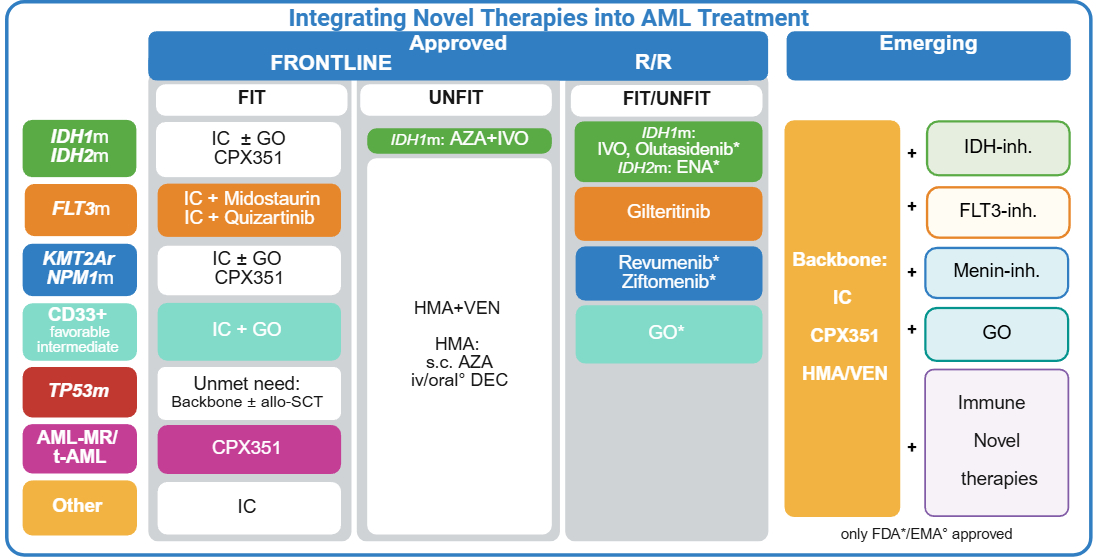
Integrating Targeted Therapies into AML Frontline Therapy: Who Gets What and What Does the Future Hold?

Simple Summary
Abstract
1. Introduction
2. FLT3-Mutated AML—Integrating FLT3 Inhibitors with Chemotherapy and Low-Intensity Therapy
2.1. What Can We Offer This Patient?
2.1.1. FLT3 Inhibitors for IC-Eligible Patients
2.1.2. FLT3 Inhibitors for IC-Ineligible Patients
2.2. What Happened to Our Patient?
2.3. Emerging Frontline Combinations
2.3.1. FLT3 Inhibitors + HMA + Venetoclax
2.3.2. FLT3 Inhibitors + GO + IC Combinations
2.3.3. Head-to-Head FLT3 Inhibitor Trials and Novel Agents
3. IDH Inhibitors: When to Incorporate IDH Inhibitors?
3.1. Which Frontline Regimen Should This Patient Receive?
IDH-Mutated AML: Biology and Therapeutic Targeting
3.2. What Happened to Our Patient?
3.3. Emerging Frontline Combinations
4. BCL-2 Inhibition in AML: Venetoclax-Based Therapies
4.1. What First-Line Regimen Is Recommended for This Patient?
4.1.1. CPX-351 in AML with Myelodysplasia-Related Changes
4.1.2. Hypomethylating Agent + Venetoclax
4.1.3. Hypomethylating Agent
4.1.4. Risk Stratification for HMA + Venetoclax
4.1.5. Safety Profile
4.1.6. Optimal Venetoclax Schedule
4.2. What Happened to Our Patient?
4.3. Emerging Frontline Combinations
4.3.1. Venetoclax-Based Combinations for IC-Ineligible Patients
4.3.2. Venetoclax-Based Combinations for IC-Eligible Patients
5. Menin Inhibitors—Changing the Treatment KMT2A-Rearranged and NPM1-Mutated AML
5.1. Menin Inhibitors in Clinical Development
5.2. Safety Profile
5.3. Emerging Frontline Combinations
6. TP53-Mutated AML: An Unresolved Challenge
7. Discussion
8. Conclusions
Author Contributions
Funding
Data Availability Statement
Acknowledgments
Conflicts of Interest
Abbreviations
| allo-SCT | allogeneic stem cell transplantation |
| AE(s) | adverse event(s) |
| AML | acute myeloid leukemia |
| AML-MR | AML, myelodysplasia-related |
| AZA | azacitidine |
| ATP | adenosine triphosphate |
| BCL-2 | B-cell lymphoma 2 |
| BSC | best supportive care |
| CBF | core-binding factor |
| CC-486 | oral azacitidine |
| CD | cluster of differentiation |
| CI | confidence interval |
| CPX-351 | liposomal daunorubicin and cytarabine |
| CR | complete remission |
| CRc | composite complete remission |
| CRh | complete remission with partial hematologic recovery |
| CRi | complete remission with incomplete hematologic recovery |
| CYP3A4 | cytochrome P450 3A4 |
| CXCR4 | C-X-C chemokine receptor type 4 |
| DA | daunorubicin + cytarabine |
| DEC | decitabine |
| DEC-C | decitabine-cedazuridine |
| DOR | duration of response |
| ECOG | Eastern cooperative oncology group |
| EFS | event-free survival |
| ELN | European leukemia net |
| EMA | European medicines agency |
| ENA | enasidenib |
| FAB | French-American-British |
| FDA | food and drug administration |
| FLAG-IDA | fludarabine, cytarabine, G-CSF, and idarubicin |
| FLT3 | fms-like tyrosine kinase 3 |
| G-CSF | granulocyte colony-stimulating factor |
| GO | gemtuzumab ozogamicin |
| HCT-CI | hematopoietic cell transplantation-specific comorbidity index |
| HMA | hypomethylating agent |
| HOXHR | homeobox |
| HR | hazard ratio |
| IC | intensive chemotherapy |
| ICC | international consensus classification |
| IDH | isocitrate dehydrogenase |
| ITD | internal tandem duplication |
| IV | intravenous |
| IVO | ivosidenib |
| KMT2A | lysine methyltransferase 2A |
| LDAC | low-dose cytarabine |
| MAPK | mitogen-activated protein kinase |
| MCL-1 | myeloid cell leukemia 1 |
| MDS | myelodysplastic syndromes |
| MEK | mitogen-activated protein kinase kinase |
| MLFS | morphologic leukemia-free state |
| mOS | median overall survival |
| MPN | myeloproliferative neoplasm |
| MRD | measurable residual disease |
| ND | newly diagnosed |
| NGS | next-generation sequencing |
| NIC | not eligible for intensive chemotherapy |
| NOS | not otherwise specified |
| NPM1 | nucleophosmin 1 |
| ORR | overall response rate |
| OS | overall survival |
| PCR | polymerase chain reaction |
| PDGFR | platelet-derived growth factor receptor |
| PRISM | prognostic risk integration for survival modeling |
| QTc | corrected QT interval |
| R/R | relapsed/refractory |
| RFS | relapse-free survival |
| SC | subcutaneous |
| TFR | treatment-free remission |
| TIM-3 | T-cell immunoglobulin and mucin-domain containing 3 |
| TKD | tyrosine kinase domain |
| TP53 | tumor protein p53 |
| VAF | variant allele frequency |
| VEN | venetoclax |
| WBC | white blood cell count |
| WHO | world health organization |
References
- Yates, J.W.; Wallace, H.J.; Ellison, R.R.; Holland, J.F. Cytosine Arabinoside (NSC-63878) and Daunorubicin (NSC-83142) Therapy in Acute Nonlymphocytic Leukemia. Cancer Chemother. Rep. 1973, 57, 485–488. [Google Scholar]
- Papaemmanuil, E.; Gerstung, M.; Bullinger, L.; Gaidzik, V.I.; Paschka, P.; Roberts, N.D.; Potter, N.E.; Heuser, M.; Thol, F.; Bolli, N.; et al. Genomic Classification and Prognosis in Acute Myeloid Leukemia. N. Engl. J. Med. 2016, 374, 2209–2221. [Google Scholar] [CrossRef]
- Cancer Genome Atlas Research Network; Ley, T.J.; Miller, C.; Ding, L.; Raphael, B.J.; Mungall, A.J.; Robertson, A.G.; Hoadley, K.; Triche, T.J.; Laird, P.W.; et al. Genomic and Epigenomic Landscapes of Adult de Novo Acute Myeloid Leukemia. N. Engl. J. Med. 2013, 368, 2059–2074. [Google Scholar] [CrossRef]
- DiNardo, C.D.; Jonas, B.A.; Pullarkat, V.; Thirman, M.J.; Garcia, J.S.; Wei, A.H.; Konopleva, M.; Döhner, H.; Letai, A.; Fenaux, P.; et al. Azacitidine and Venetoclax in Previously Untreated Acute Myeloid Leukemia. N. Engl. J. Med. 2020, 383, 617–629. [Google Scholar] [CrossRef]
- Wei, A.H.; Montesinos, P.; Ivanov, V.; DiNardo, C.D.; Novak, J.; Laribi, K.; Kim, I.; Stevens, D.A.; Fiedler, W.; Pagoni, M.; et al. Venetoclax plus LDAC for Newly Diagnosed AML Ineligible for Intensive Chemotherapy: A Phase 3 Randomized Placebo-Controlled Trial. Blood 2020, 135, 2137–2145. [Google Scholar] [CrossRef]
- Lambert, J.; Pautas, C.; Terré, C.; Raffoux, E.; Turlure, P.; Caillot, D.; Legrand, O.; Thomas, X.; Gardin, C.; Gogat-Marchant, K.; et al. Gemtuzumab Ozogamicin for de Novo Acute Myeloid Leukemia: Final Efficacy and Safety Updates from the Open-Label, Phase III ALFA-0701 Trial. Haematologica 2019, 104, 113–119. [Google Scholar] [CrossRef]
- Stone, R.M.; Mandrekar, S.J.; Sanford, B.L.; Laumann, K.; Geyer, S.; Bloomfield, C.D.; Thiede, C.; Prior, T.W.; Döhner, K.; Marcucci, G.; et al. Midostaurin plus Chemotherapy for Acute Myeloid Leukemia with a FLT3 Mutation. N. Engl. J. Med. 2017, 377, 454–464. [Google Scholar] [CrossRef]
- Perl, A.E.; Martinelli, G.; Cortes, J.E.; Neubauer, A.; Berman, E.; Paolini, S.; Montesinos, P.; Baer, M.R.; Larson, R.A.; Ustun, C.; et al. Gilteritinib or Chemotherapy for Relapsed or Refractory FLT3-Mutated AML. N. Engl. J. Med. 2019, 381, 1728–1740. [Google Scholar] [CrossRef]
- Erba, H.P.; Montesinos, P.; Kim, H.-J.; Patkowska, E.; Vrhovac, R.; Žák, P.; Wang, P.-N.; Mitov, T.; Hanyok, J.; Kamel, Y.M.; et al. Quizartinib plus Chemotherapy in Newly Diagnosed Patients with FLT3-Internal-Tandem-Duplication-Positive Acute Myeloid Leukaemia (QuANTUM-First): A Randomised, Double-Blind, Placebo-Controlled, Phase 3 Trial. Lancet Lond. Engl. 2023, 401, 1571–1583. [Google Scholar] [CrossRef]
- Montesinos, P.; Recher, C.; Vives, S.; Zarzycka, E.; Wang, J.; Bertani, G.; Heuser, M.; Calado, R.T.; Schuh, A.C.; Yeh, S.-P.; et al. Ivosidenib and Azacitidine in IDH1-Mutated Acute Myeloid Leukemia. N. Engl. J. Med. 2022, 386, 1519–1531. [Google Scholar] [CrossRef]
- DiNardo, C.D.; Stein, E.M.; de Botton, S.; Roboz, G.J.; Altman, J.K.; Mims, A.S.; Swords, R.; Collins, R.H.; Mannis, G.N.; Pollyea, D.A.; et al. Durable Remissions with Ivosidenib in IDH1-Mutated Relapsed or Refractory AML. N. Engl. J. Med. 2018, 378, 2386–2398. [Google Scholar] [CrossRef]
- Stein, E.M.; DiNardo, C.D.; Pollyea, D.A.; Fathi, A.T.; Roboz, G.J.; Altman, J.K.; Stone, R.M.; DeAngelo, D.J.; Levine, R.L.; Flinn, I.W.; et al. Enasidenib in Mutant IDH2 Relapsed or Refractory Acute Myeloid Leukemia. Blood 2017, 130, 722–731. [Google Scholar] [CrossRef]
- de Botton, S.; Fenaux, P.; Yee, K.; Récher, C.; Wei, A.H.; Montesinos, P.; Taussig, D.C.; Pigneux, A.; Braun, T.; Curti, A.; et al. Olutasidenib (FT-2102) Induces Durable Complete Remissions in Patients with Relapsed or Refractory IDH1-Mutated AML. Blood Adv. 2023, 7, 3117–3127. [Google Scholar] [CrossRef]
- Geissler, K.; Koristek, Z.; Del Castillo, T.B.; Novák, J.; Rodríguez-Macías, G.; Metzelder, S.K.; Illes, A.; Mayer, J.; Arnan, M.; Keating, M.-M.; et al. Oral Decitabine/Cedazuridine versus Intravenous Decitabine for Acute Myeloid Leukaemia: A Randomised, Crossover, Registration, Pharmacokinetics Study. Br. J. Haematol. 2024, 205, 1734–1745. [Google Scholar] [CrossRef]
- Wei, A.H.; Döhner, H.; Pocock, C.; Montesinos, P.; Afanasyev, B.; Dombret, H.; Ravandi, F.; Sayar, H.; Jang, J.-H.; Porkka, K.; et al. Oral Azacitidine Maintenance Therapy for Acute Myeloid Leukemia in First Remission. N. Engl. J. Med. 2020, 383, 2526–2537. [Google Scholar] [CrossRef]
- Lancet, J.E.; Uy, G.L.; Newell, L.F.; Lin, T.L.; Ritchie, E.K.; Stuart, R.K.; Strickland, S.A.; Hogge, D.; Solomon, S.R.; Bixby, D.L.; et al. CPX-351 versus 7+3 Cytarabine and Daunorubicin Chemotherapy in Older Adults with Newly Diagnosed High-Risk or Secondary Acute Myeloid Leukaemia: 5-Year Results of a Randomised, Open-Label, Multicentre, Phase 3 Trial. Lancet Haematol. 2021, 8, e481–e491. [Google Scholar] [CrossRef]
- Papayannidis, C.; Smith, B.D.; Heuser, M.; Montesinos, P.; Sekeres, M.A.; Oriol, A.; Schiller, G.; Candoni, A.; Jamieson, C.; Hoang, C.J.; et al. Low-Dose Cytarabine with or Without Glasdegib in Newly Diagnosed Patients with Acute Myeloid Leukemia: Long-Term Analysis of a Phase 2 Randomized Trial. Clin. Lymphoma Myeloma Leuk. 2019, 19, S228–S229. [Google Scholar] [CrossRef]
- Arellano, M.L.; Thirman, M.J.; DiPersio, J.F.; Heiblig, M.; Stein, E.M.; Schuh, A.C.; Žučenka, A.; de Botton, S.; Grove, C.S.; Mannis, G.N.; et al. Menin Inhibition with Revumenib for NPM1-Mutated Relapsed or Refractory Acute Myeloid Leukemia: The AUGMENT-101 Study. Blood 2025, 146, 1065–1077. [Google Scholar] [CrossRef]
- Issa, G.C.; Aldoss, I.; Thirman, M.J.; DiPersio, J.; Arellano, M.; Blachly, J.S.; Mannis, G.N.; Perl, A.; Dickens, D.S.; McMahon, C.M.; et al. Menin Inhibition with Revumenib for KMT2A-Rearranged Relapsed or Refractory Acute Leukemia (AUGMENT-101). J. Clin. Oncol. 2025, 43, 75–84. [Google Scholar] [CrossRef]
- Wang, E.S.; Montesinos, P.; Foran, J.; Erba, H.; Rodríguez-Arbolí, E.; Fedorov, K.; Heiblig, M.; Heidel, F.H.; Altman, J.K.; Baer, M.R.; et al. Ziftomenib in Relapsed or Refractory NPM1-Mutated AML. J. Clin. Oncol. 2025, 43, 3381–3390. [Google Scholar] [CrossRef]
- Montesinos, P.; Marchione, D.M.; Recher, C.; Heuser, M.; Vives, S.; Zarzycka, E.; Wang, J.; Riva, M.; Calado, R.T.; Schuh, A.C.; et al. Long-Term Results from the AGILE Study of Azacitidine plus Ivosidenib vs Placebo in Newly Diagnosed IDH1-Mutated AML. Blood Adv. 2025, 9, 5177–5189. [Google Scholar] [CrossRef]
- Cortes, J.; Curti, A.; Fenaux, P.; Jonas, B.A.; Krauter, J.; Montesinos, P.; Récher, C.; Taussig, D.C.; Wang, E.S.; Watts, J.; et al. Olutasidenib for Mutated IDH1 Acute Myeloid Leukemia: Final Five-Year Results from the Phase 2 Pivotal Cohort. J. Hematol. Oncol. 2025, 18, 102. [Google Scholar] [CrossRef]
- Cortes, J.E.; Heidel, F.H.; Hellmann, A.; Fiedler, W.; Smith, B.D.; Robak, T.; Montesinos, P.; Pollyea, D.A.; DesJardins, P.; Ottmann, O.; et al. Randomized Comparison of Low Dose Cytarabine with or without Glasdegib in Patients with Newly Diagnosed Acute Myeloid Leukemia or High-Risk Myelodysplastic Syndrome. Leukemia 2019, 33, 379–389. [Google Scholar] [CrossRef]
- Garcia-Manero, G.; McCloskey, J.; Griffiths, E.A.; Yee, K.W.L.; Zeidan, A.M.; Al-Kali, A.; Deeg, H.J.; Patel, P.A.; Sabloff, M.; Keating, M.-M.; et al. Oral Decitabine–Cedazuridine versus Intravenous Decitabine for Myelodysplastic Syndromes and Chronic Myelomonocytic Leukaemia (ASCERTAIN): A Registrational, Randomised, Crossover, Pharmacokinetics, Phase 3 Study. Lancet Haematol. 2024, 11, e15–e26. [Google Scholar] [CrossRef]
- Altman, J.; Perl, A.; Wang, E.; Borate, U.; Traer, E.; Dugan, J.; Kasner, M.; Larson, R.; Deutsch, Y.; Shastri, A.; et al. Venetoclax (VEN) and Azacitidine (AZA) with Gilteritinib (GILT) in Patients with Newly Diagnosed (ND) FLT3mut+ Acute Myeloid Leukemia (AML) Ineligible for Intensive Induction Chemotherapy (Chemo): Interim Results from the Phase 1/2 VICEROY Study. Blood 2025, 146, 654. [Google Scholar] [CrossRef]
- Yilmaz, M.; Muftuoglu, M.; Short, N.J.; Loghavi, S.; Kadia, T.M.; DiNardo, C.D.; Borthakur, G.; Pemmaraju, N.; Alvarado Valero, Y.; Maiti, A.; et al. Phase I/II Study of Quizartinib, Venetoclax, and Decitabine Triple Combination in FLT3-ITD Mutated AML. Blood 2024, 144, 4263. [Google Scholar] [CrossRef]
- Russell, N.; Othman, J.; Cumming, O.; Thomas, A.; Tedjaseputra, A.; Potter, N.; Jovanovic, J.; Gilkes, A.; Batten, L.; Canham, J.; et al. Safety and Efficacy of Combining Midostaurin and Gemtuzumab Ozogamicin with Induction Chemotherapy in FLT3-Mutated AML. Blood Adv. 2025, 9, 6455–6466. [Google Scholar] [CrossRef]
- Wang, E.S.; Goldberg, A.D.; Tallman, M.; Walter, R.B.; Karanes, C.; Sandhu, K.; Vigil, C.E.; Collins, R.; Jain, V.; Stone, R.M. Crenolanib and Intensive Chemotherapy in Adults with Newly Diagnosed FLT3-Mutated AML. J. Clin. Oncol. 2024, 42, 1776–1787. [Google Scholar] [CrossRef]
- Luger, S.; Chen, L.; Pratz, K.W.; Loghavi, S.; Perl, A.E.; Altman, J.K.; Redner, R.L.; Fathi, A.T.; Qasrawi, A.; Asch, A.S.; et al. Gilteritinib Results in Higher Remission and Transplant Rates Than Midostaurin but Does Not Increase the Post-Induction Mutational MRD Negative Rate: Results of the Phase 2 Randomized Precog 0905 Study in Newly Diagnosed FLT3 Mutated AML. Blood 2024, 144, 221. [Google Scholar] [CrossRef]
- Lachowiez, C.A.; Loghavi, S.; Zeng, Z.; Tanaka, T.; Kim, Y.J.; Uryu, H.; Turkalj, S.; Jakobsen, N.A.; Luskin, M.R.; Duose, D.Y.; et al. A Phase Ib/II Study of Ivosidenib with Venetoclax ± Azacitidine in IDH1-Mutated Myeloid Malignancies. Blood Cancer Discov. 2023, 4, 276–293. [Google Scholar] [CrossRef]
- Huselton, E.; Borate, U.; Reagan, J.; Little, R.; Gore, S.; Othus, M.; Moseley, A.; Pandey, M.; Wang, X.; Michaelis, L.; et al. A Randomized Phase II Trial of ASTX727 and Venetoclax with or without Enasidenib for Newly Diagnosed Older Adults with IDH2 Mutant Acute Myeloid Leukemia: A Myelomatch Substudy (MM1OA-S03). Blood 2025, 146, 3466. [Google Scholar] [CrossRef]
- Marvin-Peek, J.; Maiti, A.; Alvarado, Y.; Daver, N.; Sasaki, K.; Borthakur, G.; Short, N.; Chien, K.; Haddad, F.; Hammond, D.E.; et al. AML-150: A Phase 1b/2 Trial of an All-Oral “Triplet” Regimen for IDH-Mutated Myeloid Malignancies: Decitabine or Cedazuridine and Venetoclax in Combination with Ivosidenib or Enasidenib. Clin. Lymphoma Myeloma Leuk. 2025, 25, S404–S405. [Google Scholar] [CrossRef]
- Stein, E.M.; DiNardo, C.D.; Fathi, A.T.; Mims, A.S.; Pratz, K.W.; Savona, M.R.; Stein, A.S.; Stone, R.M.; Winer, E.S.; Seet, C.S.; et al. Ivosidenib or Enasidenib Combined with Intensive Chemotherapy in Patients with Newly Diagnosed AML: A Phase 1 Study. Blood 2021, 137, 1792–1803. [Google Scholar] [CrossRef]
- Zeidan, A.M.; Wang, E.; Fathi, A.; Roboz, G.; Madanat, Y.; Strickland, S.; Balasubramanian, S.; Mangan, J.; Pratz, K.; Advani, A.; et al. AML-732: Ziftomenib Combined with Intensive Induction Chemotherapy (7+3) in Newly Diagnosed NPM1-m or KMT2A-r Acute Myeloid Leukemia (AML): Updated Phase 1a/b Results From KOMET-007. Clin. Lymphoma Myeloma Leuk. 2025, 25, S452–S453. [Google Scholar] [CrossRef]
- Roboz, G.; Wang, E.; Fathi, A.; Erba, H.; Pratz, K.; Guru Murthy, G.S.; Alsfeld, L.; Blachly, J.; Naqvi, K.; Issa, G.; et al. Ziftomenib in Combination with Venetoclax and Azacitidine in Newly Diagnosed NPM1-m Acute Myeloid Leukemia: Phase 1b Results from KOMET-007. Blood 2025, 146, 766. [Google Scholar] [CrossRef]
- Wei, A.H.; Esteve, J.; Garciaz, S.; Aldoss, I.; Piérola, A.A.; Allred, A.; Alonso-Dominguez, J.M.; Barreyro, L.; Bories, P.; Daskalakis, N.; et al. RP2D Determination of Bleximenib in Combination with VEN + AZA: Phase 1b Study in R/R & ND AML with KMT2A/NPM1 Alterations. Presented at the 30th European Hematology Association (EHA) Congress, Milan, Italy; Available online: https://www.jnjmedicalconnect.com/media/attestation/congresses/oncology/2025/eha/rp2d-determination-of-bleximenib-in-combination-with-venaza-phase-1b-study-in-nd-rr-aml-with-kmt2an.pdf (accessed on 15 March 2026).
- Döhner, H.; Schuh, A.; Recher, C.; O’Nions, J.; Aldoss, I.; Alfonso-Pierola, A.; Allred, A.; Alonso-Dominguez, J.M.; Barreyro, L.; Bories, P.; et al. Bleximenib in Combination with Intensive Chemotherapy: A Phase 1b Study in Newly Diagnosed Acute Myeloid Leukemia with KMT2A or NPM1 Alterations. Blood 2025, 146, 5199. [Google Scholar] [CrossRef]
- Zeidner, J.F.; Lin, T.L.; Welkie, R.L.; Curran, E.; Koenig, K.; Stock, W.; Madanat, Y.F.; Swords, R.; Baer, M.R.; Blum, W.; et al. Azacitidine, Venetoclax, and Revumenib for Newly Diagnosed NPM1-Mutated or KMT2A-Rearranged AML. J. Clin. Oncol. 2025, 43, 2606–2615. [Google Scholar] [CrossRef] [PubMed]
- Jen, W.-Y.; DiNardo, C.; Short, N.; Farhat, A.; El Hajjar, G.; Zhang, B.; Duose, D.; Daver, N.; Kadia, T.; Cuglievan, B.; et al. Phase II Study of the All-Oral Combination of Revumenib (SNDX-5613) with Decitabine/Cedazuridine (ASTX727) and Venetoclax (SAVE) in Newly Diagnosed AML. Blood 2025, 146, 47. [Google Scholar] [CrossRef]
- Syndax Highlights Leadership in Menin Inhibition at ASH 2025 with Multiple Revuforj® (Revumenib) Presentations Spanning the Acute Leukemia Treatment Continuum|Syndax Pharmaceuticals, Inc. Available online: https://ir.syndax.com/news-releases/news-release-details/syndax-highlights-leadership-menin-inhibition-ash-2025-multiple (accessed on 15 February 2026).
- Garcia-Manero, G.; Goldberg, A.D.; Winer, E.S.; Altman, J.K.; Fathi, A.T.; Odenike, O.; Roboz, G.J.; Sweet, K.; Miller, C.; Wennborg, A.; et al. Eprenetapopt Combined with Venetoclax and Azacitidine in TP53-Mutated Acute Myeloid Leukaemia: A Phase 1, Dose-Finding and Expansion Study. Lancet Haematol. 2023, 10, e272–e283. [Google Scholar] [CrossRef]
- Mantzaris, I.; Goldfinger, M.; Uriel, M.; Shastri, A.; Shah, N.; Gritsman, K.; Kornblum, N.S.; Shapiro, L.; Sica, R.A.; Munoz, A.; et al. Venetoclax plus Daunorubicin and Cytarabine for Newly Diagnosed Acute Myeloid Leukemia: Results of a Phase 1b Study. Blood 2025, 145, 1870–1875. [Google Scholar] [CrossRef]
- DiNardo, C.D.; Jen, W.-Y.; Takahashi, K.; Kadia, T.M.; Loghavi, S.; Daver, N.G.; Xiao, L.; Reville, P.K.; Issa, G.C.; Short, N.J.; et al. Correction: Long Term Results of Venetoclax Combined with FLAG-IDA Induction and Consolidation for Newly Diagnosed and Relapsed or Refractory Acute Myeloid Leukemia. Leukemia 2026, 40, 262. [Google Scholar] [CrossRef]
- Bataller, A.; Kantarjian, H.M.; Bazinet, A.; Senapati, J.; Borthakur, G.; Short, N.J.; Jabbour, E.; Takahashi, K.; Daver, N.; Issa, G.C.; et al. Phase II Study of Cladribine with Low Dose Cytarabine and Venetoclax Alternating with Azacytidine and Venetoclax for Newly Diagnosed Acute Myeloid Leukemia. Blood 2024, 144, 56. [Google Scholar] [CrossRef]
- Zeidan, A.M.; Kovacsovics, T.; Venditti, A.; Rodriguez Macias, G.; Schuh, A.; Sanford, D.; Platzbecker, U.; Kim, H.J.; Westermann, J.; Shenoy, V.; et al. Primary Results STIMULUS-AML1: A Large, International, Phase II Study of Sabatolimab Combined with Azacitidine and Venetoclax as Frontline Therapy for Unfit Acute Myeloid Leukemia (AML) Patients. HemaSphere 2025, 9, PS1483. Available online: https://library.ehaweb.org/eha/2025/eha2025-congress/4160559 (accessed on 15 March 2026).
- Daver, N.; Advani, A.; De La Fuente Burguera, A.; Montesinos, P.; Garciaz, S.; Benedetta Giannini, M.; Wang, E.; Roboz, G.; Curti, A.; Lunghi, M.; et al. Efficacy and Safety of Pivekimab Sunirine in Combination with Venetoclax plus Azacitidine in Unfit Patients with Newly Diagnosed Acute Myeloid Leukemia. Blood 2025, 146, 651. [Google Scholar] [CrossRef]
- Watts, J.; Borthakur, G.; Lin, T.; Gabrail, N.; Patel, K.; Madanat, Y.; Zeidner, J.; Khaskhely, N.; Bonham, L.; Nelson, M.; et al. A Dose Optimization Phase 1b/2 Study Evaluating Mipletamig (Formerly APVO436), a Novel Bispecific CD123 x CD3 ADAPTIRÒ Molecule in Combination Therapy for the Treatment of Frontline Acute Myeloid Leukemia (AML) in Patients Unfit for Intensive Chemotherapy. Blood 2025, 146, 5198. [Google Scholar] [CrossRef]
- Zeidan, A.M.; Griffiths, E.A.; Dinardo, C.D.; Mannis, G.N.; Montesinos, P.; Arnan, M.; Savona, M.R.; Odenike, O.; McCloskey, J.K.; Amin, H.V.; et al. An All-Oral Regimen of Decitabine-Cedazuridine (DEC-C) plus Venetoclax (VEN) in Patients (Pts) with Newly Diagnosed Acute Myeloid Leukemia (AML) Ineligible for Intensive Induction Chemotherapy: Results from a Phase 2 Cohort of 101 Pts. J. Clin. Oncol. 2025, 43, 6504. [Google Scholar] [CrossRef]
- Garciaz, S.; Dumas, P.-Y.; Peterlin, P.; Morillo, D.; Torregrosa Diaz, J.M.; Ulrickson, M.; Penedo, A.; De Gassart, A.; Valentin, E.; Mairesse, M.; et al. Γ9δ2 T-Cell (γ9δ2TC) Activation with ICT01 and Azacitidine-Venetoclax (Aza-Ven) Induces High Rates of Remission and Overall Survival in Patients with Newly Diagnosed (ND) Acute Myeloid Leukemia (AML): Results from the Phase 1/2 Study Eviction. Blood 2025, 146, 652. [Google Scholar] [CrossRef]
- Roboz, G.J.; Aribi, A.; Ochsenbein, A.; Riether, C.; Stuart, M.J.; Mitchell, E.; Changela, K.; George, A.; Boyiadzis, M.; Smith, C.; et al. Trial in Progress: A Multicenter, Open Label, Randomized, Phase 2 Study of Venetoclax and Azacitidine Plus Cusatuzumab Versus Venetoclax and Azacitidine Alone in Newly Diagnosed AML Patients Who Are Not Candidates for Intensive Therapy. Blood 2024, 144, 1504.2. [Google Scholar] [CrossRef]
- Daver, N.; Vyas, P.; Huls, G.; Döhner, H.; Maury, S.; Novak, J.; Papayannidis, C.; Martínez Chamorro, C.; Montesinos, P.; Niroula, R.; et al. The ENHANCE-3 Study: Venetoclax and Azacitidine plus Magrolimab or Placebo for Untreated AML Unfit for Intensive Therapy. Blood 2025, 146, 601–611. [Google Scholar] [CrossRef]
- Mannis, G.; Podoltsev, N.; Jeyakumar, D.; Watts, J.; Vachhani, P.; Jonas, B.; Borate, U.; Tam, E.; Erba, H.; Shi, Y.; et al. Tuscany Study Demonstrates Safety and Efficacy of Tuspetinib plus Standard of Care Venetoclax and Azacitidine in Patients with Newly Diagnosed AML Ineligible for Induction Chemotherapy. Blood 2025, 146, 1645. [Google Scholar] [CrossRef]
- Döhner, H.; Wei, A.H.; Appelbaum, F.R.; Craddock, C.; DiNardo, C.D.; Dombret, H.; Ebert, B.L.; Fenaux, P.; Godley, L.A.; Hasserjian, R.P.; et al. Diagnosis and Management of AML in Adults: 2022 Recommendations from an International Expert Panel on Behalf of the ELN. Blood 2022, 140, 1345–1377. [Google Scholar] [CrossRef]
- Zhao, J.C.; Agarwal, S.; Ahmad, H.; Amin, K.; Bewersdorf, J.P.; Zeidan, A.M. A Review of FLT3 Inhibitors in Acute Myeloid Leukemia. Blood Rev. 2022, 52, 100905. [Google Scholar] [CrossRef]
- Cortes, J. Quizartinib: A Potent and Selective FLT3 Inhibitor for the Treatment of Patients with FLT3-ITD–Positive AML. J. Hematol. Oncol. 2024, 17, 111. [Google Scholar] [CrossRef]
- Döhner, H.; Weber, D.; Krzykalla, J.; Fiedler, W.; Wulf, G.; Salih, H.; Lübbert, M.; Kühn, M.W.M.; Schroeder, T.; Salwender, H.; et al. Midostaurin plus Intensive Chemotherapy for Younger and Older Patients with AML and FLT3 Internal Tandem Duplications. Blood Adv. 2022, 6, 5345–5355. [Google Scholar] [CrossRef]
- Tettero, J.M.; Cloos, J.; Bullinger, L. Acute Myeloid Leukemia: Does Sex Matter? Leukemia 2024, 38, 2329–2331. [Google Scholar] [CrossRef]
- Burchert, A.; Bug, G.; Fritz, L.V.; Finke, J.; Stelljes, M.; Röllig, C.; Wollmer, E.; Wäsch, R.; Bornhäuser, M.; Berg, T.; et al. Sorafenib Maintenance After Allogeneic Hematopoietic Stem Cell Transplantation for Acute Myeloid Leukemia with FLT3–Internal Tandem Duplication Mutation (SORMAIN). J. Clin. Oncol. 2020, 38, 2993–3002. [Google Scholar] [CrossRef]
- Abedin, S.; Baidoo, V.; Szabo, A.; Jones, R.; Singh, A.; Litzow, M.; Wingard, J.; Papadopoulos, E.; Perl, A.; Soiffer, R.; et al. Effect of FLT3 Maintenance in Older FLT3-ITD+ Adults Undergoing Allogeneic HCT. a Post Hoc Analysis of BMT CTN 1506. Blood 2025, 146, 170. [Google Scholar] [CrossRef]
- Levis, M.J.; Hamadani, M.; Logan, B.; Jones, R.J.; Singh, A.K.; Litzow, M.; Wingard, J.R.; Papadopoulos, E.B.; Perl, A.E.; Soiffer, R.J.; et al. Gilteritinib as Post-Transplant Maintenance for AML with Internal Tandem Duplication Mutation of FLT3. J. Clin. Oncol. 2024, 42, 1766–1775. [Google Scholar] [CrossRef]
- Wang, E.S.; Montesinos, P.; Minden, M.D.; Lee, J.-H.; Heuser, M.; Naoe, T.; Chou, W.-C.; Laribi, K.; Esteve, J.; Altman, J.K.; et al. Phase 3 Trial of Gilteritinib plus Azacitidine vs Azacitidine for Newly Diagnosed FLT3mut+ AML Ineligible for Intensive Chemotherapy. Blood 2022, 140, 1845–1857. [Google Scholar] [CrossRef] [PubMed]
- Ohanian, M.; Garcia-Manero, G.; Levis, M.; Jabbour, E.; Daver, N.; Borthakur, G.; Kadia, T.; Pierce, S.; Burger, J.; Richie, M.A.; et al. Sorafenib Combined with 5-Azacytidine in Older Patients with Untreated FLT3-ITD Mutated Acute Myeloid Leukemia. Am. J. Hematol. 2018, 93, 1136–1141. [Google Scholar] [CrossRef]
- Arora, S.; Kantarjian, H.; Maroun, M.; Borthakur, G.; Garcia-Manero, G.; Montalban-Bravo, G.; Issa, G.; Chien, K.; Maiti, A.; Ohanian, M.; et al. A Phase II Study of Azacitidine, Venetoclax, and Gilteritinib for Newly Diagnosed Adverse Risk FLT3-Wild Type Acute Myeloid Leukemia. Blood 2025, 146, 5226. [Google Scholar] [CrossRef]
- Perl, A.E.; Levis, M.J.; Wei, A.; Kim, H.; Cheong, J.; Zhang, Y.; Li, J.; Yokoyama, H.; Hosono, N.; Hasabou, N.; et al. Timing of Response with Gilteritinib Monotherapy in Relapsed or Refractory FLT3-Mutated Acute Myeloid Leukemia. Blood 2024, 144, 2889. [Google Scholar] [CrossRef]
- McMahon, C.M.; Ferng, T.; Canaani, J.; Wang, E.S.; Morrissette, J.J.D.; Eastburn, D.J.; Pellegrino, M.; Durruthy-Durruthy, R.; Watt, C.D.; Asthana, S.; et al. Clonal Selection with RAS Pathway Activation Mediates Secondary Clinical Resistance to Selective FLT3 Inhibition in Acute Myeloid Leukemia. Cancer Discov. 2019, 9, 1050–1063. [Google Scholar] [CrossRef]
- Yuan, R.; Xie, Y.; Miron, P.M.; Higgins, A.W.; Hutchinson, L.; Cerny, J.; Patel, S.A. Clinico-Genomic Characterization of RAS-Mutant Acute Myeloid Leukemia. Ann. Hematol. 2026, 105, 99. [Google Scholar] [CrossRef] [PubMed]
- Rasouli, M.; Blair, H.; Troester, S.; Szoltysek, K.; Cameron, R.; Ashtiani, M.; Krippner-Heidenreich, A.; Grebien, F.; McGeehan, G.; Zwaan, C.M.; et al. The MLL-Menin Interaction Is a Therapeutic Vulnerability in NUP98-Rearranged AML. HemaSphere 2023, 7, e935. [Google Scholar] [CrossRef]
- Azevedo, R.S.; Daver, N.; Karrar, O.; DiNardo, C.; Kadia, T.; Yilmaz, M.; Borthakur, G.; Issa, G.; Jabbour, E.; Huang, X.; et al. Long-Term Follow-up of Azacitidine, Venetoclax, and Gilteritinib in Patients with Newly Diagnosed FLT3-Mutated Acute Myeloid Leukemia. Blood 2025, 146, 45. [Google Scholar] [CrossRef]
- National Cancer Institute (NCI) A Randomized Phase II Study of Venetoclax and HMA-Based Therapies for the Treatment of Older and Unfit Adults with Newly Diagnosed FLT3-Mutated Acute Myeloid Leukemia (AML): A MyeloMATCH Treatment Trial. Available online: https://clinicaltrials.gov/study/NCT06317649 (accessed on 14 February 2026).
- Fathi, A.; Perl, A.; Fell, G.; Jonas, B.; Ragon, B.; Mims, A.; Borate, U.; Mannis, G.; Quillen, K.; Stahl, M.; et al. Results from Paradigm—A Phase 2 Randomized Multi-Center Study Comparing Azacitidine and Venetoclax to Conventional Induction Chemotherapy for Newly Diagnosed Fit Adults with Acute Myeloid Leukemia. Blood 2025, 146, 6. [Google Scholar] [CrossRef]
- Hills, R.K.; Castaigne, S.; Appelbaum, F.R.; Delaunay, J.; Petersdorf, S.; Othus, M.; Estey, E.H.; Dombret, H.; Chevret, S.; Ifrah, N.; et al. Addition of Gemtuzumab Ozogamicin to Induction Chemotherapy in Adult Patients with Acute Myeloid Leukaemia: A Meta-Analysis of Individual Patient Data from Randomised Controlled Trials. Lancet Oncol. 2014, 15, 986–996. [Google Scholar] [CrossRef]
- Russell, N.H.; Wilhelm-Benartzi, C.; Othman, J.; Dillon, R.; Knapper, S.; Batten, L.M.; Canham, J.; Hinson, E.L.; Betteridge, S.; Overgaard, U.M.; et al. Fludarabine, Cytarabine, Granulocyte Colony-Stimulating Factor, and Idarubicin with Gemtuzumab Ozogamicin Improves Event-Free Survival in Younger Patients with Newly Diagnosed AML and Overall Survival in Patients with NPM1 and FLT3 Mutations. J. Clin. Oncol. 2024, 42, 1158–1168. [Google Scholar] [CrossRef]
- Canham, J.; Casbard, A.; Freeman, S.D.; Potter, N.; Thomas, A.; Gilkes, A.; Johnson, S.; Marsh, L.; Leahy, J.; Timmins, H.; et al. Optimising Therapy in FLT3-Mutated Acute Myeloid Leukaemia. Blood 2024, 144, 4191.1. [Google Scholar] [CrossRef]
- Im, A.; Sehgal, A.; Carroll, M.; Smith, B.; Tefferi, A.; Johnson, D.; Boyiadzis, M. DNMT3A and IDH Mutations in Acute Myeloid Leukemia and Other Myeloid Malignancies: Associations with Prognosis and Potential Treatment Strategies. Leukemia 2014, 28, 1774–1783. [Google Scholar] [CrossRef]
- Ward, P.S.; Patel, J.; Wise, D.R.; Abdel-Wahab, O.; Bennett, B.D.; Coller, H.A.; Cross, J.R.; Fantin, V.R.; Hedvat, C.V.; Perl, A.E.; et al. The Common Feature of Leukemia-Associated IDH1 and IDH2 Mutations Is a Neomorphic Enzyme Activity Converting Alpha-Ketoglutarate to 2-Hydroxyglutarate. Cancer Cell 2010, 17, 225–234. [Google Scholar] [CrossRef]
- Stein, E.M.; Fathi, A.T.; DiNardo, C.D.; Pollyea, D.A.; Roboz, G.J.; Collins, R.; Sekeres, M.A.; Stone, R.M.; Attar, E.C.; Frattini, M.G.; et al. Enasidenib in Patients with Mutant IDH2 Myelodysplastic Syndromes: A Phase 1 Subgroup Analysis of the Multicentre, AG221-C-001 Trial. Lancet Haematol. 2020, 7, e309–e319. [Google Scholar] [CrossRef]
- Pollyea, D.A.; DiNardo, C.D.; Arellano, M.L.; Pigneux, A.; Fiedler, W.; Konopleva, M.; Rizzieri, D.A.; Smith, B.D.; Shinagawa, A.; Lemoli, R.M.; et al. Impact of Venetoclax and Azacitidine in Treatment-Naïve Patients with Acute Myeloid Leukemia and IDH1/2 Mutations. Clin. Cancer Res. 2022, 28, 2753–2761. [Google Scholar] [CrossRef]
- Hammond, D.; Loghavi, S.; Wang, S.A.; Konopleva, M.Y.; Kadia, T.M.; Daver, N.G.; Ohanian, M.; Issa, G.C.; Alvarado, Y.; Short, N.J.; et al. Response Patterns and Impact of MRD in Patients with IDH1/2-Mutated AML Treated with Venetoclax and Hypomethylating Agents. Blood Cancer J. 2023, 13, 148. [Google Scholar] [CrossRef]
- DiNardo, C.D.; Schuh, A.C.; Stein, E.M.; Montesinos, P.; Wei, A.H.; de Botton, S.; Zeidan, A.M.; Fathi, A.T.; Kantarjian, H.M.; Bennett, J.M.; et al. Enasidenib plus Azacitidine versus Azacitidine Alone in Patients with Newly Diagnosed, Mutant-IDH2 Acute Myeloid Leukaemia (AG221-AML-005): A Single-Arm, Phase 1b and Randomised, Phase 2 Trial. Lancet Oncol. 2021, 22, 1597–1608. [Google Scholar] [CrossRef]
- Pratz, K.W.; Jonas, B.A.; Pullarkat, V.; Thirman, M.J.; Garcia, J.S.; Döhner, H.; Récher, C.; Fiedler, W.; Yamamoto, K.; Wang, J.; et al. Long-Term Follow-up of VIALE-A: Venetoclax and Azacitidine in Chemotherapy-Ineligible Untreated Acute Myeloid Leukemia. Am. J. Hematol. 2024, 99, 615–624. [Google Scholar] [CrossRef]
- Döhner, H.; Pratz, K.W.; DiNardo, C.D.; Wei, A.H.; Jonas, B.A.; Pullarkat, V.A.; Thirman, M.J.; Récher, C.; Schuh, A.C.; Babu, S.; et al. Genetic Risk Stratification and Outcomes among Treatment-Naive Patients with AML Treated with Venetoclax and Azacitidine. Blood 2024, 144, 2211–2222. [Google Scholar] [CrossRef]
- DiNardo, C.D.; Marvin-Peek, J.; Loghavi, S.; Takahashi, K.; Issa, G.C.; Jen, W.-Y.; Daver, N.G.; Reville, P.K.; Short, N.J.; Sasaki, K.; et al. Outcomes of Frontline Triplet Regimens with a Hypomethylating Agent, Venetoclax, and Isocitrate Dehydrogenase Inhibitor for Intensive Chemotherapy-Ineligible Patients with Isocitrate Dehydrogenase-Mutated AML. J. Clin. Oncol. 2025, 43, 2692–2699. [Google Scholar] [CrossRef]
- Döhner, H.; Huls, G.A.; Vyas, P. Phase 3 Study of Ivosidenib (IVO) and Azacitidine (AZA) with or without Venetoclax in Adult Patients with Newly Diagnosed IDH1-Mutated AML or MDS/AML Ineligible for Intensive Chemotherapy (EVOLVE-1). Blood 2025, 146, 5192. [Google Scholar] [CrossRef]
- Stein, E.; DiNardo, C.; Fathi, A.; Mims, A.; Pratz, K.; Savona, M.; Stein, A.S.; Stone, R.; Winer, E.; Seet, C.; et al. Updated Response and Safety Analyses from a Phase 1 Study of Ivosidenib Combined with Intensive Chemotherapy in Patients with Newly Diagnosed (ND) Acute Myeloid Leukemia with Isocitrate Dehydrogenase (IDH)1 Mutation. Blood 2025, 146, 992. [Google Scholar] [CrossRef]
- Stein, E.M.; Derkach, A.; Melamed, G.; Block, A.; Kim, J.; Georgieva, G.; Thompson, V.; Levine, R.L.; Intlekofer, A.M.; Abdel-Wahab, O.; et al. A Phase 1b Multi-Center Study of the FLT3 Inhibitor Gilteritinib in Combination with the IDH1 Inhibitor Ivosidenib or the IDH2 Inhibitor Enasidenib for Patients with Relapsed or Refractory Acute Myeloid Leukemia Who Have Co-Occurring FLT3/IDH1 or FLT3/IDH2 Mutations. Blood 2023, 142, 5945. [Google Scholar] [CrossRef]
- Uy, G.L.; Newell, L.F.; Lin, T.L.; Goldberg, S.L.; Wieduwilt, M.J.; Ryan, R.J.; Faderl, S.; Lancet, J.E. Transplant Outcomes after CPX-351 vs 7 + 3 in Older Adults with Newly Diagnosed High-Risk and/or Secondary AML. Blood Adv. 2022, 6, 4989–4993, Erratum in Blood Adv. 2023, 7, 2715–2717. https://doi.org/10.1182/bloodadvances.2023010005. [Google Scholar] [CrossRef]
- Wei, A.H.; Loo, S.; Daver, N. How I Treat Patients with AML Using Azacitidine and Venetoclax. Blood 2025, 145, 1237–1250. [Google Scholar] [CrossRef]
- Solana-Altabella, A.; Rodríguez-Veiga, R.; Martínez-Cuadrón, D.; Montesinos, P. A Systematic Review of Venetoclax for the Treatment of Unfit AML Patients in Real-World: Is All That Glitters Gold? Ann. Hematol. 2025, 104, 913–935. [Google Scholar] [CrossRef]
- Othman, J.; Lam, H.P.J.; Leong, S.; Basheer, F.; Abdallah, I.; Fleming, K.; Mehta, P.; Yassin, H.; Laurie, J.; Austin, M.; et al. Real-World Outcomes of Newly Diagnosed AML Treated with Venetoclax and Azacitidine or Low-Dose Cytarabine in the UK NHS. Blood Neoplasia 2024, 1, 100017. [Google Scholar] [CrossRef]
- Wolach, O.; Levi, I.; Nachmias, B.; Tavor, S.; Amitai, I.; Ofran, Y.; Ganzel, C.; Zuckerman, T.; Okasha, D.; Hellmann, I.; et al. Trial Eligibility, Treatment Patterns, and Outcome for Venetoclax-Based Therapy in AML: A Prospective Cohort Study. Blood Adv. 2025, 9, 1544–1554. [Google Scholar] [CrossRef] [PubMed]
- Wei, A.H.; Panayiotidis, P.; Montesinos, P.; Laribi, K.; Ivanov, V.; Kim, I.; Novak, J.; Champion, R.; Fiedler, W.; Pagoni, M.; et al. Long-Term Follow-up of VIALE-C in Patients with Untreated AML Ineligible for Intensive Chemotherapy. Blood 2022, 140, 2754–2756. [Google Scholar] [CrossRef]
- Sekeres, M.A.; Montesinos, P.; Novak, J.; Wang, J.; Jeyakumar, D.; Tomlinson, B.; Mayer, J.; Jou, E.; Robak, T.; Taussig, D.C.; et al. Glasdegib plus Intensive or Non-Intensive Chemotherapy for Untreated Acute Myeloid Leukemia: Results from the Randomized, Phase 3 BRIGHT AML 1019 Trial. Leukemia 2023, 37, 2017–2026. [Google Scholar] [CrossRef]
- Lachowiez, C.A.; Ravikumar, V.I.; Othman, J.; O’Nions, J.; Peters, D.T.; McMahon, C.; Swords, R.; Cook, R.; Saultz, J.N.; Tyner, J.W.; et al. Refined ELN 2024 Risk Stratification Improves Survival Prognostication Following Venetoclax-Based Therapy in AML. Blood 2024, 144, 2788–2792. [Google Scholar] [CrossRef]
- Gangat, N.; Elbeih, A.; Ghosoun, N.; McCullough, K.; Aperna, F.; Johnson, I.M.; Abdelmagid, M.; Al-Kali, A.; Alkhateeb, H.B.; Begna, K.H.; et al. Mayo Genetic Risk Models for Newly Diagnosed Acute Myeloid Leukemia Treated with Venetoclax + Hypomethylating Agent. Am. J. Hematol. 2025, 100, 260–271. [Google Scholar] [CrossRef]
- Döhner, H.; DiNardo, C.D.; Appelbaum, F.R.; Craddock, C.; Dombret, H.; Ebert, B.L.; Fenaux, P.; Godley, L.A.; Hasserjian, R.P.; Larson, R.A.; et al. Genetic Risk Classification for Adults with AML Receiving Less-Intensive Therapies: The 2024 ELN Recommendations. Blood 2024, 144, 2169–2173. [Google Scholar] [CrossRef]
- Hoff, F.W.; Blum, W.G.; Huang, Y.; Welkie, R.L.; Swords, R.T.; Traer, E.; Stein, E.M.; Lin, T.L.; Archer, K.J.; Patel, P.A.; et al. Beat-AML 2024 ELN-Refined Risk Stratification for Older Adults with Newly Diagnosed AML given Lower-Intensity Therapy. Blood Adv. 2024, 8, 5297–5305. [Google Scholar] [CrossRef] [PubMed]
- Lachowiez, C.; Kaempf, A.; Othman, J.; Yun, S.; Heiblig, M.; Heuser, M.; Shahswar, R.; Patel, A.; Madero-Marroquin, R.; Cannova, J.; et al. Prognostic Risk Integration for Survival Modeling (PRISM) in Newly Diagnosed Acute Myeloid Leukemia Treated with Venetoclax: A Multinational Retrospective Cohort Study. Blood 2025, 146, 453. [Google Scholar] [CrossRef]
- PRISM Risk Calculator in AML. Available online: https://prism-aml.com/ (accessed on 17 January 2026).
- Gangat, N.; Dinardo, C.D. Newly Diagnosed Acute Myeloid Leukemia in Unfit Patients: 2026 Treatment Algorithms. Blood Cancer J. 2025, 15, 139. [Google Scholar] [CrossRef]
- Gangat, N.; Tefferi, A. Venetoclax Schedule in AML: 7 vs 14 vs 21 vs 28 Days. Blood Cancer J. 2025, 15, 56. [Google Scholar] [CrossRef]
- Willekens, C.; Bazinet, A.; Chraibi, S.; Bataller, A.; Decroocq, J.; Arani, N.; Carpentier, B.; Rausch, C.; Lebon, D.; Maiti, A.; et al. Reduced Venetoclax Exposure to 7 Days vs Standard Exposure with Hypomethylating Agents in Newly Diagnosed AML Patients. Blood Cancer J. 2025, 15, 68. [Google Scholar] [CrossRef] [PubMed]
- Karrar, O.; Abdelmagid, M.; Rana, M.; Iftikhar, M.; McCullough, K.; Al-Kali, A.; Alkhateeb, H.B.; Begna, K.H.; Elliott, M.A.; Mangaonkar, A.; et al. Venetoclax Duration (14 vs. 21 vs. 28 Days) in Combination with Hypomethylating Agent in Newly Diagnosed Acute Myeloid Leukemia: Comparative Analysis of Response, Toxicity, and Survival. Am. J. Hematol. 2024, 99, E63–E66. [Google Scholar] [CrossRef]
- Aiba, M.; Shigematsu, A.; Suzuki, T.; Miyagishima, T. Shorter Duration of Venetoclax Administration to 14 Days Has Same Efficacy and Better Safety Profile in Treatment of Acute Myeloid Leukemia. Ann. Hematol. 2023, 102, 541–546. [Google Scholar] [CrossRef]
- Kanaya, M.; Onozawa, M.; Matsukawa, T.; Miyashita, N.; Fujii, F.; Yoshida, S.; Nagai, J.; Aiba, M.; Hidaka, D.; Hashiguchi, J.; et al. Comparable Outcomes with 14-, 21-, or Standard 28-Day Venetoclax in the First Cycle of Azacitidine–Venetoclax in Untreated Acute Myeloid Leukemia: Real-World Experience from the Hokkaido Leukemia Net. Blood Cancer J. 2025, 15, 118. [Google Scholar] [CrossRef] [PubMed]
- Ginosyan, A.A.; Ashouri, K.; Humayun, L.; Ford, L.; Baya, M.; Hong, H.-J.; Huang, E.; Hom, B.; Ashtiani, Y.; Ann, B.; et al. Optimizing Venetoclax Duration in Combination with Hypomethylating Agents for Newly Diagnosed AML: Impact on Treatment Response and Survival Outcomes. Blood 2024, 144, 2892. [Google Scholar] [CrossRef]
- Dhakal, P.; Bates, M.; Tomasson, M.H.; Sutamtewagul, G.; Dupuy, A.; Bhatt, V.R. Acute Myeloid Leukemia Resistant to Venetoclax-Based Therapy: What Does the Future Hold? Blood Rev. 2023, 59, 101036. [Google Scholar] [CrossRef] [PubMed]
- Nicol, W.; Wei, A.H. Triplet Regimens for All: Genomically Agnostic Approaches to Improve on HMA + VEN in AML? Hematology 2025, 2025, 607–613. [Google Scholar] [CrossRef]
- Kadia, T.M.; Reville, P.K.; Wang, X.; Rausch, C.R.; Borthakur, G.; Pemmaraju, N.; Daver, N.G.; DiNardo, C.D.; Sasaki, K.; Issa, G.C.; et al. Phase II Study of Venetoclax Added to Cladribine Plus Low-Dose Cytarabine Alternating with 5-Azacitidine in Older Patients with Newly Diagnosed Acute Myeloid Leukemia. J. Clin. Oncol. 2022, 40, 3848–3857. [Google Scholar] [CrossRef]
- Zeidan, A.M.; Westermann, J.; Kovacsovics, T.; Assouline, S.; Schuh, A.C.; Kim, H.-J.; Rodriguez Macias, G.; Sanford, D.; Luskin, M.R.; Stein, E.M.; et al. P582: First Results of a Phase II Study (STIMULUS-AML1) Investigating Sabatolimab + Azacitidine + Venetoclax In Patients with Newly Diagnosed Acute Myeloid Leukemia. HemaSphere 2022, 6, 481–482. [Google Scholar] [CrossRef]
- Ipsen. U.S. FDA Grants Ipsen’s IPN60340 (ICT01) Breakthrough Therapy Designation in First Line Unfit Acute My-eloid Leukemia. Available online: https://www.ipsen.com/press-release/u-s-fda-grants-ipsens-ipn60340-ict01-breakthrough-therapy-designation-in-first-line-unfit-acute-myeloid-leukemia-3218133/ (accessed on 15 March 2026).
- ImCheck Therapeutics. ImCheck Reports Durable Responses and Early Overall Survival Signal with ICT01 in First-Line AML at ASH 2025. Available online: https://www.imchecktherapeutics.com/all-press-release/news/imcheck-reports-durable-responses-and-early-overall-survival-signal-with-ict01-in-first-line-aml-at-ash-2025/ (accessed on 15 February 2026).
- Jen, W.Y.; Takahashi, K.; Loghavi, S.; Kadia, T.M.; Daver, N.G.; Xiao, L.; Short, N.J.; Borthakur, G.; Issa, G.C.; Pemmaraju, N.; et al. FLAG-IDA + Venetoclax in Newly Diagnosed (ND) or Relapsed/Refractory (RR) AML. J. Clin. Oncol. 2024, 42, 6519. [Google Scholar] [CrossRef]
- Mantzaris, I.; Uriel, M.; Goldfinger, M.; Shastri, A.; Shah, N.; Gritsman, K.; Kornblum, N.; Shapiro, L.; Sica, R.A.; Munoz, A.; et al. Venetoclax Combined with “7+3” Induction Chemotherapy Induces High MRD-Negative Response Rates in Newly Diagnosed AML Patients Fit for Intensive Chemotherapy across Ages. Blood 2024, 144, 57. [Google Scholar] [CrossRef]
- Liu, Y.; Zhang, Y.; Gao, J.; Wang, L.; Xie, F.; Zhang, C.; Mao, P.; Yan, J. Venetoclax and Hypomethylating Agents versus Induction Chemotherapy for Newly Diagnosed Acute Myeloid Leukemia Patients: A Systematic Review and Meta-Analysis. BMC Cancer 2025, 25, 894. [Google Scholar] [CrossRef] [PubMed]
- Lu, J.; Xue, S.; Wang, Y.; He, X.; Hu, X.; Miao, M.; Zhang, Y.; Tang, Z.; Xie, J.; Yang, X.; et al. Venetoclax and Decitabine vs Intensive Chemotherapy as Induction for Young Patients with Newly Diagnosed AML. Blood 2025, 145, 2645–2655. [Google Scholar] [CrossRef]
- Craddock, C.; Platzbecker, U.; Heuser, M.; Pullarkat, V.; Chaudhury, S.; Wu, D.; Addo, S.; Chyla, B.; Jiang, Q.; Lee, P.; et al. P561: VIALE-T: A Randomized, Open-Label, Phase 3 Study Of Venetoclax In Combination with Azacitidine After Allogeneic Stem Cell Transplantation in Patients with Acute Myeloid Leukemia. HemaSphere 2022, 6, 460. [Google Scholar] [CrossRef]
- Nadiminti, K.V.G.; Sahasrabudhe, K.D.; Liu, H. Menin Inhibitors for the Treatment of Acute Myeloid Leukemia: Challenges and Opportunities Ahead. J. Hematol. Oncol. 2024, 17, 113. [Google Scholar] [CrossRef]
- Yu, B.D.; Hanson, R.D.; Hess, J.L.; Horning, S.E.; Korsmeyer, S.J. MLL, a Mammalian Trithorax-Group Gene, Functions as a Transcriptional Maintenance Factor in Morphogenesis. Proc. Natl. Acad. Sci. USA 1998, 95, 10632–10636. [Google Scholar] [CrossRef]
- Huls, G.; Woolthuis, C.M.; Schuringa, J.J. Menin Inhibitors in the Treatment of Acute Myeloid Leukemia. Blood 2025, 145, 561–566. [Google Scholar] [CrossRef]
- Shahzad, M.; Amin, M.K.; Daver, N.G.; Shah, M.V.; Hiwase, D.; Arber, D.A.; Kharfan-Dabaja, M.A.; Badar, T. What Have We Learned about TP53-Mutated Acute Myeloid Leukemia? Blood Cancer J. 2024, 14, 202. [Google Scholar] [CrossRef]
- Pollyea, D.A.; Pratz, K.W.; Wei, A.H.; Pullarkat, V.; Jonas, B.A.; Recher, C.; Babu, S.; Schuh, A.C.; Dail, M.; Sun, Y.; et al. Outcomes in Patients with Poor-Risk Cytogenetics with or without TP53 Mutations Treated with Venetoclax and Azacitidine. Clin. Cancer Res. 2022, 28, 5272–5279. [Google Scholar] [CrossRef]
- Badar, T.; Jamy, O.; Lin, C.; Patel, A.; Wang, Y.-H.; Shallis, R.; Diebold, K.; Coltoff, A.; Goldberg, A.; Bewersdorf, J.P.; et al. Choice of Hypomethylating Agent for Newly Diagnosed TP53-Mutant Acute Myeloid Leukemia: A Command Registry Study. Blood 2025, 146, 874. [Google Scholar] [CrossRef]
- Nawas, M.T.; Kosuri, S. Utility or Futility? A Contemporary Approach to Allogeneic Hematopoietic Cell Transplantation for TP53-Mutated MDS/AML. Blood Adv. 2024, 8, 553–561. [Google Scholar] [CrossRef]
- Stelljes, M.; Middeke, J.M.; Bug, G.; Wagner-Drouet, E.-M.; Müller, L.P.; Schmid, C.; Krause, S.W.; Bethge, W.; Jost, E.; Platzbecker, U.; et al. Disease Risk but Not Remission Status Determines Transplant Outcomes in AML: Long-Term Outcomes of the ASAP Trial. Blood 2025, 146, 2293–2305. [Google Scholar] [CrossRef] [PubMed]
- Chao, M.P.; Takimoto, C.H.; Feng, D.D.; McKenna, K.; Gip, P.; Liu, J.; Volkmer, J.-P.; Weissman, I.L.; Majeti, R. Therapeutic Targeting of the Macrophage Immune Checkpoint CD47 in Myeloid Malignancies. Front. Oncol. 2020, 9, 1380. [Google Scholar] [CrossRef]
- Daver, N.; Senapati, J.; Kantarjian, H.M.; Wang, B.; Reville, P.K.; Loghavi, S.; Yilmaz, M.; DiNardo, C.D.; Kadia, T.M.; Yassouf, M.Y.; et al. Azacitidine, Venetoclax, and Magrolimab in Newly Diagnosed and Relapsed Refractory Acute Myeloid Leukemia: Phase Ib/II Study and Correlative Analysis. Clin. Cancer Res. 2025, 31, 2386–2398. [Google Scholar] [CrossRef]
- Cluzeau, T.; Sebert, M.; Rahmé, R.; Cuzzubbo, S.; Lehmann-Che, J.; Madelaine, I.; Peterlin, P.; Bève, B.; Attalah, H.; Chermat, F.; et al. Eprenetapopt Plus Azacitidine in TP53-Mutated Myelodysplastic Syndromes and Acute Myeloid Leukemia: A Phase II Study by the Groupe Francophone Des Myélodysplasies (GFM). J. Clin. Oncol. 2021, 39, 1575–1583. [Google Scholar] [CrossRef]
- Garcia-Manero, G.; Goldberg, A.D.; Winer, E.S.; Altman, J.K.; Fathi, A.T.; Odenike, O.; Roboz, G.J.; Gallacher, P.; Wennborg, A.; Kaylor Hickman, D.; et al. Phase I and Expansion Study of Eprenetapopt (APR-246) in Combination with Venetoclax (VEN) and Azacitidine (AZA) in TP53-Mutant Acute Myeloid Leukemia (AML). Blood 2021, 138, 3409. [Google Scholar] [CrossRef]
- MyeloMATCH Precision Medicine Trials—NCI. Available online: https://www.cancer.gov/types/leukemia/research/myelomatch-trials (accessed on 15 February 2026).
- Lane, A.A.; Garcia, J.S.; Raulston, E.G.; Garzon, J.L.; Galinsky, I.; Baxter, E.W.; Leonard, R.; DeAngelo, D.J.; Luskin, M.R.; Reilly, C.R.; et al. Phase 1b Trial of Tagraxofusp in Combination with Azacitidine with or without Venetoclax in Acute Myeloid Leukemia. Blood Adv. 2024, 8, 591–602. [Google Scholar] [CrossRef]
- Bruzzese, A.; Vigna, E.; Martino, E.A.; Labanca, C.; Caridà, G.; Mendicino, F.; Lucia, E.; Olivito, V.; Puccio, N.; Neri, A.; et al. TP53-Mutated Acute Myeloid Leukemia: Unanswered Questions. Hematol. Oncol. 2025, 43, e70106. [Google Scholar] [CrossRef] [PubMed]
- Sharipol, A.; Frisch, B.J. Are We Ready to Integrate 3D Culture Systems in Acute Myeloid Leukemia and Bone Marrow Microenvironment Research? Front. Hematol. 2024, 3, 1407698. [Google Scholar] [CrossRef]
- Dombret, H.; Seymour, J.F.; Butrym, A.; Wierzbowska, A.; Selleslag, D.; Jang, J.H.; Kumar, R.; Cavenagh, J.; Schuh, A.C.; Candoni, A.; et al. International Phase 3 Study of Azacitidine vs Conventional Care Regimens in Older Patients with Newly Diagnosed AML with >30% Blasts. Blood 2015, 126, 291–299. [Google Scholar] [CrossRef]
- Kantarjian, H.M.; Thomas, X.G.; Dmoszynska, A.; Wierzbowska, A.; Mazur, G.; Mayer, J.; Gau, J.-P.; Chou, W.-C.; Buckstein, R.; Cermak, J.; et al. Multicenter, Randomized, Open-Label, Phase III Trial of Decitabine versus Patient Choice, with Physician Advice, of Either Supportive Care or Low-Dose Cytarabine for the Treatment of Older Patients with Newly Diagnosed Acute Myeloid Leukemia. J. Clin. Oncol. 2012, 30, 2670–2677. [Google Scholar] [CrossRef] [PubMed]
- Venditti, A.; Palmieri, R.; Maurillo, L.; Röllig, C.; Wierzbowska, A.; de Leeuw, D.; Efficace, F.; Curti, A.; Ngai, L.L.; Tettero, J.; et al. Fitness Assessment in Acute Myeloid Leukemia: Recommendations from an Expert Panel on Behalf of the European LeukemiaNet. Blood Adv. 2025, 9, 2207–2220. [Google Scholar] [CrossRef]
- Stone, R. A Phase I Trial of Revumenib in Combination with 7+3 (7 Days of Cytarabine and 3 Days of Daunorubicin) + Midostaurin Induction Chemotherapy for the Frontline Treatment of NPM1 and FLT3 Mutated AML. ClinicalTrials.gov Identifier: NCT06313437. Available online: https://clinicaltrials.gov/study/NCT06313437 (accessed on 15 March 2026).
- Kura Oncology, Inc. Phase 1 Study of Venetoclax/Azacitidine or Venetoclax in Combination with Ziftomenib or Standard Induction Cytarabine/Daunorubicin (7+3) Chemotherapy in Combination with Ziftomenib for the Treat-ment of Patients with Acute Myeloid Leukemia. ClinicalTrials.gov Identifier: NCT05735184. Available online: https://clinicaltrials.gov/study/NCT05735184 (accessed on 15 March 2026).

| Drug | Pivotal Trial (NCT) | Approved Indication | Key Efficacy | Safety Highlights | FDA | EMA |
|---|---|---|---|---|---|---|
| FLT3 Inhibitors | ||||||
| Midostaurin | RATIFY [7] (NCT00651261) | ND FLT3m (TKD + ITD) AML, with 7+3 Ind/Consol/Maint | mOS 74.7 vs. 25.6 mo (HR 0.78) | FN, rash, mucositis, nausea | 2017 | 2017 |
| Gilteritinib | ADMIRAL [8] (NCT02421939) | R/R FLT3m AML, mono | mOS 9.3 vs. 5.6 mo (HR 0.64) | LFT ↑, FN, nausea | 2018 | 2019 |
| Quizartinib | QuANTUM-First [9] (NCT02668653) | ND FLT3-ITD+ AML, with 7+3 Ind/Consol/Maint | mOS 31.9 vs. 15.1 mo (HR 0.78) | QTc ↑, cytopenias | 2023 | 2023 |
| IDH 2 Inhibitor | ||||||
| Enasidenib | AG221-C-001 [12] (NCT01915498) | R/R IDH2m AML, mono | mOS 9.3 mo; ORR 40.3%; CR 19.3% | DS, TLS, bilirubin ↑ | 2017 | -- |
| IDH 1 Inhibitor | ||||||
| Ivosidenib | AG120-C-001 [11] (NCT02074839) | R/R IDH1m AML, mono | mOS 8.8 mo; CR+CRh 30.4% | DS, QTc ↑, GI events neutropenia | 2018 | -- a |
| AGILE [10,21] (NCT03173248) | ND IDH1m AML unfit for IC, with AZA | mOS 29.3 vs. 7.9 mo (HR 0.42); CR 47% vs. 15% | 2022 | 2023 | ||
| Olutasidenib | 2102-02 [13,22] (NCT02719574) | R/R IDH1m AML, mono | mOS 11.5 mo; CR+CRh 35% | DS, nausea, fatigue | 2022 | -- |
| BCL-2 Inhibitor | ||||||
| Venetoclax | VIALE-A [4] (NCT02993523) | ND-AML unfit for IC, with AZA b | mOS 14.7 vs. 9.6 mo (HR 0.66) CR+CRi 66.4% vs. 28.3% | Cytopenias, FN, TLS | 2018 | 2021 |
| VIALE-C [5] (NCT03069352) | ND-AML unfit for IC, with LDAC c | mOS 8.4 vs. 4.1 mo (HR 0.70), CR+CRi 48% vs. 13% | 2018 | -- | ||
| Menin Inhibitors | ||||||
| Revumenib | AUGMENT-101 [19] (NCT04065399) | R/R KMT2Ar acute leukemia (adult + pediatric ≥ 1y) | mOS 8 mo ORR 63%, CR+CRh 23%, | FN, DS, QTc ↑, infections | 2024 | -- |
| AUGMENT-101 [18] (NCT04065399) | R/R NPM1m AML (adult + pediatric ≥ 1y) | mOS 4.8 mo, ORR 47%, CR+CRh 23.4% | 2025 | -- | ||
| Ziftomenib | KO-MEN-001 [20] (NCT04067336) | R/R NPM1m AML (adults) | mOS 6.6 mo, ORR 33%, CR+CRh 22% | DS, FN, infections | 2025 | -- |
| Other Approved Agents | ||||||
| Gemtuzumab ozogamicin | ALFA-0701 [6] (NCT00927498) | ND CD33+ AML, with 7+3 IC; R/R mono (FDA only) | EFS HR 0.66 (p = 0.006); meta-analysis: OS benefit in fav/int risk | Hepatotoxicity, cytopenias, infusion reactions | 2017 | 2018 |
| CPX-351 | 301 Study [16] (NCT01696084) | ND-t-AML or AML-MRC | mOS 9.3 vs. 5.9 mo (HR 0.70) | FN, bleeding, prolonged cytopenias | 2017 | 2018 |
| Glasdegib | BRIGHT AML 1003 [23] (NCT01546038) | ND-AML unfit for IC, with LDAC | mOS 8.8 vs. 4.9 mo (HR 0.51) | Muscle spasms, QTc ↑, Dysgeusia | 2018 | 2020 |
| Oral azacitidine | QUAZAR AML-001 [15] (NCT01757535) | AML maintenance in CR1 post-IC, not transplant candidates | mOS 24.7 vs. 14.8 mo (HR 0.69) | GI events, neutropenia, FN | 2020 | 2021 |
| Oral decitabine-cedazuridine | ASCERTAIN [14,24] (NCT03306264) | ND-AML unfit for IC | bioequivalent to IV decitabine | Cytopenias, fatigue, infections | -- d | 2023 |
| Regimen | Trial (NCT) | Phase | Cohort ° | Key Efficacy |
|---|---|---|---|---|
| FLT3-Targeted Combinations | ||||
| Gilteritinib + AZA/VEN | VICEROY (NCT05520567) [25] | 1/2 | NIC | (n = 24 [VEN400]; 44 total) CRc 91%; 12-month OS 77% |
| Quizartinib + DEC/VEN | AML-804 (NCT03661307) [26] | 1/2 | NIC | (n = 30) CRc 94%, CR 70%, MRD-neg 75%; mOS NR |
| Midostaurin + IC ± GO a | OPTIMISE-FLT3 (ISRCTN34016918) | 3 * | IC | Ph 1: (n = 77) CRc 91%; 2y OS 77% [27] |
| Crenolanib + IC (7+3) | (NCT02283177) [28] | 2 | IC | (n = 44) CRc 86%, CR 77%; 3y OS 71% |
| Gilteritinib vs. midostaurin + IC (7+3) | PrECOG 0905 (NCT03836209) [29] | 2 | IC | (n = 180) CRc: gilt 86% vs. mido 72% (p = 0.042); HCT 66% vs. 46%, FLT3 clearance 83% vs. 44% |
| IDH-Targeted Combinations | ||||
| IVO + AZA ± VEN | EVOLVE-1 (NCT07075016) | 3 * | NIC | Ph 1b/2: (n = 31) CRc 90% (IVO+VEN+AZA) vs. 83% (IVO+VEN); mOS 42 mo [30] |
| DEC-C + VEN ± ENA b | MM1OA-S03 (NCT05564390) [31] | 2 * | NIC | Ph 1b/2 (AML-150): IDH2m (n = 23) CRc 100%, MRD-neg 95% [32] |
| IVO or ENA + IC (7+3) | HOVON 150 (NCT03839771) | 3 * | IC | Ph 1 (Stein): IVO (n = 60) CRc 77%, 12-month OS 78%, mOS NR; ENA (n = 91) CRc 74%, mOS 25.6 mo [33] |
| Menin Inhibitor Combinations | ||||
| Ziftomenib + IC (7+3) | KOMET-017 (NCT07007312) | 3 * | IC | Ph 1 (KOMET-007): NPM1m (n = 34) CRc 94%, CR 88%; KMT2Ar (n = 12) CRc 83%, CR 83% [34] |
| Ziftomenib + AZA/VEN | KOMET-017 (NCT07007312) | 3 * | NIC | Ph 1 (KOMET-007): (n = 31) CRc 84%, CR 58% [35] |
| Bleximenib + AZA/VEN | cAMeLot-2 (NCT06852222) | 3 * | NIC | Ph 1b (ALE1002): (n = 20) CRc 75% [36] |
| Bleximenib + IC (7+3) | HOVON 181 (NCT07223814) | 3 * | IC | Ph 1b (ALE1002): (n = 24) CRc 87.5% [37] |
| Revumenib + AZA/VEN | EVOLVE-2 (NCT06652438) | 2/3 * | NIC | Ph 1b (BEAT AML): (n = 43) CRc 81%, CR 67%, MRD-neg 100% (37/37) [38] |
| Revumenib + DEC-C + VEN | SAVE (NCT05360160) [39,40] | 1/2 | NIC | (n = 21) ORR 86%, CR 76%, CRh 5%; MRD-neg 100% (18/18) |
| Revumenib + IC (7+3) | REVEAL-ND (NCT07211958) | 3 * | IC | Ph 1 (SNDX-5613-0708): (n = 26) CRc 92%, CR 69%, MRD-neg CR 86% [39,40] |
| TP53-Directed Combinations | ||||
| Eprenetapopt + AZA/VEN | (NCT04214860) [41] | 1/2 | NIC | (n = 39) CR 38%; mOS 7.3 mo; not pursued further |
| Biomarker-Agnostic/Immunotherapy Combinations | ||||
| GO + 7+3 ± VEN b | MM1YA-A04 (NCT06917911) [42] | 2 * | IC | Ph 1b (VEN+7+3): (n = 34) CRc 85%; MRD-neg 86% |
| FLAG-IDA + VEN | (NCT03214562) [43] | 1/2 | IC | (n = 77 [ND]; 138 total) CRc 95%, MRD-neg 90%; 3y OS 66% |
| Cladribine + LDAC + VEN/AZA/VEN | (NCT03586609) [44] | 2 | NIC | (n = 190) CRc 84%, CR 73%, MRD-neg 75% |
| Sabatolimab (anti-TIM-3) + AZA/VEN | STIMULUS-AML1 (NCT04150029) [45] | 2 | NIC | (n = 85) CR 47%; mOS 13.3 mo; MRD-neg 74% (36/49) |
| Pivekimab sunirine (anti-CD123 ADC) + AZA/VEN | IMGN632-0802 (NCT04086264) [46] | 1/2 | NIC | (n = 49) CRc 80%, CR 63%, MRD-neg 90% |
| Mipletamig (anti-CD123) + AZA/VEN | RAINIER (NCT05303076) [47] | 1/2 | NIC | (n = 13) CR 78%, MRD-neg 71% (5/7) |
| DEC-C + VEN | ASCERTAIN-V (NCT04657081) [48] | 2 | NIC | (n = 101) CRc 63%, CR 47%; mOS 15.5 mo |
| ICT01 (anti-BTN3A) + AZA/VEN | EVICTION (NCT04243499) [49] | 1/2 | NIC | (n = 57) CRc 84%, CR 68% |
| Cusatuzumab (anti-CD70) + AZA/VEN | ELEVATE (NCT04150887) [50] | 1 b | NIC | (n = 42) CRc 81%, CR 48%, MRD-neg 47% |
| Magrolimab (anti-CD47) + AZA/VEN | ENHANCE-3 (NCT05079230) [51] | 3 | NIC | (n = 378) Negative: mOS 10.7 vs. 14.1 mo (control superior) |
| Tuspetinib + AZA/VEN | TUSCANY (NCT03850574) [52] | 1/2 | NIC | (n = 18) CR/CRh 100%, MRD-neg 78% |
Disclaimer/Publisher’s Note: The statements, opinions and data contained in all publications are solely those of the individual author(s) and contributor(s) and not of MDPI and/or the editor(s). MDPI and/or the editor(s) disclaim responsibility for any injury to people or property resulting from any ideas, methods, instructions or products referred to in the content. |
© 2026 by the authors. Licensee MDPI, Basel, Switzerland. This article is an open access article distributed under the terms and conditions of the Creative Commons Attribution (CC BY) license.
Share and Cite
Schreiber, J.; Hopfinger, G.; Gleixner, K.V. Integrating Targeted Therapies into AML Frontline Therapy: Who Gets What and What Does the Future Hold? Cancers 2026, 18, 1034. https://doi.org/10.3390/cancers18061034
Schreiber J, Hopfinger G, Gleixner KV. Integrating Targeted Therapies into AML Frontline Therapy: Who Gets What and What Does the Future Hold? Cancers. 2026; 18(6):1034. https://doi.org/10.3390/cancers18061034
Chicago/Turabian StyleSchreiber, Johanna, Georg Hopfinger, and Karoline V. Gleixner. 2026. "Integrating Targeted Therapies into AML Frontline Therapy: Who Gets What and What Does the Future Hold?" Cancers 18, no. 6: 1034. https://doi.org/10.3390/cancers18061034
APA StyleSchreiber, J., Hopfinger, G., & Gleixner, K. V. (2026). Integrating Targeted Therapies into AML Frontline Therapy: Who Gets What and What Does the Future Hold? Cancers, 18(6), 1034. https://doi.org/10.3390/cancers18061034