Sarcopenia in Older Adults with Hematologic Malignancies: A Comprehensive Review of Epidemiology, Prognosis, and Interventions

 , , ,
, , ,
Simple Summary
Abstract
1. Introduction
2. Sarcopenia: Diagnostic Approach
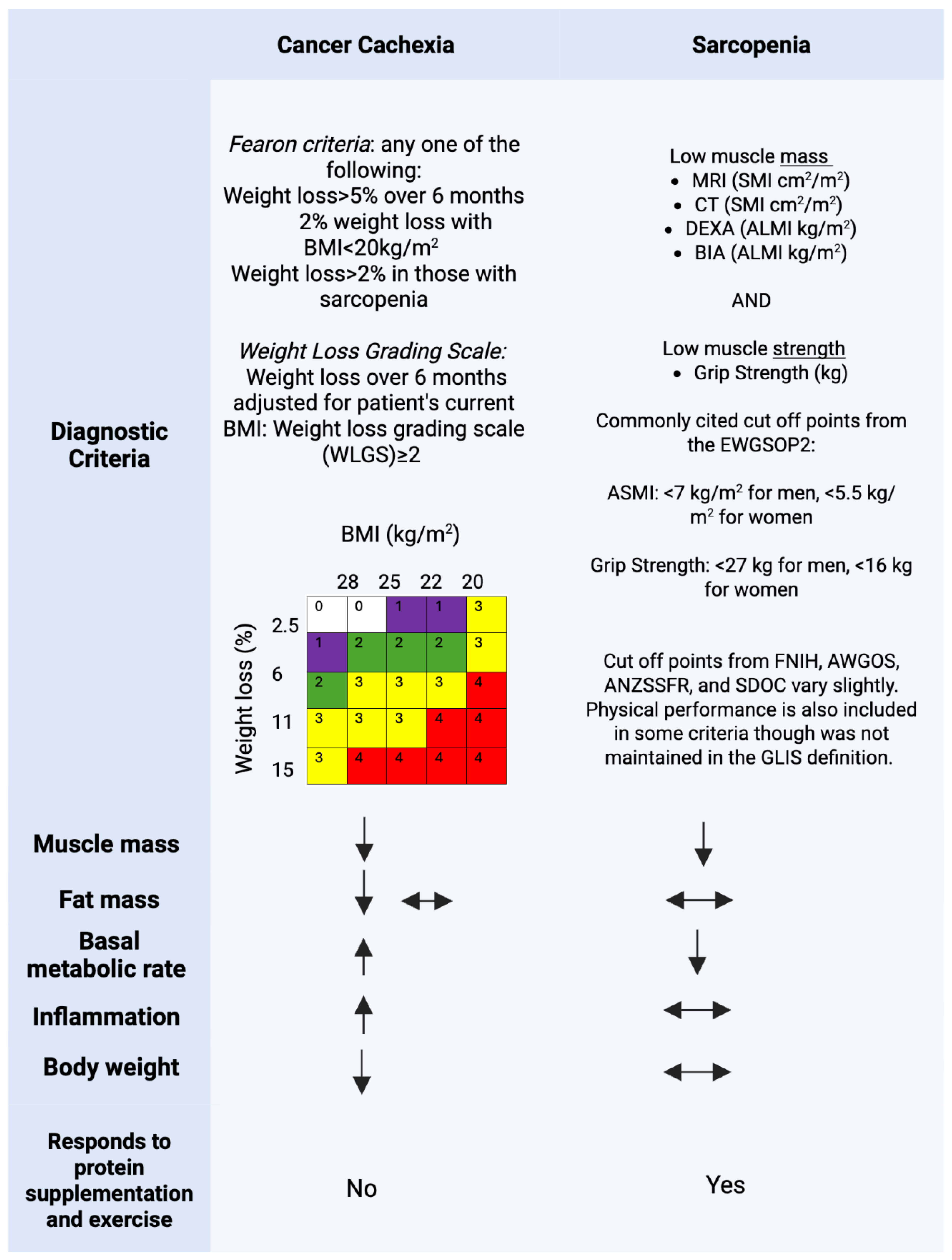
3. Sarcopenia and Cancer Cachexia: A Diagnostic Conundrum
4. Sarcopenia in Older Adults with Hematologic Malignancies
4.1. Sarcopenia Among Older Adults with Leukemia
4.2. Sarcopenia Among Older Adults with Lymphomas
4.3. Sarcopenia Among Older Adults with Multiple Myeloma
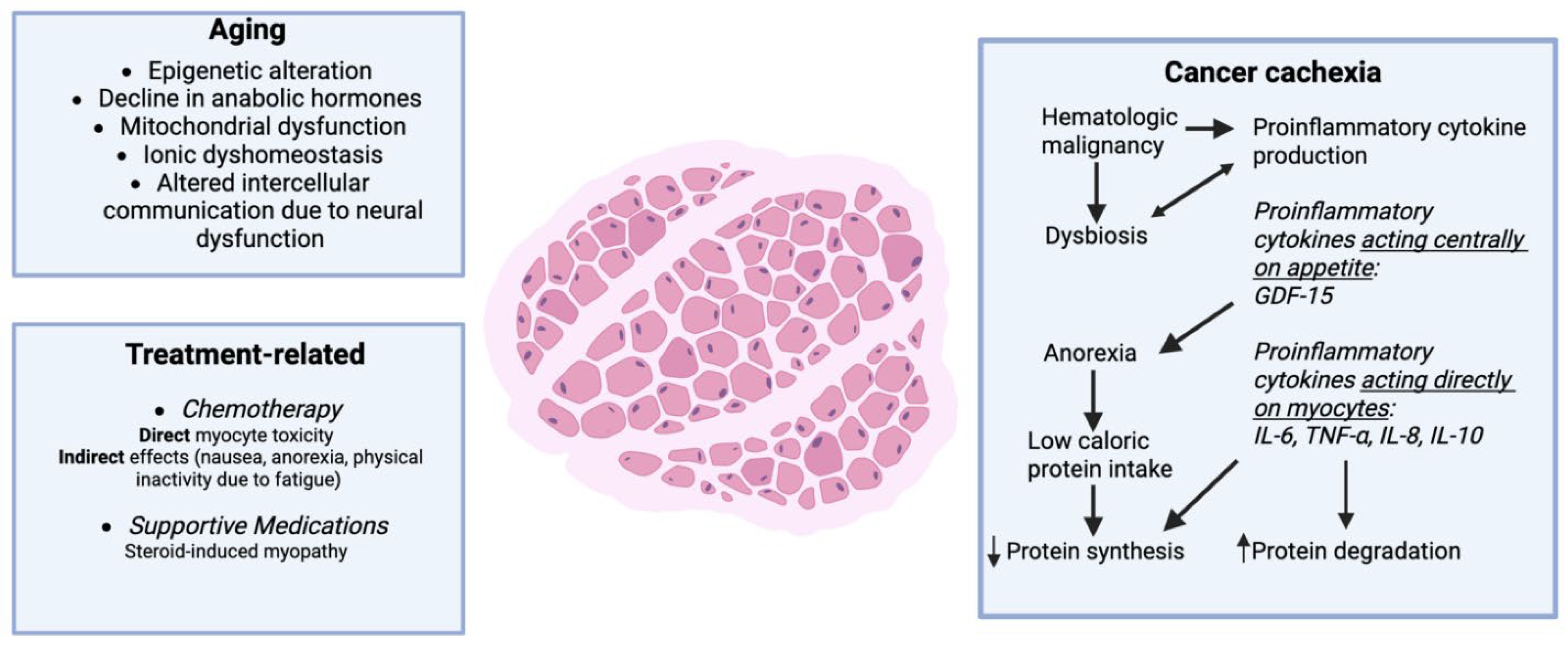
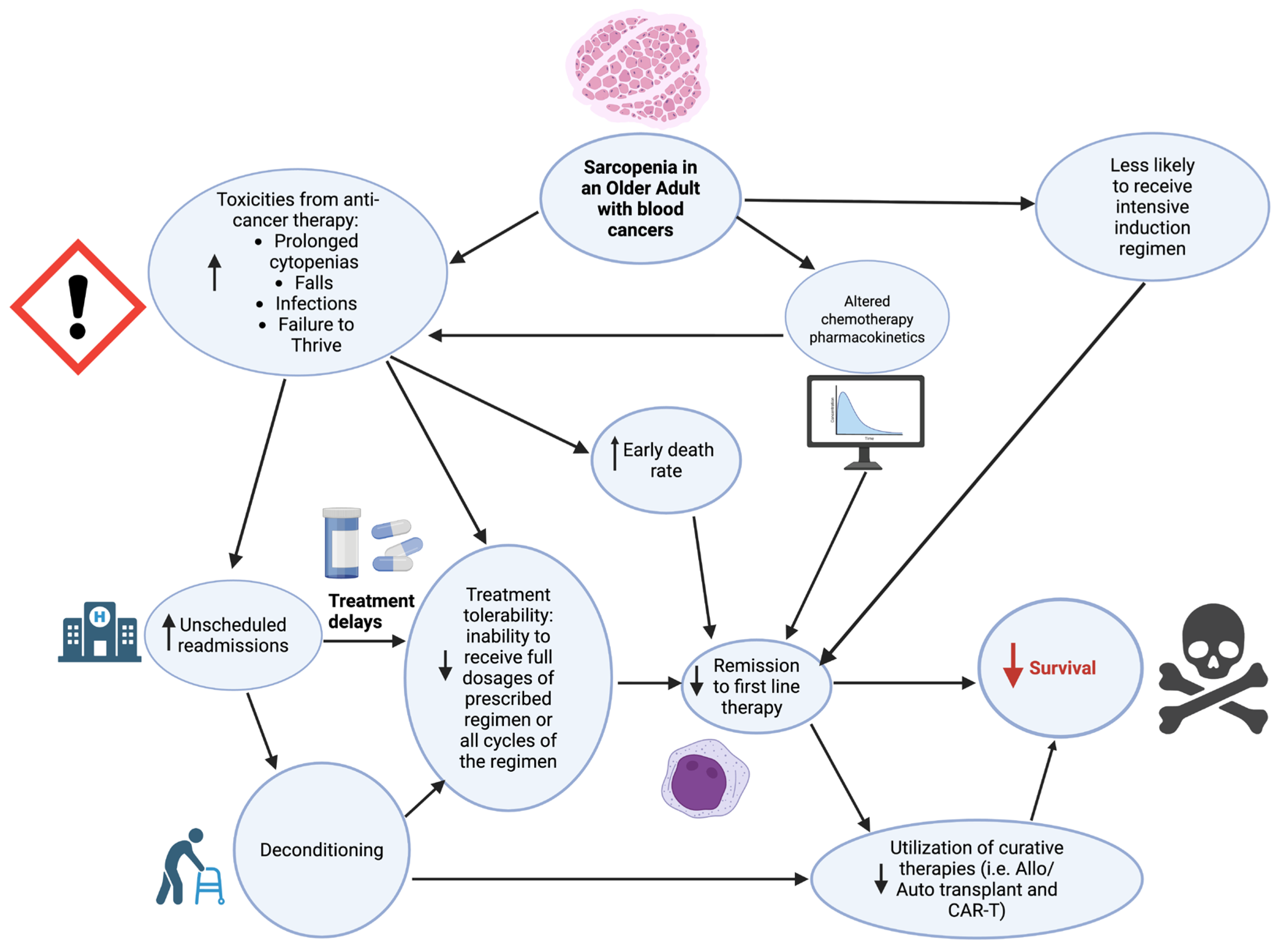
5. Proposed Mechanisms of Sarcopenia Development and Pathogenesis in Older Adults with Blood Cancers
6. Intervening on Sarcopenia
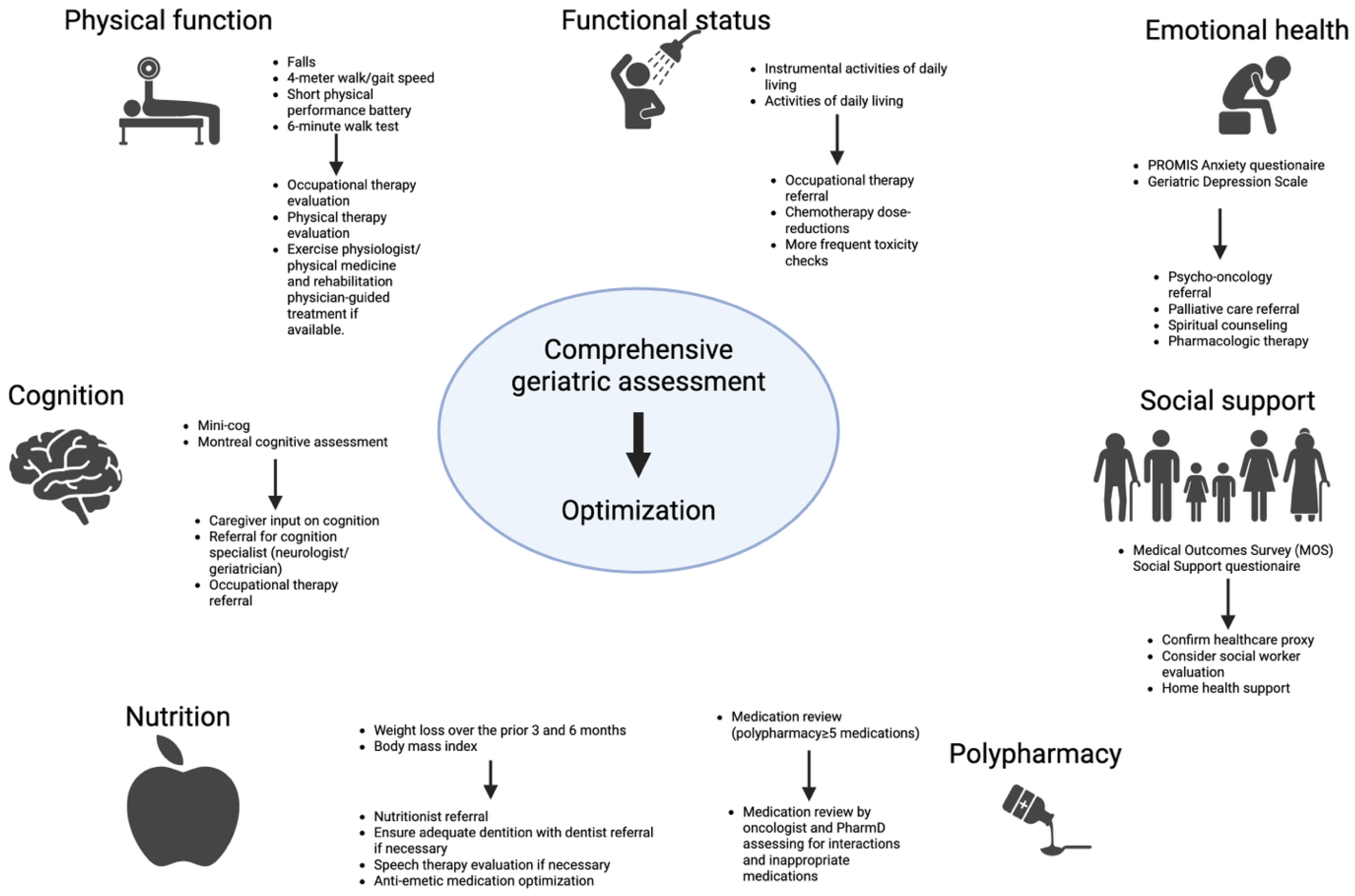
6.1. Fitness Assessment at Diagnosis
6.2. Protein Supplementation and Resistance Training Exercise
6.3. Cancer Cachexia
7. Future Directions
8. Conclusions
Author Contributions
Funding
Data Availability Statement
Conflicts of Interest
Abbreviations
| ALL | Acute lymphoblastic leukemia |
| AML | Acute myelocytic leukemia |
| AlloHSCT | Allogeneic stem cell transplant |
| ASCO | American Society of Clinical Oncology |
| ALM | Appendicular Lean Mass |
| ASMM | Appendicular Skeletal Muscle Mass |
| AWGOS | Asian Working Group on Sarcopenia |
| ANZSSFR | Australian and New Zealand Society for Frailty Research |
| AutoHSCT | Autologous stem cell transplant |
| BIA | Bioelectrical impedance analysis |
| BMI | Body mass index |
| BSA | Body surface area |
| CAR-T | Chimeric antigen receptor T-cell therapy |
| CLL | Chronic lymphocytic leukemia |
| CGA | Comprehensive geriatric assessment |
| CT | Computed tomography |
| DLBCL | Diffuse large B-cell lymphoma |
| DFS | Disease-free survival |
| DEXA | Dual-energy X-ray absorptiometry |
| EPA | Eicosapentaenoic acid |
| EMA | European Medical Agency |
| EWGSOP | European Working Group on Sarcopenia in Older People |
| EFS | Event-free survival |
| FL | Follicular lymphoma |
| FDA | Food and Drug Administration |
| FNIH | Foundation of National Institutes of Health |
| GLIS | Global Leadership in Sarcopenia |
| GDF-15 | Growth differentiation factor 15 |
| HR | Hazard ratio |
| HL | Hodgkin’s lymphoma |
| HU | Hounsfield Unit |
| MM | Multiple myeloma |
| MDS | Myelodysplastic syndrome |
| nHL | Non-Hodgkin’s lymphoma |
| OS | Overall survival |
| PET | Positron emission tomography |
| QOL | Quality of life |
| SDOC | Sarcopenia Definitions and Outcomes Consortium |
| SMD | Skeletal muscle density |
| SMI | Skeletal muscle index |
| TRM | Treatment-related mortality |
References
- Rosenberg, I.H. Sarcopenia: Origins and clinical relevance. J. Nutr. 1997, 127, 990S–991S. [Google Scholar] [CrossRef] [PubMed]
- Ferrucci, L.; de Cabo, R.; Knuth, N.D.; Studenski, S. Of Greek Heroes, Wiggling Worms, Mighty Mice, and Old Body Builders. J. Gerontol. A Biol. Sci. Med. Sci. 2011, 67, 13–16. [Google Scholar] [CrossRef] [PubMed]
- Rosenberg, I.H. Summary comments. Am. J. Clin. Nutr. 1989, 50, 1231–1233. [Google Scholar] [CrossRef]
- López-Otín, C.; Blasco, M.A.; Partridge, L.; Serrano, M.; Kroemer, G. Hallmarks of aging: An expanding universe. Cell 2023, 186, 243–278. [Google Scholar] [CrossRef]
- Granic, A.; Suetterlin, K.; Shavlakadze, T.; Grounds, M.D.; Sayer, A.A. Hallmarks of ageing in human skeletal muscle and implications for understanding the pathophysiology of sarcopenia in women and men. Clin. Sci. 2023, 137, 1721–1751. [Google Scholar] [CrossRef]
- Sayer, A.A.; Cooper, R.; Arai, H.; Cawthon, P.M.; Essomba, M.-J.N.; Fielding, R.A.; Grounds, M.D.; Witham, M.D.; Cruz-Jentoft, A.J. Sarcopenia. Nat. Rev. Dis. Primers 2024, 10, 1–16. [Google Scholar] [CrossRef]
- Cruz-Jentoft, A.J.; Sayer, A.A. Sarcopenia. Lancet 2019, 393, 2636–2646. [Google Scholar] [CrossRef]
- Shen, W.; Punyanitya, M.; Wang, Z.; Gallagher, D.; St.-Onge, M.-P.; Albu, J.; Heymsfield, S.B.; Heshka, S. Total body skeletal muscle and adipose tissue volumes: Estimation from a single abdominal cross-sectional image. J. Appl. Physiol. 2004, 97, 2333–2338. [Google Scholar] [CrossRef]
- Mourtzakis, M.; Prado, C.M.; Lieffers, J.R.; Reiman, T.; McCargar, L.J.; Baracos, V.E. A practical and precise approach to quantification of body composition in cancer patients using computed tomography images acquired during routine care. Appl. Physiol. Nutr. Metab. 2008, 33, 997–1006. [Google Scholar] [CrossRef]
- Prado, C.M.; Baracos, V.E.; McCargar, L.J.; Mourtzakis, M.; Mulder, K.E.; Reiman, T.; Butts, C.A.; Scarfe, A.G.; Sawyer, M.B. Body Composition as an Independent Determinant of 5-Fluorouracil–Based Chemotherapy Toxicity. Clin. Cancer Res. 2007, 13, 3264–3268. [Google Scholar] [CrossRef]
- Williams, G.R.; Dunne, R.F.; Giri, S.; Shachar, S.S.; Caan, B.J. Sarcopenia in the Older Adult with Cancer. J. Clin. Oncol. 2021, 39, 2068–2078. [Google Scholar] [CrossRef] [PubMed]
- Koh, K.; Scott, R.; Feliciano, E.M.C.; Janowitz, T.; Goncalves, M.D.; White, E.P.; Laird, B.J.; Haase, K.; Jamal-Hanjani, M. Cancer-Associated Cachexia: Bridging Clinical Findings with Mechanistic Insights in Human Studies. Cancer Discov. 2025, 15, 1543–1568. [Google Scholar] [CrossRef] [PubMed]
- Barreto, R.; Mandili, G.; Witzmann, F.A.; Novelli, F.; Zimmers, T.A.; Bonetto, A. Cancer and Chemotherapy Contribute to Muscle Loss by Activating Common Signaling Pathways. Front. Physiol. 2016, 7, 472. [Google Scholar] [CrossRef] [PubMed]
- Chen, J.; Splenser, A.; Guillory, B.; Luo, J.; Mendiratta, M.; Belinova, B.; Halder, T.; Zhang, G.; Li, Y.; Garcia, J.M. Ghrelin prevents tumour- and cisplatin-induced muscle wasting: Characterization of multiple mechanisms involved. J. Cachexia Sarcopenia Muscle 2015, 6, 132–143. [Google Scholar] [CrossRef]
- Campelj, D.G.; Timpani, C.A.; Rybalka, E. Cachectic muscle wasting in acute myeloid leukaemia: A sleeping giant with dire clinical consequences. J. Cachexia Sarcopenia Muscle 2021, 13, 42–54. [Google Scholar] [CrossRef]
- Campelj, D.G.; Goodman, C.A.; Rybalka, E. Chemotherapy-Induced Myopathy: The Dark Side of the Cachexia Sphere. Cancers 2021, 13, 3615. [Google Scholar] [CrossRef]
- Min, K.; Kwon, O.; Smuder, A.J.; Wiggs, M.P.; Sollanek, K.J.; Christou, D.D.; Yoo, J.; Hwang, M.; Szeto, H.H.; Kavazis, A.N.; et al. Increased mitochondrial emission of reactive oxygen species and calpain activation are required for doxorubicin-induced cardiac and skeletal muscle myopathy. J. Physiol. 2015, 593, 2017–2036. [Google Scholar] [CrossRef]
- Goede, V.; Neuendorff, N.R.; Schulz, R.-J.; Hormigo, A.-I.; Martinez-Peromingo, F.J.; Cordoba, R. Frailty assessment in the care of older people with haematological malignancies. Lancet Healthy Longev. 2021, 2, e736–e745. [Google Scholar] [CrossRef]
- Cordoba, R.; A Eyre, T.; Klepin, H.D.; Wildes, T.M.; Goede, V. A comprehensive approach to therapy of haematological malignancies in older patients. Lancet Haematol. 2021, 8, e840–e852. [Google Scholar] [CrossRef]
- Abel, G.A.; Klepin, H.D. Frailty and the management of hematologic malignancies. Blood 2018, 131, 515–524. [Google Scholar] [CrossRef]
- van der Straten, L.; Stege, C.A.M.; Kersting, S.; Nasserinejad, K.; Dubois, J.; Dobber, J.A.; Mellink, C.H.M.; van der Kevie-Kersemaekers, A.-M.F.; Evers, L.M.; de Boer, F.; et al. Fixed-duration venetoclax plus obinutuzumab improves quality of life and geriatric impairments in FCR-unfit patients with CLL. Blood 2023, 142, 1131–1142. [Google Scholar] [CrossRef]
- Bhatt, V.R.; Wichman, C.; Koll, T.T.; Fisher, A.L.; Wildes, T.M.; Berger, A.; Armitage, J.O.; Holstein, S.A.; Maness, L.J.; Gundabolu, K. Longitudinal changes in cognitive and physical function and health-related quality of life in older adults with acute myeloid leukemia. J. Geriatr. Oncol. 2023, 15, 101676. [Google Scholar] [CrossRef]
- Smits, F.; Groen, K.; Levin, M.-D.; Stege, C.A.M.; van Kampen, R.; van der Spek, E.; Bilgin, Y.M.; Thielen, N.; Nijhof, I.; Ludwig, I.; et al. Beyond static measurements: Dynamic frailty improves survival prediction in multiple myeloma. Blood 2025, 145, 543–546. [Google Scholar] [CrossRef]
- Yates, S.; Terman, E.; Miller, L.; Wild, C.; Cursio, J.; Matthews, J.; Norani, A.; Youshanlouei, H.R.; Saygin, C.; Patel, A.; et al. Comprehensive geriatric assessment predicts early death among older adults with newly diagnosed acute myeloid leukemia: Results from NCT05458258. J. Geriatr. Oncol. 2025, 16, 102448. [Google Scholar] [CrossRef]
- Yates, S.J.; Klepin, H.D. Moving beyond the eyeball test for fitness assessment in AML. Blood Adv. 2025, 9, 4488–4490. [Google Scholar] [CrossRef] [PubMed]
- Dale, W.; Klepin, H.D.; Williams, G.R.; Alibhai, S.M.; Bergerot, C.; Brintzenhofeszoc, K.; Hopkins, J.O.; Jhawer, M.P.; Katheria, V.; Loh, K.P.; et al. Practical Assessment and Management of Vulnerabilities in Older Patients Receiving Systemic Cancer Therapy: ASCO Guideline Update. J. Clin. Oncol. 2023, 41, 4293–4312. [Google Scholar] [CrossRef] [PubMed]
- Klepin, H.D. Ready for prime time: Role for geriatric assessment to improve quality of care in hematology practice. Blood 2019, 134, 2005–2012. [Google Scholar] [CrossRef]
- Loh, K.; Liposits, G.; Arora, S.; Neuendorff, N.; Gomes, F.; Krok-Schoen, J.; Amaral, T.; Mariamidze, E.; Biganzoli, L.; Brain, E.; et al. Adequate assessment yields appropriate care—The role of geriatric assessment and management in older adults with cancer: A position paper from the ESMO/SIOG Cancer in the Elderly Working Group. ESMO Open 2024, 9, 103657. [Google Scholar] [CrossRef]
- Hurria, A.; Gupta, S.; Zauderer, M.; Zuckerman, E.L.; Cohen, H.J.; Muss, H.; Rodin, M.; Panageas, K.S.; Holland, J.C.; Saltz, L.; et al. Developing a cancer-specific geriatric assessment. Cancer 2005, 104, 1998–2005. [Google Scholar] [CrossRef]
- Klepin, H.D.; Geiger, A.M.; Tooze, J.A.; Kritchevsky, S.B.; Williamson, J.D.; Pardee, T.S.; Ellis, L.R.; Powell, B.L. Geriatric assessment predicts survival for older adults receiving induction chemotherapy for acute myelogenous leukemia. Blood 2013, 121, 4287–4294. [Google Scholar] [CrossRef]
- Palumbo, A.; Bringhen, S.; Mateos, M.-V.; Larocca, A.; Facon, T.; Kumar, S.K.; Offidani, M.; McCarthy, P.; Evangelista, A.; Lonial, S.; et al. Geriatric assessment predicts survival and toxicities in elderly myeloma patients: An International Myeloma Working Group report. Blood 2015, 125, 2068–2074. [Google Scholar] [CrossRef] [PubMed]
- Tucci, A.; Ferrari, S.; Bottelli, C.; Borlenghi, E.; Drera, M.; Rossi, G. A comprehensive geriatric assessment is more effective than clinical judgment to identify elderly diffuse large cell lymphoma patients who benefit from aggressive therapy. Cancer 2009, 115, 4547–4553. [Google Scholar] [CrossRef] [PubMed]
- Bhasin, S.; Travison, T.G.; Manini, T.M.; Patel, S.; Pencina, K.M.; Fielding, R.A.; Magaziner, J.M.; Newman, A.B.; Kiel, D.P.; Cooper, C.; et al. Sarcopenia Definition: The Position Statements of the Sarcopenia Definition and Outcomes Consortium. J. Am. Geriatr. Soc. 2020, 68, 1410–1418. [Google Scholar] [CrossRef] [PubMed]
- Chen, L.-K.; Woo, J.; Assantachai, P.; Auyeung, T.-W.; Chou, M.-Y.; Iijima, K.; Jang, H.C.; Kang, L.; Kim, M.; Kim, S.; et al. Asian Working Group for Sarcopenia: 2019 Consensus Update on Sarcopenia Diagnosis and Treatment. J. Am. Med. Dir. Assoc. 2020, 21, 300.e302–307.e302. [Google Scholar] [CrossRef]
- Cruz-Jentoft, A.J.; Bahat, G.; Bauer, J.; Boirie, Y.; Bruyère, O.; Cederholm, T.; Cooper, C.; Landi, F.; Rolland, Y.; Sayer, A.A.; et al. Sarcopenia: Revised European consensus on definition and diagnosis. Age Ageing 2019, 48, 16–31. [Google Scholar] [CrossRef]
- Zanker, J.; Sim, M.; Anderson, K.; Balogun, S.; Brennan-Olsen, S.L.; Dent, E.; Duque, G.; Girgis, C.M.; Grossmann, M.; Hayes, A.; et al. The Australian and New Zealand Society for Sarcopenia and Frailty Research (ANZSSFR) sarcopenia diagnosis and management task force: Findings from the consumer expert Delphi process. Australas. J. Ageing 2022, 42, 251–257. [Google Scholar] [CrossRef]
- Ben Kirk, B.; Cawthon, P.M.; Arai, H.; A Ávila-Funes, J.; Barazzoni, R.; Bhasin, S.; Binder, E.F.; Bruyere, O.; Cederholm, T.; Chen, L.-K.; et al. The Conceptual Definition of Sarcopenia: Delphi Consensus from the Global Leadership Initiative in Sarcopenia (GLIS). Age Ageing 2024, 53, afae052. [Google Scholar] [CrossRef]
- Kyle, U.G.; Bosaeus, I.; De Lorenzo, A.D.; Deurenberg, P.; Elia, M.; Gomez, J.M.; Heitmann, B.L.; Kent-Smith, L.; Melchior, J.-C.; Pirlich, M.; et al. Bioelectrical impedance analysis? Part I: Review of principles and methods. Clin. Nutr. 2004, 23, 1226–1243. [Google Scholar] [CrossRef]
- Aleixo, G.F.; Shachar, S.S.; Nyrop, K.A.; Muss, H.B.; Battaglini, C.L.; Williams, G.R. Bioelectrical Impedance Analysis for the Assessment of Sarcopenia in Patients with Cancer: A Systematic Review. Oncologist 2019, 25, 170–182. [Google Scholar] [CrossRef]
- Malmstrom, T.K.; Miller, D.K.; Simonsick, E.M.; Ferrucci, L.; Morley, J.E. SARC-F: A symptom score to predict persons with sarcopenia at risk for poor functional outcomes. J. Cachexia Sarcopenia Muscle 2016, 7, 28–36. [Google Scholar] [CrossRef]
- Voelker, S.N.; Michalopoulos, N.; Maier, A.B.; Reijnierse, E.M. Reliability and Concurrent Validity of the SARC-F and Its Modified Versions: A Systematic Review and Meta-Analysis. J. Am. Med Dir. Assoc. 2021, 22, 1864–1876.e16. [Google Scholar] [CrossRef]
- Fearon, K.C. Cancer Cachexia and Fat–Muscle Physiology. N. Engl. J. Med. 2011, 365, 565–567. [Google Scholar] [CrossRef] [PubMed]
- Martin, L.; Senesse, P.; Gioulbasanis, I.; Antoun, S.; Bozzetti, F.; Deans, C.; Strasser, F.; Thoresen, L.; Jagoe, R.T.; Chasen, M.; et al. Diagnostic Criteria for the Classification of Cancer-Associated Weight Loss. J. Clin. Oncol. 2015, 33, 90–99. [Google Scholar] [CrossRef] [PubMed]
- Ferrer, M.; Anthony, T.G.; Ayres, J.S.; Biffi, G.; Brown, J.C.; Caan, B.J.; Feliciano, E.M.C.; Coll, A.P.; Dunne, R.F.; Goncalves, M.D.; et al. Cachexia: A systemic consequence of progressive, unresolved disease. Cell 2023, 186, 1824–1845. [Google Scholar] [CrossRef] [PubMed]
- Argilés, J.M.; López-Soriano, F.J.; Stemmler, B.; Busquets, S. Cancer-associated cachexia—Understanding the tumour macroenvironment and microenvironment to improve management. Nat. Rev. Clin. Oncol. 2023, 20, 250–264. [Google Scholar] [CrossRef]
- Fearon, K.; Strasser, F.; Anker, S.D.; Bosaeus, I.; Bruera, E.; Fainsinger, R.L.; Jatoi, A.; Loprinzi, C.; MacDonald, N.; Mantovani, G.; et al. Definition and classification of cancer cachexia: An international consensus. Lancet Oncol. 2011, 12, 489–495. [Google Scholar] [CrossRef]
- Nakamura, N.; Ninomiya, S.; Matsumoto, T.; Nakamura, H.; Kitagawa, J.; Shiraki, M.; Hara, T.; Shimizu, M.; Tsurumi, H. Prognostic impact of skeletal muscle assessed by computed tomography in patients with acute myeloid leukemia. Ann. Hematol. 2018, 98, 351–359. [Google Scholar] [CrossRef]
- Jung, J.; Lee, E.; Shim, H.; Park, J.-H.; Eom, H.-S.; Lee, H. Prediction of clinical outcomes through assessment of sarcopenia and adipopenia using computed tomography in adult patients with acute myeloid leukemia. Int. J. Hematol. 2021, 114, 44–52. [Google Scholar] [CrossRef]
- Sun, Q.; Cui, J.; Liu, W.; Li, J.; Hong, M.; Qian, S. The Prognostic Value of Sarcopenia in Acute Myeloid Leukemia Patients and the Development and Validation of a Novel Nomogram for Predicting Survival. Front. Oncol. 2022, 12, 828939. [Google Scholar] [CrossRef]
- Fang, Y.; Zhao, M.; Luo, T.; Cui, J.; Liu, W.; Hong, M.; Sun, Q.; Qian, S. Prediction of survival in acute myeloid leukemia patients by extracellular to intracellular water ratio and sarcopenia: Development and validation of a novel nomogram. Ann. Hematol. 2025, 104, 985–996. [Google Scholar] [CrossRef]
- Qin, Z.; Lu, K.; Jiang, T.; Wang, M.; Weng, Y.; Tang, X.; Zhao, Y. Evaluating Sarcopenia by Using the Bioelectrical Impedance Analysis in Patients with Acute Myeloid Leukemia After Chemotherapy. Int. J. Gen. Med. 2022, ume 15, 1261–1269. [Google Scholar] [CrossRef] [PubMed]
- Derstine, B.A.; Holcombe, S.A.; Ross, B.E.; Wang, N.C.; Su, G.L.; Wang, S.C. Skeletal muscle cutoff values for sarcopenia diagnosis using T10 to L5 measurements in a healthy US population. Sci. Rep. 2018, 8, 11369. [Google Scholar] [CrossRef]
- Studenski, S.A.; Peters, K.W.; Alley, D.E.; Cawthon, P.M.; McLean, R.R.; Harris, T.B.; Ferrucci, L.; Guralnik, J.M.; Fragala, M.S.; Kenny, A.M.; et al. The FNIH Sarcopenia Project: Rationale, Study Description, Conference Recommendations, and Final Estimates. J. Gerontol. A Biol. Sci. Med. Sci. 2014, 69, 547–558. [Google Scholar] [CrossRef]
- Armenian, S.H.; Xiao, M.; Teh, J.B.; Lee, B.; A Chang, H.; Mascarenhas, K.; Lee, S.; Iukuridze, A.; Xie, J.J.; Scott, J.M.; et al. Impact of Sarcopenia on Adverse Outcomes After Allogeneic Hematopoietic Cell Transplantation. JNCI J. Natl. Cancer Inst. 2019, 111, 837–844. [Google Scholar] [CrossRef] [PubMed]
- Martin, L.; Birdsell, L.; MacDonald, N.; Reiman, T.; Clandinin, M.T.; McCargar, L.J.; Murphy, R.; Ghosh, S.; Sawyer, M.B.; Baracos, V.E. Cancer Cachexia in the Age of Obesity: Skeletal Muscle Depletion Is a Powerful Prognostic Factor, Independent of Body Mass Index. J. Clin. Oncol. 2013, 31, 1539–1547. [Google Scholar] [CrossRef] [PubMed]
- Ando, T.; Fujisawa, S.; Teshigawara, H.; Matsumura, A.; Sakuma, T.; Suzuki, T.; Teranaka, H.; Ogusa, E.; Ishii, Y.; Miyashita, K.; et al. Computed tomography-defined sarcopenia: Prognostic predictor of nonrelapse mortality after allogeneic hematopoietic stem cell transplantation: A multicenter retrospective study. Int. J. Hematol. 2020, 112, 46–56. [Google Scholar] [CrossRef]
- Rios-Olais, F.A.; Gil-Lopez, F.; Mora-Cañas, A.; Zalapa-Soto, J.; Rosales-Sotomayor, G.; Gabutti-Thomas, A.; Demichelis-Gomez, R. The prognostic impact of body composition assessed by computed tomography in adult patients with newly diagnosed acute lymphoblastic leukemia. Clin. Nutr. ESPEN 2025, 66, 539–546. [Google Scholar] [CrossRef]
- Nakamura, N.; Hara, T.; Shibata, Y.; Matsumoto, T.; Nakamura, H.; Ninomiya, S.; Kito, Y.; Kitagawa, J.; Kanemura, N.; Goto, N.; et al. Sarcopenia is an independent prognostic factor in male patients with diffuse large B-cell lymphoma. Ann. Hematol. 2015, 94, 2043–2053. [Google Scholar] [CrossRef]
- Lanic, H.; Kraut-Tauzia, J.; Modzelewski, R.; Clatot, F.; Mareschal, S.; Picquenot, J.M.; Stamatoullas, A.; Leprêtre, S.; Tilly, H.; Jardin, F. Sarcopenia is an independent prognostic factor in elderly patients with diffuse large B-cell lymphoma treated with immunochemotherapy. Leuk. Lymphoma 2013, 55, 817–823. [Google Scholar] [CrossRef]
- Pénichoux, J.; Lanic, H.; Thill, C.; Ménard, A.-L.; Camus, V.; Stamatoullas, A.; Lemasle, E.; Leprêtre, S.; Lenain, P.; Contentin, N.; et al. Prognostic relevance of sarcopenia, geriatric, and nutritional assessments in older patients with diffuse large B-cell lymphoma: Results of a multicentric prospective cohort study. Ann. Hematol. 2023, 102, 1811–1823. [Google Scholar] [CrossRef]
- Chu, M.P.; Lieffers, J.; Ghosh, S.; Belch, A.; Chua, N.S.; Fontaine, A.; Sangha, R.; Turner, R.A.; Baracos, V.E.; Sawyer, M.B. Skeletal muscle density is an independent predictor of diffuse large B-cell lymphoma outcomes treated with rituximab-based chemoimmunotherapy. J. Cachexia Sarcopenia Muscle 2016, 8, 298–304. [Google Scholar] [CrossRef] [PubMed]
- Zilioli, V.R.; Albano, D.; Arcari, A.; Merli, F.; Coppola, A.; Besutti, G.; Marcheselli, L.; Gramegna, D.; Muzi, C.; Manicone, M.; et al. Clinical and prognostic role of sarcopenia in elderly patients with classical Hodgkin lymphoma: A multicentre experience. J. Cachexia Sarcopenia Muscle 2021, 12, 1042–1055. [Google Scholar] [CrossRef] [PubMed]
- Albano, D.; Pasinetti, N.; Dondi, F.; Giubbini, R.; Tucci, A.; Bertagna, F. Prognostic Role of Pre-Treatment Metabolic Parameters and Sarcopenia Derived by 2-[18F]-FDG PET/CT in Elderly Mantle Cell Lymphoma. J. Clin. Med. 2022, 11, 1210. [Google Scholar] [CrossRef] [PubMed]
- Armenian, S.H.; Iukuridze, A.; Teh, J.B.; Mascarenhas, K.; Herrera, A.; McCune, J.S.; Zain, J.M.; Mostoufi-Moab, S.; McCormack, S.; Slavin, T.P.; et al. Abnormal body composition is a predictor of adverse outcomes after autologous haematopoietic cell transplantation. J. Cachexia Sarcopenia Muscle 2020, 11, 962–972. [Google Scholar] [CrossRef]
- Lin, R.J.; Elko, T.A.; Devlin, S.M.; Shahrokni, A.; Jakubowski, A.A.; Dahi, P.B.; Perales, M.-A.; Tamari, R.; Shaffer, B.C.; Sauter, C.S.; et al. Impact of geriatric vulnerabilities on allogeneic hematopoietic cell transplantation outcomes in older patients with hematologic malignancies. Bone Marrow Transplant. 2019, 55, 157–164. [Google Scholar] [CrossRef]
- Rejeski, K.; dos Santos, D.M.C.; Parker, N.H.; Bücklein, V.L.; Winkelmann, M.; Jhaveri, K.S.; Liu, L.; Trinkner, P.; Günther, S.; Karschnia, P.; et al. Influence of Adipose Tissue Distribution, Sarcopenia, and Nutritional Status on Clinical Outcomes After CD19 CAR T-cell Therapy. Cancer Immunol. Res. 2023, 11, 707–719. [Google Scholar] [CrossRef]
- Jhaveri, K.; Thapa, R.; Ercan, D.; Saha, A.; Noble, J.; Singh, P.; Fahrmann, J.; Saini, N.; Wu, R.; Dennison, J.B.; et al. Sarcopenia and Skeletal Muscle Loss after CAR T-cell Therapy in Diffuse Large B-cell Lymphoma. Clin. Cancer Res. 2025, 31, 2756–2766. [Google Scholar] [CrossRef]
- Prado, C.M.; Lieffers, J.R.; McCargar, L.J.; Reiman, T.; Sawyer, M.B.; Martin, L.; Baracos, V.E. Prevalence and clinical implications of sarcopenic obesity in patients with solid tumours of the respiratory and gastrointestinal tracts: A population-based study. Lancet Oncol. 2008, 9, 629–635. [Google Scholar] [CrossRef]
- Williams, A.; Baruah, D.; Patel, J.; Szabo, A.; Chhabra, S.; Dhakal, B.; Hari, P.; Janz, S.; Stolley, M.; D’sOuza, A. Prevalence and significance of sarcopenia in multiple myeloma patients undergoing autologous hematopoietic cell transplantation. Bone Marrow Transplant. 2020, 56, 225–231. [Google Scholar] [CrossRef]
- Abdallah, N.H.; Nagayama, H.; Takahashi, N.; Gonsalves, W.; Fonder, A.; Dispenzieri, A.; Dingli, D.; Buadi, F.K.; Lacy, M.Q.; Hobbs, M.; et al. Muscle and fat composition in patients with newly diagnosed multiple myeloma. Blood Cancer J. 2023, 13, 185. [Google Scholar] [CrossRef]
- Ordonez, F.B.; Wolleschak, D.; Zeller, Y.; Hinnerichs, M.; Rodríguez-Feria, P.; Aghayev, A.; Mikusko, M.; Borggrefe, J.; Mougiakakos, D.; Surov, A. Parameters of body composition do not predict survival in patients with multiple myeloma undergoing autologous stem cell transplantation. Leuk. Lymphoma 2024, 65, 825–832. [Google Scholar] [CrossRef] [PubMed]
- Surov, A.; Benkert, F.; Pönisch, W.; Meyer, H.-J. CT-defined body composition as a prognostic factor in multiple myeloma. Hematology 2023, 28, 2191075. [Google Scholar] [CrossRef] [PubMed]
- Annibali, O.; Altomare, A.; Tomarchio, V.; Rocchi, G.; Mallio, C.A.; Tafuri, M.A.; Zobel, B.B.; Vincenzi, B.; Guarino, M.P.L.; Rigacci, L.; et al. Sarcopenia Does Not Impact the Outcome of Patients with Multiple Myeloma Consolidated with Autologous Hematopoietic Stem Cell Transplantation. Chemotherapy 2024, 69, 133–140. [Google Scholar] [CrossRef] [PubMed]
- Park, S.-S.; Kwag, D.; Lee, J.Y.; Jeon, Y.-W.; Yahng, S.-A.; Shin, S.-H.; Youn, S.Y.; Min, C.-K. Prognostic value of low muscle mass at the 12th thoracic vertebral level in multiple myeloma treated with transplantation: CAREMM-2101 study. Diagn. Interv. Radiol. 2023, 29, 596–608. [Google Scholar] [CrossRef]
- Takeoka, Y.; Sakatoku, K.; Miura, A.; Yamamura, R.; Araki, T.; Seura, H.; Okamura, T.; Koh, H.; Nakamae, H.; Hino, M.; et al. Prognostic Effect of Low Subcutaneous Adipose Tissue on Survival Outcome in Patients with Multiple Myeloma. Clin. Lymphoma Myeloma Leuk. 2016, 16, 434–441. [Google Scholar] [CrossRef]
- Nandakumar, B.; Baffour, F.; Abdallah, N.H.; Kumar, S.K.; Dispenzieri, A.; Buadi, F.K.; Dingli, D.; Lacy, M.Q.; Hayman, S.R.; Kapoor, P.; et al. Sarcopenia identified by computed tomography imaging using a deep learning–based segmentation approach impacts survival in patients with newly diagnosed multiple myeloma. Cancer 2022, 129, 385–392. [Google Scholar] [CrossRef]
- Diallo, T.D.; Blessing, A.I.L.; Ihorst, G.; Möller, M.D.; Jungmann, P.M.; Bamberg, F.; Herget, G.; Wäsch, R.; Engelhardt, M.; Neubauer, J. Myosteatosis in multiple myeloma: A key determinant of survival beyond sarcopenia. Skelet. Radiol. 2024, 54, 275–285. [Google Scholar] [CrossRef]
- Tagliafico, A.S.; Rossi, F.; Bignotti, B.; Torri, L.; Bonsignore, A.; Belgioia, L.; Domineitto, A. CT-derived relationship between low relative muscle mass and bone damage in patients with multiple myeloma undergoing stem cells transplantation. Br. J. Radiol. 2021, 95, 20210923. [Google Scholar] [CrossRef]
- Amini, B.; Boyle, S.P.; Boutin, R.D.; Lenchik, L. Approaches to Assessment of Muscle Mass and Myosteatosis on Computed Tomography: A Systematic Review. J. Gerontol. Ser. A 2019, 74, 1671–1678. [Google Scholar] [CrossRef]
- Stege, C.A.; Nasserinejad, K.; Levin, M.M.-D.; Klein, S.K.; de Waal, E.; Eeltink, C.; Korst, C.L.; Ypma, P.F.; Dijk, A.C.; Westerman, M.; et al. Geriatric Impairments and Low Muscle Mass Are Associated with Treatment Discontinuation and Overall Survival in Newly Diagnosed Non-Transplant Eligible Multiple Myeloma Patients (nte-NDMM) Treated with Dose-Adjusted Melphalan-Prednisone-Bortezomib (MPV)—Results of the Dutch HOVON 123 Study. Blood 2018, 132, 1889. [Google Scholar] [CrossRef]
- Grinblatt, D.L.; Roboz, G.J.; Pollyea, D.A.; Sekeres, M.A.; Scott, B.L.; Seiter, K.; Zeidan, A.M.; Patel, J.L.; Garcia-Manero, G.; Komrokji, R.S.; et al. Treatment Patterns and Outcomes of Patients with Acute Myeloid Leukemia (AML) from 2013 to 2022: A Connect ® Myeloid Registry Study. Blood 2023, 142, 593. [Google Scholar] [CrossRef]
- Dinardo, C.D.; Jonas, B.A.; Pullarkat, V.; Thirman, M.J.; Garcia, J.S.; Wei, A.H.; Konopleva, M.; Döhner, H.; Letai, A.; Fenaux, P.; et al. Azacitidine and Venetoclax in Previously Untreated Acute Myeloid Leukemia. N. Engl. J. Med. 2020, 383, 617–629. [Google Scholar] [CrossRef]
- Anabtawi, N.M.; Pasala, M.S.; Grimshaw, A.A.; Kharel, P.; Bal, S.; Godby, K.; Siwakoti, A.; Buford, T.W.; Bhatia, S.; Costa, L.J.; et al. Low skeletal muscle mass and treatment outcomes among adults with haematologic malignancies: A systematic review and meta-analysis. J. Cachexia Sarcopenia Muscle 2024, 15, 1084–1093. [Google Scholar] [CrossRef] [PubMed]
- DeFilipp, Z.; Troschel, F.M.; Qualls, D.A.; Li, S.; Kuklinski, M.W.; Kempner, M.E.; Hochberg, E.; Chen, Y.-B.; El-Jawahri, A.; Fintelmann, F.J. Evolution of Body Composition Following Autologous and Allogeneic Hematopoietic Cell Transplantation: Incidence of Sarcopenia and Association with Clinical Outcomes. Biol. Blood Marrow Transplant. 2018, 24, 1741–1747. [Google Scholar] [CrossRef] [PubMed]
- Lin, R.J.; Michaud, L.; Lobaugh, S.M.; Nakajima, R.; Mauguen, A.; Elko, T.A.; Ruiz, J.D.; Maloy, M.A.; Sauter, C.S.; Dahi, P.B.; et al. The geriatric syndrome of sarcopenia impacts allogeneic hematopoietic cell transplantation outcomes in older lymphoma patients. Leuk. Lymphoma 2020, 61, 1833–1841. [Google Scholar] [CrossRef]
- Gökbuget, N.; Steffen, B. How I treat older patients with Ph/BCR-ABL–negative acute lymphoblastic leukemia. Blood 2025, 145, 53–63. [Google Scholar] [CrossRef]
- Tran, T.H.; Tasian, S.K. How I treat Philadelphia chromosome–like acute lymphoblastic leukemia in children, adolescents, and young adults. Blood 2025, 145, 20–34. [Google Scholar] [CrossRef]
- Bankar, A.; Chan, W.C.; Liu, N.; Cheung, M.C.; Alibhai, S.M.; Gupta, V. Prevalence of frailty and its association with clinical outcomes in myeloproliferative neoplasms: A population-based study. Blood Adv. 2023, 7, 5014–5026. [Google Scholar] [CrossRef]
- Starkman, R.; Alibhai, S.; Wells, R.A.; Geddes, M.; Zhu, N.; Keating, M.M.; Leber, B.; Chodirker, L.; Sabloff, M.; Christou, G.; et al. An MDS-specific frailty index based on cumulative deficits adds independent prognostic information to clinical prognostic scoring. Leukemia 2019, 34, 1394–1406. [Google Scholar] [CrossRef]
- Xu, X.-T.; He, D.-L.; Tian, M.-X.; Wu, H.-J.; Jin, X. Prognostic Value of Sarcopenia in Patients with Diffuse Large B-Cell Lymphoma Treated with R-CHOP: A Systematic Review and Meta-Analysis. Front. Nutr. 2022, 9, 816883. [Google Scholar] [CrossRef]
- Chu, M.P.; Lieffers, J.; Ghosh, S.; Belch, A.R.; Chua, N.S.; Fontaine, A.; Sangha, R.; Turner, A.R.; Baracos, V.E.; Sawyer, M.B. Skeletal Muscle Radio-Density Is an Independent Predictor of Response and Outcomes in Follicular Lymphoma Treated with Chemoimmunotherapy. PLoS ONE 2015, 10, e0127589. [Google Scholar] [CrossRef] [PubMed]
- Dac, D.T.; Koshihara, H.; Cho, M.; Inaoka, P.T.; Nguyen, H.T.G.; Espinoza, J.L. Sarcopenia and clinical outcomes in lymphoma and multiple myeloma patients receiving hematopoietic cell transplantation: A systematic review and meta-analysis. Int. J. Hematol. 2025, 122, 25–34. [Google Scholar] [CrossRef] [PubMed]
- Howlader, N.; Noone, A.M.; Krapcho, M.; Miller, D.; Brest, A.; Yu, M.; Ruhl, J.; Tatalovich, Z.; Mariotto, A.; Lewis, D.R.; et al. SEER Cancer Statistics Review (CSR) 1975–2018. Available online: https://seer.cancer.gov/csr/1975_2018/ (accessed on 12 January 2025).
- Goel, U.; Usmani, S.; Kumar, S. Current approaches to management of newly diagnosed multiple myeloma. Am. J. Hematol. 2022, 97, S3–S25. [Google Scholar] [CrossRef] [PubMed]
- Mikhael, J.; Ismaila, N.; Cheung, M.C.; Costello, C.; Dhodapkar, M.V.; Kumar, S.; Lacy, M.; Lipe, B.; Little, R.F.; Nikonova, A.; et al. Treatment of Multiple Myeloma: ASCO and CCO Joint Clinical Practice Guideline. J. Clin. Oncol. 2019, 37, 1228–1263. [Google Scholar] [CrossRef]
- Atrash, S.; Moyo, T.K. A Review of Chimeric Antigen Receptor T-Cell Therapy for Myeloma and Lymphoma. OncoTargets Ther. 2021, ume 14, 2185–2201. [Google Scholar] [CrossRef]
- Parker, N.; Modi, K.; Villanueva, R.; Skelson, L.; Scotto, A.; Booth-Jones, M.; De Avila, G.; Jain, M.D.; Mishra, A.; Faramand, R.; et al. Sarcopenia Prevalence and Influence on the Development of Toxicity and Length of Stay in Patients with Relapsed and Refractory Myeloma Treated with Commercial Anti-BCMA CART Cells. Blood 2022, 140, 4688–4690. [Google Scholar] [CrossRef]
- Wiedmer, P.; Jung, T.; Castro, J.P.; Pomatto, L.C.; Sun, P.Y.; Davies, K.J.; Grune, T. Sarcopenia–Molecular mechanisms and open questions. Ageing Res. Rev. 2021, 65, 101200. [Google Scholar] [CrossRef]
- Bowen, T.S.; Schuler, G.; Adams, V. Skeletal muscle wasting in cachexia and sarcopenia: Molecular pathophysiology and impact of exercise training. J. Cachexia Sarcopenia Muscle 2015, 6, 197–207. [Google Scholar] [CrossRef]
- Evans, W.J. Skeletal muscle loss: Cachexia, sarcopenia, and inactivity. Am. J. Clin. Nutr. 2010, 91, 1123S–1127S. [Google Scholar] [CrossRef]
- Ahn, H.; Kim, D.W.; Ko, Y.; Ha, J.; Bin Shin, Y.; Lee, J.; Sung, Y.S.; Kim, K.W. Updated systematic review and meta-analysis on diagnostic issues and the prognostic impact of myosteatosis: A new paradigm beyond sarcopenia. Ageing Res. Rev. 2021, 70, 101398. [Google Scholar] [CrossRef]
- Walston, J.D. Sarcopenia in older adults. Curr. Opin. Rheumatol. 2012, 24, 623–627. [Google Scholar] [CrossRef]
- Narici, M.V.; Maffulli, N. Sarcopenia: Characteristics, mechanisms and functional significance. Br. Med. Bull. 2010, 95, 139–159. [Google Scholar] [CrossRef] [PubMed]
- Sieber, C.C. Malnutrition and sarcopenia. Aging Clin. Exp. Res. 2019, 31, 793–798. [Google Scholar] [CrossRef] [PubMed]
- Stauder, R.; Augschoell, J.; Hamaker, M.E.; Koinig, K.A. Malnutrition in Older Patients with Hematological Malignancies at Initial Diagnosis–Association with Impairments in Health Status, Systemic Inflammation and Adverse Outcome. HemaSphere 2020, 4, e332. [Google Scholar] [CrossRef] [PubMed]
- Foran, J.M.; Sun, Z.; Lai, C.; Fernandez, H.F.; Cripe, L.D.; Ketterling, R.P.; Racevskis, J.; Luger, S.M.; Paietta, E.; Lazarus, H.M.; et al. Obesity in adult acute myeloid leukemia is not associated with inferior response or survival even when dose capping anthracyclines: An ECOG-ACRIN analysis. Cancer 2023, 129, 2479–2490. [Google Scholar] [CrossRef]
- Correa-De-Araujo, R.; Addison, O.; Miljkovic, I.; Goodpaster, B.H.; Bergman, B.C.; Clark, R.V.; Elena, J.W.; Esser, K.A.; Ferrucci, L.; Harris-Love, M.O.; et al. Myosteatosis in the Context of Skeletal Muscle Function Deficit: An Interdisciplinary Workshop at the National Institute on Aging. Front. Physiol. 2020, 11, 963. [Google Scholar] [CrossRef]
- Bodine, S.C. Disuse-induced muscle wasting. Int. J. Biochem. Cell Biol. 2013, 45, 2200–2208. [Google Scholar] [CrossRef]
- Nunes, E.A.; Stokes, T.; McKendry, J.; Currier, B.S.; Phillips, S.M. Disuse-induced skeletal muscle atrophy in disease and nondisease states in humans: Mechanisms, prevention, and recovery strategies. Am. J. Physiol. Physiol. 2022, 322, C1068–C1084. [Google Scholar] [CrossRef]
- Glass, D.J. Skeletal muscle hypertrophy and atrophy signaling pathways. Int. J. Biochem. Cell Biol. 2005, 37, 1974–1984. [Google Scholar] [CrossRef]
- VanderVeen, B.N.; Fix, D.K.; A Carson, J. Disrupted Skeletal Muscle Mitochondrial Dynamics, Mitophagy, and Biogenesis during Cancer Cachexia: A Role for Inflammation. Oxid. Med. Cell. Longev. 2017, 2017, 3292087. [Google Scholar] [CrossRef]
- Valtis, Y.K.; Devlin, S.; Shouval, R.; Rejeski, K.; Corona, M.; De Abia, A.L.; Rivas-Delgado, A.; Luttwak, E.; Cassanello, G.; Landego, I.; et al. Cancer cachexia and weight loss before CAR T-cell therapy for lymphoma are independently associated with poor outcomes. Blood Adv. 2024, 9, 151–161. [Google Scholar] [CrossRef]
- Pötgens, S.A.; Havelange, V.; Lecop, S.; Li, F.; Neyrinck, A.M.; Bindels, F.; Neveux, N.; Demoulin, J.-B.; Moors, I.; Kerre, T.; et al. Gut microbiome alterations at acute myeloid leukemia diagnosis are associated with muscle weakness and anorexia. Haematologica 2024, 109, 3194–3208. [Google Scholar] [CrossRef]
- Jabir, A.R.; Ciarrocca, A.L.; O’COnnell, N.; Needles, K.; Pardee, T.S.; Bhave, R.; Ellis, L.R.; Wieduwilt, M.J.; Powell, B.L.; Burkart, M. The Impact of Weight Loss Grading Scale, a Measure of Cancer Cachexia, on Clinical Outcomes in Patients with Acute Myeloid Leukemia. Blood 2024, 144, 2858. [Google Scholar] [CrossRef]
- Komici, K.; Iacono, A.D.; De Luca, A.; Perrotta, F.; Bencivenga, L.; Rengo, G.; Rocca, A.; Guerra, G. Adiponectin and Sarcopenia: A Systematic Review with Meta-Analysis. Front. Endocrinol. 2021, 12, 576619. [Google Scholar] [CrossRef] [PubMed]
- Smiechowska, J.; Utech, A.; Taffet, G.; Hayes, T.; Marcelli, M.; Garcia, J.M. Adipokines in Patients with Cancer Anorexia and Cachexia. J. Investig. Med. 2010, 58, 554–559. [Google Scholar] [CrossRef] [PubMed]
- VanderVeen, B.N.; Cardaci, T.D.; Madero, S.S.; McDonald, S.J.; Bullard, B.M.; Price, R.L.; Carson, J.A.; Fan, D.; Murphy, E.A. 5-Fluorouracil disrupts skeletal muscle immune cells and impairs skeletal muscle repair and remodeling. J. Appl. Physiol. 2022, 133, 834–849. [Google Scholar] [CrossRef]
- VanderVeen, B.N.; Cardaci, T.D.; Bullard, B.M.; Huss, A.R.; McDonald, S.J.; Muhammed, A.D.; Kubinak, J.L.; Fan, D.; Murphy, E.A. The complex heterogeneity of immune cell signatures across wasting tissues with C26 and 5-fluorouracil-induced cachexia. Am. J. Physiol. Physiol. 2024, 326, C606–C621. [Google Scholar] [CrossRef]
- Hiensch, A.E.; Bolam, K.A.; Mijwel, S.; Jeneson, J.A.L.; Huitema, A.D.R.; Kranenburg, O.; van der Wall, E.; Rundqvist, H.; Wengstrom, Y.; May, A.M. Doxorubicin-induced skeletal muscle atrophy: Elucidating the underlying molecular pathways. Acta Physiol. 2019, 229, e13400. [Google Scholar] [CrossRef]
- VanderVeen, B.N.; Murphy, E.A.; Carson, J.A. The Impact of Immune Cells on the Skeletal Muscle Microenvironment During Cancer Cachexia. Front. Physiol. 2020, 11, 1037. [Google Scholar] [CrossRef]
- Gérard, S.; Bréchemier, D.; Lefort, A.; Lozano, S.; Van Kan, G.A.; Filleron, T.; Mourey, L.; Bernard-Marty, C.; Rougé-Bugat, M.E.; Soler, V.; et al. Body composition and anti-neoplastic treatment in adult and older subjects—A systematic review. J. Nutr. Health Aging 2015, 20, 878–888. [Google Scholar] [CrossRef]
- Assenat, E.; Ben Abdelghani, M.; Gourgou, S.; Perrier, H.; Akouz, F.K.; Desgrippes, R.; Galais, M.-P.; Janiszewski, C.; Mazard, T.; Rinaldi, Y.; et al. Impact of Lean Body Mass–Based Oxaliplatin Dose Calculation on Neurotoxicity in Adjuvant Treatment of Stage III Colon Cancer: Results of the Phase II Randomized LEANOX Trial. J. Clin. Oncol. 2025, 43, 2616–2627. [Google Scholar] [CrossRef]
- Wolfe, R.R. The underappreciated role of muscle in health and disease. Am. J. Clin. Nutr. 2006, 84, 475–482. [Google Scholar] [CrossRef] [PubMed]
- Lightfoot, A.P.; Cooper, R.G. The role of myokines in muscle health and disease. Curr. Opin. Rheumatol. 2016, 28, 661–666. [Google Scholar] [CrossRef] [PubMed]
- Yates, S.J.; Cursio, J.F.; Artz, A.; Kordas, K.; Bishop, M.R.; Derman, B.A.; Kosuri, S.; Riedell, P.A.; Kline, J.; Jakubowiak, A.; et al. Optimization of older adults by a geriatric assessment–guided multidisciplinary clinic before CAR T-cell therapy. Blood Adv. 2024, 8, 3785–3797. [Google Scholar] [CrossRef] [PubMed]
- Derman, B.A.; Kordas, K.; Molloy, E.; Chow, S.; Dale, W.; Jakubowiak, A.J.; Jasielec, J.; Kline, J.P.; Kosuri, S.; Lee, S.M.; et al. Recommendations and outcomes from a geriatric assessment guided multidisciplinary clinic prior to autologous stem cell transplant in older patients. J. Geriatr. Oncol. 2021, 12, 585–591. [Google Scholar] [CrossRef]
- Facon, T.; Leleu, X.; Manier, S. How I treat multiple myeloma in geriatric patients. Blood 2024, 143, 224–232. [Google Scholar] [CrossRef]
- Venditti, A.; Palmieri, R.; Maurillo, L.; Röllig, C.; Wierzbowska, A.; de Leeuw, D.; Efficace, F.; Curti, A.; Ngai, L.L.; Tettero, J.; et al. Fitness assessment in acute myeloid leukemia: Recommendations from an expert panel on behalf of the European LeukemiaNet. Blood Adv. 2025, 9, 2207–2220. [Google Scholar] [CrossRef]
- Extermann, M.; Artz, A.; Rebollo, M.A.; Klepin, H.D.; Krug, U.; Loh, K.P.; Mims, A.S.; Neuendorff, N.; Santini, V.; Stauder, R.; et al. Treating acute myelogenous leukemia in patients aged 70 and above: Recommendations from the International Society of Geriatric Oncology (SIOG). J. Geriatr. Oncol. 2023, 15, 101626. [Google Scholar] [CrossRef]
- Bernabei, R.; Landi, F.; Calvani, R.; Cesari, M.; Del Signore, S.; Anker, S.D.; Bejuit, R.; Bordes, P.; Cherubini, A.; Cruz-Jentoft, A.J.; et al. Multicomponent intervention to prevent mobility disability in frail older adults: Randomised controlled trial (SPRINTT project). BMJ 2022, 377, e068788. [Google Scholar] [CrossRef]
- Pahor, M.; Guralnik, J.M.; Ambrosius, W.T.; Blair, S.; Bonds, D.E.; Church, T.S.; Espeland, M.A.; Fielding, R.A.; Gill, T.M.; Groessl, E.J.; et al. Effect of Structured Physical Activity on Prevention of Major Mobility Disability in Older Adults. JAMA 2014, 311, 2387–2396. [Google Scholar] [CrossRef]
- Muscaritoli, M.; Arends, J.; Bachmann, P.; Baracos, V.; Barthelemy, N.; Bertz, H.; Bozzetti, F.; Hütterer, E.; Isenring, E.; Kaasa, S.; et al. ESPEN practical guideline: Clinical Nutrition in cancer. Clin. Nutr. 2021, 40, 2898–2913. [Google Scholar] [CrossRef] [PubMed]
- Bauer, J.; Morley, J.E.; Schols, A.M.W.J.; Ferrucci, L.; Cruz-Jentoft, A.J.; Dent, E.; Baracos, V.E.; Crawford, J.A.; Doehner, W.; Heymsfield, S.B.; et al. Sarcopenia: A Time for Action. An SCWD Position Paper. J. Cachexia Sarcopenia Muscle 2019, 10, 956–961. [Google Scholar] [CrossRef] [PubMed]
- Bauer, J.; Biolo, G.; Cederholm, T.; Cesari, M.; Cruz-Jentoft, A.J.; Morley, J.E.; Phillips, S.; Sieber, C.; Stehle, P.; Teta, D.; et al. Evidence-Based Recommendations for Optimal Dietary Protein Intake in Older People: A Position Paper from the PROT-AGE Study Group. J. Am. Med. Dir. Assoc. 2013, 14, 542–559. [Google Scholar] [CrossRef] [PubMed]
- Prado, C.M.; Purcell, S.A.; Laviano, A. Nutrition interventions to treat low muscle mass in cancer. J. Cachexia Sarcopenia Muscle 2020, 11, 366–380. [Google Scholar] [CrossRef]
- Bagherniya, M.; Mahdavi, A.; Shokri-Mashhadi, N.; Banach, M.; Von Haehling, S.; Johnston, T.P.; Sahebkar, A. The beneficial therapeutic effects of plant-derived natural products for the treatment of sarcopenia. J. Cachexia Sarcopenia Muscle 2022, 13, 2772–2790. [Google Scholar] [CrossRef]
- Shen, Y.; Shi, Q.; Nong, K.; Li, S.; Yue, J.; Huang, J.; Dong, B.; Beauchamp, M.; Hao, Q. Exercise for sarcopenia in older people: A systematic review and network meta-analysis. J. Cachex-Sarcopenia Muscle 2023, 14, 1199–1211. [Google Scholar] [CrossRef]
- Hurst, C.; Robinson, S.M.; Witham, M.D.; Dodds, R.M.; Granic, A.; Buckland, C.; De Biase, S.; Finnegan, S.; Rochester, L.; A Skelton, D.; et al. Resistance exercise as a treatment for sarcopenia: Prescription and delivery. Age Ageing 2022, 51, afac003. [Google Scholar] [CrossRef]
- Knips, L.; Bergenthal, N.; Streckmann, F.; Monsef, I.; Elter, T.; Skoetz, N. Aerobic physical exercise for adult patients with haematological malignancies. Cochrane Database Syst Rev. 2019, 1, CD009075. [Google Scholar] [CrossRef]
- Klepin, H.D.; Tooze, J.A.; Rejeski, W.J.; Mihalko, S.; Pardee, T.S.; Ellis, L.; Howard, D.; Demark-Wahnefried, W.; Powell, B.L.; Kritchevsky, S. Pilot study of an inpatient physical activity intervention for older adults treated intensively for acute myeloid leukemia. Blood Adv. 2025, 9, 5152–5163. [Google Scholar] [CrossRef]
- Loh, K.P.; Sanapala, C.; Watson, E.E.; Jensen-Battaglia, M.; Janelsins, M.C.; Klepin, H.D.; Schnall, R.; Culakova, E.; Vertino, P.; Susiarjo, M.; et al. A single-arm pilot study of a mobile health exercise intervention (GO-EXCAP) in older patients with myeloid neoplasms. Blood Adv. 2022, 6, 3850–3860. [Google Scholar] [CrossRef]
- Loh, K.P.; Sanapala, C.; Janelsins, M.; Klepin, H.D.; Schnall, R.; Culakova, E.; Sohn, M.B.; Vertino, P.; Susiarjo, M.; Jensen-Battaglia, M.; et al. Protocol for a pilot randomized controlled trial of a mobile health exercise intervention for older patients with myeloid neoplasms (GO-EXCAP 2). J. Geriatr. Oncol. 2021, 13, 545–553. [Google Scholar] [CrossRef]
- Rosko, A.; Huang, Y.; Jones, D.; Presley, C.J.; Jaggers, J.; Owens, R.; Naughton, M.; Krok-Schoen, J.L. Feasibility of implementing an exercise intervention in older adults with hematologic malignancy. J. Geriatr. Oncol. 2021, 13, 234–240. [Google Scholar] [CrossRef]
- Dreyling, E.; Räder, J.; Möller, M.; Ihorst, G.; Wenger, S.; Pahl, A.; Arends, J.; Herget, G.; Deibert, P.; Wäsch, R.; et al. A Randomized Controlled ‘REAL-FITNESS’ Trial to Evaluate Physical Activity in Patients with Newly Diagnosed Multiple Myeloma. J. Cachexia Sarcopenia Muscle 2025, 16, e13793. [Google Scholar] [CrossRef] [PubMed]
- Persoon, S.; ChinAPaw, M.J.M.; Buffart, L.M.; Liu, R.D.K.; Wijermans, P.; Koene, H.R.; Minnema, M.C.; Lugtenburg, P.J.; Marijt, E.W.A.; Brug, J.; et al. Randomized controlled trial on the effects of a supervised high intensity exercise program in patients with a hematologic malignancy treated with autologous stem cell transplantation: Results from the EXIST study. PLoS ONE 2017, 12, e0181313. [Google Scholar] [CrossRef] [PubMed]
- Ma, D.D.; Liu, Z.; Au, K.; Tran, M.; Artuz, C.M.; Greenwood, M.; Bilmon, I.; Kliman, D. Randomized Controlled Trial of a Virtually Delivered Exercise and Stress Management Program to Improve Physical Performance of Hematopoietic Cell Transplant Survivors. J. Clin. Oncol. 2025, 43, 949–959. [Google Scholar] [CrossRef] [PubMed]
- Jarden, M.; Baadsgaard, M.T.; Hovgaard, D.J.; Boesen, E.; Adamsen, L. A randomized trial on the effect of a multimodal intervention on physical capacity, functional performance and quality of life in adult patients undergoing allogeneic SCT. Bone Marrow Transplant. 2009, 43, 725–737. [Google Scholar] [CrossRef]
- Jacobsen, P.B.; Le-Rademacher, J.; Jim, H.; Syrjala, K.; Wingard, J.R.; Logan, B.; Wu, J.; Majhail, N.S.; Wood, W.; Rizzo, J.D.; et al. Exercise and Stress Management Training Prior to Hematopoietic Cell Transplantation: Blood and Marrow Transplant Clinical Trials Network (BMT CTN) 0902. Biol. Blood Marrow Transplant. 2014, 20, 1530–1536. [Google Scholar] [CrossRef]
- Wakabayashi, H.; Arai, H.; Inui, A. The regulatory approval of anamorelin for treatment of cachexia in patients with non-small cell lung cancer, gastric cancer, pancreatic cancer, and colorectal cancer in Japan: Facts and numbers. J. Cachexia Sarcopenia Muscle 2020, 12, 14–16. [Google Scholar] [CrossRef]
- Loprinzi, C.L.; Kugler, J.W.; Sloan, J.A.; Mailliard, J.A.; Krook, J.E.; Wilwerding, M.B.; Rowland, K.M.; Camoriano, J.K.; Novotny, P.J.; Christensen, B.J. Randomized Comparison of Megestrol Acetate Versus Dexamethasone Versus Fluoxymesterone for the Treatment of Cancer Anorexia/Cachexia. J. Clin. Oncol. 1999, 17, 3299–3306. [Google Scholar] [CrossRef]
- Jatoi, A.; Windschitl, H.E.; Loprinzi, C.L.; Sloan, J.A.; Dakhil, S.R.; Mailliard, J.A.; Pundaleeka, S.; Kardinal, C.G.; Fitch, T.R.; Krook, J.E.; et al. Dronabinol Versus Megestrol Acetate Versus Combination Therapy for Cancer-Associated Anorexia: A North Central Cancer Treatment Group Study. J. Clin. Oncol. 2002, 20, 567–573. [Google Scholar] [CrossRef][Green Version]
- Groarke, J.D.; Crawford, J.; Collins, S.M.; Lubaczewski, S.; Roeland, E.J.; Naito, T.; Hendifar, A.E.; Fallon, M.; Takayama, K.; Asmis, T.; et al. Ponsegromab for the Treatment of Cancer Cachexia. N. Engl. J. Med. 2024, 391, 2291–2303. [Google Scholar] [CrossRef]
- Temel, J.S.; Abernethy, A.P.; Currow, D.C.; Friend, J.; Duus, E.M.; Yan, Y.; Fearon, K.C. Anamorelin in patients with non-small-cell lung cancer and cachexia (ROMANA 1 and ROMANA 2): Results from two randomised, double-blind, phase 3 trials. Lancet Oncol. 2016, 17, 519–531. [Google Scholar] [CrossRef]
- Sandhya, L.; Sreenivasan, N.D.; Goenka, L.; Dubashi, B.; Kayal, S.; Solaiappan, M.; Govindarajalou, R.; Kt, H.; Ganesan, P. Randomized Double-Blind Placebo-Controlled Study of Olanzapine for Chemotherapy-Related Anorexia in Patients with Locally Advanced or Metastatic Gastric, Hepatopancreaticobiliary, and Lung Cancer. J. Clin. Oncol. 2023, 41, 2617–2627. [Google Scholar] [CrossRef] [PubMed]
- Katakami, N.; Uchino, J.; Yokoyama, T.; Naito, T.; Kondo, M.; Yamada, K.; Kitajima, H.; Yoshimori, K.; Sato, K.; Saito, H.; et al. Anamorelin (ONO-7643) for the treatment of patients with non–small cell lung cancer and cachexia: Results from a randomized, double-blind, placebo-controlled, multicenter study of Japanese patients (ONO-7643-04). Cancer 2017, 124, 606–616. [Google Scholar] [CrossRef] [PubMed]
- E Baracos, V. Cancer Cachexia and the Brain Stem. N. Engl. J. Med. 2024, 391, 2373–2376. [Google Scholar] [CrossRef] [PubMed]
- Roeland, E.J.; Bohlke, K.; Baracos, V.E.; Smith, T.J.; Loprinzi, C.L.; Panel, F.T.C.C.E.; Bruera, E.; del Fabbro, E.; Dixon, S.; Fallon, M.; et al. Cancer Cachexia: ASCO Guideline Rapid Recommendation Update. J. Clin. Oncol. 2023, 41, 4178–4179. [Google Scholar] [CrossRef]
- Bayliss, T.J.; Smith, J.T.; Schuster, M.; Dragnev, K.H.; Rigas, J.R. A humanized anti-IL-6 antibody (ALD518) in non-small cell lung cancer. Expert Opin. Biol. Ther. 2011, 11, 1663–1668. [Google Scholar] [CrossRef]
- Jatoi, A.; Ritter, H.L.; Dueck, A.; Nguyen, P.L.; Nikcevich, D.A.; Luyun, R.F.; Mattar, B.I.; Loprinzi, C.L. A placebo-controlled, double-blind trial of infliximab for cancer-associated weight loss in elderly and/or poor performance non-small cell lung cancer patients (N01C9). Lung Cancer 2010, 68, 234–239. [Google Scholar] [CrossRef]
- Solheim, T.S.; A Laird, B.J.; Balstad, T.R.; Stene, G.B.; Baracos, V.; Bye, A.; Dajani, O.; Hendifar, A.E.; Strasser, F.; Chasen, M.R.; et al. Results from a randomised, open-label trial of a multimodal intervention (exercise, nutrition and anti-inflammatory medication) plus standard care versus standard care alone to attenuate cachexia in patients with advanced cancer undergoing chemotherapy. J. Clin. Oncol. 2024, 42, LBA12007. [Google Scholar] [CrossRef]
- Currow, D.C.; Glare, P.; Louw, S.; Martin, P.; Clark, K.; Fazekas, B.; Agar, M.R. A randomised, double blind, placebo-controlled trial of megestrol acetate or dexamethasone in treating symptomatic anorexia in people with advanced cancer. Sci. Rep. 2021, 11, 2421. [Google Scholar] [CrossRef]
- Solheim, T.S.; A Laird, B.J.; Balstad, T.R.; Bye, A.; Stene, G.; Baracos, V.; Strasser, F.; Griffiths, G.; Maddocks, M.; Fallon, M.; et al. Cancer cachexia: Rationale for the MENAC (Multimodal—Exercise, Nutrition and Anti-inflammatory medication for Cachexia) trial. BMJ Support. Palliat. Care 2018, 8, 258–265. [Google Scholar] [CrossRef] [PubMed]
- Arends, J.; Bachmann, P.; Baracos, V.; Barthelemy, N.; Bertz, H.; Bozzetti, F.; Fearon, K.; Hütterer, E.; Isenring, E.; Kaasa, S.; et al. ESPEN guidelines on nutrition in cancer patients. Clin. Nutr. 2017, 36, 11–48. [Google Scholar] [CrossRef] [PubMed]
- Roeland, E.J.; Bohlke, K.; Baracos, V.E.; Bruera, E.; del Fabbro, E.; Dixon, S.; Fallon, M.; Herrstedt, J.; Lau, H.; Platek, M.; et al. Management of Cancer Cachexia: ASCO Guideline. J. Clin. Oncol. 2020, 38, 2438–2453. [Google Scholar] [CrossRef] [PubMed]
- Dobs, A.S.; Boccia, R.V.; Croot, C.C.; Gabrail, N.Y.; Dalton, J.T.; Hancock, M.L.; A Johnston, M.; Steiner, M.S. Effects of enobosarm on muscle wasting and physical function in patients with cancer: A double-blind, randomised controlled phase 2 trial. Lancet Oncol. 2013, 14, 335–345. [Google Scholar] [CrossRef]
- Coats, A.J.S.; Ho, G.F.; Prabhash, K.; von Haehling, S.; Tilson, J.; Brown, R.; Beadle, J.; Anker, S.D.; for and on behalf of the ACT-ONE study group. Espindolol for the treatment and prevention of cachexia in patients with stage III/IV non-small cell lung cancer or colorectal cancer: A randomized, double-blind, placebo-controlled, international multicentre phase II study (the ACT-ONE trial). J. Cachexia Sarcopenia Muscle 2016, 7, 355–365. [Google Scholar] [CrossRef]
- Chang, A.Y.; Bolongaita, S.; Cao, B.; Castro, M.C.; Karlsson, O.; Mao, W.; Norheim, O.F.; Ogbuoji, O.; Jamison, D.T. Epidemiological and demographic trends and projections in global health from 1970 to 2050: A descriptive analysis from the third Lancet Commission on Investing in Health, Global Health 2050. Lancet 2025, 406, 940–949. [Google Scholar] [CrossRef]
- Anker, S.D.; Morley, J.E.; von Haehling, S. Welcome to the ICD-10 code for sarcopenia. J. Cachexia Sarcopenia Muscle 2016, 7, 512–514. [Google Scholar] [CrossRef]
- Evans, W.J.; Guralnik, J.; Cawthon, P.; Appleby, J.; Landi, F.; Clarke, L.; Vellas, B.; Ferrucci, L.; Roubenoff, R. Sarcopenia: No consensus, no diagnostic criteria, and no approved indication—How did we get here? GeroScience 2023, 46, 183–190. [Google Scholar] [CrossRef]
- Guralnik, J.M.; Cawthon, P.M.; Bhasin, S.; Fielding, R.; Magaziner, J.; Cruz-Jentoft, A.J.; Vellas, B.; Clarke, L.; Lattimer, L.; Evans, W. Limited physician knowledge of sarcopenia: A survey. J. Am. Geriatr. Soc. 2023, 71, 1595–1602. [Google Scholar] [CrossRef]
- Chaves, J.M.Z.; Hom, J.; Lenchik, L.; Chaudhari, A.S.; Boutin, R.D. Sarcopenia, Obesity, and Sarcopenic Obesity: Retrospective Audit of Electronic Health Record Documentation versus Automated CT Analysis in 17 646 Patients. Radiology 2025, 315, e243525. [Google Scholar] [CrossRef]
- Goncalves, M.D.; Dunne, R.F.; Moore, A.C.; Phillips, W.; Heymsfield, S.B.; Brown, J.C.; Talbert, E.E.; Janowitz, T. Call to Improve Coding of Cancer-Associated Cachexia. JCO Oncol. Pract. 2025, 21, 926–931. [Google Scholar] [CrossRef]
- Al-Sawaf, O.; Weiss, J.; Skrzypski, M.; Lam, J.M.; Karasaki, T.; Zambrana, F.; Kidd, A.C.; Frankell, A.M.; Watkins, T.B.K.; Martínez-Ruiz, C.; et al. Body composition and lung cancer-associated cachexia in TRACERx. Nat. Med. 2023, 29, 846–858. [Google Scholar] [CrossRef]
- Ye, Z.; Saraf, A.; Ravipati, Y.; Hoebers, F.; Catalano, P.J.; Zha, Y.; Zapaishchykova, A.; Likitlersuang, J.; Guthier, C.; Tishler, R.B.; et al. Development and Validation of an Automated Image-Based Deep Learning Platform for Sarcopenia Assessment in Head and Neck Cancer. JAMA Netw. Open 2023, 6, e2328280. [Google Scholar] [CrossRef]
- Nazha, A.; Elemento, O.; Ahuja, S.; Lam, B.; Miles, M.; Shouval, R.; McWeeney, S.; Sirhan, S.; Srisuwananukorn, A.; Haferlach, T. Artificial intelligence in hematology. Blood 2025, 146, 2283–2292. [Google Scholar] [CrossRef]
- Brown, J.D.; Lenchik, L.; Doja, F.; Kaviani, P.; Judd, D.; Probyn, L.; Lee, S.; Goodman, E.M.; Sedeh, A.E.; Makary, M.S.; et al. Leveraging Large Language Models in Radiology Research: A Comprehensive User Guide. Acad. Radiol. 2025, 32, 3082–3091. [Google Scholar] [CrossRef]



| Organization | Year | Definition Components | Muscle Mass | Muscle Strength | Physical Performance |
|---|---|---|---|---|---|
| European Working Group on Sarcopenia in Older People2 (EWGSOP2) [35], also endorsed by the Australian and New Zealand Society for Frailty Research (ANZSSFR) [36] | 2019 | Low muscle strength (primary); confirmed by low muscle mass; severity assessed by physical performance | ALMI: ALM/height2: <7.0 kg/m2 (men), <5.5 kg/m2 (women) | Handgrip strength: <27 kg (men), <16 kg (women) | Gait speed < 0.8 m/s SPPB ≤ 8 TUG ≥ 20 s 400 m walk test ≥ 6 min 5-time chair stand > 15 s |
| Asian Working Group for Sarcopenia (AWGS) [34] | 2019 | Low muscle mass + low muscle strength and/or low physical performance | ALMI: ALM/height2: <7.0 kg/m2 (men, BIA or DXA), <5.4 kg/m2 (women, using DXA); <5.7 kg/m2 (women, using BIA) | Handgrip strength: <28 kg (men), <18 kg (women) | Gait speed < 1.0 m/s SPPB ≤ 9 5-time chair stand ≥ 12 s |
| Sarcopenia Definition and Outcomes Consortium (SDOC) [33] | 2020 | Low muscle strength and low physical performance | Not used | Hand grip strength: <35.5 kg (men), <20 kg (women) | Gait speed < 1.0 m/s |
| Global Leadership in Sarcopenia [37] | 2024 | Low muscle mass + low muscle strength | Cut offs not yet determined | Cut offs not yet determined | Used as an outcome, not diagnostic criteria |
| Study | Hematologic Malignancy | Number of Patients | Median Age; Range (Years), % Older Adults | Treatment Regimen | Definition of Sarcopenia or Myopenia | Mass Measurement | Strength Measurement | Sarcopenia or Myopenia Prevalence (%) | Outcomes and Their Association with Sarcopenia or Myopenia |
|---|---|---|---|---|---|---|---|---|---|
| Nakamura et al. [47] | AML | 90 | 54 (18–84), 49% | Intensive chemotherapy (73%), less-intensive chemotherapy (23%) | +SMI at L3 < 48.4 cm2/m2 (males), SMI at L3 < 33.5 cm2/m2 (females) | SMI at L3 by CT | None | Whole cohort (43%), Older adult subgroup (41%) | Associated with OS, EFS, DFS in whole cohort and older adult subgroup |
| Jung et al. [48] | AML | 96 | 58 (18–84), 46.9% | Intensive chemotherapy (79%), less-intensive chemotherapy (21%) | +SMI at L1 < 40.79 cm2/ m2 (males), SMI at L1 < 31.6 cm2/m2 (female) | SMI at L1 by PET-CT or CT | None | Whole cohort (58%), older adult subgroup (41.7%) | Associated with OS and TRM |
| Sun et al. [49] | AML | 227 | 64 (24–87), 67% | Intensive chemotherapy (25%), less intensive chemotherapy (75%) | EWGSOP2 criteria [35]: ASMI < 7.0 kg/m2 for men, ASMI < 5.5 kg/m2 for women | BIA-derived ASMI | None | Whole cohort (18%), older adult subgroup (21%) | Associated with OS, DFS |
| Fang et al. [50] | AML | 219 | 64 (53–70), 62.5% | Intensive chemotherapy (20%), less intensive chemotherapy (80%) | EWGSOP2 criteria [35]: ASMI < 7.0 kg/m2 for men, ASMI < 5.5 kg/m2 for women | BIA-derived ASMI | None | Whole cohort (16%), older adult subgroup (NR) | Associated with OS |
| Qin et al. [51] | AML | 69 | 53 (44.5–61.0), NR | Intensive chemotherapy (100%) | AWGS criteria: [34]: Mass: <5.7 kg/m2 in women and <7.0 kg/m2 in men. Strength: <18 kg in women and <28 kg in men | BIA-derived ASMI | Grip strength | Whole cohort (14.5%), older adult subgroup (NR) | None assessed |
| Yates et al. [24] | AML | 79 | 73 (60–93), 100% | Intensive chemotherapy (8%), Less-intensive chemotherapy (83%), unable to initiate induction due to fatality (9%) | SMI at L1 < 25.9 cm2/m2 for females, <34.6 cm2/m2 for males [52] Grip strength adjusted for BMI [53] | CT-derived SMI at L1 | Grip strength | Whole cohort was older adult (24%) | Associated with early death, treatment tolerability, readmissions. Numerically associated with OS (13.8 months vs. 2.9 months; p = 0.1). |
| Armenian et al. [54] | AML, ALL, or MDS | 859 | 51 (18–74), NR | AlloHSCT | Males: SMI at L3 < 43 cm2/m2 (BMI < 25 kg/m2) or SMI < 53 cm2/m2 (BMI 325 kg/m2) [55] Females: SMI at L3 < 41 cm2/m2 (regardless of BMI) | CT-derived SMI at L3 | None | Whole cohort (33.7%), older adult subgroup (NR) | Associated with OS and early death |
| Ando et al. [56] | AML, MDS | 125 | 47 (16–65), NR | AlloHSCT | SMI at L3 < 50.9 cm2/m2 (males), SMI at L3 < 48.4 cm2/m2 (females) [46] | CT-derived SMI at L3 | None | Whole cohort (41.6%), older adult subgroup (NR) | Associated with OS and early death |
| van der Straten et al. [21] | CLL | 67 | 71 (68–75), 100% | Venetoclax + Obinutuzumab | EWGSOP2 criteria [35]: +SMI at L3 < 41.6 cm2/m2 (males) and 32.0 cm2 /m2 (females) Grip Strength: <27 g (males), <16 kg (females) [35] | CT-derived SMI at L3 | Grip strength | Whole cohort older adult (13%) | None assessed |
| Rios Olais et al. [57] | ALL | 90 | 37 (18–72), NR | Intensive chemotherapy (60%), less intensive chemotherapy (40%) | SMI at L3 < 55 cm2/m2 (men), SMI at L3 < 39 cm2/m2 in women [46] | CT-derived SMI at L3 | None | Whole cohort (76.7%), older adult subgroup (NR) | Associated with OS |
| Nakamura et al. [58] | DLBCL | 207 | 67 (19–86), 71% | R-CHOP (56%), R-THP-COP (44%) | SMI at L3 < 47.1 cm2/m2 in males and <34.4 cm2/m2 in females [9] | CT-derived SMI at L3 | None | Whole cohort (56%), older adult subgroup (63%) | Associated with OS, PFS |
| Lanic et al. [59] | DLBCL | 82 | 80.2 (mean) (70–95), 100% | R-CHOP (55%), R-miniCHOP (45%) | +SMI at L3 < 55.8 cm2/ m2 (males) and 38.9 cm2/m2 (females) | CT-derived SMI at L3 | None | Whole cohort older adult (55%) | Associated with OS, PFS |
| Pénichoux et al. [60] | DLBCL | 97 | 78.4 (mean) (70–92), 100% | R-CHOP (58%), R-miniCHOP (42%) | +SMI at L3 < 55.8 cm2/ m2 (males) and 38.9 cm2/m2 (females) | CT-derived SMI at L3 | None | Whole cohort older adult (56%) | Not associated with OS or PFS |
| Chu et al. [61] | DLBCL | 224 | 62, (21–88), NR | R-CHOP (100%) | +SMD: BMI < 25 kg/m2: 33 HU BMI325 kg/m2: 40 HU | Mean muscle attenuation at L3 | None | Whole cohort (51.7%), older adult subgroup (NR) | Associated with OS |
| Zilioli et al. [62] | Hodgkin Lymphoma | 154 | 71, (NR), 100% | ABVD (76%), other chemotherapy (21%) | +SMI at L3 < 55.8 cm2/ m2 (males) and 38.9 cm2/m2 (females); <47.1 cm2/m2 (males) and <34.4 cm2/m2 (females) [9] | CT-derived SMI at L3 | None | Whole cohort was older adult (73%) | Not associated with OS and PFS |
| Albano et al. [63] | Mantle Cell Lymphoma | 53 | 72.7 (mean) (66–82), 100% | R-BAC, R-CHOP, R-hyperCVAD (percentages not reported) | +SMI at L3 < 53 cm2/ m2 (males) and 45.6 cm2/m2 (females) | CT-derived SMI at L3 | None | Whole cohort was older adult (60%) | Associated with PFS |
| Armenian et al. [64] | Hodgkin and Non-Hodgkin Lymphoma | 320 | 53.3 (18.5–78.1), NR | autoHSCT (100%) | SMI male: <43 cm2/m2 (BMI < 25 kg/m2) or <53 cm2/m2 (BMI ≥ 25 kg/m2) and female: <41 cm2/m2 (regardless of BMI) [55] | CT-derived SMI at L3 | None | Whole cohort (34%), older adult subgroup (NR) | Associated with length of hospitalization, ICU admission, unplanned readmission, OS |
| Lin et al. [65] | Hodgkin and Non-Hodgkin Lymphoma | 146 | 60.7 (50−78.7), NR | alloHSCT (100%) | SMI male: <43 cm2/m2 (BMI < 25 kg/m2) or <53 cm2/m2 (BMI ≥ 25 kg/m2) and female: <41 cm2/m2 (regardless of BMI) [55] | CT-derived SMI at L3 | None | Whole cohort (55%), older adult subgroup (NR) | Associated with OS, PFS, non-relapse mortality |
| Rejeski et al. [66] | DLBCL, transformed indolent lymphoma | 106 | 64 (19–83), NR | CAR-T: axicabtagene ciloleucel (64%), tisagenlecleucel (36%) | +SMI < 34.5 (cm2/m2) | CT-derived SMI at L3 | None | Whole cohort: 10%, older adult subgroup (NR) | Associated with PFS and OS |
| Jhaveri et al. [67] | DLBCL, transformed indolent lymphoma | 83 | 66 (36–86), NR | CAR-T: axicabtagene ciloleucel (76%), tisagenlecleucel (21.6%), lisocabtagene maraleucel (2.4%) | SMI < 52.4 cm2/m2 for males and <38.5 cm2/m2 for females [68] | CT-derived SMI at L3 | None | Whole cohort (53%), older adult subgroup (NR) | Associated with non-relapse mortality, PFS, OS |
| Williams et al. [69] | MM | 142 | 62.4 (38.2–78.7), NR | autoHSCT | +≤80% high-density muscle. High-density (>+29 HU) | Percentage of high-density muscle within the psoas muscle at L3 on CT or PET-CT. | None | Whole cohort (51%), older adult subgroup (NR) | Associated with early post-transplant complications (100 days) and PFS. Not associated with OS. |
| Abdallah et al. [70] | MM | 341 | 65 (59–72), 83% | Induction +/− autoHSCT | +Various cutoffs for SMI at L3 1- < sex-specific median 2- < 52.4 cm2/m2 in men and <38.5 cm2/m2 in women 3- < 55 cm2/m2 in men and <39 cm2/m2 in women 4- ≤ 43 cm2/m2 if BMI is <25 kg/m2 or ≤53 cm2/m2 if BMI is ≥25 in men and <41 cm2/m2 in women irrespective of BMI | PET/CT-derived SMI at L3 | None | Whole cohort (46–56%) depending on the cutoff used, older adult subgroup (NR) | Associated with PFS, OS |
| Ordonez et al. [71] | MM | 129 | Mean ± SD, (59.17 ± 7.2), NR | autoHSCT | Males: SMI at L1 < 43 cm2/m2 (BMI < 25 kg/m2) or SMI < 53 cm2/m2 (BMI 325 kg/m2) [55] Females: SMI at L1 < 41 cm2/m2 (regardless of BMI) | CT-derived SMI at L1 | None | Whole cohort (86.6%), older adult subgroup (NR) | Not associated with early post-transplant adverse events (30 days), PFS or OS |
| Survov et al. [72] | MM | 123 | Mean ± SD (57.8 ± 7.6), NR | autoHSCT | Males: SMI at L3 < 52.4 cm2/m2 [68] Females: SMI at L3 < 38.5 cm2/m2 | CT-derived SMI at L3 | None | Whole cohort (33.3%), older adult subgroup (NR) | Not associated with PFS or OS |
| Annibali et al. [73] | MM | 68 | 58 (38–70), 33% | autoHSCT | Males: SMI at L3 < 52.4 cm2/m2 [68] Females: SMI at L3 < 38.5 cm2/m2 | CT-derived SMI at L3 | None | Whole cohort 54%, older adult subgroup (69%) | Not associated with PFS or OS |
| Park et al. [74] | MM | 190 | Mean ± SD (55.9 ± 7.0), NR | Induction + utoHSCT | Lower than 20th percentile of sex-specific quintile [69]: 92 cm2/m2 for males and 81 cm2/m2 for females. | CT-derived Paraspinal muscle index (PMI) at T12 | None | Whole cohort 20%, older adult subgroup (NR) | Associated with PFS, OS, TRM |
| Takeoka et al. [75] | MM | 56 | 71 (NR), NR | Induction +/− autoHSCT | Males: SMI at L3 < 43 cm2/m2 (BMI < 25 kg/m2) or SMI < 53 cm2/m2 (BMI 325 kg/m2) [55] Females: SMI at L3 < 41 cm2/m2 (regardless of BMI) | CT-derived SMI at L3 | None | Whole cohort 66%, older adult subgroup (NR) | Not associated with OS |
| Nandakumar et al. [76] | MM | 322 | 66 (37–95), NR | Induction + autoHSCT | Male: SMI at L3 < 55 cm2/m2 [46] Female: SMI at L3 <39 cm2/m2 | CT-derived SMI at L3 | None | Whole cohort 53%, older adult subgroup (NR) | Associated with OS |
| Diallo et al. [77] | MM | 226 | 65 (29–89), NR | Induction chemotherapy +/− autoHSCT | Males: SMI at L3 < 43 cm2/m2 (BMI < 25 kg/m2) or SMI < 53 cm2/m2 (BMI 325 kg/m2) [55] Females: SMI at L3 < 41 cm2/m2 (regardless of BMI) | CT-derived SMI at L3 | None | Whole cohort 51%, older adult subgroup (NR) | Associated with OS and PFS |
| Tagliafico et al. [78] | MM | 74 | 61 (36–89), NR | Induction chemotherapy + autoHSCT/alloHSCT | SMI < 41 cm2/m2 in males and females [79] | CT-derived SMI at L3 | None | Whole cohort (24%), older adult subgroup (NR) | Not associated with OS |
| Stege et al. [80] | MM | 220 | 78 (65–92), 100% | Induction Chemotherapy without autoHSCT | EWGSOP2 criteria [35] +SMI at L3 < 41.6 cm2/m2 (males) and 32.0 cm2 /m2 (females) Grip Strength: <27 g (males), <16 kg (females) | CT-derived SMI at L3 | Grip strength | Whole cohort older adult (15%) | Myopenia, but not sarcopenia, associated with treatment discontinuation and OS |
Disclaimer/Publisher’s Note: The statements, opinions and data contained in all publications are solely those of the individual author(s) and contributor(s) and not of MDPI and/or the editor(s). MDPI and/or the editor(s) disclaim responsibility for any injury to people or property resulting from any ideas, methods, instructions or products referred to in the content. |
© 2026 by the authors. Licensee MDPI, Basel, Switzerland. This article is an open access article distributed under the terms and conditions of the Creative Commons Attribution (CC BY) license.
Share and Cite
Yates, S.J.; Abdallah, N.H.; Christofyllakis, K.; VanderVeen, B.N.; Pardee, T.S.; Houston, D.K.; Kritchevsky, S.B.; Klepin, H.D. Sarcopenia in Older Adults with Hematologic Malignancies: A Comprehensive Review of Epidemiology, Prognosis, and Interventions. Cancers 2026, 18, 503. https://doi.org/10.3390/cancers18030503
Yates SJ, Abdallah NH, Christofyllakis K, VanderVeen BN, Pardee TS, Houston DK, Kritchevsky SB, Klepin HD. Sarcopenia in Older Adults with Hematologic Malignancies: A Comprehensive Review of Epidemiology, Prognosis, and Interventions. Cancers. 2026; 18(3):503. https://doi.org/10.3390/cancers18030503
Chicago/Turabian StyleYates, Samuel J., Nadine H. Abdallah, Konstantinos Christofyllakis, Brandon N. VanderVeen, Timothy S. Pardee, Denise K. Houston, Stephen B. Kritchevsky, and Heidi D. Klepin. 2026. "Sarcopenia in Older Adults with Hematologic Malignancies: A Comprehensive Review of Epidemiology, Prognosis, and Interventions" Cancers 18, no. 3: 503. https://doi.org/10.3390/cancers18030503
APA StyleYates, S. J., Abdallah, N. H., Christofyllakis, K., VanderVeen, B. N., Pardee, T. S., Houston, D. K., Kritchevsky, S. B., & Klepin, H. D. (2026). Sarcopenia in Older Adults with Hematologic Malignancies: A Comprehensive Review of Epidemiology, Prognosis, and Interventions. Cancers, 18(3), 503. https://doi.org/10.3390/cancers18030503