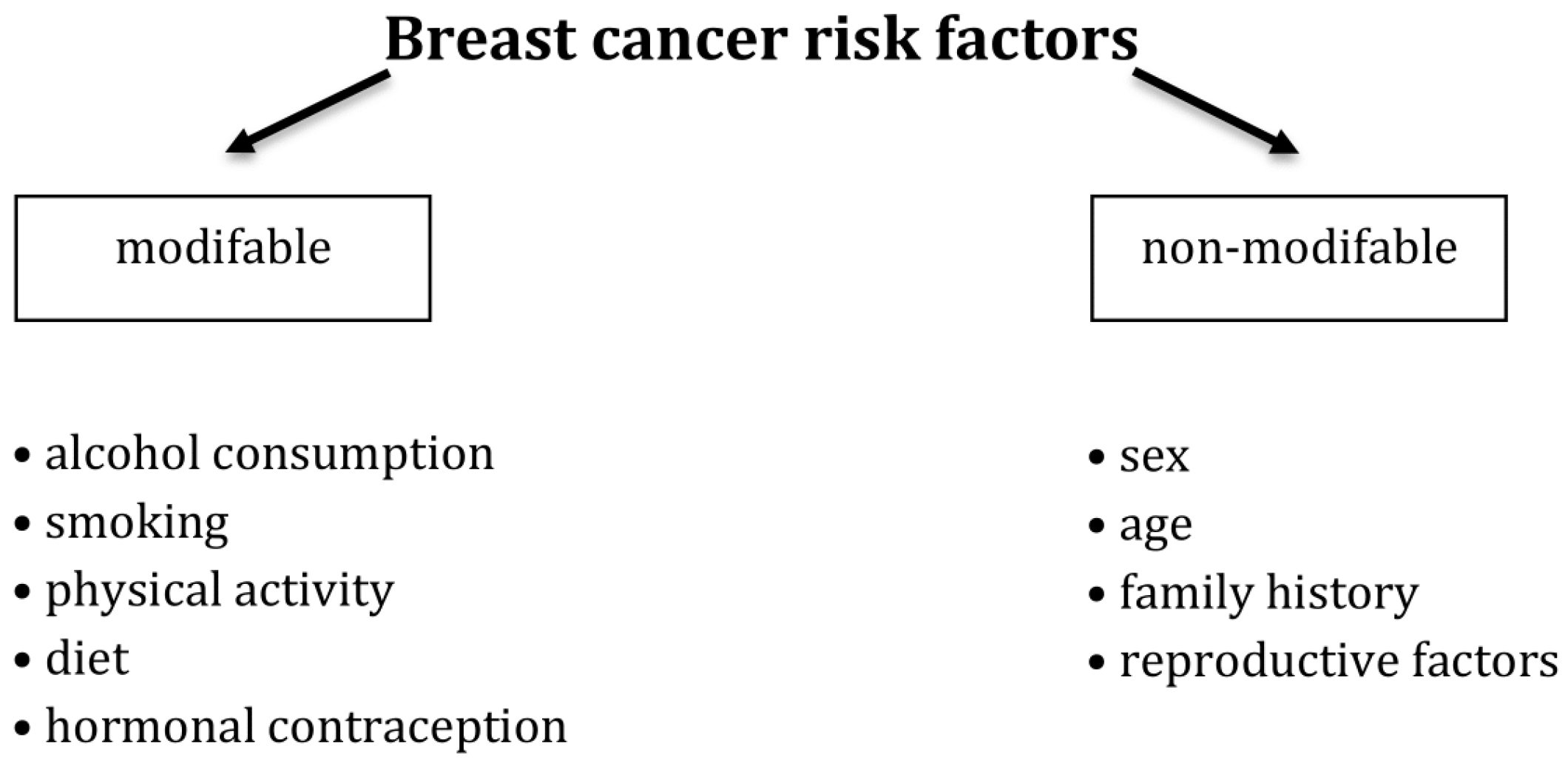
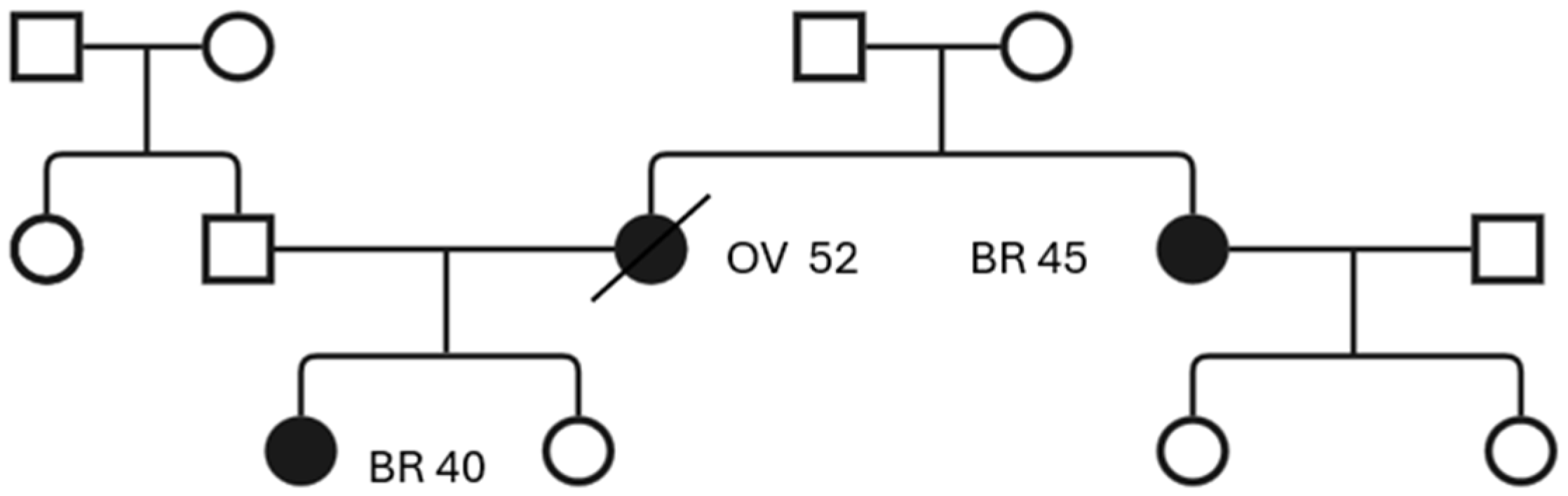
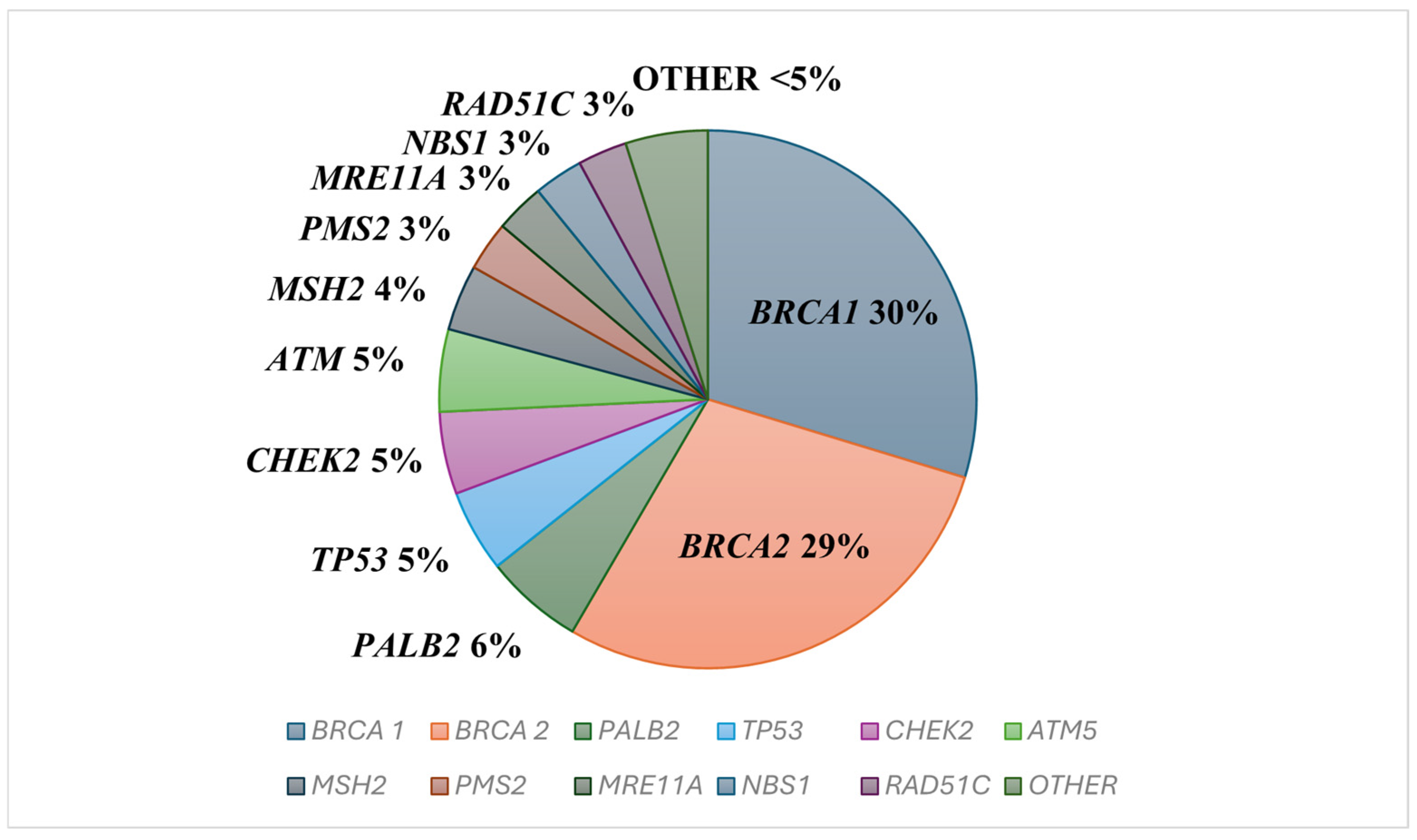
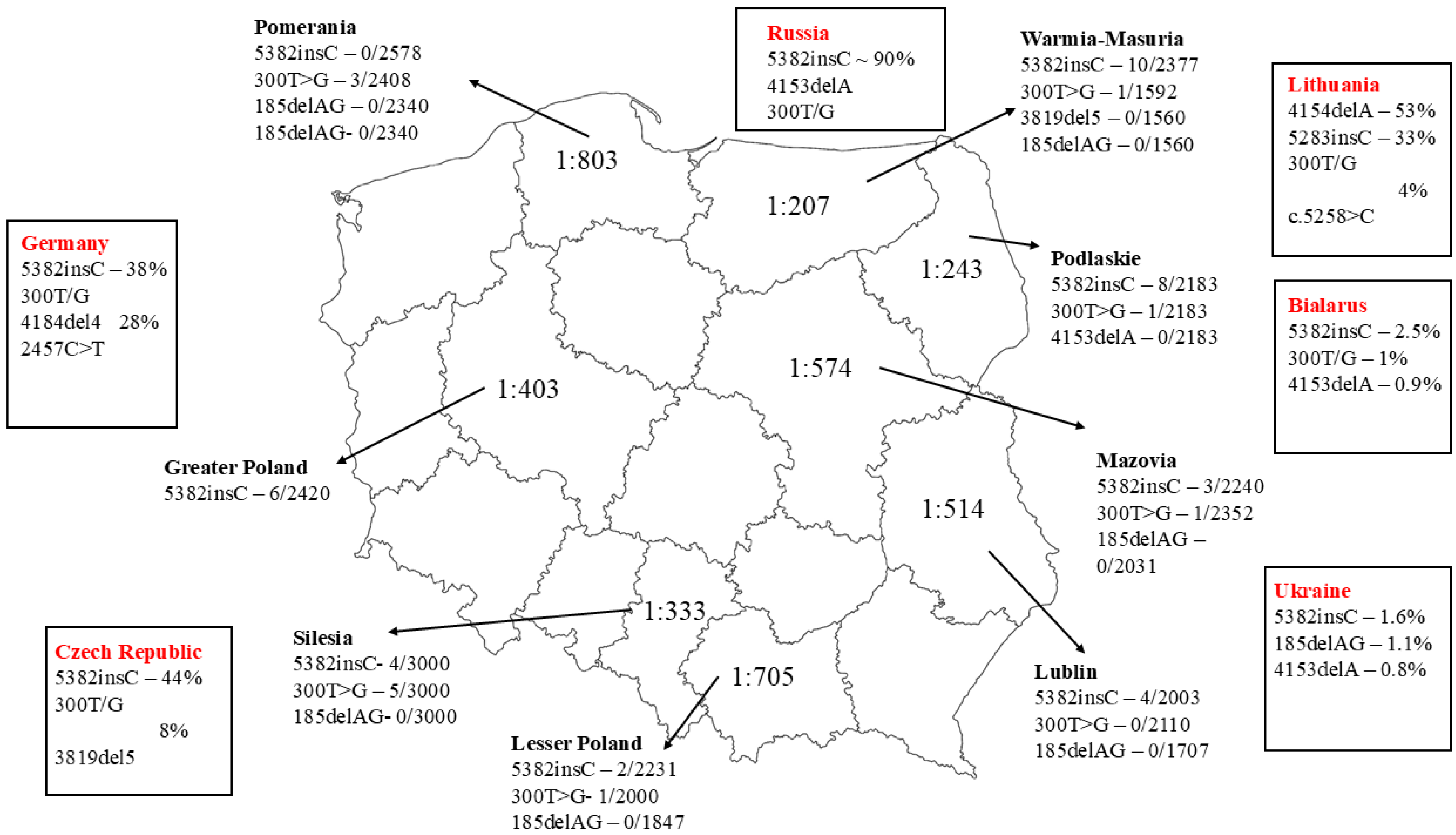
Frequency of Founder Mutations in BRCA1 and BRCA2 Genes in Hereditary Breast Cancers in Poland vs. Other Countries


Simple Summary
Abstract
1. Introduction
Family Risk
2. Methodology
3. Hereditary Breast Cancer
3.1. Location and Function of BRCA1/2 Genes
3.2. Cancer Risk in BRCA1/2 Pathogenic Variant Carriers
4. Prevalence of BRCA1 Founder Mutations
4.1. Poland
4.2. Other Countries
4.2.1. Belarus
4.2.2. Ukrainerus
4.2.3. Czech Republic
4.2.4. Estonia
4.2.5. Latvia
4.2.6. Lithuania
4.2.7. Germany
4.2.8. Russia
4.2.9. Italy
5. Prevalence of BRCA2 Founder Mutations
5.1. Poland
5.2. Other Countries
5.2.1. Belarus
5.2.2. Russia
5.2.3. Lithuania
5.2.4. Czech Republic
5.2.5. Germany
5.2.6. Ukraine, Estonia, Latvia
6. Genetic Counseling
6.1. Impact of Genetic Counseling
6.2. Challenges and Future Directions
7. Conclusions
Author Contributions
Funding
Data Availability Statement
Conflicts of Interest
Abbreviations
| BC | Breast cancer |
| OC | Ovarian cancer |
| HBC | Hereditary breast cancer |
| FHS | Family History Score |
| PVs | Pathogenic variants |
| RR | Relative risk |
| BIC | Breast Cancer Information Core |
| ASH | Ashkenazi Jews |
| HOC | Hereditary ovarian cancer |
| HBOC | Hereditary breast and ovarian cancer |
| VUS | Variant of uncertain significance |
References
- Cancer (IARC). Global Cancer Observatory. Available online: https://gco.iarc.fr/ (accessed on 10 September 2024).
- Available online: https://www.cancer.org/cancer/types/breast-cancer/about/how-common-is-breast-cancer.html (accessed on 10 September 2024).
- World Health Organization (WHO). Available online: https://www.who.int (accessed on 11 September 2024).
- Krajowy Rejestr Nowotworów. Available online: http://onkologia.org.pl/pl/raporty (accessed on 11 September 2024).
- Collaborative Group on Hormonal Factors in Breast Cancer. Menarche, menopause, and breast cancer risk: Individual participant meta-analysis, including 118 964 women with breast cancer from 117 epidemiological studies. Lancet Oncol. 2012, 13, 1141–1151. [Google Scholar] [CrossRef] [Scilit] [PubMed]
- Sisti, J.S.; Bernstein, J.L.; Lynch, C.F.; Reiner, A.S.; Mellemkjaer, L.; Brooks, J.D.; Knight, J.A.; Bernstein, L.; Malone, K.E.; Woods, M.; et al. Reproductive factors, tumor estrogen receptor status and contralateral breast cancer risk: Results from the WECARE study. SpringerPlus 2015, 4, 825. [Google Scholar] [CrossRef] [Scilit]
- Rana, M.S.; Rahman, M.M.; Baker, J.; Houssami, N.; Yu, X.Q.; Marinovich, M.L. Association of lifestyle factors with breast cancer incidence: An overview of systematic reviews. Chin. J. Cancer Res. 2025, 37, 575–591. [Google Scholar] [CrossRef] [Scilit]
- Zare, N.; Haem, E.; Lankarani, K.B.; Heydari, S.T.; Barooti, E. Breast cancer risk factors in a defined population: Weighted logistic regression approach for rare events. J. Breast Cancer 2013, 16, 214–219. [Google Scholar] [CrossRef] [Scilit]
- Catsburg, C.; Miller, A.B.; Rohan, T.E. Active cigarette smoking and risk of breast cancer. Int. J. Cancer 2015, 136, 2204–2209. [Google Scholar] [CrossRef] [Scilit]
- Rumgay, H.; Shield, K.; Charvat, H.; Ferrari, P.; Sornpaisarn, B.; Obot, I.; Islami, F.; Lemmens, V.E.P.P.; Rehm, J.; Soerjomataram, I. Global burden of cancer in 2020 attributable to alcohol consumption: A population-based study. Lancet Oncol. 2021, 22, 1071–1080. [Google Scholar] [CrossRef] [Scilit]
- Honrado, E.; Benítez, J.; Palacios, J. The molecular pathology of hereditary breast cancer: Genetic testing and therapeutic implications. Mod. Pathol. 2005, 18, 1305–1320. [Google Scholar] [CrossRef] [Scilit]
- Liaw, D.; Marsh, D.J.; Li, J.; Dahia, P.L.M.; Wang, S.I.; Zheng, Z.; Bose, S.; Call, K.M.; Tsou, H.C.; Peacocke, M.; et al. Germline mutations of the PTEN gene in Cowden disease, an inherited breast and thyroid cancer syndrome. Nat. Genet. 1997, 16, 64–67. [Google Scholar] [CrossRef] [Scilit]
- Li, J.; Yen, C.; Liaw, D.; Podsypanina, K.; Bose, S.; Wang, S.I.; Puc, J.; Miliaresis, C.; Rodgers, L.; McCombie, R.; et al. PTEN, a putative protein tyrosine phosphatase gene mutated in human brain, breast, and prostate cancer. Science 1997, 275, 1943–1947. [Google Scholar] [CrossRef] [Scilit] [PubMed]
- Greenblatt, M.S.; Chappuis, P.O.; Bond, J.P.; Hamel, N.; Foulkes, W.D. TP53 mutations in breast cancer associated with BRCA1 or BRCA2 germ-line mutations: Distinctive spectrum and structural distribution. Cancer Res. 2001, 61, 4092–4097. [Google Scholar] [PubMed]
- Vahteristo, P.; Bartkova, J.; Eerola, H.; Syrjäkoski, K.; Ojala, S.; Kilpivaara, O.; Tamminen, A.; Kononen, J.; Aittomäki, K.; Heikkilä, P.; et al. A CHEK2 Genetic Variant Contributing to a Substantial Fraction of Familial Breast Cancer. Am. J. Hum. Genet. 2002, 71, 432–438. [Google Scholar] [CrossRef] [Scilit]
- Thompson, D.; Duedal, S.; Kirner, J.; McGuffog, L.; Last, J.; Reiman, A.; Byrd, P.; Taylor, M.; Easton, D.F. Cancer risks and mortality in heterozygous ATM mutation carriers. J. Natl. Cancer Inst. 2005, 97, 813–822. [Google Scholar] [CrossRef] [Scilit] [PubMed]
- Rahman, N.; Seal, S.; Thompson, D.; Kelly, P.; Renwick, A.; Elliott, A.; Reid, S.; Spanova, K.; Barfoot, R.; Chagtai, T.; et al. PALB2, which encodes a BRCA2-interacting protein, is a breast cancer susceptibility gene. Nat. Genet. 2007, 39, 165–167. [Google Scholar] [CrossRef] [Scilit]
- Fackenthal, J.D.; Olopade, O.I. Breast cancer risk associated with BRCA1 and BRCA2 in diverse populations. Nat. Rev. Cancer 2007, 7, 937–948. [Google Scholar] [CrossRef] [Scilit] [PubMed]
- Ferla, R.; Calò, V.; Cascio, S.; Rinaldi, G.; Badalamenti, G.; Carreca, I.; Surmacz, E.; Colucci, G.; Bazan, V.; Russo, A. Founder mutations in BRCA1 and BRCA2 genes. Ann. Oncol. 2007, 18, vi93–vi98. [Google Scholar] [CrossRef] [Scilit]
- Janavičius, R. Founder BRCA1/2 mutations in the Europe: Implications for hereditary breast-ovarian cancer prevention and control. EPMA J. 2010, 1, 397–412. [Google Scholar] [CrossRef] [Scilit] [PubMed]
- Pensabene, M.; Calabrese, A.; von Arx, C.; Caputo, R.; De Laurentiis, M. Cancer genetic counselling for hereditary breast cancer in the era of precision oncology. Cancer Treat. Rev. 2024, 125, 102702. [Google Scholar] [CrossRef] [Scilit]
- Roseman, D.L.; Straus, A.K.; Shorey, W. A positive family history of breast cancer: Does it effect diminish with age? Arch. Intern. Med. 1990, 150, 191–194. [Google Scholar] [CrossRef] [Scilit]
- Mukama, T.; Kharazmi, E.; Sundquist, K.; Sundquist, J.; Brenner, H.; Fallah, M. Familial risk of breast cancer by dynamic, accumulative, and static definitions of family history. Cancer 2020, 126, 2837–2848. [Google Scholar] [CrossRef] [Scilit]
- Brewer, H.R.; Jones, M.E.; Schoemaker, M.J.; Ashworth, A.; Swerdlow, A.J. Family history and risk of breast cancer: An analysis accounting for family structure. Breast Cancer Res. Treat. 2017, 165, 193–200. [Google Scholar] [CrossRef] [Scilit]
- Broca, P. Traité des Tumeurs: I. P.; Asselin: Thouars, France, 1866. [Google Scholar]
- Miki, Y.; Swensen, J.; Shattuck-Eidens, D.; Futreal, P.A.; Harshman, K.; Tavtigian, S.; Liu, Q.; Cochran, C.; Bennett, L.M.; Ding, W.; et al. A strong candidate for the breast and ovarian cancer susceptibility gene BRCA1. Science 1994, 266, 66–71. [Google Scholar] [CrossRef] [Scilit]
- Wooster, R.; Bignell, G.; Lancaster, J.; Swift, S.; Seal, S.; Mangion, J.; Collins, N.; Gregory, S.; Gumbs, C.; Micklem, G. Identification of the breast cancer susceptibility gene BRCA2. Nature 1995, 378, 789–792. [Google Scholar] [CrossRef] [Scilit]
- Couch, F.J.; Shimelis, H.; Hu, C.; Hart, S.N.; Polley, E.C.; Na, J.; Hallberg, E.; Moore, R.; Thomas, A.; Lilyquist, J.; et al. Associations Between Cancer Predisposition Testing Panel Genes and Breast Cancer. JAMA Oncol. 2017, 3, 1190–1196. [Google Scholar] [CrossRef] [Scilit]
- Mouchawar, J.; Korch, C.; Byers, T.; Pitts, T.M.; Li, E.; McCredie, M.R.E.; Giles, G.G.; Hopper, J.L.; Southey, M.C. Population-based estimate of the contribution of TP53 mutations to subgroups of early-onset breast cancer: Australian Breast Cancer Family Study. Cancer Res. 2010, 70, 4795–4800. [Google Scholar] [CrossRef] [Scilit]
- Antoniou, A.C.; Casadei, S.; Heikkinen, T.; Barrowdale, D.; Pylkäs, K.; Roberts, J.; Lee, A.; Subramanian, D.; De Leeneer, K.; Fostira, F.; et al. Breast-cancer risk in families with mutations in PALB2. N. Engl. J. Med. 2014, 371, 497–506. [Google Scholar] [CrossRef] [Scilit]
- Damiola, F.; Pertesi, M.; Oliver, J.; Le Calvez-Kelm, F.; Voegele, C.; Young, E.L.; Robinot, N.; Forey, N.; Durand, G.; Vallée, M.P.; et al. Rare key functional domain missense substitutions in MRE11A, RAD50, and NBN contribute to breast cancer susceptibility: Results from a Breast Cancer Family Registry case-control mutation-screening study. Breast Cancer Res. 2014, 16, R58. [Google Scholar] [CrossRef] [Scilit] [PubMed]
- Villarreal-Garza, C.; Weitzel, J.N.; Llacuachaqui, M.; Sifuentes, E.; Magallanes-Hoyos, M.C.; Gallardo, L.; Alvarez-Gómez, R.M.; Herzog, J.; Castillo, D.; Royer, R.; et al. The prevalence of BRCA1 and BRCA2 mutations among young Mexican women with triple-negative breast cancer. Breast Cancer Res. Treat. 2015, 150, 389–394. [Google Scholar] [CrossRef] [Scilit] [PubMed]
- Lin, P.-H.; Kuo, W.-H.; Huang, A.-C.; Lu, Y.-S.; Lin, C.-H.; Kuo, S.-H.; Wang, M.-Y.; Liu, C.-Y.; Cheng, F.-T.; Yeh, M.-H.; et al. Multiple gene sequencing for risk assessment in patients with early-onset or familial breast cancer. Oncotarget 2016, 7, 8310–8320. [Google Scholar] [CrossRef] [Scilit] [PubMed]
- Chodosh, L.A. Expression of BRCA1 and BRCA2 in normal and neoplastic cells. J. Mammary Gland. Biol. Neoplasia 1998, 3, 389–402. [Google Scholar] [CrossRef] [Scilit]
- Varol, U.; Kucukzeybek, Y.; Alacacioglu, A.; Somali, I.; Altun, Z.; Aktas, S.; Oktay Tarhan, M. BRCA genes: BRCA 1 and BRCA 2. JBUON 2018, 23, 862–866. [Google Scholar]
- Wooster, R.; Neuhausen, S.L.; Mangion, J.; Quirk, Y.; Ford, D.; Collins, N.; Nguyen, K.; Seal, S.; Tran, T.; Averill, D.; et al. Localization of a breast cancer susceptibility gene, BRCA2, to chromosome 13q12-13. Science 1994, 265, 2088–2090. [Google Scholar] [CrossRef] [Scilit]
- Narod, S.A.; Foulkes, W.D. BRCA1 and BRCA2: 1994 and beyond. Nat. Rev. Cancer 2004, 4, 665–676. [Google Scholar] [CrossRef] [Scilit]
- Yoshida, K.; Miki, Y. Role of BRCA1 and BRCA2 as regulators of DNA repair, transcription, and cell cycle in response to DNA damage. Cancer Sci. 2004, 95, 866–871. [Google Scholar] [CrossRef] [Scilit]
- Takaoka, M.; Miki, Y. BRCA1 gene: Function and deficiency. Int. J. Clin. Oncol. 2018, 23, 36–44. [Google Scholar] [CrossRef] [Scilit] [PubMed]
- Kleiblova, P.; Stolarova, L.; Krizova, K.; Lhota, F.; Hojny, J.; Zemankova, P.; Havranek, O.; Vocka, M.; Cerna, M.; Lhotova, K.; et al. Identification of deleterious germline CHEK2 mutations and their association with breast and ovarian cancer. Int. J. Cancer 2019, 145, 1782–1797. [Google Scholar] [CrossRef] [Scilit]
- Ford, D.; Easton, D.F.; Bishop, D.T.; Narod, S.A.; Goldgar, D.E. Risks of cancer in BRCA1-mutation carriers. Lancet 1994, 343, 692–695. [Google Scholar] [CrossRef] [Scilit]
- Antoniou, A.; Pharoah, P.D.; Narod, S.; Risch, H.A.; Eyfjord, J.E.; Hopper, J.L.; Loman, N.; Olsson, H.; Johannsson, O.; Borg, A.; et al. Average risks of breast and ovarian cancer associated with BRCA1 or BRCA2 mutations detected in case Series unselected for family history: A combined analysis of 22 studies. Am. J. Hum. Genet. 2003, 72, 1117–1130. [Google Scholar] [CrossRef] [Scilit]
- Li, S.; Silvestri, V.; Leslie, G.; Rebbeck, T.R.; Neuhausen, S.L.; Hopper, J.L.; Nielsen, H.R.; Lee, A.; Yang, X.; McGuffog, L.; et al. Cancer Risks Associated with BRCA1 and BRCA2 Pathogenic Variants. J. Clin. Oncol. 2022, 40, 1529–1541. [Google Scholar] [CrossRef] [Scilit] [PubMed]
- Goggins, M.; Schutte, M.; Lu, J.; Moskaluk, C.A.; Weinstein, C.L.; Petersen, G.M.; Yeo, C.J.; Jackson, C.E.; Lynch, H.T.; Hruban, R.H.; et al. Germline BRCA2 gene mutations in patients with apparently sporadic pancreatic carcinomas. Cancer Res. 1996, 56, 5360–5364. [Google Scholar]
- Friedenson, B. BRCA1 and BRCA2 pathways and the risk of cancers other than breast or ovarian. Medscape Gen. Med. 2005, 7, 60. [Google Scholar]
- Nyberg, T.; Frost, D.; Barrowdale, D.; Evans, D.G.; Bancroft, E.; Adlard, J.; Ahmed, M.; Barwell, J.; Brady, A.F.; Brewer, C.; et al. Prostate Cancer Risks for Male BRCA1 and BRCA2 Mutation Carriers: A Prospective Cohort Study. Eur. Urol. 2020, 77, 24–35. [Google Scholar] [CrossRef] [Scilit] [PubMed]
- Daly, M.B.; Pal, T.; Berry, M.P.; Buys, S.S.; Dickson, P.; Domchek, S.M.; Elkhanany, A.; Friedman, S.; Goggins, M.; Hutton, M.L.; et al. Genetic/Familial High-Risk Assessment: Breast, Ovarian, and Pancreatic, Version 2.2021, NCCN Clinical Practice Guidelines in Oncology. J. Natl. Compr. Cancer Netw. 2021, 19, 77–102. [Google Scholar] [CrossRef] [Scilit] [PubMed]
- Kuchenbaecker, K.B.; Hopper, J.L.; Barnes, D.R.; Phillips, K.-A.; Mooij, T.M.; Roos-Blom, M.-J.; Jervis, S.; van Leeuwen, F.E.; Milne, R.L.; Andrieu, N.; et al. Risks of Breast, Ovarian, and Contralateral Breast Cancer for BRCA1 and BRCA2 Mutation Carriers. JAMA 2017, 317, 2402–2416. [Google Scholar] [CrossRef] [Scilit]
- Mann, G.J.; Thorne, H.; Balleine, R.L.; Butow, P.N.; Clarke, C.L.; Edkins, E.; Evans, G.M.; Fereday, S.; Haan, E.; Gattas, M.; et al. Analysis of cancer risk and BRCA1 and BRCA2 mutation prevalence in the kConFab familial breast cancer resource. Breast Cancer Res. 2006, 8, R12. [Google Scholar] [CrossRef] [Scilit]
- Antoniou, A.C.; Pharoah, P.D.P.; McMullan, G.; Day, N.E.; Stratton, M.R.; Peto, J.; Ponder, B.J.; Easton, D.F. A comprehensive model for familial breast cancer incorporating BRCA1, BRCA2 and other genes. Br. J. Cancer 2002, 86, 76–83. [Google Scholar] [CrossRef] [Scilit]
- National Human Genome Research Institute (NHGRI). Online Research Resources. Available online: https://research.nhgri.nih.gov/ (accessed on 24 October 2024).
- Johannesdottir, G.; Gudmundsson, J.; Bergthorsson, J.T.; Arason, A.; Agnarsson, B.A.; Eiriksdottir, G.; Johannsson, O.T.; Borg, A.; Ingvarsson, S.; Easton, D.F.; et al. High prevalence of the 999del5 mutation in Icelandic breast and ovarian cancer patients. Cancer Res. 1996, 56, 3663–3665. [Google Scholar]
- Trottier, M.; Lunn, J.; Butler, R.; Curling, D.; Turnquest, T.; Francis, W.; Halliday, D.; Royer, R.; Zhang, S.; Li, S.; et al. Prevalence of founder mutations in the BRCA1 and BRCA2 genes among unaffected women from the Bahamas. Clin. Genet. 2016, 89, 328–331. [Google Scholar] [CrossRef] [Scilit]
- Vézina, H.; Durocher, F.; Dumont, M.; Houde, L.; Szabo, C.; Tranchant, M.; Chiquette, J.; Plante, M.; Laframboise, R.; Lépine, J.; et al. Molecular and genealogical characterization of the R1443X BRCA1 mutation in high-risk French-Canadian breast/ovarian cancer families. Hum. Genet. 2005, 117, 119–132. [Google Scholar] [CrossRef] [Scilit]
- Petrij-Bosch, A.; Peelen, T.; van Vliet, M.; van Eijk, R.; Olmer, R.; Drüsedau, M.; Hogervorst, F.B.; Hageman, S.; Arts, P.J.; Ligtenberg, M.J.; et al. BRCA1 genomic deletions are major founder mutations in Dutch breast cancer patients. Nat. Genet. 1997, 17, 341–345. [Google Scholar] [CrossRef] [Scilit]
- Johannsson, O.; Ostermeyer, E.A.; Håkansson, S.; Friedman, L.S.; Johansson, U.; Sellberg, G.; Brøndum-Nielsen, K.; Sele, V.; Olsson, H.; King, M.C.; et al. Founding BRCA1 mutations in hereditary breast and ovarian cancer in southern Sweden. Am. J. Hum. Genet. 1996, 58, 441–450. [Google Scholar] [PubMed]
- Andersen, T.I.; Børresen, A.L.; Møller, P. A common BRCA1 mutation in Norwegian breast and ovarian cancer families? Am. J. Hum. Genet. 1996, 59, 486–487. [Google Scholar]
- Levy-Lahad, E.; Catane, R.; Eisenberg, S.; Kaufman, B.; Hornreich, G.; Lishinsky, E.; Shohat, M.; Weber, B.L.; Beller, U.; Lahad, A.; et al. Founder BRCA1 and BRCA2 mutations in Ashkenazi Jews in Israel: Frequency and differential penetrance in ovarian cancer and in breast-ovarian cancer families. Am. J. Hum. Genet. 1997, 60, 1059–1067. [Google Scholar]
- Risch, H.A.; McLaughlin, J.R.; Cole, D.E.; Rosen, B.; Bradley, L.; Kwan, E.; Jack, E.; Vesprini, D.J.; Kuperstein, G.; Abrahamson, J.L.; et al. Prevalence and penetrance of germline BRCA1 and BRCA2 mutations in a population series of 649 women with ovarian cancer. Am. J. Hum. Genet. 2001, 68, 700–710. [Google Scholar] [CrossRef] [Scilit]
- Struewing, J.P.; Abeliovich, D.; Peretz, T.; Avishai, N.; Kaback, M.M.; Collins, F.S.; Brody, L.C. The carrier frequency of the BRCA1 185delAG mutation is approximately 1 percent in Ashkenazi Jewish individuals. Nat. Genet. 1995, 11, 198–200. [Google Scholar] [CrossRef] [Scilit] [PubMed]
- Roa, B.B.; Boyd, A.A.; Volcik, K.; Richards, C.S. Ashkenazi Jewish population frequencies for common mutations in BRCA1 and BRCA2. Nat. Genet. 1996, 14, 185–187. [Google Scholar] [CrossRef] [Scilit] [PubMed]
- Phelan, C.M.; Kwan, E.; Jack, E.; Li, S.; Morgan, C.; Aubé, J.; Hanna, D.; Narod, S.A. A low frequency of non-founder BRCA1 mutations in Ashkenazi Jewish breast-ovarian cancer families. Hum. Mutat. 2002, 20, 352–357. [Google Scholar] [CrossRef] [Scilit] [PubMed]
- Antoniou, A.C.; Pharoah, P.D.P.; Narod, S.; Risch, H.A.; Eyfjord, J.E.; Hopper, J.L.; Olsson, H.; Johannsson, O.; Borg, A.; Pasini, B.; et al. Breast and ovarian cancer risks to carriers of the BRCA1 5382insC and 185delAG and BRCA2 6174delT mutations: A combined analysis of 22 population based studies. J. Med. Genet. 2005, 42, 602–603. [Google Scholar] [CrossRef] [Scilit]
- Neuhausen, S.L.; Mazoyer, S.; Friedman, L.; Stratton, M.; Offit, K.; Caligo, A.; Tomlinson, G.; Cannon-Albright, L.; Bishop, T.; Kelsell, D.; et al. Haplotype and phenotype analysis of six recurrent BRCA1 mutations in 61 families: Results of an international study. Am. J. Hum. Genet. 1996, 58, 271–280. [Google Scholar]
- Górski, B.; Byrski, T.; Huzarski, T.; Jakubowska, A.; Menkiszak, J.; Gronwald, J.; Pluzańska, A.; Bebenek, M.; Fischer-Maliszewska, L.; Grzybowska, E.; et al. Founder mutations in the BRCA1 gene in Polish families with breast-ovarian cancer. Am. J. Hum. Genet. 2000, 66, 1963–1968. [Google Scholar] [CrossRef] [Scilit]
- Szwiec, M.; Jakubowska, A.; Górski, B.; Huzarski, T.; Tomiczek-Szwiec, J.; Gronwald, J.; Dębniak, T.; Byrski, T.; Kluźniak, W.; Wokołorczyk, D.; et al. Recurrent mutations of BRCA1 and BRCA2 in Poland: An update. Clin. Genet. 2015, 87, 288–292. [Google Scholar] [CrossRef] [Scilit]
- Brozek, I.; Cybulska, C.; Ratajska, M.; Piatkowska, M.; Kluska, A.; Balabas, A.; Dabrowska, M.; Nowakowska, D.; Niwinska, A.; Pamula-Pilat, J.; et al. Prevalence of the most frequent BRCA1 mutations in Polish population. J. Appl. Genet. 2011, 52, 325–330. [Google Scholar] [CrossRef] [Scilit]
- van Der Looij, M.; Wysocka, B.; Brozek, I.; Jassem, J.; Limon, J.; Olah, E. Founder BRCA1 mutations and two novel germline BRCA2 mutations in breast and/or ovarian cancer families from North-Eastern Poland. Hum. Mutat. 2000, 15, 480–481. [Google Scholar] [CrossRef] [Scilit]
- Grzybowska, E.; Siemińska, M.; Zientek, H.; Kalinowska, E.; Michalska, J.; Utracka-Hutka, B.; Rogozińska-Szczepka, J.; Kaźmierczak-Maciejewska, M. Germline mutations in the BRCA1 gene predisposing to breast and ovarian cancers in Upper Silesia population. Acta Biochim. Pol. 2002, 49, 351–356. [Google Scholar] [CrossRef] [Scilit]
- Paszko, Z.; Skasko, E.; Wiśniewska, A.; Konopka, B.; Niwińska, A.; Pieńkowski, T. Changes in BRCA1 gene in patients with familial breast cancer in the Warsaw region of Poland. Nowotw. J. Oncol. 2002, 42, 97–103. [Google Scholar]
- Perkowska, M.; BroZek, I.; Wysocka, B.; Haraldsson, K.; Sandberg, T.; Johansson, U.; Sellberg, G.; Borg, A.; Limon, J. BRCA1 and BRCA2 mutation analysis in breast-ovarian cancer families from northeastern Poland. Hum. Mutat. 2003, 21, 553–554. [Google Scholar] [CrossRef] [Scilit]
- Ratajska, M.; Brozek, I.; Senkus-Konefka, E.; Jassem, J.; Stepnowska, M.; Palomba, G.; Pisano, M.; Casula, M.; Palmieri, G.; Borg, A.; et al. BRCA1 and BRCA2 point mutations and large rearrangements in breast and ovarian cancer families in Northern Poland. Oncol. Rep. 2008, 19, 263–268. [Google Scholar] [CrossRef] [Scilit] [PubMed]
- Sobczak, K.; Kozłowski, P.; Napierała, M.; Czarny, J.; Woźniak, M.; Kapuścińska, M.; Łośko, M.; Koziczak, M.; Jasińska, A.; Powierska, J.; et al. Novel BRCA1 mutations and more frequent intron-20 alteration found among 236 women from Western Poland. Oncogene 1997, 15, 1773–1779. [Google Scholar] [CrossRef] [Scilit] [PubMed]
- Górski, B.; Jakubowska, A.; Huzarski, T.; Byrski, T.; Gronwald, J.; Grzybowska, E.; Mackiewicz, A.; Stawicka, M.; Bebenek, M.; Sorokin, D.; et al. A high proportion of founder BRCA1 mutations in Polish breast cancer families. Int. J. Cancer 2004, 110, 683–686. [Google Scholar] [CrossRef] [Scilit]
- Sokolenko, A.P.; Mitiushkina, N.V.; Buslov, K.G.; Bit-Sava, E.M.; Iyevleva, A.G.; Chekmariova, E.V.; Kuligina, E.S.; Ulibina, Y.M.; Rozanov, M.E.; Suspitsin, E.N.; et al. High frequency of BRCA1 5382insC mutation in Russian breast cancer patients. Eur. J. Cancer 2006, 42, 1380–1384. [Google Scholar] [CrossRef] [Scilit]
- Ramus, S.J.; Kote-Jarai, Z.; Friedman, L.S.; van der Looij, M.; Gayther, S.A.; Csokay, B.; Ponder, B.A.; Olah, E. Analysis of BRCA1 and BRCA2 mutations in Hungarian families with breast or breast-ovarian cancer. Am. J. Hum. Genet. 1997, 60, 1242–1246. [Google Scholar] [PubMed]
- Krajc, M.; Teugels, E.; Zgajnar, J.; Goelen, G.; Besic, N.; Novakovic, S.; Hocevar, M.; De Grève, J. Five recurrent BRCA1/2 mutations are responsible for cancer predisposition in the majority of Slovenian breast cancer families. BMC Med. Genet. 2008, 9, 83. [Google Scholar] [CrossRef] [Scilit]
- Couch, F.J.; Weber, B.L. Mutations and polymorphisms in the familial early-onset breast cancer (BRCA1) gene. Hum. Mutat. 1996, 8, 8–18. [Google Scholar] [CrossRef] [Scilit]
- Backe, J.; Hofferbert, S.; Skawran, B.; Dörk, T.; Stuhrmann, M.; Karstens, J.H.; Untch, M.; Meindl, A.; Burgemeister, R.; Chang-Claude, J.; et al. Frequency of BRCA1 mutation 5382insC in German breast cancer patients. Gynecol. Oncol. 1999, 72, 402–406. [Google Scholar] [CrossRef] [Scilit]
- Loginova, A.N.; Pospekhova, N.I.; Lyubchenko, L.N.; Budilov, A.V.; Zakhar’ev, V.M.; Gar’kavtseva, R.F.; Ginter, E.K.; Karpukhin, A.V. Spectrum of mutations in BRCA1 gene in hereditary forms of breast and ovarian cancer in Russian families. Bull. Exp. Biol. Med. 2003, 136, 276–278. [Google Scholar] [CrossRef] [Scilit]
- Oszurek, O.; Gorski, B.; Gronwald, J.; Prosolow, Z.; Uglanica, K.; Murinow, A.; Bobko, I.; Downar, O.; Zlobicz, M.; Norik, D.; et al. Founder mutations in the BRCA1 gene in west Belarusian breast-ovarian cancer families. Clin. Genet. 2001, 60, 470–471. [Google Scholar] [CrossRef] [Scilit]
- Tikhomirova, L.; Sinicka, O.; Smite, D.; Eglitis, J.; Hodgson, S.V.; Stengrevics, A. High prevalence of two BRCA1 mutations, 4154delA and 5382insC, in Latvia. Fam. Cancer 2005, 4, 77–84. [Google Scholar] [CrossRef] [Scilit] [PubMed]
- Pohlreich, P.; Zikan, M.; Stribrna, J.; Kleibl, Z.; Janatova, M.; Kotlas, J.; Zidovska, J.; Novotny, J.; Petruzelka, L.; Szabo, C.; et al. High proportion of recurrent germline mutations in the BRCA1 gene in breast and ovarian cancer patients from the Prague area. Breast Cancer Res. 2005, 7, R728. [Google Scholar] [CrossRef] [Scilit] [PubMed]
- Machackova, E.; Foretova, L.; Lukesova, M.; Vasickova, P.; Navratilova, M.; Coene, I.; Pavlu, H.; Kosinova, V.; Kuklova, J.; Claes, K. Spectrum and characterisation of BRCA1 and BRCA2 deleterious mutations in high-risk Czech patients with breast and/or ovarian cancer. BMC Cancer 2008, 8, 140. [Google Scholar] [CrossRef] [Scilit]
- Janavicius, R.; Pepalyte, I.; Kucinskas, V. Novel and common BRCA1 mutations in familial breast/ovarian cancer patients from Lithuania. Breast Cancer Res. Treat. 2009, 117, 467–469. [Google Scholar] [CrossRef] [Scilit] [PubMed]
- Friedman, L.S.; Ostermeyer, E.A.; Szabo, C.I.; Dowd, P.; Lynch, E.D.; Rowell, S.E.; King, M.C. Confirmation of BRCA1 by analysis of germline mutations linked to breast and ovarian cancer in ten families. Nat. Genet. 1994, 8, 399–404. [Google Scholar] [CrossRef] [Scilit]
- Wagner, T.M.; Möslinger, R.A.; Muhr, D.; Langbauer, G.; Hirtenlehner, K.; Concin, H.; Doeller, W.; Haid, A.; Lang, A.H.; Mayer, P.; et al. BRCA1-related breast cancer in Austrian breast and ovarian cancer families: Specific BRCA1 mutations and pathological characteristics. Int. J. Cancer 1998, 77, 354–360. [Google Scholar] [CrossRef]
- Hamann, U.; Brauch, H.; Garvin, A.M.; Bastert, G.; Scott, R.J. German family study on hereditary breast and/or ovarian cancer: Germline mutation analysis of the BRCA1 gene. Genes Chromosomes Cancer 1997, 18, 126–132. [Google Scholar] [CrossRef]
- Csokay, B.; Tihomirova, L.; Stengrevics, A.; Sinicka, O.; Olah, E. Strong founder effects in BRCA1 mutation carrier breast cancer patients from Latvia. Hum. Mutat. 1999, 14, 92. [Google Scholar] [CrossRef] [Scilit]
- Kozłowski, P.; Sobczak, K.; Napierała, M.; Woźniak, M.; Czarny, J.; Włodzimierz, J.; Kryzosiak, J. PCR-SSCP-HDX analysis of pooled DNA for more rapid detection of germline mutations in large genes. The BRCA1 example. Nucleic Acids Res. 1996, 24, 1177–1178. [Google Scholar] [CrossRef] [Scilit] [PubMed]
- Gayther, S.A.; Harrington, P.; Russell, P.; Kharkevich, G.; Garkavtseva, R.F.; Ponder, B.A. Frequently occurring germ-line mutations of the BRCA1 gene in ovarian cancer families from Russia. Am. J. Hum. Genet. 1997, 60, 1239–1242. [Google Scholar] [PubMed]
- Nguyen-Dumont, T.; Karpinski, P.; Sasiadek, M.M.; Akopyan, H.; Steen, J.A.; Theys, D.; Hammet, F.; Tsimiklis, H.; Park, D.J.; Pope, B.J.; et al. Genetic testing in Poland and Ukraine: Should comprehensive germline testing of BRCA1 and BRCA2 be recommended for women with breast and ovarian cancer? Genet. Res. 2020, 102, e6. [Google Scholar] [CrossRef] [Scilit] [PubMed]
- Wojcik, P.; Jasiowka, M.; Strycharz, E.; Sobol, M.; Hodorowicz-Zaniewska, D.; Skotnicki, P.; Byrski, T.; Blecharz, P.; Marczyk, E.; Cedrych, I.; et al. Recurrent mutations of BRCA1, BRCA2 and PALB2 in the population of breast and ovarian cancer patients in Southern Poland. Hered. Cancer Clin. Pract. 2016, 14, 5. [Google Scholar] [CrossRef] [Scilit]
- Cybulski, C.; Lubiński, J.; Wokołorczyk, D.; Kuźniak, W.; Kashyap, A.; Sopik, V.; Huzarski, T.; Gronwald, J.; Byrski, T.; Szwiec, M.; et al. Mutations predisposing to breast cancer in 12 candidate genes in breast cancer patients from Poland. Clin. Genet. 2015, 88, 366–370. [Google Scholar] [CrossRef] [Scilit]
- Gaj, P.; Kluska, A.; Nowakowska, D.; Bałabas, A.; Piątkowska, M.; Dabrowska, M.; Niwińska, A.; Ostrowski, J. High frequency of BRCA1 founder mutations in Polish women with nonfamilial breast cancer. Fam. Cancer 2012, 11, 623–628. [Google Scholar] [CrossRef] [Scilit]
- Kluska, A.; Balabas, A.; Paziewska, A.; Kulecka, M.; Nowakowska, D.; Mikula, M.; Ostrowski, J. New recurrent BRCA1/2 mutations in Polish patients with familial breast/ovarian cancer detected by next generation sequencing. BMC Med. Genom. 2015, 8, 19. [Google Scholar] [CrossRef] [Scilit]
- Rogoża-Janiszewska, E.; Malińska, K.; Cybulski, C.; Jakubowska, A.; Gronwald, J.; Huzarski, T.; Lener, M.; Górski, B.; Kluźniak, W.; Rudnicka, H.; et al. Prevalence of Recurrent Mutations Predisposing to Breast Cancer in Early-Onset Breast Cancer Patients from Poland. Cancers 2020, 12, 2321. [Google Scholar] [CrossRef] [Scilit] [PubMed]
- Lubiński, J.; Górski, B.; Huzarski, T.; Byrski, T.; Gronwald, J.; Serrano-Fernández, P.; Domagała, W.; Chosia, M.; Uciński, M.; Grzybowska, E.; et al. BRCA1-positive breast cancers in young women from Poland. Breast Cancer Res. Treat. 2006, 99, 71–76. [Google Scholar] [CrossRef] [Scilit]
- Bogdanova, N.V.; Antonenkova, N.N.; Rogov, Y.I.; Karstens, J.H.; Hillemanns, P.; Dörk, T. High frequency and allele-specific differences of BRCA1 founder mutations in breast cancer and ovarian cancer patients from Belarus. Clin. Genet. 2010, 78, 364–372. [Google Scholar] [CrossRef] [Scilit]
- Uglanitsa, N.; Oszurek, O.; Uglanitsa, K.; Savonievich, E.; Lubiński, J.; Cybulski, C.; Debniak, T.; Narod, S.; Gronwald, J. The contribution of founder mutations in BRCA1 to breast cancer in Belarus. Clin. Genet. 2010, 78, 377–380. [Google Scholar] [CrossRef] [Scilit] [PubMed]
- Kitsera, N.; Shparyk, Y.; Bilynsky, B.; Duda, I.; Kachmar, T.; Oleksyak, O. BRCA1 4153delA mutation (“Baltic/Black Sea”) in breast cancer patients in Ukraine. Nowotw. J. Oncol. 2014, 64, 246–250. [Google Scholar] [CrossRef] [Scilit]
- Tamboom, K.; Kaasik, K.; Aršavskaja, J.; Tekkel, M.; Lilleorg, A.; Padrik, P.; Metspalu, A.; Veidebaum, T. BRCA1 mutations in women with familial or early-onset breast cancer and BRCA2 mutations in familial cancer in Estonia. Hered. Cancer Clin. Pract. 2010, 8, 4. [Google Scholar] [CrossRef] [Scilit] [PubMed]
- Ozolina, S.; Sinicka, O.; Jankevics, E.; Inashkina, I.; Lubinski, J.; Gorski, B.; Gronwald, J.; Nasedkina, T.; Fedorova, O.; Lyubchenko, L.; et al. The 4154delA mutation carriers in the BRCA1 gene share a common ancestry. Fam. Cancer 2009, 8, 1–4. [Google Scholar] [CrossRef] [Scilit]
- Gronwald, J.; Elsakov, P.; Górski, B.; Lubiński, J. High incidence of 4153delA BRCA1 gene mutations in Lithuanian breast- and breast-ovarian cancer families. Breast Cancer Res. Treat. 2005, 94, 111–113. [Google Scholar] [CrossRef] [Scilit]
- Janavičius, R.; Rudaitis, V.; Mickys, U.; Elsakov, P.; Griškevičius, L. Comprehensive BRCA1 and BRCA2 mutational profile in Lithuania. Cancer Genet. 2014, 207, 195–205. [Google Scholar] [CrossRef] [Scilit]
- German Consortium for Hereditary Breast and Ovarian Cancer. Comprehensive analysis of 989 patients with breast or ovarian cancer provides BRCA1 and BRCA2 mutation profiles and frequencies for the German population. Int. J. Cancer 2002, 97, 472–480. [Google Scholar] [CrossRef] [Scilit]
- Sokolenko, A.P.; Rozanov, M.E.; Mitiushkina, N.V.; Sherina, N.Y.; Iyevleva, A.G.; Chekmariova, E.V.; Buslov, K.G.; Shilov, E.S.; Togo, A.V.; Bit-Sava, E.M.; et al. Founder mutations in early-onset, familial and bilateral breast cancer patients from Russia. Fam. Cancer 2007, 6, 281–286. [Google Scholar] [CrossRef] [Scilit]
- Sokolenko, A.P.; Sokolova, T.N.; Ni, V.I.; Preobrazhenskaya, E.V.; Iyevleva, A.G.; Aleksakhina, S.N.; Romanko, A.A.; Bessonov, A.A.; Gorodnova, T.V.; Anisimova, E.I.; et al. Frequency and spectrum of founder and non-founder BRCA1 and BRCA2 mutations in a large series of Russian breast cancer and ovarian cancer patients. Breast Cancer Res. Treat. 2020, 184, 229–235. [Google Scholar] [CrossRef] [Scilit]
- Incorvaia, L.; Fanale, D.; Badalamenti, G.; Bono, M.; Calò, V.; Cancelliere, D.; Castiglia, M.; Fiorino, A.; Pivetti, A.; Barraco, N.; et al. Hereditary Breast and Ovarian Cancer in Families from Southern Italy (Sicily)—Prevalence and Geographic Distribution of Pathogenic Variants in BRCA1/2 Genes. Cancers 2020, 12, 1158. [Google Scholar] [CrossRef] [Scilit]
- Rocca, V.; Lo Feudo, E.; Dinatolo, F.; Lavano, S.M.; Bilotta, A.; Amato, R.; D’Antona, L.; Trapasso, F.; Baudi, F.; Colao, E.; et al. Germline Variant Spectrum in Southern Italian High-Risk Hereditary Breast Cancer Patients: Insights from Multi-Gene Panel Testing. Curr. Issues Mol. Biol. 2024, 46, 13003–13020. [Google Scholar] [CrossRef] [Scilit] [PubMed]
- Thompson, E.R.; Rowley, S.M.; Li, N.; McInerny, S.; Devereux, L.; Wong-Brown, M.W.; Trainer, A.H.; Mitchell, G.; Scott, R.J.; James, P.A.; et al. Panel Testing for Familial Breast Cancer: Calibrating the Tension Between Research and Clinical Care. J. Clin. Oncol. 2016, 34, 1455–1459. [Google Scholar] [CrossRef] [Scilit]
- Thorlacius, S.; Olafsdottir, G.; Tryggvadottir, L.; Neuhausen, S.; Jonasson, J.G.; Tavtigian, S.V.; Tulinius, H.; Ogmundsdottir, H.M.; Eyfjörd, J.E. A single BRCA2 mutation in male and female breast cancer families from Iceland with varied cancer phenotypes. Nat. Genet. 1996, 13, 117–119. [Google Scholar] [CrossRef] [Scilit] [PubMed]
- Sarantaus, L.; Huusko, P.; Eerola, H.; Launonen, V.; Vehmanen, P.; Rapakko, K.; Gillanders, E.; Syrjäkoski, K.; Kainu, T.; Vahteristo, P.; et al. Multiple founder effects and geographical clustering of BRCA1 and BRCA2 families in Finland. Eur. J. Hum. Genet. 2000, 8, 757–763. [Google Scholar] [CrossRef] [Scilit] [PubMed]
- Akbari, M.R.; Donenberg, T.; Lunn, J.; Curling, D.; Turnquest, T.; Krill-Jackson, E.; Zhang, S.; Narod, S.; Hurley, J. The spectrum of BRCA1 and BRCA2 mutations in breast cancer patients in the Bahamas. Clin. Genet. 2014, 85, 64–67. [Google Scholar] [CrossRef] [Scilit]
- Oddoux, C.; Struewing, J.P.; Clayton, C.M.; Neuhausen, S.; Brody, L.C.; Kaback, M.; Haas, B.; Norton, L.; Borgen, P.; Jhanwar, S.; et al. The carrier frequency of the BRCA2 6174delT mutation among Ashkenazi Jewish individuals is approximately 1%. Nat. Genet. 1996, 14, 188–190. [Google Scholar] [CrossRef] [Scilit]
- Balabas, A.; Skasko, E.; Nowakowska, D.; Niwinska, A.; Blecharz, P. Novel germline mutations in BRCA2 gene among breast and breast-ovarian cancer families from Poland. Fam. Cancer 2010, 9, 267–274. [Google Scholar] [CrossRef] [Scilit]
- Chodick, G.; Struewing, J.P.; Ron, E.; Rutter, J.L.; Iscovich, J. Similar prevalence of founder BRCA1 and BRCA2 mutations among Ashkenazi and non-Ashkenazi men with breast cancer: Evidence from 261 cases in Israel, 1976–1999. Eur. J. Med. Genet. 2008, 51, 141–147. [Google Scholar] [CrossRef] [Scilit] [PubMed]
- Grzybowska, E.; Zientek, H.; Jasinska, A.; Rusin, M.; Kozlowski, P.; Sobczak, K.; Sikorska, A.; Kwiatkowska, E.; Gorniak, L.; Kalinowska, E.; et al. High frequency of recurrent mutations in BRCA1 and BRCA2 genes in Polish families with breast and ovarian cancer. Hum. Mutat. 2000, 16, 482–490. [Google Scholar] [CrossRef] [Scilit]
- Foretova, L.; Machackova, E.; Navratilova, M.; Pavlu, H.; Hruba, M.; Lukesova, M.; Valik, D. BRCA1 and BRCA2 mutations in women with familial or early-onset breast/ovarian cancer in the Czech Republic. Hum. Mutat. 2004, 23, 397–398. [Google Scholar] [CrossRef] [Scilit] [PubMed]
- Konecny, M.; Milly, M.; Zavodna, K.; Vavrova, L.; Mlkvá, I.; Ilencikova, D.; Kausitz, J.; Bartošová, Z. Molecular-genetic analysis of hereditary breast/ovarian cancer: Results of mutation testing of BRCA1 and BRCA2 genes; Molekularno-geneticka diagnostika hereditarneho karcinomu prsnika/ovarii: Vysledky testovania mutacii v genoch BRCA1 a BRCA2. Onkologia 2012, 7, 89–93. [Google Scholar]
- Kwiatkowska, E.; Teresiak, M.; Lamperska, K.M.; Karczewska, A.; Breborowicz, D.; Stawicka, M.; Godlewski, D.; Krzyzosiak, W.J.; Mackiewicz, A. BRCA2 germline mutations in male breast cancer patients in the Polish population. Hum. Mutat. 2001, 17, 73. [Google Scholar] [CrossRef]
- Brozek, I.; Ochman, K.; Debniak, J.; Morzuch, L.; Ratajska, M.; Stepnowska, M.; Stukan, M.; Emerich, J.; Limon, J. High frequency of BRCA1/2 germline mutations in consecutive ovarian cancer patients in Poland. Gynecol. Oncol. 2008, 108, 433–437. [Google Scholar] [CrossRef] [Scilit]
- Ratajska, M.; Krygier, M.; Stukan, M.; Kuźniacka, A.; Koczkowska, M.; Dudziak, M.; Śniadecki, M.; Dębniak, J.; Wydra, D.; Brozek, I.; et al. Mutational analysis of BRCA1/2 in a group of 134 consecutive ovarian cancer patients. Novel and recurrent BRCA1/2 alterations detected by next generation sequencing. J. Appl. Genet. 2014, 56, 193–198. [Google Scholar] [CrossRef] [Scilit]
- Yanus, G.A.; Savonevich, E.L.; Sokolenko, A.P.; Romanko, A.A.; Ni, V.I.; Bakaeva, E.K.; Gorustovich, O.A.; Bizin, I.V.; Imyanitov, E.N. Founder vs. non-founder BRCA1/2 pathogenic alleles: The analysis of Belarusian breast and ovarian cancer patients and review of other studies on ethnically homogenous populations. Fam. Cancer 2023, 22, 19–30. [Google Scholar] [CrossRef] [Scilit]
- Riedlova, P.; Janoutova, J.; Hermanova, B. Frequency of mutations in BRCA genes and other candidate genes in high-risk probands or probands with breast or ovarian cancer in the Czech Republic. Mol. Biol. Rep. 2020, 47, 2763–2769. [Google Scholar] [CrossRef] [Scilit]
- Sessa, C.; Balmaña, J.; Bober, S.L.; Cardoso, M.J.; Colombo, N.; Curigliano, G.; Domchek, S.; Evans, D.; Fischerova, D.; Harbeck, N.; et al. Risk reduction and screening of cancer in hereditary breast-ovarian cancer syndromes: ESMO Clinical Practice Guideline. Ann. Oncol. 2023, 34, 33–47. [Google Scholar] [CrossRef] [Scilit] [PubMed]



| Sobczak [73] | Górski [65] | Perkowska [71] | Górski [74] | Lubiński [98] | Ratajska [72] | Brożek [67] | Gaj [95] | Cybulski [94] | Szwiec [66] | Kluska [96] | Wójcik [93] | Rogoza-Janiszewska [97] | Nguyen-Dumont [92] | |
|---|---|---|---|---|---|---|---|---|---|---|---|---|---|---|
| n = 236 | N = 66 | N = 60 | N = 200 | n = 3472 | N = 64 | n = 1185 | n = 906 | n = 144 | n = 1164 | n = 512 | n = 121 | n = 2464 | n = 337 | |
| c.5266dupC (Polish founder mutation) | - | 18 | 6 | 68 | 134 | 17 | 35 | 114 | - | 39 | - | 6 | 184 | 24 |
| c.181T>G (Polish founder mutation) | - | 7 | 3 | 31 | 52 | 9 | 18 | 38 | - | 19 | - | 4 | 83 | 7 |
| c.4035delA (Polish founder mutation) | 1 | 4 | - | 12 | 12 | - | - | 2 | - | 3 | - | - | 13 | 2 |
| c.68_69delAG | - | 2 | 1 | 1 | - | 3 | - | 8 | - | 5 | - | - | 6 | 1 |
| c.5251C>T | - | - | - | 1 | - | - | - | 8 | 1 | 3 | - | - | 5 | 1 |
| c.4501C>T | - | - | - | - | - | - | - | - | - | - | 1 | - | - | - |
| c.190T>C | - | 1 | - | - | - | - | - | - | - | - | - | - | - | - |
| c.2563C>T | - | - | 1 | - | - | - | - | - | - | - | - | -- | - | - |
| c.2872_2876delTTTCA | - | - | - | - | - | 1 | - | - | - | - | - | - | - | - |
| c.4357+1G>A | - | - | 1 | - | - | - | - | - | - | - | - | - | - | - |
| c.4516delG | - | - | - | - | - | - | - | - | - | - | 4 | - | - | - |
| c.2866_2870delTCTCA | - | - | - | 1 | - | - | - | - | - | - | - | - | - | - |
| c.4243G>T | - | - | - | - | - | - | - | - | - | - | 1 | - | - | - |
| c.403delAAGA | - | - | - | - | - | - | - | - | - | - | 1 | - | - | - |
| c.3700_3704del5 | - | 2 | 1 | 3 | - | 4 | - | 11 | - | 9 | - | - | 9 | - |
| c.3817C>T | - | - | - | - | - | 1 | - | - | - | - | - | - | - | - |
| c.340delTC | - | - | - | - | - | - | - | - | - | - | 1 | - | - | - |
| c.675delT | - | - | - | 2 | - | - | - | - | - | - | - | - | - | - |
| c.3756_3759delGTCT | - | - | - | - | - | - | - | 4 | - | - | - | -- | - | - |
| c.5285insG | - | - | - | - | - | - | - | - | - | - | 1 | - | - | - |
| c.5344G>A | - | - | 1 | - | - | - | - | - | - | - | - | - | - | - |
| c.3779delT | - | - | - | - | - | - | - | 2 | - | - | - | - | - | - |
| c.403delA | - | - | - | - | - | - | - | - | - | - | 1 | - | - | - |
| c.5028_5031delGAAA | - | - | - | 1 | - | - | - | - | - | - | - | - | - | - |
| c.4041_4042delAG | - | - | - | - | - | - | - | 1 | 1 | - | - | - | - | - |
| c.5211G>A | - | - | - | - | - | - | - | 1 | - | - | - | - | - | - |
| c.1612_1616del | - | - | - | - | - | - | - | - | - | - | - | - | - | 1 |
| c.1695insG | - | - | - | - | - | - | - | - | - | - | 1 | - | - | - |
| c.5177_5180delGAAA | - | - | - | - | - | - | - | - | 1 | - | - | - | - | - |
| c.5346G>A | 1 | - | - | - | - | - | - | - | 1 | - | 4 | - | 1 | 1 |
| c.1687C>T | - | - | - | - | - | - | - | - | 1 | - | 8 | - | - | - |
| c.4689C>G | - | - | - | - | - | - | - | - | - | - | 1 | - | - | - |
| c.843_846del | - | - | - | - | - | - | - | - | - | - | - | - | - | 1 |
| c.4597delGA | - | - | - | - | - | - | - | - | - | - | 1 | - | - | - |
| c.5232del7ins12 | - | - | - | - | - | - | - | - | - | - | 1 | - | - | - |
| c.1612C>T | - | - | - | - | - | - | - | - | - | - | 1 | - | - | - |
| c.5137delG | - | - | - | - | - | - | - | - | - | - | 1 | - | - | - |
| c.3531delT | - | - | - | - | - | - | - | - | - | - | - | 1 | - | - |
| c.314A>G | 1 | - | - | - | - | - | - | - | - | - | - | - | - | - |
| c.374dup | - | - | - | - | - | - | - | - | - | - | - | - | - | 1 |
| Looij [68] | Grzybowska [118] | Kwiatkowska [121] | Perkowska [71] | Górski [74] | Brożek [122] | Ratajska [72] | Balabas [116] | Gaj [95] | Cybulski [94] | Ratajska [123] | Szwiec [66] | Kluska [96] | Wójcik [93] | Rogoża-Jerzewska [97] | Nguyen-Dumont [92] | Total | |
|---|---|---|---|---|---|---|---|---|---|---|---|---|---|---|---|---|---|
| n = 25 | n = 47 | n = 37 | n = 60 | n = 200 | n = 151 | n = 64 | n = 105 | n = 906 | n = 144 | n = 134 | n = 1164 | n = 512 | n = 121 | n = 2464 | n = 337 | ||
| c.2 T>C | - | - | - | - | - | - | - | - | - | 1 | - | - | - | - | - | - | 1 |
| c.22_23delAG | - | - | - | - | - | - | - | - | - | 1 | - | - | - | - | - | - | 1 |
| c.262_263delCT | - | - | - | - | 1 | - | - | - | - | - | - | - | - | - | - | - | 1 |
| c.274C>T | - | - | - | - | - | - | - | - | - | - | - | - | 1 | - | - | - | 1 |
| c.658_659delGT | - | - | - | - | - | - | - | - | - | - | - | 1 | - | - | 1 | - | 2 |
| c.700delT | - | - | - | - | - | - | - | - | - | - | - | - | 1 | - | - | - | 1 |
| c.1180G>T | - | - | - | - | - | - | - | 1 | 1 | - | - | - | - | - | - | - | 2 |
| c.1310_1313delAAGA | - | - | - | - | - | - | - | - | - | - | - | - | - | 2 | - | - | 2 |
| c.1318_1321delCTTA | - | - | - | - | - | - | - | - | - | - | - | - | 1 | - | - | - | 1 |
| c.1813_1814insA | - | - | 1 | - | - | - | - | - | - | - | - | - | - | - | - | - | 1 |
| c.2806_2809delAAAC | - | - | - | - | - | - | - | - | - | 1 | - | - | - | - | - | - | 1 |
| c.2808_2811delACAA | - | - | - | - | - | - | - | - | - | - | 1 | - | 1 | - | - | - | 2 |
| c.3075_3076delinsTT | - | - | - | - | - | - | - | - | - | - | - | - | - | - | - | 1 | 1 |
| c.3199delA | - | - | - | - | 1 | - | - | - | - | - | - | - | - | - | - | - | 1 |
| c.3847_3848delGT | 1 | - | - | - | - | - | - | - | - | - | - | 1 | - | - | 1 | - | 3 |
| c.3860delA | - | - | - | 1 | - | - | - | - | - | - | - | - | - | - | - | - | 1 |
| c.3975_3981dupTGCT | - | - | - | - | - | 1 | - | - | - | 1 | 1 | - | - | - | - | - | 3 |
| c.4223delA | - | - | - | - | - | 1 | - | - | - | - | - | - | - | - | - | - | 1 |
| c.5042_5043delTG | - | - | - | - | - | - | - | - | - | - | 1 | - | - | - | - | 1 | |
| c.5239_5240insT | - | - | - | - | 1 | - | - | 1 | 4 | - | - | 1 | - | - | - | 1 | 8 |
| c.5718_5719delCT | - | - | - | - | - | - | - | - | - | 1 | - | - | - | - | - | - | 1 |
| c.5946delT | - | - | - | - | - | - | - | 1 | 4 | - | - | 1 | - | - | - | - | 6 |
| c.5964_5965delAT | - | - | - | - | - | - | - | 1 | - | - | - | - | - | - | - | - | 1 |
| c.6010_6030delinsTT | - | - | - | - | - | - | 1 | - | - | - | - | - | - | - | - | - | 1 |
| c.6267_6269delGCAinsC | - | - | 1 | - | - | - | - | - | - | - | - | - | - | 1 | - | - | 2 |
| c.6275_6276delTT | - | - | - | - | - | - | - | - | - | 1 | - | - | - | - | - | - | 1 |
| c.6393_6396delATTA | - | - | - | - | - | 1 | - | - | - | - | - | - | - | - | - | - | 1 |
| c.6402_6406delTAACT | - | - | - | - | - | - | - | - | - | 1 | - | - | - | - | - | - | 1 |
| c.6447_6448delTA | - | - | - | - | - | - | - | 1 | - | - | - | - | - | - | - | - | 1 |
| c.6658_6662delGAAAA | - | 1 | - | - | - | - | - | - | - | - | - | - | - | - | - | - | 1 |
| c.7007G>A | - | - | - | - | 1 | - | - | - | - | - | - | - | - | - | - | - | 1 |
| c.7180A>T | - | - | - | - | - | - | - | - | - | - | 1 | - | - | - | - | - | 1 |
| c.7251_7252delCA | - | - | - | - | - | - | - | - | - | 1 | - | - | 3 | - | - | - | 4 |
| c.7080_7099dup | 1 | - | - | - | - | - | - | - | - | - | - | - | - | - | - | 1 | 2 |
| c.7913_7917delTTCCT | - | - | 1 | - | 1 | - | - | 3 | 2 | - | - | 1 | - | 1 | - | - | 9 |
| c.8648delC | - | - | - | - | - | - | 1 | - | - | 1 | - | - | - | - | - | - | 2 |
| c.8842delA | 1 | - | - | - | 1 | - | - | - | - | - | - | - | 1 | - | - | - | 3 |
| c.8924delT | - | - | - | - | - | - | - | 1 | 1 | - | - | - | - | - | - | - | 2 |
| c.8946delA | - | - | - | - | - | - | - | - | - | - | - | - | 1 | - | - | - | 1 |
| c.9027delT | - | - | - | - | - | - | - | - | - | - | - | - | - | 1 | - | - | 1 |
| c.9 | - | - | - | - | - | - | - | 1 | - | 1 | - | - | - | - | - | - | 2 |
| c.9118-2A>G | - | - | - | - | - | - | - | 1 | - | - | - | - | 3 | - | - | - | 4 |
| c.9138C>T | - | - | - | - | - | - | - | - | - | - | - | - | 1 | - | - | - | 1 |
| c.9253_9254insA | - | - | - | - | - | - | - | - | - | 1 | - | - | - | - | - | 1 | 2 |
| c.9371A>T | - | 1 | 1 | - | - | - | - | 3 | - | - | - | - | 6 | 2 | - | - | 13 |
| c.9376delC | - | - | - | - | - | - | - | - | - | - | - | - | 1 | - | - | - | 1 |
| c.9402delC | - | 3 | - | - | 1 | - | - | 1 | - | 1 | - | - | - | 2 | - | - | 8 |
| c.10095delCinsGAATTATATCT | - | - | - | - | - | - | 2 | 1 | - | - | - | - | - | 1 | - | - | 4 |
| c.5857G>T | - | - | - | - | - | - | - | - | - | - | - | - | - | - | - | 1 | 1 |
| c.8623G>T | - | - | - | - | - | - | - | - | - | - | - | - | - | - | - | 1 | 1 |
| c.6315_6318del | - | - | - | - | - | - | - | - | - | - | - | - | - | - | - | 1 | 1 |
| c.9089_9090insA | - | - | - | - | - | - | - | - | - | 1 | - | - | - | - | - | - | 1 |
| c.9246_9247insA | - | - | - | - | - | - | - | - | - | 1 | - | - | - | - | - | - | 1 |
Disclaimer/Publisher’s Note: The statements, opinions and data contained in all publications are solely those of the individual author(s) and contributor(s) and not of MDPI and/or the editor(s). MDPI and/or the editor(s) disclaim responsibility for any injury to people or property resulting from any ideas, methods, instructions or products referred to in the content. |
© 2026 by the authors. Licensee MDPI, Basel, Switzerland. This article is an open access article distributed under the terms and conditions of the Creative Commons Attribution (CC BY) license.
Share and Cite
Kulikowska, B.; Panasiuk, B.; Posmyk, R. Frequency of Founder Mutations in BRCA1 and BRCA2 Genes in Hereditary Breast Cancers in Poland vs. Other Countries. Cancers 2026, 18, 492. https://doi.org/10.3390/cancers18030492
Kulikowska B, Panasiuk B, Posmyk R. Frequency of Founder Mutations in BRCA1 and BRCA2 Genes in Hereditary Breast Cancers in Poland vs. Other Countries. Cancers. 2026; 18(3):492. https://doi.org/10.3390/cancers18030492
Chicago/Turabian StyleKulikowska, Beata, Barbara Panasiuk, and Renata Posmyk. 2026. "Frequency of Founder Mutations in BRCA1 and BRCA2 Genes in Hereditary Breast Cancers in Poland vs. Other Countries" Cancers 18, no. 3: 492. https://doi.org/10.3390/cancers18030492
APA StyleKulikowska, B., Panasiuk, B., & Posmyk, R. (2026). Frequency of Founder Mutations in BRCA1 and BRCA2 Genes in Hereditary Breast Cancers in Poland vs. Other Countries. Cancers, 18(3), 492. https://doi.org/10.3390/cancers18030492