Contemporary Preoperative Detection of Extraprostatic Extension in Prostate Cancer
 ,
,
Simple Summary
Abstract
1. Introduction
2. Materials and Methods
3. Review
3.1. Parameters Used for EPE Detection
3.1.1. Clinical Parameters: PSA Level, PSA Density, ISUP Grade Group, Positive Biopsy Cores
3.1.2. The Role of Magnetic Resonance Imaging
3.1.3. mpMRI Parameters Used in EPE Prediction
3.1.4. Normograms
3.1.5. Alternative Imaging Modalities
Micro-Ultrasound
Positron Emission Tomography
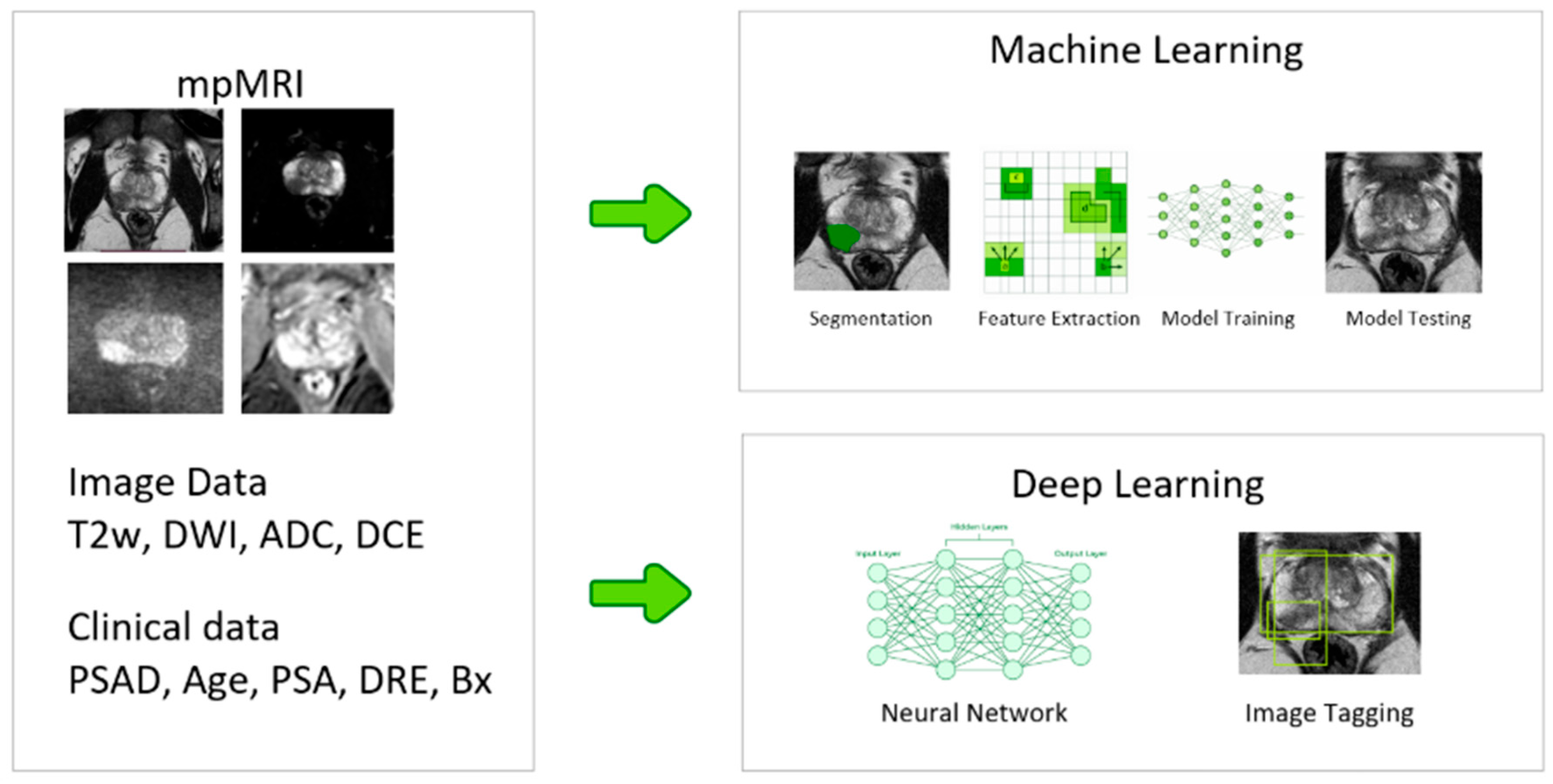
3.1.6. Machine Learning Algorithms
3.2. Artificial Intelligence in Image Analysis for EPE Prediction
3.2.1. Machine Learning and Radiomics in Image Analysis for EPE Prediction
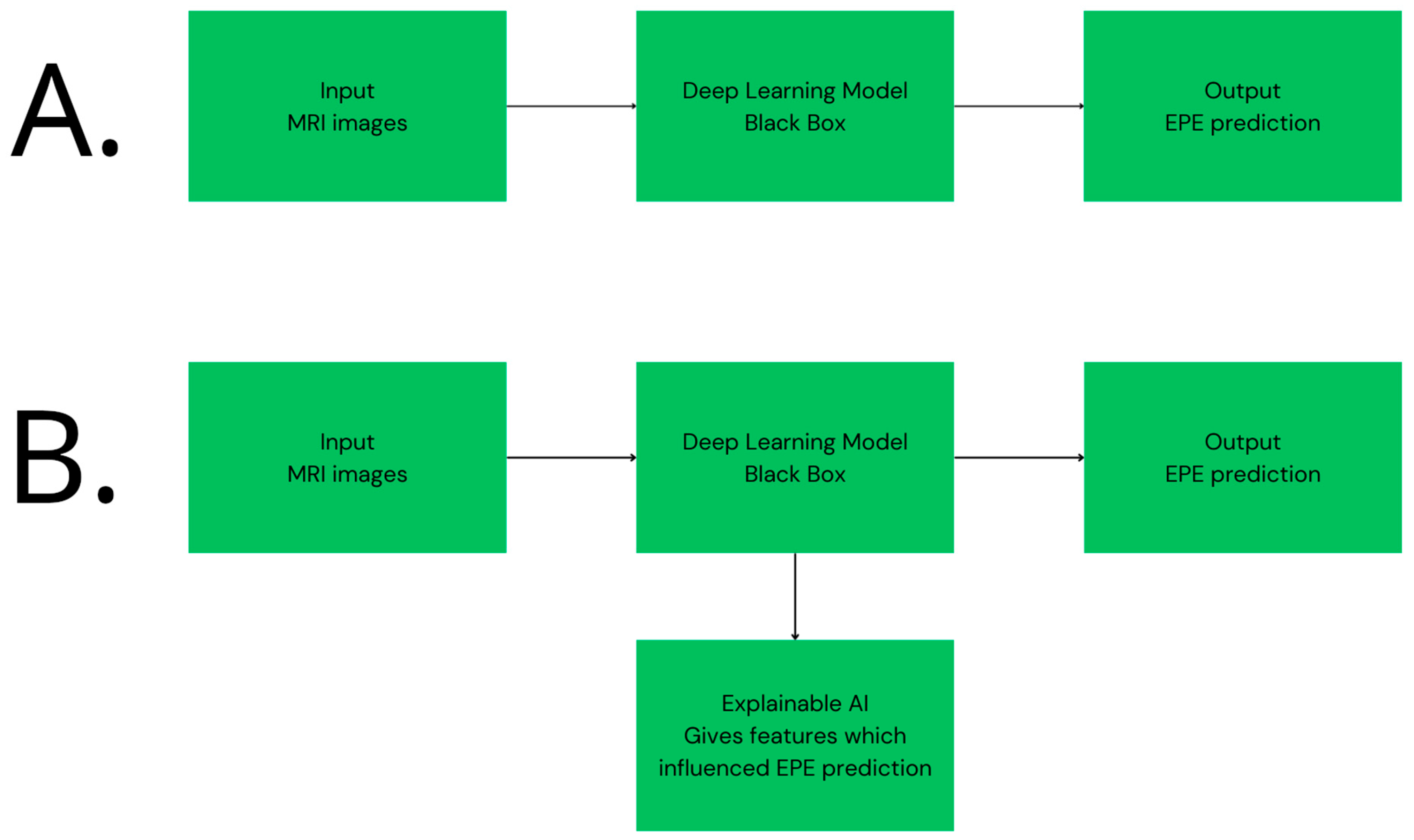
3.2.2. Deep Learning
3.2.3. AI vs. Specialists
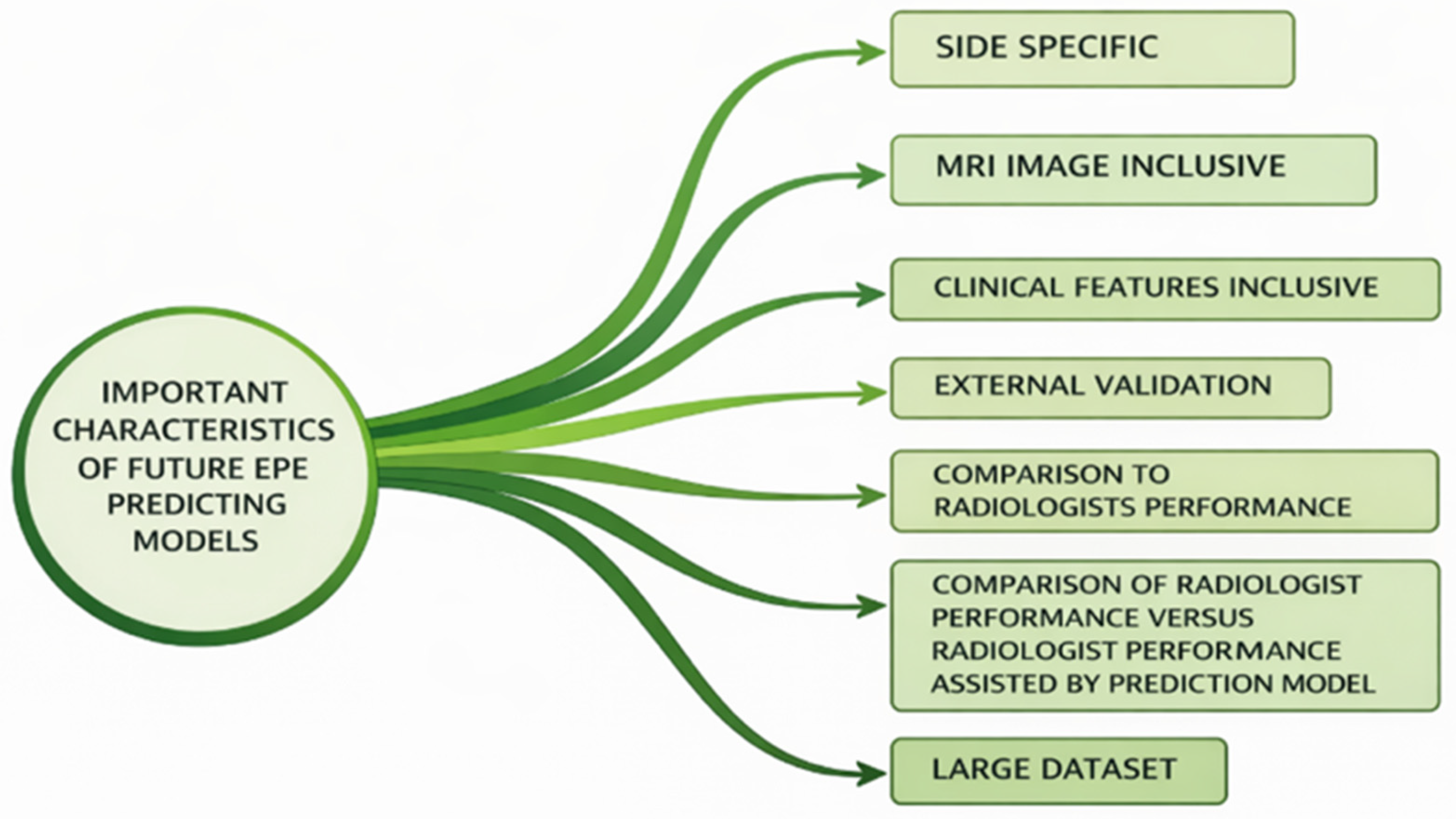
4. Future Directions
5. Conclusions
Author Contributions
Funding
Data Availability Statement
Acknowledgments
Conflicts of Interest
Abbreviations
| EPE | Extraprostatic extension |
| mpMRI | Multiparametric Magnetic Resonance Imaging |
| ML | Machine learning |
| DL | Deep learning |
| PSA | Prostate-specific antigen |
| PSAD | PSA density |
| ISUP | International Society of Urological Pathology |
| TNM | Tumor, Node, Metastasis |
| EAU | European Association of Urology |
| csPC | Clinically significant prostate cancer |
| PC | Prostate cancer |
| SVI | Seminal vesicle invasion |
| NVB | Neurovascular bundle |
| TCA1 | Tumor contact area 1 |
| TCA2 | Tumor contact area 2 |
| TCL | Tumor contact length |
| MSKCC | Memorial Sloan Kettering Cancer Center |
| CAPRA | Cancer of the Prostate Risk Assessment |
| AUROC | Area under receiver operating characteristic curve |
| AUPRC | Area under precision–recall curve |
| SEPERA | Side-specific Extraprostatic Extension Risk Assessment |
| DGC | Decipher Genomic Classifier |
| PET | Positron emission tomography |
| PSMA | Prostate specific membrane antigen |
| PSMA-PET | Prostate-specific membrane antigen positron emission tomography |
| PSMA-TV | Prostate-specific membrane antigen–derived tumor volume |
| SUVmax | Maximum standardized uptake value |
| TV | Tumor volume |
References
- Wibmer, A.G.; Robertson, N.L.; Hricak, H.; Zheng, J.; Capanu, M.; Stone, S.; Ehdaie, B.; Brawer, M.K.; Vargas, H.A. Extracapsular Extension on MRI Indicates a More Aggressive Cell Cycle Progression Genotype of Prostate Cancer. Abdom. Radiol. 2019, 44, 2864–2873. [Google Scholar] [CrossRef] [PubMed]
- Cheng, L.; Darson, M.F.; Bergstralh, E.J.; Slezak, J.; Myers, R.P.; Bostwick, D.G. Correlation of Margin Status and Extraprostatic Extension with Progression of Prostate Carcinoma. Cancer 1999, 86, 1775–1782. [Google Scholar] [CrossRef]
- Ball, M.W.; Partin, A.W.; Epstein, J.I. Extent of Extraprostatic Extension Independently Influences Biochemical Recurrence-Free Survival: Evidence for Further PT3 Subclassification. Urology 2015, 85, 161–164. [Google Scholar] [CrossRef] [PubMed]
- Wang, X.; Wu, Y.; Guo, J.; Chen, H.; Weng, X.; Liu, X. Intrafascial Nerve-Sparing Radical Prostatectomy Improves Patients’ Postoperative Continence Recovery and Erectile Function: A Pooled Analysis Based on Available Literatures. Medicine 2018, 97, e11297. [Google Scholar] [CrossRef]
- Kyriazis, I.; Spinos, T.; Tsaturyan, A.; Kallidonis, P.; Stolzenburg, J.U.; Liatsikos, E. Different Nerve-Sparing Techniques during Radical Prostatectomy and Their Impact on Functional Outcomes. Cancers 2022, 14, 1601. [Google Scholar] [CrossRef]
- Liu, Y.; Deng, X.Z.; Qin, J.; Wen, Z.; Jiang, Y.; Huang, J.; Wang, C.J.; Chen, C.X.; Wang, L.; Li, K.P.; et al. Erectile Function, Urinary Continence and Oncologic Outcomes of Neurovascular Bundle Sparing Robot-Assisted Radical Prostatectomy for High-Risk Prostate Cancer: A Systematic Review and Meta-Analysis. Front. Oncol. 2023, 13, 1161544. [Google Scholar] [CrossRef]
- Xiang, P.; Du, Z.; Guan, D.; Yan, W.; Wang, M.; Guo, D.; Liu, D.; Liu, Y.; Ping, H. Is There Any Difference in Urinary Continence between Bilateral and Unilateral Nerve Sparing during Radical Prostatectomy? A Systematic Review and Meta-Analysis. World J. Surg. Oncol. 2024, 22, 66. [Google Scholar] [CrossRef]
- Lavallée, L.T.; Stokl, A.; Cnossen, S.; Mallick, R.; Morash, C.; Cagiannos, I.; Breau, R.H. The Effect of Wide Resection during Radical Prostatectomy on Surgical Margins. J. Can. Urol. Assoc. 2016, 10, 14–17. [Google Scholar] [CrossRef]
- Prostate Cancer Nomograms: Pre-Radical Prostatectomy|Memorial Sloan Kettering Cancer Center. Available online: https://www.mskcc.org/nomograms/prostate/pre_op (accessed on 28 December 2025).
- Partin, A.W.; Mangold, L.A.; Lamm, D.M.; Walsh, P.C.; Epstein, J.I.; Pearson, J.D. Contemporary Update of Prostate Cancer Staging Nomograms (Partin Tables) for the New Millennium. Urology 2001, 58, 843–848. [Google Scholar] [CrossRef]
- Ahmed, H.U.; El-Shater Bosaily, A.; Brown, L.C.; Gabe, R.; Kaplan, R.; Parmar, M.K.; Collaco-Moraes, Y.; Ward, K.; Hindley, R.G.; Freeman, A.; et al. Diagnostic Accuracy of Multi-Parametric MRI and TRUS Biopsy in Prostate Cancer (PROMIS): A Paired Validating Confirmatory Study. Lancet 2017, 389, 815–822. [Google Scholar] [CrossRef]
- Prostate Cancer—Uroweb. Available online: https://uroweb.org/guidelines/prostate-cancer/summary-of-changes/2019 (accessed on 28 December 2025).
- Turkbey, B.; Rosenkrantz, A.B.; Haider, M.A.; Padhani, A.R.; Villeirs, G.; Macura, K.J.; Tempany, C.M.; Choyke, P.L.; Cornud, F.; Margolis, D.J.; et al. Prostate Imaging Reporting and Data System Version 2.1: 2019 Update of Prostate Imaging Reporting and Data System Version 2. Eur. Urol. 2019, 76, 340–351. [Google Scholar] [CrossRef] [PubMed]
- Zhang, F.; Liu, C.L.; Chen, Q.; Shao, S.C.; Chen, S.Q. Accuracy of Multiparametric Magnetic Resonance Imaging for Detecting Extracapsular Extension in Prostate Cancer: A Systematic Review and Meta-Analysis. Br. J. Radiol. 2019, 92, 20190480. [Google Scholar] [CrossRef] [PubMed]
- Zhu, M.L.; Gao, J.H.; Han, F.; Yin, L.L.; Zhang, L.S.; Yang, Y.; Zhang, J.W. Diagnostic Performance of Prediction Models for Extraprostatic Extension in Prostate Cancer: A Systematic Review and Meta-Analysis. Insights Imaging 2023, 14, 140. [Google Scholar] [CrossRef] [PubMed]
- Ponsiglione, A.; Gambardella, M.; Stanzione, A.; Green, R.; Cantoni, V.; Nappi, C.; Crocetto, F.; Cuocolo, R.; Cuocolo, A.; Imbriaco, M. Radiomics for the Identification of Extraprostatic Extension with Prostate MRI: A Systematic Review and Meta-Analysis. Eur. Radiol. 2023, 34, 3981–3991. [Google Scholar] [CrossRef]
- Wen, J.; Liu, W.; Zhang, Y.; Shen, X. MRI-Based Radiomics for Prediction of Extraprostatic Extension of Prostate Cancer: A Systematic Review and Meta-Analysis. La Radiol. Medica 2024, 129, 702–711. [Google Scholar] [CrossRef]
- Gilliland, F.D.; Hoffman, R.M.; Hamilton, A.; Albertsen, P.; Eley, J.W.; Harlan, L.; Stanford, J.L.; Hunt, W.C.; Potosky, A. Predicting Extracapsular Extension of Prostate Cancer in Men Treated with Radical Prostatectomy: Results from the Population Based Prostate Cancer Outcomes Study. J. Urol. 1999, 162, 1341–1345. [Google Scholar] [CrossRef]
- Moon, H.W.; Kim, D.H.; Kim, J.; Kim, B.; Oh, S.N.; Choi, J.-I.; Rha, S.E.; Lee, J.Y. A Preoperative Scoring System for Predicting the Extraprostatic Extension of Prostate Cancer Following Radical Prostatectomy Using Magnetic Resonance Imaging and Clinical Factors. Abdom. Radiol. 2024, 49, 2683–2692. [Google Scholar] [CrossRef]
- Koie, T.; Mitsuzuka, K.; Yoneyama, T.; Narita, S.; Kawamura, S.; Kaiho, Y.; Tsuchiya, N.; Tochigi, T.; Habuchi, T.; Arai, Y.; et al. Prostate-Specific Antigen Density Predicts Extracapsular Extension and Increased Risk of Biochemical Recurrence in Patients with High-Risk Prostate Cancer Who Underwent Radical Prostatectomy. Int. J. Clin. Oncol. 2015, 20, 176–181. [Google Scholar] [CrossRef]
- Kim, S.H.; Cho, S.H.; Kim, W.H.; Kim, H.J.; Park, J.M.; Kim, G.C.; Ryeom, H.K.; Yoon, Y.S.; Cha, J.G. Predictors of Extraprostatic Extension in Patients with Prostate Cancer. J. Clin. Med. 2023, 12, 5321. [Google Scholar] [CrossRef]
- Lim, C.; Flood, T.A.; Hakim, S.W.; Shabana, W.M.; Quon, J.S.; El-Khodary, M.; Thornhill, R.E.; El Hallani, S.; Schieda, N. Evaluation of Apparent Diffusion Coefficient and MR Volumetry as Independent Associative Factors for Extra-Prostatic Extension (EPE) in Prostatic Carcinoma. J. Magn. Reson. Imaging 2016, 43, 726–736. [Google Scholar] [CrossRef]
- Sertkaya, Z.; Öztürk, M.İ.; Koca, O.; Güneş, M.; Karaman, M.İ. Predictive Values for Extracapsular Extension in Prostate Cancer Patients with PSA Values below 10 Ng/ML. Turk. J. Urol. 2014, 40, 130. [Google Scholar] [CrossRef]
- Merder, E.; Arıman, A.; Altunrende, F. A Modified Partın Table to Better Predict Extracapsular Extensıon in Clinically Localized Prostate Cancer. Urol. J. 2021, 18, 74–80. [Google Scholar] [CrossRef]
- Gnanapragasam, V.J.; Lophatananon, A.; Wright, K.A.; Muir, K.R.; Gavin, A.; Greenberg, D.C. Improving Clinical Risk Stratification at Diagnosis in Primary Prostate Cancer: A Prognostic Modelling Study. PLoS Med. 2016, 13, 1002063. [Google Scholar] [CrossRef] [PubMed]
- Gnanapragasam, V.J.; Bratt, O.; Muir, K.; Lee, L.S.; Huang, H.H.; Stattin, P.; Lophatananon, A. The Cambridge Prognostic Groups for Improved Prediction of Disease Mortality at Diagnosis in Primary Non-Metastatic Prostate Cancer: A Validation Study. BMC Med. 2018, 16, 31. [Google Scholar] [CrossRef] [PubMed]
- Parry, M.G.; Cowling, T.E.; Sujenthiran, A.; Nossiter, J.; Berry, B.; Cathcart, P.; Aggarwal, A.; Payne, H.; Van Der Meulen, J.; Clarke, N.W.; et al. Risk Stratification for Prostate Cancer Management: Value of the Cambridge Prognostic Group Classification for Assessing Treatment Allocation. BMC Med. 2020, 18, 114. [Google Scholar] [CrossRef] [PubMed]
- Cozzi, G.; Rocco, B.M.; Grasso, A.; Rosso, M.; Abed El Rahman, D.; Oliva, I.; Talso, M.; Costa, B.; Tafa, A.; Palumbo, C.; et al. Perineural Invasion as a Predictor of Extraprostatic Extension of Prostate Cancer: A Systematic Review and Meta-Analysis. Scand. J. Urol. 2013, 47, 443–448. [Google Scholar] [CrossRef]
- Chen, J.R.; Zhao, J.G.; Zhu, S.; Zhang, M.N.; Chen, N.; Liu, J.D.; Sun, G.X.; Shen, P.F.; Zeng, H. Clinical and Oncologic Findings of Extraprostatic Extension on Needle Biopsy in de Novo Metastatic Prostate Cancer. Asian J. Androl. 2020, 22, 427–431. [Google Scholar] [CrossRef]
- Goldberg, H.; Ramiz, A.H.; Glicksman, R.; Salgado, N.S.; Chandrasekar, T.; Klaassen, Z.; Wallis, C.J.D.; Hosni, A.; Moraes, F.Y.; Ghai, S.; et al. Extraprostatic Extension in Core Biopsies Epitomizes High-Risk but Locally Treatable Prostate Cancer. Eur. Urol. Oncol. 2019, 2, 88–96. [Google Scholar] [CrossRef]
- Fleshner, K.; Assel, M.; Benfante, N.; Lee, J.; Vickers, A.; Fine, S.; Carlsson, S.; Eastham, J. Clinical Findings and Treatment Outcomes in Patients with Extraprostatic Extension Identified on Prostate Biopsy. J. Urol. 2016, 196, 703–708. [Google Scholar] [CrossRef]
- Billis, A. Pathology. Int. Braz. J. Urol. 2004, 30, 346–348. [Google Scholar] [CrossRef][Green Version]
- Choi, M.H.; Kim, D.H.; Lee, Y.J.; Rha, S.E.; Lee, J.Y. Imaging Features of the PI-RADS for Predicting Extraprostatic Extension of Prostate Cancer: Systematic Review and Meta-Analysis. Insights Imaging 2023, 14, 77. [Google Scholar] [CrossRef] [PubMed]
- Majchrzak, N.; Cieśliński, P.; Milecki, T.; Głyda, M.; Karmelita-Katulska, K. MRI utility in predicting extraprostatic extension of prostate cancer and biochemical recurrence after radical prostatectomy. Biul. Pol. Tow. Onkol. Nowotw. 2021, 4, 261–265. [Google Scholar] [CrossRef]
- Ayaz, M.; Gülseren, Y.; İnan, İ.; Ok, F.; Kabaalioǧlu, A.; Yildirim, A. Extraprostatic Extension in Multiparametric MRI.; Is Presurgical Detection Possible? J. Cancer Res. Ther. 2023, 19, S639–S644. [Google Scholar] [CrossRef] [PubMed]
- Li, W.; Dong, A.; Hong, G.; Shang, W.; Shen, X. Diagnostic Performance of ESUR Scoring System for Extraprostatic Prostate Cancer Extension: A Meta-Analysis. Eur. J. Radiol. 2021, 143, 109896. [Google Scholar] [CrossRef]
- Schieda, N.; Quon, J.S.; Lim, C.; El-Khodary, M.; Shabana, W.; Singh, V.; Morash, C.; Breau, R.H.; McInnes, M.D.F.; Flood, T.A. Evaluation of the European Society of Urogenital Radiology (ESUR) PI-RADS Scoring System for Assessment of Extra-Prostatic Extension in Prostatic Carcinoma. Eur. J. Radiol. 2015, 84, 1843–1848. [Google Scholar] [CrossRef]
- de Rooij, M.; Hamoen, E.H.J.; Witjes, J.A.; Barentsz, J.O.; Rovers, M.M. Accuracy of Magnetic Resonance Imaging for Local Staging of Prostate Cancer: A Diagnostic Meta-Analysis. Eur. Urol. 2016, 70, 233–245. [Google Scholar] [CrossRef]
- Krishna, S.; Lim, C.S.; McInnes, M.D.F.; Flood, T.A.; Shabana, W.M.; Lim, R.S.; Schieda, N. Evaluation of MRI for Diagnosis of Extraprostatic Extension in Prostate Cancer. J. Magn. Reson. Imaging 2018, 47, 176–185. [Google Scholar] [CrossRef]
- Freifeld, Y.; DeLeon, A.D.; Xi, Y.; Pedrosa, I.; Roehrborn, C.G.; Lotan, Y.; Francis, F.; Costa, D.N. Diagnostic Performance of Prospectively Assigned Likert Scale Scores to Determine Extraprostatic Extension and Seminal Vesicle Invasion with Multiparametric MRI of the Prostate. AJR Am. J. Roentgenol. 2019, 212, 576–581. [Google Scholar] [CrossRef]
- Asfuroğlu, U.; Asfuroğlu, B.B.; Özer, H.; Gönül, İ.I.; Tokgöz, N.; İnan, M.A.; Uçar, M. Which One Is Better for Predicting Extraprostatic Extension on Multiparametric MRI: ESUR Score, Likert Scale, Tumor Contact Length, or EPE Grade? Eur. J. Radiol. 2022, 149, 110228. [Google Scholar] [CrossRef]
- Zapała, P.; Dybowski, B.; Bres-Niewada, E.; Lorenc, T.; Powała, A.; Lewandowski, Z.; Gołębiowski, M.; Radziszewski, P. Predicting Side-Specific Prostate Cancer Extracapsular Extension: A Simple Decision Rule of PSA, Biopsy, and MRI Parameters. Int. Urol. Nephrol. 2019, 51, 1545–1552. [Google Scholar] [CrossRef]
- Reisæter, L.A.R.; Halvorsen, O.J.; Beisland, C.; Honoré, A.; Gravdal, K.; Losnegård, A.; Monssen, J.; Akslen, L.A.; Biermann, M. Assessing Extraprostatic Extension with Multiparametric MRI of the Prostate: Mehralivand Extraprostatic Extension Grade or Extraprostatic Extension Likert Scale? Radiol. Imaging Cancer 2020, 2, e190071. [Google Scholar] [CrossRef]
- Engel, H.; Oerther, B.; Reisert, M.; Kellner, E.; Sigle, A.; Gratzke, C.; Bronsert, P.; Krauss, T.; Bamberg, F.; Benndorf, M. Quantitative Analysis of Diffusion Weighted Imaging May Improve Risk Stratification of Prostatic Transition Zone Lesions. In Vivo 2022, 36, 2323. [Google Scholar] [CrossRef] [PubMed]
- Wibmer, A.; Vargas, H.A.; Donahue, T.F.; Zheng, J.; Moskowitz, C.; Eastham, J.; Sala, E.; Hricak, H. Diagnosis of Extracapsular Extension of Prostate Cancer on Prostate MRI: Impact of Second-Opinion Readings by Subspecialized Genitourinary Oncologic Radiologists. AJR Am. J. Roentgenol. 2015, 205, W73–W78. [Google Scholar] [CrossRef] [PubMed]
- Li, W.; Shang, W.; Lu, F.; Sun, Y.; Tian, J.; Wu, Y.; Dong, A. Diagnostic Performance of Extraprostatic Extension Grading System for Detection of Extraprostatic Extension in Prostate Cancer: A Diagnostic Systematic Review and Meta-Analysis. Front. Oncol. 2022, 11, 792120. [Google Scholar] [CrossRef] [PubMed]
- Ahn, H.; Hwang, S.I.; Lee, H.J.; Suh, H.S.; Choe, G.; Byun, S.S.; Hong, S.K.; Lee, S.; Lee, J. Prediction of Extraprostatic Extension on Multi-Parametric Magnetic Resonance Imaging in Patients with Anterior Prostate Cancer. Eur. Radiol. 2020, 30, 26–37. [Google Scholar] [CrossRef]
- Kim, T.H.; Woo, S.; Han, S.; Suh, C.H.; Ghafoor, S.; Hricak, H.; Vargas, H.A. The Diagnostic Performance of the Length of Tumor Capsular Contact on MRI for Detecting Prostate Cancer Extraprostatic Extension: A Systematic Review and Meta-Analysis. Korean J. Radiol. 2020, 21, 684–694. [Google Scholar] [CrossRef]
- Futela, D.; Bhargava, M.; Rama, S.; Doddi, S.; Chen, Y.; Ramaiya, N.H.; Tirumani, S.H. 10 mm (PI-RADS v2.1) versus 15 Mm (PI-RADS v1.0) Tumor Capsule Contact Length in Predicting Extracapsular Extension in Prostate Cancer: Meta-Analysis and Systematic Review. Abdom. Radiol. 2025, 50, 6106–6118. [Google Scholar] [CrossRef]
- Bakir, B.; Onay, A.; Vural, M.; Armutlu, A.; Yildiz, S.Ö.; Esen, T. Can Extraprostatic Extension Be Predicted by Tumor-Capsule Contact Length in Prostate Cancer? Relationship With International Society of Urological Pathology Grade Groups. AJR Am. J. Roentgenol. 2020, 214, 588–596. [Google Scholar] [CrossRef]
- Gomez-Iturriaga, A.; Büchser, D.; Miguel, I.S.; Marban, M.; Urresola, A.; Ezquerro, A.; Gil, A.; Suarez, F.; Gonzalez, A.; Mairata, E.; et al. MRI Detected Extaprostatic Extension (EPE) in Prostate Cancer: Do All T3a Patients Have the Same Outcomes? Clin. Transl. Radiat. Oncol. 2020, 24, 135–139. [Google Scholar] [CrossRef]
- Martini, F.; Pigati, M.; Mattiauda, M.; Ponzano, M.; Piol, N.; Pigozzi, S.; Spina, B.; Cittadini, G.; Giasotto, V.; Zawaideh, J.P. Extra-Prostatic Extension Grading System: Correlation with MRI Features and Integration of Capsular Enhancement Sign for “Enhanced” Detection of T3a Lesions. Br. J. Radiol. 2024, 97, 971. [Google Scholar] [CrossRef]
- Asfuroğlu, U.; Asfuroğlu, B.B.; Özer, H.; İnan, M.A.; Uçar, M. A Comparative Analysis of Techniques for Measuring Tumor Contact Length in Predicting Extraprostatic Extension. Eur. J. Radiol. 2024, 181, 111753. [Google Scholar] [CrossRef] [PubMed]
- Tsujimoto, M.; Inoue, Y.; Taga, H.; Saito, Y.; Kaneko, M.; Miyashita, M.; Yamada, T.; Yamada, Y.; Ueda, T.; Fujihara, A.; et al. MRI-Determined Tumor Contact Area as a Predictor of Pathological Extraprostatic Extension in Clinical T2 Prostate Cancer. Prostate Cancer 2025, 2025, 9165949. [Google Scholar] [CrossRef]
- Park, C.K.; Chung, Y.S.; Choi, Y.D.; Ham, W.S.; Jang, W.S.; Cho, N.H. Revisiting Extraprostatic Extension Based on Invasion Depth and Number for New Algorithm for Substaging of PT3a Prostate Cancer. Sci. Rep. 2021, 11, 13952. [Google Scholar] [CrossRef] [PubMed]
- Eifler, J.B.; Feng, Z.; Lin, B.M.; Partin, M.T.; Humphreys, E.B.; Han, M.; Epstein, J.I.; Walsh, P.C.; Trock, B.J.; Partin, A.W. An Updated Prostate Cancer Staging Nomogram (Partin Tables) Based on Cases from 2006 to 2011. BJU Int. 2013, 111, 22–29. [Google Scholar] [CrossRef] [PubMed]
- Cooperberg, M.R.; Pasta, D.J.; Elkin, E.P.; Litwin, M.S.; Latini, D.M.; Duchane, J.; Carroll, P.R. The University of California, San Francisco Cancer of the Prostate Risk Assessment Score: A Straightforward and Reliable Preoperative Predictor of Disease Recurrence after Radical Prostatectomy. J. Urol. 2005, 173, 1938–1942. [Google Scholar] [CrossRef]
- Martini, A.; Gupta, A.; Lewis, S.C.; Cumarasamy, S.; Haines, K.G.; Briganti, A.; Montorsi, F.; Tewari, A.K. Development and Internal Validation of a Side-Specific, Multiparametric Magnetic Resonance Imaging-Based Nomogram for the Prediction of Extracapsular Extension of Prostate Cancer. BJU Int. 2018, 122, 1025–1033. [Google Scholar] [CrossRef]
- Soeterik, T.F.W.; van Melick, H.H.E.; Dijksman, L.M.; Küsters-Vandevelde, H.V.N.; Biesma, D.H.; Witjes, J.A.; van Basten, J.P.A. External Validation of the Martini Nomogram for Prediction of Side-Specific Extraprostatic Extension of Prostate Cancer in Patients Undergoing Robot-Assisted Radical Prostatectomy. Urol. Oncol. Semin. Orig. Investig. 2020, 38, 372–378. [Google Scholar] [CrossRef]
- Nyarangi-Dix, J.; Wiesenfarth, M.; Bonekamp, D.; Hitthaler, B.; Schütz, V.; Dieffenbacher, S.; Mueller-Wolf, M.; Roth, W.; Stenzinger, A.; Duensing, S.; et al. Combined Clinical Parameters and Multiparametric Magnetic Resonance Imaging for the Prediction of Extraprostatic Disease—A Risk Model for Patient-Tailored Risk Stratification When Planning Radical Prostatectomy. Eur. Urol. Focus 2020, 6, 1205–1212. [Google Scholar] [CrossRef]
- Wibmer, A.G.; Kattan, M.W.; Alessandrino, F.; Baur, A.D.J.; Boesen, L.; Franco, F.B.; Bonekamp, D.; Campa, R.; Cash, H.; Catalá, V.; et al. International Multi-Site Initiative to Develop an MRI-Inclusive Nomogram for Side-Specific Prediction of Extraprostatic Extension of Prostate Cancer. Cancers 2021, 13, 2627. [Google Scholar] [CrossRef]
- Heetman, J.G.; van der Hoeven, E.J.R.J.; Rajwa, P.; Zattoni, F.; Kesch, C.; Shariat, S.; Dal Moro, F.; Novara, G.; La Bombara, G.; Sattin, F.; et al. External Validation of Nomograms Including MRI Features for the Prediction of Side-Specific Extraprostatic Extension. Prostate Cancer Prostatic Dis. 2024, 27, 492–499. [Google Scholar] [CrossRef]
- Soeterik, T.F.W.; van Melick, H.H.E.; Dijksman, L.M.; Küsters-Vandevelde, H.; Stomps, S.; Schoots, I.G.; Biesma, D.H.; Witjes, J.A.; van Basten, J.P.A. Development and External Validation of a Novel Nomogram to Predict Side-Specific Extraprostatic Extension in Patients with Prostate Cancer Undergoing Radical Prostatectomy. Eur. Urol. Oncol. 2022, 5, 328–337. [Google Scholar] [CrossRef] [PubMed]
- Diamand, R.; Ploussard, G.; Roumiguié, M.; Oderda, M.; Benamran, D.; Fiard, G.; Quackels, T.; Assenmacher, G.; Simone, G.; Van Damme, J.; et al. External Validation of a Multiparametric Magnetic Resonance Imaging–Based Nomogram for the Prediction of Extracapsular Extension and Seminal Vesicle Invasion in Prostate Cancer Patients Undergoing Radical Prostatectomy. Eur. Urol. 2021, 79, 180–185. [Google Scholar] [CrossRef] [PubMed]
- Gandaglia, G.; Ploussard, G.; Valerio, M.; Mattei, A.; Fiori, C.; Roumiguié, M.; Fossati, N.; Stabile, A.; Beauval, J.B.; Malavaud, B.; et al. The Key Combined Value of Multiparametric Magnetic Resonance Imaging, and Magnetic Resonance Imaging–Targeted and Concomitant Systematic Biopsies for the Prediction of Adverse Pathological Features in Prostate Cancer Patients Undergoing Radical Prostatectomy. Eur. Urol. 2020, 77, 733–741. [Google Scholar] [CrossRef] [PubMed]
- Sayyid, R.; Perlis, N.; Ahmad, A.; Evans, A.; Toi, A.; Horrigan, M.; Finelli, A.; Zlotta, A.; Kulkarni, G.; Hamilton, R.; et al. Development and External Validation of a Biopsy-Derived Nomogram to Predict Risk of Ipsilateral Extraprostatic Extension. BJU Int. 2017, 120, 76–82. [Google Scholar] [CrossRef]
- Diamand, R.; Roche, J.B.; Lievore, E.; Lacetera, V.; Chiacchio, G.; Beatrici, V.; Mastroianni, R.; Simone, G.; Windisch, O.; Benamran, D.; et al. External Validation of Models for Prediction of Side-Specific Extracapsular Extension in Prostate Cancer Patients Undergoing Radical Prostatectomy. Eur. Urol. Focus 2023, 9, 309–316. [Google Scholar] [CrossRef]
- Tosoian, J.J.; Chappidi, M.; Feng, Z.; Humphreys, E.B.; Han, M.; Pavlovich, C.P.; Epstein, J.I.; Partin, A.W.; Trock, B.J. Prediction of Pathological Stage Based on Clinical Stage, Serum Prostate-Specific Antigen, and Biopsy Gleason Score: Partin Tables in the Contemporary Era. BJU Int. 2017, 119, 676–683. [Google Scholar] [CrossRef]
- Fanning, D.M.; Fan, Y.; Fitzpatrick, J.M.; Watson, R.W.G. External Validation of the 2007 and 2001 Partin Tables in Irish Prostate Cancer Patients. Urol. Int. 2010, 84, 174–179. [Google Scholar] [CrossRef]
- Karakiewicz, P.I.; Bhojani, N.; Capitanio, U.; Reuther, A.M.; Suardi, N.; Jeldres, C.; Pharand, D.; Péloquin, F.; Perrotte, P.; Shariat, S.F.; et al. External Validation of the Updated Partin Tables in a Cohort of North American Men. J. Urol. 2008, 180, 898–903. [Google Scholar] [CrossRef]
- Bhojani, N.; Salomon, L.; Capitanio, U.; Suardi, N.; Shariat, S.F.; Jeldres, C.; Zini, L.; Pharand, D.; Péloquin, F.; Arjane, P.; et al. External Validation of the Updated Partin Tables in a Cohort of French and Italian Men. Int. J. Radiat. Oncol. Biol. Phys. 2009, 73, 347–352. [Google Scholar] [CrossRef]
- Otles, E.; Denton, B.T.; Qu, B.; Murali, A.; Merdan, S.; Auffenberg, G.B.; Hiller, S.C.; Lane, B.R.; George, A.K.; Singh, K. Development and Validation of Models to Predict Pathological Outcomes of Radical Prostatectomy in Regional and National Cohorts. J. Urol. 2022, 207, 358–366. [Google Scholar] [CrossRef]
- Blas, L.; Shiota, M.; Nagakawa, S.; Tsukahara, S.; Matsumoto, T.; Lee, K.; Monji, K.; Kashiwagi, E.; Inokuchi, J.; Eto, M. Validation of User-Friendly Models Predicting Extracapsular Extension in Prostate Cancer Patients. Asian J. Urol. 2023, 10, 81–88. [Google Scholar] [CrossRef]
- Xu, L.; Zhang, G.; Zhang, X.; Bai, X.; Yan, W.; Xiao, Y.; Sun, H.; Jin, Z. External Validation of the Extraprostatic Extension Grade on MRI and Its Incremental Value to Clinical Models for Assessing Extraprostatic Cancer. Front. Oncol. 2021, 11, 655093. [Google Scholar] [CrossRef]
- Sighinolfi, M.C.; Sandri, M.; Torricelli, P.; Ligabue, G.; Fiocchi, F.; Scialpi, M.; Eissa, A.; Reggiani Bonetti, L.; Puliatti, S.; Bianchi, G.; et al. External Validation of a Novel Side-Specific, Multiparametric Magnetic Resonance Imaging-Based Nomogram for the Prediction of Extracapsular Extension of Prostate Cancer: Preliminary Outcomes on a Series Diagnosed with Multiparametric Magnetic Resonance imaging-targeted plus systematic saturation biopsy. BJU Int. 2019, 124, 192–194. [Google Scholar] [CrossRef]
- Kwong, J.C.C.; Khondker, A.; Meng, E.; Taylor, N.; Kuk, C.; Perlis, N.; Kulkarni, G.S.; Hamilton, R.J.; Fleshner, N.E.; Finelli, A.; et al. Development, Multi-Institutional External Validation, and Algorithmic Audit of an Artificial Intelligence-Based Side-Specific Extra-Prostatic Extension Risk Assessment Tool (SEPERA) for Patients Undergoing Radical Prostatectomy: A Retrospective Cohort Study. Lancet Digit. Health 2023, 5, e435–e445. [Google Scholar] [CrossRef]
- Veerman, H.; Heymans, M.W.; van der Poel, H.G. External Validation of a Prediction Model for Side-Specific Extraprostatic Extension of Prostate Cancer at Robot-Assisted Radical Prostatectomy. Eur. Urol. Open Sci. 2022, 37, 50–52. [Google Scholar] [CrossRef] [PubMed]
- Kwong, J.C.C.; Khondker, A.; Tran, C.; Evans, E.; Cozma, A.I.; Javidan, A.; Ali, A.; Jamal, M.; Short, T.; Papanikolaou, F.; et al. Explainable Artificial Intelligence to Predict the Risk of Side-Specific Extraprostatic Extension in Pre-Prostatectomy Patients. Can. Urol. Assoc. J. 2022, 16, 213–221. [Google Scholar] [CrossRef] [PubMed]
- Regis, F.; Casale, P.; Persico, F.; Colombo, P.; Cieri, M.; Guazzoni, G.; Buffi, N.M.; Lughezzani, G. Use of 29-MHz Micro-Ultrasound for Local Staging of Prostate Cancer in Patients Scheduled for Radical Prostatectomy: A Feasibility Study. Eur. Urol. Open Sci. 2020, 19, 20–23. [Google Scholar] [CrossRef] [PubMed]
- Fasulo, V.; Buffi, N.M.; Regis, F.; Paciotti, M.; Persico, F.; Maffei, D.; Uleri, A.; Saita, A.; Casale, P.; Hurle, R.; et al. Use of High-Resolution Micro-Ultrasound to Predict Extraprostatic Extension of Prostate Cancer Prior to Surgery: A Prospective Single-Institutional Study. World J. Urol. 2022, 40, 435–442. [Google Scholar] [CrossRef]
- Pedraza, A.M.; Parekh, S.; Joshi, H.; Grauer, R.; Wagaskar, V.; Zuluaga, L.; Gupta, R.; Barthe, F.; Nasri, J.; Pandav, K.; et al. Side-Specific, Microultrasound-Based Nomogram for the Prediction of Extracapsular Extension in Prostate Cancer. Eur. Urol. Open Sci. 2023, 48, 72–81. [Google Scholar] [CrossRef]
- Frego, N.; Contieri, R.; Fasulo, V.; Maffei, D.; Avolio, P.P.; Arena, P.; Beatrici, E.; Sordelli, F.; De Carne, F.; Lazzeri, M.; et al. Development of a Microultrasound-Based Nomogram to Predict Extra-Prostatic Extension in Patients with Prostate Cancer Undergoing Robot-Assisted Radical Prostatectomy. Urol. Oncol. Semin. Orig. Investig. 2024, 42, 159.e9–159.e16. [Google Scholar] [CrossRef]
- Uslu-Beşli, L.; Durmaz, S.; Onay, A.; Bakır, B.; Gürses, İ.; Özel-Yıldız, S.; Demirdağ, Ç.; Sayman, H.B.; Uslu-Beşli, L.; Durmaz, S.; et al. Impact of 68Ga-PSMA PET/MRI on the Accuracy of MRI-Derived Grading Systems for Predicting Extraprostatic Extension in Prostate Cancer. Diagnostics 2025, 15, 2405. [Google Scholar] [CrossRef]
- Evangelista, L.; Zattoni, F.; Cassarino, G.; Artioli, P.; Cecchin, D.; dal Moro, F.; Zucchetta, P. PET/MRI in Prostate Cancer: A Systematic Review and Meta-Analysis. Eur. J. Nucl. Med. Mol. Imaging 2020, 48, 859–873. [Google Scholar] [CrossRef]
- Woo, S.; Ghafoor, S.; Becker, A.S.; Han, S.; Wibmer, A.G.; Hricak, H.; Burger, I.A.; Schöder, H.; Vargas, H.A. Prostate-Specific Membrane Antigen Positron Emission Tomography (PSMA-PET) for Local Staging of Prostate Cancer: A Systematic Review and Meta-Analysis. Eur. J. Hybrid Imaging 2020, 4, 16. [Google Scholar] [CrossRef] [PubMed]
- Mari, A.; Cadenar, A.; Giudici, S.; Cianchi, G.; Albisinni, S.; Autorino, R.; Di Maida, F.; Gandaglia, G.; Mir, M.C.; Valerio, M.; et al. A Systematic Review and Meta-Analysis to Evaluate the Diagnostic Accuracy of PSMA PET/CT in the Initial Staging of Prostate Cancer. Prostate Cancer Prostatic Dis. 2024, 28, 56–69. [Google Scholar] [CrossRef] [PubMed]
- Tillu, N.; Maheshwari, A.; Kolanukuduru, K.; Choudhary, M.; Agarwal, Y.; Joshi, H.; Goel, S.; Sur, H.; Ben- David, R.; Kaufmann, B.; et al. Predicting Side-Specific Extraprostatic Extension in Prostate Cancer Using an 18F-DCFPyL PSMA-PET/CT–Based Nomogram. Prostate Cancer Prostatic Dis. 2025, 2025, 1–8. [Google Scholar] [CrossRef]
- Chimmula, R.R.; Green, M.; Tann, M.; Koch, M.; Boris, R.; Collins, K.; Bahler, C.; Oderinde, O. Comparative Analysis of Machine Learning-Derived Nomogram and Biomarkers in Predicting Side-Specific Extraprostatic Extension: Preliminary Findings. Clin. Imaging 2025, 125, 110556. [Google Scholar] [CrossRef] [PubMed]
- Kumar, V.; Gu, Y.; Basu, S.; Berglund, A.; Eschrich, S.A.; Schabath, M.B.; Forster, K.; Aerts, H.J.W.L.; Dekker, A.; Fenstermacher, D.; et al. Radiomics: The Process and the Challenges. Magn. Reson. Imaging 2012, 30, 1234–1248. [Google Scholar] [CrossRef]
- Mayerhoefer, M.E.; Materka, A.; Langs, G.; Häggström, I.; Szczypiński, P.; Gibbs, P.; Cook, G. Introduction to Radiomics. J. Nucl. Med. 2020, 61, 488–495. [Google Scholar] [CrossRef]
- Cameron, A.; Khalvati, F.; Haider, M.A.; Wong, A. MAPS: A Quantitative Radiomics Approach for Prostate Cancer Detection. IEEE Trans. Biomed. Eng. 2016, 63, 1145–1156. [Google Scholar] [CrossRef]
- Van Griethuysen, J.J.M.; Fedorov, A.; Parmar, C.; Hosny, A.; Aucoin, N.; Narayan, V.; Beets-Tan, R.G.H.; Fillion-Robin, J.C.; Pieper, S.; Aerts, H.J.W.L. Computational Radiomics System to Decode the Radiographic Phenotype. Cancer Res. 2017, 77, e104–e107. [Google Scholar] [CrossRef]
- Sun, Y.; Reynolds, H.M.; Parameswaran, B.; Wraith, D.; Finnegan, M.E.; Williams, S.; Haworth, A. Multiparametric MRI and Radiomics in Prostate Cancer: A Review. Australas. Phys. Eng. Sci. Med. 2019, 42, 3–25. [Google Scholar] [CrossRef]
- Koçak, B.; Durmaz, E.Ş.; Ateş, E.; Kılıçkesmez, Ö. Radiomics with Artificial Intelligence: A Practical Guide for Beginners. Diagn. Interv. Radiol. 2019, 25, 485. [Google Scholar] [CrossRef] [PubMed]
- Zhovannik, I.; Bussink, J.; Traverso, A.; Shi, Z.; Kalendralis, P.; Wee, L.; Dekker, A.; Fijten, R.; Monshouwer, R. Learning from Scanners: Bias Reduction and Feature Correction in Radiomics. Clin. Transl. Radiat. Oncol. 2019, 19, 33–38. [Google Scholar] [CrossRef] [PubMed]
- Chen, T.; Guestrin, C. XGBoost: A Scalable Tree Boosting System. In Proceedings of the ACM SIGKDD International Conference on Knowledge Discovery and Data Mining 2016, San Francisco, CA, USA, 13–17 August 2016; pp. 785–794. [Google Scholar] [CrossRef]
- Breiman, L. Random Forests. Mach. Learn. 2001, 45, 5–32. [Google Scholar] [CrossRef]
- Schölkopf, B. SVMs—A Practical Consequence of Learning Theory. IEEE Intell. Syst. Their Appl. 1998, 13, 18–21. [Google Scholar] [CrossRef]
- Zhang, Y.P.; Zhang, X.Y.; Cheng, Y.T.; Li, B.; Teng, X.Z.; Zhang, J.; Lam, S.; Zhou, T.; Ma, Z.R.; Sheng, J.B.; et al. Artificial Intelligence-Driven Radiomics Study in Cancer: The Role of Feature Engineering and Modeling. Mil. Med. Res. 2023, 10, 22. [Google Scholar] [CrossRef]
- Bejani, M.M.; Ghatee, M. Regularized Deep Networks in Intelligent Transportation Systems: A Taxonomy and a Case Study. Artif. Intell. Rev. 2019, 54, 6391–6438. [Google Scholar] [CrossRef]
- Yip, S.S.F.; Aerts, H.J.W.L. Applications and Limitations of Radiomics. Phys. Med. Biol. 2016, 61, R150–R166. [Google Scholar] [CrossRef]
- Ma, S.; Xie, H.; Wang, H.; Yang, J.; Han, C.; Wang, X.; Zhang, X. Preoperative Prediction of Extracapsular Extension: Radiomics Signature Based on Magnetic Resonance Imaging to Stage Prostate Cancer. Mol. Imaging Biol. 2020, 22, 711–721. [Google Scholar] [CrossRef]
- Damascelli, A.; Gallivanone, F.; Cristel, G.; Cava, C.; Interlenghi, M.; Esposito, A.; Brembilla, G.; Briganti, A.; Montorsi, F.; Castiglioni, I.; et al. Advanced Imaging Analysis in Prostate Mri: Building a Radiomic Signature to Predict Tumor Aggressiveness. Diagnostics 2021, 11, 594. [Google Scholar] [CrossRef]
- Cuocolo, R.; Stanzione, A.; Faletti, R.; Gatti, M.; Calleris, G.; Fornari, A.; Gentile, F.; Motta, A.; Dell’Aversana, S.; Creta, M.; et al. MRI Index Lesion Radiomics and Machine Learning for Detection of Extraprostatic Extension of Disease: A Multicenter Study. Eur. Radiol. 2021, 31, 7575–7583. [Google Scholar] [CrossRef] [PubMed]
- Fan, X.; Xie, N.; Chen, J.; Li, T.; Cao, R.; Yu, H.; He, M.; Wang, Z.; Wang, Y.; Liu, H.; et al. Multiparametric MRI and Machine Learning Based Radiomic Models for Preoperative Prediction of Multiple Biological Characteristics in Prostate Cancer. Front. Oncol. 2022, 12, 839621. [Google Scholar] [CrossRef] [PubMed]
- Bai, H.; Xia, W.; Ji, X.; He, D.; Zhao, X.; Bao, J.; Zhou, J.; Wei, X.; Huang, Y.; Li, Q.; et al. Multiparametric Magnetic Resonance Imaging-Based Peritumoral Radiomics for Preoperative Prediction of the Presence of Extracapsular Extension with Prostate Cancer. J. Magn. Reson. Imaging 2021, 54, 1222–1230. [Google Scholar] [CrossRef] [PubMed]
- Losnegård, A.; Reisæter, L.A.R.; Halvorsen, O.J.; Jurek, J.; Assmus, J.; Arnes, J.B.; Honoré, A.; Monssen, J.A.; Andersen, E.; Haldorsen, I.S.; et al. Magnetic Resonance Radiomics for Prediction of Extraprostatic Extension in Non-Favorable Intermediate- and High-Risk Prostate Cancer Patients. Acta Radiol. 2020, 61, 1570–1579. [Google Scholar] [CrossRef]
- Xu, L.; Zhang, G.; Zhao, L.; Mao, L.; Li, X.; Yan, W.; Xiao, Y.; Lei, J.; Sun, H.; Jin, Z. Radiomics Based on Multiparametric Magnetic Resonance Imaging to Predict Extraprostatic Extension of Prostate Cancer. Front. Oncol. 2020, 10, 533290. [Google Scholar] [CrossRef]
- He, D.; Wang, X.; Fu, C.; Wei, X.; Bao, J.; Ji, X.; Bai, H.; Xia, W.; Gao, X.; Huang, Y.; et al. MRI-Based Radiomics Models to Assess Prostate Cancer, Extracapsular Extension and Positive Surgical Margins. Cancer Imaging 2021, 21, 46. [Google Scholar] [CrossRef]
- Stanzione, A.; Cuocolo, R.; Cocozza, S.; Romeo, V.; Persico, F.; Fusco, F.; Longo, N.; Brunetti, A.; Imbriaco, M. Detection of Extraprostatic Extension of Cancer on Biparametric MRI Combining Texture Analysis and Machine Learning: Preliminary Results. Acad. Radiol. 2019, 26, 1338–1344. [Google Scholar] [CrossRef]
- Shen, D.; Wu, G.; Suk, H. Il Deep Learning in Medical Image Analysis. Annu. Rev. Biomed. Eng. 2017, 19, 221–248. [Google Scholar] [CrossRef]
- Li, Y. Research and Application of Deep Learning in Image Recognition. In Proceedings of the 2022 IEEE 2nd International Conference on Power, Electronics and Computer Applications (ICPECA), Shenyang, China, 21–23 January 2022; Volume 2022, pp. 994–999. [Google Scholar] [CrossRef]
- Lundervold, A.S.; Lundervold, A. An Overview of Deep Learning in Medical Imaging Focusing on MRI. Z. Med. Phys. 2019, 29, 102–127. [Google Scholar] [CrossRef]
- Mazurowski, M.A.; Buda, M.; Saha, A.; Bashir, M.R. Deep Learning in Radiology: An Overview of the Concepts and a Survey of the State of the Art with Focus on MRI. J. Magn. Reson. Imaging 2019, 49, 939–954. [Google Scholar] [CrossRef]
- Hou, Y.; Zhang, Y.H.; Bao, J.; Bao, M.L.; Yang, G.; Shi, H.B.; Song, Y.; Zhang, Y.D. Artificial Intelligence Is a Promising Prospect for the Detection of Prostate Cancer Extracapsular Extension with MpMRI: A Two-Center Comparative Study. Eur. J. Nucl. Med. Mol. Imaging 2021, 48, 3805–3816. [Google Scholar] [CrossRef]
- Yao, F.; Lin, H.; Xue, Y.N.; Zhuang, Y.D.; Bian, S.Y.; Zhang, Y.Y.; Yang, Y.J.; Pan, K.H. Multimodal Imaging Deep Learning Model for Predicting Extraprostatic Extension in Prostate Cancer Using MpMRI and 18 F-PSMA-PET/CT. Cancer Imaging 2025, 25, 103. [Google Scholar] [CrossRef]
- Priester, A.; Mota, S.M.; Grunden, K.P.; Shubert, J.; Richardson, S.; Sisk, A.; Felker, E.R.; Sayre, J.; Marks, L.S.; Natarajan, S.; et al. Extracapsular Extension Risk Assessment Using an Artificial Intelligence Prostate Cancer Mapping Algorithm. BJUI Compass 2024, 5, 1100–1111. [Google Scholar] [CrossRef] [PubMed]
- Khosravi, P.; Saikali, S.; Alipour, A.; Mohammadi, S.; Boger, M.; Diallo, D.M.; Smith, C.J.; Moschovas, M.C.; Hajirasouliha, I.; Hung, A.J.; et al. AutoRadAI: A Versatile Artificial Intelligence Framework Validated for Detecting Extracapsular Extension in Prostate Cancer. Biol. Methods Protoc. 2025, 10, bpaf032. [Google Scholar] [CrossRef] [PubMed]
- Moroianu, Ş.L.; Bhattacharya, I.; Seetharaman, A.; Shao, W.; Kunder, C.A.; Sharma, A.; Ghanouni, P.; Fan, R.E.; Sonn, G.A.; Rusu, M. Computational Detection of Extraprostatic Extension of Prostate Cancer on Multiparametric MRI Using Deep Learning. Cancers 2022, 14, 2821. [Google Scholar] [CrossRef] [PubMed]
- Renard, F.; Guedria, S.; Palma, N.D.; Vuillerme, N. Variability and Reproducibility in Deep Learning for Medical Image Segmentation. Sci. Rep. 2020, 10, 13724. [Google Scholar] [CrossRef]
- Sonn, G.A.; Fan, R.E.; Ghanouni, P.; Wang, N.N.; Brooks, J.D.; Loening, A.M.; Daniel, B.L.; To’o, K.J.; Thong, A.E.; Leppert, J.T. Prostate Magnetic Resonance Imaging Interpretation Varies Substantially Across Radiologists. Eur. Urol. Focus 2019, 5, 592–599. [Google Scholar] [CrossRef]
- Castelvecchi, D. Can We Open the Black Box of AI? Nat. News 2016, 538, 20. [Google Scholar] [CrossRef]
- Yu, A.C.; Mohajer, B.; Eng, J. External Validation of Deep Learning Algorithms for Radiologic Diagnosis: A Systematic Review. Radiol. Artif. Intell. 2022, 4, e210064. [Google Scholar] [CrossRef]
- Ching, T.; Himmelstein, D.S.; Beaulieu-Jones, B.K.; Kalinin, A.A.; Do, B.T.; Way, G.P.; Ferrero, E.; Agapow, P.M.; Zietz, M.; Hoffman, M.M.; et al. Opportunities and Obstacles for Deep Learning in Biology and Medicine. J. R. Soc. Interface 2018, 15, 64908. [Google Scholar] [CrossRef]
- Ji, S.; Zeng, C.; Zhang, Y.; Duan, Y. An Evaluation of Conventional and Deep Learning-Based Image-Matching Methods on Diverse Datasets. Photogramm. Rec. 2023, 38, 137–159. [Google Scholar] [CrossRef]
- Gong, Z.; Zhong, P.; Hu, W. Diversity in Machine Learning. IEEE Access 2019, 7, 64323–64350. [Google Scholar] [CrossRef]
- Rudzicz, F.; Joshi, S. Explainable AI for the Operating Theater. In Digital Surgery; Springer: Cham, Switzerland, 2021; pp. 339–350. [Google Scholar] [CrossRef]
- Qian, J.; Li, H.; Wang, J.; He, L. Recent Advances in Explainable Artificial Intelligence for Magnetic Resonance Imaging. Diagnostics 2023, 13, 1571. [Google Scholar] [CrossRef] [PubMed]
- Shin, D. The Effects of Explainability and Causability on Perception, Trust, and Acceptance: Implications for Explainable AI. Int. J. Hum. Comput. Stud. 2021, 146, 102551. [Google Scholar] [CrossRef]
- Cancer Systems Biology: Translational Mathematical Oncology—Ravi Salgia, Mohit Kumar Jolly, Prakash Kulkarni, Govindan Rangarajan—Google Books. Available online: https://books.google.pl/books?hl=en&lr=&id=Wa2GEQAAQBAJ&oi=fnd&pg=PA187&ots=yKdypZxS7C&sig=nir4QwG0KT0FgJql-OD5uqQgqo4&redir_esc=y#v=onepage&q&f=false (accessed on 29 December 2025).
- Lundberg, S.M.; Nair, B.; Vavilala, M.S.; Horibe, M.; Eisses, M.J.; Adams, T.; Liston, D.E.; Low, D.K.W.; Newman, S.F.; Kim, J.; et al. Explainable Machine-Learning Predictions for the Prevention of Hypoxaemia during Surgery. Nat. Biomed. Eng. 2018, 2, 749–760. [Google Scholar] [CrossRef]
- Rashid, M.; Singh, H.; Goyal, V. The Use of Machine Learning and Deep Learning Algorithms in Functional Magnetic Resonance Imaging—A Systematic Review. Expert Syst. 2020, 37, e12644. [Google Scholar] [CrossRef]
- Latif, J.; Xiao, C.; Imran, A.; Tu, S. Medical Imaging Using Machine Learning and Deep Learning Algorithms: A Review. In Proceedings of the 2019 2nd International Conference on Computing, Mathematics and Engineering Technologies, iCoMET, Sukkur, Pakistan, 30–31 January 2019. [Google Scholar] [CrossRef]
- Jha, S.; Topol, E.J. Adapting to Artificial Intelligence: Radiologists and Pathologists as Information Specialists. JAMA 2016, 316, 2353–2354. [Google Scholar] [CrossRef]
- Saha, A.; Bosma, J.S.; Twilt, J.J.; van Ginneken, B.; Bjartell, A.; Padhani, A.R.; Bonekamp, D.; Villeirs, G.; Salomon, G.; Giannarini, G.; et al. Artificial Intelligence and Radiologists in Prostate Cancer Detection on MRI (PI-CAI): An International, Paired, Non-Inferiority, Confirmatory Study. Lancet Oncol. 2024, 25, 879–887. [Google Scholar] [CrossRef]
- Syer, T.; Mehta, P.; Antonelli, M.; Mallett, S.; Atkinson, D.; Ourselin, S.; Punwani, S. Artificial Intelligence Compared to Radiologists for the Initial Diagnosis of Prostate Cancer on Magnetic Resonance Imaging: A Systematic Review and Recommendations for Future Studies. Cancers 2021, 13, 3318. [Google Scholar] [CrossRef]
- Giganti, F.; Panebianco, V.; Tempany, C.M.; Purysko, A.S. Is Artificial Intelligence Replacing Our Radiology Stars in Prostate Magnetic Resonance Imaging? The Stars Do Not Look Big, But They Can Look Brighter. Eur. Urol. Open Sci. 2022, 48, 12. [Google Scholar] [CrossRef]
- Brembilla, G.; Dell’Oglio, P.; Stabile, A.; Damascelli, A.; Brunetti, L.; Ravelli, S.; Cristel, G.; Schiani, E.; Venturini, E.; Grippaldi, D.; et al. Interreader Variability in Prostate MRI Reporting Using Prostate Imaging Reporting and Data System Version 2.1. Eur. Radiol. 2020, 30, 3383–3392. [Google Scholar] [CrossRef] [PubMed]
- AlDubayan, S.H.; Conway, J.R.; Camp, S.Y.; Witkowski, L.; Kofman, E.; Reardon, B.; Han, S.; Moore, N.; Elmarakeby, H.; Salari, K.; et al. Detection of Pathogenic Variants with Germline Genetic Testing Using Deep Learning vs Standard Methods in Patients With Prostate Cancer and Melanoma. JAMA 2020, 324, 1957–1969. [Google Scholar] [CrossRef] [PubMed]
- Wong, E.Y.; Chu, T.N.; Ladi-Seyedian, S.S. Genomics and Artificial Intelligence: Prostate Cancer. Urol. Clin. N. Am. 2024, 51, 27–33. [Google Scholar] [CrossRef] [PubMed]
- Johann, L.I.; Guangming, Z.H.U.; Hua, C.; Feng, M.; Bennamoun, B.; Ping, L.I.; Xiaoyuan, L.U.; Song, J.; Shen, P.; Xu, X.U.; et al. A Systematic Collection of Medical Image Datasets for Deep Learning. ACM Comput. Surv. 2024, 56, 3615862. [Google Scholar] [CrossRef]
- Cho, J.; Lee, K.; Shin, E.; Choy, G.; Do, S. How Much Data Is Needed to Train a Medical Image Deep Learning System to Achieve Necessary High Accuracy? arXiv 2015, arXiv:1511.06348. [Google Scholar]
- Rice, L.; Wong, E.; Kolter, J.Z. Overfitting in Adversarially Robust Deep Learning. In International Conference on Machine Learning; PMLR: Boston, MA, USA, 2020; pp. 8093–8104. [Google Scholar]
- Thanapol, P.; Lavangnananda, K.; Bouvry, P.; Pinel, F.; Leprevost, F. Reducing Overfitting and Improving Generalization in Training Convolutional Neural Network (CNN) under Limited Sample Sizes in Image Recognition. In Proceedings of the CIT 2020—5th International Conference on Information Technology, Chonburi, Thailand, 21–22 October 2020; pp. 300–305. [Google Scholar] [CrossRef]
- Liu, X.; Faes, L.; Kale, A.U.; Wagner, S.K.; Fu, D.J.; Bruynseels, A.; Mahendiran, T.; Moraes, G.; Shamdas, M.; Kern, C.; et al. A Comparison of Deep Learning Performance against Health-Care Professionals in Detecting Diseases from Medical Imaging: A Systematic Review and Meta-Analysis. Lancet Digit. Health 2019, 1, e271–e297. [Google Scholar] [CrossRef]
- Collins, G.S.; Reitsma, J.B.; Altman, D.G.; Moons, K.G.M. Transparent Reporting of a Multivariable Prediction Model for Individual Prognosis Or Diagnosis (TRIPOD): The TRIPOD Statement. BJS 2015, 102, 148–158. [Google Scholar] [CrossRef]
- Collins, G.S.; Moons, K.G.M. Reporting of Artificial Intelligence Prediction Models. Lancet 2019, 393, 1577–1579. [Google Scholar] [CrossRef]
- Guni, A.; Sounderajah, V.; Whiting, P.; Bossuyt, P.; Darzi, A.; Ashrafian, H. Revised Tool for the Quality Assessment of Diagnostic Accuracy Studies Using AI (QUADAS-AI): Protocol for a Qualitative Study. JMIR Res. Protoc. 2024, 13, 58202. [Google Scholar] [CrossRef]
- Moons, K.G.M.; Damen, J.A.A.; Kaul, T.; Hooft, L.; Andaur Navarro, C.; Dhiman, P.; Beam, A.L.; Van Calster, B.; Celi, L.A.; Denaxas, S.; et al. PROBAST+AI: An Updated Quality, Risk of Bias, and Applicability Assessment Tool for Prediction Models Using Regression or Artificial Intelligence Methods. BMJ 2025, 388, e082505. [Google Scholar] [CrossRef]
- Wolff, R.F.; Moons, K.G.M.; Riley, R.D.; Whiting, P.F.; Westwood, M.; Collins, G.S.; Reitsma, J.B.; Kleijnen, J.; Mallett, S. PROBAST: A Tool to Assess the Risk of Bias and Applicability of Prediction Model Studies. Ann. Intern. Med. 2019, 170, 51–58. [Google Scholar] [CrossRef]
- Fouladi, S.; Darvizeh, F.; Gianini, G.; Di Meo, R.; Di Palma, L.; Damiani, E.; Maiocchi, A.; Fazzini, D.; Alì, M. Exploring UNet-Based Models for Prostate Lesion Segmentation from Multi-Sequence MRI (T2W, ADC, DWI). World Wide Web 2025, 29, 4. [Google Scholar] [CrossRef]
- Milletari, F.; Navab, N.; Ahmadi, S.A. V-Net: Fully Convolutional Neural Networks for Volumetric Medical Image Segmentation. In Proceedings of the 2016 4th International Conference on 3D Vision, 3DV, Stanford, CA, USA, 25–28 October 2016; pp. 565–571. [Google Scholar] [CrossRef]
- Bhandary, S.; Kuhn, D.; Babaiee, Z.; Fechter, T.; Benndorf, M.; Zamboglou, C.; Grosu, A.L.; Grosu, R. Investigation and Benchmarking of U-Nets on Prostate Segmentation Tasks. Comput. Med. Imaging Graph. 2023, 107, 102241. [Google Scholar] [CrossRef] [PubMed]
- Comelli, A.; Dahiya, N.; Stefano, A.; Vernuccio, F.; Portoghese, M.; Cutaia, G.; Bruno, A.; Salvaggio, G.; Yezzi, A. Deep Learning-Based Methods for Prostate Segmentation in Magnetic Resonance Imaging. Appl. Sci. 2021, 11, 782. [Google Scholar] [CrossRef] [PubMed]
- Ullrich, T.; Quentin, M.; Oelers, C.; Dietzel, F.; Sawicki, L.M.; Arsov, C.; Rabenalt, R.; Albers, P.; Antoch, G.; Blondin, D.; et al. Magnetic Resonance Imaging of the Prostate at 1.5 versus 3.0 T: A Prospective Comparison Study of Image Quality. Eur. J. Radiol. 2017, 90, 192–197. [Google Scholar] [CrossRef] [PubMed]
- Woernle, A.; Englman, C.; Dickinson, L.; Kirkham, A.; Punwani, S.; Haider, A.; Freeman, A.; Kasivisivanathan, V.; Emberton, M.; Hines, J.; et al. Picture Perfect: The Status of Image Quality in Prostate MRI. J. Magn. Reson. Imaging 2024, 59, 1930–1952. [Google Scholar] [CrossRef]
- Giganti, F.; Allen, C.; Emberton, M.; Moore, C.M.; Kasivisvanathan, V. Prostate Imaging Quality (PI-QUAL): A New Quality Control Scoring System for Multiparametric Magnetic Resonance Imaging of the Prostate from the PRECISION Trial. Eur. Urol. Oncol. 2020, 3, 615–619. [Google Scholar] [CrossRef]
- Danneman, D.; Wiklund, F.; Wiklund, N.P.; Egevad, L. Prognostic Significance of Histopathological Features of Extraprostatic Extension of Prostate Cancer. Histopathology 2013, 63, 580–589. [Google Scholar] [CrossRef]
- Lazzereschi, L.; Birks, J.; Colling, R. Does the Extent of Extraprostatic Extension at Radical Prostatectomy Predict Outcome?—A Systematic Review and Meta-Analysis. Histopathology 2024, 85, 727–742. [Google Scholar] [CrossRef]
- Mehralivand, S.; Shih, J.H.; Harmon, S.; Smith, C.; Bloom, J.; Czarniecki, M.; Gold, S.; Hale, G.; Rayn, K.; Merino, M.J.; et al. A Grading System for the Assessment of Risk of Extraprostatic Extension of Prostate Cancer at Multiparametric MRI. Radiology 2019, 202, 440–441. [Google Scholar] [CrossRef]



| Parameter | Description | Association with EPE |
|---|---|---|
| PSA level | Serum prostate-specific antigen (ng/mL) | Higher PSA → increased risk |
| Age | Patient age at diagnosis | Older age → higher risk |
| PSAD | PSA ÷ prostate volume (ng/mL/cc) | Higher density → increased risk |
| cT stage | Clinical T stage (T1c–T3) | ≥T2b/T2c → higher risk |
| Biopsy Gleason score/grade group | Histologic grade from biopsy | Higher grade → higher risk. |
| Number of positive cores | Absolute number | More cores → higher risk |
| % Positive biopsy cores | Positive cores ÷ total cores | Higher % → increased risk |
| Perineural invasion | Presence on biopsy | Associated with EPE |
| Lymphovascular invasion | Presence on biopsy | Associated with EPE |
| Parameter | Description | Diagnostic Value | Comments |
|---|---|---|---|
| Breach of the capsule | Disruption of the capsule with direct tumor infiltration | Very high specificity | Detects mainly macroscopic EPE |
| Outside the prostate | |||
| Tumor-capsule contact length (TCL) | Length of contact between the tumor and the prostate capsule | Increased EPE risk | No standardized threshold |
| Tumor size | Tumor diameter | Improve sensitivity but reduce specificity | No impact on overall accuracy |
| ADC entropy | Tissue heterogeneity in MRI | Improve sensitivity but reduce specificity | No impact on overall accuracy |
| Capsular enhancement sign | |||
| Early enhancement of the prostate increases diagnostic accuracy | |||
| Capsule adjacent to the tumor | |||
| Rectoprostatic angle obliteration | The acute angle between the posterior prostate capsule and the anterior rectal wall | Increased EPE risk | |
| Asymmetry/obliteration of the neurovascular bundle | Abnormal appearance of the NVB | Increased EPE risk | |
| Periprostatic fat infiltration | Visible tumor tissue projecting into the surrounding periprostatic fat | Increased EPE risk | |
| Capsular bulging, irregularity, | A contour abnormality of the prostate capsule | Increased EPE risk | The highest diagnostic performance for EPE prediction with clinical parameters |
| TCA1 | Tumor dimensions across two planes | Increased EPE risk | Tested on cT2N0M0 patients |
| TCA2 | Tumor’s contact area within the MRI volume | Increased EPE risk | Tested on cT2N0M0 patients |
| Normogram | Parameters | AUC Before Validation | AUC—External Validation |
|---|---|---|---|
| Partin tables | PSA, Gleason score, cT stage | 0.724 [68] | 0.61 [65]; |
| 0.22 [69]; | |||
| 0.71 [70]; | |||
| 0.61 [71]; | |||
| 0.67 [72]; | |||
| 0.61 [73] | |||
| MSKCC | PSA, age, Gleason score | 0.71 [9] | 0.68 [65]; |
| cT stage, biopsy cores | 0.76 [72]; | ||
| 0.723 [74]; | |||
| 0.74 [73] | |||
| CAPRA score | PSA, Gleason score, cT stage, | 0.66 [57] | 0.704 [74] |
| % positive cores, age | |||
| Gandaglia without MRI | PSA, ISUP, cT stage, | 0.67 [65] | none |
| % positive cores |
| Normogram | Parameters | AUC Before Validation | AUC—External Validation |
|---|---|---|---|
| Martini | PSA, Gleason grade, % core involvement, EPE at MRI | 0.821 [58] | 0.74 [62]; |
| 0.78 [34]; | |||
| 0.78 [59]; | |||
| 0.68 [75]; | |||
| 0.75 [73] | |||
| Gandaglia with MRI | PSA, Gleason grade, % positive cores, EPE at MRI, max. diameter of the index lesion at MRI | 0.70 [65] | none |
| PSA, Gleason grade, % positive cores, EPE at MRI, max. diameter of the index lesion at MRI | |||
| Wibmer | Age, PSA, PSAD, ISUP, % positive cores, max. tumor extent, PIRADS, max. Lesion Diameter, Length of Capsular Contact, Presence of EPE | 0.828 [61] | 0.72 [62] |
| Age, PSA, PSAD, ISUP, % positive cores, max. tumor extent, PIRADS, max. lesion diameter, length of capsular contact, presence of EPE | |||
| Nyarangi-Dix | PSA, cT stage, prostate volume, ISUP, ESUR criteria, capsule contact length | 0.87 [60] | 0.76 [62] |
| Soeterik | PSAD, clinical stage on MRI, ISUP | 0.77–0.83 [63] | 0.75 [62]; |
| 0.80 [60]; | |||
| 0.69 [76]; | |||
| 0.80 [77]; | |||
| 0.81 [73] | |||
| Sayyid | Age, PSA, prostate volume, palpable nodule on DRE, hypoechoic nodule on TRUS, max. core involvement, % positive cores, ISUP | 0.74 [66] | 0.75 [78]; |
| 0.75 [76]; | |||
| 0.77 [73] | |||
| Age, PSA, prostate volume, palpable nodule on DRE, hypoechoic nodule on TRUS, max. core involvement, % positive cores, ISUP |
| Category | Radiomics + Machine Learning | Deep Learning |
|---|---|---|
| Feature extraction | Based on handcrafted features extracted after segmentation. | Features are learned automatically from raw images. |
| Workflow complexity | Requires multiple steps: segmentation, feature extraction, feature selection, and modelling. | Features are learned automatically from raw images. |
| Explainability | Relatively transparent, features can be interpreted clinically. | Often, a black box requires explainable AI methods for interpretation. |
| Data dependency | It can be applied with limited datasets, but it is sensitive to feature engineering. | Requires large, well-annotated datasets to perform reliably. |
Disclaimer/Publisher’s Note: The statements, opinions and data contained in all publications are solely those of the individual author(s) and contributor(s) and not of MDPI and/or the editor(s). MDPI and/or the editor(s) disclaim responsibility for any injury to people or property resulting from any ideas, methods, instructions or products referred to in the content. |
© 2026 by the authors. Licensee MDPI, Basel, Switzerland. This article is an open access article distributed under the terms and conditions of the Creative Commons Attribution (CC BY) license.
Share and Cite
Stępka, J.; Milecki, T.; Ksepka, J.; Kujawska, A.; Hendrysiak, J.; Cieślikowski, W.A. Contemporary Preoperative Detection of Extraprostatic Extension in Prostate Cancer. Cancers 2026, 18, 456. https://doi.org/10.3390/cancers18030456
Stępka J, Milecki T, Ksepka J, Kujawska A, Hendrysiak J, Cieślikowski WA. Contemporary Preoperative Detection of Extraprostatic Extension in Prostate Cancer. Cancers. 2026; 18(3):456. https://doi.org/10.3390/cancers18030456
Chicago/Turabian StyleStępka, Jan, Tomasz Milecki, Jędrzej Ksepka, Anna Kujawska, Jaśmina Hendrysiak, and Wojciech A. Cieślikowski. 2026. "Contemporary Preoperative Detection of Extraprostatic Extension in Prostate Cancer" Cancers 18, no. 3: 456. https://doi.org/10.3390/cancers18030456
APA StyleStępka, J., Milecki, T., Ksepka, J., Kujawska, A., Hendrysiak, J., & Cieślikowski, W. A. (2026). Contemporary Preoperative Detection of Extraprostatic Extension in Prostate Cancer. Cancers, 18(3), 456. https://doi.org/10.3390/cancers18030456