The Contribution of Genetic Modifiers to Ovarian Cancer Risk in BRCA1 and BRCA2 Pathogenic Variant Carriers

Simple Summary
Abstract
1. Introduction
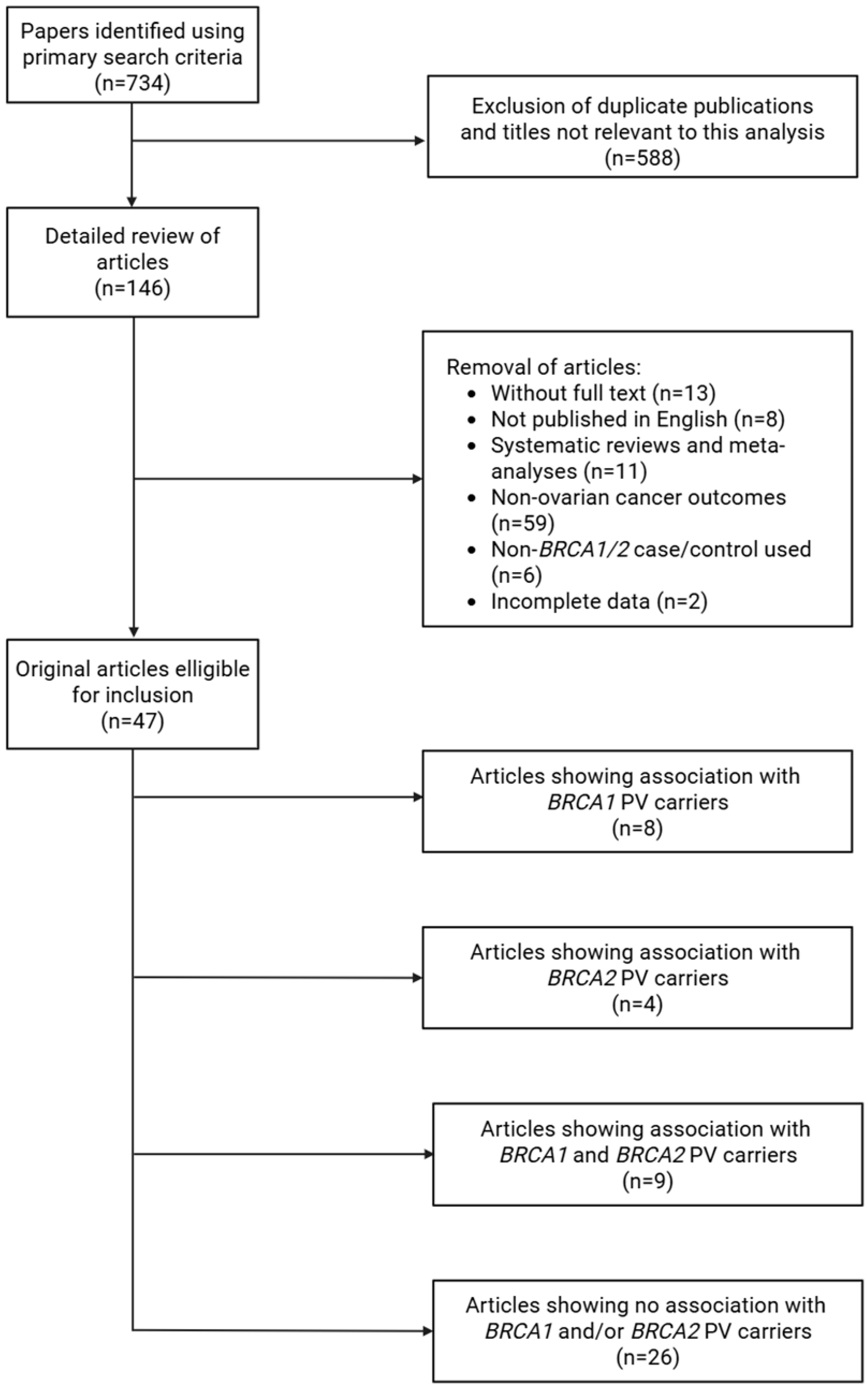
2. Methodology
3. Results
3.1. Research Approaches to Identify Genetic Modifiers

| Feature | Candidate Gene Studies | GWAS |
|---|---|---|
| Prior hypothesis | Required | None |
| Number of variants analyzed | Limited to tens or hundreds of variants | Genome-scale, millions of SNPs |
| Selection of genes | Yes | No |
| Type of variants analyzed | Can detect rare/non-SNP variants (e.g., VNTRs) | Focus on common SNPs (<1% MAF), some rare variant coverage via arrays or imputation |
| Sample size | Usually small (hundreds) | Large (tens of thousands) |
| Objective | Validation of biologically plausible variants | Discovery of novel susceptibility loci |
| Statistical power | High for tested variants | Lower due to multiple testing corrections |
| Limitations | Limited genomic scope, high selection and publication bias, poor replicability, relies on prior knowledge | Requires large sample sizes, high multiple testing, interpretation challenges |
| False positive rate | Large | Low |
| False negative rate | Low | Large |
| Significance threshold | p < 0.05 | p < 5.0 × 10⁻⁸ |
| Common analysis methods | TaqMan genotyping | Microarrays |
3.2. BRCA1 Genetic Modifiers
| Gene | Locus | Polymorphism | Sample Size | Unaffected/ Affected | HR/OR/RR (95% CI) | p-Value | Genotyping Platform | Function | Ref |
|---|---|---|---|---|---|---|---|---|---|
| OGG1 | 3p25.3 | rs2304277 | 15,245 | 12,783/2462 | HR: 1.12 (1.03–1.21) | 4.8 × 10⁻³ | iCOGS | Base excision repair (oxidative DNA damage) | [48] |
| MTHFR | 1p36.22 | rs1801133 | 426 | 2800/146 | OR: 2.7 (1.01–7.21) | 0.047 | PCR-based | Folate metabolism | [49] |
| ITGB3 | 17q21.32 | rs5918 | 426 | 280/146 | OR: 2.08 (1.33–3.27) | 0.001 | Taqman | Integrin β3—cell adhesion | [52] |
| DR4 | 8p21.3 | rs17088993 | 557 | 480/77 | HR: 1.78 (1.24–2.55) | 0.009 | Taqman | Apoptosis (TRAIL receptor) | [54] |
| TRIM61 | 4q32.3 | rs4691139 | 14,350 | 12,070/2280 | HR: 1.20 (1.17–1.38) | 3.4 × 10⁻⁸ | iCOGS, iPLEX | Protein ubiquitination | [55] |
| HRAS1 | 11p15.5 | VNTR | 154 | 112/42 | RR: 2.11 (1.15–4.18) | 0.015 | VNTR genotyping | Oncogene; altered expression | [56] |
| MDM2 | 12q15 | rs2279744 | 2626 | 2465/161 | OR: 1.92 (1.19–3.10) | 0.009 | Taqman | Regulation of p53 | [58] |
| MDM2 | 12q15 | rs117039649 | 2626 | 2465/161 | OR: 1.73 (1.23–2.45) | 0.002 | Taqman | Modulates promoter activity regulating MDM2 expression | [58] |
| CYP2A7 | 19q13.2 | CNV deletion | 2319 | 1962/357 | RR: 0.5 (0.2–1.27) | 0.007 | Illumina Human610-Quad | Enhancer deletion reducing ovarian-specific risk | [59] |
| CASP8 | 2q33.1 | rs1045485 | 4844 | 4268/576 | HR: 0.69 (0.53–0.89) | 0.008 | Taqman | Initiation of apoptosis | [60] |
3.3. BRCA2 Genetic Modifiers
| Gene | Locus | Polymorphism | Sample Size | Unaffected/ Affected | HR (95% CI) | p-Value | Genotyping Platform | Function | Ref |
|---|---|---|---|---|---|---|---|---|---|
| ATM | 11q22.3 | Haplotype (rare) | 856 | 809/47 | 10.93 (4.43–26.96) | 0.022 | SNPlex | DNA damage response | [61] |
| BRIP1 | 17q22 | Haplotype B | 856 | 809/47 | 6.59 (1.10–39.65) | 0.001 | SNPlex | BRCA1-interacting helicase | [61] |
| BRIP1 | 17q22 | Haplotype G | 856 | 809/47 | 7.28 (1.67–31.82) | 0.001 | SNPlex | BRCA1-interacting helicase | [61] |
| BARD1 | 2q34 | Haplotype (rare) | 856 | 809/47 | 4.62 (1.31–16.31) | 0.003 | SNPlex | BRCA1-binding tumor suppressor | [61] |
| MRE11 | 11q21 | Haplotype C | 856 | 809/47 | 2.33 (1.39–3.91) | 0.003 | SNPlex | DNA break repair in the MRN complex | [61] |
| MRE11 | 11q21 | Haplotype (rare) | 856 | 809/47 | 5.13 (1.24–21.24) | 0.003 | SNPlex | DNA break repair in the MRN complex | [61] |
| RAD51 | 15q15.1 | Haplotype C | 856 | 809/47 | 3.53 (1.77–7.05) | 0.01 | SNPlex | Homologous recombination | [61] |
| UNG | 12q23.2 | rs34259 | 8211 | 7580/631 | 0.80 (0.69–0.94) | 7.6 × 10⁻³ | iCOGS | Base excision repair (uracil DNA glycosylase) | [48] |
| TDG | 12q24.1 | rs4135087 | 8211 | 7580/631 | 1.32 (1.09–1.59) | 2.8 × 10⁻³ | iCOGS | Base excision repair | [48] |
| TDG | 12q24.1 | rs167715 | 8208 | 7577/631 | 0.76 (0.62–0.94) | 7.4 × 10⁻³ | iCOGS | Base excision repair | [48] |
| PARP2 | 14q11.2 | rs3093926 | 8211 | 7580/631 | 0.64 (0.49–0.84) | 1.5 × 10⁻³ | iCOGS | DNA repair (BER) | [48] |
| upstream of BNC2 | 9p22.2 | rs62543585 | 5837 | 5314/523 | 0.69 (0.59–0.80) | 1 × 10⁻⁶ | iPLEX | Regulatory region affecting BNC2 | [63] |
3.4. BRCA1 and BRCA2 Genetic Modifiers
3.5. Candidate BRCA1/BRCA2 Genetic Modifiers with Unconfirmed Effect
3.6. Genetic Modifiers and Polygenic Risk Models
3.7. Implications and Utility in Clinical Practice
4. Discussion
5. Conclusions
Supplementary Materials
Author Contributions
Funding
Data Availability Statement
Conflicts of Interest
Abbreviations
| GWAS | Genome-wide association study |
| PV | Pathogenic variant |
| SNP | Single nucleotide polymorphism |
| CNV | Copy number variant |
| CIMBA | Consortium of Investigators of Modifiers of BRCA1/2 |
| EOC | Epithelial ovarian cancer |
| WGS | Whole-genome sequencing |
| RRSO | Risk-reducing salpingo-oophorectomy |
| PRS | Polygenic risk score |
| AUC | Area under the curve |
| CI | Confidence interval |
| TVU | Transvaginal ultrasound |
| OCP | Oral contraceptive |
| VNTR | Variable number of tandem repeat |
References
- Smolarz, B.; Biernacka, K.; Łukasiewicz, H.; Samulak, D.; Piekarska, E.; Romanowicz, H.; Makowska, M. Ovarian Cancer—Epidemiology, Classification, Pathogenesis, Treatment, and Estrogen Receptors’ Molecular Backgrounds. Int. J. Mol. Sci. 2025, 26, 4611. [Google Scholar] [CrossRef]
- Bray, F.; Laversanne, M.; Sung, H.; Ferlay, J.; Siegel, R.L.; Soerjomataram, I.; Jemal, A. Global Cancer Statistics 2022: GLOBOCAN Estimates of Incidence and Mortality Worldwide for 36 Cancers in 185 Countries. CA Cancer J. Clin. 2024, 74, 229–263. [Google Scholar] [CrossRef]
- Siegel, R.L.; Miller, K.D.; Jemal, A. Cancer Statistics, 2020. CA Cancer J. Clin. 2020, 70, 7–30. [Google Scholar] [CrossRef]
- Kehoe, S. FIGO Staging in Ovarian Carcinoma and Histological Subtypes. J. Gynecol. Oncol. 2020, 31, e70. [Google Scholar] [CrossRef] [PubMed]
- Zhang, S.; Royer, R.; Li, S.; McLaughlin, J.R.; Rosen, B.; Risch, H.A.; Fan, I.; Bradley, L.; Shaw, P.A.; Narod, S.A. Frequencies of BRCA1 and BRCA2 Mutations among 1,342 Unselected Patients with Invasive Ovarian Cancer. Gynecol. Oncol. 2011, 121, 353–357. [Google Scholar] [CrossRef] [PubMed]
- Levy-Lahad, E.; Friedman, E. Cancer Risks among BRCA1 and BRCA2 Mutation Carriers. Br. J. Cancer 2007, 96, 11–15. [Google Scholar] [CrossRef]
- Rebbeck, T.R.; Mitra, N.; Wan, F.; Sinilnikova, O.M.; Healey, S.; McGuffog, L.; Mazoyer, S.; Chenevix-Trench, G.; Easton, D.F.; Antoniou, A.C.; et al. Association of Type and Location of BRCA1 and BRCA2 Mutations with Risk of Breast and Ovarian Cancer. JAMA 2015, 313, 1347–1361. [Google Scholar] [CrossRef]
- Ramus, S.J.; Antoniou, A.C.; Kuchenbaecker, K.B.; Soucy, P.; Beesley, J.; Chen, X.; McGuffog, L.; Sinilnikova, O.M.; Healey, S.; Barrowdale, D.; et al. Ovarian Cancer Susceptibility Alleles and Risk of Ovarian Cancer in BRCA1 and BRCA2 Mutation Carriers. Hum. Mutat. 2012, 33, 690–702. [Google Scholar] [CrossRef] [PubMed]
- Gronwald, J.; Byrski, T.; Huzarski, T.; Oszurek, O.; Janicka, A.; Szymanska-Pasternak, J.; Górski, B.; Menkiszak, J.; Rzepka-Górska, I.; Lubinski, J. Hereditary Breast and Ovarian Cancer. Hered. Cancer Clin. Pract. 2008, 6, 88–98. [Google Scholar] [CrossRef]
- Friebel, T.M.; Domchek, S.M.; Rebbeck, T.R. Modifiers of Cancer Risk in BRCA1 and BRCA2 Mutation Carriers: Systematic Review and Meta-Analysis. J. Natl. Cancer Inst. 2014, 106, dju091. [Google Scholar] [CrossRef]
- Brandao, R.D. Improving the Risk Assessment of Inherited Breast and Ovarian Cancer: Clinical Significance of BRCA1/2 Variants and Risk Modifiers. Ph.D. Thesis, Maastricht University, Maastricht, The Netherlands, 2012. [Google Scholar]
- Baquero, J.M.; Benítez-Buelga, C.; Fernández, V.; Urioste, M.; García-Giménez, J.L.; Perona, R.; The CIMBA Consortium; Benítez, J.; Osorio, A. A Common SNP in the UNG Gene Decreases Ovarian Cancer Risk in 2 Mutation Carriers. Mol. Oncol. 2019, 13, 1110–1120. [Google Scholar] [CrossRef]
- Chenevix-Trench, G.; Milne, R.L.; Antoniou, A.C.; Couch, F.J.; Easton, D.F.; Goldgar, D.E. An International Initiative to Identify Genetic Modifiers of Cancer Risk in BRCA1 and BRCA2 Mutation Carriers: The Consortium of Investigators of Modifiers of BRCA1 and BRCA2 (CIMBA). Breast Cancer Res. 2007, 9, 104. [Google Scholar] [CrossRef]
- Bolton, K.L.; Ganda, C.; Berchuck, A.; Pharaoh, P.D.P.; Gayther, S.A. Role of Common Genetic Variants in Ovarian Cancer Susceptibility and Outcome: Progress to Date from the Ovarian Cancer Association Consortium (OCAC). J. Intern. Med. 2012, 271, 366–378. [Google Scholar] [CrossRef]
- Page, M.J.; McKenzie, J.E.; Bossuyt, P.M.; Boutron, I.; Hoffmann, T.C.; Mulrow, C.D.; Shamseer, L.; Tetzlaff, J.M.; Akl, E.A.; Brennan, S.E.; et al. The PRISMA 2020 Statement: An Updated Guideline for Reporting Systematic Reviews. BMJ 2021, 372, n71. [Google Scholar] [CrossRef]
- Milne, R.L.; Antoniou, A.C. Modifiers of Breast and Ovarian Cancer Risks for BRCA1 and BRCA2 Mutation Carriers. Endocr. Relat. Cancer 2016, 23, T69–T84. [Google Scholar] [CrossRef]
- Pearce, C.L.; Hirschhorn, J.N.; Wu, A.H.; Burtt, N.P.; Stram, D.O.; Young, S.; Kolonel, L.N.; Henderson, B.E.; Altshuler, D.; Pike, M.C. Clarifying the PROGINS Allele Association in Ovarian and Breast Cancer Risk: A Haplotype-Based Analysis. J. Natl. Cancer Inst. 2005, 97, 51–59. [Google Scholar] [CrossRef] [PubMed]
- Doherty, J.A.; Rossing, M.A.; Cushing-Haugen, K.L.; Chen, C.; Van Den Berg, D.J.; Wu, A.H.; Pike, M.C.; Ness, R.B.; Moysich, K.; Chenevix-Trench, G.; et al. ESR1/SYNE1 Polymorphism and Invasive Epithelial Ovarian Cancer Risk: An Ovarian Cancer Association Consortium Study. Cancer Epidemiol. Biomark. Prev. Publ. 2010, 19, 245–250. [Google Scholar] [CrossRef]
- Kang, S.; Ju, W.; Kim, J.W.; Park, N.-H.; Song, Y.-S.; Kim, S.C.; Park, S.-Y.; Kang, S.-B.; Lee, H.-P. Association between Excision Repair Cross-Complementation Group 1 Polymorphism and Clinical Outcome of Platinum-Based Chemotherapy in Patients with Epithelial Ovarian Cancer. Exp. Mol. Med. 2006, 38, 320–324. [Google Scholar] [CrossRef] [PubMed]
- Gayther, S.A.; Song, H.; Ramus, S.J.; Kjaer, S.K.; Whittemore, A.S.; Quaye, L.; Tyrer, J.; Shadforth, D.; Hogdall, E.; Hogdall, C.; et al. Tagging Single Nucleotide Polymorphisms in Cell Cycle Control Genes and Susceptibility to Invasive Epithelial Ovarian Cancer. Cancer Res. 2007, 67, 3027–3035. [Google Scholar] [CrossRef]
- Cunningham, J.M.; Vierkant, R.A.; Sellers, T.A.; Phelan, C.; Rider, D.N.; Liebow, M.; Schildkraut, J.; Berchuck, A.; Couch, F.J.; Wang, X.; et al. Cell Cycle Genes and Ovarian Cancer Susceptibility: A tagSNP Analysis. Br. J. Cancer 2009, 101, 1461–1468. [Google Scholar] [CrossRef]
- Quaye, L.; Song, H.; Ramus, S.J.; Gentry-Maharaj, A.; Høgdall, E.; DiCioccio, R.A.; McGuire, V.; Wu, A.H.; Van Den Berg, D.J.; Pike, M.C.; et al. Tagging Single-Nucleotide Polymorphisms in Candidate Oncogenes and Susceptibility to Ovarian Cancer. Br. J. Cancer 2009, 100, 993–1001. [Google Scholar] [CrossRef][Green Version]
- Quaye, L.; Gayther, S.A.; Ramus, S.J.; Di Cioccio, R.A.; McGuire, V.; Hogdall, E.; Hogdall, C.; Blaakr, J.; Easton, D.F.; Ponder, B.A.J.; et al. The Effects of Common Genetic Variants in Oncogenes on Ovarian Cancer Survival. Clin. Cancer Res. Off. J. Am. Assoc. Cancer Res. 2008, 14, 5833–5839. [Google Scholar] [CrossRef] [PubMed]
- Schildkraut, J.M.; Goode, E.L.; Clyde, M.A.; Iversen, E.S.; Moorman, P.G.; Berchuck, A.; Marks, J.R.; Lissowska, J.; Brinton, L.; Peplonska, B.; et al. Single Nucleotide Polymorphisms in the TP53 Region and Susceptibility to Invasive Epithelial Ovarian Cancer. Cancer Res. 2009, 69, 2349–2357. [Google Scholar] [CrossRef]
- Song, H.; Ramus, S.J.; Shadforth, D.; Quaye, L.; Kjaer, S.K.; Dicioccio, R.A.; Dunning, A.M.; Hogdall, E.; Hogdall, C.; Whittemore, A.S.; et al. Common Variants in RB1 Gene and Risk of Invasive Ovarian Cancer. Cancer Res. 2006, 66, 10220–10226. [Google Scholar] [CrossRef]
- Uffelmann, E.; Huang, Q.Q.; Munung, N.S.; de Vries, J.; Okada, Y.; Martin, A.R.; Martin, H.C.; Lappalainen, T.; Posthuma, D. Genome-Wide Association Studies. Nat. Rev. Methods Primers 2021, 1, 59. [Google Scholar] [CrossRef]
- Garcia-Closas, M.; Chanock, S. Genetic Susceptibility Loci for Breast Cancer by Estrogen Receptor (ER) Status. Clin. Cancer Res. Off. J. Am. Assoc. Cancer Res. 2008, 14, 8000–8009. [Google Scholar] [CrossRef] [PubMed][Green Version]
- Dudbridge, F.; Gusnanto, A. Estimation of Significance Thresholds for Genomewide Association Scans. Genet. Epidemiol. 2008, 32, 227–234. [Google Scholar] [CrossRef]
- Song, H.; Ramus, S.J.; Tyrer, J.; Bolton, K.L.; Gentry-Maharaj, A.; Wozniak, E.; Anton-Culver, H.; Chang-Claude, J.; Cramer, D.W.; DiCioccio, R.; et al. A Genome-Wide Association Study Identifies a New Ovarian Cancer Susceptibility Locus On 9p22.2. Nat. Genet. 2009, 41, 996–1000. [Google Scholar] [CrossRef]
- Pharoah, P.D.P.; Tsai, Y.-Y.; Ramus, S.J.; Phelan, C.M.; Goode, E.L.; Lawrenson, K.; Price, M.; Fridley, B.L.; Tyrer, J.P.; Shen, H.; et al. GWAS Meta-Analysis and Replication Identifies Three New Susceptibility Loci for Ovarian Cancer. Nat. Genet. 2013, 45, 362–370. [Google Scholar] [CrossRef]
- Permuth-Wey, J.; Lawrenson, K.; Shen, H.C.; Velkova, A.; Tyrer, J.P.; Chen, Z.; Lin, H.-Y.; Ann Chen, Y.; Tsai, Y.-Y.; Qu, X.; et al. Identification and Molecular Characterization of a New Ovarian Cancer Susceptibility Locus at 17q21.31. Nat. Commun. 2013, 4, 1627. [Google Scholar] [CrossRef] [PubMed]
- Goode, E.L.; Chenevix-Trench, G.; Song, H.; Ramus, S.J.; Notaridou, M.; Lawrenson, K.; Widschwendter, M.; Vierkant, R.A.; Larson, M.C.; Kjaer, S.K.; et al. A Genome-Wide Association Study Identifies Susceptibility Loci for Ovarian Cancer at 2q31 and 8q24. Nat. Genet. 2010, 42, 874–879. [Google Scholar] [CrossRef]
- Bolton, K.L.; Tyrer, J.; Song, H.; Ramus, S.J.; Notaridou, M.; Jones, C.; Sher, T.; Gentry-Maharaj, A.; Wozniak, E.; Tsai, Y.-Y.; et al. Common Variants at 19p13 Are Associated with Susceptibility to Ovarian Cancer. Nat. Genet. 2010, 42, 880–884. [Google Scholar] [CrossRef]
- Manolio, T.A. Bringing Genome-Wide Association Findings into Clinical Use. Nat. Rev. Genet. 2013, 14, 549–558. [Google Scholar] [CrossRef] [PubMed]
- Manolio, T.A.; Collins, F.S.; Cox, N.J.; Goldstein, D.B.; Hindorff, L.A.; Hunter, D.J.; McCarthy, M.I.; Ramos, E.M.; Cardon, L.R.; Chakravarti, A.; et al. Finding the Missing Heritability of Complex Diseases. Nature 2009, 461, 747–753. [Google Scholar] [CrossRef] [PubMed]
- Wei, W.-H.; Hemani, G.; Haley, C.S. Detecting Epistasis in Human Complex Traits. Nat. Rev. Genet. 2014, 15, 722–733. [Google Scholar] [CrossRef]
- Hindorff, L.A.; Sethupathy, P.; Junkins, H.A.; Ramos, E.M.; Mehta, J.P.; Collins, F.S.; Manolio, T.A. Potential Etiologic and Functional Implications of Genome-Wide Association Loci for Human Diseases and Traits. Proc. Natl. Acad. Sci. USA 2009, 106, 9362–9367. [Google Scholar] [CrossRef] [PubMed]
- Tam, V.; Patel, N.; Turcotte, M.; Bossé, Y.; Paré, G.; Meyre, D. Benefits and Limitations of Genome-Wide Association Studies. Nat. Rev. Genet. 2019, 20, 467–484. [Google Scholar] [CrossRef]
- Lawrenson, K.; Song, F.; Hazelett, D.J.; Kar, S.P.; Tyrer, J.; Phelan, C.M.; Corona, R.I.; Rodríguez-Malavé, N.I.; Seo, J.-H.; Adler, E.; et al. Genome-Wide Association Studies Identify Susceptibility Loci for Epithelial Ovarian Cancer in East Asian Women. Gynecol. Oncol. 2019, 153, 343–355. [Google Scholar] [CrossRef]
- Ramus, S.J.; Kartsonaki, C.; Gayther, S.A.; Pharoah, P.D.P.; Sinilnikova, O.M.; Beesley, J.; Chen, X.; McGuffog, L.; Healey, S.; Couch, F.J.; et al. Genetic Variation at 9p22.2 and Ovarian Cancer Risk for BRCA1 and BRCA2 Mutation Carriers. J. Natl. Cancer Inst. 2011, 103, 105–116. [Google Scholar] [CrossRef]
- Kuchenbaecker, K.B.; Ramus, S.J.; Tyrer, J.; Lee, A.; Shen, H.C.; Beesley, J.; Lawrenson, K.; McGuffog, L.; Healey, S.; Lee, J.M.; et al. Identification of Six New Susceptibility Loci for Invasive Epithelial Ovarian Cancer. Nat. Genet. 2015, 47, 164–171. [Google Scholar] [CrossRef]
- Ioannidis, J.P.A. Why Most Discovered True Associations Are Inflated. Epidemiology 2008, 19, 640. [Google Scholar] [CrossRef]
- Sayols-Baixeras, S.; Lluís-Ganella, C.; Lucas, G.; Elosua, R. Pathogenesis of Coronary Artery Disease: Focus on Genetic Risk Factors and Identification of Genetic Variants. Appl. Clin. Genet. 2014, 7, 15–32. [Google Scholar] [CrossRef]
- Frazier-Wood, A.C. Dietary Patterns, Genes, and Health: Challenges and Obstacles to Be Overcome. Curr. Nutr. Rep. 2015, 4, 82–87. [Google Scholar] [CrossRef]
- Pearson, T.A.; Manolio, T.A. How to Interpret a Genome-Wide Association Study. JAMA 2008, 299, 1335–1344. [Google Scholar] [CrossRef]
- Hirschhorn, J.N.; Lohmueller, K.; Byrne, E.; Hirschhorn, K. A Comprehensive Review of Genetic Association Studies. Genet. Med. 2002, 4, 45–61. [Google Scholar] [CrossRef] [PubMed]
- Shabalin, A.A.; Aberg, K.A. Candidate Gene Methylation Studies Are at High Risk of Erroneous Conclusions. Epigenomics 2015, 7, 13–15. [Google Scholar] [CrossRef] [PubMed]
- Osorio, A.; Milne, R.L.; Kuchenbaecker, K.; Vaclová, T.; Pita, G.; Alonso, R.; Peterlongo, P.; Blanco, I.; de la Hoya, M.; Duran, M.; et al. DNA Glycosylases Involved in Base Excision Repair May Be Associated with Cancer Risk in BRCA1 and BRCA2 Mutation Carriers. PLoS Genet. 2014, 10, e1004256. [Google Scholar] [CrossRef] [PubMed]
- Jakubowska, A.; Gronwald, J.; Menkiszak, J.; Górski, B.; Huzarski, T.; Byrski, T.; Edler, L.; Lubiński, J.; Scott, R.J.; Hamann, U. Methylenetetrahydrofolate Reductase Polymorphisms Modify BRCA1-Associated Breast and Ovarian Cancer Risks. Breast Cancer Res. Treat. 2007, 104, 299–308. [Google Scholar] [CrossRef]
- Pepe, C.; Guidugli, L.; Sensi, E.; Aretini, P.; D’Andrea, E.; Montagna, M.; Manoukian, S.; Ottini, L.; Radice, P.; Viel, A.; et al. Methyl Group Metabolism Gene Polymorphisms as Modifier of Breast Cancer Risk in Italian BRCA1/2 Carriers. Breast Cancer Res. Treat. 2007, 103, 29–36. [Google Scholar] [CrossRef]
- Jakubowska, A.; Rozkrut, D.; Antoniou, A.; Hamann, U.; Scott, R.J.; McGuffog, L.; Healy, S.; Sinilnikova, O.M.; Rennert, G.; Lejbkowicz, F.; et al. Association of PHB 1630 C>T and MTHFR 677 C>T Polymorphisms with Breast and Ovarian Cancer Risk in BRCA1/2 Mutation Carriers: Results from a Multicenter Study. Br. J. Cancer 2012, 106, 2016–2024. [Google Scholar] [CrossRef]
- Jakubowska, A.; Gronwald, J.; Menkiszak, J.; Górski, B.; Huzarski, T.; Byrski, T.; Edler, L.; Lubiński, J.; Scott, R.J.; Hamann, U. Integrin Β3 Leu33Pro Polymorphism Increases BRCA1-associated Ovarian Cancer Risk. J. Med. Genet. 2007, 44, 408–411. [Google Scholar] [CrossRef]
- Jakubowska, A.; Rozkrut, D.; Antoniou, A.; Hamann, U.; Lubinski, J. The Leu33Pro Polymorphism in the ITGB3 Gene Does Not Modify BRCA1/2-Associated Breast or Ovarian Cancer Risks: Results from a Multicenter Study among 15,542 BRCA1 and BRCA2 Mutation Carriers. Breast Cancer Res. Treat. 2010, 121, 639–649. [Google Scholar] [CrossRef]
- Dick, M.G.; Versmold, B.; Engel, C.; Meindl, A.; Arnold, N.; Varon-Mateeva, R.; Sutter, C.; Niederacher, D.; Deissler, H.; Preisler-Adams, S.; et al. Association of Death Receptor 4 Variant (683A>C) with Ovarian Cancer Risk in BRCA1 Mutation Carriers. Int. J. Cancer 2012, 130, 1314–1318. [Google Scholar] [CrossRef]
- Couch, F.J.; Wang, X.; McGuffog, L.; Lee, A.; Olswold, C.; Kuchenbaecker, K.B.; Soucy, P.; Fredericksen, Z.; Barrowdale, D.; Dennis, J.; et al. Genome-Wide Association Study in BRCA1 Mutation Carriers Identifies Novel Loci Associated with Breast and Ovarian Cancer Risk. PLoS Genet. 2013, 9, e1003212. [Google Scholar] [CrossRef]
- Phelan, C.M.; Rebbeck, T.R.; Weber, B.L.; Devilee, P.; Ruttledge, M.H.; Lynch, H.T.; Lenoir, G.M.; Stratton, M.R.; Easton, D.F.; Ponder, B.A.J.; et al. Ovarian Cancer Risk in BRCA1 Carriers Is Modified by the HRAS1 Variable Number of Tandem Repeat (VNTR) Locus. Nat. Genet. 1996, 12, 309–311. [Google Scholar] [CrossRef]
- Yarden, R.I.; Friedman, E.; Metsuyanim, S.; Olender, T.; Ben-Asher, E.; Papa, M.Z. MDM2 SNP309 Accelerates Breast and Ovarian Carcinogenesis in BRCA1 and BRCA2 Carriers of Jewish–Ashkenazi Descent. Breast Cancer Res. Treat. 2008, 111, 497–504. [Google Scholar] [CrossRef] [PubMed]
- Bjørnslett, M.; Knappskog, S.; Lønning, P.E.; Dørum, A. Effect of the MDM2 Promoter Polymorphisms SNP309T>G and SNP285G>C on the Risk of Ovarian Cancer in BRCA1 Mutation Carriers. BMC Cancer 2012, 12, 454. [Google Scholar] [CrossRef] [PubMed]
- Walker, L.C.; Marquart, L.; Pearson, J.F.; Wiggins, G.A.R.; O’Mara, T.A.; Parsons, M.T.; BCFR; Barrowdale, D.; McGuffog, L.; Dennis, J.; et al. Evaluation of Copy-Number Variants as Modifiers of Breast and Ovarian Cancer Risk for BRCA1 Pathogenic Variant Carriers. Eur. J. Hum. Genet. 2017, 25, 432–438. [Google Scholar] [CrossRef]
- Engel, C.; Versmold, B.; Wappenschmidt, B.; Simard, J.; Easton, D.F.; Peock, S.; Cook, M.; Oliver, C.; Frost, D.; Mayes, R.; et al. Association of the Variants CASP8 D302H and CASP10 V410I with Breast and Ovarian Cancer Risk in BRCA1 and BRCA2 Mutation Carriers. Cancer Epidemiol. Biomark. Prev. Publ. 2010, 19, 2859–2868. [Google Scholar] [CrossRef]
- Rebbeck, T.R.; Mitra, N.; Domchek, S.M.; Wan, F.; Chuai, S.; Friebel, T.M.; Panossian, S.; Spurdle, A.; Chenevix-Trench, G.; kConFab; et al. Modification of Ovarian Cancer Risk by BRCA1/2-Interacting Genes in a Multicenter Cohort of BRCA1/2 Mutation Carriers. Cancer Res. 2009, 69, 5801–5810. [Google Scholar] [CrossRef]
- López, B.; Miguel, J. Functional Validation of DNA Glycosylases as Cancer Risk Modifiers in BRCA1 and BRCA2 Mutation Carriers. Potential Use of OGG1 Inhibitors as a Novel Strategy for Cancer Treatment. Ph.D. Thesis, University of Arkansas at Monticello, Monticello, AR, USA, 2021. [Google Scholar]
- Vigorito, E.; Kuchenbaecker, K.B.; Beesley, J.; Adlard, J.; Agnarsson, B.A.; Andrulis, I.L.; Arun, B.K.; Barjhoux, L.; Belotti, M.; Benitez, J.; et al. Fine-Scale Mapping at 9p22.2 Identifies Candidate Causal Variants That Modify Ovarian Cancer Risk in BRCA1 and BRCA2 Mutation Carriers. PLoS ONE 2016, 11, e0158801. [Google Scholar] [CrossRef]
- Yarmolinsky, J.; Bull, C.J.; Vincent, E.E.; Robinson, J.; Walther, A.; Smith, G.D.; Lewis, S.J.; Relton, C.L.; Martin, R.M. Association Between Genetically Proxied Inhibition of HMG-CoA Reductase and Epithelial Ovarian Cancer. JAMA 2020, 323, 646–655. [Google Scholar] [CrossRef]
- Ding, Y.C.; McGuffog, L.; Healey, S.; Friedman, E.; Laitman, Y.; Paluch-Shimon, S.; Kaufman, B.; SWE-BRCA; Liljegren, A.; Lindblom, A.; et al. A Nonsynonymous Polymorphism in IRS1 Modifies Risk of Developing Breast and Ovarian Cancers in BRCA1 and Ovarian Cancer in BRCA2 Mutation Carriers. Cancer Epidemiol. Biomark. Prev. 2012, 21, 1362–1370. [Google Scholar] [CrossRef]
- Couch, F.J.; Gaudet, M.M.; Antoniou, A.C.; Ramus, S.J.; Kuchenbaecker, K.B.; Soucy, P.; Beesley, J.; Chen, X.; Wang, X.; Kirchhoff, T.; et al. Common Variants at the 19p13.1 and ZNF365 Loci Are Associated with ER Subtypes of Breast Cancer and Ovarian Cancer Risk in BRCA1 and BRCA2 Mutation Carriers. Cancer Epidemiol. Biomark. Prev. 2012, 21, 645–657. [Google Scholar] [CrossRef]
- Zhu, Q.; Wang, J.; Yu, H.; Hu, Q.; Bateman, N.W.; Long, M.; Rosario, S.; Schultz, E.; Dalgard, C.L.; Wilkerson, M.D.; et al. Whole-Genome Sequencing Identifies PPARGC1A as a Putative Modifier of Cancer Risk in BRCA1/2 Mutation Carriers. Cancers 2022, 14, 2350. [Google Scholar] [CrossRef] [PubMed]
- Tomaselli, S.; Megiorni, F.; Lin, L.; Mazzilli, M.C.; Gerrelli, D.; Majore, S.; Grammatico, P.; Achermann, J.C. Human RSPO1/R-Spondin1 Is Expressed during Early Ovary Development and Augments β-Catenin Signaling. PLoS ONE 2011, 6, e16366. [Google Scholar] [CrossRef] [PubMed]
- Ruiz De Garibay, G.; Fernandez-Garcia, I.; Mazoyer, S.; Leme De Calais, F.; Ameri, P.; Vijayakumar, S.; Martinez-Ruiz, H.; Damiola, F.; Barjhoux, L.; Thomassen, M.; et al. Altered Regulation of BRCA1 Exon 11 Splicing Is Associated with Breast Cancer Risk in Carriers of BRCA1 Pathogenic Variants. Hum. Mutat. 2021, 42, 1488–1502. [Google Scholar] [CrossRef] [PubMed]
- Hughes, D.J.; Ginolhac, S.M.; Coupier, I.; Corbex, M.; Bressac-de-Paillerets, B.; Chompret, A.; Bignon, Y.-J.; Uhrhammer, N.; Lasset, C.; Giraud, S.; et al. Common BRCA2 Variants and Modification of Breast and Ovarian Cancer Risk in BRCA1 Mutation Carriers. Cancer Epidemiol. Biomark. Prev. 2005, 14, 265–267. [Google Scholar] [CrossRef]
- Jakubowska, A.; Gronwald, J.; Menkiszak, J.; Górski, B.; Huzarski, T.; Byrski, T.; Tołoczko-Grabarek, A.; Gilbert, M.; Edler, L.; Zapatka, M.; et al. BRCA1-Associated Breast and Ovarian Cancer Risks in Poland: No Association with Commonly Studied Polymorphisms. Breast Cancer Res. Treat. 2010, 119, 201–211. [Google Scholar] [CrossRef]
- Osorio, A.; Pollán, M.; Pita, G.; Schmutzler, R.K.; Versmold, B.; Engel, C.; Meindl, A.; Arnold, N.; Preisler-Adams, S.; Niederacher, D.; et al. An Evaluation of the Polymorphisms Ins16bp and Arg72Pro in P53 as Breast Cancer Risk Modifiers in BRCA1 and BRCA2 Mutation Carriers. Br. J. Cancer 2008, 99, 974–977. [Google Scholar] [CrossRef][Green Version]
- Osorio, A.; Martínez-Delgado, B.; Pollán, M.; Cuadros, M.; Urioste, M.; Torrenteras, C.; Melchor, L.; Díez, O.; De La Hoya, M.; Velasco, E.; et al. A Haplotype Containing the p53 Polymorphisms Ins16bp and Arg72Pro Modifies Cancer Risk in BRCA2 Mutation Carriers. Hum. Mutat. 2006, 27, 242–248. [Google Scholar] [CrossRef] [PubMed]
- Wang-Gohrke, S.; Weikel, W.; Risch, H.; Vesprini, D.; Abrahamson, J.; Lerman, C.; Godwin, A.; Moslehi, R.; Olipade, O.; Brunet, J.-S.; et al. Intron Variants of the p53 Gene Are Associated with Increased Risk for Ovarian Cancer but Not in Carriers of BRCA1 or BRCA2 Germline Mutations. Br. J. Cancer 1999, 81, 179–183. [Google Scholar] [CrossRef]
- Antoniou, A.C.; Kartsonaki, C.; Sinilnikova, O.M.; Soucy, P.; McGuffog, L.; Healey, S.; Lee, A.; Peterlongo, P.; Manoukian, S.; Peissel, B.; et al. Common Alleles at 6q25.1 and 1p11.2 Are Associated with Breast Cancer Risk for BRCA1 and BRCA2 Mutation Carriers. Hum. Mol. Genet. 2011, 20, 3304–3321. [Google Scholar] [CrossRef]
- Given, H.F.; Radbourne, R.; Oag, H.; Merritt, S.; Barclay, E.; Hanby, A.M.; Lamlum, H.; McGrath, J.; Curran, C.; Tomlinson, I.P.M. The Androgen Receptor Exon 1 Trinucleotide Repeat Does Not Act as a Modifier of the Age of Presentation in Breast Cancer. Eur. J. Cancer 2000, 36, 533–534. [Google Scholar] [CrossRef]
- Kadouri, L.; Easton, D.F.; Edwards, S.; Hubert, A.; Kote-Jarai, Z.; Glaser, B.; Durocher, F.; Abeliovich, D.; Peretz, T.; Eeles, R.A. CAG and GGC Repeat Polymorphisms in the Androgen Receptor Gene and Breast Cancer Susceptibility in BRCA1/2 Carriers and Non-Carriers. Br. J. Cancer 2001, 85, 36–40. [Google Scholar] [CrossRef][Green Version]
- Menin, C.; Banna, G.L.; De Salvo, G.; Lazzarotto, V.; De Nicolo, A.; Agata, S.; Montagna, M.; Sordi, G.; Nicoletto, O.; Chieco-Bianchi, L.; et al. Lack of Association between Androgen Receptor CAG Polymorphism and Familial Breast/Ovarian Cancer. Cancer Lett. 2001, 168, 31–36. [Google Scholar] [CrossRef]
- Kim, S.C.; Ju, W.; Mahavni, V.; Geisler, J.P.; Buller, R.E. CAG Repeat Length in Exon 1 of the Androgen Receptor Gene Is Related to Age of Diagnosis but Not Germ Line BRCA1 Mutation Status in Ovarian Cancer. Int. J. Gynecol. Cancer 2006, 16, 190–194. [Google Scholar] [CrossRef]
- Li, A.J.; McAllister, P.; Karlan, B.Y. Impact of Androgen Receptor Cytosine-Adenine-Guanine Polymorphisms on Clinical Outcome in BRCA Mutation-Associated Epithelial Ovarian Cancers. Gynecol. Oncol. 2010, 116, 105–108. [Google Scholar] [CrossRef] [PubMed]
- Runnebaum, I.B.; Wang-Gohrke, S.; Vesprini, D.; Kreienberg, R.; Lynch, H.; Moslehi, R.; Ghadirian, P.; Weber, B.; Godwin, A.K.; Risch, H.; et al. Progesterone Receptor Variant Increases Ovarian Cancer Risk in BRCA1 and BRCA2 Mutation Carriers Who Were Never Exposed to Oral Contraceptives. Pharmacogenetics 2001, 11, 635–638. [Google Scholar] [CrossRef]
- Jakubowska, A.; Gronwald, J.; Menkiszak, J.; Górski, B.; Huzarski, T.; Byrski, T.; Benner, A.; Lubiński, J.; Scott, R.J.; Hamann, U. Ovarian Cancer Risk in Polish BRCA1 Mutation Carriers Is Not Associated with the Prohibitin 3′ Untranslated Region Polymorphism. BMC Cancer 2008, 8, 90. [Google Scholar] [CrossRef] [PubMed][Green Version]
- Fung, W.L.A.; Risch, H.; McLaughlin, J.; Rosen, B.; Cole, D.; Vesprini, D.; Narod, S.A. The N314D Polymorphism of Galactose-1-Phosphate Uridyl Transferase Does Not Modify the Risk of Ovarian Cancer. Cancer Epidemiol. Biomark. Prev. 2003, 12, 678–680. [Google Scholar]
- Pharoah, P.D.P.; Palmieri, R.T.; Ramus, S.J.; Gayther, S.A.; Andrulis, I.L.; Anton-Culver, H.; Antonenkova, N.; Antoniou, A.C.; Goldgar, D.; Beattie, M.S.; et al. The Role of KRAS Rs61764370 in Invasive Epithelial Ovarian Cancer: Implications for Clinical Testing. Clin. Cancer Res. 2011, 17, 3742–3750. [Google Scholar] [CrossRef]
- Ovarian Cancer Association Consortium, Breast Cancer Association Consortium, and Consortium of Modifiers of BRCA1 and BRCA2; Hollestelle, A.; van der Baan, F.H.; Berchuck, A.; Johnatty, S.E.; Aben, K.K.; Agnarsson, B.A.; Aittomäki, K.; Alducci, E.; Andrulis, I.L.; et al. No Clinical Utility of KRAS Variant Rs61764370 for Ovarian or Breast Cancer. Gynecol. Oncol. 2016, 141, 386–401. [Google Scholar] [CrossRef]
- Laitman, Y.; Kuchenbaecker, K.B.; Rantala, J.; Hogervorst, F.; Peock, S.; Godwin, A.K.; Arason, A.; Kirchhoff, T.; Offit, K.; Isaacs, C.; et al. The KL-VS Sequence Variant of Klotho and Cancer Risk in BRCA1 and BRCA2 Mutation Carriers. Breast Cancer Res. Treat. 2012, 132, 1119–1126. [Google Scholar] [CrossRef]
- Pooley, K.A.; McGuffog, L.; Barrowdale, D.; Frost, D.; Ellis, S.D.; Fineberg, E.; Platte, R.; Izatt, L.; Adlard, J.; Bardwell, J.; et al. Lymphocyte Telomere Length Is Long in BRCA1 and BRCA2 Mutation Carriers Regardless of Cancer-Affected Status. Cancer Epidemiol. Biomark. Prev. 2014, 23, 1018–1024. [Google Scholar] [CrossRef] [PubMed]
- Aghmesheh, M.; Suo, Z.; Friedlander, M.; Nesland, J.M.; Kaern, J.; Stewart, M.; Kconfab; Dorum, A.; Tucker, K.M.; Buckley, M.F. Chromosome 2q24.2 Is Lost in Sporadic but Not in BRCA1-Associated Ovarian Carcinomas. Pathology 2006, 38, 145–151. [Google Scholar] [CrossRef] [PubMed]
- Hamdi, Y.; Soucy, P.; Kuchenbaeker, K.B.; Pastinen, T.; Droit, A.; Lemaçon, A.; Adlard, J.; Aittomäki, K.; Andrulis, I.L.; Arason, A.; et al. Association of Breast Cancer Risk in BRCA1 and BRCA2 Mutation Carriers with Genetic Variants Showing Differential Allelic Expression: Identification of a Modifier of Breast Cancer Risk at Locus 11q22.3. Breast Cancer Res. Treat. 2017, 161, 117–134. [Google Scholar] [CrossRef]
- Gaudet, M.M.; Kuchenbaecker, K.B.; Vijai, J.; Klein, R.J.; Kirchhoff, T.; McGuffog, L.; Barrowdale, D.; Dunning, A.M.; Lee, A.; Dennis, J.; et al. Identification of a BRCA2-Specific Modifier Locus at 6p24 Related to Breast Cancer Risk. PLoS Genet. 2013, 9, e1003173. [Google Scholar] [CrossRef] [PubMed]
- Peterlongo, P.; Chang-Claude, J.; Moysich, K.B.; Rudolph, A.; Schmutzler, R.K.; Simard, J.; Soucy, P.; Eeles, R.A.; Easton, D.F.; Hamann, U.; et al. Candidate Genetic Modifiers for Breast and Ovarian Cancer Risk in BRCA1 and BRCA2 Mutation Carriers. Cancer Epidemiol. Biomark. Prev. 2015, 24, 308–316. [Google Scholar] [CrossRef]
- LeVasseur, N.; Chia, S. Cancer Screening and Prevention in BRCA Mutation Carriers: A Missed Opportunity? Br. J. Cancer 2019, 121, 1–2. [Google Scholar] [CrossRef]
- Parker, W.H.; Jacoby, V.; Shoupe, D.; Rocca, W. Effect of Bilateral Oophorectomy on Women’s Long-Term Health. Women’s Health 2009, 5, 565–576. [Google Scholar] [CrossRef]
- Rivera, C.M.; Grossardt, B.R.; Rhodes, D.J.; Rocca, W.A. Increased Mortality for Neurological and Mental Diseases Following Early Bilateral Oophorectomy. Neuroepidemiology 2009, 33, 32–40. [Google Scholar] [CrossRef]
- Kuchenbaecker, K.B.; McGuffog, L.; Barrowdale, D.; Lee, A.; Soucy, P.; Healey, S.; Dennis, J.; Lush, M.; Robson, M.; Spurdle, A.B.; et al. Evaluation of Polygenic Risk Scores for Breast and Ovarian Cancer Risk Prediction in BRCA1 and BRCA2 Mutation Carriers. J. Natl. Cancer Inst. 2017, 109, djw302. [Google Scholar] [CrossRef] [PubMed]
- Barnes, D.R.; Rookus, M.A.; McGuffog, L.; Leslie, G.; Mooij, T.M.; Dennis, J.; Mavaddat, N.; Adlard, J.; Ahmed, M.; Aittomäki, K.; et al. Polygenic Risk Scores and Breast and Epithelial Ovarian Cancer Risks for Carriers of BRCA1 and BRCA2 Pathogenic Variants. Genet. Med. 2020, 22, 1653–1666. [Google Scholar] [CrossRef]
- Dareng, E.O.; Tyrer, J.P.; Barnes, D.R.; Jones, M.R.; Yang, X.; Aben, K.K.H.; Adank, M.A.; Agata, S.; Andrulis, I.L.; Anton-Culver, H.; et al. Polygenic Risk Modeling for Prediction of Epithelial Ovarian Cancer Risk. Eur. J. Hum. Genet. 2022, 30, 349–362. [Google Scholar] [CrossRef] [PubMed]
- Yang, X.; Leslie, G.; Gentry-Maharaj, A.; Ryan, A.; Intermaggio, M.; Lee, A.; Kalsi, J.K.; Tyrer, J.; Gaba, F.; Manchanda, R.; et al. Evaluation of Polygenic Risk Scores for Ovarian Cancer Risk Prediction in a Prospective Cohort Study. J. Med. Genet. 2018, 55, 546–554. [Google Scholar] [CrossRef]
- Bogdan, R.; Baranger, D.A.A.; Agrawal, A. Polygenic Risk Scores in Clinical Psychology: Bridging Genomic Risk to Individual Differences. Annu. Rev. Clin. Psychol. 2018, 14, 119–157. [Google Scholar] [CrossRef] [PubMed]
- Carver, T.; Hartley, S.; Lee, A.; Cunningham, A.P.; Archer, S.; Babb de Villiers, C.; Roberts, J.; Ruston, R.; Walter, F.M.; Tischkowitz, M.; et al. CanRisk Tool—A Web Interface for the Prediction of Breast and Ovarian Cancer Risk and the Likelihood of Carrying Genetic Pathogenic Variants. Cancer Epidemiol. Biomark. Prev. 2020, 30, 469. [Google Scholar] [CrossRef]
- Møller, N.B.; Boonen, D.S.; Feldner, E.S.; Hao, Q.; Larsen, M.; Lænkholm, A.-V.; Borg, Å.; Kvist, A.; Törngren, T.; Jensen, U.B.; et al. Validation of the BOADICEA Model for Predicting the Likelihood of Carrying Pathogenic Variants in Eight Breast and Ovarian Cancer Susceptibility Genes. Sci. Rep. 2023, 13, 8536. [Google Scholar] [CrossRef]
- Yang, X.; Wu, Y.; Ficorella, L.; Wilcox, N.; Dennis, J.; Tyrer, J.; Carver, T.; Pashayan, N.; Tischkowitz, M.; Pharoah, P.D.; et al. Validation of the BOADICEA Model for Epithelial Tubo-Ovarian Cancer Risk Prediction in UK Biobank. Br. J. Cancer 2024, 131, 1473–1479. [Google Scholar] [CrossRef]
- Phillips, S.; Landy, R.; Bodelon, C.; Machiela, M.J.; Temkin, S.M.; Wentzensen, N. Association of a Polygenic Risk Score with Risk of Abnormal Ultrasound Findings and Ovarian Cancer in the Prostate, Lung, Colorectal, and Ovarian Cancer Screening Trial. J. Clin. Oncol. 2024, 42, 10542. [Google Scholar] [CrossRef]
- Lewis, C.M.; Vassos, E. Polygenic Risk Scores: From Research Tools to Clinical Instruments. Genome Med. 2020, 12, 44. [Google Scholar] [CrossRef] [PubMed]
- Ottman, R. Gene–Environment Interaction: Definitions and Study Designs. Prev. Med. 1996, 25, 764–770. [Google Scholar] [CrossRef] [PubMed]
- Kim, M.S.; Patel, K.P.; Teng, A.K.; Berens, A.J.; Lachance, J. Genetic Disease Risks Can Be Misestimated across Global Populations. Genome Biol. 2018, 19, 179. [Google Scholar] [CrossRef]
- Wang, Y.; Zhu, M.; Ma, H.; Shen, H. Polygenic Risk Scores: The Future of Cancer Risk Prediction, Screening, and Precision Prevention. Med. Rev. 2021, 1, 129–149. [Google Scholar] [CrossRef]
- Skinner, C.S.; Schildkraut, J.M.; Berry, D.; Calingaert, B.; Marcom, P.K.; Sugarman, J.; Winer, E.P.; Iglehart, J.D.; Futreal, P.A.; Rimer, B.K. Pre-Counseling Education Materials for BRCA Testing: Does Tailoring Make a Difference? Genet. Test. 2002, 6, 93–105. [Google Scholar] [CrossRef]
- Barnes, D.R.; Antoniou, A.C. Unravelling Modifiers of Breast and Ovarian Cancer Risk for BRCA1 and BRCA2 Mutation Carriers: Update on Genetic Modifiers. J. Intern. Med. 2012, 271, 331–343. [Google Scholar] [CrossRef]
- Chan, J.L.; Johnson, L.N.; Sammel, M.D.; DiGiovanni, L.; Voong, C.; Domchek, S.M.; Gracia, C.R. Reproductive Decision-Making in Women with BRCA1/2 Mutations. J. Genet. Couns. 2017, 26, 594–603. [Google Scholar] [CrossRef] [PubMed]
- Hesse-Biber, S.; Seven, M.; Jiang, J.; Van Schaik, S.; Dwyer, A.A. Impact of BRCA Status on Reproductive Decision-Making and Self-Concept: A Mixed-Methods Study Informing the Development of Tailored Interventions. Cancers 2022, 14, 1494. [Google Scholar] [CrossRef]
- Pal, T.; Permuth-Wey, J.; Betts, J.A.; Krischer, J.P.; Fiorica, J.; Arango, H.; LaPolla, J.; Hoffman, M.; Martino, M.A.; Wakeley, K.; et al. BRCA1 and BRCA2 Mutations Account for a Large Proportion of Ovarian Carcinoma Cases. Cancer 2005, 104, 2807–2816. [Google Scholar] [CrossRef]
- Wentzensen, N.; Ring, K.; Erickson, B.K.; Reid, B.; O’Donnell, T.; Check, D.; Tworoger, S.S.; Choudhury, P.P. Ovarian Cancer Risk Prediction: A Clinical Epidemiology Perspective. Am. J. Epidemiol. 2025, 194, 1182–1191. [Google Scholar] [CrossRef] [PubMed]
- Kim, S.; Wang, M.; Tyrer, J.P.; Jensen, A.; Wiensch, A.; Liu, G.; Lee, A.W.; Ness, R.B.; Salvatore, M.; Tworoger, S.S.; et al. A Comprehensive Gene-Environment Interaction Analysis in Ovarian Cancer Using Genome-Wide Significant Common Variants. Int. J. Cancer 2019, 144, 2192–2205. [Google Scholar] [CrossRef] [PubMed]
- Turnbull, C.; Seal, S.; Renwick, A.; Warren-Perry, M.; Hughes, D.; Elliott, A.; Pernet, D.; Peock, S.; Adlard, J.W.; Barwell, J.; et al. Gene–Gene Interactions in Breast Cancer Susceptibility. Hum. Mol. Genet. 2012, 21, 958–962. [Google Scholar] [CrossRef]
- Cano-Gamez, E.; Trynka, G. From GWAS to Function: Using Functional Genomics to Identify the Mechanisms Underlying Complex Diseases. Front. Genet. 2020, 11, 424. [Google Scholar] [CrossRef] [PubMed]
- Moffitt, L.R.; Karimnia, N.; Wilson, A.L.; Stephens, A.N.; Ho, G.-Y.; Bilandzic, M. Challenges in Implementing Comprehensive Precision Medicine Screening for Ovarian Cancer. Curr. Oncol. 2024, 31, 8023–8038. [Google Scholar] [CrossRef]
- Masoodi, T.; Siraj, S.; Siraj, A.K.; Azam, S.; Qadri, Z.; Parvathareddy, S.K.; Tulbah, A.; Al-Dayel, F.; AlHusaini, H.; AlOmar, O.; et al. Genetic Heterogeneity and Evolutionary History of High-Grade Ovarian Carcinoma and Matched Distant Metastases. Br. J. Cancer 2020, 122, 1219–1230. [Google Scholar] [CrossRef]
- Kim, S.; Han, Y.; Kim, S.I.; Kim, H.-S.; Kim, S.J.; Song, Y.S. Tumor Evolution and Chemoresistance in Ovarian Cancer. npj Precis. Oncol. 2018, 2, 20. [Google Scholar] [CrossRef]

| BRCA1 (+) | BRCA2 (+) | ||||||||||||
|---|---|---|---|---|---|---|---|---|---|---|---|---|---|
| Gene | Locus | SNP | Sample Size | Unaffected/ Affected | HR (95% CI) | p-Value | Sample Size | Unaffected/ Affected | HR (95% CI) | p-Value | Genotyping Platform | Function | Ref |
| IRS1 | 2q36.3 | rs1801278 | 1928 | 1533/395 | 1.43 (1.06–1.92) | 0.019 | 1064 | 944/120 | 2.21 (1.39–3.52) | 0.0008 | Taqman, iPLEX | Insulin/IGF-1 signaling mediating | [65] |
| RSPO1 | 1p34.3 | rs58722170 | 15,252 | 12,790/2462 | 1.14 (1.05–1.23) | 1.5 × 10⁻³ | 8211 | 7580/631 | 1.35 (1.17–1.57) | 5.2 × 10⁻⁵ | iPLEX | Wnt/β-catenin signaling | [41] |
| SYNPO2 | 4q26 | rs17329882 | 15,252 | 12,790/2462 | 1.08 (1.00–1.17) | 0.042 | 8211 | 7580/631 | 1.15 (1.00–1.13) | 0.06 | iPLEX | Cell motility and growth | [41] |
| BABAM1 | 19p13.1 | rs8170 | 5779 | 4380/1399 | 1.15 (1.03–1.29) | 0.015 | 3095 | 2667/428 | 1.34 (1.12–1.62) | 1.9 × 10⁻³ | iPLEX | DNA repair-dependent chromatin remodeling | [66] |
| MRPL34 | 19p13.1 | rs67397200 | 5011 | 3699/1312 | 1.16 (1.05–1.29) | 3.8 × 10⁻⁴ | 3129 | 2700/429 | 1.30 (1.10–1.52) | 1.8 × 10⁻³ | iPLEX | Mitochondrial translation | [66] |
| PLEKHM1 | 17q21 | rs17631303 | 11,624 | 9793/1831 | 1.27 (1.16–1.40) | 3.04 × 10⁻⁷ | 8107 | 7481/626 | 1.32 (1.15–1.52) | 1.98 × 10⁻⁴ | iCOGS | Bone resorption | [55] |
| TIPARP | 3q25 | rs2665390 | 11,584 | 9630/1954 | 1.25 (1.10–1.42) | 6.1 × 10⁻⁴ | 6697 | 6126/571 | 1.48 (1.21–1.83) | 1.8 × 10⁻⁴ | iPLEX | Mono-ADP-ribosylation of proteins | [8] |
| BNC2 | 9p22.2 | rs3814113 | 10,029 | 8142/1887 | 0.78 (0.72–0.85) | 4.8 × 10⁻⁹ | 5837 | 5314/523 | 0.78 (0.67–0.90) | 0.00055 | iPLEX | Skin color saturation | [40] |
| LINC00824 | 8q24 | rs10088218 | 12,541 | 10,479/2062 | 0.89 (0.81–0.99) | 0.029 | 7129 | 6515/614 | 0.81 (0.67–0.98) | 0.033 | iPLEX | IcnRNA class, may regulate gene expression | [8] |
Disclaimer/Publisher’s Note: The statements, opinions and data contained in all publications are solely those of the individual author(s) and contributor(s) and not of MDPI and/or the editor(s). MDPI and/or the editor(s) disclaim responsibility for any injury to people or property resulting from any ideas, methods, instructions or products referred to in the content. |
© 2026 by the authors. Licensee MDPI, Basel, Switzerland. This article is an open access article distributed under the terms and conditions of the Creative Commons Attribution (CC BY) license.
Share and Cite
Cylwik, D.; Dwornik, R.; Białkowska, K. The Contribution of Genetic Modifiers to Ovarian Cancer Risk in BRCA1 and BRCA2 Pathogenic Variant Carriers. Cancers 2026, 18, 354. https://doi.org/10.3390/cancers18030354
Cylwik D, Dwornik R, Białkowska K. The Contribution of Genetic Modifiers to Ovarian Cancer Risk in BRCA1 and BRCA2 Pathogenic Variant Carriers. Cancers. 2026; 18(3):354. https://doi.org/10.3390/cancers18030354
Chicago/Turabian StyleCylwik, Dagmara, Roksana Dwornik, and Katarzyna Białkowska. 2026. "The Contribution of Genetic Modifiers to Ovarian Cancer Risk in BRCA1 and BRCA2 Pathogenic Variant Carriers" Cancers 18, no. 3: 354. https://doi.org/10.3390/cancers18030354
APA StyleCylwik, D., Dwornik, R., & Białkowska, K. (2026). The Contribution of Genetic Modifiers to Ovarian Cancer Risk in BRCA1 and BRCA2 Pathogenic Variant Carriers. Cancers, 18(3), 354. https://doi.org/10.3390/cancers18030354