Understanding the Experiences of Adolescents and Young Adults Diagnosed with Cancer During Higher Education—An Exploratory Interview Study

 ,
,  , , and
Simple Summary
Abstract
1. Introduction
2. Materials and Methods
2.1. Setting
2.2. Study Population and Recruitment
2.3. Data Collection
2.4. Data Analysis
2.5. Ethical Considerations
3. Results
3.1. Sample Characteristics
3.2. Thematic Categories and Themes
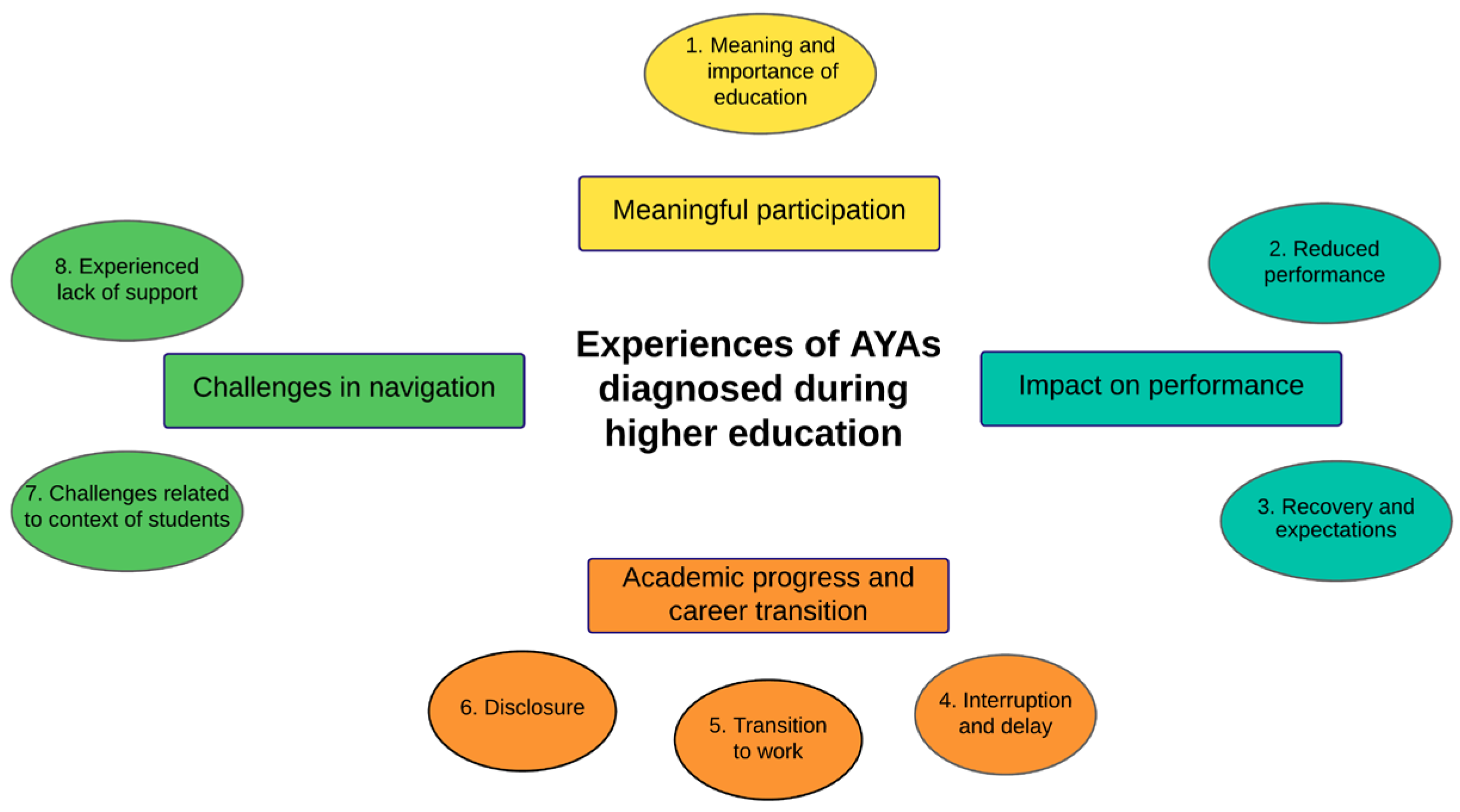
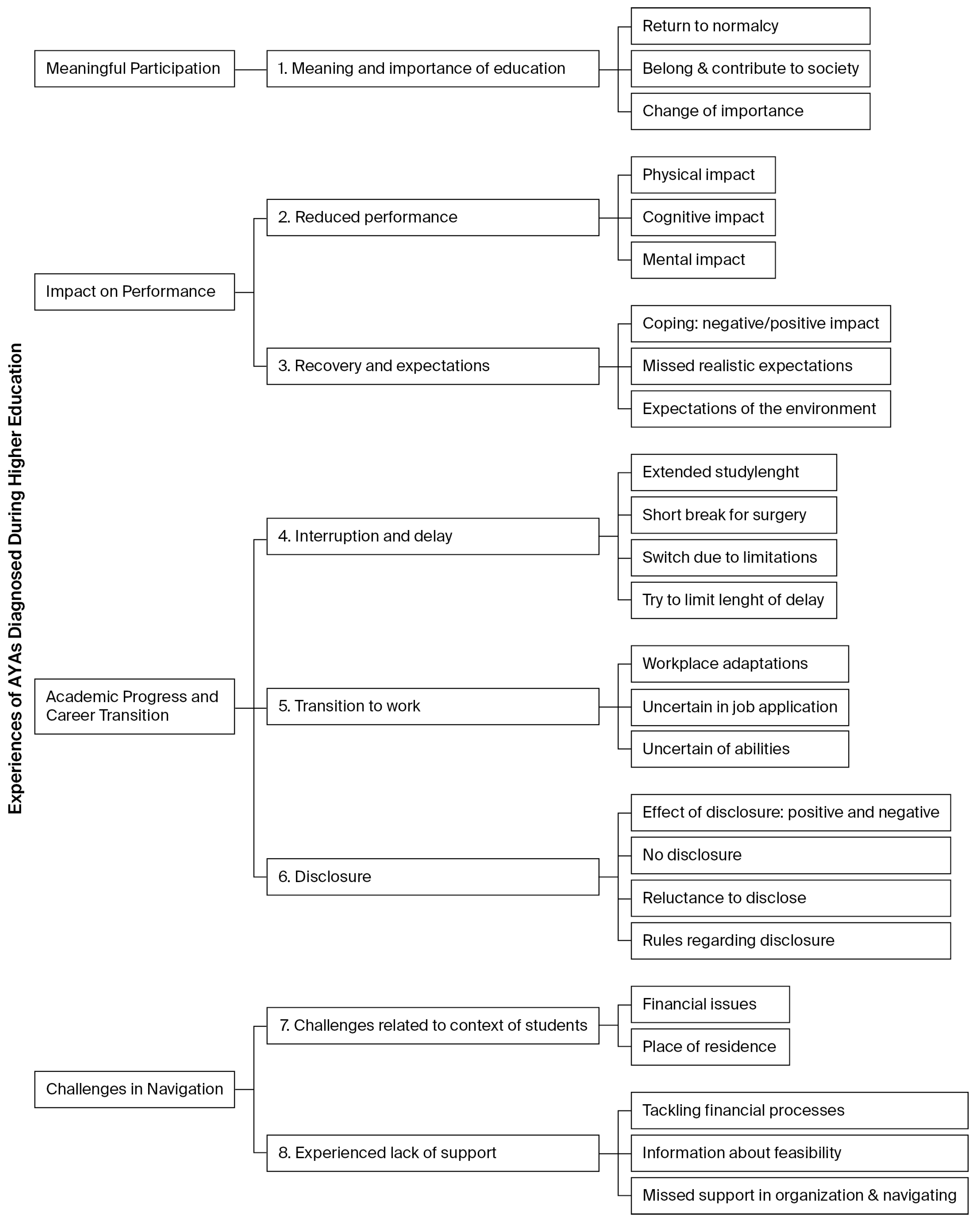
3.2.1. Meaningful Participation
- (1)
- Meaning and importance of education
“It also gave me a lot of structure, support, and strength. It made me think ‘Yes, I’m just studying’.”(R11)
“You’re in a world surrounded by people who are studying, so you also want to be engaged in it.”(R7)
“And during my illness, I became even more aware of how important other things are besides studying.”(R5)
“And that was the idea—to keep my studies going during treatment. If I study, if I stay enrolled, then I’m not sick. So yes, I still think my studies were actually more important than my own health.”(R8)
3.2.2. Impact on Performance
- (2)
- Reduced performance
“I experienced a level of fatigue that’s just impossible to explain [...]. ‘I’m so tired, I’m so, so tired.’ Even if I slept nine or ten hours a night, I’d wake up feeling as if I had only slept for ten minutes.”(R4)
“I still have issues with my fingertips. Of course, I would have preferred not to have it [neuropathy]. But oh well, I got it for free.”(R12)
“The focus wasn’t there, the concentration wasn’t there, it just didn’t register. You feel like there’s some kind of cloud over your brain. You’re sitting there, but what’s being said? No idea.”(R8)
“But really, as soon as the chemo was over, I suddenly thought: ‘Wow, I’ve actually lost who I used to be. I’ve lost my independence, my ability to think clearly is gone.’ I had panic attacks because I was too afraid to go outside alone.”(R8)
“I always had long hair, like I do now. But back then, I didn’t—I had black curls. And you just don’t feel like yourself. Yet, that’s the introduction you make into this new world you’re stepping into.”(R5)
- (3)
- Recovery and expectations
“With what I know now, I would have never started a full-time study program, only to be completely burned out within a month.”(R6)
“That it really helped me a lot to, yes, continue my studies. And yes, actually, on the one hand, it’s just a huge distraction; it makes your normal life continue a bit, despite everything.”(R11)
“You notice that concentration is sometimes difficult, keeping up with lectures is a challenge. You’re still in the recovery process. You expect to immediately return to your old level, but that’s just not how it works.”(R7)
“I had such a bad experience—I had to quit after a month, and it really made me afraid of studying again.”(R6)
“The frustration was psychological. I wanted to move forward, but I was using the wrong frame of reference. What did it cost me? My enjoyment of studying, I think.”(R12)
“I kept my room, but I was a bit naïve. I thought I’d be able to move back there within six months. But a month ago [note: 1 year after diagnosis], I cancelled the lease.”(R1)
“For a lot of people, chemo is the cancer treatment, and once you’re done with chemo, you’re cured, you’re finished. For the people around you, you’re supposed to be better. But that’s not how it works.”(R8)
3.2.3. Academic Progress and Career Transition
- (4)
- Interruption and delay
“When I got the diagnosis, I immediately stopped studying. [...] Cancer became such a priority that everything else just fell away. I didn’t even think twice about it. I think that’s very normal, very understandable.”(R6)
“And then I thought, well I’ll have to do it part-time. That ruled out medicine because you can’t do that part-time. So, psychology it was.”(R6)
“If I stop now and have to start again in a year, that would be awful. I’d fall so far behind my peers, while right now those are the people who can help pull me through.”(R11)
- (5)
- Transition to work
“I think I could work ten to fifteen hours a week, which would be my goal, while also being able to go to the gym, maintain a social life, and keep up with household chores.”(R8)
“In the beginning, I was really afraid that I was suffering from chemo brain […] So for me, it also brought some uncertainty, like: yeah, what am I actually still capable of?”(R11)
“Sometimes I worry—can I even work a full day? And how will employers view that?”(R6)
“How do I incorporate my cancer experience into my CV and the image I present of myself? So that, in a way, it empowers me.”(R11)
- (6)
- Disclosure
“But I think it’s good to know what you’re obligated to disclose and what you’re not. There used to be a rule that you had to tell them, unless it had been five or ten years. I remember hearing something like that.”(R1)
“But look, I have two years of work experience now, but I still wonder: should I mention it again, or should I not?”(R2)
“Cancer is simply a part of me. If I didn’t talk about it, it would almost feel like denying a part of myself. So, I really wanted to share it, also because it has had such a huge impact on who I am and how I approach life.”(R11)
“I choose not to bring it up to colleagues, because, as I mentioned earlier, I want them to see me for who I am and not treat me differently because of it.”(R3)
3.2.4. Challenges in Navigation
- (7)
- Challenges related to context of students
“In principle, you can do any course through self-study, but it’s really difficult when you haven’t studied for a year. You’re used to studying with peers, so when you’re at home, you’re completely alone.”(R1)
“But then I called general practitioners in [location of university], even though my official general practitioner (GP) was still registered with my parents. I asked: ‘Can you recommend a psychologist who also understands cancer and can guide me through this?’ I called two or three different GPs, and they all told me: ‘No, that is not what we are here for. You would have to register with us first before we can help you.”(R8)
“I think I claimed a small part or something. I don’t remember, but not full, because I hadn’t gotten cancer in my undergraduate year, but in my master’s year. So that was kind of such a crooked arrangement. They still said, if you had had that a year earlier, we could help you, but not now. So that was another thing that I thought, what a crooked system.”(R2)
“If you don’t have financial support, you become dependent on your mom and your partner, which is the last thing you want. That was a big reason why I wanted to graduate as soon as possible and have my own income. Because when you’re 25 or 26, you really don’t want to be financially dependent—not on your parents, and not on your partner. You just want to do your own thing.”(R11)
“That was also one of the reasons I went back to studying—so I could get state education grand again and live on my own again.”(R12)
“I think these are specific challenges for AYAs. You’re in a phase where nothing is settled, yet you don’t have a permanent contract, a steady income, or a home. And then, because of the illness, you’re suddenly stuck.”(R11)
“We also applied for new student loan entitlements, so then you’re basically saying that I would never be able to finish medical school because of my situation now, that that means I get to start all over again.”(R6)
“Yes, I had to go specifically to a doctor in [city, not in the neighborhood] for that, which I thought was a little crazy, but okay. And I think that was just a general practitioner there. And I had to go there… I had looked up on the Internet what kind of forms they have to have and have to sign. […]. And then the right box was checked and I could get my money back.”(R5)
- (8)
- Experienced lack of support
“You had to figure everything out yourself, and I just didn’t have the energy for that.”(R2)
“I didn’t know anyone around me, I had no idea where to go. You just feel incredibly lonely and think I’m never getting out of this.”(R4)
“You need support during treatment, but especially afterwards when you’re trying to pick up your studies again. That’s when you really run into challenges, and support in that phase is so important.”(R9)
“But professionally, really no one [addressed the expectations of recovery]. Not even the doctor. Yes, he said: ‘Yes, you can...’ Yes, I don’t want to say nonchalantly, the way he told it, but he was like: ‘Well, people do get tired after the treatments, but generally they come out fit again. So that was kind of the hope that was given, that it should work out again in September.”(R12)
“My, oh yes, my doctor who had said [...], ‘You can study or work alongside this illness.’ And then I thought, ‘Oh, if anyone can do that, I can’. So, I did my radiation therapy, I did it in [city], because I thought, ‘I can study in addition to that.’ However, I wasn’t able to do anything about my studies during radiation, nothing at all.”(R8)
“But in terms of focusing on the study, it was said that the condition and concentration would go down. I also knew about myself: I’m younger than the average person who goes through this. So, you hold onto the vain hope of being able to do something and stay busy during your sickbed. But I found out very quickly that that was not the case.”(R7)
“I’m not entitled to anything. I completely fall through the cracks. I’m not eligible for benefits or anything, and I’ve fought hard to find out if I was. But no, I’m not.”(R4)
4. Discussion
- (1)
- The meaning of study participation: beyond academic attendance
- (2)
- Impact on performance: reduced capacity and shifting expectations
- (3)
- Academic progress and career transition: emerging uncertainties
- (4)
- Challenges in navigation: disclosure, contextual barriers, and perceived lack of support
4.1. Strengths and Limitations
4.2. Implications for Practice, Policy and Research
5. Conclusions
Author Contributions
Funding
Institutional Review Board Statement
Informed Consent Statement
Data Availability Statement
Acknowledgments
Conflicts of Interest
Abbreviations
| AYA | Adolescent and Young Adult |
| CRF | Case Report Form |
| MBO | Middelbaar Beroepsonderwijs (secondary Vocational Education and Training (VET) |
| EP | Educational Professional |
| GP | General Practitioner |
| HBO | Hoger Beroepsonderwijs (universities of applied sciences) |
| HCP | HealthCare Professional |
| WMO | Wet Medisch-wetenschappelijk Onderzoek met mensen (Medical Research Involving Human Subjects Act) |
| QoL | Quality of Life |
| SJK | Stichting Jongeren en Kanker (Dutch AYA patient advocacy group) |
| SRQR | Standards for Reporting Qualitative Research |
| VET | secondary Vocational Education and Training |
| WO | Wetenschappelijk Onderwijs (research universities) |
References
- Smith, A.W.; Keegan, T.; Hamilton, A.; Lynch, C.; Wu, X.; Schwartz, S.M.; Kato, I.; Cress, R.; Harlan, L.; AYA HOPE Study Collaborative Group. Understanding care and outcomes in adolescents and young adults with cancer: A review of the AYA HOPE study. Pediatr. Blood Cancer 2018, 66, e27486. [Google Scholar] [CrossRef]
- van der Meer, D.J.; Karim-Kos, H.E.; van der Mark, M.; Aben, K.K.H.; Bijlsma, R.M.; Rijneveld, A.W.; van der Graaf, W.T.A.; Husson, O. Incidence, Survival, and Mortality Trends of Cancers Diagnosed in Adolescents and Young Adults (15–39 Years): A Population-Based Study in The Netherlands 1990–2016. Cancers 2020, 12, 3421. [Google Scholar] [CrossRef]
- Yarbrough, A. Survivorship in Adolescents and Young Adults with Cancer. JNCI Monogr. 2021, 2021, 15–17. [Google Scholar] [CrossRef]
- Dewar, E.O.; Ahn, C.; Eraj, S.; Mahal, B.A.; Sanford, N.N. Psychological distress and cognition among long-term survivors of adolescent and young adult cancer in the USA. J. Cancer Surviv. 2021, 15, 776–784. [Google Scholar] [CrossRef] [PubMed]
- Link, C.; Qi, S.; Thompson, S.; DeIure, A.; McKillop, S.; Watson, L. Understanding the Symptoms and Concerns of Adolescents and Young Adults with Cancer in Alberta: A Comparative Cohort Study Using Patient-Reported Outcomes. J. Adolesc. Young Adult Oncol. 2023, 12, 199–206. [Google Scholar] [CrossRef] [PubMed]
- Brock, H.; Friedrich, M.; Sender, A.; Richter, D.; Geue, K.; Mehnert-Theuerkauf, A.; Leuteritz, K. Work ability and cognitive impairments in young adult cancer patients: Associated factors and changes over time—Results from the AYA-Leipzig study. J. Cancer Surviv. 2021, 16, 771–780. [Google Scholar] [CrossRef]
- Spathis, A.; Hatcher, H.; Booth, S.; Gibson, F.; Stone, P.; Abbas, L.; Barclay, M.; Brimicombe, J.; Thiemann, P.; McCabe, M.G.; et al. Cancer-Related Fatigue in Adolescents and Young Adults After Cancer Treatment: Persistent and Poorly Managed. J. Adolesc. Young Adult Oncol. 2017, 6, 489–493. [Google Scholar] [CrossRef]
- Galán, S.; de la Vega, R.; Miró, J. Needs of adolescents and young adults after cancer treatment: A systematic review. Eur. J. Cancer Care 2018, 27, e12558. [Google Scholar] [CrossRef]
- Bradford, N.K.; McDonald, F.E.J.; Bibby, H.; Kok, C.; Patterson, P. Psychological, functional and social outcomes in adolescent and young adult cancer survivors over time: A systematic review of longitudinal studies. Psycho-Oncology 2022, 31, 1448–1458. [Google Scholar] [CrossRef] [PubMed]
- Jones, J.M.; Fitch, M.; Bongard, J.; Maganti, M.; Gupta, A.; D’agostino, N.; Korenblum, C. The Needs and Experiences of Post-Treatment Adolescent and Young Adult Cancer Survivors. J. Clin. Med. 2020, 9, 1444. [Google Scholar] [CrossRef]
- Kaul, S.; Fluchel, M.; Spraker-Perlman, H.; Parmeter, C.F.; Kirchhoff, A.C. Health care experiences of long-term survivors of adolescent and young adult cancer. Support. Care Cancer 2016, 24, 3967–3977. [Google Scholar] [CrossRef] [PubMed]
- Parsons, H.M.; Harlan, L.C.; Lynch, C.F.; Hamilton, A.S.; Wu, X.-C.; Kato, I.; Schwartz, S.M.; Smith, A.W.; Keel, G.; Keegan, T.H. Impact of Cancer on Work and Education Among Adolescent and Young Adult Cancer Survivors. J. Clin. Oncol. 2012, 30, 2393–2400. [Google Scholar] [CrossRef]
- Stone, D.S.; Ganz, P.A.; Pavlish, C.; Robbins, W.A. Young adult cancer survivors and work: A systematic review. J. Cancer Surviv. 2017, 11, 765–781. [Google Scholar] [CrossRef]
- Zebrack, B.J. Psychological, social, and behavioral issues for young adults with cancer. Cancer 2011, 117, 2289–2294. [Google Scholar] [CrossRef]
- Siembida, E.J.; Fladeboe, K.M.; Ip, E.; Zebrack, B.; Snyder, M.A.; Salsman, J.M. A Developmental Science Approach to Informing Age Subgroups in Adolescent and Young Adult Cancer Research. J. Adolesc. Health 2023, 73, 543–552. [Google Scholar] [CrossRef]
- Fardell, J.E.; Wakefield, C.E.; Patterson, P.; Lum, A.; Cohn, R.J.; Pini, S.A.; Sansom-Daly, U.M. Narrative Review of the Educational, Vocational, and Financial Needs of Adolescents and Young Adults with Cancer: Recommendations for Support and Research. J. Adolesc. Young Adult Oncol. 2018, 7, 143–147. [Google Scholar] [CrossRef]
- Wallis, A.; Meredith, P.; Stanley, M. Living beyond cancer: Adolescent and young adult perspectives on choice of and participation in meaningful occupational roles. Br. J. Occup. Ther. 2020, 84, 628–636. [Google Scholar] [CrossRef]
- Janssen, S.; van der Meer, D.; van Eenbergen, M.; Manten-Horst, E.; van der Graaf, W.; Husson, O. Short- and long-term impact of cancer on employment and financial outcomes of adolescents and young adults (AYAs): A large population-based case-control registry study in the Netherlands. ESMO Open 2022, 7, 100521. [Google Scholar] [CrossRef]
- Siebinga, T.M.; Janssen, S.H.M.; Boumans, A.W.; Van Eenbergen, M.C.; Siflinger, B.; A Van Der Graaf, W.T.; Husson, O. Financial outcomes of adolescent and young adult cancer survivors: A longitudinal population-based registry study. JNCI J. Natl. Cancer Inst. 2023, 115, 1294–1301. [Google Scholar] [CrossRef]
- Jin, Z.; Griffith, M.A.; Rosenthal, A.C. Identifying and Meeting the Needs of Adolescents and Young Adults with Cancer. Curr. Oncol. Rep. 2021, 23, 1–10. [Google Scholar] [CrossRef] [PubMed]
- Magrath, C.M.; Critoph, D.J.; Smith, L.A.; Hatcher, H.M. “A Different Person Entirely”: Adolescent and Young Adults’ Experiences Returning to Education after Cancer Treatment. J. Adolesc. Young Adult Oncol. 2021, 10, 562–572. [Google Scholar] [CrossRef]
- Kosola, S.; McCarthy, M.C.; McNeil, R.; Orme, L.M.; Drew, S.; Sawyer, S.M. Early Education and Employment Outcomes After Cancer in Adolescents and Young Adults. J. Adolesc. Young Adult Oncol. 2018, 7, 238–244. [Google Scholar] [CrossRef]
- Dax, V.; Edwards, N.; Doidge, O.; Morkunas, B.; Thompson, K.; Lewin, J. Evaluation of an Educational and Vocational Service for Adolescent and Young Adults with Cancer: A Retrospective Review. J. Adolesc. Young Adult Oncol. 2021, 10, 56–65. [Google Scholar] [CrossRef]
- Sisk, B.A.; Fasciano, K.; Block, S.D.; Mack, J.W. Impact of cancer on school, work, and financial independence among adolescents and young adults. Cancer 2020, 126, 4400–4406. [Google Scholar] [CrossRef]
- Husson, O.; Zebrack, B.J.; Aguilar, C.; Hayes-Lattin, B.; Cole, S. Cancer in adolescents and young adults: Who remains at risk of poor social functioning over time? Cancer 2017, 123, 2743–2751. [Google Scholar] [CrossRef] [PubMed]
- Altherr, A.; Bolliger, C.; Kaufmann, M.; Dyntar, D.; Scheinemann, K.; Michel, G.; Mader, L.; Roser, K. Education, Employment, and Financial Outcomes in Adolescent and Young Adult Cancer Survivors—A Systematic Review. Curr. Oncol. 2023, 30, 8720–8762. [Google Scholar] [CrossRef]
- Braun, I.; Friedrich, M.; Morgenstern, L.; Sender, A.; Geue, K.; Mehnert-Theuerkauf, A.; Leuteritz, K. Changes, challenges and support in work, education and finances of adolescent and young adult (AYA) cancer survivors: A qualitative study. Eur. J. Oncol. Nurs. 2023, 64, 102329. [Google Scholar] [CrossRef]
- Elsbernd, A.; Pedersen, K.J.; Boisen, K.A.; Midtgaard, J.; Larsen, H.B. “On Your Own”: Adolescent and Young Adult Cancer Survivors’ Experience of Managing Return to Secondary or Higher Education in Denmark. J. Adolesc. Young Adult Oncol. 2018, 7, 618–625. [Google Scholar] [CrossRef] [PubMed]
- Pedersen, K.J.; Boisen, K.A.; Midtgaard, J.; Elsbernd, A.; Larsen, H.B. Facing the Maze: Young Cancer Survivors’ Return to Education and Work—A Professional Expert Key Informant Study. J. Adolesc. Young Adult Oncol. 2018, 7, 445–452. [Google Scholar] [CrossRef] [PubMed]
- Blanch-Hartigan, D.; Kinel, J. Addressing Career-Related Needs in Adolescent and Young Adult Cancer Survivors: University Career Service Professionals’ Experience and Resources. J. Adolesc. Young Adult Oncol. 2018, 7, 245–248. [Google Scholar] [CrossRef]
- Vetsch, J.; Wakefield, C.E.; McGill, B.C.; Cohn, R.J.; Ellis, S.J.; Stefanic, N.; Sawyer, S.M.; Zebrack, B.; Sansom-Daly, U.M. Educational and vocational goal disruption in adolescent and young adult cancer survivors. Psycho-Oncology 2017, 27, 532–538. [Google Scholar] [CrossRef]
- Rabin, C. Cancer-Related Self-Disclosure in the Workplace/School by Adolescent and Young Adult Cancer Survivors. J. Adolesc. Young Adult Oncol. 2020, 9, 528–533. [Google Scholar] [CrossRef] [PubMed]
- Broholm-Jørgensen, M.; Tjørnhøj-Thomsen, T.; Pedersen, P.V. Development of an intervention for the social reintegration of adolescents and young adults affected by cancer. BMC Public Health 2022, 22, 1–15. [Google Scholar] [CrossRef]
- Denzin, N.K.; Lincoln, Y.S.; Giardina, M.D.; Cannella, G.S. (Eds.) The SAGE Handbook of Qualitative Research, 6th ed.; SAGE: Los Angeles, CA, USA, 2024; ISBN 978-1-0718-3674-3. [Google Scholar]
- O’Brien, B.C.; Harris, I.B.; Beckman, T.J.; Reed, D.A.; Cook, D.A. Standards for reporting qualitative research: A synthesis of recommendations. Acad. Med. 2014, 89, 1245–1251. [Google Scholar] [CrossRef]
- Ahmed, S.K. The pillars of trustworthiness in qualitative research. J. Med. Surg. Public Health 2024, 2, 100051. [Google Scholar] [CrossRef]
- Kreugel, M. (Ed.) Kanker Bij Jongvolwassenen; Een Gezamenlijke Uitgave Van IKNL En Het Nationaal AYA “Jong & Kanker” Zorgnetwerk: Utrecht, The Netherlands, 2022; ISBN 978-90-72175-51-9. [Google Scholar]
- Nationaal AYA Jong En Kanker Zorgnetwerk. Available online: https://ayazorgnetwerk.nl/ (accessed on 13 November 2025).
- Hennink, M.; Kaiser, B.N. Sample sizes for saturation in qualitative research: A systematic review of empirical tests. Soc. Sci. Med. 2022, 292, 114523. [Google Scholar] [CrossRef]
- Braun, V.; Clarke, V. Using thematic analysis in psychology. Qual. Res. Psychol. 2006, 3, 77–101. [Google Scholar] [CrossRef]
- Clarke, V.; Braun, V. Thematic analysis. J. Posit. Psychol. 2016, 12, 297–298. [Google Scholar] [CrossRef]
- Branje, S. Adolescent identity development in context. Curr. Opin. Psychol. 2022, 45, 101286. [Google Scholar] [CrossRef]
- Pini, S.; Hugh-Jones, S.; Gardner, P.H. What effect does a cancer diagnosis have on the educational engagement and school life of teenagers? A systematic review. Psycho-Oncology 2011, 21, 685–694. [Google Scholar] [CrossRef] [PubMed]
- Davis, E.L.; Clarke, K.S.; Patterson, P.; Cohen, J. Using Intervention Mapping to Develop an Education and Career Support Service for Adolescents and Young Adults Diagnosed with Cancer: Identification of the Contextual Factors That Influence Participation in Education and Employment. Cancers 2022, 14, 4590. [Google Scholar] [CrossRef]
- Wong, A.W.K.; Chang, T.-T.; Christopher, K.; Lau, S.C.L.; Beaupin, L.K.; Love, B.; Lipsey, K.L.; Feuerstein, M. Patterns of unmet needs in adolescent and young adult (AYA) cancer survivors: In their own words. J. Cancer Surviv. 2017, 11, 751–764. [Google Scholar] [CrossRef] [PubMed]
- E Schilstra, C.; Ellis, S.J.; Cohen, J.; Gall, A.; Diaz, A.; Clarke, K.; Dumlao, G.; Chard, J.; Cumming, T.M.; Davis, E.; et al. Exploring Web-Based Information and Resources That Support Adolescents and Young Adults With Cancer to Resume Study and Work: Environmental Scan Study. JMIR Cancer 2024, 10, e47944. [Google Scholar] [CrossRef]
- Ministerie van Volksgezondheid W en S. Nationale Strategie Voor De Implementatie Van Het VN-Verdrag Handicap; Ministerie van Volksgezondheid W en S: Den Haag, The Netherlands, 2024. [Google Scholar]
- European Commission; EACEA (Ministry of Education, Culture and Science, The Netherlands). Support Measures for Learners in Higher Education. Available online: https://eurydice.eacea.ec.europa.eu/eurypedia/netherlands/support-measures-learners-higher-education (accessed on 6 January 2026).
- Büscher-Touwen, M.; De Groot, M.; Van Hal, L. Mind the Gap Between Higher Education and the Labour Market for Students with a Disability in The Netherlands: A Research Agenda. Soc. Incl. 2018, 6, 149–157. [Google Scholar] [CrossRef]
- Honda, N.; Shiroshita, Y.; Miyazaki, A.; Sobue, I. Factors associated with cancer disclosure in adolescent and young adult cancer survivors: An integrative review from the social-ecological model perspective. Eur. J. Oncol. Nurs. 2024, 69, 102542. [Google Scholar] [CrossRef]
- Vlooswijk, C.; van de Poll-Franse, L.V.; Janssen, S.H.M.; Derksen, E.; Reuvers, M.J.P.; Bijlsma, R.; Kaal, S.E.J.; Kerst, J.M.; Tromp, J.M.; Bos, M.E.M.M.; et al. Recruiting Adolescent and Young Adult Cancer Survivors for Patient-Reported Outcome Research: Experiences and Sample Characteristics of the SURVAYA Study. Curr. Oncol. 2022, 29, 5407–5425. [Google Scholar] [CrossRef] [PubMed]
- Wang, R.R.; Schweitzer, J.B.; Hernandez, S.; Molina, S.C.; Keegan, T.H. Strategies for Recruitment and Retention of Adolescent and Young Adult Cancer Patients in Research Studies. J. Clin. Transl. Sci. 2023, 7, 1–27. [Google Scholar] [CrossRef]
- van Ham, C.R.; Burgers, V.W.G.; Sleeman, S.H.E.; Dickhout, A.; Harthoorn, N.C.G.L.; Manten-Horst, E.; van Eenbergen, M.C.; Husson, O. A qualitative study on the involvement of adolescents and young adults (AYAs) with cancer during multiple research phases: “plan, structure, and discuss”. Res. Involv. Engag. 2022, 8, 1–14. [Google Scholar] [CrossRef]
- Vandekerckhove, P.; de Mul, M.; de Groot, L.; Elzevier, H.W.; Fabels, B.; Mohammad, S.H.; Husson, O.; Noij, J.; Sleeman, S.H.; Verbeek, D.; et al. Lessons for Employing Participatory Design When Developing Care for Young People with Cancer: A Qualitative Multiple-Case Study. J. Adolesc. Young Adult Oncol. 2021, 10, 404–417. [Google Scholar] [CrossRef]
- Abma, T.; Banks, S.; Cook, T.; Dias, S.; Madsen, W.; Springett, J.; Wright, M.T. Participatory Research for Health and Social Well-Being; Corrected publication; Springer Nature: Cham, Switzerland, 2019; ISBN 978-3-319-93190-6. [Google Scholar]
- Van Lieshout, F.; Jacobs, G.C.; Cardiff, S. Actieonderzoek: Principes en Onderzoeksmethoden Voor Participatief Veranderen; Uitgeverij Koninklijke Van Gorcum: Assen, The Netherlands, 2021; ISBN 978-90-232-5778-3. (Revised 2021). [Google Scholar]
- Aken, J.; van Andriessen, D. (Eds.) Handboek Ontwerpgericht Wetenschappelijk Onderzoek: Wetenschap Met Effect; Boom Lemma Uitgevers: Den Haag, The Netherlands, 2011; ISBN 978-90-5931-746-8. [Google Scholar]



| Respondents | n = 13 |
|---|---|
| Sex | Female (n = 10; 77%) Male (n = 3; 23%) |
| Age at time of diagnosis (years) | Range: 19–25 M (SD): 21.3 (2.3) |
| Age at time of interview (years) | Range: 22–30 M (SD): 26.4 (3.0) |
| Time since diagnosis (years) | Range: 0–9 M (SD): 4.7 (3.1) |
| Enrolled in educational level at time of diagnosis | University of applied science (HBO)—(n = 4; 31%) Research university (WO)—bachelor’s program (n = 5; 38%) Research university (WO)—master’s program (n = 4; 31%) |
| Diagnosis in study year | 1 (n = 2, 15%) 2 (n = 4, 30%) 3 (n = 2, 15%) 4 (n = 3, 23%) 5 (n = 2, 15%) |
| Work status at time of diagnosis | Student and no part-time job (n = 8; 62%) Student and part time job without contract (n = 4; 31%) Student and part time job with contract (n = 1; 8%) |
| Working hours if working part time | Without contract: Range: 4–19 h/week, M (SD): 10.8 (6.4) With contract: Range: 14 h/week, M (SD): 14 (0) |
| Living situation * | Student house at time of diagnosis, but returned to parent(s) after diagnosis (n = 5; 38%) Lives with parent(s) at time of diagnosis (n = 3; 23%) Unknown (n = 5; 38%) |
| Treatment status | In treatment (n = 8; 62%) Finished treatment (n = 5; 38%) |
| Type of cancer | Brain cancer (n = 1; 8%) Breast cancer (n = 2; 15%) Colorectal cancer (n = 1; 8%) Salivary gland carcinoma (n = 1; 8%) Lymphoid hematological malignancies (Hodgkin) (n = 5; 38%) Male genitalia tumor (n = 1; 8%) Mediastinal germ cell tumor (n = 1; 8%) Thyroid cancer (n = 1; 8%) |
Disclaimer/Publisher’s Note: The statements, opinions and data contained in all publications are solely those of the individual author(s) and contributor(s) and not of MDPI and/or the editor(s). MDPI and/or the editor(s) disclaim responsibility for any injury to people or property resulting from any ideas, methods, instructions or products referred to in the content. |
© 2026 by the authors. Licensee MDPI, Basel, Switzerland. This article is an open access article distributed under the terms and conditions of the Creative Commons Attribution (CC BY) license.
Share and Cite
Boumans, A.W.; van Hartingsveldt, M.J.; de Boer, A.G.E.M.; Brus, M.M.; Hoddenbagh-Bosdijk, F.M.; Reuvers, M.J.P.; Morgan, J.D.; Stuiver, M.M.; Husson, O. Understanding the Experiences of Adolescents and Young Adults Diagnosed with Cancer During Higher Education—An Exploratory Interview Study. Cancers 2026, 18, 325. https://doi.org/10.3390/cancers18020325
Boumans AW, van Hartingsveldt MJ, de Boer AGEM, Brus MM, Hoddenbagh-Bosdijk FM, Reuvers MJP, Morgan JD, Stuiver MM, Husson O. Understanding the Experiences of Adolescents and Young Adults Diagnosed with Cancer During Higher Education—An Exploratory Interview Study. Cancers. 2026; 18(2):325. https://doi.org/10.3390/cancers18020325
Chicago/Turabian StyleBoumans, Anke W., Margo J. van Hartingsveldt, Angela G. E. M. de Boer, Maaike M. Brus, Floor M. Hoddenbagh-Bosdijk, Milou J. P. Reuvers, Jack D. Morgan, Martijn M. Stuiver, and Olga Husson. 2026. "Understanding the Experiences of Adolescents and Young Adults Diagnosed with Cancer During Higher Education—An Exploratory Interview Study" Cancers 18, no. 2: 325. https://doi.org/10.3390/cancers18020325
APA StyleBoumans, A. W., van Hartingsveldt, M. J., de Boer, A. G. E. M., Brus, M. M., Hoddenbagh-Bosdijk, F. M., Reuvers, M. J. P., Morgan, J. D., Stuiver, M. M., & Husson, O. (2026). Understanding the Experiences of Adolescents and Young Adults Diagnosed with Cancer During Higher Education—An Exploratory Interview Study. Cancers, 18(2), 325. https://doi.org/10.3390/cancers18020325