The Efficacy of Electronic Health Record-Based Artificial Intelligence Models for Early Detection of Pancreatic Cancer: A Systematic Review and Meta-Analysis
 , , , , and
Simple Summary
Abstract
1. Introduction
2. Methods
2.1. Search Strategy
2.2. Inclusion and Exclusion Criteria
2.3. Data Extraction
2.4. Statistical Analysis and Quality Appraisal
3. Results
3.1. Characteristics of the Included Studies

| Reference | AI Type | AI Models | Outcome Measures | Population Characteristics | PC Cases (n) | Total Sample (n) | Model Performance Metrics |
|---|---|---|---|---|---|---|---|
| Chen, Q. et al. [15] | ML | XGBoost | Diagnosis of PC; ability to distinguish early-stage PC patients from matched controls | Early-stage PC defined as surgically managed cases; controls matched by region and observation period | 3322 | 53,152 | Se = 60%, Sp = 89.8%, PPV = 0.07%, AUC = 0.84 (95% CI: 0.83–0.85) |
| Chen, W., Zhou, Y., Xie, F. et al. [16] | ML | Random Forest | Detection of PC or PC-related death within 18 months | Adults aged 50–84 years with ≥1 clinical visit during 2008–2017; continuous enrollment ≥ 12 months prior to index date | 1792 | 1,801,931 | Se = 56.6%, Sp = 79.6%, PPV = 1.1%, C-index = 0.77 |
| Matchaba, S. et al. [17] | ML | Ensemble Model | PC diagnosis predicted 1–2 years prior to clinical diagnosis | Patients with ≥3 healthcare interactions | 8438 | 18,987 | Se = 85.61%, Sp = 76.18%, PPV = 1.1%, AUC = 0.89 |
| Appelbaum, L. et al. [11] | ML | Logistic Regression, Neural Network | PC diagnosis predicted 180, 270, and 365 days prior to clinical diagnosis | Patients with ≥6 months of observation prior to diagnosis (cases) or prior to last visit (controls) | 594 | 101,381 | AUROC = 0.71 (95% CI: 0.67–0.76), PPV = 0.93% |
| Park, J. et al. [18] | DL | LogReg, NN, Random Masking, XGB, Black-box model | PC diagnosis predicted within 12 months | Patients with ≥1 documented risk factor (smoking, obesity, diabetes, chronic pancreatitis); exclusion of those undergoing treatment for chronic pancreatitis | 834 | 9057 | AUROC: LogReg 0.491; XGB 0.501; Black-box 0.644; NN (no masking) 0.649; NN + Random Masking 0.671 |
| Chen, W., Butler, R. et al. [19] | ML | Random Forest | PC diagnosis or death from PC within 3 years after elevated HbA1c | Adults aged 50–84 years with ≥1 elevated HbA1c; exclusion of diabetes patients | 319 | 109,266 | Se = 60%, Sp = 80.3%, PPV = 2.5%, AUROC = 0.812 |
| Malhotra, A. et al. [5] | ML | LogReg, RF | Binary classification: PC case vs. control with unrelated cancer | Patients aged 15–99 with primary PC; controls with other cancers | 1139 | 5695 | Se = 65%, Sp = 57%, AUC = 61%, PPV = 32.5% |
| Hsieh, M. et al. [20] | ML | LogReg, NN | PC diagnosis among patients with type 2 diabetes | Adults > 20 years with newly diagnosed type 2 diabetes; exclusion of those with prior PC | 3092 | 1,358,634 | PPV: LogReg 0.995, NN 0.996; AUROC: LogReg 0.727, NN 0.605 |
| Muhammad, W. et al. [21] | DL | Neural Network | Binary: PC diagnosis within 4 years of survey | General population; PC diagnosed < 4 years before survey | 898 | 800,114 | Se = 87.3%, Sp = 80.8%, AUROC = 0.86, NPV = 99.997%, PPV = 0.1% |
| Placido, D. et al. [22] | DL | Transformer | Risk of PC at 3, 6, 12, 36, and 60 months | General population; archival EMRs | 26,403 | 8,123,446 | AUC = 0.879, PPV = 0.32% |
| Xiaodong, Li et al. [23] | ML, DL | XGB + Deep NN | PC diagnosis within a 24-month prediction window | Adults ≥ 35 years seeking medical care | 4361 | 265,225 | Se = 54.35%, AUROC = 0.809, PPV = 67.62% |
| Zhao, D. et al. [24] | ML | Weighted Bayesian Network Inference | Binary: PC vs. non-PC | Randomly selected controls plus symptomatic non-PC patients | 98 | 15,069 | Se = 84.7%, Sp = 85.2%, AUROC = 0.910 |
| Chen, W., Zhou, B., Jeon, C. et al. [25] | ML | RF, XGB | Time-to-event: PC diagnosis or PC-related death within 18 months | Adults aged 50–84, ≥1 clinical visit, no prior PC | 1792 | 1,800,000 | RF: AUC 0.767; XGB: AUC 0.779; PPV ≈1% |
| Jia, K. et al. [26] | ML | PrismNN, LogReg | PC risk prediction 6–18 months after index date | Adults > 40 with ≥16 records over 2 years | 35,387 | 1,535,468 | PrismNN: Se = 35.9%, Sp = 95.3%, AUROC = 0.826; LogReg: AUROC = 0.800 |
| Cichosz, S. et al. [27] | ML | Random Forest | PC development within 3 years after diabetes onset | Adults > 50 with new-onset diabetes | 716 | 1432 | AUROC = 0.74; Se 21.4% at high specificity; NPV up to 99.8% |
| Shih-Min Chen et al. [28] | ML | Linear Discriminant Analysis | PC diagnosis within 4 years post anti-diabetes therapy | Type 2 diabetes patients ≥ 40 years | 89 | 66,384 | Se 86.11%, Sp 84.03%, AUROC 0.907, PPV 0.02% |
| Zhichao Yang et al. [29] | DL | NN, Transformer | Disease-/Outcome-agnostic prediction: all ICD oncology codes at next visit | General healthcare-seeking population; PC subgroup ≥ 45 years without other cancers | 4639 | 6,475,218 | AUROC = 0.82, PPV = 8.8% |
| Zhu, W. et al. [30] | ML | Elastic-Net Regularized LogReg | PC diagnosis within 2.5–3 years | Adults with ≥3 years of continuous EMR data | 1932 | 53,741 | At 1st percentile threshold: Se = 6.78%, Sp = 99.01%, NPV = 99.93%, PPV = 0.65%, AUROC = 0.742 |
| Akmeşe, Ö. et al. [31] | ML | LGBM, Bagging, CatBoost and others | Binary: PC vs. non-PC | PC-patients, non-cancerous (benign) pancreatic/hepatobiliary disease patients, healthy controls. In addition to clinical data, laboratory data were also used | 199 | 590 | LGBM (Best Model): accuracy = 98.8%, precision = 99%, recall = 99%, F1-Score = 0.99, Se = 99%, Sp = 98.7% |
3.2. Quality Assessment
| Study | Selection (/4) | Comparability (/2) | Outcome (/3) | Methodological Quality |
|---|---|---|---|---|
| Chen, Q. et al. [15] | 4 | 0 | 2 | 6 (Fair) |
| Chen, W., Zhou, Y., Xie, F. et al. [16] | 4 | 1 | 2 | 7 (Fair) |
| Matchaba, S. et al. [17] | 4 | 0 | 2 | 6 (Fair) |
| Appelbaum, L. et al. [11] | 4 | 1 | 2 | 7 (Fair) |
| Park, J. et al. [18] | 4 | 2 | 3 | 9 (Good) |
| Chen, W., Butler, R. et al. [19] | 4 | 2 | 3 | 9 (Good) |
| Malhotra, A. et al. [5] | 4 | 2 | 3 | 9 (Good) |
| Hsieh, M. et al. [20] | 4 | 2 | 3 | 9 (Good) |
| Muhammad, W. et al. [21] | 4 | 2 | 2 | 8 (Good) |
| Placido, D. et al. [22] | 4 | 2 | 2 | 8 (Good) |
| Xiaodong Li et al. [23] | 3 | 0 | 2 | 5 (Poor) |
| Zhao, D. et al. [24] | 4 | 2 | 3 | 9 (Good) |
| Chen, W., Zhou, B., Jeon, C. et al. [25] | 4 | 2 | 2 | 8 (Good) |
| Jia, K. et al. [26] | 4 | 2 | 2 | 8 (Good) |
| Cichosz, S. et al. [27] | 4 | 1 | 3 | 8 (Good) |
| Shih-Min Chen et al. [28] | 4 | 2 | 2 | 8 (Good) |
| Zhichao Yang et al. [29] | 4 | 2 | 2 | 8 (Good) |
| Zhu, W. et al. [30] | 3 | 1 | 3 | 7 (Fair) |
| Akmeşe, Ö. et al. [31] | 3 | 0 | 2 | 5 (Poor) |
3.3. Meta-Analytic Assessment of AUC
3.4. Meta-Analytic Assessment of Sensitivity
3.5. Meta-Analytic Assessment of Specificity
4. Discussion
5. Conclusions
Author Contributions
Funding
Data Availability Statement
Acknowledgments
Conflicts of Interest
Abbreviations
| PC | Pancreatic cancer |
| AI | Artificial Intelligence |
| EHR | Electronic health record |
| Se | Sensitivity |
| Sp | Specificity |
| LogReg | Logistic Regression |
| LGB | Light Gradient Boosting |
| RF | Random Forests |
| NN | Neural Network |
| XGB | XGBoost |
| CI | Confidence interval |
| ML | Machine learning |
| DL | Deep learning |
| AUC | Area under the curve |
| AUROC | Area under the receiver operating characteristic curve |
References
- Bray, F.; Ferlay, J.; Soerjomataram, I.; Siegel, R.L.; Torre, L.A.; Jemal, A. Global cancer statistics 2018: GLOBOCAN estimates of incidence and mortality worldwide for 36 cancers in 185 countries. CA Cancer J. Clin. 2018, 68, 394–424. [Google Scholar] [CrossRef] [Scilit] [PubMed]
- Arnold, M.; Rutherford, M.J.; Bardot, A.; Ferlay, J.; Andersson, T.M.; Myklebust, T.Å.; Tervonen, H.; Thursfield, V.; Ransom, D.; Shack, L.; et al. Progress in cancer survival, mortality, and incidence in seven high-income countries 1995-2014 (ICBP SURVMARK-2): A population-based study. Lancet Oncol. 2019, 20, 1493–1505. [Google Scholar] [CrossRef] [Scilit] [PubMed]
- Strobel, O.; Neoptolemos, J.; Jäger, D.; Büchler, M.W. Optimizing the outcomes of pancreatic cancer surgery. Nat. Rev. Clin. Oncol. 2019, 16, 11–26. [Google Scholar] [CrossRef] [Scilit] [PubMed]
- Hart, P.A.; Chari, S.T. Is Screening for Pancreatic Cancer in High-Risk Individuals One Step Closer or a Fool’s Errand? Clin. Gastroenterol. Hepatol. 2019, 17, 36–38. [Google Scholar] [CrossRef] [Scilit]
- Malhotra, A.; Rachet, B.; Bonaventure, A.; Pereira, S.P.; Woods, L.M. Can we screen for pancreatic cancer? Identifying a sub-population of patients at high risk of subsequent diagnosis using machine learning techniques applied to primary care data. PLoS ONE 2021, 16, e0251876. [Google Scholar] [CrossRef] [Scilit]
- Estiri, H.; Strasser, Z.H.; Klann, J.G.; Naseri, P.; Wagholikar, K.B.; Murphy, S.N. Predicting COVID-19 mortality with electronic medical records. npj Digit. Med. 2021, 4, 15. [Google Scholar] [CrossRef] [Scilit]
- Luchini, C.; Pea, A.; Scarpa, A. Artificial intelligence in oncology: Current applications and future perspectives. Br. J. Cancer 2022, 126, 4–9. [Google Scholar] [CrossRef] [Scilit]
- Ramos-Casallas, A.; Cardona-Mendoza, A.; Perdomo-Lara, S.J.; Rico-Mendoza, A.; Porras-Ramírez, A. Performance Evaluation of Machine Learning Models in Cervical Cancer Diagnosis: Systematic Review and Meta-Analysis. Eur. J. Cancer 2025, 229, 115768. [Google Scholar] [CrossRef] [Scilit]
- Crawford, M.E.; Kamali, K.; Dorey, R.A.; Maclntyre, O.C.; Cleminson, K.; MacGillivary, M.L.; Green, P.J.; Langley, R.G.; Purdy, K.S.; DeCoste, R.C.; et al. Using Artificial Intelligence as a Melanoma Screening Tool in Self-Referred Patients. J. Cutan. Med. Surg. 2024, 28, 37–43. [Google Scholar] [CrossRef] [Scilit]
- Pereira, S.P.; Oldfield, L.; Ney, A.; Hart, P.A.; Keane, M.G.; Pandol, S.J.; Li, D.; Greenhalf, W.; Jeon, C.Y.; Koay, E.J.; et al. Early detection of pancreatic cancer. Lancet Gastroenterol. Hepatol. 2020, 5, 698–710. [Google Scholar] [CrossRef] [Scilit]
- Appelbaum, L.; Cambronero, J.P.; Stevens, J.P.; Horng, S.; Pollick, K.; Silva, G.; Haneuse, S.; Piatkowski, G.; Benhaga, N.; Duey, S.; et al. Development and validation of a pancreatic cancer risk model for the general population using electronic health records: An observational study. Eur. J. Cancer 2021, 143, 19–30. [Google Scholar] [CrossRef] [Scilit]
- Page, M.J.; McKenzie, J.E.; Bossuyt, P.M.; Boutron, I.; Hoffmann, T.C.; Mulrow, C.D.; Shamseer, L.; Tetzlaff, J.M.; Akl, E.A.; Brennan, S.E.; et al. The PRISMA 2020 Statement: An Updated Guideline for Reporting Systematic Reviews. BMJ 2021, 372, n71. [Google Scholar] [CrossRef] [Scilit]
- Wells, G.A.; Shea, B.; O’Connell, D.; Peterson, J.; Welch, V.; Losos, M.; Tugwell, P. The Newcastle-Ottawa Scale (NOS) for Assessing the Quality of Nonrandomized Studies in Meta-Analyses. Available online: http://www.ohri.ca/programs/clinical_epidemiology/oxford.asp (accessed on 16 January 2026).
- Bhinder, B.; Gilvary, C.; Madhukar, N.S.; Elemento, O. Artificial Intelligence in Cancer Research and Precision Medicine. Cancer Discov. 2021, 11, 900–915. [Google Scholar] [CrossRef] [Scilit] [PubMed]
- Chen, Q.; Cherry, D.R.; Nalawade, V.; Qiao, E.M.; Kumar, A.; Lowy, A.M.; Simpson, D.R.; Murphy, J.D. Clinical Data Prediction Model to Identify Patients With Early-Stage Pancreatic Cancer. JCO Clin. Cancer Inform. 2021, 5, 279–287. [Google Scholar] [CrossRef] [Scilit] [PubMed]
- Chen, W.; Zhou, Y.; Xie, F.; Butler, R.K.; Jeon, C.Y.; Luong, T.Q.; Zhou, B.; Lin, Y.C.; Lustigova, E.; Pisegna, J.R.; et al. Derivation and External Validation of Machine Learning-Based Model for Detection of Pancreatic Cancer. Am. J. Gastroenterol. 2023, 118, 157–167. [Google Scholar] [CrossRef] [Scilit] [PubMed]
- Matchaba, S.; Fellague-Chebra, R.; Purushottam, P.; Johns, A. Early Diagnosis of Pancreatic Cancer via Machine Learning Analysis of a National Electronic Medical Record Database. JCO Clin. Cancer Inform. 2023, 7, e2300076. [Google Scholar] [CrossRef] [Scilit]
- Park, J.; Artin, M.G.; Lee, K.E.; Pumpalova, Y.S.; Ingram, M.A.; May, B.L.; Park, M.; Hur, C.; Tatonetti, N.P. Deep learning on time series laboratory test results from electronic health records for early detection of pancreatic cancer. J. Biomed. Inform. 2022, 131, 104095. [Google Scholar] [CrossRef] [Scilit]
- Chen, W.; Butler, R.K.; Lustigova, E.; Chari, S.T.; Maitra, A.; Rinaudo, J.A.; Wu, B.U. Risk Prediction of Pancreatic Cancer in Patients With Recent-onset Hyperglycemia: A Machine-learning Approach. J. Clin. Gastroenterol. 2023, 57, 103–110. [Google Scholar] [CrossRef] [Scilit]
- Hsieh, M.H.; Sun, L.M.; Lin, C.L.; Hsieh, M.J.; Hsu, C.Y.; Kao, C.H. Development of a prediction model for pancreatic cancer in patients with type 2 diabetes using logistic regression and artificial neural network models. Cancer Manag. Res. 2018, 10, 6317–6324. [Google Scholar] [CrossRef] [Scilit]
- Muhammad, W.; Hart, G.R.; Nartowt, B.; Farrell, J.J.; Johung, K.; Liang, Y.; Deng, J. Pancreatic Cancer Prediction Through an Artificial Neural Network. Front. Artif. Intell. 2019, 2, 2. [Google Scholar] [CrossRef] [Scilit]
- Placido, D.; Yuan, B.; Hjaltelin, J.X.; Zheng, C.; Haue, A.D.; Chmura, P.J.; Yuan, C.; Kim, J.; Umeton, R.; Antell, G.; et al. A deep learning algorithm to predict risk of pancreatic cancer from disease trajectories. Nat. Med. 2023, 29, 1113–1122. [Google Scholar] [CrossRef] [Scilit] [PubMed]
- Li, X.; Guo, P.; Huang, C.-J.; Hao, S. A deep-learning based prediction of pancreatic adenocarcinoma with electronic health records from the state of maine. Int. Sch. Sci. Res. Innov. 2020, 14, 358–365. [Google Scholar]
- Zhao, D.; Weng, C. Combining PubMed knowledge and EHR data to develop a weighted Bayesian network for pancreatic cancer prediction. J. Biomed. Inform. 2011, 44, 859–868. [Google Scholar] [CrossRef] [Scilit] [PubMed]
- Chen, W.; Zhou, B.; Jeon, C.Y.; Xie, F.; Lin, Y.C.; Butler, R.K.; Zhou, Y.; Luong, T.Q.; Lustigova, E.; Pisegna, J.R.; et al. Machine learning versus regression for prediction of sporadic pancreatic cancer. Pancreatology 2023, 23, 396–402. [Google Scholar] [CrossRef] [Scilit]
- Jia, K.; Kundrot, S.; Palchuk, M.B.; Warnick, J.; Haapala, K.; Kaplan, I.D.; Rinard, M.; Appelbaum, L. A pancreatic cancer risk prediction model (Prism) developed and validated on large-scale US clinical data. eBioMedicine 2023, 98, 104888. [Google Scholar] [CrossRef] [Scilit]
- Cichosz, S.L.; Jensen, M.H.; Hejlesen, O.; Henriksen, S.D.; Drewes, A.M.; Olesen, S.S. Prediction of pancreatic cancer risk in patients with new-onset diabetes using a machine learning approach based on routine biochemical parameters. Comput. Methods Programs Biomed. 2024, 244, 107965. [Google Scholar] [CrossRef] [Scilit]
- Chen, S.M.; Phuc, P.T.; Nguyen, P.A.; Burton, W.; Lin, S.J.; Lin, W.C.; Lu, C.Y.; Hsu, M.H.; Cheng, C.T.; Hsu, J.C. A novel prediction model of the risk of pancreatic cancer among diabetes patients using multiple clinical data and machine learning. Cancer Med. 2023, 12, 19987–19999. [Google Scholar] [CrossRef] [Scilit]
- Yang, Z.; Mitra, A.; Liu, W.; Berlowitz, D.; Yu, H. TransformEHR: Transformer-based encoder-decoder generative model to enhance prediction of disease outcomes using electronic health records. Nat. Commun. 2023, 14, 7857. [Google Scholar] [CrossRef] [Scilit]
- Zhu, W.; Chen, L.; Aphinyanaphongs, Y.; Kastrinos, F.; Simeone, D.M.; Pochapin, M.; Stender, C.; Razavian, N.; Gonda, T.A. Identification of patients at risk for pancreatic cancer in a 3-year timeframe based on machine learning algorithms. Sci. Rep. 2025, 15, 11697. [Google Scholar] [CrossRef] [Scilit]
- Akmeşe, Ö.F. Data privacy-aware machine learning approach in pancreatic cancer diagnosis. BMC Med. Inform. Decis. Mak. 2024, 24, 248. [Google Scholar] [CrossRef] [Scilit]
- Li, Z.; Liu, X.; Tang, Z.; Jin, N.; Zhang, P.; Eadon, M.T.; Song, Q.; Chen, Y.V.; Su, J. TrajVis: A visual clinical decision support system to translate artificial intelligence trajectory models in the precision management of chronic kidney disease. J. Am. Med. Inform. Assoc. 2024, 31, 2474–2485. [Google Scholar] [CrossRef] [Scilit]
- Song, Q.; Liu, X.; Li, Z.; Zhang, P.; Eadon, M.; Su, J. DEPOT: Graph learning delineates the roles of cancers in the progression trajectories of chronic kidney disease using electronic medical records. medRxiv 2023. medRxiv:2023.08.13.23293968. [Google Scholar] [CrossRef] [Scilit]


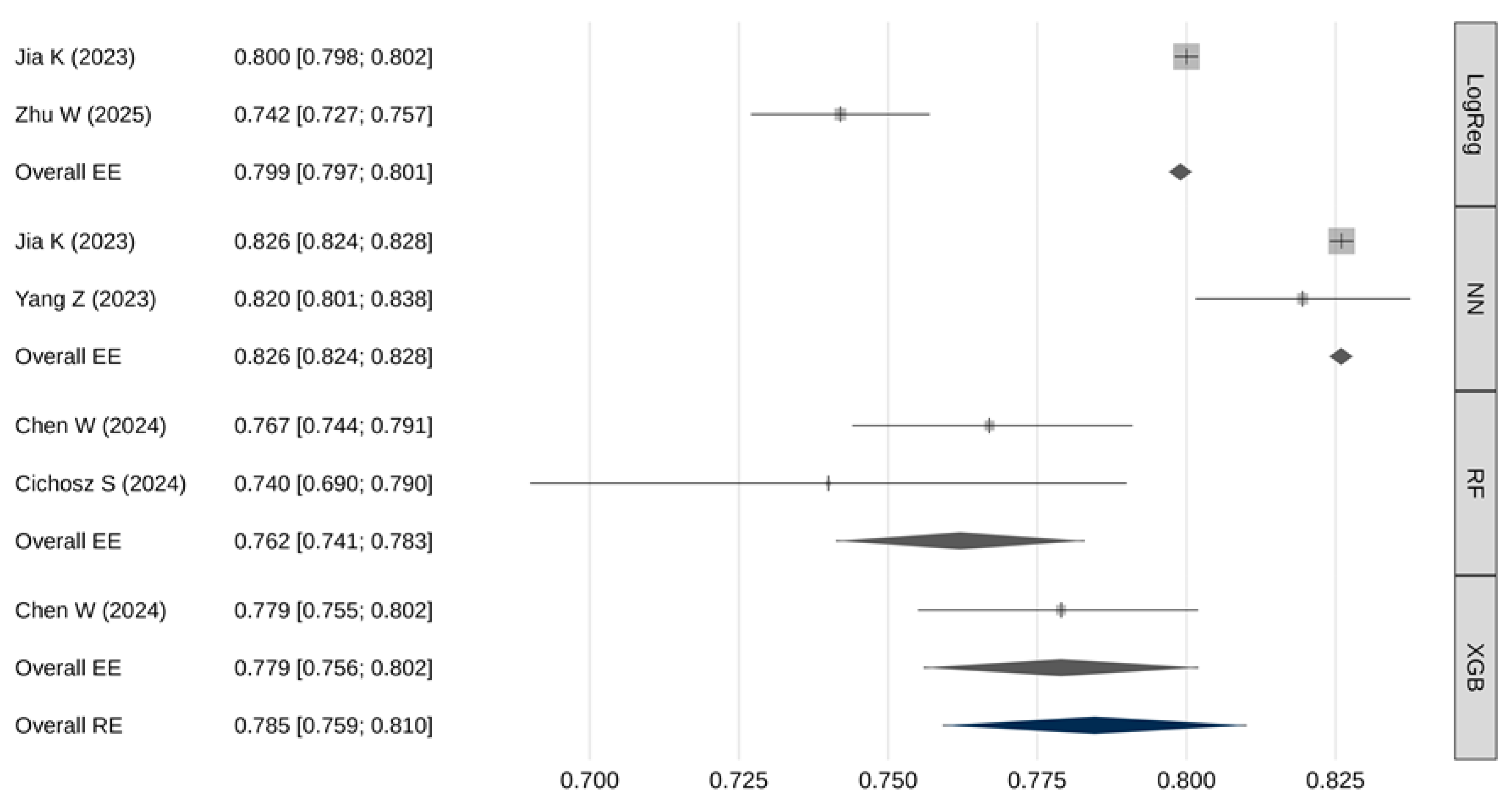
| Model Type | Study | AUC | 95% CI | Heterogeneity Statistics | |||
|---|---|---|---|---|---|---|---|
| I2 | Q | df | p | ||||
| LogReg | Jia, K. (2023) [26] | 0.8 | 0.798; 0.802 | % | |||
| LogReg | Zhu, W. (2025) [30] | 0.742 | 0.727; 0.757 | % | |||
| LogReg | Overall EE | 0.799 | 0.797; 0.801 | 98.3% | 58.8 | 1 | <0.001 |
| NN | Jia, K. (2023) [26] | 0.826 | 0.824; 0.828 | % | |||
| NN | Yang, Z. (2023) [29] | 0.82 | 0.801; 0.838 | % | |||
| NN | Overall EE | 0.826 | 0.824; 0.828 | 0% | 0.515 | 1 | 0.473 |
| RF | Chen, W. (2024) [25] | 0.767 | 0.744; 0.791 | % | |||
| RF | Cichosz, S. (2024) [27] | 0.74 | 0.69; 0.79 | % | |||
| RF | Overall EE | 0.762 | 0.741; 0.783 | 0% | 0.955 | 1 | 0.328 |
| XGB | Chen, W. (2024) [25] | 0.779 | 0.755; 0.802 | % | |||
| XGB | Overall EE | 0.779 | 0.756; 0.802 | 0% | 0 | 0 | >0.999 |
| Overall RE | 0.785 | 0.759; 0.81 | % | ||||
| Comparison | Difference in AUC | 95% CI | p |
|---|---|---|---|
| NN vs. LogReg | 0.027 | 0.024; 0.03 | <0.001 |
| RF vs. LogReg | −0.037 | −0.058; −0.016 | <0.001 |
| XGB vs. LogReg | −0.02 | −0.043; 0.003 | 0.09 |
| RF vs. NN | −0.064 | −0.085; −0.043 | <0.001 |
| XGB vs. NN | −0.047 | −0.07; −0.024 | <0.001 |
| XGB vs. RF | 0.017 | −0.014; 0.048 | 0.287 |
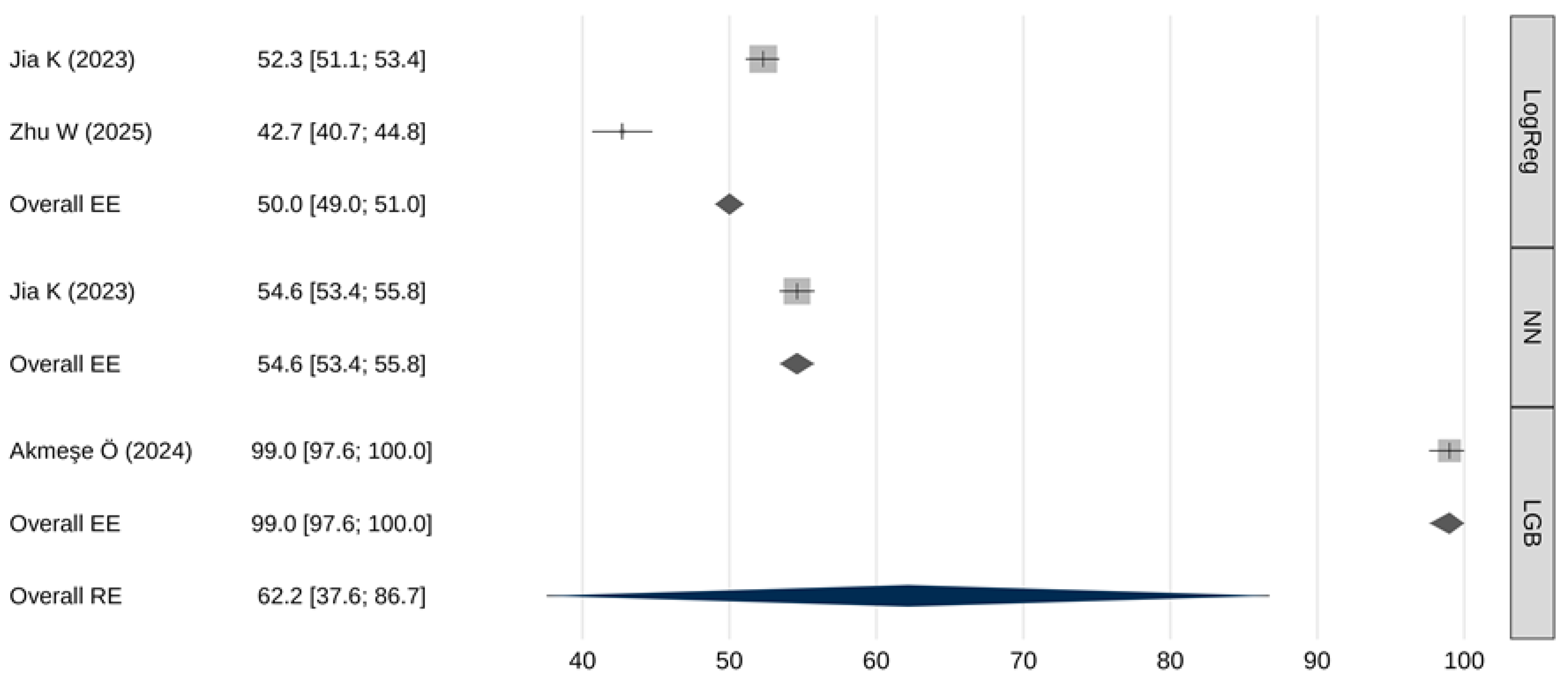
| Model Type | Study | Sensitivity (Se) | 95% CI | Heterogeneity Statistics | |||
|---|---|---|---|---|---|---|---|
| I2 | Q | df | p | ||||
| LogReg | Jia, K. (2023) [26] | 52.3 | 51.1; 53.4 | % | |||
| LogReg | Zhu, W. (2025) [30] | 42.7 | 40.7; 44.8 | % | |||
| LogReg | Overall EE | 50 | 49; 51 | 98.5% | 66.6 | 1 | <0.001 |
| NN | Jia, K. (2023) [26] | 54.6 | 53.4; 55.8 | % | |||
| NN | Overall EE | 54.6 | 53.4; 55.8 | 0% | 0 | 0 | >0.999 |
| LGB | Akmeşe, Ö. (2024) [31] | 99 | 97.6; 100 | % | |||
| LGB | Overall EE | 99 | 97.6; 100 | 0% | 0 | 0 | >0.999 |
| Overall RE | 62.2 | 37.6; 86.7 | % | ||||
| Comparison | Difference i95. | 95% CI | p |
|---|---|---|---|
| NN vs. LogReg | 4.6 | 3.1; 6.1 | <0.001 |
| LGB vs. LogReg | 49 | 47.3; 50.7 | <0.001 |
| LGB vs. NN | 44.4 | 42.6; 46.2 | <0.001 |
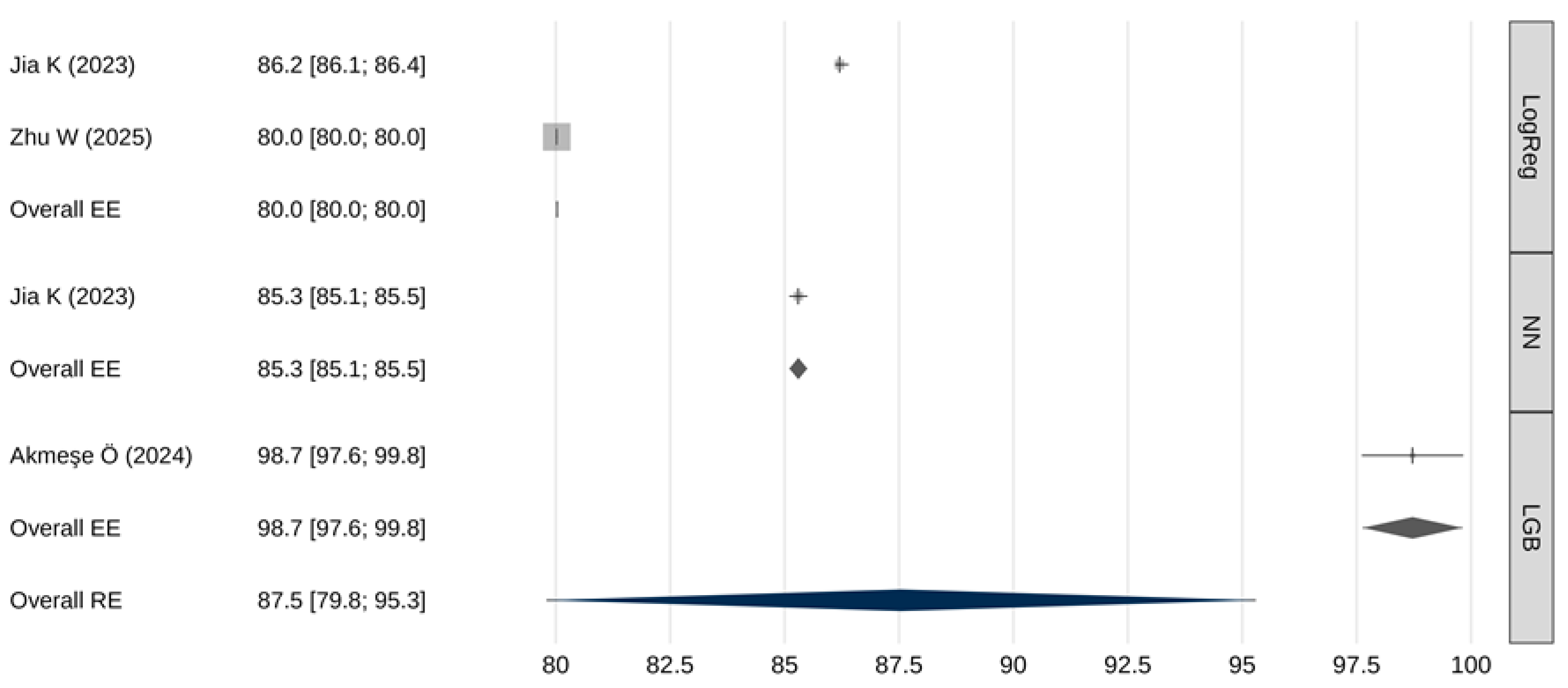
| Model Type | Study | Specificity (Sp) | 95% CI | Heterogeneity Statistics | |||
|---|---|---|---|---|---|---|---|
| I2 | Q | df | p | ||||
| LogReg | Jia, K. (2023) [26] | 86.2 | 86.1; 86.4 | % | |||
| LogReg | Zhu, W. (2025) [30] | 80 | 80; 80 | % | |||
| LogReg | Overall EE | 80 | 80; 80 | 100% | 6782 | 1 | <0.001 |
| NN | Jia, K. (2023) [26] | 85.3 | 85.1; 85.5 | % | |||
| NN | Overall EE | 85.3 | 85.1; 85.5 | 0% | 0 | 0 | >0.999 |
| LGB | Akmeşe, Ö. (2024) [31] | 98.7 | 97.6; 99.8 | % | |||
| LGB | Overall EE | 98.7 | 97.6; 99.8 | 0% | 0 | 0 | >0.999 |
| Overall RE | 87.5 | 79.8; 95.3 | % | ||||
| Comparison | Difference in Specificity (Sp) | 95% CI | p |
|---|---|---|---|
| NN vs. LogReg | 5.3 | 5.1; 5.5 | <0.001 |
| LGB vs. LogReg | 18.7 | 17.6; 19.8 | <0.001 |
| LGB vs. NN | 13.4 | 12.3; 14.5 | <0.001 |
Disclaimer/Publisher’s Note: The statements, opinions and data contained in all publications are solely those of the individual author(s) and contributor(s) and not of MDPI and/or the editor(s). MDPI and/or the editor(s) disclaim responsibility for any injury to people or property resulting from any ideas, methods, instructions or products referred to in the content. |
© 2026 by the authors. Licensee MDPI, Basel, Switzerland. This article is an open access article distributed under the terms and conditions of the Creative Commons Attribution (CC BY) license.
Share and Cite
Makiev, G.G.; Samoylenko, I.V.; Nazarova, V.V.; Magomedova, Z.R.; Tryakin, A.A.; Gevorkyan, T.G. The Efficacy of Electronic Health Record-Based Artificial Intelligence Models for Early Detection of Pancreatic Cancer: A Systematic Review and Meta-Analysis. Cancers 2026, 18, 315. https://doi.org/10.3390/cancers18020315
Makiev GG, Samoylenko IV, Nazarova VV, Magomedova ZR, Tryakin AA, Gevorkyan TG. The Efficacy of Electronic Health Record-Based Artificial Intelligence Models for Early Detection of Pancreatic Cancer: A Systematic Review and Meta-Analysis. Cancers. 2026; 18(2):315. https://doi.org/10.3390/cancers18020315
Chicago/Turabian StyleMakiev, George G., Igor V. Samoylenko, Valeria V. Nazarova, Zahra R. Magomedova, Alexey A. Tryakin, and Tigran G. Gevorkyan. 2026. "The Efficacy of Electronic Health Record-Based Artificial Intelligence Models for Early Detection of Pancreatic Cancer: A Systematic Review and Meta-Analysis" Cancers 18, no. 2: 315. https://doi.org/10.3390/cancers18020315
APA StyleMakiev, G. G., Samoylenko, I. V., Nazarova, V. V., Magomedova, Z. R., Tryakin, A. A., & Gevorkyan, T. G. (2026). The Efficacy of Electronic Health Record-Based Artificial Intelligence Models for Early Detection of Pancreatic Cancer: A Systematic Review and Meta-Analysis. Cancers, 18(2), 315. https://doi.org/10.3390/cancers18020315