Emergent Role of Intra-Tumor Radioactive Implantation in Pancreatic Cancer

Simple Summary
Abstract
1. Introduction
2. Tumor Barriers and Chemoresistance in Pancreatic Cancer
3. Concept of Direct Tumoral Injectional Therapy
4. Radiotherapy in Pancreatic Adenocarcinoma
5. EUS-Guided Intra-Tumoral Brachytherapy: A Targeted Approach
5.1. 125I Radioactive Brachytherapy in Pancreatic Cancer
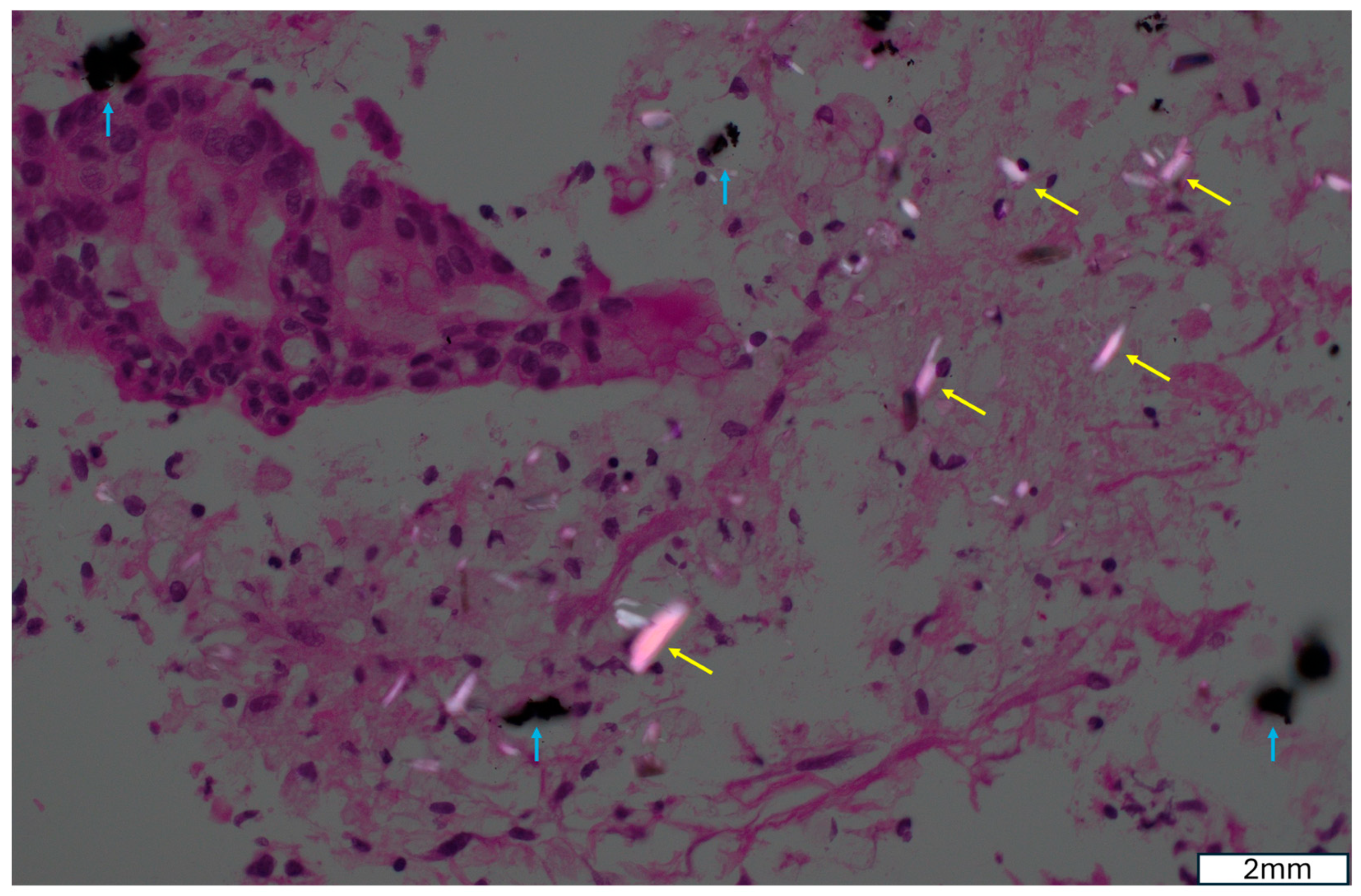
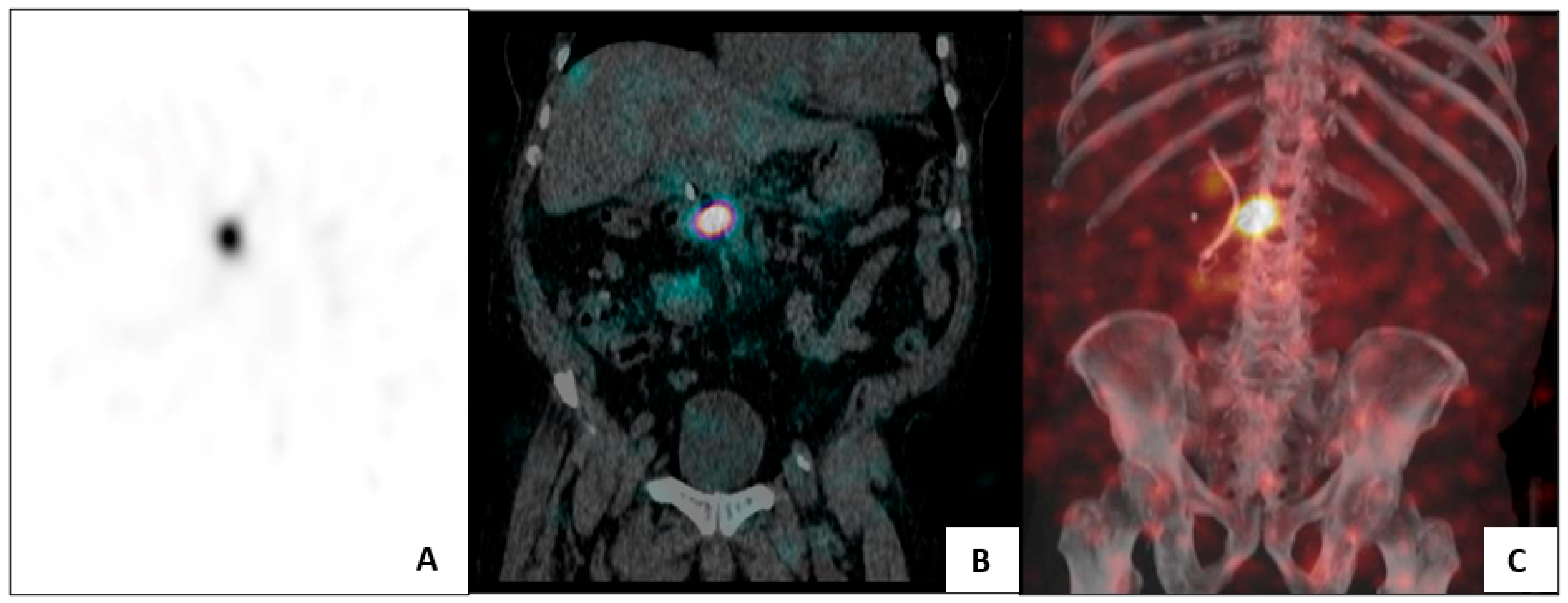
5.2. 32P Microparticle Brachytherapy in Pancreatic Cancer
5.3. Other Radioactive Agents for Brachytherapy in Pancreatic Cancer
5.3.1. Holmium-166 (166Ho) Poly-L-Lactic Acid Microspheres (166HoMS)
5.3.2. Palladium-103 (103Pd)
5.3.3. Yttrium-90 (90Y)
5.3.4. Iridium-192 (192Ir)

| Radioisotope | Half-Life | Radiation Type and Penetration | Typical Dose | Delivery Method | Clinical Stage/Use | Advantages | Limitations |
|---|---|---|---|---|---|---|---|
| 125I [49,50,51,52,53,54,55] | 60 days | γ-rays, moderate penetration (~1–2 cm) | 140–160 Gy | EUS-guided seed implantation | Unresectable PDAC (Stage III–IV) | Long half-life allows sustained radiation | Multiple punctures required; stiff 19G needle; limited survival benefit; risk of pancreatitis |
| 32P [56,57,58,59,60,61,62] | 16 days | β-particles, short penetration (<1 cm) | 100–400 Gy | EUS-guided microparticles | LAPC, metastatic PDAC | High localized dose; minimally invasive; synergistic with concurrent chemo; enhances vascularity | Requires imaging to confirm distribution; limited long-term data |
| 166HoMS [63,64] | 26.8 h | β−, short penetration (~1 cm) | Equivalent high dose rate | Intratumoral injection | Unresectable PDAC (experimental) | High dose rate; multimodality imaging (SPECT/CT/MRI); steep dose fall-off | Very limited human data; efficacy unproven |
| 103Pd [65,66] | 17 days | Low-energy photons, rapid dose fall-off with penetration of 1.7 cm | ~100–115 Gy | Intraoperative interstitial implant | Unresectable PDAC | Favorable dose distribution; palliation of pain | Small studies; no survival benefit; risk of grade ≥ 3 complications |
| 90Y [67,68,69,70,71] | 64.5 h | β-particles, moderate penetration (~5–10 mm) | Variable, high | TARE or EUS-guided intratumoral | Liver metastases from PDAC; unresectable PDAC (experimental) | High local dose; rapid energy delivery; potential for image-guided placement | Mostly preclinical or hepatic metastases; clinical efficacy in pancreatic primary under investigation |
| 192Ir [72] | 73.8 days | γ-rays (5–10 mm) | 20 Gy | Intratumoral injection (intraoperative) | Unresectable PDAC/pain relief | Shown to improve pain and quality of life | Requires surgical catheter placement |
6. Conclusions
Author Contributions
Funding
Data Availability Statement
Conflicts of Interest
References
- Bray, F.; Laversanne, M.; Sung, H.; Ferlay, J.; Siegel, R.L.; Soerjomataram, I.; Jemal, A. Global cancer statistics 2022: GLOBOCAN estimates of incidence and mortality worldwide for 36 cancers in 185 countries. CA Cancer J. Clin. 2024, 74, 229–263. [Google Scholar] [CrossRef]
- Siegel, R.L.; Kratzer, T.B.; Giaquinto, A.N.; Sung, H.; Jemal, A. Cancer statistics, 2025. CA Cancer J. Clin. 2025, 75, 10–45. [Google Scholar] [CrossRef]
- Rawla, P.; Sunkara, T.; Gaduputi, V. Epidemiology of Pancreatic Cancer: Global Trends, Etiology and Risk Factors. World J. Oncol. 2019, 10, 10–27. [Google Scholar] [CrossRef]
- Conroy, T.; Pfeiffer, P.; Vilgrain, V.; Lamarca, A.; Seufferlein, T.; O’reilly, E.; Hackert, T.; Golan, T.; Prager, G.; Haustermans, K.; et al. Pancreatic cancer: ESMO Clinical Practice Guideline for diagnosis, treatment and follow-up. Ann. Oncol. 2023, 34, 987–1002. [Google Scholar] [CrossRef] [PubMed]
- Balaban, E.P.; Mangu, P.B.; Khorana, A.A.; Shah, M.A.; Mukherjee, S.; Crane, C.H.; Javle, M.M.; Eads, J.R.; Allen, P.; Ko, A.H.; et al. Locally Advanced, Unresectable Pancreatic Cancer: American Society of Clinical Oncology Clinical Practice Guideline. J. Clin. Oncol. 2016, 34, 2654–2668. [Google Scholar] [CrossRef]
- Tempero, M.A.; Malafa, M.P.; Al-Hawary, M.; Behrman, S.W.; Benson, A.B.; Cardin, D.B.; Chiorean, E.G.; Chung, V.; Czito, B.; Del Chiaro, M.; et al. Pancreatic Adenocarcinoma, Version 2.2021, NCCN Clinical Practice Guidelines in Oncology. J. Natl. Compr. Cancer Netw. 2021, 19, 439–457. [Google Scholar] [CrossRef] [PubMed]
- Jiang, Y.; Sohal, D.P. Pancreatic Adenocarcinoma Management. JCO Oncol. Pract. 2023, 19, 19–32. [Google Scholar] [CrossRef]
- Quiñonero, F.; Mesas, C.; Doello, K.; Cabeza, L.; Perazzoli, G.; Jimenez-Luna, C.; Rama, A.R.; Melguizo, C.; Prados, J. The challenge of drug resistance in pancreatic ductal adenocarcinoma: A current overview. Cancer Biol. Med. 2019, 16, 688–699. [Google Scholar] [CrossRef] [PubMed]
- Anderson, N.M.; Simon, M.C. The tumor microenvironment. Curr. Biol. 2020, 30, R921–R925. [Google Scholar] [CrossRef]
- Erkan, M.; Adler, G.; Apte, M.V.; Bachem, M.G.; Buchholz, M.; Detlefsen, S.; Esposito, I.; Friess, H.; Gress, T.M.; Habisch, H.J.; et al. StellaTUM: Current consensus and discussion on pancreatic stellate cell research. Gut 2012, 61, 172–178. [Google Scholar] [CrossRef]
- Vaish, U.; Jain, T.; Are, A.C.; Dudeja, V. Cancer-Associated Fibroblasts in Pancreatic Ductal Adenocarcinoma: An Update on Heterogeneity and Therapeutic Targeting. Int. J. Mol. Sci. 2021, 22, 13408. [Google Scholar] [CrossRef]
- De Grandis, M.C.; Ascenti, V.; Lanza, C.; Di Paolo, G.; Galassi, B.; Ierardi, A.M.; Carrafiello, G.; Facciorusso, A.; Ghidini, M. Locoregional Therapies and Remodeling of Tumor Microenvironment in Pancreatic Cancer. Int. J. Mol. Sci. 2023, 24, 12681. [Google Scholar] [CrossRef]
- Ramanathan, R.K.; McDonough, S.L.; Philip, P.A.; Hingorani, S.R.; Lacy, J.; Kortmansky, J.S.; Thumar, J.; Chiorean, E.G.; Shields, A.F.; Behl, D.; et al. Phase IB/II Randomized Study of FOLFIRINOX Plus Pegylated Recombinant Human Hyaluronidase Versus FOLFIRINOX Alone in Patients With Metastatic Pancreatic Adenocarcinoma: SWOG S1313. J. Clin. Oncol. 2019, 37, 1062–1069. [Google Scholar] [CrossRef] [PubMed]
- Van Cutsem, E.; Tempero, M.A.; Sigal, D.; Oh, D.-Y.; Fazio, N.; Macarulla, T.; Hitre, E.; Hammel, P.; Hendifar, A.E.; Bates, S.E.; et al. Randomized Phase III Trial of Pegvorhyaluronidase Alfa With Nab-Paclitaxel Plus Gemcitabine for Patients With Hyaluronan-High Metastatic Pancreatic Adenocarcinoma. J. Clin. Oncol. 2020, 38, 3185–3194. [Google Scholar] [CrossRef]
- Mulvihill, S.; Warren, R.; Venook, A.; Adler, A.; Randlev, B.; Heise, C.; Kirn, D. Safety and feasibility of injection with an E1B-55 kDa gene-deleted, replication-selective adenovirus (ONYX-015) into primary carcinomas of the pancreas: A phase I trial. Gene Ther. 2001, 8, 308–315. [Google Scholar] [CrossRef]
- Sooklal, S.; Chahal, P. Endoscopic Ultrasound. Surg. Clin. N. Am. 2020, 100, 1133–1150. [Google Scholar] [CrossRef] [PubMed]
- Levy, M.J.; Alberts, S.R.; Bamlet, W.R.; Burch, P.A.; Farnell, M.B.; Gleeson, F.C.; Haddock, M.G.; Kendrick, M.L.; Oberg, A.L.; Petersen, G.M.; et al. EUS-guided fine-needle injection of gemcitabine for locally advanced and metastatic pancreatic cancer. Gastrointest. Endosc. 2017, 86, 161–169. [Google Scholar] [CrossRef]
- Song, T.J.; Seo, D.W.; Lakhtakia, S.; Reddy, N.; Oh, D.W.; Park, D.H.; Lee, S.S.; Lee, S.K.; Kim, M.-H. Initial experience of EUS-guided radiofrequency ablation of unresectable pancreatic cancer. Gastrointest. Endosc. 2016, 83, 440–443. [Google Scholar] [CrossRef] [PubMed]
- Crinò, S.F.; D’oNofrio, M.; Bernardoni, L.; Frulloni, L.; Iannelli, M.; Malleo, G.; Paiella, S.; Larghi, A.; Gabbrielli, A. EUS-guided Radiofrequency Ablation (EUS-RFA) of Solid Pancreatic Neoplasm Using an 18-gauge Needle Electrode: Feasibility, Safety, and Technical Success. J. Gastrointest. Liver Dis. 2018, 27, 67–72. [Google Scholar] [CrossRef]
- Kongkam, P.; Tantitanawat, K.; Kerr, S.; Lopimpisuth, C.; Tiankanon, K.; Angsuwatcharakon, P.; Ridtitid, W.; Mekaroonkamol, P.; Teeyapun, N.; Tanasanvimon, S.; et al. One-year survival rate of unresectable pancreatic cancer size 4 cm or smaller treated with or without EUS-radiofrequency ablation. Gastrointest. Endosc. 2025, 102, 883–887. [Google Scholar] [CrossRef]
- Oh, D.; Seo, D.-W.; Song, T.J.; Park, D.H.; Lee, S.K.; Kim, M.-H. Clinical outcomes of EUS-guided radiofrequency ablation for unresectable pancreatic cancer. Endosc. Ultrasound 2022, 11, 68–74. [Google Scholar] [CrossRef]
- Scopelliti, F.; Pea, A.; Conigliaro, R.; Butturini, G.; Frigerio, I.; Regi, P.; Giardino, A.; Bertani, H.; Paini, M.; Pederzoli, P.; et al. Technique, safety, and feasibility of EUS-guided radiofrequency ablation in unresectable pancreatic cancer. Surg. Endosc. 2018, 32, 4022–4028. [Google Scholar] [CrossRef]
- Thosani, N.; Cen, P.; Rowe, J.; Guha, S.; Bailey-Lundberg, J.M.; Bhakta, D.; Patil, P.; Wray, C.J. Endoscopic ultrasound-guided radiofrequency ablation (EUS-RFA) for advanced pancreatic and periampullary adenocarcinoma. Sci. Rep. 2022, 12, 1–7. [Google Scholar] [CrossRef]
- Tiankanon, K.; Kongkam, P.; Orprayoon, T.; Luangsukrerk, T.; Seo, D.; Sriuranpong, V.; Nantavithya, C.; Jantarattana, T.; Cañones, A.; Angsuwatcharakon, P.; et al. EUS-guided radiofrequency ablation plus chemotherapy versus chemotherapy alone for unresectable pancreatic cancer (ERAP): Preliminary results of a prospective comparative study. Endoscopy 2019, 51, S59. [Google Scholar] [CrossRef]
- Khoury, T.; Sbeit, W.; Napoléon, B. Endoscopic ultrasound guided radiofrequency ablation for pancreatic tumors: A critical review focusing on safety, efficacy and controversies. World J. Gastroenterol. 2023, 29, 157–170. [Google Scholar] [CrossRef]
- Chang, K.J.; Nguyen, P.T.; Thompson, J.A.; Kurosaki, T.T.; Casey, L.R.; Leung, E.C.; Granger, G.A. Phase I clinical trial of allogeneic mixed lymphocyte culture (cytoimplant) delivered by endoscopic ultrasound?guided fine-needle injection in patients with advanced pancreatic carcinoma. Cancer 2000, 88, 1325–1335. [Google Scholar] [CrossRef]
- Hecht, J.R.; Bedford, R.; Abbruzzese, J.L.; Lahoti, S.; Reid, T.R.; Soetikno, R.M.; Kirn, D.H.; Freeman, S.M. A phase I/II trial of intratumoral endoscopic ultrasound injection of ONYX-015 with intravenous gemcitabine in unresectable pancreatic carcinoma. Clin. Cancer Res. 2003, 9, 555–561. [Google Scholar]
- Hecht, J.R.; Farrell, J.J.; Senzer, N.; Nemunaitis, J.; Rosemurgy, A.; Chung, T.; Hanna, N.; Chang, K.J.; Javle, M.; Posner, M.; et al. EUS or percutaneously guided intratumoral TNFerade biologic with 5-fluorouracil and radiotherapy for first-line treatment of locally advanced pancreatic cancer: A phase I/II study. Gastrointest. Endosc. 2012, 75, 332–338. [Google Scholar] [CrossRef] [PubMed]
- Herman, J.M.; Wild, A.T.; Wang, H.; Tran, P.T.; Chang, K.J.; Taylor, G.E.; Donehower, R.C.; Pawlik, T.M.; Ziegler, M.A.; Cai, H.; et al. Randomized Phase III Multi-Institutional Study of TNFerade Biologic With Fluorouracil and Radiotherapy for Locally Advanced Pancreatic Cancer: Final Results. J. Clin. Oncol. 2013, 31, 886–894. [Google Scholar] [CrossRef] [PubMed]
- Hirooka, Y.; Itoh, A.; Kawashima, H.; Hara, K.; Nonogaki, K.; Kasugai, T.; Ohno, E.; Ishikawa, T.; Matsubara, H.; Ishigami, M.; et al. A Combination Therapy of Gemcitabine With Immunotherapy for Patients With Inoperable Locally Advanced Pancreatic Cancer. Pancreas 2009, 38, e69–e74. [Google Scholar] [CrossRef] [PubMed]
- Hirooka, Y.; Kasuya, H.; Ishikawa, T.; Kawashima, H.; Ohno, E.; Villalobos, I.B.; Naoe, Y.; Ichinose, T.; Koyama, N.; Tanaka, M.; et al. A Phase I clinical trial of EUS-guided intratumoral injection of the oncolytic virus, HF10 for unresectable locally advanced pancreatic cancer. BMC Cancer 2018, 18, 596. [Google Scholar] [CrossRef]
- Hirooka, Y.; Kawashima, H.; Ohno, E.; Ishikawa, T.; Kamigaki, T.; Goto, S.; Takahara, M.; Goto, H. Comprehensive immunotherapy combined with intratumoral injection of zoledronate-pulsed dendritic cells, intravenous adoptive activated T lymphocyte and gemcitabine in unresectable locally advanced pancreatic carcinoma: A phase I/II trial. Oncotarget 2017, 9, 2838–2847. [Google Scholar] [CrossRef]
- Irisawa, A.; Takagi, T.; Kanazawa, M.; Ogata, T.; Sato, Y.; Takenoshita, S.-I.; Ohto, H.; Ohira, H. Endoscopic Ultrasound-Guided Fine-Needle Injection of Immature Dendritic Cells Into Advanced Pancreatic Cancer Refractory to Gemcitabine. Pancreas 2007, 35, 189–190. [Google Scholar] [CrossRef] [PubMed]
- Xu, Y.; Chen, J.; Qiu, Y.; Du, J. Radiotherapy and immune microenvironment crosstalk in pancreatic cancer: A comprehensive review of current insights and future directions. Front. Immunol. 2025, 16, 1619946. [Google Scholar] [CrossRef]
- Costa, A.D.; Väyrynen, S.A.; Chawla, A.; Zhang, J.; Väyrynen, J.P.; Lau, M.C.; Williams, H.L.; Yuan, C.; Morales-Oyarvide, V.; Elganainy, D.; et al. Neoadjuvant Chemotherapy Is Associated with Altered Immune Cell Infiltration and an Anti-Tumorigenic Microenvironment in Resected Pancreatic Cancer. Clin. Cancer Res. 2022, 28, 5167–5179. [Google Scholar] [CrossRef] [PubMed]
- Salamekh, S.; Gottumukkala, S.; Park, C.; Lin, M.-H.; Sanford, N.N. Radiotherapy for Pancreatic Adenocarcinoma. Hematol. Clin. N. Am. 2022, 36, 995–1009. [Google Scholar] [CrossRef]
- Yasuda, S.; Nagai, M.; Nakamura, K.; Matsuo, Y.; Sho, M. Role of radiotherapy in surgical approaches to pancreatic cancer treatment: A narrative review. Ann. Gastroenterol. Surg. 2025, 9, 418–428. [Google Scholar] [CrossRef]
- Malla, M.; Fekrmandi, F.; Malik, N.; Hatoum, H.; George, S.; Goldberg, R.M.; Mukherjee, S. The evolving role of radiation in pancreatic cancer. Front. Oncol. 2023, 12, 1060885. [Google Scholar] [CrossRef]
- Ermongkonchai, T.; Khor, R.; Muralidharan, V.; Tebbutt, N.; Lim, K.; Kutaiba, N.; Ng, S.P. Stereotactic radiotherapy and the potential role of magnetic resonance-guided adaptive techniques for pancreatic cancer. World J. Gastroenterol. 2022, 28, 745–754. [Google Scholar] [CrossRef] [PubMed]
- Ejlsmark, M.W.; Bahij, R.; Schytte, T.; Hansen, C.R.; Bertelsen, A.; Mahmood, F.; Mortensen, M.B.; Detlefsen, S.; Weber, B.; Bernchou, U.; et al. Adaptive MRI-guided stereotactic body radiation therapy for locally advanced pancreatic cancer—A phase II study. Radiother. Oncol. 2024, 197, 110347. [Google Scholar] [CrossRef]
- Tchelebi, L.T.; Lehrer, E.J.; Trifiletti, D.M.; Sharma, N.K.; Gusani, N.J.; Crane, C.H.; Zaorsky, N.G. Conventionally fractionated radiation therapy versus stereotactic body radiation therapy for locally advanced pancreatic cancer (CRiSP): An international systematic review and meta-analysis. Cancer 2020, 126, 2120–2131. [Google Scholar] [CrossRef]
- Cazacu, I.M.; Singh, B.S.; Martin-Paulpeter, R.M.; Beddar, S.; Chun, S.; Holliday, E.B.; Koong, A.C.; Das, P.; Koay, E.J.; Taniguchi, C.; et al. Endoscopic Ultrasound-Guided Fiducial Placement for Stereotactic Body Radiation Therapy in Patients with Pancreatic Cancer. Cancers 2023, 15, 5355. [Google Scholar] [CrossRef]
- Kerdsirichairat, T.; Shin, E.J. Role of endoscopic ultrasonography guided fiducial marker placement in gastrointestinal cancer. Curr. Opin. Gastroenterol. 2020, 36, 402–408. [Google Scholar] [CrossRef]
- Sanders, M.K.; Moser, A.J.; Khalid, A.; Fasanella, K.E.; Zeh, H.J.; Burton, S.; McGrath, K. EUS-guided fiducial placement for stereotactic body radiotherapy in locally advanced and recurrent pancreatic cancer. Gastrointest. Endosc. 2010, 71, 1178–1184. [Google Scholar] [CrossRef]
- Mills, B.N.; Qiu, H.; Drage, M.G.; Chen, C.; Mathew, J.S.; Garrett-Larsen, J.; Ye, J.; Uccello, T.P.; Murphy, J.D.; Belt, B.A.; et al. Modulation of the Human Pancreatic Ductal Adenocarcinoma Immune Microenvironment by Stereotactic Body Radiotherapy. Clin. Cancer Res. 2021, 28, 150–162. [Google Scholar] [CrossRef] [PubMed]
- DeNittis, A.S.; Stambaugh, M.D.; Lang, P.; Wallner, P.E.; Lustig, R.A.; Dillman, R.O.; Order, S.E. Complete Remission of Nonresectable Pancreatic Cancer After Infusional Colloidal Phosphorus-32 Brachytherapy, External Beam Radiation Therapy, and 5-Fluorouracil. Am. J. Clin. Oncol. 1999, 22, 355–360. [Google Scholar] [CrossRef]
- Han, J.; Chang, K.J. Endoscopic Ultrasound-Guided Direct Intervention for Solid Pancreatic Tumors. Clin. Endosc. 2017, 50, 126–137. [Google Scholar] [CrossRef]
- Larghi, A.; Rimbaș, M.; Rizzatti, G.; Carbone, C.; Gasbarrini, A.; Costamagna, G.; Alfieri, S.; Tortora, G. Endoscopic ultrasound-guided therapies for pancreatic solid tumors: An overview. Semin. Oncol. 2021, 48, 95–105. [Google Scholar] [CrossRef]
- Wei, S.; Li, C.; Li, M.; Xiong, Y.; Jiang, Y.; Sun, H.; Qiu, B.; Lin, C.J.; Wang, J. Radioactive Iodine-125 in Tumor Therapy: Advances and Future Directions. Front. Oncol. 2021, 11, 717180. [Google Scholar] [CrossRef] [PubMed]
- Jin, Z.; Du, Y.; Li, Z.; Jiang, Y.; Chen, J.; Liu, Y. Endoscopic ultrasonography-guided interstitial implantation of iodine 125-seeds combined with chemotherapy in the treatment of unresectable pancreatic carcinoma: A prospective pilot study. Endoscopy 2008, 40, 314–320. [Google Scholar] [CrossRef] [PubMed]
- Sun, S.; Xu, H.; Xin, J.; Liu, J.; Guo, Q.; Li, S. Endoscopic Ultrasound-Guided Interstitial Brachytherapy of Unresectable Pancreatic Cancer: Results of a Pilot Trial. Endoscopy 2006, 38, 399–403. [Google Scholar] [CrossRef]
- Sun, X.; Lu, Z.; Wu, Y.; Min, M.; Bi, Y.; Shen, W.; Xu, Y.; Li, Z.; Jin, Z.; Liu, Y. An endoscopic ultrasonography-guided interstitial brachytherapy based special treatment-planning system for unresectable pancreatic cancer. Oncotarget 2017, 8, 79099–79110. [Google Scholar] [CrossRef]
- Du, Y.-Q.; Jin, Z.; Meng, H.; Zou, D.; Chen, J.; Liu, Y.; Zhan, X.; Wang, D.; Liao, Z.; Li, Z. Long-term effect of gemcitabine-combined endoscopic ultrasonography-guided brachytherapy in pancreatic cancer. J Interv Gastroenterol. 2013, 3, 18–24. [Google Scholar] [CrossRef]
- Han, Q.; Deng, M.; Lv, Y.; Dai, G. Survival of patients with advanced pancreatic cancer after iodine125 seeds implantation brachytherapy. Medicine 2017, 96, e5719. [Google Scholar] [CrossRef] [PubMed]
- Lim, A.H.; Sukocheva, O.; Bednarz, J.; Bartholomeusz, D.; Rayner, C.K.; Tse, E.; Nguyen, N.Q. Impact of Different Modalities of Radiotherapy in Locally Advanced Pancreatic Cancer: A Review and Meta-Analysis. J. Gastroenterol. Hepatol. 2025, 40, 2413–2424. [Google Scholar] [CrossRef]
- Gholami, Y.H.; Wilson, N.; James, D.; Kuncic, Z. Toward Personalized Dosimetry with 32 P Microparticle Therapy for Advanced Pancreatic Cancer. Int. J. Radiat. Oncol. 2017, 99, 1029–1038. [Google Scholar] [CrossRef]
- Ross, P.; Wasan, H.; Croagh, D.; Nikfarjam, M.; Nguyen, N.; Aghmesheh, M.; Nagrial, A.; Bartholomeusz, D.; Hendlisz, A.; Ajithkumar, T.; et al. Results of a single-arm pilot study of 32P microparticles in unresectable locally advanced pancreatic adenocarcinoma with gemcitabine/nab-paclitaxel or FOLFIRINOX chemotherapy. ESMO Open 2021, 7, 100356. [Google Scholar] [CrossRef] [PubMed]
- Lim, A.H.; Nitchingham, D.; Bednarz, J.; Bills, M.; Lanka, L.; Allen, B.; Tan, A.; Joshi, R.; Hsieh, W.; Crouch, B.; et al. Combined phosphorus-32 implantation and chemotherapy versus chemotherapy alone for locally advanced pancreatic cancer: A propensity score–weighted landmark analysis. Gastrointest. Endosc. 2025, 103, 126–135.e5. [Google Scholar] [CrossRef] [PubMed]
- Lim, A.H.; Ali, F.; Zobel, J.; Safaeian, R.; Phan, V.-A.; Singhal, N.; Bartholomeusz, D.; Jin, A.; Rayner, C.K.; Tse, E.; et al. Tu1372: Comparison of combined chemotherapy and stereotactic body radiation therapy with combined chemotherapy and phosphorus-32 microparticle intra-tumoural implantation in patients with locally advanced pancreatic adenocarcinoma. Gastroenterology 2025, 169, S-1409. [Google Scholar] [CrossRef]
- Lim, A.H.W.; Zobel, J.; Bills, M.; Hsieh, W.; Crouch, B.; Joshi, R.; Thomson, J.-E.; Neo, E.; Kuan, L.L.; Safaeian, R.; et al. The Impact of Combined Chemotherapy and Intra-Tumoural Injection of Phosphorus-32 Microparticles on Vascularity in Locally Advanced Pancreatic Carcinoma. Cancers 2024, 16, 3412. [Google Scholar] [CrossRef]
- Naidu, J.; Bartholomeusz, D.; Zobel, J.; Safaeian, R.; Hsieh, W.; Crouch, B.; Ho, K.; Calnan, D.; Singhal, N.; Ruszkiewicz, A.; et al. Combined chemotherapy and endoscopic ultrasound-guided intratumoral 32P implantation for locally advanced pancreatic adenocarcinoma: A pilot study. Endoscopy 2021, 54, 75–80. [Google Scholar] [CrossRef]
- Lim, A.H.W.; Singhal, N.; Bartholomeusz, D.; Zobel, J.; Naidu, J.; Hsieh, W.; Crouch, B.; Wasan, H.; Croagh, D.; Nagrial, A.; et al. Outcomes of phosphorus-32 microparticle intratumoral implantation added to chemotherapy in patients with metastatic pancreatic adenocarcinoma. iGIE 2024, 3, 373–381. [Google Scholar] [CrossRef]
- Klaassen, N.J.M.; Arntz, M.J.; Gil Arranja, A.; Roosen, J.; Nijsen, J.F.W. The various therapeutic applications of the medical isotope holmium-166: A narrative review. EJNMMI Radiopharm. Chem. 2019, 4, 19. [Google Scholar] [CrossRef]
- Willink, C.Y.; Jenniskens, S.F.; Stommel, M.W.; Janssen, M.J.; Hermans, J.J.; Westdorp, H.; van Laarhoven, C.J.; Fütterer, J.J.; Nijsen, J.F.W. Intratumoral Holmium-166 Microsphere Injection in Patients with Unresectable Pancreatic Ductal Adenocarcinoma: A Single-Center, Single-Arm, Open-Label Feasibility and Safety Study. Dig. Surg. 2025, 42, 136–145. [Google Scholar] [CrossRef] [PubMed]
- Nori, D.; Merimsky, O.; Osian, A.D.; Heffernan, M.; Cortes, E.; Turner, J.W. Palladium-103: A new radioactive source in the treatment of unresectable carcinoma of the pancreas: A phase I–II study. J. Surg. Oncol. 1996, 61, 300–305. [Google Scholar] [CrossRef]
- Raben, A.; Mychalczak, B.; Brennan, M.F.; Minsky, B.; Anderson, L.; Casper, E.S.; Harrison, L.B. Feasibility study of the treatment of primary unresectable carcinoma of the pancreas with 103PD brachytherapy. Int. J. Radiat. Oncol. 1996, 35, 351–356. [Google Scholar] [CrossRef]
- Salem, R.; Gordon, A.C.; Mouli, S.; Hickey, R.; Kallini, J.; Gabr, A.; Mulcahy, M.F.; Baker, T.; Abecassis, M.; Miller, F.H.; et al. Y90 Radioembolization Significantly Prolongs Time to Progression Compared With Chemoembolization in Patients With Hepatocellular Carcinoma. Gastroenterology 2016, 151, 1155–1163.e2. [Google Scholar] [CrossRef]
- Kayaleh, R.; Krzyston, H.; Rishi, A.; Naziri, J.; Frakes, J.; Choi, J.; El-Haddad, G.; Parikh, N.; Sweeney, J.; Kis, B. Transarterial Radioembolization Treatment of Pancreatic Cancer Patients with Liver-Dominant Metastatic Disease Using Yttrium-90 Glass Microspheres: A Single-Institution Retrospective Study. J. Vasc. Interv. Radiol. 2020, 31, 1060–1068. [Google Scholar] [CrossRef]
- Kim, A.Y.; Frantz, S.; Brower, J.; Akhter, N. Radioembolization with Yttrium-90 Microspheres for the Treatment of Liver Metastases of Pancreatic Adenocarcinoma: A Multicenter Analysis. J. Vasc. Interv. Radiol. 2019, 30, 298–304.e2. [Google Scholar] [CrossRef] [PubMed]
- Michl, M.; Haug, A.; Jakobs, T.; Paprottka, P.; Hoffmann, R.-T.; Bartenstein, P.; Boeck, S.; Haas, M.; Laubender, R.; Heinemann, V. Radioembolization with Yttrium-90 Microspheres (SIRT) in Pancreatic Cancer Patients with Liver Metastases: Efficacy, Safety and Prognostic Factors. Oncology 2013, 86, 24–32. [Google Scholar] [CrossRef]
- Zhao, Y.; Yang, Y.; Zhang, B.; Cui, H.; Liu, L.; Wang, R.; Han, Y.; Zhu, D.; Ma, W.; Zhang, X.; et al. Endoscopic Ultrasound-Guided Brachytherapy of Yttrium-90 Implantation Into Pancreas: A Dose-Escalation Pilot Study. Medcomm 2025, 6, e70117. [Google Scholar] [CrossRef] [PubMed]
- Waniczek, D.; Piecuch, J.; Rudzki, M.; Mikusek, W.; Arendt, J.; Białas, B. Clinical Investigations Perioperative high dose rate (HDR) brachytherapy in unresectable locally advanced pancreatic tumors. J. Contemp. Brachytherapy 2011, 2, 84–90. [Google Scholar] [CrossRef] [PubMed]


| Modalities | Types of Study | Patient Group | Intra-Tumor Therapy | Additional Therapy | Response Outcome | Median Survival (Months) |
|---|---|---|---|---|---|---|
| Chemotherapy | ||||||
| Levy M et al. (2017) [17] | Prospective | Stage II, III, IV | Gemcitabine | 5-FU with or without RT | PR 25% SD 57% Downstaging with resection 20% (4/20 patients of stage III disease) | 10.4 |
| Radiofrequency ablation (RFA) | ||||||
| Song et al. (2016) [18] | Prospective | LAPC and mPDAC | RFA 20–50 W | 50% with Gemcitabine | Technically feasible and safe | NR |
| Crino SF et al. (2018) [19] | Prospective | LAPC | RFA 30 W | Standard CTX with or without RT | Mean volume reduction 30% of tumor mass | NR |
| Scopelliti F et al. (2018) [22] | Prospective | LAPC | RFA 30 W (> 3 cm) or 20 W (<3 cm) | Standard CTX with or without RT | Tumor size reduction 50% | NR |
| Thosani N et al. (2022) [23] | Prospective | LAPC and mPDAC | RFA 15–20 W up to 4 sessions | Standard CTX | 7/10 patients with tumor progression 1/10 downstaging with R0 resection | 13.4 |
| Oh D et al. (2022) [21] | Prospective | LAPC and mPDAC | RFA 50 W | Standard CTX | Local progression free 6.83 months | 24.03 |
| Tiankanon K et al. (2019) [24] | Prospective, open-labeled | LAPC | RFA 50 W | Standard CTX with RFA vs. CTX alone | No significant tumor size in median maximal tumor diameter between both groups | Survival rate 70% at 6 months |
| Kongkam P et al. (2025) [20] | Prospective, propensity score matched | LAPC | RFA 50 W | Standard CTX with RFA vs. CTX alone | Hazard ratio 0.5, p = 0.03 Survival probability at 12 months 58% in EUS-RFA compared to 22% for controls | 13.4 |
| Immune-induced local therapy | ||||||
| Chang KJ et al. (2000) [26] | Prospective | Stage II, III, IV | Mixed lymphocyte culture | None | PR 25% Minor response 1% | 13.2 |
| Irisawa A et al. (2007) [33] | Prospective | Stage IV | Immature DCs | RT | SD 26% Minor response 26% | 9.9 |
| Hirooka Y et al. (2009) [30] | Prospective | Stage III | OK-432 primed immature DCs | Gemcitabine, CD3-LAK antibodies | SD 40% PR 20% | 15.9 |
| Hirooka Y et al. (2017) [32] | Prospective | LAPC | Zolendronate-pulsed immature DCs | Gemcitabine, αβ T cells | SD 40% | 11.5 |
| Gene-induced local therapy | ||||||
| Hecht JR et al. (2003) [27] | Prospective | Stage III and IV | ONYX-15 (adenovirus) | Gemcitabine | PR 9.5% (2/21) Minor response 9.5% (2/21) SD 28.6% (6/11) | 7.5 |
| Hecht JR et al. (2012) [28] | Prospective | LAPC | TNFerade | 5-FU, external RT | CR 2% (1/50) PR 6% (3/50) SD 34% (12/50) | 9.9 |
| Herman JM et al. (2013) [29] | RCT | LAPC | TNFerade | 5-FU, RT, gemcitabine ± erlotinib | No difference in local control | 10 |
| Hirooka Y et al. (2018) [31] | Single arm, open-label Phase I trial | Stage III | HF10 Oncolytic virus | Erlotinib and gemcitabine | PR 30% SD40% PD 20% Downstaging with resection 20% | 15.5 |
| Feature | SBRT (Stereotactic Body Radiotherapy) | 32P EUS-Guided Brachytherapy |
|---|---|---|
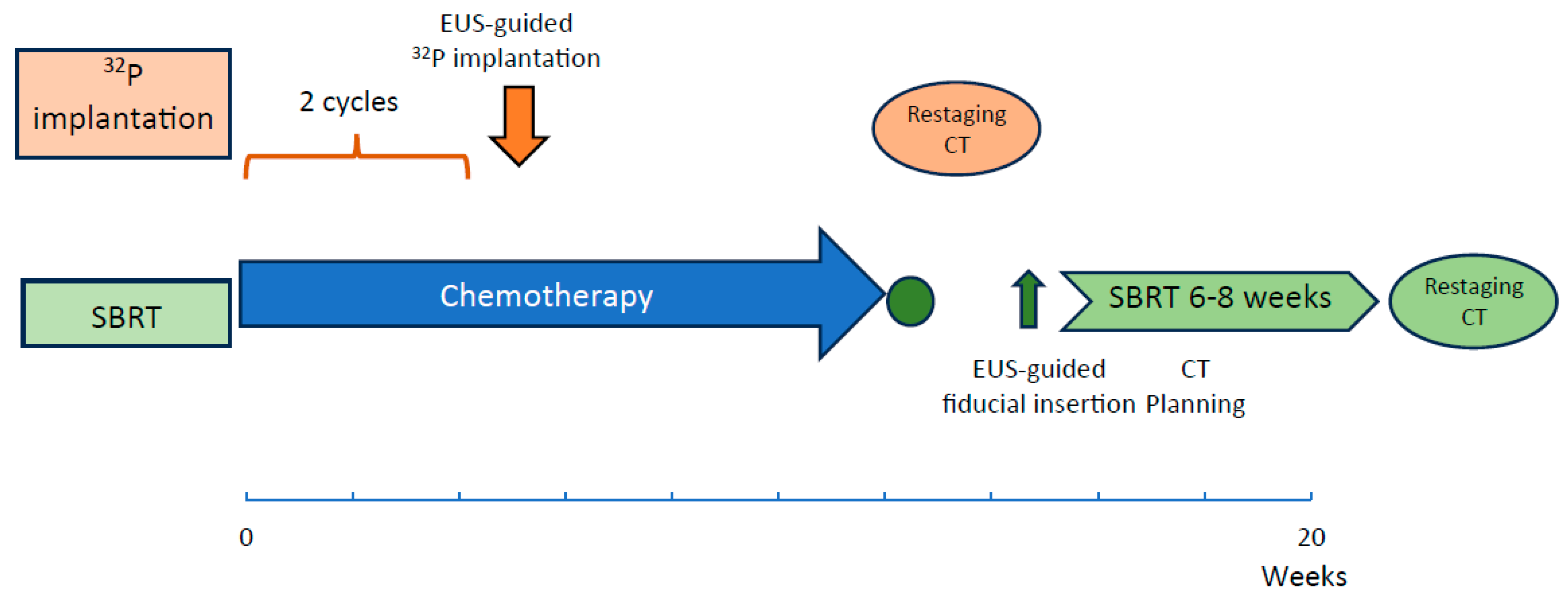
| Timing with Chemotherapy | Usually delivered after completion of systemic chemotherapy | Can be implanted early, during initial chemotherapy cycles, allowing concurrent therapy |
| Radiation Dose | Typically 40–50 Gy (external beam) | Higher localized dose: 100–400 Gy directly to tumor |
| Radiation Delivery | External beam, penetrates surrounding tissues | Beta radiation with short penetration (<1 cm), minimizing exposure to adjacent organs |
| Procedure | Requires fiducial markers, CT planning, and multiple sessions (3–5 fractions) | Single-session EUS-guided implantation using microparticles |
| Treatment Delay | Planning and fiducial placement can delay restaging or surgery | Minimal delay; systemic chemotherapy can resume soon after implantation |
| Tumor Microenvironment | May induce immunogenic cell death but limited effect on vascularity or stromal barrier | May enhance microvascular flow and overcome dense stroma, improving chemotherapy delivery |
| Surgical Conversion Potential | Limited; performed after chemotherapy | Higher downstaging and resection rates observed when combined with chemotherapy |
| Monitoring | Imaging-based assessment post-treatment | Bremsstrahlung imaging or SPECT-CT immediately after implantation for precise localization |
| Side Effects | Risk of radiation-induced injury to adjacent organs; grade 3–4 toxicity up to 37.7% | Generally safe; minor self-limited events, serious procedure-related complications rare (<10%) |
| Local Control | Good but limited by dose constraints | High local control rates reported (up to 100% at 3 months in metastatic PDAC) |
Disclaimer/Publisher’s Note: The statements, opinions and data contained in all publications are solely those of the individual author(s) and contributor(s) and not of MDPI and/or the editor(s). MDPI and/or the editor(s) disclaim responsibility for any injury to people or property resulting from any ideas, methods, instructions or products referred to in the content. |
© 2026 by the authors. Licensee MDPI, Basel, Switzerland. This article is an open access article distributed under the terms and conditions of the Creative Commons Attribution (CC BY) license.
Share and Cite
Durongpongkasem, P.; Lim, A.H.; Nguyen, N.Q. Emergent Role of Intra-Tumor Radioactive Implantation in Pancreatic Cancer. Cancers 2026, 18, 302. https://doi.org/10.3390/cancers18020302
Durongpongkasem P, Lim AH, Nguyen NQ. Emergent Role of Intra-Tumor Radioactive Implantation in Pancreatic Cancer. Cancers. 2026; 18(2):302. https://doi.org/10.3390/cancers18020302
Chicago/Turabian StyleDurongpongkasem, Pathipat, Amanda H. Lim, and Nam Q. Nguyen. 2026. "Emergent Role of Intra-Tumor Radioactive Implantation in Pancreatic Cancer" Cancers 18, no. 2: 302. https://doi.org/10.3390/cancers18020302
APA StyleDurongpongkasem, P., Lim, A. H., & Nguyen, N. Q. (2026). Emergent Role of Intra-Tumor Radioactive Implantation in Pancreatic Cancer. Cancers, 18(2), 302. https://doi.org/10.3390/cancers18020302