Prognostic Value of Phosphatidylinositol-3 Kinase p110 α Protein Expression in Patients with Stage I–III Invasive Breast Cancer
 ,
,
Simple Summary
Abstract
1. Introduction
2. Methods
2.1. Study Population
2.2. Follow-Up
2.3. Immunohistochemistry (IHC)
2.4. External Validation Using Gene Expression Data
2.5. Statistical Analysis
3. Results
3.1. Patient Characteristics
3.2. Association Between p110α Protein Expression and Patient Prognosis
3.3. Univariate and Multivariate Cox Regression Analyses
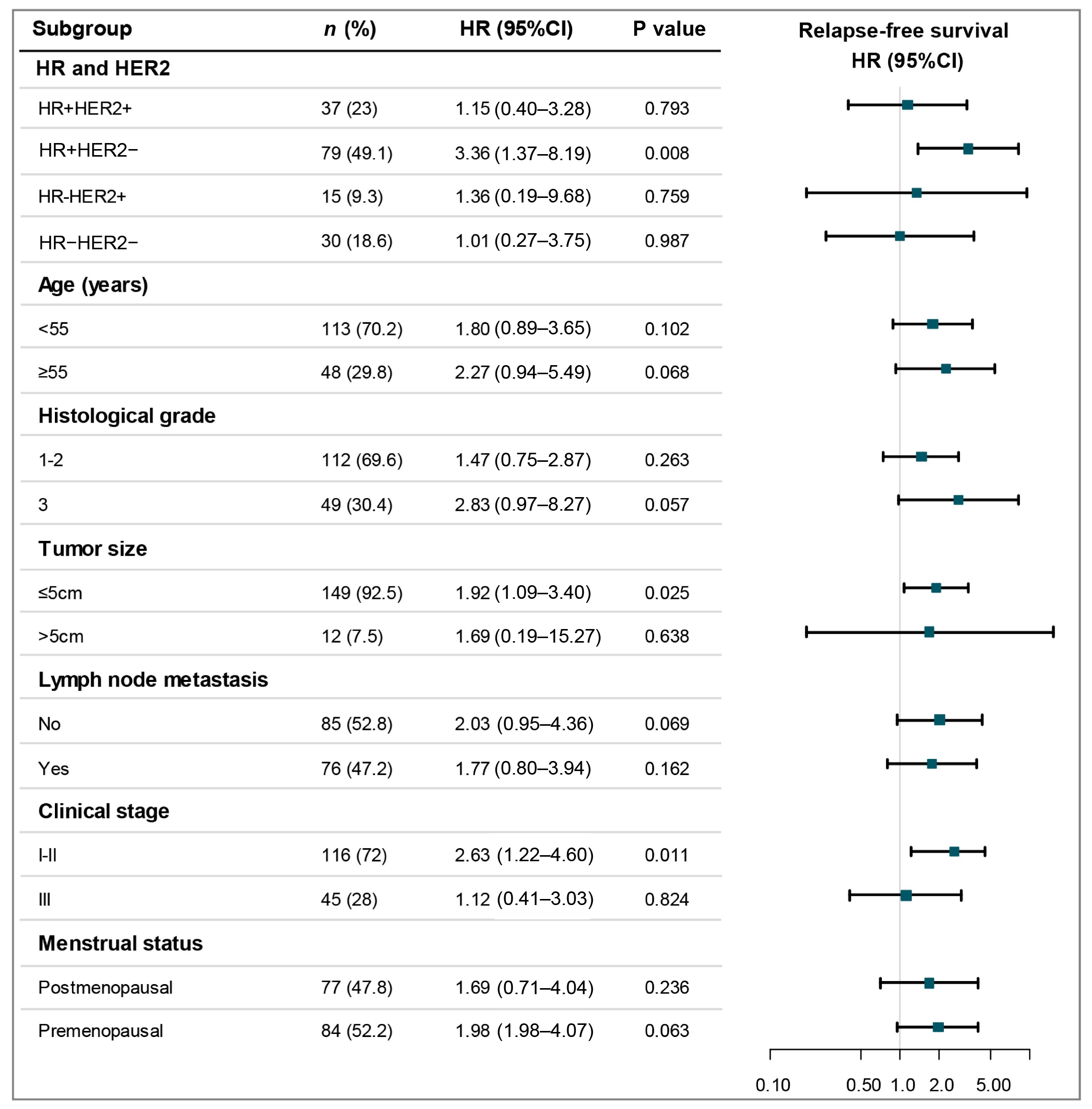
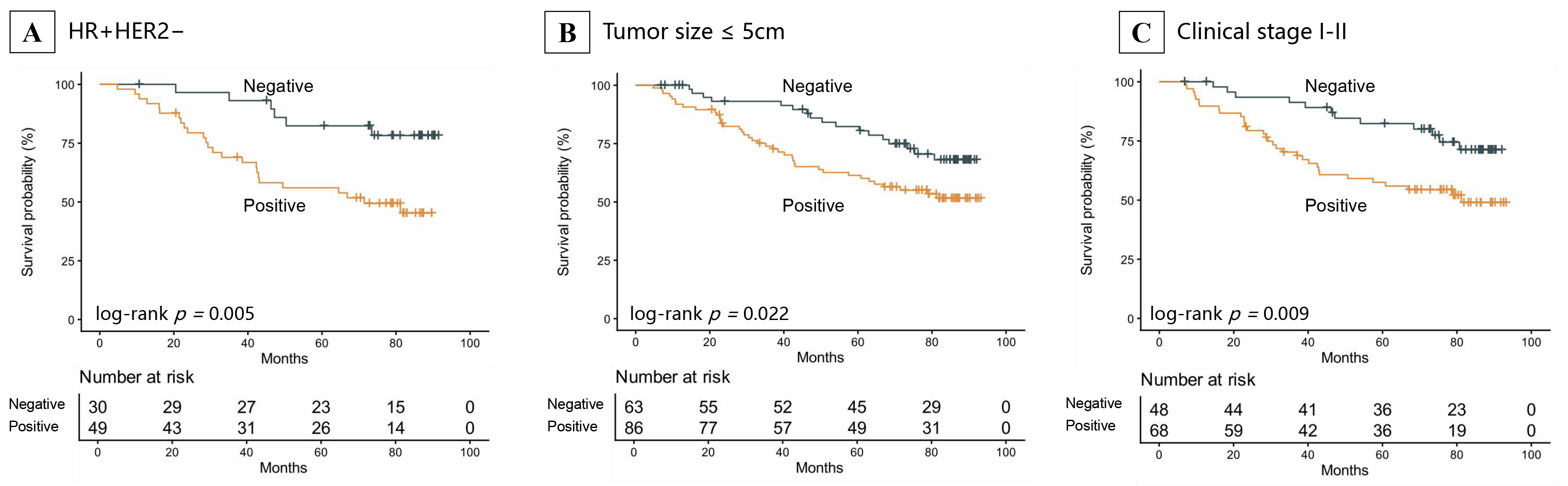
3.4. Subgroup Analyses of p110α Expression
3.5. External Validation at the Transcriptional Level
4. Discussion
5. Conclusions
Supplementary Materials
Author Contributions
Funding
Institutional Review Board Statement
Informed Consent Statement
Data Availability Statement
Conflicts of Interest
References
- Trapani, D.; Ginsburg, O.; Fadelu, T.; Lin, N.U.; Hassett, M.; Ilbawi, A.M.; Anderson, B.O.; Curigliano, G. Global challenges and policy solutions in breast cancer control. Cancer Treat. Rev. 2022, 104, 102339. [Google Scholar] [CrossRef]
- Fu, M.; Peng, Z.; Wu, M.; Lv, D.; Li, Y.; Lyu, S. Current and future burden of breast cancer in Asia: A GLOBOCAN data analysis for 2022 and 2050. Breast 2025, 79, 103835. [Google Scholar] [CrossRef]
- Mannan, A.; Mohan, M.; Singh, T.G. Revenge unraveling the fortress: Exploring anticancer drug resistance mechanisms in BC for enhanced therapeutic strategies. Crit. Rev. Oncol. Hematol. 2025, 210, 104707. [Google Scholar] [CrossRef]
- Li, X.; Zhang, Y.; Gong, J.; Liu, W.; Zhao, H.; Xue, W.; Ren, Z.; Bao, J.; Lin, Z. Development of a breast cancer invasion score to predict tumor aggressiveness and prognosis via PI3K/AKT/mTOR pathway analysis. Cell Death Discov. 2025, 11, 157. [Google Scholar] [CrossRef] [PubMed]
- Sirico, M.; Jacobs, F.; Molinelli, C.; Nader-Marta, G.; Debien, V.; Dewhurst, H.F.; Palleschi, M.; Merloni, F.; Gianni, C.; De Giorgi, U.; et al. Navigating the complexity of PI3K/AKT pathway in HER-2 negative breast cancer: Biomarkers and beyond. Crit. Rev. Oncol. Hematol. 2024, 200, 104404. [Google Scholar] [CrossRef] [PubMed]
- Gao, F.; Liu, S.; Wang, J.; Wei, G.; Yu, C.; Zheng, L.; Sun, L.; Wang, G.; Sun, Y.; Bao, Y.; et al. TSP50 facilitates breast cancer stem cell-like properties maintenance and epithelial-mesenchymal transition via PI3K p110α mediated activation of AKT signaling pathway. J. Exp. Clin. Cancer Res. 2024, 43, 201. [Google Scholar] [CrossRef] [PubMed]
- He, Y.; Sun, M.M.; Zhang, G.G.; Yang, J.; Chen, K.S.; Xu, W.W.; Li, B. Targeting PI3K/Akt signal transduction for cancer therapy. Signal Transduct. Target. Ther. 2021, 6, 425. [Google Scholar] [CrossRef]
- Fontana, F.; Giannitti, G.; Marchesi, S.; Limonta, P. The PI3K/Akt Pathway and Glucose Metabolism: A Dangerous Liaison in Cancer. Int. J. Biol. Sci. 2024, 20, 3113–3125. [Google Scholar] [CrossRef]
- Chen, H.; Si, Y.; Wen, J.; Hu, C.; Xia, E.; Wang, Y.; Wang, O. P110α inhibitor alpelisib exhibits a synergistic effect with pyrotinib and reverses pyrotinib resistant in HER2+ breast cancer. Neoplasia 2023, 43, 100913. [Google Scholar] [CrossRef]
- Hutchinson, K.E.; Chen, J.W.; Savage, H.M.; Stout, T.J.; Schimmoller, F.; Cortés, J.; Dent, S.; Harbeck, N.; Jacot, W.; Krop, I.; et al. Multiple PIK3CA mutation clonality correlates with outcomes in taselisib + fulvestrant-treated ER+/HER2-, PIK3CA-mutated breast cancers. Genome Med. 2023, 15, 28. [Google Scholar] [CrossRef]
- Gris-Oliver, A.; Ibrahim, Y.H.; Rivas, M.A.; García-García, C.; Sánchez-Guixé, M.; Ruiz-Pace, F.; Viaplana, C.; Pérez-García, J.M.; Llombart-Cussac, A.; Grueso, J.; et al. PI3K activation promotes resistance to eribulin in HER2-negative breast cancer. Br. J. Cancer 2021, 124, 1581–1591. [Google Scholar] [CrossRef] [PubMed]
- Simond, A.M.; Bui, T.; Zuo, D.; Sanguin-Gendreau, V.; Rao, T.; Phillips, W.A.; Cardiff, R.D.; Muller, W.J. Physiological expression of PI3K H1047R mutation reveals its anti-metastatic potential in ErbB2-driven breast cancer. Oncogene 2022, 41, 3445–3451. [Google Scholar] [CrossRef] [PubMed]
- Zagami, P.; Fernandez-Martinez, A.; Rashid, N.U.; Hoadley, K.A.; Spears, P.A.; Curigliano, G.; Perou, C.M.; Carey, L.A. Association of PIK3CA Mutation with Pathologic Complete Response and Outcome by Hormone Receptor Status and Intrinsic Subtype in Early-Stage ERBB2/HER2-Positive Breast Cancer. JAMA Netw. Open 2023, 6, e2348814. [Google Scholar] [CrossRef]
- Mosele, F.; Stefanovska, B.; Lusque, A.; Tran Dien, A.; Garberis, I.; Droin, N.; Le Tourneau, C.; Sablin, M.P.; Lacroix, L.; Enrico, D.; et al. Outcome and molecular landscape of patients with PIK3CA-mutated metastatic breast cancer. Ann. Oncol. 2020, 31, 377–386. [Google Scholar] [CrossRef]
- Li, J.; Guo, Y.; Yang, Y.; Xue, Q.; Cao, H.; Yang, G.; Sun, Z.; Jia, L.L.; Yu, H.B. Li, J.; Guo, Y.; Yang, Y.; Xue, Q.; Cao, H.; Yang, G.; Sun, Z.; Jia, L.L.; Yu, H.B. The cardioprotective effects of acteoside in myocardial ischemia reperfusion injury and the underlying mechanism. BMC. Cardiovasc. Disord 2025, 25, 329. [Google Scholar]
- Goswami, C.P.; Nakshatri, H. PROGgeneV2: Enhancements on the existing database. BMC Cancer 2014, 14, 970. [Google Scholar] [CrossRef]
- McShane, L.M.; Altman, D.G.; Sauerbrei, W.; Taube, S.E.; Gion, M.; Clark, G.M. REporting recommendations for tumour MARKer prognostic studies (REMARK). Br. J. Cancer 2005, 93, 387–391. [Google Scholar] [CrossRef]
- Pascual, J.; Turner, N.C. Targeting the PI3-kinase pathway in triple-negative breast cancer. Ann. Oncol. 2019, 30, 1051–1060. [Google Scholar] [CrossRef]
- Han, B.Y.; Chen, C.; Luo, H.; Lin, C.J.; Han, X.C.; Nasir, J.; Shi, J.X.; Huang, W.; Shao, Z.M.; Ling, H.; et al. Clinical sequencing defines the somatic and germline mutation landscapes of Chinese HER2-Low Breast Cancer. Cancer Lett. 2024, 588, 216763. [Google Scholar] [CrossRef]
- Sivakumar, S.; Jin, D.X.; Rathod, R.; Ross, J.; Cantley, L.C.; Scaltriti, M.; Chen, J.W.; Hutchinson, K.E.; Wilson, T.R.; Sokol, E.S.; et al. Genetic Heterogeneity and Tissue-specific Patterns of Tumors with Multiple PIK3CA Mutations. Clin. Cancer Res. 2023, 29, 1125–1136. [Google Scholar] [CrossRef]
- Mukherjee, R.; Vanaja, K.G.; Boyer, J.A.; Gadal, S.; Solomon, H.; Chandarlapaty, S.; Levchenko, A.; Rosen, N. Regulation of PTEN translation by PI3K signaling maintains pathway homeostasis. Mol. Cell 2021, 81, 708–723.e705. [Google Scholar] [CrossRef]
- Andrikopoulou, A.; Chatzinikolaou, S.; Panourgias, E.; Kaparelou, M.; Liontos, M.; Dimopoulos, M.A.; Zagouri, F. The emerging role of capivasertib in breast cancer. Breast 2022, 63, 157–167. [Google Scholar] [CrossRef]
- Prasad, D.; Baldelli, E.; Blais, E.M.; Davis, J.; El Gazzah, E.; Mueller, C.; Gomeiz, A.; Ibrahim, A.; Newrekar, A.V.; Corgiat, B.A.; et al. Functional activation of the AKT-mTOR signalling axis in a real-world metastatic breast cancer cohort. Br. J. Cancer 2024, 131, 1543–1554. [Google Scholar] [CrossRef]
- Hao, C.; Wei, Y.; Meng, W.; Zhang, J.; Yang, X. PI3K/AKT/mTOR inhibitors for hormone receptor-positive advanced breast cancer. Cancer Treat. Rev. 2025, 132, 102861. [Google Scholar] [CrossRef]
- Sreekumar, R.; Harris, S.; Moutasim, K.; DeMateos, R.; Patel, A.; Emo, K.; White, S.; Yagci, T.; Tulchinsky, E.; Thomas, G.; et al. Assessment of Nuclear ZEB2 as a Biomarker for Colorectal Cancer Outcome and TNM Risk Stratification. JAMA Netw. Open 2018, 1, e183115. [Google Scholar] [CrossRef]
- Budczies, J.; Romanovsky, E.; Kirchner, M.; Neumann, O.; Blasi, M.; Schnorbach, J.; Shah, R.; Bozorgmehr, F.; Savai, R.; Stiewe, T.; et al. KRAS and TP53 co-mutation predicts benefit of immune checkpoint blockade in lung adenocarcinoma. Br. J. Cancer 2024, 131, 524–533. [Google Scholar] [CrossRef]
- Sparano, J.A.; Gray, R.J.; Ravdin, P.M.; Makower, D.F.; Pritchard, K.I.; Albain, K.S.; Hayes, D.F.; Geyer, C.E., Jr.; Dees, E.C.; Goetz, M.P.; et al. Clinical and Genomic Risk to Guide the Use of Adjuvant Therapy for Breast Cancer. N. Engl. J. Med. 2019, 380, 2395–2405. [Google Scholar] [CrossRef]
- André, F.; Ciruelos, E.; Rubovszky, G.; Campone, M.; Loibl, S.; Rugo, H.S.; Iwata, H.; Conte, P.; Mayer, I.A.; Kaufman, B.; et al. Alpelisib for PIK3CA-Mutated, Hormone Receptor-Positive Advanced Breast Cancer. N. Engl. J. Med. 2019, 380, 1929–1940. [Google Scholar] [CrossRef] [PubMed]
- Maharati, A.; Moghbeli, M. PI3K/AKT signaling pathway as a critical regulator of epithelial-mesenchymal transition in colorectal tumor cells. Cell Commun. Signal. CCS 2023, 21, 201. [Google Scholar] [CrossRef] [PubMed]
- Lu, K.; Zhao, Y.; Li, Y.; Fu, Z.; Chen, Y.; Kong, Y.; Li, G. IFI16 promotes the progression of clear cell renal cell carcinoma through the IL6/PI3K/AKT axis. Cell Commun. Signal. 2024, 22, 533. [Google Scholar] [CrossRef]
- Cui, R.; Luo, Z.; Zhang, X.; Yu, X.; Yuan, G.; Li, X.; Xie, F.; Jiang, O. Targeting PI3K Signaling to Overcome Tumor Immunosuppression: Synergistic Strategies to Enhance Cancer Vaccine Efficacy. Vaccines 2025, 13, 292. [Google Scholar] [CrossRef]
- Ouyang, Y.; Ou, Z.; Zhong, W.; Yang, J.; Fu, S.; Ouyang, N.; Chen, J.; Xu, L.; Wu, D.; Qian, J.; et al. FGFR3 Alterations in Bladder Cancer Stimulate Serine Synthesis to Induce Immune-Inert Macrophages That Suppress T-cell Recruitment and Activation. Cancer Res. 2023, 83, 4030–4046. [Google Scholar] [CrossRef]
- Mafi, S.; Mansoori, B.; Taeb, S.; Sadeghi, H.; Abbasi, R.; Cho, W.C.; Rostamzadeh, D. mTOR-Mediated Regulation of Immune Responses in Cancer and Tumor Microenvironment. Front. Immunol. 2021, 12, 774103. [Google Scholar] [CrossRef] [PubMed]
- Collins, N.B.; Al Abosy, R.; Miller, B.C.; Bi, K.; Zhao, Q.; Quigley, M.; Ishizuka, J.J.; Yates, K.B.; Pope, H.W.; Manguso, R.T.; et al. PI3K activation allows immune evasion by promoting an inhibitory myeloid tumor microenvironment. J. Immunother. Cancer 2022, 10, e003402. [Google Scholar] [CrossRef]



| Characteristics | n | % |
|---|---|---|
| Age (years) | ||
| <55 | 113 | 70.2 |
| ≥55 | 48 | 29.8 |
| Menstrual status | ||
| Postmenopausal | 77 | 47.8 |
| Premenopausal | 84 | 52.2 |
| Histological grade | ||
| 1–2 | 112 | 69.6 |
| 3 | 49 | 30.4 |
| Tumor size | ||
| ≤5 cm | 149 | 92.5 |
| >5 cm | 12 | 7.5 |
| Lymph node metastasis | ||
| No | 85 | 52.8 |
| Yes | 76 | 47.2 |
| Clinical stage | ||
| I–II | 116 | 72.0 |
| III | 45 | 28.0 |
| HR status | ||
| Negative | 46 | 28.6 |
| Positive | 115 | 71.4 |
| HER2 status | ||
| Negative | 109 | 67.7 |
| Positive | 52 | 32.3 |
| p110α expression | ||
| Negative | 66 | 41.0 |
| Positive | 95 | 59.0 |
| Characteristics | n | p110α-Negative (n, %) | p110α-Positive (n, %) | p-Value |
|---|---|---|---|---|
| Age (years) | ||||
| <55 | 113 | 46 (40.7) | 67 (59.3) | 0.910 |
| ≥55 | 48 | 20 (41.7) | 28 (58.3) | |
| Menstrual status | ||||
| Postmenopausal | 77 | 37 (48.1) | 40 (51.9) | 0.081 |
| Premenopausal | 84 | 29 (34.5) | 55 (65.5) | |
| Histological grade | ||||
| 1–2 | 112 | 52 (46.4) | 60 (53.6) | 0.034 |
| 3 | 49 | 14 (28.6) | 35 (71.4) | |
| Tumor size | ||||
| ≤5 cm | 149 | 63 (42.3) | 86 (57.7) | 0.242 |
| >5 cm | 12 | 3 (25.0) | 9 (75.0) | |
| Lymph node metastasis | ||||
| No | 85 | 32 (37.6) | 53 (62.4) | 0.361 |
| Yes | 76 | 34 (44.7) | 42 (55.3) | |
| Clinical stage | ||||
| I–II | 116 | 48 (41.4) | 68 (58.6) | 0.873 |
| III | 45 | 18 (40.0) | 27 (60.0) | |
| HR status | ||||
| Negative | 46 | 17 (37.0) | 29 (63.0) | 0.510 |
| Positive | 115 | 49 (42.6) | 66 (57.4) | |
| HER2 status | ||||
| Negative | 109 | 39 (35.8) | 70 (64.2) | 0.051 |
| Positive | 52 | 27 (51.9) | 25 (48.1) |
| Characteristics | Univariate | Multivariate | ||
|---|---|---|---|---|
| HR (95%CI) | p-Value | HR (95%CI) | p-Value | |
| p110α expression | ||||
| Negative | 1.00 [Reference] | 1.00 [Reference] | ||
| Positive | 2.30 (1.22–4.33) | 0.010 | 2.00 (1.05–3.80) | 0.034 |
| Age (years) | ||||
| <55 | 1.00 [Reference] | 1.00 [Reference] | ||
| ≥55 | 2.13 (1.13–4.01) | 0.020 | 1.75 (0.92–3.34) | 0.088 |
| Menstrual status | ||||
| Postmenopausal | 1.00 [Reference] | |||
| Premenopausal | 1.41 (0.80–2.49) | 0.239 | ||
| Histological grade | ||||
| 1–2 | 1.00 [Reference] | 1.00 [Reference] | ||
| 3 | 2.63 (1.50–4.62) | 0.001 | 2.24 (1.26–3.97) | 0.006 |
| Tumor size | ||||
| ≤5 cm | 1.00 [Reference] | |||
| >5 cm | 1.79 (0.71–4.51) | 0.219 | ||
| Lymph node metastasis | ||||
| No | 1.00 [Reference] | |||
| Yes | 0.84 (0.48–1.48) | 0.555 | ||
| Tumor size | ||||
| I–II | 1.00 [Reference] | |||
| III | 0.77 (0.40–1.48) | 0.438 | ||
| HR status | ||||
| Negative | 1.00 [Reference] | |||
| Positive | 1.02 (0.55–1.90) | 0.942 | ||
| HER2 status | ||||
| Negative | 1.00 [Reference] | |||
| Positive | 0.55 (0.28–1.08) | 0.081 | ||
| Characteristics | Univariate | Multivariate | ||
|---|---|---|---|---|
| HR (95%CI) | p-Value | HR (95%CI) | p-Value | |
| p110α expression | ||||
| Negative | 1.00 [Reference] | 1.00 [Reference] | ||
| Positive | 1.92 (1.11–3.34) | 0.020 | 1.92 (1.10–3.34) | 0.022 |
| Age (years) | ||||
| <55 | 1.00 [Reference] | 1.00 [Reference] | ||
| ≥55 | 1.86 (1.04–3.33) | 0.035 | 1.79 (1.07–2.99) | 0.028 |
| Menstrual status | ||||
| Postmenopausal | 1.00 [Reference] | 1.00 [Reference] | ||
| Premenopausal | 1.75 (1.04–2.97) | 0.036 | 1.66 (0.99–2.81) | 0.057 |
| Histological grade | ||||
| 1–2 | 1.00 [Reference] | 1.00 [Reference] | ||
| 3 | 1.87 (1.12–3.11) | 0.017 | 1.01 (0.78–1.32) | 0.936 |
| Tumor size | ||||
| ≤5 cm | 1.00 [Reference] | |||
| >5 cm | 1.27 (0.51–3.18) | 0.607 | ||
| Lymph node metastasis | ||||
| No | 1.00 [Reference] | |||
| Yes | 0.89 (0.53–1.47) | 0.637 | ||
| Tumor size | ||||
| I–II | 1.00 [Reference] | |||
| III | 1.01 (0.58–1.77) | 0.964 | ||
| HR status | ||||
| Negative | 1.00 [Reference] | |||
| Positive | 0.98 (0.56–1.71) | 0.941 | ||
| HER2 status | ||||
| Negative | 1.00 [Reference] | |||
| Positive | 0.77 (0.46–1.38) | 0.416 | ||
Disclaimer/Publisher’s Note: The statements, opinions and data contained in all publications are solely those of the individual author(s) and contributor(s) and not of MDPI and/or the editor(s). MDPI and/or the editor(s) disclaim responsibility for any injury to people or property resulting from any ideas, methods, instructions or products referred to in the content. |
© 2026 by the authors. Licensee MDPI, Basel, Switzerland. This article is an open access article distributed under the terms and conditions of the Creative Commons Attribution (CC BY) license.
Share and Cite
Zong, Z.; Zhou, X.; Shen, J.; Yan, M.; Xia, X.; Li, J.; Wang, X.; Li, F. Prognostic Value of Phosphatidylinositol-3 Kinase p110 α Protein Expression in Patients with Stage I–III Invasive Breast Cancer. Cancers 2026, 18, 301. https://doi.org/10.3390/cancers18020301
Zong Z, Zhou X, Shen J, Yan M, Xia X, Li J, Wang X, Li F. Prognostic Value of Phosphatidylinositol-3 Kinase p110 α Protein Expression in Patients with Stage I–III Invasive Breast Cancer. Cancers. 2026; 18(2):301. https://doi.org/10.3390/cancers18020301
Chicago/Turabian StyleZong, Zhiqiang, Xuan Zhou, Jian Shen, Min Yan, Xi Xia, Jingjing Li, Xian Wang, and Fanfan Li. 2026. "Prognostic Value of Phosphatidylinositol-3 Kinase p110 α Protein Expression in Patients with Stage I–III Invasive Breast Cancer" Cancers 18, no. 2: 301. https://doi.org/10.3390/cancers18020301
APA StyleZong, Z., Zhou, X., Shen, J., Yan, M., Xia, X., Li, J., Wang, X., & Li, F. (2026). Prognostic Value of Phosphatidylinositol-3 Kinase p110 α Protein Expression in Patients with Stage I–III Invasive Breast Cancer. Cancers, 18(2), 301. https://doi.org/10.3390/cancers18020301