Effect of Preoperative Sarcopenic Obesity on Outcomes in Patients with Gastric Cancer After Surgery
 , , ,
, , ,
Simple Summary
Abstract
1. Introduction
2. Materials and Methods
2.1. Patients
2.2. Image Analysis
2.3. Statistical Analysis
3. Results
3.1. Difference in Clinicopathological Factors Between the Body Composition Groups
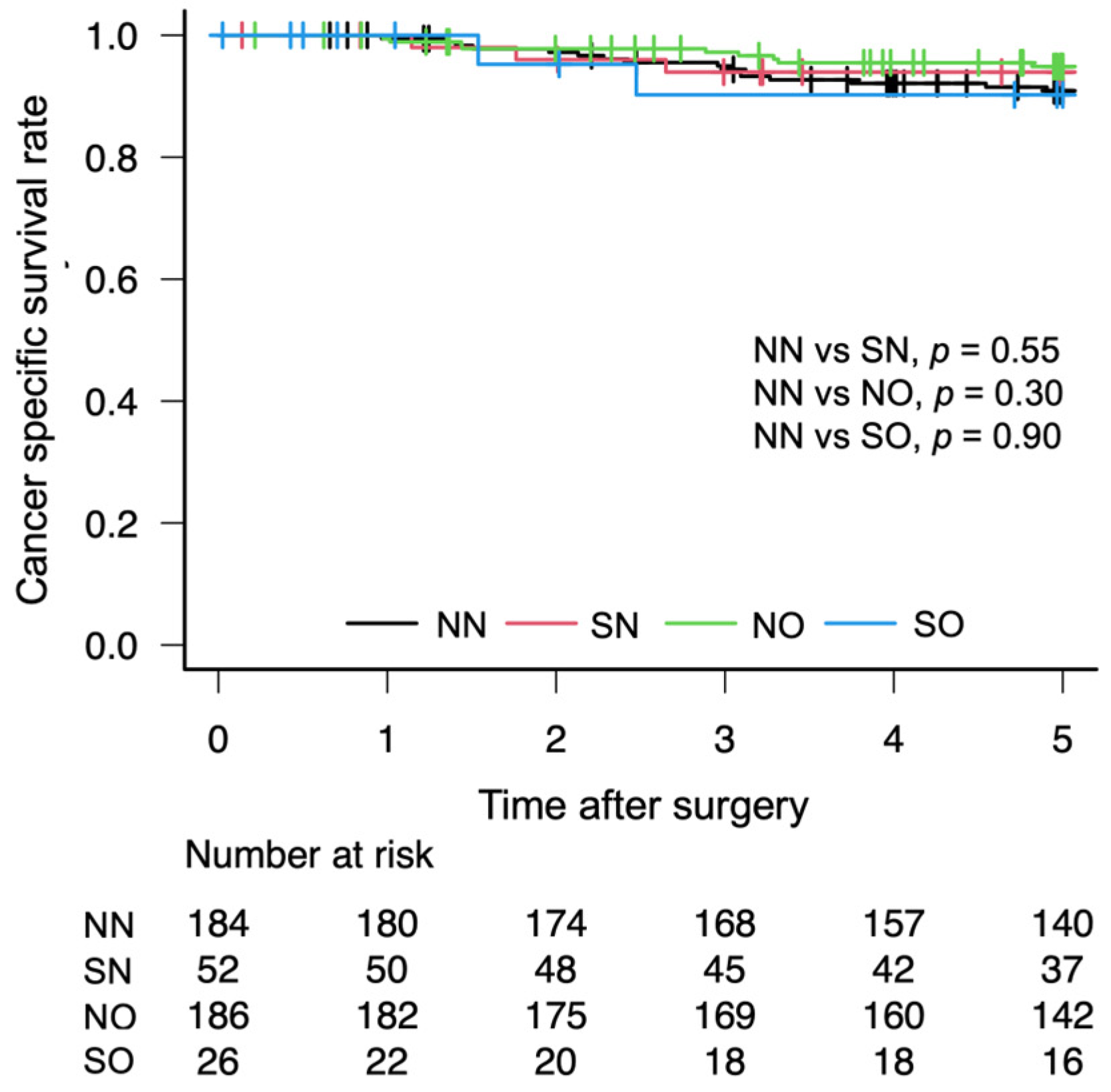
3.2. Body Composition and Survival Outcomes
3.3. Univariate and Multivariate Analyses for OS and RFS
4. Discussion
5. Conclusions
Author Contributions
Funding
Institutional Review Board Statement
Informed Consent Statement
Data Availability Statement
Acknowledgments
Conflicts of Interest
References
- Bray, F.; Laversanne, M.; Sung, H.; Ferlay, J.; Siegel, R.L.; Soerjomataram, I.; Jemal, A. Global cancer statistics 2022: GLOBOCAN estimates of incidence and mortality worldwide for 36 cancers in 185 countries. CA Cancer J. Clin. 2024, 74, 229–263. [Google Scholar] [CrossRef]
- Smyth, E.C.; Nilsson, M.; Grabsch, H.I.; van Grieken, N.C.; Lordick, F. Gastric cancer. Lancet 2020, 396, 635–648. [Google Scholar] [CrossRef]
- Zhu, Y.; Guo, X.; Zhang, Q.; Yang, Y. Prognostic value of sarcopenia in patients with rectal cancer: A meta-analysis. PLoS ONE 2022, 17, e0270332. [Google Scholar] [CrossRef]
- Sakamoto, T.; Yagyu, T.; Uchinaka, E.; Miyatani, K.; Hanaki, T.; Kihara, K.; Matsunaga, T.; Yamamoto, M.; Tokuyasu, N.; Honjo, S.; et al. Sarcopenia as a prognostic factor in patients with recurrent pancreatic cancer: A retrospective study. World J. Surg. Oncol. 2020, 18, 221. [Google Scholar] [CrossRef]
- Kuwada, K.; Kuroda, S.; Kikuchi, S.; Yoshida, R.; Nishizaki, M.; Kagawa, S.; Fujiwara, T. Sarcopenia and comorbidity in gastric cancer surgery as a useful combined factor to predict eventual death from other causes. Ann. Surg. Oncol. 2018, 25, 1160–1166. [Google Scholar] [CrossRef] [PubMed]
- Liu, T.; Yi, X.; Ge, J.; Zhang, J.; Tan, F.; Song, K.; Liu, H.; Tang, M. Preoperative computed tomography-determined sarcopenia is a reliable prognostic factor in patients with gastric cancer after radical gastrectomy: A sex-specific analysis. Front. Nutr. 2022, 9, 884586. [Google Scholar] [CrossRef] [PubMed]
- Meyer, H.-J.; Wienke, A.; Pech, M.; Surov, A. Computed tomography-defined fat composition as a prognostic marker in gastric adenocarcinoma: A systematic review and meta-analysis. Dig. Dis. 2023, 41, 177–186. [Google Scholar] [CrossRef]
- Gu, L.; Zhang, Y.; Hong, J.; Xu, B.; Yang, L.; Yan, K.; Zhang, J.; Chen, P.; Zheng, J.; Lin, J. Prognostic value of pretreatment overweight/obesity and adipose tissue distribution in resectable gastric cancer: A retrospective cohort study. Front. Oncol. 2021, 11, 680190. [Google Scholar] [CrossRef] [PubMed]
- Lin, Y.-C.; Lin, G.; Yeh, T.-S. Visceral-to-subcutaneous fat ratio independently predicts the prognosis of locally advanced gastric cancer—Highlighting the role of adiponectin receptors and PPARα, β/δ, ɤ. Eur. J. Surg. Oncol. 2021, 47, 3064–3073. [Google Scholar] [CrossRef]
- Donini, L.M.; Busetto, L.; Bischoff, S.C.; Cederholm, T.; Ballesteros-Pomar, M.D.; Batsis, J.A.; Bauer, J.M.; Boirie, Y.; Cruz-Jentoft, A.J.; Dicker, D.; et al. Definition and diagnostic criteria for sarcopenic obesity: ESPEN and EASO consensus statement. Clin. Nutr. 2022, 41, 990–1000. [Google Scholar] [CrossRef]
- Carneiro, I.P.; Mazurak, V.C.; Prado, C.M. Clinical implications of sarcopenic obesity in cancer. Curr. Oncol. Rep. 2016, 18, 62. [Google Scholar] [CrossRef] [PubMed]
- Kobayashi, A.; Kaido, T.; Hamaguchi, Y.; Okumura, S.; Shirai, H.; Yao, S.; Kamo, N.; Yagi, S.; Taura, K.; Okajima, H.; et al. Impact of sarcopenic obesity on outcomes in patients undergoing hepatectomy for hepatocellular carcinoma. Ann. Surg. 2019, 269, 924–931. [Google Scholar] [CrossRef]
- Mintziras, I.; Miligkos, M.; Wächter, S.; Manoharan, J.; Maurer, E.; Bartsch, D.K. Sarcopenia and sarcopenic obesity are significantly associated with poorer overall survival in patients with pancreatic cancer: Systematic review and meta-analysis. Int. J. Surg. 2018, 59, 19–26. [Google Scholar] [CrossRef]
- Irving, B.A.; Weltman, J.Y.; Brock, D.W.; Davis, C.K.; Gaesser, G.A.; Weltman, A. NIH ImageJ and Slice-O-Matic computed tomography imaging software to quantify soft tissue. Obesity 2007, 15, 370–376. [Google Scholar] [CrossRef]
- Dennis, R.A.; Long, D.E.; Landes, R.D.; Padala, K.P.; Padala, P.R.; Garner, K.K.; Wise, J.N.; Peterson, C.A.; Sullivan, D.H. Tutorial for using SliceOmatic to calculate thigh area and composition from computed tomography images from older adults. PLoS ONE 2018, 13, e0204529. [Google Scholar] [CrossRef]
- Hamaguchi, Y.; Kaido, T.; Okumura, S.; Kobayashi, A.; Shirai, H.; Yagi, S.; Kamo, N.; Okajima, H.; Uemoto, S. Impact of skeletal muscle mass index, intramuscular adipose tissue content, and visceral to subcutaneous adipose tissue area ratio on early mortality of living donor liver transplantation. Transplantation 2017, 101, 565–574. [Google Scholar] [CrossRef] [PubMed]
- Ogawa, W.; Hirota, Y.; Miyazaki, S.; Nakamura, T.; Ogawa, Y.; Shimomura, I.; Yamauchi, T.; Yokote, K. Creation Committee for Guidelines for the Management of Obesity Disease 2022 by Japan Society for the Study of Obesity (JASSO). Definition, criteria, and core concepts of guidelines for the management of obesity disease in Japan. Endocr J 2024, 71, 223–231. [Google Scholar] [CrossRef] [PubMed]
- Nishigori, T.; Tsunoda, S.; Okabe, H.; Tanaka, E.; Hisamori, S.; Hosogi, H.; Shinohara, H.; Sakai, Y. Impact of sarcopenic obesity on surgical site infection after laparoscopic total gastrectomy. Ann. Surg. Oncol. 2016, 23, 524–531. [Google Scholar] [CrossRef]
- Uchida, T.; Sekine, R.; Matsuo, K.; Kigawa, G.; Umemoto, T.; Tanaka, K. Impact of body fat and muscle quantity on short- and long-term outcome after gastrectomy for cancer. Clin. Nutr. 2022, 41, 1467–1474. [Google Scholar] [CrossRef]
- Kim, J.; Han, S.H.; Kim, H.-I. Detection of sarcopenic obesity and prediction of long-term survival in patients with gastric cancer using preoperative computed tomography and machine learning. J. Surg. Oncol. 2021, 124, 1347–1355. [Google Scholar] [CrossRef]
- Rodrigues, V.; Landi, F.; Castro, S.; Mast, R.; Rodríguez, N.; Gantxegi, A.; Pradell, J.; López-Cano, M.; Armengol, M. Is sarcopenic obesity an indicator of poor prognosis in gastric cancer surgery? A cohort study in a Western population. J. Gastrointest. Surg. 2021, 25, 1388–1403. [Google Scholar] [CrossRef]
- Haruna, K.; Minami, S.; Miyoshi, N.; Fujino, S.; Mizumoto, R.; Toyoda, Y.; Hayashi, R.; Kato, S.; Takeda, M.; Sekido, Y.; et al. Examination of sarcopenia with obesity as a prognostic factor in patients with colorectal cancer using the psoas muscle mass index. Cancers 2024, 16, 3429. [Google Scholar] [CrossRef]
- Zhao, B.; Bao, L.; Zhang, T.; Chen, Y.; Zhang, S.; Zhang, C. Prevalence of sarcopenic obesity in patients with gastric cancer and effects on adverse outcomes: A meta-analysis and systematic review. Eur. J. Surg. Oncol. 2024, 50, 108772. [Google Scholar] [CrossRef]
- Matsui, R.; Yonezu, K.; Rifu, K.; Watanabe, J.; Inaki, N.; Fukunaga, T.; Nunobe, S. Impact of sarcopenic obesity on postoperative outcomes in patients with oesophago-gastric cancer: A systematic review and meta-analysis. World J. Surg. 2025, 49, 459–471. [Google Scholar] [CrossRef] [PubMed]
- Yıldız Kopuz, T.N.; Yıldız, H.F.; Er, S.; Fisunoğlu, M. Prognostic impact of sarcopenic obesity on postoperative outcomes in colorectal cancer patients undergoing surgery: A systematic review and meta-analysis. Nutr. Cancer 2025, 77, 360–371. [Google Scholar] [CrossRef]
- Gao, Q.; Hu, K.; Gao, J.; Shang, Y.; Mei, F.; Zhao, L.; Chen, F.; Ma, B. Prevalence and prognostic value of sarcopenic obesity in patients with cancer: A systematic review and meta-analysis. Nutrition 2022, 101, 111704. [Google Scholar] [CrossRef]
- Boakye, D.; Rillmann, B.; Walter, V.; Jansen, L.; Hoffmeister, M.; Brenner, H. Impact of comorbidity and frailty on prognosis in colorectal cancer patients: A systematic review and meta-analysis. Cancer Treat. Rev. 2018, 64, 30–39. [Google Scholar] [CrossRef]
- Søgaard, M.; Thomsen, R.W.; Bossen, K.S.; Sørensen, H.T.; Nørgaard, M. The impact of comorbidity on cancer survival: A review. Clin. Epidemiol. 2013, 5, 3–29. [Google Scholar] [CrossRef] [PubMed]
- Baracos, V.E.; Arribas, L. Sarcopenic obesity: Hidden muscle wasting and its impact for survival and complications of cancer therapy. Ann. Oncol. 2018, 29, ii1–ii9. [Google Scholar] [CrossRef] [PubMed]
- Anandavadivelan, P.; Brismar, T.B.; Nilsson, M.; Johar, A.M.; Martin, L. Sarcopenic obesity: A probable risk factor for dose limiting toxicity during neo-adjuvant chemotherapy in oesophageal cancer patients. Clin. Nutr. 2016, 35, 724–730. [Google Scholar] [CrossRef]
- Onishi, S.; Tajika, M.; Tanaka, T.; Yamada, K.; Abe, T.; Higaki, E.; Hosoi, T.; Inaba, Y.; Muro, K.; Shimizu, M.; et al. Prognostic impact of sarcopenic obesity after neoadjuvant chemotherapy followed by surgery in elderly patients with esophageal squamous cell carcinoma. J. Clin. Med. 2020, 9, 2974. [Google Scholar] [CrossRef]
- Wooten, S.V.; Fleming, R.Y.D.; Wolf, J.S., Jr.; Stray-Gundersen, S.; Bartholomew, J.B.; Mendoza, D.; Stanforth, P.R.; Stanforth, D.; Hernandez, L.M.; Tanaka, H. Prehabilitation program composed of blood flow restriction training and sports nutrition improves physical functions in abdominal cancer patients awaiting surgery. Eur. J. Surg. Oncol. 2021, 47, 2952–2958. [Google Scholar] [CrossRef]
- Ngo-Huang, A.; Herbert, A.; Fontillas, R.C.; Parker, N.H.; Asumbrado, R.; Garg, N.; Dibaj, S.; Liu, D.D.; Ng, A.H.; Guo, Y.; et al. Frequency of sarcopenia, sarcopenic obesity, and changes in physical function in surgical oncology patients referred for prehabilitation. Integr. Cancer Ther. 2021, 20, 15347354211000118. [Google Scholar] [CrossRef] [PubMed]
- Ghiotto, L.; Muollo, V.; Tatangelo, T.; Schena, F.; Rossi, A.P. Exercise and physical performance in older adults with sarcopenic obesity: A systematic review. Front. Endocrinol. 2022, 13, 913953. [Google Scholar] [CrossRef] [PubMed]
- Chang, W.H.; Lai, A.G. Pan-cancer analyses of the associations between 109 pre-existing conditions and cancer treatment patterns across 19 adult cancers. Sci. Rep. 2024, 14, 464. [Google Scholar] [CrossRef] [PubMed]



| Variables | All Patients | NN | SN | NO | SO | p-Value |
|---|---|---|---|---|---|---|
| (n = 448) | (n = 184) | (n = 52) | (n = 186) | (n = 26) | ||
| Age | <65 | 61 (33.2) | 15 (28.8) | 58 (31.2) | 5 (19.2) | 0.533 |
| ≥65 | 123 (66.8) | 37 (71.2) | 128 (68.8) | 21 (80.8) | ||
| BMI | <18.5 | 29 (15.8) | 16 (30.8) | 0 (0.0) | 1 (3.8) | <0.001 |
| ≥18.5, <25.0 | 145 (78.8) | 36 (69.2) | 100 (53.8) | 24 (92.3) | ||
| ≥25 | 10 (5.4) | 0 (0.0) | 86 (46.2) | 1 (3.8) | ||
| Hypertension | - | 128 (69.6) | 36 (69.2) | 102 (54.8) | 14 (53.8) | 0.015 |
| + | 56 (30.4) | 16 (30.8) | 84 (45.2) | 12 (46.2) | ||
| Diabetes mellitus | - | 171 (92.9) | 47 (90.4) | 155 (83.3) | 22 (84.6) | 0.033 |
| + | 13 (7.1) | 5 (9.6) | 31 (16.7) | 4 (15.4) | ||
| COPD | - | 156 (84.8) | 40 (76.9) | 148 (79.6) | 18 (69.2) | 0.186 |
| + | 28 (15.2) | 12 (23.1) | 38 (20.4) | 8 (30.8) | ||
| Operation | not TG | 142 (77.2) | 38 (73.1) | 140 (75.3) | 20 (76.9) | 0.931 |
| TG | 42 (22.8) | 14 (26.9) | 46 (24.7) | 6 (23.1) | ||
| Tumor size | ≤30 | 97 (52.7) | 26 (50.0) | 96 (51.6) | 15 (57.7) | 0.927 |
| >30 | 87 (47.3) | 26 (50.0) | 90 (48.4) | 11 (42.3) | ||
| Histological type | Well/Moderately | 77 (41.8) | 29 (55.8) | 101 (54.3) | 14 (53.8) | 0.071 |
| Poorly | 107 (58.2) | 23 (44.2) | 85 (45.7) | 12 (46.2) | ||
| Lymphatic invasion | - | 123 (66.8) | 36 (69.2) | 135 (72.6) | 19 (73.1) | 0.663 |
| + | 61 (33.2) | 16 (30.8) | 51 (27.4) | 7 (26.9) | ||
| Venous invasion | - | 111 (60.3) | 32 (61.5) | 108 (58.1) | 15 (57.7) | 0.954 |
| + | 73 (39.7) | 20 (38.5) | 78 (41.9) | 11 (42.3) | ||
| pStage | I | 119 (64.7) | 40 (76.9) | 135 (72.6) | 17 (65.4) | 0.221 |
| II–III | 65 (35.3) | 12 (23.1) | 51 (27.4) | 9 (34.6) | ||
| Surgical complications | - | 161 (87.5) | 45 (88.2) | 148 (79.6) | 22 (88.0) | 0.143 |
| + | 23 (12.5) | 6 (11.8) | 38 (20.4) | 3 (12.0) | ||
| Death due to other diseases | - | 175 (95.1) | 48 (92.3) | 170 (91.4) | 20 (76.9) | 0.013 |
| + | 9 (4.9) | 4 (7.7) | 16 (8.6) | 6 (23.1) |
| Factors | Univariate | p-Value | Multivariate | p-Value | |||
|---|---|---|---|---|---|---|---|
| HR | 95% CI | HR | 95% CI | ||||
| Age | <65 | 1 | 1 | ||||
| ≥65 | 1.98 | 1.08–3.62 | 0.03 | 1.88 | 0.99–3.55 | 0.05 | |
| BMI | <18.5 | 1 | 1 | ||||
| ≥18.5, <25.0 | 0.73 | 0.34–1.55 | 0.41 | 0.55 | 0.24–1.25 | 0.16 | |
| ≥25 | 1.01 | 0.44–2.32 | 0.98 | 0.74 | 0.26–2.12 | 0.57 | |
| Hypertension | - | 1 | 1 | ||||
| + | 1.27 | 0.78–2.07 | 0.34 | 0.96 | 0.57–1.61 | 0.87 | |
| Diabetes mellitus | - | 1 | 1 | ||||
| + | 1.57 | 0.82–3.00 | 0.18 | 1.79 | 0.91–3.56 | 0.09 | |
| Operation | not TG | 1 | 1 | ||||
| TG | 2.02 | 1.23–3.32 | 0.01 | 1.69 | 0.99–2.88 | 0.05 | |
| Tumor size | ≤30 | 1 | 1 | ||||
| >30 | 1.88 | 1.14–3.09 | 0.01 | 0.85 | 0.47–1.52 | 0.57 | |
| Histological type | Well/Moderately | 1 | 1 | ||||
| Poorly | 1.21 | 0.74–1.96 | 0.45 | 1.13 | 0.68–1.87 | 0.65 | |
| Lymphatic invasion | - | 1 | 1 | ||||
| + | 3.33 | 2.04–5.42 | <0.001 | 1.81 | 1.03–3.17 | 0.04 | |
| Venous invasion | - | 1 | 1 | ||||
| + | 4.01 | 2.35–6.83 | <0.001 | 1.93 | 1.02–3.64 | 0.04 | |
| Stage | I | 1 | 1 | ||||
| II–III | 4.76 | 2.87–7.91 | <0.001 | 2.87 | 1.46–5.63 | 0.002 | |
| Surgical complications | - | 1 | 1 | ||||
| + | 0.79 | 0.39–1.60 | 0.52 | 0.68 | 0.33–1.40 | 0.30 | |
| Body composition | NN | 1 | 1 | ||||
| SN | 1.07 | 0.46–2.48 | 0.88 | 1.29 | 0.54–3.09 | 0.57 | |
| NO | 1.09 | 0.63–1.90 | 0.75 | 1.22 | 0.60–2.48 | 0.58 | |
| SO | 2.75 | 1.23–6.12 | 0.01 | 3.18 | 1.33–7.64 | 0.01 | |
| Factors | Univariate | p-Value | Multivariate | p-Value | |||
|---|---|---|---|---|---|---|---|
| HR | 95% CI | HR | 95% CI | ||||
| Age | <65 | 1 | 1 | ||||
| ≥65 | 1.80 | 1.03–3.12 | 0.04 | 1.66 | 0.93–2.96 | 0.09 | |
| BMI | <18.5 | 1 | 1 | ||||
| ≥18.5, <25.0 | 0.71 | 0.35–1.45 | 0.35 | 0.55 | 0.25–1.20 | 0.13 | |
| ≥25 | 1.08 | 0.50–2.35 | 0.84 | 0.83 | 0.31–2.23 | 0.72 | |
| Hypertension | - | 1 | 1 | ||||
| + | 1.32 | 0.84–2.08 | 0.23 | 1.03 | 0.64–1.66 | 0.91 | |
| Diabetes mellitus | - | 1 | 1 | ||||
| + | 1.47 | 0.79–2.72 | 0.22 | 1.64 | 0.86–3.15 | 0.14 | |
| Operation | not TG | 1 | 1 | ||||
| TG | 1.80 | 1.13–2.88 | 0.01 | 1.50 | 0.91–2.47 | 0.11 | |
| Tumor size | ≤30 | 1 | 1 | ||||
| >30 | 1.99 | 1.25–3.17 | 0.004 | 1.01 | 0.59–1.74 | 0.97 | |
| Histological type | Well/Moderately | 1 | 1 | ||||
| Poorly | 1.24 | 0.79–1.96 | 0.34 | 1.15 | 0.72–1.86 | 0.56 | |
| Lymphatic invasion | - | 1 | 1 | ||||
| + | 3.40 | 2.16–5.35 | <0.001 | 2.10 | 1.24–3.55 | 0.01 | |
| Venous invasion | - | 1 | 1 | ||||
| + | 2.96 | 1.85–4.74 | <0.001 | 1.34 | 0.76–2.38 | 0.31 | |
| Stage | I | 1 | 1 | ||||
| II–III | 4.29 | 2.70–6.82 | <0.001 | 2.55 | 1.37–4.73 | 0.003 | |
| Surgical complications | - | 1 | 1 | ||||
| + | 0.96 | 0.52–1.79 | 0.90 | 0.89 | 0.47–1.67 | 0.71 | |
| Body composition | NN | 1 | 1 | ||||
| SN | 0.90 | 0.39–2.06 | 0.80 | 1.04 | 0.44–2.46 | 0.92 | |
| NO | 1.11 | 0.67–1.84 | 0.70 | 1.10 | 0.57–2.11 | 0.78 | |
| SO | 2.74 | 1.29–5.81 | 0.01 | 3.08 | 1.36–6.95 | 0.01 | |
| Factors | Univariate | p-Value | Multivariate | p-Value | |||
|---|---|---|---|---|---|---|---|
| HR | 95% CI | HR | 95% CI | ||||
| Age | <65 | 1 | 1 | ||||
| ≥65 | 1.06 | 0.50–2.24 | 0.88 | 1.15 | 0.51–2.57 | 0.74 | |
| BMI | <18.5 | 1 | 1 | ||||
| ≥18.5, <25.0 | 0.43 | 0.17–1.08 | 0.07 | 0.42 | 0.15–1.15 | 0.09 | |
| ≥25 | 0.58 | 0.20–1.68 | 0.32 | 0.63 | 0.15–2.60 | 0.52 | |
| Hypertension | - | 1 | 1 | ||||
| + | 1.32 | 0.84–2.08 | 0.23 | 1.00 | 0.47–2.14 | 0.99 | |
| Diabetes mellitus | - | 1 | 1 | ||||
| + | 1.47 | 0.79–2.72 | 0.22 | 1.51 | 0.48–4.68 | 0.48 | |
| Operation | not TG | 1 | 1 | ||||
| TG | 1.54 | 0.73–3.25 | 0.26 | 1.16 | 0.51–2.60 | 0.72 | |
| Tumor size | ≤30 | 1 | 1 | ||||
| >30 | 4.09 | 1.77–9.45 | <0.001 | 1.10 | 0.44–2.72 | 0.84 | |
| Histological type | Well/Moderately | 1 | 1 | ||||
| Poorly | 2.59 | 1.20–5.59 | 0.02 | 1.73 | 0.77–3.85 | 0.18 | |
| Lymphatic invasion | - | 1 | 1 | ||||
| + | 13.67 | 5.26–35.49 | <0.001 | 4.02 | 1.45–11.12 | 0.007 | |
| Venous invasion | - | 1 | 1 | ||||
| + | 8.82 | 3.39–22.90 | <0.001 | 1.75 | 0.61–5.01 | 0.30 | |
| Stage | I | 1 | 1 | ||||
| II–III | 38.56 | 9.21–161.40 | <0.001 | 13.69 | 2.74–68.42 | 0.001 | |
| Surgical complications | - | 1 | 1 | ||||
| + | 0.71 | 0.25–2.03 | 0.52 | 0.62 | 0.21–1.88 | 0.40 | |
| Body composition | NN | 1 | 1 | ||||
| SN | 0.68 | 0.20–2.35 | 0.55 | 1.32 | 0.36–4.80 | 0.68 | |
| NO | 0.67 | 0.31–1.45 | 0.31 | 0.97 | 0.33–2.84 | 0.96 | |
| SO | 1.06 | 0.24–4.63 | 0.93 | 1.71 | 0.36–8.05 | 0.50 | |
Disclaimer/Publisher’s Note: The statements, opinions and data contained in all publications are solely those of the individual author(s) and contributor(s) and not of MDPI and/or the editor(s). MDPI and/or the editor(s) disclaim responsibility for any injury to people or property resulting from any ideas, methods, instructions or products referred to in the content. |
© 2026 by the authors. Licensee MDPI, Basel, Switzerland. This article is an open access article distributed under the terms and conditions of the Creative Commons Attribution (CC BY) license.
Share and Cite
Hashimoto, I.; Komori, K.; Akimoto, N.; Nakayama, Y.; Nagasawa, S.; Maezawa, Y.; Kanematsu, K.; Yamada, T.; Yukawa, N.; Saito, A.; et al. Effect of Preoperative Sarcopenic Obesity on Outcomes in Patients with Gastric Cancer After Surgery. Cancers 2026, 18, 191. https://doi.org/10.3390/cancers18020191
Hashimoto I, Komori K, Akimoto N, Nakayama Y, Nagasawa S, Maezawa Y, Kanematsu K, Yamada T, Yukawa N, Saito A, et al. Effect of Preoperative Sarcopenic Obesity on Outcomes in Patients with Gastric Cancer After Surgery. Cancers. 2026; 18(2):191. https://doi.org/10.3390/cancers18020191
Chicago/Turabian StyleHashimoto, Itaru, Keisuke Komori, Norihiro Akimoto, Yuta Nakayama, Shinsuke Nagasawa, Yukio Maezawa, Kyohei Kanematsu, Takanobu Yamada, Norio Yukawa, Aya Saito, and et al. 2026. "Effect of Preoperative Sarcopenic Obesity on Outcomes in Patients with Gastric Cancer After Surgery" Cancers 18, no. 2: 191. https://doi.org/10.3390/cancers18020191
APA StyleHashimoto, I., Komori, K., Akimoto, N., Nakayama, Y., Nagasawa, S., Maezawa, Y., Kanematsu, K., Yamada, T., Yukawa, N., Saito, A., Ogata, T., & Oshima, T. (2026). Effect of Preoperative Sarcopenic Obesity on Outcomes in Patients with Gastric Cancer After Surgery. Cancers, 18(2), 191. https://doi.org/10.3390/cancers18020191