
Molecular Classification and Clinical Outcomes in Endometrial Cancer: Real-World Evidence from a Tertiary Care Center

 , , , and
Simple Summary
Abstract
1. Introduction
2. Materials and Methods
2.1. Study Design and Patient Population
2.2. Testing for Molecular Classification
2.2.1. Immunohistochemistry for MMR and p53
2.2.2. POLE Mutation Analysis
2.2.3. Final Molecular Subtype Assignment
2.3. Treatment, Follow-Up, and Outcome Definitions
2.4. Sample-Size Calculation
2.5. Statistical Analysis
3. Results
3.1. Clinicopathologic Characteristics
3.2. Molecular Classification and Correlation with Clinicopathologic Features
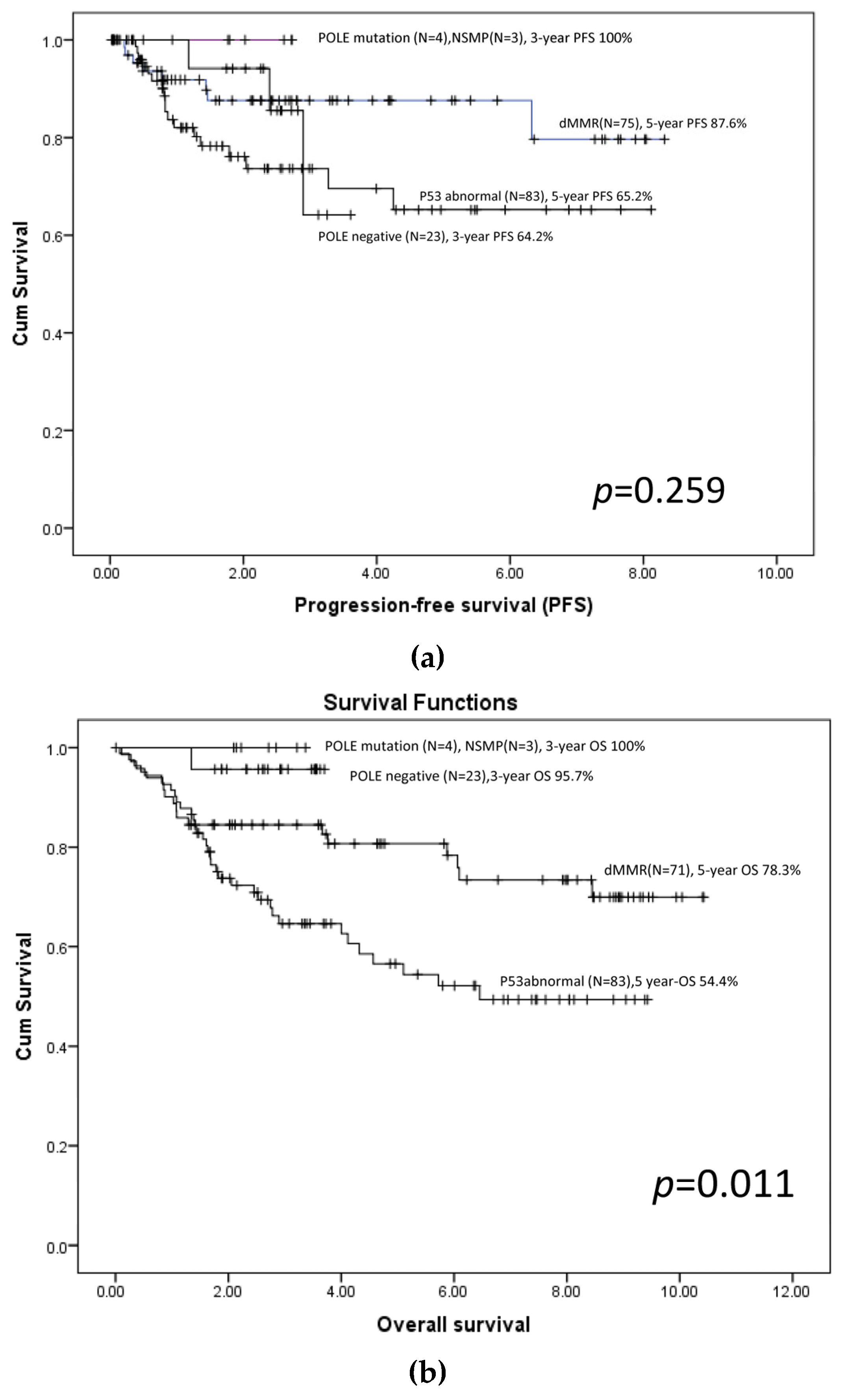
3.3. Survival Outcomes by Molecular Subtype
3.4. Clinicopathologic Correlates of MMR and p53 Status
4. Discussion
4.1. Distribution of Molecular Subtypes
4.2. Survival Outcomes by Molecular Subtype
4.3. Methodological Considerations for POLE Testing
4.4. Clinicopathologic Correlates of MMR and p53 Status
4.5. Strengths and Limitations
5. Conclusions
Supplementary Materials
Author Contributions
Funding
Institutional Review Board Statement
Informed Consent Statement
Data Availability Statement
Conflicts of Interest
Abbreviations
| POLE DNA | polymerase epsilon |
| dMMR | mismatch repair–deficient |
| p53-abn | p53-abnormal |
| NSMP | no specific molecular profile |
| MMR | mismatch repair |
| EC | endometrial cancer |
| IHC | Immunohistochemistry |
| PFS | Progression-free survival |
| OS | overall survival |
| OR | odd ratio |
| CI | confident interval |
| TCGA | The Cancer Genome Atlas |
| PORTEC | Post operative radiation therapy in endometrial carcinoma |
| ASR | Age-standardized incidence rate |
| MSI | microsatellite instability |
| ProMisE | Proactive Molecular Risk Classifier for Endometrial Cancer |
| FIGO | International Federation of Gynecology and Obstetrics |
| WHO | World Health Organization |
| ESGO | European Society of Gynaecological Oncology |
| ESTRO | European Society for Radiotherapy and Oncology |
| ESP | European Society of Pathology |
| FFPE | Formalin-fixed paraffin-embedded |
| HGVS | Human Genome Variation Society |
| CT | Computed tomography |
| BMI | Body mass index |
| LVSI | lymphovascular invasion |
| EBRT | External beam radiation therapy |
Appendix A. Sample-Size Calculation
References
- International Agency for Research on Cancer. GLOBOCAN 2022: Estimated Cancer Incidence, Mortality and Prevalence Worldwide in 2022; IARC: Lyon, France, 2022; Available online: https://gco.iarc.fr (accessed on 2 February 2025).
- Kandoth, C. The Cancer Genome Atlas Research Network. Integrated genomic characterization of endometrial carcinoma. Nature 2013, 497, 67–73. [Google Scholar] [CrossRef] [PubMed]
- Talhouk, A.; McConechy, M.K.; Leung, S.; Li-Chang, H.H.; Kwon, J.S.; Melnyk, N.; Yang, W.; Senz, J.; Boyd, N.; Karnezis, A.N.; et al. A clinically applicable molecular-based classification for endometrial cancers. Br. J. Cancer 2015, 113, 299–310. [Google Scholar] [CrossRef] [PubMed]
- Stelloo, E.; Bosse, T.; Nout, R.A.; MacKay, H.J.; Church, D.N.; Nijman, H.W.; Leary, A.; Edmondson, R.J.; Powell, M.E.; Crosbie, E.J.; et al. Refining prognosis and identifying targetable pathways for high-risk endometrial cancer; a TransPORTEC initiative. Mod. Pathol. 2015, 28, 836–844. [Google Scholar] [CrossRef] [PubMed]
- Parkash, V.; Aisagbonhi, O.; Riddle, N.; Siddon, A.; Panse, G.; Fadare, O. Recent Advances in the Classification of Gynecological Tract Tumors: Updates From the 5th Edition of the World Health Organization “Blue Book”. Arch. Pathol. Lab. Med. 2023, 147, 1204–1216. [Google Scholar] [CrossRef] [PubMed]
- Berek, J.S.; Matias-Guiu, X.; Creutzberg, C.; Fotopoulou, C.; Gaffney, D.; Kehoe, S.; Lindemann, K.; Mutch, D.; Concin, N. FIGO staging of endometrial cancer: 2023. Int. J. Gynaecol. Obstet. 2023, 162, 383–394. [Google Scholar] [CrossRef] [PubMed]
- Concin, N.; Matias-Guiu, X.; Vergote, I.; Cibula, D.; Mirza, M.R.; Marnitz, S.; Ledermann, J.; Bosse, T.; Chargari, C.; Fagotti, A.; et al. ESGO/ESTRO/ESP guidelines for the management of patients with endometrial carcinoma. Int. J. Gynecol. Cancer 2021, 31, 12–39. [Google Scholar] [CrossRef] [PubMed]
- Mojtahed, A.; Schrijver, I.; Ford, J.M.; Longacre, T.A.; Pai, R.K. A two-antibody mismatch repair protein immunohistochemistry screening approach for colorectal carcinomas, skin sebaceous tumors, and gynecologic tract carcinomas. Mod. Pathol. 2011, 24, 1004–1014. [Google Scholar] [CrossRef] [PubMed]
- Stelloo, E.; Jansen, A.M.L.; Osse, E.M.; Nout, R.A.; Creutzberg, C.L.; Ruano, D.; Church, D.N.; Morreau, H.; Smit, V.T.H.B.M.; van Wezel, T.; et al. Practical guidance for mismatch repair-deficiency testing in endometrial cancer. Ann. Oncol. 2017, 28, 96–102. [Google Scholar] [CrossRef] [PubMed]
- Köbel, M.; Ronnett, B.M.; Singh, N.; Soslow, R.A.; Gilks, C.B.; McCluggage, W.G. Interpretation of P53 Immunohistochemistry in Endometrial Carcinomas: Toward Increased Reproducibility. Int. J. Gynecol. Pathol. 2019, 38, S123–S131. [Google Scholar] [CrossRef] [PubMed]
- Biocartis, N.V. Idylla™ POLE-POLD1 Mutation Assay Technical Sheet [Internet]. Mechelen, Belgium: Biocartis NV. 2025. Available online: https://www.biocartis.com/en-US/oncology-research/oncology-research-assays#IdyllaPOLEPOLD1 (accessed on 20 October 2025).
- León-Castillo, A.; Britton, H.; McConechy, M.K.; McAlpine, J.N.; Nout, R.; Kommoss, S.; Brucker, S.Y.; Carlson, J.W.; Epstein, E.; Rau, T.T.; et al. Interpretation of somatic POLE mutations in endometrial carcinoma. J. Pathol. 2020, 250, 323–335. [Google Scholar] [CrossRef] [PubMed]
- Hussein, Y.R.; Weigelt, B.; Levine, D.A.; Schoolmeester, J.K.; Dao, L.N.; Balzer, B.L.; Liles, G.; Karlan, B.; Köbel, M.; Lee, C.-H.; et al. Clinicopathological analysis of endometrial carcinomas harboring somatic POLE exonuclease domain mutations. Mod. Pathol. 2015, 28, 505–514. [Google Scholar] [CrossRef] [PubMed]
- Freedman, L.S. Tables of the number of patients required in clinical trials using the logrank test. Stat. Med. 1982, 1, 121–129. [Google Scholar] [CrossRef] [PubMed]
- León-Castillo, A.; de Boer, S.M.; Powell, M.E.; Mileshkin, L.R.; Mackay, H.J.; Leary, A.; Nijman, H.W.; Singh, N.; Pollock, P.M.; Bessette, P.; et al. Molecular Classification of the PORTEC-3 Trial for High-Risk Endometrial Cancer: Impact on Prognosis and Benefit From Adjuvant Therapy. J. Clin. Oncol. 2020, 38, 3388–3397. [Google Scholar] [CrossRef] [PubMed]
- Corr, B.; Cosgrove, C.; Spinosa, D.; Guntupalli, S. Endometrial cancer: Molecular classification and future treatments. BMJ Med. 2022, 1, e000152. [Google Scholar] [CrossRef] [PubMed]
- Uguen, A.; Troncone, G. A review on the Idylla platform towards the assessment of actionable genomic alterations in one day. J. Clin. Pathol. 2018, 71, 757–762. [Google Scholar] [CrossRef] [PubMed]
- Huang, H.; Springborn, S.; Haug, K.; Bartow, K.; Samra, H.; Menon, S.; Mackinnon, A.C. Evaluation, Validation, and Implementation of the Idylla System as Rapid Molecular Testing for Precision Medicine. J. Mol. Diagn. 2019, 21, 862–872. [Google Scholar] [CrossRef] [PubMed]
- Chase, D.M.; Kobayashi, M.; Gomez, P.; Lubinga, S.J.; Chan, J.K. Treatment patterns and outcomes by mismatch repair/microsatellite instability status among patients with primary advanced or recurrent endometrial cancer in the United States. Future Oncol. 2025, 21, 2299–2310. [Google Scholar] [CrossRef] [PubMed]
- Jumaah, A.S.; Al-Haddad, H.S.; Salem, M.M.; McAllister, K.A.; Yasseen, A.A. Mismatch repair deficiency and clinicopathological characteristics in endometrial carcinoma: A systematic review and meta-analysis. J. Pathol. Transl. Med. 2021, 55, 202–211. [Google Scholar] [CrossRef] [PubMed]
- Vaziri Fard, E.; Imboden, S.; Rau, T.; Epstein, E.; Petta, T.B.; Walia, S.; Carlson, J.W.M. p53 Abnormal (Copy Number High) Endometrioid Endometrial Carcinoma Has a Prognosis Indistinguishable From Serous Carcinoma. Int. J. Gynecol. Pathol. 2024, 43, 515–526. [Google Scholar] [CrossRef] [PubMed]
- Yin, X.; Luo, B.; Li, Y. Meta-analysis of the clinicopathologic features of endometrial cancer molecular staging. Front. Oncol. 2025, 14, 1510102. [Google Scholar] [CrossRef] [PubMed]


| Data | Number (%) |
|---|---|
| Testing coverage | |
| MMR | 24 (13.0) |
| P53 | 55 (29.9) |
| POLE | 25 (13.6) |
| MMR + p53 | 70 (38.0) |
| MMR + POLE | 2 (1.1) |
| P53 + POLE | 3 (1.6) |
| MMR + p53 + POLE | 5 (2.7) |
| IHC and molecular findings | |
| dMMR | 24 (13) |
| Abnormal p53 | 55 (29.9) |
| POLE negative | 22 (12.0) |
| POLE mutation | 2 (1.1) |
| POLE invalid | 1 (0.5) |
| dMMR + wild type P53 | 45 (24.5) |
| dMMR + POLE negative | 2 (1.1) |
| dMMR + wildtype P53 + POLE mutation | 1 (0.5) |
| pMMR + P 53 abnormal | 26 (14.1) |
| pMMR+ wild type p53 + POLE negative (NSMP) | 3 (1.6) |
| wide type P53 + POLE mutation | 1 (0.5) |
| P53 abnormal + POLE negative | 2 (1.1) |
| Final Molecular Subtype Assignment | |
| Pole mutation | 4 (2.2) |
| Pole negative | 23 (12.5) |
| p53 abnormal | 83 (45.1) |
| dMMR | 71 (38.6) |
| NSMP | 3 (1.6) |
| Summary of results by individual molecular test | |
| MMR | |
| Not done | 83 (45.1) |
| pMMR | 29 (15.8) |
| dMMR | 72 (39.1) |
| P53 | |
| Not done | 51 (27.7) |
| Abnormal * | 85 (46.2) |
| Wild type | 50 (30.3) |
| POLE | |
| Not done | 149 (81.0) |
| Done | 35 (19.0) |
| Not detected | 29 (15.8) |
| Detected | 4 (2.1) |
| Invalid | 2 (1.1) |
| Factors | MMR | p53 | ||||||||||||
|---|---|---|---|---|---|---|---|---|---|---|---|---|---|---|
| dMMR (%) | pMMR (%) | Total | Unadjusted OR * (95%CI) | p Value | Adjusted OR ** (95%CI) | p Value | Wild | Abnormal | Total | Unadjusted OR * (95%CI) | p Value | Adjusted OR ** (95%CI) | p Value | |
| Age (years) | ||||||||||||||
| ≤60 years | 52 (81.3) | 12 (18.8) | 64 (63.4) | 3.683 (1.496–9.070) | 0.006 | 2.611 (0.888–7.677) | 0.081 | 33 (61.1) | 21 (38.9) | 54 (40.6) | 5.731 (2.663–12.332) | <0.001 | 7.952 (1.208–47.697) | 0.031 |
| >60 years | 20 (54.1) | 17 (45.9) | 37 (36.6) | 17 (21.5) | 62 (78.5) | 79 (59.4) | ||||||||
| BMI | ||||||||||||||
| <25 | 47 (75.8) | 15 (24.2) | 62 (61.4) | 1.755 (0.731–4.210) | 0.260 | - | - | 32 (43.8) | 41 (56.2) | 73 (54.9) | 1.821 (0.886–3.742) | 0.109 | - | - |
| ≥25 | 25 (64.1) | 14 (35.9) | 39 (38.6) | 18 (30.0) | 42 (70.0) | 60 (45.1) | ||||||||
| UD | ||||||||||||||
| None | 28 (82.4) | 6 (17.6) | 34 (33.7) | 2.439 (0.883–6.736) | 0.104 | - | - | 25 (67.6) | 12 (32.4) | 5.917 (2.519–13.509) | <0.001 | 5.618 (0.870–36.278) | 0.070 | |
| Present | 44 (65.7) | 23 (34.3) | 67 (66.3) | 25 (26.0) | 71 (74.0) | |||||||||
| Residual disease | ||||||||||||||
| None | 65 (70.7) | 27 (29.3) | 92 (91.1) | 0.688 (0.134–2.526) | 0.727 | - | - | 45 (37.5) | 75 (62.5) | 120 (90.2) | 0.960 (0.269–3.114) | 1.000 | - | - |
| Present | 7 (77.8) | 2 (22.2) | 9 (8.9) | 5 (38.5) | 8 (61.5) | 13 (9.8) | ||||||||
| Histology | ||||||||||||||
| Endometrioid | 65 (86.7) | 10 (13.3) | 75 (74.3) | 17.463 (5.915–52.622) | <0.001 | 15.215 (4.992–46.374) | <0.001 | 46 (80.7) | 11 (19.3) | 57 (42.9) | 75.273 (22.611–250.586 | <0.001 | 79.416 (10.599–595.049) | <0.001 |
| Non-endometrioid | 7 (26.9) | 19 (65.5) | 26 (25.7) | 4 (5.3) | 72 (94.7) | 76 (57.1) | ||||||||
| MI | ||||||||||||||
| Less than 50% | 39 (76.5) | 12 (23.5) | 51 (50.5) | 1.674 (0.700–4.006) | 0.277 | - | - | 1.266 (0.625–2.563) | 0.590 | - | - | |||
| ≥50% | 33 (66.0) | 17 (28.7) | 50 (49.5) | 26 (35.1) | 48 (64.9) | 74 (55.6) | ||||||||
| LVSI | - | |||||||||||||
| None | 45 (73.8) | 16 (26.2) | 61 (60.4) | 1.354 (0.565–3.244) | 0.509 | - | - | 0.627 (0.309–1.275) | 0.210 | - | ||||
| Present | 27 (67.5) | 13 (32.5) | 40 (39.6) | 25 (50.0) | 32 (56.1) | 57 (42.9) | ||||||||
| Peritoneal cytology | ||||||||||||||
| Negative | 70 (72.9) | 26 (27.1) | 96 (95.0) | 4.038 (0.638–25.555) | 0.141 | - | - | 48 (40.7) | 70 (59.3) | 118 (88.7) | 4.457 (0.962–20.653) | 0.050 | - | - |
| Positive | 2 (40.0) | 3 (60.0) | 5 (5.0) | 2 (13.3) | 13 (86.7) | 15 (11.3) | ||||||||
| Stage *** | ||||||||||||||
| I&II | 47 (78.3) | 13 (21.7) | 60 (59.4) | 2.314 (0.962–5.568) | 0.074 | - | - | 33 (44.0) | 42 (56.0) | 75 (56.4) | 1.895 (0.917–3.918) | 0.105 | - | - |
| III&IV | 25 (61.0) | 16 (39.0) | 41 (40.6) | 17 (29.3) | 41 (70.7) | 58 (43.6) | ||||||||
| Risk | ||||||||||||||
| Low&intermediate | 44 (89.8) | 5 (10.2) | 49 (48.5) | 7.543 (2.578–22.072) | <0.001 | 1.329 (0.298–5.919) | 0.709 | 31 (81.6) | 7 (18.4) | 38 (28.6) | 17.714 (6.769–46.357) | <0.001 | 1.848 (0.059–57.817) | 0.727 |
| High risk | 28 (53.8) | 24 (46.2) | 52 (51.5) | 19 (20.0) | 76 (80.0) | 95 (71.4) | ||||||||
| Adjuvant RT | ||||||||||||||
| None | 31 (77.5) | 9 (22.5) | 40 (75.5) | 0.287 (0.03–2.516) | 0.419 | - | - | 19 (32.2) | 40 (67.8) | 59 (84.3) | 0.048 (0.006–0.398) | <0.001 | 0.268 (0.020–3.600) | 0.320 |
| Present | 12 (92.3) | 1 (7.7) | 13 (24.5) | 10 (90.9) | 1 (9.1) | 11 (15.7) | ||||||||
| Adjuvant CT | ||||||||||||||
| None | 66 (74.2) | 23 (25.8) | 89 (88.1) | 2.870 (0.841–9.789) | 0.098 | - | - | 44 (44.9) | 54 (55.1) | 98 (73.7) | 3.938 (1.500–10.337) | 0.004 | 0.546 (0.037–8.013) | 0.659 |
Disclaimer/Publisher’s Note: The statements, opinions and data contained in all publications are solely those of the individual author(s) and contributor(s) and not of MDPI and/or the editor(s). MDPI and/or the editor(s) disclaim responsibility for any injury to people or property resulting from any ideas, methods, instructions or products referred to in the content. |
© 2026 by the authors. Licensee MDPI, Basel, Switzerland. This article is an open access article distributed under the terms and conditions of the Creative Commons Attribution (CC BY) license.
Share and Cite
Salakphet, T.; Suprasert, P.; Pongsuvareeyakul, T.; Teerapakpinyo, C.; Khunamornpong, S. Molecular Classification and Clinical Outcomes in Endometrial Cancer: Real-World Evidence from a Tertiary Care Center. Cancers 2026, 18, 181. https://doi.org/10.3390/cancers18020181
Salakphet T, Suprasert P, Pongsuvareeyakul T, Teerapakpinyo C, Khunamornpong S. Molecular Classification and Clinical Outcomes in Endometrial Cancer: Real-World Evidence from a Tertiary Care Center. Cancers. 2026; 18(2):181. https://doi.org/10.3390/cancers18020181
Chicago/Turabian StyleSalakphet, Tanadon, Prapaporn Suprasert, Tip Pongsuvareeyakul, Chinachote Teerapakpinyo, and Surapan Khunamornpong. 2026. "Molecular Classification and Clinical Outcomes in Endometrial Cancer: Real-World Evidence from a Tertiary Care Center" Cancers 18, no. 2: 181. https://doi.org/10.3390/cancers18020181
APA StyleSalakphet, T., Suprasert, P., Pongsuvareeyakul, T., Teerapakpinyo, C., & Khunamornpong, S. (2026). Molecular Classification and Clinical Outcomes in Endometrial Cancer: Real-World Evidence from a Tertiary Care Center. Cancers, 18(2), 181. https://doi.org/10.3390/cancers18020181