Functional Outcomes and Anti-Reflux Performance of Reconstruction Methods Following Proximal Gastrectomy: A Systematic Review


Simple Summary
Abstract
1. Introduction
2. Methods
2.1. Literature Search Strategy
2.2. Inclusion and Exclusion Criteria
- Population consisted of adult patients (≥18 years) with histologically confirmed gastric cancer;
- Evaluated surgical outcomes following proximal gastrectomy, including reflux symptoms, nutritional status, and QOL.
- Original clinical research, including randomized controlled trials, non-randomized comparative studies, and prospective or retrospective observational studies.
- Studies involving pediatric patients;
- Animal or preclinical studies;
- Review articles, including systematic reviews and meta-analyses;
- Editorials, letters, or commentaries, or consensus statements;
- Study protocols;
- Scale-development studies;
- Single case reports;
- Studies without extractable clinical outcomes relevant to the review;
- Duplicate or overlapping publications that did not provide additional relevant data;
- Non-English-language publications.
Study Selection and Data Extraction
- Study characteristics: first author, year of publication, journal
- Study design: randomized controlled trial, non-randomized comparative study, or prospective or retrospective observational study
- Patient characteristics: number of patients, age, tumor stage
- Surgical procedures: type of gastrectomy, reconstruction method
- Primary outcome 1—Reflux esophagitis: incidence and evaluation method (e.g., Los Angeles classification of reflux esophagitis)
- Primary outcome 2—QOL: assessment tool used (e.g., the Postgastrectomy Syndrome Assessment Scale-45 (PGSAS-45) and the European Organisation for Research and Treatment of Cancer Quality of Life Questionnaire-Stomach 22 (EORTC QLQ-STO22))
- Follow-up period: duration of postoperative follow-up (months or years).
2.3. Methodological Quality Assessment
2.4. Data Synthesis
3. Results
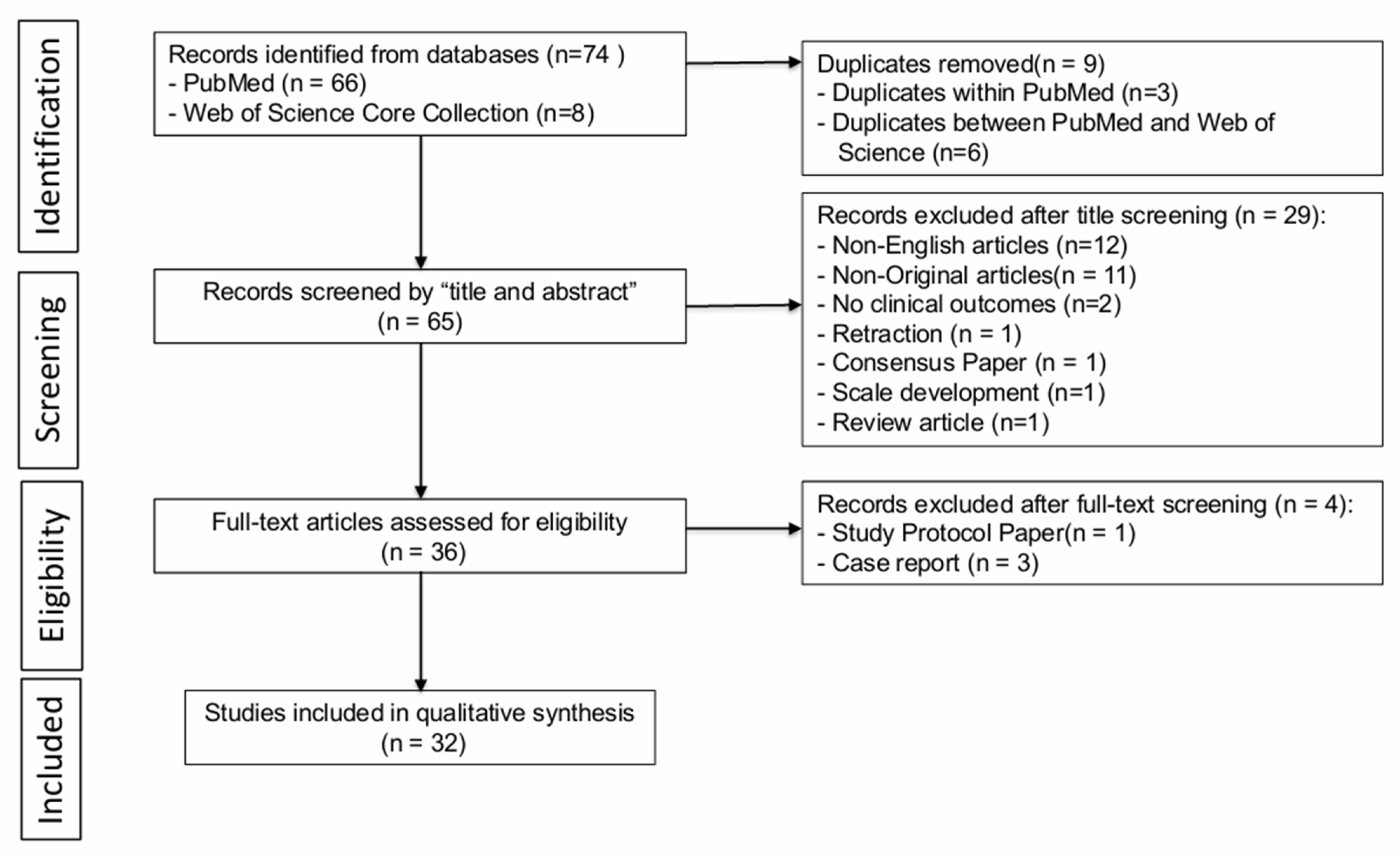
3.1. Study Selection
3.2. Study Characteristics
3.3. Methodological Quality of the Included Studies
3.4. Reflux Esophagitis
3.5. Simple EG
3.6. DTR
3.7. JI and Jejunal Pouch Interposition
3.8. Impact of Anti-Reflux Reconstructions Including the Double-Flap Technique, Pseudofornix Technique, Side Overlap with Fundoplication by Yamashita, and Fundoplication-Augmented Esophagogastrostomy
3.9. Quality of Life
3.9.1. Post-Gastrectomy Syndrome Assessment Scale (PGSAS-45/PGSAS-37)
3.9.2. EORTC QLQ-C30/QLQ-STO22
3.9.3. Other QOL Instruments
4. Discussion
5. Limitations
6. Conclusions
Supplementary Materials
Author Contributions
Funding
Data Availability Statement
Conflicts of Interest
References
- WHO. Global Health Estimates 2020: Deaths by Cause, Age, Sex, by Country and by Region, 2000–2019; WHO: Geneva, Switzerland, 2020. [Google Scholar]
- Smyth, E.C.; Nilsson, M.; Grabsch, H.I.; van Grieken, N.C.; Lordick, F. Gastric cancer. Lancet 2020, 396, 635–648. [Google Scholar] [CrossRef]
- Piccioni, S.A.; Costantini, M.; Petrioli, R.; Bagnacci, G.; Ferrara, D.; Andreucci, E.; Carbone, L.; Ongaro, A.; Calomino, N.; Sandini, M.; et al. Impact of HER2 and microsatellite instability status on response to neoadjuvant/conversion therapy and survival in patients with gastric cancer. Eur. J. Cancer Prev. 2026, 35, 66–77. [Google Scholar] [CrossRef] [PubMed]
- Kim, Y.W.; Baik, Y.H.; Yun, Y.H.; Nam, B.H.; Kim, D.H.; Choi, I.J.; Bae, J.M. Improved quality of life outcomes after laparoscopy-assisted distal gastrectomy for early gastric cancer: Results of a prospective randomized clinical trial. Ann. Surg. 2008, 248, 721–727. [Google Scholar] [CrossRef] [PubMed]
- Eom, B.W.; Yoon, H.M.; Kim, Y.W.; Min, J.S.; An, J.Y.; Hur, H.; Lee, Y.J.; Cho, G.S.; Park, Y.K.; Jung, M.R.; et al. Quality of Life and Nutritional Outcomes of Stomach-Preserving Surgery for Early Gastric Cancer: A Secondary Analysis of the SENORITA Randomized Clinical Trial. JAMA Surg. 2024, 159, 900–908. [Google Scholar] [CrossRef] [PubMed]
- Nomura, E.; Okajima, K. Function-preserving gastrectomy for gastric cancer in Japan. World J. Gastroenterol. 2016, 22, 5888–5895. [Google Scholar] [CrossRef] [PubMed]
- Hirata, Y.; Kim, H.I.; Grotz, T.E.; Matsuda, S.; Badgwell, B.D.; Ikoma, N. The role of proximal gastrectomy in gastric cancer. Chin. Clin. Oncol. 2022, 11, 39. [Google Scholar] [CrossRef] [PubMed]
- Kuroda, S.; Nishizaki, M.; Kikuchi, S.; Noma, K.; Tanabe, S.; Kagawa, S.; Shirakawa, Y.; Fujiwara, T. Double-Flap Technique as an Antireflux Procedure in Esophagogastrostomy after Proximal Gastrectomy. J. Am. Coll. Surg. 2016, 223, e7–e13. [Google Scholar] [CrossRef] [PubMed]
- Yamashita, Y.; Tatsubayashi, T.; Okumura, K.; Miyamoto, T.; Ueno, K. Modified side overlap esophagogastrostomy after laparoscopic proximal gastrectomy. Ann. Gastroenterol. Surg. 2022, 6, 594–599. [Google Scholar] [CrossRef] [PubMed]
- Li, B.; Wang, Y.; Li, B.; Shan, F.; Li, Z. Short-term outcomes and long-term quality of life of reconstruction methods after proximal gastrectomy: A systematic review and meta-analysis. BMC Cancer 2024, 24, 56. [Google Scholar] [CrossRef] [PubMed]
- Page, M.J.; McKenzie, J.E.; Bossuyt, P.M.; Boutron, I.; Hoffmann, T.C.; Mulrow, C.D.; Shamseer, L.; Tetzlaff, J.M.; Akl, E.A.; Brennan, S.E.; et al. The PRISMA 2020 statement: An updated guideline for reporting systematic reviews. BMJ 2021, 372, n71. [Google Scholar] [CrossRef] [PubMed]
- Tian, Z.; Cheng, Y.; Wang, Y.; Ren, J.; Wang, S.; Wang, D. A 3-Arm case-matched analysis of anti-reflux reconstruction methods after laparoscopic proximal gastrectomy–Single tract jejunal interposition vs double tract reconstruction vs tube-like stomach reconstruction. Eur. J. Surg. Oncol. 2025, 51, 109482. [Google Scholar] [CrossRef] [PubMed]
- Oh, S.E.; Suh, Y.S.; An, J.Y.; Ryu, K.W.; Cho, I.; Kim, S.G.; Park, J.H.; Hur, H.; Kim, H.H.; Ahn, S.H.; et al. Prospective Multicenter Observational Study on Postoperative Quality of Life According to Type of Gastrectomy for Gastric Cancer. J. Gastric Cancer 2025, 25, 382–399. [Google Scholar] [CrossRef] [PubMed]
- Wang, Z.J.; Xu, Z.Y.; Huang, Z.J.; Li, L.; Guan, D.; Gao, Y.H.; Wang, X.X. Double tract reconstruction improves the quality of life and better maintain the BMI of patients with proximal gastric cancer. BMC Surg. 2024, 24, 171. [Google Scholar] [CrossRef] [PubMed]
- Sun, Y.; Chen, C.; Hou, L.; Zhao, E. Short-term outcomes and quality of life of esophagogastrostomy versus the double-tract reconstruction after laparoscopic proximal gastrectomy. BMC Cancer 2024, 24, 1324. [Google Scholar] [CrossRef] [PubMed]
- Saeki, Y.; Tanabe, K.; Ota, H.; Chikuie, E.; Takemoto, Y.; Karakuchi, N.; Miura, O.; Toyama, E.; Ohdan, H. Intraoesophageal pressure in patients receiving proximal gastrectomy with hinged double flap method for gastric cancer: A retrospective cohort study. Ann. Med. Surg. 2024, 86, 712–719. [Google Scholar] [CrossRef] [PubMed]
- Zhang, H.; Zheng, Z.; Liu, X.; Xin, C.; Huang, Y.; Li, Y.; Yin, J.; Zhang, J. Safety and efficacy of laparoscopic proximal gastrectomy with SOFY versus laparoscopic total gastrectomy with Roux-en-Y for treating cT1–2 Siewert II/III adenocarcinoma of the esophagogastric junction: A single-center prospective cohort study. Langenbeck’s Arch. Surg. 2023, 408, 69. [Google Scholar] [CrossRef] [PubMed]
- Shibamoto, J.; Kubota, T.; Nishibeppu, K.; Ohashi, T.; Konishi, H.; Shiozaki, A.; Fujiwara, H.; Otsuji, E. Clinical Relevance of Proximal Gastrectomy with Double-Flap Esophagogastrostomy Reconstruction with Glycemic Profile and Postgastrectomy Syndromes. Anticancer Res. 2023, 43, 857–864. [Google Scholar] [CrossRef] [PubMed]
- Park, D.J.; Han, S.U.; Hyung, W.J.; Hwang, S.H.; Hur, H.; Yang, H.K.; Lee, H.J.; Kim, H.I.; Kong, S.H.; Kim, Y.W.; et al. Effect of Laparoscopic Proximal Gastrectomy with Double-Tract Reconstruction vs Total Gastrectomy on Hemoglobin Level and Vitamin B12 Supplementation in Upper-Third Early Gastric Cancer: A Randomized Clinical Trial. JAMA Netw. Open 2023, 6, e2256004. [Google Scholar] [CrossRef] [PubMed]
- Gong, J.; Liu, X.; Wang, G.; Li, W.; Luo, G.; Lin, Y.; Zhang, B.; Chen, C. Uncut interposed jejunum pouch versus esophago-gastrostomy and double anastomoses of jejunum to the esophagus and residual stomach: An innovative method of digestive tract reconstruction following proximal gastrectomy. Asian J. Surg. 2023, 46, 4196–4201. [Google Scholar] [CrossRef] [PubMed]
- Chen, J.; Wang, F.; Gao, S.; Yang, Y.; Zhao, Z.; Shi, J.; Wang, L.; Ren, J. Surgical outcomes of laparoscopic proximal gastrectomy for upper-third gastric cancer: Esophagogastrostomy, gastric tube reconstruction, and double-tract reconstruction. BMC Surg. 2023, 23, 309. [Google Scholar] [CrossRef] [PubMed]
- Aizawa, M.; Ishida, M.; Kodera, Y.; Kanazawa, T.; Fukushima, R.; Akashi, Y.; Yoshimura, F.; Ota, S.; Oshio, A.; Nakada, K. A comparison of the effects of anti-reflux procedures during esophagogastrostomy after proximal gastrectomy on the postoperative quality of life. Surg. Today 2023, 53, 182–191. [Google Scholar] [CrossRef] [PubMed]
- Yu, B.; Park, K.B.; Park, J.Y.; Lee, S.S.; Kwon, O.K.; Chung, H.Y.; Hwang, Y.J. Double tract reconstruction versus double flap technique: Short-term clinical outcomes after laparoscopic proximal gastrectomy for early gastric cancer. Surg. Endosc. 2022, 36, 5243–5256. [Google Scholar] [CrossRef] [PubMed]
- Kamiya, S.; Namikawa, T.; Takahashi, M.; Hasegawa, Y.; Ikeda, M.; Kinami, S.; Isozaki, H.; Takeuchi, H.; Oshio, A.; Nakada, K. Optimal Procedures for Double Tract Reconstruction After Proximal Gastrectomy Assessed by Postgastrectomy Syndrome Assessment Scale-45. J. Gastrointest. Surg. 2022, 26, 1817–1829. [Google Scholar] [CrossRef] [PubMed]
- Aizawa, M.; Yabusaki, H.; Nakada, K.; Matsuki, A.; Bamba, T.; Nakagawa, S. Simple modifications of conventional esophagogastrostomy after proximal gastrectomy adequately reduces the postoperative reflux esophagitis: A retrospective analysis of posterolateral fundoplication. Langenbeck’s Arch. Surg. 2022, 407, 3153–3160. [Google Scholar] [CrossRef] [PubMed]
- Toyomasu, Y.; Mochiki, E.; Ishiguro, T.; Ito, T.; Suzuki, O.; Ogata, K.; Kumagai, Y.; Ishibashi, K.; Saeki, H.; Shirabe, K.; et al. Clinical outcomes of gastric tube reconstruction following laparoscopic proximal gastrectomy for early gastric cancer in the upper third of the stomach: Experience with 100 consecutive cases. Langenbeck’s Arch. Surg. 2021, 406, 659–666. [Google Scholar] [CrossRef] [PubMed]
- Sato, R.; Kinoshita, T.; Akimoto, E.; Yoshida, M.; Nishiguchi, Y.; Harada, J. Feasibility and quality of life assessment of laparoscopic proximal gastrectomy using double-tract reconstruction. Langenbeck’s Arch. Surg. 2021, 406, 479–489. [Google Scholar] [CrossRef] [PubMed]
- Li, Z.; Ma, Y.; Liu, G.; Fang, M.; Xue, Y. Proximal gastrectomy with gastric tube reconstruction or jejunal interposition reconstruction in upper-third gastric cancer: Which offers better short-term surgical outcomes? BMC Surg. 2021, 21, 249. [Google Scholar] [CrossRef] [PubMed]
- Ji, X.; Jin, C.; Ji, K.; Zhang, J.; Wu, X.; Jia, Z.; Bu, Z.; Ji, J. Double Tract Reconstruction Reduces Reflux Esophagitis and Improves Quality of Life after Radical Proximal Gastrectomy for Patients with Upper Gastric or Esophagogastric Adenocarcinoma. Cancer Res. Treat. 2021, 53, 784–794. [Google Scholar] [CrossRef] [PubMed]
- Eom, B.W.; Park, J.Y.; Park, K.B.; Yoon, H.M.; Kwon, O.K.; Ryu, K.W.; Kim, Y.W. Comparison of nutrition and quality of life of esophagogastrostomy and the double-tract reconstruction after laparoscopic proximal gastrectomy. Medicine 2021, 100, e25453. [Google Scholar] [CrossRef] [PubMed]
- Yue, C.; Peng, R.; Wei, W.; Zhou, B.; Wen, X.; Gu, R.; Ming, X.; Li, G.; Chen, H. Comparison on the Efficacy of Double Tract Gastric Interposition Reconstruction Versus Jejunal Interposition Reconstruction After Proximal Gastrectomy. Med. Sci. Monit. 2020, 26, e922504. [Google Scholar] [CrossRef] [PubMed]
- Yabusaki, H.; Kodera, Y.; Fukushima, N.; Hiki, N.; Kinami, S.; Yoshida, M.; Aoyagi, K.; Ota, S.; Hata, H.; Noro, H.; et al. Comparison of Postoperative Quality of Life among Three Different Reconstruction Methods After Proximal Gastrectomy: Insights From the PGSAS Study. World J. Surg. 2020, 44, 3433–3440. [Google Scholar] [CrossRef] [PubMed]
- Tsumura, T.; Kuroda, S.; Nishizaki, M.; Kikuchi, S.; Kakiuchi, Y.; Takata, N.; Ito, A.; Watanabe, M.; Kuwada, K.; Kagawa, S.; et al. Short-term and long-term comparisons of laparoscopy-assisted proximal gastrectomy with esophagogastrostomy by the double-flap technique and laparoscopy-assisted total gastrectomy for proximal gastric cancer. PLoS ONE 2020, 15, e0242223. [Google Scholar] [CrossRef] [PubMed]
- Nomura, E.; Kayano, H.; Lee, S.W.; Kawai, M.; Machida, T.; Yamamoto, S.; Nabeshima, K.; Nakamura, K.; Mukai, M.; Uchiyama, K. Functional evaluations comparing the double-tract method and the jejunal interposition method following laparoscopic proximal gastrectomy for gastric cancer: An investigation including laparoscopic total gastrectomy. Surg. Today 2019, 49, 38–48. [Google Scholar] [CrossRef] [PubMed]
- Park, J.Y.; Park, K.B.; Kwon, O.K.; Yu, W. Comparison of laparoscopic proximal gastrectomy with double-tract reconstruction and laparoscopic total gastrectomy in terms of nutritional status or quality of life in early gastric cancer patients. Eur. J. Surg. Oncol. 2018, 44, 1963–1970. [Google Scholar] [CrossRef] [PubMed]
- Nishigori, T.; Okabe, H.; Tsunoda, S.; Shinohara, H.; Obama, K.; Hosogi, H.; Hisamori, S.; Miyazaki, K.; Nakayama, T.; Sakai, Y. Superiority of laparoscopic proximal gastrectomy with hand-sewn esophagogastrostomy over total gastrectomy in improving postoperative body weight loss and quality of life. Surg. Endosc. 2017, 31, 3664–3672. [Google Scholar] [CrossRef] [PubMed]
- Ronellenfitsch, U.; Najmeh, S.; Andalib, A.; Perera, R.M.; Rousseau, M.C.; Mulder, D.S.; Ferri, L.E. Functional outcomes and quality of life after proximal gastrectomy with esophagogastrostomy using a narrow gastric conduit. Ann. Surg. Oncol. 2015, 22, 772–779. [Google Scholar] [CrossRef] [PubMed]
- Ohashi, M.; Morita, S.; Fukagawa, T.; Oda, I.; Kushima, R.; Katai, H. Functional Advantages of Proximal Gastrectomy with Jejunal Interposition Over Total Gastrectomy with Roux-en-Y Esophagojejunostomy for Early Gastric Cancer. World J. Surg. 2015, 39, 2726–2733. [Google Scholar] [CrossRef] [PubMed]
- Ichikawa, D.; Komatsu, S.; Okamoto, K.; Shiozaki, A.; Fujiwara, H.; Otsuji, E. Evaluation of symptoms related to reflux esophagitis in patients with esophagogastrostomy after proximal gastrectomy. Langenbeck’s Arch. Surg. 2013, 398, 697–701. [Google Scholar] [CrossRef] [PubMed]
- Ahn, S.H.; Lee, J.H.; Park, D.J.; Kim, H.H. Comparative study of clinical outcomes between laparoscopy-assisted proximal gastrectomy (LAPG) and laparoscopy-assisted total gastrectomy (LATG) for proximal gastric cancer. Gastric Cancer Off. J. Int. Gastric Cancer 2013, 16, 282–289. [Google Scholar] [CrossRef] [PubMed]
- Zhang, H.; Sun, Z.; Xu, H.M.; Shan, J.X.; Wang, S.B.; Chen, J.Q. Improved quality of life in patients with gastric cancer after esophagogastrostomy reconstruction. World J. Gastroenterol. 2009, 15, 3183–3190. [Google Scholar] [CrossRef] [PubMed]
- Nakane, Y.; Michiura, T.; Inoue, K.; Sato, M.; Nakai, K.; Ioka, M.; Yamamichi, K. Role of pyloroplasty after proximal gastrectomy for cancer. Hepatogastroenterology 2004, 51, 1867–1871. [Google Scholar] [PubMed]
- Shiraishi, N.; Adachi, Y.; Kitano, S.; Kakisako, K.; Inomata, M.; Yasuda, K. Clinical outcome of proximal versus total gastrectomy for proximal gastric cancer. World J. Surg. 2002, 26, 1150–1154. [Google Scholar] [CrossRef] [PubMed]
- Lundell, L.R.; Dent, J.; Bennett, J.R.; Blum, A.L.; Armstrong, D.; Galmiche, J.P.; Johnson, F.; Hongo, M.; Richter, J.E.; Spechler, S.J.; et al. Endoscopic assessment of oesophagitis: Clinical and functional correlates and further validation of the Los Angeles classification. Gut 1999, 45, 172–180. [Google Scholar] [CrossRef] [PubMed]
- Nakada, K.; Ikeda, M.; Takahashi, M.; Kinami, S.; Yoshida, M.; Uenosono, Y.; Kawashima, Y.; Oshio, A.; Suzukamo, Y.; Terashima, M.; et al. Characteristics and clinical relevance of postgastrectomy syndrome assessment scale (PGSAS)-45: Newly developed integrated questionnaires for assessment of living status and quality of life in postgastrectomy patients. Gastric Cancer 2015, 18, 147–158. [Google Scholar] [CrossRef] [PubMed]
- Blazeby, J.M.; Conroy, T.; Bottomley, A.; Vickery, C.; Arraras, J.; Sezer, O.; Moore, J.; Koller, M.; Turhal, N.S.; Stuart, R.; et al. Clinical and psychometric validation of a questionnaire module, the EORTC QLQ-STO 22, to assess quality of life in patients with gastric cancer. Eur. J. Cancer 2004, 40, 2260–2268. [Google Scholar] [CrossRef] [PubMed]
- Eom, B.W.; Lee, J.; Lee, I.S.; Son, Y.G.; Ryu, K.W.; Kim, S.G.; Kim, H.I.; Kim, Y.W.; Kong, S.H.; Kwon, O.K.; et al. Development and Validation of a Symptom-Focused Quality of Life Questionnaire (KOQUSS-40) for Gastric Cancer Patients after Gastrectomy. Cancer Res. Treat. 2021, 53, 763–772. [Google Scholar] [CrossRef] [PubMed]
- Svedlund, J.; Sjödin, I.; Dotevall, G. GSRS—A clinical rating scale for gastrointestinal symptoms in patients with irritable bowel syndrome and peptic ulcer disease. Dig. Dis. Sci. 1988, 33, 129–134. [Google Scholar] [CrossRef] [PubMed]
- Hany, M.; El-Ansari, K.; El Ansari, W. Diagnostic accuracy of symptoms compared to endoscopy, biopsy and bile reflux index in detecting reflux-related abnormalities at one year after OAGB. Langenbeck’s Arch. Surg. 2025, 410, 179. [Google Scholar] [CrossRef] [PubMed]
- Hosoda, K.; Washio, M.; Mieno, H.; Moriya, H.; Ema, A.; Ushiku, H.; Watanabe, M.; Yamashita, K. Comparison of double-flap and OrVil techniques of laparoscopy-assisted proximal gastrectomy in preventing gastroesophageal reflux: A retrospective cohort study. Langenbeck’s Arch. Surg. 2019, 404, 81–91. [Google Scholar] [CrossRef] [PubMed]
- Yamashita, Y.; Yamamoto, A.; Tamamori, Y.; Yoshii, M.; Nishiguchi, Y. Side overlap esophagogastrostomy to prevent reflux after proximal gastrectomy. Gastric Cancer 2017, 20, 728–735. [Google Scholar] [CrossRef] [PubMed]
- Hu, Q.; Ohashi, M.; Ri, M.; Makuuchi, R.; Irino, T.; Hayami, M.; Sano, T.; Nunobe, S. Safety of robotic double-flap technique following proximal gastrectomy in the introductory phase compared with laparoscopic procedure: A propensity score-matched analysis. Surg. Endosc. 2024, 38, 5824–5831. [Google Scholar] [CrossRef] [PubMed]


| NO | Authors (Year) [Ref. No.] | Study Period | Country | Study Design | Patients | Tumor Stage (Included) | Approach | Reconstruction Methods | Anti-Reflux Mechanism | Follow-Up Duration |
|---|---|---|---|---|---|---|---|---|---|---|
| 1 | Tian Z et al. (2025) [12] | 2018–2022 | China | Retrospective study | 186 | Stage not restricted | Laparoscopic Proximal Gastrectomy | JI/DTR/Tube-like stomach reconstruction | No | 12 months |
| 2 | Oh S et al. (2025) [13] | 2017–2019 | Republic of Korea | Prospective observational study | 49 | Stage not restricted | Laparoscopic Proximal Gastrectomy/Robot-assisted Proximal Gastrectomy | DTR | No | 12 months |
| 3 | Wang Z et al. (2024) [14] | 2020–2021 | China | Retrospective study | 114 | Stage not restricted | Laparoscopic Proximal Gastrectomy | DTR | No | 12 months |
| 4 | Sun Y et al. (2024) [15] | 2019–2023 | China | Retrospective study | 156 | Stage not restricted | Laparoscopic Proximal Gastrectomy | DTR | No | 12 months |
| 5 | Saeki Y et al. (2023) [16] | 2015–2020 | Japan | Retrospective study | 16 | pT1–T2 only | Laparoscopic Proximal Gastrectomy/Robot-assisted Proximal Gastrectomy | Double-flap technique | Yes | 12 months |
| 6 | Zhang H et al. (2023) [17] | 2019–2021 | China | Prospective cohort study | 21 | cT1–T2N0 only | Laparoscopic Proximal Gastrectomy | Side overlap with fundoplication by Yamashita | Yes | 12 months |
| 7 | Shibamoto J et al. (2023) [18] | 2017–2021 | Japan | Retrospective study | 21 | cT1–T2 only | Open Proximal Gastrectomy/Laparoscopic Proximal Gastrectomy/Robot-assisted Proximal Gastrectomy | Double-flap technique | Yes | 6 months |
| 8 | Park J etal. (2023) [19] | 2011–2015 | Republic of Korea | RCT | 68 | cStage I only | Laparoscopic Proximal Gastrectomy | DTR | No | 24 months |
| 9 | Gong J et al. (2023) [20] | 2014–2019 | China | Retrospective study | 118 | Stage not restricted | Open Proximal Gastrectomy | The uncut interposed jejunum pouch, esophagus and residual stomach double anastomosis/JI | No | 24 months |
| 10 | Chen J et al. (2023) [21] | 2017–2022 | China | Retrospective study | 164 | Stage not restricted | Laparoscopic Proximal Gastrectomy | Gastric tube/DTR | No | 12 months |
| 11 | Aizawa M et al. (2023) [22] | 2018–2020 | Japan | Prospective observational study | 297 | Stage not restricted | Open Proximal Gastrectomy/Laparoscopic Proximal Gastrectomy | EG/EG+ anti-reflux procedure | Yes | 6 months |
| 12 | Yu B et al. (2022) [23] | 2014–2018 | China | Retrospective study | 69 | cStage I only | Laparoscopic Proximal Gastrectomy | DTR/Double-flap technique | Yes | 12 months |
| 13 | Kamiya S et al. (2022) [24] | 2018–2019 | Japan | Cross-sectional study | 172 | Stage not restricted | Open Proximal Gastrectomy/Laparoscopic Proximal Gastrectomy | DTR | No | 6 months |
| 14 | Aizawa M et al. (2022) [25] | 2005–2020 | Japan | Retrospective study | 61 | cT1N0 only | Open Proximal Gastrectomy/Laparoscopic Proximal Gastrectomy | EG | Yes | 12 months |
| 15 | Toyomasu Y et al. (2021) [26] | 2006–2017 | Japan | Retrospective study | 102 | cT1–T2N0 only | Laparoscopic Proximal Gastrectomy | Gastric tube | No | >12 months |
| 16 | Sato R et al. (2021) [27] | 2013–2019 | Japan | Retrospective study | 99 | Stage not restricted | Laparoscopic Proximal Gastrectomy | DTR | No | 24 months |
| 17 | Li Z et al. (2021) [28] | 2007–2016 | China | Retrospective study | 301 | Stage not restricted | Open Proximal Gastrectomy | JI/Gastric tube | No | 3 months |
| 18 | JI X et al. (2021) [29] | 2014–2019 | China | Retrospective study | 64 | Stage not restricted | Open Proximal Gastrectomy/Laparoscopic Proximal Gastrectomy | DTR | No | 12 months |
| 19 | Eom B et al. (2021) [30] | 2013–2017 | Republic of Korea | Retrospective study | 103 | cStage I only | Laparoscopic Proximal Gastrectomy | DTR | No | 12 months |
| 20 | Yue C et al. (2020) [31] | 2015–2017 | China | Retrospective study | 62 | Stage not restricted | Open Proximal Gastrectomy | Antrum-preserving double tract gastric interposition reconstruction/JI | Yes | 12 months |
| 21 | Yabusaki H et al. (2020) [32] | 2009–2010 | Japan | Prospective observational study | 193 | pStage I only | Open Proximal Gastrectomy/Laparoscopic Proximal Gastrectomy | EG/JI/JI with jejunal pouch interposition | No | 12 months |
| 22 | Tsumura T et al. (2020) [33] | 2011–2014 | Japan | Retrospective study | 19 | pStage I only | Laparoscopic Proximal Gastrectomy | Double-flap technique | Yes | 36 months |
| 23 | Nomura E et al. (2019) [34] | 2012–2016 | Japan | Prospective cohort study | 30 | cT1–T2 only | Laparoscopic Proximal Gastrectomy | DTR/JI | No | 12 months |
| 24 | Park J et al. (2018) [35] | 2011–2015 | Republic of Korea | Retrospective study | 34 | Stage not restricted | Laparoscopic Proximal Gastrectomy | DTR | No | <24 months |
| 25 | Nishigori T et al. (2017) [36] | 2006–2014 | Japan | Retrospective study | 20 | cStage I only | Laparoscopic Proximal Gastrectomy | EG | Yes | 12 months |
| 26 | Ronellenfitsch U et al. (2015) [37] | 2005–2013 | Canada | Retrospective study | 50 | Stage not restricted | Open Proximal Gastrectomy/Laparoscopic Proximal Gastrectomy | Gastric tube | No | 6 months |
| 27 | Ohashi M et al. (2015) [38] | 2007–2012 | Japan | Prospective cohort study | 65 | cT1 only | Open Proximal Gastrectomy | JI | No | 12 months |
| 28 | Ichikawa D et al. (2013) [39] | 1997–2009 | Japan | Retrospective study | 39 | pT1–T2 only | Open Proximal Gastrectomy | EG | Yes | 8 months |
| 29 | Ahn S et al. (2013) [40] | 2003–2009 | Republic of Korea | Retrospective study | 50 | Stage not restricted | Laparoscopic Proximal Gastrectomy | EG | No | evaluated on symptoms |
| 30 | Zhang H et al. (2009) [41] | 2002–2005 | China | RCT | 149 | Stage not restricted | Open Proximal Gastrectomy | EG | No | 6 and 24 months |
| 31 | Nakane Y et al. (2004) [42] | 1993–2000 | Japan | Retrospective study | 35 | pStage I–II only | Open Proximal Gastrectomy | JI/JI with pyloroplasty | No | 24 months |
| 32 | Shiraishi N et al. (2002) [43] | 1993–1999 | Japan | Retrospective study | 31 | pStage I–II only | Open Proximal Gastrectomy | Gastric tube/JI | No | - |
| No. | Author (Year) | Anti-Reflux Mechanism | Reconstruction Method (Number) | Anastomotic Leakage | Anastmotic Stricture | Reflux Evaluation Method | Result Regarding Reflux | Conclusion Regarding Reflux |
|---|---|---|---|---|---|---|---|---|
| 1 | Tian Z et al. (2025) [12] | No | JI (66) vs. DTR (62) vs. Tube-like stomach reconstruction (62) | 0 (0) vs. 0 (0) vs. 1 (1.6%), p = 0.99 | 2 (3.2%) vs. 2 (3.2%) vs. 3 (4.8%), p = 0.862 | Endoscopy | 7 (11.3%) vs. 6 (9.7%) vs. 15 (24.2%), p = 0.046 | Tube-like stomach reconstruction group demonstrated higher reflux |
| EORTC QLQ-STO22-Reflux subscale | 33.3 (22.2–66.7) vs. 33.3 (16.7–66.7) vs. 66.7 (47.2–75.0), p < 0.001 | |||||||
| 2 | Oh S et al. (2025) [13] | No | EG (18) vs. DTR (31) | Not reported | Not reported | KOQUSS-40-Reflux subscale | Δ = −8.48 (EG lower = worse), p = 0.067 | No significant difference |
| 3 | Wang Z et al. (2024) [14] | No | DTR (87) vs. EG (96) | 1 (1%) vs. 3 (2.6%), no significant difference | 1 (1%) vs. 4 (3.5%), no significant difference | Endoscopy | 8 (9.2%) vs. 26 (23.2), p = 0.009 | DTR demonstrated fewer reflux |
| EORTC QLQ-STO22-Reflux subscale | 11.1 (0.22–22) vs. 22.2 (11.1–33.3), p = 0.001 | |||||||
| 4 | Sun Y etal. (2024) [15] | No | DTR (93) vs. EG (63) | 4 (4.3%) vs. 5 (7.9%) | 0 (0%) vs. 2 (3.2%) | EORTC QLQ-STO22-Reflux subscale | 11.1 (5.55–27.8) vs. 48.9 (27.8–66.6), p = 0.030 | DTR group demonstrated fewer reflux |
| 5 | Saeki Y et al. (2023) [16] | Yes | Double-flap technique (16) vs. the Japanese standard data of the PGSAS statics (Reflux) | Not reported | Not reported | PGSAS-37-Reflux subscale, HRIM | Reflux subscale: 2.0 ± 1.0 vs. 1.7 ± 1.0, p = 0.243 | Some value in HRIM are correlated with reflux score |
| The integrated relaxation pressure and Lower Esophageal Sphincter Residual Pressure measured (HRIM)correlated with Reflux subscale | ||||||||
| 6 | Zhang H et al. (2023) [17] | Yes | Side overlap with fundoplication by Yamashita (21) vs. Total Gastrectomy with Roux-en-Y reconstruction (34) | 1 (3.6%) vs. 0 (0%), p = 0.999 | 0 (0%) vs. 0 (0%) | Endoscopy | Side overlap with fundoplication by Yamashita: 12 (42.9%) | Side overlap with fundoplication by Yamashita demonstrated higher reflux |
| EORTC QLQ-STO22-Reflux subscale | 22.2 (11.1–33.3) vs. 0 (0), p < 0.001 | |||||||
| 7 | Shibamoto J et al. (2023) [18] | Yes | Double-flap technique (21) vs. Total Gastrectomy with Roux-en-Y reconstruction (34) | Not reported | Not reported | PGSAS-37-Reflux subscale | Reflux subscale: 1.8 ± 0.8 vs. 2.0 ± 0.9, p = 0.541 | No significant difference |
| 8 | Park J et al. (2023) [19] | No | DTR (68) vs. Total Gastrectomy with Roux-en-Y reconstruction (69) | Not reported | 2 (2.9%) vs. 0 (0%), p = 0.25 | Endoscopy (LA A–D), | 2 (2.9%) vs. 2 (2.9%), p = 0.99 | No significant difference |
| EORTC QLQ-STO22-Reflux subscale | No significant difference | |||||||
| 10 | Chen J et al. (2023) [21] | No | EG (51) vs. Gastric tube (77) vs. DTR (36) | 2 (3.9%) vs. 0 (0%) vs. 0 (0%), p = 0.106 | 1 (2.0%) vs. 4 (5.2%) vs. 2 (5.6%), p = 0.615 | Endoscopy (LA A–D) | 19 (37.3%) vs. 18 (23.4%) vs. 5 (13.9%), p = 0.04 | DTR group demonstrated fewer reflux |
| PGSAS-45-Esophageal reflux subscale | Reflux subscale: 2.7 ± 1.4 vs. 2.7 ± 1.5 vs. 2.1 ± 1.5, p = 0.008 (DTR < EG) (p = 0.047, Cohen’s d 0.44) and Gastric tube (p = 0.046, Cohen’s d 0.041) | |||||||
| 11 | Aizawa M et al. (2023) [22] | Yes | EG (21) vs. EG+anti-reflux procedure (264) (A: Double-flap technique (153), B: Pseudofornix and/or His angle (67) and C: Fundplication (44)) | Not reported | Not reported | PGSAS-45-Esophageal reflux subscale | Reflux subscale: 2.6 ± 1.1 vs. 1.9 ± 1.0, p = 0.002, Cohen’s d 0.73 | The group of anti-reflux procedure demonstrated fewer reflux. |
| Reflux subscale of anti-reflux procedures: A: 1.8 ± 0.9 vs. B: 1.9 ± 1.1 vs. C: 2.1 ± 2.1, p = 0.217) | ||||||||
| 12 | Yu B et al. (2022) [23] | Yes | DTR (51) vs. Double-flap technique (18) | 1 (2.0%) vs. 0 (0%) | 1 (2.0%) vs. 1 (5.6%) | Endoscopy (LA A–D) | 3 (5.9%) vs. 0 (0%), p > 0.999 | No significant difference |
| EORTC QLQ-STO22-Reflux subscale | 15.8 vs. 11.1, p = 0.553 | Double-flap technique group demonstrated a fewer tendency of taking anti-reflux medications | ||||||
| 13 | Kamiya S et al. (2022) [24] | No | DTR (172) (comparison by the size of remnant stomach, A: 1/3 (13), B: 1/2 (97), C: >2/3 (60), by the length of jejunum between esophagojejunostomy and jejunogastrostomy, D: <10 cm (62), E: >11 cm (97) and by the size of jenunogastrostomy, F: <5 cm, G: >6 cm) | Not reported | Not reported | PGSAS-45-Esophageal reflux subscale | A: 2.6 ± 1.2 vs. B: 2.0 ± 0.9 vs. C: 2.0 ± 1.0, p = 0.146 | No significant difference in reflux regardless of remnant stomach size, length of interposed jejunum, or size of jejunogastrostomy |
| D: 1.9 ± 1.0 vs. E: 2.2 ± 1.0, p = 0.171 | ||||||||
| F: 2.1 ± 0.9 vs. G: 2.0 ± 1.0, p = 0.683 | ||||||||
| 14 | Aizawa M et al. (2022) [25] | Yes | EG (17) vs. EG with posterior fundoplication (44) | Not reported | Not reported | Endoscopy (LA A–D) | 12 (70.6%) vs. 2 (0.5%), p < 0.01 | EG with posterior fundoplication group demonstrated fewer reflux. |
| PGSAS-45-Esophageal reflux subscale | Reflux subscale 2.4 ± 0.6 vs. 1.5 ± 0.5 (p < 0.01, Cohen’s d 1.75) | |||||||
| 15 | Toyomasu Y et al. (2021) [26] | No | Gastric tube (102) vs. Total Gastrectomy with Roux-en-Y reconstruction (69) | 3 (2.9%) vs. 1 (1.4%), p = 0.322 | 10 (9.8%) vs. 2 (2.9%), p = 0.008 | Endoscopy (LA A–D) | 17 (16.7%) vs. 7 (10.1%), p = 0.07 | No significant difference |
| 16 | Sato R et al. (2021) [27] | No | DTR (99) vs. Total Gastrectomy with Roux-en-Y reconstruction (190) | 5 (6.7%) vs. 1 (1.3%), p = 0.209 | 0 (0%) vs. 1 (1.3%), p = 1.000 | Endoscopy (LA B-D) | 6 (8.0%) vs. 0 (0%), p = 0.008 | DTR group demonstrated higher reflux. |
| PGSAS-45-Esophageal reflux subscale | 1.97 vs. 1.89, p = 0.789 (12 months) | |||||||
| 17 | Li Z et al. (2021) [28] | No | JI (150) vs. Gastric tube (151) | Not reported | Not reported | Endoscopy (LA A–D) | 31 (20.7%) vs. 48 (31.8%), p = 0.028 | JI group demonstrated fewer reflux. |
| 18 | JI X et al. (2021) [29] | No | EG (39) vs. DTR (25) | 4 (10.2%) vs. 2 (8.0%) | Not reported | Endoscopy (LA A–D), | 12 (30.8%) vs. 2 (8%), p = 0.032 | DTR group demonstrated fewer reflux. |
| 19 | Eom B et al. (2021) [30] | No | EG (45) vs. DTR (58) | Not reported | 11 (24.4%) vs. 5 (8.6%), p = 0.068 | Endoscopy (LA A–D) | 8 (17.8%) vs. 2 (3.4%), p = 0.041 | DTR group demonstrated fewer reflux |
| EORTC QLQ-STO22-Reflux subscale | 11.1 (6.2–25.0) vs. 0 (0–19.4), p = 0.350 | |||||||
| 20 | Yue C et al. (2020) [31] | Yes | Antrum-preserving double tract gastric interposition reconstruction (32) vs. JI (30) | 1 (3.1%) vs. 0 (0%), p = 0.329 | Not reported | Endoscopy (LA B-D) | 1 (3.33%) vs. 1 (3.13%), p = 0.467 | No significant difference |
| 21 | Yabusaki H et al. (2020) [32] | No | EG (115) vs. JI (34) vs. Jejunal pouch interposition (44) | Not reported | Not reported | PGSAS-45-Esophageal reflux subscale | 2.0 ± 1.0 vs. 2.1 ± 1.0 vs. 2.0 ± 0.9, p = 0.895 | No significant difference |
| 22 | Tsumura T et al. (2020) [33] | Yes | Double-flap technique (19) vs. Total Gastrectomy with Roux-en-Y reconstruction (17) | 0 (0%) vs. 1 (5%) | 1 (5%) vs. 0 (0%) | Endoscopy (LA A–D) | 0% vs. 6% | Double-flap technique demonstrated fewer esophagitis in endoscopy but no difference in PGSAS-45-Esophageal reflux subscale |
| PGSAS-45-Esophageal reflux subscale | 1.3 (1.1–2.5) vs. 1.5 (1.1–2.5), p = 0.3531 | |||||||
| 23 | Nomura E et al. (2019) [34] | No | DTR (15) vs. JI (15) | 0 (0%) vs. 0 (0%) | 1 (6.7%) vs. 1 (6.7%) | Endoscopy (LA A–D) | 1 (6.7%) vs. 1 (6.7%) | No significant difference |
| 24 | Park J et al. (2018) [35] | No | DTR (34) vs. Total Gastrectomy with Roux-en-Y reconstruction (46) | Not reported | Not reported | EORTC QLQ-STO22-Reflux subscale | No significant difference, p = 0.458 (Graph only) | No significant difference |
| 25 | Nishigori T et al. (2017) [36] | Yes | EG (20) with posterior fundoplication vs. Total Gastrectomy with Roux-en-Y reconstruction (42) | 1 (5%) vs. 1 (2%) | 5 (25%) vs. 0 (0%), p = 0.002 | Endoscopy (LA A–D) | 5 (25%) vs. 3 (7%), p = 0.15 | No significant difference |
| PGSAS-45-Esophageal reflux subscale | 1.5 (1–2.5) vs. 2.3 (1.5–2.8), p = 0.15 | |||||||
| 26 | Ronellenfitsch U et al. (2015) [37] | No | Gastric tube (50) | Not reported | Not reported | Endoscopy | 7/24 (29.2%) | Gastric tube group demonstrated reflux in almost 30% of patients |
| FACT-E-Heartburn subscale | Reflux symptoms: 10/30 (33.3%) | |||||||
| 28 | Ichikawa D et al. (2013) [39] | Yes | EG with posterior fundoplication (39) vs. Total Gastrectomy with Roux-en-Y reconstruction (45) | 0 (0%) vs. 0 (0%) | 1 (2.6%) vs. 0 (%) | Endoscopy (LA A–D) | EG: 5/20 (25%) vs. Total Gastrectomy with Roux-en-Y reconstruction: Not reported | No significant difference |
| GSRS-Reflux subscale | GSRS-Reflux: 1.9 vs. 2.1, p > 0.1 | |||||||
| Frequency scale for the symptoms of GERD (more than 9 points) | 15/32 (47%) vs. 25/40 (63%), p = 0.18 | |||||||
| 29 | Ahn S et al. (2013) [40] | No | EG (50) vs. Total Gastrectomy with Roux-en-Y reconstruction (81) | EG: 5 (10%) vs. Total Gastrectomy with Roux-en-Y reconstruction: Not reported | EG: 6 (12%) vs. Total Gastrectomy with Roux-en-Y reconstruction: 4 (4.9%) | Reflux symptoms according to Visick score | EG: 16 (32%) vs. Total Gastrectomy with Roux-en-Y reconstruction: 3 (3.7%), p < 0.001 | EG group demonstrated higher incidence of reflux |
| among EG: end-to-end anastomosis (EEA) (13) vs. side-to-side anastomosis (SSA) (37) | EEA: 1 (7.7%) vs. SSA: 4 (10.8%) | EEA: 6 (46.2%) vs. SSA: 0 (0%), p < 0.001 | Reflux symptoms according to Visick score | EEA: 2 (15.4%) vs. SSA: 14 (37.8%), p = 0.135 | ||||
| 30 | Zhang H et al. (2009) [41] | No | EG (149) Esophagogastric anterior wall end-to-side anastomosis combined with pyloroplasty (EA) (54) vs. Esophagogastric posterior end-to-side anastomosis (EP) (45) vs. Esophagogastric end-to-end anastomosis (EE) (50) | Not reported | Not reported | The Spitzer QOL index-Heart burden or belch subscale | 6 months: EA: 1.37 ± 0.708 vs. EP: 0.73 ± 0.863, p < 0.005 | EA group demonstrated significantly less heartburn or belching than EP group and EE group at 6 months after operation At 24 months as postoperative time progresses, results showed that heartburn or belching had improved, with EA group had significantly less heartburn or belching than EE group. |
| EA: 1.37 ± 0.708 vs. EE: 0.80 ± 0.756, p < 0.005 | ||||||||
| EP: 0.73 ± 0.863 vs. EE: 0.80 ± 0.756, p = 0.547 | ||||||||
| 24 months: EA: 1.78 ± 0.502 vs. EP: 1.73 ± 0.53, p = 0.651 | ||||||||
| EA: 1.78 ± 0.502 vs. EE: 1.38 ± 0.805, p = 0.005 | ||||||||
| EP: 1.38 ± 0.805 vs. EE: 1.38 ± 0.805, p = 0.023 | ||||||||
| 31 | Nakane Y et al. (2004) [42] | No | JI (17) vs. JI with pyloroplasty (B) (18) | Not reported | Not reported | Endoscopy (LA A–D) | A: 0 (0%) vs. B 1 (6%) | No significant difference |
| 32 | Shiraishi N et al. (2002) [43] | No | Gastric tube (14) vs. JI (17) | Not reported | Not reported | Heartburn or belch subscale of the 22-item functional assessment scale proposed by Skeel | Gastric tube: 1.44 ± 0.53 vs. GI: 1.71 ± 0.61, p > 0.05 | No significant difference |
| No. | Author (Year) | Anti-Reflux Mechanism | Reconstruction Method (Number) | QOL Assessment Tool | QOL Outcome | Conclusion (QOL) |
|---|---|---|---|---|---|---|
| 1 | Tian Z et al. (2025) [12] | No | JI (62) vs. DTR (62) vs. Tube-like stomach reconstruction (62) | EORTC QLQ-30 | • Global health status: Single-tract jejunal interposition 83.3 > DTR 75.0 > Tube-like stomach reconstruction 70.8 (Single-tract jejunal interposition vs. DTR p = 0.021; Single-tract jejunal interposition vs. Tube-like stomach reconstruction p < 0.001). • Emotional functioning: Single-tract jejunal interposition 70.8 > DTR 66.7 > Tube-like stomach reconstruction 50.0 (Single-tract jejunal interposition vs. Tube-like stomach reconstruction p < 0.001). | Single-tract jejunal interposition group demonstrated a more favorable QOL |
| 2 | Oh S et al. (2025) [13] | No | EG (18) vs. DTR (31) | KOQUSS-40 | • Global health score: mean Δ = −3.45 (EG lower = worse), p = 0.305 | No significant difference |
| 3 | Wang Z et al. (2024) [14] | No | DTR (87) vs. EG (96) | EORTC QLQ-STO22 | • Anxiety: 22.2 (0.33–33) vs. 33.33 (11.11–44.44), p = 0.008 • Dysphasia: 11.1 (1–11.1) vs. 0 (0–11.1), p = 0.032 | DTR group demonstrated more favorable QOL |
| 4 | Sun Y et al. (2024) [15] | No | DTR (93) vs. EG (63) | EORTC QLQ-30, QLQ-STO22 | • Global health status: DTR 83.3 > EG 50, p < 0.001 • Nausea and vomiting score: DTR 25 < EG 66.7, p = 0.033 • Appetite loss score: DTR 33.3 < EG 66.7, p = 0.022 | DTR group demonstrated more favorable QOL |
| 5 | Saeki Y et al. (2023) [16] | Yes | Double-flap technique (16) vs. the Japanese standard data of the PGSAS statics (Reflux) | PGSAS-37 | Lower Esophageal Sphincter Residual Pressure measured (HRIM) correlated with diarrhea score (p = 0.0412) | Lower Esophageal Sphincter Residual Pressure measured and the integrated relaxation pressure values correlated with reflux symptoms |
| 6 | Zhang H et al. (2023) [17] | Yes | Side overlap with fundoplication by Yamashita (21) vs. Total Gastrectomy with Roux-en-Y reconstruction (34) | EORTC QLQ-30, QLQ-STO22 | • Global health status: Total Gastrectomy with Roux-en-Y reconstruction 83.3 > Side overlap with fundoplication by Yamashita 75, p = 0.036 • Diarrhea score: Side overlap with fundoplication by Yamashita 0 < Total Gastrectomy with Roux-en-Y reconstruction 16.7, p = 0.012 • Eating score: Side overlap with fundoplication by Yamashita 4.2 < Total Gastrectomy with Roux-en-Y reconstruction 12.5, p = 0.046 • Body weight loss at 1 year: Side overlap with fundoplication by Yamashita −10.5% < Total Gastrectomy with Roux-en-Y reconstruction −17.4%, p = 0.001 | Side overlap with fundoplication by Yamashita demonstrated more favorable postoperative recovery, body weight, eating, and diarrhea. |
| 7 | Shibamoto J et al. (2023) [18] | Yes | Double-flap technique (21) vs. Total Gastrectomy with Roux-en-Y reconstruction (34) | PGSAS-37 | • No significant difference in any of the QOL scores • Hemoglobin level at 1 and 6 months were higher in Double-flap technique group | No significant difference in QOL, but postoperative hemoglobin level is higher in Double-flap technique group |
| 8 | Park J et al. (2023) [19] | No | DTR (68) vs. Total Gastrectomy with Roux-en-Y reconstruction (69) | EORTC QLQ-30, QLQ-STO22 | • No significant difference in Global health status • Physical functioning: DTR 89.5 > Total Gastrectomy with Roux-en-Y reconstruction 82.9 p = 0.03 • Social functioning: DTR 89.5 > Total Gastrectomy with Roux-en-Y reconstruction 82.4 p = 0.03 • Amount of Vitamin B12 supplementation (mg): DTR 0.4 (0–0) < Total Gastrectomy with Roux-en-Y reconstruction 2.5 (0–4) | DTR group demonstrated more favorable QOL |
| 9 | Gong J et al. (2023) [20] | No | The uncut interposed jejunum pouch, esophagus and residual stomach double anastomosis (43) vs. EG (36) vs. JI (39) | - | • PNI: The uncut interposed jejunum pouch, esophagus and residual stomach double anastomosis 50.5 ± 5.9 vs. EG 44.9 ± 4.5 vs. JI 47.8 ± 4.3, p < 0.0001 • Weight loss (kg): The uncut interposed jejunum pouch, esophagus and residual stomach double anastomosis 1.6 ± 0.8 vs. EG 3.9 ± 1.1 vs. JI 2.3 ± 1.3, p < 0.0001 | The uncut interposed jejunum pouch, esophagus and residual stomach double anastomosis group demonstrated better postoperative nutritional status |
| 10 | Chen J et al. (2023) [21] | No | EG (51) vs. Gastric tube (77) vs. DTR (36) | PGSAS-45 | • Change in body weight: −9.8 ± 8.6 vs. −12.6 ± 9.4 vs. −8.1 ± 5.5, p = 0.021 (Gastric tube > EG (p = 0.093, Cohen’s d 0.31) and DT (p = 0.002, Cohen’s d 0.55) • Dissatisfaction after meal: 2.8 ± 0.9 vs. 2.6 ± 1.0 vs. 2.3 ± 1.0, p = 0.031 (DT < EG (p = 0.009, Cohen’s d 0.58) and Gastric tube (p = 0.051, Cohen’s d 0.40) • Dissatisfaction for daily life subscale: 2.4 ± 0.6 vs. 2.4 ± 0.8 vs. 2.1 ± 0.7, p = 0.062) (DT < EG (p = 0.012, Cohen’s d 0.56) and Gastric tube (p = 0.064, Cohen’s d 0.38) | DTR group demonstrated more favorable QOL |
| 11 | Aizawa M et al. (2023) [22] | Yes | EG (21) vs. EG+anti-reflux procedure (264) (A: Double-flap technique (153), B: Pseudofornix and/or His angle (67) and C: Fundplication (44)) | PGSAS-45 | • Abdominal pain subscale: 2.2 ± 1.2 vs. 1.7 ± 0.8, p = 0.007, Cohen’s d 0.63 • Constipation subscale: 3.1 ± 1.3 vs. 2.5 ± 1.3, p = 0.0026, Cohen’s d 0.52 | The group of anti-reflux procedure demonstrated fewer abdominal pain and constipation |
| 12 | Yu B et al. (2022) [23] | Yes | DTR (51) vs. Double-flap technique (18) | EORTC QLQ-30, QLQ-STO22 | • Dysphagia score: DTR 17.7 > Double-flap technique 5.9, p = 0.004 • Eating restriction score: DTR 24.8 > Double-flap technique 15.2, p = 0.012 • Anxiety score: DTR 34.6 > Double-flap technique 20.9, p = 0.039 • Body image score: DTR 36.7 > Double-flap technique 17.7, p = 0.029 | DTR group demonstrated more favorable QOL |
| 13 | Kamiya S et al. (2022) [24] | No | DTR (172) (comparison by the size of remnant stomach, A: 1/3 (13), B: 1/2 (97), C: >2/3 (60), by the length of jejunum between esophagojejunostomy and jejunogastrostomy, D: <10 cm (62), E: >11 cm (97) and by the size of jenunogastrostomy, F: <5 cm, G: >6 cm) | PGSAS-45 | • Dissatisfaction with symptoms scale: A: 2.8 ± 1.1 vs. B: 2.0 ± 1.0 vs. C: 1.8 ± 0.9, p = 0.005 (A > C (p = 0.003, Cohen’s d 1.06) and A > B (p = 0.002, Cohen’s d 0.78)), D: 2.5 ± 1.1 vs. E: 2.2 ± 1.0 (p = 0.014, Cohen’s d 0.41), F: 2.4 ± 1.1 vs. G: 1.9 ± 0.9, (p = 0.022, Cohen’s d 0.49) • Dissatisfaction with meal scale: A: 3.2 ± 1.3 vs. B: 2.7 ± 1.2 vs. C: 2.4 ± 1.0, p = 0.035 (A > C (p = 0.043, Cohen’s d 0.8)), D: 2.5 ± 1.1 vs. E: 2.8 ± 1.2 (p = 0.082, Cohens’d 0.29), F: 3.1 ± 1.2 vs. G: 2.6 ± 1.1 (p = 0.0035, Cohen’s d 0.46) • Dissatisfaction with working scale: A: 2.9 ± 1.1 vs. B: 2.2 ± 0.9 vs. C: 1.7 ± 0.8, p < 0.001 (A > C (p < 0.001, Cohen’s d 1.45) and A > B (p < 0.005, Cohen’s d 0.87)), D: 1.7 ± 0.8 vs. E: 2.2 ± 1.1 (p = 0.003, Cohen’s d 0.49) • Dissatisfaction for daily life SS: A: 3.0 ± 1.0 vs. B: 2.2 ± 0.9 vs. C: 2.0 ± 0.7, p = 0.001 (A > B (p = 0.012, Cohen’s d 0.80) and A > C (p = 0.097, Cohen’s d 0.66), D: 2.0 ± 0.8, vs. E: 2.4 ± 0.9 (p = 0.005, Cohen’s d 0.47), F: 2.5 ± 0.9 vs. G: 2.1 ± 0.8 (p = 0.018, Cohen’s d 0.51) • Change in body weight score: D: −0.11 ± 0.08 vs. E: −0.14 ± 0.07 (p = 0.042, Cohen’s d 0.34) • Necessity for additional meals score: F: 2.6 ± 0.9 vs. G: 2.2 ± 0.9 (p = 0.05, Cohen’s d 0.42) | Larger remnant stomach, shorter length of interposed jejunum, and longer jejunogastrostomy demonstrated more favorable QOL |
| 14 | Aizawa M et al. (2022) [25] | Yes | EG (17) vs. EG with posterior fundoplication (44) | PGSAS-45 | • No significant difference in any of the QOL scores | No significant difference in QOL |
| 15 | Toyomasu Y et al. (2021) [26] | No | Gastric tube (102) vs. Total Gastrectomy with Roux-en-Y reconstruction (69) | - | • postoperative bodyweight at more than 2.5 years: Gastric tube > Total Gastrectomy with Roux-en-Y reconstruction, p < 0.05 • postoperative hemoglobin at more than 1 year: Gastric tube > Total Gastrectomy with Roux-en-Y reconstruction, p < 0.05 | Gastric tube group demonstrated more favorable nutritional status |
| 16 | Sato R et al. (2021) [27] | No | DTR (99) vs. Total Gastrectomy with Roux-en-Y reconstruction (190) | PGSAS-37 | • No significant difference in any of the QOL scores • The percentage of body weight loss was lower in the DTR group but there was No significant difference. | No significant difference in QOL |
| 17 | Li Z et al. (2021) [28] | No | JI (150) vs. Gastric tube (151) | GSRS, Visick grade | • GSRS score: total 26.89 ± 5.06 vs. JI 25.58 ± 4.56 vs. Gastric tube 28.48 ± 5.78, p < 0.001 • Visick grade: lower in the JI, p < 0.05 | JI group demonstrated more favorable QOL |
| 18 | JI X et al. (2021) [29] | No | EG (39) vs. DTR (25) | EORTC QLQ-30, QLQ-STO22 | • Global health status: DT 83.3 > EG 50.0, p < 0.001 • Emotional functioning: DT 66.7 > EG 50.0, p < 0.001 • Nausea and vomiting: DTR 16.7 < EG 50.0, p < 0.001 • Appetite loss: DTR 0.0 < EG 33.3, p < 0.001 • Eating: DTR 25 < EG 41.7, p < 0.001 • Anxiety: DTR 55.6 < EG 41.7, p < 0.001 | DTR group demonstrated more favorable nutritional status |
| 19 | Eom B et al. (2021) [30] | No | EG (45) vs. DTR (58) | EORTC QLQ-STO22 | • No significant difference in any of the QOL scores | No significant difference in QOL |
| 20 | Yue C et al. (2020) [31] | Yes | Antrum-preserving double tract gastric interposition reconstruction (32) us JI (30) | Visick score | • Visick score: Antrum-preserving double tract gastric interposition reconstruction 1.53 ± 0.12 vs. ADJR 1.37 ± 0.14, no significant difference | No significant difference in QOL |
| 21 | Yabusaki H et al. (2020) [32] | No | EG (115) vs. JI (34) vs. Jejunal pouch interposition (44) | PGSAS-45 | • Quality of ingestion subscale: EG 3.5 ± 1.0 vs. JI 4.0 ± 0.8 vs. Jejunal pouch interposition 3.5 ± 1.0, p = 0.022 JI > EG (p = 0.022, Cohen’s d 0.57), JI > Jejunal pouch interposition (p = 0.050, Cohen’s d 0.59) • Food-related distress subscale/Constipation subscale/Dumping subscale: Jejunal pouch interposition group tend to better than EG group • Dissatisfaction at working/Dissatisfaction for daily life subscale: Jejunal pouch interposition group tend to better than EG group | Several main QOL outcomes tend to better in Jejunal pouch interposition group than EG group |
| 22 | Tsumura T et al. (2020) [33] | Yes | Double-flap technique (19) vs. Total Gastrectomy with Roux-en-Y reconstruction (17) | PGSAS-45 | • No significant difference in any of the QOL scores • Body weight loss (%): Double-flap technique 9.6% vs. Total Gastrectomy with Roux-en-Y reconstruction 15.1%, p = 0.0132 | No significant difference in QOL, but Double-flap technique maintained postoperative body weight |
| 23 | Nomura E et al. (2019) [34] | No | DTR (15) vs. JI (15) | - | • No significant difference in body weight change | No significant difference in body weight change |
| 24 | Park J et al. (2018) [35] | No | DTR (34) vs. Total Gastrectomy with Roux-en-Y reconstruction (46) | EORTC QLQ-30, QLQ-STO22 | • No significant difference in any of the QOL scores • Vitamin B12 injection required (mg): 1 (0–12) vs. 4 (0–12), p < 0.001 | No significant difference in QOL, but DTR group demonstrated superior in preventing vitamin B12 deficiency |
| 25 | Nishigori T et al. (2017) [36] | Yes | EG (20) with posterior fundoplication vs. Total Gastrectomy with Roux-en-Y reconstruction (42) | PGSAS-45 | • Diarrhea subscale: 1 (1.0–2.3) vs. 2.7 (2.0–3.0), p = 0.002 • Dissatisfaction with symptoms: 1 (1–2) vs. 2 (2–3), p = 0.002 • Body weight loss (%): 10.7% vs. 16.3%, p = 0.034 | EG with posterior fundoplication demonstrated less postoperative body weight loss and better QOL than Total Gastrectomy with Roux-en-Y reconstruction despite higher rates of anastomotic stricture |
| 26 | Ronellenfitsch U et al. (2015) [37] | No | Gastric tube (50) | FACT-E | • FACT-E scale: 1–6 month 122.5 (97–142) vs. >6 months 147 (132–159), p = 0.003 | Gastric tube group demonstrated a significant increase in QOL upon assessment more than 6 months after surgery compared to both the preoperative and early postoperative state. |
| 27 | Ohashi M et al. (2015) [38] | No | JI (65) vs. Total Gastrectomy with Roux-en-Y reconstruction (117) | - | • Number of dumping symptom: 7 (11%) vs. 35 (30%), p = 0.003 • Body weight loss (%): 12.5 ± 5.8 vs. 17.4 ± 6.4, p < 0.001 • Decline in serum hemoglobin (%): 7.0 ± 5.7 vs. 9.7 ± 5.4, p = 0.002 | JI group demonstrated more favorable nutritional status |
| 28 | Ichikawa D et al. (2013) [39] | Yes | EG with posterior fundoplication (39) vs. Total Gastrectomy with Roux-en-Y reconstruction (45) | GSRS | • Constipation score: 2.5 vs. 1.8, p < 0.05 | No differences in QOL, except that constipation scores were higher in the EG group. |
| 29 | Ahn S et al. (2013) [40] | No | EG (50) vs. Total Gastrectomy with Roux-en-Y reconstruction (81) among EG: end-to-end anastomosis (EEA) (13) vs. side-to-side anastomosis (SSA) (37) | - | • No significant difference in any of nutritional status | No significant difference in any of nutritional status |
| 30 | Zhang H et al. (2009) [41] | No | EG (149): Esophagogastric anterior wall end-to-side anastomosis combined with pyloroplasty (EA) (54) vs. esophagogastric posterior end-to-side anastomosis (EP) (45) vs. esophagogastric end-to-end anastomosis (EE) (50) | The Spitzer QOL index | 6 months • Eating time: EA: 1.83 ± 0.80 > EP: 1.58 ± 0.38 (p = 0.005), EE: 1.42 ± 0.64 (p < 0.05) • Volume of food: EA: 1.2 ± 0.81 > EP: 0.60 ± 0.78 (p < 0.05), EE: 0.58 ± 0.70 (p < 0.05) 24 months • Body weight: EA: 1.48 ± 0.64 > EP: 1.13 ± 0.63 (p = 0.005), EE: 1.14 ± 0.05 (p = 0.03) • Postprandial discomfort: EA: 1.69 ± 0.61 > EP: 1.07 ± 0.92 (p < 0.05), EE: 1.22 ± 0.79 (p = 0.001) | EA group demonstrated more favorable QOL |
| 31 | Nakane Y et al. (2004) [42] | No | JI (17) vs. JI with pyloroplasty (B) (18) | - | • No significant difference in postoperative symptoms • Dietary intake: B > A (p < 0.05, Graph only, 12 months) • Change of body weight (%): B < A (p < 0.05 Graph only, 6 and 24 months) (p < 0.01 Graph only, 12 months) | JI with pyloroplasty group demonstrated more favorable nutritional status |
| 32 | Shiraishi N et al. (2002) [43] | No | Gastric tube (14) vs. JI (17) | the 22-item functional assessment scale proposed by Skeel | • Vomiting: Gastric tube: 1.11 ± 0.33 < JI: 1.57 ± 0.65, p < 0.05 • Performance status: Gastric tube: 1.33 ± 0.50 < 1.85 ± 0.54, p < 0.05 | Gastric tube group demonstrated more favorable QOL |
Disclaimer/Publisher’s Note: The statements, opinions and data contained in all publications are solely those of the individual author(s) and contributor(s) and not of MDPI and/or the editor(s). MDPI and/or the editor(s) disclaim responsibility for any injury to people or property resulting from any ideas, methods, instructions or products referred to in the content. |
© 2026 by the authors. Licensee MDPI, Basel, Switzerland. This article is an open access article distributed under the terms and conditions of the Creative Commons Attribution (CC BY) license.
Share and Cite
Tanabe, K.; Lei, R.; Saeki, Y.; Chikuie, E.; Ohdan, H. Functional Outcomes and Anti-Reflux Performance of Reconstruction Methods Following Proximal Gastrectomy: A Systematic Review. Cancers 2026, 18, 2476. https://doi.org/10.3390/cancers18152476
Tanabe K, Lei R, Saeki Y, Chikuie E, Ohdan H. Functional Outcomes and Anti-Reflux Performance of Reconstruction Methods Following Proximal Gastrectomy: A Systematic Review. Cancers. 2026; 18(15):2476. https://doi.org/10.3390/cancers18152476
Chicago/Turabian StyleTanabe, Kazuaki, Ruxin Lei, Yoshihiro Saeki, Emi Chikuie, and Hideki Ohdan. 2026. "Functional Outcomes and Anti-Reflux Performance of Reconstruction Methods Following Proximal Gastrectomy: A Systematic Review" Cancers 18, no. 15: 2476. https://doi.org/10.3390/cancers18152476
APA StyleTanabe, K., Lei, R., Saeki, Y., Chikuie, E., & Ohdan, H. (2026). Functional Outcomes and Anti-Reflux Performance of Reconstruction Methods Following Proximal Gastrectomy: A Systematic Review. Cancers, 18(15), 2476. https://doi.org/10.3390/cancers18152476