Survivorship Challenges in Metastatic Prostate Cancer in the Era of Prolonged Survival: A Review
Simple Summary
Abstract
1. Introduction
2. The Changing Landscape of Metastatic Prostate Cancer
2.1. Metastatic Hormone-Sensitive Prostate Cancer
2.2. Metastatic Castration-Resistant Prostate Cancer
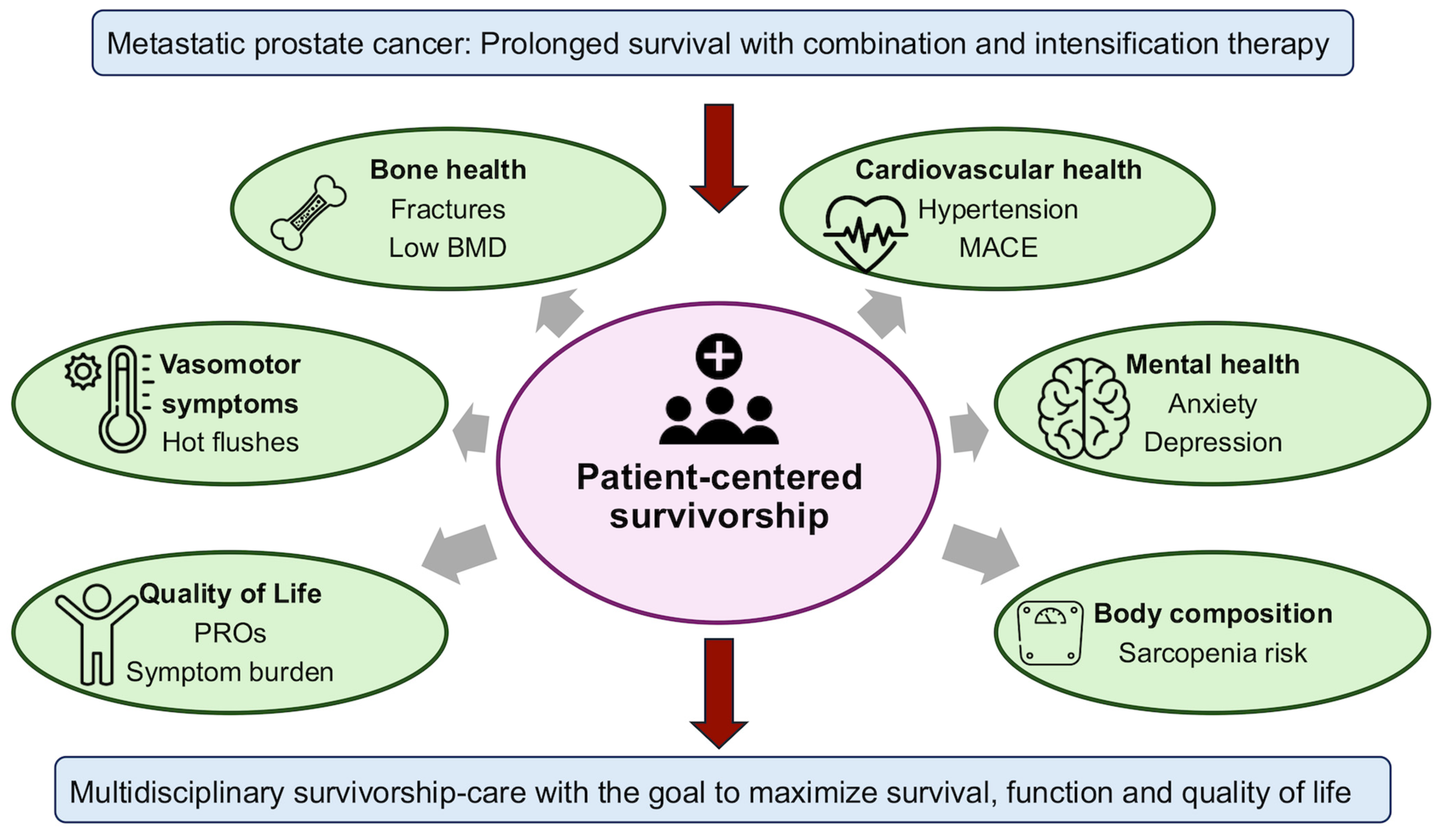
3. Prostate Cancer Survivorship in the Context of Metastatic Disease
4. Treatment-Related Toxicities: A Multidimensional Burden
4.1. Bone Health and Skeletal Complications
4.2. Cardiovascular Effects
4.3. Physical Function and Body Composition
4.4. Vasomotor Symptoms
4.5. Patient-Reported Quality of Life and Psychological Health
5. Future Directions in Survivorship-Oriented Care
6. Conclusions
Supplementary Materials
Author Contributions
Funding
Data Availability Statement
Conflicts of Interest
Abbreviations
| ADT | Androgen deprivation therapy |
| mHSPC | Metastatic hormone-sensitive prostate cancer |
| ARPI | Androgen receptor pathway inhibitor |
| MDT | Metastasis-directed therapy |
| SBRT | Stereotactic body radiation therapy |
| PSMA PET/CT | Prostate-specific membrane antigen positron emission tomography/computed tomography |
| mCRPC | Metastatic castration resistant prostate cancer |
| PARP | Poly (ADP-ribose) polymerase |
| HRR | Homologous recombination repair |
| MASCC | Multinational Association of Supportive Care in Cancer |
| ASCO | American Society of Clinical Oncology |
| NCCN | National Comprehensive Cancer Network |
| EAU | European Association of Urology |
| CVD | Cardiovascular disease |
| GnRH | Gonadotropin-releasing hormone |
| HR | Hazard ratio |
| CI | Confidence interval |
| GLP-1RA | Glucagon-like peptide-1 receptor agonists |
| GIP/GLP-1 | Glucose-dependent insulinotropic polypeptide/glucagon-like peptide-1 |
| PROs | Patient-reported outcomes |
| HRQoL | Health-related quality of life |
| FACT-p | Functional Assessment of Cancer Therapy—Prostate |
| BPI-SF | Brief Pain Inventory (Short Form) |
| EORTC QLQ-C30 | European Organization for Research and Treatment of Cancer Quality of Life Questionnaire Core 30 |
| EQ-5D | EuroQol 5-Dimension |
| SEER | Surveillance, Epidemiology, and End Results |
References
- Bray, F.; Laversanne, M.; Sung, H.; Ferlay, J.; Siegel, R.L.; Soerjomataram, I.; Jemal, A. Global Cancer Statistics 2022: GLOBOCAN Estimates of Incidence and Mortality Worldwide for 36 Cancers in 185 Countries. CA Cancer J. Clin. 2024, 74, 229–263. [Google Scholar] [CrossRef] [Scilit] [PubMed]
- Bethesda, M. SEER Cancer Stat Facts: Prostate Cancer. National Cancer Institute. Available online: https://seer.cancer.gov/statfacts/html/prost.html (accessed on 4 May 2026).
- Fonteyne, V.; Tree, A.; Castro, E.; Touijer, K.; Walz, J. Prostate Cancer. Lancet 2026, 407, 622–636. [Google Scholar] [CrossRef] [Scilit] [PubMed]
- Nguyen, P.L.; Je, Y.; Schutz, F.A.B.; Hoffman, K.E.; Hu, J.C.; Parekh, A.; Beckman, J.A.; Choueiri, T.K. Association of Androgen Deprivation Therapy with Cardiovascular Death in Patients with Prostate Cancer A Meta-Analysis of Randomized Trials. JAMA 2011, 306, 2359–2366. [Google Scholar] [CrossRef] [Scilit] [PubMed]
- Sweeney, C.J.; Chen, Y.-H.; Carducci, M.; Liu, G.; Jarrard, D.F.; Eisenberger, M.; Wong, Y.-N.; Hahn, N.; Kohli, M.; Cooney, M.M.; et al. Chemohormonal Therapy in Metastatic Hormone-Sensitive Prostate Cancer. N. Engl. J. Med. 2015, 373, 737–746. [Google Scholar] [CrossRef] [Scilit] [PubMed]
- James, N.D.; Sydes, M.R.; Clarke, N.W.; Mason, M.D.; Dearnaley, D.P.; Spears, M.R.; Ritchie, A.W.S.; Parker, C.C.; Russell, J.M.; Attard, G.; et al. Addition of Docetaxel, Zoledronic Acid, or Both to First-Line Long-Term Hormone Therapy in Prostate Cancer (STAMPEDE): Survival Results from an Adaptive, Multiarm, Multistage, Platform Randomised Controlled Trial. Lancet 2016, 387, 1163–1177. [Google Scholar] [CrossRef] [Scilit] [PubMed]
- Kyriakopoulos, C.E.; Chen, Y.-H.; Carducci, M.A.; Liu, G.; Jarrard, D.F.; Hahn, N.M.; Shevrin, D.H.; Dreicer, R.; Hussain, M.; Eisenberger, M.; et al. Chemohormonal Therapy in Metastatic Hormone-Sensitive Prostate Cancer: Long-Term Survival Analysis of the Randomized Phase III E3805 CHAARTED Trial. J. Clin. Oncol. 2018, 36, 1080–1087. [Google Scholar] [CrossRef] [Scilit] [PubMed]
- Tripathi, A.; Chen, Y.; Jarrard, D.F.; Garcia, J.A.; Dreicer, R.; Liu, G.; Hussain, M.H.; Shevrin, D.H.; Cooney, M.; Eisenberger, M.A.; et al. Ten-Year Survival Rates by PSA Nadir in Patients with Metastatic Hormone-Sensitive Prostate Cancer: Long-Term Survival Analysis from the ECOG-ACRIN 3805 (CHAARTED) Trial. Ann. Oncol. 2025, 36, 1409–1413. [Google Scholar] [CrossRef] [Scilit] [PubMed]
- Clarke, N.W.; Ali, A.; Ingleby, F.C.; Hoyle, A.; Amos, C.L.; Attard, G.; Brawley, C.D.; Calvert, J.; Chowdhury, S.; Cook, A.; et al. Addition of Docetaxel to Hormonal Therapy in Low- And High-Burden Metastatic Hormone Sensitive Prostate Cancer: Long-Term Survival Results from the STAMPEDE Trial. Ann. Oncol. 2019, 30, 1992–2003, Correction in Ann. Oncol. 2020, 31, 442. https://doi.org/10.1016/j.annonc.2020.01.002. [Google Scholar] [CrossRef] [Scilit] [PubMed]
- Fizazi, K.; Tran, N.P.; Fein, L.; Matsubara, N.; Rodriguez-Antolin, A.; Alekseev, B.Y.; Özgüroğlu, M.; Ye, D.; Feyerabend, S.; Protheroe, A.; et al. Abiraterone Acetate plus Prednisone in Patients with Newly Diagnosed High-Risk Metastatic Castration-Sensitive Prostate Cancer (LATITUDE): Final Overall Survival Analysis of a Randomised, Double-Blind, Phase 3 Trial. Lancet Oncol. 2019, 20, 686–700. [Google Scholar] [CrossRef] [Scilit] [PubMed]
- Attard, G.; Murphy, L.; Clarke, N.W.; Sachdeva, A.; Jones, C.; Hoyle, A.; Cross, W.; Jones, R.J.; Parker, C.C.; Gillessen, S.; et al. Abiraterone Acetate plus Prednisolone with or without Enzalutamide for Patients with Metastatic Prostate Cancer Starting Androgen Deprivation Therapy: Final Results from Two Randomised Phase 3 Trials of the STAMPEDE Platform Protocol. Lancet Oncol. 2023, 24, 443–456. [Google Scholar] [CrossRef] [Scilit] [PubMed]
- Sweeney, C.J.; Martin, A.J.; Stockler, M.R.; Begbie, S.; Cheung, L.; Chi, K.N.; Chowdhury, S.; Frydenberg, M.; Horvath, L.G.; Joshua, A.M.; et al. Testosterone Suppression plus Enzalutamide versus Testosterone Suppression plus Standard Antiandrogen Therapy for Metastatic Hormone-Sensitive Prostate Cancer (ENZAMET): An International, Open-Label, Randomised, Phase 3 Trial. Lancet Oncol. 2023, 24, 323–334. [Google Scholar] [CrossRef] [Scilit] [PubMed]
- Armstrong, A.J.; Petrylak, D.P.; Shore, N.D.; Szmulewitz, R.Z.; Holzbeierlein, J.; Villers, A.; Alcaraz, A.; Alekseev, B.; Iguchi, T.; Gomez-Veiga, F.; et al. ARCHES 5-Year Survival with Enzalutamide Plus Androgen-Deprivation Therapy in Metastatic Hormone-Sensitive Prostate Cancer Patients. Eur. Urol. 2026, 89, 396–403. [Google Scholar] [CrossRef] [Scilit] [PubMed]
- Armstrong, A.J.; Azad, A.A.; Iguchi, T.; Szmulewitz, R.Z.; Petrylak, D.P.; Holzbeierlein, J.; Villers, A.; Alcaraz, A.; Alekseev, B.; Shore, N.D.; et al. Improved Survival with Enzalutamide in Patients with Metastatic Hormone-Sensitive Prostate Cancer. J. Clin. Oncol. 2022, 40, 1616–1622. [Google Scholar] [CrossRef] [Scilit] [PubMed]
- Chi, K.N.; Chowdhury, S.; Bjartell, A.; Chung, B.H.; Pereira de Santana Gomes, A.J.; Given, R.; Juárez, A.; Merseburger, A.S.; Özgüroğlu, M.; Uemura, H.; et al. Apalutamide in Patients with Metastatic Castration-Sensitive Prostate Cancer: Final Survival Analysis of the Randomized, Double-Blind, Phase III TITAN Study. J. Clin. Oncol. 2021, 39, 2294–2303. [Google Scholar] [CrossRef] [Scilit] [PubMed]
- Saad, F.; Vjaters, E.; Shore, N.; Olmos, D.; Xing, N.; Pereira De Santana Gomes, A.J.; Cesar De Andrade Mota, A.; Salman, P.; Jievaltas, M.; Ulys, A.; et al. Darolutamide in Combination with Androgen-Deprivation Therapy in Patients with Metastatic Hormone-Sensitive Prostate Cancer from the Phase III ARANOTE Trial. J. Clin. Oncol. 2024, 42, 4271–4281. [Google Scholar] [CrossRef] [Scilit] [PubMed]
- Fizazi, K.; Foulon, S.; Carles, J.; Roubaud, G.; McDermott, R.; Fléchon, A.; Tombal, B.; Supiot, S.; Berthold, D.; Ronchin, P.; et al. Abiraterone plus Prednisone Added to Androgen Deprivation Therapy and Docetaxel in de Novo Metastatic Castration-Sensitive Prostate Cancer (PEACE-1): A Multicentre, Open-Label, Randomised, Phase 3 Study with a 2 × 2 Factorial Design. Lancet 2022, 399, 1695–1707. [Google Scholar] [CrossRef] [Scilit] [PubMed]
- Smith, M.R.; Hussain, M.; Saad, F.; Fizazi, K.; Sternberg, C.N.; Crawford, E.D.; Kopyltsov, E.; Park, C.H.; Alekseev, B.; Montesa-Pino, Á.; et al. Darolutamide and Survival in Metastatic, Hormone-Sensitive Prostate Cancer. N. Engl. J. Med. 2022, 386, 1132–1142. [Google Scholar] [CrossRef] [Scilit] [PubMed]
- Raychaudhuri, R.; Lin, D.W.; Montgomery, R.B. Prostate Cancer: A Review. JAMA 2025, 333, 1433–1446. [Google Scholar] [PubMed]
- Fizazi, K.; Tran, N.; Fein, L.; Matsubara, N.; Rodriguez-Antolin, A.; Alekseev, B.Y.; Özgüroğlu, M.; Ye, D.; Feyerabend, S.; Protheroe, A.; et al. Abiraterone plus Prednisone in Metastatic, Castration-Sensitive Prostate Cancer. N. Engl. J. Med. 2017, 377, 352–360. [Google Scholar] [CrossRef] [Scilit] [PubMed]
- Chi, K.N.; Agarwal, N.; Bjartell, A.; Chung, B.H.; Pereira de Santana Gomes, A.J.; Given, R.; Soto, Á.J.; Merseburger, A.S.; Özguroglu, M.; Uemura, H.; et al. Apalutamide for Metastatic, Castration-Sensitive Prostate Cancer. N. Engl. J. Med. 2019, 381, 13–24. [Google Scholar] [CrossRef] [Scilit] [PubMed]
- Armstrong, A.J.; Szmulewitz, R.Z.; Petrylak, D.P.; Holzbeierlein, J.; Villers, A.; Azad, A.; Alcaraz, A.; Alekseev, B.; Iguchi, T.; Shore, N.D.; et al. ARCHES: A Randomized, Phase III Study of Androgen Deprivation Therapy with Enzalutamide or Placebo in Men with Metastatic Hormone-Sensitive Prostate Cancer. J. Clin. Oncol. 2019, 37, 2974–2986. [Google Scholar] [CrossRef] [Scilit] [PubMed]
- Davis, I.D.; Martin, A.J.; Stockler, M.R.; Begbie, S.; Chi, K.N.; Chowdhury, S.; Coskinas, X.; Frydenberg, M.; Hague, W.E.; Horvath, L.G.; et al. Enzalutamide with Standard First-Line Therapy in Metastatic Prostate Cancer. N. Engl. J. Med. 2019, 381, 121–131. [Google Scholar] [CrossRef] [Scilit] [PubMed]
- Parker, C.C.; James, N.D.; Brawley, C.D.; Clarke, N.W.; Hoyle, A.P.; Ali, A.; Ritchie, A.W.S.; Attard, G.; Chowdhury, S.; Cross, W.; et al. Radiotherapy to the Primary Tumour for Newly Diagnosed, Metastatic Prostate Cancer (STAMPEDE): A Randomised Controlled Phase 3 Trial. Lancet 2018, 392, 2353–2366. [Google Scholar] [CrossRef] [Scilit] [PubMed]
- Burdett, S.; Boevé, L.M.; Ingleby, F.C.; Fisher, D.J.; Rydzewska, L.H.; Vale, C.L.; van Andel, G.; Clarke, N.W.; Hulshof, M.C.; James, N.D.; et al. Prostate Radiotherapy for Metastatic Hormone-Sensitive Prostate Cancer: A STOPCAP Systematic Review and Meta-Analysis. Eur. Urol. 2019, 76, 115–124. [Google Scholar] [CrossRef] [Scilit] [PubMed]
- Phillips, R.; Shi, W.Y.; Deek, M.; Radwan, N.; Lim, S.J.; Antonarakis, E.S.; Rowe, S.P.; Ross, A.E.; Gorin, M.A.; Deville, C.; et al. Outcomes of Observation vs Stereotactic Ablative Radiation for Oligometastatic Prostate Cancer: The ORIOLE Phase 2 Randomized Clinical Trial. JAMA Oncol. 2020, 6, 650–659. [Google Scholar] [CrossRef] [Scilit] [PubMed]
- Ost, P.; Reynders, D.; Decaestecker, K.; Fonteyne, V.; Lumen, N.; De Bruycker, A.; Lambert, B.; Delrue, L.; Bultijnck, R.; Claeys, T.; et al. Surveillance or Metastasis-Directed Therapy for Oligometastatic Prostate Cancer Recurrence: A Prospective, Randomized, Multicenter Phase II Trial. J. Clin. Oncol. 2017, 36, 446–453. [Google Scholar] [CrossRef] [Scilit] [PubMed]
- Marvaso, G.; Corrao, G.; Zaffaroni, M.; Vincini, M.G.; Lorubbio, C.; Gandini, S.; Fodor, C.; Netti, S.; Zerini, D.; Luzzago, S.; et al. ADT with SBRT versus SBRT Alone for Hormone-Sensitive Oligorecurrent Prostate Cancer (RADIOSA): A Randomised, Open-Label, Phase 2 Clinical Trial. Lancet 2025, 26, 300–311. [Google Scholar] [CrossRef] [Scilit] [PubMed]
- Ost, P.; Siva, S.; Brabrand, S.; Dirix, P.; Liefhooghe, N.; Otte, F.X.; Gomez-Iturriaga, A.; Everaerts, W.; Shelan, M.; Conde-Moreno, A.; et al. Salvage Metastasis-Directed Therapy versus Elective Nodal Radiotherapy for Oligorecurrent Nodal Prostate Cancer Metastases (PEACE V–STORM): A Phase 2, Open-Label, Randomised Controlled Trial. Lancet Oncol. 2025, 26, 695–706. [Google Scholar] [CrossRef] [Scilit] [PubMed]
- de Wit, R.; de Bono, J.; Sternberg, C.N.; Fizazi, K.; Tombal, B.; Wülfing, C.; Kramer, G.; Eymard, J.-C.; Bamias, A.; Carles, J.; et al. Cabazitaxel versus Abiraterone or Enzalutamide in Metastatic Prostate Cancer. N. Engl. J. Med. 2019, 381, 2506–2518. [Google Scholar] [CrossRef] [Scilit] [PubMed]
- Hussain, M.; Mateo, J.; Fizazi, K.; Saad, F.; Shore, N.; Sandhu, S.; Chi, K.N.; Sartor, O.; Agarwal, N.; Olmos, D.; et al. Survival with Olaparib in Metastatic Castration-Resistant Prostate Cancer. N. Engl. J. Med. 2020, 383, 2345–2357. [Google Scholar] [CrossRef] [Scilit] [PubMed]
- Sartor, O.; de Bono, J.; Chi, K.N.; Fizazi, K.; Herrmann, K.; Rahbar, K.; Tagawa, S.T.; Nordquist, L.T.; Vaishampayan, N.; El-Haddad, G.; et al. Lutetium-177–PSMA-617 for Metastatic Castration-Resistant Prostate Cancer. N. Engl. J. Med. 2021, 385, 1091–1103. [Google Scholar] [CrossRef] [Scilit] [PubMed]
- Fizazi, K.; Chi, K.N.; Shore, N.D.; Herrmann, K.; de Bono, J.S.; Castellano, D.; Piulats, J.M.; Fléchon, A.; Wei, X.X.; Mahammedi, H.; et al. Final Overall Survival and Safety Analyses of the Phase III PSMAfore Trial of [177Lu]Lu-PSMA-617 versus Change of Androgen Receptor Pathway Inhibitor in Taxane-Naive Patients with Metastatic Castration-Resistant Prostate Cancer. Ann. Oncol. 2025, 36, 1319–1330. [Google Scholar] [CrossRef] [Scilit] [PubMed]
- Fizazi, K.; Piulats, J.M.; Reaume, M.N.; Ostler, P.; McDermott, R.; Gingerich, J.R.; Pintus, E.; Sridhar, S.S.; Bambury, R.M.; Emmenegger, U.; et al. Rucaparib or Physician’s Choice in Metastatic Prostate Cancer. N. Engl. J. Med. 2023, 388, 719–732. [Google Scholar] [CrossRef] [Scilit] [PubMed]
- Saad, F.; Clarke, N.W.; Oya, M.; Shore, N.; Procopio, G.; Guedes, J.D.; Arslan, C.; Mehra, N.; Parnis, F.; Brown, E.; et al. Olaparib plus Abiraterone versus Placebo plus Abiraterone in Metastatic Castration-Resistant Prostate Cancer (PROpel): Final Prespecified Overall Survival Results of a Randomised, Double-Blind, Phase 3 Trial. Lancet Oncol. 2023, 24, 1094–1108, Correction in Lancet Oncol. 2024, 25, 180. https://doi.org/10.1016/S1470-2045(24)00209-2. [Google Scholar] [CrossRef] [Scilit] [PubMed]
- Agarwal, N.; Azad, A.A.; Carles, J.; Fay, A.P.; Matsubara, N.; Szczylik, C.; De Giorgi, U.; Young Joung, J.; Fong, P.C.C.; Voog, E.; et al. Talazoparib plus Enzalutamide in Men with Metastatic Castration-Resistant Prostate Cancer: Final Overall Survival Results from the Randomised, Placebo-Controlled, Phase 3 TALAPRO-2 Trial. Lancet 2025, 406, 447–460. [Google Scholar] [CrossRef] [Scilit] [PubMed]
- Chi, K.N.; Castro, E.; Attard, G.; Smith, M.R.; Sandhu, S.; Efstathiou, E.; Roubaud, G.; Small, E.J.; de Santana Gomes, A.P.; Rathkopf, D.E.; et al. Niraparib and Abiraterone Acetate plus Prednisone in Metastatic Castration-Resistant Prostate Cancer: Final Overall Survival Analysis for the Phase 3 MAGNITUDE Trial. Eur. Urol. Oncol. 2025, 8, 986–998. [Google Scholar] [CrossRef] [Scilit] [PubMed]
- Gillessen, S.; Gallardo, E.; Choudhury, A.; Saad, F.; Soares, A.; Loriot, Y.; McDermott, R.; Rodriguez-Vida, A.; Isaacsson Velho, P.; Nolè, F.; et al. Final Overall Survival Results from EORTC 1333/PEACE-3 Trial of Enzalutamide plus Radium-223 in Metastatic Castration-Resistant Prostate Cancer. Ann. Oncol. 2026, 37, 736–742. [Google Scholar] [CrossRef] [Scilit] [PubMed]
- Agarwal, N.; Azad, A.A.; Carles, J.; Fay, A.P.; Matsubara, N.; Heinrich, D.; Szczylik, C.; De Giorgi, U.; Young Joung, J.; Fong, P.C.C.; et al. Talazoparib plus Enzalutamide in Men with First-Line Metastatic Castration-Resistant Prostate Cancer (TALAPRO-2): A Randomised, Placebo-Controlled, Phase 3 Trial. Lancet 2023, 402, 291–303. [Google Scholar] [CrossRef] [Scilit] [PubMed]
- Chi, K.N.; Sandhu, S.; Smith, M.R.; Attard, G.; Saad, M.; Olmos, D.; Castro, E.; Roubaud, G.; Pereira de Santana Gomes, A.J.; Small, E.J.; et al. Niraparib plus Abiraterone Acetate with Prednisone in Patients with Metastatic Castration-Resistant Prostate Cancer and Homologous Recombination Repair Gene Alterations: Second Interim Analysis of the Randomized Phase III MAGNITUDE Trial. Ann. Oncol. 2023, 34, 772–782. [Google Scholar] [CrossRef] [Scilit] [PubMed]
- Parker, C.; Nilsson, S.; Heinrich, D.; Helle, S.I.; O’Sullivan, J.M.; Fosså, S.D.; Chodacki, A.; Wiechno, P.; Logue, J.; Seke, M.; et al. Alpha Emitter Radium-223 and Survival in Metastatic Prostate Cancer. N. Engl. J. Med. 2013, 369, 213–223. [Google Scholar] [CrossRef] [Scilit] [PubMed]
- Tombal, B.; Choudhury, A.; Saad, F.; Gallardo, E.; Soares, A.; Loriot, Y.; McDermott, R.; Rodriguez-Vida, A.; Isaacsson Velho, P.; Nolè, F.; et al. Enzalutamide plus Radium-223 in Metastatic Castration-Resistant Prostate Cancer: Results of the EORTC 1333/PEACE-3 Trial. Ann. Oncol. 2025, 36, 1058–1067. [Google Scholar] [CrossRef] [Scilit] [PubMed]
- Resnick, M.J.; Lacchetti, C.; Bergman, J.; Hauke, R.J.; Hoffman, K.E.; Kungel, T.M.; Morgans, A.K.; Penson, D.F. Prostate Cancer Survivorship Care Guideline: American Society of Clinical Oncology Clinical Practice Guideline Endorsement. J. Clin. Oncol. 2015, 33, 1078–1085. [Google Scholar] [CrossRef] [Scilit] [PubMed]
- Jones, J.M.; Matthew, A.; Tanguay, S.; Higano, C.S.; Goldenberg, L.; Howell, D.; Maganti, M. A Tailored Electronic Survivorship Care Plan for Prostate Cancer Survivors: A Multicenter Randomized Controlled Trial. J. Urol. 2025, 213, 407–415. [Google Scholar] [CrossRef] [Scilit] [PubMed]
- Hart, N.H.; Nekhlyudov, L.; Smith, T.J.; Yee, J.; Fitch, M.I.; Crawford, G.B.; Koczwara, B.; Ashbury, F.D.; Lustberg, M.B.; Mollica, M.; et al. Survivorship Care for People Affected by Advanced or Metastatic Cancer: MASCC-ASCO Standards and Practice Recommendations. JCO Oncol. Pract. 2024, 20, 1160–1172. [Google Scholar] [CrossRef] [Scilit] [PubMed]
- Peterson, L.L.; McDonough, A.L.; Ansbaugh, S.M.; Ella Ariza-Heredia, P.J.; Scott Baker, K.; Ballinger, T.J.; Cathcart-Rake, E.J.; Cohen, S.H.; Œ, L.; Day, A.T.; et al. NCCN Guidelines Version 2.2026 Survivorship. 2026. Available online: https://www.nccn.org/guidelines/guidelines-detail?category=3&id=1466 (accessed on 22 July 2026).
- Spratt, D.E.; An, Y.; Bitting, R.; Chapin, B.; Cheng, H.H.; Cho, S.Y.; D’Amico, A.V.; Desai, N.; Dorff, T.; Eastham, J.A.; et al. NCCN Clinical Practice Guidelines in Oncology (NCCN Guidelines®): Prostate Cancer. Version 5. 2026. Available online: https://education.nccn.org/May2026#group-tabs-node-course-default1 (accessed on 22 July 2026).
- Cornford, P.; Tilki, D.; van den Bergh, R.C.N.; Eberli, D.; Fonteyne, V.; Gandaglia, G.; Gillessen, S.; Henry, A.M.; van Leenders, G.J.L.H. Guidelines on Prostate Cancer; European Association of Urology: Arnhem, The Netherlands, 2026. [Google Scholar]
- Armstrong, A.J.; Morris, M.J.; Abida, W.; Aggarwal, R.R.; Antonarakis, E.S.; Attard, G.; Beltran, H.; Bryce, A.; Carducci, M.A.; Cheng, H.H.; et al. Trial Design and Objectives for Patients with Prostate Cancer: Recommendations From the Prostate Cancer Working Group 4. J. Clin. Oncol. 2026, 44, 1249–1265. [Google Scholar] [CrossRef] [Scilit] [PubMed]
- Smith, M.R.; Boyce, S.P.; Moyneur, E.; Duh, M.S.; Raut, M.K.; Brandman, J. Risk of Clinical Fractures after Gonadotropin-Releasing Hormone Agonist Therapy for Prostate Cancer. J. Urol. 2006, 175, 136–139; discussion 139. [Google Scholar] [CrossRef] [Scilit] [PubMed]
- Beebe-Dimmer, J.L.; Cetin, K.; Shahinian, V.; Morgenstern, H.; Yee, C.; Schwartz, K.L.; Acquavella, J. Timing of Androgen Deprivation Therapy Use and Fracture Risk among Elderly Men with Prostate Cancer in the United States. Pharmacoepidemiol. Drug Saf. 2012, 21, 70–78. [Google Scholar] [CrossRef] [Scilit] [PubMed]
- Fizazi, K.; Carducci, M.; Smith, M.; Damião, R.; Brown, J.; Karsh, L.; Milecki, P.; Shore, N.; Rader, M.; Wang, H.; et al. Denosumab versus Zoledronic Acid for Treatment of Bone Metastases in Men with Castration-Resistant Prostate Cancer: A Randomised, Double-Blind Study. Lancet 2011, 377, 813–822. [Google Scholar] [CrossRef] [Scilit] [PubMed]
- Smith, M.; Parker, C.; Saad, F.; Miller, K.; Tombal, B.; Ng, Q.S.; Boegemann, M.; Matveev, V.; Piulats, J.M.; Zucca, L.E.; et al. Addition of Radium-223 to Abiraterone Acetate and Prednisone or Prednisolone in Patients with Castration-Resistant Prostate Cancer and Bone Metastases (ERA 223): A Randomised, Double-Blind, Placebo-Controlled, Phase 3 Trial. Lancet Oncol. 2019, 20, 408–419. [Google Scholar] [CrossRef] [Scilit] [PubMed]
- Gillessen, S.; Tombal, B.; Turco, F.; Choudhury, A.; Rodriguez-Vida, A.; Gallardo, E.; Velho, P.I.; Nolè, F.; Cruz, F.; Loriot, Y.; et al. Decrease in Fracture Rate with Mandatory Bone-Protecting Agents in the EORTC 1333/PEACE-3 Trial Comparing Radium-223 Combined with Enzalutamide Versus Enzalutamide Alone: A Safety Analysis. Eur. Urol. 2025, 87, 285–288. [Google Scholar] [CrossRef] [Scilit] [PubMed]
- McKay, R.R.; Xie, W.; Ajmera, A.; Araneta, A.; Jamieson, C.; Folefac, E.; Hussain, A.; Kyriakopoulos, C.E.; Manning, D.K.; Olson, A.; et al. Multicenter, Randomized, Phase II Trial of Olaparib Plus Radium-223 Versus Radium-223 in Men with Castration-Resistant Prostate Cancer with Bone Metastases (COMRADE). J. Clin. Oncol. 2026, 44, 1709–1719. [Google Scholar] [CrossRef] [Scilit] [PubMed]
- Templeton, A.J.; Hayoz, S.; Wyss-Neyer, S.; Cathomas, R.; Pereira Mestre, R.; Alexander Rothermundt, C.; Anchisi, S.; Jakob Ackermann, C.; Reichel, K.; Mueller, B.; et al. Osteonecrosis of the Jaw (ONJ) in Patients with Metastatic Castration Resistant Prostate Cancer (MCRPC) Treated with Denosumab in a Randomized Phase III Trial Comparing 4 vs. 12 Weekly Administration (REDUSE, SAKK 96/12). J. Clin. Oncol. 2026, 43, 163. [Google Scholar]
- Mitchell, A.P.; Meza, A.M.; Panageas, K.S.; Lipitz-Snyderman, A.; Farooki, A.; Morris, M.J. Real-World Use of Bone Modifying Agents in Metastatic, Castration-Resistant Prostate Cancer. Prostate Cancer Prostatic Dis. 2023, 26, 126–132. [Google Scholar] [CrossRef] [Scilit] [PubMed]
- Smith, M.R.; Halabi, S.; Ryan, C.J.; Hussain, A.; Vogelzang, N.; Stadler, W.; Hauke, R.J.; Monk, J.P.; Saylor, P.; Bhoopalam, N.; et al. Randomized Controlled Trial of Early Zoledronic Acid in Men with Castration-Sensitive Prostate Cancer and Bone Metastases: Results of CALGB 90202 (Alliance). J. Clin. Oncol. 2014, 32, 1143–1150. [Google Scholar] [CrossRef] [Scilit] [PubMed]
- Saporita, I.; Calabrese, M.; Carfi, F.M.; Mogavero, A.; Puglisi, M.; Treglia, G.; Vogl, U.M.; Gillessen, S.; Pereira Mestre, R.; Pedrani, M.; et al. Risk of Bone Fractures in Patients with Prostate Cancer Treated with Maximal Androgen Blockade Therapy: A Systematic Literature Review and Meta-Analysis. Prostate Cancer Prostatic Dis. 2026. [Google Scholar] [CrossRef] [Scilit] [PubMed]
- Jones, C.; Dutey-Magni, P.; Murphy, L.R.; Murray, M.L.; Brown, J.E.; McCloskey, E.; Brown, M.; Amos, C.L.; Gilbert, D.C.; Jones, R.J.; et al. Fracture-Related Hospitalisations in Newly Diagnosed High-Risk Localised or Metastatic Hormone-Sensitive Prostate Cancer: Secondary Analysis of the STAMPEDE Phase III Trials of Docetaxel and Zoledronic Acid Using Healthcare Systems Data. Ann. Oncol. 2025, 36, 1331–1341. [Google Scholar] [CrossRef] [Scilit] [PubMed]
- Fukuokaya, W.; Mori, K.; Urabe, F.; Igarashi, T.; Yanagisawa, T.; Tsuzuki, S.; Honda, M.; Miki, K.; Kimura, T. Bone-Modifying Agents in Patients with High-Risk Metastatic Castration-Sensitive Prostate Cancer Treated with Abiraterone Acetate. JAMA Netw. Open 2024, 7, e242467. [Google Scholar] [CrossRef] [Scilit] [PubMed]
- Caramella, I.; Dalla Volta, A.; Valcamonico, F.; Bergamini, M.; Buffoni, M.; Zivi, A.; Procopio, G.; Sepe, P.; Di Meo, N.; Foti, S.; et al. Multiparametric Assessment of Bone Health in Metastatic Hormone-Sensitive Prostate Cancer Patients Receiving Androgen Deprivation + Enzalutamide ± Zoledronic Acid (BonEnza Study). Bone 2026, 209, 117906. [Google Scholar] [CrossRef] [Scilit] [PubMed]
- Dalla Volta, A.; Valcamonico, F.; Zivi, A.; Procopio, G.; Sepe, P.; Del Conte, G.; Di Meo, N.; Foti, S.; Zamboni, S.; Messina, C.; et al. Addition of Zoledronic Acid to Enzalutamide and Androgen Deprivation Therapy in Metastatic Hormone-Sensitive Prostate Cancer: The Randomized Phase II BONENZA Trial. Prostate Cancer Prostatic Dis. 2025, 29, 116–123. [Google Scholar] [CrossRef] [Scilit] [PubMed]
- Moryousef, J.; Duivenvoorden, W.; Leong, D.; Pinthus, J.H. Comprehensive Review of Cardiovascular Disease in Prostate Cancer: Epidemiology, Risk Factors, Therapeutics and Prevention Strategies. Prostate Cancer Prostatic Dis. 2025, 28, 632–638. [Google Scholar] [CrossRef] [Scilit] [PubMed]
- Keating, N.L.; O’Malley, A.J.; Freedland, S.J.; Smith, M.R. Diabetes and Cardiovascular Disease during Androgen Deprivation Therapy: Observational Study of Veterans with Prostate Cancer. J. Natl. Cancer Inst. 2010, 102, 39–46, Correction in J. Natl. Cancer Inst. 2012, 104, 1518–1523. https://doi.org/10.1093/jnci/djs376. [Google Scholar] [CrossRef] [Scilit] [PubMed]
- Bosco, C.; Bosnyak, Z.; Malmberg, A.; Adolfsson, J.; Keating, N.L.; Van Hemelrijck, M. Quantifying Observational Evidence for Risk of Fatal and Nonfatal Cardiovascular Disease Following Androgen Deprivation Therapy for Prostate Cancer: A Meta-Analysis. Eur. Urol. 2015, 68, 386–396. [Google Scholar] [CrossRef] [Scilit] [PubMed]
- O’Farrell, S.; Garmo, H.; Holmberg, L.; Adolfsson, J.; Stattin, P.; Van Hemelrijck, M. Risk and Timing of Cardiovascular Disease after Androgen-Deprivation Therapy in Men with Prostate Cancer. J. Clin. Oncol. 2015, 33, 1243–1251. [Google Scholar] [CrossRef] [Scilit] [PubMed]
- Zhao, J.; Zhu, S.; Sun, L.; Meng, F.; Zhao, L.; Zhao, Y.; Tian, H.; Li, P.; Niu, Y. Androgen Deprivation Therapy for Prostate Cancer Is Associated with Cardiovascular Morbidity and Mortality: A Meta-Analysis of Population-Based Observational Studies. PLoS ONE 2014, 9, e107516. [Google Scholar] [CrossRef] [Scilit] [PubMed]
- Elmehrath, A.O.; Afifi, A.M.; Al-Husseini, M.J.; Saad, A.M.; Wilson, N.; Shohdy, K.S.; Pilie, P.; Sonbol, M.B.; Alhalabi, O. Causes of Death among Patients with Metastatic Prostate Cancer in the US from 2000 to 2016. JAMA Netw. Open 2021, 4, e2119568. [Google Scholar] [CrossRef] [Scilit] [PubMed]
- Leong, D.P.; Rangarajan, S.; Ng, K.; Fradet, V.; Shayegan, B.; Violette, P.D.; Higano, C.S.; Nunes, R.A.B.; Neves, P.D.; Valle, F.; et al. Rationale and Design of RADICAL PC: A Trial of Cardioprotective Strategies in Prostate Cancer. JU Open Plus 2026, 4, 44. [Google Scholar]
- Leong, D.P.; Fradet, V.; Shayegan, B.; Duceppe, E.; Siemens, R.; Niazi, T.; Klotz, L.; Brown, I.; Chin, J.; Lavallee, L.; et al. Cardiovascular Risk in Men with Prostate Cancer: Insights from the RADICAL PC Study. J. Urol. 2020, 203, 1109–1116. [Google Scholar] [CrossRef] [Scilit] [PubMed]
- Klimis, H.; Pinthus, J.H.; Aghel, N.; Duceppe, E.; Fradet, V.; Brown, I.; Siemens, D.R.; Shayegan, B.; Klotz, L.; Luke, P.P.; et al. The Burden of Uncontrolled Cardiovascular Risk Factors in Men with Prostate Cancer: A RADICAL-PC Analysis. JACC CardioOncol 2023, 5, 70–81. [Google Scholar] [CrossRef] [Scilit] [PubMed]
- Lopes, R.D.; Higano, C.S.; Slovin, S.F.; Nelson, A.J.; Bigelow, R.; Sørensen, P.S.; Melloni, C.; Goodman, S.G.; Evans, C.P.; Nilsson, J.; et al. Cardiovascular Safety of Degarelix Versus Leuprolide in Patients with Prostate Cancer: The Primary Results of the PRONOUNCE Randomized Trial. Circulation 2021, 144, 1295–1307, Correction in Circulation 2022, 146, e119–e136. https://doi.org/10.1161/CIR.0000000000001082. [Google Scholar] [CrossRef] [Scilit] [PubMed]
- Shore, N.D.; Saad, F.; Cookson, M.S.; George, D.J.; Saltzstein, D.R.; Tutrone, R.; Akaza, H.; Bossi, A.; Van Veenhuyzen, D.F.; Selby, B.; et al. Oral Relugolix for Androgen-Deprivation Therapy in Advanced Prostate Cancer. J. Urol. 2021, 205, 303–304. [Google Scholar] [CrossRef] [Scilit]
- Nelson, A.J.; Lopes, R.D.; Hong, H.; Hua, K.; Slovin, S.; Tan, S.; Nilsson, J.; Bhatt, D.L.; Goodman, S.G.; Evans, C.P.; et al. Cardiovascular Effects of GnRH Antagonists Compared with Agonists in Prostate Cancer: A Systematic Review. JACC CardioOncol 2023, 5, 613–624. [Google Scholar] [CrossRef] [Scilit] [PubMed]
- Patel, S.A.; Yadalam, A.K.; Van Assen, M.; Cantu, S.M.; Onnis, C.; Zheng, B.; Koo, A.; Goyal, S.; Liu, Y.; Liu, C.; et al. Coronary Plaque Progression After Androgen Deprivation Therapy in Men with Prostate Cancer: A Randomized Clinical Trial. JAMA Cardiol. 2026, 11, 459–463. [Google Scholar] [CrossRef] [Scilit] [PubMed]
- Cirne, F.; Aghel, N.; Petropoulos, J.A.; Klotz, L.; Lenihan, D.J.; Saad, F.; Pinthus, J.; Leong, D.P. The Cardiovascular Effects of Gonadotropin-Releasing Hormone Antagonists in Men with Prostate Cancer. Eur. Heart J. Cardiovasc. Pharmacother. 2022, 8, 253–262. [Google Scholar] [CrossRef] [Scilit] [PubMed]
- El-Taji, O.; Taktak, S.; Jones, C.; Brown, M.; Clarke, N.; Sachdeva, A. Cardiovascular Events and Androgen Receptor Signaling Inhibitors in Advanced Prostate Cancer: A Systematic Review and Meta-Analysis. JAMA Oncol. 2024, 10, 874–884. [Google Scholar] [CrossRef] [Scilit] [PubMed]
- Leong, D.P.; Fradet, V.; Niazi, T.; Selvanayagam, J.B.; Sabbagh, R.; Higano, C.S.; Agapay, S.; Rangarajan, S.; Mian, R.; Nakashima, C.A.K.; et al. Adiposity and Muscle Strength in Men with Prostate Cancer and Cardiovascular Outcomes. JACC CardioOncol 2024, 6, 761–771. [Google Scholar] [CrossRef] [Scilit] [PubMed]
- Newton, R.U.; Taaffe, D.R.; Spry, N.; Cormie, P.; Chambers, S.K.; Gardiner, R.A.; Shum, D.H.K.; Joseph, D.; Galvão, D.A. Can Exercise Ameliorate Treatment Toxicity during the Initial Phase of Testosterone Deprivation in Prostate Cancer Patients? Is This More Effective than Delayed Rehabilitation? BMC Cancer 2012, 12, 432. [Google Scholar] [CrossRef] [Scilit] [PubMed]
- Wall, B.A.; Galvão, D.A.; Fatehee, N.; Taaffe, D.R.; Spry, N.; Joseph, D.; Hebert, J.J.; Newton, R.U. Exercise Improves VO2max and Body Composition in Androgen Deprivation Therapy-Treated Prostate Cancer Patients. Med. Sci. Sports Exerc. 2017, 49, 1503–1510. [Google Scholar] [CrossRef] [Scilit] [PubMed]
- Taaffe, D.R.; Newton, R.U.; Chambers, S.K.; Nelson, C.J.; Spry, N.; Luo, H.; Schumacher, O.; Joseph, D.; Gardiner, R.A.; Hayne, D.; et al. Immediate Versus Delayed Exercise on Health-Related Quality of Life in Patients Initiating Androgen Deprivation Therapy: Results from a Year-Long Randomised Trial. Eur. Urol. Oncol. 2025, 8, 387–393. [Google Scholar] [CrossRef] [Scilit] [PubMed]
- Taaffe, D.R.; Galvão, D.A.; Spry, N.; Joseph, D.; Chambers, S.K.; Gardiner, R.A.; Hayne, D.; Cormie, P.; Shum, D.H.K.; Newton, R.U. Immediate versus Delayed Exercise in Men Initiating Androgen Deprivation: Effects on Bone Density and Soft Tissue Composition. BJU Int. 2019, 123, 261–269. [Google Scholar] [CrossRef] [Scilit] [PubMed]
- Houben, L.H.P.; Overkamp, M.; Van Kraaij, P.; Trommelen, J.; Van Roermund, J.G.H.; De Vries, P.; De Laet, K.; Van Der Meer, S.; Mikkelsen, U.R.; Verdijk, L.E.X.B.; et al. Resistance Exercise Training Increases Muscle Mass and Strength in Prostate Cancer Patients on Androgen Deprivation Therapy. Med. Sci. Sports Exerc. 2023, 55, 614–624. [Google Scholar] [CrossRef] [Scilit] [PubMed]
- Dawson, J.K.; Dorff, T.B.; Todd Schroeder, E.; Lane, C.J.; Gross, M.E.; Dieli-Conwright, C.M. Impact of Resistance Training on Body Composition and Metabolic Syndrome Variables during Androgen Deprivation Therapy for Prostate Cancer: A Pilot Randomized Controlled Trial. BMC Cancer 2018, 18, 368. [Google Scholar] [CrossRef] [Scilit] [PubMed]
- Gilbert, S.E.; Tew, G.A.; Fairhurst, C.; Bourke, L.; Saxton, J.M.; Winter, E.M.; Rosario, D.J. Effects of a Lifestyle Intervention on Endothelial Function in Men on Long-Term Androgen Deprivation Therapy for Prostate Cancer. Br. J. Cancer 2016, 114, 401–408. [Google Scholar] [CrossRef] [Scilit] [PubMed]
- Baguley, B.J.; Adlard, K.; Jenkins, D.; Wright, O.R.L.; Skinner, T.L. Mediterranean Style Dietary Pattern with High Intensity Interval Training in Men with Prostate Cancer Treated with Androgen Deprivation Therapy: A Pilot Randomised Control Trial. Int. J. Environ. Res. Public Health 2022, 19, 5709. [Google Scholar] [CrossRef] [Scilit] [PubMed]
- Harrison, M.R.; Davis, P.G.; Khouri, M.G.; Bartlett, D.B.; Gupta, R.T.; Armstrong, A.J.; McNamara, M.A.; Zhang, T.; Anand, M.; Onyenwoke, K.; et al. A Randomized Controlled Trial Comparing Changes in Fitness with or without Supervised Exercise in Patients Initiated on Enzalutamide and Androgen Deprivation Therapy for Non-Metastatic Castration-Sensitive Prostate Cancer (EXTEND). Prostate Cancer Prostatic Dis. 2022, 25, 58–64. [Google Scholar] [CrossRef] [Scilit] [PubMed]
- Papadopoulos, E.; Leach, H.J.; Tomlinson, G.; Durbano, S.; Danyluk, J.M.; Sabiston, C.M.; Mina, D.S.; Alibhai, S.M.H.; Culos-Reed, S.N. Factors Predicting Gains in Moderate-to-Vigorous Physical Activity in Prostate Cancer Survivors on Androgen Deprivation Therapy. Support. Care Cancer 2022, 30, 9011–9018. [Google Scholar] [CrossRef] [Scilit] [PubMed]
- Alibhai, S.M.H.; Papadopoulos, E.; Mina, D.S.; Ritvo, P.; Tomlinson, G.; Sabiston, C.M.; Durbano, S.; Bremner, K.E.; Chiarotto, J.; Matthew, A.; et al. Home-Based versus Supervised Group Exercise in Men with Prostate Cancer on Androgen Deprivation Therapy: A Randomized Controlled Trial and Economic Analysis. J. Geriatr. Oncol. 2024, 15, 101646. [Google Scholar] [CrossRef] [Scilit] [PubMed]
- Lam, T.; Cheema, B.; Hayden, A.; Lord, S.R.; Gurney, H.; Gounden, S.; Reddy, N.; Shahidipour, H.; Read, S.; Stone, G.; et al. Androgen Deprivation in Prostate Cancer: Benefits of Home-Based Resistance Training. Sports Med. Open 2020, 6, 59. [Google Scholar] [CrossRef] [Scilit] [PubMed]
- Langlais, C.S.; Chen, Y.H.; Van Blarigan, E.L.; Chan, J.M.; Ryan, C.J.; Zhang, L.; Borno, H.T.; Newton, R.U.; Luke, A.; Bang, A.S.; et al. Quality of Life for Men with Metastatic Castrate-Resistant Prostate Cancer Participating in an Aerobic and Resistance Exercise Pilot Intervention. Urol. Oncol. Semin. Orig. Investig. 2023, 41, 146.e1–146.e11. [Google Scholar] [CrossRef] [Scilit] [PubMed]
- Rantaniemi, L.; Jussila, I.; Siltari, A.; Ahtiainen, J.P.; Hakulinen, A.; Harju, E.; Sormunen, J.; Nordström, T.; Tammela, T.L.J.; Murtola, T.J. Is Exercise During Androgen Deprivation Therapy Effective and Safe? A Randomized Controlled Trial. Scand. J. Med. Sci. Sports 2025, 35, e70084. [Google Scholar] [CrossRef] [Scilit] [PubMed]
- Ragle, A.M.; Mikkelsen, M.K.; Vinther, A.; Zerahn, B.; Bogh Juhl, C.; Theile, S.; Madsen, K.; Nielsen, D.L.; Østergren, P.B. High-Intensity Resistance and Impact Training for Patients with Hormone-Sensitive Prostate Cancer and Bone Metastases—Study Protocol of a Randomized Clinical Trial. Trials 2025, 26, 259. [Google Scholar] [CrossRef] [Scilit] [PubMed]
- Kang, D.W.; Ficarra, S.; Wilson, R.L.; Morgans, A.K.; Nguyen, P.L.; Rebbeck, T.R.; Einstein, D.J.; Uno, H.; Mossanen, M.; Hill, D.M.; et al. Exercise to Enhance Cardiovascular Health among Black Men with Prostate Cancer with Androgen Deprivation Therapy (the POWER Trial): A Study Protocol. Contemp. Clin. Trials 2025, 155, 107973. [Google Scholar] [CrossRef] [Scilit] [PubMed]
- McNaught, E.; Reale, S.; Bourke, L.; Brown, J.E.; Collinson, M.; Day, F.; Hewison, J.; Farrin, A.J.; Ibeggazene, S.; Innes, A.Q.; et al. Supported Exercise TrAining for Men wIth Prostate CaNcer on Androgen Deprivation Therapy (STAMINA): Study Protocol for a Randomised Controlled Trial of the Clinical and Cost-Effectiveness of the STAMINA Lifestyle Intervention Compared with Optimised Usual Care, Including Internal Pilot and Parallel Process Evaluation. Trials 2024, 25, 257. [Google Scholar] [CrossRef] [Scilit] [PubMed]
- Knop, F.K.; Aroda, V.R.; do Vale, R.D.; Holst-Hansen, T.; Laursen, P.N.; Rosenstock, J.; Rubino, D.M.; Garvey, W.T. Oral Semaglutide 50 Mg Taken Once per Day in Adults with Overweight or Obesity (OASIS 1): A Randomised, Double-Blind, Placebo-Controlled, Phase 3 Trial. Lancet 2023, 402, 705–719. [Google Scholar] [CrossRef] [Scilit] [PubMed]
- Aronne, L.J.; Horn, D.B.; le Roux, C.W.; Ho, W.; Falcon, B.L.; Gomez Valderas, E.; Das, S.; Lee, C.J.; Glass, L.C.; Senyucel, C.; et al. Tirzepatide as Compared with Semaglutide for the Treatment of Obesity. N. Engl. J. Med. 2025, 393, 26–36. [Google Scholar] [CrossRef] [Scilit] [PubMed]
- Jastreboff, A.M.; le Roux, C.W.; Stefanski, A.; Aronne, L.J.; Halpern, B.; Wharton, S.; Wilding, J.P.H.; Perreault, L.; Zhang, S.; Battula, R.; et al. Tirzepatide for Obesity Treatment and Diabetes Prevention. N. Engl. J. Med. 2025, 392, 958–971. [Google Scholar] [CrossRef] [Scilit] [PubMed]
- Frías, J.P.; Davies, M.J.; Rosenstock, J.; Pérez Manghi, F.C.; Fernández Landó, L.; Bergman, B.K.; Liu, B.; Cui, X.; Brown, K. Tirzepatide versus Semaglutide Once Weekly in Patients with Type 2 Diabetes. N. Engl. J. Med. 2021, 385, 503–515. [Google Scholar] [CrossRef] [Scilit] [PubMed]
- Kahn, S.E.; Deanfield, J.E.; Jeppesen, O.K.; Emerson, S.S.; Boesgaard, T.W.; Colhoun, H.M.; Kushner, R.F.; Lingvay, I.; Burguera, B.; Gajos, G.; et al. Effect of Semaglutide on Regression and Progression of Glycemia in People with Overweight or Obesity but Without Diabetes in the SELECT Trial. Diabetes Care 2024, 47, 1350–1359. [Google Scholar] [CrossRef] [Scilit] [PubMed]
- Lincoff, A.M.; Brown-Frandsen, K.; Colhoun, H.M.; Deanfield, J.; Emerson, S.S.; Esbjerg, S.; Hardt-Lindberg, S.; Hovingh, G.K.; Kahn, S.E.; Kushner, R.F.; et al. Semaglutide and Cardiovascular Outcomes in Obesity without Diabetes. N. Engl. J. Med. 2023, 389, 2221–2232. [Google Scholar] [CrossRef] [Scilit] [PubMed]
- Leong, D.; Gong, S.; Sattar, N.; Narayan, V.; Reizine, N.M.; Gerstein, H.; Vellky, J. Incretin Mimetics in Cancer and Cardiovascular Disease. JACC CardioOncol 2026, 8, 1–16. [Google Scholar] [CrossRef] [Scilit] [PubMed]
- Pedrani, M.; Gillessen, S.; Briers, E.; Blanchard, P.; Joshua, A.M.; Tombal, B. Beyond Menopause: Ending the Inequality—Why Men with Prostate Cancer Still Lack Therapies for Hot Flushes. Eur. Urol. 2025, 89, 196–198. [Google Scholar] [CrossRef] [Scilit] [PubMed]
- Crabb, S.J.; Morgan, A.; Stefanopoulou, E.; Fleure, L.; Griffiths, G.O.; Boxall, C.; Wilding, S.; Nearchou, T.; Ewings, S.; Nuttall, J.; et al. Self-Help Cognitive Behavioural Therapy for Hot Flushes and Night Sweats during Androgen Deprivation Therapy for Prostate Cancer: The MANCAN2 Randomized Controlled Trial. Br. J. Cancer 2026, 134, 1413–1419. [Google Scholar] [CrossRef] [Scilit] [PubMed]
- Qin, Z.; Zang, Z.; Yu, J.; Lv, J.; Li, N.; Zhang, J.; Yang, M.; Kwong, J.S.W.; Pang, R.; Wang, J.; et al. Acupuncture versus Sham Acupuncture and Usual Care for Antiandrogen-Induced Hot FLashes in Prostate Cancer (AVAIL): Study Protocol for a Randomized Clinical Trial. BMC Complement. Med. Ther. 2023, 23, 388. [Google Scholar] [CrossRef] [Scilit] [PubMed]
- Hosseini, A.K.; Etedali, A.; Darakhshandeh, A.; Mehrzad, V.; Sharifi, M.; Bariuti, Z.; Moghaddas, A. Targeting Side Effects Associated with Androgen Deprivation Therapy Using Melatonin: A Randomized Trial on Hot Flashes and Sexual Health in Prostate Cancer Patients. Asian Pac. J. Cancer Prev. 2026, 27, 453–462. [Google Scholar] [CrossRef] [Scilit] [PubMed]
- Moraska, A.R.; Atherton, P.J.; Szydlo, D.W.; Barton, D.L.; Stella, P.J.; Rowland, K.M.; Schaefer, P.L.; Krook, J.; Bearden, J.D.; Loprinzi, C.L. Gabapentin for the Management of Hot Flashes in Prostate Cancer Survivors: A Longitudinal Continuation Study-NCCTG Trial N00CB. J. Support. Oncol. 2010, 8, 128–132. [Google Scholar] [PubMed]
- Quality of Life Study Using Gabapentin Versus Venlafaxine in Treating Hot Flashes in Patients with Prostate Cancer. Identifier: NCT01533753. Available online: https://clinicaltrials.gov/study/NCT01533753 (accessed on 19 May 2026).
- Stish, B.J.; Mazza, G.L.; Nauseef, J.T.; Humeniuk, M.S.; Smith, T.J.; Tofthagen, C.; Diaz Pardo, D.A.; Chay, C.; Huang, A.J.; Naha, K.; et al. Alliance A222001: Oxybutynin Versus Placebo for the Treatment of Hot Flashes in Patients Receiving Androgen-Deprivation Therapy for Prostate Cancer. J. Clin. Oncol. 2026, 44, 1198–1205. [Google Scholar] [CrossRef] [Scilit] [PubMed]
- Proof-of-Concept Trial to Assess the Efficacy and Safety of Fezolinetant in Improving Vasomotor Symptoms in Men with Prostate Cancer Undergoing Androgen Deprivation Therapy (Fezo-ADT). Available online: https://clinicaltrials.gov/study/NCT06957691 (accessed on 24 June 2026).
- Langley, R.E.; Gilbert, D.C.; Mangar, S.; Rosen, S.; Bourmaki, E.; Rush, H.L.; Kananga Sundaram, S.; Alhasso, A.; Kockelbergh, R.; Abdel-Aty, H.; et al. Transdermal Estradiol Patches in Locally Advanced Prostate Cancer. N. Engl. J. Med. 2026, 394, 1595–1607. [Google Scholar] [CrossRef] [Scilit] [PubMed]
- Chi, K.N.; Protheroe, A.; Rodríguez-Antolín, A.; Facchini, G.; Suttman, H.; Matsubara, N.; Ye, Z.; Keam, B.; Damião, R.; Li, T.; et al. Patient-Reported Outcomes Following Abiraterone Acetate plus Prednisone Added to Androgen Deprivation Therapy in Patients with Newly Diagnosed Metastatic Castration-Naive Prostate Cancer (LATITUDE): An International, Randomised Phase 3 Trial. Lancet Oncol. 2018, 19, 194–206. [Google Scholar] [CrossRef] [Scilit] [PubMed]
- Agarwal, N.; McQuarrie, K.; Bjartell, A.; Chowdhury, S.; Pereira de Santana Gomes, A.J.; Chung, B.H.; Özgüroğlu, M.; Juárez Soto, Á.; Merseburger, A.S.; Uemura, H.; et al. Health-Related Quality of Life after Apalutamide Treatment in Patients with Metastatic Castration-Sensitive Prostate Cancer (TITAN): A Randomised, Placebo-Controlled, Phase 3 Study. Lancet Oncol. 2019, 20, 1518–1530. [Google Scholar] [CrossRef] [Scilit] [PubMed]
- Stenzl, A.; Dunshee, C.; De Giorgi, U.; Alekseev, B.; Iguchi, T.; Szmulewitz, R.Z.; Flaig, T.W.; Tombal, B.; Morlock, R.; Ivanescu, C.; et al. Effect of Enzalutamide plus Androgen Deprivation Therapy on Health-Related Quality of Life in Patients with Metastatic Hormone-Sensitive Prostate Cancer: An Analysis of the ARCHES Randomised, Placebo-Controlled, Phase 3 Study. Eur. Urol. 2020, 78, 603–614. [Google Scholar] [CrossRef] [Scilit] [PubMed]
- Morgans, A.K.; Haresh, K.P.; Jievaltas, M.; Olmos, D.; Shore, N.D.; Vjaters, E.; Xing, N.; Mohamed, A.F.; Littleton, N.; Srinivasan, S.; et al. Pain and Health-Related Quality-of-Life Outcomes with Darolutamide in Metastatic Hormone-Sensitive Prostate Cancer (ARANOTE): Secondary and Exploratory Analyses of a Multicentre, Randomised, Placebo-Controlled, Phase 3 Trial. Lancet Oncol. 2026, 27, 614–624. [Google Scholar] [CrossRef] [Scilit] [PubMed]
- Nilsson, S.; Cislo, P.; Sartor, O.; Vogelzang, N.J.; Coleman, R.E.; O’Sullivan, J.M.; Reuning-Scherer, J.; Shan, M.; Zhan, L.; Parker, C. Patient-Reported Quality-of-Life Analysis of Radium-223 Dichloride from the Phase III ALSYMPCA Study. Ann. Oncol. 2016, 27, 868–874. [Google Scholar] [CrossRef] [Scilit] [PubMed]
- Fizazi, K.; Herrmann, K.; Krause, B.J.; Rahbar, K.; Chi, K.N.; Morris, M.J.; Sartor, O.; Tagawa, S.T.; Kendi, A.T.; Vogelzang, N.; et al. Health-Related Quality of Life and Pain Outcomes with [177Lu]Lu-PSMA-617 plus Standard of Care versus Standard of Care in Patients with Metastatic Castration-Resistant Prostate Cancer (VISION): A Multicentre, Open-Label, Randomised, Phase 3 Trial. Lancet Oncol. 2023, 24, 597–610. [Google Scholar] [CrossRef] [Scilit] [PubMed]
- Thiery-Vuillemin, A.; de Bono, J.; Hussain, M.; Roubaud, G.; Procopio, G.; Shore, N.; Fizazi, K.; dos Anjos, G.; Gravis, G.; Joung, J.Y.; et al. Pain and Health-Related Quality of Life with Olaparib versus Physician’s Choice of next-Generation Hormonal Drug in Patients with Metastatic Castration-Resistant Prostate Cancer with Homologous Recombination Repair Gene Alterations (PROfound): An Open-Label, Randomised, Phase 3 Trial. Lancet Oncol. 2022, 23, 393–405. [Google Scholar] [CrossRef] [Scilit] [PubMed]
- Stockler, M.R.; Martin, A.J.; Davis, I.D.; Dhillon, H.M.; Begbie, S.D.; Chi, K.N.; Chowdhury, S.; Coskinas, X.; Frydenberg, M.; Hague, W.E.; et al. Health-Related Quality of Life in Metastatic, Hormone-Sensitive Prostate Cancer: ENZAMET (ANZUP 1304), an International, Randomized Phase III Trial Led by ANZUP. J. Clin. Oncol. 2022, 40, 837–846. [Google Scholar] [CrossRef] [Scilit] [PubMed]
- Amdal, C.D.; Falk, R.S.; Alanya, A.; Schlichting, M.; Roychoudhury, S.; Bhatnagar, V.; Wintner, L.M.; Regnault, A.; Ingelgård, A.; Coens, C.; et al. SISAQOL-IMI Consensus-Based Guidelines to Design, Analyse, Interpret, and Present Patient-Reported Outcomes in Cancer Clinical Trials. Lancet Oncol. 2025, 26, e683–e693. [Google Scholar] [CrossRef] [Scilit] [PubMed]
- Di Maio, M. Reading and Interpreting Quality-of-Life Results in Cancer Trials. NEJM Evid. 2025, 4, EVIDra2400340. [Google Scholar] [CrossRef] [Scilit] [PubMed]
- Morgans, A.K.; Chen, Y.-H.; Sweeney, C.J.; Jarrard, D.F.; Plimack, E.R.; Gartrell, B.A.; Carducci, M.A.; Hussain, M.; Garcia, J.A.; Cella, D.; et al. Quality of Life During Treatment with Chemohormonal Therapy: Analysis of E3805 Chemohormonal Androgen Ablation Randomized Trial in Prostate Cancer. J. Clin. Oncol. 2018, 36, 1088–1095. [Google Scholar] [CrossRef] [Scilit] [PubMed]
- Paravathaneni, M.; Safa, H.; Joshi, V.; Tamil, M.K.; Adashek, J.J.; Ionescu, F.; Shah, S.; Chadha, J.S.; Gilbert, S.; Manley, B.; et al. 15 Years of Patient-Reported Outcomes in Clinical Trials Leading to GU Cancer Drug Approvals: A Systematic Review on the Quality of Data Reporting and Analysis. eClinicalMedicine 2023, 68, 102413. [Google Scholar] [CrossRef] [Scilit] [PubMed]
- Haslam, A.; Herrera-Perez, D.; Gill, J.; Prasad, V. Patient Experience Captured by Quality-of-Life Measurement in Oncology Clinical Trials. JAMA Netw. Open 2020, 3, e200363. [Google Scholar] [CrossRef] [Scilit] [PubMed]
- Fervaha, G.; Izard, J.P.; Tripp, D.A.; Aghel, N.; Shayegan, B.; Klotz, L.; Niazi, T.; Fradet, V.; Taussky, D.; Lavallée, L.T.; et al. Psychological Morbidity Associated with Prostate Cancer: Rates and Predictors of Depression in the RADICAL PC Study. Can. Urol. Assoc. J. 2020, 15, 181–186. [Google Scholar] [CrossRef] [Scilit] [PubMed]
- Brunckhorst, O.; Hashemi, S.; Martin, A.; George, G.; Van Hemelrijck, M.; Dasgupta, P.; Stewart, R.; Ahmed, K. Depression, Anxiety, and Suicidality in Patients with Prostate Cancer: A Systematic Review and Meta-Analysis of Observational Studies. Prostate Cancer Prostatic Dis. 2021, 24, 281–289. [Google Scholar] [CrossRef] [Scilit] [PubMed]
- Dinh, K.T.; Reznor, G.; Muralidhar, V.; Mahal, B.A.; Nezolosky, M.D.; Choueiri, T.K.; Hoffman, K.E.; Hu, J.C.; Sweeney, C.J.; Trinh, Q.D.; et al. Association of Androgen Deprivation Therapy with Depression in Localized Prostate Cancer. J. Clin. Oncol. 2016, 34, 1905–1912. [Google Scholar] [CrossRef] [Scilit] [PubMed]
- Qazi, S.U.; Altaf, Z.; Zafar, M.; Tariq, M.A.; Khalid, A.; Kaleem, A.; Saad, E.; Qazi, S. Development of Depression in Patients Using Androgen Deprivation Therapy: A Systemic Review and Meta-Analysis. Prostate 2024, 84, 525–538. [Google Scholar] [CrossRef] [Scilit] [PubMed]
- Tsao, P.A.; Ross, R.D.; Bohnert, A.S.B.; Mukherjee, B.; Caram, M.E.V. Depression, Anxiety, and Patterns of Mental Health Care Among Men with Prostate Cancer Receiving Androgen Deprivation Therapy. Oncologist 2022, 27, 314–322. [Google Scholar] [CrossRef] [Scilit] [PubMed]
- Mucci, L.A.; Vinson, J.; Gold, T.; Gerke, T.; Filipenko, J.; Green, R.M.; Anderson, S.G.; Badal, S.; Bjartell, A.; Chi, K.N.; et al. IRONMAN: A Novel International Registry of Men with Advanced Prostate Cancer. JCO Glob. Oncol. 2022, 8, e2200154. [Google Scholar] [CrossRef] [Scilit] [PubMed]
- Mundle, R.; Afenya, E.; Agarwal, N. The Effectiveness of Psychological Intervention for Depression, Anxiety, and Distress in Prostate Cancer: A Systematic Review of Literature. Prostate Cancer Prostatic Dis. 2021, 24, 674–687. [Google Scholar] [CrossRef] [Scilit] [PubMed]
- Chambers, S.K.; Occhipinti, S.; Foley, E.; Clutton, S.; Legg, M.; Berry, M.; Stockler, M.R.; Frydenberg, M.; Gardiner, R.A.; Lepore, S.J.; et al. Mindfulness-Based Cognitive Therapy in Advanced Prostate Cancer: A Randomized Controlled Trial. J. Clin. Oncol. 2017, 35, 291–297. [Google Scholar] [CrossRef] [Scilit] [PubMed]
- Penedo, F.J.; Fox, R.S.; Oswald, L.B.; Moreno, P.I.; Boland, C.L.; Estabrook, R.; McGinty, H.L.; Mohr, D.C.; Begale, M.J.; Dahn, J.R.; et al. Technology-Based Psychosocial Intervention to Improve Quality of Life and Reduce Symptom Burden in Men with Advanced Prostate Cancer: Results from a Randomized Controlled Trial. Int. J. Behav. Med. 2020, 27, 490–505. [Google Scholar] [CrossRef] [Scilit] [PubMed]
- Gong, R.; Heller, A.; Moreno, P.I.; Yanez, B.; Penedo, F.J. Low Social Well-Being in Advanced and Metastatic Prostate Cancer: Effects of a Randomized Controlled Trial of Cognitive Behavioral Stress Management. Int. J. Behav. Med. 2025, 32, 799–812. [Google Scholar] [CrossRef] [Scilit] [PubMed]
- Vanbutsele, G.; Pardon, K.; Van Belle, S.; Surmont, V.; De Laat, M.; Colman, R.; Eecloo, K.; Cocquyt, V.; Geboes, K.; Deliens, L. Effect of Early and Systematic Integration of Palliative Care in Patients with Advanced Cancer: A Randomised Controlled Trial. Lancet Oncol. 2018, 19, 394–404. [Google Scholar] [CrossRef] [Scilit] [PubMed]
- Zhang, S.; Li, J.; Hu, X. Peer Support Interventions on Quality of Life, Depression, Anxiety, and Self-Efficacy among Patients with Cancer: A Systematic Review and Meta-Analysis. Patient Educ. Couns. 2022, 105, 3213–3224. [Google Scholar] [CrossRef] [Scilit] [PubMed]
- Hussain, M.; Tangen, C.M.; Berry, D.L.; Higano, C.S.; Crawford, E.D.; Liu, G.; Wilding, G.; Prescott, S.; Kanaga Sundaram, S.; Small, E.J.; et al. Intermittent versus Continuous Androgen Deprivation in Prostate Cancer. N. Engl. J. Med. 2013, 368, 1314–1325. [Google Scholar] [CrossRef] [Scilit] [PubMed]
- Chowdhury, S.; Bjartell, A.; Agarwal, N.; Chung, B.H.; Given, R.W.; Pereira de Santana Gomes, A.J.; Merseburger, A.S.; Özgüroğlu, M.; Soto, Á.J.; Uemura, H.; et al. Deep, Rapid, and Durable Prostate-Specific Antigen Decline with Apalutamide plus Androgen Deprivation Therapy Is Associated with Longer Survival and Improved Clinical Outcomes in TITAN Patients with Metastatic Castration-Sensitive Prostate Cancer. Ann. Oncol. 2023, 34, 477–485. [Google Scholar] [CrossRef] [Scilit] [PubMed]
- Azad, A.A.; Petrylak, D.P.; Iguchi, T.; Shore, N.D.; Villers, A.; Gomez-Veiga, F.; Alcaraz, A.; Alekseev, B.; Szmulewitz, R.Z.; Holzbeierlein, J.; et al. Enzalutamide and Prostate-Specific Antigen Levels in Metastatic Prostate Cancer: A Secondary Analysis of the ARCHES Randomized Clinical Trial. JAMA Netw. Open 2025, 8, e258751. [Google Scholar] [CrossRef] [Scilit] [PubMed]
- Choudhury, A.D.; Ballman, K.V.; Reimers, M.A.; Laccetti, A.L.; Smieliauskas, F.; Ravi, P.; Xiao, H.; Dooley, K.; Hillman, D.W.; Mazza, G.L.; et al. A Phase 2 Trial of Androgen Deprivation Therapy Interruption in Patients Responding Exceptionally to Androgen Receptor Pathway Inhibitor in Metastatic Hormone-Sensitive Prostate Cancer (A-DREAM/Alliance A032101). J. Clin. Oncol. 2026, 44, 5004. [Google Scholar] [CrossRef] [Scilit]
- Grisay, G.; Turco, F.; Litiere, S.; Fournier, B.; Patrikidou, A.; Gallardo, E.; McDermott, R.; Alanya, A.; Gillessen, S.; Tombal, B. EORTC 2238 “De-Escalate”: A Pragmatic Trial to Revisit Intermittent Androgen Deprivation Therapy in the Era of New Androgen Receptor Pathway Inhibitors. Front. Oncol. 2024, 14, 1391825. [Google Scholar] [CrossRef] [Scilit] [PubMed]


| Trial Name | Intervention (n) | Comparator (n) | Median OS (Months) | HR (95% CI) | Median Follow-Up (Months) | Latest Update |
|---|---|---|---|---|---|---|
| CHAARTED [7,8] | Docetaxel + ADT (n = 397) | ADT (n = 393) | 57.6 vs. 47.2 | 0.72 (0.59–0.89) | 53.7 | 2025: 10-year OS 25.9% vs. 22.5%, HR 0.78 (0.66–0.93) |
| STAMPEDE [9] (Docetaxel, M1) | Docetaxel + ADT (n = 362) | ADT (n = 724) | NR vs. NR (M1 subgroup) | 0.81 (0.69–0.95) | 78.2 | |
| LATITUDE [10] | Abiraterone + ADT (n = 597) | Placebo + ADT (n = 602) | 53.3 vs. 36.5 | 0.66 (0.56–0.78) | 51.8 | |
| STAMPEDE [11] (Abiraterone) | ADT + abiraterone (n = 501) | ADT (n = 502) | 76.6 vs. 45.7 | 0.62 (0.53–0.73) | 96 | |
| ENZAMET [12] | Enzalutamide + ADT (n = 563) | ADT + Nonsteroidal antiandrogen (n = 562) | NR vs. NR | 0.70 (0.58–0.84) | 68 | 2025: median OS 95 vs. 70 months, HR 0.73 (0.63–0.86) * |
| ARCHES [13,14] | Enzalutamide + ADT (n = 574) | Placebo + ADT (n = 576) | NR vs. NR | 0.66 (0.53–0.81) | 44.6 | 2026: 5-year OS 66% vs. 53%, HR 0.70 (0.58–0.85) |
| TITAN [15] | Apalutamide + ADT (n = 525) | Placebo + ADT (n = 527) | NR vs. 52.2 | 0.65 (0.53–0.79) | 44.0 | |
| ARANOTE [16] | Darolutamide + ADT (n = 446) | Placebo + ADT (n = 223) | NR vs. NR | 0.81 (0.59–1.12) | 25.3 vs. 25.0 | |
| PEACE-1 [17] (ADT with docetaxel population) | Abiraterone + ADT + Docetaxel (n = 355) | ADT + Docetaxel (n = 355) | NR vs. 52.8 | 0.75 (0.59–0.95) | 52.8 | |
| ARASENS [18] | Darolutamide + Docetaxel + ADT (n = 651) | Placebo + Docetaxel + ADT (n = 654) | NR vs. 48.9 | 0.68 (0.57–0.80) | 43.7 vs. 42.4 |
| Trial Name | Population | Intervention (n) | Comparator (n) | Median OS (Months) | HR (95% CI) | Median Follow-Up (Months) |
|---|---|---|---|---|---|---|
| ALSYMPCA [24] | Symptomatic bone lesions, no visceral metastases | Radium-223 (n = 614) | Placebo (n = 307) | 14.9 vs. 11.3 | 0.70 (0.58–0.83) | - * |
| CARD [30] | Post-docetaxel and progressed ≤12 months on ARPI | Cabazitaxel + ADT (n = 129) | Second ARPI (n = 126) | 13.6 vs. 11.0 | 0.64 (0.46–0.89) | 9.2 |
| PROfound [31] (Cohort A) | HRR-mutated (BRCA 1/2 or ATM) after ARPI | Olaparib (n = 162) | Second ARPI (n = 83) | 19.1 vs. 14.7 | 0.69 (0.50–0.97) | 21.9 vs. 21.0 |
| VISION [32] | PSMA-avid lesions post-ARPI and post-docetaxel | Lu-177-PSMA-617 + SoC (n = 551) | SoC (n = 280) | 15.3 vs. 11.3 | 0.62 (0.52–0.74) | 20.9 |
| PSMAfore [33] | PSMA-avid lesions post-ARPI, chemotherapy-naïve in mCRPC | Lu-177-PSMA-617 (n = 234) | Second ARPI (n = 234) | 24.5 vs. 23.1 | 0.91 (0.72–1.14) | 34.27 |
| TRITON-3 [34] (BCRA) | BRCA-mutated, post-ARPI | Rucaparib (n = 201) | Physician’s choice (docetaxel or second ARPI) (n = 101) | 24.3 vs. 20.8 | 0.81 (0.58–1.12) | - |
| PROPEL [35] | First line mCRPC, biomarker-unselected | Olaparib + abiraterone (n = 399) | Placebo + abiraterone (n = 397) | 42.1 vs. 34.7 | 0.81 (0.67–1.00) | 36.6 vs. 36.5 |
| TALAPRO-2 [36] | First line mCRPC, biomarker-unselected | Talazoparib + enzalutamide (n = 402) | Placebo + enzalutamide (n = 403) | 45.8 vs. 37.0 | 0.80 (0.66–0.96) | 52.5 |
| MAGNITUDE [37] | First line mCRPC (except up to 4 months of prior abiraterone allowed), HRR-alterations | Niraparib + abiraterone (n = 212) | Placebo + abiraterone (n = 211) | 30.36 vs. 28.55 | 0.93 (0.72–1.20) | 37.3 |
| PEACE-3 [38] | First line mCRPC, chemotherapy-naïve in mCRPC, bone metastases | Enzalutamide + Radium-223 (n = 222) | Enzalutamide (n = 224) | 38.2 vs. 32.6 | 0.76 (0.60–0.96) | 58 |
Disclaimer/Publisher’s Note: The statements, opinions and data contained in all publications are solely those of the individual author(s) and contributor(s) and not of MDPI and/or the editor(s). MDPI and/or the editor(s) disclaim responsibility for any injury to people or property resulting from any ideas, methods, instructions or products referred to in the content. |
© 2026 by the authors. Licensee MDPI, Basel, Switzerland. This article is an open access article distributed under the terms and conditions of the Creative Commons Attribution (CC BY) license.
Share and Cite
Cano Garcia, C.; Moryousef, J.; Pinthus, J.H.; Leong, D.P. Survivorship Challenges in Metastatic Prostate Cancer in the Era of Prolonged Survival: A Review. Cancers 2026, 18, 2465. https://doi.org/10.3390/cancers18152465
Cano Garcia C, Moryousef J, Pinthus JH, Leong DP. Survivorship Challenges in Metastatic Prostate Cancer in the Era of Prolonged Survival: A Review. Cancers. 2026; 18(15):2465. https://doi.org/10.3390/cancers18152465
Chicago/Turabian StyleCano Garcia, Cristina, Joseph Moryousef, Jehonathan H. Pinthus, and Darryl P. Leong. 2026. "Survivorship Challenges in Metastatic Prostate Cancer in the Era of Prolonged Survival: A Review" Cancers 18, no. 15: 2465. https://doi.org/10.3390/cancers18152465
APA StyleCano Garcia, C., Moryousef, J., Pinthus, J. H., & Leong, D. P. (2026). Survivorship Challenges in Metastatic Prostate Cancer in the Era of Prolonged Survival: A Review. Cancers, 18(15), 2465. https://doi.org/10.3390/cancers18152465