Prevalence and Clinical Implications of Somatic and Germline EGFR Mutations in Patients with Non-Small-Cell Lung Cancer


Simple Summary
Abstract
1. Introduction
2. Somatic EGFR Mutations
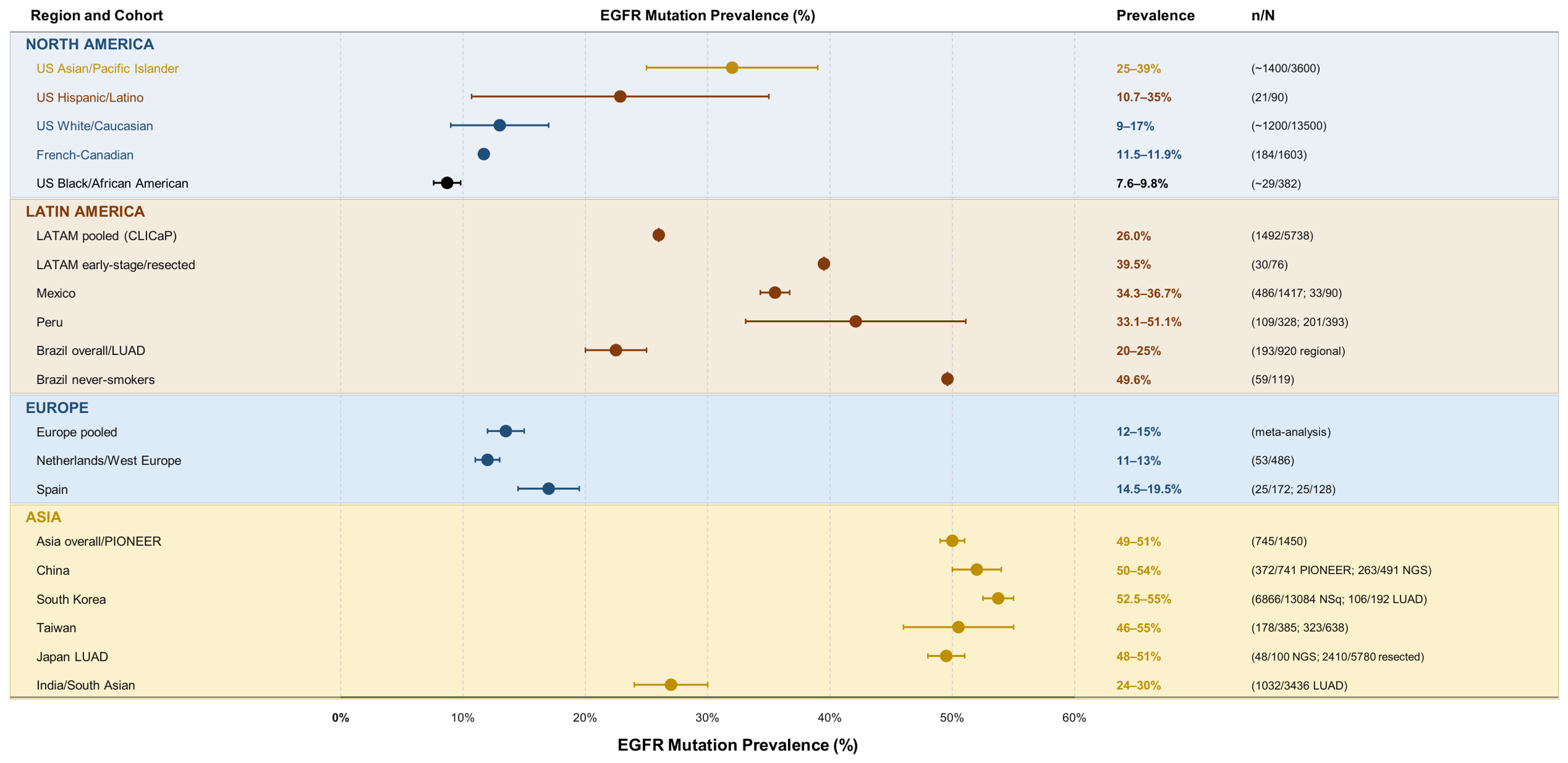
2.1. Global Prevalence of Somatic EGFR Mutations
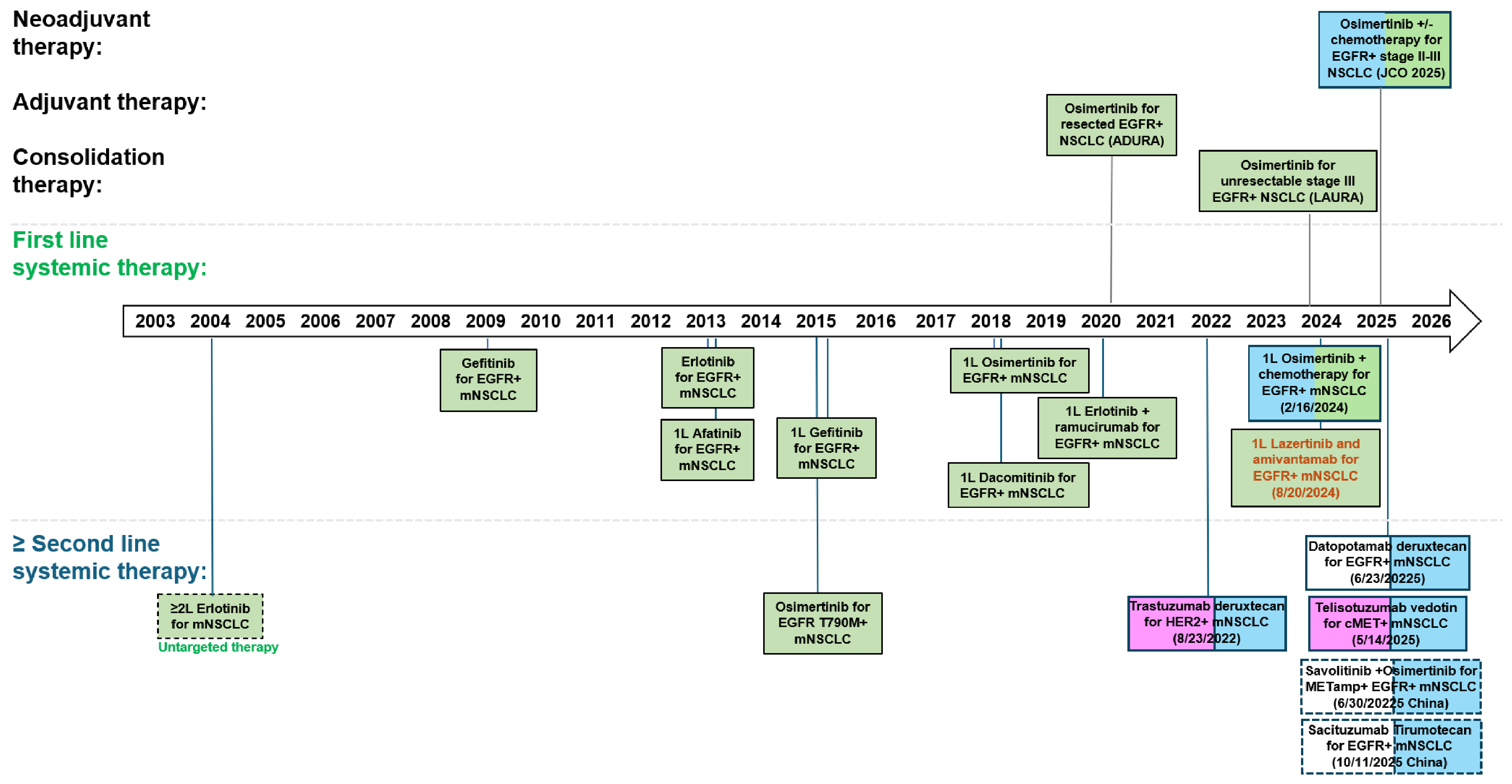
2.2. Clinical Implications of EGFR-Targeted Therapies Based on Somatic EGFR Mutations
2.2.1. EGFR TKI Monotherapy
2.2.2. Combination Therapies for First-Line EGFR-Mutant NSCLC
2.2.3. Other Combination Therapies for First-Line and Beyond EGFR-Mutant NSCLC
3. Germline EGFR Mutations
3.1. Hereditary EGFR Mutations and Lung Cancer Predisposition
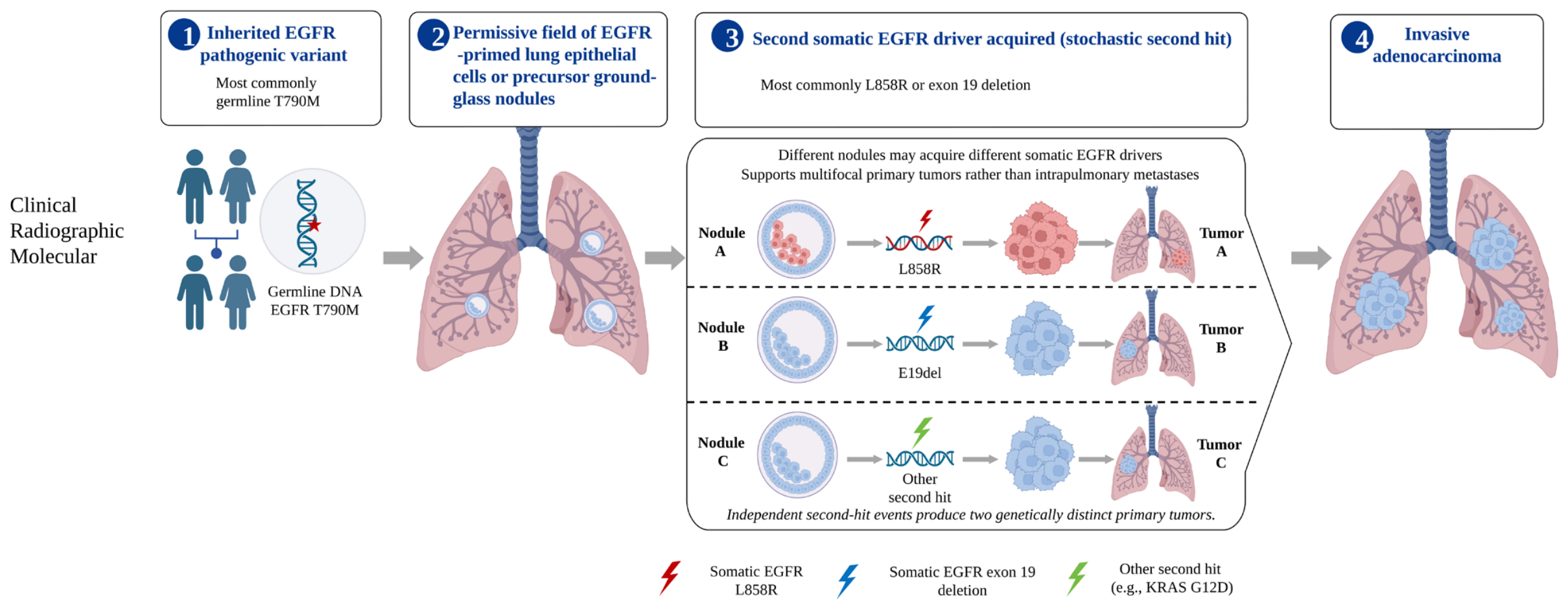
3.2. Pathogenesis and Two-Hit Tumorigenesis
3.3. Phenotype and Prevalence
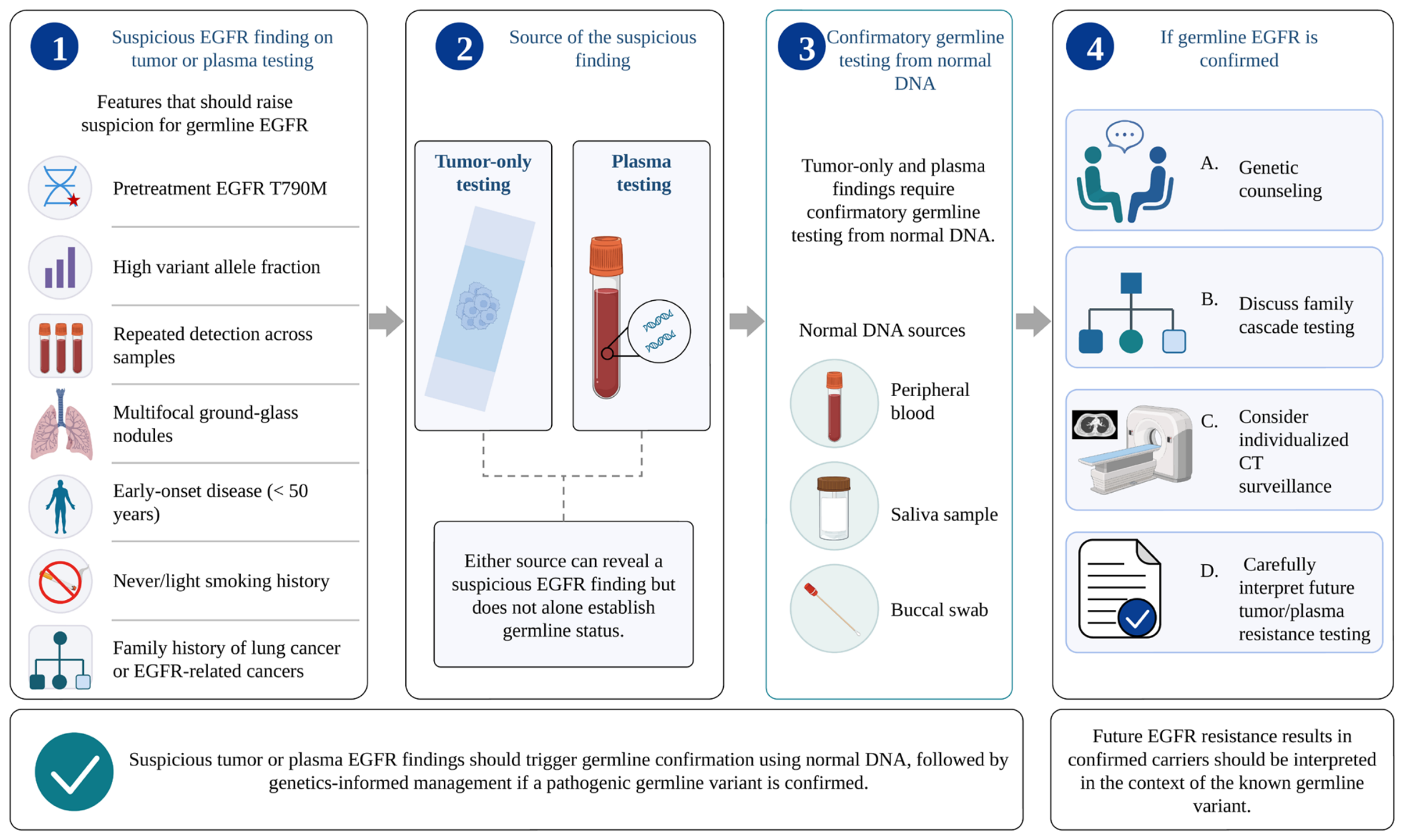
3.4. Detection Workflow
3.5. Non-T790M EGFR Variants
3.6. Screening and Surveillance for Lung Cancer
3.7. Considerations for Prevention
4. Broader Germline Predisposition
5. Summary and Perspectives
6. Conclusions
Supplementary Materials
Author Contributions
Funding
Data Availability Statement
Conflicts of Interest
Abbreviations
| ABCP | atezolizumab, bevacizumab, carboplatin, and paclitaxel |
| ADC | antibody–drug conjugate |
| AE | adverse event |
| ALK | anaplastic lymphoma kinase |
| AMP | Association for Molecular Pathology |
| CAP | College of American Pathologists |
| cEFR | CNS-evaluable-for-response |
| cFAS | CNS full-analysis set |
| cfDNA | cell-free DNA |
| CI | confidence interval |
| CNS | central nervous system |
| CNV | copy-number variation |
| CT | computed tomography |
| ctDNA | circulating tumor DNA |
| DDR | DNA damage repair |
| DoR | duration of response |
| EGFR | epidermal growth factor receptor |
| ERBB2/HER2 | human epidermal growth factor receptor 2 |
| Ex20ins | exon 20 insertion |
| FDA | U.S. Food and Drug Administration |
| FLC | familial lung cancer |
| GGO | ground-glass opacity |
| GWAS | genome-wide association study |
| HR | hazard ratio |
| IASLC | International Association for the Study of Lung Cancer |
| ICI | immune checkpoint inhibitor |
| ILD | interstitial lung disease |
| IRR | infusion-related reaction |
| IV | intravenous |
| LA/mNSCLC | locally advanced or metastatic non-small-cell lung cancer |
| LDCT | low-dose computed tomography |
| LUAD | lung adenocarcinoma |
| LUSC | lung squamous-cell carcinoma |
| MET | mesenchymal–epithelial transition factor |
| mOS | median overall survival |
| mPFS | median progression-free survival |
| MRD | molecular residual disease |
| NCCN | National Comprehensive Cancer Network |
| NCT | ClinicalTrials.gov identifier |
| NE | not estimable |
| NGS | next-generation sequencing |
| NR | not reported |
| NSCLC | non-small-cell lung cancer |
| ORR | objective response rate |
| OS | overall survival |
| P/LP | pathogenic or likely pathogenic |
| PACC | P-loop and αC-helix compressing |
| PARP | poly(ADP-ribose) polymerase |
| PD-1 | programmed cell death protein 1 |
| PD-L1 | programmed death ligand 1 |
| PFS | progression-free survival |
| PGV | pathogenic germline variant |
| PRS | polygenic risk score |
| PV | pathogenic variant |
| sac-TMT | sacituzumab tirumotecan |
| TKI | tyrosine kinase inhibitor |
| TMB | tumor mutational burden |
| TRAE | treatment-related adverse event |
| TROP2 | trophoblast cell-surface antigen 2 |
| VAF | variant allele fraction |
| VEGF | vascular endothelial growth factor |
| VTE | venous thromboembolism |
| VUS | variant of uncertain significance |
References
- Carpenter, G. Receptors for epidermal growth factor and other polypeptide mitogens. Annu. Rev. Biochem. 1987, 56, 881–914. [Google Scholar] [CrossRef] [PubMed]
- Herbst, R.S.; Morgensztern, D.; Boshoff, C. The biology and management of non-small cell lung cancer. Nature 2018, 553, 446–454. [Google Scholar] [CrossRef] [PubMed]
- Mendelsohn, J.; Baselga, J. The EGF receptor family as targets for cancer therapy. Oncogene 2000, 19, 6550–6565. [Google Scholar] [CrossRef] [PubMed]
- Yarden, Y.; Sliwkowski, M.X. Untangling the ErbB signalling network. Nat. Rev. Mol. Cell Biol. 2001, 2, 127–137. [Google Scholar] [CrossRef] [PubMed]
- Zhang, Y.L.; Yuan, J.Q.; Wang, K.F.; Fu, X.H.; Han, X.R.; Threapleton, D.; Yang, Z.Y.; Mao, C.; Tang, J.L. The prevalence of EGFR mutation in patients with non-small cell lung cancer: A systematic review and meta-analysis. Oncotarget 2016, 7, 78985–78993. [Google Scholar] [CrossRef] [PubMed]
- Melosky, B.; Kambartel, K.; Hantschel, M.; Bennetts, M.; Nickens, D.J.; Brinkmann, J.; Kayser, A.; Moran, M.; Cappuzzo, F. Worldwide prevalence of epidermal growth factor receptor mutations in non-small cell lung cancer: A meta-analysis. Mol. Diagn. Ther. 2022, 26, 7–18. [Google Scholar] [CrossRef] [PubMed]
- Shi, Y.; Au, J.S.; Thongprasert, S.; Srinivasan, S.; Tsai, C.M.; Khoa, M.T.; Heeroma, K.; Itoh, Y.; Cornelio, G.; Yang, P.C. A prospective, molecular epidemiology study of EGFR mutations in Asian patients with advanced non-small-cell lung cancer of adenocarcinoma histology (PIONEER). J. Thorac. Oncol. 2014, 9, 154–162. [Google Scholar] [CrossRef] [PubMed]
- Shi, Y.; Li, J.; Zhang, S.; Wang, M.; Yang, S.; Li, N.; Wu, G.; Liu, W.; Liao, G.; Cai, K.; et al. Molecular epidemiology of EGFR mutations in Asian patients with advanced non-small-cell lung cancer of adenocarcinoma histology: Mainland China subset analysis of the PIONEER study. PLoS ONE 2015, 10, e0143515. [Google Scholar] [CrossRef] [PubMed]
- Jung, H.A.; Lee, D.H.; Lim, S.M.; Yu, H.; Yoon, S.; Kim, D.; Kim, K.P.; Jeong, H.; Doh, H.; Lim, S.; et al. Epidemiology and outcomes of non-small cell lung cancer in South Korea. JAMA Netw. Open 2024, 7, e2355331. [Google Scholar] [CrossRef] [PubMed]
- Soo, R.A.; Reungwetwattana, T.; Perroud, H.A.; Batra, U.; Kilickap, S.; Tejado Gallegos, L.F.; Donner, N.; Alsayed, M.; Huggenberger, R.; Van Tu, D. Prevalence of EGFR mutations in patients with resected stages I to III NSCLC: Results from the EARLY-EGFR study. J. Thorac. Oncol. 2024, 19, 1449–1459. [Google Scholar] [CrossRef] [PubMed]
- Soria, J.C.; Ohe, Y.; Vansteenkiste, J.; Reungwetwattana, T.; Chewaskulyong, B.; Lee, K.H.; Dechaphunkul, A.; Imamura, F.; Nogami, N.; Kurata, T.; et al. Osimertinib in untreated EGFR-mutated advanced non-small-cell lung cancer. N. Engl. J. Med. 2018, 378, 113–125. [Google Scholar] [CrossRef] [PubMed]
- Russo, A.; Franchina, T.; Ricciardi, G.R.; Picone, A.; Ferraro, G.; Zanghi, M.; Toscano, G.; Giordano, A.; Adamo, V. A decade of EGFR inhibition in EGFR-mutated non-small cell lung cancer (NSCLC): Old successes and future perspectives. Oncotarget 2015, 6, 26814–26825. [Google Scholar] [CrossRef] [PubMed]
- Leonetti, A.; Sharma, S.; Minari, R.; Perego, P.; Giovannetti, E.; Tiseo, M. Resistance mechanisms to osimertinib in EGFR-mutated non-small cell lung cancer. Br. J. Cancer 2019, 121, 725–737. [Google Scholar] [CrossRef] [PubMed]
- Passaro, A.; Janne, P.A.; Mok, T.; Peters, S. Overcoming therapy resistance in EGFR-mutant lung cancer. Nat. Cancer 2021, 2, 377–391. [Google Scholar] [CrossRef] [PubMed]
- Pan, K.; Ramalingam, S.S. Rapidly evolving therapeutic advances for classical EGFR-mutant NSCLC. Front. Oncol. 2025, 15, 1732467. [Google Scholar] [CrossRef] [PubMed]
- Borgeaud, M.; Olivier, T.; Bar, J.; Saw, S.P.L.; Parikh, K.; Banna, G.L.; De Vito, C.; Feldman, J.; Le, X.; Addeo, A. Personalized care for patients with EGFR-mutant nonsmall cell lung cancer: Navigating early to advanced disease management. CA Cancer J. Clin. 2025, 75, 387–409. [Google Scholar] [CrossRef] [PubMed]
- Melosky, B.; Juergens, R.A.; Chu, Q.S.C.; Cheema, P.; Snow, S.; Leighl, N.B.; Blais, N.; Ionescu, D.N.; McLeod, D.; Tsao, M.S.; et al. Targeting common EGFR mutations in non-small cell lung cancer: A review of global phase 3 trials of third-generation inhibitors. J. Natl. Cancer Inst. 2026, 118, 789–810. [Google Scholar] [CrossRef] [PubMed]
- Wu, S.G.; Ho, C.C. 2025 Taiwan guidelines on the drug therapy of lung cancer: Advanced non-squamous cell carcinoma with actionable oncogenic drivers. J. Formos. Med. Assoc. 2026. [Google Scholar] [CrossRef] [PubMed]
- Wang, F.Y.; Yeh, Y.C.; Lin, S.Y.; Wang, S.Y.; Chen, P.C.; Chou, T.Y.; Ho, H.L. Real-world application of targeted next-generation sequencing for identifying molecular variants in Asian non-small-cell lung cancer. BMC Cancer 2025, 25, 715. [Google Scholar] [CrossRef] [PubMed]
- Li, W.S.; Hung, M.Y.; Kuo, Y.H.; Tey, S.F.; Liu, R.Y.; Hung, C.P.; Chen, C.L.; Simon, I.M.; Li, C.F. Implementation of real-world diagnostic strategies in Taiwan for the identification of targetable oncogenic driver alterations in non-small cell lung cancer. JCO Glob. Oncol. 2025, 11, e2500144. [Google Scholar] [CrossRef] [PubMed]
- Lai, W.A.; Huang, Y.S.; Chang, K.C.; Yang, S.F.; Yang, C.J.; Liu, Y.W.; Chen, H.D. Next-generation sequencing in lung cancers: A single-center experience in Taiwan. Medicina 2024, 60, 236. [Google Scholar] [CrossRef] [PubMed]
- Suda, K.; Mitsudomi, T.; Shintani, Y.; Okami, J.; Ito, H.; Ohtsuka, T.; Toyooka, S.; Mori, T.; Watanabe, S.-I.; Asamura, H.; et al. Clinical impacts of EGFR mutation status: Analysis of 5780 surgically resected lung cancer cases. Ann. Thorac. Surg. 2021, 111, 269–276. [Google Scholar] [CrossRef] [PubMed]
- Kawaguchi, T.; Koh, Y.; Ando, M.; Ito, N.; Takeo, S.; Adachi, H.; Tagawa, T.; Kakegawa, S.; Yamashita, M.; Kataoka, K.; et al. Prospective analysis of oncogenic driver mutations and environmental factors: Japan Molecular Epidemiology for Lung Cancer Study. J. Clin. Oncol. 2016, 34, 2247–2257. [Google Scholar] [CrossRef] [PubMed]
- Yokochi, Y.; Miura, M.; Hamakawa, M. Retrospective database study of druggable mutation detection among patients with non-small cell lung cancer in Japan. Sci. Rep. 2025, 15, 17692. [Google Scholar] [CrossRef] [PubMed]
- Batra, U.; Prabhash, K.; Noronha, V.; Deshpande, R.; Khurana, S.; Bhat, G.M.; Mistry, R.; Agarwala, V.; Rajpurohit, S.; Poladia, B.; et al. Prevalence of EGFR mutations in patients with resected stage I to III nonsquamous non-small cell lung cancer: Results of India cohort. JCO Glob. Oncol. 2025, 11, e2400353. [Google Scholar] [CrossRef] [PubMed]
- Hondelink, L.M.; Ernst, S.M.; Atmodimedjo, P.; Cohen, D.; Wolf, J.L.; Dingemans, A.M.C.; Dubbink, H.J.; von der Thüsen, J.H. Prevalence, clinical and molecular characteristics of early stage EGFR-mutated lung cancer in a real-life West-European cohort: Implications for adjuvant therapy. Eur. J. Cancer 2023, 181, 53–61. [Google Scholar] [CrossRef] [PubMed]
- Varela, M.; Teixido, C.; Alvarez-Fernandez, C.; Arasanz, H.; Peralta, S.; Lazaro, M.; Calvo, V.; Alvarez, R.; Baena, J.; Valdivia, J.; et al. Prevalence of EGFR gene mutations in patients with early-stage resectable non-small cell lung cancer in Spain: The ORIGEN study. Transl. Lung Cancer Res. 2025, 14, 1254–1265. [Google Scholar] [CrossRef] [PubMed]
- Parra-Medina, R.; Castaneda-Gonzalez, J.P.; Montoya, L.; Paula Gomez-Gomez, M.; Clavijo Cabezas, D.; Plazas Vargas, M. Prevalence of oncogenic driver mutations in Hispanics/Latin patients with lung cancer: A systematic review and meta-analysis. Lung Cancer 2023, 185, 107378. [Google Scholar] [CrossRef] [PubMed]
- Arrieta, O.; Cardona, A.F.; Martin, C.; Mas-Lopez, L.; Corrales-Rodriguez, L.; Bramuglia, G.; Castillo-Fernandez, O.; Meyerson, M.; Amieva-Rivera, E.; Campos-Parra, A.D.; et al. Updated frequency of EGFR and KRAS mutations in non-small-cell lung cancer in Latin America: The Latin-American Consortium for the Investigation of Lung Cancer (CLICaP). J. Thorac. Oncol. 2015, 10, 838–843. [Google Scholar] [CrossRef] [PubMed]
- Kajatt, E.A.; Perroud, H.A.; Garcia-Herreros, L.; Suarez, F.; Puello Guerrero, A.; Tejado Gallegos, L.F.; Donner, N.; Huggenberger, R.; Corrales, L. Prevalence of EGFR mutations in patients with resected stage I–III non-small cell lung cancer: Results from EARLY-EGFR Latin America study. J. Thorac. Dis. 2025, 17, 10944–10953. [Google Scholar] [CrossRef] [PubMed]
- Hernández-Pedro, N.; Soca-Chafre, G.; Alaez-Versón, C.; Carrillo-Sánchez, K.; Avilés-Salas, A.; Vergara, E.; Arrieta, O. Mutational profile by targeted next generation sequencing of non-small cell lung cancer in the Mexican population. Salud Publica Mex. 2019, 61, 308–317. [Google Scholar] [CrossRef] [PubMed]
- Martinez-Herrera, J.F.; Sanchez Dominguez, G.; Juarez-Vignon Whaley, J.J.; Carrasco-Cara Chards, S.; Lopez Vratny, C.; Guzman Casta, J.; Riera Sala, R.F.; Alatorre-Alexander, J.A.; Seidman Sorsby, A.; Cruz Zermeno, M.; et al. Mutation profile in liquid biopsy tested by next generation sequencing in Mexican patients with non-small cell lung carcinoma and its impact on survival. J. Thorac. Dis. 2024, 16, 161–174. [Google Scholar] [CrossRef] [PubMed]
- Carrot-Zhang, J.; Soca-Chafre, G.; Patterson, N.; Thorner, A.R.; Nag, A.; Watson, J.; Genovese, G.; Rodriguez, J.; Gelbard, M.K.; Corrales-Rodriguez, L.; et al. Genetic ancestry contributes to somatic mutations in lung cancers from admixed Latin American populations. Cancer Discov. 2021, 11, 591–598. [Google Scholar] [CrossRef] [PubMed]
- Cavagna, R.O.; Escremim de Paula, F.; Berardinelli, G.N.; Bonatelli, M.; Santana, I.; Albino da Silva, E.C.; Teixeira, G.R.; Zaniolo, B.G.; Mourao Dias, J.; Ferreira da Silva, F.A.; et al. Molecular profile of driver genes in lung adenocarcinomas of Brazilian patients who have never smoked: Implications for targeted therapies. Oncologist 2024, 29, e1419–e1424. [Google Scholar] [CrossRef] [PubMed]
- de Andrade Natal, R.; Araújo Jernigan, A.L.; Oliveira Scliar, M.; Klock, C.; Távora, F.R.; Sousa, J.C.; Soares, F.A.; Macedo, M.P.; Cunha, I.W. EGFR variant profiles in lung adenocarcinoma from different regions of Brazil: A multi-institutional study using a rapid RT-PCR platform. Surg. Exp. Pathol. 2026, 9, 3. [Google Scholar] [CrossRef]
- Gutta, R.; Teslow, E.; Jaeger, E.; Stoppler, M.C.; Chao, C.; Rous, F.A.; Potguari, B.; Gadgeel, S. Racial diversity and co-mutational analysis of biologically relevant alterations in EGFR mutant lung cancers. Clin. Lung Cancer 2025, 26, 307–313.e7. [Google Scholar] [CrossRef] [PubMed]
- Lopez-Chavez, A.; Thomas, A.; Evbuomwan, M.O.; Xi, L.; Chun, G.; Vidaurre, T.; Arrieta, O.; Oblitas, G., 3rd; Oton, A.B.; Calvo, A.R.; et al. EGFR mutations in Latinos from the United States and Latin America. J. Glob. Oncol. 2016, 2, 259–267. [Google Scholar] [CrossRef] [PubMed]
- Liu, X.D.; Zhang, Y.; He, H.Y. Targeted next-generation sequencing of 491 lung cancers in clinical practice: Implications for future detection strategy and targeted therapy. Heliyon 2024, 10, e27591. [Google Scholar] [CrossRef] [PubMed]
- Sharma, S.; Noronha, V.; Yadav, A.; Mandhania, M.; Mohanty, S.K.; Katara, R.; Aggarwal, A.; Mohanty, S.S.; Kumar, A.; Kumar, S.; et al. Comprehensive genomic profiling of Indian patients with lung cancer. JCO Glob. Oncol. 2025, 11, e2400587. [Google Scholar] [CrossRef] [PubMed]
- Shah, M.; Noronha, V.; Patil, V.; Singh, A.K.; Menon, N.; Goud, S.; Shah, S.; More, S.; Kapoor, A.; Mishra, B.K.; et al. Genomic profiling of driver gene alterations in patients with non-small cell lung cancer, patterns of treatment and impact on survival outcomes: A single-center experience of more than 1200 patients. Clin. Lung Cancer 2025, 26, e270–e283. [Google Scholar] [CrossRef] [PubMed]
- Jha, P.; Joshi, A.; Mishra, R.; Biswal, R.P.; Kulkarni, P.M.; Limaye, S.; Babu, G.; Batra, U.; Malik, P.; Kumar, R.; et al. Landscape of clinically relevant genomic alterations in the Indian non-small cell lung cancer patients. Clin. Lung Cancer 2024, 25, e420–e430.e20. [Google Scholar] [CrossRef] [PubMed]
- Chougule, A.; Prabhash, K.; Noronha, V.; Joshi, A.; Thavamani, A.; Chandrani, P.; Upadhyay, P.; Utture, S.; Desai, S.; Jambhekar, N.; et al. Frequency of EGFR mutations in 907 lung adenocarcinoma patients of Indian ethnicity. PLoS ONE 2013, 8, e76164. [Google Scholar] [CrossRef] [PubMed]
- Noronha, V.; Budukh, A.; Chaturvedi, P.; Anne, S.; Punjabi, A.; Bhaskar, M.; Sahoo, T.P.; Menon, N.; Shah, M.; Batra, U.; et al. Uniqueness of lung cancer in Southeast Asia. Lancet Reg. Health Southeast Asia 2024, 27, 100430. [Google Scholar] [CrossRef] [PubMed]
- Costa, P.A.; Saul, E.E.; Paul, Y.; Iyer, S.; da Silva, L.L.; Tamariz, L.; Lopes, G. Prevalence of targetable mutations in Black patients with lung cancer: A systematic review and meta-analysis. JCO Oncol. Pract. 2021, 17, e629–e636. [Google Scholar] [CrossRef] [PubMed]
- Steuer, C.E.; Behera, M.; Berry, L.; Kim, S.; Rossi, M.; Sica, G.; Owonikoko, T.K.; Johnson, B.E.; Kris, M.G.; Bunn, P.A.; et al. Role of race in oncogenic driver prevalence and outcomes in lung adenocarcinoma: Results from the Lung Cancer Mutation Consortium. Cancer 2016, 122, 766–772. [Google Scholar] [CrossRef] [PubMed]
- Campbell, J.D.; Lathan, C.; Sholl, L.; Ducar, M.; Vega, M.; Sunkavalli, A.; Lin, L.; Hanna, M.; Schubert, L.; Thorner, A.; et al. Comparison of prevalence and types of mutations in lung cancers among Black and White populations. JAMA Oncol. 2017, 3, 801–809. [Google Scholar] [CrossRef] [PubMed]
- Benbrahim, Z.; Antonia, T.; Mellas, N. EGFR mutation frequency in Middle East and African non-small cell lung cancer patients: A systematic review and meta-analysis. BMC Cancer 2018, 18, 891. [Google Scholar] [CrossRef] [PubMed]
- Tfayli, A.; Rafei, H.; Mina, A.; Khalil, M.; Fakhreddin, N.; Mahfouz, R.; Hamouri, S.; Farhat, F.; Salem, Z.; Dbouk, H.; et al. Prevalence of EGFR and ALK mutations in lung adenocarcinomas in the Levant area: A prospective analysis. Asian Pac. J. Cancer Prev. 2017, 18, 107–114. [Google Scholar] [CrossRef] [PubMed]
- El Zaitouni, S.; Laraqui, A.; Ghaouti, M.; Benzekri, A.; Kettani, F.; Boustany, Y.; Benmokhtar, S.; Lamrani Alaoui, H.; El Annaz, H.; Abi, R.; et al. Genetic profiling of non-small cell lung cancer in Moroccan patients by targeted next-generation sequencing. Technol. Cancer Res. Treat. 2024, 23, 15330338241288907. [Google Scholar] [CrossRef] [PubMed]
- Dawood, S.; Sandhir, N.; Akasheh, M.; El Khoury, M.; Otsmane, S.; Alnassar, M.; Abulkhair, O.; Farhat, F.; Olsen, S. Genomic landscape of advanced solid tumors in Middle East and North Africa using circulating tumor DNA in routine clinical practice. Oncology 2025, 103, 508–520. [Google Scholar] [CrossRef] [PubMed]
- Bosse, Y.; Boudreau, D.K.; Saavedra Armero, V.; Li, Z.; Tremblay, E.; Gaudreault, N.; Gagne, A.; Desmeules, P.; Joubert, P. Frequency of targetable genetic alterations in resectable lung adenocarcinoma: Results from the LORD project. Lung Cancer 2025, 203, 108530. [Google Scholar] [CrossRef] [PubMed]
- Kuruvilla, M.S.; Liu, G.; Syed, I.; Gwadry-Sridhar, F.; Sheffield, B.S.; Sachdeva, R.; Pencz, A.; Zhan, L.; Hueniken, K.; Patel, D.; et al. EGFR mutation prevalence, real-world treatment patterns, and outcomes among patients with resected, early-stage, non-small cell lung cancer in Canada. Lung Cancer 2022, 173, 58–66. [Google Scholar] [CrossRef] [PubMed]
- Nguyen, K.H.; Stehr, H.; Zhou, L.; Nguyen, A.H.; Hiep, P.N.; Van Cau, N.; Duy, P.C.; Thorp, R.; Wakelee, H.A.; Diehn, M.; et al. Comparison of genomic driver oncogenes in Vietnamese patients with non-small-cell lung cancer in the United States and Vietnam. J. Glob. Oncol. 2018, 4, 1–9. [Google Scholar] [CrossRef] [PubMed]
- Legius, B.; Van Den Broecke, S.; Muylle, I.; Ninane, V. Driver oncogenes in Sub-Saharan African patients with non-small cell lung cancer. Lung Cancer 2016, 7, 149–152. [Google Scholar] [CrossRef] [PubMed]
- Lindeman, N.I.; Cagle, P.T.; Beasley, M.B.; Chitale, D.A.; Dacic, S.; Giaccone, G.; Jenkins, R.B.; Kwiatkowski, D.J.; Saldivar, J.S.; Squire, J.; et al. Molecular testing guideline for selection of lung cancer patients for EGFR and ALK tyrosine kinase inhibitors: Guideline from the College of American Pathologists, International Association for the Study of Lung Cancer, and Association for Molecular Pathology. Arch. Pathol. Lab. Med. 2013, 137, 828–860. [Google Scholar] [CrossRef] [PubMed]
- Lindeman, N.I.; Cagle, P.T.; Aisner, D.L.; Arcila, M.E.; Beasley, M.B.; Bernicker, E.H.; Colasacco, C.; Dacic, S.; Hirsch, F.R.; Kerr, K.; et al. Updated molecular testing guideline for the selection of lung cancer patients for treatment with targeted tyrosine kinase inhibitors: Guideline from the College of American Pathologists, the International Association for the Study of Lung Cancer, and the Association for Molecular Pathology. J. Thorac. Oncol. 2018, 13, 323–358. [Google Scholar] [CrossRef] [PubMed]
- Robichaux, J.P.; Le, X.; Vijayan, R.S.K.; Hicks, J.K.; Heeke, S.; Elamin, Y.Y.; Lin, H.Y.; Udagawa, H.; Skoulidis, F.; Tran, H.; et al. Structure-based classification predicts drug response in EGFR-mutant NSCLC. Nature 2021, 597, 732–737. [Google Scholar] [CrossRef] [PubMed]
- Aredo, J.V.; Singhal, S.; Banwait, M.; Guo, E.; Piotrowska, Z.; Wakelee, H.A.; Shrager, J.B.; Berry, M.F.; Loo, B.W., Jr.; Diehn, M.; et al. Outcomes of atypical EGFR mutations in early-stage EGFR-mutated non-small cell lung cancer (NSCLC). J. Clin. Oncol. 2026, 44, 8034. [Google Scholar] [CrossRef]
- Zayed, A.M.; Hamadneh, Y.; Mustafa, N.M.; Alzoubi, L.M.; El Khatib, O.; Al-Kraimeen, L.M.; Tamimi, F.; Abu Jazar, H.; Yaser, S.; Abdeljalil, R.; et al. EGFR-mutated lung cancer: A comparative analysis of common and uncommon variants. J. Clin. Oncol. 2026, 44, 8635. [Google Scholar] [CrossRef]
- Shepherd, F.A.; Rodrigues Pereira, J.; Ciuleanu, T.; Tan, E.H.; Hirsh, V.; Thongprasert, S.; Campos, D.; Maoleekoonpiroj, S.; Smylie, M.; Martins, R.; et al. Erlotinib in previously treated non-small-cell lung cancer. N. Engl. J. Med. 2005, 353, 123–132. [Google Scholar] [CrossRef] [PubMed]
- Yu, H.A.; Riely, G.J. Second-generation epidermal growth factor receptor tyrosine kinase inhibitors in lung cancers. J. Natl. Compr. Cancer Netw. 2013, 11, 161–169. [Google Scholar] [CrossRef] [PubMed]
- Harvey, R.D.; Adams, V.R.; Beardslee, T.; Medina, P. Afatinib for the treatment of EGFR mutation-positive NSCLC: A review of clinical findings. J. Oncol. Pharm. Pract. 2020, 26, 1461–1474. [Google Scholar] [CrossRef] [PubMed]
- Mok, T.S.; Wu, Y.L.; Ahn, M.J.; Garassino, M.C.; Kim, H.R.; Ramalingam, S.S.; Shepherd, F.A.; He, Y.; Akamatsu, H.; Theelen, W.S.; et al. Osimertinib or platinum-pemetrexed in EGFR T790M-positive lung cancer. N. Engl. J. Med. 2017, 376, 629–640. [Google Scholar] [CrossRef] [PubMed]
- Ramalingam, S.S.; Vansteenkiste, J.; Planchard, D.; Cho, B.C.; Gray, J.E.; Ohe, Y.; Zhou, C.; Reungwetwattana, T.; Cheng, Y.; Chewaskulyong, B.; et al. Overall survival with osimertinib in untreated, EGFR-mutated advanced NSCLC. N. Engl. J. Med. 2020, 382, 41–50. [Google Scholar] [CrossRef] [PubMed]
- Karachaliou, N.; Fernandez-Bruno, M.; Bracht, J.W.P.; Rosell, R. EGFR first- and second-generation TKIs: There is still place for them in EGFR-mutant NSCLC patients. Transl. Cancer Res. 2019, 8, S23–S47. [Google Scholar] [CrossRef] [PubMed]
- Du, W.; Li, A.; Xiao, B.; Yang, Y.; Fang, W.; Huang, Y.; Hong, S.; Zhang, L. First-line third-generation EGFR tyrosine kinase inhibitor monotherapy for advanced EGFR-mutated non-small cell lung cancer: A systematic review and network meta-analysis. MedComm 2025, 6, e70393. [Google Scholar] [CrossRef] [PubMed]
- National Comprehensive Cancer Network. NCCN Clinical Practice Guidelines in Oncology (NCCN Guidelines): Non-Small Cell Lung Cancer. Version 6. 2026. Available online: www.nccn.org (accessed on 17 July 2026).
- Tsuboi, M.; Herbst, R.S.; John, T.; Kato, T.; Majem, M.; Grohe, C.; Wang, J.; Goldman, J.W.; Lu, S.; Su, W.C.; et al. Overall survival with osimertinib in resected EGFR-mutated NSCLC. N. Engl. J. Med. 2023, 389, 137–147. [Google Scholar] [CrossRef] [PubMed]
- Herbst, R.S.; John, T.; Grohe, C.; Goldman, J.W.; Kato, T.; Laktionov, K.; Bonanno, L.; Tiseo, M.; Majem, M.; Domine, M.; et al. Molecular residual disease analysis of adjuvant osimertinib in resected EGFR-mutated stage IB–IIIA non-small-cell lung cancer. Nat. Med. 2025, 31, 1958–1968. [Google Scholar] [CrossRef] [PubMed]
- He, J.; Tsuboi, M.; Weder, W.; Chen, K.N.; Hochmair, M.J.; Shih, J.Y.; Lee, S.Y.; Lee, K.Y.; Nhung, N.V.; Saeteng, S.; et al. Neoadjuvant osimertinib for resectable EGFR-mutated non-small cell lung cancer. J. Clin. Oncol. 2025, 43, 2875–2887. [Google Scholar] [CrossRef] [PubMed]
- Lu, S.; Kato, T.; Dong, X.; Ahn, M.J.; Quang, L.V.; Soparattanapaisarn, N.; Inoue, T.; Wang, C.L.; Huang, M.; Yang, J.C.; et al. Osimertinib after chemoradiotherapy in stage III EGFR-mutated NSCLC. N. Engl. J. Med. 2024, 391, 585–597. [Google Scholar] [CrossRef] [PubMed]
- Okuma, Y.; Kubota, K.; Shimokawa, M.; Hashimoto, K.; Kawashima, Y.; Sakamoto, T.; Wakui, H.; Murakami, S.; Okishio, K.; Hayashihara, K.; et al. First-line osimertinib for previously untreated patients with NSCLC and uncommon EGFR mutations: The UNICORN phase 2 nonrandomized clinical trial. JAMA Oncol. 2024, 10, 43–51. [Google Scholar] [CrossRef] [PubMed]
- Wang, V.E.; Gainor, J.F. Osimertinib in patients with non-small cell lung cancer and uncommon EGFR mutations: Chasing unicorns? JAMA Oncol. 2024, 10, 52–53. [Google Scholar] [CrossRef] [PubMed]
- Tomasini, P.; Wang, Y.; Li, Y.; Felip, E.; Wu, L.; Cui, J.; Besse, B.; Spira, A.I.; Neal, J.W.; Goto, K.; et al. Amivantamab plus lazertinib in atypical EGFR-mutated advanced non-small cell lung cancer: Results from CHRYSALIS-2. J. Clin. Oncol. 2026, 44, 54–65. [Google Scholar] [CrossRef] [PubMed]
- Neal, J.W.; Cho, B.C.; Wang, Y.; Wu, L.; Felip, E.; Cui, J.; Spira, A.I.; Marmarelis, M.E.; Ichihara, E.; Lee, S.H.; et al. Overall survival of first-line amivantamab plus lazertinib in atypical EGFR-mutated advanced non-small cell lung cancer: Updated results from the CHRYSALIS-2 study. J. Clin. Oncol. 2026, 44, 8501. [Google Scholar] [CrossRef]
- Chon, K.; Larkins, E.; Chatterjee, S.; Mishra-Kalyani, P.S.; Aungst, S.; Wearne, E.; Subramaniam, S.; Li, Y.; Liu, J.; Sun, J.; et al. FDA approval summary: Amivantamab for the treatment of patients with non-small cell lung cancer with EGFR exon 20 insertion mutations. Clin. Cancer Res. 2023, 29, 3262–3266. [Google Scholar] [CrossRef] [PubMed]
- U.S. Food and Drug Administration. FDA Grants Accelerated Approval to Mobocertinib for Metastatic Non-Small Cell Lung Cancer with EGFR Exon 20 Insertion Mutations. 2021. Available online: https://ecancer.org/en/news/20939-fda-grants-accelerated-approval-to-mobocertinib-for-metastatic-non-small-cell-lung-cancer-with-egfr-exon-20-insertion-mutations (accessed on 17 July 2026).
- U.S. Food and Drug Administration. FDA Approves Amivantamab-vmjw for EGFR Exon 20 Insertion-Mutated Non-Small Cell Lung Cancer Indications. 2024. Available online: https://www.fda.gov/drugs/resources-information-approved-drugs/fda-approves-amivantamab-vmjw-egfr-exon-20-insertion-mutated-non-small-cell-lung-cancer-indications (accessed on 17 July 2026).
- U.S. Food and Drug Administration. FDA Grants Accelerated Approval to Sunvozertinib for Metastatic Non-Small Cell Lung Cancer with EGFR Exon 20 Insertion Mutations. 2025. Available online: https://www.fda.gov/drugs/resources-information-approved-drugs/fda-grants-accelerated-approval-sunvozertinib-metastatic-non-small-cell-lung-cancer-egfr-exon-20 (accessed on 17 July 2026).
- Zhou, C.; Greillier, L.; Liu, G.; John, T.; Xing, L.; Kowalski, D.; Memmott, R.M.; Yazici, O.; Sun, M.; Shu, C.; et al. First-line sunvozertinib in NSCLC with EGFR exon 20 insertion mutations. N. Engl. J. Med. 2026. [Google Scholar] [CrossRef] [PubMed]
- Joshi, A.; Zanwar, S.; Noronha, V.; Patil, V.M.; Chougule, A.; Kumar, R.; Janu, A.; Mahajan, A.; Kapoor, A.; Prabhash, K. EGFR mutation in squamous cell carcinoma of the lung: Does it carry the same connotation as in adenocarcinomas? OncoTargets Ther. 2017, 10, 1859–1863. [Google Scholar] [CrossRef] [PubMed]
- Ho, H.L.; Kao, H.L.; Yeh, Y.C.; Chou, T.Y. The importance of EGFR mutation testing in squamous cell carcinoma or non-small cell carcinoma favor squamous cell carcinoma diagnosed from small lung biopsies. Diagn. Pathol. 2019, 14, 59. [Google Scholar] [CrossRef] [PubMed]
- Soria, J.C.; Felip, E.; Cobo, M.; Lu, S.; Syrigos, K.; Lee, K.H.; Göker, E.; Georgoulias, V.; Li, W.; Isla, D.; et al. Afatinib versus erlotinib as second-line treatment of patients with advanced squamous cell carcinoma of the lung (LUX-Lung 8): An open-label randomised controlled phase 3 trial. Lancet Oncol. 2015, 16, 897–907. [Google Scholar] [CrossRef] [PubMed]
- Thatcher, N.; Hirsch, F.R.; Luft, A.V.; Szczesna, A.; Ciuleanu, T.E.; Dediu, M.; Ramlau, R.; Galiulin, R.K.; Balint, B.; Losonczy, G.; et al. Necitumumab plus gemcitabine and cisplatin versus gemcitabine and cisplatin alone as first-line therapy in patients with stage IV squamous non-small-cell lung cancer (SQUIRE): An open-label, randomised, controlled phase 3 trial. Lancet Oncol. 2015, 16, 763–774. [Google Scholar] [CrossRef] [PubMed]
- Li, T.; Ma, W.; Al-Obeidi, E. Evolving precision first-line systemic treatment for patients with unresectable non-small cell lung cancer. Cancers 2024, 16, 2350. [Google Scholar] [CrossRef] [PubMed]
- Ikeda, S.; Araki, K.; Kitagawa, M.; Makihara, N.; Nagata, Y.; Fujii, K.; Yoshida, K.; Ikoma, T.; Nakahama, K.; Takeyasu, Y.; et al. Survival, toxicity, and sequencing: Navigating the new first-line standard established by FLAURA2. Transl. Lung Cancer Res. 2026, 15, 115. [Google Scholar] [CrossRef] [PubMed]
- Jänne, P.A.; Planchard, D.; Kobayashi, K.; Cheng, Y.; Lee, C.K.; Valdiviezo, N.; Laktionov, K.; Yang, T.Y.; Yu, Y.; Kato, T.; et al. CNS efficacy of osimertinib with or without chemotherapy in epidermal growth factor receptor-mutated advanced non-small-cell lung cancer. J. Clin. Oncol. 2024, 42, 808–820. [Google Scholar] [CrossRef] [PubMed]
- Jänne, P.A.; Planchard, D.; Kobayashi, K.; Yang, J.C.H.; Liu, Y.; Valdiviezo, N.; Kim, T.M.; Jiang, L.; Kagamu, H.; Yanagitani, N.; et al. Survival with osimertinib plus chemotherapy in EGFR-mutated advanced NSCLC. N. Engl. J. Med. 2026, 394, 27–38. [Google Scholar] [CrossRef] [PubMed]
- Maffezzoli, M.; Lau, J.; Justin, S.; Misbah, D.; Banna, G.L. Who truly benefits from first-line intensification in EGFR-mutant NSCLC? Curr. Oncol. Rep. 2025, 27, 1409–1415. [Google Scholar] [CrossRef] [PubMed]
- Planchard, D.; Jänne, P.A.; Cheng, Y.; Yang, J.C.; Yanagitani, N.; Kim, S.W.; Sugawara, S.; Yu, Y.; Fan, Y.; Geater, S.L.; et al. Osimertinib with or without chemotherapy in EGFR-mutated advanced NSCLC. N. Engl. J. Med. 2023, 389, 1935–1948. [Google Scholar] [CrossRef] [PubMed]
- U.S. Food and Drug Administration. FDA Approves Osimertinib with Chemotherapy for EGFR-Mutated Non-Small Cell Lung Cancer. 2024. Available online: https://www.fda.gov/drugs/resources-information-approved-drugs/fda-approves-osimertinib-chemotherapy-egfr-mutated-non-small-cell-lung-cancer (accessed on 17 July 2026).
- Cho, B.C.; Lu, S.; Felip, E.; Spira, A.I.; Girard, N.; Lee, J.S.; Lee, S.H.; Ostapenko, Y.; Danchaivijitr, P.; Liu, B.; et al. Amivantamab plus lazertinib in previously untreated EGFR-mutated advanced non-small-cell lung cancer. N. Engl. J. Med. 2024, 391, 1486–1498. [Google Scholar] [CrossRef] [PubMed]
- U.S. Food and Drug Administration. FDA Approves Lazertinib with Amivantamab-vmjw for Non-Small Lung Cancer. 2024. Available online: https://www.fda.gov/drugs/resources-information-approved-drugs/fda-approves-lazertinib-amivantamab-vmjw-non-small-lung-cancer (accessed on 17 July 2026).
- Felip, E.; Cho, B.C.; Gutiérrez, V.; Alip, A.; Besse, B.; Lu, S.; Spira, A.I.; Girard, N.; Califano, R.; Gadgeel, S.M.; et al. Amivantamab plus lazertinib versus osimertinib in first-line EGFR-mutant advanced non-small-cell lung cancer with biomarkers of high-risk disease: A secondary analysis from MARIPOSA. Ann. Oncol. 2024, 35, 805–816. [Google Scholar] [CrossRef] [PubMed]
- Torchia, A.; Sabatini, A.; Bengala, E.; Di Civita, M.A.; Ciurluini, F.; Marinelli, D.; Giammaruco, M.; Laudisi, A.; Gelibter, A.; Minuti, G.; et al. First-line treatment in EGFR-mutated non-small cell lung cancer: Brief report of an individual patient data comparison of phase 3 clinical trials. Lung Cancer 2025, 210, 108845. [Google Scholar] [CrossRef] [PubMed]
- Yang, J.C.; Lu, S.; Hayashi, H.; Felip, E.; Spira, A.I.; Girard, N.; Kim, Y.J.; Lee, S.H.; Ostapenko, Y.; Danchaivijitr, P.; et al. Overall survival with amivantamab-lazertinib in EGFR-mutated advanced NSCLC. N. Engl. J. Med. 2025, 393, 1681–1693. [Google Scholar] [CrossRef] [PubMed]
- Mei, T.; Wang, T.; Zhou, Q. Assessing first-line treatment for advanced EGFR-mutated NSCLC in diverse clinicopathological subgroups: A systematic review and network meta-analysis. BMC Cancer 2025, 25, 1767. [Google Scholar] [CrossRef] [PubMed]
- Giaccone, G.; Herbst, R.S.; Manegold, C.; Scagliotti, G.; Rosell, R.; Miller, V.; Natale, R.B.; Schiller, J.H.; Von Pawel, J.; Pluzanska, A.; et al. Gefitinib in combination with gemcitabine and cisplatin in advanced non-small-cell lung cancer: A phase III trial—INTACT 1. J. Clin. Oncol. 2004, 22, 777–784. [Google Scholar] [CrossRef] [PubMed]
- Herbst, R.S.; Giaccone, G.; Schiller, J.H.; Natale, R.B.; Miller, V.; Manegold, C.; Scagliotti, G.; Rosell, R.; Oliff, I.; Reeves, J.A.; et al. Gefitinib in combination with paclitaxel and carboplatin in advanced non-small-cell lung cancer: A phase III trial—INTACT 2. J. Clin. Oncol. 2004, 22, 785–794. [Google Scholar] [CrossRef] [PubMed]
- Herbst, R.S.; Prager, D.; Hermann, R.; Fehrenbacher, L.; Johnson, B.E.; Sandler, A.; Kris, M.G.; Tran, H.T.; Klein, P.; Li, X.; et al. TRIBUTE: A phase III trial of erlotinib hydrochloride (OSI-774) combined with carboplatin and paclitaxel chemotherapy in advanced non-small-cell lung cancer. J. Clin. Oncol. 2005, 23, 5892–5899. [Google Scholar] [CrossRef] [PubMed]
- Gatzemeier, U.; Pluzanska, A.; Szczesna, A.; Kaukel, E.; Roubec, J.; De Rosa, F.; Milanowski, J.; Karnicka-Mlodkowski, H.; Pesek, M.; Serwatowski, P.; et al. Phase III study of erlotinib in combination with cisplatin and gemcitabine in advanced non-small-cell lung cancer: The Tarceva Lung Cancer Investigation Trial. J. Clin. Oncol. 2007, 25, 1545–1552. [Google Scholar] [CrossRef] [PubMed]
- Sordella, R.; Bell, D.W.; Haber, D.A.; Settleman, J. Gefitinib-sensitizing EGFR mutations in lung cancer activate anti-apoptotic pathways. Science 2004, 305, 1163–1167. [Google Scholar] [CrossRef] [PubMed]
- Tracy, S.; Mukohara, T.; Hansen, M.; Meyerson, M.; Johnson, B.E.; Jänne, P.A. Gefitinib induces apoptosis in the EGFRL858R non-small-cell lung cancer cell line H3255. Cancer Res. 2004, 64, 7241–7244. [Google Scholar] [CrossRef] [PubMed]
- Li, T.; Ling, Y.H.; Goldman, I.D.; Perez-Soler, R. Schedule-dependent cytotoxic synergism of pemetrexed and erlotinib in human non-small cell lung cancer cells. Clin. Cancer Res. 2007, 13, 3413–3422. [Google Scholar] [CrossRef] [PubMed]
- Li, T.; Piperdi, B.; Walsh, W.V.; Kim, M.; Beckett, L.A.; Gucalp, R.; Haigentz, M., Jr.; Bathini, V.G.; Wen, H.; Zhou, K.; et al. Randomized phase 2 trial of pharmacodynamic separation of pemetrexed and intercalated erlotinib versus pemetrexed alone for advanced nonsquamous non-small-cell lung cancer. Clin. Lung Cancer 2017, 18, 60–67. [Google Scholar] [CrossRef] [PubMed]
- Byers, L.A.; Heymach, J.V. Dual targeting of the vascular endothelial growth factor and epidermal growth factor receptor pathways: Rationale and clinical applications for non-small-cell lung cancer. Clin. Lung Cancer 2007, 8, S79–S85. [Google Scholar] [CrossRef] [PubMed]
- Nakagawa, K.; Garon, E.B.; Seto, T.; Nishio, M.; Ponce Aix, S.; Paz-Ares, L.; Chiu, C.H.; Park, K.; Novello, S.; Nadal, E.; et al. Ramucirumab plus erlotinib in patients with untreated, EGFR-mutated, advanced non-small-cell lung cancer (RELAY): A randomised, double-blind, placebo-controlled, phase 3 trial. Lancet Oncol. 2019, 20, 1655–1669. [Google Scholar] [CrossRef] [PubMed]
- Saito, H.; Fukuhara, T.; Furuya, N.; Watanabe, K.; Sugawara, S.; Iwasawa, S.; Tsunezuka, Y.; Yamaguchi, O.; Okada, M.; Yoshimori, K.; et al. Erlotinib plus bevacizumab versus erlotinib alone in patients with EGFR-positive advanced non-squamous non-small-cell lung cancer (NEJ026): Interim analysis of an open-label, randomised, multicentre, phase 3 trial. Lancet Oncol. 2019, 20, 625–635. [Google Scholar] [CrossRef] [PubMed]
- Akamatsu, H.; Toi, Y.; Hayashi, H.; Fujimoto, D.; Tachihara, M.; Furuya, N.; Otani, S.; Shimizu, J.; Katakami, N.; Azuma, K.; et al. Efficacy of osimertinib plus bevacizumab vs. osimertinib in patients with EGFR T790M-mutated non-small cell lung cancer previously treated with epidermal growth factor receptor-tyrosine kinase inhibitor: West Japan Oncology Group 8715L phase 2 randomized clinical trial. JAMA Oncol. 2021, 7, 386–394. [Google Scholar] [CrossRef] [PubMed]
- Soo, R.A.; Han, J.Y.; Dafni, U.; Cho, B.C.; Yeo, C.M.; Nadal, E.; Carcereny, E.; de Castro, J.; Sala, M.A.; Bernabé, R.; et al. A randomised phase II study of osimertinib and bevacizumab versus osimertinib alone as second-line targeted treatment in advanced NSCLC with confirmed EGFR and acquired T790M mutations: The European Thoracic Oncology Platform (ETOP 10-16) BOOSTER trial. Ann. Oncol. 2022, 33, 181–192. [Google Scholar] [CrossRef] [PubMed]
- Kenmotsu, H.; Wakuda, K.; Mori, K.; Kato, T.; Sugawara, S.; Kirita, K.; Yoneshima, Y.; Azuma, K.; Nishino, K.; Teraoka, S.; et al. Randomized phase 2 study of osimertinib plus bevacizumab versus osimertinib for untreated patients with nonsquamous NSCLC harboring EGFR mutations: WJOG9717L study. J. Thorac. Oncol. 2022, 17, 1098–1108. [Google Scholar] [CrossRef] [PubMed]
- Le, X.; Patel, J.D.; Shum, E.; Baik, C.; Sanborn, R.E.; Shu, C.A.; Kim, C.; Fidler, M.J.; Hall, R.; Elamin, Y.Y.; et al. A multicenter open-label randomized phase II study of osimertinib with and without ramucirumab in tyrosine kinase inhibitor-naive EGFR-mutant metastatic non-small cell lung cancer (RAMOSE trial). J. Clin. Oncol. 2025, 43, 403–411. [Google Scholar] [CrossRef] [PubMed]
- Kenmotsu, H. Combination of osimertinib and vascular endothelial growth factor receptor inhibitors for EGFR-mutated non-small cell lung cancer: Old or new regimen? J. Clin. Oncol. 2025, 43, 369–372. [Google Scholar] [CrossRef] [PubMed]
- Chmielecki, J.; Mok, T.; Wu, Y.L.; Han, J.Y.; Ahn, M.J.; Ramalingam, S.S.; John, T.; Okamoto, I.; Yang, J.C.; Shepherd, F.A.; et al. Analysis of acquired resistance mechanisms to osimertinib in patients with EGFR-mutated advanced non-small cell lung cancer from the AURA3 trial. Nat. Commun. 2023, 14, 1071. [Google Scholar] [CrossRef] [PubMed]
- Passaro, A.; Wang, J.; Wang, Y.; Lee, S.H.; Melosky, B.; Shih, J.Y.; Wang, J.; Azuma, K.; Juan-Vidal, O.; Cobo, M.; et al. Amivantamab plus chemotherapy with and without lazertinib in EGFR-mutant advanced NSCLC after disease progression on osimertinib: Primary results from the phase III MARIPOSA-2 study. Ann. Oncol. 2024, 35, 77–90. [Google Scholar] [CrossRef] [PubMed]
- Sands, J.; Ahn, M.J.; Lisberg, A.; Cho, B.C.; Blumenschein, G., Jr.; Shum, E.; Pons Tostivint, E.; Goto, Y.; Yoh, K.; Heist, R.; et al. Datopotamab deruxtecan in advanced or metastatic non-small cell lung cancer with actionable genomic alterations: Results from the phase II TROPION-Lung05 study. J. Clin. Oncol. 2025, 43, 1254–1265. [Google Scholar] [CrossRef] [PubMed]
- Ahn, M.J.; Tanaka, K.; Paz-Ares, L.; Cornelissen, R.; Girard, N.; Pons-Tostivint, E.; Vicente Baz, D.; Sugawara, S.; Cobo, M.; Perol, M.; et al. Datopotamab deruxtecan versus docetaxel for previously treated advanced or metastatic non-small cell lung cancer: The randomized, open-label phase III TROPION-Lung01 study. J. Clin. Oncol. 2025, 43, 260–272. [Google Scholar] [CrossRef] [PubMed]
- Fang, W.; Wu, L.; Meng, X.; Yao, Y.; Zuo, W.; Yao, W.; Xie, Y.; Zhang, Y.; Cui, J.; Zhang, Y.; et al. Sacituzumab tirumotecan in EGFR-TKI-resistant, EGFR-mutated advanced NSCLC. N. Engl. J. Med. 2026, 394, 13–26. [Google Scholar] [CrossRef] [PubMed]
- Wang, Z.; Zhong, J.; Duan, J.; Zhao, J.; Wang, Z.; Zhuo, M.; Zhou, C.; Li, Z.; Yi, X.; Chang, J.; et al. Osimertinib with/without chemotherapy in patients with persistent ctDNA EGFR mutant (EGFRm) NSCLC at 3 weeks after 1L osimertinib: A randomized phase II study (FLAME study). J. Clin. Oncol. 2026, 44, LBA101. [Google Scholar] [CrossRef]
- Reuss, J.E.; Ismaila, N.; Ahluwalia, A.; Campbell, T.; Feldman, J.; Gadgeel, S.; Mullane, M.; Presley, C.J.; Singhi, E.K.; Suga, J.M.; et al. Therapy for stage IV non-small cell lung cancer with driver alterations: ASCO Living Guideline, 2026.3.1. J. Clin. Oncol. 2026, 44, e89–e100. [Google Scholar] [CrossRef] [PubMed]
- Socinski, M.A.; Jotte, R.M.; Cappuzzo, F.; Orlandi, F.; Stroyakovskiy, D.; Nogami, N.; Rodríguez-Abreu, D.; Moro-Sibilot, D.; Thomas, C.A.; Barlesi, F.; et al. Atezolizumab for first-line treatment of metastatic nonsquamous NSCLC. N. Engl. J. Med. 2018, 378, 2288–2301. [Google Scholar] [CrossRef] [PubMed]
- Reck, M.; Mok, T.S.K.; Nishio, M.; Jotte, R.M.; Cappuzzo, F.; Orlandi, F.; Stroyakovskiy, D.; Nogami, N.; Rodríguez-Abreu, D.; Moro-Sibilot, D.; et al. Atezolizumab plus bevacizumab and chemotherapy in non-small-cell lung cancer (IMpower150): Key subgroup analyses of patients with EGFR mutations or baseline liver metastases in a randomized, open-label phase 3 trial. Lancet Respir. Med. 2019, 7, 387–401. [Google Scholar] [CrossRef] [PubMed]
- Zhao, Y.; He, Y.; Wang, W.; Cai, Q.; Ge, F.; Chen, Z.; Zheng, J.; Zhang, Y.; Deng, H.; Chen, Y.; et al. Efficacy and safety of immune checkpoint inhibitors for individuals with advanced EGFR-mutated non-small-cell lung cancer who progressed on EGFR tyrosine-kinase inhibitors: A systematic review, meta-analysis, and network meta-analysis. Lancet Oncol. 2024, 25, 1347–1356. [Google Scholar] [CrossRef] [PubMed]
- HARMONi-A Study Investigators; Fang, W.; Zhao, Y.; Luo, Y.; Yang, R.; Huang, Y.; He, Z.; Zhao, H.; Li, M.; Li, K.; et al. Ivonescimab plus chemotherapy in non-small cell lung cancer with EGFR variant: A randomized clinical trial. JAMA 2024, 332, 561–570. [Google Scholar] [CrossRef] [PubMed]
- Goldman, J.W.; Passaro, A.; Laskin, J.; Rodrigues-Abreu, D.; Calles, A.; Bazhenova, L.; Lo Russo, G.; Leighl, N.; Cappuzzo, F.; Girard, N.; et al. PL02.12 Ivonescimab vs. placebo plus chemo, phase 3 in patients with EGFR+ NSCLC progressed with 3rd gen EGFR-TKI treatment: HARMONi. J. Thorac. Oncol. 2025, 20, S2–S3. [Google Scholar] [CrossRef]
- Panagiotou, E.; Vathiotis, I.A.; Makrythanasis, P.; Hirsch, F.; Sen, T.; Syrigos, K. Biological and therapeutic implications of the cancer-related germline mutation landscape in lung cancer. Lancet Respir. Med. 2024, 12, 997–1005. [Google Scholar] [CrossRef] [PubMed]
- Oxnard, G.R.; Miller, V.A.; Robson, M.E.; Azzoli, C.G.; Pao, W.; Ladanyi, M.; Arcila, M.E. Screening for germline EGFR T790M mutations through lung cancer genotyping. J. Thorac. Oncol. 2012, 7, 1049–1052. [Google Scholar] [CrossRef] [PubMed]
- Hu, Y.; Alden, R.S.; Odegaard, J.I.; Fairclough, S.R.; Chen, R.; Heng, J.; Feeney, N.; Nagy, R.J.; Shah, J.; Ulrich, B.; et al. Discrimination of germline EGFR T790M mutations in plasma cell-free DNA allows study of prevalence across 31,414 cancer patients. Clin. Cancer Res. 2017, 23, 7351–7359. [Google Scholar] [CrossRef] [PubMed]
- Oxnard, G.R.; Chen, R.; Pharr, J.C.; Koeller, D.R.; Bertram, A.A.; Dahlberg, S.E.; Rainville, I.; Shane-Carson, K.; Taylor, K.A.; Sable-Hunt, A.; et al. Germline EGFR mutations and familial lung cancer. J. Clin. Oncol. 2023, 41, 5274–5284. [Google Scholar] [CrossRef] [PubMed]
- Bell, D.W.; Gore, I.; Okimoto, R.A.; Godin-Heymann, N.; Sordella, R.; Mulloy, R.; Sharma, S.V.; Brannigan, B.W.; Mohapatra, G.; Settleman, J.; et al. Inherited susceptibility to lung cancer may be associated with the T790M drug resistance mutation in EGFR. Nat. Genet. 2005, 37, 1315–1316. [Google Scholar] [CrossRef] [PubMed]
- Gazdar, A.; Robinson, L.; Oliver, D.; Xing, C.; Travis, W.D.; Soh, J.; Toyooka, S.; Watumull, L.; Xie, Y.; Kernstine, K.; et al. Hereditary lung cancer syndrome targets never smokers with germline EGFR gene T790M mutations. J. Thorac. Oncol. 2014, 9, 456–463. [Google Scholar] [CrossRef] [PubMed]
- Yu, H.A.; Arcila, M.E.; Harlan Fleischut, M.; Stadler, Z.; Ladanyi, M.; Berger, M.F.; Robson, M.; Riely, G.J. Germline EGFR T790M mutation found in multiple members of a familial cohort. J. Thorac. Oncol. 2014, 9, 554–558. [Google Scholar] [CrossRef] [PubMed]
- Yun, C.H.; Mengwasser, K.E.; Toms, A.V.; Woo, M.S.; Greulich, H.; Wong, K.K.; Meyerson, M.; Eck, M.J. The T790M mutation in EGFR kinase causes drug resistance by increasing the affinity for ATP. Proc. Natl. Acad. Sci. USA 2008, 105, 2070–2075. [Google Scholar] [CrossRef] [PubMed]
- Godin-Heymann, N.; Bryant, I.; Rivera, M.N.; Ulkus, L.; Bell, D.W.; Riese, D.J., 2nd; Settleman, J.; Haber, D.A. Oncogenic activity of epidermal growth factor receptor kinase mutant alleles is enhanced by the T790M drug resistance mutation. Cancer Res. 2007, 67, 7319–7326. [Google Scholar] [CrossRef] [PubMed]
- Li, D.; Shimamura, T.; Ji, H.; Chen, L.; Haringsma, H.J.; McNamara, K.; Liang, M.C.; Perera, S.A.; Zaghlul, S.; Borgman, C.L.; et al. Bronchial and peripheral murine lung carcinomas induced by T790M-L858R mutant EGFR respond to HKI-272 and rapamycin combination therapy. Cancer Cell 2007, 12, 81–93. [Google Scholar] [CrossRef] [PubMed]
- Regales, L.; Balak, M.N.; Gong, Y.; Politi, K.; Sawai, A.; Le, C.; Koutcher, J.A.; Solit, D.B.; Rosen, N.; Zakowski, M.F.; et al. Development of new mouse lung tumor models expressing EGFR T790M mutants associated with clinical resistance to kinase inhibitors. PLoS ONE 2007, 2, e810. [Google Scholar] [CrossRef] [PubMed]
- Pan, K.; Owens, J.; Elamin, Y.; Lu, C.; Routbort, M.; Zhang, J.; Fossella, F.; Negrao, M.V.; Altan, M.; Pozadzides, J.; et al. Mutational characteristics and clinical outcomes for lung adenocarcinoma with EGFR germline mutations. J. Thorac. Oncol. 2024, 19, 1438–1448. [Google Scholar] [CrossRef] [PubMed]
- Francis, E.R.; Sirajuddin, A.; Summers, R.M.; Mathai, T.; Calzone, K.; Steinberg, S.M.; Keen, C.; Guha, U.; Szabo, E.; Rajan, A. Familial lung cancer: A thirteen-year prospective analysis of participants with germline EGFR T790M pathologic variant. J. Clin. Oncol. 2025, 43, 10617. [Google Scholar] [CrossRef]
- Vikis, H.; Sato, M.; James, M.; Wang, D.; Wang, Y.; Wang, M.; Jia, D.; Liu, Y.; Bailey-Wilson, J.E.; Amos, C.I.; et al. EGFR-T790M is a rare lung cancer susceptibility allele with enhanced kinase activity. Cancer Res. 2007, 67, 4665–4670. [Google Scholar] [CrossRef] [PubMed]
- O’Brien, J.; Ramaker, R.C.; Moyer, A.; Strickler, J.H.; Tong, B.C.; Ramaker, M.E.; Shah, S.H.; Alder, L.; Stinchcombe, T.E.; Clarke, J.M. Prevalence and Clinical Characteristics of Germline Epidermal Growth Factor Receptor Mutations in the Southeastern Unites States. JCO Precis Oncol. 2026, 10, e2500678. [Google Scholar] [CrossRef] [PubMed]
- Melikova, L.A.; Gasimov, M.E.; Mehdizadeh, S.G.; Aliyev, J.E.; Aliyeva, E.E.; Aliyev, J.A. Germline EGFR T790M in lung cancer: Prevalence, clinical impact, and implications for hereditary risk. Cancer Prev. Res. 2026, 19, 153–159. [Google Scholar] [CrossRef] [PubMed]
- Govindan, R.; Navo, K.; Huang, M.; Liu, J.; Chao, C.; Zong, X.; Sankararaman, S.; Bolton, K.; Cao, Y. Germline alterations in patients with lung cancer. Ann. Oncol. 2026, 37, 701–711. [Google Scholar] [CrossRef] [PubMed]
- Holt, M.E.; Misch, A.; Rao, S.K.; Sturgill, E.; Jones, C.; Schlauch, D.; Luckett, D.; Spigel, D.R.; Jones, S.F.; McKenzie, A.J. De novo EGFR T790M mutations in a community-based oncology practice. J. Clin. Oncol. 2022, 40, 3146. [Google Scholar] [CrossRef]
- Tung, N.; Ricker, C.; Messersmith, H.; Balmaña, J.; Domchek, S.; Stoffel, E.M.; Almhanna, K.; Arun, B.; Chávarri-Guerra, Y.; Cohen, S.A.; et al. Selection of germline genetic testing panels in patients with cancer: ASCO guideline. J. Clin. Oncol. 2024, 42, 2599–2615. [Google Scholar] [CrossRef] [PubMed]
- Zurera, M.; Laguna, J.C.; Mezquita, L.; Higuera, O.; Menao, S.; Arruebo, M.; Jimenez, J.T.; de Castro, J.; Isla, D.; Lastra, R. Germline mutation analysis and real-world impact in a selected cohort of patients with non-small cell lung cancer: INHERITY LC Study. Clin. Lung Cancer 2026, 27, 144–152.e4. [Google Scholar] [CrossRef] [PubMed]
- Sorscher, S.; LoPiccolo, J.; Heald, B.; Chen, E.; Bristow, S.L.; Michalski, S.T.; Nielsen, S.M.; Lacoste, A.; Keyder, E.; Lee, H.; et al. Rate of pathogenic germline variants in patients with lung cancer. JCO Precis. Oncol. 2023, 7, e2300190. [Google Scholar] [CrossRef] [PubMed]
- Ikeda, K.; Nomori, H.; Mori, T.; Sasaki, J.; Kobayashi, T. Novel germline mutation: EGFR V843I in patient with multiple lung adenocarcinomas and family members with lung cancer. Ann. Thorac. Surg. 2008, 85, 1430–1432. [Google Scholar] [CrossRef] [PubMed]
- Ohtsuka, K.; Ohnishi, H.; Kurai, D.; Matsushima, S.; Morishita, Y.; Shinonaga, M.; Goto, H.; Watanabe, T. Familial lung adenocarcinoma caused by the EGFR V843I germ-line mutation. J. Clin. Oncol. 2011, 29, e191–e192. [Google Scholar] [CrossRef] [PubMed]
- Matsushima, S.; Ohtsuka, K.; Ohnishi, H.; Fujiwara, M.; Nakamura, H.; Morii, T.; Kishino, T.; Goto, H.; Watanabe, T. V843I, a lung cancer predisposing EGFR mutation, is responsible for resistance to EGFR tyrosine kinase inhibitors. J. Thorac. Oncol. 2014, 9, 1377–1384. [Google Scholar] [CrossRef] [PubMed]
- Alsaddah, S.; Papadakis, A.I.; Wong, N.; Palma, L.; Szlachtycz, D.; Cruz Marino, T.; Fiset, P.O.; Foulkes, W.D. Germline EGFR c.2527G>A (p.V843I) variant and familial lung cancer. Lung Cancer 2023, 181, 107247. [Google Scholar] [CrossRef] [PubMed]
- van Noesel, J.; van der Ven, W.H.; van Os, T.A.M.; Kunst, P.W.A.; Weegenaar, J.; Reinten, R.J.A.; Kancha, R.K.; Duyster, J.; van Noesel, C.J. Activating germline R776H mutation in the epidermal growth factor receptor associated with lung cancer with squamous differentiation. J. Clin. Oncol. 2013, 31, e161–e164. [Google Scholar] [CrossRef] [PubMed]
- Centeno, I.; Blay, P.; Santamaria, I.; Astudillo, A.; Pitiot, A.S.; Osorio, F.G.; Gonzalez-Arriaga, P.; Iglesias, F.; Menendez, P.; Tardon, A.; et al. Germ-line mutations in epidermal growth factor receptor (EGFR) are rare but may contribute to oncogenesis: A novel germ-line mutation in EGFR detected in a patient with lung adenocarcinoma. BMC Cancer 2011, 11, 172. [Google Scholar] [CrossRef] [PubMed]
- Gabriel, L.; McVeigh, T.; Macmahon, S.; Avila, Z.; Donovan, L.; Hunt, I.; Draper, A.; Minchom, A.; Popat, S.; Davidson, M.; et al. Familial rare EGFR-mutant lung cancer syndrome: Review of literature and description of R776H family. Lung Cancer 2024, 191, 107543. [Google Scholar] [CrossRef] [PubMed]
- Petrini, I.; Bruno, R.; Di Stefano, I.; Aprile, V.; Korasidis, S.; Pardini, E.; Chella, A.; Ali, G. A patient with a germline (p.R776H) EGFR mutation with multiple lung cancers harboring different somatic EGFR mutations. Clin. Lung Cancer 2024, 25, e238–e242. [Google Scholar] [CrossRef] [PubMed]
- Guo, T.; Zhu, L.; Li, W.; Lin, R.; Ding, Y.; Kang, Q.; Shao, L.; Li, C.; Pan, X. Two cases of non-small cell lung cancer patients with somatic or germline EGFR R776H mutation. Lung Cancer 2021, 161, 94–97. [Google Scholar] [CrossRef] [PubMed]
- Jiang, X.; Jeng, M.Y.; Yang, Z.; Ugwu, N.; Cheng, Y.; Echeandia-Francis, C.; Mortlock, R.D.; Mani, M.V.; Rekhtman, N.; Podolanczuk, A.J.; et al. De novo germline L858R EGFR variants and generalized acanthosis nigricans. JAMA Dermatol. 2026, 162, 236–244. [Google Scholar] [CrossRef] [PubMed]
- Lu, S.; Yu, Y.; Li, Z.; Yu, R.; Wu, X.; Bao, H.; Ding, Y.; Shao, Y.W.; Jian, H. EGFR and ERBB2 germline mutations in Chinese lung cancer patients and their roles in genetic susceptibility to cancer. J. Thorac. Oncol. 2019, 14, 732–736. [Google Scholar] [CrossRef] [PubMed]
- Lin, X.; Peng, M.; Chen, Q.; Yuan, M.; Chen, R.; Deng, H.; Deng, J.; Liu, O.; Weng, Y.; Chen, M.; et al. Identification of the unique clinical and genetic features of Chinese lung cancer patients with EGFR germline mutations in a large-scale retrospective study. Front. Oncol. 2021, 11, 774156. [Google Scholar] [CrossRef] [PubMed]
- Saridaki, Z.; Fountzilas, E.; Alexopoulos, A.; Karachaliou, N. Inherited rare epidermal growth factor receptor mutation and somatic mutations in patients with non-small cell lung cancer: A case report. BMC Med. Genom. 2025, 18, 51. [Google Scholar] [CrossRef] [PubMed]
- Prim, N.; Legrain, M.; Guerin, E.; Mennecier, B.; Weingertner, N.; Voegeli, A.C.; Guenot, D.; Maugard, C.M.; Quoix, A.E.; Beau-Faller, M. Germ-line exon 21 EGFR mutations, V843I and P848L, in nonsmall cell lung cancer patients. Eur. Respir. Rev. 2014, 23, 390–392. [Google Scholar] [CrossRef] [PubMed]
- Sharma, P.; Mahadevia, H.; Donepudi, S.; Kujtan, L.; Gustafson, B.; Ponvilawan, B.; Al-Obaidi, A.; Subramanian, J.; Bansal, D. A novel EGFR germline mutation in lung adenocarcinoma: Case report and literature review. Clin. Lung Cancer 2024, 25, 479–482. [Google Scholar] [CrossRef] [PubMed]
- Yamamoto, H.; Higasa, K.; Sakaguchi, M.; Shien, K.; Soh, J.; Ichimura, K.; Furukawa, M.; Hashida, S.; Tsukuda, K.; Takigawa, N.; et al. Novel germline mutation in the transmembrane domain of HER2 in familial lung adenocarcinomas. J. Natl. Cancer Inst. 2014, 106, djt338. [Google Scholar] [CrossRef] [PubMed]
- U.S. Preventive Services Task Force; Krist, A.H.; Davidson, K.W.; Mangione, C.M.; Barry, M.J.; Cabana, M.; Caughey, A.B.; Davis, E.M.; Donahue, K.E.; Doubeni, C.A.; et al. Screening for lung cancer: US Preventive Services Task Force recommendation statement. JAMA 2021, 325, 962–970. [Google Scholar] [CrossRef] [PubMed]
- Chang, G.C.; Chiu, C.H.; Yu, C.J.; Chang, Y.C.; Chang, Y.H.; Hsu, K.H.; Wu, Y.C.; Chen, C.Y.; Hsu, H.H.; Wu, M.T.; et al. Low-dose CT screening among never-smokers with or without a family history of lung cancer in Taiwan: A prospective cohort study. Lancet Respir. Med. 2024, 12, 141–152. [Google Scholar] [CrossRef] [PubMed]
- Kang, H.R.; Cho, J.Y.; Lee, S.H.; Lee, Y.J.; Park, J.S.; Cho, Y.J.; Yoon, H.I.; Lee, K.W.; Lee, J.H.; Lee, C.T. Role of low-dose computerized tomography in lung cancer screening among never-smokers. J. Thorac. Oncol. 2019, 14, 436–444. [Google Scholar] [CrossRef] [PubMed]
- Kerpel-Fronius, A.; Tammemägi, M.; Cavic, M.; Henschke, C.I.; Jiang, L.; Kazerooni, E.; Lee, C.T.; Ventura, L.; Yang, D.; Lam, S.; et al. Screening for lung cancer in individuals who never smoked: An International Association for the Study of Lung Cancer Early Detection and Screening Committee report. J. Thorac. Oncol. 2022, 17, 56–66. [Google Scholar] [CrossRef] [PubMed]
- Shi, J.; Shiraishi, K.; Choi, J.; Matsuo, K.; Chen, T.Y.; Dai, J.; Hung, R.J.; Chen, K.; Shu, X.O.; Kim, Y.T.; et al. Genome-wide association study of lung adenocarcinoma in East Asia and comparison with a European population. Nat. Commun. 2023, 14, 3043. [Google Scholar] [CrossRef] [PubMed]
- Lee, P.H.; Chen, I.C.; Chen, Y.M.; Hsiao, T.H.; Tseng, J.S.; Huang, Y.H.; Hsu, K.H.; Lin, H.; Yang, T.Y.; Shao, Y.H.J. Using a polygenic risk score to improve the risk prediction of non-small cell lung cancer in Taiwan. JCO Precis. Oncol. 2024, 8, e2400236. [Google Scholar] [CrossRef] [PubMed]
- Wei, X.; Sun, D.; Gao, J.; Zhang, J.; Zhu, M.; Yu, C.; Ma, Z.; Fu, Y.; Ji, C.; Pei, P.; et al. Development and evaluation of a polygenic risk score for lung cancer in never-smoking women: A large-scale prospective Chinese cohort study. Int. J. Cancer 2024, 154, 807–815. [Google Scholar] [CrossRef] [PubMed]
- Blechter, B.; Wang, X.; Dai, J.; Karsonaki, C.; Shi, J.; Shiraishi, K.; Choi, J.; Matsuo, K.; Chen, T.Y.; Hung, R.J.; et al. Stratifying lung adenocarcinoma risk with multi-ancestry polygenic risk scores in East Asian never-smokers. J. Natl. Cancer Inst. 2026, 118, 231–249. [Google Scholar] [CrossRef] [PubMed]
- Murphy, C.; Pandya, T.; Swanton, C.; Solomon, B.J. Lung Cancer in Nonsmoking Individuals: A Review. JAMA 2025, 334, 1836–1845. [Google Scholar] [CrossRef] [PubMed]
- Shiraishi, K.; Okada, Y.; Takahashi, A.; Kamatani, Y.; Momozawa, Y.; Ashikawa, K.; Kunitoh, H.; Matsumoto, S.; Takano, A.; Shimizu, K.; et al. Association of variations in HLA class II and other loci with susceptibility to EGFR-mutated lung adenocarcinoma. Nat. Commun. 2016, 7, 12451. [Google Scholar] [CrossRef] [PubMed]
- Seow, W.J.; Matsuo, K.; Hsiung, C.A.; Shiraishi, K.; Song, M.; Kim, H.N.; Wong, M.P.; Hong, Y.C.; Hosgood, H.D., 3rd; Wang, Z.; et al. Association between GWAS-identified lung adenocarcinoma susceptibility loci and EGFR mutations in never-smoking Asian women, and comparison with findings from Western populations. Hum. Mol. Genet. 2017, 26, 454–465. [Google Scholar] [CrossRef] [PubMed]
- Mukherjee, S.; Bandlamudi, C.; Hellmann, M.D.; Kemel, Y.; Drill, E.; Rizvi, H.; Tkachuk, K.; Khurram, A.; Walsh, M.F.; Zauderer, M.G.; et al. Germline pathogenic variants impact clinicopathology of advanced lung cancer. Cancer Epidemiol. Biomark. Prev. 2022, 31, 1450–1459. [Google Scholar] [CrossRef] [PubMed]
- Parry, E.M.; Gable, D.L.; Stanley, S.E.; Khalil, S.E.; Antonescu, V.; Florea, L.; Armanios, M. Germline mutations in DNA repair genes in lung adenocarcinoma. J. Thorac. Oncol. 2017, 12, 1673–1678. [Google Scholar] [CrossRef] [PubMed]
- Peng, W.; Li, B.; Li, J.; Chang, L.; Bai, J.; Yi, Y.; Chen, R.; Zhang, Y.; Chen, C.; Pu, X.; et al. Clinical and genomic features of Chinese lung cancer patients with germline mutations. Nat. Commun. 2022, 13, 1268. [Google Scholar] [CrossRef] [PubMed]
- Arrieta, O.; Caballe-Perez, E.; Hernandez-Pedro, N.; Romero-Nunez, E.; Lucio-Lozada, J.; Castillo-Ruiz, C.; Acevedo-Castillo, K.; Alvarez-Gomez, R.M.; Molina-Garay, C.; Jimenez-Olivares, M.; et al. Prevalence of pathogenic or likely pathogenic germline variants in cancer predisposition genes among selected patients with lung adenocarcinoma: The GERMLUNG study. Lung Cancer 2024, 194, 107864. [Google Scholar] [CrossRef] [PubMed]
- Cho, H.; Shiraishi, K.; Sunami, K.; Momozawa, Y.; Yoshida, T.; Matsumoto, S.; Matsuda, K.; Saito, M.; Goto, A.; Honda, T.; et al. Genomic profiles of pathogenic and moderate-penetrance germline variants associated with risk of early-onset lung adenocarcinoma. J. Thorac. Oncol. 2025, 20, 1626–1638. [Google Scholar] [CrossRef] [PubMed]
- Liu, Y.; Li, Y.; Byun, J.; Shaw, V.R.; Pikielny, C.; Peng, B.; Cheng, C.; Tsavachidis, S.; Xiao, X.; Zhu, D.; et al. High-penetrance rare variants underlying familial lung cancer risk: Insights from Genetic Epidemiology of Lung Cancer Consortium. J. Thorac. Oncol. 2026, 21, 103534. [Google Scholar] [CrossRef] [PubMed]
- Gentile, G.; Gelibter, A.; De Marchis, L.; Pappalardo, L.; Capasso, C.; Giusti, R.; Botticelli, A.; Mazzuca, F.; Santini, D.; Siringo, M. The role of germline mutations in non-small cell lung cancer: A systematic review of emerging genetic drivers and clinical implications. Crit. Rev. Oncol. Hematol. 2026, 223, 105307. [Google Scholar] [CrossRef] [PubMed]
- Anbil, S.; Seewald, N.J.; Chiorean, E.G.; Hussein, M.; Kasi, P.M.; Laux, D.E.; Schwartz, G.K.; Shapiro, G.I.; Lin, K.K.; Craib, M.; et al. LODESTAR: A single-arm phase II study of rucaparib in solid tumors with pathogenic germline or somatic variants in homologous recombination repair genes. JCO Precis. Oncol. 2025, 9, e2500090. [Google Scholar] [CrossRef] [PubMed]
- Al Baghdadi, T.; Rothe, M.; Mangat, P.K.; Garrett-Mayer, E.; Crysler, O.V.; Mileham, K.F.; Farrington, L.C.; Adesunloye, B.; Dublis, S.A.; Astsaturov, I.; et al. Olaparib in patients with solid tumors with BRCA1/2 alterations: Results from the Targeted Agent and Profiling Utilization Registry (TAPUR) study. JCO Precis. Oncol. 2025, 9, e2500649. [Google Scholar] [CrossRef] [PubMed]
- Fennell, D.A.; Porter, C.; Lester, J.; Danson, S.; Blackhall, F.; Nicolson, M.; Nixon, L.; Gardner, G.; White, A.; Griffiths, G.; et al. Olaparib maintenance versus placebo monotherapy in patients with advanced non-small cell lung cancer (PIN): A multicentre, randomised, controlled, phase 2 trial. eClinicalMedicine 2022, 52, 101595. [Google Scholar] [CrossRef] [PubMed]



| Types of Mutations | Somatic EGFR Mutation | Germline EGFR Mutation |
|---|---|---|
| Origin | Acquired in tumor cells | Inherited in all cells |
| Prevalence in NSCLC | Common (15–50%) | Rare (1% or less) |
| Primary Role | Driver of carcinogenesis and drug target | Predisposition to lung cancer |
| Common Mutations | Classic: Exon 19 del, L858R Uncommon: exon 18 G719X, exon 20 S768I, exon 21 L861Q, etc. EGFR E20ins | T790M (50–70% of reported germline mutation carriers), V843I, R776H, P848L, V769M, etc. |
| Clinical Implication | TKIs, bispecifics, ADCs | Familial risk, early screening, prevention |
| Resistance | T790M, C797S; often with MET amplification | Often combined with somatic mutations |
| Disease Setting | Unresectable | Resectable | |||||
|---|---|---|---|---|---|---|---|
| Type of EGFR Mutation | 1L Targeted Monotherapy | 1L Targeted Combination | 1L Targeted + Chemotherapy | 2L Targeted Therapy or ADC | Post-ChemoRT | Resected Stage I–III | Neoadjuvant Stage I–III |
| Common (classic) EGFR mutations (Ex19del or L858R) | Osimertinib Erlotinib; gefitinib; afatinib; dacomitinib † Icotinib (China, November 2014) † Furmonertinib (China, June 2022) † Limertinib (China, April 2025) | Amivantamab + lazertinib (August 2024) * Afatinib + cetuximab Erlotinib + ramucirumab * Erlotinib + bevacizumab | Osimertinib + platinum/pemetrexed (February 2024) | Amivantamab + carboplatin/pemetrexed after EGFR TKI (September 2024) Datopotamab deruxtecan (June 2025) † Savolitinib + osimertinib (MET amplification; China, June 2025) † Sacituzumab tirumotecan (after EGFR TKI + platinum: China, March 2025; after EGFR TKI: China, October 2025) | Osimertinib | Osimertinib | * Osimertinib or Osimertinib + platinum/pemetrexed (NeoADAURA) |
| Acquired EGFR T790M resistance mutation | — | — | — | Osimertinib † Furmonertinib (China, March 2021) † Limertinib (China, January 2025) | — | — | — |
| Atypical/PACC EGFR mutations (G719X, S768I, L861Q; E709X, L747P/S) | Afatinib (FDA, January 2018: G719X, L861Q, S768I) * Osimertinib | * Amivantamab + lazertinib | — | — | — | — | — |
| EGFR exon 20 insertion (Ex20ins) mutations | — | — | Amivantamab + carboplatin/pemetrexed (March 2024) | Amivantamab (May 2021) Sunvozertinib (China, August 2023; US FDA, July 2025) † Furmonertinib (China, February 2026) † Andamertinib (China, April 2026) | — | — | — |
| Trial Information /Endpoint | FLAURA Osimertinib vs. First Generation EGFR TKI (NCT02296125) [11,64,66,97] | FLAURA2 Osimertinib + Platinum-Pemetrexed vs. Osimertinib (NCT04035486) [86,87,88,89,90,97] | MARIPOSA Amivantamab-Lazertinib vs. Osimertinib (NCT04487080) [89,92,94,95,96] |
|---|---|---|---|
| Trial design and baseline characteristics | |||
| Treatment arms | Osimertinib/first generation EGFR TKI (gefitinib or erlotinib) | Osimertinib + platinum-pemetrexed/osimertinib | Amivantamab-lazertinib/osimertinib |
| No. patients | 279/277 | 279/278 | 429/429 |
| Median age | 64 yr/64 yr; age < 65 yr: 298 (53.6%); age ≥ 65 yr: 258 (46.4%) | 61 (26–83)/62 (30–85) yr | 64 (25–88)/63 (28–88) yr; age ≥ 75 yr: 51 (12%)/53 (12%); age 65 to <75 yr: 143 (33%)/139 (32%); age < 65 yr: 235 (55%)/237 (55%) |
| Region/race | Asian: 162/160 | Asian: 179 (64%)/176 (63%); non-Hispanic White: 74 (27%)/83 (30%); Black: 2 (1%)/3 (1%); Other: 13 (5%)/10 (4%) | Asian: 250 (58%)/251 (59%); non-Hispanic White: 164 (38%)/165 (38%); Hispanic: 7 (2%)/7 (2%); Black: 4 (1%)/3 (1%) |
| Smoking | NR | NR | Never-smoker: 130 (30%)/134 (31%) |
| Metastatic sites | CNS: 61/67; liver: 12/13 | CNS: 116 (42%)/110 (40%); liver: 43 (15%)/66 (24%); other: 132 (47%)/142 (51%) | CNS: 178 (41%)/172 (40%); liver: 62 (15%)/72 (17%) |
| EGFR Mutations | EGFR L858R: 103 (37%)/102 (37%); EGFR exon 19 deletion: 176 (63%)/175 (63%) | EGFR L858R: 106 (38%)/107 (38%); EGFR exon 19 deletion: 169 (61%)/168 (60%); TP53 altered: 46/40; TP53 wild type: 33/34 | EGFR L858R: 172 (40%)/172 (40%); EGFR exon 19 deletion: 258 (60%)/257 (60%); TP53 altered: 149 (46.6%)/144 (45.6%); TP53 wild type: 117 (36.6%)/130 (41.1%) |
| Plasma ctDNA | 353 (63%) evaluable overall | 308 (73.2%) evaluable | 266 (83.1%)/274 (86.7%) |
| Efficacy | |||
| ORR | 80%/76% | 83%/76% | 86%/85% |
| PFS/OS | mPFS: 18.9/10.2 mo; mOS: 38.6/31.8 mo | mPFS: 25.5/16.7 mo (gain 9.9 mo); mOS: 47.5/37.6 mo; HR 0.77 (95% CI, 0.61–0.96), p = 0.02 | mPFS: 23.7/16.6 mo (gain > 12 mo); mOS: NE (42.9–NE)/36.7 (33.4–41.0) mo; HR 0.75 (95% CI, 0.61–0.92), p = 0.005 |
| CNS response subset | cFAS: 61 (22%)/67 (24%); cEFR: 22 (36%)/19 (28%) | cFAS: 118 (42%)/104 (37%); cEFR: 40 (33.9%)/38 (36.5%) | CNS metastases at baseline: 178 (41%)/172 (40%) |
| Safety and practical considerations | |||
| All-grade TRAEs | 98%/98% | 97%/88% | 98%/NR |
| Grade ≥3 AEs | 32%/41% | 64–70%/27–34% | 75–80%/43–52% |
| Key toxicities | Rash, diarrhea, dry skin, ILD (~3%) | Rash, diarrhea, dry skin, neutropenia (19%/0–2%), anemia (12%/2%), fatigue, nausea, ILD (~3%) | IRRs (61–67%), rash (60–70%), diarrhea, stomatitis, VTE (37%), ILD (~3%)/rash (40–50%), VTE (10%) |
| Dose reduction | 4%/NR | 15%/NR | 40%/NR |
| Discontinuation | 13%/14% | 12%/7% | 10%/3% |
| Supportive care | Emollient cream; topical steroid creams | Emollient cream; topical steroid creams; cytopenia monitoring; mouthwashes as needed | Emollient cream; topical steroid creams; prophylactic antibiotics; anticoagulation considerations |
| Schedule | Daily oral tablet; visits every 2–3 months | Daily oral osimertinib plus IV platinum-pemetrexed every 3 weeks/daily oral osimertinib | Daily oral lazertinib plus amivantamab infusion weekly for the first 4 weeks, then every 2 weeks/daily oral osimertinib |
| Relative financial burden | $/comparator EGFR TKI | $$/osimertinib monotherapy | $$$$/osimertinib |
| Study | Cohort/Context | Key Numbers | Clinical/Radiographic Signal | Main Message |
|---|---|---|---|---|
| Hu et al., 2017 [128] | Large plasma NGS cohort All cancer types N = 31,414 | 48 likely germline T790M carriers (0.15%); 43 had non-squamous NSCLC | cfDNA pattern/allele fraction raised suspicion | cfDNA can flag possible germline T790M; confirm with normal DNA. |
| Oxnard et al./INHERIT 2023 [129] | Confirmed/obligate germline EGFR carriers 39 kindreds N = 91 | 55% developed lung cancer; 95% of tested tumors had a second somatic EGFR driver | 52% of evaluable carriers diagnosed by age 60; 60% of unaffected carriers had lung nodules | Characterizes a family-enriched predisposition phenotype; supports two-hit/field-effect model. |
| Pan et al., 2024 (MD Anderson) [137] | Germline EGFR-associated lung adenocarcinoma N = 22 | 95.5% had germline T790M; osimertinib mPFS 20.4 mo, OS 82.0 mo | 72.7% had multifocal GGOs | Modern radiographic and outcomes dataset. |
| Melikova et al., 2025 [141] | Single-center Azerbaijani NSCLC cohort N = 507 | 11 confirmed germline T790M carriers (2.1%) | Positive family history; more often stage I-II than somatic T790M | Suggests international variation; caution for enrichment bias. |
| O’Brien et al., 2026 (Duke/Southeastern US) [140] | Duke + CATHGEN/All of Us/gnomAD/UK Biobank comparisons | Germline EGFR T790M prevalence >1 in 3000 in Duke catchment area | Enriched relative to external population datasets | Supports regional enrichment/possible founder effect. |
| Govindan et al., 2026 [142] | Paired tumor-normal sequencing Primary lung cancers N = 11,740 | P/LP germline alterations: 4.8% smokers; 5.8% never-smokers | EGFR alterations enriched in never-smoker, somatic EGFR-altered tumors | Places germline EGFR in the broader lung cancer germline landscape. |
| Variant (Evidence Level) | Clinical Clues | Second Hit/Biology | Clinical Takeaway | Refs |
|---|---|---|---|---|
| T790M (best defined) | Familial LUAD; multifocal GGOs/nodules; pretreatment or high-VAF T790M | Second EGFR driver common, often L858R or exon 19 deletion | Confirm in normal DNA; genetics referral and cascade testing; interpret baseline T790M carefully. | [127,128,129,130,131,132,133,134,135,136,137,138,139,140,141,142,143] |
| L858R (emerging) | Rare de novo syndrome; skin/hair phenotype; bilateral pulmonary nodules | V834L second hit described | Variant-specific; preventive EGFR inhibition is not established. | [156] |
| V843I (familial reports) | Familial LUAD; multiple primary tumors | L858R, L861Q, or cis L858R described | Supports two-hit model beyond T790M; TKI sensitivity remains uncertain. | [147,148,149,150] |
| R776H/R776G (emerging) | Familial or multifocal cases; suspicious VAF | Additional somatic EGFR drivers described | Confirm if suspicious; treatment is case-specific. | [151,152,153,154,155] |
| Other EGFR variants (limited/uncertain) | A871E, P848L, K757R, G863D, D1014N, T725M | Mostly case-level data | Do not assume T790M-equivalent risk without stronger evidence. | [157,158,159,160,161] |
| ERBB2/HER2 G660D (comparator) | Familial LUAD in one Japanese family | EGFR-family signaling; not an EGFR variant | Discuss separately from germline EGFR-associated lung cancer. | [162] |
| Study/Focus | Population | Key Germline Finding | Clinical Relevance |
|---|---|---|---|
| Parry et al., 2017 [175] Early signal beyond EGFR | LUAD cases N = 555 | 2.5% had pathogenic variants; genes included ATM, TP53, BRCA2, EGFR, PARK2. | Inherited susceptibility in LUAD extends beyond EGFR. |
| Mukherjee et al., 2022 [174] Paired tumor-normal cohort | Advanced lung cancer N = 5118 | 4.3% had high- or moderate-penetrance PGVs; biallelic tumor inactivation was frequent. | Germline findings may affect tumor biology, not only family risk. |
| Peng et al., 2022 [176] Diverse cohort | Chinese lung cancer cohort N = 1794 | 106/1794 (5.9%) carried P/LP variants; BRCA2 and DDR genes were represented. | Supports ancestry-aware interpretation and more diverse datasets. |
| Govindan et al., 2026 [142] Large paired tumor-normal cohort | Primary lung cancers N = 11,740 | P/LP germline alterations: 4.8% in smokers and 5.8% in never-smokers. | Places germline EGFR within the broader lung cancer germline landscape. |
| GERMLUNG 2024 [177] Selected/enriched cohort | Selected LUAD N = 201 | Approximately one-fifth carried P/LP germline variants. | Clinical selection criteria can enrich for germline predisposition. |
| INHERITY LC 2026 [145] Testing/cascade workflow | Selected Hispanic NSCLC cohort, N = 145 | 15/145 (10.3%) had PGVs; cascade testing identified unaffected relatives. | Shows practical value of genetics referral and cascade testing. |
| Cho et al., 2025 [178] Young-onset disease | Early-onset LUAD N = 348 Comparator: N = 1425 later-onset LUAD | TP53 and BRCA2 GPVs enriched in early-onset LUAD; ALKBH2 identified in larger case–control analysis. | Supports germline evaluation in young-onset LUAD. |
| GELCC/Liu et al., 2025 [179] High-risk families | Familial lung cancer N = 120 | Rare high-penetrance variants identified; pathways included mucin-type O-glycosylation and DDR. | Expands familial lung cancer biology beyond EGFR and canonical DDR genes. |
Disclaimer/Publisher’s Note: The statements, opinions and data contained in all publications are solely those of the individual author(s) and contributor(s) and not of MDPI and/or the editor(s). MDPI and/or the editor(s) disclaim responsibility for any injury to people or property resulting from any ideas, methods, instructions or products referred to in the content. |
© 2026 by the authors. Licensee MDPI, Basel, Switzerland. This article is an open access article distributed under the terms and conditions of the Creative Commons Attribution (CC BY) license.
Share and Cite
Zhang, J.; Zha, L.; Liang, R.; Li, T. Prevalence and Clinical Implications of Somatic and Germline EGFR Mutations in Patients with Non-Small-Cell Lung Cancer. Cancers 2026, 18, 2417. https://doi.org/10.3390/cancers18152417
Zhang J, Zha L, Liang R, Li T. Prevalence and Clinical Implications of Somatic and Germline EGFR Mutations in Patients with Non-Small-Cell Lung Cancer. Cancers. 2026; 18(15):2417. https://doi.org/10.3390/cancers18152417
Chicago/Turabian StyleZhang, Jingyao, Linjun Zha, Ruqiang Liang, and Tianhong Li. 2026. "Prevalence and Clinical Implications of Somatic and Germline EGFR Mutations in Patients with Non-Small-Cell Lung Cancer" Cancers 18, no. 15: 2417. https://doi.org/10.3390/cancers18152417
APA StyleZhang, J., Zha, L., Liang, R., & Li, T. (2026). Prevalence and Clinical Implications of Somatic and Germline EGFR Mutations in Patients with Non-Small-Cell Lung Cancer. Cancers, 18(15), 2417. https://doi.org/10.3390/cancers18152417