When Myeloma Escapes the Bone Marrow: Extramedullary Disease in the Immunotherapy Era

 , , , , , ,
  , and
, and
Simple Summary
Abstract
1. Introduction
2. Classification and Epidemiology
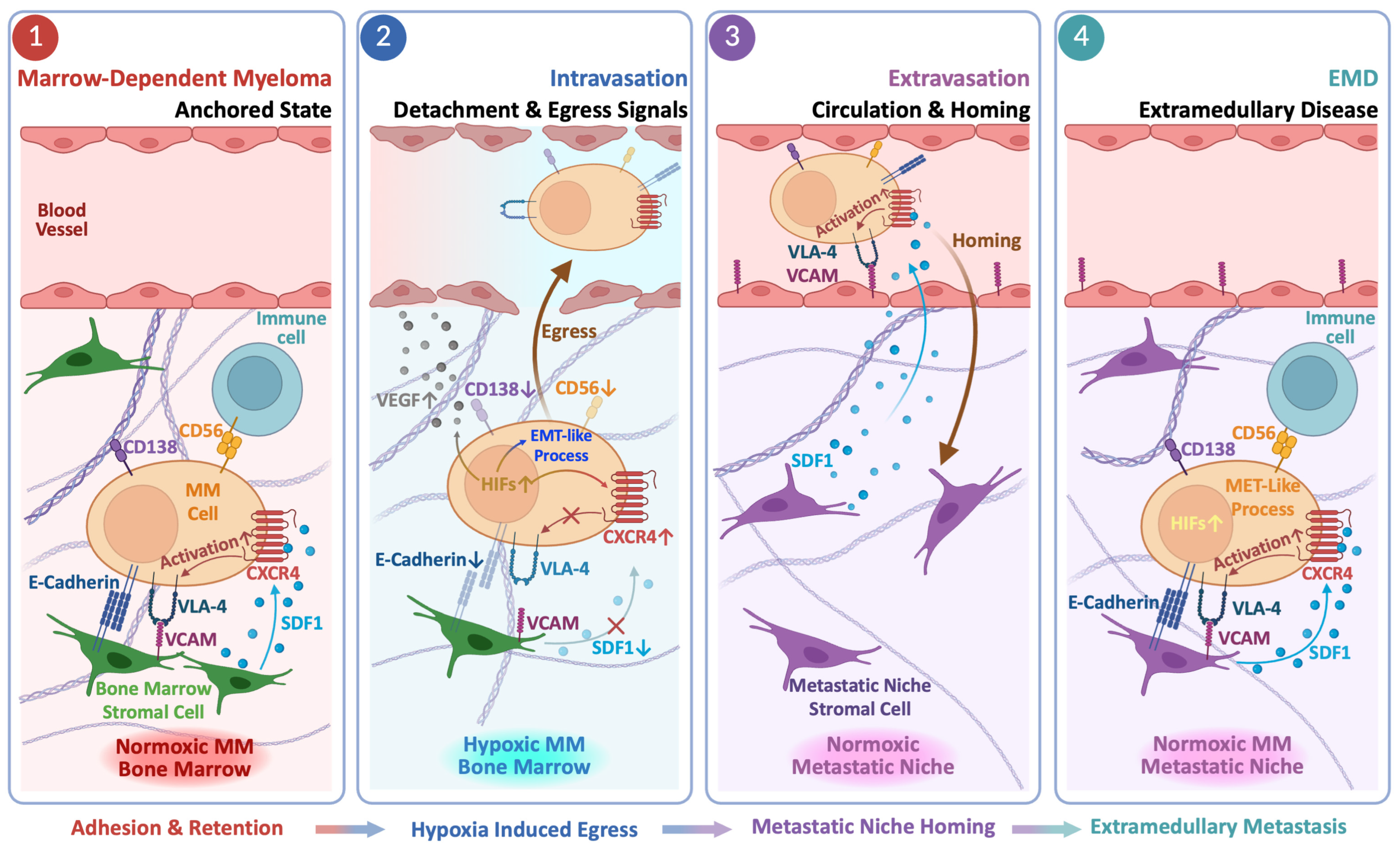
3. Pathophysiology of EMD
3.1. Bone Marrow-Dependent Anchored State
3.2. Hypoxia-Induced Egress and Intravasation
3.3. Circulation and Homing to Secondary Niches
3.4. Extramedullary Disease and Microenvironmental Independence
4. Genomic Landscape of EMD
4.1. Genomic Architecture and Cooperating Alterations
4.2. Therapeutic Target Expression and Immune Evasion
5. Treatment Strategies
5.1. Antibody–Drug Conjugates (ADCs)
5.2. T-Cell Engager (TCE) Antibodies
5.2.1. Bispecific Antibodies
BCMA-Directed Bispecific Antibody
GPRC5D-Directed Bispecific Antibody
Combination of Bispecific Antibodies with Different Targets
5.2.2. Trispecific Antibodies
5.3. CAR T-Cell Therapy
5.3.1. BCMA-Directed CAR T-Cell Therapy
5.3.2. GPRC5D-Directed CAR T Therapy
5.3.3. Dual-Targeted CAR T Therapy

| Trial/Study | Therapy | Phase | EMD Definition | N (EMD/Total) | ORR EMD | ORR Comparator † | mPFS EMD | mPFS Comparator † | mOS EMD | mOS Comparator † | Median Follow Up | Ref Δ |
|---|---|---|---|---|---|---|---|---|---|---|---|---|
| ADC | ||||||||||||
| DREAMM-2 | Belantamab mafodotin (2.5 mg/Kg Q3W) | Ph2 | STP (EMD + PSK) | 22/97 | 4.5% | 32% (all) | 1.1 mo | 2.8 mo (all) | 13.4 mo | 15.3 mo (all) | 12.5 mo | [67,68] |
| BCMA Bispecific Antibodies | ||||||||||||
| MajesTEC-1 | Teclistamab (1.5 mg QW) | Ph1-2 | EMD | 28/165 | 35.7% | 63.0% (all) | NRep | 11.3 mo (all) | NRep | 18.3 mo (all) | 14.1 mo | [70] |
| Riedhammer et al. | Teclistamab | RWE | EMD | 43/119 | 37.0% | 59.3% (all) | 2.1 mo | 8.7 mo (all) | NRep | NR (all) | 5.5 mo | [83] |
| Afrough et al. | Teclistamab | RWE | EMD | 109/358 | 38.0% | 62.4% (no-STP) | 1.4 mo | 8.95 mo (no-STP) | 9.54 mo | NR (no STP) | 9.9 mo | [73] |
| MagnetisMM-3 | Elranatamab | Ph2 | STP (EMD + PSD) | 39/123 | 38.5% | 71.4% (no-STP) | NRep | NRep | NRep | NRep | 14.7 mo | [72] |
| LINKER-MM1 | Linvoseltamab (200 mg) | Ph1-2 | EMD (≥2 cm) | 19/117 | 52.6% | 70.9% (all) | NRep | NR (all) | NRep | 31.9 mo (all) | 14.3 mo | [71] |
| GPRC5D Bispecific Antibody | ||||||||||||
| MonumenTAL-1 | Talquetamab (0.4 mg/kg QW) | Ph1-2 | EMD | 33/143 | 48% | 82% (no-EMD) | 4.6 mo | 9.2 mo (no-EMD) | NRep | Median: NRep; 12-mo: 76% (no-EMD) | 25.6 mo | [80] |
| MonumenTAL-1 | Talquetamab (0.8 mg/Kg Q2W) | Ph1-2 | EMD | 41/154 | 41% | 80% (no-EMD) | 3.4 mo | 16.9 mo (no-EMD) | NRep | Median: NRep; 12-mo: 77% (no-EMD) | 19.4 mo | [80] |
| Afrough et al. | Talquetamab | RWE | EMD | 97/360 | 68% | 65% (no STP) | 4.3 mo | 7.8 mo (no STP) | 10.3 mo | NR (no STP) | 12.8 mo | [81] |
| Dual Bispecific Combination | ||||||||||||
| RedirecTT-1 | Talquetamab + Teclistamab (RP2D) | Ph1b | EMD (≥2 cm) | 18/44 | 61% | 80% (all) | Median: NRep; 18-mo: 53% | Median: NRep; 18-mo: 70% (all) | NRep | NRep | 20.3 mo | [84] |
| RedirecTT-1 | Talquetamab + Teclistamab | Ph2 | EMD (≥2 cm) | 90/90 | 79% | — | Median: 15.4 mo; 12-mo: 61% | — | Median: NR; 12-mo: 74% | — | 12.6 mo | [85] |
| CAR T-Cell Therapy (BCMA) | ||||||||||||
| KarMMa | Ide-cel | Ph2 | STP (EMD + PSD) | 50/128 | 70% | 73% (all) | NRep | 8.8 mo (all) | NRep | 19.4 mo (all) | 13.3 mo | [90] |
| KarMMa-3 | Ide-cel | Ph3 | STP (EMD + PSD) | 61/254 | 55.7% | 71.3% (all) | 7.2 mo | 13.3 mo (all) | NRep | NRep | 18.6 mo | [96] |
| KarMMa-3 | SOC * | Ph3 | STP (EMD + PSD) | 32/132 | 18.7% | 41.7% (all) | 2.0 mo | 4.4 mo (all) | NRep | NRep | 18.6 mo | [96] |
| CARTITUDE-1 | Cilta-cel | Ph1b/2 | STP (EMD + PSK) | 19/97 | 100% | 97.9% (all) | Median: 13.8 mo; 27-mo: 47.4% | Median: NR (all); 27-mo: 54.9% | Median: NRep; 27-mo: 52% | NR (all); 27-mo: 70.4% (all) | 28 mo | [91] |
| CARTITUDE-4 | Cilta-cel | Ph3 | STP (EMD + PSK) | 44/208 35/211 | NRep | 84.6% (all) | 16.9 mo | NE (all) | NE | NE (all) | 33.6 mo | [97,98] |
| CARTITUDE-4 | SOC # | Ph3 | STP (EMD + PSK) | 35/211 | NRep | 67.3% (all) | 4.7 mo | 11.8 mo (all) | 19.5 mo | NE (all) | 33.6 mo | [97,98] |
| Zanwar et.al. | Ide-cel | RWE | EMD | 84/351 | 54% | 82% (no-EMD) | 5.3 mo | 11.1 mo (no EMD) | 14.8 mo | 26.9 mo (no-EMD) | 18.2 mo | [94] |
| Sidana et.al. | Cilta-cel | RWE | EMD | 60/236 | 84% | 91% (no-EMD) | NRep | NRep | NRep | NRep | 13 mo | [95] |
| CAR T-Cell Therapy (GPRC5D) | ||||||||||||
| MCARH109 | MCARH109 | Ph1 | EMD | 8/17 | 62.5% | 71% (all) | NRep | NRep | NRep | Median: NR (all); 3-yr: 59% (all) | 37.0 mo | [101,102] |
| NCT04674813 | Arlo-cel | Ph 1 | STP (EMD + PSK) | 39/84 | 86% | 87% (all) | NRep | 18.3 mo (all) | NRep | Median: NR (all); 1-yr: 90% (all) | NRep | [103] |
| Dual-Target CAR T | ||||||||||||
| Yao et al. | BCMA/GPRC5D CAR T-cell | Ph1 | EMD | 9/9 | 100% | — | Median: NR; 1-yr: 63% | — | Median: NR; 1-yr: 60% | — | 6.08 mo | [104] |
| CAR T vs. BsAb Comparison | ||||||||||||
| Steinhardt et al. | Ide-cel | RWE | EMD | 22/80 | 82% | — | 7.6 mo | — | 24.6 mo | — | 16.5 mo | [100] |
| Steinhardt et al. | Cilta-cel | RWE | EMD | 14/80 | 100% | — | NR | — | NR | — | 12.2 mo | [100] |
| Steinhardt et al. | Teclistamab | RWE | EMD | 16/80 | 36% | — | 4.0 mo | — | 6.3 mo | — | 6.1 mo | [100] |
| Steinhardt et al. | Talquetamab | RWE | EMD | 28/80 | 29% | — | 2.6 mo | — | 13.5 mo | — | 8.7 mo | [100] |
5.4. Other Considerations
5.4.1. Radiation Therapy as an Adjunct to T-Cell-Redirecting Therapies
5.4.2. Immunomodulatory Agents and the Inflammatory Microenvironment
5.5. Clinical Implication
- Distinguishing EMD from PSD is essential, as they differ in biology, prognosis, and treatment response: PSD arises from direct bone extension with contiguity to the BM niche, whereas EMD reflects hematogenous dissemination with BM-independent growth and a worse prognosis [4]. Clinicians should classify and document these entities separately to guide treatment intensity and prognostic counseling.
- EMD is an aggressive, treatment-resistant phenotype that warrants early escalation to T-cell-redirecting therapies (CAR T-cell therapy or BsAb), as conventional regimens yield poor outcomes (ORR ~20%; median PFS of 6 months) [65].
- Combination strategies may enhance T-cell-redirecting therapy efficacy by overcoming the immunosuppressive EMD microenvironment. Combining BsAb or CAR T-cell therapy with agents such as CELMoDs, anti-CD38 antibodies, or other targeted therapies may improve responses, although prospective EMD-specific data remain limited.
- Given the limited efficacy of standard regimens and the emerging role of novel combination strategies, early referral to tertiary centers with access to clinical trials should be prioritized.
6. CNS Myeloma: Focus on CAR T-Cell Therapy and Bispecific Antibodies
6.1. Definition and Clinical Context
6.2. The Blood–Brain Barrier in CNS-MM
6.3. Multimodality Therapy: Radiation and Intrathecal Chemotherapy
6.4. CAR T-Cell Therapy in CNS Myeloma
6.5. Bispecific Antibodies in CNS-MM
6.6. Comparative Outcomes
6.7. Clinical Implications
- A history of treated CNS-MM should not, by itself, exclude patients from CAR T-cell or BsAb therapy. Both modalities can be delivered to this population with safety profiles comparable to those in patients without CNS involvement, and patients with controlled or responding CNS disease at the time of T-cell redirection appear to derive the greatest benefit [138].
- The available evidence, including both major retrospective datasets, supports CNS-directed bridging followed by T-cell redirection as the emerging treatment framework for CNS-MM [126].
- Given the strong association between non-CNS EMD and CNS involvement (OR 6.3 in the Greek Myeloma Study Group) [129], clinicians should maintain a low threshold for neuroaxis imaging and CSF evaluation in patients with non-CNS EMD, high-risk cytogenetics, plasmablastic morphology, or new neurologic symptoms. Earlier identification of CNS-MM creates a wider window for incorporating multimodality treatment before CAR T-cell therapy or BsAb.
7. Future Directions
7.1. Improving Outcomes of Soft Tissues (Non-CNS) EMD
- Multisite and Liquid Biopsy Approaches
- Overcoming the Immunosuppressive Microenvironment
- Novel Therapeutic Targets
- -
- -
- KRAS mutations in EMD are predominantly non-G12C and only a minority of BRAF mutations are V600E, limiting the applicability of mutation-specific inhibitors; broader pan-RAS or MEK-level inhibition may be more universally applicable [36].
- -
- CD24, a marker of drug-resistant and less-differentiated myeloma cells enriched in RRMM and post-BCMA-directed therapy, represents another emerging target of relevance to EMD. Preclinical data [146] demonstrate that dual BCMA/CD24 CAR T-cell constructs outperform monospecific approaches by eliminating dormant resistant cells and restoring macrophage-mediated clearance via CD24–Siglec-10 ‘don’t eat me’ checkpoint blockade, warranting prospective evaluation in the EMD setting.
- Prospective Trial Design
7.2. Improving Outcomes of CNS Myeloma
- Sequencing of Bispecifics and CAR T-Cell Therapy
- Dual-Antigen Targeting and Combination Therapies
- Maintenance Strategies After CAR T-Cell Therapy
- Prospective Trial Design
8. Conclusions
Author Contributions
Funding
Data Availability Statement
Acknowledgments
Conflicts of Interest
References
- Malard, F.; Neri, P.; Bahlis, N.J.; Terpos, E.; Moukalled, N.; Hungria, V.T.M.; Manier, S.; Mohty, M. Multiple myeloma. Nat. Rev. Dis. Prim. 2024, 10, 45. [Google Scholar] [CrossRef] [Scilit] [PubMed]
- van de Donk, N.; Pawlyn, C.; Yong, K.L. Multiple myeloma. Lancet 2021, 397, 410–427. [Google Scholar] [CrossRef] [Scilit] [PubMed]
- Touzeau, C.; Moreau, P. How I treat extramedullary myeloma. Blood 2016, 127, 971–976. [Google Scholar] [CrossRef] [Scilit] [PubMed]
- Bladé, J.; Beksac, M.; Caers, J.; Jurczyszyn, A.; von Lilienfeld-Toal, M.; Moreau, P.; Rasche, L.; Rosiñol, L.; Usmani, S.Z.; Zamagni, E.; et al. Extramedullary disease in multiple myeloma: A systematic literature review. Blood Cancer J. 2022, 12, 45. [Google Scholar] [CrossRef] [Scilit] [PubMed]
- Kumar, S.; Richter, J.; Usmani, S.Z.; Cohen, Y.C.; Ye, J.C.; Mateos, M.V.; Hungria, V.; Zamagni, E. Extramedullary Disease-Achilles Heel in Myeloma? Am. J. Hematol. 2026, 101, 521–536. [Google Scholar] [CrossRef] [Scilit] [PubMed]
- Weinstock, M.; Aljawai, Y.; Morgan, E.A.; Laubach, J.; Gannon, M.; Roccaro, A.M.; Varga, C.; Mitsiades, C.S.; Paba-Prada, C.; Schlossman, R.; et al. Incidence and clinical features of extramedullary multiple myeloma in patients who underwent stem cell transplantation. Br. J. Haematol. 2015, 169, 851–858. [Google Scholar] [CrossRef] [Scilit] [PubMed]
- Rosiñol, L.; Beksac, M.; Zamagni, E.; Van de Donk, N.; Anderson, K.C.; Badros, A.; Caers, J.; Cavo, M.; Dimopoulos, M.A.; Dispenzieri, A.; et al. Expert review on soft-tissue plasmacytomas in multiple myeloma: Definition, disease assessment and treatment considerations. Br. J. Haematol. 2021, 194, 496–507. [Google Scholar] [CrossRef] [Scilit] [PubMed]
- Usmani, S.Z.; Heuck, C.; Mitchell, A.; Szymonifka, J.; Nair, B.; Hoering, A.; Alsayed, Y.; Waheed, S.; Haider, S.; Restrepo, A.; et al. Extramedullary disease portends poor prognosis in multiple myeloma and is over-represented in high-risk disease even in the era of novel agents. Haematologica 2012, 97, 1761–1767. [Google Scholar] [CrossRef] [Scilit] [PubMed]
- Varettoni, M.; Corso, A.; Pica, G.; Mangiacavalli, S.; Pascutto, C.; Lazzarino, M. Incidence, presenting features and outcome of extramedullary disease in multiple myeloma: A longitudinal study on 1003 consecutive patients. Ann. Oncol. 2010, 21, 325–330. [Google Scholar] [CrossRef] [Scilit] [PubMed]
- Short, K.D.; Rajkumar, S.V.; Larson, D.; Buadi, F.; Hayman, S.; Dispenzieri, A.; Gertz, M.; Kumar, S.; Mikhael, J.; Roy, V.; et al. Incidence of extramedullary disease in patients with multiple myeloma in the era of novel therapy, and the activity of pomalidomide on extramedullary myeloma. Leukemia 2011, 25, 906–908. [Google Scholar] [CrossRef] [Scilit] [PubMed]
- Azab, A.K.; Azab, F.; Blotta, S.; Pitsillides, C.M.; Thompson, B.; Runnels, J.M.; Roccaro, A.M.; Ngo, H.T.; Melhem, M.R.; Sacco, A.; et al. RhoA and Rac1 GTPases play major and differential roles in stromal cell-derived factor-1-induced cell adhesion and chemotaxis in multiple myeloma. Blood 2009, 114, 619–629. [Google Scholar] [CrossRef] [Scilit] [PubMed]
- Azab, A.K.; Quang, P.; Azab, F.; Pitsillides, C.; Thompson, B.; Chonghaile, T.; Patton, J.T.; Maiso, P.; Monrose, V.; Sacco, A.; et al. P-selectin glycoprotein ligand regulates the interaction of multiple myeloma cells with the bone marrow microenvironment. Blood 2012, 119, 1468–1478. [Google Scholar] [CrossRef] [Scilit] [PubMed]
- Azab, A.K.; Runnels, J.M.; Pitsillides, C.; Moreau, A.S.; Azab, F.; Leleu, X.; Jia, X.; Wright, R.; Ospina, B.; Carlson, A.L.; et al. CXCR4 inhibitor AMD3100 disrupts the interaction of multiple myeloma cells with the bone marrow microenvironment and enhances their sensitivity to therapy. Blood 2009, 113, 4341–4351. [Google Scholar] [CrossRef] [Scilit] [PubMed]
- Azab, A.K.; Sahin, I.; Moschetta, M.; Mishima, Y.; Burwick, N.; Zimmermann, J.; Romagnoli, B.; Patel, K.; Chevalier, E.; Roccaro, A.M.; et al. CXCR7-dependent angiogenic mononuclear cell trafficking regulates tumor progression in multiple myeloma. Blood 2014, 124, 1905–1914. [Google Scholar] [CrossRef] [Scilit] [PubMed]
- de la Puente, P.; Muz, B.; Gilson, R.C.; Azab, F.; Luderer, M.; King, J.; Achilefu, S.; Vij, R.; Azab, A.K. 3D tissue-engineered bone marrow as a novel model to study pathophysiology and drug resistance in multiple myeloma. Biomaterials 2015, 73, 70–84. [Google Scholar] [CrossRef] [Scilit] [PubMed]
- Muz, B.; Azab, F.; de la Puente, P.; Landesman, Y.; Azab, A.K. Selinexor Overcomes Hypoxia-Induced Drug Resistance in Multiple Myeloma. Transl. Oncol. 2017, 10, 632–640. [Google Scholar] [CrossRef] [Scilit] [PubMed]
- Muz, B.; Buggio, M.; Azab, F.; de la Puente, P.; Fiala, M.; Padval, M.V.; Weaver, D.T.; Pachter, J.A.; Vij, R.; Azab, A.K. PYK2/FAK inhibitors reverse hypoxia-induced drug resistance in multiple myeloma. Haematologica 2019, 104, e310–e313. [Google Scholar] [CrossRef] [Scilit] [PubMed]
- Muz, B.; de la Puente, P.; Azab, F.; Azab, A.K. The role of hypoxia in cancer progression, angiogenesis, metastasis, and resistance to therapy. Hypoxia 2015, 3, 83–92. [Google Scholar] [CrossRef] [Scilit] [PubMed]
- Muz, B.; de la Puente, P.; Azab, F.; Luderer, M.; Azab, A.K. Hypoxia promotes stem cell-like phenotype in multiple myeloma cells. Blood Cancer J. 2014, 4, e262. [Google Scholar] [CrossRef] [Scilit] [PubMed]
- Muz, B.; de la Puente, P.; Azab, F.; Luderer, M.; Azab, A.K. The role of hypoxia and exploitation of the hypoxic environment in hematologic malignancies. Mol. Cancer Res. 2014, 12, 1347–1354. [Google Scholar] [CrossRef] [Scilit] [PubMed]
- Muz, B.; de la Puente, P.; Azab, F.; Luderer, M.J.; King, J.; Vij, R.; Azab, A.K. A CD138-independent strategy to detect minimal residual disease and circulating tumour cells in multiple myeloma. Br. J. Haematol. 2016, 173, 70–81. [Google Scholar] [CrossRef] [Scilit] [PubMed]
- Muz, B.; Kusdono, H.D.; Azab, F.; de la Puente, P.; Federico, C.; Fiala, M.; Vij, R.; Salama, N.N.; Azab, A.K. Tariquidar sensitizes multiple myeloma cells to proteasome inhibitors via reduction of hypoxia-induced P-gp-mediated drug resistance. Leuk. Lymphoma 2017, 58, 2916–2925. [Google Scholar] [CrossRef] [Scilit] [PubMed]
- Neri, P.; Ren, L.; Azab, A.K.; Brentnall, M.; Gratton, K.; Klimowicz, A.C.; Lin, C.; Duggan, P.; Tassone, P.; Mansoor, A.; et al. Integrin beta7-mediated regulation of multiple myeloma cell adhesion, migration, and invasion. Blood 2011, 117, 6202–6213. [Google Scholar] [CrossRef] [Scilit] [PubMed]
- Runnels, J.M.; Carlson, A.L.; Pitsillides, C.; Thompson, B.; Wu, J.; Spencer, J.A.; Kohler, J.M.; Azab, A.; Moreau, A.S.; Rodig, S.J.; et al. Optical techniques for tracking multiple myeloma engraftment, growth, and response to therapy. J. Biomed. Opt. 2011, 16, 011006. [Google Scholar] [CrossRef] [Scilit] [PubMed]
- Azab, F.; Vali, S.; Abraham, J.; Potter, N.; Muz, B.; de la Puente, P.; Fiala, M.; Paasch, J.; Sultana, Z.; Tyagi, A.; et al. PI3KCA plays a major role in multiple myeloma and its inhibition with BYL719 decreases proliferation, synergizes with other therapies and overcomes stroma-induced resistance. Br. J. Haematol. 2014, 165, 89–101. [Google Scholar] [CrossRef] [Scilit] [PubMed]
- de la Puente, P.; Quan, N.; Hoo, R.S.; Muz, B.; Gilson, R.C.; Luderer, M.; King, J.; Achilefu, S.; Salama, N.N.; Vij, R.; et al. Newly established myeloma-derived stromal cell line MSP-1 supports multiple myeloma proliferation, migration, and adhesion and induces drug resistance more than normal-derived stroma. Haematologica 2016, 101, e307–e311. [Google Scholar] [CrossRef] [Scilit] [PubMed]
- de la Puente, P.; Weisberg, E.; Muz, B.; Nonami, A.; Luderer, M.; Stone, R.M.; Melo, J.V.; Griffin, J.D.; Azab, A.K. Identification of ILK as a novel therapeutic target for acute and chronic myeloid leukemia. Leuk. Res. 2015, 39, 1299–1308. [Google Scholar] [CrossRef] [Scilit] [PubMed]
- Federico, C.; Alhallak, K.; Sun, J.; Duncan, K.; Azab, F.; Sudlow, G.P.; de la Puente, P.; Muz, B.; Kapoor, V.; Zhang, L.; et al. Tumor microenvironment-targeted nanoparticles loaded with bortezomib and ROCK inhibitor improve efficacy in multiple myeloma. Nat. Commun. 2020, 11, 6037. [Google Scholar] [CrossRef] [Scilit] [PubMed]
- Ghobrial, I.M.; Liu, C.J.; Zavidij, O.; Azab, A.K.; Baz, R.; Laubach, J.P.; Mishima, Y.; Armand, P.; Munshi, N.C.; Basile, F.; et al. Phase I/II trial of the CXCR4 inhibitor plerixafor in combination with bortezomib as a chemosensitization strategy in relapsed/refractory multiple myeloma. Am. J. Hematol. 2019, 94, 1244–1253. [Google Scholar] [CrossRef] [Scilit] [PubMed]
- Noborio-Hatano, K.; Kikuchi, J.; Takatoku, M.; Shimizu, R.; Wada, T.; Ueda, M.; Nobuyoshi, M.; Oh, I.; Sato, K.; Suzuki, T.; et al. Bortezomib overcomes cell-adhesion-mediated drug resistance through downregulation of VLA-4 expression in multiple myeloma. Oncogene 2009, 28, 231–242. [Google Scholar] [CrossRef] [Scilit] [PubMed]
- Hathi, D.; Chanswangphuwana, C.; Cho, N.; Fontana, F.; Maji, D.; Ritchey, J.; O’Neal, J.; Ghai, A.; Duncan, K.; Akers, W.J.; et al. Ablation of VLA4 in multiple myeloma cells redirects tumor spread and prolongs survival. Sci. Rep. 2022, 12, 30. [Google Scholar] [CrossRef] [Scilit] [PubMed]
- Varga, C.; Xie, W.; Laubach, J.; Ghobrial, I.M.; O’Donnell, E.K.; Weinstock, M.; Paba-Prada, C.; Warren, D.; Maglio, M.E.; Schlossman, R.; et al. Development of extramedullary myeloma in the era of novel agents: No evidence of increased risk with lenalidomide-bortezomib combinations. Br. J. Haematol. 2015, 169, 843–850. [Google Scholar] [CrossRef] [Scilit] [PubMed]
- Azab, A.K.; Hu, J.; Quang, P.; Azab, F.; Pitsillides, C.; Awwad, R.; Thompson, B.; Maiso, P.; Sun, J.D.; Hart, C.P.; et al. Hypoxia promotes dissemination of multiple myeloma through acquisition of epithelial to mesenchymal transition-like features. Blood 2012, 119, 5782–5794. [Google Scholar] [CrossRef] [Scilit] [PubMed]
- Ryu, D.; Kim, S.J.; Hong, Y.; Jo, A.; Kim, N.; Kim, H.J.; Lee, H.O.; Kim, K.; Park, W.Y. Alterations in the Transcriptional Programs of Myeloma Cells and the Microenvironment during Extramedullary Progression Affect Proliferation and Immune Evasion. Clin. Cancer Res. 2020, 26, 935–944. [Google Scholar] [CrossRef] [Scilit] [PubMed]
- Jelinek, T.; Zihala, D.; Sevcikova, T.; Anilkumar Sithara, A.; Kapustova, V.; Sahinbegovic, H.; Venglar, O.; Muronova, L.; Broskevicova, L.; Nenarokov, S.; et al. Beyond the marrow: Insights from comprehensive next-generation sequencing of extramedullary multiple myeloma tumors. Leukemia 2024, 38, 1323–1333. [Google Scholar] [CrossRef] [Scilit] [PubMed]
- Zanwar, S.; Novak, J.; Gonsalves, W.; Howe, M.; Braggio, E.; Rajkumar, S.V.; Binder, M.; Jevremovic, D.; Dasari, S.; Kumar, S. Extramedullary myeloma is genomically complex and characterized by near-universal MAPK pathway alterations. Blood Adv. 2025, 9, 3979–3987. [Google Scholar] [CrossRef] [Scilit] [PubMed]
- Chatterjee, M.; Stühmer, T.; Herrmann, P.; Bommert, K.; Dörken, B.; Bargou, R.C. Combined disruption of both the MEK/ERK and the IL-6R/STAT3 pathways is required to induce apoptosis of multiple myeloma cells in the presence of bone marrow stromal cells. Blood 2004, 104, 3712–3721. [Google Scholar] [CrossRef] [Scilit] [PubMed]
- Burroughs Garcìa, J.; Eufemiese, R.A.; Storti, P.; Sammarelli, G.; Craviotto, L.; Todaro, G.; Toscani, D.; Marchica, V.; Giuliani, N. Role of 1q21 in Multiple Myeloma: From Pathogenesis to Possible Therapeutic Targets. Cells 2021, 10, 1360. [Google Scholar] [CrossRef] [Scilit] [PubMed]
- Dankbar, B.; Padró, T.; Leo, R.; Feldmann, B.; Kropff, M.; Mesters, R.M.; Serve, H.; Berdel, W.E.; Kienast, J. Vascular endothelial growth factor and interleukin-6 in paracrine tumor-stromal cell interactions in multiple myeloma. Blood 2000, 95, 2630–2636. [Google Scholar] [CrossRef] [Scilit] [PubMed]
- Iwasaki, T.; Hamano, T.; Ogata, A.; Hashimoto, N.; Kitano, M.; Kakishita, E. Clinical significance of vascular endothelial growth factor and hepatocyte growth factor in multiple myeloma. Br. J. Haematol. 2002, 116, 796–802. [Google Scholar] [CrossRef] [Scilit] [PubMed]
- Bingham, N.; Shah, J.; Wong, D.; Lim, S.L.; Bergin, K.; Kalff, A.; Reale, A.; Khong, T.; Mithraprabhu, S.; Spencer, A. Whole genome sequencing and the genetics of extramedullary disease in multiple myeloma. Blood Cancer J. 2025, 15, 5. [Google Scholar] [CrossRef] [Scilit] [PubMed]
- Maura, F.; Rajanna, A.R.; Ziccheddu, B.; Poos, A.M.; Derkach, A.; Maclachlan, K.; Durante, M.; Diamond, B.; Papadimitriou, M.; Davies, F.; et al. Genomic Classification and Individualized Prognosis in Multiple Myeloma. J. Clin. Oncol. 2024, 42, 1229–1240. [Google Scholar] [CrossRef] [Scilit] [PubMed]
- Nakamoto-Matsubara, R.; Nardi, V.; Horick, N.; Fukushima, T.; Han, R.S.; Shome, R.; Ochi, K.; Panaroni, C.; Fulzele, K.; Rexha, F.; et al. Integration of clinical outcomes and molecular features in extramedullary disease in multiple myeloma. Blood Cancer J. 2024, 14, 224. [Google Scholar] [CrossRef] [Scilit] [PubMed]
- Xu, J.; Yang, H.; Huang, J.; Niu, T.; Sun, C.; Zhang, L.; Zheng, Y. A comprehensive analysis of bone marrow-derived cytogenetic abnormalities in multiple myeloma patients with extramedullary disease. J. Cancer Res. Clin. Oncol. 2025, 151, 169. [Google Scholar] [CrossRef] [Scilit] [PubMed]
- Bacolla, A.; Cooper, D.N.; Vasquez, K.M. Mechanisms of base substitution mutagenesis in cancer genomes. Genes 2014, 5, 108–146. [Google Scholar] [CrossRef] [Scilit] [PubMed]
- Walker, B.A.; Wardell, C.P.; Murison, A.; Boyle, E.M.; Begum, D.B.; Dahir, N.M.; Proszek, P.Z.; Melchor, L.; Pawlyn, C.; Kaiser, M.F.; et al. APOBEC family mutational signatures are associated with poor prognosis translocations in multiple myeloma. Nat. Commun. 2015, 6, 6997. [Google Scholar] [CrossRef] [Scilit] [PubMed]
- Yamazaki, H.; Shirakawa, K.; Matsumoto, T.; Hirabayashi, S.; Murakawa, Y.; Kobayashi, M.; Sarca, A.D.; Kazuma, Y.; Matsui, H.; Maruyama, W.; et al. Endogenous APOBEC3B Overexpression Constitutively Generates DNA Substitutions and Deletions in Myeloma Cells. Sci. Rep. 2019, 9, 7122. [Google Scholar] [CrossRef] [Scilit] [PubMed]
- John, M.; Helal, M.; Duell, J.; Mattavelli, G.; Stanojkovska, E.; Afrin, N.; Leipold, A.M.; Steinhardt, M.J.; Zhou, X.; Žihala, D.; et al. Spatial transcriptomics reveals profound subclonal heterogeneity and T-cell dysfunction in extramedullary myeloma. Blood 2024, 144, 2121–2135. [Google Scholar] [CrossRef] [Scilit] [PubMed]
- Croonquist, P.A.; Van Ness, B. The polycomb group protein enhancer of zeste homolog 2 (EZH 2) is an oncogene that influences myeloma cell growth and the mutant ras phenotype. Oncogene 2005, 24, 6269–6280. [Google Scholar] [CrossRef] [Scilit] [PubMed]
- Pawlyn, C.; Bright, M.D.; Buros, A.F.; Stein, C.K.; Walters, Z.; Aronson, L.I.; Mirabella, F.; Jones, J.R.; Kaiser, M.F.; Walker, B.A.; et al. Overexpression of EZH2 in multiple myeloma is associated with poor prognosis and dysregulation of cell cycle control. Blood Cancer J. 2017, 7, e549. [Google Scholar] [CrossRef] [Scilit] [PubMed]
- Hernando, H.; Gelato, K.A.; Lesche, R.; Beckmann, G.; Koehr, S.; Otto, S.; Steigemann, P.; Stresemann, C. EZH2 Inhibition Blocks Multiple Myeloma Cell Growth through Upregulation of Epithelial Tumor Suppressor Genes. Mol. Cancer Ther. 2016, 15, 287–298. [Google Scholar] [CrossRef] [Scilit] [PubMed]
- Bugide, S.; Gupta, R.; Green, M.R.; Wajapeyee, N. EZH2 inhibits NK cell-mediated antitumor immunity by suppressing CXCL10 expression in an HDAC10-dependent manner. Proc. Natl. Acad. Sci. USA 2021, 118, e2102718118. [Google Scholar] [CrossRef] [Scilit] [PubMed]
- Mortezaee, K. EZH2 regulatory roles in cancer immunity and immunotherapy. Pathol. Res. Pract. 2025, 270, 155992. [Google Scholar] [CrossRef] [Scilit] [PubMed]
- U.S. Food and Drug Administration. FDA Granted Accelerated Approval to Tazemetostat for Follicular Lymphoma. Available online: https://www.fda.gov/drugs/fda-granted-accelerated-approval-tazemetostat-follicular-lymphoma (accessed on 1 June 2026).
- Li, Y.; Wilson, A.; Chrisochoidou, Y.; Martin, S.; Bird, S.; Morales, S.; Leiro, M.; Kozik, Z.; Crump, N.T.; Roumeliotis, T.I.; et al. EZH2 inhibition overcomes immunomodulatory drug resistance in multiple myeloma via a cereblon-dependent pathway. Haematologica 2026. Online ahead of print. [Google Scholar] [CrossRef] [Scilit] [PubMed]
- Flieswasser, T.; Van den Eynde, A.; Van Audenaerde, J.; De Waele, J.; Lardon, F.; Riether, C.; de Haard, H.; Smits, E.; Pauwels, P.; Jacobs, J. The CD70-CD27 axis in oncology: The new kids on the block. J. Exp. Clin. Cancer Res. 2022, 41, 12. [Google Scholar] [CrossRef] [Scilit] [PubMed]
- Forster, S.; Reinhardt, C.; Boy, M.; Wegmüller, A.; Hinrichsen, A.; Schürch, C.M.; Brühl, F.K.; Fend, F.; Tzankov, A.; Kronig, M.N.; et al. CD70/CD27 signaling promotes the pathogenesis of multiple myeloma and represents a promising therapeutic target. Leukemia 2026, 40, 1163–1175. [Google Scholar] [CrossRef] [Scilit] [PubMed]
- Sam, I.; Ben Hamouda, N.; Alkatrib, M.; Gonnin, C.; Siska, P.J.; Oudard, S.; Lebbé, C.; Tartour, E. The CD70-CD27 Axis in Cancer Immunotherapy: Predictive Biomarker and Therapeutic Target. Clin. Cancer Res. 2025, 31, 2872–2881. [Google Scholar] [CrossRef] [Scilit] [PubMed]
- Kasap, C.; Izgutdina, A.; Patiño-Escobar, B.; Kang, A.S.; Chilakapati, N.; Akagi, N.; Manoj, A.; Johnson, H.; Rashid, T.; Werner, J.; et al. Targeting high-risk multiple myeloma genotypes with optimized anti-CD70 CAR T cells. Blood 2025, 146, 819–833. [Google Scholar] [CrossRef] [Scilit] [PubMed]
- Gagelmann, N.; Eikema, D.J.; Iacobelli, S.; Koster, L.; Nahi, H.; Stoppa, A.M.; Masszi, T.; Caillot, D.; Lenhoff, S.; Udvardy, M.; et al. Impact of extramedullary disease in patients with newly diagnosed multiple myeloma undergoing autologous stem cell transplantation: A study from the Chronic Malignancies Working Party of the EBMT. Haematologica 2018, 103, 890–897. [Google Scholar] [CrossRef] [Scilit] [PubMed]
- Jelinek, T.; Sevcikova, T.; Zihala, D.; Popkova, T.; Kapustova, V.; Broskevicova, L.; Capkova, L.; Rihova, L.; Bezdekova, R.; Sevcikova, S.; et al. Limited efficacy of daratumumab in multiple myeloma with extramedullary disease. Leukemia 2022, 36, 288–291. [Google Scholar] [CrossRef] [Scilit] [PubMed]
- Bladé, J.; Perales, M.; Rosiñol, L.; Tuset, M.; Montoto, S.; Esteve, J.; Cobo, F.; Villela, L.; Rafel, M.; Nomdedeu, B.; et al. Thalidomide in multiple myeloma: Lack of response of soft-tissue plasmacytomas. Br. J. Haematol. 2001, 113, 422–424. [Google Scholar] [CrossRef] [Scilit] [PubMed]
- Rosiñol, L.; Cibeira, M.T.; Bladé, J.; Esteve, J.; Aymerich, M.; Rozman, M.; Segarra, M.; Cid, M.C.; Filella, X.; Montserrat, E. Extramedullary multiple myeloma escapes the effect of thalidomide. Haematologica 2004, 89, 832–836. [Google Scholar] [PubMed]
- Cibeira, M.T.; Rosiñol, L.; Ramiro, L.; Esteve, J.; Torrebadell, M.; Bladé, J. Long-term results of thalidomide in refractory and relapsed multiple myeloma with emphasis on response duration. Eur. J. Haematol. 2006, 77, 486–492. [Google Scholar] [CrossRef] [Scilit] [PubMed]
- Moreau, P.; Mateos, M.V.; Goldschmidt, H.; Garcia, M.E.G.; Besemer, B.; Perez, M.S.G.; Mohty, M.; Lindsey-Hill, J.; Kirkpatrick, S.; Delforge, M.; et al. Outcomes of Patients With Extramedullary Disease in Triple-Class Exposed Relapsed/Refractory Multiple Myeloma From the Pooled LocoMMotion and MoMMent Studies. Clin. Lymphoma Myeloma Leuk. 2025, 25, 646–655.e641. [Google Scholar] [CrossRef] [Scilit] [PubMed]
- Voorhees, P.M.; Kumar, S.; Usmani, S.Z.; Ye, J.C.; Cohen, Y.C.; Scott, E.; Carson, R.L.; Heuck, C.; Gan, R.; Ackerman, B.; et al. Outcomes in patients with relapsed/refractory multiple myeloma with extramedullary disease: A meta-analysis. Ann. Hematol. 2025, 104, 6263–6274. [Google Scholar] [CrossRef] [Scilit] [PubMed]
- Lonial, S.; Lee, H.C.; Badros, A.; Trudel, S.; Nooka, A.K.; Chari, A.; Abdallah, A.O.; Callander, N.; Sborov, D.; Suvannasankha, A.; et al. Longer term outcomes with single-agent belantamab mafodotin in patients with relapsed or refractory multiple myeloma: 13-month follow-up from the pivotal DREAMM-2 study. Cancer 2021, 127, 4198–4212. [Google Scholar] [CrossRef] [Scilit] [PubMed]
- Nooka, A.K.; Cohen, A.D.; Lee, H.C.; Badros, A.; Suvannasankha, A.; Callander, N.; Abdallah, A.O.; Trudel, S.; Chari, A.; Libby, E.N.; et al. Single-agent belantamab mafodotin in patients with relapsed/refractory multiple myeloma: Final analysis of the DREAMM-2 trial. Cancer 2023, 129, 3746–3760. [Google Scholar] [CrossRef] [Scilit] [PubMed]
- Dileo, R.; Mewawalla, P.; Babu, K.; Yin, Y.; Strouse, C.; Chen, E.; Shaikh, H.; Davis, J.A.; Green, K.M.; Alkharabsheh, O.; et al. A real-world experience of efficacy and safety of belantamab mafodotin in relapsed refractory multiple myeloma. Blood Cancer J. 2025, 15, 34. [Google Scholar] [CrossRef] [Scilit] [PubMed]
- Moreau, P.; Garfall, A.L.; van de Donk, N.; Nahi, H.; San-Miguel, J.F.; Oriol, A.; Nooka, A.K.; Martin, T.; Rosinol, L.; Chari, A.; et al. Teclistamab in Relapsed or Refractory Multiple Myeloma. N. Engl. J. Med. 2022, 387, 495–505. [Google Scholar] [CrossRef] [Scilit] [PubMed]
- Bumma, N.; Richter, J.; Jagannath, S.; Lee, H.C.; Hoffman, J.E.; Suvannasankha, A.; Zonder, J.A.; Shah, M.R.; Lentzsch, S.; Baz, R.; et al. Linvoseltamab for Treatment of Relapsed/Refractory Multiple Myeloma. J. Clin. Oncol. 2024, 42, 2702–2712. [Google Scholar] [CrossRef] [Scilit] [PubMed]
- Lesokhin, A.M.; Tomasson, M.H.; Arnulf, B.; Bahlis, N.J.; Miles Prince, H.; Niesvizky, R.; Rodrίguez-Otero, P.; Martinez-Lopez, J.; Koehne, G.; Touzeau, C.; et al. Elranatamab in relapsed or refractory multiple myeloma: Phase 2 MagnetisMM-3 trial results. Nat. Med. 2023, 29, 2259–2267. [Google Scholar] [CrossRef] [Scilit] [PubMed]
- Afrough, A.; Dima, D.; Razzo, B.; Goel, U.; Sannareddy, A.; Pasvolsky, O.; Vazquez-Martinez, M.A.; Ferreri, C.J.; Banerjee, R.; Khouri, J.; et al. The impact of extramedullary and paraskeletal plasmacytomas on treatment outcomes in multiple myeloma treated with teclistamab: U.S. Myeloma Immunotherapy Consortium real-world experience. Blood Cancer J. 2025, 16, 12. [Google Scholar] [CrossRef] [Scilit] [PubMed]
- Portuguese, A.J.; Davis, J.A.; Raza, S.; Castaneda Puglianini, O.; Freeman, C.; Alsina, M.; Wright, C.; Blue, B.J.; Baz, R.C.; Shain, K.H.; et al. Real-world outcomes with elranatamab in multiple myeloma: A multicenter analysis from the U.S. Multiple Myeloma Immunotherapy Consortium. Blood Cancer J. 2026, 16, 47. [Google Scholar] [CrossRef] [Scilit] [PubMed]
- Kumar, S.; Jagannath, S.; Weisel, K.C.; Rosiñol, L.; Leleu, X.; Dimopoulos, M.A.; Kastritis, E.; Siegel, D.S.; Monge, J.; Du, J.; et al. Linvoseltamab versus real-world International Myeloma Working Group standard-of-care in triple-class exposed relapsed/refractory multiple myeloma. Blood Cancer J. 2026, 16, 44. [Google Scholar] [CrossRef] [Scilit] [PubMed]
- Mol, I.; Hu, Y.; LeBlanc, T.W.; Cappelleri, J.C.; Chu, H.; Nador, G.; Aydin, D.; Schepart, A.; Hlavacek, P. A matching-adjusted indirect comparison of the efficacy of elranatamab versus teclistamab in patients with triple-class exposed/refractory multiple myeloma. Leuk. Lymphoma 2024, 65, 660–668. [Google Scholar] [CrossRef] [Scilit] [PubMed]
- Lee, H.C.; Bumma, N.; Richter, J.R.; Zonder, J.A.; Hoffman, J.E.; Zhou, Z.-Y.; Horton, V.G.; Fillbrunn, M.; Wang, H.; Mattera, M.; et al. Comparative efficacy of linvoseltamab versus teclistamab in triple-class exposed (TCE) relapsed/refractory multiple myeloma (RRMM): Updated matching-adjusted indirect comparison (MAIC) with longer follow-up. J. Clin. Oncol. 2026, 44, 7526. [Google Scholar] [CrossRef] [Scilit]
- Richter, J.; Lee, H.C.; Jagannath, S.; Zonder, J.A.; Hoffman, J.E.; Zhou, Z.Y.; Garcia-Horton, V.; Fillbrunn, M.; Wang, H.; Mattera, M.; et al. Linvoseltamab versus elranatamab for triple-class exposed relapsed or refractory multiple myeloma: An indirect treatment comparison. Leuk. Lymphoma 2026, 1–13, ahead of print. [Google Scholar] [CrossRef] [Scilit] [PubMed]
- Chari, A.; Minnema, M.C.; Berdeja, J.G.; Oriol, A.; van de Donk, N.; Rodríguez-Otero, P.; Askari, E.; Mateos, M.V.; Costa, L.J.; Caers, J.; et al. Talquetamab, a T-Cell-Redirecting GPRC5D Bispecific Antibody for Multiple Myeloma. N. Engl. J. Med. 2022, 387, 2232–2244. [Google Scholar] [CrossRef] [Scilit] [PubMed]
- Chari, A.; Touzeau, C.; Schinke, C.; Minnema, M.C.; Berdeja, J.G.; Oriol, A.; van de Donk, N.; Rodríguez-Otero, P.; Morillo, D.; Martinez-Chamorro, C.; et al. Safety and activity of talquetamab in patients with relapsed or refractory multiple myeloma (MonumenTAL-1): A multicentre, open-label, phase 1-2 study. Lancet Haematol. 2025, 12, e269–e281. [Google Scholar] [CrossRef] [Scilit] [PubMed]
- Afrough, A.; Pasvolsky, O.; Zanwar, S.; Gaballa, M.; Sannareddy, A.; Dima, D.; Goel, U.; Ali, H.M.; Julian, K.; Corraes, A.; et al. Impact of Extramedullary Plasmacytoma on Outcomes in Patients with Relapsed Refractory Multiple Myeloma Treated with Talquetamab: U.S. Myeloma Immunotherapy Consortium. Blood Cancer J. 2026, in press. [Google Scholar] [CrossRef] [Scilit]
- Einsele, H.; Moreau, P.; Bahlis, N.; Bhutani, M.; Vincent, L.; Karlin, L.; Perrot, A.; Goldschmidt, H.; van de Donk, N.; Ocio, E.M.; et al. Comparative Efficacy of Talquetamab vs. Real-World Physician’s Choice of Treatment in Triple-Class-Exposed Relapsed/Refractory Multiple Myeloma: Updated Analyses of MonumenTAL-1 vs. LocoMMotion/MoMMent. Adv. Ther. 2025, 43, 333–355. [Google Scholar] [CrossRef] [Scilit] [PubMed]
- Riedhammer, C.; Bassermann, F.; Besemer, B.; Bewarder, M.; Brunner, F.; Carpinteiro, A.; Einsele, H.; Faltin, J.; Frenking, J.; Gezer, D.; et al. Real-world analysis of teclistamab in 123 RRMM patients from Germany. Leukemia 2024, 38, 365–371. [Google Scholar] [CrossRef] [Scilit] [PubMed]
- Cohen, Y.C.; Magen, H.; Gatt, M.; Sebag, M.; Kim, K.; Min, C.K.; Ocio, E.M.; Yoon, S.S.; Chu, M.P.; Rodríguez-Otero, P.; et al. Talquetamab plus Teclistamab in Relapsed or Refractory Multiple Myeloma. N. Engl. J. Med. 2025, 392, 138–149. [Google Scholar] [CrossRef] [Scilit] [PubMed]
- Kumar, S.; Mateos, M.V.; Ye, J.C.; Atrash, S.; Magen, H.; Quach, H.; Chu, M.P.; Trudel, S.; Richter, J.; Rodríguez-Otero, P.; et al. Dual Targeting of Extramedullary Myeloma with Talquetamab and Teclistamab. N. Engl. J. Med. 2026, 394, 51–61. [Google Scholar] [CrossRef] [Scilit] [PubMed]
- Ke, Q.; Zhou, S. Beyond dual targeting: Redefining the treatment horizon for true extramedullary myeloma?—A critical appraisal. Front. Oncol. 2026, 16, 1822293. [Google Scholar] [CrossRef] [Scilit] [PubMed]
- Rasche, L.; Chavan, S.S.; Stephens, O.W.; Patel, P.H.; Tytarenko, R.; Ashby, C.; Bauer, M.; Stein, C.; Deshpande, S.; Wardell, C.; et al. Spatial genomic heterogeneity in multiple myeloma revealed by multi-region sequencing. Nat. Commun. 2017, 8, 268. [Google Scholar] [CrossRef] [Scilit] [PubMed]
- Donk, N.W.C.J.v.d.; Vega, G.; Perrot, A.; Anguille, S.; Oriol, A.; Minnema, M.; Kaiser, M.F.; Lee, H.C.; Garfall, A.; Matous, J.V.; et al. First-in-human study of JNJ-79635322 (JNJ-5322), a novel, next-generation trispecific antibody (TsAb), in patients (pts) with relapsed/refractory multiple myeloma (RRMM): Initial phase 1 results. J. Clin. Oncol. 2025, 43, 7505. [Google Scholar] [CrossRef] [Scilit]
- Lichtman, E.I.; Khot, A.; Augustson, B.; Levitz, D.; Sia, H.; Doo, N.W.; Liedtke, M.; Martinet, C.; Menon, V.; Garton, A.; et al. Phase 1, first-in-human study of ISB 2001: A BCMAxCD38xCD3-targeting trispecific antibody for patients with relapsed/refractory multiple myeloma (RRMM)—Dose escalation (DE) results. J. Clin. Oncol. 2025, 43, 7514. [Google Scholar] [CrossRef] [Scilit]
- Munshi, N.C.; Anderson, L.D., Jr.; Shah, N.; Madduri, D.; Berdeja, J.; Lonial, S.; Raje, N.; Lin, Y.; Siegel, D.; Oriol, A.; et al. Idecabtagene Vicleucel in Relapsed and Refractory Multiple Myeloma. N. Engl. J. Med. 2021, 384, 705–716. [Google Scholar] [CrossRef] [Scilit] [PubMed]
- Martin, T.; Usmani, S.Z.; Berdeja, J.G.; Agha, M.; Cohen, A.D.; Hari, P.; Avigan, D.; Deol, A.; Htut, M.; Lesokhin, A.; et al. Ciltacabtagene Autoleucel, an Anti-B-cell Maturation Antigen Chimeric Antigen Receptor T-Cell Therapy, for Relapsed/Refractory Multiple Myeloma: CARTITUDE-1 2-Year Follow-Up. J. Clin. Oncol. 2023, 41, 1265–1274. [Google Scholar] [CrossRef] [Scilit] [PubMed]
- Jagannath, S.; Martin, T.G.; Lin, Y.; Cohen, A.D.; Raje, N.; Htut, M.; Deol, A.; Agha, M.; Berdeja, J.G.; Lesokhin, A.M.; et al. Long-Term (≥5-Year) Remission and Survival After Treatment With Ciltacabtagene Autoleucel in CARTITUDE-1 Patients With Relapsed/Refractory Multiple Myeloma. J. Clin. Oncol. 2025, 43, 2766–2771. [Google Scholar] [CrossRef] [Scilit] [PubMed]
- Dima, D.; Abdallah, A.O.; Davis, J.A.; Awada, H.; Goel, U.; Rashid, A.; DeJarnette, S.; Anwer, F.; Shune, L.; Raza, S.; et al. Impact of Extraosseous Extramedullary Disease on Outcomes of Patients with Relapsed-Refractory Multiple Myeloma receiving Standard-of-Care Chimeric Antigen Receptor T-Cell Therapy. Blood Cancer J. 2024, 14, 90. [Google Scholar] [CrossRef] [Scilit] [PubMed]
- Zanwar, S.; Sidana, S.; Shune, L.; Puglianini, O.C.; Pasvolsky, O.; Gonzalez, R.; Dima, D.; Afrough, A.; Kaur, G.; Davis, J.A.; et al. Impact of extramedullary multiple myeloma on outcomes with idecabtagene vicleucel. J. Hematol. Oncol. 2024, 17, 42. [Google Scholar] [CrossRef] [Scilit] [PubMed]
- Sidana, S.; Patel, K.K.; Peres, L.C.; Bansal, R.; Kocoglu, M.H.; Shune, L.; Atrash, S.; Smith, K.; Midha, S.; Ferreri, C.; et al. Safety and efficacy of standard-of-care ciltacabtagene autoleucel for relapsed/refractory multiple myeloma. Blood 2025, 145, 85–97. [Google Scholar] [CrossRef] [Scilit] [PubMed]
- Rodriguez-Otero, P.; Ailawadhi, S.; Arnulf, B.; Patel, K.; Cavo, M.; Nooka, A.K.; Manier, S.; Callander, N.; Costa, L.J.; Vij, R.; et al. Ide-cel or Standard Regimens in Relapsed and Refractory Multiple Myeloma. N. Engl. J. Med. 2023, 388, 1002–1014. [Google Scholar] [CrossRef] [Scilit] [PubMed]
- San-Miguel, J.; Dhakal, B.; Yong, K.; Spencer, A.; Anguille, S.; Mateos, M.V.; Fernández de Larrea, C.; Martínez-López, J.; Moreau, P.; Touzeau, C.; et al. Cilta-cel or Standard Care in Lenalidomide-Refractory Multiple Myeloma. N. Engl. J. Med. 2023, 389, 335–347. [Google Scholar] [CrossRef] [Scilit] [PubMed]
- Einsele, H.; San-Miguel, J.; Dhakal, B.; Touzeau, C.; Leleu, X.; van de Donk, N.W.C.J.; Sidana, S.; Oriol, A.; Cohen, Y.C.; Harrison, S.J.; et al. Cilta-cel in lenalidomide-refractory multiple myeloma (CARTITUDE-4): An updated analysis including overall survival from an open-label, multicentre, randomised, phase 3 trial. Lancet Oncol. 2026, 27, 254–268. [Google Scholar] [CrossRef] [Scilit] [PubMed]
- Gagelmann, N.; Einsele, H.; Flossdorf, S.; Smaili, S.; Metzeler, K.; Scheid, C.; Bullinger, L.; Sauer, S.; Raab, M.; Duyster, J.; et al. Standard-of-care ciltacabtagene autoleucel in earlier versus later lines of therapy for relapsed or refractory multiple myeloma: A nationwide registry analysis. J. Hematol. Oncol. 2026, 19, 46. [Google Scholar] [CrossRef] [Scilit] [PubMed]
- Steinhardt, M.J.; Schaefers, C.; Leypoldt, L.B.; Blau, I.W.; Harzer, M.; Zhou, X.; Riedhammer, C.; Kamili, A.; Kosch, R.; Topp, L.S.; et al. Activity of CAR-T cells and bispecific antibodies in multiple myeloma with extramedullary involvement. Blood Cancer J. 2025, 15, 126. [Google Scholar] [CrossRef] [Scilit] [PubMed]
- Mailankody, S.; Devlin, S.M.; Landa, J.; Nath, K.; Diamonte, C.; Carstens, E.J.; Russo, D.; Auclair, R.; Fitzgerald, L.; Cadzin, B.; et al. GPRC5D-Targeted CAR T Cells for Myeloma. N. Engl. J. Med. 2022, 387, 1196–1206. [Google Scholar] [CrossRef] [Scilit] [PubMed]
- Jurgens, E.M.; Firestone, R.S.; Chaudhari, J.; Hosszu, K.; Devlin, S.M.; Shah, U.A.; Landa, J.; McAvoy, D.P.; Lesokhin, A.M.; Korde, N.; et al. Phase I Trial of MCARH109, a G Protein-Coupled Receptor Class C Group 5 Member D (GPRC5D)-Targeted Chimeric Antigen Receptor T-Cell Therapy for Multiple Myeloma: An Updated Analysis. J. Clin. Oncol. 2025, 43, 498–504. [Google Scholar] [CrossRef] [Scilit] [PubMed]
- Bal, S.; Htut, M.; Nadeem, O.; Anderson, L.D., Jr.; Gregory, T.; Kocoglu, M.; Rossi, A.C.; Martin, T.G.; Egan, D.N.; Costa, L.J.; et al. Arlocabtagene autoleucel-a GPRC5D-targeted CAR T-cell therapy in heavily pretreated relapsed/refractory multiple myeloma. Blood 2026, 10, 2025030750. [Google Scholar] [CrossRef] [Scilit] [PubMed]
- Yao, H.; Ren, S.H.; Wang, L.H.; Ren, M.Q.; Cai, J.; Chen, D.; He, Y.; Lai, S.H.; Dou, B.T.; Li, M.J.; et al. BCMA/GPRC5D bispecific CAR T-cell therapy for relapsed/refractory multiple myeloma with extramedullary disease: A single-center, single-arm, phase 1 trial. J. Hematol. Oncol. 2025, 18, 56. [Google Scholar] [CrossRef] [Scilit] [PubMed]
- Manjunath, S.H.; Cohen, A.D.; Lacey, S.F.; Davis, M.M.; Garfall, A.L.; Melenhorst, J.J.; Maxwell, R.; Arscott, W.T.; Maity, A.; Jones, J.A.; et al. The Safety of Bridging Radiation with Anti-BCMA CAR T-Cell Therapy for Multiple Myeloma. Clin. Cancer Res. 2021, 27, 6580–6590. [Google Scholar] [CrossRef] [Scilit] [PubMed]
- Ababneh, H.S.; Yee, A.J.; Raje, N.S.; Martin, S.; Frigault, M.J.; Ng, A.K.; Patel, C.G. Radiation therapy as a bridging and salvage strategy in patients with relapsed or refractory multiple myeloma undergoing BCMA-targeted CAR T-cell therapy. Radiother. Oncol. 2023, 189, 109933. [Google Scholar] [CrossRef] [Scilit] [PubMed]
- Smith, E.L.; Mailankody, S.; Staehr, M.; Wang, X.; Senechal, B.; Purdon, T.J.; Daniyan, A.F.; Geyer, M.B.; Goldberg, A.D.; Mead, E.; et al. BCMA-Targeted CAR T-cell Therapy plus Radiotherapy for the Treatment of Refractory Myeloma Reveals Potential Synergy. Cancer Immunol. Res. 2019, 7, 1047–1053. [Google Scholar] [CrossRef] [Scilit] [PubMed]
- Kostopoulos, N.; Costabile, F.; Krimitza, E.; Beghi, S.; Goia, D.; Perales-Linares, R.; Thyfronitis, G.; LaRiviere, M.J.; Chong, E.A.; Schuster, S.J.; et al. Local radiation enhances systemic CAR T-cell efficacy by augmenting antigen crosspresentation and T-cell infiltration. Blood Adv. 2024, 8, 6308–6320. [Google Scholar] [CrossRef] [Scilit] [PubMed]
- van de Donk, N.; Moreau, P.; San-Miguel, J.F.; Mateos, M.V.; Dimopoulos, M.A.; Zweegman, S.; Gay, F.; Engelhardt, M.; Mina, R.; Zamagni, E.; et al. Optimising T-cell immunotherapy in patients with multiple myeloma: Practical considerations from the European Myeloma Network. Lancet Haematol. 2025, 12, e635–e649. [Google Scholar] [CrossRef] [Scilit] [PubMed]
- Herrera, F.G.; Ronet, C.; Ochoa de Olza, M.; Barras, D.; Crespo, I.; Andreatta, M.; Corria-Osorio, J.; Spill, A.; Benedetti, F.; Genolet, R.; et al. Low-Dose Radiotherapy Reverses Tumor Immune Desertification and Resistance to Immunotherapy. Cancer Discov. 2022, 12, 108–133. [Google Scholar] [CrossRef] [Scilit] [PubMed]
- Ochoa de Olza, M.; Navarro Rodrigo, B.; Zimmermann, S.; Coukos, G. Turning up the heat on non-immunoreactive tumours: Opportunities for clinical development. Lancet Oncol. 2020, 21, e419–e430. [Google Scholar] [CrossRef] [Scilit] [PubMed]
- Yamamoto, K.; Kitawaki, T.; Sugimoto, N.; Fujita, H.; Kawase, Y.; Takaori-Kondo, A.; Kadowaki, N. Anti-inflammatory modulation of human myeloid-derived dendritic cell subsets by lenalidomide. Immunol. Lett. 2019, 211, 41–48. [Google Scholar] [CrossRef] [Scilit] [PubMed]
- Ostendorf, L.; Burns, M.; Durek, P.; Heinz, G.A.; Heinrich, F.; Garantziotis, P.; Enghard, P.; Richter, U.; Biesen, R.; Schneider, U.; et al. Targeting CD38 with Daratumumab in Refractory Systemic Lupus Erythematosus. N. Engl. J. Med. 2020, 383, 1149–1155. [Google Scholar] [CrossRef] [Scilit] [PubMed]
- Zaninoni, A.; Giannotta, J.A.; Gallì, A.; Artuso, R.; Bianchi, P.; Malcovati, L.; Barcellini, W.; Fattizzo, B. The Immunomodulatory Effect and Clinical Efficacy of Daratumumab in a Patient With Cold Agglutinin Disease. Front. Immunol. 2021, 12, 649441. [Google Scholar] [CrossRef] [Scilit] [PubMed]
- Fostier, K.; Caers, J.; Meuleman, N.; Broos, K.; Corthals, J.; Thielemans, K.; Schots, R.; De Keersmaecker, B. Impact of lenalidomide maintenance on the immune environment of multiple myeloma patients with low tumor burden after autologous stem cell transplantation. Oncotarget 2018, 9, 20476–20489. [Google Scholar] [CrossRef] [Scilit] [PubMed]
- Busch, A.; Zeh, D.; Janzen, V.; Mügge, L.O.; Wolf, D.; Fingerhut, L.; Hahn-Ast, C.; Maurer, O.; Brossart, P.; von Lilienfeld-Toal, M. Treatment with lenalidomide induces immunoactivating and counter-regulatory immunosuppressive changes in myeloma patients. Clin. Exp. Immunol. 2014, 177, 439–453. [Google Scholar] [CrossRef] [Scilit] [PubMed]
- Chiu, H.; Zhao, J.; Basavanhally, T.; Hsu, C.C.; Amatangelo, M.D.; Jain, G.; Bjorklund, C.C.; Huang, T.H.; Chen, L.Y.; Milne, T.A.; et al. Mezigdomide reverses T-cell exhaustion through degradation of IKZF1/IKZF3 and reinvigoration of cytokine production pathways. Blood 2026, in press. [Google Scholar] [CrossRef] [Scilit] [PubMed]
- Chen, L.Y.; Aleman, A.; Larrayoz, M.; Chiu, H.; Zhao, J.; Van Oekelen, O.; Kelly, G.; Kim-Schulze, S.; Lagana, A.; Jagannath, S.; et al. Ikaros degradation by mezigdomide reduces T-cell dysfunction and improves the efficacy of antimyeloma T-cell therapies. Blood 2026, in press. [Google Scholar] [CrossRef] [Scilit] [PubMed]
- Meermeier, E.W.; Pfeffer, K.; Stein, C.K.; Sharik, M.E.; Du, M.T.; Tafoya Alvarado, Y.; Shi, C.X.; Zhu, Y.X.; Bergsagel, P.L.; Chesi, M. An immunostimulatory CELMoD combination overcomes resistance to T-cell engagers caused by a high multiple myeloma burden. Blood 2025, 146, 3072–3085. [Google Scholar] [CrossRef] [Scilit] [PubMed]
- Richardson, P.G.; Trudel, S.; Popat, R.; Mateos, M.V.; Vangsted, A.J.; Ramasamy, K.; Martinez-Lopez, J.; Quach, H.; Orlowski, R.Z.; Arnao, M.; et al. Mezigdomide plus Dexamethasone in Relapsed and Refractory Multiple Myeloma. N. Engl. J. Med. 2023, 389, 1009–1022. [Google Scholar] [CrossRef] [Scilit] [PubMed]
- Orlowski, R.Z.; Gercheva, L.; Williams, C.; Sutherland, H.; Robak, T.; Masszi, T.; Goranova-Marinova, V.; Dimopoulos, M.A.; Cavenagh, J.D.; Špička, I.; et al. A phase 2, randomized, double-blind, placebo-controlled study of siltuximab (anti-IL-6 mAb) and bortezomib versus bortezomib alone in patients with relapsed or refractory multiple myeloma. Am. J. Hematol. 2015, 90, 42–49. [Google Scholar] [CrossRef] [Scilit] [PubMed]
- San-Miguel, J.; Bladé, J.; Shpilberg, O.; Grosicki, S.; Maloisel, F.; Min, C.K.; Polo Zarzuela, M.; Robak, T.; Prasad, S.V.; Tee Goh, Y.; et al. Phase 2 randomized study of bortezomib-melphalan-prednisone with or without siltuximab (anti-IL-6) in multiple myeloma. Blood 2014, 123, 4136–4142. [Google Scholar] [CrossRef] [Scilit] [PubMed]
- Shah, J.J.; Feng, L.; Thomas, S.K.; Berkova, Z.; Weber, D.M.; Wang, M.; Qazilbash, M.H.; Champlin, R.E.; Mendoza, T.R.; Cleeland, C.; et al. Siltuximab (CNTO 328) with lenalidomide, bortezomib and dexamethasone in newly-diagnosed, previously untreated multiple myeloma: An open-label phase I trial. Blood Cancer J. 2016, 6, e396. [Google Scholar] [CrossRef] [Scilit] [PubMed]
- Voorhees, P.M.; Manges, R.F.; Sonneveld, P.; Jagannath, S.; Somlo, G.; Krishnan, A.; Lentzsch, S.; Frank, R.C.; Zweegman, S.; Wijermans, P.W.; et al. A phase 2 multicentre study of siltuximab, an anti-interleukin-6 monoclonal antibody, in patients with relapsed or refractory multiple myeloma. Br. J. Haematol. 2013, 161, 357–366. [Google Scholar] [CrossRef] [Scilit] [PubMed]
- Katodritou, E.; Terpos, E. Central nervous system myeloma: Pathogenesis, diagnostic challenges, and practical management strategies. Hemasphere 2025, 9, e70213. [Google Scholar] [CrossRef] [Scilit] [PubMed]
- Gaballa, M.; Feng, L.; Afrough, A.; Banerjee, R.; Davis, J.; Borogovac, A.; Zanwar, S.; Julian, K.; Biran, N.; Castaneda Puglianini, O.A.; et al. Outcomes of bispecific T-cell engagers in MM patients with central nervous system (CNS) involvement. Blood 2025, 146, 824. [Google Scholar] [CrossRef] [Scilit]
- D’Angelo, C.R.; Derman, B.A.; Devarakonda, S.; Godara, A.; Lee, H.C.; Robinson, T.; Kumar, S.; Callander, N. Diagnosis and Management of Multiple Myeloma With Central Nervous System Involvement. J. Natl. Compr. Canc Netw. 2026, 24, 1–7. [Google Scholar] [CrossRef] [Scilit] [PubMed]
- Fassas, A.B.; Muwalla, F.; Berryman, T.; Benramdane, R.; Joseph, L.; Anaissie, E.; Sethi, R.; Desikan, R.; Siegel, D.; Badros, A.; et al. Myeloma of the central nervous system: Association with high-risk chromosomal abnormalities, plasmablastic morphology and extramedullary manifestations. Br. J. Haematol. 2002, 117, 103–108. [Google Scholar] [CrossRef] [Scilit] [PubMed]
- Katodritou, E.; Dalampira, D.; Delimpasi, S.; Ntanasis-Stathopoulos, I.; Karaolidou, F.; Gkioka, A.I.; Labropoulou, V.; Spanoudakis, E.; Triantafyllou, T.; Kotsopoulou, M.; et al. Central nervous system multiple myeloma: A real-world multi-institutional study of the Greek Myeloma Study Group. Am. J. Hematol. 2024, 99, 1897–1905. [Google Scholar] [CrossRef] [Scilit] [PubMed]
- Jurczyszyn, A.; Grzasko, N.; Gozzetti, A.; Czepiel, J.; Cerase, A.; Hungria, V.; Crusoe, E.; Silva Dias, A.L.; Vij, R.; Fiala, M.A.; et al. Central nervous system involvement by multiple myeloma: A multi-institutional retrospective study of 172 patients in daily clinical practice. Am. J. Hematol. 2016, 91, 575–580. [Google Scholar] [CrossRef] [Scilit] [PubMed]
- Manzar, G.S.; Dudzinski, S.O.; Yoder, A.K.; Seo, A.; Nasr, L.F.; Rafei, H.; Becnel, M.R.; Patel, K.K.; Lee, H.C.; Kaufman, G.P.; et al. Outcome of Patients With Central Nervous System Multiple Myeloma (CNS-MM) Treated With CNS-Directed Radiation Therapy. Clin. Lymphoma Myeloma Leuk. 2025, 25, 271–284. [Google Scholar] [CrossRef] [Scilit] [PubMed]
- Huehnchen, P.; Springer, A.; Kern, J.; Kopp, U.; Kohler, S.; Alexander, T.; Hiepe, F.; Meisel, A.; Boehmerle, W.; Endres, M. Bortezomib at therapeutic doses poorly passes the blood-brain barrier and does not impair cognition. Brain Commun. 2020, 2, fcaa021. [Google Scholar] [CrossRef] [Scilit] [PubMed]
- Mele, G.; Pinna, S.; Alloro, E.; Brocca, M.C.; Coppi, M.R.; Quarta, G. Inefficacy of bortezomib therapy for CNS involvement of refractory multiple myeloma. Leuk. Res. 2007, 31, 721–723. [Google Scholar] [CrossRef] [Scilit] [PubMed]
- Zajec, M.; Frerichs, K.A.; van Duijn, M.M.; Nijhof, I.S.; Stege, C.A.M.; Avet-Loiseau, H.; Luider, T.M.; de Rijke, Y.B.; Jacobs, J.F.M.; van de Donk, N. Cerebrospinal Fluid Penetrance of Daratumumab in Leptomeningeal Multiple Myeloma. Hemasphere 2020, 4, e413. [Google Scholar] [CrossRef] [Scilit] [PubMed]
- Muscal, J.A.; Sun, Y.; Nuchtern, J.G.; Dauser, R.C.; McGuffey, L.H.; Gibson, B.W.; Berg, S.L. Plasma and cerebrospinal fluid pharmacokinetics of thalidomide and lenalidomide in nonhuman primates. Cancer Chemother. Pharmacol. 2012, 69, 943–947. [Google Scholar] [CrossRef] [Scilit] [PubMed]
- Yamashita, T.; Takamatsu, H.; Kawamura, K.; Sunami, K.; Hagiwara, S.; Itagaki, M.; Takahashi, T.; Kondo, T.; Ikeda, T.; Watakabe-Inamoto, K.; et al. A nationwide survey on central nervous system multiple myeloma in Japan: Analysis of prognostic and treatment factors that impact survival. Br. J. Haematol. 2021, 195, 217–229. [Google Scholar] [CrossRef] [Scilit] [PubMed]
- Wang, Y.; Wang, L.; Zeng, Y.; Hong, R.; Zu, C.; Yin, E.T.S.; Zhao, H.; Wei, G.; Yang, L.; Jin, A.; et al. Successful BCMA CAR-T Therapy for Multiple Myeloma With Central Nervous System Involvement Manifesting as Cauda Equina Syndrome-A Wandering Road to Remission. Front. Oncol. 2021, 11, 755584. [Google Scholar] [CrossRef] [Scilit] [PubMed]
- Gaballa, M.R.; Puglianini, O.C.; Cohen, A.; Vogl, D.; Chung, A.; Ferreri, C.J.; Voorhees, P.; Hansen, D.K.; Patel, K.K. BCMA-directed CAR T-cell therapy in patients with multiple myeloma and CNS involvement. Blood Adv. 2025, 9, 1171–1180. [Google Scholar] [CrossRef] [Scilit] [PubMed]
- Egan, P.A.; Elder, P.T.; Deighan, W.I.; O’Connor, S.J.M.; Alexander, H.D. Multiple myeloma with central nervous system relapse. Haematologica 2020, 105, 1780–1790. [Google Scholar] [CrossRef] [Scilit] [PubMed]
- Lee, D.; Kalff, A.; Low, M.; Gangatharan, S.; Ho, P.; Bajel, A.; Ritchie, D.; Grigg, A.; Spencer, A. Central nervous system multiple myeloma--potential roles for intrathecal therapy and measurement of cerebrospinal fluid light chains. Br. J. Haematol. 2013, 162, 371–375. [Google Scholar] [CrossRef] [Scilit] [PubMed]
- Wang, Y.; Zu, C.; Teng, X.; Yang, L.; Zhang, M.; Hong, R.; Zhao, H.; Cui, J.; Xu, H.; Hongsheng, A.C.; et al. BCMA CAR-T Therapy Is Safe and Effective for Refractory/Relapsed Multiple Myeloma With Central Nervous System Involvement. J. Immunother. 2022, 45, 25–34. [Google Scholar] [CrossRef] [Scilit] [PubMed]
- Noveihed, A.; Al Hadidi, S.; Mohan, M.; Shah, M.R. Bispecific antibody therapy in CNS myeloma: Early evidence from a multicentre cohort. Br. J. Haematol. 2025, 207, 2161–2166. [Google Scholar] [CrossRef] [Scilit] [PubMed]
- Rugo, H.S.; Rumble, R.B.; Macrae, E.; Barton, D.L.; Connolly, H.K.; Dickler, M.N.; Fallowfield, L.; Fowble, B.; Ingle, J.N.; Jahanzeb, M.; et al. Endocrine Therapy for Hormone Receptor-Positive Metastatic Breast Cancer: American Society of Clinical Oncology Guideline. J. Clin. Oncol. 2016, 34, 3069–3103. [Google Scholar] [CrossRef] [Scilit] [PubMed]
- Martello, M.; Solli, V.; Mazzocchetti, G.; Solimando, A.G.; Bezzi, D.; Taurisano, B.; Kanapari, A.; Poletti, A.; Borsi, E.; Armuzzi, S.; et al. High level of circulating cell-free tumor DNA at diagnosis correlates with disease spreading and defines multiple myeloma patients with poor prognosis. Blood Cancer J. 2024, 14, 208. [Google Scholar] [CrossRef] [Scilit] [PubMed]
- Porazzi, P.; Nason, S.; Yang, Z.; Carturan, A.; Ghilardi, G.; Guruprasad, P.; Patel, R.P.; Tan, M.; Padmanabhan, A.A.; Lemoine, J.; et al. EZH1/EZH2 inhibition enhances adoptive T cell immunotherapy against multiple cancer models. Cancer Cell 2025, 43, 537–551.e537. [Google Scholar] [CrossRef] [Scilit] [PubMed]
- Sun, F.; Cheng, Y.; Wanchai, V.; Guo, W.; Mery, D.; Xu, H.; Gai, D.; Siegel, E.; Bailey, C.; Ashby, C.; et al. Bispecific BCMA/CD24 CAR-T cells control multiple myeloma growth. Nat. Commun. 2024, 15, 615. [Google Scholar] [CrossRef] [Scilit] [PubMed]

| Outcome Δ | CAR T + CNS-Directed Therapy (n = 10) | Bispecifics + CNS-Directed Therapy (n = 24) | Traditional Therapies + CNS-Directed Therapy |
|---|---|---|---|
| Systemic ORR | 80% (≥VGPR 70%) | 63% (≥VGPR 37%) | Variable |
| CNS Response Rate | 100% | 58% | Not systematically reported |
| Median PFS | 6.3 months | 5.0 months | — |
| Median OS | 13.3 months | 12.2 months | 4–8 months |
| Grade ≥ 3 CRS | 0% | 0% | N/A |
| Grade ≥ 3 ICANS | 10% | 4% | N/A |
Disclaimer/Publisher’s Note: The statements, opinions and data contained in all publications are solely those of the individual author(s) and contributor(s) and not of MDPI and/or the editor(s). MDPI and/or the editor(s) disclaim responsibility for any injury to people or property resulting from any ideas, methods, instructions or products referred to in the content. |
© 2026 by the authors. Licensee MDPI, Basel, Switzerland. This article is an open access article distributed under the terms and conditions of the Creative Commons Attribution (CC BY) license.
Share and Cite
Afrough, A.; Dillard, C.M.; Alsup, A.M.; Lee, J.; Al Hadidi, S.; Sannareddy, A.; Abraham, P.R.; Turer, L.; Dima, D.; Khan, A.M.; et al. When Myeloma Escapes the Bone Marrow: Extramedullary Disease in the Immunotherapy Era. Cancers 2026, 18, 2415. https://doi.org/10.3390/cancers18152415
Afrough A, Dillard CM, Alsup AM, Lee J, Al Hadidi S, Sannareddy A, Abraham PR, Turer L, Dima D, Khan AM, et al. When Myeloma Escapes the Bone Marrow: Extramedullary Disease in the Immunotherapy Era. Cancers. 2026; 18(15):2415. https://doi.org/10.3390/cancers18152415
Chicago/Turabian StyleAfrough, Aimaz, Christen M. Dillard, Anne M. Alsup, Jimmy Lee, Samer Al Hadidi, Aishwarya Sannareddy, Pearl R. Abraham, Laura Turer, Danai Dima, Adeel M. Khan, and et al. 2026. "When Myeloma Escapes the Bone Marrow: Extramedullary Disease in the Immunotherapy Era" Cancers 18, no. 15: 2415. https://doi.org/10.3390/cancers18152415
APA StyleAfrough, A., Dillard, C. M., Alsup, A. M., Lee, J., Al Hadidi, S., Sannareddy, A., Abraham, P. R., Turer, L., Dima, D., Khan, A. M., Taasan, S. M., Pasvolsky, O., Patel, K. K., Azab, A. K., Anderson, L. D., Jr., & Gaballa, M. R. (2026). When Myeloma Escapes the Bone Marrow: Extramedullary Disease in the Immunotherapy Era. Cancers, 18(15), 2415. https://doi.org/10.3390/cancers18152415