Cancer Risk Profile of the Levonorgestrel-Releasing Intrauterine Device: A Narrative Review


 , , , ,
  ,
,  ,
,  , and
, and
Simple Summary
Abstract
1. Introduction
2. Literature Search Strategy
3. Description and Pharmacokinetics of Levonorgestrel-Releasing Intrauterine Device
4. Potential Biological Mechanisms Underlying Cancer Relationships
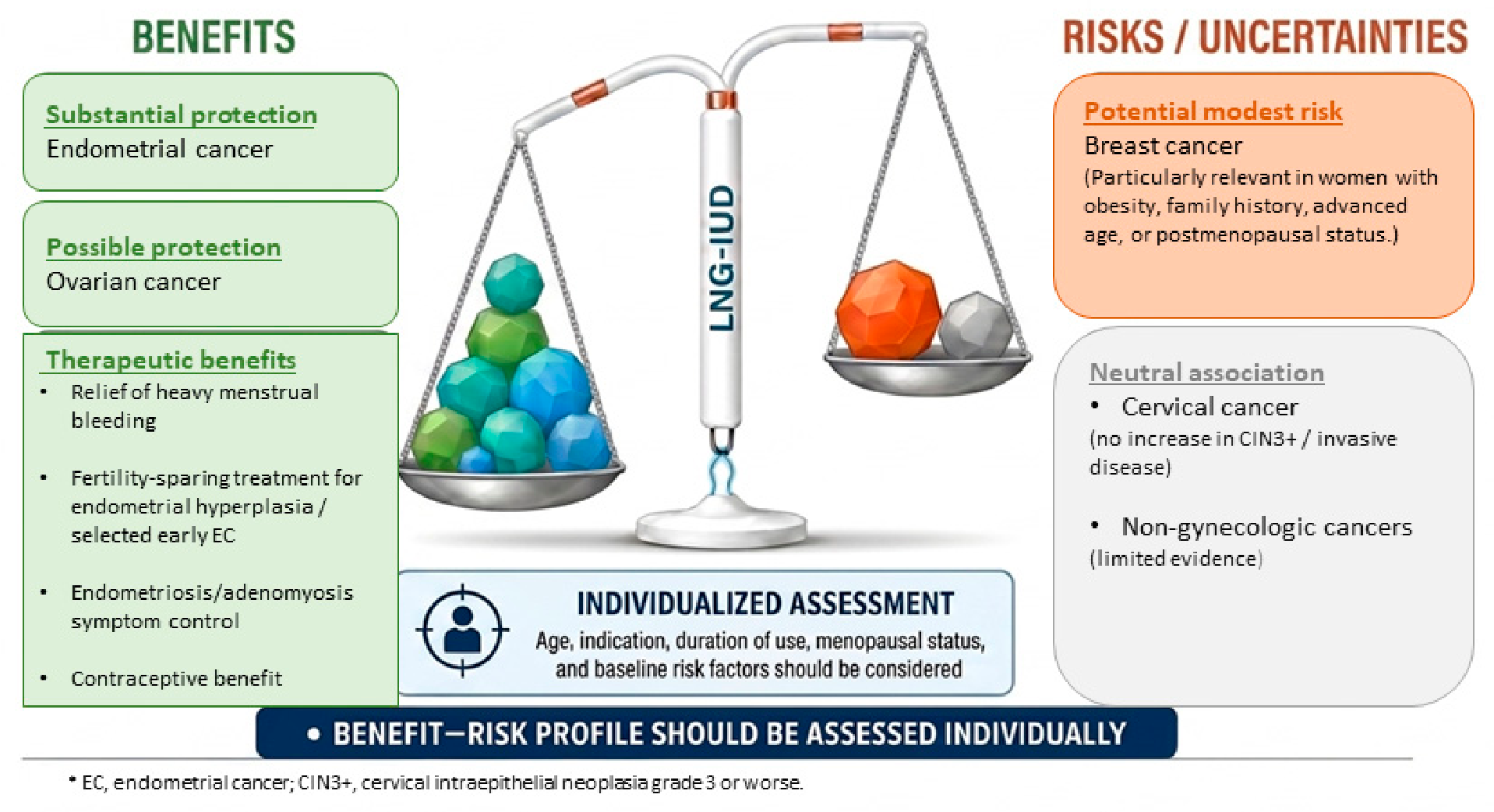
5. Advantages and Therapeutic Indications of Intrauterine Devices
6. Association Between Levonorgestrel-Releasing Intrauterine Device Use and Breast Cancer Risk
7. Association Between Levonorgestrel-Releasing Intrauterine Device Use and Cervical Cancer Risk
8. Association Between Levonorgestrel-Releasing Intrauterine Device Use and Ovarian Cancer Risk
9. Association Between Levonorgestrel-Releasing Intrauterine Device Use and Endometrial Cancer Risk
10. The Association Between Levonorgestrel-Releasing Intrauterine Device Use and Non-Gynaecologic Cancer Risk
11. Methodological Gaps in Current Epidemiological Data
12. Conclusions
Author Contributions
Funding
Institutional Review Board Statement
Informed Consent Statement
Data Availability Statement
Acknowledgments
Conflicts of Interest
Abbreviations
| BMI | Body Mass Index |
| CI | Confidence Interval |
| CIN2+ | Cervical Intraepithelial Neoplasia Grade 2 Or Higher |
| CIN3+ | Cervical Intraepithelial Neoplasia Grade 3 Or Higher |
| Cu-IUD | Copper Intrauterine Device |
| EC-Cvc | European Commission Initiative On Cervical Cancer |
| EPT | Estradiol-Progestin Therapy |
| ESGE | European Society For Gynaecological Endoscopy |
| ESGO | European Society Of Gynaecological Oncology |
| ESHRE | European Society Of Human Reproduction And Embryology |
| ESMO | European Society For Medical Oncology |
| Genai | Generative Artificial Intelligence |
| HPV | Human Papillomavirus |
| HR | Hazard Ratio |
| IUD | Intrauterine Device |
| LNG-IUD | Levonorgestrel-Releasing Intrauterine Device |
| LNG-IUS | Levonorgestrel-Releasing Intrauterine System |
| MEDLINE | Medical Literature Analysis And Retrieval System Online |
| NOWAC | Norwegian Women And Cancer Study |
| OR | Odds Ratio |
| RR | Relative Risk |
| SANRA | Scale For The Assessment Of Narrative Review Articles |
| SHBG | Sex Hormone-Binding Globulin |
| SIR | Standardised Incidence Ratio |
References
- Luukkainen, T.; Lähteenmäki, P.; Toivonen, J. Levonorgestrel-releasing intrauterine device. Ann. Med. 1990, 22, 85–90. [Google Scholar] [CrossRef] [PubMed]
- Bürger, Z.; Bucher, A.M.; Comasco, E.; Henes, M.; Hübner, S.; Kogler, L.; Derntl, B. Association of levonorgestrel intrauterine devices with stress reactivity, mental health, quality of life and sexual functioning: A systematic review. Front. Neuroendocrinol. 2021, 63, 100943. [Google Scholar] [CrossRef] [PubMed]
- Rodolakis, A.; Scambia, G.; Planchamp, F.; Acien, M.; Di Spiezio Sardo, A.; Farrugia, M.; Grynberg, M.; Pakiz, M.; Pavlakis, K.; Vermeulen, N.; et al. ESGO/ESHRE/ESGE Guidelines for the fertility-sparing treatment of patients with endometrial carcinoma. Int. J. Gynecol. Cancer 2023, 33, 208–222. [Google Scholar] [CrossRef] [PubMed]
- Soini, T.; Hurskainen, R.; Grénman, S.; Mäenpää, J.; Paavonen, J.; Joensuu, H.; Pukkala, E. Levonorgestrel-releasing intrauterine system and the risk of breast cancer: A nationwide cohort study. Acta Oncol. 2016, 55, 188–192. [Google Scholar] [CrossRef] [PubMed]
- Breast cancer and hormonal contraceptives: Collaborative reanalysis of individual data on 53,297 women with breast cancer and 100,239 women without breast cancer from 54 epidemiological studies. Lancet 1996, 347, 1713–1727. [CrossRef] [PubMed]
- Soini, T.; Hurskainen, R.; Grénman, S.; Mäenpää, J.; Paavonen, J.; Pukkala, E. Cancer risk in women using the levonorgestrel-releasing intrauterine system in Finland. Obstet. Gynecol. 2014, 124, 292–299. [Google Scholar] [CrossRef] [PubMed]
- Mørch, L.S.; Skovlund, C.W.; Hannaford, P.C.; Iversen, L.; Fielding, S.; Lidegaard, Ø. Contemporary Hormonal Contraception and the Risk of Breast Cancer. N. Engl. J. Med. 2017, 377, 2228–2239. [Google Scholar] [CrossRef] [PubMed]
- Wheeler, L.J.; Desanto, K.; Teal, S.B.; Sheeder, J.; Guntupalli, S.R. Intrauterine Device Use and Ovarian Cancer Risk: A Systematic Review and Meta-analysis. Obstet. Gynecol. 2019, 134, 791–800. [Google Scholar] [CrossRef] [PubMed]
- Jareid, M.; Thalabard, J.C.; Aarflot, M.; Bøvelstad, H.M.; Lund, E.; Braaten, T. Levonorgestrel-releasing intrauterine system use is associated with a decreased risk of ovarian and endometrial cancer, without increased risk of breast cancer. Results from the NOWAC Study. Gynecol. Oncol. 2018, 149, 127–132. [Google Scholar] [CrossRef] [PubMed]
- Baethge, C.; Goldbeck-Wood, S.; Mertens, S. SANRA-a scale for the quality assessment of narrative review articles. Res. Integr. Peer Rev. 2019, 4, 5. [Google Scholar] [CrossRef] [PubMed]
- Attia, A.M.; Ibrahim, M.M.; Abou-Setta, A.M. Role of the levonorgestrel intrauterine system in effective contraception. Patient Prefer. Adherence 2013, 7, 777–785. [Google Scholar] [CrossRef] [PubMed]
- Sitruk-Ware, R.; Nath, A.; Mishell, D.R., Jr. Contraception technology: Past, present and future. Contraception 2013, 87, 319–330. [Google Scholar] [CrossRef] [PubMed]
- Jia, M.C.; Zhou, L.Y.; Ren, S.; Dong, L.; Xiao, B. Serum SHBG levels during normal menstrual cycle and after insertion of levonorgestrel-releasing IUD. Adv. Contracept. 1992, 8, 33–40. [Google Scholar] [CrossRef] [PubMed]
- Louw-du Toit, R.; Hapgood, J.P.; Africander, D. A direct comparison of the transcriptional activities of progestins used in contraception and menopausal hormone therapy via the mineralocorticoid receptor. Biochem. Biophys. Res. Commun. 2020, 526, 466–471. [Google Scholar] [CrossRef] [PubMed]
- Depypere, H.T.; Stanczyk, F.Z.; Croubels, S.; Blondeel, P.N.; Roche, N.A.; Depypere, B.P.; Vanhaecke, L. Breast levonorgestrel concentrations in women using a levonorgestrel-releasing intrauterine system. Contraception 2019, 100, 299–301. [Google Scholar] [CrossRef] [PubMed]
- Shamseddin, M.; De Martino, F.; Constantin, C.; Scabia, V.; Lancelot, A.S.; Laszlo, C.; Ayyannan, A.; Battista, L.; Raffoul, W.; Gailloud-Matthieu, M.C.; et al. Contraceptive progestins with androgenic properties stimulate breast epithelial cell proliferation. EMBO Mol. Med. 2021, 13, e14314. [Google Scholar] [CrossRef] [PubMed]
- Lundström, E.; Virijevic, I.; Söderqvist, G. Progestogen addition with low-dose levonorgestrel intrauterine system in menopausal hormone treatment gives less normal breast tissue proliferation than oral norethisterone acetate or medroxyprogesterone acetate. Horm. Mol. Biol. Clin. Investig. 2020, 41, 20190051. [Google Scholar] [CrossRef] [PubMed]
- Minalt, N.; Caldwell, A.; Yedlicka, G.M.; Joseph, S.; Robertson, S.E.; Landrum, L.M.; Peipert, J.F. Association between intrauterine device use and endometrial, cervical, and ovarian cancer: An expert review. Am. J. Obstet. Gynecol. 2023, 229, 93–100. [Google Scholar] [CrossRef] [PubMed]
- Delvenne, P.; Herman, L.; Kholod, N.; Caberg, J.H.; Herfs, M.; Boniver, J.; Jacobs, N.; Hubert, P. Role of hormone cofactors in the human papillomavirus-induced carcinogenesis of the uterine cervix. Mol. Cell. Endocrinol. 2007, 264, 1–5. [Google Scholar] [CrossRef] [PubMed]
- Bahamondes, L.; Fernandes, A.; Monteiro, I.; Bahamondes, M.V. Long-acting reversible contraceptive (LARCs) methods. Best Pract. Res. Clin. Obstet. Gynaecol. 2020, 66, 28–40. [Google Scholar] [CrossRef] [PubMed]
- Fraser, I.S. Non-contraceptive health benefits of intrauterine hormonal systems. Contraception 2010, 82, 396–403. [Google Scholar] [CrossRef] [PubMed]
- Kaunitz, A.M.; Bissonnette, F.; Monteiro, I.; Lukkari-Lax, E.; Muysers, C.; Jensen, J.T. Levonorgestrel-releasing intrauterine system or medroxyprogesterone for heavy menstrual bleeding: A randomized controlled trial. Obstet. Gynecol. 2010, 116, 625–632. [Google Scholar] [CrossRef] [PubMed]
- Lethaby, A.; Hussain, M.; Rishworth, J.R.; Rees, M.C. Progesterone or progestogen-releasing intrauterine systems for heavy menstrual bleeding. Cochrane Database Syst. Rev. 2015, CD002126. [Google Scholar] [CrossRef] [PubMed]
- Lähteenmäki, P.; Haukkamaa, M.; Puolakka, J.; Riikonen, U.; Sainio, S.; Suvisaari, J.; Nilsson, C.G. Open randomised study of use of levonorgestrel releasing intrauterine system as alternative to hysterectomy. BMJ 1998, 316, 1122–1126. [Google Scholar] [CrossRef] [PubMed]
- Hurskainen, R.; Teperi, J.; Rissanen, P.; Aalto, A.M.; Grenman, S.; Kivelä, A.; Kujansuu, E.; Vuorma, S.; Yliskoski, M.; Paavonen, J. Quality of life and cost-effectiveness of levonorgestrel-releasing intrauterine system versus hysterectomy for treatment of menorrhagia: A randomised trial. Lancet 2001, 357, 273–277. [Google Scholar] [CrossRef] [PubMed]
- Adeyemi-Fowode, O.A.; Bercaw-Pratt, J.L. Intrauterine Devices: Effective Contraception with Noncontraceptive Benefits for Adolescents. J. Pediatr. Adolesc. Gynecol. 2019, 32, S2–S6. [Google Scholar] [CrossRef] [PubMed]
- Peuranpää, P.; Heliövaara-Peippo, S.; Fraser, I.; Paavonen, J.; Hurskainen, R. Effects of anemia and iron deficiency on quality of life in women with heavy menstrual bleeding. Acta Obstet. Gynecol. Scand. 2014, 93, 654–660. [Google Scholar] [CrossRef] [PubMed]
- Oliveira, J.A.; Eskandar, K.; Chagas, J.; do Nascimento, L.L.O.; Ribeiro, D.D.; Rocha, A.L.L.; de Oliveira, F.R. Heavy menstrual bleeding in women with inherited bleeding disorders in use of LNG-IUS: A systematic review and single-arm meta-analysis. Contraception 2024, 135, 110450. [Google Scholar] [CrossRef] [PubMed]
- Petta, C.A.; Ferriani, R.A.; Abrao, M.S.; Hassan, D.; Rosa, E.S.J.C.; Podgaec, S.; Bahamondes, L. Randomized clinical trial of a levonorgestrel-releasing intrauterine system and a depot GnRH analogue for the treatment of chronic pelvic pain in women with endometriosis. Hum. Reprod. 2005, 20, 1993–1998. [Google Scholar] [CrossRef] [PubMed]
- Vercellini, P.; Frontino, G.; De Giorgi, O.; Aimi, G.; Zaina, B.; Crosignani, P.G. Comparison of a levonorgestrel-releasing intrauterine device versus expectant management after conservative surgery for symptomatic endometriosis: A pilot study. Fertil. Steril. 2003, 80, 305–309. [Google Scholar] [CrossRef] [PubMed]
- Carvalho, N.; Margatho, D.; Cursino, K.; Benetti-Pinto, C.L.; Bahamondes, L. Control of endometriosis-associated pain with etonogestrel-releasing contraceptive implant and 52-mg levonorgestrel-releasing intrauterine system: Randomized clinical trial. Fertil. Steril. 2018, 110, 1129–1136. [Google Scholar] [CrossRef] [PubMed]
- Bahamondes, L.; Valeria Bahamondes, M.; Shulman, L.P. Non-contraceptive benefits of hormonal and intrauterine reversible contraceptive methods. Hum. Reprod. Update 2015, 21, 640–651. [Google Scholar] [CrossRef] [PubMed]
- Ji, F.; Yang, X.H.; Ai Xing Zi, A.L.; Ha Ni Ke Zi, T.X.; He, Y.; Ding, Y. Role of levonorgestrel-releasing intrauterine system in dysmenorrhea due to adenomyosis and the influence on ovarian function. Clin. Exp. Obstet. Gynecol. 2014, 41, 677–680. [Google Scholar] [CrossRef] [PubMed]
- Bounous, V.E.; Actis, S.; Rosso, R.; Giorgi, M.; Tiranini, L.; Nappi, R.E.; Biglia, N. No-daily hormonal contraception today: General overview and application in specific clinical settings. Gynecol. Endocrinol. 2023, 39, 2214626. [Google Scholar] [CrossRef] [PubMed]
- Heikkinen, S.; Koskenvuo, M.; Malila, N.; Sarkeala, T.; Pukkala, E.; Pitkäniemi, J. Use of exogenous hormones and the risk of breast cancer: Results from self-reported survey data with validity assessment. Cancer Causes Control 2016, 27, 249–258. [Google Scholar] [CrossRef] [PubMed]
- Conz, L.; Mota, B.S.; Bahamondes, L.; Teixeira Dória, M.; Françoise Mauricette Derchain, S.; Rieira, R.; Sarian, L.O. Levonorgestrel-releasing intrauterine system and breast cancer risk: A systematic review and meta-analysis. Acta Obstet. Gynecol. Scand. 2020, 99, 970–982. [Google Scholar] [CrossRef] [PubMed]
- Siegelmann-Danieli, N.; Katzir, I.; Landes, J.V.; Segal, Y.; Bachar, R.; Rabinovich, H.R.; Bialik, M.; Azuri, J.; Porath, A.; Lomnicky, Y. Does levonorgestrel-releasing intrauterine system increase breast cancer risk in peri-menopausal women? An HMO perspective. Breast Cancer Res. Treat. 2018, 167, 257–262. [Google Scholar] [CrossRef] [PubMed]
- Backman, T.; Rauramo, I.; Jaakkola, K.; Inki, P.; Vaahtera, K.; Launonen, A.; Koskenvuo, M. Use of the levonorgestrel-releasing intrauterine system and breast cancer. Obstet. Gynecol. 2005, 106, 813–817. [Google Scholar] [CrossRef] [PubMed]
- Dinger, J.; Bardenheuer, K.; Minh, T.D. Levonorgestrel-releasing and copper intrauterine devices and the risk of breast cancer. Contraception 2011, 83, 211–217. [Google Scholar] [CrossRef] [PubMed]
- Yi, H.; Zhang, N.; Huang, J.; Zheng, Y.; Hong, Q.H.; Sundquist, J.; Sundquist, K.; Zheng, X.; Ji, J. Association of levonorgestrel-releasing intrauterine device with gynecologic and breast cancers: A national cohort study in Sweden. Am. J. Obstet. Gynecol. 2024, 231, 450.E1–450.E12. [Google Scholar] [CrossRef] [PubMed]
- Castellsagué, X.; Díaz, M.; Vaccarella, S.; de Sanjosé, S.; Muñoz, N.; Herrero, R.; Franceschi, S.; Meijer, C.J.; Bosch, F.X. Intrauterine device use, cervical infection with human papillomavirus, and risk of cervical cancer: A pooled analysis of 26 epidemiological studies. Lancet Oncol. 2011, 12, 1023–1031. [Google Scholar] [CrossRef] [PubMed]
- Cortessis, V.K.; Barrett, M.; Brown Wade, N.; Enebish, T.; Perrigo, J.L.; Tobin, J.; Zhong, C.; Zink, J.; Isiaka, V.; Muderspach, L.I.; et al. Intrauterine Device Use and Cervical Cancer Risk: A Systematic Review and Meta-analysis. Obstet. Gynecol. 2017, 130, 1226–1236. [Google Scholar] [CrossRef] [PubMed]
- Averbach, S.; Silverberg, M.J.; Leyden, W.; Smith-McCune, K.; Raine-Bennett, T.; Sawaya, G.F. Recent intrauterine device use and the risk of precancerous cervical lesions and cervical cancer. Contraception 2018, 98, 130–134. [Google Scholar] [CrossRef] [PubMed]
- Curtis, K.M.; Marchbanks, P.A.; Peterson, H.B. Neoplasia with use of intrauterine devices. Contraception 2007, 75, S60–S69. [Google Scholar] [CrossRef] [PubMed]
- Frega, A.; Manzara, F.; Schimberni, M.; Guarino, A.; Catalano, A.; Bianchi, P.; Marziani, R.; Cozza, G.; Milazzo, G.N.; French, D.; et al. Human papilloma virus infection and cervical cytomorphological changing among intrauterine contraception users. Eur. Rev. Med. Pharmacol. Sci. 2016, 20, 3528–3534. [Google Scholar] [PubMed]
- Skorstengaard, M.; Lynge, E.; Napolitano, G.; Blaakær, J.; Bor, P. Risk of precancerous cervical lesions in women using a hormone-containing intrauterine device and other contraceptives: A register-based cohort study from Denmark. Hum. Reprod. 2021, 36, 1796–1807. [Google Scholar] [CrossRef] [PubMed]
- Iversen, L.; Fielding, S.; Lidegaard, O.; Hannaford, P.C. Contemporary hormonal contraception and cervical cancer in women of reproductive age. Int. J. Cancer 2021, 149, 769–777. [Google Scholar] [CrossRef] [PubMed]
- Jans, L.; Brynhildsen, J.; Cherif, E.; Tenerz, L.; Bergengren, L. Prevalence of high-risk HPV and cervical dysplasia in IUD users and controls: A cross sectional study. Eur. J. Contracept. Reprod. Health Care 2024, 29, 109–114. [Google Scholar] [CrossRef] [PubMed]
- Soini, T.; Hurskainen, R.; Grénman, S.; Mäenpää, J.; Paavonen, J.; Pukkala, E. Impact of levonorgestrel-releasing intrauterine system use on the cancer risk of the ovary and fallopian tube. Acta Oncol. 2016, 55, 1281–1284. [Google Scholar] [CrossRef] [PubMed]
- Iversen, L.; Fielding, S.; Lidegaard, Ø.; Mørch, L.S.; Skovlund, C.W.; Hannaford, P.C. Association between contemporary hormonal contraception and ovarian cancer in women of reproductive age in Denmark: Prospective, nationwide cohort study. BMJ 2018, 362, k3609. [Google Scholar] [CrossRef] [PubMed]
- Balayla, J.; Gil, Y.; Lasry, A.; Mitric, C. Ever-use of the intra-uterine device and the risk of ovarian cancer. J. Obstet. Gynaecol. 2021, 41, 848–853. [Google Scholar] [CrossRef] [PubMed]
- D’Alessandro, G.; Frigerio, M.; Barra, F.; Costantini, S.; Gustavino, C.; Ferrero, S. Systematic review and meta-analysis on the impact of the levonorgestrel-releasing intrauterine system in reducing risk of ovarian cancer. Int. J. Gynaecol. Obstet. 2022, 156, 418–424. [Google Scholar] [CrossRef] [PubMed]
- Koskela-Niska, V.; Pukkala, E.; Lyytinen, H.; Ylikorkala, O.; Dyba, T. Effect of various forms of postmenopausal hormone therapy on the risk of ovarian cancer--a population-based case control study from Finland. Int. J. Cancer 2013, 133, 1680–1688. [Google Scholar] [CrossRef] [PubMed]
- Koskela-Niska, V.; Pukkala, E.; Lyytinen, H.; Ylikorkala, O.; Dyba, T. Postmenopausal hormone therapy-also use of estradiol plus levonorgestrel-intrauterine system is associated with an increased risk of primary fallopian tube carcinoma. Int. J. Cancer 2015, 137, 1947–1952. [Google Scholar] [CrossRef] [PubMed]
- Jaakkola, S.; Lyytinen, H.K.; Dyba, T.; Ylikorkala, O.; Pukkala, E. Endometrial cancer associated with various forms of postmenopausal hormone therapy: A case control study. Int. J. Cancer 2011, 128, 1644–1651. [Google Scholar] [CrossRef] [PubMed]
- Mittermeier, T.; Farrant, C.; Wise, M.R. Levonorgestrel-releasing intrauterine system for endometrial hyperplasia. Cochrane Database Syst. Rev. 2020, 9, CD012658. [Google Scholar] [CrossRef] [PubMed]
- Wei, H.; Pan, N.; Zhang, W.; Xiong, G.; Guo, W.; Dong, Z.; Ma, C. Levonorgestrel-releasing intrauterine system-based therapies for early-stage endometrial cancer: A systematic review and meta-analysis. J. Gynecol. Oncol. 2023, 34, e36. [Google Scholar] [CrossRef] [PubMed]
- Dorjgochoo, T.; Shu, X.O.; Li, H.L.; Qian, H.Z.; Yang, G.; Cai, H.; Gao, Y.T.; Zheng, W. Use of oral contraceptives, intrauterine devices and tubal sterilization and cancer risk in a large prospective study, from 1996 to 2006. Int. J. Cancer 2009, 124, 2442–2449. [Google Scholar] [CrossRef] [PubMed]


| Author (References) | Study Population | Study Design | Method of Evaluation | Effect Estimate | Main Finding |
|---|---|---|---|---|---|
| Soini et al. [6] | Finnish registry cohort of LNG-IUD users treated for heavy menstrual bleeding; 93,843 LNG-IUD users | Nationwide registry-based cohort | LNG-IUD users compared with the general female population | SIR 1.19; (95% CI: 1.13–1.25); >5 years SIR 1.40; (95% CI: 1.24–1.57) | Modestly increased breast cancer incidence, particularly among long-term users. |
| Soini et al. [4] | Finnish LNG-IUD users aged 30–49 years; breast cancers identified before age 55 | Nationwide registry-based cohort; histology-specific analysis | Histology-specific breast cancer incidence compared with the general female population | Ductal carcinoma: SIR 1.20; (95% CI: 1.14–1.25). Lobular carcinoma: SIR 1.33; (95% CI: 1.20–1.46). Among women with ≥2 LNG-IUD purchases, lobular carcinoma SIR 1.73; (95% CI: 1.37–2.15) | Increased ductal and lobular breast cancer incidence; highest estimate for lobular carcinoma with repeated purchases. |
| Mørch et al. [7] | Danish nationwide cohort of women aged 15–49 years; approximately 1.8 million women and >20 million person-years | Nationwide prospective cohort | Current/recent hormonal contraception users versus never-users | Progestin-only intrauterine system: RR 1.21; (95% CI: 1.11–1.33) Absolute excess: 13 additional cases/100,000 person-years | Modest relative increase in breast cancer risk; absolute increase was small. |
| Heikkinen et al. [35] | Finnish population-based dataset including 13,265 breast cancer cases; analyses stratified by menopausal status | Population-based observational analysis | Breast cancer risk stratified by menopausal status | Postmenopausal: OR 1.48; (95% CI: 1.10–1.99); premenopausal: OR 0.77; (95% CI: 0.52–1.13) | Increased risk was observed among postmenopausal users, whereas no increased risk was found among premenopausal users. |
| Jareid et al./NOWAC [9] | Participants in the Norwegian Women and Cancer Study; 104,318 women, including 9144 LNG-IUD ever-users and 95,174 never-users; | Population-based prospective cohort | Multivariable-adjusted breast cancer risk among LNG-IUD users. Mean follow-up 12.5 years, contributing 1,305,435 person-years | Breast cancer incidence: 275.7 vs. 281.6 per 100,000 person-years among ever-users and never-users, respectively; multivariable-adjusted RR 1.03; 95% CI: 0.91–1.17 | LNG-IUD use was not associated with increased breast cancer risk after multivariable adjustment. |
| Siegelmann-Danieli et al. [37] | 13,354 LNG-IUD users aged 40–50 years and 27,324 age-matched controls | Retrospective cohort | Breast cancer incidence in LNG-IUD users versus age-matched controls | Overall not significantly increased; age 40–45 years: 0.88% vs. 0.69%; p = 0.014 | No overall increase was observed, although a small absolute difference was reported among women aged 40–45 years. |
| Backman et al. [38] | Finnish post-marketing cohort of LNG-IUD users aged 30–54 years | Post-marketing observational cohort | 100,000 woman-years among LNG-IUD users compared with the general Finnish female population across five-year age groups | Incidence rates per 100,000 woman-years for LNG-IUD users vs. general population: 30–34 years, 27.2 vs. 25.5; 35–39 years, 74.0 vs. 49.2; 40–44 years, 120.3 vs. 122.4; 45–49 years, 203.6 vs. 232.5; 50–54 years, 258.5 vs. 272.6 | Age-specific breast cancer incidence among LNG-IUD users was comparable to that of the general Finnish population, with no consistent increase across age groups. |
| Dinger et al. [39] | Finland and Germany; 5113 breast cancer cases and 20,452 matched controls | Retrospective population-based case–control study | Breast cancer risk among LNG-IUD users compared with copper IUD users | Ever-use of LNG-IUD vs. copper IUD: adjusted OR 0.99; (95% CI: 0.88–1.12). Current use at diagnosis: adjusted OR 0.85; (95% CI: 0.52–1.39) | LNG-IUD use was not associated increased breast cancer risk compared with copper IUD use. |
| Yi et al. [40] | Swedish nationwide register-based cohort of 514,719 LNG-IUD users aged 18–50 years, matched 1:3 with 1,544,157 non-users between July 2005 and December 2018 | Nationwide register-based cohort with propensity score matching | Breast cancer risk among LNG-IUD users, including stratified analyses by family history and menopausal status | Overall HR 1.13; (95% CI: 1.10–1.17); family history HR 2.07; (95% CI: 1.71–2.51); no family history HR 1.09; (95% CI: 1.04–1.15) | LNG-IUD use was associated with a modest increase in breast cancer risk, with higher estimates among women with a family history of breast cancer and among postmenopausal women. |
| Author (References) | Study Population | Study Design | Method of Evaluation | Effect Estimate | Main Finding |
|---|---|---|---|---|---|
| Castellsagué et al. [36] | 2205 women with cervical cancer, 2214 matched controls, and 15,272 healthy women from HPV prevalence surveys; pooled data from 26 epidemiological studies | Pooled analysis of case–control studies and HPV prevalence surveys | Ever-use of IUD versus never-use; adjusted for cervical HPV DNA, number of previous Pap smears, and other covariates | Cervical cancer: OR 0.55; 95% CI: 0.42–0.70; p < 0.0001. Squamous-cell carcinoma: OR 0.56; 95% CI: 0.43–0.72. Adenocarcinoma/adenosquamous carcinoma: OR 0.46; 95% CI: 0.22–0.97 | IUD use might act as a protective cofactor in cervical carcinogenesis. |
| Cortessis et al. [37] | Meta-analysis of 16 harmonised case–control and cohort studies; IUD type not distinguished in most included studies | Systematic review and meta-analysis | Point and interval estimates for IUD use and cervical cancer risk extracted from original reports and pooled | Random-effects pooled odds ratio for invasive cervical cancer among ever-IUD users versus never-users: OR 0.64 (95% CI, 0.53–0.77). | IUD use was associated with an approximately 36% lower risk of cervical cancer; invasive cervical cancer may be roughly one-third less frequent among ever-users. |
| Averbach et al. [38] | Kaiser Permanente Northern California; 17,559 women aged 18–49 with incident CIN2+ (including 1657 IUD users) and 87,378 age-matched controls (including 7925 IUD users), 1996–2014 | Case–control study | Recent IUD use within 18 months before the index date; LNG-IUD and copper IUD were evaluated separately for CIN2+, CIN3+, and cervical cancer | LNG-IUD: CIN2+ RR 1.18 (95% CI: 1.08–1.30), p < 0.001; CIN3+ RR 1.05 (95% CI: 0.91–1.21), p = 0.48. Copper IUD: CIN2+ RR 0.88 (95% CI: 0.75–1.04); CIN3+ RR 0.81 (95% CI: 0.64–1.02) | LNG-IUD use was associated with a modest increase in CIN2 (a lesion with a high regression rate) but not CIN3+ or cervical cancer; copper IUD use showed no association with either outcome. |
| Curtis et al. [39] | Literature review of studies published 1960–September 2006; four case–control studies evaluating cervical cancer risk in IUD users (device type largely unspecified/older devices) | Systematic literature review | Narrative synthesis of four case–control studies assessing IUD use and cervical cancer risk | All four studies reported similar or decreased risk; no pooled quantitative estimate reported | Intrauterine device use was not associated with an increased risk of cervical cancer. |
| Frega et al. [40] | 789 intrauterine contraception users, including 354 LNG-IUD users and 435 Cu-IUD users; additionally, 1491 non-users with abnormal Pap tests were evaluated as controls | Observational follow-up study | Serial cytology (Pap test), colposcopy, HPV-DNA and HPV-mRNA testing compared between current and ever-users of IUC, by device type and duration of use | No formal RR/OR for cervical cancer was reported. Among women with abnormal cytology, Pap-test severity decreased over time in both IUC users and non-users, with no significant group-by-time interaction (p = 0.763). Squamous cell carcinoma at last follow-up was observed in 0/105 IUC users versus 3/1491 non-users (p = 0.6455). | IUC use was not associated with persistence, progression, or increased severity of squamous intraepithelial lesions, and no increased occurrence of cervical carcinoma was observed. |
| Soini et al. [41] | Finnish registry cohort of LNG-IUD users treated for heavy menstrual bleeding; 93,843 LNG-IUD users | Nationwide registry-based cohort | Cervical cancer incidence among LNG-IUD users compared with the general Finnish female population (standardised incidence ratio) | SIR for cervical cancer: 0.90 (95% CI, 0.69–1.15) | No increased cervical cancer risk was observed among LNG-IUD users. |
| Skorstengaard et al. [42] | Danish population-based register cohort of women aged 26–50 years: 60,551 hormone-containing IUD (HIUD) users, 30,303 copper IUD users, and 165,627 oral contraceptive (OC) users, 2008–2011, with 5-year follow-up | Nationwide register-based cohort | Histology and cytology diagnoses were followed for 5 years after baseline; adjusted relative risks were calculated for CIN2 and CIN3+ among HIUD users compared with CIUD and OC users | For CIN3+ among women with normal cytology at baseline: HIUD vs. CIUD, aRR 1.08 (95% CI, 0.94–1.22); HIUD vs. OC, aRR 0.63 (95% CI, 0.57–0.69). | HIUD users had a similar risk of CIN3+ compared with CIUD users and a lower risk compared with OC users. No signal of increased high-grade cervical precancer risk was observed for hormone-containing IUDs. |
| Iversen et al. [43] | Danish women aged 15–49 years followed from 1995 to 2014; study population contributed more than 20 million person-years | Nationwide prospective cohort | Cervical cancer risk among users of contemporary hormonal contraception, including LNG-IUD users, compared with women who had never used hormonal contraception | RR for cervical cancer among LNG-IUD users versus never-users of hormonal contraception: 0.76 (95% CI, 0.52–1.11). | LNG-IUD use was not associated with an increased risk of cervical cancer. |
| Jans et al. [44] | Swedish cross-sectional study; 16,181 women aged 30–49 years (297 CIN2+ cases) | Cross-sectional study | Age-adjusted odds ratios for HPV positivity and histological HSIL+ (CIN2+), comparing LNG-IUD, copper-IUD, and hormonal contraceptive users with non-users | LNG-IUD use was associated with higher odds of hrHPV infection, aOR 1.21 (95% CI, 1.04–1.41), and histological HSIL+, aOR 1.45 (95% CI, 1.02–2.06), in age-adjusted models. No significant difference was observed in HPV clearance rates. | LNG-IUD use was associated with higher prevalence of hrHPV infection and histological HSIL+ in this cross-sectional screening cohort. However, the study did not separately evaluate CIN3+ or invasive cervical cancer. |
| Author (References) | Study Population | Study Design | Method of Evaluation | Effect Estimate | Main Finding |
|---|---|---|---|---|---|
| Soini et al. [6] | Finnish nationwide cohort of LNG-IUD users; 93,843 women and 855,324 person-years | Nationwide registry-based cohort | Ovarian cancer incidence among LNG-IUD users compared with the general female population | Standardised incidence ratio for ovarian cancer among LNG-IUD users versus the general Finnish female population: SIR 0.60 (95% CI, 0.45–0.76). | LNG-IUD use was associated with a reduced incidence of ovarian cancer. |
| Jareid et al./NOWAC [9] | Norwegian Women and Cancer Study; 104,380 pre- and postmenopausal women, including 9146 LNG-IUD users; 1,305,435 person-years | Population-based prospective cohort | Observed ovarian cancer incidence among LNG-IUD users was compared with expected incidence in the general Finnish female population using standardised incidence ratios | Ovarian cancer incidence: 16.7 vs. 38.1 per 100,000 person-years among LNG-IUD users and non-users, respectively. Age-adjusted RR 0.49 (95% CI, 0.30–0.82); multivariable-adjusted RR 0.53 (95% CI, 0.32–0.88). | LNG-IUD use was associated with a significantly lower ovarian cancer risk. However, duration-response assessment was limited by the small number of ovarian cancer cases among users. |
| Soini et al. [45] | Finnish registry cohort; approximately 1,000,000 person-years, histology-specific analysis | Nationwide registry-based cohort; histology-specific analysis | Ovarian and primary fallopian tube cancer incidence among LNG-IUD users compared with the general population | Invasive ovarian cancer: SIR 0.59 (95% CI, 0.47–0.73); borderline tumours: SIR 0.76 (95% CI, 0.57–0.99); mucinous: SIR 0.49 (95% CI, 0.24–0.87); endometrioid: SIR 0.55 (95% CI, 0.28–0.98); serous: SIR 0.75 (95% CI, 0.55–0.99); primary fallopian tube carcinoma: SIR 1.22 (95% CI, 0.49–2.50). | LNG-IUD use was associated with reduced ovarian cancer incidence across several histological subtypes, particularly mucinous and serous carcinomas. No significant reduction was observed for fallopian tube cancer. |
| Iversen et al. [46] | Danish nationwide cohort of 1.9 million women; 21 million person-years; 1249 ovarian cancer cases | Nationwide prospective cohort | Ovarian cancer risk among users of contemporary hormonal contraception, including progestogen-only LNG-IUD | No significant ovarian cancer risk reduction was observed among users of progestogen-only products, including LNG-IUDs. | Combined hormonal contraception was associated with reduced ovarian cancer risk, whereas progestogen-only methods, including LNG-IUDs, did not show a significant protective association. |
| Balayla et al. [47] | Meta-analysis pooling multiple observational studies of IUD ever-users (all device types, with a levonorgestrel-specific subgroup analysis) | Systematic review and meta-analysis | Pooled odds ratio for ovarian cancer, ever-use vs. never-use of any IUD, with a pre-specified LNG-IUD subgroup analysis | All intrauterine devices: OR 0.67 (95% CI: 0.60–0.74), p < 0.0006; LNG-IUD subgroup: SIR 0.58 (95% CI: 0.47–0.71) | Intrauterine device use, including LNG-IUD, was associated with a protective effect against ovarian cancer. |
| D’Alessandro et al. [48] | Meta-analysis of 3 studies meeting inclusion criteria (from 34,323 records screened); 1687 ovarian cancer events across 20,461,311 person-years | Systematic review and meta-analysis | Pooled odds ratio for ovarian cancer risk among LNG-IUD users vs. never-users | Random-effects pooled odds ratio for ovarian cancer among LNG-IUD users versus non-users: OR 0.66 (95% CI, 0.41–1.08). | The LNG-IUD-specific pooled estimate suggested a possible reduction in ovarian cancer risk, but the association was not statistically significant. |
| Koskela-Niska et al. [49] | 3958 ovarian cancer cases and 11,325 age-matched controls from Finland | Population-based case–control study | Association between postmenopausal hormone therapy regimens, including oestradiol plus LNG-IUD, and ovarian cancer risk | Oestradiol plus LNG-IUD: OR 1.02 (95% CI, 0.63–1.66). | Oestradiol plus LNG-IUD was not associated with ovarian cancer risk. This evidence relates to postmenopausal hormone therapy rather than contraceptive LNG-IUD use. |
| Koskela-Niska et al. [50] | Finnish case–control study; 360 primary fallopian tube carcinoma cases and 3442 age-matched controls | Population-based case–control study | Association between LNG-IUD use and primary fallopian tube carcinoma risk, including duration of use | LNG-IUD use for >5 years: OR 2.84 (95% CI, 1.10–7.38), p = 0.032. | Long-term LNG-IUD use was associated with increased primary fallopian tube carcinoma risk. However, the number of exposed cases was limited, and statistical power was low. |
| Cancer Type | Observed Cases | Expected Cases | SIR (95% CI) | Interpretation |
|---|---|---|---|---|
| Corpus uteri (all types) | 56 | 94.3 | 0.59 (0.45–0.77) | Decreased risk |
| Endometrial Adenocarcinoma | 37 | 79.6 | 0.46 (0.33–0.64) | Decreased risk |
| Uterine Sarcomas | 18 | 12.5 | 1.44 (0.86–2.28) | NS * |
| Ovarian Cancer | 59 | 98.9 | 0.60 (0.45–0.76) | Decreased risk |
| Breast Cancer | 1542 | 1292.2 | 1.19 (1.13–1.25) | Increased risk |
| Cervical Cancer | 60 | 66.8 | 0.90 (0.69–1.15) | NS |
| Pancreatic Cancer | 15 | 30.3 | 0.50 (0.28–0.81) | Decreased risk |
| Lung Cancer | 43 | 63.0 | 0.68 (0.49–0.91) | Decreased risk |
| Colorectal Cancer | 154 | 131.4 | 1.17 (0.99–1.36) | NS |
| Gastric Cancer | 45 | 40.9 | 1.10 (0.80–1.47) | NS |
| Liver Cancer | 6 | 8.7 | 0.69 (0.25–1.50) | NS |
| Gallbladder and Biliary Tract | 7 | 7.9 | 0.88 (0.35–1.81) | NS |
| Skin Melanoma | 129 | 119.5 | 1.08 (0.90–1.27) | NS |
| Kidney Cancer | 40 | 41.0 | 0.98 (0.70–1.32) | NS |
| Bladder, Ureter, Urethra | 12 | 12.3 | 0.98 (0.51–1.70) | NS |
| Brain and Nervous System | 175 | 168.3 | 1.04 (0.89–1.19) | NS |
| Thyroid Cancer | 138 | 126.1 | 1.09 (0.92–1.28) | NS |
| Non-Hodgkin Lymphoma | 81 | 75.8 | 1.07 (0.85–1.32) | NS |
| Hodgkin Lymphoma | 13 | 10.9 | 1.19 (0.63–2.03) | NS |
| Multiple Myeloma | 11 | 11.7 | 0.94 (0.47–1.68) | NS |
| Leukaemia | 34 | 36.6 | 0.93 (0.64–1.29) | NS |
Disclaimer/Publisher’s Note: The statements, opinions and data contained in all publications are solely those of the individual author(s) and contributor(s) and not of MDPI and/or the editor(s). MDPI and/or the editor(s) disclaim responsibility for any injury to people or property resulting from any ideas, methods, instructions or products referred to in the content. |
© 2026 by the authors. Licensee MDPI, Basel, Switzerland. This article is an open access article distributed under the terms and conditions of the Creative Commons Attribution (CC BY) license.
Share and Cite
Akgör, U.; Temiz, B.E.; Ege, H.V.; Ellis, L.B.; Bowden, S.; Kyrgiou, M.; Arbyn, M.; Preti, M.; Chatzistamatiou, K.; Razumova, Z.; et al. Cancer Risk Profile of the Levonorgestrel-Releasing Intrauterine Device: A Narrative Review. Cancers 2026, 18, 2374. https://doi.org/10.3390/cancers18152374
Akgör U, Temiz BE, Ege HV, Ellis LB, Bowden S, Kyrgiou M, Arbyn M, Preti M, Chatzistamatiou K, Razumova Z, et al. Cancer Risk Profile of the Levonorgestrel-Releasing Intrauterine Device: A Narrative Review. Cancers. 2026; 18(15):2374. https://doi.org/10.3390/cancers18152374
Chicago/Turabian StyleAkgör, Utku, Bilal Esat Temiz, Hasan Volkan Ege, Laura Burney Ellis, Sarah Bowden, Maria Kyrgiou, Marc Arbyn, Mario Preti, Kimon Chatzistamatiou, Zoia Razumova, and et al. 2026. "Cancer Risk Profile of the Levonorgestrel-Releasing Intrauterine Device: A Narrative Review" Cancers 18, no. 15: 2374. https://doi.org/10.3390/cancers18152374
APA StyleAkgör, U., Temiz, B. E., Ege, H. V., Ellis, L. B., Bowden, S., Kyrgiou, M., Arbyn, M., Preti, M., Chatzistamatiou, K., Razumova, Z., Kesic, V., Bizzarri, N., Gassama, O., Hemida, R., Ibraheem, N., El Hajj, H., Raina, D., Collinet, P., Krämer, B., & Gultekin, M. (2026). Cancer Risk Profile of the Levonorgestrel-Releasing Intrauterine Device: A Narrative Review. Cancers, 18(15), 2374. https://doi.org/10.3390/cancers18152374