Immunotherapy-Based Conversion to Curative-Intent Treatment in Hepatocellular Carcinoma: A Multidisciplinary Framework


Simple Summary
Abstract
1. Introduction
2. Terminology and Regional Paradigms in Curative-Intent Transition
2.1. Conversion, Downstaging, Bridging, and Neoadjuvant Therapy
2.2. Western Transplant-Anchored Paradigm
2.3. Asian Resection-Anchored Paradigm
2.4. Need for a Shared Multidisciplinary Lexicon
3. Current Evidence for Immunotherapy-Based Conversion Strategies
3.1. TACE-Unsuitable Intermediate-Stage HCC
3.2. Macrovascular Invasion and Portal Vein Tumor Thrombus
3.3. Borderline-Resectable or Locally Advanced HCC
3.4. Transplant Downstaging and Bridging
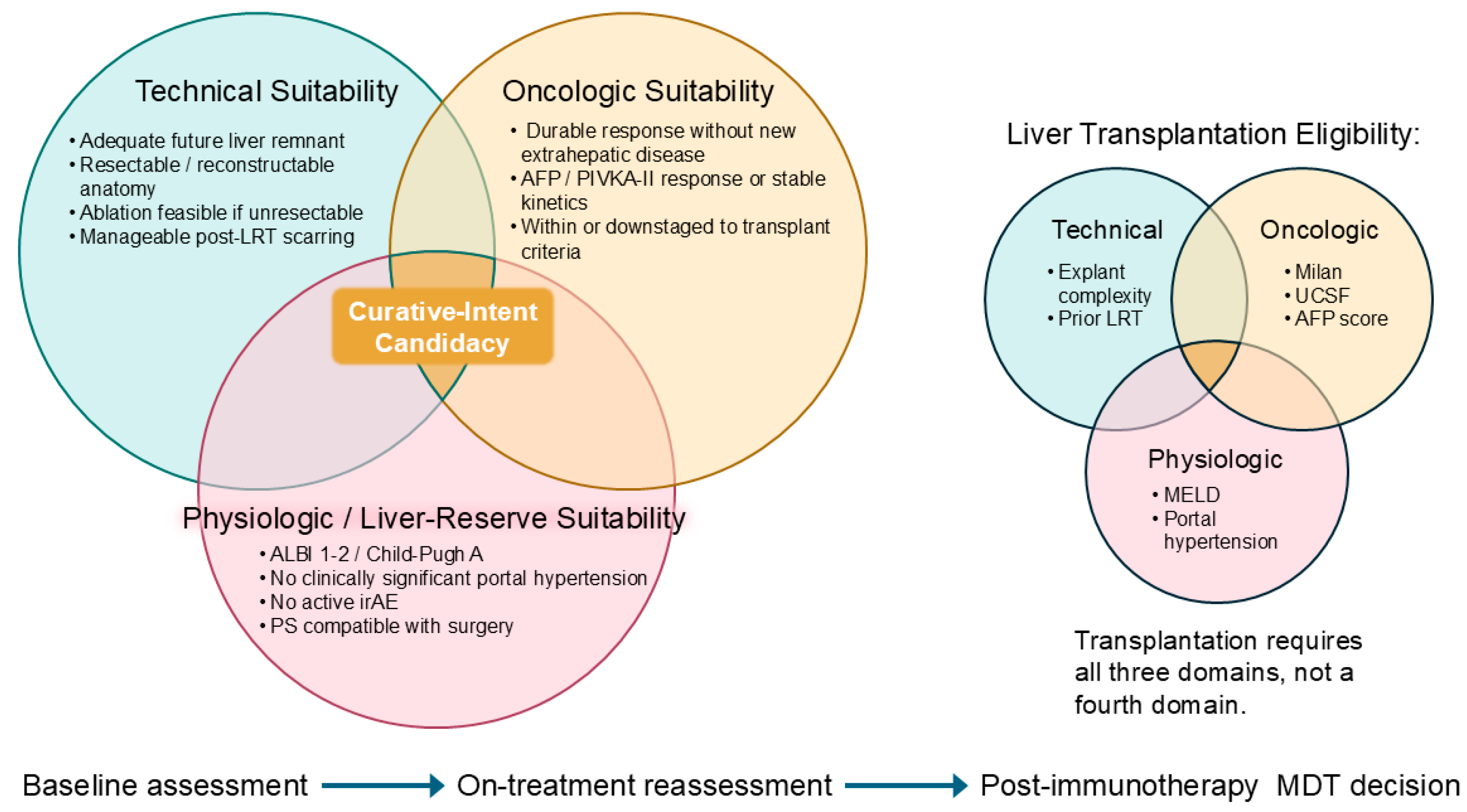
4. Defining Curative-Intent Candidacy After Immunotherapy
4.1. Rationale for a Three-Domain Candidacy Framework
4.2. Technical Suitability
4.3. Oncologic Suitability
4.4. Physiologic and Liver-Reserve Suitability
4.5. Liver Transplantation Within the Three-Domain Framework
5. Biomarkers for Conversion Candidacy Rather Than Response Alone
5.1. Tumor-Marker Kinetics
5.2. Imaging and Radiologic–Pathologic Discordance
5.3. Molecular and Immune Biomarkers
5.4. Physiologic Biomarkers of Surgical Tolerance
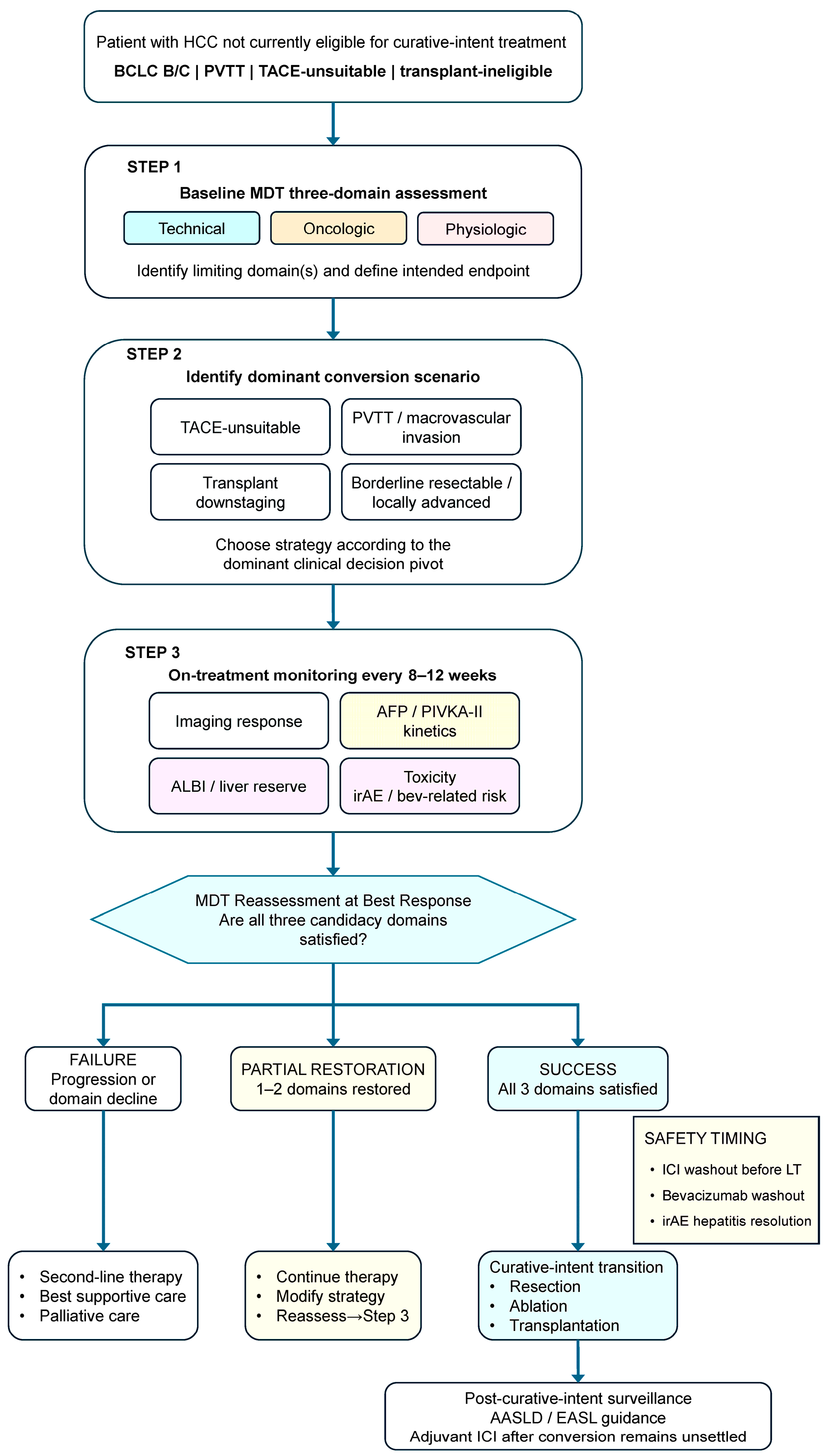
6. Multidisciplinary Workflow for Curative-Intent Transition
6.1. Baseline Multidisciplinary Team Assessment
6.2. On-Treatment Reassessment
6.3. Timing and Safety of Curative-Intent Treatment
6.4. Curative-Intent Endpoints and Post-Treatment Surveillance
7. Comparative Lessons from Gastrointestinal Oncology
7.1. Pancreatic Borderline Resectability
7.2. Biliary Tract Cancer and Intrahepatic Cholangiocarcinoma
7.3. Colorectal Liver Metastases
7.4. What HCC Can Adapt—And What It Cannot
8. Conclusions and Future Directions
Supplementary Materials
Author Contributions
Funding
Data Availability Statement
Acknowledgments
Conflicts of Interest
Abbreviations
| AFP | Alpha-fetoprotein |
| ALBI | Albumin-bilirubin |
| BCLC | Barcelona Clinic Liver Cancer |
| CRLM | Colorectal liver metastases |
| HAIC | Hepatic arterial infusion chemotherapy |
| HCC | Hepatocellular carcinoma |
| ICI | Immune checkpoint inhibitor |
| irAE | Immune-related adverse event |
| LI-RADS TR | Liver Imaging Reporting and Data System Treatment Response |
| MELD | Model for End-Stage Liver Disease |
| mRECIST | Modified Response Evaluation Criteria in Solid Tumors |
| PIVKA-II | Protein induced by vitamin K absence or antagonist-II |
| PVTT | Portal vein tumor thrombus |
| RETREAT | Risk Estimation of Tumor Recurrence After Transplant score |
| R0 | Margin-negative resection |
| SBRT | Stereotactic body radiotherapy |
| TACE | Transarterial chemoembolization |
| UCSF | University of California San Francisco |
| UNOS | United Network for Organ Sharing |
| Vp3/Vp4 | Portal vein invasion class 3/4 |
References
- Bray, F.; Laversanne, M.; Sung, H.; Ferlay, J.; Siegel, R.L.; Soerjomataram, I.; Jemal, A. Global Cancer Statistics 2022: GLOBOCAN Estimates of Incidence and Mortality Worldwide for 36 Cancers in 185 Countries. CA Cancer J. Clin. 2024, 74, 229–263. [Google Scholar] [CrossRef] [PubMed]
- Singal, A.G.; Kanwal, F.; Llovet, J.M. Global Trends in Hepatocellular Carcinoma Epidemiology: Implications for Screening, Prevention and Therapy. Nat. Rev. Clin. Oncol. 2023, 20, 864–884. [Google Scholar] [CrossRef] [PubMed]
- Llovet, J.M.; Ricci, S.; Mazzaferro, V.; Hilgard, P.; Gane, E.; Blanc, J.-F.; de Oliveira, A.C.; Santoro, A.; Raoul, J.-L.; Forner, A.; et al. Sorafenib in Advanced Hepatocellular Carcinoma. N. Engl. J. Med. 2008, 359, 378–390. [Google Scholar] [CrossRef] [PubMed]
- Kudo, M.; Finn, R.S.; Qin, S.; Han, K.-H.; Ikeda, K.; Piscaglia, F.; Baron, A.; Park, J.-W.; Han, G.; Jassem, J.; et al. Lenvatinib versus Sorafenib in First-Line Treatment of Patients with Unresectable Hepatocellular Carcinoma: A Randomised Phase 3 Non-Inferiority Trial. Lancet 2018, 391, 1163–1173. [Google Scholar] [CrossRef] [PubMed]
- Facciorusso, A.; Abd El Aziz, M.A.; Sacco, R. Efficacy of Regorafenib in Hepatocellular Carcinoma Patients: A Systematic Review and Meta-Analysis. Cancers 2019, 12, 36. [Google Scholar] [CrossRef] [PubMed]
- Abd El Aziz, M.A.; Facciorusso, A.; Nayfeh, T.; Saadi, S.; Elnaggar, M.; Cotsoglou, C.; Sacco, R. Immune Checkpoint Inhibitors for Unresectable Hepatocellular Carcinoma. Vaccines 2020, 8, 616. [Google Scholar] [CrossRef] [PubMed]
- Finn, R.S.; Qin, S.; Ikeda, M.; Galle, P.R.; Ducreux, M.; Kim, T.-Y.; Kudo, M.; Breder, V.; Merle, P.; Kaseb, A.O.; et al. Atezolizumab plus Bevacizumab in Unresectable Hepatocellular Carcinoma. N. Engl. J. Med. 2020, 382, 1894–1905. [Google Scholar] [CrossRef] [PubMed]
- Abou-Alfa, G.K.; Lau, G.; Kudo, M.; Chan, S.L.; Kelley, R.K.; Furuse, J.; Sukeepaisarnjaroen, W.; Kang, Y.-K.; Van Dao, T.; De Toni, E.N.; et al. Tremelimumab plus Durvalumab in Unresectable Hepatocellular Carcinoma. N. Engl. J. Med. Evid. 2022, 1, EVIDoa2100070. [Google Scholar] [CrossRef] [PubMed]
- Yau, T.; Galle, P.R.; Decaens, T.; Sangro, B.; Qin, S.; da Fonseca, L.G.; Karachiwala, H.; Blanc, J.-F.; Park, J.-W.; Gane, E.; et al. Nivolumab plus Ipilimumab versus Lenvatinib or Sorafenib as First-Line Treatment for Unresectable Hepatocellular Carcinoma (CheckMate 9DW): An Open-Label, Randomised, Phase 3 Trial. Lancet 2025, 405, 1851–1864. [Google Scholar] [CrossRef] [PubMed]
- Qin, S.; Gu, S.; Chan, S.L.; Bai, Y.; Ren, Z.; Lin, X.; Chen, Z.; Jia, W.; Jin, Y.; Guo, Y.; et al. Camrelizumab plus Rivoceranib versus Sorafenib as First-Line Therapy for Unresectable Hepatocellular Carcinoma (CARES-310): Final Analysis of a Randomised, Open-Label, International, Phase 3 Study. Lancet Oncol. 2025, 26, 1598–1611. [Google Scholar] [CrossRef] [PubMed]
- Llovet, J.M.; Kudo, M.; Merle, P.; Meyer, T.; Qin, S.; Ikeda, M.; Xu, R.; Edeline, J.; Ryoo, B.-Y.; Ren, Z.; et al. Lenvatinib plus Pembrolizumab versus Lenvatinib plus Placebo for Advanced Hepatocellular Carcinoma (LEAP-002): A Randomised, Double-Blind, Phase 3 Trial. Lancet Oncol. 2023, 24, 1399–1410, Erratum in Lancet Oncol. 2024, 25, e137. https://doi.org/10.1016/S1470-2045(24)00078-0. [Google Scholar] [CrossRef] [PubMed]
- Yau, T.; Kaseb, A.; Cheng, A.-L.; Qin, S.; Zhu, A.X.; Chan, S.L.; Melkadze, T.; Sukeepaisarnjaroen, W.; Breder, V.; Verset, G.; et al. Cabozantinib plus Atezolizumab versus Sorafenib for Advanced Hepatocellular Carcinoma (COSMIC-312): Final Results of a Randomised Phase 3 Study. Lancet Gastroenterol. Hepatol. 2024, 9, 310–322. [Google Scholar] [CrossRef] [PubMed]
- Sangro, B.; Kudo, M.; Erinjeri, J.P.; Qin, S.; Ren, Z.; Chan, S.L.; Arai, Y.; Heo, J.; Mai, A.; Escobar, J.; et al. Durvalumab with or without Bevacizumab with Transarterial Chemoembolisation in Hepatocellular Carcinoma (EMERALD-1): A Multiregional, Randomised, Double-Blind, Placebo-Controlled, Phase 3 Study. Lancet 2025, 405, 216–232. [Google Scholar] [CrossRef] [PubMed]
- Kudo, M.; Ren, Z.; Guo, Y.; Han, G.; Lin, H.; Zheng, J.; Ogasawara, S.; Kim, J.H.; Zhao, H.; Li, C.; et al. Transarterial Chemoembolisation Combined with Lenvatinib plus Pembrolizumab versus Dual Placebo for Unresectable, Non-Metastatic Hepatocellular Carcinoma (LEAP-012): A Multicentre, Randomised, Double-Blind, Phase 3 Study. Lancet 2025, 405, 203–215, Erratum in Lancet 2025, 405, 468. https://doi.org/10.1016/S0140-6736(25)00205-3. [Google Scholar] [CrossRef] [PubMed]
- Llovet, J.M.; Castet, F.; Heikenwalder, M.; Maini, M.K.; Mazzaferro, V.; Pinato, D.J.; Pikarsky, E.; Zhu, A.X.; Finn, R.S. Immunotherapies for Hepatocellular Carcinoma. Nat. Rev. Clin. Oncol. 2022, 19, 151–172. [Google Scholar] [CrossRef] [PubMed]
- Sun, H.-C.; Zhou, J.; Wang, Z.; Liu, X.; Xie, Q.; Jia, W.; Zhao, M.; Bi, X.; Li, G.; Bai, X.; et al. Chinese Expert Consensus on Conversion Therapy for Hepatocellular Carcinoma (2021 Edition). Hepatobiliary Surg. Nutr. 2022, 11, 227–252. [Google Scholar] [CrossRef] [PubMed]
- Bi, X.; Zhao, H.; Zhao, H.; Li, G.; Wang, X.; Chen, B.; Zhang, W.; Che, X.; Huang, Z.; Han, Y.; et al. Consensus of Chinese Experts on Neoadjuvant and Conversion Therapies for Hepatocellular Carcinoma: 2023 Update. Liver Cancer 2025, 14, 223–238. [Google Scholar] [CrossRef] [PubMed]
- Tang, H.; Zhang, W.; Cao, J.; Cao, Y.; Bi, X.; Zhao, H.; Zhang, Z.; Liu, Z.; Wan, T.; Lang, R.; et al. Chinese Expert Consensus on Sequential Surgery Following Conversion Therapy Based on Combination of Immune Checkpoint Inhibitors and Antiangiogenic Targeted Drugs for Advanced Hepatocellular Carcinoma (2024 Edition). Biosci. Trends 2025, 18, 505–524. [Google Scholar] [CrossRef] [PubMed]
- Singal, A.G.; Llovet, J.M.; Yarchoan, M.; Mehta, N.; Heimbach, J.K.; Dawson, L.A.; Jou, J.H.; Kulik, L.M.; Agopian, V.G.; Marrero, J.A.; et al. AASLD Practice Guidance on Prevention, Diagnosis, and Treatment of Hepatocellular Carcinoma. Hepatology 2023, 78, 1922–1965. [Google Scholar] [CrossRef] [PubMed]
- Yao, F.Y.; Ferrell, L.; Bass, N.M.; Watson, J.J.; Bacchetti, P.; Venook, A.; Ascher, N.L.; Roberts, J.P. Liver Transplantation for Hepatocellular Carcinoma: Expansion of the Tumor Size Limits Does Not Adversely Impact Survival. Hepatology 2001, 33, 1394–1403. [Google Scholar] [CrossRef] [PubMed]
- Mehta, N.; Heimbach, J.; Harnois, D.M.; Sapisochin, G.; Dodge, J.L.; Lee, D.; Burns, J.M.; Sanchez, W.; Greig, P.D.; Grant, D.R.; et al. Validation of a Risk Estimation of Tumor Recurrence After Transplant (RETREAT) Score for Hepatocellular Carcinoma Recurrence After Liver Transplant. JAMA Oncol. 2017, 3, 493–500. [Google Scholar] [CrossRef] [PubMed]
- Duvoux, C.; Roudot-Thoraval, F.; Decaens, T.; Pessione, F.; Badran, H.; Piardi, T.; Francoz, C.; Compagnon, P.; Vanlemmens, C.; Dumortier, J.; et al. Liver Transplantation for Hepatocellular Carcinoma: A Model Including α-Fetoprotein Improves the Performance of Milan Criteria. Gastroenterology 2012, 143, 986–994.e3; quiz e14–15. [Google Scholar] [CrossRef] [PubMed]
- Tabrizian, P.; Holzner, M.L.; Ajmera, V.; Kim, A.K.; Zhou, K.; Schnickel, G.T.; Torosian, K.; Hoteit, M.; Marino, R.; Li, M.; et al. Intention-to-Treat Outcomes of Patients with Hepatocellular Carcinoma Receiving Immunotherapy before Liver Transplant: The Multicenter VITALITY Study. J. Hepatol. 2025, 82, 512–522. [Google Scholar] [CrossRef] [PubMed]
- Ho, W.J.; Zhu, Q.; Durham, J.; Popovic, A.; Xavier, S.; Leatherman, J.; Mohan, A.; Mo, G.; Zhang, S.; Gross, N.; et al. Neoadjuvant Cabozantinib and Nivolumab Converts Locally Advanced HCC into Resectable Disease with Enhanced Antitumor Immunity. Nat. Cancer 2021, 2, 891–903. [Google Scholar] [CrossRef] [PubMed]
- Kaseb, A.O.; Hasanov, E.; Cao, H.S.T.; Xiao, L.; Vauthey, J.-N.; Lee, S.S.; Yavuz, B.G.; Mohamed, Y.I.; Qayyum, A.; Jindal, S.; et al. Perioperative Nivolumab Monotherapy versus Nivolumab plus Ipilimumab in Resectable Hepatocellular Carcinoma: A Randomised, Open-Label, Phase 2 Trial. Lancet Gastroenterol. Hepatol. 2022, 7, 208–218. [Google Scholar] [CrossRef] [PubMed]
- Marron, T.U.; Fiel, M.I.; Hamon, P.; Fiaschi, N.; Kim, E.; Ward, S.C.; Zhao, Z.; Kim, J.; Kennedy, P.; Gunasekaran, G.; et al. Neoadjuvant Cemiplimab for Resectable Hepatocellular Carcinoma: A Single-Arm, Open-Label, Phase 2 Trial. Lancet Gastroenterol. Hepatol. 2022, 7, 219–229. [Google Scholar] [CrossRef] [PubMed]
- Llovet, J.M.; Pinyol, R.; Yarchoan, M.; Singal, A.G.; Marron, T.U.; Schwartz, M.; Pikarsky, E.; Kudo, M.; Finn, R.S. Adjuvant and Neoadjuvant Immunotherapies in Hepatocellular Carcinoma. Nat. Rev. Clin. Oncol. 2024, 21, 294–311. [Google Scholar] [CrossRef] [PubMed]
- Moeckli, B.; Wassmer, C.-H.; El Hajji, S.; Kumar, R.; Rodrigues Ribeiro, J.; Tabrizian, P.; Feng, H.; Schnickel, G.; Kulkarni, A.V.; Allaire, M.; et al. Determining Safe Washout Period for Immune Checkpoint Inhibitors Prior to Liver Transplantation: An International Retrospective Cohort Study. Hepatology 2025, 82, 1122–1137. [Google Scholar] [CrossRef] [PubMed]
- Aceituno, L.; Magyar, C.; Tabrizian, P.; Marino, R.; Watt, K.; Chascsa, D.; Schnickel, G.; Banz, V.; Alconchel, F.; Martagon, C.; et al. Safety of Immune Checkpoint Inhibitors Prior to Liver Transplantation in Hepatocellular Carcinoma. Aliment. Pharmacol. Ther. 2026, 63, 1369–1379. [Google Scholar] [CrossRef] [PubMed]
- Kudo, M.; Aoki, T.; Ueshima, K.; Tsuchiya, K.; Morita, M.; Chishina, H.; Takita, M.; Hagiwara, S.; Minami, Y.; Ida, H.; et al. Achievement of Complete Response and Drug-Free Status by Atezolizumab plus Bevacizumab Combined with or without Curative Conversion in Patients with Transarterial Chemoembolization-Unsuitable, Intermediate-Stage Hepatocellular Carcinoma: A Multicenter Proof-Of-Concept Study. Liver Cancer 2023, 12, 321–338. [Google Scholar] [CrossRef] [PubMed]
- Mazzaferro, V.; Regalia, E.; Doci, R.; Andreola, S.; Pulvirenti, A.; Bozzetti, F.; Montalto, F.; Ammatuna, M.; Morabito, A.; Gennari, L. Liver Transplantation for the Treatment of Small Hepatocellular Carcinomas in Patients with Cirrhosis. N. Engl. J. Med. 1996, 334, 693–699. [Google Scholar] [CrossRef] [PubMed]
- Mazzaferro, V.; Sposito, C.; Zhou, J.; Pinna, A.D.; De Carlis, L.; Fan, J.; Cescon, M.; Di Sandro, S.; Yi-Feng, H.; Lauterio, A.; et al. Metroticket 2.0 Model for Analysis of Competing Risks of Death After Liver Transplantation for Hepatocellular Carcinoma. Gastroenterology 2018, 154, 128–139. [Google Scholar] [CrossRef] [PubMed]
- Heimbach, J.K.; Kulik, L.M.; Finn, R.S.; Sirlin, C.B.; Abecassis, M.M.; Roberts, L.R.; Zhu, A.X.; Murad, M.H.; Marrero, J.A. AASLD Guidelines for the Treatment of Hepatocellular Carcinoma. Hepatology 2018, 67, 358–380. [Google Scholar] [CrossRef] [PubMed]
- Kokudo, T.; Hasegawa, K.; Matsuyama, Y.; Takayama, T.; Izumi, N.; Kadoya, M.; Kudo, M.; Ku, Y.; Sakamoto, M.; Nakashima, O.; et al. Survival Benefit of Liver Resection for Hepatocellular Carcinoma Associated with Portal Vein Invasion. J. Hepatol. 2016, 65, 938–943. [Google Scholar] [CrossRef] [PubMed]
- Kudo, M.; Han, K.-H.; Ye, S.-L.; Zhou, J.; Huang, Y.-H.; Lin, S.-M.; Wang, C.-K.; Ikeda, M.; Chan, S.L.; Choo, S.P.; et al. A Changing Paradigm for the Treatment of Intermediate-Stage Hepatocellular Carcinoma: Asia-Pacific Primary Liver Cancer Expert Consensus Statements. Liver Cancer 2020, 9, 245–260. [Google Scholar] [CrossRef] [PubMed]
- Kudo, M.; Kawamura, Y.; Hasegawa, K.; Tateishi, R.; Kariyama, K.; Shiina, S.; Toyoda, H.; Imai, Y.; Hiraoka, A.; Ikeda, M.; et al. Management of Hepatocellular Carcinoma in Japan: JSH Consensus Statements and Recommendations 2021 Update. Liver Cancer 2021, 10, 181–223. [Google Scholar] [CrossRef] [PubMed]
- Lau, G.; Obi, S.; Zhou, J.; Tateishi, R.; Qin, S.; Zhao, H.; Otsuka, M.; Ogasawara, S.; George, J.; Chow, P.K.H.; et al. APASL Clinical Practice Guidelines on Systemic Therapy for Hepatocellular Carcinoma-2024. Hepatol. Int. 2024, 18, 1661–1683. [Google Scholar] [CrossRef] [PubMed]
- Xu, C.; Sun, J.; Liang, Q.; Zhao, H.; Pan, J. Conversion Surgery as a Missing Outcome in First-Line Immunotherapy Trials for Hepatocellular Carcinoma. J. Hepatol. 2026, 84, e218–e220. [Google Scholar] [CrossRef] [PubMed]
- Singal, A.G.; Garcia-Reyes, K.; Kelley, R.K.; Kim, E. Impact of LEAP-012 and EMERALD-1 in the Management of HCC. JHEP Rep. 2026, 8, 101664. [Google Scholar] [CrossRef] [PubMed]
- Chen, Y.; Zhang, J.; Hu, W.; Li, X.; Sun, K.; Shen, Y.; Zhang, M.; Wu, J.; Gao, S.; Yu, J.; et al. Envafolimab plus Lenvatinib and Transcatheter Arterial Chemoembolization for Unresectable Hepatocellular Carcinoma: A Prospective, Single-Arm, Phase II Study. Signal Transduct. Target. Ther. 2024, 9, 280. [Google Scholar] [CrossRef] [PubMed]
- Lyu, N.; Wang, X.; Li, J.-B.; Lai, J.-F.; Chen, Q.-F.; Li, S.-L.; Deng, H.-J.; He, M.; Mu, L.-W.; Zhao, M. Arterial Chemotherapy of Oxaliplatin Plus Fluorouracil Versus Sorafenib in Advanced Hepatocellular Carcinoma: A Biomolecular Exploratory, Randomized, Phase III Trial (FOHAIC-1). J. Clin. Oncol. 2022, 40, 468–480. [Google Scholar] [CrossRef] [PubMed]
- Cai, M.; Liang, L.; Zhang, J.; Chen, N.; Huang, W.; Guo, Y.; Hong, X.; Lin, L.; Liu, Y.; Dan, C.; et al. Lenvatinib plus Drug-Eluting Bead Transarterial Chemoembolization with/without Hepatic Arterial Infusion Chemotherapy for Hepatocellular Carcinoma Larger than 7 Cm with Major Portal Vein Tumor Thrombosis: A Multicenter Retrospective Cohort Study. Int. J. Surg. 2024, 110, 7860–7870. [Google Scholar] [CrossRef] [PubMed]
- Dawson, L.A.; Winter, K.A.; Knox, J.J.; Zhu, A.X.; Krishnan, S.; Guha, C.; Kachnic, L.A.; Gillin, M.T.; Hong, T.S.; Craig, T.D.; et al. Stereotactic Body Radiotherapy vs Sorafenib Alone in Hepatocellular Carcinoma: The NRG Oncology/RTOG 1112 Phase 3 Randomized Clinical Trial. JAMA Oncol. 2025, 11, 136–144, Erratum in JAMA Oncol. 2025, 11, 675. https://doi.org/10.1001/jamaoncol.2025.0928. [Google Scholar] [CrossRef] [PubMed]
- O’Kane, G.M.; Mesci, A.; Jang, R.W.; Barry, A.; Bocaya, C.M.; Boukhaled, G.M.; Acton, H.; Doddington, D.; Rodrigo, R.; Chan, L.M.L.; et al. Pembrolizumab and Stereotactic Body Radiotherapy Combined in Advanced Hepatocellular Carcinoma Post Sorafenib—A Phase II Trial (PEMRAD). JHEP Rep. 2026, 8, 101658. [Google Scholar] [CrossRef] [PubMed]
- Ichida, A.; Arita, J.; Hatano, E.; Eguchi, S.; Saiura, A.; Nagano, H.; Shindoh, J.; Hashimoto, M.; Takemura, N.; Taura, K.; et al. A Multicenter Phase 2 Trial Evaluating the Efficacy and Safety of Preoperative Lenvatinib Therapy for Patients with Advanced Hepatocellular Carcinoma (LENS-HCC Trial). Liver Cancer 2024, 13, 322–334. [Google Scholar] [CrossRef] [PubMed]
- Lu, S.; Zhang, W.; Li, J.; Zhang, Z.; Hu, B.; Li, X.; Cao, Y.; Wang, Z.; Wang, Z.; Ye, H.; et al. Sintilimab (PD-1 Inhibitor) plus Lenvatinib as Conversion Therapy Followed by Sequential Surgery (SILENSES) for Advanced Unresectable Hepatocellular Carcinoma: A Phase II, Expansion Trial. Signal Transduct. Target. Ther. 2026, 11, 167. [Google Scholar] [CrossRef] [PubMed]
- Lin, Y.-J.; Ou, D.-L.; Su, Y.-Y.; Hsu, C.-L.; Hsiao, C.-F.; Ko, B.-S.; Chen, S.-C.; Wang, H.-W.; Wang, J.-H.; Wu, Y.-M.; et al. Nivolumab plus Ipilimumab for Potentially Resectable Hepatocellular Carcinoma: Long-Term Efficacy and Biomarker Exploration. J. Hepatol. 2026, 84, 316–328. [Google Scholar] [CrossRef] [PubMed]
- Pinato, D.J.; Murray, S.M.; Forner, A.; Kaneko, T.; Fessas, P.; Toniutto, P.; Mínguez, B.; Cacciato, V.; Avellini, C.; Diaz, A.; et al. Trans-Arterial Chemoembolization as a Loco-Regional Inducer of Immunogenic Cell Death in Hepatocellular Carcinoma: Implications for Immunotherapy. J. Immunother. Cancer 2021, 9, e003311. [Google Scholar] [CrossRef] [PubMed]
- Garin, E.; Tselikas, L.; Guiu, B.; Chalaye, J.; Edeline, J.; de Baere, T.; Assenat, E.; Tacher, V.; Robert, C.; Terroir-Cassou-Mounat, M.; et al. Personalised versus Standard Dosimetry Approach of Selective Internal Radiation Therapy in Patients with Locally Advanced Hepatocellular Carcinoma (DOSISPHERE-01): A Randomised, Multicentre, Open-Label Phase 2 Trial. Lancet Gastroenterol. Hepatol. 2021, 6, 17–29. [Google Scholar] [CrossRef] [PubMed]
- D’Alessio, A.; Stefanini, B.; Blanter, J.; Adegbite, B.; Crowley, F.; Yip, V.; Slater, S.; Fulgenzi, C.A.M.; Celsa, C.; Manfredi, G.F.; et al. Pathological Response Following Neoadjuvant Immune Checkpoint Inhibitors in Patients with Hepatocellular Carcinoma: A Cross-Trial, Patient-Level Analysis. Lancet Oncol. 2024, 25, 1465–1475. [Google Scholar] [CrossRef] [PubMed]
- Qin, S.; Chen, M.; Cheng, A.-L.; Kaseb, A.O.; Kudo, M.; Lee, H.C.; Yopp, A.C.; Zhou, J.; Wang, L.; Wen, X.; et al. Atezolizumab plus Bevacizumab versus Active Surveillance in Patients with Resected or Ablated High-Risk Hepatocellular Carcinoma (IMbrave050): A Randomised, Open-Label, Multicentre, Phase 3 Trial. Lancet 2023, 402, 1835–1847. [Google Scholar] [CrossRef] [PubMed]
- Yopp, A.; Chen, M.; Cheng, A.-L.; Kaseb, A.; Kudo, M.; Lee, H.C.; Cha, E.; Hack, S.P.; Lian, Q.; Spahn, J.; et al. Updated Data from IMbrave050: Adjuvant Atezolizumab plus Bevacizumab for High-Risk Hepatocellular Carcinoma. J. Hepatol. 2026, 84, 1102–1111. [Google Scholar] [CrossRef] [PubMed]
- Mendiratta-Lala, M.; Wiggermann, P.; Pech, M.; Serres-Créixams, X.; White, S.B.; Davis, C.; Ahmed, O.; Parikh, N.D.; Planert, M.; Thormann, M.; et al. The #HOPE4LIVER Single-Arm Pivotal Trial for Histotripsy of Primary and Metastatic Liver Tumors. Radiology 2024, 312, e233051. [Google Scholar] [CrossRef] [PubMed]
- Katz, M.H.G.; Pisters, P.W.T.; Evans, D.B.; Sun, C.C.; Lee, J.E.; Fleming, J.B.; Vauthey, J.N.; Abdalla, E.K.; Crane, C.H.; Wolff, R.A.; et al. Borderline Resectable Pancreatic Cancer: The Importance of This Emerging Stage of Disease. J. Am. Coll. Surg. 2008, 206, 833–846; discussion 846–848. [Google Scholar] [CrossRef] [PubMed]
- Tempero, M.A.; Malafa, M.P.; Behrman, S.W.; Benson, A.B.; Casper, E.S.; Chiorean, E.G.; Chung, V.; Cohen, S.J.; Czito, B.; Engebretson, A.; et al. Pancreatic Adenocarcinoma, Version 2.2014: Featured Updates to the NCCN Guidelines. J. Natl. Compr. Cancer Netw. 2014, 12, 1083–1093. [Google Scholar] [CrossRef] [PubMed]
- Versteijne, E.; Suker, M.; Groothuis, K.; Akkermans-Vogelaar, J.M.; Besselink, M.G.; Bonsing, B.A.; Buijsen, J.; Busch, O.R.; Creemers, G.-J.M.; van Dam, R.M.; et al. Preoperative Chemoradiotherapy Versus Immediate Surgery for Resectable and Borderline Resectable Pancreatic Cancer: Results of the Dutch Randomized Phase III PREOPANC Trial. J. Clin. Oncol. 2020, 38, 1763–1773. [Google Scholar] [CrossRef] [PubMed]
- Versteijne, E.; van Dam, J.L.; Suker, M.; Janssen, Q.P.; Groothuis, K.; Akkermans-Vogelaar, J.M.; Besselink, M.G.; Bonsing, B.A.; Buijsen, J.; Busch, O.R.; et al. Neoadjuvant Chemoradiotherapy Versus Upfront Surgery for Resectable and Borderline Resectable Pancreatic Cancer: Long-Term Results of the Dutch Randomized PREOPANC Trial. J. Clin. Oncol. 2022, 40, 1220–1230. [Google Scholar] [CrossRef] [PubMed]
- Akabane, M.; Kawashima, J.; Altaf, A.; Woldesenbet, S.; Cauchy, F.; Aucejo, F.; Popescu, I.; Kitago, M.; Martel, G.; Ratti, F.; et al. International Validation and Refinement of Oncological Borderline Resectability Criteria for Hepatocellular Carcinoma Using Tumor Burden Score to Predict Survival. Ann. Surg. Open 2025, 6, e557. [Google Scholar] [CrossRef] [PubMed]
- Reig, M.; Sanduzzi-Zamparelli, M.; Forner, A.; Rimola, J.; Ferrer-Fàbrega, J.; Burrel, M.; Garcia-Criado, Á.; Díaz, A.; Llarch, N.; Iserte, G.; et al. BCLC Strategy for Prognosis Prediction and Treatment Recommendations: The 2026 Update. J. Hepatol. 2026, 84, 631–654. [Google Scholar] [CrossRef] [PubMed]
- Alaimo, L.; Moazzam, Z.; Lima, H.A.; Endo, Y.; Ruzzenente, A.; Guglielmi, A.; Ratti, F.; Aldrighetti, L.; Weiss, M.; Bauer, T.W.; et al. An Attempt to Establish and Apply Global Benchmarks for Liver Resection of Malignant Hepatic Tumors. Surgery 2023, 174, 1384–1392. [Google Scholar] [CrossRef] [PubMed]
- Tsilimigras, D.I.; Moris, D.; Hyer, J.M.; Bagante, F.; Sahara, K.; Moro, A.; Paredes, A.Z.; Mehta, R.; Ratti, F.; Marques, H.P.; et al. Hepatocellular Carcinoma Tumour Burden Score to Stratify Prognosis after Resection. Br. J. Surg. 2020, 107, 854–864. [Google Scholar] [CrossRef] [PubMed]
- Tsilimigras, D.I.; Mehta, R.; Paredes, A.Z.; Moris, D.; Sahara, K.; Bagante, F.; Ratti, F.; Marques, H.P.; Silva, S.; Soubrane, O.; et al. Overall Tumor Burden Dictates Outcomes for Patients Undergoing Resection of Multinodular Hepatocellular Carcinoma Beyond the Milan Criteria. Ann. Surg. 2020, 272, 574–581. [Google Scholar] [CrossRef] [PubMed]
- Johnson, P.J.; Berhane, S.; Kagebayashi, C.; Satomura, S.; Teng, M.; Reeves, H.L.; O’Beirne, J.; Fox, R.; Skowronska, A.; Palmer, D.; et al. Assessment of Liver Function in Patients with Hepatocellular Carcinoma: A New Evidence-Based Approach—The ALBI Grade. J. Clin. Oncol. 2015, 33, 550–558. [Google Scholar] [CrossRef] [PubMed]
- Wang, Y.-Y.; Zhong, J.-H.; Su, Z.-Y.; Huang, J.-F.; Lu, S.-D.; Xiang, B.-D.; Ma, L.; Qi, L.-N.; Ou, B.-N.; Li, L.-Q. Albumin-Bilirubin versus Child-Pugh Score as a Predictor of Outcome after Liver Resection for Hepatocellular Carcinoma. Br. J. Surg. 2016, 103, 725–734. [Google Scholar] [CrossRef] [PubMed]
- Toyoda, H.; Johnson, P.J. The ALBI Score: From Liver Function in Patients with HCC to a General Measure of Liver Function. JHEP Rep. 2022, 4, 100557. [Google Scholar] [CrossRef] [PubMed]
- Akabane, M.; Kawashima, J.; Altaf, A.; Woldesenbet, S.; Cauchy, F.; Aucejo, F.; Popescu, I.; Kitago, M.; Martel, G.; Ratti, F.; et al. Dynamic ALBI Score and FIB-4 Index Trends to Predict Complications after Resection of Hepatocellular Carcinoma: A K-Means Clustering Approach. Eur. J. Surg. Oncol. 2025, 51, 109723. [Google Scholar] [CrossRef] [PubMed]
- Voron, T.; Tselikas, L.; Pietrasz, D.; Pigneur, F.; Laurent, A.; Compagnon, P.; Salloum, C.; Luciani, A.; Azoulay, D. Sarcopenia Impacts on Short- and Long-Term Results of Hepatectomy for Hepatocellular Carcinoma. Ann. Surg. 2015, 261, 1173–1183. [Google Scholar] [CrossRef] [PubMed]
- Berardi, G.; Antonelli, G.; Colasanti, M.; Meniconi, R.; Guglielmo, N.; Laurenzi, A.; Ferretti, S.; Levi Sandri, G.B.; Spagnoli, A.; Moschetta, G.; et al. Association of Sarcopenia and Body Composition with Short-Term Outcomes After Liver Resection for Malignant Tumors. JAMA Surg. 2020, 155, e203336. [Google Scholar] [CrossRef] [PubMed]
- Celsa, C.; Cabibbo, G.; Fulgenzi, C.A.M.; Battaglia, S.; Enea, M.; Scheiner, B.; D’Alessio, A.; Manfredi, G.F.; Stefanini, B.; Nishida, N.; et al. Hepatic Decompensation Is the Major Driver of Mortality in Patients with HCC Treated with Atezolizumab plus Bevacizumab: The Impact of Successful Antiviral Treatment. Hepatology 2025, 81, 837–852. [Google Scholar] [CrossRef] [PubMed]
- Stella, L.; Pallozzi, M.; Cerrito, L.; Santopaolo, F.; Tovoli, F.; Hollande, C.; Sidali, S.; Stefanini, B.; Campani, C.; Pellegrini, E.; et al. Liver Decompensation in Patients with Hepatocellular Carcinoma Treated with Atezolizumab Plus Bevacizumab: A Real-Life Study. Clin. Gastroenterol. Hepatol. 2025, 23, 2529–2539.e5. [Google Scholar] [CrossRef] [PubMed]
- Cabibbo, G.; Celsa, C.; Bhoori, S.; Reiberger, T.; Pinato, D.J.; Cammà, C. Establishing Hepatic Decompensation as a Meaningful Clinical Outcome during Systemic Therapy for Hepatocellular Carcinoma. J. Hepatol. 2025, 83, 1443–1451. [Google Scholar] [CrossRef] [PubMed]
- Qiu, Z.; Wu, Y.; Qi, W.; Li, C. PIVKA-II Combined with Tumor Burden Score to Predict Long-term Outcomes of AFP-negative Hepatocellular Carcinoma Patients after Liver Resection. Cancer Med. 2023, 13, e6835. [Google Scholar] [CrossRef] [PubMed]
- Lencioni, R.; Llovet, J.M. Modified RECIST (mRECIST) Assessment for Hepatocellular Carcinoma. Semin. Liver Dis. 2010, 30, 52–60. [Google Scholar] [CrossRef] [PubMed]
- Kielar, A.; Fowler, K.J.; Lewis, S.; Yaghmai, V.; Miller, F.H.; Yarmohammadi, H.; Kim, C.; Chernyak, V.; Yokoo, T.; Meyer, J.; et al. Locoregional Therapies for Hepatocellular Carcinoma and the New LI-RADS Treatment Response Algorithm. Abdom. Radiol. 2018, 43, 218–230. [Google Scholar] [CrossRef] [PubMed]
- Akabane, M.; Kawashima, J.; Altaf, A.; Woldesenbet, S.; Cauchy, F.; Aucejo, F.; Popescu, I.; Kitago, M.; Martel, G.; Ratti, F.; et al. Impact of Disparity between Imaging and Pathological Tumor Size on Cancer-Specific Prognosis among Patients with Hepatocellular Carcinoma. Eur. J. Surg. Oncol. 2025, 51, 109683. [Google Scholar] [CrossRef] [PubMed]
- Sia, D.; Jiao, Y.; Martinez-Quetglas, I.; Kuchuk, O.; Villacorta-Martin, C.; Castro de Moura, M.; Putra, J.; Camprecios, G.; Bassaganyas, L.; Akers, N.; et al. Identification of an Immune-Specific Class of Hepatocellular Carcinoma, Based on Molecular Features. Gastroenterology 2017, 153, 812–826. [Google Scholar] [CrossRef] [PubMed]
- Yarchoan, M.; Xing, D.; Luan, L.; Xu, H.; Sharma, R.B.; Popovic, A.; Pawlik, T.M.; Kim, A.K.; Zhu, Q.; Jaffee, E.M.; et al. Characterization of the Immune Microenvironment in Hepatocellular Carcinoma. Clin. Cancer Res. 2017, 23, 7333–7339. [Google Scholar] [CrossRef] [PubMed]
- Montironi, C.; Castet, F.; Haber, P.K.; Pinyol, R.; Torres-Martin, M.; Torrens, L.; Mesropian, A.; Wang, H.; Puigvehi, M.; Maeda, M.; et al. Inflamed and Non-Inflamed Classes of HCC: A Revised Immunogenomic Classification. Gut 2023, 72, 129–140. [Google Scholar] [CrossRef] [PubMed]
- Pfister, D.; Núñez, N.G.; Pinyol, R.; Govaere, O.; Pinter, M.; Szydlowska, M.; Gupta, R.; Qiu, M.; Deczkowska, A.; Weiner, A.; et al. NASH Limits Anti-Tumour Surveillance in Immunotherapy-Treated HCC. Nature 2021, 592, 450–456. [Google Scholar] [CrossRef] [PubMed]
- Stefanini, B.; Piscaglia, F.; Marra, F.; Iavarone, M.; Vivaldi, C.; Cabibbo, G.; Palloni, A.; Pressiani, T.; Dalbeni, A.; Stefanini, B.; et al. Etiology of Hepatocellular Carcinoma May Influence the Pattern of Progression under Atezolizumab-Bevacizumab. Liver Cancer 2025, 15, 10–23. [Google Scholar] [CrossRef] [PubMed]
- Ruiz de Galarreta, M.; Bresnahan, E.; Molina-Sánchez, P.; Lindblad, K.E.; Maier, B.; Sia, D.; Puigvehi, M.; Miguela, V.; Casanova-Acebes, M.; Dhainaut, M.; et al. β-Catenin Activation Promotes Immune Escape and Resistance to Anti-PD-1 Therapy in Hepatocellular Carcinoma. Cancer Discov. 2019, 9, 1124–1141. [Google Scholar] [CrossRef] [PubMed]
- Calderaro, J.; Petitprez, F.; Becht, E.; Laurent, A.; Hirsch, T.Z.; Rousseau, B.; Luciani, A.; Amaddeo, G.; Derman, J.; Charpy, C.; et al. Intra-Tumoral Tertiary Lymphoid Structures Are Associated with a Low Risk of Early Recurrence of Hepatocellular Carcinoma. J. Hepatol. 2019, 70, 58–65. [Google Scholar] [CrossRef] [PubMed]
- Abdelrahim, M.; Mejia, A.; Esmail, A.; Barrera Gutierrez, J.C.; Ouf, M.; Franses, J.W.; Bhan, I.; Kodali, S.; Saharia, A.; Mahipal, A.; et al. Feasibility of Personalized and Tumor-Informed Circulating Tumor DNA Assay for Early Recurrence Detection in Patients with Hepatocellular Carcinoma. JCO Precis. Oncol. 2025, 9, e2400934. [Google Scholar] [CrossRef] [PubMed]
- Buonopane, I.R.; Saldanha, E.F.; de Menezes, J.S.A.; da Conceição, L.D.; de Paiva Reis, C.M.; Leite, L.F.; Francischetto, T.; Peixoto, R.D.; Biachi de Castria, T. Circulating Tumour DNA for a Minimal Residual Disease Assessment and Recurrence Risk in Hepatocellular Carcinoma: A Systematic Review and Meta-Analysis. Br. J. Cancer 2026, 134, 699–706. [Google Scholar] [CrossRef] [PubMed]
- Gonzalez-Kozlova, E.; Sweeney, R.; Figueiredo, I.; Tuballes, K.; Ozbey, S.; Hamon, P.; Park, M.D.; Ioannou, G.; Nose, Y.; Guo, R.; et al. Humoral IgG1 Responses to Tumor Antigens Underpin Clinical Outcomes in Immune Checkpoint Blockade. Nat. Med. 2026, 32, 978–991. [Google Scholar] [CrossRef] [PubMed]
- European Association for the Study of the Liver. EASL Clinical Practice Guidelines on the Management of Hepatocellular Carcinoma. J. Hepatol. 2025, 82, 315–374. [Google Scholar] [CrossRef] [PubMed]
- Yopp, A.C.; Mansour, J.C.; Beg, M.S.; Arenas, J.; Trimmer, C.; Reddick, M.; Pedrosa, I.; Khatri, G.; Yakoo, T.; Meyer, J.J.; et al. Establishment of a Multidisciplinary Hepatocellular Carcinoma Clinic Is Associated with Improved Clinical Outcome. Ann. Surg. Oncol. 2014, 21, 1287–1295. [Google Scholar] [CrossRef] [PubMed]
- Kneuertz, P.J.; Cosgrove, D.P.; Cameron, A.M.; Kamel, I.R.; Geschwind, J.-F.H.; Herman, J.M.; Pawlik, T.M. Multidisciplinary Management of Recurrent Hepatocellular Carcinoma Following Liver Transplantation. J. Gastrointest. Surg. 2012, 16, 874–881. [Google Scholar] [CrossRef] [PubMed]
- Kinsey, E.; Lee, H.M. Management of Hepatocellular Carcinoma in 2024: The Multidisciplinary Paradigm in an Evolving Treatment Landscape. Cancers 2024, 16, 666. [Google Scholar] [CrossRef] [PubMed]
- Nault, J.-C.; Calderaro, J.; Ronot, M. Integration of New Technologies in the Multidisciplinary Approach to Primary Liver Tumours: The next-Generation Tumour Board. J. Hepatol. 2024, 81, 756–762. [Google Scholar] [CrossRef]
- Vitale, A.; Cabibbo, G.; Iavarone, M.; Viganò, L.; Pinato, D.J.; Ponziani, F.R.; Lai, Q.; Casadei-Gardini, A.; Celsa, C.; Galati, G.; et al. Personalised Management of Patients with Hepatocellular Carcinoma: A Multiparametric Therapeutic Hierarchy Concept. Lancet Oncol. 2023, 24, e312–e322. [Google Scholar] [CrossRef] [PubMed]
- Shen, Y.-C.; Pinato, D.J.; Liu, T.-H.; Lu, L.-C.; Chuang, C.-H.; Chen, P.-Y.; Shao, Y.-Y.; Lin, Z.-Z.; Cheng, A.-L. Revisiting Prophylactic Corticosteroids to Mitigate Severe Immune-Related Adverse Events in Hepatocellular Carcinoma. J. Hepatol. 2026, 84, 1178–1182. [Google Scholar] [CrossRef] [PubMed]
- Ponziani, F.R.; Giannelli, V.; Marrone, G.; Martini, S.; Morelli, M.C.; Pagano, D.; Baroni, G.S.; Germani, G.; Burra, P.; Toniutto, P.; et al. Expert Consensus on the Use of Immune Checkpoint Inhibitors in the Liver Transplant Setting: Guidance from the Liver Transplant Committee of the Italian Association for the Study of the Liver (AISF). Am. J. Transplant. 2026, in press. [Google Scholar] [CrossRef] [PubMed]
- Dalbeni, A.; Auriemma, A.; Vicardi, M.; Cattazzo, F.; Bellucco, M.E.; Mazzarelli, C.; Villa, F.; Dispinzieri, G.; Natola, L.A.; Soldà, C.; et al. Multidisciplinary Clinic Approach Improves Immunotherapy Treatment Outcomes in Unresectable Hepatocellular Carcinoma: A Multicentre Retrospective Study. Liver Cancer 2026. [Google Scholar] [CrossRef] [PubMed]
- Ben Khaled, N.; Zarka, V.; Hobeika, B.; Schneider, J.; Rau, M.; Weich, A.; Leicht, H.B.; Ye, L.; Piseddu, I.; Dill, M.T.; et al. Therapeutic Sequences of Systemic Therapy After Atezolizumab Plus Bevacizumab for Hepatocellular Carcinoma: Real-World Analysis of the IMMUreal Cohort. Aliment. Pharmacol. Ther. 2025, 61, 1755–1766. [Google Scholar] [CrossRef] [PubMed]
- Valle, J.; Wasan, H.; Palmer, D.H.; Cunningham, D.; Anthoney, A.; Maraveyas, A.; Madhusudan, S.; Iveson, T.; Hughes, S.; Pereira, S.P.; et al. Cisplatin plus Gemcitabine versus Gemcitabine for Biliary Tract Cancer. N. Engl. J. Med. 2010, 362, 1273–1281. [Google Scholar] [CrossRef] [PubMed]
- Oh, D.-Y.; Ruth He, A.; Qin, S.; Chen, L.-T.; Okusaka, T.; Vogel, A.; Kim, J.W.; Suksombooncharoen, T.; Ah Lee, M.; Kitano, M.; et al. Durvalumab plus Gemcitabine and Cisplatin in Advanced Biliary Tract Cancer. N. Engl. J. Med. Evid. 2022, 1, EVIDoa2200015. [Google Scholar] [CrossRef] [PubMed]
- Kelley, R.K.; Ueno, M.; Yoo, C.; Finn, R.S.; Furuse, J.; Ren, Z.; Yau, T.; Klümpen, H.-J.; Chan, S.L.; Ozaka, M.; et al. Pembrolizumab in Combination with Gemcitabine and Cisplatin Compared with Gemcitabine and Cisplatin Alone for Patients with Advanced Biliary Tract Cancer (KEYNOTE-966): A Randomised, Double-Blind, Placebo-Controlled, Phase 3 Trial. Lancet 2023, 401, 1853–1865, Erratum in Lancet 2023, 402, 964. https://doi.org/10.1016/S0140-6736(23)01904-9; Erratum in Lancet 2024, 403, 1140. https://doi.org/10.1016/S0140-6736(24)00545-2. [Google Scholar] [CrossRef] [PubMed]
- Kawashima, J.; Akabane, M.; Woldesenbet, S.; Tsilimigras, D.I.; Endo, Y.; Sahara, K.; Cauchy, F.; Aucejo, F.; Marques, H.P.; Lopes, R.; et al. Oncological Resectability Criteria for Intrahepatic Cholangiocarcinoma: A Preoperative Framework for Multidisciplinary Management. Ann. Surg. Oncol. 2025, 32, 7141–7151. [Google Scholar] [CrossRef] [PubMed]
- Yuza, K.; Akabane, M.; Pawlik, T.M. Intrahepatic Cholangiocarcinoma: Contemporary Approaches to Surgical, Systemic, and Liver-Directed Therapy. Livers 2026, 6, 24. [Google Scholar] [CrossRef]
- Adam, R.; Delvart, V.; Pascal, G.; Valeanu, A.; Castaing, D.; Azoulay, D.; Giacchetti, S.; Paule, B.; Kunstlinger, F.; Ghémard, O.; et al. Rescue Surgery for Unresectable Colorectal Liver Metastases Downstaged by Chemotherapy: A Model to Predict Long-Term Survival. Ann. Surg. 2004, 240, 644–657; discussion 657–658. [Google Scholar] [CrossRef] [PubMed]
- Cremolini, C.; Antoniotti, C.; Rossini, D.; Lonardi, S.; Loupakis, F.; Pietrantonio, F.; Bordonaro, R.; Latiano, T.P.; Tamburini, E.; Santini, D.; et al. Upfront FOLFOXIRI plus Bevacizumab and Reintroduction after Progression versus mFOLFOX6 plus Bevacizumab Followed by FOLFIRI plus Bevacizumab in the Treatment of Patients with Metastatic Colorectal Cancer (TRIBE2): A Multicentre, Open-Label, Phase 3, Randomised, Controlled Trial. Lancet Oncol. 2020, 21, 497–507. [Google Scholar] [CrossRef] [PubMed]
- Filoni, E.; Musci, V.; Di Rito, A.; Inchingolo, R.; Memeo, R.; Mannavola, F. Multimodal Management of Colorectal Liver Metastases: State of the Art. Oncol. Rev. 2023, 17, 11799. [Google Scholar] [CrossRef] [PubMed]
- Pérez-Santiago, L.; Huntley Pascual, D.; Sánchez Lara, J.S.; Huerta, M.; Dorcaratto, D. How to Integrate Surgery into the Multidisciplinary Treatment of Liver-Only Metastatic Colorectal Cancer. Cancers 2026, 18, 489. [Google Scholar] [CrossRef] [PubMed]


| Term | Practical Definition | Typical Starting Scenario | Intended Endpoint | Regional or Specialty Nuance | Common Pitfall |
|---|---|---|---|---|---|
| Conversion therapy | Systemic and/or locoregional therapy intended to render initially non-curative-intent HCC eligible for resection, ablation, or transplantation [16,17,18]. | Initially unresectable, borderline-resectable, or TACE-unsuitable HCC, including selected patients with BCLC B/C disease or PVTT. | Usually resection, particularly in Asian practice; selected patients may proceed to ablation or transplantation. | Most prominent in Asian resection-anchored literature; increasingly adopted in Western literature. | Often conflated with downstaging or neoadjuvant therapy. The intended curative endpoint should be defined at baseline whenever possible. |
| Downstaging | Reduction in tumor burden from beyond predefined transplant eligibility criteria to within acceptable criteria for liver transplantation [19,20,21,22]. | HCC exceeding Milan, UCSF, UNOS downstaging, or AFP-based transplant eligibility frameworks. | Liver transplantation. | Western transplant-anchored concept; often protocol-defined in waitlist systems. | Requires predefined baseline and reassessment criteria. Ad hoc tumor shrinkage is not equivalent to protocol-based downstaging. |
| Bridging therapy | Usually locoregional, and occasionally systemic, therapy used to prevent tumor progression while awaiting liver transplantation [19,23]. | HCC within accepted transplant criteria in patients listed, or being evaluated, for liver transplantation. | Liver transplantation while maintaining eligibility. | Primarily a Western waitlist concept; treatment modalities overlap with those used for downstaging. | Distinct from downstaging: bridging maintains eligibility, whereas downstaging restores eligibility. |
| Neoadjuvant therapy | Systemic and/or locoregional therapy given before planned curative-intent treatment in patients already eligible at baseline [24,25,26,27]. | Resectable HCC with high-risk, borderline technical, or high-recurrence-risk features. | Most commonly resection; occasionally ablation or transplantation depending on pathway. | Emerging mainly in Western trial frameworks; conceptually analogous to borderline-resectable pancreatic cancer. | Distinct from conversion therapy because patients are already curative-intent candidates at baseline. |
| Post-ICI transplantation/ICI bridge to transplantation | ICI-based therapy before planned or possible liver transplantation, followed by reassessment of transplant candidacy, washout interval, and rejection risk [23,28,29]. | HCC patients exposed to ICI-based therapy, who are being considered for liver transplantation. | Liver transplantation. | Rapidly evolving transplant-oncology area; safety and optimal washout interval remain unsettled. | Drug half-life does not fully capture immune persistence. Washout interval, prior immune-related toxicity, and immunosuppression strategy should be considered. |
| Drug-free or treatment-free status | Sustained complete or near-complete response after stopping systemic therapy without immediate resection or liver transplantation [30]. | Complete or near-complete response after ICI-based combination therapy, often in patients initially unsuitable for curative-intent local therapy. | Durable disease control without ongoing systemic therapy; does not necessarily imply anatomic cure. | Increasingly discussed in Asian frameworks after atezolizumab–bevacizumab-based deep responses. | Should not replace feasible curative-intent local therapy. Long-term durability remains uncertain. |
| Clinical Decision Setting | Representative Strategy | Representative Evidence | Conversion-Relevant Signal | Evidence Certainty for Conversion Decisions | Practical Interpretation/Main Limitation |
|---|---|---|---|---|---|
| Systemic backbone for advanced HCC | ICI-VEGF combination (atezolizumab plus bevacizumab) | IMbrave150 (Finn et al. 2020) [7] | ORR of approximately 30% with durable responses established atezolizumab plus bevacizumab as a major first-line systemic backbone. | High for systemic disease control; lower for conversion decisions | Substrate for many reported conversion case series; pivotal trial was not designed with curative-intent conversion as an endpoint. |
| Systemic backbone for advanced HCC | Dual immune checkpoint blockade | HIMALAYA (Abou-Alfa et al. 2022) [8]; CheckMate 9DW (Yau et al. 2025) [9] | Durable responses with long-term survival tails; CheckMate 9DW demonstrated a high ORR among phase 3 ICI-based regimens. | High for systemic disease control; lower for conversion decisions | Bevacizumab-free regimens may be useful in patients with bleeding risk; early toxicity and physiologic selection remain important. |
| Systemic backbone for advanced HCC | ICI-TKI/ICI-VEGFR combinations | CARES-310 (Qin et al. 2025) [10]; LEAP-002 (Llovet et al. 2023) [11]; COSMIC-312 (Yau et al. 2024) [12] | CARES-310 supports an Asia-led ICI-TKI approach; LEAP-002 and COSMIC-312 did not improve OS despite PFS or response signals. | High for systemic disease control; lower for conversion decisions | Combinations should not be assumed equivalent. ORR or PFS gains do not consistently translate into OS benefit in HCC. |
| TACE-unsuitable or intermediate-stage HCC | TACE combined with immunotherapy-based systemic therapy | EMERALD-1 (Sangro et al. 2025) [13]; LEAP-012 (Kudo et al. 2025) [14]; Singal 2026 commentary [39] | Phase 3 trials showed improved PFS with systemic integration into TACE-based treatment. | High for PFS in intermediate-stage disease; lower for conversion decisions | Supports earlier systemic integration in BCLC-B disease, but conversion to resection, ablation, or liver transplantation was not the primary endpoint. |
| TACE-unsuitable or intermediate-stage HCC | ICI plus TKI plus TACE in selected TACE-unsuitable patients | Chen et al. 2024 [40] | Early-phase data reported substantial conversion-to-resection rates in selected responders. | Low; prospective single-arm, selected conversion cohort | Supports the Asian conversion paradigm; evidence remains highly selected and requires broader validation. |
| Deep response without immediate local therapy | Atezolizumab plus bevacizumab followed by treatment discontinuation | Kudo et al. 2023 drug-free status [30] | Complete or near-complete responders may maintain treatment-free status after stopping systemic therapy. | Low; proof-of-concept cohort | Relevant when curative-intent local therapy is not feasible; treatment-free status should not be equated with anatomic cure. |
| Macrovascular invasion/PVTT | HAIC-based or multimodal locoregional-systemic therapy for high-burden or PVTT disease | FOHAIC-1 (Lyu et al. 2022) [41]; Cai et al. 2024 [42] | HAIC improved OS versus sorafenib and enabled curative surgery or ablation in a subset; HAIC added to lenvatinib plus DEB-TACE improved response and survival in major PVTT. | Moderate for disease control; lower for conversion decisions | Important Asia-Pacific strategy for PVTT-heavy disease; applicability depends on institutional expertise and immunotherapy-specific conversion endpoints remain limited. |
| Macrovascular invasion/PVTT | Radiation-based integration with systemic therapy | RTOG 1112 (Dawson et al. 2024) [43]; PEMRAD (O’Kane et al. 2025) [44] | SBRT-based approaches improved local control or response, including in macrovascular invasion. | Moderate for local control or survival; lower for conversion decisions | Supports local control as part of conversion strategy; immunotherapy-specific phase 3 conversion data remain limited. |
| Macrovascular invasion/PVTT | Preoperative lenvatinib for Vp3 or Vp4 disease | Ichida et al. 2024 [45] | Preoperative lenvatinib maintained surgical feasibility and yielded R0 resection and favorable 1-year survival in selected patients. | Low; prospective single-arm, selected surgical cohort | Reinforces the resection-anchored Asian paradigm; broader validation is needed. |
| Macrovascular invasion/PVTT | Systemic ICI-TKI conversion followed by resection | SILENSES (Lu et al. 2026) [46] | Prospective trial with conversion rate as the primary endpoint: 56% successful conversion, 60 resections; 5-year OS 73.9% in the surgical cohort. | Low to moderate; prospective single-center, single-arm conversion study | Direct prospective conversion signal; single-center, single-arm, highly selected, predominantly HBV/Asian. |
| Borderline-resectable or locally advanced HCC | Neoadjuvant or perioperative ICI | Marron et al. 2022 [26]; Kaseb et al. 2022 [25]; Lin et al. 2026 [47] | Pathologic responses after ICI-based therapy support neoadjuvant immunotherapy as a selection and treatment strategy. | Low to moderate; small prospective perioperative studies | Pathologic response may be more informative than radiographic response; optimal regimen and timing remain unsettled. |
| Borderline-resectable or locally advanced HCC | ICI combined with TKI before surgery | Ho et al. 2021 [24] | Cabozantinib plus nivolumab enabled R0 resection in many patients within a small proof-of-concept cohort. | Very low; small proof-of-concept cohort | Strong conversion signal; sample size is small and patient selection is critical. |
| Transplant downstaging or bridging | ICI exposure before liver transplantation | VITALITY (Tabrizian et al. 2025) [23]; Aceituno et al. 2026 [29] | Multicenter data suggest that transplantation after ICI exposure is feasible in selected patients. | Low to moderate; retrospective or pooled transplant cohorts | Feasibility is increasingly supported; rejection risk and selection bias remain major concerns. |
| Transplant downstaging or bridging | ICI washout before liver transplantation | Moeckli et al. 2025 [28] | Longer washout interval was associated with lower rejection risk after transplantation. | Low; retrospective cohort | Provides practical sequencing guidance for MDT decisions; the optimal washout interval is not yet standardized. |
Disclaimer/Publisher’s Note: The statements, opinions and data contained in all publications are solely those of the individual author(s) and contributor(s) and not of MDPI and/or the editor(s). MDPI and/or the editor(s) disclaim responsibility for any injury to people or property resulting from any ideas, methods, instructions or products referred to in the content. |
© 2026 by the authors. Licensee MDPI, Basel, Switzerland. This article is an open access article distributed under the terms and conditions of the Creative Commons Attribution (CC BY) license.
Share and Cite
Yuza, K.; Pawlik, T.M. Immunotherapy-Based Conversion to Curative-Intent Treatment in Hepatocellular Carcinoma: A Multidisciplinary Framework. Cancers 2026, 18, 2234. https://doi.org/10.3390/cancers18142234
Yuza K, Pawlik TM. Immunotherapy-Based Conversion to Curative-Intent Treatment in Hepatocellular Carcinoma: A Multidisciplinary Framework. Cancers. 2026; 18(14):2234. https://doi.org/10.3390/cancers18142234
Chicago/Turabian StyleYuza, Kizuki, and Timothy M. Pawlik. 2026. "Immunotherapy-Based Conversion to Curative-Intent Treatment in Hepatocellular Carcinoma: A Multidisciplinary Framework" Cancers 18, no. 14: 2234. https://doi.org/10.3390/cancers18142234
APA StyleYuza, K., & Pawlik, T. M. (2026). Immunotherapy-Based Conversion to Curative-Intent Treatment in Hepatocellular Carcinoma: A Multidisciplinary Framework. Cancers, 18(14), 2234. https://doi.org/10.3390/cancers18142234